
Shreveport City Zoning Code
ARTICLE 22
- WIRELESS TELECOMMUNICATIONS
22.1 - PURPOSE
The purpose of this Article is to establish guidelines regulating the location of wireless telecommunication facilities in areas other than public rights-of-way in order to protect and promote public safety, and to minimize and mitigate any adverse visual or aesthetic impacts on the community while promoting the orderly development of telecommunication facilities within the City of Shreveport, Louisiana as set forth within the goals, objectives and policies of the Master Plan; while at the same time not unduly restricting the development of needed wireless telecommunication facilities (WTFs) and expediting and facilitating such development. The objective is to avoid the creation of visual distractions, prevent obstructions to the view of pedestrians and motorists on public thoroughfares, and ensure the structural integrity of supporting structures. Installation, construction, alteration, modification or replacement of telecommunications towers and antennas, when permitted by federal law and the laws of the State of Louisiana, shall be regulated and governed by the following use regulations and requirements.
(Ord. No. 130, 2019, § 6, 10-8-19)
22.2 - INITIATION
Any person who proposes to install, site, place, build, construct, modify, operate or prepare any site for the placement or use of a wireless telecommunications facility (WTF) on private or City-owned property in areas other than the public right-of-way shall first obtain a wireless telecommunication facility permit (WTFP) as set forth in this Code. Any person who proposes to install, site, place, build, construct, modify, operate or prepare any site for the placement or use of a wireless telecommunications facility (WTF) in the public right-of-way shall first obtain a wireless telecommunication facility permit (WTFP) as set forth in Chapter 105 of the Shreveport City Code. If a person has obtained a small wireless facility (SWF) permit or a WTFP under Chapter 105 of the Shreveport City Code (collectively, a "Chapter 105 Permit"), then no further approval, review or permits shall be required under this Article with respect to any work or other matters approved under the applicable Chapter 105 Permit.
(Ord. No. 130, 2019, § 6, 10-8-19)
22.3 - AUTHORITY
A.
This Article is enacted pursuant to applicable authority granted by State and Federal law.
1.
Land Use and Zoning Review
Regarding the land use and zoning decisions, the Executive Director will review and make a written determination regarding all land use and zoning decisions for approval of the wireless telecommunication facility permit (WTFP) application, based on completeness and compliance with the land use and zoning requirements and standards of this Article. If a special use Permit is required, review shall be by the Metropolitan Planning Commission; in such case the Metropolitan Planning Commission has final approval for special use permits.
2.
Technical Review
Regarding the technical decisions, the Executive Director, with assistance from the MPC's consultant (as applicable), will review and make a written determination regarding technical decisions for approval of a WTFP application, based on completeness and compliance with any technical requirements and standards of this Article.
3.
Final Approval of a Wireless Telecommunications Facility Permit
After the appropriate land use and zoning approvals have been obtained and the technical requirements have been met, the Executive Director makes the final approval on requests for a WTFP and forwards the approved WTFP for distribution to the applicant.
B.
The Executive Director shall develop a WTFP application packet containing application forms that combine land use and zoning requirements (pursuant to this Code) with technical requirements and shall distinguish between the types of permits required to streamline processing of applications. All forms made available to applicants for WTFP applications shall be reviewed and approved by the City Attorney, or his or her designee, to assure compliance with all legal requirements.
C.
All legally permitted existing wireless telecommunications facilities, constructed as permitted, existing on or before the effective date of this Article, shall be allowed to continue as they presently exist; provided however that a substantial change to an existing wireless telecommunications facility as defined in this Code, shall require compliance with this Code and any applicable requirements set forth in the Shreveport City Code.
(Ord. No. 130, 2019, § 6, 10-8-19)
22.4 - DEFINITIONS
The definitions set forth and defined in Article 5 of this Code, as well as Chapter 105 of the Shreveport City Code, shall control the application of this Article.
(Ord. No. 130, 2019, § 6, 10-8-19)
22.5 - GENERAL REQUIREMENTS
A.
Wireless Telecommunications Facility Permit (WTFP)
1.
A wireless telecommunications facility permit (WTFP) is the official permit which allows an applicant to file for a building permit to construct and use a wireless telecommunications facility in accordance with the requirements of this Article.
2.
WTFPs are approved by the Executive Director, unless otherwise stated in this Code, and distributed by the Office of the Metropolitan Planning Commission.
B.
Building Permit
A building permit application cannot be approved by the City of Shreveport for any wireless telecommunications facility, unless and until a WTFP has been approved by the Executive Director and any conditions of the permit precedent to the issuance of the building permit have been met.
C.
Notification of Final Completion
An applicant shall notify the Executive Director in writing of the final completion date of the facility and said notification shall be received by the Executive Director no later than 30 days after final completion. Said notification shall contain a statement from the applicant that the facility was constructed as approved and permitted in accordance with the issued WTFP permit.
D.
Platted Lots
Telecommunications facilities, including towers and related equipment buildings located on private or City-owned property, shall be located on platted lots if the conveyance of the subject property to the WTFP applicant required the creation of a platted lot.
E.
Consultant Review
The Executive Director may authorize the application, proposed findings, and conditions to be reviewed by a third-party consultant if, after meetings or other consultations with the applicant, the Executive Director reasonably determines that there is a need to retain a third-party consultant in order to review technical aspects of the applicant's application and the Executive Director, after request, has not received sufficient information from the applicant to allow the Executive Director to make an evaluation of such technical matters. Any actual and reasonable cost of such review shall be borne by the applicant and paid pursuant to the City's Schedule of Fees. The applicant shall submit the fee/deposit at the Office of the MPC.
F.
Historic Districts and Landmarks
1.
Except for compatible stealth facilities that camouflage or conceal the presence of telecommunications antennas, wireless telecommunications facilities and/or wireless support structures shall not be located on or within 300 feet of property within a registered historic district or landmark. In addition, said facilities should, to the extent reasonably and technically feasible, be located to ensure that views of a Federal, State or locally registered historic district or landmark are not unreasonably impaired.
2.
Historic Preservation Commission review is required for all wireless telecommunication facility permits involving designated historic properties or property located in historic districts in accordance with Chapter 36 of the Shreveport City Code.
G.
Master Facility Map
1.
To facilitate collocation and coordination of telecommunication sites, the MPC shall, within 30 days of the effective date of this Article (October XX, 2019), of the Shreveport Unified Development Code, notify the local providers of telecommunication services of the enactment of this Shreveport Unified Development Code. Telecommunication service providers shall, within 90 days of the date of such notice, provide the MPC with their respective master facility maps. The master facility map shall show the locations, heights, and collocation capabilities of all telecommunications facilities or complexes. Each master facility map shall include a cover sheet stating in bold type "DOCUMENT CONTAINS CONFIDENTIAL PROPRIETARY OR TRADE SECRET INFORMATION", and because it contains such information, each master facility map shall be exempt from disclosure pursuant to applicable public records laws.
2.
Providers also shall provide the MPC with any updates to the aforementioned documents within 90 days of the installation of any facility on any new or existing towers not previously identified and notice of any change in ownership of any telecommunications tower.
(Ord. No. 130, 2019, § 6, 10-8-19)
22.6 - APPLICATION PROCESS FOR A WIRELESS TELECOMMUNICATIONS FACILITY PERMIT (WTFP)
A.
In General
1.
The WTFP application packet combines land use and zoning requirements with technical requirements and shall be made available for distribution by the Office of the Metropolitan Planning Commission. An applicant seeking a WTFP shall include such information and documents required by the form of application.
2.
All applications for WTFPs shall be submitted to the Office of the Metropolitan Planning Commission. Application fees are due to the MPC at the time of application submission.
3.
Pursuant to FCC regulations, the City and MPC have 10 days to make a joint determination regarding whether an application for a small wireless facility is incomplete; and for all other applications, the City and MPC have 30 days to make a joint determination regarding whether an application is incomplete.
4.
An applicant shall not be permitted to refuse to provide information lawfully and specifically required by this Article or reasonably related information needed to establish the substantial written record required under federal law. Refusal for more than 60 days without agreement by the Executive Director shall result in denial of the application or the application shall be deemed abandoned; provided, however, that failure to provide such information shall not result in denial or deemed abandonment if the applicant is working with City or MPC Staff with respect to providing such information.
5.
Applications are not required for routine maintenance on wireless telecommunication facilities.
6.
Applications are not required for a Section 6409(a) modification (non-substantial change), but notice of a Section 6409(a) modification (non-substantial change) is required as herein described. No person may perform a Section 6409(a) modification (non-substantial change) to a wireless telecommunication facility without first submitting written notice to the Office of the MPC describing in reasonable detail the work to be performed and the location of the work. The written notice shall be on a form, paper or electronic, provided by the City and made available for distribution at the Office of the MPC. Any such notice must be submitted at least 10 days prior to commencement of the proposed work, except that a shorter notice period shall be allowed in event of emergency.
7.
Any amendments or updates to information contained in a pending SWF permit application shall be submitted in writing to the city within 10 days after the request was made for said information (or as soon thereafter as reasonably practical) and/or within 10 days after a change necessitating the amendment occurred (or as soon thereafter as reasonably practical).
B.
Timeline of Wireless Telecommunications Facility Permit (WTFP) Application
1.
Once an application has been submitted by the applicant, action on the application shall then be taken within the timeframe as follows, subject to tolling pursuant to 47 C.F.R. § 1.6003(d):
a.
For collocations of small wireless facilities, as defined in 47 C.F.R. § 1.6002(l), on existing structures within 60 days of submission of the application.
b.
For collocations that are not small wireless facilities as defined in 47 C.F.R. § 1.6002(l), and for applications to deploy a small wireless facility using a new structure, within 90 days of the submission of the application.
c.
For all other applications, within 150 days of the submission of the application.
C.
Application Meetings
In connection with filing an application for a wireless telecommunications facility permit (WTFP), to help assure the submittal of an application is in compliance with this Article, the applicant is encouraged (but not required) to meet with the Executive Director and/or the Metropolitan Planning Commission staff, along with City staff, determine if the location shall require a special use permit or other approvals, and to review specific issues with regard to the location(s). If an applicant schedules such meeting, the occurrence of the meeting shall not extend the deadlines set forth in Section 22.6.B above unless the parties otherwise agree in writing. The meeting may be held in person, by phone or by other electronic or digital means.
D.
Site Visit
A site visit with MPC staff and/or City staff is encouraged (but not required) prior to any approval of a WTFP. The purpose of a site visit is to make assessments regarding, but not limited to, screening and landscaping requirements, setbacks, and aesthetic considerations. If an applicant schedules a site visit, the occurrence of the site visit shall not extend the deadlines set forth in Section 22.6.B above.
(Ord. No. 130, 2019, § 6, 10-8-19; Ord. No. 95, 2021, § 25, 7-13-21)
22.7 - SPECIAL USE PERMIT (SUP) PROCESS
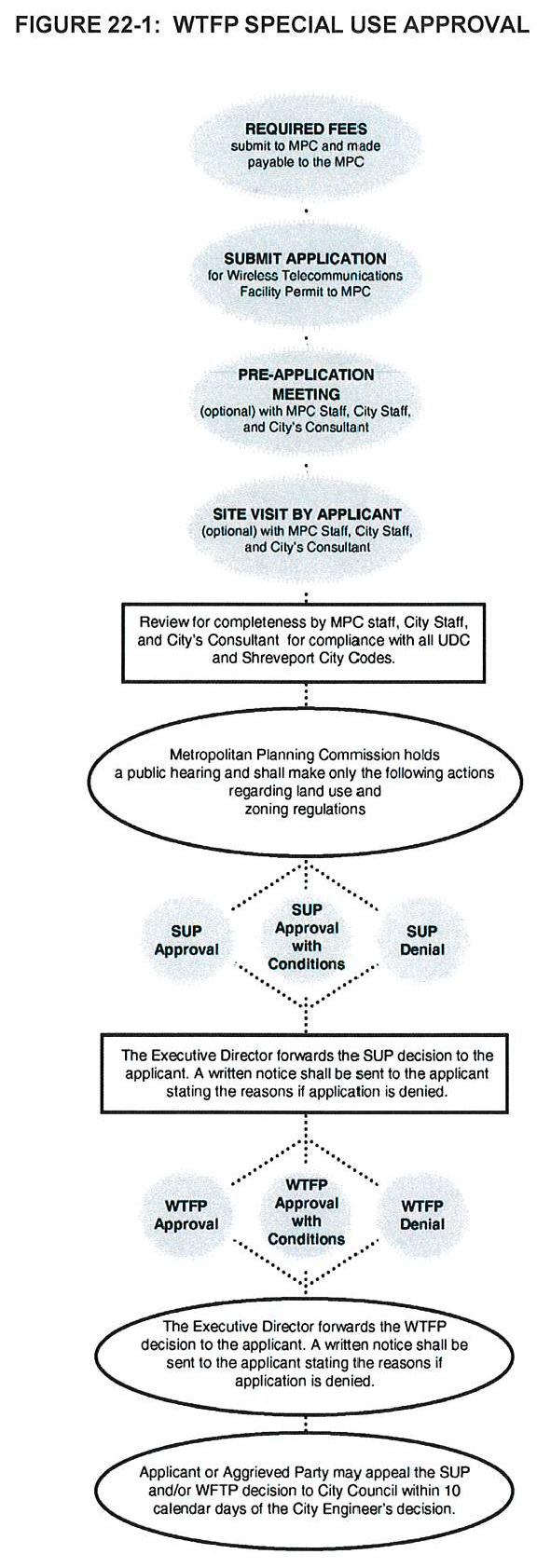
Any application for a wireless telecommunications facility not subject to administrative review and approval shall be permitted for land use approval upon the granting of a special use permit from the Metropolitan Planning Commission in accordance with the general land use and design standards as established by this Code. Upon the issuance of the special use permit (SUP) by the Metropolitan Planning Commission, the wireless telecommunication facility permit (WTFP) shall be approved by the Executive Director and distributed at the Office of the Metropolitan Planning Commission. A WTFP for a small wireless facility (as defined in Section 22.8 below) shall not be require an SUP, and shall require only administrative review and approval by the Executive Director.
A.
Authority
1.
Land Use and Zoning Review
a.
Regarding the land use and zoning decisions, the Metropolitan Planning Commission shall take formal action on requests for special use permits based on completeness and compliance with the land use and zoning requirements and standards of this Article, Article 16, and any applicable requirements set forth in the Shreveport City Code. The Metropolitan Planning Commission has final approval for special use permits.
b.
The Executive Director and/or Metropolitan Planning Commission may apply reasonable land use and zoning conditions to the approval of a wireless telecommunications facility special use permit as deemed necessary to ensure conformance with applicable review criteria as outlined within this article, and any applicable requirements set forth in the Shreveport City Code.
2.
Technical Review
Regarding the technical decisions, the Executive Director, with assistance, as applicable, from the City's third-party consultant, will review and make a written determination regarding technical decisions for approval of the WTFP application, based on compliance with any technical requirements and standards of this Article, and all applicable requirements set forth in the Shreveport City Code.
3.
Final Approval of a Wireless Telecommunications Facility Permit
Once all application materials required under this Article, the Executive Director will issue one of the following: WTFP Approval, WTFP Approval with Conditions, or WTFP Denial. The written notice shall set forth the reasons for denial. The Executive Director, or his or her designee, shall forward the decision for a WTFP to the applicant.
B.
Appeals
1.
Appeals of Metropolitan Planning Commission and Executive Director Decision
a.
All decisions on wireless telecommunications facility permits requiring a special use permit may be appealed to the City Council and shall be combined into one joint appeal action to the City Council.
b.
Within 30 calendar days after the date of the final decision of the Executive Director regarding a WTFP, the applicant or any aggrieved party may appeal the Executive Director's decision on the WTFP and/or the Metropolitan Planning Commission's decision on the SUP to City Council.
2.
Appeals of City Council
Within 30 days after the date of the decision by City Council, the applicant or any aggrieved party may appeal the City Council's decision to the Caddo Parish Civil District Court.
(Ord. No. 130, 2019, § 6, 10-8-19)
22.8 - SMALL WIRELESS FACILITIES
A.
Small Wireless Facility
Small wireless facility means a wireless facility that meets the following conditions:
1.
The facilities:
a.
Are mounted on structures 50 feet or less in height including their antennas, or
b.
Are mounted on structures no more than 10% taller than other adjacent structures, or
c.
Do not extend existing structures on which they are located to a height of more than 50 feet tall or by more than 10% in height, whichever is greater;
2.
Each antenna associated with the deployment, excluding associated antenna equipment, is no more than three cubic feet in volume;
3.
All other wireless equipment associated with the structure, including the wireless equipment associated with the antenna and any pre-existing associated equipment on the structure, is no more than 28 cubic feet in volume;
4.
The facilities do not require antenna structure registration under C.F.R. Title 47, Chapter 1 Federal Communications Commission, Part 17;
5.
The facilities are not located on Tribal lands, as defined under 36 CFR 800.16(x); and
6.
The facilities do not result in human exposure to radiofrequency radiation in excess of the applicable safety standards.
B.
Collocation of Small Wireless Facilities
In an effort to reduce visual clutter, applicants are encouraged to practice collocation of small wireless facilities when practicable and technically feasible as reasonably determined by the applicant, to the extent permitted under applicable regulations or law.
C.
Concealment Elements
1.
Design
Small wireless facilities shall be designed to blend into the surrounding environment and be consistent with existing structures through the use of color, camouflaging and architectural treatment to the extent technically feasible. Any equipment mounted to the support structures shall also match the support structure in color and general design unless a different color is needed for public safety or service reliability reasons.
2.
Undergrounding
To the extent permitted under applicable regulations or law, the Executive Director may require undergrounding of antenna equipment or any other associated equipment, other than the antennae, for small wireless facilities.
D.
Maintenance and Modifications to Small Wireless Facilities
The requirement of a wireless telecommunication facility permit (WTFP) for small wireless facilities located on private property in commercial and industrial zoning districts may be waived by the Executive Director if the application is reviewed and verified to be for: (i) the replacement of a small wireless facility with another small wireless facility that is substantially similar or smaller in size, weight and height; and (ii) the existing small wireless facility is in compliance with the requirements of this Article and the Shreveport City Code regarding stealth and/or any concealment elements, land use and design standards, code compliance, and undergrounded utilities.
(Ord. No. 130, 2019, § 6, 10-8-19)
22.9 - GENERAL LAND USE AND DESIGN STANDARDS
The Executive Director or the Metropolitan Planning Commission must consider the following land use and design standards.
A.
Location of Wireless Telecommunications Facilities
1.
Wireless telecommunications facilities are permitted per Table 5-1: USE MATRIX of this Code. Small wireless facilities are permitted uses in all zoning districts.
2.
Freestanding monopoles and towers are permitted in residential or downtown zoning districts only with issuance of a special use permit approved by the Metropolitan Planning Commission.
3.
No tower may be located within the front setback or between the face of a building and a public street, sidewalk or park.
4.
All towers shall be set back at least 100 feet from any public trail, park, or outdoor recreation area, unless it is a stealth facility.
B.
Collocation
Facilities owned by different wireless telecommunications providers may be collocated on a single tower, monopole or building to the extent technically feasible and aesthetically desirable to minimize proliferation and visual impacts of new facilities. In order to facilitate future collocation of antennas for other service providers, the conditions of approval shall prohibit the applicant from entering into an exclusive lease for the use of the entirety of the facility if it is technically feasible for other providers to collocate on the facility.
1.
No new facility tower (excluding any support structure for a small wireless facility) shall be established if there is a commercially, technically or otherwise reasonably practical or desirable place available on an existing communications tower of comparable height (if any) within a 2,640-foot radius (measured from center of the tower) of an existing communications tower.
2.
The applicant's proposal for a new communications tower shall not be approved until documentation is provided by the applicant or service provider that the proposed facility cannot commercially, technically or otherwise reasonably be accommodated on an existing or approved tower located within the search area due to one or more of the following reasons:
a.
The planned equipment would exceed the structural capacity of the existing or approved towers which cannot be reinforced to accommodate the service provider's proposed facility at a reasonable cost;
b.
The planned equipment would cause radio frequency interference with other existing or planned equipment for those towers, and the interference cannot be prevented at a reasonable cost;
c.
Existing or approved towers do not have space on which the service provider's equipment can be placed so it can function effectively and reasonably in parity with other similar equipment in place or approved;
d.
The existing or approved tower does not meet geographic service requirements of the applicant; or
e.
The service provider is able to show sufficient proof that collocation agreement could not be obtained.
3.
All new or upgraded communication towers shall have the capacity to permit multiple service providers. At a minimum, monopoles shall be able to accommodate two service providers, and at a minimum, transmission towers shall be able to accommodate three service providers.
4.
Tower owners shall not prohibit any other service provider from collocating on an existing tower so long as the service provider pays the tower owner reasonable compensation according to industry standards for space on the tower and pays for any and all costs. If the tower owner fails to allow collocation in this situation, the Executive Director may prohibit that owner from submitting any applications.
Note: Acceptable documentation for the above subsections shall be one or more statements from a Louisiana licensed structural engineer, network RF engineer and/or other duly qualified representative of the applicant or service provider evidencing compliance with the criteria set forth above or demonstrating why a specific criteria is not commercially, technically or otherwise reasonably practical or desirable.
C.
Visibility from Public Places
A wireless telecommunications facility installed in a location readily visible from a public park or other publicly owned outdoor recreation area shall be sited and designed to blend in with the existing natural and/or manmade environment to the extent reasonably and technically feasible.
D.
Setbacks and Fall Zone
Wireless telecommunication facilities and equipment shall comply with the minimum setback requirements of the underlying zoning district; if the following requirements are more restrictive than those of the underlying zoning district, the more restrictive standard shall apply.
1.
All towers shall be set back from any property lines and occupied or habitable buildings by 110% of the total fall radius of the tower, as certified by the applicant's engineer.
2.
No portion of any facility, including an antenna array, shall extend beyond the property lines.
3.
If the proposal is for a new tower (excluding any support structure for a small wireless facility), certification by a Louisiana licensed and registered professional engineer regarding the manner in which the proposed structure will fall is required.
4.
If the proposal is for a new tower, (excluding any support structure for a small wireless facility), certification by a Louisiana licensed and registered professional engineer regarding the manner in which the proposed structure will fall is required.
E.
Height
1.
Wireless communication facility towers in any zoning district exclusive of the industrial zoned districts listed below shall not exceed 100 feet; provided, however, that the maximum allowable height may be increased upon technical documentation illustrating as to why the 100 feet maximum height is not a viable option.
2.
The maximum allowable height for a wireless communication facility tower shall not exceed 180 feet in the I-1 Light Industrial Zoning District and I-2 Heavy Industrial Zoning District.
3.
Wireless telecommunications support structures shall not block or encroach upon any sidewalk or walkway.
F.
Architectural Compatibility
Whether manned or unmanned, wireless telecommunication facilities, to the extent reasonably and technically feasible, shall be consistent with the architectural style of the surrounding architectural environment. In addition:
1.
Lattice antenna towers and guyed towers are prohibited within the City of Shreveport.
2.
To the extent reasonably and technically feasible, wireless telecommunication facility equipment shall be of the same color as the building or structure to which or on which such equipment is mounted.
3.
Whenever wireless telecommunication facility equipment is mounted to the wall of a building or structure, the equipment shall be mounted in a configuration designed to blend with and be architecturally integrated into a building or other concealing structure, be as flush to the wall as reasonably and technically feasible, and shall not project above the wall on which it is mounted.
G.
Visibility and Aesthetics
The Executive Director are authorized to publish design guidelines regarding aesthetics and appearance for wireless telecommunication facilities. Any proposed design guidelines shall be published on-line and made available for distribution at the Office of the Metropolitan Planning Commission (MPC) The Office of the MPC reserves its rights to amend said design guidelines, as necessary, in the future.
1.
Stealth
Stealth design for wireless antennas is encouraged to the extent reasonably and technically feasible. In addition to the standards of this Article, stealth design must comply with the following regulations:
a.
To qualify as a stealth design, wireless telecommunication antennas must be enclosed, camouflaged, screened or obscured to the extent reasonably and technically feasible.
b.
No antenna may increase the overall height of any structure on which it is mounted by more than 10% of the original height of the structure.
2.
Paint and Finish Materials
To the extent reasonably and technically feasible, to the extent visible from adjacent public rights-of-way, and unless otherwise required by the Federal Communications Commission, the Federal Aviation Administration or the City, wall-mounted or rooftop antennas shall be constructed out of nonreflective materials, and coated, wrapped and/or textured to match the existing support structure, and shall be maintained in accordance with the requirements of this Article.
3.
Retrofitting
In the event a tower or other support structure that is lighted as of the effective date of this Article is modified, at the time of the first modification of the facility the City reserves the right to require that the tower be retrofitted so as to comply with the lighting requirements of this Article, and any applicable requirements set forth in the Shreveport City Code.
4.
Antenna Mounting
Except for omni-directional antennas, all new or replacement antennas, shall be top-mounted, flush-mounted, or as close to flush-mounted on the support structure as is reasonably and technically feasible, unless it can be demonstrated that such has the effect of prohibiting the provision of service to the intended service area, alone or in combination with another facility/site(s), or unless the applicant reasonably can demonstrate that it is impracticable.
5.
Placement on Building
If attached to a building (other than a roof-mounted antenna), all antennas shall be mounted on the fascia of the building and camouflaged so as to match the color and, if possible, the texture of the building, or in a manner so as to make the antennas as visually unobtrusive as is reasonably possible given the facts and circumstances involved.
a.
Roof-mounted antennas shall be set back from the edge of the roof a distance at least as great as the height of the antenna or to minimize visibility from adjacent public rights-of-way.
b.
Wall-mounted antennas shall be architecturally integrated into the building design to the extent reasonably and technically feasible.
6.
Landscaping
a.
All wireless telecommunications facilities, including maintenance and service operations, unless otherwise stated in the Article, must be screened at a minimum from view of adjacent residential areas and public rights-of-way with one shrub, measuring a minimum of 18 inches in height at planting and reaching a minimum of three feet in height at maturity, that must be planted for every three linear feet of fence length spaced linearly, in accordance with the screening requirements of this Article.
b.
The Executive Director or Metropolitan Planning Commission may choose to not require landscaping for sites that are not visible from the City public right-of-way or adjacent property or in instances where in the judgment of the Executive Director or Metropolitan Planning Commission, landscaping is not appropriate or necessary because of the fencing materials being used to screen the equipment compound or for other reasons.
c.
In addition to the requirements of this Article for landscape plans, all wireless telecommunications shall follow all landscape plan submittal requirements of Article 10.1 of this Code.
d.
All plant material must be maintained in a healthy and growing condition, and must be replaced with plant material of similar variety and size if damaged, destroyed, or removed.
e.
Landscaping is not required for small wireless facilities.
7.
Screening
To the extent reasonably and technically feasible, roof and ground-mounted wireless telecommunication facilities and equipment, including accessory equipment, shall be screened from adjacent City public rights-of-way and public or private properties by paint color selection, parapet walls, screen walls, fencing, landscaping and/or berming in a manner compatible with the building's and/or surrounding environment's design, color, materials, texture, land forms and/or topography. In addition:
a.
Chain link fencing shall be unacceptable to screen facilities, support structures or accessory and related equipment (including HVAC or mechanical equipment present on support buildings); solid fencing material shall be a minimum of six feet and a maximum of eight feet in height and shall consist of wood, masonry, stucco, stone or other acceptable materials that are opaque and appropriate given the facts and circumstances. A fence permit shall be required.
b.
The applicable decision-making authority may allow use of an alternate plan and specifications for landscape and screening, including plantings, fences, walls, sign and structural applications, manufactured devices and other features designed to screen, camouflage and buffer antennas, support structures, and accessory uses.
H.
Compatibility with the Natural Environment
To the extent reasonably and technically feasible, site disturbances shall be minimized and existing vegetation shall be preserved or improved to the extent possible, unless it can be demonstrated that such disturbance to vegetation and topography results in less visual impact to the surrounding area.
I.
Accessory Facility, Structure, or Equipment
1.
Accessory facilities or structures, including any buildings, cabinets or shelters, shall be used only to house equipment in support of the operation of telecommunication facilities or other communication services. Unrelated equipment shall not be stored on the site.
2.
Any accessory facilities or structures must conform to the setback standards of the applicable zoning district. In the situation of stacked equipment buildings, additional screening/landscaping measures may be required by the Executive Director or Metropolitan Planning Commission.
3.
Accessory equipment, other than antennas, antenna attachment devices, and cables, shall be located in an equipment cabinet. If the attached wireless telecommunication facility is proposed to be located in an area of the City that requires new utility equipment or communication lines to be located underground, then the utilities or communication lines providing service to the equipment cabinet shall be located underground.
4.
Unless otherwise expressly approved, to the extent reasonably and technically feasible, all cables for a facility shall be concealed or obscured from view underground or inside of the screening or monopole structure supporting the antennas to the extent reasonably and technically feasible; any cables and/or conduit that cannot be buried or otherwise hidden from view shall be painted to match the color of the building or other existing structure to which they are attached or positioned on the facility so as to be screened from view from City public rights-of-way.
J.
Lighting
1.
Wireless telecommunication antennas, towers, and facilities shall not be artificially lighted, unless required by the Federal Communications Commission (FCC) or the Federal Aviation Administration (FAA).
2.
All approved light fixtures (other than FAA and FCC required lighting) shall be equipped with cutoff lenses to minimize spill-over of light to adjacent properties.
K.
Signage
1.
Wireless telecommunications facilities shall include the installation of all-weather emergency information signs at all gates. Each sign shall indicate, at minimum, the site address and a 24-hour emergency contact phone number.
2.
On all wireless telecommunications facilities at all locations, an FCC registration sign, as applicable, is also to be present.
3.
No other signage, including commercial advertising, shall be permitted except for signage required by applicable law.
L.
Access Ways
In addition to ingress and egress requirements of the Shreveport City Code, access to and from wireless telecommunication facilities and equipment shall be regulated as follows:
1.
No wireless telecommunication facility shall be located in a required parking, maneuvering or vehicle/pedestrian circulation area such that it interferes with the intent or functionality of the original design.
2.
The wireless telecommunication facility must be secured from access by the general public but access for emergency services must be ensured. Access roads must be capable of supporting all potential emergency response vehicles and equipment and must be of a dimension to allow access to any emergency equipment.
3.
All driveways and drive aprons must be made of a durable all-weather material, such as concrete or asphalt. Areas within the fenced-in facility including, but not limited to access aisles and surface parking lots, may consist of an improved surface of gravel or crushed stone, subject to permission by the Executive Director or Metropolitan Planning Commission (if part of a Special Use Permit approval).
M.
Security
All facilities, including antennas, towers and other supporting structures shall be made inaccessible to unauthorized individuals and shall be designed so as to be resistant to and minimize opportunities for unauthorized access, climbing, vandalism, graffiti, and other conditions which would result in hazardous conditions, visual blight, or attractive nuisances. All facilities shall not be easily climbed or collided with and shall expressly include removing the climbing steps for the first 10 feet from the ground on a monopole.
N.
Operation and Maintenance Standards
All wireless communication facilities shall comply at all times with the following operation and maintenance standards:
1.
All wireless telecommunications facilities and related equipment, including but not limited to fences, cabinets, poles and landscaping (if any), shall be maintained in good working condition over the life of the permit, subject to reasonable wear and tear, and in compliance with the version of the International Building Code in effect when the applicable WTFP is issued. This shall include keeping the structures maintained to the visual standards established at the time of approval. The facility shall remain free from trash, debris, litter, graffiti and other forms of vandalism. Any damage shall be repaired as soon as practicable, and in no instance more than 10 calendar days from the time of notification by the city or after discovery by the permittee.
2.
Each facility shall be operated in such a manner so as to minimize any possible disruption caused by noise. Backup generators shall only be operated during periods of power outages, and shall not be tested on weekends or holidays, or between the hours of 8:00 p.m. and 7:00 a.m. on weekday nights.
3.
Each owner or operator of a facility shall regularly inspect each site to ensure compliance with the standards set forth in this Article.
O.
Abandonment
Any wireless telecommunication tower or facility that is not operated for a period of 180 consecutive calendar days is considered abandoned (unless such interruption in operations is due to maintenance, repair or replacement). The owner must immediately remove the tower or facility, and all aboveground equipment and related debris. The City may ensure and enforce removal by means of its existing regulatory authority.
P.
Structural Standards
All wireless communication facilities shall, at all times, comply with all applicable requirements of the International Building Code in effect on the date the building permit is issued.
(Ord. No. 130, 2019, § 6, 10-8-19; Ord. No. 2, 2020, § 8, 1-28-20)
22.10 - WAIVERS
Any applicant may seek a waiver of the requirements in this Article, which may be granted by the Executive Director, upon good cause shown, as determined by the Executive Director. Such waivers shall be granted in a nondiscriminatory manner.
(Ord. No. 130, 2019, § 6, 10-8-19; Ord. No. 42, 2023, § 6, 5-9-23)
22.11 - FEES
The applicant shall submit all applicable fees established by Article 21 of this Code, as well as the Shreveport City Code. In accordance with Article 21, the schedule of fees is kept on file in the Office of the Metropolitan Planning Commission. Such fees shall include, but not be limited to: (1) application processing fee, and (2) wireless telecommunications facility permit (WTFP) fee.
(Ord. No. 130, 2019, § 6, 10-8-19)

