
Shreveport City Zoning Code
ARTICLE 9
- SIGN REGULATIONS
9.1 - PURPOSE
The purpose of these sign regulations is to establish a framework for a comprehensive system of sign controls governing the display, design, construction, installation, and maintenance of signs that will:
A.
Promote and protect the health, safety and welfare of the City of Shreveport by ensuring the compatibility of signs with surrounding structures and land uses.
B.
Create a more attractive business and economic climate by enhancing and protecting the orderly and effective display of signs.
C.
Discourage an excessive number of signs, and encourage a visually favorable environment.
D.
Protect the public from hazardous conditions that result from the indiscriminate use and placement of signs, structurally unsafe signs, signs that obscure the vision of pedestrians or motorists, and signs that compete or conflict with necessary traffic signals, government signs, and warning signs.
9.2 - GENERAL STANDARDS
All signs constructed, erected, modified, or altered must comply with the following standards of design, construction, and maintenance.
A.
Sign Permit Required
Signs that require a sign permit are delineated in this Article and are required to obtain a sign permit in accordance with Article 16. A sign permit may be revoked where there has been a violation of the provisions of this Code or misrepresentation of fact on the permit application.
B.
Prohibited Installations
1.
No sign may be erected in a location that violates the current building code, fire code, and other applicable codes. In addition, no sign may be erected in the following locations:
2.
Freestanding signs are subject to the height restrictions of the view obstruction triangle in Section 7.1.E.
3.
All freestanding signs must be placed a minimum of 15 feet from the back of the curb or edge of pavement if there is no curb. All parts of the sign must be set back 15 feet. Any additional setback requirements required by the specific sign type regulations also apply.
4.
Only signs that have been placed by federal, state, or local government may be installed on public property, unless a sign's placement has been authorized by the City. Any sign installed on public property without authorization may be removed without notice.
5.
No sign may be erected on private property without the consent of the property owner. All sign installations must be signed off by the property owner or his/her authorized agent. If the applicant is not the property owner, a letter signed by the property owner authorizing the installation of a sign is required as part of the sign permit application.
6.
No sign may be erected in a manner that obstructs access to any ingress or egress, fire escapes, or standpipes.
C.
Construction Standards
1.
All signs shall be constructed of permanent durable materials and permanently affixed to the ground or building except for those signs that, by their nature, are considered temporary.
2.
Supports and braces must be designed as an integral part of the overall sign and obscured from public view to the extent technically feasible.
3.
All signs attached to a building must be installed and maintained so that wall penetrations are watertight and the structure does not exceed allowable stresses of supporting materials.
4.
All signs must be designed and constructed in compliance with the current building code, electrical code, and other applicable codes.
5.
No permanent sign may be constructed of plywood, particleboard, or paper.
6.
No sign may be hand-painted on a structure.
7.
Glass forming any part of a sign must be safety glass.
8.
All letters, figures, characters, or representations in cut-out or irregular form, maintained in conjunction with, attached to or superimposed upon any sign must be safely and securely built into or attached to the sign structure.
9.
Audio components are prohibited on any sign, with the exception of menuboards. For menuboards, the audio component is limited to communication between customer and service window.
D.
Electrical Wiring
1.
All electrical fixtures, devices, circuits, conduits, raceways, or similar features must be installed and maintained in compliance with the current electrical code.
2.
Conduits and other components of a sign illumination system must be designed as an integral part of the overall sign structure and obscured from public view to the extent technically feasible.
E.
Sign Copy
1.
When a single establishment is shared by two or more businesses or tenants, the permitted sign types and maximum sign area for the establishment allowed by this Code must be shared between the businesses or tenants. The Metropolitan Planning Commission will not broker nor enforce any private agreements between such businesses or tenants regarding shared signs.
2.
Items of information for certain sign types are limited as follows:
a.
Freestanding signs are limited to six items of information on each sign face. This does not apply to freestanding signs for multi-tenant retail centers.
b.
Wall signs are limited to six items of information. Items of information for wall signs are counted by each item of information on the same façade. This includes wall sign designs that are composed of multiple individual wall signs.
c.
Projecting signs are limited to six items of information on each sign face.
3.
Items of information are calculated as follows:
a.
Each piece of information on a sign is defined as an item of information. For example, each of the following would be defined as one item of information: establishment name, logo, telephone number, website address, or product or service. A multi-word name or address is counted as one item of information. If a sign advertises products or services, each product or service, including multi-word, is considered one item of information.
b.
A street address is not counted as an item of information.
c.
The message area of an electronic message sign, where information is changed digitally, is counted as one item of information.
d.
Where a changeable message board is permitted and included as part of a sign, the message area is counted as one item of information.
e.
For gas station signs, the area used to display prices of gas is counted as one item of information.
F.
Required Maintenance
1.
At all times, all permanent and temporary signs, together with all supports, braces, guys, and anchors, as well as their display surface be of sound structural quality, kept in good repair and, unless constructed of galvanized or non-corroding metal, be given a protective coating as necessary to maintain in a neat, clean and attractive condition that is free of cracked or peeling paint, missing or damaged sign panels or supports, and which adheres to all general standards identified in this Section.
2.
At all times, the land area adjacent to the site shall be free from trash and weeds, and any grass or vegetation that obscures the view of the sign message.
3.
At all times, all signs must be maintained to prevent any kind of safety hazard, including faulty sign structures, a fire hazard, or an electrical shock hazard.
4.
At all times, all permanent and temporary signs must be kept from all unused sign hardware or wiring.
5.
Abandoned, unsafe and signs in violation of this Code.
a.
Any sign, whether permanent or temporary, together with all supports, braces, guys, and anchors, which remains without a message, or whose display surface remains blank or that does not meet the required maintenance standards of this subsection, fora period of 90 days or more; or any sign which pertains to a time, event or purpose which no longer applies, shall be deemed to have been abandoned.
b.
Any sign remaining after demolition of a principal structure, or any sign remaining that pertains to a business that is no longer in operation, shall be deemed to be abandoned. In the event the use of any sign has been discontinued for a period of 90 days or more, as determined by the Zoning Administrator, said sign shall be deemed abandoned.
c.
Any sign which is insecure, in danger of falling, or otherwise hazardous in the opinion of the Zoning Administrator, shall be deemed unsafe.
d.
Should any sign be deemed abandoned or unsafe by the Zoning Administrator, or if any sign is installed, erected, or constructed in violation of this Code, the owner or person or firm maintaining the sign, has 30 calendar days written notice to:
i.
Submit documentation to the Zoning Administrator to establish that the sign is not abandoned, unsafe, or in violation; or
ii.
Remove the sign, as well as all supports, braces, guys, and anchors.
iii.
Any such sign not removed within 30 calendar days from the written notice may be removed by the City, and all costs charged to the owner, agent, or person having beneficial interest of the structure or lot or parcel upon which such sign was located, or in the sign itself, as allowed through permitted enforcement procedures of this Code.
e.
The Zoning Administrator, or his or her designee, may authorize removal of any sign that is an immediate public peril to persons or property summarily and without notice.
(Ord. No. 113, 2023, §§ 2—4, 10-10-23)
9.3 - ILLUMINATION STANDARDS
A.
Any sign illumination, including gooseneck reflectors, external illumination, and internal illumination, must be designed, located, shielded, and directed to prevent the casting of glare or direct light upon roadways and surrounding properties, and the distraction of motor vehicle operators or pedestrians in the public right-of-way.
B.
The maximum allowable footcandle at the lot line for any illuminated sign is one footcandle. For signs that are allowed to project over the public right-of-way, the maximum allowable footcandle at the curb line is one footcandle.
C.
The sign face of internally illuminated signs must function as a filter to diffuse illumination. The sign face must cover all internal illumination components so that no exposed bulbs are visible.
D.
All external illumination of a sign must concentrate the illumination upon the printed area of the sign face.
E.
For electronic message signs, the maximum brightness is limited to 5,000 nits during daylight hours, and 500 nits between dusk to dawn. The sign must have an automatic dimmer control that produces a distinct illumination change from a higher allowed illumination level to a lower allowed level for the time period between one-half hour before sunset and one-half hour after sunrise. Billboards are controlled by the illumination standards in Section 9.8.
F.
No sign illumination may be combined with reflective materials, such as mirrors, polished metal, or highly-glazed tiles, which would increase glare.
G.
The use of neon or LED lighting as a sign material or sign accent is permitted only in the commercial districts, downtown districts, industrial districts, and IC District. When lit, lighting must be continuously illuminated. Flashing neon or LED lighting is prohibited.
H.
Neon or LED lighting to outline doors and windows is prohibited.
9.4 - PROHIBITED SIGNS
All signs not expressly allowed by this Code are prohibited. In addition, the following sign types are specifically prohibited:
A.
Abandoned signs.
B.
Balloon and air-infused/air-inflated signs.
C.
Banners wrapped around a permanent sign structure, such as a freestanding sign, projecting sign, or wall sign.
D.
Cabinet box wall signs.
E.
Flashing or animated signs.
F.
Moving signs, including signs designed to be moved by wind or other natural elements, and tri-vision signs. This excludes clocks and barber poles.
G.
Obsolete signs and sign structures.
H.
Off-premise signs, temporary. All temporary off-premise signs are prohibited and are hereby declared to be abandoned trash at the time of posting and may be removed and discarded without notice notwithstanding any conflicting regulation or requirement within this Code. Any citizen removing a temporary off-premise sign or other sign in the public right-of-way does so at his/her own risk, and neither the City, nor any public utility exercising control of the right-of-way, pole or fixture is liable for damage, loss, or injury due to such independent acts.
I.
Portable reader-board signs, except as allowed for temporary signs. This includes both signs mounted on a wheeled structure and those mounted on a stationary structure that can be moved and is not permanently installed on a site.
J.
Snipe signs.
K.
Strobe lights, moving or fixed spotlights, and floodlights.
L.
Any sign that can create a hazardous traffic situation, including those that:
1.
Interfere with, obstruct the view of, or may be confused with any authorized traffic sign, signal, or device because of its position, shape, or color, including signs illuminated in red, green, or amber color to resemble a traffic signal.
2.
Make use of the words STOP, LOOK, DETOUR, DANGER, CAUTION, WARNING, or any other word, phrase, symbol, or character in a manner that misleads, interferes with, or confuses traffic.
M.
Video display signs.
N.
Any signs attached to, or placed, on, a vehicle or trailer parked on public or private property, except for signs meeting the following conditions:
1.
The primary purpose of such a vehicle or trailer is not the display of signs.
2.
The signs are magnetic, decals or painted on an integral part of the vehicle or equipment as originally designed by the manufacturer, and do not break the silhouette of the vehicle.
3.
The vehicle or trailer is in operating condition, currently registered and licensed to operate on public streets where applicable, and actively used or available for use in daily function of the business to which such signs relate.
O.
Vehicles and trailers are not used primarily as static displays, advertising a product or service, nor utilized as storage, shelter or distribution points for commercial products or services for the general public.
(Ord. No. 187, 2019, §§ 20, 21, 12-10-19; Ord. No. 113, 2023, § 5, 10-10-23)
9.5 - SUMMARY OF PERMANENT AND TEMPORARY SIGN PERMISSIONS
Table 9-1: Summary of Permanent and Temporary Sign Permissions indicates whether a permanent or temporary sign requires a sign permit. Section 9.6 contains regulations for the specific sign types that do not require a permit, both permanent and temporary, and Section 9.7 contains regulations for the specific sign types that require a permit, both permanent and temporary. Billboards are regulated in Section 9.8.
TABLE 9-1: SUMMARY OF PERMANENT AND TEMPORARY SIGN PERMISSIONS
(Ord. No. 66, 2019, §§ 21, 22, 6-11-19)
9.6 - NO PERMIT REQUIRED: PERMANENT AND TEMPORARY SIGNS
A.
Exemption of Alteration and Maintenance Operations
The following activities are exempt from a sign permit:
1.
Painting, repainting, cleaning, changing permitted items of information, or other normal maintenance and repair of a sign, not involving structural changes or changes in the electrical components of the sign. Any activity that increases the sign area, sign height, or any sign dimension is not exempt from a sign permit.
2.
Changing of the message of a changeable message sign or electronic message sign.
3.
Changing a copy or the color on an existing permitted sign, or performing repair and maintenance on an existing permitted sign which is not an alteration does not require a sign permit.
B.
Exempt Ancillary Information
1.
Logos and labels located on mechanical equipment, recycling bins, trash containers, or similar, which are part of the equipment as manufactured and/or installed are exempt.
2.
Signs on public transit stations, bike-sharing stations, or car-share facilities, when such signs are installed by the sponsors of such facilities, are exempt.
3.
Signs installed on gas station pumps are exempt. Such signs may not be electronic message signs and may not be illuminated. Such signs are limited to two square feet in sign area and a maximum of one per pump station.
C.
Permitted Exempt Signs
The following signs are allowed without a sign permit. All exempt signs must comply with all the regulations of this section and this Code. No such exempt sign can advertise any off-premise operations or services.
1.
Additional Sign for Construction Activity
On a site where active construction is taking place, an additional temporary sign is permitted in conjunction with active construction, subject to the following:
a.
Additional construction activity signs are permitted in all districts on all sites with active construction projects. Additional construction activity signs may be installed only after approval of a development application and must be removed once construction is complete.
b.
Additional construction activity signs may be constructed as either freestanding or wall signs, subject to the following:
i.
Signs are limited to 12 square feet in area for construction sites for individual single-family—detached or attached or two-family dwellings. Signs are limited to 64 square feet maximum size for all other construction sites less than two acres in size, and 96 square feet maximum on all other construction sites over two acres.
ii.
Freestanding signs are limited to eight feet in height and must be located five feet from any lot line.
iii.
Wall signs may be installed on a fence.
iv.
Signs may not be illuminated.
c.
Additional construction activity signs are limited to one per street frontage.
2.
Additional Sign When Conducting Garage/Yard Sale On-Site
a.
When a garage/yard sale is conducted as part of a residential use, an additional temporary sign is permitted. Such additional temporary signs must be located on the site of the garage/yard sale, and may be installed 48 hours prior to event and must be removed within 24 hours of the end of the sale.
b.
An additional temporary sign may be constructed as either freestanding or wall signs, subject to the following:
i.
Signs are limited to six square feet in area.
ii.
Freestanding signs are limited to five feet in height, and must be located within five feet from any lot line.
iii.
Wall signs may be installed on a fence.
iv.
Signs may not be illuminated.
c.
Additional temporary signs are limited to one per lot.
3.
Additional Sign for Historic Location
When a location memorializes a historic person, event, structure, or site, an additional permanent sign is permitted in any district as follows:
a.
An additional sign may be constructed as either freestanding or wall signs, subject to the following:
i.
Signs are limited to six square feet.
ii.
Freestanding signs are limited to four feet in height and must be located five feet from any lot line.
iii.
Signs may be internally or externally illuminated.
b.
An additional sign is limited to one per street frontage.
4.
Additional Sign for Multi-Tenant Buildings
Townhouse, multi-family dwellings, and non-residential developments with multiple tenants are permitted an additional permanent sign.
a.
Multi-tenant building signs may be constructed as either freestanding or wall signs, subject to the following:
i.
Signs are limited to six square feet in area.
ii.
Freestanding signs are limited to five feet in height, and must be located within 10 feet of the building entry and five feet from any lot line.
iii.
Signs may only be internally illuminated.
b.
Multi-tenant building signs are limited to one per building entry.
5.
Additional Signs for Parking Lots and Structures
Parking lots and structures are permitted additional signs, whether such parking lots or structures are a principal or ancillary use.
a.
Additional signs are permitted at each entrance/exit, driveway intersection, drive-through lane, and other circulation points.
b.
Signs are limited to four square feet in area.
c.
A freestanding sign is limited to four feet in height and must be five feet from any lot line.
d.
Signs may be internally or externally illuminated.
6.
Additional Sign for Property Identification
For building rented/leased by a property management company, an additional permanent sign is permitted as follows:
a.
A maximum of one additional sign is permitted per building in all districts.
b.
The sign must be wall-mounted and is limited to two square feet in area.
7.
Flag
a.
Non-Governmental Flag
i.
Non-governmental flags are permitted for non-residential uses in the commercial, downtown, and industrial districts.
ii.
Non-governmental flags may be freestanding or wall-mounted, and are limited to a maximum area of 16 square feet
iii.
Freestanding non-governmental flags are limited to a maximum height of 35 feet and must be a minimum of 10 feet from any lot line.
iv.
Wall-mounted non-governmental flags must maintain a minimum five foot sidewalk clearance.
v.
One freestanding non-governmental flag is permitted per lot. One wall-mounted non-governmental flag is permitted per establishment. In multi-tenant structures, each establishment is permitted one wall-mounted non-governmental flag.
vi.
External illumination of freestanding non-governmental flags is permitted. Illumination of wall-mounted non-governmental flags is prohibited.
b.
Governmental Flag
Flags of any nation, state, municipality, or political subdivision, flags officially designated as a national, state, or local symbol, or flags of fraternal, religious, and civic organizations are permitted in all districts.
i.
Governmental flags may be freestanding or wall-mounted.
ii.
Poles for freestanding governmental flags are limited to the maximum height of the district.
iii.
Poles for freestanding governmental flags must be a minimum of 10 feet from any lot line.
iv.
Wall-mounted governmental flags may not extend over the public right-of-way.
v.
There is no limit on the number of governmental flags per lot.
vi.
External illumination of governmental flags is permitted.
8.
Government Sign
Signs placed or authorized by a government agency are permitted in any number, configuration, or size in any district. Such signs may be illuminated as required by the agency.
9.
Light Pole Banner
Light pole banners are permitted for light poles in parking lots and must be mounted so that they are held taut between support posts. Light pole banners are limited to a maximum area of 10 square feet. Light pole banners must be mounted to project perpendicular from light poles.
10.
Real Estate Activity Sign
When a structure or lot is offered for sale, lease, or rent, such lot is permitted an additional temporary sign as follows:
a.
Real estate activity signs are permitted in all districts. Real estate activity signs must be located on the site of the property for sale, lease, or rent.
b.
Real estate activity signs are limited to one per street frontage.
c.
Real estate activity signs may be constructed as either freestanding, wall, or window signs.
d.
Real estate activity signs are limited to 12 square feet in residential districts and 32 square feet in all other districts.
e.
Freestanding signs are limited to five feet in height and must be located within five feet from any lot line.
f.
Real estate activity signs may not be illuminated.
g.
Real estate activity signs must be removed within 30 days of final closing, lease, or rental. If such real estate signs are used in conjunction with a temporary event, such signs may be installed 48 hours prior to event and must be removed within 24 hours of the end of the event.
11.
Temporary Signs
Except where specifically in conflict with this Subsection 11., all regulations set forth in this Article 9 shall apply to temporary signs.
a.
Temporary signs are permitted in all districts.
b.
Temporary signs erected in residential districts shall be no larger than eight square feet.
c.
Temporary signs erected in non-residential districts shall be no larger than 16 square feet. Any Temporary signs larger than 16 square feet is considering a freestanding sign and shall follow all freestanding sign regulations found in Section 9.7.H.
d.
Temporary signs advertising a one-time event shall not be erected more than 90 days prior to the initiation of the one-time event and shall be removed within seven days following the termination of the one-time event.
e.
Temporary signs shall not be illuminated.
f.
Temporary signs shall not advertise off-premises commercial activity.
g.
All temporary signs shall be set back 10 feet from any property line.
h.
Temporary signs shall not be erected within the City's public right-of-way.
12.
Window Sign
a.
Window signs are permitted for all non-residential uses in all districts.
b.
All window signs, whether temporary or permanent, are limited to no more than 30% of the surface of each window area. Window area is counted as a continuous surface until divided by an architectural or structural element. Mullions are not considered an element that divides window area.
c.
Window signs may be internally or externally illuminated.
13.
Yard Signs
a.
Yard signs are permitted in all districts.
b.
Yard signs may be constructed as either freestanding, wall, or window signs. There is no limit on the number of signs permitted.
c.
Reserved.
d.
Freestanding yard signs must be located five feet from any lot line.
e.
Yard signs must meet the coverage limitations of window signs. If no coverage is specified, the limitation is 30% of the window area.
f.
Yard signs must be posted on private property only, and only with the permission of the property owner.
g.
Yard signs specifically advertising or pertaining to an event, such as an election, must be removed within seven days immediately following the event.
h.
Yard signs may not be illuminated.
(Ord. No. 72, 2018, §§ 21—24, 8-28-18; Ord. No. 187, 2019, § 22, 12-10-19; Ord. No. 114, 2020, § 10, 9-8-20; Ord. No. 137, 2021, § 14, 9-28-21; Ord. No. 109, 2022, §§ 2, 3, 12-13-22)
9.7 - PERMIT REQUIRED: PERMANENT AND TEMPORARY SIGNS
A.
Sign Types Permitted by District
1.
This section describes the types of signs allowed with a sign permit. Table 9-2: Sign Types Requiring Permit District Permissions indicates in which districts these types of signs are permitted. Specific regulations on each sign type may include further restrictions on which uses within a district may utilize these sign types.
2.
Changing the sign face of an existing sign requires a sign permit.
3.
Billboards are regulated by Section 9.8.
TABLE 9-2: SIGNS TYPES REQUIRING PERMIT DISTRICT PERMISSIONS
FOOTNOTES
* • = Sign type permitted in district, subject to additional standards of this section
* Menuboard signs are permitted for all drive-through uses in any district
B.
A-Frame Sign
1.
A-frame signs are permitted for non-residential uses in the districts indicated in Table 9-2.
2.
Sign permits for A-frame signs are valid from January 1 st through December 31 st , unless otherwise restricted as part of the sign permit approval. A new sign permit application must be applied for on or after January 1 st of each year. In addition to the sign permit application submittal requirements, a placement plan must be submitted that shows the general location of the A-frame sign.
3.
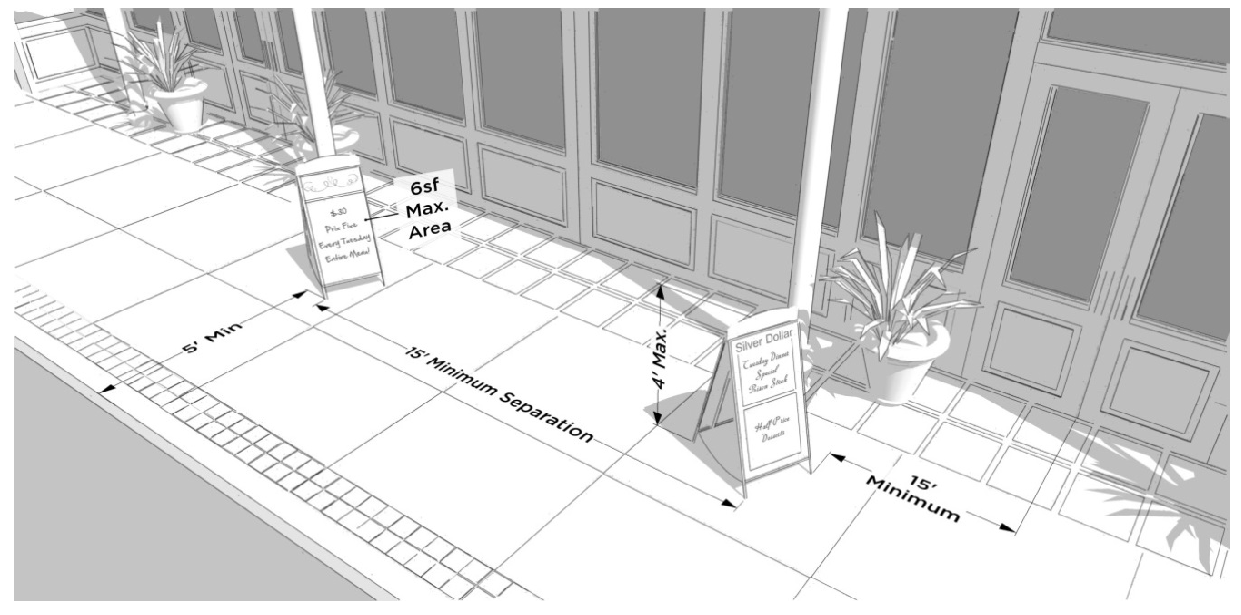
One A-frame sign is permitted per establishment, including for multi-tenant establishments. A minimum 15 foot separation is required between all A-frame signs.
4.
An A-frame sign must be placed within 15 feet of the primary entrance of the business, and must not interfere with pedestrian traffic or violate standards of accessibility as required by the ADA or other accessibility codes. A-frame signs may be placed in the public right-of-way but must maintain a five foot sidewalk clearance at all times.
5.
A-frame signs are limited to six square feet in area per side and four feet in height.
6.
The use of A-frame signs is limited to business hours only. Signs must be stored indoors at all other times.
7.
A-frame signs must not be used outdoors when high winds or heavy rain conditions exist.
8.
Illumination of A-frame signs is prohibited. No A-frame sign may have an electronic component.
FIGURE 9-1: A-FRAME SIGNS
C.
Attention-Getting Device
1.
Attention-getting devices are permitted for non-residential uses in the districts indicated in Table 9-2.
2.
An establishment may have both a freestanding and wall-mounted attention-getting device installed or mounted simultaneously. For multi-tenant sites, the property owner(s) and/or tenants must coordinate display of attention-getting devices.
3.
Freestanding attention-getting devices are subject to the following:
a.
Freestanding attention-getting devices are limited to the following maximums per lot:
i.
For single-tenant sites: One per street frontage.
ii.
For multi-tenant sites: Two per street frontage. There must be 20 feet of separation between attention-getting devices.
b.
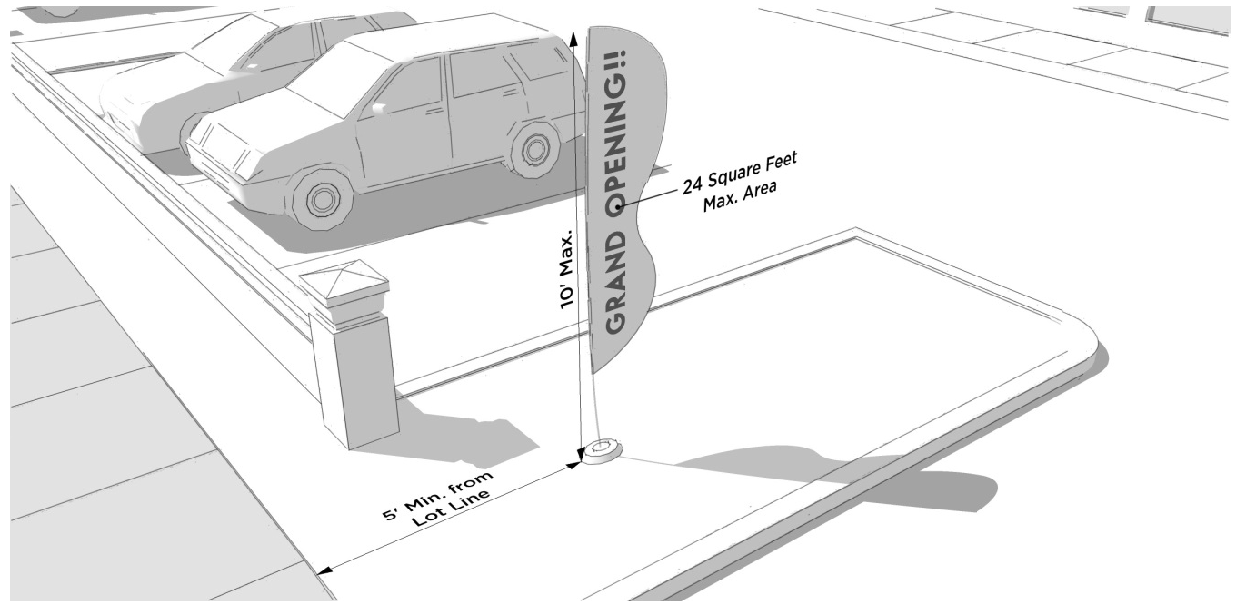
Freestanding attention-getting devices are limited to a maximum height of 10 feet and 24 square feet in area.
c.
Freestanding attention-getting devices must be located a minimum of five feet from a lot line.
FIGURE 9-2: ATTENTION-GETTING DEVICE
4.
Wall-mounted attention-getting devices are subject to the following:
a.
Wall-mounted attention-getting devices are limited to 32 square feet in total area when mounted upon a façade of less than 100 linear feet in length. Wall-mounted attention-getting devices are limited to 64 square feet in total area when mounted upon a façade of 100 or more linear feet in length.
b.
Wall-mounted attention-getting devices are limited to a maximum of one per each façade of an establishment.
5.
Pennants are subject to the following:
a.
Pennants may be used in place of one freestanding or wall-mounted attention getting device as described in item 2 above.
b.
Pennants are limited to one and one-half square feet per pennant triangle.
c.
Pennants may not be installed across or over any driveway or drive aisle.
6.
Illumination of any attention-getting devices is prohibited.
7.
Attention-getting devices are limited to the following display periods:
a.
When related to a time-specific event: A combined display period of seven days prior to the event, the time period of the event, and two days following the event.
b.
When not related to a time-specific event: 15 days.
c.
A maximum of four display periods per year with a minimum of 30 days between displays. For multi-tenant sites, the display period and separation period apply to each establishment individually rather than the site as a whole.
D.
Awning Sign
1.
Awning signs are permitted for multi-family dwellings and non-residential uses in the districts indicated in Table 9-2.
2.
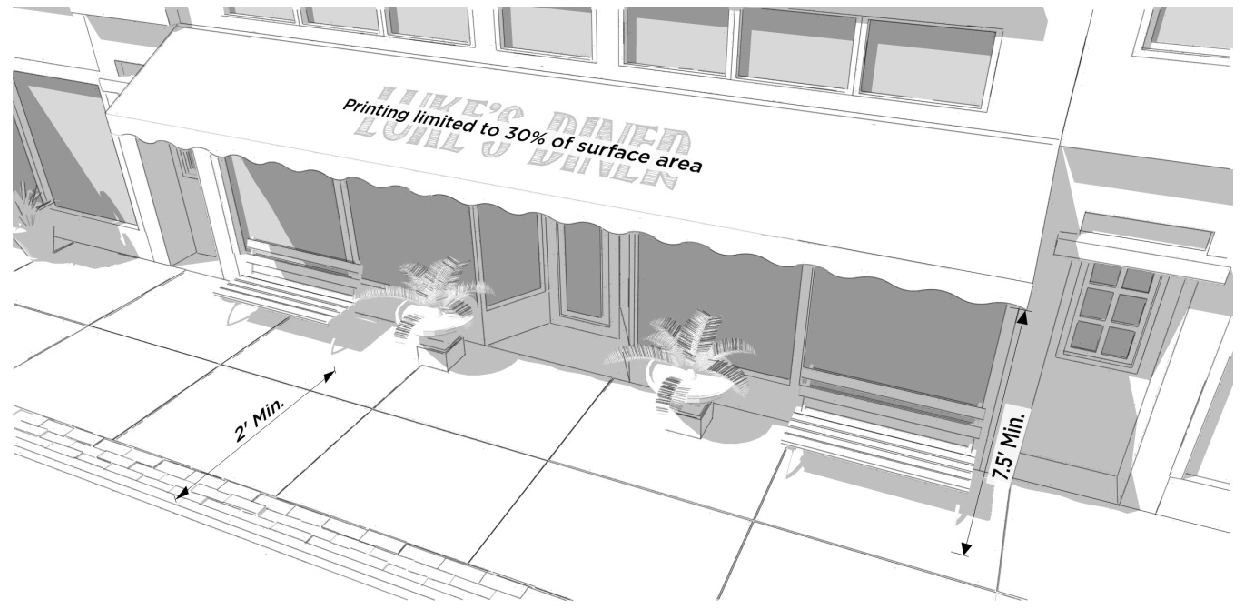
Awning signs must maintain a minimum vertical clearance of seven feet six inches.
3.
Awning signs may encroach into the public right-of-way but must be located at least two feet from the curb line.
4.
Awning signs must be made of a durable, weather-resistant material such as canvas, canvas-like material, nylon, vinyl-coated fabric, or metal.
5.
Printing on any awning sign is limited to 30% of the surface area.
6.
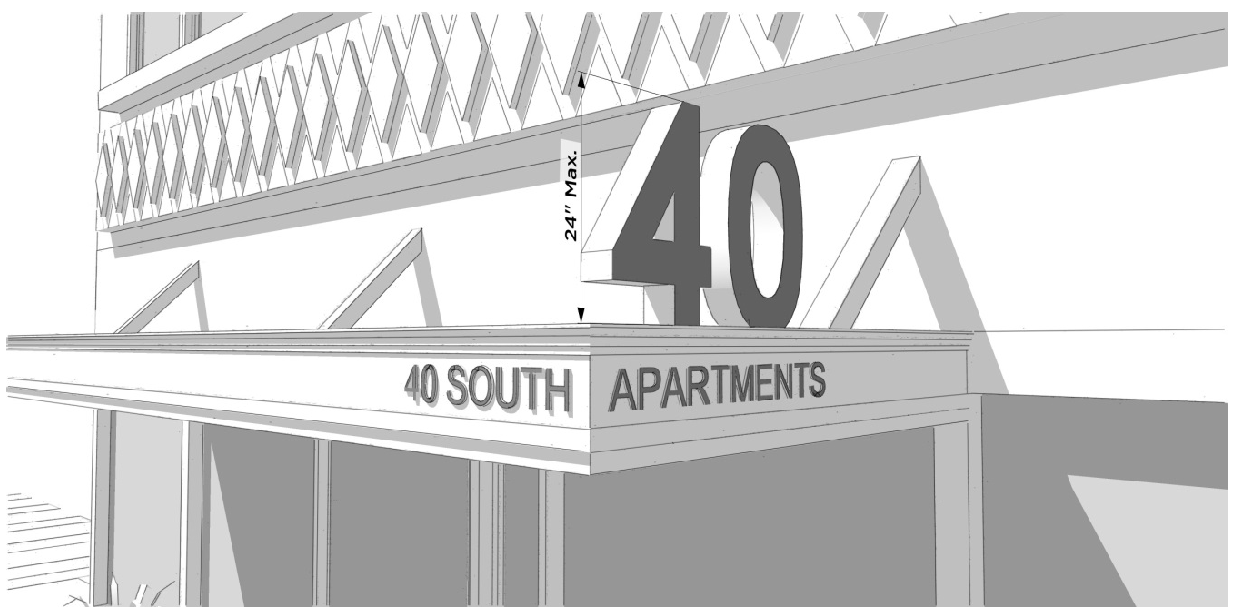
Awning signs are permitted lettering attached to and located above the top of a solid flat awning mounted perpendicular to a façade to a maximum height of 24 inches.
7.
Awning signs may be externally illuminated and must be focused on the printed area.
8.
Back-lit awnings are prohibited.
FIGURE 9-3: AWNING SIGNS
9.
Under-awning signs are permitted subject to the following standards. These standards also apply to signs mounted under galleries or arcades.
a.
Under-awning signs must be attached to the underside of an awning. Under-awning signs must not project beyond the edge of the awning.
b.
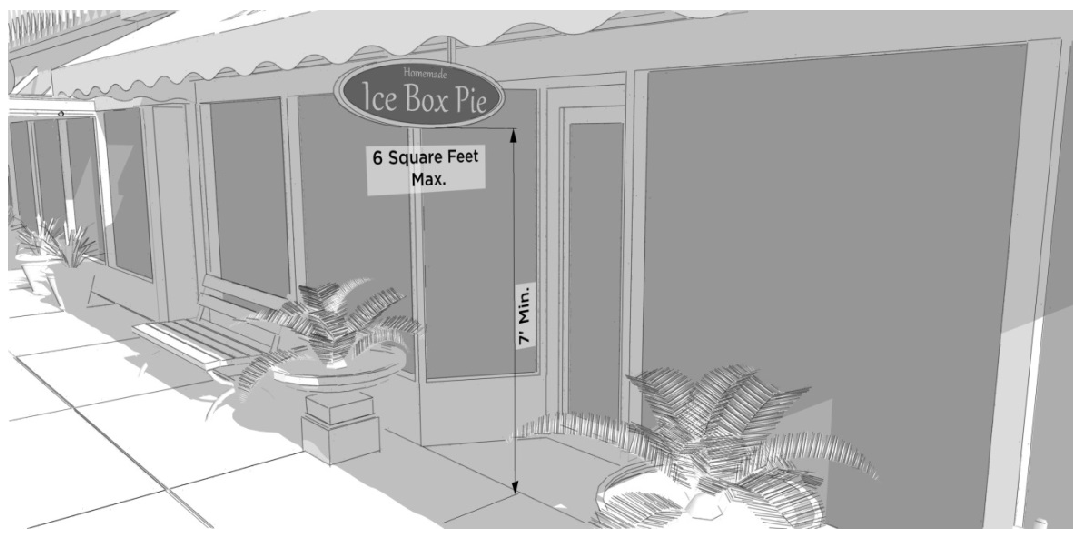
Under-awning signs must maintain a minimum vertical clearance of seven feet.
c.
A maximum of one under-awning sign is permitted per business establishment with frontage where the awning is mounted.
d.
Under-awning signs are limited to a maximum of six square feet.
e.
Under-awning signs must be securely fixed to the awning with metal supports.
f.
Under-awning signs must be made of wood, metal, or plastic.
FIGURE 9-4: UNDER-AWNING SIGN
E.
Banners/Exhibition Banners
1.
Banners and exhibition banners shall be printed upon flexible material, mounted with or without frames and shall be professionally printed and installed in a way that does not create a safety hazard.
2.
Banners and exhibition banners must be securely and tautly attached to the wall of a structure or pole. No banners or exhibition banners may be located higher than the roofline or encroach into the public right-of-way unless approved by the Executive Director.
3.
All banners and exhibition banners must be located within the required yard setbacks for that district, as described in Article 4 of this Code.
4.
No banner or exhibition banner is allowed to be attached to a retaining wall or fence.
5.
Banners
a.
Banners shall not exceed a maximum sign area of 32 square feet.
b.
No more than one banner shall be displayed on a building/property frontage at one time, unless approved by the Executive Director.
c.
No property shall display a banner for more than 30 days, not more than two times per calendar year. Banners may be displayed longer than 30 days if approved by the Executive Director.
d.
Banners are prohibited from being placed in the public right-of-way.
e.
Banners will be allowed for the following public events and entities and are permitted year round:
i.
Charitable, humanitarian or artistic activities;
ii.
Banners intended for use by sponsors of non-profit community activities such as festivals, conventions and general street beautification;
iii.
Banners displayed on publicly owned property (parks, convention centers, and buildings) and are limited to activities occurring on the publicly owned property;
iv.
Banners are allowed on the property of any place of worship, and within all commercial and industrial zoning districts; or
v.
Banners for use by sponsors of any educational facility are allowed during a display period of one calendar school year not to exceed nine months.
f.
In order to reduce the proliferation of signs, banners must be greater than 50 feet from any other temporary sign.
g.
Banners wrapped around a permanent sign structure, such as a freestanding sign, projecting sign, or wall sign are prohibited.
6.
Exhibition Banners
a.
Exhibition banners are permitted for any educational facility, government use, or cultural facility to be used in conjunction with a special exhibit or event.
b.
Each structure of an allowed use is permitted up to eight exhibition banners during one display period. The display period is defined as the combined period of 45 days prior to the opening of the exhibit, the run of the exhibit, and 14 days following the close of the exhibit, unless written otherwise in this Code.
c.
An applicant may include up to eight exhibition signs, per structure, as part of the sign application.
d.
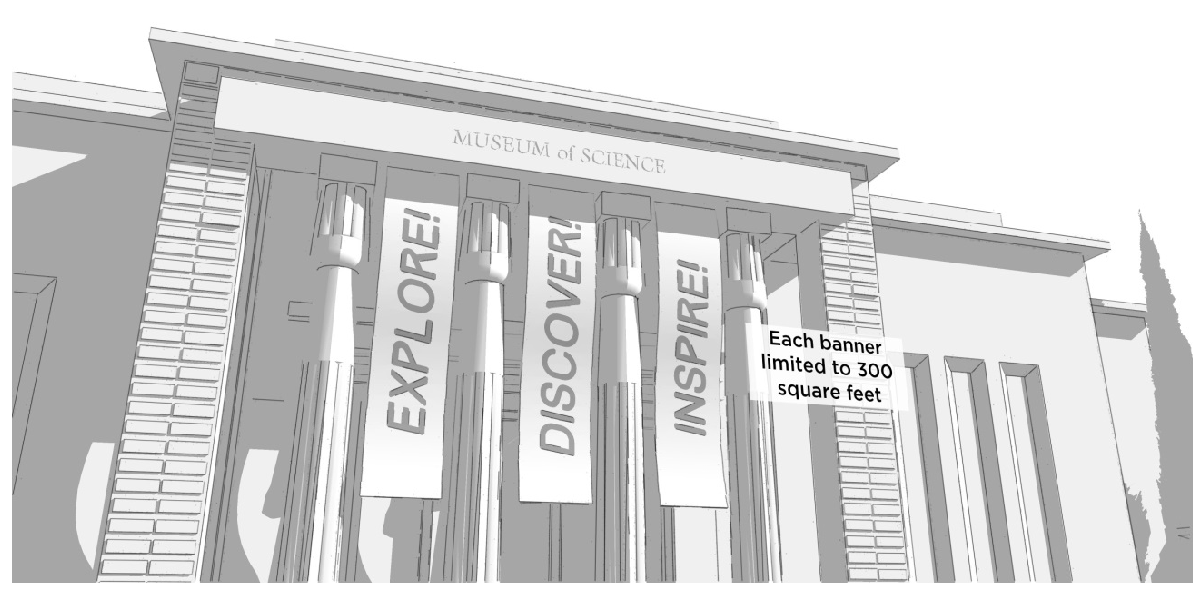
Each exhibition banner shall not exceed a maximum sign area of 300 square feet.
e.
Exhibition banners may be externally illuminated and must be focused on the printed area.
FIGURE 9-5: EXHIBITION BANNERS
F.
Canopy Sign
1.
Canopy signs are divided into two types: non-structural and structural. Canopy signs are permitted for multi-family dwellings and commercial uses in the districts indicated in Table 9-2.
2.
Non-structural canopy signs are subject to the following:
a.
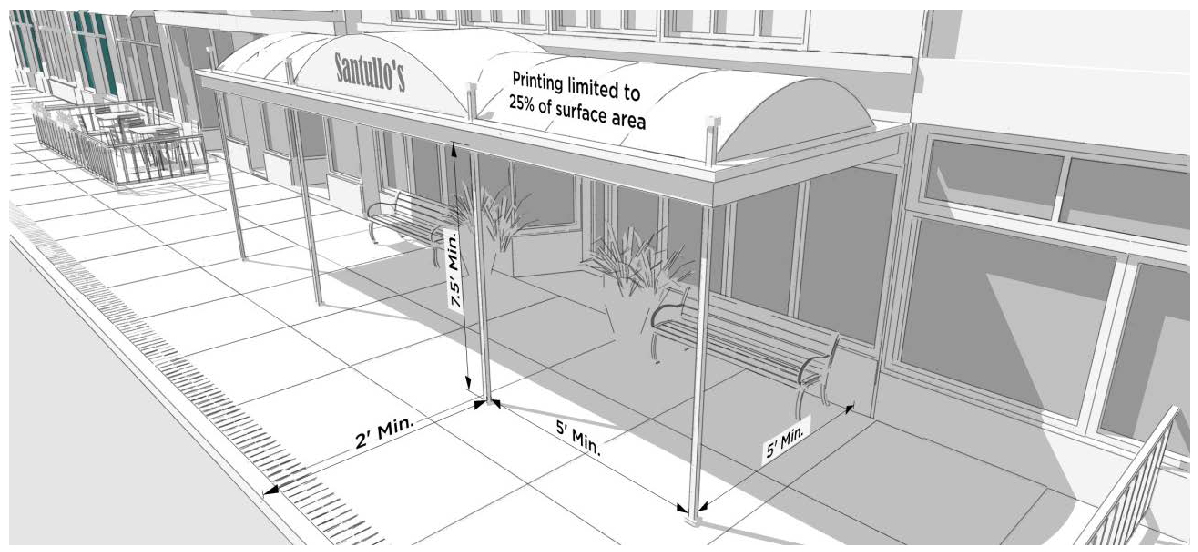
Non-structural canopy signs must maintain a minimum vertical clearance of seven feet six inches.
b.
Non-structural canopy signs may encroach into the public right-of-way but must be located at least two feet from the curb line. Support posts must maintain a minimum separation of five feet between posts and between the posts and any building wall.
c.
Non-structural canopy signs must be made of a durable, weather-resistant material such as canvas, canvas-like material, nylon, or vinyl-coated fabric.
d.
Printing on any non-structural canopy sign is limited to 25% of the surface area.
e.
Non-structural canopy signs may be externally illuminated and lighting must be focused on the printed area.
FIGURE 9-6: NON-STRUCTURAL CANOPIES
3.
Structural canopy signs are subject to the following:
a.
Structural canopy signs for multi-family dwellings must be attached to the principal structure. Structural canopy signs for commercial uses may be either attached to the principal structure or may be a freestanding structure.
b.
Structural canopy signs attached to the principal structure may encroach into the public right-of-way but must be located at least two feet from the curb line. Support posts must maintain a minimum separation of five feet between posts and between the posts and any building wall.
c.
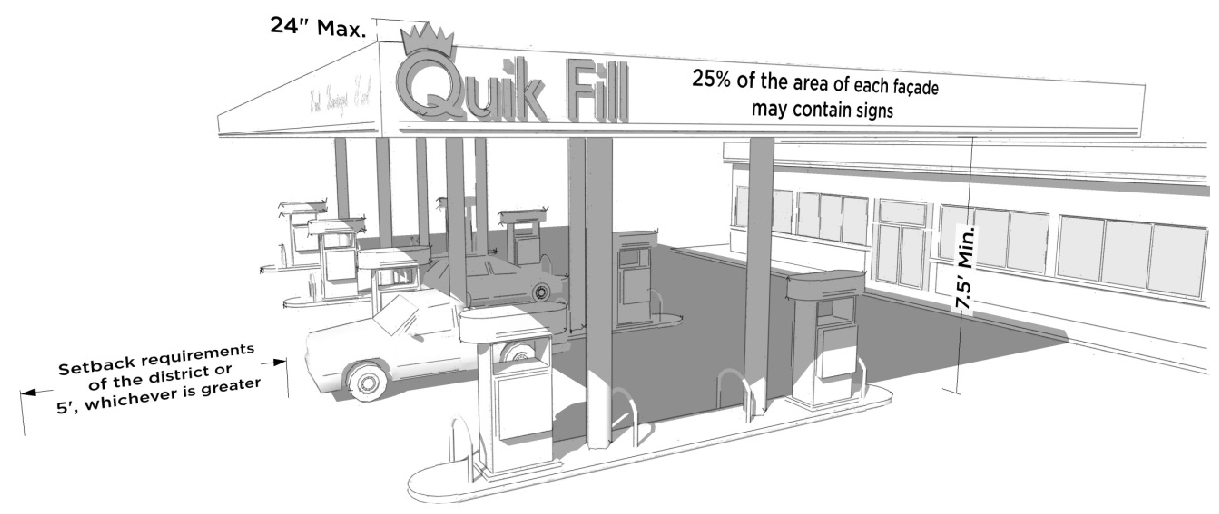
Freestanding structural canopy signs are subject to the setback requirements of the district in which they are located or five feet from any lot line, whichever is greater.
d.
All structural canopy signs must maintain a minimum vertical clearance of seven feet six inches.
e.
For structural canopies attached to a building, signs are limited to 25% of the surface area. Such signs are permitted lettering attached to and located above the top of a structural canopy to a maximum height of 24 inches.
f.
For freestanding structural canopies, a maximum of 25% of the area of each façade may include signs. No sign may be mounted above the top of the roof of the structural canopy; however, a sign mounted on the structural canopy façade may extend a maximum of 12 inches above the roofline.
g.
Structural canopy signs must be made of metal, brick, stucco, concrete, or other permanent building material.
h.
Structural canopy signs may be internally or externally illuminated. If externally illuminated, the lighting must be focused on the sign. In addition, structural canopies for gas stations are permitted an illuminated band along the facades of the canopy. The illuminated band is limited to 15% of the overall height of the facade of the canopy and is not counted as a sign unless there is a commercial message integrated into the band, whereby, the commercial message portion would be calculated as a sign.
FIGURE 9-7: STRUCTURAL CANOPIES
G.
Electronic Message Sign
An electronic message signs that is included as part of a permanent window sign is allowed, but is subject to the regulations for window signs. The following standards apply to freestanding, wall, or marquee signs with an electronic message sign component.
1.
Electronic message signs are permitted in the districts indicated in Table 9-2. In the residential districts, electronic message signs are permitted only for an educational facility, government use, public park, cultural facility, or place of worship. In all other districts permitted by Table 9-2, electronic message signs are permitted only for non-residential uses.
2.
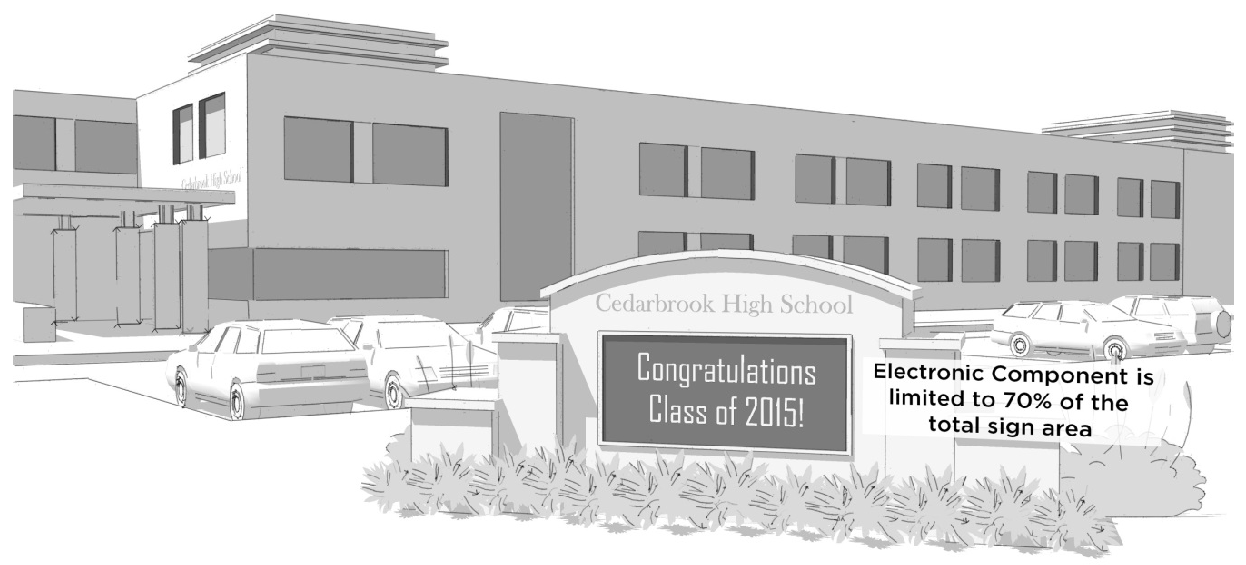
Electronic message signs are permitted as a freestanding sign or wall sign and are subject to the requirements for those sign types within that district, including that they are counted within the number of signs permitted and the total sign area. Electronic message signs must be integrated into the larger sign structure and the electronic component is limited to a maximum of 70% of the total sign area of a freestanding sign or wall sign.
3.
Only one electronic message sign per lot is permitted, whether freestanding sign or wall sign.
4.
Each message or image displayed on an electronic message sign must be static for a minimum of four seconds. Multi-color messages and static images are permitted.
5.
Electronic message signs cannot display any off-premises commercial advertising.
6.
Any scrolling, flashing, animation, or movement of the message or any component of the sign is prohibited.
FIGURE 9-8: ELECTRONIC MESSAGE SIGNS
H.
Freestanding Sign
Freestanding signs are permitted for: non-residential uses, multi-family and townhouse dwellings, and residential subdivisions developments. Freestanding signs are subject to the following regulations. In some districts, freestanding signs may be prohibited as regulated in this section.
1.
Freestanding signs may be either pole or monument construction. In certain districts or for certain uses, freestanding signs may be limited to only one type of construction.
a.
A freestanding pole sign that is affixed, attached, or erected on one or more poles, where such poles are not an integral part of the sign. Freestanding pole signs include any freestanding sign that does not meet the design and construction standards of a freestanding monument sign as described in this section.
b.
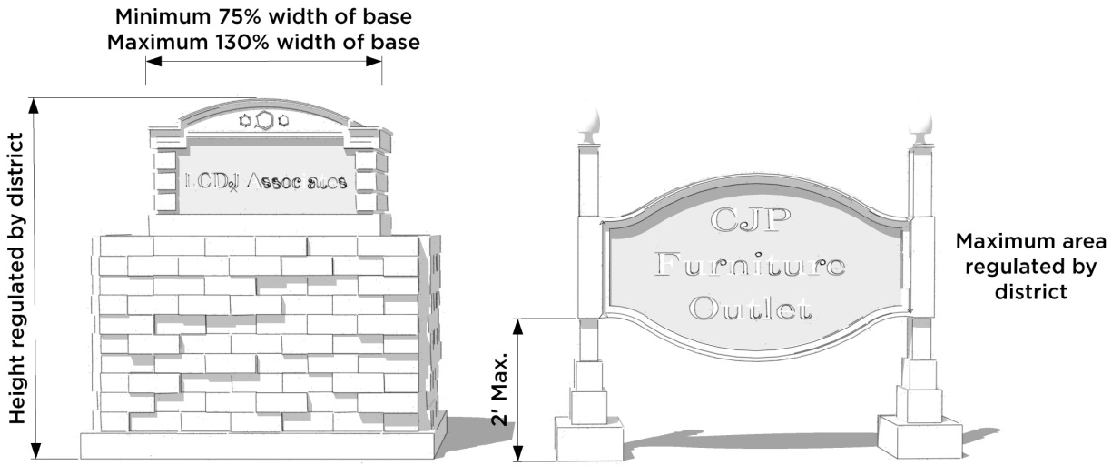
A freestanding monument sign is designed with the base of the sign installed on the ground. The monument base must be designed as an integral part of the sign structure. The width of the top of the sign face must be a minimum of 75% and a maximum of 130% of the width of the base.
c.
In order to create flexibility for freestanding monument signs installed where the ground is not level, structural (non-decorative) posts may extend out of the ground but are limited to a maximum of six inches above the adjacent ground where they are installed. When the freestanding monument sign is designed with decorative posts that are part of the overall sign structure and sign design, such decorative posts may extend out of the ground for a maximum of two feet above the adjacent ground where they are installed.
FIGURE 9-9: FREESTANDING MONUMENT SIGNS
2.
Freestanding signs for all uses except multi-tenant retail centers or residential subdivisions are subject to the following limitations on sign area, sign height, and sign number.
a.
One freestanding sign is permitted per street frontage of a lot and where such street frontage is a minimum of 50 feet. When a lot has over 200 feet of street frontage, an additional ground monument sign is permitted for each additional access point to the lot. A minimum separation of 50 feet is required between ground monument signs.
b.
Freestanding signs are limited to the type, height, and area maximums of Table 9-3: Freestanding Sign Regulations.
TABLE 9-3: FREESTANDING SIGN REGULATIONS
c.
Where a nonresidential development has 200 feet of street frontage and a lot area of two acres or more, such development is permitted an increased sign area and height of 200 square feet of area and 25 feet in height. The street frontage of a corner lot is the shortest street lot line of a corner lot abutting a street.
3.
Freestanding signs for multi-tenant retail centers are subject to the following limitations on sign area, sign height, and sign number:
a.
One freestanding sign is permitted per street frontage of a lot. An additional freestanding sign is permitted for each additional access point to the lot. A minimum separation of 50 feet is required between freestanding signs. For the purposes of this regulation, a multi-tenant development where the development as a whole may be comprised of separate lots of record, the entire development including outlot parcels and inline development is considered one lot. Such freestanding sign may be either pole or monument construction.
b.
Freestanding sign may be either pole or monument construction, and are permitted a maximum sign area of 200 square feet and a maximum sign height of 25 feet.
4.
Freestanding signs for residential subdivision are subject to the following limitations on sign area, sign height, and sign number:
a.
Freestanding sign must be monument construction.
b.
One freestanding sign is permitted per each access point to the residential subdivision. A minimum separation of 50 feet is required between freestanding signs.
c.
Freestanding monument signs are permitted a maximum sign area of 150 square feet and a maximum sign height of 6 feet.
5.
All freestanding signs must be landscaped at the base of the sign in accordance with the following:
a.
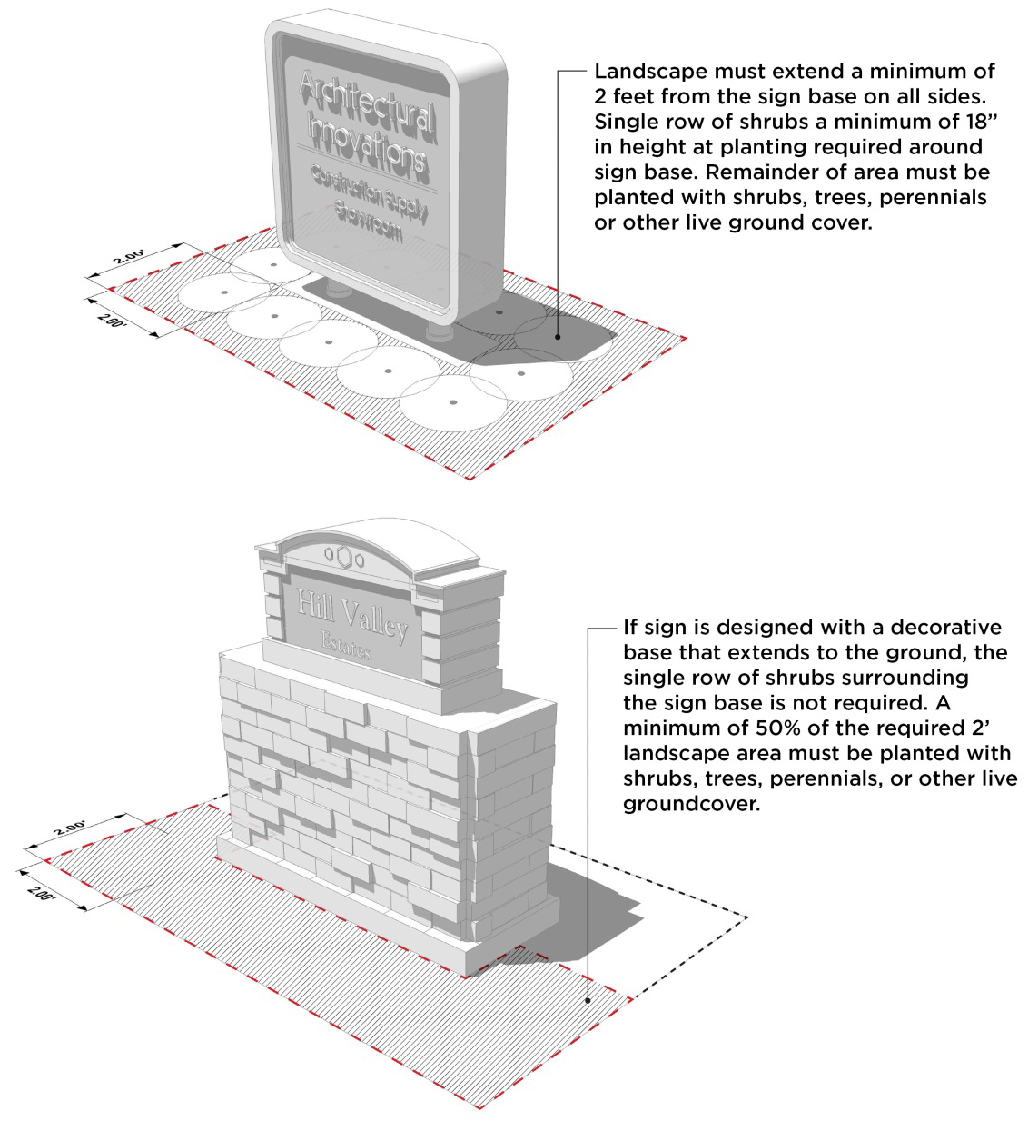
Landscape must extend a minimum of two feet from the sign base on all sides with small shrubs a minimum of 18 inches in height at planting in a single row around the sign base. The remainder of the landscape area must be planted with trees, perennials, or other live groundcover.
b.
If a freestanding monument sign is designed with a decorative base and such decorative base extends to the ground, the single row of shrubs surrounding the sign base is not required. A minimum of 50% of the required two foot landscape area in item a above must be planted with shrubs, trees, perennials, or other live groundcover.
c.
If landscape is required on a site, freestanding sign landscape is included in the total amount of landscape required on a site. Where a sign is installed in any landscape area of a site, the specific landscape requirements of this section do not apply and the sign landscape can be integrated into the overall site landscape plan. Sign landscape must be shown on the landscape plan.
d.
All landscape must be maintained in good condition and free and clear of rubbish and weeds.
FIGURE 9-10: FREESTANDING SIGN LANDSCAPE
6.
Freestanding signs must be set back five feet from any lot line. No freestanding sign may project into, over, or otherwise encroach on a public right-of-way.
7.
Freestanding signs may be internally or externally illuminated. If externally illuminated, all light must be directed onto the sign face.
8.
Freestanding signs must be constructed of wood or simulated wood, stone, concrete, metal, or plastic.
9.
If a nonresidential development does not have direct adjacency to a major street, said development is permitted to place one additional freestanding sign on any adjacent property that has direct access to a major street provided that such sign is either pole or monument construction, as determined by the zoning district it is located in, and must adhere to the following:
a.
The location of the property of the development being displayed on the proposed freestanding sign shall not be located more the 500 linear feet from the right-of-way of the street on which the sign fronts.
b.
Adheres to all freestanding sign regulations found in this subsection.
I.
Marquee
1.
Marquees are permitted for non-residential uses in the districts indicated in Table 9-2.
2.
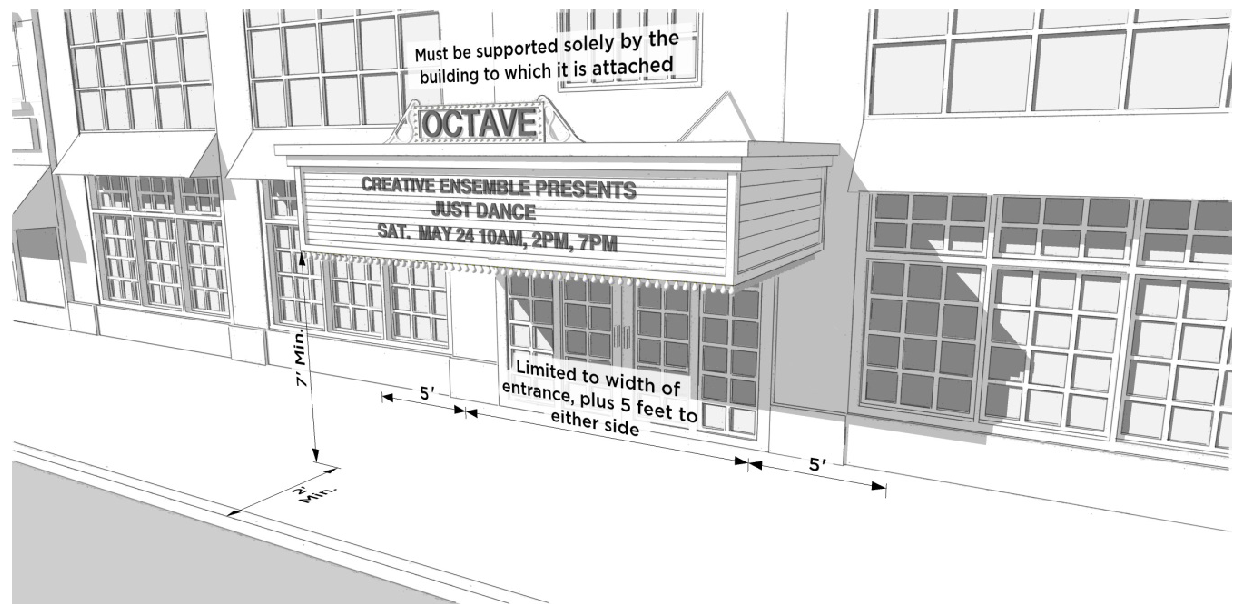
Marquees must be supported solely by the building to which they are attached. No exterior columns or posts are permitted as supports.
3.
The roof of a marquee may not be used for any purpose other than to form and constitute a roof and must be constructed of noncombustible material.
4.
Water from the roofs of a marquee may not drain, drip, or flow onto the surface of a public right-of-way. Sufficient downspouts, drains, and gutters must be installed as part of each marquee to prevent water from the roof of the marquee from flowing onto the surface of a public right-of-way.
5.
Marquees must be erected over a building entrance and are limited to the width of the building entrance with an additional five feet on each side of the entrance doors.
6.
All marquees must maintain a minimum vertical clearance of seven feet and six inches, and the roof of the marquee structure must be erected below the second floor windowsill.
7.
Marquees may encroach into the public right-of-way but must be located at least two feet from the curb line.
8.
Marquees are permitted lettering attached to and located above the roof of a marquee to a maximum height of 48 inches.
9.
Marquees may be internally illuminated.
FIGURE 9-11: MARQUEES
J.
Menuboard
1.
Menuboards are permitted for all drive-through facilities.
2.
Menuboards are limited to a maximum of one per drive-through lane.
3.
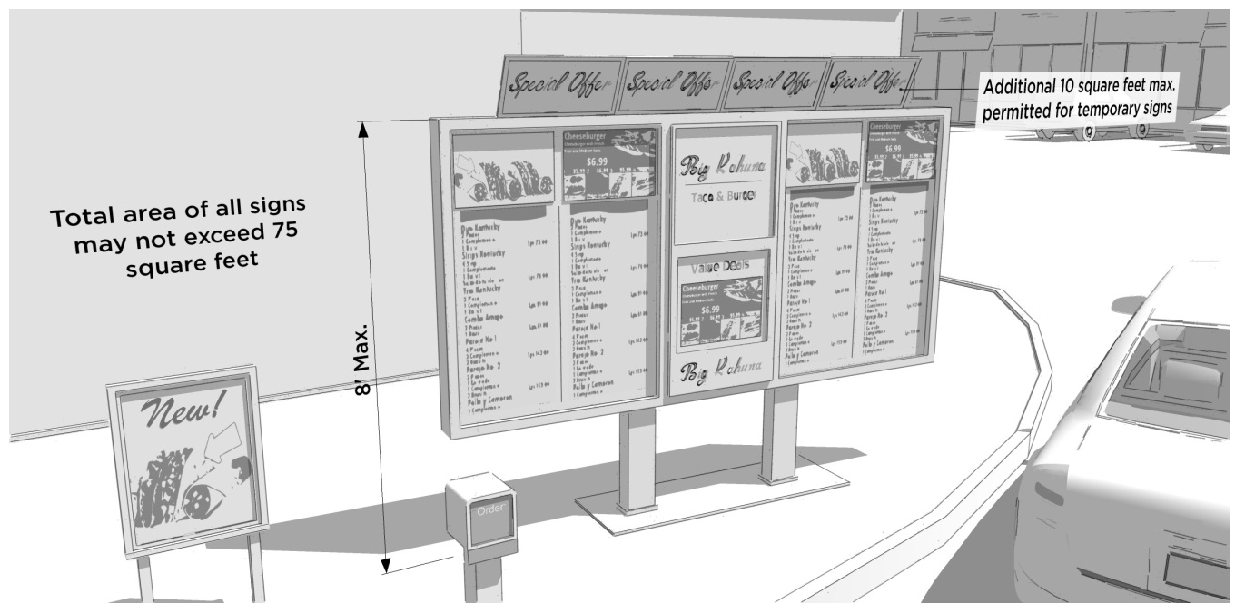
Menuboards are limited to 75 square feet in sign area and eight feet in height. The menuboard may be designed as separate freestanding signs grouped together and may include the use of preview boards designed as separate freestanding signs installed a distance earlier in the drive-through lane, however the total area of all signs must not exceed 75 square feet.
4.
Menuboards are permitted an additional 10 square feet of sign area for temporary signs attached to the top or sides of the menuboard.
5.
Menuboards must be located a minimum of 15 feet from any residential district lot line.
6.
Menuboards may be internally illuminated. Menuboards may also contain an electronic screen that displays order information for each customer.
FIGURE 9-12: MENUBOARD
K.
Portable Reader Board
1.
A portable reader-board sign may be used on a temporary basis to identify a business. Signs identified as a portable reader board may be used to advertise a product or service, or direct the public to an activity located on or off the premises.
2.
A portable reader-board shall be regulated as an attention-getting device in accordance with the attention-getting device regulations.
3.
As of June 30, 2022, all portable reader board signs, as defined by this Code, will be prohibited. Any existing sign permit approved for a portable reader board will become null and void.
L.
Projecting Sign
1.
Projecting signs are permitted for non-residential uses in the districts indicated in Table 9-2.
2.
One projecting sign is permitted per establishment with frontage on a street. For a corner lot, one projecting sign is permitted for each street frontage.
3.
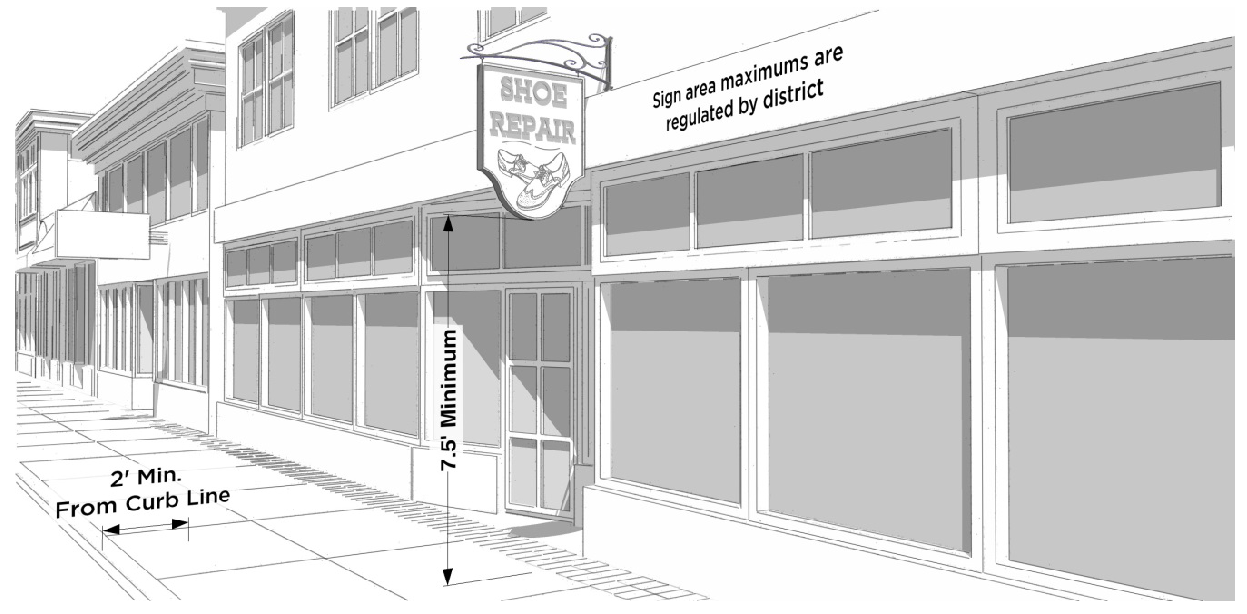
Projecting signs may encroach into the public right-of-way but must be located at least two feet from the curb line.
4.
Projecting signs must maintain a minimum vertical clearance of seven feet, six inches. No projecting sign affixed to a building may project higher than the building height, including the sign support structure.
5.
Projecting sign area is limited to the maximums of Table 9-4: Projecting Sign Regulations.
TABLE 9-4: PROJECTING SIGN REGULATIONS
6.
Projecting signs must be constructed of wood or simulated wood, metal, plastic, high-density urethane (HDU) foam board or similar durable foam construction, or durable, weather-resistant fabric material like canvas, canvas-like material, nylon, or vinyl-coated fabric. Projecting signs constructed of fabric material must be mounted so that they are held taut between support posts.
7.
Projecting signs may be internally or externally illuminated. If externally illuminated, all lighting must be directed onto the sign face from above.
FIGURE 9-13: PROJECTING SIGNS
M.
Public Information/Event Sign
1.
Public information/event signs are temporary signs permitted for institutional and open space uses, and any civic organization to advertise a public event or informational message in the districts indicated in Table 9-2.
2.
Sign permits for public information/event signs are approved as a comprehensive sign package. The sign permit application must contain the following additional information:
a.
The nature of the event or the public information to be presented.
b.
The proposed sign copy.
c.
The sign area of all signs to be installed.
d.
The number of signs to be installed.
e.
The general location of where such signs will be installed.
f.
The dates the signs will be displayed, including all installation and removal dates.
g.
When located on private property or on property owned by another jurisdiction, permission from the property owner or other jurisdiction.
3.
Public information/event signs must contain a non-commercial message related to a public event or public information. No commercial advertising is permitted.
4.
All public information/event signs must be removed by the date specified in the sign permit approval. Any signs that remain installed on public property or public right-of-way following such expiration date may be removed without notice.
N.
Roof Signs
1.
Roof signs are permitted for non-residential uses in the districts indicated in Table 9-2.
2.
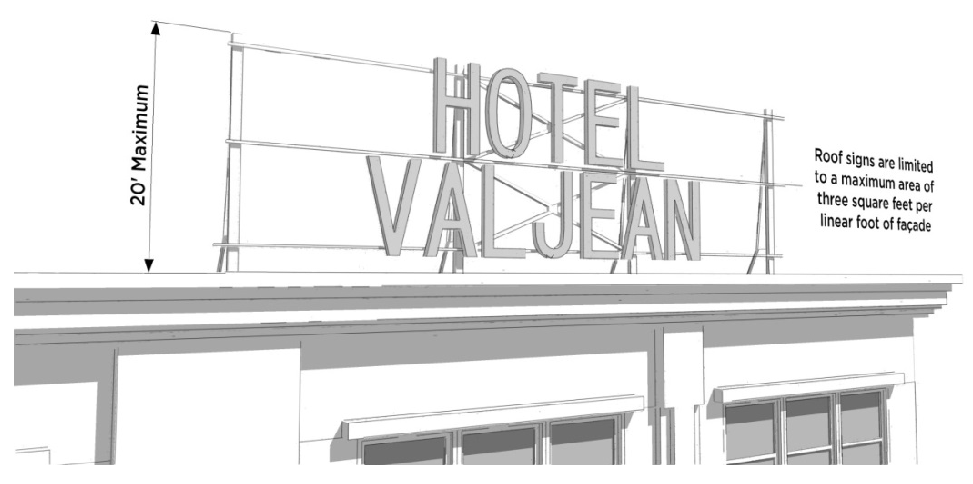
Roof signs may not project more than 20 feet above the rooftop.
3.
Roof signs are limited to a maximum area of three square feet per linear foot of façade.
4.
Roof signs may be internally or externally illuminated.
FIGURE 9-14: ROOF SIGNS
5.
Signs on mansard roofs shall met the following provisions:
a.
All signs on mansard roofs shall be one-sided, permanent in nature and may be illuminated.
b.
Signs on mansard roofs shall be consistent with and incorporated into the architecture of the building and shall be constructed to conceal all supporting structures and fastenings to the greatest extent feasible.
c.
There shall be not more than one sign on a mansard roof per lot, except that on a corner lot two signs, one facing each street, shall be permitted.
d.
The maximum size of a sign on a mansard roof is established at one square foot per linear foot of building wall where the sign will be mounted or 40 square feet, whichever is greater.
e.
For a corner lot, the maximum size of a sign on a mansard roof located on each building wall shall be established at one square foot per linear foot of building wall where the sign on a mansard will be mounted or 40 square feet, whichever is greater. The size of a sign on a each side of the building shall be limited to the square footage calculated on that side only. In no case shall the square footage permitted for the signs located along the front lot line and the square footage permitted for the building wall located along the corner side lot line be combined to create a larger sign on a wall other than that permitted on each individual wall.
f.
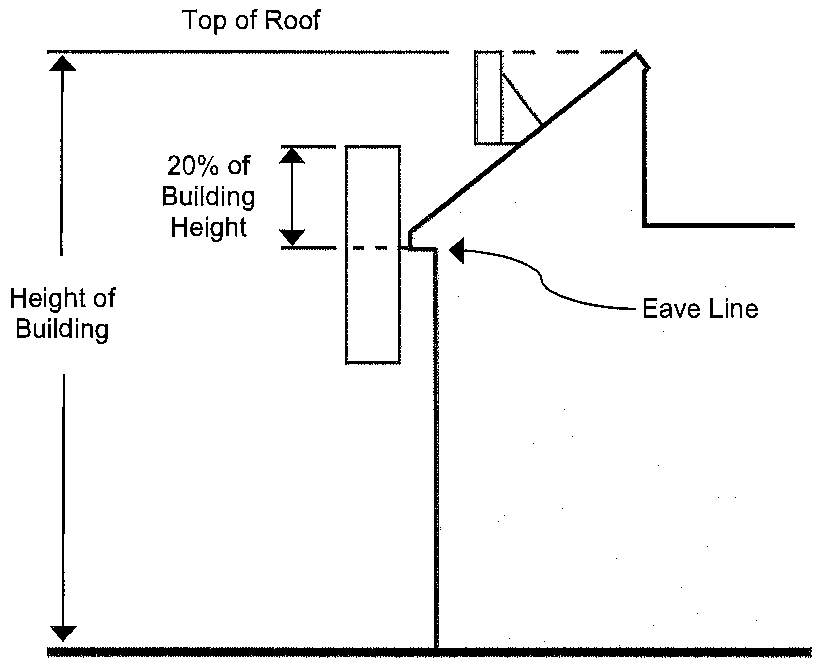
Signs placed on a wall of a structure may not project above the eave line of a mansard roof a distance greater than 20% of the distance between the ground level and the top of mansard roof. No sign on a mansard roof shall project higher than the deck line of the mansard roof, as shown in the figure below.
O.
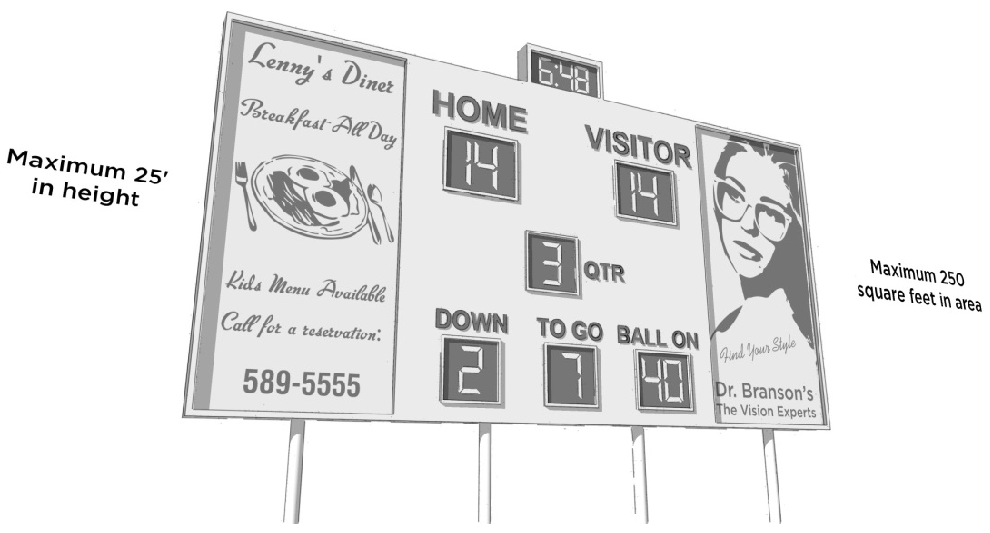
Scoreboard
Scoreboards that are part of an outdoor recreational field of an educational facility or a recreational field for a public park/playground are not regulated by this Code and considered part of the use, and are exempt from these provisions. This exemption also applies to scoreboards for indoor recreation fields. Scoreboards for an outdoor recreational field in association with any other use are subject to the following standards:
1.
Scoreboards are permitted as part of an outdoor recreational field playing field. Unless they are exempted from regulations as described in this section, scoreboards require approval of a sign permit.
2.
One scoreboard is permitted per playing field. Scoreboards are limited to a maximum of 250 square feet in sign area and 25 feet in height.
3.
The score-keeping portion of the scoreboard may utilize an electronic message component.
4.
If the scoreboard cannot be viewed from any adjacent right-of-way, up to 50% of the sign area may be used for sponsor advertising. If the scoreboard can be viewed from any adjacent right-of-way, up to 30% of the sign area may be used for sponsor advertising.
FIGURE 9-15: SCOREBOARD
P.
Wall Sign
1.
Wall signs are permitted for non-residential uses in the districts indicated in Table 9-2.
2.
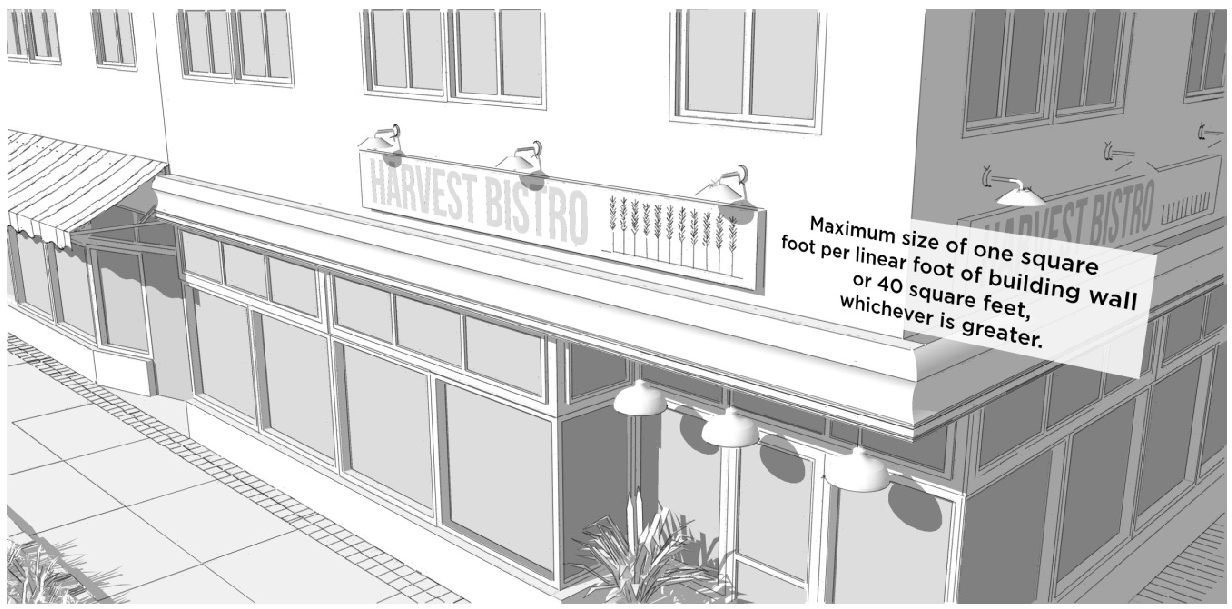
The maximum size of a wall sign is established at one square foot per linear foot of building wall where the wall sign will be mounted or 40 square feet, whichever is greater. The square footage from different façades cannot be combined to create a larger sign on any façade. In a multi-tenant structure, each tenant is permitted a wall sign of one square foot per linear foot of business frontage or 40 square feet, whichever is greater.
3.
For a corner lot, the maximum size of a wall sign located on each building wall shall be established at one square foot per linear foot of building wall where the wall sign will be mounted or 40 square feet, whichever is greater. The size of a wall sign on each side of the building shall be limited to the square footage calculated on that side only. In no case shall the square footage permitted for the building wall located along the front lot line and the square footage permitted for the building wall located along the corner side lot line be combined to create a larger sign on a wall other than that permitted on each individual wall.
4.
Wall signs may be internally or externally illuminated. If externally illuminated, all light must be directed onto the sign face.
5.
Wall signs must be safely and securely attached to the building wall. Wall signs must be affixed flat against the wall and must project 18 inches or less from the building wall. Wall signs may encroach into the public right-of-way for no more than 18 inches.
6.
No wall sign affixed to a building, including sign support structure, may project beyond the ends or top of the wall or higher than the roofline of the structure to which it is attached.
7.
Wall signs must be constructed of wood or simulated wood, brick, metal, high-density urethane (HDU) foam board or similar durable foam construction, or plastic. Wall signs constructed of material must be mounted so that they are held taut against the wall.
8.
Wall signs are permitted on architectural appurtenances, such as chimneys or penthouses, which are part of the structure. Wall signs must not cover any window, windowsill, transom sill, or significant architectural feature.
9.
In addition, any structure over 10 stories in height is permitted one additional wall sign per façade to identify the building. Such wall sign must be placed within the top 20 feet of the structure and cannot not cover any fenestration or architectural features. The maximum size is established at two square feet per linear foot of façade, measured at the roof line, where the wall sign will be mounted.
10.
Ghost signs are considered wall signs. Existing ghost signs are exempt from these requirements and deemed conforming. Ghost signs may be maintained and repainted but no new information or images may be added to the existing sign. No new wall signs may be painted on structures.
11.
Wall signs are only permitted on the front and side facade of a building. Rear wall signs are not permitted.
12.
Wall signs may not be located on any facade which abuts a residentially zoned district.
FIGURE 9-16: WALL SIGNS
(Ord. No. 19, 2018, § 32, 3-13-18; Ord. No. 62, 2018, § 12, 8-14-18; Ord. No. 72, 2018, § 25, 8-28-18; Ord. No. 66, 2019, §§ 23, 24, 6-11-19; Ord. No. 187, 2019, §§ 23, 24(Exh. C), 25, 12-10-19; Ord. No. 19, 2021, §§ 9(Exh. D), 10(Exh. E), 11(Exh. F), 2-9-21; Ord. No. 109, 2021, § 1, 8-10-21; Ord. No. 57, 2024, §§ 1, 2, 6-11-24)
9.8 - BILLBOARDS
A.
Purpose
1.
The purpose of this section is to:
a.
Establish standards and regulations to insure the reasonable, orderly and effective display of billboards and to define those structures that are not in compliance.
b.
Enforce the intent of the U. S. Congress and the Louisiana State Legislature in adopting the Highway Beautification Act and the state version of that law, who, in so acting, have declared that it is in the public interest to regulate and restrict the erection and maintenance of billboards along any interstate or primary aid highway system.
c.
Promote the safety and recreational value of public travel.
d.
Promote and enhance the beauty, order and attractiveness of the City of Shreveport to residents, tourists, and visitors, and positively influence the economic prosperity of the area.
e.
Support and complement the land use objectives of this Code.
2.
These regulations control the location, size, spacing, illumination, and maintenance of all billboard devices resulting in the overall enhancement of the health, safety, and welfare of the citizens in the City of Shreveport.
B.
Permitted Billboard Locations
1.
Static and Electronic Billboards
a.
After the effective date of this Code, no new billboard, static or electronic, may be constructed, erected, installed, or modified within the City of Shreveport, and no sign permit will be issued for the construction, erection, or modification of a new billboard or an existing billboard in the City of Shreveport, except as authorized by this section.
b.
Any active sign permit issued prior to the effective date of this Code shall be allowed to be constructed based on the Code at the time of issuance, provided said permit meets the following conditions:
i.
Any existing active sign permit may be cancelled and surrendered to the Zoning Administrator for a 1-to-1 square footage credit towards the application of a new sign permit within 30 days of July 17, 2019.
ii.
Any new sign permit reissued under this provision shall expire within 90 days from issuance.
iii.
All existing sign permit not surrendered within the 30-day period shall become null and void August 27, 2019.
2.
Permitted Locations
a.
Construction of a new static or non-electronic billboard is allowed in the C-4, I-1, and I-2 Districts or where legally allowed within 660 feet of any federal interstate or primary aid highway on land that is zoned commercial or industrial.
b.
Construction of a new electronic billboard is allowed in the C-2, C-3, C-4, I-1, and I-2 Districts or within 660 feet of any federal interstate or primary aid highway on land that is zoned commercial or industrial.
c.
All static and electronic billboards are prohibited in the following zoning districts: R-A, R-E, R-1-12, R-1-10, R-1-7, R-1-5, R-UC, R-TH, R-2, R-3, R-4, R-MHS, R-MHP, C-1, C-UC, C-UV, D-1, OR, NA, OS, and IC Districts.
d.
No property may be rezoned to one of the permitted allowable districts for the sole purpose of allowing the erection of a static or electronic billboard. Any property that has been rezoned within the past 24 months shall (1) obtain an approved site plan, (2) acquire an active building permit, and (3) commence active construction on the site—for a use other than a billboard—prior to any submittal of an application for a static or electronic billboard.
3.
New Billboard Construction
a.
In order to construct one new billboard, whether static or electronic, the applicant must permanently remove either:
i.
One existing conforming billboard; or
ii.
One or more existing nonconforming billboards whose cumulative sign area is a minimum of two times the square footage of the sign area of the proposed billboard.
b.
If the applicant constructing a new billboard permanently removes nonconforming existing billboards whose total square footage of sign area exceeds that required to construct a new billboard (i.e., the total square footage removed is more than twice the square footage of the new billboard), the square footage in excess of that required will be held by the Metropolitan Planning Commission, once verified as extra square footage by the Executive Director, in a credit bank that can be applied to the square footage nonconforming billboard removal requirement for a new billboard.
c.
The applicant requesting a sign permit for any new billboard must identify the locations and total display face area of the existing billboards to be removed and their status as either conforming or nonconforming, and obtain a demolition permit for each billboard to be removed prior to issuance of the sign permit for the new billboard. Each of the billboards identified for demolition must be completely removed prior to the construction and operation of the new billboard. Each of the billboard structures identified to be removed must be demolished and the entire structure completely removed to grade level prior to the construction or installation of the new billboard, including the support structure, electrical connections, catwalk (if any), and special grading, and all post holes must be completely covered.
C.
Permitted Billboard Conversions
Existing static billboards may be converted to electronic billboards as described in this section.
1.
An existing conforming billboard may be converted to an electronic billboard in accordance with the standards of this Code.
2.
In order to convert an existing nonconforming static billboard to an electronic billboard, the applicant must permanently remove one or more existing billboards whose cumulative sign area is a minimum of two times the square footage of the sign area of the new billboard. If the applicant converting a billboard permanently removes existing nonconforming billboards whose total square footage of sign area exceeds that required to construct a new billboard (i.e., the total square footage removed is more than twice the square footage of the new billboard), the square footage in excess of that required will be held by the Metropolitan Planning Commission, once verified as extra square footage by the Executive Director, in a credit bank and can be applied to the square footage removal requirement for a new billboard.
3.
When converting an existing nonconforming static billboard to an electronic billboard, the applicant requesting a sign permit for a billboard conversion must identify the locations and total display face area of the existing billboards to be removed and their status as either conforming or nonconforming, and obtain a demolition permit for each billboard to be removed prior to issuance of the sign permit for the new billboard. Each of the billboards identified for demolition must be completely removed prior to the conversion of the billboard. Each of the billboard structures identified to be removed must be demolished and the entire structure completely removed to grade level prior to the construction or installation of the new billboard, including the support structure, electrical connections, catwalk (if any), and special grading, and all post holes must be completely covered.
D.
Electronic Billboard Owner/Operator Responsibilities
1.
The face of the electronic sign permit application must identify contact information for an emergency contact available to turn off the electronic sign within 12 hours after a malfunction occurs.
2.
An electronic display must contain a default mechanism to show a "full black" image or turn the sign off in case of malfunction, or must be manually turned off within 12 hours of a reported malfunction.
E.
Billboard Design
1.
No new static or electronic billboard may obscure, obstruct, or otherwise physically interfere with the clear or unobstructed view of an official traffic sign, signal, or device, or obstruct or physically interfere with the driver's view of approaching, merging or intersecting traffic.
2.
No new static or electronic billboard may be located on or project over a building.
3.
Signs and sign faces must not be stacked. Only one sign face is allowed on each side.
4.
All billboards must include an identification plaque of 200 square inches or less on each sign surface. The plaque must contain the name (or easily recognized logo) of the billboard owner and be clearly legible.
5.
All new billboards can only be constructed on steel beams, metal pipes, or similar material, and must be painted a neutral color. No new static or electronic billboard may be built on wood poles.
6.
Visible backs of billboards must be suitably painted or otherwise covered to present a neat and clean appearance.
7.
No billboard may have audio speakers or any audio component.
8.
Billboards may be illuminated, subject to the following restrictions:
a.
No revolving or rotating beam or beacon of light that simulates any emergency light or device is permitted as part of any billboard. Flashing devices are prohibited. However, illuminated signs that indicate customary public service as time, date, temperature, or other similar information are permitted.
b.
External lighting, such as floodlights, thin line, and gooseneck reflectors are permitted provided the light source is directed on the face of the billboard and are effectively shielded so as to prevent beams or rays of light from being directed or reflected onto any portion of the interstate highway or public street.
9.
An electronic display must be equipped with both a dimmer control and a photocell that automatically adjusts the display's intensity according to natural ambient light conditions.
10.
Operational requirements for new electronic billboards must comply with the following standards:
a.
Only one electronic billboard is permitted per lot. Electronic billboards are subject to the same location and dimensional limitations as standard static billboards.
b.
The changeable images must be only a series of still images. Moving images or images which create the appearance of motion during the static display period are prohibited.
c.
The minimum dwell time, defined as the interval of change between each individual message, is eight seconds, and a change of message must be accomplished within one second or less. The dwell time cannot include the one second or less required to change a message.
d.
An electronic billboard display cannot resemble or simulate any traffic control or other official signage.
e.
An electronic billboard display must be equipped with a light sensing device that automatically adjusts the display's intensity according to natural ambient light conditions.
f.
No electronic billboard display may be erected, installed, or altered to include animation, such as parts which move, blinking lights, sound, or smoke or fumes issuing from the sign. Use of flashing, strobing, or scrolling line-travel test is prohibited. An electronic billboard must not exceed a maximum illumination of 6,000 nits during daylight hours and a maximum illumination of 500 nits between dusk and dawn, as measured from the sign's face at maximum brightness.
11.
Any new billboard must comply with all of the provisions of this section, as well as all other City of Shreveport ordinances including, but not limited to, electrical, plumbing, and grading.
F.
Billboard Height Limitations
No billboard may exceed the most restrictive height applicable to it under Table 9-5: Height Limits for
Billboards, and is subject to the further specific conditions set forth in this section:
TABLE 9-5: HEIGHT LIMITS FOR BILLBOARDS
Note: The maximum height of any signs is measured as the vertical distance between the highest part of the sign and either the ground level at its supports or the nearest shoulder of the adjacent Interstate highway right-of-way or public street right-of-way, whichever is higher in elevation.
G.
Billboard Size Limitations
Table 9-6: Maximum Billboard Sign Area below specifies the maximum permitted sizes for any new billboard by district:
TABLE 9-6: MAXIMUM BILLBOARD SIGN AREA
1.
The maximum area, heights of surface, and length of surface dimensions in the above table are exclusive of any border or trim, the base or supports, and other structural members. For signs in I-2, I-1, C-2, C-3, and C-4 Districts, cut-outs or extensions up to 50 square feet of additional area may be allowed without Metropolitan Planning Commission approval and cut-outs above 50 square feet may be permitted administratively by the Executive Director.
2.
No more than two sign surfaces are allowed on one device. Two-sided signs must have the same surface area on each side.
H.
Billboard Separation
Billboards must be separated by the distances set forth in this subsection and must comply with the requirements of Table 9-7: Separation Requirements for Billboards.
TABLE 9-7: SEPARATION REQUIREMENTS FOR BILLBOARDS
1.
Where Table 9-7 requires a separation from another sign or another use and that separation requirement is greater than the setback requirement under this subsection, the greater separation requirement applies.
2.
For the purpose of these regulations, each side of the interstate system is considered separately.
3.
The maximum distance between billboards is measured along the nearest edge of the pavement between points directly opposite the signs on each side of the roadway and applies only to billboards located on the same side of the roadway.
4.
For the purpose of separation requirement regulations, V-type or back-to-back sign surfaces on the same device are considered one sign.
5.
Any new static or electronic billboard must maintain a minimum spacing of 200 feet from any residential district lot line and any public park or educational facility, primary or secondary.
I.
Billboard Setback Requirements
1.
Any new billboard shall be setback from the front property lines on the properties on which they are located by the distances set forth in this subsection. Minimum front yard setbacks must comply with the requirements of Table 9-8: Billboard Setback Requirements.
TABLE 9-8: BILLBOARD LOT LINE SETBACK REQUIREMENTS
2.
In no case can the property line extend into the parkway or right-of-way.
3.
Setbacks are measured from the sign surface to the lot line.
4.
Side and rear minimum setbacks must be five feet.
J.
Special Control Areas for Billboards
New static and new electronic billboards are prohibited in the following special control areas:
1.
Historic Preservation Overlay Districts (HPODs)
Billboards are prohibited within the boundaries of any Historic Preservation Overlay District (HPOD), as defined in Article 21, and within 500 feet of the centerline of streets forming the boundaries of any designated Historic Preservation Overlay District (HPOD).
2.
Designated Scenic Corridors
Billboards are prohibited within 1,000 feet of the Clyde E. Fant Memorial Parkway right-of-way, within 500 feet of I-220, and within 500 feet of the Inner Loop Expressway rights-of-way.
K.
Construction of Billboards
1.
Stacked billboards are prohibited.
2.
V-type billboards shall be constructed with an angle of construction that is consistent with industry standards.
3.
New electronic displays cannot be erected back-to-back. New electronic billboards must be V-style and erected using appropriate industry standards.
L.
Time for Construction
Construction of any new or converted billboard, whether static or electronic, must be completed within six months of issuance of a sign permit. One six month extension may be granted by the Metropolitan Planning Commission upon a showing that the permittee has diligently attempted to complete the installation.
M.
Billboard Maintenance, Cleanliness, and Repair
All billboards, both new and existing, must be maintained in good structural condition at all times.
1.
All billboards must be kept neatly painted, including all metal parts and supports thereof, except those portions that are galvanized or of rust-resistant material. The display surface of all billboards shall be kept neatly painted or posted. Billboard sites must be kept free from the accumulation of filth, weeds, graffiti, trash, and all other debris. The Zoning Administrator has the authority to order the painting, repair, alteration, or removal of any sign that constitutes a hazard to public health, safety, and welfare by reason of inadequate maintenance or dilapidation. The owner of the property on which a sign is located is responsible for the conditions of the area occupied by the sign and are required to keep the area clean, sanitary, and free from rubbish. Failure to comply with this section constitutes a violation of this Code.
2.
For purposes of responsibility, the owner of the property refers, jointly and severally, to the legal owner of the property.
3.
The following are considered to be routine maintenance activities that do not require a permit: the replacement of nuts, bolts, nailing, riveting, welding, cleaning, painting, changing of light bulbs, changing of the advertising message, or the replacement of minor parts if the materials are the same type as those being replaced and the basic design or structure of the sign is not altered.
4.
The following are customary maintenance activities that require a permit before initiation: replacement of poles, but only if not more than one-half of the total number of poles of the sign structure are replaced in any 12 month period and the same material is used for the replacement poles or adding a catwalk to the sign structure. An added catwalk must meet Occupational Safety and Health Administration guidelines.
5.
The following are examples of substantial changes that require a sign permit application before the initiation of such an activity. Nonconforming signs may not engage in such maintenance activities and will lose their legal nonconforming status if they conduct such maintenance, regardless of whether or not a permit was issued:
a.
Adding lights to an un-illuminated sign or adding more intense lighting to an illuminated sign whether or not the lights are attached to the sign structure.
b.
Changing the number of poles in the sign structure.
c.
Adding permanent bracing wires, guy wires, or other reinforcing devices, except if the structure is modified to convert a static sign to an electronic sign to conform with the current IBC code.
d.
Changing the material used in the construction of the sign structure, such as replacing wooden material with metal material.
e.
Adding faces to a sign, changing the sign configuration, or increasing the height of the sign.
f.
Changing the configuration of the sign structure, such as changing a V-sign to a back-to-back sign, or a single face sign to a back-to back sign.
g.
Moving the sign structure or sign face in any way unless the movement is made in accordance with a relocation or replacement.
N.
Registration of Existing Billboards
1.
No later than 70 calendar days after the effective date of this Code, the owner and, if different, the operator of each billboard must submit to the Metropolitan Planning Commission a complete and accurate inventory of signs erected and operational as of the effective date of this Code. The inventory must identify each sign, in accordance with industry standards, and at a minimum should identify the sign by location description, latitude/longitude, type of sign (i.e., poster, junior, etc.), dimensions of the display face, orientation of the display face, and current photograph of the sign. Supporting documentation for each sign, such as permits, should be provided if reasonably available.
2.
It is the responsibility of the owner and operator to ensure that the signs submitted as part of the inventory comply with the registration provisions. Deficiencies may be corrected provided that the sign inventory is submitted in a timely manner to allow the Metropolitan Planning Commission at least 30 days to review what has been submitted or, if the Metropolitan Planning Commission finds deficiencies in any submittals, the Metropolitan Planning Commission will notify the owner or operator and provide 45 days for the owner or operator to correct the deficiencies.
O.
Nonconforming Billboards
1.
A nonconforming billboard location means a billboard which met all legal requirements at the time of construction but could not be built at the effective date of this Code due to subsequent changes to the sign regulations regarding zoning or spacing between billboards or was originally constructed with no regards to local permitting requirements.
2.
A legal nonconforming billboard refers to billboards which were constructed when the Code allowed for them but have since become noncompliant due to a change in legislation or due to a change in billboard size or configuration; however the land on which the billboard is located is still a legal conforming location for a billboard based on current zoning requirements. For the purposes concerning billboard removal credits, legal nonconforming billboards on properly zoned property shall have the same meaning as conforming.
P.
Abandoned Billboards
1.
In the event the use of any billboard has been discontinued for a period of 90 calendar days or more, as determined by the Zoning Administrator, said billboard shall be deemed abandoned. The Zoning Administrator shall notify the owner of the property on which the billboard is located, as well as the owner of the billboard if not the same, 30 days written notice to:
a.
Submit documentation to the Zoning Administrator to establish that the billboard has not been abandoned, as provided in this Subsection; or
b.
Remove the billboard as well as any support structure.
2.
Any such billboard not removed within 30 calendar days from the written notice may be removed by the City, and all costs charged to the owner, agent, or person having beneficial interest of the structure or lot or parcel upon which such sign was located, or in the sign itself, as allowed through permitted enforcement procedures of this Code.
(Ord. No. 6, 2019, § 37, 2-12-19; Ord. No. 81, 2019, § 2, 7-23-19; Ord. No. 187, 2019, § 26, 12-10-19; Ord. No. 19, 2021, § 12, 2-9-21; Ord. No. 113, 2023, §§ 6, 7, 10-10-23)
9.9 - CLASSIC SIGNS
A.
Applicability
1.
Any person within the City of Shreveport may apply for designation of an existing sign, as of the effective date of this Code, as a classic sign. Classic signs are exempt from area, setback, height, lighting, movement, flashing, placement, type, content, placement, and construction materials requirements of this Code.
2.
To qualify for designation as a classic sign, the sign must:
a.
Be at least 25 years old or an exact replica of an original sign where the combined age of the duplicate and original sign is at least 25 years old.
b.
Possess unique physical design characteristics, such as configuration, message, color, texture, etc.
c.
Be of significance to the City, regardless of the use identified by the sign.
3.
A sign designated a classic sign may remain on the premises even if the original use to which the sign relates is no longer located on the premises. In addition, a designated classic sign may be moved to another structure within the City of Shreveport.
4.
No designated classic sign may be converted into a billboard.
B.
Designation
1.
An application for classic sign status must include plans for sign maintenance, renovation, or possible reconstruction.
2.
Application for classic sign status must be made to the Metropolitan Planning Commission, who will schedule a public hearing, where the applicant presents classic sign application.
3.
The Metropolitan Planning Commission will approve or deny the application within 60 days of the public hearing.
C.
Maintenance
1.
The owner of a classic sign must ensure that the sign is not structurally dangerous, a fire hazard, an electrical shock hazard, or any other kind of hazard.
2.
Classic signs may be rebuilt if damaged.
D.
Designated Classic Signs
An inventory of all classic signs shall be kept and made available for distribution at the Office of the Metropolitan Planning Commission. All designated classic signs are exempt from the provisions of this Code.
(Ord. No. 187, 2019, § 26, 12-10-19)

