
Springdale City Zoning Code
CHAPTER 9
RESIDENTIAL ZONES
10-9A-1: - PURPOSE:
A.
Protection: The Town and Zion Canyon have a national and international reputation for their natural beauty. The area that comprises the foothill residential zone is an integral part of that scenic beauty and therefore must be protected for residents and visitors.
B.
Intent: The foothill residential zone is intended to allow for open space, low density, and low-profile single-family dwellings that are in harmony with the indigenous characteristics and views of the area and to mitigate erosion and other potential geologic hazards.
C.
Standards: The Town finds that the health, safety, and the general public welfare of its residents will be promoted by establishing standards for the development and excavation of hillside and slope areas located in the Town. The foothill residential zone encompasses the most fragile geologic and soil stability area of the Town. Development of these areas must not threaten the safety of current and future residents and shall preserve to the fullest extent possible the hillsides' indigenous characteristics.
D.
Purposes specified: The FR zoning regulations are established to accomplish the following:
1.
Minimize soil and slope instability and erosion;
2.
Minimize the adverse effects of grading, cut and fill operations;
3.
Preserve the indigenous vegetation and contours of the natural hillsides, and otherwise supplement and amplify the General Plan;
4.
Prohibit development of uses which would likely result in a hazardous situation due to slope instability, rock falls or excessive soil erosion;
5.
Encourage the location, design, and development of the building sites in a manner that will minimize the scarring and erosive effects of cutting, filling, and grading of hillsides;
6.
Encourage the location, design and development of the building sites in a manner that will minimize the visual impact of development from adjacent hillside areas and toward hillsides from the valley floor;
7.
Where hillside development does occur, require that buildings be located in the cut area and any remaining cut area be covered and stabilized, and scarring revegetated to minimize the visual effects of scarring;
8.
Allow for the development of low-profile, low density, single-family dwellings and the preservation of open space.
10-9A-2: - CONFLICTING PROVISIONS:
If any provision of this article conflicts with the state construction code or any provision of this title, the most restrictive provision applies.
10-9A-3: - PERMITTED, ACCESSORY, AND CONDITIONAL USES; NONPERMITTED USES:
The provisions of chapter 7A of this title specify the permitted, accessory, conditional, and prohibited uses in the FR zone.
10-9A-4: - FOOTHILL RESIDENTIAL SUBZONES; APPLICABILITY:
A.
Designation by elevation: The FR zone is made up of two subzones. These subzones are defined based on the 3,950-foot elevation line, as established by the United States geological survey map. Any lot or parcel of land, the majority of which is located at or below the 3,950-foot elevation line, is included in the FR-2 subzone. A lot or parcel of land, the majority of which is located at or above the 3,950-foot elevation line, is included in the FR-5 subzone.
B.
Applicability. Each regulation in this chapter 9A applies to both subzones unless specifically provided otherwise.
10-9A-5: - LOT REQUIREMENTS AND LIMITATIONS:
A.
Area and width: Each lot or parcel in the FR zone must meet the following standards:
B.
Slope: No building, structure, excavation, or fill is allowed on any natural grade of 30 percent or more unless it is specifically allowed under section 10-15B-9(A).
C.
Frontage: A lot or parcel must have at least 35 feet of frontage on a dedicated street, a publicly approved street, an approved private street, or an approved private lane. Notwithstanding, if the parcel is an approved flag lot, it must have at least 20 feet of frontage on a dedicated street, a publicly approved street, an approved private street, or an approved private lane. The frontage distance is measured on a line parallel to the centerline of the street or lane or along the circumference of a cul-de-sac.
D.
Only one single-family dwelling is allowed on a lot or parcel in the FR zone, except as otherwise provided in this title.
10-9A-6: - PRIOR CREATED LOTS:
A lot that was created before the December 1992 adoption of this title is eligible for a building permit notwithstanding any nonconformity with the requirements of lot area, width, or frontage as stated in section 10-9A-5 of this article.
10-9A-7: - REQUIRED LANDSCAPING:
All development in the FR zone must be consistent with the standards of chapter 18 of this title.
10-9A-8: - SETBACK REQUIREMENTS:
The average of all setbacks on each lot or parcel in the FR zone shall be at least 30 feet, with no one setback being less than 20 feet.
10-9A-9: - ENCROACHMENTS ON SETBACKS:
A.
The following may encroach on any required setback:
1.
A fence or wall that otherwise complies with the requirements of this title and all other applicable codes and ordinances;
2.
Landscape elements, including trees, shrubs, and other plants; and
3.
A necessary appurtenance for utility services.
B.
Conditions: Where any object is allowed to encroach on any required setback under subsection A. above, the Planning Commission may impose conditions.
10-9A-10: - BUILDING SIZE AND HEIGHT:
A.
No structure on a High Visual Impact Parcel may exceed 15 feet in height. No structure on a Normal Parcel may exceed 20 feet in height. Building height for structures on a View-Obstructing parcel are established in section 10-9A-13(C)(1).
B.
The height of a structure is measured from the uniform, natural, or cut grade as provided under section 10-15A-5. A chimney on a structure is excluded from the height calculation if the chimney is five feet wide or less.
C.
The maximum total square footage for a building in the FR zone is 3,000 square feet. Total square footage includes all the areas enclosed by walls (measured from the face of the outside wall to the face of the outside wall, including attached garages) on all stories of the structure, as well as all functional areas covered by a roof, trellis, or other similar structure, such as patios, porches, and covered walkways. A basement is included in the calculation of total square footage only to the extent provided in subsection C.1.
1.
If the vertical distance between either natural grade or cut grade and the finished floor elevation (FFE) of the first floor of a structure at any point on an exterior building surface (such as basement walls, crawl space walls, foundation walls, pool deck walls, etc.), exceeds four feet, then the area of the structure below the FFE of the first floor shall be counted as building square footage, as detailed below:
a.
When the structure is placed on natural grade or fill grade, the amount of square footage included in the building is equal to that portion of the footprint of the structure where there is more than one foot in vertical distance between natural grade and the finished floor elevation of the main floor.
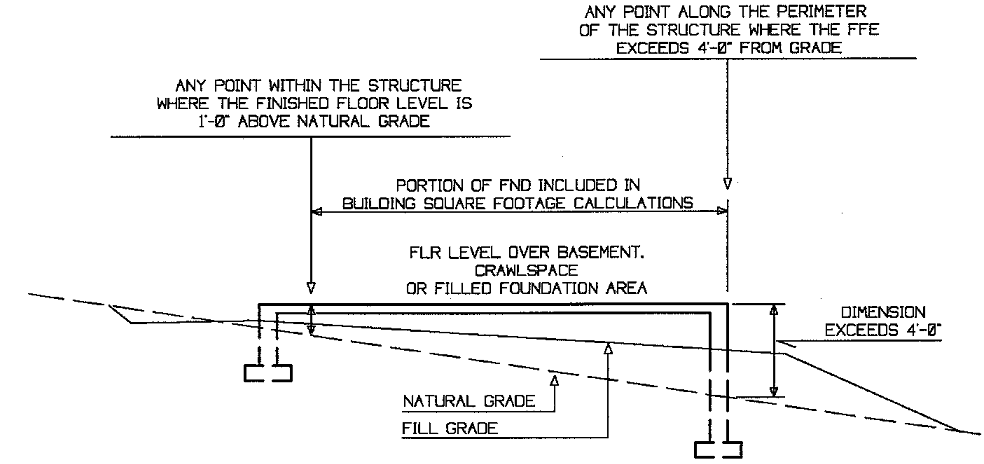
Figure 10-9A-10(C)(1)A.
Structure Placed on Natural Grades or Fill Grades
b.
When the structure is placed on cut grade the amount of area included in building size is equal to the portion of the footprint of the structure where there is more than one foot in vertical distance between cut grade and the finished floor elevation.
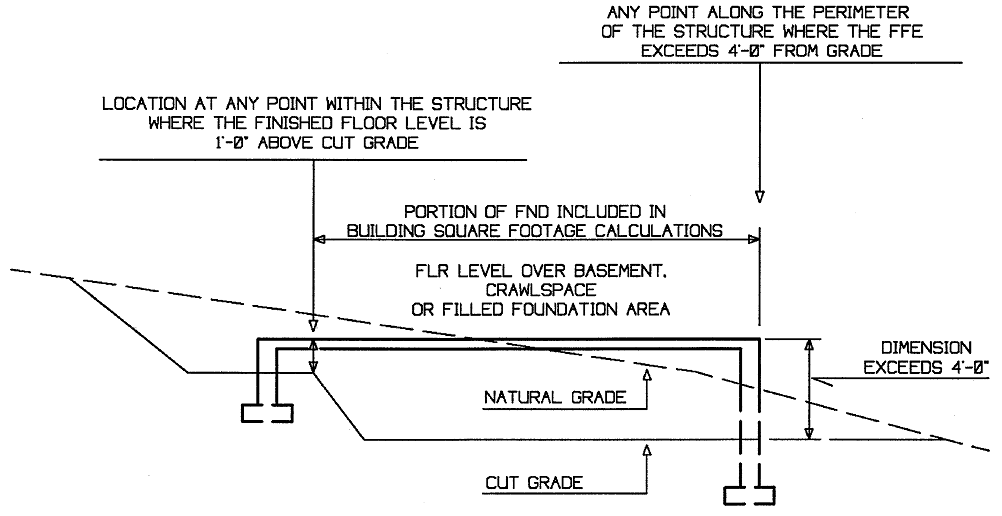
Figure 10-9A-10(C)(1)B. Structure Placed on Cut Grades
D.
Notwithstanding, a building that is elevated above natural grade for the sole purpose of flood protection is exempt from subsection C.1., provided that the building is located in a flood hazard zone according to the flood insurance rate map, and further provided that the building does not have a basement.
E.
Plan changes after approval: Any changes to the exterior envelope of a building after initial approval must be reviewed by the Planning Commission.
(Ord. No. 2021-10, § 1, 8-11-2021; Ord. No. 2022-12, 11-9-2022)
10-9A-11: - DISTANCE BETWEEN BUILDINGS: (FR ZONE)
The minimum distance between a main building and any accessory structure on a parcel is as follows. The distance is measured between the furthest extension of a permanent element on each building:
(Ord. No. 2022-06, § 3, 5-11-2022)
10-9A-12: - PARKING, LOADING AND ACCESS:
Each lot or parcel of land in the FR zone shall have, on the same lot or parcel of land, off-street parking and driveway access sufficient to comply with chapter 23 of this title. A required parking space may not be within a required setback.
10-9A-13: - BUILDING AND SITE DESIGN REQUIREMENTS:
A.
The following requirements apply to all new construction or reconstruction on a normal parcel and to the repair, maintenance, or alteration of any building or structure on a normal parcel:
1.
Building site: The proposed building or structure may not break the skyline when viewed from either the valley floor or SR-9 highway corridor, as defined by chapter 2 of this title. The proposed building or structure may not be located on a Hilltop, on a Ridgeline, or within 50 feet of the edge of a mesa.
2.
Building design: Building design elements, landscaping elements and the natural features of the lot or parcel of land shall be used and blended to produce the most unobtrusive building or structure feasible.
3.
Building materials: All exterior building and roofing materials must be nonreflective.
a.
Roofing materials must be heavily textured to prevent glare. A metal roof is allowed only if the property owner or a designee demonstrates to the satisfaction of the Planning Commission that the roof will not be reflective.
b.
Every effort shall be made in the size and placement of windows to minimize the reflectivity towards neighboring properties and the valley floor.
4.
Colors: Colors on all exterior building surfaces must conform to the color palette regulations as contained in chapter 17 of this title.
5.
Landscape features: The design and location of all buildings and structures shall be such as to retain as much of the existing environment as possible. Excavated and filled areas not built upon shall be revegetated with drought-tolerant native vegetation.
6.
Lighting: Exterior lighting may provide only that illumination necessary for safety in order to preserve, to the greatest extent possible, the visual qualities of the night sky and to protect neighboring properties from light pollution. No exterior fixture emitting light above a horizontal plane shall be permitted. All exterior fixtures must be recessed or fully shielded with no lens visible from outside the property boundaries.
B.
The following requirements apply to all new construction or reconstruction on a high visual impact parcel, and to repair, maintenance, or alteration of any building or structure on any high visual impact parcel:
1.
Building site: The building must blend with the natural topography of the site.
a.
If the building site is primarily flat, the building design shall have a horizontal, rather than vertical, emphasis. Any tall vertical element (chimneys, towers, etc.) must extend no more than two and one-half feet above any point within ten feet of the element.
b.
If the building site is sloped, the building must be built into the slope rather than the slope being cut or graded to develop a flat building pad.
c.
Existing natural features such as vegetation, boulders, and rock outcrops must be used (if present) to screen the most visual portions of the building. These features must be documented as part of the site analysis required for design/development review.
d.
Excavation and fill outside of the building footprint shall be minimized and any resulting scarring shall be completely restored and revegetated with drought-tolerant desert vegetation.
2.
Building design: Design elements, roofline variations, roof pitch modifications, varying of wall planes, other methods or combinations thereof, shall be used to maximize integration of the design into the site.
a.
Wall planes must feature a minimum four-foot recess at least every 30 linear feet.
b.
Unbroken rooflines may not exceed 25 linear feet in length.
c.
Roof pitch may not exceed six feet of rise in 12 feet of run.
d.
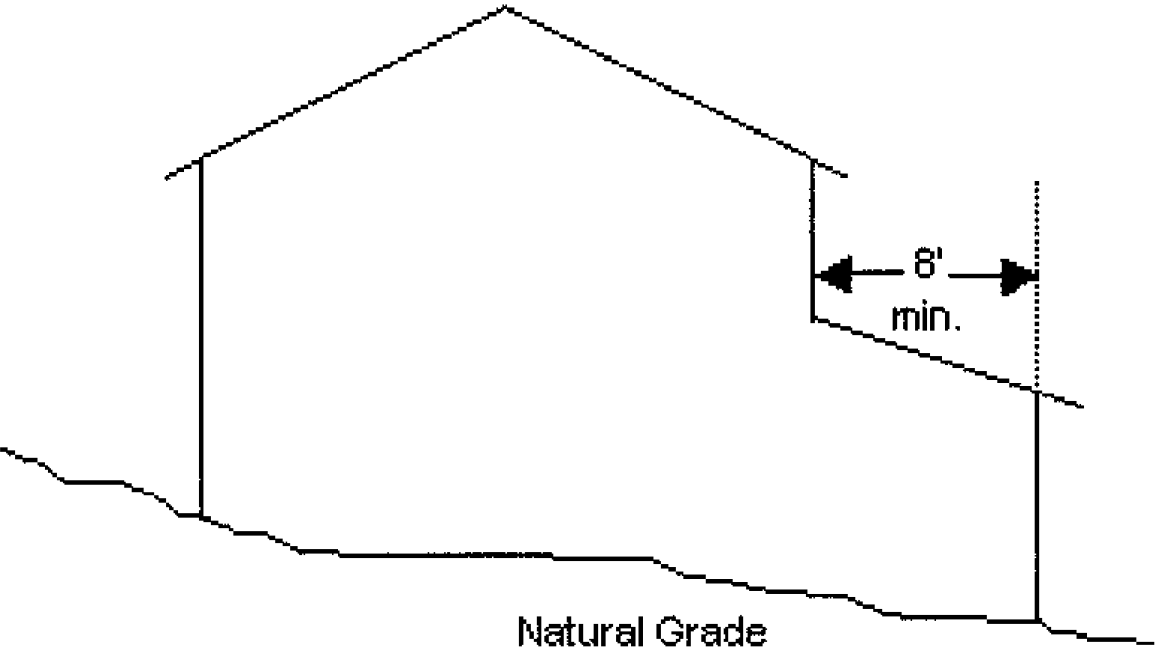
If the proposed building is a multi-story building, the outermost wall plane (or the outermost roof extension of a covered deck or patio if such extends farther than the outermost wall plane) of any story must be setback at least eight feet from the outermost wall plane of the story immediately below it on the building elevation that intersects the lowest natural grade.
3.
Building materials: Selection of exterior building and roofing materials, or combinations thereof, shall maximize integration of the design into the site. Window size and placement shall mitigate the window's reflective nature on the most highly visible sides of a building, as viewed from the valley floor or SR-9 highway corridor.
a.
No more than 25 percent of a building elevation that is visible from either the valley floor or the SR-9 highway corridor may be composed of windows.
b.
Building materials shall complement the natural characteristics of the site. For example, if the site is composed largely of slickrock sandstone, building materials shall complement the look of sandstone.
4.
Colors: Colors on all exterior building surfaces must conform to the color palette regulations as contained in chapter 17 of this title.
5.
Landscape features: On any building elevation visible from either the valley floor or the SR-9 highway corridor, landscape elements shall be used to integrate the building into the site. Any of the following options (or a combination of options) may be used to meet this standard:
a.
Drought-tolerant desert brush or trees that have a projected mature height of at least 15 feet shall be placed at random intervals along the building elevation visible from the valley floor or the SR-9 highway corridor with a maximum of ten feet in between placements. The homeowner shall irrigate and maintain the vegetation, and if any vegetation dies, the homeowner will replace it at the homeowner's expense.
b.
A stacked rock wall, composed of rocks very similar to those occurring on the building site, at least five feet in height, shall be placed along the length of the building elevation visible from the valley floor or the SR-9 highway corridor. The wall shall not be constructed in a straight line and shall be placed to preserve as many natural features of the lot as possible. Drought-tolerant desert vegetation shall be placed on the exterior side of the wall to soften the appearance of the wall from the valley floor and the SR-9 highway corridor.
c.
Boulders consistent with the natural characteristics of the site, at least ten feet in diameter, shall be placed at random intervals along the length of the elevation visible from the valley floor or the SR-9 highway corridor, with a maximum of ten feet in between boulders. The space in between the boulders shall be landscaped with drought tolerant desert shrubs.
6.
Lighting: Windows visible from either the valley floor or the SR-9 highway corridor must be tinted or equipped with blinds or shades to prevent light trespass. All light fixtures, both interior and exterior, shall not emit light visible beyond the property boundaries. Exterior lighting shall provide only that illumination necessary for safety in order to preserve, to the greatest extent possible, the visual qualities of the night sky and to protect neighboring properties from light pollution. No exterior fixture emitting light above a horizontal plane is permitted. All exterior fixtures shall be recessed or fully shielded with no lens visible from outside the property boundaries.
C.
Design standards for view-obstructing parcels: The design standards of this subsection apply to any view-obstructing parcel.
1.
Building Height: Building height shall be governed by Section 10-9A-10 of this article and Chapter 15A of this title, except that the height of any proposed structure on a View-Obstructing Parcel shall not exceed the greater of either: a) the lowest height which would cause the structure to not interrupt views of the vertical cliff faces of the Navajo Sandstone from any point not on the subject parcel and within 350 feet of the proposed structure, or b) 15 feet, as calculated by chapter 15A of this title.
2.
Building placement: The proposed structure must be placed on the parcel so as to minimize view obstruction from surrounding properties. The following requirements apply to the site location:
a.
Distance from existing structures: The proposed structure must be placed as far away as possible from existing structures that will suffer view obstruction, if the increased distance reduces view obstruction.
b.
Topography: The proposed structure must be placed in the lowest topographic area of the lot as feasible, unless compliance with this section would increase view obstruction on surrounding properties, interfere with natural drainages, or disturb slopes of 30 percent or more.
3.
Building element and roof orientation: Rooflines, roof parapets, gable ends, chimneys, and other similar building elements must be oriented in such a manner as to minimize view obstruction of the Navajo Sandstone from properties within 350 feet of the proposed structure.
4.
Landscaping: Drought-tolerant desert vegetation must be planted to screen the view of the structure from any existing structure that will suffer view obstruction.
(Ord. No. 2021-10, § 2, 8-11-2021)
10-9A-14: - SPECIAL REGULATIONS AND REQUIREMENTS:
A.
Commercial residential use: It is unlawful for a person to receive money or other consideration in exchange for the rental of any dwelling in the FR zone for a term of 90 days or less. A rental or other arrangement is unlawful under this subsection if it has the purpose or effect of renting any dwelling in any FR zone for a term of 90 days or less in exchange for money or other consideration.
B.
Minimum impact construction: All construction shall minimize the scarring and disturbance of the land through all phases of construction. No more than an area extending 30 feet from each exterior wall or structure may be disturbed unless approved on a grading plan or approved as trenching for irrigation or utility lines as shown on the approved landscape plan. The DCD or Planning Commission may allow a limited additional allowance in cases of hardship. The property owner shall revegetate all disturbed areas with indigenous noninvasive plants.
C.
Natural hazard: No permanent structure may be permitted or constructed if the construction would put real or personal property or individuals at unreasonable risk of harm or injury from natural, geologic, or topographic hazards including but not limited to landslides, floods, or excessive soil erosion. In addition to compliance with provisions of the state building code governing standards to meet the maximum foreseeable risk of such hazards, a person who develops, improves, manages, or owns such property shall safeguard the property and the general public from unreasonable risk of harm or injury from such natural hazards.
D.
Utilities: All utilities, including, but not limited to, water, sewer, electrical, telephone, fiber, and cable TV, shall be placed underground.
E.
Mechanical devices; screening: Air conditioners, heating, cooling and ventilating equipment, propane tanks, swimming pool pumps and heaters, and all other mechanical devices, must be screened from the surrounding properties and streets or lanes, and must be operated so that the noise does not exceed the applicable sound control levels under the Town ordinances. Facilities for the operation of alternate energy systems must be designed and constructed according to the standards in chapter 15E of this title.
F.
Motor vehicles and accessories: Required setbacks may not be used for the parking or storage of any motor vehicle or vehicle accessory such as camper shells, trailers, recreational vehicles, boats, motorcycles or other wheeled accessory or conveyance.
G.
Storage: A maximum area of 400 square feet may be used on any one lot or parcel of land for the permanent outdoor storage of any new or used materials, including, but not limited to, lumber, auto parts, household appliances, pipe, drums, machinery or furniture. The storage of such materials and motor vehicles or vehicle accessories shall be screened by a wall, fence, landscaping or structure if they are visible to surrounding properties or the public. The provisions of this subsection shall not be construed as to restrict the storage of firewood maintained for fuel purposes and use by the occupant of the premises. Outdoor storage of commercial goods or materials is prohibited. Materials being actively utilized in construction on the same lot or parcel of land, in excess of the permitted 400 square feet, may be stored outdoors until the completion of said construction or 90 days, whichever is less.
H.
Landscaping: Any part of a site not used for buildings, parking, driveways, walkways or other appurtenant uses shall be retained in a natural state, reclaimed to its natural state, or landscaped as necessary to enhance its natural state. Specific landscape requirements are found in Chapter 18 of this title.
10-9A-15: - DEFINITIONS:
View-obstructing parcel means any parcel for which a proposed structure on the parcel would interrupt views of the vertical cliff faces of the Navajo sandstone from any point not on the subject parcel and within 350 feet of the proposed building site.
(Ord. No. 2022-12, 11-9-2022)
10-9B-1: - PURPOSE AND OBJECTIVES:
The valley residential (VR) zone is established to provide areas in the Town where residential uses may be harmoniously integrated with incidental agricultural pursuits. This zone is intended to allow the keeping of farm animals and fowl in conjunction with single-family dwelling units to an extent consistent with the development. The VR zone is also intended to retain land in parcels or lots large enough to provide efficient and attractive residential development, which preserves the historic open agricultural and farm-type impression of the area.
10-9B-2: - PERMITTED, ACCESSORY AND CONDITIONAL USES:
The permitted, accessory, and conditional uses in the VR zone are specified in section 10-7A-2 of this title. A use is prohibited in the VR zone if it is designated as "N" in section 10-7A-2.
10-9B-3: - VR SUBZONES:
A.
The valley residential zone is divided into three subzones: VR-S, VR-A, and VR-B. The boundaries of each subzone are shown on the Town's official zoning map. Where a reference is made in this chapter to the VR zone without specifying which subzone, the reference includes all VR subzones.
B.
The VR-A and VR-B subzones are established solely to accommodate lots of small size that were created before the adoption of this title and do not conform to the lot size required by the VR zone. The Town Council will not approve zone change requests to the VR-A or VR-B subzone when the property conforms to the minimum lot size required by the VR-S zone, or when the property did conform to said minimum lot size in December 1992.
C.
New subdivisions are not allowed in the VR-A or VR-B subzones. Subdivisions in these subzones existing prior to 2013 will continue as noncomplying uses.
10-9B-4: - LOT AREA, LOT WIDTH, LOT FRONTAGE AND SLOPE:
A.
Lot area:
1.
VR-S subzone: The minimum area of any lot in the VR-S subzone is three-fourths acre.
2.
VR-A subzone: The minimum area of any lot in the VR-A subzone is one-fourth acre.
3.
VR-B subzone: The minimum area of any lot in the VR-B subzone is 5,000 square feet.
B.
Lot width:
1.
Each lot or parcel in the VR-S subzone must have a width of at least 100 feet.
2.
Each lot or parcel in the VR-A subzone must have a width of at least 75 feet.
3.
Each lot or parcel in the VR-B subzone must have a width of at least 50 feet.
C.
Slope: No building, structure, excavation, or fill is allowed on any natural grade of 30 percent or more unless it is specifically allowed under section 10-15B-9.A.
D.
Frontage: A lot or parcel in the VR zone must have at least 35 feet of frontage on a dedicated street, a publicly approved street, an approved private street, or an approved private lane, unless the lot is an approved flag lot. An approved flag lot in the VR zone must have at least 20 feet of frontage on a dedicated street, a publicly approved street, an approved private street, or an approved private lane. The distance shall be measured on a line parallel to the centerline of the street or lane or along the circumference of a cul-de-sac.
10-9B-5: - PRIOR CREATED LOTS:
A lot or parcel that was created before the December 1992 adoption of this title is eligible for a building permit notwithstanding any nonconformity with the requirements of lot area, width, or frontage in section 10-9B-4 of this article.
10-9B-6: - ONE DWELLING:
Each lot or parcel in the VR zone may have only one single-family dwelling or one duplex, except as otherwise provided in this title.
10-9B-7: - SETBACK REQUIREMENTS:
Each lot or parcel in the VR zone must have at least the following minimum setbacks:
A.
Front setback:
1.
VR-S subzone: 30 feet, except for lots three-quarters of an acre and larger with frontage on SR9. On those lots the front setback is 30 feet for all buildings and structures 18 feet and less in height and 50 feet for all buildings and structures greater than 18 feet and less than 26 feet in height.
2.
VR-A subzone: 30 feet.
3.
VR-B subzone: 15 feet.
B.
Side setback:
1.
VR-S and VR-A subzones: Ten feet.
2.
VR-B zone: Ten feet on one side of the lot and five feet on the opposite side of the lot, except that all development on the lot must be at least ten feet away from existing development on all adjacent lots.
C.
Side setback; corner lots:
1.
VR-S and VR-A subzones: 30 feet.
2.
VR-B zone: 15 feet.
D.
Rear setback:
1.
VR-S subzone: 20 feet.
2.
VR-A subzone and VR-B subzone: Ten feet.
(Ord. No. 2022-10, § 1, 6-22-2022)
10-9B-8: - ENCROACHMENTS INTO SETBACKS:
A.
The following may encroach into a required setback:
1.
A fence or wall that complies with the requirements of this title and all other applicable codes and ordinances;
2.
Landscape elements, including trees, shrubs, and other plants;
3.
A necessary appurtenance for utility services; and
4.
A sign that is allowed under chapter 24 of this title.
B.
Required parking spaces on lots less than 8,000 square feet may encroach into the front setback only if: (a) there is at least ten feet between the edge of the parking area and the front lot line; and (b) the width of the required parking spaces does not equal more than 40 percent of the width of the frontage of the lot.
C.
Conditions attached: The Planning Commission may impose conditions on any encroachment that is allowed under subsections 10-9B-8(A) or (B).
10-9B-9: - BUILDING SIZE AND HEIGHT:
A.
Square footage: A building in the VR zone may not have a total square footage of over 3,000 square feet, as calculated in accordance with this section.
1.
Total square footage under this section includes all the areas enclosed by walls (measured from the face of the outside wall to the face of the outside wall, including attached garages) on all stories of the structure, as well as all functional areas covered by a roof, trellis, or other similar structure including but not limited to patios, porches, and covered walkways. A basement is included in the calculation of total square footage of a structure only to the extent provided in subsection A.2.
2.
If the vertical distance between either natural grade or cut grade and the finished floor elevation (FFE) of the first floor of a structure at any point on an exterior building surface (including but not limited to basement walls, crawl space walls, foundation walls, pool deck walls, and decking), exceeds four feet, then the footprint of the structure below the FFE of the first floor is counted in the calculation of building square footage, as detailed below:
a.
If the structure is placed on natural grade or fill grade, the amount of area included in building square footage is equal to the portion of the footprint of the structure where there is more than one foot in vertical distance between natural grade and the FFE of the main floor.
b.
If the structure is placed on cut grade, the amount of area included in building square footage is equal to the portion of the footprint of the structure where there is more than one foot in vertical distance between cut grade and the FFE.
3.
Subsection A.2. does not apply to any building that is elevated above natural grade for the sole purpose of flood protection, provided that the building is located in a flood hazard zone according to the flood insurance rate map, and further provided that the building does not have a basement.
B.
Height: A principal structure on a normal lot in the VR-S and VR-A subzones may not be more than 21 feet high. A principal structure on a high visual impact lot in the VR-S and VR-A subzones may not be more than 16 feet high. A principal structure in the VR-B subzone may not be more than 17 feet high, and any portion of a principal structure in the VR-B subzone that is within five feet of a required setback may not be more than 13 feet high.
C.
Height measurement. The height of any structure for purposes of section 10-9B-9(B) above is measured from the uniform, natural, or cut grade as provided under section 10-15A-5. A chimney is included in the height calculation only if it is more than five feet wide.
D.
No structure in the VR zone may have more than two stories.
E.
An accessory building or structure may not be taller than any principal structure on the same lot.
(Ord. No. 2021-10, § 3, 8-11-2021; Ord. No. 2022-12, 11-9-2022)
10-9B-10: - DISTANCE BETWEEN BUILDINGS: (VR ZONE)
A main building and any accessory structure on a lot must be separated by at least the following minimum distances. This distance is measured between the furthest extension of a permanent element on each building:
(Ord. No. 2022-06, § 4, 5-11-2022)
10-9B-11: - REQUIRED LANDSCAPING:
Development in the VR zone must be consistent with the standards of chapter 18 of this title.
10-9B-12: - PARKING, LOADING AND ACCESS:
Each lot in the VR zone shall have, on the same lot, off-street parking spaces sufficient to comply with chapter 23 of this title. Required parking spaces may not be provided within a required setback.
10-9B-13: - SPECIAL REGULATIONS:
A.
Commercial residential use: It is unlawful for a person to receive money or other consideration in exchange for the rental of any dwelling in the VR zone for a term of 90 days or less. A rental or other arrangement is unlawful under this subsection if it has the purpose or effect of allowing the rental of any dwelling in the VR zone for a term of 90 days or less in exchange for money or other consideration.
B.
Natural hazard: No permanent structure may be permitted or constructed if the construction would put real or personal property or individuals at unreasonable risk of harm or injury from natural, geologic, or topographic hazards including but not limited to landslides, floods, or excessive soil erosion. In addition to compliance with provisions of the state building code governing standards to meet the maximum foreseeable risk of such hazards, a person who develops, improves, manages, or owns such property shall safeguard the property and the general public from unreasonable risk of harm or injury from such natural hazards.
C.
Utilities: All utilities shall be placed underground on the subject property.
10-9B-14: - OTHER REQUIREMENTS:
A.
Mechanical devices: Air conditioners, heating, cooling and ventilating equipment, propane tanks, swimming pool pumps and heaters, and all other mechanical devices must be screened from the surrounding properties and streets or lanes, and must be operated so that the noise does not exceed the applicable sound control levels under the Town ordinances. Facilities for the operation of alternate energy systems must be designed according to the standards in chapter 15E of this title.
B.
Motor vehicles and accessories: Required front or side setbacks may not be used for the permanent parking or storage of any motor vehicle or vehicle accessory such as camper shells, trailers, recreational vehicles, boats, motorcycles or other wheeled accessory or conveyance.
C.
Storage: No more than 400 square feet on a lot may be used for the permanent outdoor storage of any new or used materials, including, but not limited to, lumber, auto parts, household appliances, pipe, drums, machinery or furniture. Any permanent outdoor storage subject to this subsection must be screened from surrounding properties and from public view by a wall, fence, landscaping, or other structure, and the permanent outdoor storage must be located to the side or rear of the main dwelling or structure. Notwithstanding the foregoing, this subsection does not apply to firewood that is maintained for fuel purposes and use by the occupant of the premises. Storage of commercial foods or materials is expressly prohibited. Materials being actively utilized in construction on the same lot for which all appropriate permits have been issued, may be stored outdoors until the completion of said construction or 90 days, whichever is less.
D.
Wildlife corridors: The VR zone is comprised primarily of the greenbelt and Virgin River areas of the canyon valley. Much of the wildlife living in Zion Canyon depend on the river and the greenbelt for their survival. The Planning Commission may reasonably restrict the use of land, buildings, structures, fences and walls within the VR zone to maintain adequate wildlife corridors for access from the foothills to the river valley.
10-9C-1: - PURPOSE:
The Town recognizes that certain residential subdivisions and areas were platted and developed before the 1992 adoption of this title with lot sizes much smaller than this title requires. Because the lots are deficient in lot area, existing development on those lots is also typically out of compliance with required landscape and setback standards. Proposed new development and redevelopment on small lots also has difficulty meeting landscape and setback requirements. The purpose of this article is to allow flexibility in setbacks and landscape standards on small lots in order to accommodate reasonable development and/or redevelopment, consistent with existing patterns of development on similar small lots in the general area.
10-9C-2: - APPLICABILITY:
The standards of this chapter apply to any lot in the FR zone that meets the definition of "small lot" under section 10-9C-3.
10-9C-3: - SMALL LOT DEFINITION:
A lot is considered a "small lot" under this chapter if it meets each of the following requirements:
A.
The lot is 32,000 square feet or less;
B.
The lot was lawfully created before December 1, 1992;
C.
The lot is not subject to any variance, special exception, settlement agreement, development agreement, court order, or other similar entitlement or agreement that governs lot size, setback, or lot coverage standards; and
D.
The lot is used only for residential purposes.
10-9C-4: - SETBACK AND LANDSCAPE STANDARDS:
Setbacks and landscape standards on a small lot are governed by the standards in the table below and not by the setback and landscape standards contained in the FR zone:
TABLE 1 LANDSCAPE AND SETBACK STANDARDS FOR A SMALL LOT IN THE FR ZONE
10-9C-5: - BUILDING HEIGHT STANDARDS:
Building height for small lots governed by this article shall be governed by the underlying zoning.
10-9C-6: - PARKING IN SETBACKS:
Required parking spaces on small lots not within structures may encroach into any side or rear setback, provided there is at least five feet between the edge of the parking area and the side or rear lot line.

