
Springdale City Zoning Code
CHAPTER 11
COMMERCIAL ZONES
10-11A-1: - PURPOSE AND OBJECTIVES:
The central commercial (CC) zone is established to provide a district in which the primary use of the land is for retail commercial and service use to serve the needs of the residents of the Town and the visitors to the area. Development in the CC zone should reflect Springdale's rural, pioneer, and agricultural heritage. As the Town's "Downtown" area, the CC zone should be clearly identifiable from other zones in appearance and intensity of development. The CC zone should feature a mix of land uses, clean and quaintly lighted streets, village scale development with abundant pedestrian walkways, and feasible off street parking areas. The CC zone should make provisions for affordable and employee housing, especially as second story dwelling units over commercial uses. The front of buildings and lots as seen from SR-9 should be inviting, accommodate pedestrian travel, and should be landscaped with appropriate drought tolerant vegetation.
10-11A-2: - PERMITTED, ACCESSORY AND CONDITIONAL USES:
Permitted uses, accessory uses, conditional uses, and nonpermitted uses in the CC zone are listed in section 10-7A-2 of this title.
10-11A-3: - LOT AREA, LOT WIDTH, LOT FRONTAGE, SLOPE:
A.
Lot area: The minimum area of any lot or parcel of land within the CC zone is one-fourth acre.
B.
Lot width: Each lot or parcel of land in the CC zone must have a minimum width of at least 50 feet.
C.
Lot frontage: Each lot or parcel of land in the CC zone shall have frontage on a dedicated public street or private street constructed to meet all of the standards of the Town's Construction Design Details and Standards Manual. The frontage shall be for a minimum distance of 50 feet, on a line parallel to the centerline of the street or along the circumference of a cul-de-sac. No lot or parcel of land in the CC zone shall be accessed through a VR or FR lot or parcel.
D.
Slope: No building, structure, excavation or fill is permitted on any natural grade of 30 percent or greater, except as specifically allowed by subsection 10-15B-9.A. of this title.
(Ord. No. 2023-09, § 1, 10-11-2023)
10-11A-4: - PRIOR CREATED LOTS:
Lots or parcels of land which were legally created before December 1992 shall not be denied a building permit solely for the reason of nonconformance with the requirements of lot area, width, or frontage in section 10-11A-3 of this article.
10-11A-5: - BUILDING SIZE:
A.
Individual building gross area: The gross area of each individual building or structure on a lot or parcel of land in the CC zone shall not exceed 8,500 square feet, except that an additional 4,000 square feet of gross area may be allowed according to the criteria established in subsections A.1. and A.2. of this section. In no case may an individual building in the CC zone exceed 12,500 square feet in gross area.
1.
The gross area of any individual building may be increased according to the bonuses below.
a.
An additional 2,500 square feet for one individual building on a property if the property provides and maintains public restrooms. In order to qualify for this additional square footage the property owner must provide both men's and women's restrooms, with entrances accessible directly from the outside of the building. The restrooms must be clearly signed and advertised as public restrooms. The restrooms do not need to be in the building receiving the bonus.
b.
An additional 1,333 square feet for one individual building on a property for each employee or affordable housing unit included in the development. Such employee or affordable housing shall be subject to the requirements of chapter 6A of this title. The affordable or employee housing does not need to be in the building receiving the bonus.
c.
An additional 1,500 square feet for the use of red sandstone resembling that native to the Springdale area on at least 30 percent of the building facade that faces a public street. (Stone veneer greater than four feet in height must be seismically reinforced.) The stone must be used on the building receiving the bonus.
2.
A building that is set back at least 300 feet from SR-9 and 100 feet from a residential zone may be increased in gross area up to 12,500 if the Planning Commission finds that adequate design features and site planning techniques have been incorporated into the development to mitigate the visual impact of the building.
3.
Notwithstanding subsection A.1. of this section, no more than 8,500 square feet of any individual building may be within 100 feet of the SR-9 right-of-way.
4.
Covered walkways designed to provide a covered pedestrian connection from one building to another shall not be included in gross area calculations, nor shall such walkways be construed as combining two buildings into a single building, if the following criteria are met:
a.
The walkway is not enclosed by a wall, screen, or other similar element on either side.
b.
The width of the overhead covering for the walkway is no more than ten feet.
c.
All walls, roofs, and other structural elements of the individual buildings are separated by the required building separation distances.
10-11A-6: - SETBACK REQUIREMENTS:
A.
Building setbacks: Buildings shall be set back from property lines according to the standards listed below:
1.
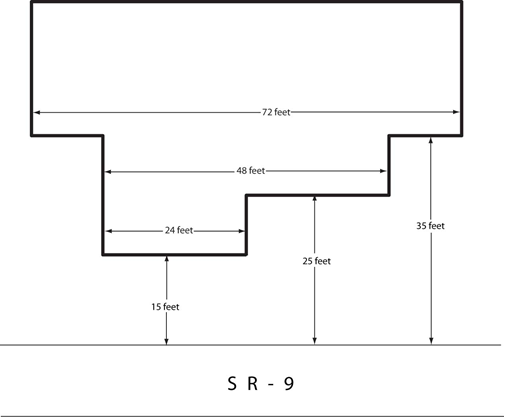
Setbacks from the SR-9 right-of-way shall increase as the total amount of building wall frontage facing SR-9 increases. This method allows portions of buildings to be brought closer to the street while requiring most of the mass of the building (as measured by building wall frontage) to be set back from the street. The table below lists the total amount of building wall frontage allowed at different setback distances from the SR-9 right-of-way. The amounts of building wall frontage in the table apply to lots with 100 feet or less of frontage along SR-9. On lots with more than 100 feet of frontage along SR-9, the amount of total building wall frontage allowed will be prorated based on the amount of frontage along SR-9. For example, for a lot with 150 feet of frontage on SR-9 the amount of total building wall frontage in the table would be increased 1.5 times. For a lot with 235 feet of frontage on SR-9 the amount of total building wall frontage shown in the table would be increased 2.35 times.
Note: Properties with less than 100 feet of frontage on SR-9 are allowed the building wall frontages shown in the right column of the table above.
The figure below is a sample illustration of how these setback requirements are applied.
2.
On lots with more than 100 feet of frontage along SR-9, the total building wall frontage measurements per 100 feet of SR-9 frontage allowed by subsection A.1. of this section must be separated by at least the distances specified in the table below. For example, a lot with 235 feet of frontage along SR-9 may have 56.4 feet of building wall frontage at a 15-foot setback; however, there may be no more than 24 feet of building wall frontage before a 48-foot separation is required to the next 24 feet of building wall frontage at the 15-foot setback.
3.
Setbacks on property lines not regulated by subsections A.1. and A.2. of this section shall be as follows:
a.
Front setbacks shall be a minimum of 15 feet.
b.
Side setbacks on lots with more than 100 feet of lot width shall be a minimum of ten feet.
c.
Side setbacks on lots with 100 feet or less of lot width shall be a minimum of ten feet.
d.
Side setbacks for corner lots shall be 15 feet along the side property line adjacent to the street, unless the street is SR-9 in which case side setbacks shall be determined by subsections A.1. and A.2. of this section.
e.
Rear setbacks shall be ten feet.
f.
When a property is adjacent to a zone other than the CC zone, side and rear setbacks along the property line adjacent to the different zone shall be the same as those for the adjacent zone.
B.
Encroachments into setbacks: The following elements may encroach on the required setbacks:
1.
Fences and walls in conformance with section 10-20-9 of this title and all other applicable codes or ordinances.
2.
Landscape elements including trees, shrubs, and other plants.
3.
Necessary devices for utility services.
4.
A signs that complies with chapter 24 of this title.
5.
Pedestrian conveniences such as park benches and drinking water fountains.
6.
Outdoor commercial uses such as outdoor seating areas or open air displays (in conformance with section 10-22-9 of this title), provided: a) that such outdoor commercial use does not cover more than 50 percent of the setback area, and b) there is a minimum three-foot landscape buffer between the property line and the outdoor commercial use.
7.
Uncovered patios and porches.
8.
Retractable awnings or sunscreens, provided such awnings or sunscreens do not project more than ten feet into the setback.
10-11A-7: - DENSITY STANDARD:
No lot or parcel of land within the CC zone may be developed to have more than one apartment, condominium, or other similar unit per 2,500 square feet of land area.
(Ord. No. 2023-08, § 2, 12-13-2023)
10-11A-8: - BUILDING HEIGHT:
The height of any structure in the CC zone is measured as provided in chapter 15A of this title.
A.
For any portion of a building or structure within 30 feet of the SR-9 right-of-way, the maximum building height is 20 feet.
B.
For any portion of a building or structure located on a normal lot and set back 30 feet or more from the SR-9 right-of-way, the maximum building height is 26 feet. For any portion of a building or structure located on a high-visual impact lot and setback 30 feet or more from the SR-9 right-of-way, the maximum building height is 21 feet.
C.
No structure in the CC zone may contain more than two stories.
(Ord. No. 2022-12, 11-9-2022)
10-11A-9: - DISTANCE BETWEEN BUILDINGS:
The minimum distance between any buildings or structures on the same lot or parcel shall be at least ten feet, as measured by the distance between the furthest extensions (including eave overhangs and exterior stairwells) of each building.
10-11A-10: - REQUIRED LANDSCAPING:
All lots in the CC zone shall be landscaped in conformance with chapter 18 of this title.
10-11A-11: - PARKING:
Off street parking in the CC zone must conform to the standards contained in chapter 23 of this title.
10-11A-12: - SPECIAL REGULATIONS:
A.
Natural hazard: No permanent structure may be permitted or constructed if the construction would put real or personal property or individuals at unreasonable risk of harm or injury from natural, geologic, or topographic hazards including but not limited to landslides, floods, or excessive soil erosion. In addition to compliance with provisions of the state building code governing standards to meet the maximum foreseeable risk of such hazards, a person who develops, improves, manages, or owns such property shall safeguard the property and the general public from unreasonable risk of harm or injury from such natural hazards.
B.
Utilities underground: All new utilities in the CC zone shall be placed underground.
10-11A-13: - OTHER REQUIREMENTS:
A.
Mechanical devices: Air conditioners, heating, cooling and ventilating equipment, propane tanks, swimming pool pumps and heaters, and all other mechanical devices, shall be screened from view from the surrounding properties and streets or lanes, and shall be operated so that the resulting sound does not exceed the applicable sound control levels as set forth in Town ordinances. Facilities for the operation of alternate energy systems must be designed according to the standards in chapter 15E of this title.
B.
Trash storage: No trash, used materials or wrecked or abandoned vehicles or equipment may be stored in open areas. All such materials shall be screened from public streets or walkways and adjacent properties with an opaque fence or wall, or shall be stored within an enclosed building.
C.
Screening: A decorative wall, fence or landscape screen may be required of a commercial use, along all property lines which lie adjacent to an FR or VR zone or a residential use of a VC or CC zone. The DCD or Planning Commission shall determine if such a wall, fence or screening is appropriate and the extent thereof on a case by case basis.
D.
Lighting: All outdoor lighting must comply with chapter 15C.
E.
Storage: The outside storage of objects and materials is permitted only as an accessory use, providing such storage is totally screened from public view or view of any contiguous property.
F.
Trash receptacles: Each property in the CC zone with a commercial use must provide outdoor trash receptacles for its patrons to use. A sufficient number of receptacles must be provided to accommodate the trash generated by patrons of the commercial use. Each property must provide at least one trash receptacle. The design of the trash receptacle must be consistent with the Town's design standards. The trash receptacle must be located so as to be of convenient use by patrons of the commercial use on the property.
10-11A-14: - DESIGN STANDARDS:
A.
Design Standards Manual: The Town of Springdale Design Standards Manual, available at the Town Office, is hereby incorporated into this chapter by reference. The manual contains graphic examples and explanations of the standards contained in this chapter.
B.
Design standards: New development in the CC zone, as well as substantial alterations to existing development in the CC zone, must conform to the following design standards. These standards are adopted in order to more fully promote a visual character consistent with Springdale's village character and small town feel. These standards are intended to supplement the architectural standards and design guidelines in chapter 16 of this title. In the event of a conflict between these standards and those in chapter 16 of this title, the more restrictive requirement (as determined by the Planning Commission) shall apply.
1.
Covered porches: Each building, any portion of which is within 75 feet of Zion Park Boulevard, shall include a covered porch on the building elevation that faces Zion Park Boulevard. There shall be a minimum six-foot wide pedestrian pathway that connects the covered porch to the public sidewalk system. The pedestrian pathway may not be adjacent to a parking area or a parking access lane.
2.
Reentrant corners: No more than 40 feet of any building wall shall be allowed without a minimum four-foot reentrant corner. This provision does not apply to building walls that will not be visible from SR-9 or other public streets.
3.
Pedestrian amenities: Each property shall include at least one exterior amenity for the convenience of pedestrians or bicyclists intended to encourage outdoor pedestrian activity and gatherings or bicycle transportation. Such amenities could include, but are not limited to, benches, drinking fountains, bicycle parking or seating areas with tables. The pedestrian amenity must be integrated into the overall site planning and landscape design for the property and must be easily accessible to pedestrians.
4.
Open plazas: Open plazas and similar outdoor gathering spaces must be incorporated into all new commercial development within 100 feet of the SR-9 right- of-way. The plaza or courtyard must be located to the front or side of the building and include one or more of the pedestrian or bicycle amenities listed in subsection B.3. of this section. The plaza or courtyard must include shaded areas by means of trellis structures, umbrellas, trees with large shade canopies, or other similar means of providing shade.
C.
Design guidelines: New development in the CC zone must include design features intended to break up the mass of buildings, reduce the visual impact of new development, and make new development compatible with Springdale's village scale and rural character. The following design considerations should be included in new development. The Planning Commission will take these design elements into account in granting allowances for larger buildings and increased building heights allowed by sections 10-11A-5 and 10-11A-8 of this article.
1.
Introduction of shadow lines.
2.
Use of mixed materials for exterior building surfaces.
3.
Avoiding large, unbroken wall and roof surfaces.
4.
Integration of open space in the placement of buildings, parking areas, and other improvements to promote pedestrian mobility and convenience.
5.
Respect for and integration of historic elements such as the stone irrigation ditch and historic structures on the site or adjacent properties.
10-11B-1: - PURPOSE AND OBJECTIVES:
The village commercial (VC) zone is established to provide areas in the Town where low impact commercial and service uses may be harmoniously integrated with low and medium density residential uses and preserve a village scale in the development thereof. Serving as a buffer area between the low density VR and FR zones and the higher density CC zone, this zone is intended to allow for a lower density of buildings and structures and a lesser impact from noise, lighting and activity levels than those normally associated with commercial development. It is also intended to ensure buildings with a residential character and scale, a feeling of open space around buildings and preservation of public views of the area's natural and scenic beauty.
10-11B-2: - PERMITTED, ACCESSORY AND CONDITIONAL USES:
Permitted uses, accessory uses, conditional uses, and nonpermitted uses in the VC zone are listed in section 10-7A-2 of this title.
10-11B-3: - LOT AREA, LOT WIDTH, LOT FRONTAGE, SLOPE:
A.
Lot area: The minimum area of any lot or parcel in the VC zone is one-half acre.
B.
Lot width: Each lot or parcel of land within the VC zone must have an average width of 100 feet, with a minimum of 50 feet.
C.
Lot frontage: Each lot or parcel of land in the VC zone shall have frontage on a dedicated public street or private street constructed to meet all of the standards of the Town's Construction Design Details and Standards Manual. The frontage shall be for a minimum distance of 50 feet, on a line parallel to the centerline of the street or along the circumference of a cul-de-sac. No lot or parcel of land in the VC zone shall be accessed through a VR or FR lot or parcel.
D.
Slope: No building, structure, excavation or fill shall be permitted on any natural grade of 30 percent or greater, except as specifically allowed by subsection 10-15B-9.A. of this title.
(Ord. No. 2023-09, § 2, 10-11-2023)
10-11B-4: - PRIOR CREATED LOTS:
Lots or parcels of land which were legally created before December 1992 will not be denied a building permit solely for the reason of nonconformance with the requirements of lot area, width, or frontage in section 10-11B-3.
10-11B-5: - AREA REQUIREMENTS:
A.
Building size: The gross area of each individual building or structure on a lot or parcel within the VC zone shall not exceed 5,000 square feet. Gross area shall include all attached structures and exclude basements. Buildings or structures not exceeding 8,000 square feet may be allowed if said structure is located a minimum of 100 linear feet from SR-9 (Zion Park Boulevard) and/or a residential zone (VR or FR zone). The linear distance requirements may contain other buildings or structures and should not be substituted for the unobstructed setback requirements of section 10-11B-6 of this article.
B.
Units per lot: No lot or parcel of land within the VC zone may be developed to have more than one apartment or similar unit per 4,000 square feet of net developable land area.
(Ord. No. 2022-11, § 2, 6-22-2022; Ord. No. 2023-08, § 3, 12-13-2023)
10-11B-6: - SETBACK REQUIREMENTS:
The following minimum setback requirements apply to each lot or parcel of land within the VC zone:
A.
Front setback: Each lot or parcel of land must have a front setback of not less than 30 feet, except for lots one-half acre and larger with frontage on SR9. On those lots the front setback is 30 feet for all buildings and structures 18 feet and less in height, and 50 feet for all buildings and structures greater than 18 feet and less than 26 feet in height.
B.
Side setback: Each lot or parcel of land shall have a side setback of not less than ten feet, except where the side of the lot abuts a lot or parcel in an FR or VR Zone. In such cases, the required setback of the abutting side must be at least 20 feet.
C.
Side setback, corner lots: The side setback contiguous to any street shall be the same as required front setback.
D.
Rear setback: Each lot or parcel of land shall have a rear setback of not less than 20 feet.
E.
Exemption: In instances where the adjacent property is commercially zoned and where a building or structure on such adjacent property is already in existence closer than the required side and rear setback, the Planning Commission may allow a side or rear setback less than that stated above if it finds that the reduction would not be detrimental to the health, welfare, or safety of persons residing or working in the vicinity.
(Ord. No. 2022-10, § 2, 6-22-2022)
10-11B-7: - ENCROACHMENTS INTO SETBACKS:
A.
The following structures may encroach on any required setback:
1.
Fences and walls in conformance with section 10-20-9 of this title and all other applicable codes or ordinances;
2.
Landscape elements including trees, shrubs and other plants;
3.
Necessary appurtenances for utility services;
4.
A sign that complies with chapter 24 of this title;
5.
Noncommercial pedestrian conveniences such as drinking water fountains, park benches and the like;
6.
Outdoor commercial uses such as outdoor seating areas or open air displays, provided there is a minimum ten-foot wide buffer planted with screening vegetation between any outdoor commercial use and an adjacent residentially zoned property. A minimum five-foot high solid fence or wall is also required on any property line between a commercial use allowed in the setbacks and a residentially zoned property. No sound amplification is allowed in the setback areas.
7.
Parking spaces, not contained within a building or structure, may be permitted to encroach on a required side or rear setback or that portion of the front setback contiguous to the side setback (see illustration #1 of this subsection A.7.), with the approval of the Planning Commission. In any such case, parking spaces shall not project into greater than one-half of the required rear or side setback, nor greater than 25 feet into the front setback. The remaining setback, without parking spaces, shall directly abut property line of said lot or parcel of land. To approve any such encroachment, the Planning Commission must find:
a.
Such parking will in no way be detrimental to the health, safety or welfare of persons residing or working in the vicinity, nor unreasonably interfere with the enjoyment of property or improvements in the vicinity; and
b.
The location of an existing building or existing parking spaces render alternate parking locations impractical and infeasible; or
c.
An unusually shaped or sized lot renders alternate parking locations impractical and infeasible.
Illustration #1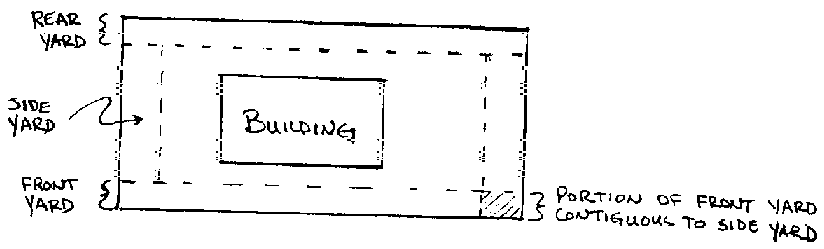
B.
The Planning Commission may attach conditions to the erection of any such structures into required setbacks.
10-11B-8: - BUILDING HEIGHT:
The height of any structure in the VC zone is measured in accordance with chapter 15A of this title.
A.
The maximum height for any structure on a normal lot in the VC zone is 26 feet, except as allowed by subsection D. of this section. The maximum height for any structure on a high-visual impact lot in the VC zone is 21 feet.
B.
No building or structure in the VC zone shall contain more than two stories, except as allowed by subsection E. of this section.
C.
In no case shall the height of any accessory building or structure exceed the height of any principal structure on the same lot or parcel.
D.
The maximum height for a structure is increased to a total of 28 feet if the highest finished floor elevation of the first floor of the building is more than four feet below the lowest elevation of the SR-9 roadway fronting the property.
E.
A building in the VC zone may have a third story walkout basement or basement parking area if all of the following requirements are met:
1.
The highest finished floor elevation of the first floor of the building is at least two feet below the elevation of the lowest elevation of the SR-9 roadway fronting the property.
2.
The walkout basement or parking area entrance opens on the side of the building opposite SR-9.
3.
There is at least six feet of natural topographic relief between the side of the building facing SR-9 and the opposite side of the building, SR-9 side being the higher side. This natural topographic relief must be retained during development of the building.
4.
The building does not exceed the height limit established in subsection A. of this section.
(Ord. No. 2022-12, 11-9-2022)
10-11B-9: - DISTANCE BETWEEN BUILDINGS: (VC ZONE)
The distance between any two buildings or structures on the same lot or parcel of land must be equal to or greater than the average height of the two buildings being compared. The distance between buildings is measured between the furthest extension of a permanent element on each building.
(Ord. No. 2022-06, § 5, 5-11-2022; Ord. No. 2022-14, 12-14-2022)
10-11B-10: - REQUIRED LANDSCAPING:
Development in the VC zone shall comply with the standards of chapter 18, "Landscaping", of this title.
10-11B-11: - PARKING, LOADING AND ACCESS:
Each lot or parcel of land in the VC zone shall have on the same lot or parcel of land, the minimum off street parking to comply with the requirements of chapter 23 of this title.
10-11B-12: - SPECIAL REGULATIONS:
A.
Natural hazard: No permanent structure may be permitted or constructed if the construction would put real or personal property or individuals at unreasonable risk of harm or injury from natural, geologic, or topographic hazards including but not limited to landslides, floods, or excessive soil erosion. In addition to compliance with provisions of the state building code governing standards to meet the maximum foreseeable risk of such hazards, a person who develops, improves, manages, or owns such property shall safeguard the property and the general public from unreasonable risk of harm or injury from such natural hazards.
B.
Grading: To reduce the possibility of erosion and eliminate unsightly scars within the Town, all excavation, grading, cut and fill operations and siting of roads shall be done under strict control and approval of the Director of Community Development (DCD). Upon review of the building or excavation permit application, the DCD may require a specific revegetation plan and schedule, approved by the Planning Commission, as a condition of the permit issuance. A geotechnical report describing the stability and suitability of said lot or parcel for development must be submitted and approval given prior to the issuance of any excavation permit, pursuant to section 10-1-8 of this title.
C.
Landscaping:Chapter 18 of this title shall apply to all commercial and multi-family residential uses within the VC zone.
D.
Utilities: All utilities shall be placed underground.
10-11B-13: - OTHER REQUIREMENTS:
A.
Mechanical devices: Air conditioners, heating, cooling and ventilating equipment, propane tanks, swimming pool pumps and heaters, and all other mechanical devices shall be screened from the surrounding properties and streets or lanes, and shall be operated so that the resulting sound does not exceed the applicable sound control levels as set forth in Town ordinances. Facilities for the operation of alternate energy systems must be designed according to the standards in chapter 15E of this title.
B.
Signs: All signs erected in the VC zone shall comply with the provisions of chapter 24 of this title.
C.
Trash storage: No trash, used materials, or wrecked and abandoned vehicles or equipment shall be stored in open areas. All such materials shall be screened from public streets or walkways and adjacent properties with an opaque fence or wall, or shall be stored within an enclosed building.
D.
Screening: A decorative masonry wall, fence or landscape screen may be required of a commercial use along all property lines which lie adjacent to an FR or VR zone or a residential use of a VC or CC zone. The DCD or Planning Commission shall determine the appropriateness of such a wall, fence or screen on a case by case basis.
E.
Lighting: All outdoor lighting shall comply with chapter 15C.
F.
Storage: The outside storage of objects and materials is permitted only as an accessory use, providing such storage is totally screened from public view or view of any contiguous property.
G.
Standards and design: Lots with frontage on SR-9 and to be developed for a single-family dwelling are additionally subject to the architectural standards and design guidelines of chapter 16 of this title.

