
Springdale City Zoning Code
CHAPTER 15A
BUILDING HEIGHT
10-15A-1: - PURPOSE:
The purpose of this chapter is to establish a uniform method for measuring the height of any building or structure in any zone. The chapter is also established to ensure the height of all buildings and structures is appropriate to maintain the Town's village scale.
10-15A-2: - APPLICABILITY:
The measurement method provided in this chapter applies to any proposed new building or structure in all zones. The method also applies to the renovation or remodeling of an existing building or structure in all zones.
10-15A-3: - DEFINITIONS:
Cut grade: Cut grades are produced by the removal of soil, rock, or other materials for the purposes of leveling or enhancing a site for the construction of a structure. Excavations to facilitate cut grades extend four feet or more past and outside the exterior walls of a proposed structure. This is in contrast to basement or other foundation excavations which are cut only to a limit required for the installation of the foundation and which are tightly backfilled to foundation walls.
Edge of a mesa: The grade break between horizontal or nearly horizontal terrain and a vertical or near vertical cliff face (at least 30 feet in height) at the upper terminus of the cliff.
Fill grade: Fill grades are produced by the placement of soil, rock, or other materials over natural grades for the purposes of leveling or enhancing a site for the construction of a structure. Fill grades extend past and outside the exterior walls of the proposed structure.
High visual impact parcel: Any parcel that is not defined as a normal parcel.
Hilltop: A well-defined natural topographic feature that slopes at least 30 vertical feet downward within 100 horizontal feet on all sides.
Natural grade: The elevation of the surface of the ground which has been created through the action of natural forces and has not resulted from manmade cuts, fills, excavation, grading or similar earthmoving processes.
Normal parcel: Any parcel that meets both of the following criteria:
1.
If located in the FR zone a proposed structure on the building site would not break the skyline when viewed from either the valley floor or the SR-9 highway corridor as defined in chapter 2 of this title; and
2.
If located in the FR, VR-S, AG, VC, or CC zone, a proposed structure on the building site would not be located on a Hilltop, Ridgeline, or within 50 feet of the Edge of a Mesa, as those terms are defined in this chapter.
Ridgeline: A long and narrow natural topographic feature that slopes downward at least 30 vertical feet within 100 horizontal feet on two opposing sides.
Stepped or terraced structure: A structure that features a main (ground level) floor which is divided into segments with each segment being separated vertically a minimum of one foot zero inches.
Uniform grade: An imaginary grade plane used in determining the virtual plane, extending beneath a structure, in straight lines, from all points of contact with exterior grades on the outside faces of the structure to all points of contact with exterior grades on the opposite outside faces of the structure.
Virtual plane: An elevated replica of uniform, natural, or cut grades across the building site as described in section 10-15A-5 of this chapter.
(Ord. No. 2022-12, 11-9-2022; Ord. No. 2023-07, § 3, 8-9-2023)
10-15A-4: - ESTABLISHMENT OF VIRTUAL PLANE:
The height limit for any building or structure is measured based on the virtual plane, as defined in this chapter. All portions of a building or structure must be below the virtual plane. The building height requirements for each zone are measured based on the vertical distance the virtual plane is elevated above uniform, natural, or cut grades at any point of the structure. A chimney that has a width of five feet or less is exempt from building height standards.
10-15A-5: - DETERMINATION OF VIRTUAL PLANE:
The virtual plane is an elevated replica of either uniform, natural, or cut grades, as determined below:
A.
Virtual plane above uniform grade: The virtual plane for a structure with earth grades backfilled tight against the exterior structure walls shall replicate the uniform grade across the site. Figure 1 of this section illustrates the location of uniform grade and the virtual plane in a typical structure cross section where existing grades are backfilled tight to all foundation walls.
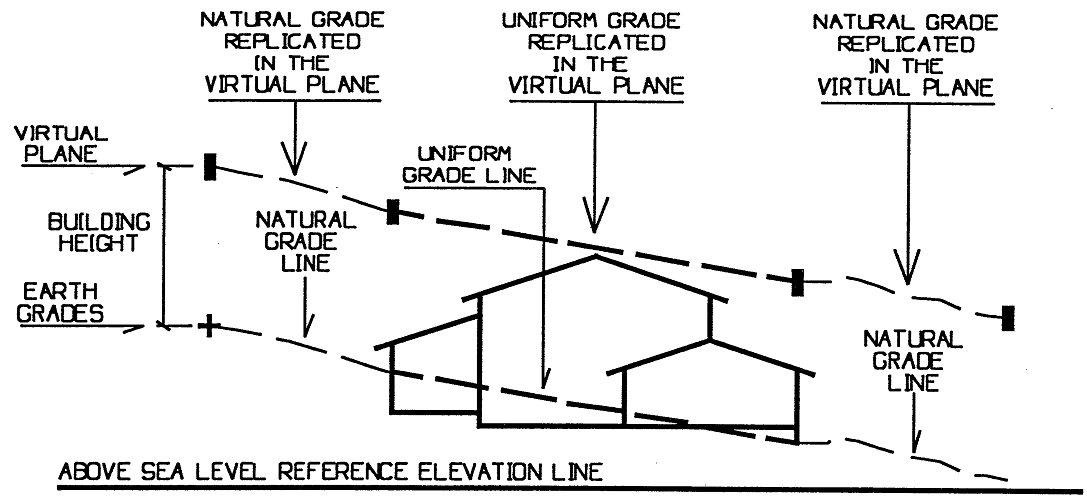
Figure 1
B.
Virtual plane above fill grades: The virtual plane for a structure constructed on fill grades shall replicate the natural grades below and surrounding the proposed structure. Figure 2 of this section illustrates the use of natural grade to determine the virtual plane when the structure is placed entirely on fill grades.
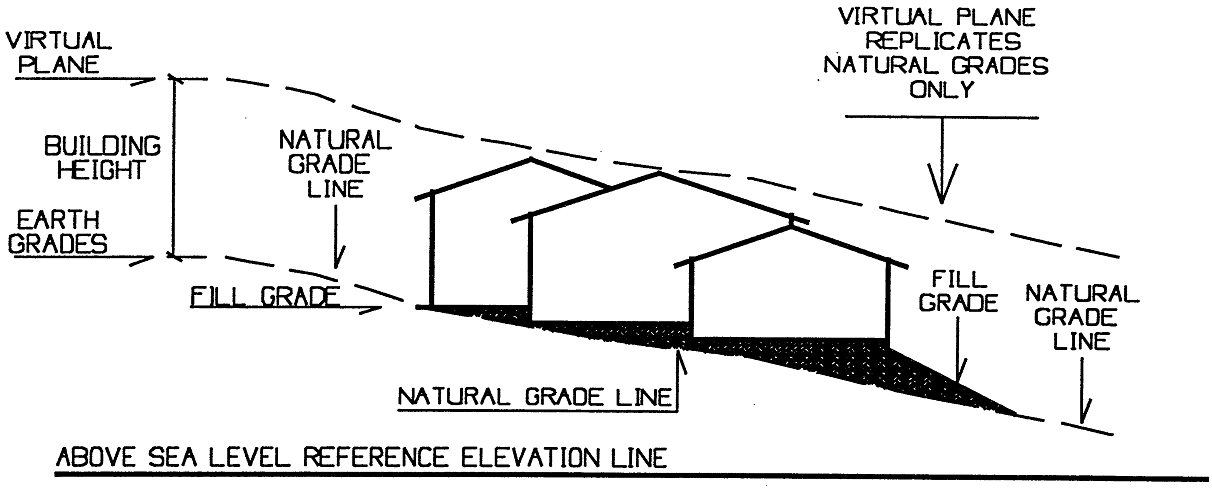
Figure 2
C.
Virtual plane above cut grades: The virtual plane for a structure constructed on cut grades shall replicate the cut grade below and surrounding the proposed structure if any portion of excavation to construct the cut grade extends more than four feet from the exterior structure wall. Figure 3 of this section represents the configuration of the virtual plane for a typical cut grade.
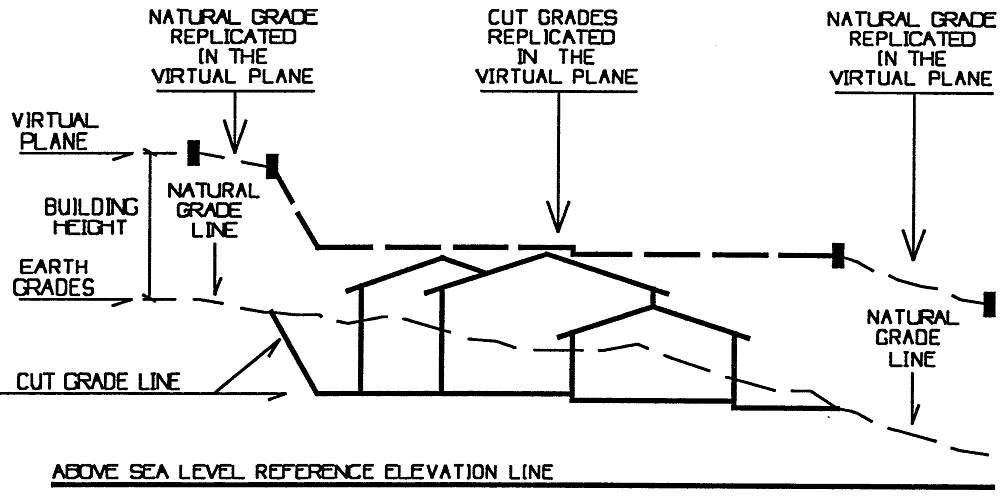
Figure 3
D.
Virtual plane above a combination of grades: The use of cuts and fills for site enhancement is infinitely variable. When a combination of grades and site enhancement techniques are used, the virtual plane shall be determined by the type of grade immediately underneath the structure at every point. Figure 4 of this section illustrates the method by which the virtual plane is to be formulated in compliance with the provisions of this section for a structure on a mix of cut and fill grades. From left to right, Figure 4 of this section shows where a cut grade has been established between the natural grade and the edge of the structure. The virtual plane replicates the cut grade in this section. Moving right, the example shows the location of uniform grade where exterior grades are backfilled tight against the structure wall. The virtual plane replicates uniform grade in this section. Further right, the structure is placed on fill grades. The virtual plane replicates natural grade in this section. Figure 4 of this section is provided for example only, and is not intended to depict any actual construction.
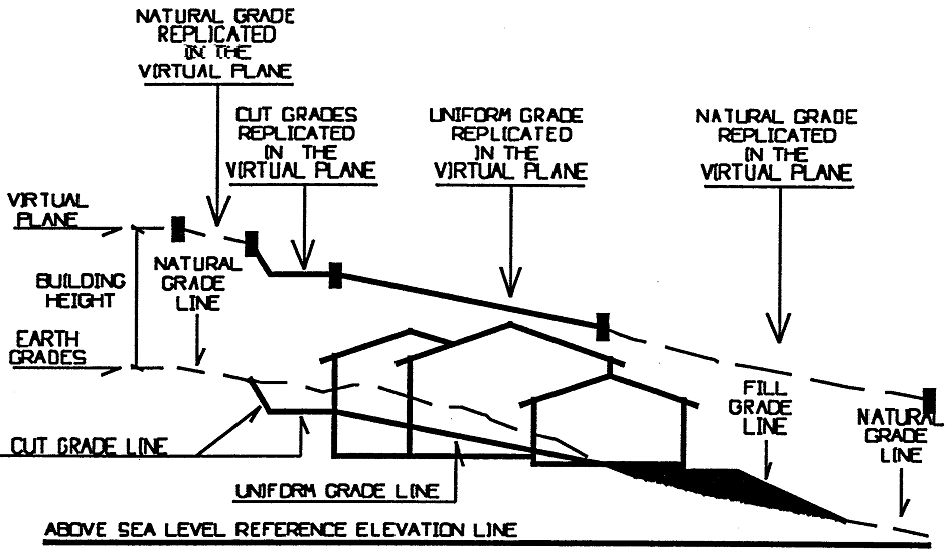
Figure 4
10-15A-6: - SPECIAL AND QUALIFYING REGULATIONS:
A.
Window well or emergency egress: Cut grades for window wells or emergency egress are not replicated in the virtual plane. Figure 5 of this section illustrates this exception. In this example the exterior grades are backfilled tight against the elevations' exterior walls along a uniform grade line as it extends toward and away from the viewer. The cut grade line represents only window wells or other retaining configurations required for egress. The window well/emergency egress exception only applies if the following criteria are met:
1.
The plan view base area of the exterior egress well measures 30 square feet or less.
2.
The slope of egress well sides is limited to 42 degrees minimum (measured from the horizontal) and may not project parallel to the wall of the structure beyond any outside corner of the structure.
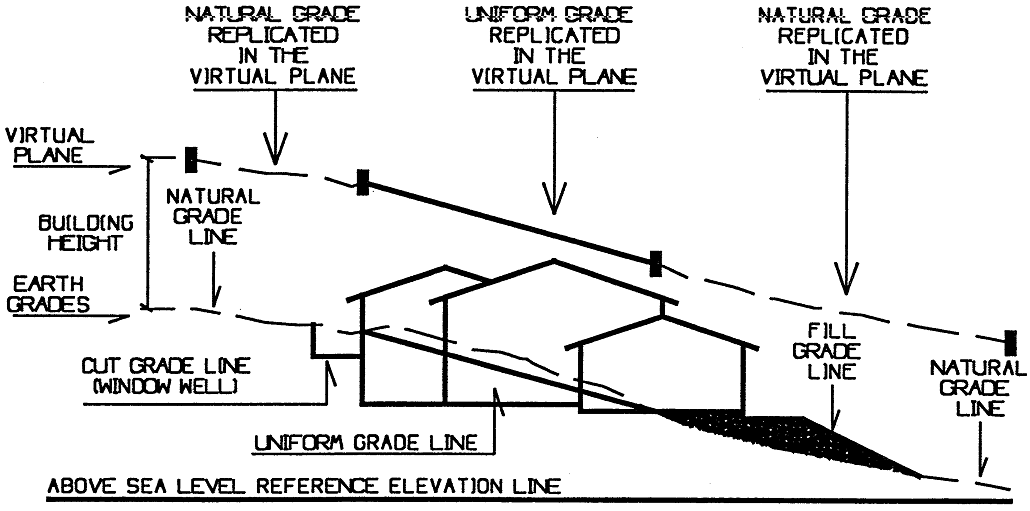
Figure 5
B.
Virtual distance: The vertical distance between the lowest contact grade at any exterior wall of a structure to the highest point of the structure shall not exceed the building height prescribed for the project plus five additional feet as illustrated in Figure 6 of this section. However, the Planning Commission may grant a total of ten additional feet over the building height prescribed for the project provided that:
1.
The applicant demonstrates that the structure is a stepped or terraced structure.
2.
The structure is terraced on natural grades, not cut or fill grades, excluding cut slopes and fill grades allowed by subsections B.2.a. and B.2.b. of this section. Materials removed or placed directly beneath the structure are exempt from this provision.
a.
Fill grades utilized for the formations of patios, walkways or door and window access are limited to three feet maximum vertical height above the natural grade at any point.
b.
Cut slopes and retaining walls utilized for the formation of patios, walkways and door or window access are limited to four feet maximum vertical height below natural grade at any point.
3.
Disturbance around the structure, including construction disturbance, is limited to an area eight feet from any point of an exterior structure wall (excluding driveway area). All natural vegetation, slopes, rock outcrops, and other natural features greater than eight feet distant from any exterior structure wall must be preserved (excluding driveway area).
4.
Natural grades are backfilled tightly to the foundation walls.
5.
The applicant clearly demonstrates that the terracing results in a structure that features multiple, broken and vertically separated rooflines.
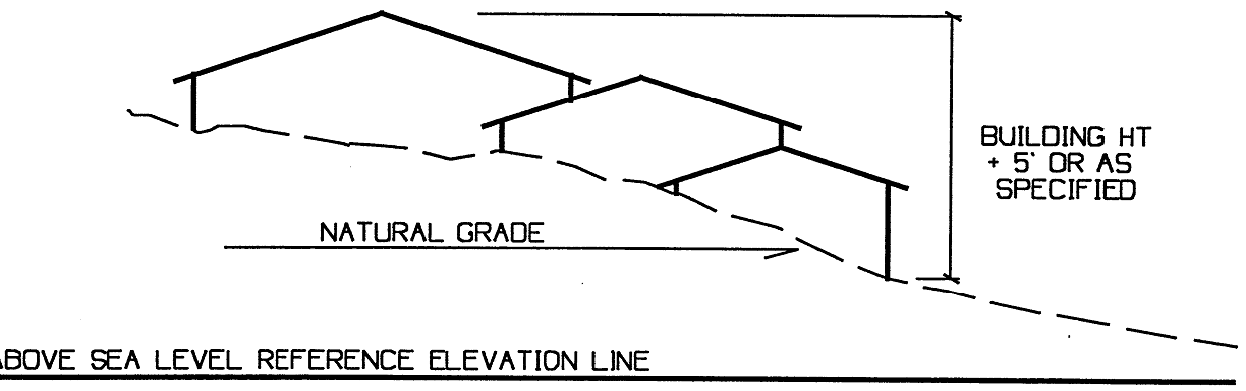
Figure 6
C.
If excavations made to accommodate the installation of footings or foundation extend more than four feet horizontally from the outside edge of the footing or foundation the excavations shall be classified as a cut grade for the purpose of determining the virtual plane and allowable structure height, regardless of whether or not such grades are backfilled or restored.

