
Springdale City Zoning Code
CHAPTER 14D
1—2 FAMILY RESIDENTIAL SUBDIVISION APPLICATIONS
10-14D-1: - SCOPE OF APPLICABILITY:
This Chapter applies to all subdivision-related applications or petitions where the intended use is one- or two-family residential dwellings, including townhomes and duplexes. This Chapter does not apply to applications or petitions for other uses. The requirements of this Chapter do not apply retroactively to subdivision applications or petitions that were approved by the Town prior to the enactment of this ordinance.
(Ord. No. 2024-09, 11-13-24)
10-14D-2: - INTERPRETATION AND CONFLICT OF LAWS:
Where any provision in this Subdivision Chapter conflicts with state law, state law shall prevail. Where any provision in this Subdivision Chapter conflicts with other ordinances enacted by the Town, the provisions in this Subdivision Chapter shall prevail unless the Town intended such conflicting ordinances not in this Chapter to amend this Chapter.
(Ord. No. 2024-09, 11-13-24)
10-14D-3: - SUBDIVISION LAND USE AUTHORITY:
A.
The Land Use Authority for preliminary applications under this Chapter is the Planning Commission. For purposes of subdivision applications, the Planning Commission shall be ultimately responsible for the following, but may delegate any task to the Town Engineer, Town staff, or members of the Planning Commission:
1.
Rendering land use decisions related to preliminary applications under this Chapter, including approving or denying preliminary applications.
2.
Reviewing all preliminary applications under this Chapter in an impartial manner and according to the standards and deadlines described in this Chapter.
3.
Providing notice to entities and parties as required by this Chapter. This task is delegated to Town staff by default.
4.
Holding public meetings for reviewing preliminary applications as required by this Chapter.
5.
Providing feedback to applicants on their preliminary applications in the manner required by this Chapter.
6.
Scheduling and holding a pre-application meeting with potential applicants as required by this Chapter. This task is delegated to Town staff and the Development Review Committee (DRC) by default.
7.
Keeping subdivision application forms (both preliminary and final) and related informational material up to date and publicly accessible and distributing such forms and materials to potential applicants. This task is delegated to Town staff by default.
B.
The Land Use Authority for final applications under this Chapter is the Development Review Committee (DRC). The DRC shall comprise the Director of Community Development, a Planning Commissioner, the Town Attorney, the Town Engineer, and the Public Works Director. For purposes of subdivision applications, the DRC shall be responsible for the following, but may delegate any task to Town staff or members of the DRC:
1.
Rendering land use decisions related to final applications under this Chapter, including approving or denying final applications.
2.
Reviewing all final applications under this Chapter in an impartial manner and according to the standards and deadlines described in this Chapter.
3.
Providing feedback to applicants on their final applications in the manner required by this Chapter.
4.
Providing notice to entities and parties as required by this Chapter.
5.
Signing final application approvals as required by this Chapter;
6.
Ensuring that documents are properly recorded with the County as required by this Chapter.
C.
As subdivision application decisions are administrative, not legislative, the Land Use Authority is authorized to make any land use decision described by this Chapter without Town Council approval.
D.
Except when operating as the Appeal Authority, the Town Council shall not require the Land Use Authority to approve or deny an application under this Chapter.
(Ord. No. 2024-09, 11-13-24)
10-14D-4: - SUBDIVISION APPEAL AUTHORITY:
A.
The Appeal Authority for Town decisions relating to this Chapter, except where otherwise noted, is the Administrative Hearing Officer. The Administrative Hearing Officer shall hear appeals in the manner described in Chapter 10-6 of this Title.
(Ord. No. 2024-09, 11-13-24)
10-14D-5: - PRE-APPLICATION MEETING:
A.
A party intending to submit a subdivision application under this Chapter may request a pre-application meeting with the DRC or a representative of the Town (depending on availability) for the purpose of reviewing any element of the party's proposed subdivision application (preliminary or final). The proposed application need not be complete for purposes of this meeting and may—if the party desires—be limited to a concept plan.
1.
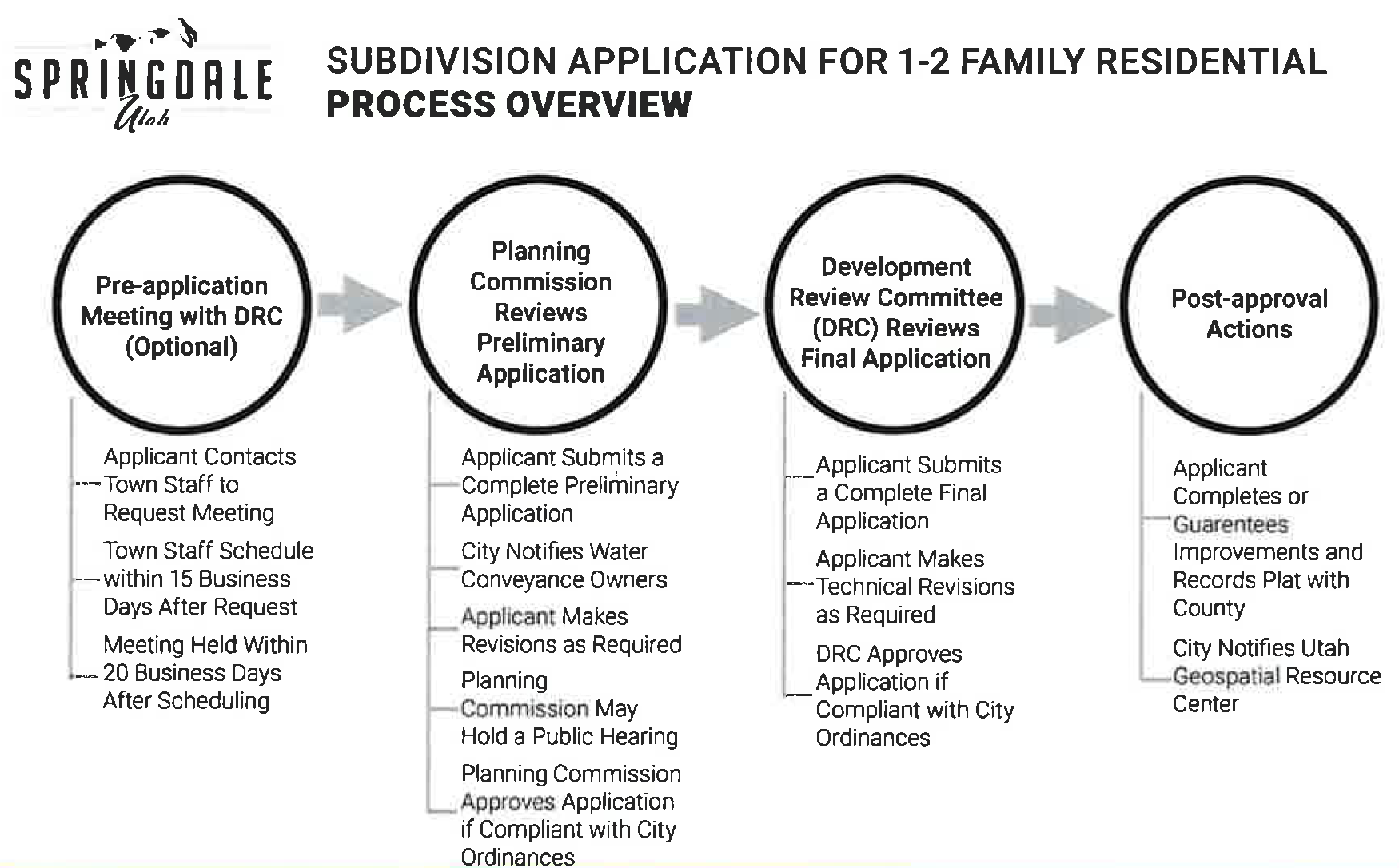
If a party requests a pre-application meeting, Town staff shall schedule the meeting within 15 business days after the request. The meeting shall be scheduled at the earliest convenient opportunity, and, at the option of the party requesting the meeting, shall occur within 20 business days after scheduling.
2.
The DRC or Town representative shall conduct the meeting, provide feedback on materials as requested by the party, and shall provide or have available on the Town website the following at the time of the meeting:
a.
Copies of applicable land use regulations,
b.
A complete list of standards required for the project, and
c.
Relevant application checklists.
(Ord. No. 2024-09, 11-13-24)
10-14D-6: - SUBDIVISION APPLICATION PROCESS AND REQUIREMENTS:
A.
The Town shall not approve, nor shall a party record, any plat or other creating instrument for a new subdivision unless the party has properly applied under this Chapter and received both a preliminary approval and a final approval from the respective Land Use Authorities.
B.
Preliminary Application. To be considered complete, a preliminary subdivision application must include at least the following elements:
1.
Proof of land use (zoning) authorization, including a description of how the property will be used after it is subdivided and citations to the specific ordinance(s) that the applicant believes authorizes the intended use. If the intended use requires a rezoning, this must be secured before a subdivision application may be submitted.
2.
A preliminary plat. The preliminary plat must be drawn to scale, in detail, and in accordance with generally accepted surveying standards and the acceptable filing standards of the County Recorder's Office. The preliminary plat must include:
a.
The proposed subdivision name, which must be distinct from any subdivision name on a plat recorded in the County Recorder's office.
b.
The boundaries, course, and dimensions of all proposed parcels.
c.
The lot or unit reference; block or building reference; street or site address; street name or coordinate address; acreage or square footage for all parcels, units, or lots; and length and width of the blocks and lots intended for sale.
d.
Every existing right-of-way and recorded easement located within the plat for underground, water, and utility facilities.
e.
Any known and unrecorded water conveyance facility located, entirely or partially, within the plat.
f.
The boundary lines of the special flood hazard as defined in section 10-13A-5 of this title.
g.
Whether any parcel is intended to be used as a street or for any other public use.
h.
Whether any parcel is reserved or proposed for dedication for a public purpose.
i.
If the subdivision includes a condominium, the requirements found in Utah Code 857-8-13, as amended.
3.
An improvement plan, created in accordance with applicable portions of Title 10 and the following, for all public improvements proposed by the applicant or required by Town ordinances. In addition to the requirements in Title 10, the improvement plan must contain:
a.
Engineer's estimate: An engineer's estimate of the cost of completing the required improvements and address.
b.
Water, sewer design: Drawings showing layout, profile and detailed design for sewer line, water lines and storm drains. These drawings must address all sewer mains and manholes, water mains, valves and fire hydrants, and all culinary water lines and pressurized irrigation lines, ditches, canals, and other waterways, along with any required improvements to the same.
c.
Profile, cross section drawings: Plan profile and typical cross section drawings of all streets, bridges, culverts and other drainage structures and any additional requirements deemed necessary by the Town Engineer.
d.
Grading plan: The applicant must submit a grading plan that meets the requirements of section 10-15B-10.
e.
A feasibility study that demonstrates the feasibility of the proposed water and sewage systems necessary to meet the requirements of this Chapter, together with letters of feasibility from the local Health Department and the Sanitary Sewer Authority.
f.
A traffic study that meets the requirements stated in the Town's Transportation Master Plan, which is adopted and incorporated as part of this title by reference.
g.
A re-vegetation plan that meets the requirements of section 10-15B-8.
h.
Measures to protect ecology: The applicant must provide a report that describes the mitigating measures that will be taken with respect to the following:
i.
Control of erosion within the subdivision, and any measures taken as necessary due to impact by the development of the subdivision, to control erosion outside the boundaries of the subdivision;
ii.
Reseeding of cuts and fills;
iii.
Prevention of fire and control of dust;
iv.
Prevention of the accumulation of weeds and debris outside the boundaries of the subdivision due to impacts of the development of the subdivision; and
v.
Prevention of destruction of vegetation outside the boundaries of the subdivision due to impacts of the development of the subdivision.
i.
Miscellaneous:
i.
The location of all curb, gutter, sidewalk and other street improvements to be constructed as required by Town ordinances;
ii.
All fences, barriers or landscaping as required by the Town ordinances or the Planning Commission;
iii.
All special improvements required by the Planning Commission as conditions of subdivision approval;
iv.
Location of all street name signs as required by the Town Engineer; and
v.
The location of any dedicated open space, as required by Chapter 10-19, and a draft of the open space agreement.
4.
Other reports. Any other report required by the Springdale Land Use Code or reasonably required by the Planning Commission after initial review of the preliminary application.
5.
Certifications, including:
a.
An affidavit from the applicant certifying that the submitted information is true and accurate.
b.
The signature of each owner of record of land described on the preliminary plat, signifying their consent to the preliminary subdivision application and their intent to dedicate portions of the preliminary plat to the public as described in the application.
c.
Certification that the surveyor who prepared the plat:
i.
Holds a license in accordance with Utah Code 58-22; and
ii.
Either:
(A)
Has completed a survey of the property described on the plat in accordance with state requirements and has verified all measurements; or
(B)
Has referenced a record of survey map of the existing property boundaries shown on the plat and verified the locations of the boundaries; and
iii.
Has placed monuments as represented on the plat.
6.
An electronic copy of all plans in PDF format.
7.
Payment of any preliminary-application-processing fees required by the Town and any other fees stated in 10-14-10.
C.
Final Application. To be considered complete, a final subdivision application must include the following:
1.
Approval of preliminary application. Planning Commission's approval of the applicant's preliminary application, given within the last 365 calendar days.
2.
A final plat. The final plat should be the version of the preliminary plat approved by the Planning Commission during the preliminary application review process, plus any other additions and immaterial changes (e.g., formatting) necessary to comply with the recording requirements of the County Recorder's Office.
3.
A completion assurance for all public improvements required by the approved improvement plan, or a statement that such improvements will be completed before development occurs on the proposed subdivision and before the applicant records the plat, as required by section 14B-5 through 14B-9 of this Chapter;
4.
Certifications, including:
a.
A Title Report or Title Insurance Policy for the land to be subdivided verifying property ownership.
b.
A Tax Clearance Certificate from the state indicating that all taxes, interest, and penalties owing on the land have been paid.
c.
An affidavit from the applicant certifying that the submitted information is true and accurate.
d.
The signature of each owner of record of land described on the plat, signifying their consent to the final subdivision application and their dedication and approval of the final plat.
e.
Town Engineer's Certificate of Approval.
f.
Town Attorney's Certificate of Approval.
g.
Notary Public's Acknowledgment.
h.
A place for members of the Development Review Committee (DRC) to sign the final plat, attested by the Town Clerk.
i.
Certification that the surveyor who prepared the plat:
i.
Holds a license in accordance with Utah Code 58-22; and
ii.
Either:
(A)
Has completed a survey of the property described on the plat in accordance with state requirements and has verified all measurements; or
(B)
Has referenced a record of survey map of the existing property boundaries shown on the plat and verified the locations of the boundaries; and
iii.
Has placed monuments as represented on the plat.
5.
Binding dedication documents, including:
a.
As applicable, formal, irrevocable offers for dedication to the public of streets, utilities, parks, easements, or other spaces.
b.
If the plat is to be part of a community association, signed and binding documents conveying to the association all common areas.
6.
Copies, including:
a.
A PDF document of the final plat and all other plans and supporting documents required by this Chapter.
b.
A copy of the final plat in AutoCAD format.
c.
A copy of the final plat drawn on a sheet of vellum or mylar having outside or trim line dimensions of 24"x36". The border line of the plat must be drawn in heavy lines, leaving a margin of at least one and one-half inches on the left hand side of the sheet for binding, and at least one-half inch on the other three sides of the sheet. The plat must be so drawn that the top of the sheet faces either north or east, whichever accommodates the drawing better. All lines, dimensions, and markings shall be made on the tracing linen with waterproof black ink. The actual map shall be made with a minimum scale of 1 inch = 50 feet. Details and the workmanship on finished drawings shall be clear and readable.
7.
Fees. Payment of any final-application-processing fees required by the Town.
D.
The Land Use Authority shall produce, maintain, and make available to the public a list of the specific items that comprise complete preliminary and final applications and a breakdown of any fees due upon submission or approval of the application.
E.
The Land Use Authority may require, and the applicant shall provide, additional information beyond the requirements of this Section or those published by the Town relating to an applicant's plans to ensure compliance with Town Ordinances and approval standards and specifications for construction of public improvements and to protect the health and safety of Town residents.
F.
In its sole discretion, the Land Use Authority may waive specific requirements on a case-by-case basis and accept an application as complete where not all the elements in this Section are provided.
(Ord. No. 2024-09, 11-13-24)
10-14D-7: - NOTICE TO AFFECTED ENTITIES:
A.
Within 15 calendar days after receiving a complete subdivision application under this Chapter, the Town Clerk or designee shall provide written notice of the proposed subdivision to the facility owner of any known water conveyance facility located, entirely or partially, within 100 feet of the subdivision plat.
1.
To determine whether any water conveyance facility is located within 100 feet of a proposed subdivision, the Town Manager or designee shall review information:
a.
From the facility owner under Utah Code § 10-9a-211, using mapping-grade global positioning satellite units or digitized data from the most recent aerial photo available to the facility owner;
b.
From the state engineer's inventory of canals; or
c.
From a licensed surveyor who has consulted with a representative of an existing water conveyance facility that services an area near the land the application concerns.
B.
To give water conveyance facilities time to provide feedback on subdivision applications, the Land Use Authority shall not approve a preliminary (or related final) subdivision application under this Chapter sooner than 20 calendar days after the applicant submits a complete application. This waiting period does not apply to revised applications the applicant may submit during the application review process.
1
A water conveyance facility owner's failure to provide comments to the Land Use Authority about a subdivision application does not affect or impar the Land Use Authority's authority to approve the subdivision application.
(Ord. No. 2024-09, 11-13-24)
10-14D-8: - REVIEW:
A.
The Land Use Authorities shall review all subdivision applications in accordance with the requirements of this Section before approving or denying those applications.
B.
For both preliminary and final applications, the review process begins when an applicant submits a complete application.
1.
The Land Use Authorities shall not review an incomplete subdivision application, except to determine whether the application is complete.
2.
If the Land Use Authority determines that an application is incomplete. It shall notify the applicant of the incompleteness, highlighting any insufficiencies and explaining that the application will not be reviewed until it is complete.
C.
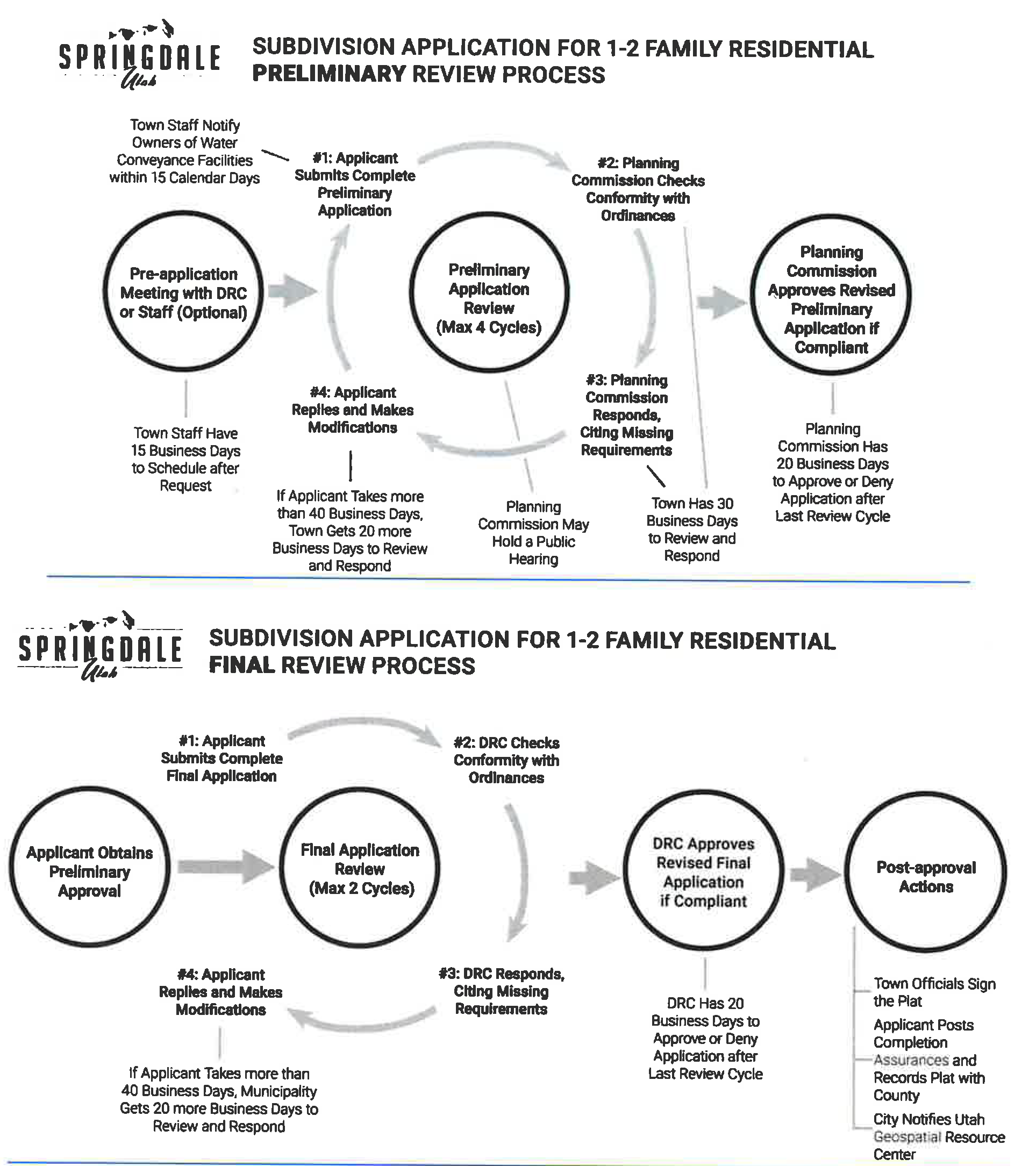
For both preliminary and final applications, after the applicant submits a complete application, the Land Use Authority shall review and provide feedback to the applicant in a series of "review cycles."
1.
A review cycle consists of the following phases:
a.
Phase #1: The applicant submits a complete application (or, if after the first cycle, submits a revised version of the complete application).
b.
Phase #2: The Land Use Authorities review the application in detail and assess whether the application conforms to local ordinances.
c.
Phase #3: The Land Use Authorities respond to the applicant, citing any missing requirements or areas of noncompliance and providing a detailed list of necessary revisions to the applicant. For any required modification or addition to the application or request for more information, the Land Use Authorities shall be specific and include citations to ordinances, standards, or specifications that require the modification or addition and shall provide the applicant with an index of all requested modifications or additions.
d.
Phase #4: The applicant revises the application, addressing each comment or requirement the Land Use Authorities made. The applicant must submit both revised plans and a comprehensive written explanation in response to the Town's review comments, identifying and explaining the applicant's revisions and reasons for declining to make revisions for declining to make revisions, if any.
D.
The Land Use Authorities (and other Town representatives and agents) shall adhere to the maximum number of review cycles and the review deadlines described in Table 14D, except as described below. If no further revisions are needed, the Land Use Authority may end the review process early and approve or deny the preliminary or final application.
1.
This provision notwithstanding, for any subdivision application that affects property within an identified geological hazard area, the Town is exempt from limits on the number of permitted review cycles and the Town's deadlines for reviewing and responding (Phases #2 and #3). Geological hazard areas, as further defined in Subsection 10-14-3(E), include areas at risk for rockfall, landslide, and liquefaction and any area within the Town's erosion hazard zone.
2.
If the applicant makes a material change to a preliminary or final application not requested by the Town at any point in the review process, the Land Use Authority may restart the review process, but only with respect to the portion of the application that the material change substantively affects.
3.
For both preliminary and final applications, if an applicant takes longer than 40 business days to submit a revised application and respond to the Town's requests for modifications and additions (Phases #1 and #4), the Town shall have an additional 20 business days to review and respond to the revised application (Phases #2 and #3) of the next review cycle or issuing an approval decision).
4.
For both preliminary and final applications, if an applicant takes longer than 365 calendar days to submit a revised application and respond to the Town's requests for modifications and additions (Phases #1 and #4), the application shall, at the option of the Land Use Authority, expire. If an application expires, the applicant must restart the subdivision application process.
5.
If the applicant has not submitted a final application within 365 calendar days after the Land Use Authority notifies the applicant that it has approved the related preliminary application, the related preliminary approval shall expire. In this case, the applicant shall not submit a final application until the Land Use Authority has issued a new preliminary application approval.
E.
When a preliminary or final application's review period ends, the Land Use Authority shall approve or deny the respective preliminary or final application within 20 business days.
1.
If the Land Use Authority has not approved or denied the application within 20 business days after the allotted review cycles are complete, the applicant may request a decision. After such a request, the Town shall, within 10 business days:
a.
For a dispute arising from the subdivision improvement plans, assemble an appeal panel in accordance with Utah Code § 10-9a-508(5)(d) to review and approve or deny the revised set of plans; or
b.
For a dispute arising from the subdivision ordinance review, advise the applicant, in writing, of the deficiency in the application and of the right to appeal the determination to the designated Appeal Authority.
F.
After the Land Use Authority provides comments in the last allotted review cycle for a final application, the Town shall not require further modifications or corrections to the application unless those modifications or corrections are necessary to protect public health and safety or to enforce state or federal law or unless the review cycle reset due to the applicant making a material change that the Land Use Authority did not request.
1.
With the exception of modifications or corrections that are needed to protect public health and safety, that are needed to enforce state or federal law, or that arise from the review cycle being reset, the Town waives noncompliant subdivision-related requirements that the Land Use Authority does not identify during the review process.
2.
The applicant shall make reasonable changes, unless prohibited otherwise by a contract or deed, to the subdivision application to accommodate the water conveyance facility to the extent required by Utah Code § 73-1-15.5.
G.
The Planning Commission may, in its discretion, hold one public hearing during the review period for a preliminary subdivision application.
1.
The purpose of this public hearing is to ask questions of the applicant and receive commentary on the technical aspects of the application from affected entities, interested parties, and the public.
2.
The hearing must occur before the end of the Land Use Authority's preliminary review period (end of Phase #3 of the last preliminary review cycle). Scheduling issue shall not extend the review and approval deadlines in this Chapter.
3.
The town shall not hold a public hearing during the review period for a final application under this Chapter.
H.
Other Chapters of this Title notwithstanding, the Land Use Authorities shall approve or deny preliminary and final applications under this Chapter after reviewing the complete applications as described in this Section.
(Ord. No. 2024-09, 11-13-24)
10-14D-9: - APPROVAL:
A.
The Land Use Authorities shall approve any complete preliminary and final applications made under this Chapter that comply with applicable Town ordinances.
B.
The Land Use Authorities shall issue all approvals in writing, and the DRC shall certify the approved final plat, either by signing the plat directly or by attaching a signed certification to the plat.
(Ord. No. 2024-09, 11-13-24)
10-14D-10: - POST-APPROVAL ACTIONS:
A.
The applicant shall record the approved final plat with the County Recorder's Office, within 365 calendar days after the Town approves the final application, provided that the applicant has completed any improvements or posted any completion assurances required by Town ordinances or described in the approved improvement plan. The applicant shall not record the approved final plat until such improvements are completed or guaranteed in compliance with Town ordinances and the approved improvement plan.
1.
An approved final plat not properly recorded within the timeline specified in this provision is void, unless the DRC approves an extension.
B.
The Land Use Authority, or designated Town staff, shall submit to the Utah Geospatial Resource Center (so the subdivision can be included in the 911 database), within 30 calendar days after approving a final application, either:
1.
An electronic copy of the approved final plat; or
2.
Preliminary geospatial data that depict any new streets and situs addresses proposed for construction within the bounds of the approved final plat.
(Ord. No. 2024-09, 11-13-24)

