
Springdale City Zoning Code
CHAPTER 25
OFFICIAL STREET MAP AND STANDARDS
10-25-1: - PREPARATION OF OFFICIAL STREET MAP:
The Planning Commission may prepare, recommend for adoption and maintain an official street map for the Town in conformance with the General Plan. Said official street map may show the location by lines of all existing and proposed streets within the limits of the Town, including the locations of proposed arterial and collector streets as defined by the subdivision ordinance. Said official street map may show, by the placing thereon of lines, the proposed locations of new streets or street extensions, widenings, narrowings or vacations, as the Planning Commission may deem appropriate, which have been accurately surveyed and definitely located. Prior to adoption of an official street map or any proposed addition or modification thereto, the Planning Commission shall hold a public hearing in accordance with provisions of section 10-3-1 of this title and shall review said official street map or any proposed addition or modification thereto for its approval. Upon recommendation of an official street map by the Planning Commission, said plan shall be submitted to the Town Council for final consideration and adoption.
10-25-2: - ADOPTION OF OFFICIAL STREET MAP:
The Town Council, upon recommendation by the Planning Commission, may adopt an official street map showing the location by lines of all existing and proposed streets within the limits of the Town, including the locations of proposed arterial and collector streets as defined by the subdivision ordinance. The placing of any street or street lines upon the official street map shall not in and of itself constitute the opening or establishment of any street or the taking or acceptance of any land for street purposes.
10-25-3: - EFFECT OF OFFICIAL STREET MAP:
A.
Effect limited: An official street map adopted under this chapter does not:
1.
Require a landowner to dedicate and construct a street as a condition of development approval except under circumstances provided in subsection B of this section; or
2.
Require the Town to immediately acquire property it has designated for eventual use as a public street.
B.
Authority granted:
1.
The Town may require a landowner to take into account the proposed streets in the planning of a development proposal.
2.
The Town may acquire the property through purchase, gift, voluntary dedication or eminent domain.
3.
The Town may require the dedication and improvement of a street if the street is found necessary by the Town because of a proposed development.
10-25-4: - STANDARDS FOR DEDICATED PUBLIC STREETS, PUBLICLY APPROVED STREETS AND PRIVATE STREETS:
The Town has adopted standards for the construction of dedicated public streets, publicly approved streets, and private streets. Any person who dedicates a street to the Town must comply with these standards in the construction of the street.
10-25-5: - STANDARDS FOR CURB, GUTTER AND SIDEWALKS:
The Town has adopted standards for the construction of curb, gutter and sidewalks.
10-25-6: - SR-9 RIGHT-OF-WAY:
The Town Engineer shall work closely with the Utah Department of Transportation to coordinate the development of the official street map where the same shall propose plans for, intersection with, or otherwise affect the SR-9 right-of-way.
10-25-7: - APPROVAL OF SUBDIVISION PLATS:
No plat of a subdivision of land shall be filed or recorded in the County Recorder's office unless:
A.
All improvements shall have been completed, approved and accepted by the Planning Commission and the Town Council; or
B.
A valid completion assurance has been provided in accordance with chapter 14B that has been accepted by the Town Council.
10-25-8: - FLAG LOTS AND PRIVATE LANES ALLOWED:
The unique topographical, geological and visual character of the Town adds a dimension of difficulty not typical in most Towns and cities. Most established lots in the Town lack frontage on a dedicated street, widths are restricted by existing structures, and foothill locations would be detrimentally affected by the pavement and width requirements of a dedicated street. Therefore, flag lots and private lanes may be developed in accordance with the special provisions herein.
10-25-9: - FLAG LOTS; SPECIAL PROVISIONS:
Flag lots may be developed in the Town, subject to the requirements of this section:
A.
Flag lots may only be developed if there is no feasible way the lot could be developed as a standard lot or that the property could be subdivided with standard lots, either at the present time or in the foreseeable future.
B.
An easement shall be recorded along the staff portion of the flag lot providing access for installation and maintenance of utility lines and services, emergency vehicle access and access of Town or other public personnel or vehicles as may be required to carry out the responsibilities of the Town and other governmental entities. Public services, such as garbage collection, will be at the dedicated street only.
C.
The staff portion of a flag lot shall front on a dedicated public street or private street. The minimum width of the staff portion of said lot shall be 20 feet. If the staff portion of the flag lot is 150 feet or longer, an emergency vehicle access, built to the specifications of the fire marshal, shall be provided on the flag lot.
D.
No building or construction, except for driveways and fences, shall be allowed on the staff portion of said lot. A minimum width of 20 feet along the entire length of the staff portion of the lot must be kept clear of obstructions, including storage of materials, general debris, and vegetation.
E.
The lot shall meet all size and setback requirements of the zone in which the lot is located.
F.
No part of the staff portion of the flag lot may serve more than one flag lot.
G.
The staff portion of the flag lot shall not be closer to an adjacent dwelling than ten feet.
H.
The staff portion of the flag lot shall be improved with a compacted gravel or other all-weather surface. The driving surface shall be well maintained, it shall be readily passable by a standard passenger car and standard emergency vehicle, and it shall be constructed to the minimum standards specified by the Town Engineer.
I.
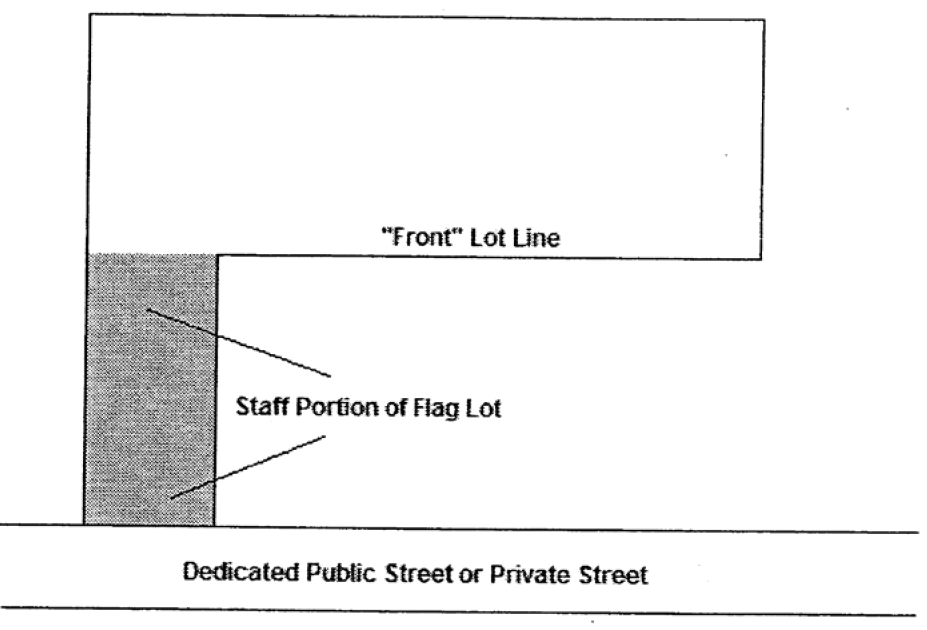
The front side of the flag lot shall be deemed to be the side nearest the street upon which the staff portion fronts. The front setback shall be measured from the lot line nearest the street on which the staff portion of the lot fronts as shown in the figure below. No part of the staff portion of the lot shall be used to meet any setback requirement.
J.
The Town shall have no maintenance responsibility for the roadway on the staff portion of the flag lot.
K.
No new flag lots shall be created in the Central Commercial or Village Commercial zones.
(Ord. No. 2023-09, § 3, 10-11-2023)
10-25-10: - PRIVATE LANES; SPECIAL PROVISIONS:
Private lanes may be developed in the Town, subject to the requirements of this section:
A.
Private lanes shall have a minimum easement width of 20 feet.
B.
Private lanes shall have a minimum all weather surface width of 20 feet, unless extenuating circumstances necessitate a lesser width. In such case a lesser width may be approved with the consent of the Fire Marshal, Town Engineer, and Planning Commission.
C.
An easement shall be recorded across the private lane providing access for installation and maintenance of utility lines and services, emergency vehicle access and access of Town or other public personnel or vehicles as may be required to carry out the responsibilities of the Town and other governmental entities. Public services, such as garbage collection, will be at the dedicated street only.
D.
Required yard or setback distances for the servient properties shall be measured from the edge of the private lane easement nearest the proposed structure, not from the lot line of the servient properties.
E.
There shall be a written and recorded road maintenance agreement that assigns maintenance responsibility for the private lane to the properties the private lane traverses and serves. The Town shall have the right to compel enforcement of the road maintenance agreement between the property owners. Should the Town be unable to compel enforcement of the agreement, the Town may, at its sole discretion, maintain the private lane and assess the property owners the costs associated with such maintenance.
F.
Private lanes shall satisfy the frontage requirements for no more than one lot.
G.
Private lanes must be designed and developed to preserve as much native vegetation and other natural features as possible.
H.
Private lanes must connect to a dedicated public street or a private street.
I.
No new private lane shall be created or improvements to existing historical accesses made, any portion of which is less than 20 feet from an existing residence.
J.
The Planning Commission shall review and approve all requests for private lanes if they conform to the above standards. Such requests must be made in conjunction with a subdivision, design/development review, or grading permit application.
K.
In situations where there has been historical access to properties that function as private lanes, but the access has not officially been designated as a private lane, the historical access shall have all the rights and privileges enjoyed by private lanes. Existing parcels which have been accessed by historical accesses prior to the adoption date hereof shall not be denied a building permit based solely on noncompliance with access or frontage requirements. Existing "historical accesses" are: Valley View Drive, Kinesava Drive, Dixie Lane, Eagle Lane, Steamboat Lane, Quail Ridge Road, Apple Lane, Dillyholler Drive, Sage Lane, Sundance Lane, West Temple Drive, Paradise Road, Elm Street, Kokopelli Drive, Big Springs Road, Wilkins Lane. No extensions of any historical access will be permitted unless the historical access is improved to meet the minimum standards of this chapter.
L.
As of the date of adoption hereof, no new subdivision which creates more than two new lots may be created which gains access off of a private lane or historical access, unless such private lane or historical access is improved to meet minimum street standards, including street width, and is designated as a private street or dedicated as a public street. The developer of said subdivision shall be solely responsible for improving the access to minimum street standards required by this chapter, including acquiring easement area (if necessary) from private property owners to meet minimum width requirements. Nothing in this subsection shall compel the Town to use its power of eminent domain to acquire land necessary to improve the street.
M.
No new lot may be created in the Central Commercial or Village Commercial zones which gains access from a private lane or historic access.
(Ord. No. 2023-09, § 4, 10-11-2023)
10-25-11: - PRIVATE STREETS; SPECIAL PROVISIONS:
A.
Private streets shall conform to the minimum street standards required by this chapter and the Town Engineer.
B.
The homeowners' association (or collective property owners, if there is no homeowners' association) shall be solely responsible for the maintenance of all private streets in the subdivision. The Town shall have the right to compel the homeowners' association (or collective property owners, if there is no homeowners' association) to maintain the private streets within a subdivision to minimum Town standards. Should the Town be unable to compel maintenance of the streets, the Town may, at its sole discretion, maintain the private streets and assess the property owners the costs associated with such maintenance.
C.
All new streets within any platted subdivision must be either private streets or dedicated public streets, except that a private lane shall be allowed in situations where the private lane satisfies the frontage requirement for only one lot.
D.
The Planning Commission shall review all proposals for private streets during the preliminary plat review or design/development review. The Planning Commission shall approve the proposed private street if it conforms to all standards of this section.
E.
Private streets may extend outside the boundaries of a subdivision if such extension connects to a public street. The extension of the private street outside the subdivision boundary may traverse private properties by means of access easements, provided such extension meets all minimum street standards (including width) required by this chapter and the Town Engineer. All extensions of private streets outside subdivision boundaries shall be designated as part of the private street and shall be maintained according to subsection B. of this section.
F.
The Planning Commission may reduce the minimum street surface width required for private streets in the FR zone up to 20 percent if:
1.
The private street serves no more than ten lots; and
2.
The Town Engineer and Fire Marshal have both approved the reduction; and
3.
The private street traverses areas of steep slopes, poor soils, or other similar topographic or geologic constrains; and
4.
The reduced street width will noticeably reduce the visual and/or environmental impact the private street will create, as compared to a street developed in the same location without the reduced street width.
10-25-12: - WIDTHS:
Arterial and collector streets shall conform to the width assigned on the arterial and collector street plan wherever a subdivision falls in an area for which an arterial and collector street plan has been adopted. For territory where such plan has not been completed at the time the preliminary plan of the subdivision is submitted to the Planning Commission, street dedications shall be provided as follows:
A.
Minor and local street dedications shall have a minimum width of 30 feet.
B.
Collector street dedications shall have a minimum width of 36 feet.
C.
Arterial street dedications shall have a minimum width of 66 feet or as shown on the arterial and collector street plan, whichever is greater.
D.
Minimum width of roadway shall be as follows:
1.
Minor streets, without on street parking: 22 feet. Additional width may be required by the Planning Commission to incorporate curb, gutter and sidewalks, or a shoulder area.
2.
Local streets, without on street parking: 28 feet. Additional width may be required by the Planning Commission to incorporate curb, gutter and sidewalks, or a shoulder area.
3.
Collector streets, without on street parking: 32 feet. Additional width may be required by the Planning Commission to incorporate curb, gutter and sidewalks, or a shoulder area.
4.
For arterial streets: 50 feet, or conform to arterial street plan, whichever is greater.
10-25-13: - CUL-DE-SACS:
Cul-de-sacs (dead end streets) shall be used only where drainage, topography or land ownership configurations exist that make other designs undesirable. Each cul-de-sac must be terminated by a turnaround of not less than 75 feet in diameter. Surface water must drain away from the turnaround, except where surface water cannot be drained along the street away from the turnaround due to the grade. In such circumstances, necessary catch basins, drain lines and drainage easements shall be provided.
10-25-14: - INTERSECTIONS:
Streets will intersect each other as nearly as possible at right angles. Minor streets shall approach the arterial or collector streets at an angle of not less than 80 degrees. Offsets in street alignment between ten feet and 120 feet shall be prohibited unless determined by the Planning Commission and Town Engineer to be permissible.
10-25-15: - GRADES:
Minimum street grades shall be four tenths of one percent and maximum street grades shall be 12 percent. Where the Town Engineer determines that a steeper or lesser grade would be acceptable because of unusual land conditions, unusual topographical, geological or other extraordinary concerns, or in order to get the best development of the land, a steeper grade may be approved by the Planning Commission with the consent of the Fire Marshal and Town Engineer.
10-25-16: - CURVES:
Where the street lines within a block deflect from each other at any one point more than five degrees, there should be a connecting curve. The radius of the curve for the inner street line shall be not less than 100 feet, unless in the opinion of the Planning Commission such is not necessary.
10-25-17: - CORNER RETURNS:
Curbs at all intersections, where required or elected, shall be rounded with curves having a minimum radius of 25 feet. Property lines at street intersection shall be rounded with a curve having a 15-foot radius.
10-25-18: - DESIGN SPECIFICATIONS:
Specifications for the design of street subbase, base, surfacing, curb and gutters, sidewalks, and the treatment of drainage courses, shall comply with standard specifications adopted by the Town Council and administered by the Town Engineer. If no such ordinance has been adopted by the Town Council, specifications shall be determined by the Town Engineer with approval by the Planning Commission.
10-25-19: - NAMES:
New street names shall not duplicate those already existing. A street which is a continuation of another already in existence shall bear the same name. New street names shall be names of local significance, reflecting the Town's geographic, biologic or pioneer heritage.
10-25-20: - DEDICATIONS:
Maps and plats, when made, acknowledged, filed and recorded according to the procedures of this chapter, operate as a dedication of all streets and other public places, of those parcels of land in the Town for the public for the uses named or intended in those maps or plats. Unless mapped streets are approved by the Planning Commission as private streets or roads, emergency vehicle easements must be granted to the Town and recorded with the final plat. The dedication established by this section does not impose liability upon the Town for streets and other public places that are dedicated in this manner but unimproved.
10-25-21: - SURFACING:
The full width of all streets (described above) within a subdivision shall be surfaced for all weather travel to specifications provided by the Town Engineer and further restricted as follows: specifications for type of surface approved may be hereafter attached as an appendix to the ordinance codified herein and on file in the Town Office.
A.
FR zone: Subdivision roadways within the Foothill Residential (FR) Zone may be surfaced with gravel road base or bituminous paving to specifications approved by the Town Engineer.
B.
VR zone: Subdivision roadways within the Valley Residential (VR) Zone shall be surfaced with bituminous pavement to reduce dust and increase vehicular flow efficiency unless it is demonstrated by the subdivider or determined by the Planning Commission to be unnecessary or undesirable to do so. If pavement is not required by the Planning Commission, a roadway shall be surfaced with gravel road base.
C.
Commercial zones: Subdivision roadways within any commercial zone shall be paved.
10-25-22: - RELATIONS TO ADJOINING STREET SYSTEM:
A.
The arrangement and surfacing of streets in new subdivisions shall provide for the continuation of the existing streets between adjacent properties when such continuation is necessary for convenient movement of traffic, effective fire protection, for efficient provision of utilities and where such continuation is in accordance with the master plan. If the adjacent property is undeveloped and the street must be a dead end street temporarily, the right-of-way shall be extended to the property line and a temporary turnabout shall be provided. The right-of-way shall be the same or greater width, but in no case less than the required minimum width, unless otherwise deemed necessary by the Planning Commission because of unusual topographical, geological or other extraordinary circumstances.
B.
Where the Planning Commission determines that it is desirable to provide for street access to adjoining property in order to provide an orderly development of a street system, proposed streets shall be extended by dedication to the boundary of such property.
10-25-23: - SIDEWALKS:
Sidewalks, where required, or where installed at the option of the subdivider where not required, shall be four feet in width except where other widths are deemed appropriate by the Town Engineer.
10-25-24: - WHEELCHAIR RAMPS:
Wheelchair ramps must be constructed at all street corners and other pedestrian crossings where sidewalks are installed.
10-25-25: - IMPROVEMENTS:
All improvements within a public right-of-way must conform to the standard drawings and specifications set by the Town Engineer.
10-25-26: - ADDITIONAL REQUIREMENTS:
Additional requirements may be required by the Planning Commission if determined by the Town Engineer that the above will not safely and adequately handle the proposed traffic associated with the development.

