
Starkville City Zoning Code
SECTION 5
Form-Based Districts
5.2 Base Dimensional Standards
Form-Based Districts | ||||
A. Lot Width | T-4 | T-5D | T-5C | T-5U |
A1. Min | 18’ | 25’ | 25’ | 25’ |
B. Principal Building Setbacks | T-4 | T-5D | T-5C | T-5U |
B1. Principal front setback (min/max) | 6/18’ | 0/15’* | 2/15’* | 2/15’* |
B2 side setback adjacent to street (min/max) | 6/18’ | 0/15’* | 2/15’* | 2/15’* |
B3. side setback (min/max) | 3' or 0' if attached | 0/24’ | 0/24’ | 0/2’ |
B4. Rear setback (min) | 3’ | 0’ | 3’ | 3’ |
C. Secondary Building Setbacks | T-4 | T-5D | T-5C | T-5U |
C1. Front setback interior lot | 5' behind rear wall of primary building | |||
C2. Side setback adjacent to street (min/max) | 6/18’ | 0/15’* | 2/15’* | 2/15’* |
C3. Side setback (min) | 3' or 0’ if attached | 0’ | 0’ | 0’ |
C4. Rear setback (min) | 3’ | 0’ | 3’ | 3’ |
D. Accessory Dwelling Unit and Accessory Structure Setbacks | T-4 | T-5D | T-5C | T-5U |
D1. Front setback interior lot | 5’ behind rear wall of principal building | -- | -- | 5’ behind rear wall of principal building |
D2. Side setback adjacent to street (min/max) | 6/18’ | -- | -- | 2/15’* |
D3. Side setback (min) | 0’ | -- | -- | 0’ |
D4. Rear setback (min) | 3’ | -- | -- | 3’ |
E. Parking Setbacks and Requirements | T-4 | T-5D | T-5C | T-5U |
E1. From primary street (min) | behind front wall of principal building(s) | 20’ behind front wall of principal building(s) | 20’ behind front wall of principal building(s) | 20’ behind front wall of principal building(s) |
E2. Side adjacent to side street (min) | 10’ unless a principal building, secondary building, and/or accessory dwelling is adjacent to the street, then behind the front wall of any street fronting buildings. | 10’ unless a principal building and/or secondary building is adjacent to the street, then behind the front wall of any street fronting buildings. | 10’ unless a principal building and/or secondary building is adjacent to the street, then behind the front wall of any street fronting buildings. | 10’ unless a principal building, secondary building, and/or carriage house is adjacent to the street, then behind the front wall of any street fronting buildings. |
E3. Masked from view from public by solid wall | yes | yes | yes | yes |
E4. Driveway width within setback (max) | 10’ | 24’ | 24’ | 24’ |
F. Height | T-4 | T-5D | T-5C | T-5U |
F1. Principal building in stories | 3 | 4, 5 (⬛) | 4, 5 (⬛) | 3 1/2, 4 (⬛) |
F2. Secondary building in stories | 3 | 4, 5 (⬛) | 4, 5 (⬛) | 3 1/2, 4 (⬛) |
F3. Accessory dwelling unit in stories | 2 | -- | -- | 2 |
F4. Accessory structures in stories | 1 | 1 | 1 | 1 |
G. Stories | T-4 | T-5D | T-5C | T-5U |
G1. Story height (min/max) | 9/12’** | 10/14’ | 10/14’ | 10/14’ |
G2. Commercial 1st floor (min/max) | N/A | 11/25’ | 11/25’ | 11/25’ |
G3.Half story height (min/max) | 9/12’** | -- | -- | 10/14’ |
H. Lot Coverage | T-4 | T-5D | T-5C | T-5U |
H1. Maximum lot coverage | 70% | 90% | 90% | 90% |
I. Lot Frontage Buildout | T-4 | T-5D | T-5C | T-5U |
I1. Percentage lot frontage buildout at front setback (min/max) | 60/85% | 85/100% | 65/85% | 65/85% |
I2. Percentage of frontage buildout at side setback corner lot (min/max) | 60/85% | 85/100% | 65/85% | 65/85% |
J. Building Width- Special Exception required to vary from maximum | T-4 | T-5D | T-5C | T-5U |
J1. Street facing building width (max) | 60’ | 120’ | 90’ | 90' |
K. Transparency | T-4 | T-5D | T-5C | T-5U |
K1. 1st floor residential (min) | 30% | 30% | 30% | 30% |
K2. 1st floor commercial (min) | n/a | 70% | 55% | 45% |
K1. Upper floors (max) | 50% | 50% | 50% | 50% |
L. Orientation | T-4 | T-5D | T-5C | T-5U |
L1. Building(s) | Face primary frontage | Face primary frontage. Corner lots must face both frontages. | Face primary frontage. Corner lots must face both frontages. | Face primary frontage. Corner lots must face both frontages. |
L2. Secondary building(s) | Corner lots must face frontage | Face primary frontage or interior courtyard. Corner lots must face frontage | Face primary frontage or interior courtyard. Corner lots must face frontage | Face primary frontage or interior courtyard. Corner lots must face frontage |
L3. Accessory dwelling unit | Corner lots must face frontage | -- | -- | Corner lots must face frontage |
M. Secondary Building(s) Requirements | T-4 | T-5D | T-5C | T-5U |
M1. minimum lot depth for secondary buildings | 100’ | 100’ | 100’ | 100’ |
M2. The lot shall be of sufficient size to accommodate any proposed secondary structure without requiring a variance from development standards | yes | yes | yes | yes |
N. Ground Floor Elevation | T-4 | T-5D | T-5C | T-5U |
N1. 1st story residential (min/max) | 16”/5’ | 16”/5’ | 16”/5’ | 16”/5’ |
N2. 1st story commercial (min/max) | N/A | 0/2’ | 0/2’ | 0/2’ |
O. Pedestrian Access | T-4 | T-5D | T-5C | T-5U |
O1. Street-facing primary entrance along street | yes | yes | yes | yes |
⬛=by Special Exception, -- = prohibited | ||||
*=Minimum setback determined by Additional Setback Requirements for Public Frontage | ||||
**=Story height may be reduced when upper floor is an open loft | ||||
Amended by Ord. 2023-03 on 7/5/2023
Amended by Ord. 2024-06 on 11/5/2024
2023-03
2024-06
5.1.1 Intent Of Form-Based Districts
The intent of the form-based districts is to implement the urban core, urban center, and urban corridor placetypes of the Comprehensive Plan. The intent of the requirements for the form-based districts are as follows:
- Regulations on buildings equitably balance the rights of individual property owners and the interests of the community as a whole.
- Infrastructure, landscape, and buildings shape the public realm, the spatial definition of which can be understood as a continuum from weak to strong.
- Form-based Districts organize the individual characteristics of infrastructure, landscape, and buildings into distinct physical environments, with the overall character of each differing from one another.
- Distinct physical environments provide a choice in living arrangement for citizens with differing physical, social, and emotional needs.
- Mixed-Uses within Form-based Districts and individual buildings provides access to daily needs within close proximity to dwellings so that residents may choose to work, recreate, and shop within walking distance of their home.
5.1.2 Organizing Principle For Form-Based Code
This form-based code regulates uses that are carefully chosen to maximize compatibility between uses and the intended physical form of the zone. The organizing principle for the form-based code is based on a hierarchy of places from the most rural to the most urban. The designation of each zone along this hierarchy or “Transect” is determined first by the character and form, intensity of development, and type of place, and secondarily by the mix of uses within the area. Form-based districts are used to reinforce existing or to create new walkable mixed-use urban environments.

5.1.3 The Model Transect For American Towns
The model transect for American towns is divided into six (6) transect zones or form-based zones: Natural (T1), Rural (T2), Sub-Urban (T3), General Urban (T4), Urban Center (T5), and Urban Core (T6). Each T-zone is given a number: higher numbers designate progressively more urban zones, and lower numbers designate more rural zones. Currently, the Starkville Transects include T4-T5 zones.
- T-4 Form-based District consists of moderately settled lands, is primarily residential in character, but permits an appropriate level of mixed-use. Moderate setbacks and lot coverage by buildings creates an increased sense of spatial definition
- T-5U- University Form-based District consists of heavily settled lands and is primarily mixed-use in character. Shallow setbacks, moderate to high lot coverage, and multi-level buildings that are proportionally scaled creating strong spatial definition of outdoor spaces.
- T-5C- Corridor Form-based District consists of heavily settled lands and is primarily commercial or mixed-use in character. Shallow setbacks, moderate to high lot coverage, and multi-level buildings that are proportionally scaled creating strong spatial definition of outdoor spaces.
- T-5D- Downtown Form-based District consists of heavily settled lands and is primarily commercial or mixed-use in character. Shallow or no front setbacks, high lot coverage, and multi-level buildings that are proportionally scaled creating strong spatial definition of outdoor spaces.
5.3.1 Development Within Form-Based Districts
All development projects within the form-based districts will be required to provide for the improvement of their Public Frontage, which is the area between the face of the curb and the back of the sidewalk. Minimum front setback requirements along important urban streets, as shown on the additional setback type map, shall be increased to provide appropriate space to accommodate pedestrian traffic, street furniture, and street trees. The additional setback area shall consist of an unobstructed pedestrian zone and a street furniture and landscape zone as illustrated in Section 5.3.4. This requirement is intended to provide sufficient space for a high-quality public realm by regulating the width between building face and face of curb.
5.3.2 Requirements For The Public Frontage
Requirements for the public frontage shall be separated into three (3) categories based on the street or section of the street as illustrated on the additional setback type map (Fig 5.3-1). Regardless of minimum setback requirements for the specific zoning, the additional setback requirements shall take precedent. The public realm shall be paved with the exception of planting space for street trees.
5.3.3 Types
- Type I
This category shall be located on primary urban streets that are primarily commercial and mixed-use developments. Type I additional setbacks shall be a minimum of twelve (12) feet from the face of curb. The minimum unobstructed pedestrian zone shall be eight (8) feet. - Type II
This category shall be located on secondary urban streets that consist of commercial, mixed-use, and residential developments. Type II additional setbacks shall be a minimum of ten (10) feet from the face of curb. The minimum unobstructed pedestrian zone shall be six (6) feet. - Type III
This category shall be located on secondary and neighborhood streets that primarily consist of residential developments. Type III additional setbacks shall be eight (8) feet from the face of the curb. The minimum unobstructed pedestrian zone shall be five (5) feet.
5.3.4 Additional Setback Requirements For Public Frontage
The area between the face of the curb and the back of the sidewalk (Fig. 5.3-2 & Fig 5.3.3).
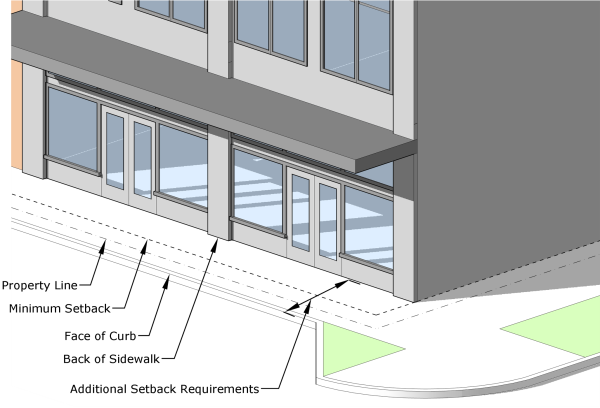
Fig. 5.3-2
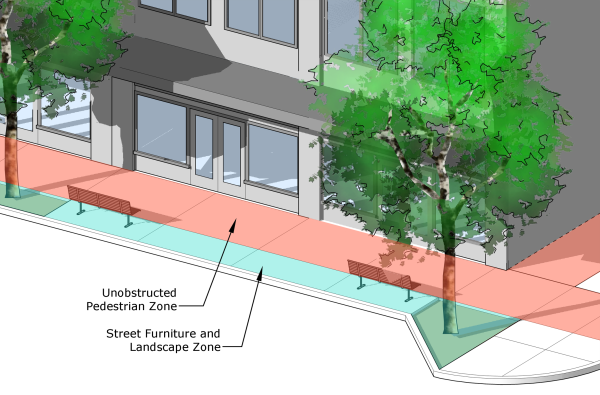
Fig. 5.3-3

