
Starkville City Zoning Code
SECTION 6
Residential Use Districts
2022-05-1
2024-06
6.1.1 Intent Of Residential Use Districts
The intent of the residential use districts is to implement the suburban single family, suburban multi-family, rural neighborhood, traditional neighborhood new, traditional neighborhood existing, suburban center, and suburban corridor placetypes of the Comprehensive Plan.
6.1.2 SD-2 Suburban Detached-2
The Suburban Detached-2 (SD-2) zoning is a suburban detached housing form with low to moderate density.
6.1.3 SD-6 Suburban Detached-6
The Suburban Detached-6 (SD-6) zoning is a suburban detached housing form with medium to high density.
6.1.4 RN Rural Neighborhood
The Rural Neighborhood (RN) zoning is a rural detached housing form with very low density residential that can include limited commercial, institutional, and industrial.
6.1.5 TN-N Traditional Neigborhood-New
The Traditional Neighborhood-New (TN-N) zoning is composed of newly constructed traditional neighborhoods with a range of housing types and limited small-scale commercial uses.
6.1.6 TN-E Traditional Neighborhood-Existing
The Traditional Neighborhood-Existing (TN-E) zoning is composed of existing neighborhoods surrounding the downtown core of Starkville and limited small-scale commercial uses.
6.1.7 MDU-9 Multi-Dwelling Unit-9
The Multi-Dwelling Unit -9 district (MDU-9) zoning is composed of smaller scale, neighborhood-style multi-dwelling housing located within the core or edge of an existing neighborhood.
6.1.8 MDU-20 Multi-Dwelling Unit-20
The Multi-Dwelling Unit -20 district (MDU-20) zoning is composed of larger scale, multi-dwelling unit developments that accommodates more units on a larger tract and is generally located along a commercial corridor or the periphery of the city.
6.1.9 CN Commercial Neighborhood
Commercial Neighborhood (CN) are small to medium scale commercial uses, intended to provide a variety of commercial uses that support everyday activities and allows for some residential uses.
6.1.10 CR Commercial Rural
Commercial Rural (CR) allows for commercial, residential, institutional, agricultural, and industrial land uses. Commercial Rural zones are located in more rural settings along the periphery of the city.
6.2.1 SD-2 Single-Dwelling 2
- Subject to the density restriction of two (2) dwelling units per acre. Allows for a single-dwelling unit in a detached house with a minimum lot size of 17,500 square feet.
- Smaller minimum lot sizes are permitted as a part of a compact development.
- Smaller lot sizes and increased density as part of a conservation development are allowed in exchange for preserving common open space.
6.2.2 SD-6 Single-Dwelling 6
- Subject to the density restriction of six (6) dwelling units per acre. Allows for a single-dwelling unit in a detached house with a minimum lot size of 6,000 square feet.
- Smaller minimum lot sizes are permitted as a part of a compact development.
- Smaller lot sizes and increased density as part of a conservation development are allowed in exchange for preserving common open space.
6.2.3 RN Rural Neighborhood
- Subject to the density restriction of one (1) dwelling unit per acre. Allows for a single-dwelling unit in a detached house with a minimum lot size of 40,000 square feet. Existing lots at the time of the adoption of this ordinance do not have to meet the minimum lot size requirements for the district, but shall be limited to one dwelling unit per lot.
- Smaller minimum lot sizes are permitted as a part of a compact development.
- Additional building types, smaller lot sizes, and increased density as part of a conservation development are allowed in exchange for preserving common open space.
6.2.4 TN-N Traditional Neighborhood New
- Subject to the density restriction of eight (8) dwelling units per acre. Allows for a variety of building types.
- Allows for limited small-scale commercial use.
6.2.5 TN-E Traditional Neighborhood Existing
- Subject to infill requirements to preserve the existing character of the neighborhood and compatible infill development styles. See Infill Development Standards.
6.2.6 MDU-9 Multi-Dwelling Unit 9
- Subject to the density restriction of nine (9) units per acre and a maximum of twenty-four (24) bedrooms per acre.
- MDU-9 is a smaller scale, neighborhood-style, multi-dwelling unit development that is generally located within the core of an existing neighborhood.
6.2.7 MDU-20 Multi Dwelling Unit 20
- Subject to the density restriction of twenty (20) units per acre and a maximum of sixty (60) bedrooms per acre.
- MDU-20 is a larger scale, multi-dwelling unit development that accommodates more units on a larger tract and is generally located along a commercial corridor or the periphery of the city.
6.3.1 Pattern Of Development
The conventional development is a pattern of residential development that includes single-dwelling and multi-dwelling units.
6.3.2 Open Yards
The conventional development option provides a majority of property owners with open yards on the individual lot.
6.3.3 Common Space And Min Lot Size
Under the conventional development option, no preserved common open space is required and the minimum lot size is limited to the lot size for the respective district.
6.3.4 Base Dimensional Standards
Fig 6.3-1
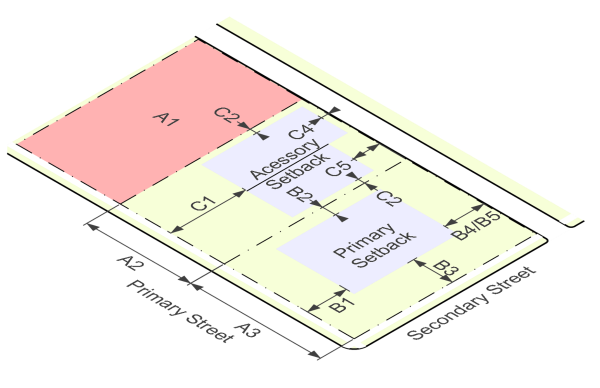
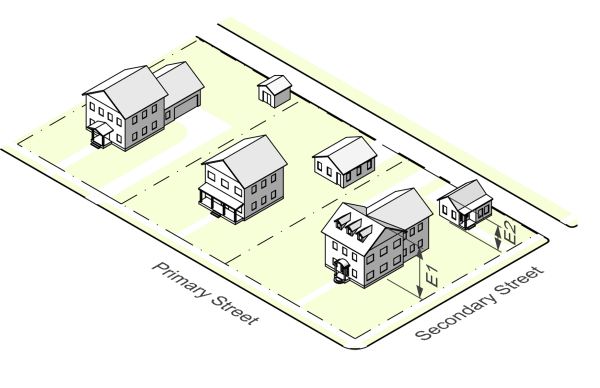
Detached and Attached Duplex Dwelling | ||||||||
A. Lot Dimensions | CR | RN | SD-2 | SD-6 | TN-N | TN-E | MDU-9 | MDU-20 |
A1. Lot size per unit in sq. ft (min.) | 40000 | 40000 | 17500 | 6000 | 5500 | 5500 | 5500 | 6000 |
A2. Lot width (min.) | 80’ | 140’ | 100’ | 50’ | 45’ | 45’ | 45’ | 50’ |
A3. Lot width at corner (min.) | 110’ | 140’ | 100’ | 60’ | 55’ | 55’ | 60’ | 60’ |
B. Principal Building Setbacks | CR | RN | SD-2 | SD-6 | TN-N | TN-E | MDU-9 | MDU-20 |
B1. Front setback | 40’ min* | 40’ min | 30’ or infill standards | 25’ or infill standards | 10’ min 15’ max | 15’ or infill standards | 10’ min 15’ max | 25’ or infill standards |
B2. Side setback (min.) | 10’ | 10’* | 10’ or infill standards | 5’ or infill standards | 5’ or infill standards | 5’ or infill standards | 5’ or infill standards | 5’ or infill standards |
B3. Side setback corner lot (min.) | 40’ | 40’* | 30’ | 25’ | 10’ min 15’ max | 15’ or see infill | 10’ min 15’ max | 25’ |
B4. Rear setback (min.) | 30’ | 30’ | 25’ | 20’ | 5’ | 15’ | 15’ | 20’ |
B5. Rear setback adjacent to street or alley (min.) | 20’ | 20’ | 30’ | 25’ | 7’ without parking, 18’ with parking | 15’ | 20’ | 20’ |
C. Accessory Dwelling Unit/Structure Setbacks | CR | RN | SD-2 | SD-6 | TN-N | TN-E | MDU-9 | MDU-20 |
C1. Front setback | Behind rear wall of principal building | |||||||
C2. Side setback | 5’ min | 5’ min* | 5’ min | 5’ min | 5’ min | 5’ min | N/A | N/A |
C3. Side setback corner lot (min.) | 40’ | 40’* | 30’ | 25’ | 10’ | 10’ | 10’ | 10’ |
C4. Rear setback | 5’, 100 for structures housing livestock | 5’, 100 for structures housing livestock | 5’, minimum of 10' from any structure | 5’, minimum of 10' from any structure | 5’, minimum of 10' from any structure | 5’, minimum of 10' from any structure | 5’, minimum of 10' from any structure | 5’, minimum of 10' from any structure |
C5. Rear setback adjacent to alley for garages (min.) | N/A | N/A | 20’ | 20’ | 7’ without parking, 18’ with parking | 15’ | 20’ | 20’ |
C6. Structures housing livestock (min.) | 100’ min | 100’ min | N/A | N/A | N/A | N/A | N/A | N/A |
D. Parking Setbacks | CR | RN | SD-2 | SD-6 | TN-N | TN-E | MDU-9 | MDU-20 |
D1. From primary street | N/A | N/A | See infill standards | See infill standards | Behind front wall of principal building | See infill standards | Behind front wall of principal building | Behind front wall of principal building |
E. Height | CR | RN | SD-2 | SD-6 | TN-N | TN-E | MDU-9 | MDU-20 |
E1. Principal building(s) (max) | 35’, 2.5 story | 35’, 2.5 story | 35’, 2.5 story | 30’, 2 story | 30’, 2 story | 30’, 2 story | 30’, 2 story | 30’, 2 story |
E2. Accessory Dwelling Unit(s)/Structure(s) (max) | Less than principal building | |||||||
E3. Accessory structure agricultural use | 70’ | 70’ | 15’ | 15’ | 15’ | 15’ | N/A | N/A |
F. Pedestrian Access | CR | RN | SD-2 | SD-6 | TN-N | TN-E | MDU-9 | MDU-20 |
F1. Street-facing primary entrance along street | yes | yes | yes | yes | yes | yes | yes | yes |
(*) For lots existing prior to establishment of current zoning, infill standards shall be used for building, accessory dwelling, and accessory structure setbacks
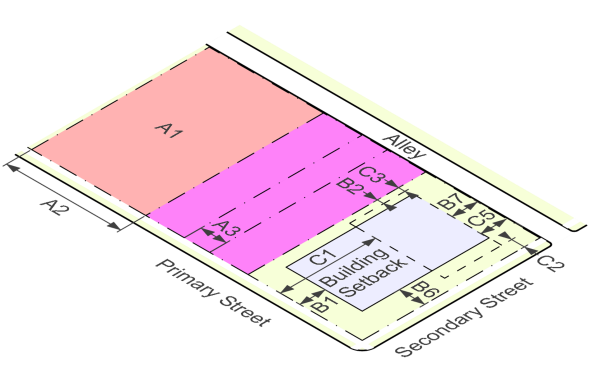
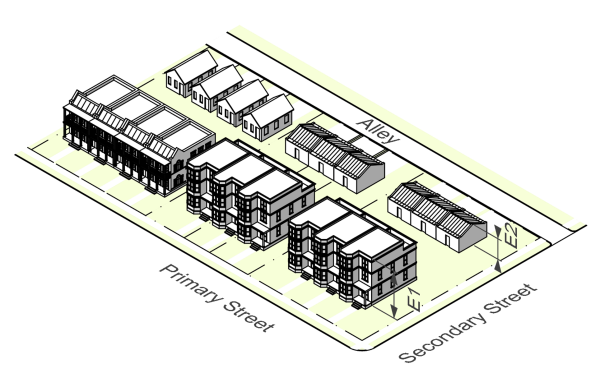
Fig 6.3-2
Townhouse /Rowhouse Dwelling | |||||
A. Lot Dimensions | TN-N | TN-E | MDU-9 | MDU-20 | C |
A1. Site size per unit (min) | 4000 sq. ft. | 4000 sq. ft. | 3300 sq. ft. | 2100 sq. ft. | 2100 sq. ft. |
A2. Site width (min) | 65’ | 65’ | 65’ | 100’ | 100’ |
A3. Lot width (min) | 20’ | 20’ | 18’ | 18’ | 18’ |
A4. Lot width at corner (min) | 30’ | 35’ | 38’ | 38’ | 33’ |
B. Building/Structure Setbacks | TN-N | TN-E | MDU-9 | MDU-20 | C |
B1. Front setback | 10/15’ max | 15’ or see infill standards | 20’ | 20’ | 15’ |
B2. Side setback for building | 5’ | 5’ | 10’ | 10’ | 10’ |
B3. Side setback between buildings | 10’ | 10’ | 10’ | 10’ | 10’ |
B4. Side setback between attached units | 0’ | 0’ | 0’ | 0’ | 0’ |
B5. Side setback adjacent to detached residential (min.) | 10’ | 10’ | 15’ | 25’ | 25’ |
B6. Side setback corner lot (min.) | 10/15’ max | 15’ or see infill standards | 20’ | 20’ | 20’ |
B7. Rear setback | 20’ | 20’ | 20’ | 20’ | 20’ |
C. Parking Setbacks | TN-N | TN-E | MDU-9 | MDU-20 | C |
C1. From primary street | Behind rear wall of principal building | Behind rear wall of principal building | Behind rear wall of principal building | Behind rear wall of principal building | Behind rear wall of principal building |
C2. From side lot line adjacent to street | 10’ | 10’ | 10’ | 10’ | 10’ |
C3. From side and rear lot line | 5’ | 5’ | 5’ | 5’ | 5’ |
C4. From rear lot line adjacent to detached residential | 10’ | 10’ | 10’ | 10’ | 10’ |
C5. From rear alley | 20’ | 20’ | 20’ | 20’ | 20’ |
D. Height | TN-N | TN-E | MDU-9 | MDU-20 | C |
D1. Principal building(s) (max) | 30’, 2 story | 30’, 2 story | 28’, 2 story | 38’, 3 story | 38’, 3 story |
D2. Accessory Structure(s) | 1 story | 1 story | 1 story | 1 story | 1 story |
E. Pedestrian Access | TN-N | TN-E | MDU-9 | MDU-20 | C |
E1. Street-facing primary entrance for each unit along street | yes | yes | yes | yes | yes |
E2. Sidewalk connection to street from each entrance | yes | yes | yes | yes | yes |
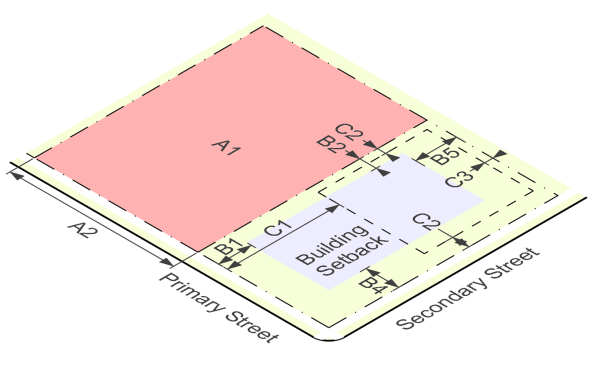
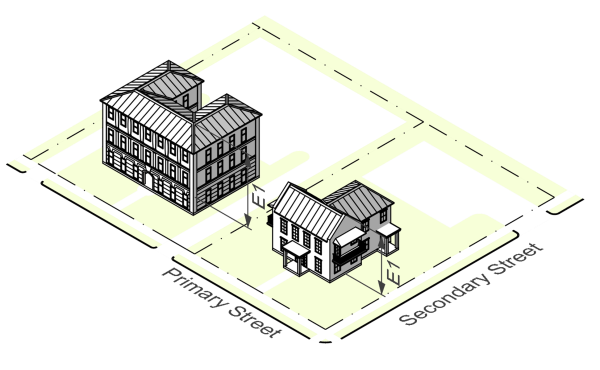
Fig 6.3-3
Triplex and Multi-plex Dwellings | ||||
A. Lot Dimensions | MDU-9 | MDU-20 | CN | C |
A1. Lot size per unit (min) | 3300 sq. ft. | 2100 sq. ft. | 4000 sq. ft. | 2100 sq. ft |
A2. Lot width (min) | 65’ | 100’ | 45' | 100' |
A3. Lot width at corner (min) | 80’ | 110’ | 55' | 110' |
B. Building/Structure Setbacks | MDU-9 | MDU-20 | CN | C |
B1. Front setback | 20’ | 20’ | 20' | 20' |
B2. Side setback | 10’ | 10’ | 5' | 10' |
B3. Side setback adjacent to detached residential | 15’ | 25’ | 20' | 25' |
B4. Side setback corner lot (min.) | 20’ | 20’ | 20' | 20' |
B5. Rear setback | 25’ | 10’ | 20' | 20' |
B6 Rear setback adjacent to detached residential | 30’ | 30’ | 30' | 30' |
C. Parking Setbacks | MDU-9 | MDU-20 | CN | C |
C1. From primary street | Behind front wall of principal building | Behind front wall of principal building | Behind front wall of principal building | 10' |
C2. From side lot line adjacent to street | 10’ | 10’ | 10' | 10' |
C3. From side and rear lot line | 5’ | 5’ | 10' | 10' |
C4. From rear lot line adjacent to detached residential | 10’ | 10’ | 15' | 15' |
D. Height | MDU-9 | MDU-20 | CN | C |
D1. Principal building(s) (max) | 28’, 2 story | 38’, 3 story | 30', 2 story | 38', 3 story |
E. Pedestrian Access | MDU-9 | MDU-20 | CN | C |
E1. Street-facing primary entrance along street | yes, all units must be accessible from the street with either common entrance or individual doors | yes | yes | yes |
E2. Sidewalk connection to street from each entrance | yes | yes | yes | yes |
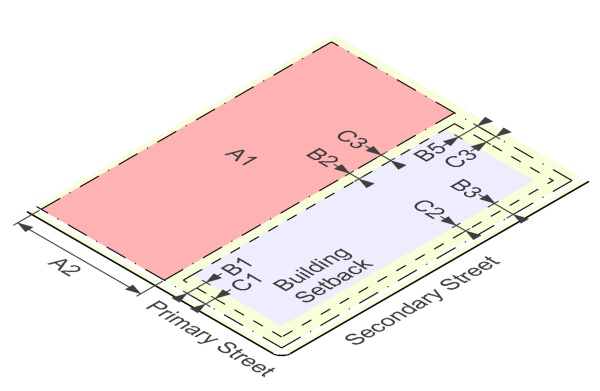
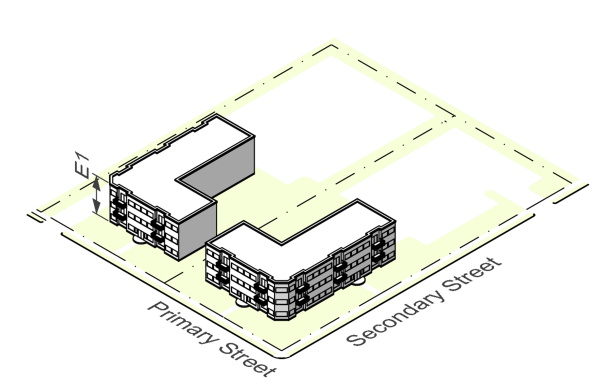
Fig 6.3-4
Apartments Dwellings | ||||
A. Lot Dimensions | MDU-20 | C | CN | O-C |
A1. Lot size per unit (min) | 2100 sq. ft. | 2100 sq. ft. | 4000 sq. ft. | 2100 sq. ft. |
A2. Lot width (min) | 100’ | 100’ | 45’ | 100’ |
A3. Lot width at corner | 110’ | 110’ | 55’ | 110’ |
B. Building/Structure Setbacks | MDU-20 | C | CN | O-C |
B1. Front setback | 20’ | 20’ | 20’ | 20’ |
B2. Side setback | 10’ | 10’ | 5’ | 10’ |
B3. Side setback adjacent to detached residential | 25’ | 25’ | 20’ | 25’ |
B4. Side setback corner lot | 20’ | 20’ | 20’ | 20’ |
B5. Rear setback | 20’ | 20’ | 20’ | 20’ |
B6. Rear setback adjacent to detached residential | 30’ | 30’ | 30’ | 30’ |
C. Parking Setbacks | MDU-20 | C | CN | O-C |
C1. From primary street | 10’ | 10’ | Behind front wall of principal building | 10’ |
C2. From side lot line adjacent to street | 10’ | 10’ | 10’ | 10’ |
C3. From side and rear lot line | 10’ | 10’ | 10’ | 10’ |
C4. From rear lot line adjacent to detached residential | 15’ | 15’ | 15’ | 15’ |
D. Height | MDU-20 | C | CN | O-C |
D1. Principal building(s) (max) | 38’, 3 story | 38’, 3 story | 30’, 2 story | 38’, 3 story |
E. Pedestrian Access | MDU-20 | C | CN | O-C |
E1. Street-facing primary entrance along street | yes | yes | yes | yes |
E2. Sidewalk connection to street from each entrance | yes | yes | yes | yes |
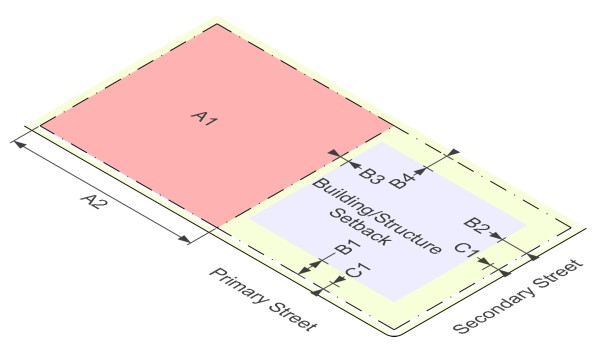
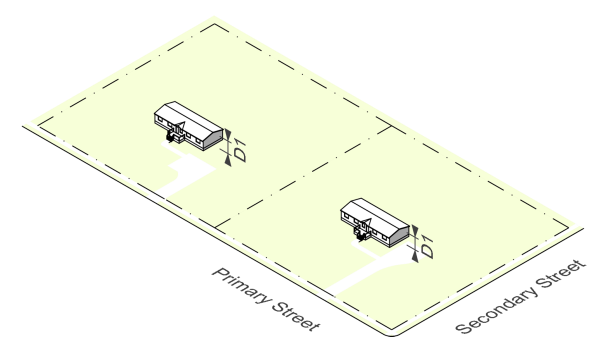
Fig 6.3-5
Manufactured and Modular Home | ||
A. Lot Dimensions | RN | CR |
A1. Lot size per unit (min) | 40000 sq. ft. | 40000 sq. ft. |
A2. Lot width | 100’ | 100’ |
B. Building/Structure Setbacks | RN | CR |
B1. Front setback | 30’ | 30’ |
B2. Side setback corner lot | 30’ | 30’ |
B3. Side setback | 10’ | 10’ |
B4. Rear setback | 25’ | 25’ |
C. Parking Setbacks | RN | CR |
C1. From primary street | 10’ | 10’ |
D. Height | RN | CR |
D1. Principal building(s) (max) | 1 story | 1 story |
Amended by Ord. 2022-05-1 on 9/20/2022
Amended by Ord. 2024-06 on 11/5/2024
6.4.1 Reduction
The compact development permits a reduction in lot size for residential subdivisions in exchange for an increase in usable common open space.
6.4.2 Minimum Gross Site Area
The total project area must meet the minimum gross site area for that district. If the size threshold cannot be met, then the conventional option must be used.
6.4.3 Development Options Restricted
Compact developments option shall only consist of detached and duplex residential units.
6.4.4 Setbacks
Setbacks shall meet the requirements of the zoning district.
6.4.5 Density
Density shall not exceed the underlying district requirements.
6.4.6 Common Open Space
Twenty percent (20%) of the total project area must be set aside as usable common open space. See Section 6.6 for common open space requirements.
6.4.7 Base Dimensional Standards
Compact Development | |||
A. Site | RN | SD-2 | SD-6 |
A1. Density (max) | 1 dwelling per acre | 2 dwellings per acre | 6 dwellings per acre |
A2. Gross site area (min) | 5 acres | 3 acres | 3 acres |
B. Open Space | RN | SD-2 | SD-6 |
B1. Open space required (min) | 20% | 20% | 20% |
B2. Width of open space (min) | 50’ | 50’ | 50’ |
C. Lot Requirements | RN | SD-2 | SD-6 |
C1. Lot size per unit (min) | 30000 sq. ft | 14000 sq. ft | 4800 sq. ft |
C2. Lot width | 140’ | 100’ | 50’ |
C3. Lot width at corner | 140’ | 100’ | 60’ |
6.5.1 Preserving Common Space
The conservation development trades smaller lot sizes and increased density in exchange for preserving common open space. This allows for a more efficient layout of lots, streets, utilities, and common open space in an attempt to protect the natural character of an area through the preservation of open space, recreation areas, and environmental features.
6.5.2 Setbacks
Setbacks shall meet the requirements of the zoning district.
6.5.3 Total Project Area
The total project area must meet the minimum gross site area for that district. If the size threshold cannot be met, then the conventional option must be used.
6.5.4 Percentage Of Common Open Space
Forty percent (40%) of the total project area must be set aside as common open space.
6.5.5 Base Dimensional Standards
Conservation Development | |||
A. Site | RN | SD-2 | SD-6 |
A1. Density (max) | 2 dwellings per acre | 4 dwellings per acre | 10 dwelling per acre |
A2. Gross site area (min) | 10 acres | 5 acres | 5 acres |
B. Open Space | RN | SD-2 | SD-6 |
B1. Open space required (min) | 40% | 40% | 40% |
B2. Percentage of lots abutting open space (min) | 60% | 50% | 40% |
B3. Contiguous area (min) | 60% | 60% | 60% |
B4. Width of open space (min) | 50’ | 50’ | 50’ |
C. Lot Dimensions | RN | SD-2 | SD-6 |
C1. Lot size per unit (min) | 20000 sq. ft. | 10000 sq. ft. | 4000 sq. ft. |
C2. Lot width | 100’ | 80’ | 45’ |
C3. Lot width at corner | 100’ | 80’ | 60’ |
6.6.1 Amount Of Open Space
- Applicants using the Compact Development Option must set aside at least twenty percent (20%) of the total project area as common open space.
- Applicants using the Conservation Development Option must set aside at least forty percent (40%) of the total project area as common open space. Sixty percent (60%) of open space shall be contiguous. Contiguous space is defined as being connected.
- Open space is calculated as a percentage of the net site area.
6.6.2 Open Space Allocation
The following hierarchy of categories shall be used in allocating land for required common open space. Before allocating land from a lower category, all applicable space shall be allocated from the higher category. If none of the categories are present on a particular site, open space shall be located to maximize its benefit to the environment and the overall aesthetics of the area.
- Floodway areas
- Jurisdictional wetlands
- Areas that connect to neighboring open space, trails, or greenways
- Individual or stands of existing healthy canopy tree(s) with a minimum diameter at breast height of eighteen (18) inches or greater
- Required buffer yards
- Areas designated as a Special Flood Hazard
- Steep slopes
6.6.3 Configuration Of Open Space
- The minimum width for any required open space is fifty (50) feet. Exceptions may be granted as part of the platting process for items such as trail easements, linear parks, and tree conservation areas.
- At least sixty percent (60%) of the required open space must be contiguous. For the purpose of this section, contiguous includes any open space bisected by a street provided that:
- A pedestrian crosswalk provides access to the open space on both sides of the street.
- The right-of-way area is not included in the calculation of minimum open space required.
- Where feasible, the open space should adjoin any neighboring areas of open space, other protected areas and non-protected natural areas.
- The required open space must be directly accessible to the largest practicable number of dwelling units within the development. Non-adjoining lots must be provided with safe and convenient access to the open space by a hard-surfaced walkway.
- No lot in a development can be farther than a ¼ mile radius from the open space. This radius is measured in a straight line from the lot line, without regard for street, sidewalk, or trail connections, to the nearest point of the open space.
- Access to the open space must be provided either by an abutting street or easement not less than twenty (20) feet in width.
6.6.4 Allowed Uses Of Open Space
To the extent not otherwise prohibited, required open space may be used for the following:
- Conservation areas for natural, archeological, or historical resources.
- Meadows, woodlands, wetlands, wildlife corridors, or similar conservation-oriented areas.
- Pedestrian or multipurpose trails
- Passive recreation areas
- Active recreation areas, provided that impervious area is limited to no more than twenty-five percent (25%) of the total open space
- Water bodies, such as lakes, ponds, and floodways provided that the total surface area does not exceed fifty percent (50%) of the required open space
- Restricted agriculture such as community gardens, floriculture, pasturage, hay production, vineyard, and noncommercial row crop production.
- Stormwater control measures
- Easements for drainage, access, and underground utility lines.
6.6.5 Stormwater Control Measures
No more than twenty-five percent (25%) of the required common space shall be devoted singularly or collectively to detention or retention ponds. However, this requirement shall not apply to retention ponds that meet all of the following criteria:
- The retention pond or closely connected series of ponds has at least 20,000 square feet of water surface area at normal water level.
- The retention pond is surrounded by accessible open space
- The retention pond is accessible to all homeowners
6.6.6 Prohibited Uses Of Open Space
Required open space cannot be used for the following:
- Overhead electric transmission lines or high voltage electrical transmission lines
- Telecommunication towers
- Water towers
- Streets and impervious parking areas. Streets crossing open space are allowed but should be avoided if possible.
6.6.7 Ownership And Management Of Open Space
- Ownership- Required open space must be owned and maintained by one of the following entities:
- A land conservancy or land trust with the legal authority to own the open space. The responsibility for maintaining the open space and any facilities shall be borne by a land conservancy or land trust.
- A homeowners’ association representing residents of the development may own the open space. The homeowners’ association must have lien authority to ensure the collection of dues from all members. The responsibility for maintaining the open space and any facilities is borne by the homeowners’ association. All of the above shall be specifically addressed in the filed covenants for the development.
- Conveyance- The conveyance of common open space shall be in accordance with the following:
- Open space shall be conveyed to the land conservancy or homeowners’ association in fee simple without any encumbrances except drainage, greenway, and utility easements. Title to the real property shall be conveyed no later than the time of conveyance of the first lot within the applicable phase of the development.
- Open space shall be preserved for the perpetual benefit of the residents within the development and it shall be restricted against private or public ownership for any other purpose except the acquisition by condemnation or in lieu of condemnation and the granting of utility, drainage, and greenway easements.
- Dissolution
- If the homeowners’ association is dissolved, the open space may be offered to another entity who shall be responsible for the maintenance and upkeep of the open space. If no other offer is accepted, the open space shall be offered to the City at no cost and if accepted, deeded to the City.
- Any non-maintained open space that is not owned by the City, a land conservancy, or a homeowners’ association shall be the responsibility of the owners of all lots within the platted subdivision. A special tax assessment may be used to provide for maintenance by the City after all necessary easements for maintenance have been provided. The reestablishment or creation of a homeowners’ association may be necessary to allow for maintenance agreements or transfer of real property.
6.7.1 Description
A cottage court development is a group of small houses centered around a courtyard. The central court enhances the character of the area through the provision of consolidated open spaces. Cottage Court Developments allow for a higher density development than is normally allowed with the underlying zoning district.
6.7.2 Allowed Districts
Cottage Courts shall be allowed in the following districts with the exception of areas that are a part of a local historic district: TN-E, TN-N, MDU-9, C, and MDU-20 Districts with approval by special exception.
6.7.3 Allowed Density
In no instance shall the density for a cottage court cluster be more than 1.5 times the allowed density for the underlying zoning.
6.7.4 Condominium Plat Requirements
All cottage courts shall be platted in accordance with the condominium plat requirements and process. Parking areas and common areas shall be owned and maintained commonly by the development’s residents through a condominium association and shall not be dedicated to or maintained by the City.
6.7.5 Maximum Bedrooms
Each cottage shall be one (1) detached dwelling unit limited to a maximum of three (3) bedrooms.
6.7.6 Phasing Restricted
Cottage Court Developments cannot be phased. Individual cottages cannot receive a Certificate of Occupancy until all units and common areas are complete.
6.7.7 Base Dimensional Standards
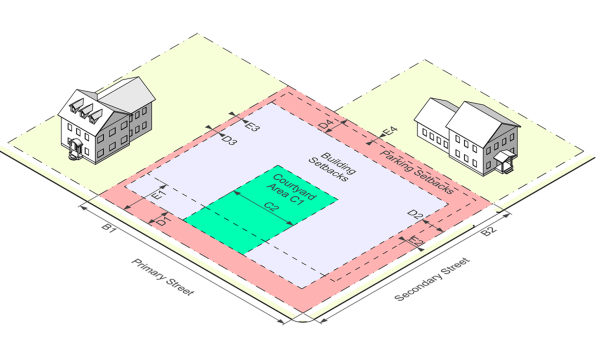
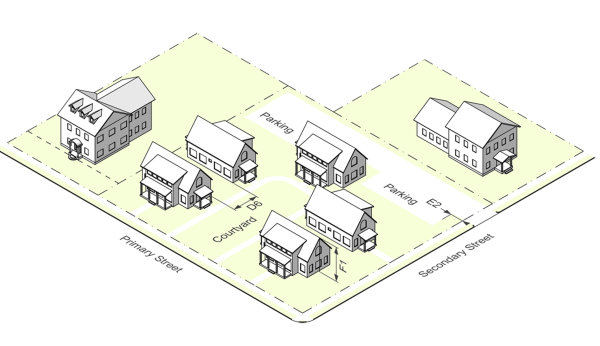
Fig 6.7-1
Cottage Court Development | |||
A. Site Dimensions | TN-E | TN-N | MDU-9, MDU-20, & C |
A1. Net site area (min) | 22000 sq. ft. | 22000 sq. ft. | 18000 sq. ft. |
A2. Site area per dwelling unit (min) | 4400 sq. ft | 4400 sq. ft | 3600 sq. ft |
A3. Site Dimensions (cont.) | TN-E | TN-N | MDU-9, MDU-20, & C |
A4. Number of cottage clusters per block | 1 | 1 | 2 |
B. Lot Dimensions | TN-E | TN-N | MDU-9, MDU-20, & C |
B1. Width (min) | 150’ | 150’ | 150’ |
B2. Depth (min/max) | 120/300’ | 120/300’ | 120/300’ |
C. Internal Courtyard | TN-E | TN-N | MDU-9, MDU-20, & C |
C1. Area per cottage(min) | 600 sq. ft. | 600 sq. ft. | 500 sq. ft. |
C2. Width of courtyard(min) | 50’ | 50’ | 40’ |
D. Building/Structure Setback | TN-E | TN-N | MDU-9, MDU-20, & C |
D1. From primary street (min) | 75% of the infill standards | 10’, porch can encroach 50% | 15’ |
D2. From side street (min) | 75% of the infill standards | 10’, porch can encroach 50% | 15’ |
D3. From side lot line (min) | 5’ (min) without driveway or 18’ feet with driveway, unless rear loaded by alley then 5’ (min) both sides. 10’ (min) from adjacent structure | ||
D4. From rear lot line (min) | 20’ | 20’ | 20’ |
D5. From alley (min) | 5’ | 5’ | 5’ |
D6. Building separation (without/ with fire rated walls) | 10’/6’ | 10’/6’ | 10’/6’ |
E. Parking Setbacks | TN-E | TN-N | MDU-9, MDU-20, & C |
E1. From Primary street (min) | 20’ behind the front facade of buildings adjacent to street | ||
E2. From side street (min) | 10’ | 10’ | 10’ |
E3. From side lot line (min) | 5’ | 5’ | 5’ |
E4. From rear lot line (min) | 5’ | 5’ | 5’ |
E5. From alley (min) | 0’ | 0’ | 0’ |
F. Height | TN-E | TN-N | MDU-9, MDU-20, & C |
F1. Building height (max) | 25’, 1.5 story | 25’, 1.5 story | 30’ 2 story |
F2. Building wall plate height (max) | 17’ | 17’ | 20’ |
F3. Height (cont.) | TN-E | TN-N | MDU-9, MDU-20, & C |
F4. Ground floor elevation (min) | 2’ | 2’ | 2’ |
G. Pedestrian Access | TN-E | TN-N | MDU-9, MDU-20, & C |
G1. Street-facing entrance or front porch required for units adjacent to street | yes | yes | yes |
G2. Distance from common space (max) | 25’ | 25’ | 25’ |
6.7.8 Additional Site And Building Design Standards
- The maximum number of bedrooms allowed per cottage is three (3).
- The gross floor area of each cottage shall not exceed 1,200 square feet.
- The footprint of the ground floor of each cottage shall not exceed eight-hundred and fifty (850) square feet.
- Cottage areas that do not count toward the gross floor area or footprint calculations are:
- Interior spaces with a ceiling height of six (6) feet or less, such as areas in a second floor that are under the slope of the roof.
- Basements
- Architectural projections such as fireplaces and utility closets that project out less than twenty-four (24) inches.
- Attached enclosed porches
- Garages or carports
- Cottages shall abut the courtyard on at least one side.
- Each cottage shall be clustered around a courtyard.
- Each cottage shall have the primary entry with a covered porch oriented to the courtyard.
- A minimum of two (2) porches shall be required for each cottage adjacent to a public street. One (1) porch shall be required to face the courtyard and one (1) porch shall be required to face the primary street with architectural enhancements oriented toward the primary street.
- Porches shall be a minimum of sixty (60) square feet.
- Private open spaces may be separated by a fence, hedge, or other visual separation not to exceed three (3) feet in height.
- All cottages shall have a pitched roof.
- No blank walls over twenty (20) feet in length are allowed.
- A diversity in the appearance of the cottages shall be achieved by incorporating at least two (2) of the following features:
- Alternating porch styles
- Alternating siding details on facades
- Alternating siding detail on roof gables
- All facades of each cottage shall be cladded in a maximum of two (2) of the following materials: wood siding, fiber cement siding, or stucco. Brick can be used to enclose crawl spaces. The use of any facade material is subject to approval by the Architecture Review Committee.
6.7.9 Courtyard Design Standards
- Dimensional requirements shall not include parking, yard setbacks, space between buildings, or driveways
- Courtyards can include landscape design features such as but not limited to: fountains, lighting, seating areas, firepits, and passive green space.
- Stormwater detention cannot be placed in the courtyard unless approved by the Development Review Committee as part of a Best Management Practice for stormwater.
6.7.10 Parking Standards
- Parking shall be twenty (20’) feet behind the front facade of the cottage(s) adjacent to a primary street and screened from public view with a masonry wall and landscaping. Wooden fences are not approved screening material.
- Driveways accessing all parking areas shall be paved with approved hard surface materials. A hard surface shall be defined as either concrete, asphalt, or pavers.
- Parking located in the rear of the property not adjacent to an alley or street may be gravel.
- Parking shall not be located between the courtyard and the primary entrance of the cottage.
- Garages and carports shall not exceed two hundred (200) square feet and shall not occupy the first floor of a cottage fronting the courtyard.
6.8.1 Intent
The intent of the residential infill compatibility standards is to accommodate and encourage compatible development and appropriate redevelopment in existing residential neighborhoods and platted subdivisions, while reinforcing the established character of the neighborhood and mitigating adverse impacts on adjacent homes.
6.8.2 Applicability
- When indicated on the base dimensional standards chart as “infill standards”, infill development standards shall be applied unless determined to be not applicable in accordance with Section 6.8.2. The base dimensional standards of the district shall apply if infill standards are not applicable.
- The standards contained within this section apply to any building in an SD-2, SD-6, TN-E, and TN-N district where all of the following are present:
- The total site area is three (3) acres or less
- At least fifty percent (50%) of the side and rear property lines abut existing detached or attached building types
- For a lot that is a part of an existing platted subdivision or any lot within a TN-E or TN-N zone that is adjacent to existing residential dwellings that front the same street.
- These infill development standards do not take precedence over any requirements found in a Historic District.
- Front Setback (see fig 6.8-1)
- The proposed building must be located within the range of front setbacks, no closer than the smallest setback in the range and no further than the largest setback in the range.
- On an interior lot, the range of front setbacks is measured on the basis of the two (2) closest developed lots in both directions along the primary street.
- On a corner lot, the range of front setbacks is measured on the basis of the two (2) closest developed lots along the primary street.
- Where the calculation cannot be applied to at least four (4) lots on an interior lot or two (2) lots on a corner lot, the building shall meet the base dimensional standards for the zoning district.Where a setback in any lot(s) used in the calculation is significantly out of the range of setbacks along the block face, the City Planner may eliminate it from the range.
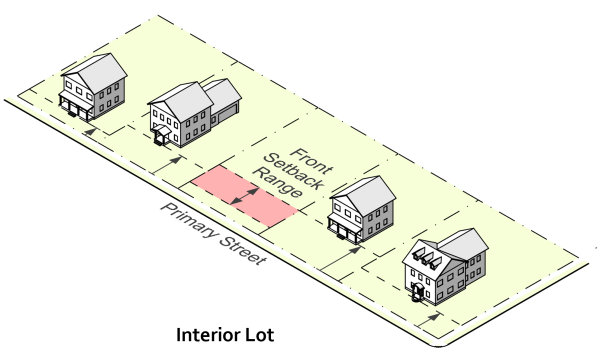
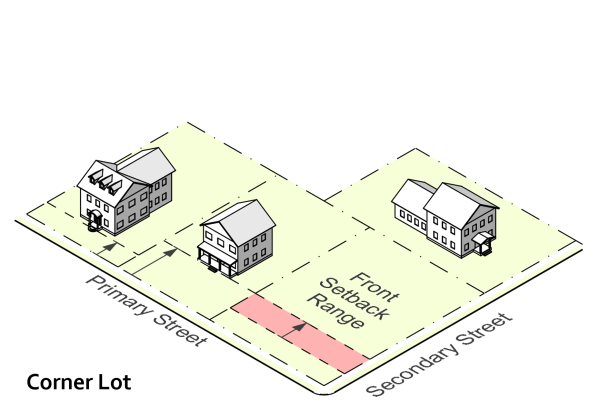
Fig 6.8-1
D. Side Setback (see fig 6.8-2)
- The minimum side setback is equal to the average side setback of the two (2) closest developed lots in either direction along the block face.
- On a corner lot, the range of side setback adjacent to a street is measured on the basis of the front setback range for the two (2) closest developed lots along the secondary street.
- No side setback is required to exceed twenty-five percent (25%) of the subject lot width.
- No structure shall be sited within ten (10) feet of an existing structure on the adjacent lot.
Side Setback (see fig 6.8-2)
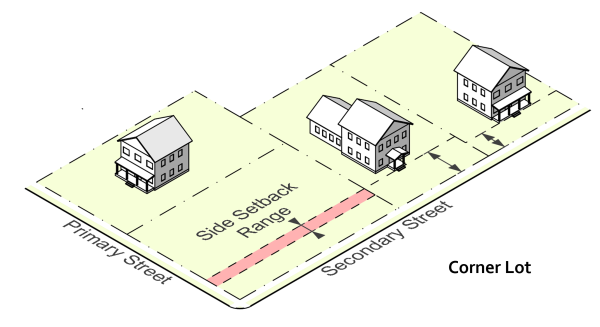
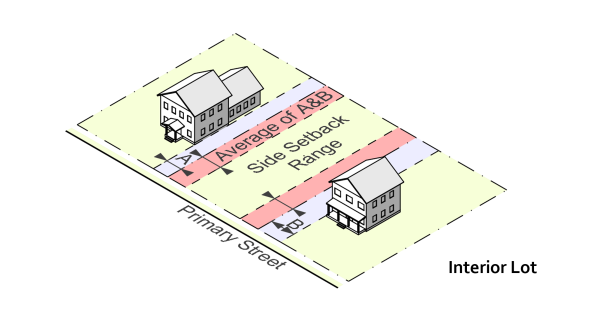
Fig 6.8-2 - Height
- For any new building or addition to an existing building in a SD-2, SD-6, TN-E, and TN-N zoning district, the maximum height of the structure shall not exceed 1.5 stories or twenty-five (25) feet. If adjacent structures on the two (2) closest developed lots in either direction along the block face exceed this requirement, the maximum height cannot exceed either adjacent structure heights.
- If the adjacent height of a structure is significantly out of the range of heights along the block face, the City Planner may eliminate it from the range.
- Garages (see fig 6.8-3)
- Garages and/or carports shall not open onto a front yard, unless more than sixty (60) percent of existing dwellings on the block on both sides of the road have garages and/or carports which open on to a front yard. Garages and/or carports may be located in the rear of the lot by right and face any direction.
- Attached garages and/or carports shall be a minimum of ten (10) feet behind the front facade of the building.
- An attached garage and/or carport shall not exceed fifty (50) percent of the width of the front façade of the house.
- Foundation
- Raised ground floors shall be required on any new building if raised ground floors are part of sixty percent (60%) of existing dwellings on the block face.
- Any building that requires a raised ground floor must have a foundation height of at least sixteen (16) inches measured from top of grade to the first finished floor.
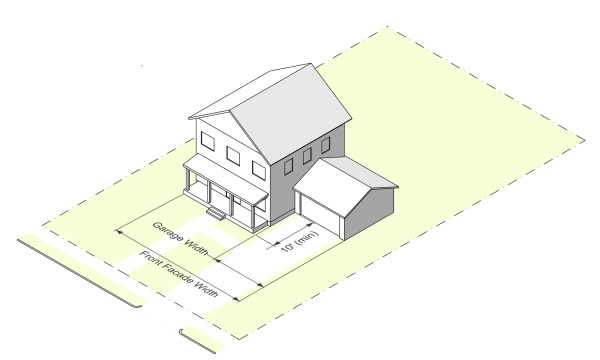
Fig 6.8-3
- Newly created lots
- Any newly subdivided lot within a SD-2, SD-6, TN-E, and TN-N zoning district, must have a minimum lot width that is the average along the block face.
- Any newly created lot within a SD-2, SD-6, TN-E, and TN-N zoning district, must have a buildable area equal to the average first floor square footage of the block face. Buildable area is calculated as the remaining lot area with the infill standard setbacks applied.
Amended by Ord. 2022-05-1 on 9/20/2022

