
Starkville City Zoning Code
SECTION 7
Commercial Use Districts
7.2 Base Dimensional Standards
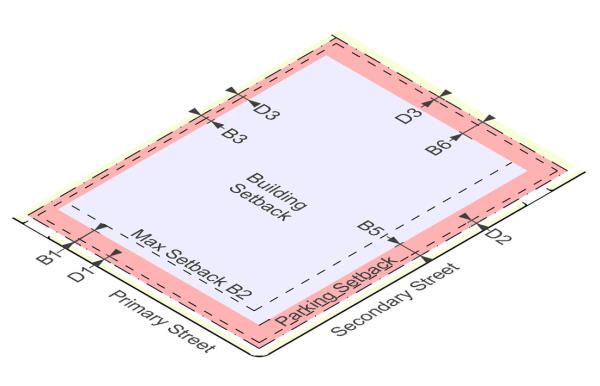
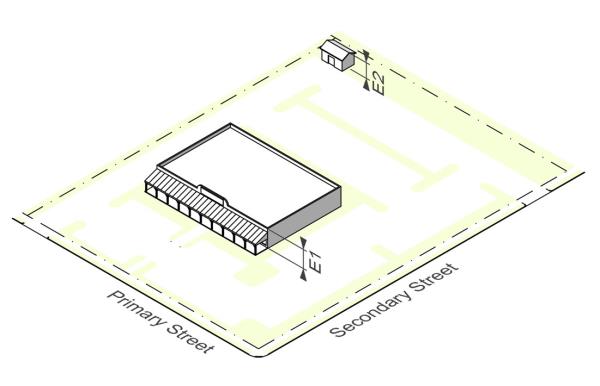
Commercial Use |
|
|
|
|
|
A. Lot Dimensions | C | CN | CR | TN-N | TN-E |
A1. Lot size (min) | * | * | * | * | * |
A2. Lot width (min) | * | * | * | * | * |
B. Building/Structure Setbacks | C | CN | CR | TN-N | TN-E |
B1. Front setback min | 20’ | 15’ | 30’ | 10’ | 15’ |
B2. Front setback max | N/A | 30’ | N/A | 20’ | 25’ |
B3. Side setback | 10’ | 5’ | 25’ | 5’ | 5’ |
B4. Side setback adjacent to detached residential | 50’ | 50’ | 30’ | 10’ | 10’ |
B5. Side setback corner lot | 20’ | 15’ | 30’ | 10’ (min) or infill standards | 15’ (min) or infill standards |
B6. Rear setback | 20’ | 20’ | 25’ | 5’ | 15’ (min) or infill standards |
B7. Rear setback adjacent to detached residential | 50’ | 50’ | 50’ | 45’ | 45’ |
D. Parking Setbacks | C | CN | CR | TN-N | TN-E |
D1. From primary street | 5’ | Behind front wall of primary building | 10’ | Behind rear wall of primary building | Behind rear wall of primary building |
D2. From side street | 5’ | 5’ | 10’ | 10’ | 10’ |
D3. From side and rear property line | 5’ | 5’ | 5’ | 5’ | 5’ |
D4. From side and rear property line adjacent to detached residential | See buffer yard requirements | See buffer yard requirements | See buffer yard requirements | See buffer yard requirements | See buffer yard requirements |
E. Height | C | CN | CR | TN-N | TN-E |
E1. Principal building(s) (max) | 50’, 4 story | 30’, 2 story | 35’, 2.5 story | 30’, 2 story | 30’, 2 story |
E2. Accessory structures(s) (max) | 15’, 1 story | 15’, 1 story | agricultural structures 70’ | 15’, 1 story | 15’, 1 story |
F. Pedestrian Access | C | CN | CR | TN-N | TN-E |
F1. Street-facing primary entrance along street | yes | yes | yes | yes | yes |
F2. Sidewalk connection to street from each entrance | yes | yes | no | yes | yes |
*lots must be of a sufficient size to accommodate the proposed use and meet all subsequent development standards | |||||
**see use chart and additional standards | |||||
7.1.1 General Purpose
- The intent of the Commercial Use Districts is to implement the Suburban Corridor, Suburban Center, and the Rural Corridor Placetype of the Starkville Comprehensive Plan. Some limited Commercial uses are allowed in the Traditional Neighborhood New and Traditional Neighborhood Existing Placetypes of the Starkville Comprehensive Plan.
- Commercial (C), are a larger scale commercial uses, ranging from “big box” retail to smaller commercial buildings located along major commercial corridors.
- Commercial Neighborhood (CN) are small to medium scale commercial uses, intended to provide a variety of commercial uses that support everyday activities.
- Commercial Rural (CR) allows for commercial, residential, institutional, agricultural, and industrial land uses and are located in more rural settings along the periphery of the city.
- Traditional Neighborhood New (TN-N) zoning is composed of newly constructed traditional neighborhoods with a range of housing types and limited small-scale commercial uses.
- Traditional Neighborhood Existing (TN-E) zoning is composed of existing neighborhoods surrounding the downtown core of Starkville and limited small-scale commercial uses.
7.1.2 Commercial (C)
- Commercial districts range from “big box” retail to smaller buildings.
- Development patterns consist of low-rise retail, mid-rise office, and lodging uses located primarily along Highway 12 and other key intersections.
- Developments shall be primarily designed to be accessed by automobiles while providing for safe access for pedestrians.
- Mixed-use and multi-dwelling residential are allowed in commercial districts. Requirements for residential uses can be found in the Residential Use Districts section.
7.1.3 Commercial Neighborhood (CN)
- Commercial neighborhood districts consist primarily of smaller lots and single use buildings.
- Development patterns consist of low-rise retail and office uses located primarily along collector roads adjacent to residential areas.
- Developments shall be designed for efficient and safe access for both automobiles and pedestrians.
- Mixed-use and multi-dwelling residential are allowed in commercial neighborhood districts. Requirements for residential uses can be found in the Residential Use Districts section.
7.1.4 Commercial Rural (CR)
- Commercial rural districts primarily consist of irregular shaped lots that vary in size with small scale single and mixed-use buildings.
- Development patterns consist of low-rise buildings oriented either linearly along the road or at the intersection of two (2) major roads.
- Developments shall be primarily designed to be accessed by automobiles while providing for safe access for pedestrians where appropriate.
- Detached dwelling residential are allowed in commercial rural districts. Requirements for residential uses can be found in the Residential Use Districts section. Limited industrial is also allowed.=
7.1.5 Traditonal Neighborhood New (TN-N)
- Traditional neighborhood new districts primarily consist of single-dwelling residential and limited small-scale commercial and/or mixed use.
- The location of commercial and/or mixed uses in a traditional neighborhood new district shall be carefully selected and designed to not detract from the aesthetic of the development and surrounding neighborhood.
- Developments shall be designed with parking to the side or rear of the building, a connected street network with on-street parking, and well-designed streetscapes with safe access for pedestrians.
- The residential use of the traditional neighborhood new district shall be the primary use. Commercial and/or mixed uses shall be very limited and based on approved plans.
7.1.6 Traditional Neighborhood Existing (TN-E)
- Traditional neighborhood existing districts consist of established neighborhoods that are primarily single-dwelling residential, but also include attached houses, small-scale commercial, and/or mixed-use.
- The location of commercial and/or mixed-uses in a traditional neighborhood existing district shall be carefully selected and designed to not detract from the aesthetic of the surrounding neighborhood.
- Developments shall be designed with parking to the side or rear of the building, a connected street network with on-street parking, and well-designed streetscapes with safe access for pedestrians.
- Detached dwelling residential use of the traditional neighborhood existing district shall be the primary use. Attached dwelling residential, commercial and/or mixed use shall be very limited and based on approved plans.
7.3.1 Intent
The intent of the commercial infill compatibility standards is to accommodate and encourage compatible development and appropriate redevelopment in traditional neighborhood areas, while reinforcing the established character of the area and mitigating adverse impacts on adjacent residential uses.
7.3.2 Applicability
- The standards contained within this section apply to any new commercial building in an TN-E and TN-N district.
- The total site area is three (3) acres or less
- At least fifty percent (50%) of the side and rear property lines abut existing detached or attached building types
- For a lot that is a part of an existing platted subdivision or any lot within a TN-E or TN-N zone that is adjacent to existing residential dwellings that front the same street.
- These infill development standards do not take precedence over any requirements found in a Historic District.
- Front Setback
- The proposed building must be located within the range of setbacks, no closer than the smallest setback in the range and no further than the largest setback in the range.
- On an interior lot, the range of setbacks is measured on the basis of the two (2) closest lots in both directions along the primary street. This shall be considered the measurement of the block face.
- On a corner lot, the range of setbacks is measured on the basis of the two (2) closest lots along the primary street. This shall be considered the measure of the block face.
- Where the calculation cannot be applied to at least four (4) lots on an interior lot or two (2) lots on a corner lot, the building shall meet the base dimensional standards for the zoning district.
- Where a setback in any lot(s) used in the calculation is significantly out of the range of setbacks along the block face, the City Planner may eliminate it from the range.
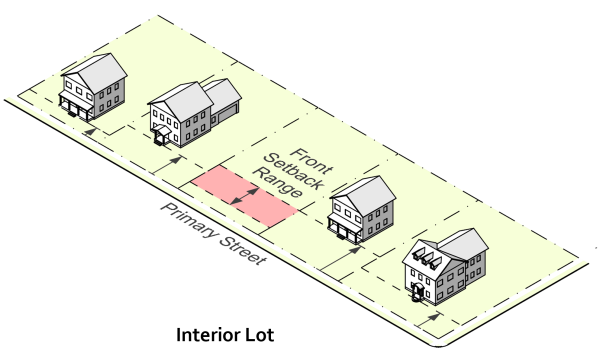
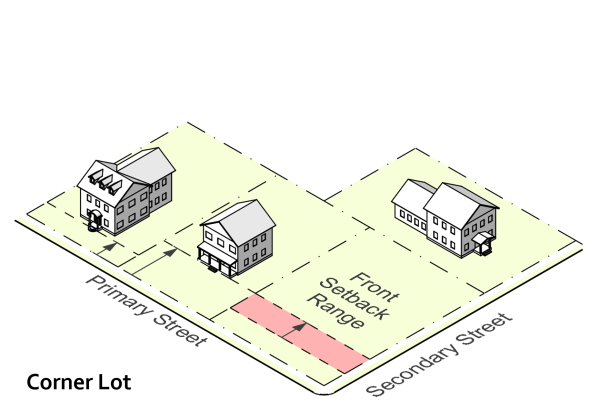
Fig 7.3-1
- Side Setback
- The minimum side setback is equal to the average side setback of the two (2) closest lots in either direction along the block face.
- On a corner lot, the side setback adjacent to a street (also known as a secondary street), shall match the front setback of the two (2) closest lots along the secondary street.
- No setback is required to exceed twenty-five percent (25%) of the subject lot width.
- No structure shall be sited within ten (10) feet of an existing structure on the adjacent lot.
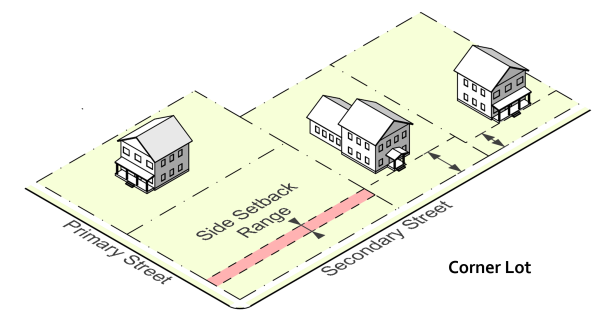
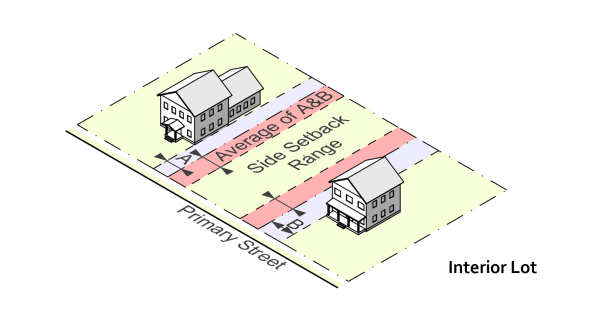
Fig 7.3-2

