
Stevenson City Zoning Code
CHAPTER 17
36 - WW WIND/WIRELESS OVERLAY DISTRICT*13
* Editor's note—Ord. No. 1048, § 12, adopted March 17, 2011, repealed the former Chapter 17.36, §§ 17.36.005—17.36.030, and enacted a new Chapter 17.36 as set out herein. The former Chapter 17.36 pertained to the WT wireless telecommunications overlay district and derived from Ord. No. 1038, adopted June 17, 2010.
17.36.005 - Purpose and applicability.
A.
The wind/wireless (WW) overlay district is intended to provide development standards that encourage the establishment of wind power generation and wireless telecommunications facilities in areas that will minimize the adverse visual impacts of such facilities.
B.
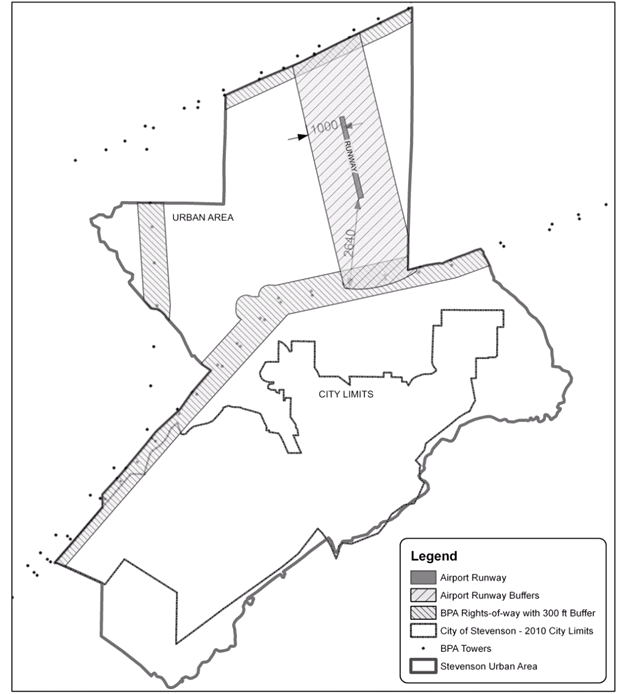
The provisions of this chapter shall apply to all areas within a BPA right-of-way or easement or within three hundred feet of a BPA right-of-way or easement; provided however, that this overlay district shall not apply within one-half mile from the end of and at least one thousand feet from the sides of any runway available for public use and identified on the most current edition of the Sectional Aeronautical Charts produced by the National Aeronautical Charting Office (NACO).
Map 17.36-1—Wind/Wireless Overlay District at Build Out
C.
Where there is a conflict between the provisions of this chapter and the provisions of an underlying zoning district, the provisions of this chapter shall apply.
(Ord. No. 1048, § 12, 3-17-11)
17.36.010 - Principal uses.
Principal uses permitted outright in the WT overlay district are as follows:
A.
All uses permitted outright in the underlying zoning district;
B.
Minor and intermediate wireless telecommunications facilities.
(Ord. No. 1048, § 12, 3-17-11)
17.36.020 - Accessory uses.
Accessory uses and activities allowed in the WT overlay district are as follows:
A.
All uses and activities allowed in the underlying zoning district;
B.
Major wireless telecommunications facilities.
(Ord. No. 1048, § 12, 3-17-11)
17.36.030 - Conditional uses.
Conditional uses that may be allowed in the WW district are set forth in the following list. In granting a conditional use request, the planning commission may attach to the conditional use permit, such reasonable requirements as will ensure that development in its proposed location:
Will not endanger the public health or safety;
Will not substantially reduce the value of adjoining or abutting property;
Will be in harmony with the area in which it is located; and
Will be in conformity with the comprehensive plan, transportation plan, or other plan officially adopted by the council.
Conditional uses that may be allowed in the WW district are as follows:
A.
Minor and major wind power generation facilities.
(Ord. No. 1048, § 12, 3-17-11)
17.36.040 - Height allowance.
Major wind power generation facilities and intermediate and major wireless telecommunications facilities proposed for collocation on BPA transmission towers existing at the time an application is submitted shall be eligible for an additional thirty-foot height allowance from that permitted or allowed above, provided that the allowance does not trigger different lighting requirements by the FAA.
(Ord. No. 1048, § 12, 3-17-11)

