10 - DEFINITIONS
For the purpose of this title certain terms are defined in this chapter. When not inconsistent with the context, words used in the present tense include the future, words in the singular number include the plural, and word "person" may be taken for persons, association, firm, partnership or corporation; the word "occupied" includes premises designed or intended to be occupied; the word "used" includes designed or intended to be used; and the word "shall" is always mandatory and not merely directive. Where specific land uses are referenced in this code, those uses are defined as described in SMC 17.13 - Use Categories and Descriptions.
(Ord. 894 (part), 1994).
(Ord. No. 1103, § 1.A, 2-16-2017)
Editor's note— Ord. No. 1103, § 1.G.1, adopted Feb. 16, 2017, repealed former § 17.10.015 in its entirety which pertained to the definition of "accessory dwelling unit" and derived from Ord. No. 950, § 1, adopted in 1998.
"Accessory use of structure" means a use subordinate to the principal use of a building on that property housing such principal use; an accessory use (of a structure) must serve a purpose customarily incidental to the instant principal use.
(Ord. 894 (part), 1994).
"Adult animal" means an animal that has been weaned from reliance on its mother and/or has reached the productive age for which it is bred or raised. For bees, a bee colony as it is defined in RCW 15.60.005 is considered one adult animal.
(Ord. No. 1093, § 2, 6-16-2016)
Editor's note— Ord. No. 1103, § 1.G.2, adopted Feb. 16, 2017, repealed former § 17.10.030 in its entirety which pertained to the definition of "adult family home" and derived from Ord. No. 894 adopted in 1994.
"Alley" means a public or private right-of-way not over thirty feet wide which affords a secondary means of access to abutting property.
(Ord. 894 (part), 1994).
"Antenna" means any device designed to transmit and/or receive electromagnetic waves, including but not limited to telephonic, radio, television or internet communications. Antennas include any mounting hardware which does not cause the antenna to exceed the height requirements of this title.
(Ord. 894 (part), 1994).
(Ord. No. 1038, § 3(B), 6-17-10)
"Basement" means any story which has a floor more than two feet below that lower point from which the height of the building is measured.
(Ord. 894 (part), 1994).
Editor's note— Ord. No. 1103, § 1.G.3, adopted Feb. 16, 2017, repealed former § 17.10.065 in its entirety which pertained to the definition of "battery exchange station" and derived from Ord. No. 1051, § 2.1 adopted July 21, 2011.
Editor's note— Ord. No. 1103, § 1.G.4, adopted Feb. 16, 2017, repealed former § 17.10.070 in its entirety which pertained to the definition of "bed and breakfast" and derived from Ord. 894 (part), 1994; Ord. No. 1092, § 1, 3-17-2016.
Editor's note— Ord. No. 1051, § 2.2, adopted July 21, 2011, repealed § 17.10.080, which pertained to billboard and derived from Ord. No. 894, 1994.
Editor's note— Ord. No. 1103, § 1.G.5, adopted Feb. 16, 2017, repealed former § 17.10.090 in its entirety which pertained to the definition of "boarding house" and derived from Ord. 894 (part), 1994; Ord. No. 1092, § 1, 3-17-2016.
"Building" means any structure built or used for the support, shelter or enclosure of any person, animals, goods, equipment or chattels and property of any kind, but does not include fences.
(Ord. 894 (part), 1994).
"Accessory building" means a building that is located on the same lot as a principal building and that is used incidentally to a principal building or that houses an accessory use.
(Ord. 894 (part), 1994).
"Principal building" means the primary building on a lot or a building that houses a principal use.
(Ord. 894 (part), 1994).
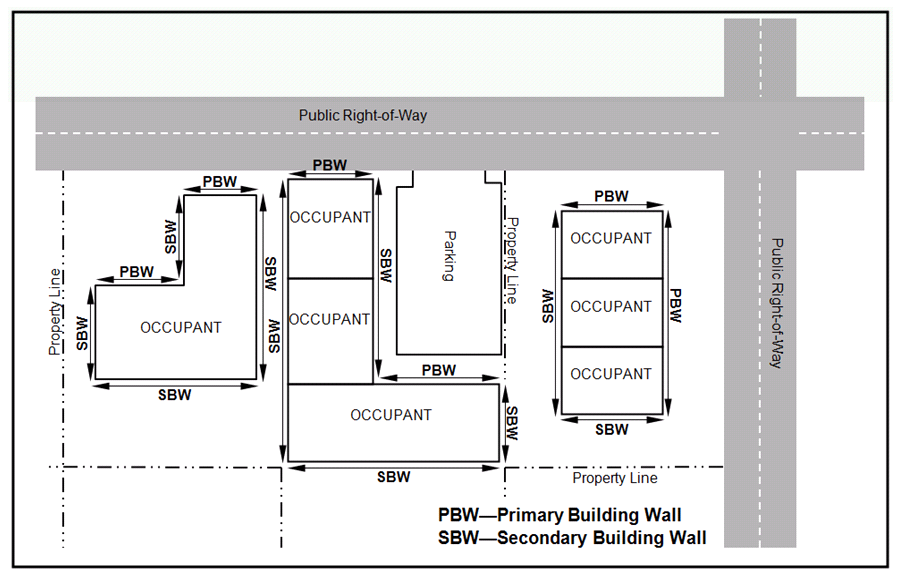
"Building wall" means any vertically oriented structure, other than a fence, having a rise-to-run ratio that is greater than or equal to one-to-one.
1.
"Primary building wall" means any building wall that faces a public right-of-way and contains a public entrance to the building. When walls are not parallel to the street, they are assigned to the street frontage to which they are most oriented.
2.
"Secondary building wall" means any exterior building wall not classified as a primary building wall.
Figure 17.10.125-1—Building Wall Examples
(Ord. No. 1051, § 2.3, 7-21-11)
Editor's note— Ord. No. 1103, § 1.G.6, adopted Feb. 16, 2017, repealed former § 17.10.135 in its entirety which pertained to the definition of "campground" and derived from Ord. No. 1092, § 1, adopted March 17, 2016.
Editor's note— Ord. No. 1103, § 1.G.7, adopted Feb. 16, 2017, repealed former § 17.10.140 in its entirety which pertained to the definition of "child day care facility" and derived from Ord. No. 894 adopted in 1994.
Editor's note— Ord. No. 1103, § 1.G.8, adopted Feb. 16, 2017, repealed former § 17.10.150 in its entirety which pertained to the definition of "child day care center" and derived from Ord. No. 894 adopted 1994.
Editor's note— Ord. No. 1103, § 1.G.9, adopted Feb. 16, 2017, repealed former § 17.10.170 in its entirety which pertained to the definition of "clinic" and derived from Ord. No. 894 adopted in 1994.
"Collocate" means to use a single site or wireless telecommunications support structure by more than one wireless telecommunications service provider.
(Ord. No. 1038, § 3(A), 6-17-10)
"Comprehensive plan" means the comprehensive plan for the city comprised of a text, maps, findings and policies relating to the physical and economic growth and development of the city.
(Ord. 894 (part), 1994).
"Conditional use" mean a use listed as conditional in the relevant zoning district and permitted only after review as herein provided; except that uses specified as conditional uses for a relevant zoning district shall not be deemed nonconforming and shall not require a conditional use permit if such use was existing at the time of adoption of this title.
(Ord. 894 (part), 1994).
"Conditional use permit" means a permit issued by the planning commission that authorizes the recipient to make use of property in accordance with the requirements of this chapter as well as any additional requirements imposed by the commission.
(Ord. 894 (part), 1994).
Editor's note— Ord. No. 1103, § 1.G.10, adopted Feb. 16, 2017, repealed former § 17.10.200 in its entirety which pertained to the definition of "cottage industry" and derived from Ord. No. 894 adopted in 1994.
"Density and dimensional regulations" means standards for each district that include minimum lot area and dimensions, minimum yards, maximum building height and coverage of lot, and maximum dwelling units allowed.
(Ord. 894 (part), 1994).
"District" or "zone" means a section or district of the city within which the standards governing the use of buildings and premises are uniform and which is designated by a category of classification listed in Chapter 17.14 of this title.
(Ord. 894 (part), 1994).
Driveway" means that portion of the vehicle travel area [SMC 17.10.855] that consists of a minor private way providing access for vehicles and pedestrians to a lot, parking space, garage, dwelling, or other structure. For residential uses, a driveway frequently serves a secondary purpose as a parking space [SMC 17.10.630].
(Ord. 894 (part), 1994).
(Ord. No. 1104, § 1.A, 6-15-2017)
Editor's note— Ord. No. 1103, § 1.G.11, adopted Feb. 16, 2017, repealed former § 17.10.260 in its entirety which pertained to the definition of "dwelling, multi-family" and derived from Ord. No. 894 adopted in 1994.
Editor's note— Ord. No. 1103, § 1.G.12, adopted Feb. 16, 2017, repealed former § 17.10.265 in its entirety which pertained to the definition of "dwelling, single family detached" and derived from Ord. No. 894 adopted in 1994.
Editor's note— Ord. No. 1103, § 1.G.13, adopted Feb. 16, 2017, repealed former § 17.10.270 in its entirety which pertained to the definition of "dwelling, two-family" and derived from Ord. No. 894 adopted in 1994.
"Dwelling unit" means a single unit providing complete, independent living facilities for one or more persons, including permanent provisions for living, sleeping, eating, cooking and sanitation.
(Ord. No. 1157, § 1, 8-20-2020)
Editor's note— Ord. No. 1103, § 1.G.15, adopted Feb. 16, 2017, repealed former § 17.10.277 in its entirety which pertained to the definition of "electric vehicle (EV) station" and derived from Ord. No. 1051, § 2.4 adopted July 21, 2011.
"FAA" means the Federal Aviation Administration or such other agency as may assume the federal duties of aviation regulation in the future.
(Ord. No. 1038, § 3(A), 6-17-10)
"Family" means one or more persons living together as a single housekeeping unit.
(Ord. 894 (part), 1994).
Editor's note— Ord. No. 1103, § 1.G.16, adopted Feb. 16, 2017, repealed former § 17.10.300 in its entirety which pertained to the definition of "family day care home" and derived from Ord. No. 894 adopted in 1994.
Editor's note— Ord. No. 1103, § 1.G.17, adopted Feb. 16, 2017, repealed former § 17.10.302 in its entirety which pertained to the definition of "farm animal" and derived from Ord. No. 1093, § 2 adopted June 16, 2016.
Editor's note— Ord. No. 1103, § 1.G.18, adopted Feb. 16, 2017, repealed former § 17.10.303 in its entirety which pertained to the definition of "farm animal, urban" and derived from Ord. No. 1093, § 2 adopted June 16, 2016.
"FCC" means the Federal Communications Commission or such other agency as may assume the federal duties of communications regulation in the future.
(Ord. No. 1038, § 3(A), 6-17-10)
"Underground fiber-to-the-home" means a system of vaults, conduits, handholds, and/or pedestals wherein fiber optic cables are installed and spliced to provide direct service to a dwelling unit.
(Ord. No. 1104, § 1.B, 6-15-2017)
"Gross floor area" means the total area of a building measured by taking the outside dimensions of the building at each story. For the purpose of determining required parking and loading, the gross floor area of food service uses includes all off-street outdoor seating areas.
(Ord. 894 (part), 1994).
(Ord. No. 1172, § 3(Exh. C), 4-15-2021)
Editor's note— Ord. No. 1172, § 3(Exh. C), adopted April 15, 2021 amended § 17.10.310 and in doing so changed the title of said section from "Gross floor area" to "Floor area, gross," as set out herein.
"Net floor area" means, for the purpose of determining required parking and loading, the gross floor area exclusive of areas designed, intended or used principally for the preparation of food and drinks, storage or processing of merchandise, administrative offices, restrooms, waiting rooms, exit corridors, elevators, stairways, furnace or mechanical rooms, and janitorial or other small closets.
(Ord. No. 1172, § 3(Exh. C), 4-15-2021)
"Hazardous waste" means all dangerous and extremely hazardous waste as defined in RCW 70.105.010 except for moderate-risk waste.
(Ord. 894 (part), 1994).
Editor's note— Ord. No. 1103, § 1.G.19, adopted Feb. 16, 2017, repealed former § 17.10.330 in its entirety which pertained to the definition of "hazardous waste storage" and derived from Ord. No. 894 adopted in 1994.
Editor's note— Ord. No. 1103, § 1.G.20, adopted Feb. 16, 2017, repealed former § 17.10.360 in its entirety which pertained to the definition of "hazardous waste treatment and storage facility" and derived from Ord. No. 894 adopted in 1994.
"Height of building" means the vertical distance from the average of the lowest point of the building exposed at the finished ground level and the highest point of the building exposed at ground level to the highest point of the building excluding chimneys.
(Ord. 919 §1, 1996: Ord. 894 (part), 1994).
"Height of wind power generation facility" means the vertical distance measured from the average grade around the facility to the highest point of the facility's support structure or to the blade tip at its highest point of travel, whichever is higher.
(Ord. No. 1048, § 2(A), 3-17-11)
"Height of wireless telecommunications support structure" means the vertical distance measured from the average grade around the support structure to the highest point of the supporting structure. This height includes the support structure itself, the base pad, and any attached antennas. Whip antennas may be excluded from this measurement provided that they do not exceed one hundred ten percent of the height of the structure to which they are attached.
(Ord. No. 1038, § 3(A), 6-17-10)
Editor's note— Ord. No. 1103, § 1.G.21, adopted Feb. 16, 2017, repealed former § 17.10.380 in its entirety which pertained to the definition of "home occupation" and derived from Ord. No. 894 adopted in 1994.
"Affordable housing" means housing intended for occupancy by families whose income does not exceed 80% of the Area Median Income for Skamania County, and where the occupants pay no more than 30% of said income for housing costs, including utilities other than telephone and cable/satellite television.
(Ord. No. 1104, § 1.C, 6-15-2017)
"Workforce housing" means housing intended for occupancy by families whose income does not exceed 120% of the Area Median Income for Skamania County, and where the occupants pay no more than 30% of said income for housing costs, including utilities other than telephone and cable/satellite television.
(Ord. No. 1104, § 1.C, 6-15-2017)
Editor's note— Ord. No. 1103, § 1.G.22, adopted Feb. 16, 2017, repealed former § 17.10.388 in its entirety which pertained to the definition of "hostel" and derived from Ord. No. 1092, § 1, adopted March 17, 2016.
Editor's note— Ord. No. 1103, § 1.G.23, adopted Feb. 16, 2017, repealed former § 17.10.390 in its entirety which pertained to the definition of "hotel" and derived from Ord. No. 894, 1994; Ord. No. 1092, § 1, 3-17-2016.
Editor's note— Ord. No. 1103, § 1.G.24, adopted Feb. 16, 2017, repealed former § 17.10.395 in its entirety which pertained to the definition of "kennel" and derived from Ord. No. 894 adopted in 1994.
"Future land use map" means a map of the city in the comprehensive plan showing the location of various land uses such as parks, residential, commercial or industrial. The map may depict areas for future growth and land use activities.
(Ord. 894 (part), 1994).
(Ord. No. 1103, § 1.B, 2-16-2017)
"Landscaping" means a continually maintained area: 1) consisting of trees, shrubs, groundcovers, grass, flowers, decorative rock, bark, mulch, and other similar materials; and 2) preventing the spread of non-native invasive species such as scotch broom, Himalayan blackberry, and other noxious weeds.
(Ord. No. 1077, § 1.1, 7-17-2014)
"Loading and unloading area" means that portion of the vehicle accommodation area used to satisfy the handling requirements of goods, merchandise or equipment routinely delivered to or shipped from a site.
(Ord. 894 (part), 1994).
"Lot" means a parcel of land with fixed boundaries which has the area and dimensions to meet the relevant zoning requirements.
(Ord. 894 (part), 1994).
"Corner lot" means a lot, abutting two or more streets at their intersection, or upon two parts of the same street, forming an interior angle of one hundred five degrees or less.
(Ord. No. 1051, § 2.5, 7-21-11)
"Interior lot" means a lot other than a corner lot.
(Ord. No. 1051, § 2.6, 7-21-11)
"Through lot" means a lot, other than a corner lot, abutting more than one street.
(Ord. No. 1051, § 2.7, 7-21-11)
"Lot area" means the total area circumscribed by the boundaries of a lot, except that: (1) when the legal instrument creating a lot shows the boundary of the lot extending into a public street right-of-way, then the lot boundary for purposes of computing the lot area shall be the street right-of-way line, or if the right-of-way line cannot be determined, a line running parallel to and thirty feet from the center of the traveled portion of the street; and (2) in a residential district, when a private road that serves more than three dwelling units is located along any lot boundary, then the right-of-way area of the road shall not be used for purposes of computing the lot area.
(Ord. 894 (part), 1994).
"Lot coverage" means that portion of a lot that is occupied by the principal buildings and accessory buildings, expressed as a percentage of the lot area. It includes all projections including decks and porches but not eaves.
(Ord. 894 (part), 1994).
"Lot depth" means the horizontal distance between the front and rear lot lines but excluding the access panhandle to a lot, if present.
(Ord. 894 (part), 1994).
"Lot width" means the distance between side lot lines measured at the front lot line. In case of irregular shaped lots, such as trapezoidal or triangular lots, the lot width shall be measured at a point midway between the front and rear lot lines.
(Ord. 894 (part), 1994).
Editor's note— Ord. No. 1103, § 1.G.25, adopted Feb. 16, 2017, repealed former § 17.10.480 in its entirety which pertained to the definition of "mini-day care center" and derived from Ord. No. 894 adopted in 1994.
Editor's note— Ord. No. 1103, § 1.G.26, adopted Feb. 16, 2017, repealed former § 17.10.490 in its entirety which pertained to the definition of "mobile home" and derived from Ord. No. 894 adopted in 1994.
Editor's note— Ord. No. 1103, § 1.G.27, adopted Feb. 16, 2017, repealed former § 17.10.530 in its entirety which pertained to the definition of "mobile home park" and derived from Ord. No. 894 adopted in 1994.
Editor's note— Ord. No. 1103, § 1.G.28, adopted Feb. 16, 2017, repealed former § 17.10.540 in its entirety which pertained to the definition of "mobile/manufactured housing" and derived from Ord. No. 894 adopted in 1994.
Editor's note— Ord. No. 1103, § 1.G.29, adopted Feb. 16, 2017, repealed former § 17.10.550 in its entirety which pertained to the definition of "modular home" and derived from Ord. No. 894 adopted in 1994.

Editor's note— Ord. No. 1092, § 1, adopted March 17, 2016, repealed former § 17.10.560 in its entirety which pertained to the definition of motel and derived from Ord. 894 (part), 1994.
"Net area of lot" means the total usable area of the lot exclusive of streets, private roads, easements and buildings.
(Ord. 894 (part), 1994).
"Nonconforming lot" means a parcel existing at the effective date of this chapter (and not created for the purposes of evading the restrictions of this chapter) that does not meet the minimum density and dimensional regulations of the district in which the lot is located.
(Ord. 894 (part), 1994).
"Nonconforming use" means a use existing at the effective date of the ordinance codified in this title or at the time of any amendment thereto, which does not conform to the standards of the zone or district in which such use is located.
(Ord. 894 (part), 1994).
"Off-street parking space" means a permanently reserved and delimited area on a lot for the parking of a motor vehicle and conforming to the standards of Chapter 17.42.
(Ord. 894 (part), 1994).
Editor's note— Ord. No. 1103, § 1.G.30, adopted Feb. 16, 2017, repealed former § 17.10.615 in its entirety which pertained to the definition of "overnight lodging" and derived from Ord. No. 1092, adopted March 17, 2016.
"Parking area aisles" means that portion of the vehicle accommodations area consisting of lanes providing access to parking spaces.
(Ord. 894 (part), 1994).
"Parking space" means a portion of the vehicle accommodation area identified for the parking of one vehicle.
(Ord. 894 (part), 1994).
"Pedestrian visibility area" means the three-dimensional space adjacent to the intersection of any residential driveway (SMC 17.10.250) and a public pedestrian way (SMC 17.10.660) or vehicle travel area (SMC 17.10.855). The minimum measurements established in the following definitions may be increased by the public works director on a case-by-case basis.
1.
"Horizontal pedestrian visibility area" means the area, usually triangular, derived by connecting the endpoints of lines extending a distance of 20 feet along the nearest edge of driveway and public pedestrian way or vehicle travel area.
2.
"Vertical pedestrian visibility area" means the area measured from 2 feet above the ground to 8 feet above the ground immediately below a potential obstruction. On hillsides, this area varies according to ground level.
FIGURE 17.10.632-1 Pedestrian Visibility Area
(Ord. No. 1166, § 2, 1-21-2021)
"Principal uses permitted outright" means uses allowed as a matter of right within certain land use districts without public hearing, zoning permit, conditional exception or variance; provided, that such use is in accordance with requirements of a particular district and general conditions stated elsewhere in this title.
(Ord. 894 (part), 1994).
"Prohibited uses" means any use which is not specifically enumerated or interpreted as allowable in that district.
(Ord. 894 (part), 1994).
"Public pedestrian way" means any path, sidewalk, or trail located within a public right-of-way, easement, or park.
(Ord. No. 1051, § 2.8, 7-21-11)
Editor's note— Ord. No. 1103, § 1.G.32, adopted Feb. 16, 2017, repealed former § 17.10.670 in its entirety which pertained to the definition of "public, private and parochial school" and derived from Ord. No. 1077, § 1.2, adopted July 14, 2014.
Editor's note— Ord. No. 1103, § 1.G.33, adopted Feb. 16, 2017, repealed former § 17.10.720 in its entirety which pertained to the definition of "residential care facility" and derived from Ord. No. 894, adopted in 1994.
Editor's note— Ord. No. 1103, § 1.G.34, adopted Feb. 16, 2017, repealed former § 17.10.722 in its entirety which pertained to the definition of "residential outbuilding" and derived from Ord. No. 1051, § 2.9, adopted July 21, 2011.
"Residential use" means a general term implying land or premises whereon a dwelling unit(s) (SMC 17.13.010(1)) exists.
(Ord. 894 (part), 1994).
(Ord. No. 1103, § 1.C, 2-16-2017)
Editor's note— Ord. No. 1103, § 1.G.35, adopted Feb. 16, 2017, repealed former § 17.10.727 in its entirety which pertained to the definition of "school support facility" and derived from Ord. No. 1077, § 1.3, adopted July 17, 2014.
"Shoreline management program" or "SMP" means the comprehensive suite of analyses, visions, goals, policies and regulations adopted by the city in accordance with the Shoreline Management Act (RCW 90.58). The shoreline management program includes the similarly named, though more specific, shoreline master plan. Unless the context clearly dictates otherwise, the phrases shoreline management plan, shoreline master plan, shoreline master program and pluralized versions thereof should be interpreted as references to the overall program.
(Ord. No. 1182, § 2(Exh. B), 5-19-2022)
Editor's note— Ord. No. 1103, § 1.G.36, adopted Feb. 16, 2017, repealed former § 17.10.730 in its entirety which pertained to the definition of "service station" and derived from Ord. No. 1051, § 2.10, adopted July 21, 2011.
"Sign" means any visual communication device, structure, fixture, placard, painted surface, banner, pennant inflatable object, beacon, or searchlight which is visible to persons not located on the lot where such device is located, and which displays graphics, colors, lights and/or written copy designed to attract the attention of such persons for the purpose of conveying a message, advertising or identifying any establishment, product, occupant, or service, or providing directions.
(Ord. No. 1051, § 2.11, 7-21-11)
Editor's note— Ord. No. 1051, § 2.11, adopted July 21, 2011, repealed the § 17.10.735, and enacted a new § 17.10.735 as set out herein. The former § 17.10.735 pertained to similar subject matter and derived from Ord. No. 894, 1994.
"Sign characteristic" means the methods or manner by which a sign communicates its message. The following definitions are types of sign characteristics:
1.
"Animated sign" means any sign that uses movement or the appearance of movement by mechanical means, changes in colors, patterns or intensity of light, computerized special effects, video displays, or through any means other than movement resulting from natural wind. Community information signs and pedestrian-oriented video displays meeting the definition and regulations herein shall not be considered animated signs.
2.
"Illuminated sign" means any sign which is artificially lighted in any way and which does not exceed ten foot candles at ten feet from the sign.
a.
"Back-lit cabinet sign" means any illuminated sign constructed so that an indirect light source shines through a translucent, usually rectangular, bounded sign surface.
b.
"Back-lit channel letter sign" means any illuminated sign constructed so that an indirect light source shines through translucent, non-bounded sign surfaces that form individual letters, characters, logos, or graphics.
c.
"Dark-sky friendly sign" means any illuminated sign constructed so as to reduce light pollution by preventing the direct upward projection of light, and if applicable, preventing the upward reflection of light through the use of vegetation or other light attenuating materials.
d.
"Directly-illuminated sign" means any illuminated sign constructed so that individual bulbs, light emitting diodes (LEDs), and/or neon or other gas tubes are visible sign elements.
e.
"Externally-illuminated sign" means any illuminated sign constructed so that the light source is external to the sign and shines directly onto the sign from some distance.
f.
"Halo-lighted sign" means any illuminated sign constructed so that the light source is not visible when the sign is lighted.
g.
"Pedestrian-oriented video displays" means any illuminated window sign directed to a public pedestrian way, which displays static images that cycle at a rate of no more than one image per five seconds.
3.
Sign Area. "Sign Area" means the two-dimensional area measured by drawing the smallest possible vertically- or horizontally-oriented rectangle or rectangles around each sign element. The following considerations shall be taken into account when measuring sign area:
a.
Individual Signs. Sign area for any individual sign is measured by including the entire cabinet, frame, background, or other material used to differentiate the sign from the background on which it is placed.
b.
Clustered Signs. Sign area for clustered signs is measured by including the area of each individual sign together with the area separating individual signs.
i.
Individual signs will be considered clustered signs whenever they are separated horizontally by a distance that is less than or equal to one-third the sum of the width of each individual sign or vertically by a distance that is less than or equal to one-half the sum of the height of each individual sign.
ii.
Regardless of their spacing, the letters forming a word shall be considered a clustered sign; however, the words forming a business name will be reviewed under the above formulas before being considered clustered signs.
iii.
Where two individual signs are not of equal size, the height or width of the smaller sign is used to calculate the area separating the signs.
Figure 17.10.736-1—Clustered Sign Calculations
c.
Three-Dimensional Signs. Sign area for three-dimensional signs is measured by drawing the smallest possible rectangle around the largest portion of the sign visible from any one location and multiplying by one and one-half.
d.
Two-Sided Signs. Sign area for two-sided signs is measured by calculating only one side of the sign. Where the two sides are not of equal size, the larger of the two sides shall be measured.
e.
V-Shaped Signs. Sign area for V-shaped signs is measured differently depending on the central angle separating the sign faces:
i.
When the central angle is less than or equal to forty-five degrees, the sign is considered a two-sided signs;
ii.
When the central angle is between forty-five and one hundred twenty degrees, sign area is measured as three-fourths the sum area of each sign face.
iii.
When the central angle is greater than or equal to one hundred twenty degrees, sign area is considered an individual sign.
4.
Sign Area, Cumulative. "Cumulative sign area" means the aggregate area of all signs existing on a property at any one time. Cumulative sign area does not include any allowed portable signs or community information signs.
5.
Sign Clearance. "Sign clearance" means the vertical distance measured from the ground directly below the sign to the bottom of the sign or sign structure. On hillsides, the sign clearance varies over the length of a sign according to the ground level.
6.
Sign Height. "Sign height" means the vertical distance measured from the average grade around the sign to the highest point of the sign or sign structure. On hillsides, the sign height does not vary over the length of a sign.
Figure 17.10.736-2—Sign Height/ Sign Clearance
(Ord. No. 1051, § 2.12, 7-21-11)
"Sign structure" means the structural components and methods by which a sign is displayed on a property.
1.
"Awning/marquee sign" means any sign that is part of, attached to, or suspended from an awning, canopy, marquee, or other permanent structure continuously projecting at least four feet over, and affording protection from the elements to, a public pedestrian way. Similar signs and/or structures not projecting over a public pedestrian way are considered building signs.
2.
"Building sign" means any sign attached to any part of a building, as contrasted to a freestanding sign. Examples of building signs include painted walls or signs attached to or projecting from a building wall or roof.
3.
"Freestanding sign" means any sign permanently mounted in or upon the ground and that is independent from any building or other structure. Examples of freestanding signs include ground signs, monument signs, pedestal signs, and pole signs.
4.
"Portable sign" means any sign capable of being moved and containing sufficient weight and stability to resist tipping and movement without being permanently affixed to the ground, a structure or a building. Examples of portable signs include sandwich board signs, a-frame signs, and human directional signs.
5.
"Temporary sign" means a light or a sign constructed of cloth, plastic, vinyl, cardboard or other light-weight materials, with or without a frame, intended to be used only temporarily and not permanently mounted. Examples of temporary signs include real estate signs, construction signs, sale signs, political signs, community event signs, garage sale signs authorized by the city under Chapter 5.16, garage sales, of this code and signs advertising seasonal products, services, or messages.
6.
"Window sign" means any sign painted on, attached to, or displayed on either the inside or outside surface of a window. No merchandise displayed inside a window and no sign displayed more than eighteen inches from the inside surface of a window shall be considered to be a window sign.
Figure 17.10.737-1—Sign Structure and Type Examples
(Ord. No. 1051, § 2.13, 7-21-11)
"Sign type" means the message or content a sign communicates. While sign content is generally not a consideration of the regulations herein, the following sign types contain content warranting special consideration:
1.
Reserved.
2.
"Community event sign" means any temporary sign advertising any for-profit or not-for-profit event held within the Stevenson Urban Area (SMC 17.10.764).
3.
"Community information sign" means any neighborhood identification sign or other sign displaying information such as time, temperature, wind speed, and/or births, marriages or similar events of a non-commercial nature. Signs meeting this definition and the specific community information sign regulations herein shall not be considered animated signs, regardless of whether such signs alternate by manual, electronic, or mechanical means.
4.
"Dilapidated sign" means any sign demonstrating least 2 of the following :
a.
Elements of the display area or panel are visibly cracked, broken, discolored, missing, or removed;
b.
The sign structure (SMC 17.10.737) or frame members are visibly corroded, bent, broken, torn, or dented;
c.
The sign content can no longer be read under normal viewing conditions;
d.
The sign relates to a business, occupant, product, or service that has not been available on the premises for a period exceeding 24 months.
5.
a. "Mural" or "Type 1 Mural" means any sign depicting a decorative design or scene intended to provide visual enjoyment that is painted or placed on an exterior building wall and contains no commercial message, logo, symbol, or graphic, provided that, when placed on a residential structure, such depiction is not considered a mural or intended to be regulated under this code.
b.
"Type 2 Mural" means any mural as defined above which is 1) located in a trade district and 2) proposed and maintained by the City of Stevenson, the Stevenson Downtown Association, or a non-profit representing the interests of the Stevenson business community.
6.
"Off-premises sign" means any sign advertising, identifying, or relating to an establishment, product, service or entertainment, which is not sold, produced, manufactured or furnished at the property on which the sign is located. Examples of off-premises signs include billboards, off-premises directional signs, etc.
7.
"Sign placed by a governmental agency" means any sign placed by a federal, state, or local governmental agency that is necessary to promote, protect and/or regulate the public health, safety, and welfare. Examples of signs placed by a governmental agency include traffic directional and control signs, hazard or public safety warnings, official public notices, and those amenity, destination, directional, kiosk and regulatory signs identified in the Stevenson Wayfinding Master Plan, as amended. Such signs do not include destination signage identifying governmental locations not identified in the Stevenson Wayfinding Master Plan.
(Ord. No. 1051, § 2.14, 7-21-11; Ord. No. 1073, § 1, 11-21-13; Ord. No. 1103, § 1.D, 2-16-2017; Ord. No. 1157, § 2, 8-20-2020)
"Significant tree" means any tree, other than alder or cottonwood, that is at least ten inches in diameter as measured four feet above existing grade. A tree growing with multiple stems shall be considered significant if at least one of the stems, measured at a point six inches from the point where the stems digress from the main trunk, is at least eight inches in diameter. Any tree that is planted to fulfill requirements set forth by this chapter shall be considered significant, regardless of size or species.
(Ord. No. 1038, § 3(A), 6-17-10)
"Stable" means a building or structure in which horses, ponies, llamas or other large animals or livestock are fed, sheltered or housed.
(Ord. 894 (part), 1994).
"Stevenson urban area" means the area circumscribed by the Stevenson urban area boundary as established and amended by the Columbia River Gorge National Scenic Area Act and the Columbia River Gorge Commission.
(Ord. No. 1051, § 2.15, 7-21-11)
"Story" means that portion of a building included between the surface of any floor and the surface of the floor next above it, or if there is no floor above, then the space between such floor and the ceiling next above it. First story means any floor not over four and one-half feet above the mean elevation of the finished grade or, if set back into a slope, above the average ground level at the front line of the building.
(Ord. 894 (part), 1994).
"Street" means a public or private way which affords a primary means of access to property.
(Ord. 894 (part), 1994).
"Structure" means anything constructed or erected.
(Ord. 894 (part), 1994).
"Subordinate to" means having a placement, gross square footage, height, audible impact, and visual impact of a lesser order or degree.
(Ord. No. 1051, § 2.16, 7-21-11)
Editor's note— Ord. No. 1103, § 1.G.37, adopted Feb. 16, 2017, repealed former § 17.10.810 in its entirety which pertained to the definition of "temporary emergency, construction or repair residence" and derived from Ord. No. 894, adopted in 1994.
Editor's note— Ord. No. 1038, § 3(C), adopted June 17, 2010, repealed § 17.10.820, which pertained to tower and derived from Ord. No. 894, 1994.
Editor's note— Ord. No. 1103, § 1.G.38, adopted Feb. 16, 2017, repealed former § 17.10.830 in its entirety which pertained to the definition of "travel trailer" and derived from Ord. No. 894, adopted in 1994.
"Use" means an activity or purpose for which land or premises or a building thereon is designed, arranged or intended, or for which it is occupied or maintained, let or leased. Where specific land uses are referenced in this code, those uses are defined as described in SMC 17.13 - Use Categories and Descriptions.
(Ord. 894 (part), 1994).
(Ord. No. 1103, § 1.F, 2-16-2017)
Editor's note— Ord. No. 1103, § 1.G.39, adopted Feb. 16, 2017, repealed former § 17.10.848 in its entirety which pertained to the definition of "vacation rental home" and derived from Ord. No. 1092, § 1, adopted March 17, 2016.
"Variance" means authorization from the board of adjustment to a property owner to depart from the literal requirements of the provisions of this title because strict enforcement of the provisions of this title would cause the owner undue hardship in view of the facts and conditions applying to the specific parcel of property.
(Ord. 894 (part), 1994).
"Vehicle travel area" means the area of any road, alley, or driveway. This area includes bike lanes, shoulders, loading zones, and any other area located beyond a curb face, provided that if a parking area is present, then such area is not included in the vehicle travel area.
(Ord. No. 1051, § 2.17, 7-21-11)
"Vicinity" means the area surrounding a use in which such use produces a discernible influence by aesthetic appearance, traffic, noise, glare, smoke or similar effects.
(Ord. 894 (part), 1994).
(Ord. No. 1048, § 2(B), 3-17-11)
"Vision clearance area" means the three-dimensional space adjacent to the intersection of any combination of roads, alleys, or driveways within which no obstructions may be placed. The minimum measurements established in the following definitions may be increased by the public works director on a case-by-case basis.
1.
"Horizontal vision clearance area" means the area, usually triangular, derived by connecting the endpoints of lines that extend along the nearest edge of the vehicle travel area fifteen feet from the intersection of said lines.
2.
"Vertical vision clearance area" means the area measured from twenty-four inches above the ground to eight feet above the ground immediately below a potential obstruction. On hillsides, this area varies according to ground level.
Figure 17.10.862-1—Vision Clearance Area
(Ord. No. 1051, § 2.18, 7-21-11)
Editor's note— Ord. No. 1103, § 1.G.40, adopted Feb. 16, 2017, repealed former § 17.10.865 in its entirety which pertained to the definition of "wind power generation facility" and derived from Ord. No. 1048, § 2(C), adopted March 17, 2011.
Editor's note— Ord. No. 1103, § 1.G.41, adopted Feb. 16, 2017, repealed former § 17.10.865 in its entirety which pertained to the definition of "wind power generation facility, major" and derived from Ord. No. 1048, § 2(D), adopted March 17, 2011.
(Ord. No. 1048, § 2(D), 3-17-11)
Editor's note— Ord. No. 1103, § 1.G.42, adopted Feb. 16, 2017, repealed former § 17.10.867 in its entirety which pertained to the definition of "wind power generation facility, minor" and derived from Ord. No. 1048, § 2(E), adopted March 17, 2011.
Editor's note— Ord. No. 1103, § 1.G.43, adopted Feb. 16, 2017, repealed former § 17.10.871 in its entirety which pertained to the definition of "wireless telecommunications facility" and derived from Ord. No. 1038, § 3(A), adopted June 17, 2010.
Editor's note— Ord. No. 1103, § 1.G.44, adopted Feb. 16, 2017, repealed former § 17.10.872 in its entirety which pertained to the definition of "wireless telecommunications facility, intermediate" and derived from Ord. No. 1038, § 3(A), adopted June 17, 2010.
Editor's note— Ord. No. 1103, § 1.G.45, adopted Feb. 16, 2017, repealed former § 17.10.873 in its entirety which pertained to the definition of "wireless telecommunications facility, major" and derived from Ord. No. 1038, § 3(A), adopted June 17, 2010.
Editor's note— Ord. No. 1103, § 1.G.46, adopted Feb. 16, 2017, repealed former § 17.10.874 in its entirety which pertained to the definition of "wireless telecommunications facility, minor" and derived from Ord. No. 1038, § 3(A), adopted June 17, 2010.
"Wireless telecommunications support structure" or "support structure" means any vertical projection used to support antennas at a desired height. Support structures include but are not limited to monopoles, lattice towers, and any antenna mounting hardware which causes the antenna to exceed the height requirements of this title. Because of their expansive use of space and their inherent threat to human and wildlife safety, nothing in this title shall be interpreted to include guyed towers within this definition.
(Ord. No. 1038, § 3(A), 6-17-10)
"Yard" means land unobstructed by buildings or structures from the ground upward, except for such encroachments as may be permitted by this title surrounding a building.
(Ord. 894 (part), 1994).
"Front yard" means an open space on the same lot with the building, between the front line of the building (exclusive of steps or eaves) and the front property line.
(Ord. 894 (part), 1994).
"Rear yard" means an open space on the same lot with the building, between the rear line of the building and the rear line of the lot.
(Ord. 894 (part), 1994).
"Side yard" means an open space on the same lot with the building between the side line of the building and the side line of the lot.
(Ord. 894 (part), 1994).
"Zone transition area" means an area of land on the less restrictive side of any district boundary. Such zone abuts the boundary or the relevant street right-of-way if the boundary is in a street right-of-way. The width of the area shall be the width of the lot on the less restrictive side of the boundary, or one hundred feet, whichever is less.
(Ord. 894 (part), 1994).
"Zoning" means the regulation of the use of private lands or the manner of construction related thereto in the interest of achieving a comprehensive plan of development. Such regulation shall also govern property use and buildings.
(Ord. 894 (part), 1994).
10 - DEFINITIONS
For the purpose of this title certain terms are defined in this chapter. When not inconsistent with the context, words used in the present tense include the future, words in the singular number include the plural, and word "person" may be taken for persons, association, firm, partnership or corporation; the word "occupied" includes premises designed or intended to be occupied; the word "used" includes designed or intended to be used; and the word "shall" is always mandatory and not merely directive. Where specific land uses are referenced in this code, those uses are defined as described in SMC 17.13 - Use Categories and Descriptions.
(Ord. 894 (part), 1994).
(Ord. No. 1103, § 1.A, 2-16-2017)
Editor's note— Ord. No. 1103, § 1.G.1, adopted Feb. 16, 2017, repealed former § 17.10.015 in its entirety which pertained to the definition of "accessory dwelling unit" and derived from Ord. No. 950, § 1, adopted in 1998.
"Accessory use of structure" means a use subordinate to the principal use of a building on that property housing such principal use; an accessory use (of a structure) must serve a purpose customarily incidental to the instant principal use.
(Ord. 894 (part), 1994).
"Adult animal" means an animal that has been weaned from reliance on its mother and/or has reached the productive age for which it is bred or raised. For bees, a bee colony as it is defined in RCW 15.60.005 is considered one adult animal.
(Ord. No. 1093, § 2, 6-16-2016)
Editor's note— Ord. No. 1103, § 1.G.2, adopted Feb. 16, 2017, repealed former § 17.10.030 in its entirety which pertained to the definition of "adult family home" and derived from Ord. No. 894 adopted in 1994.
"Alley" means a public or private right-of-way not over thirty feet wide which affords a secondary means of access to abutting property.
(Ord. 894 (part), 1994).
"Antenna" means any device designed to transmit and/or receive electromagnetic waves, including but not limited to telephonic, radio, television or internet communications. Antennas include any mounting hardware which does not cause the antenna to exceed the height requirements of this title.
(Ord. 894 (part), 1994).
(Ord. No. 1038, § 3(B), 6-17-10)
"Basement" means any story which has a floor more than two feet below that lower point from which the height of the building is measured.
(Ord. 894 (part), 1994).
Editor's note— Ord. No. 1103, § 1.G.3, adopted Feb. 16, 2017, repealed former § 17.10.065 in its entirety which pertained to the definition of "battery exchange station" and derived from Ord. No. 1051, § 2.1 adopted July 21, 2011.
Editor's note— Ord. No. 1103, § 1.G.4, adopted Feb. 16, 2017, repealed former § 17.10.070 in its entirety which pertained to the definition of "bed and breakfast" and derived from Ord. 894 (part), 1994; Ord. No. 1092, § 1, 3-17-2016.
Editor's note— Ord. No. 1051, § 2.2, adopted July 21, 2011, repealed § 17.10.080, which pertained to billboard and derived from Ord. No. 894, 1994.
Editor's note— Ord. No. 1103, § 1.G.5, adopted Feb. 16, 2017, repealed former § 17.10.090 in its entirety which pertained to the definition of "boarding house" and derived from Ord. 894 (part), 1994; Ord. No. 1092, § 1, 3-17-2016.
"Building" means any structure built or used for the support, shelter or enclosure of any person, animals, goods, equipment or chattels and property of any kind, but does not include fences.
(Ord. 894 (part), 1994).
"Accessory building" means a building that is located on the same lot as a principal building and that is used incidentally to a principal building or that houses an accessory use.
(Ord. 894 (part), 1994).
"Principal building" means the primary building on a lot or a building that houses a principal use.
(Ord. 894 (part), 1994).
"Building wall" means any vertically oriented structure, other than a fence, having a rise-to-run ratio that is greater than or equal to one-to-one.
1.
"Primary building wall" means any building wall that faces a public right-of-way and contains a public entrance to the building. When walls are not parallel to the street, they are assigned to the street frontage to which they are most oriented.
2.
"Secondary building wall" means any exterior building wall not classified as a primary building wall.
Figure 17.10.125-1—Building Wall Examples
(Ord. No. 1051, § 2.3, 7-21-11)
Editor's note— Ord. No. 1103, § 1.G.6, adopted Feb. 16, 2017, repealed former § 17.10.135 in its entirety which pertained to the definition of "campground" and derived from Ord. No. 1092, § 1, adopted March 17, 2016.
Editor's note— Ord. No. 1103, § 1.G.7, adopted Feb. 16, 2017, repealed former § 17.10.140 in its entirety which pertained to the definition of "child day care facility" and derived from Ord. No. 894 adopted in 1994.
Editor's note— Ord. No. 1103, § 1.G.8, adopted Feb. 16, 2017, repealed former § 17.10.150 in its entirety which pertained to the definition of "child day care center" and derived from Ord. No. 894 adopted 1994.
Editor's note— Ord. No. 1103, § 1.G.9, adopted Feb. 16, 2017, repealed former § 17.10.170 in its entirety which pertained to the definition of "clinic" and derived from Ord. No. 894 adopted in 1994.
"Collocate" means to use a single site or wireless telecommunications support structure by more than one wireless telecommunications service provider.
(Ord. No. 1038, § 3(A), 6-17-10)
"Comprehensive plan" means the comprehensive plan for the city comprised of a text, maps, findings and policies relating to the physical and economic growth and development of the city.
(Ord. 894 (part), 1994).
"Conditional use" mean a use listed as conditional in the relevant zoning district and permitted only after review as herein provided; except that uses specified as conditional uses for a relevant zoning district shall not be deemed nonconforming and shall not require a conditional use permit if such use was existing at the time of adoption of this title.
(Ord. 894 (part), 1994).
"Conditional use permit" means a permit issued by the planning commission that authorizes the recipient to make use of property in accordance with the requirements of this chapter as well as any additional requirements imposed by the commission.
(Ord. 894 (part), 1994).
Editor's note— Ord. No. 1103, § 1.G.10, adopted Feb. 16, 2017, repealed former § 17.10.200 in its entirety which pertained to the definition of "cottage industry" and derived from Ord. No. 894 adopted in 1994.
"Density and dimensional regulations" means standards for each district that include minimum lot area and dimensions, minimum yards, maximum building height and coverage of lot, and maximum dwelling units allowed.
(Ord. 894 (part), 1994).
"District" or "zone" means a section or district of the city within which the standards governing the use of buildings and premises are uniform and which is designated by a category of classification listed in Chapter 17.14 of this title.
(Ord. 894 (part), 1994).
Driveway" means that portion of the vehicle travel area [SMC 17.10.855] that consists of a minor private way providing access for vehicles and pedestrians to a lot, parking space, garage, dwelling, or other structure. For residential uses, a driveway frequently serves a secondary purpose as a parking space [SMC 17.10.630].
(Ord. 894 (part), 1994).
(Ord. No. 1104, § 1.A, 6-15-2017)
Editor's note— Ord. No. 1103, § 1.G.11, adopted Feb. 16, 2017, repealed former § 17.10.260 in its entirety which pertained to the definition of "dwelling, multi-family" and derived from Ord. No. 894 adopted in 1994.
Editor's note— Ord. No. 1103, § 1.G.12, adopted Feb. 16, 2017, repealed former § 17.10.265 in its entirety which pertained to the definition of "dwelling, single family detached" and derived from Ord. No. 894 adopted in 1994.
Editor's note— Ord. No. 1103, § 1.G.13, adopted Feb. 16, 2017, repealed former § 17.10.270 in its entirety which pertained to the definition of "dwelling, two-family" and derived from Ord. No. 894 adopted in 1994.
"Dwelling unit" means a single unit providing complete, independent living facilities for one or more persons, including permanent provisions for living, sleeping, eating, cooking and sanitation.
(Ord. No. 1157, § 1, 8-20-2020)
Editor's note— Ord. No. 1103, § 1.G.15, adopted Feb. 16, 2017, repealed former § 17.10.277 in its entirety which pertained to the definition of "electric vehicle (EV) station" and derived from Ord. No. 1051, § 2.4 adopted July 21, 2011.
"FAA" means the Federal Aviation Administration or such other agency as may assume the federal duties of aviation regulation in the future.
(Ord. No. 1038, § 3(A), 6-17-10)
"Family" means one or more persons living together as a single housekeeping unit.
(Ord. 894 (part), 1994).
Editor's note— Ord. No. 1103, § 1.G.16, adopted Feb. 16, 2017, repealed former § 17.10.300 in its entirety which pertained to the definition of "family day care home" and derived from Ord. No. 894 adopted in 1994.
Editor's note— Ord. No. 1103, § 1.G.17, adopted Feb. 16, 2017, repealed former § 17.10.302 in its entirety which pertained to the definition of "farm animal" and derived from Ord. No. 1093, § 2 adopted June 16, 2016.
Editor's note— Ord. No. 1103, § 1.G.18, adopted Feb. 16, 2017, repealed former § 17.10.303 in its entirety which pertained to the definition of "farm animal, urban" and derived from Ord. No. 1093, § 2 adopted June 16, 2016.
"FCC" means the Federal Communications Commission or such other agency as may assume the federal duties of communications regulation in the future.
(Ord. No. 1038, § 3(A), 6-17-10)
"Underground fiber-to-the-home" means a system of vaults, conduits, handholds, and/or pedestals wherein fiber optic cables are installed and spliced to provide direct service to a dwelling unit.
(Ord. No. 1104, § 1.B, 6-15-2017)
"Gross floor area" means the total area of a building measured by taking the outside dimensions of the building at each story. For the purpose of determining required parking and loading, the gross floor area of food service uses includes all off-street outdoor seating areas.
(Ord. 894 (part), 1994).
(Ord. No. 1172, § 3(Exh. C), 4-15-2021)
Editor's note— Ord. No. 1172, § 3(Exh. C), adopted April 15, 2021 amended § 17.10.310 and in doing so changed the title of said section from "Gross floor area" to "Floor area, gross," as set out herein.
"Net floor area" means, for the purpose of determining required parking and loading, the gross floor area exclusive of areas designed, intended or used principally for the preparation of food and drinks, storage or processing of merchandise, administrative offices, restrooms, waiting rooms, exit corridors, elevators, stairways, furnace or mechanical rooms, and janitorial or other small closets.
(Ord. No. 1172, § 3(Exh. C), 4-15-2021)
"Hazardous waste" means all dangerous and extremely hazardous waste as defined in RCW 70.105.010 except for moderate-risk waste.
(Ord. 894 (part), 1994).
Editor's note— Ord. No. 1103, § 1.G.19, adopted Feb. 16, 2017, repealed former § 17.10.330 in its entirety which pertained to the definition of "hazardous waste storage" and derived from Ord. No. 894 adopted in 1994.
Editor's note— Ord. No. 1103, § 1.G.20, adopted Feb. 16, 2017, repealed former § 17.10.360 in its entirety which pertained to the definition of "hazardous waste treatment and storage facility" and derived from Ord. No. 894 adopted in 1994.
"Height of building" means the vertical distance from the average of the lowest point of the building exposed at the finished ground level and the highest point of the building exposed at ground level to the highest point of the building excluding chimneys.
(Ord. 919 §1, 1996: Ord. 894 (part), 1994).
"Height of wind power generation facility" means the vertical distance measured from the average grade around the facility to the highest point of the facility's support structure or to the blade tip at its highest point of travel, whichever is higher.
(Ord. No. 1048, § 2(A), 3-17-11)
"Height of wireless telecommunications support structure" means the vertical distance measured from the average grade around the support structure to the highest point of the supporting structure. This height includes the support structure itself, the base pad, and any attached antennas. Whip antennas may be excluded from this measurement provided that they do not exceed one hundred ten percent of the height of the structure to which they are attached.
(Ord. No. 1038, § 3(A), 6-17-10)
Editor's note— Ord. No. 1103, § 1.G.21, adopted Feb. 16, 2017, repealed former § 17.10.380 in its entirety which pertained to the definition of "home occupation" and derived from Ord. No. 894 adopted in 1994.
"Affordable housing" means housing intended for occupancy by families whose income does not exceed 80% of the Area Median Income for Skamania County, and where the occupants pay no more than 30% of said income for housing costs, including utilities other than telephone and cable/satellite television.
(Ord. No. 1104, § 1.C, 6-15-2017)
"Workforce housing" means housing intended for occupancy by families whose income does not exceed 120% of the Area Median Income for Skamania County, and where the occupants pay no more than 30% of said income for housing costs, including utilities other than telephone and cable/satellite television.
(Ord. No. 1104, § 1.C, 6-15-2017)
Editor's note— Ord. No. 1103, § 1.G.22, adopted Feb. 16, 2017, repealed former § 17.10.388 in its entirety which pertained to the definition of "hostel" and derived from Ord. No. 1092, § 1, adopted March 17, 2016.
Editor's note— Ord. No. 1103, § 1.G.23, adopted Feb. 16, 2017, repealed former § 17.10.390 in its entirety which pertained to the definition of "hotel" and derived from Ord. No. 894, 1994; Ord. No. 1092, § 1, 3-17-2016.
Editor's note— Ord. No. 1103, § 1.G.24, adopted Feb. 16, 2017, repealed former § 17.10.395 in its entirety which pertained to the definition of "kennel" and derived from Ord. No. 894 adopted in 1994.
"Future land use map" means a map of the city in the comprehensive plan showing the location of various land uses such as parks, residential, commercial or industrial. The map may depict areas for future growth and land use activities.
(Ord. 894 (part), 1994).
(Ord. No. 1103, § 1.B, 2-16-2017)
"Landscaping" means a continually maintained area: 1) consisting of trees, shrubs, groundcovers, grass, flowers, decorative rock, bark, mulch, and other similar materials; and 2) preventing the spread of non-native invasive species such as scotch broom, Himalayan blackberry, and other noxious weeds.
(Ord. No. 1077, § 1.1, 7-17-2014)
"Loading and unloading area" means that portion of the vehicle accommodation area used to satisfy the handling requirements of goods, merchandise or equipment routinely delivered to or shipped from a site.
(Ord. 894 (part), 1994).
"Lot" means a parcel of land with fixed boundaries which has the area and dimensions to meet the relevant zoning requirements.
(Ord. 894 (part), 1994).
"Corner lot" means a lot, abutting two or more streets at their intersection, or upon two parts of the same street, forming an interior angle of one hundred five degrees or less.
(Ord. No. 1051, § 2.5, 7-21-11)
"Interior lot" means a lot other than a corner lot.
(Ord. No. 1051, § 2.6, 7-21-11)
"Through lot" means a lot, other than a corner lot, abutting more than one street.
(Ord. No. 1051, § 2.7, 7-21-11)
"Lot area" means the total area circumscribed by the boundaries of a lot, except that: (1) when the legal instrument creating a lot shows the boundary of the lot extending into a public street right-of-way, then the lot boundary for purposes of computing the lot area shall be the street right-of-way line, or if the right-of-way line cannot be determined, a line running parallel to and thirty feet from the center of the traveled portion of the street; and (2) in a residential district, when a private road that serves more than three dwelling units is located along any lot boundary, then the right-of-way area of the road shall not be used for purposes of computing the lot area.
(Ord. 894 (part), 1994).
"Lot coverage" means that portion of a lot that is occupied by the principal buildings and accessory buildings, expressed as a percentage of the lot area. It includes all projections including decks and porches but not eaves.
(Ord. 894 (part), 1994).
"Lot depth" means the horizontal distance between the front and rear lot lines but excluding the access panhandle to a lot, if present.
(Ord. 894 (part), 1994).
"Lot width" means the distance between side lot lines measured at the front lot line. In case of irregular shaped lots, such as trapezoidal or triangular lots, the lot width shall be measured at a point midway between the front and rear lot lines.
(Ord. 894 (part), 1994).
Editor's note— Ord. No. 1103, § 1.G.25, adopted Feb. 16, 2017, repealed former § 17.10.480 in its entirety which pertained to the definition of "mini-day care center" and derived from Ord. No. 894 adopted in 1994.
Editor's note— Ord. No. 1103, § 1.G.26, adopted Feb. 16, 2017, repealed former § 17.10.490 in its entirety which pertained to the definition of "mobile home" and derived from Ord. No. 894 adopted in 1994.
Editor's note— Ord. No. 1103, § 1.G.27, adopted Feb. 16, 2017, repealed former § 17.10.530 in its entirety which pertained to the definition of "mobile home park" and derived from Ord. No. 894 adopted in 1994.
Editor's note— Ord. No. 1103, § 1.G.28, adopted Feb. 16, 2017, repealed former § 17.10.540 in its entirety which pertained to the definition of "mobile/manufactured housing" and derived from Ord. No. 894 adopted in 1994.
Editor's note— Ord. No. 1103, § 1.G.29, adopted Feb. 16, 2017, repealed former § 17.10.550 in its entirety which pertained to the definition of "modular home" and derived from Ord. No. 894 adopted in 1994.

Editor's note— Ord. No. 1092, § 1, adopted March 17, 2016, repealed former § 17.10.560 in its entirety which pertained to the definition of motel and derived from Ord. 894 (part), 1994.
"Net area of lot" means the total usable area of the lot exclusive of streets, private roads, easements and buildings.
(Ord. 894 (part), 1994).
"Nonconforming lot" means a parcel existing at the effective date of this chapter (and not created for the purposes of evading the restrictions of this chapter) that does not meet the minimum density and dimensional regulations of the district in which the lot is located.
(Ord. 894 (part), 1994).
"Nonconforming use" means a use existing at the effective date of the ordinance codified in this title or at the time of any amendment thereto, which does not conform to the standards of the zone or district in which such use is located.
(Ord. 894 (part), 1994).
"Off-street parking space" means a permanently reserved and delimited area on a lot for the parking of a motor vehicle and conforming to the standards of Chapter 17.42.
(Ord. 894 (part), 1994).
Editor's note— Ord. No. 1103, § 1.G.30, adopted Feb. 16, 2017, repealed former § 17.10.615 in its entirety which pertained to the definition of "overnight lodging" and derived from Ord. No. 1092, adopted March 17, 2016.
"Parking area aisles" means that portion of the vehicle accommodations area consisting of lanes providing access to parking spaces.
(Ord. 894 (part), 1994).
"Parking space" means a portion of the vehicle accommodation area identified for the parking of one vehicle.
(Ord. 894 (part), 1994).
"Pedestrian visibility area" means the three-dimensional space adjacent to the intersection of any residential driveway (SMC 17.10.250) and a public pedestrian way (SMC 17.10.660) or vehicle travel area (SMC 17.10.855). The minimum measurements established in the following definitions may be increased by the public works director on a case-by-case basis.
1.
"Horizontal pedestrian visibility area" means the area, usually triangular, derived by connecting the endpoints of lines extending a distance of 20 feet along the nearest edge of driveway and public pedestrian way or vehicle travel area.
2.
"Vertical pedestrian visibility area" means the area measured from 2 feet above the ground to 8 feet above the ground immediately below a potential obstruction. On hillsides, this area varies according to ground level.
FIGURE 17.10.632-1 Pedestrian Visibility Area
(Ord. No. 1166, § 2, 1-21-2021)
"Principal uses permitted outright" means uses allowed as a matter of right within certain land use districts without public hearing, zoning permit, conditional exception or variance; provided, that such use is in accordance with requirements of a particular district and general conditions stated elsewhere in this title.
(Ord. 894 (part), 1994).
"Prohibited uses" means any use which is not specifically enumerated or interpreted as allowable in that district.
(Ord. 894 (part), 1994).
"Public pedestrian way" means any path, sidewalk, or trail located within a public right-of-way, easement, or park.
(Ord. No. 1051, § 2.8, 7-21-11)
Editor's note— Ord. No. 1103, § 1.G.32, adopted Feb. 16, 2017, repealed former § 17.10.670 in its entirety which pertained to the definition of "public, private and parochial school" and derived from Ord. No. 1077, § 1.2, adopted July 14, 2014.
Editor's note— Ord. No. 1103, § 1.G.33, adopted Feb. 16, 2017, repealed former § 17.10.720 in its entirety which pertained to the definition of "residential care facility" and derived from Ord. No. 894, adopted in 1994.
Editor's note— Ord. No. 1103, § 1.G.34, adopted Feb. 16, 2017, repealed former § 17.10.722 in its entirety which pertained to the definition of "residential outbuilding" and derived from Ord. No. 1051, § 2.9, adopted July 21, 2011.
"Residential use" means a general term implying land or premises whereon a dwelling unit(s) (SMC 17.13.010(1)) exists.
(Ord. 894 (part), 1994).
(Ord. No. 1103, § 1.C, 2-16-2017)
Editor's note— Ord. No. 1103, § 1.G.35, adopted Feb. 16, 2017, repealed former § 17.10.727 in its entirety which pertained to the definition of "school support facility" and derived from Ord. No. 1077, § 1.3, adopted July 17, 2014.
"Shoreline management program" or "SMP" means the comprehensive suite of analyses, visions, goals, policies and regulations adopted by the city in accordance with the Shoreline Management Act (RCW 90.58). The shoreline management program includes the similarly named, though more specific, shoreline master plan. Unless the context clearly dictates otherwise, the phrases shoreline management plan, shoreline master plan, shoreline master program and pluralized versions thereof should be interpreted as references to the overall program.
(Ord. No. 1182, § 2(Exh. B), 5-19-2022)
Editor's note— Ord. No. 1103, § 1.G.36, adopted Feb. 16, 2017, repealed former § 17.10.730 in its entirety which pertained to the definition of "service station" and derived from Ord. No. 1051, § 2.10, adopted July 21, 2011.
"Sign" means any visual communication device, structure, fixture, placard, painted surface, banner, pennant inflatable object, beacon, or searchlight which is visible to persons not located on the lot where such device is located, and which displays graphics, colors, lights and/or written copy designed to attract the attention of such persons for the purpose of conveying a message, advertising or identifying any establishment, product, occupant, or service, or providing directions.
(Ord. No. 1051, § 2.11, 7-21-11)
Editor's note— Ord. No. 1051, § 2.11, adopted July 21, 2011, repealed the § 17.10.735, and enacted a new § 17.10.735 as set out herein. The former § 17.10.735 pertained to similar subject matter and derived from Ord. No. 894, 1994.
"Sign characteristic" means the methods or manner by which a sign communicates its message. The following definitions are types of sign characteristics:
1.
"Animated sign" means any sign that uses movement or the appearance of movement by mechanical means, changes in colors, patterns or intensity of light, computerized special effects, video displays, or through any means other than movement resulting from natural wind. Community information signs and pedestrian-oriented video displays meeting the definition and regulations herein shall not be considered animated signs.
2.
"Illuminated sign" means any sign which is artificially lighted in any way and which does not exceed ten foot candles at ten feet from the sign.
a.
"Back-lit cabinet sign" means any illuminated sign constructed so that an indirect light source shines through a translucent, usually rectangular, bounded sign surface.
b.
"Back-lit channel letter sign" means any illuminated sign constructed so that an indirect light source shines through translucent, non-bounded sign surfaces that form individual letters, characters, logos, or graphics.
c.
"Dark-sky friendly sign" means any illuminated sign constructed so as to reduce light pollution by preventing the direct upward projection of light, and if applicable, preventing the upward reflection of light through the use of vegetation or other light attenuating materials.
d.
"Directly-illuminated sign" means any illuminated sign constructed so that individual bulbs, light emitting diodes (LEDs), and/or neon or other gas tubes are visible sign elements.
e.
"Externally-illuminated sign" means any illuminated sign constructed so that the light source is external to the sign and shines directly onto the sign from some distance.
f.
"Halo-lighted sign" means any illuminated sign constructed so that the light source is not visible when the sign is lighted.
g.
"Pedestrian-oriented video displays" means any illuminated window sign directed to a public pedestrian way, which displays static images that cycle at a rate of no more than one image per five seconds.
3.
Sign Area. "Sign Area" means the two-dimensional area measured by drawing the smallest possible vertically- or horizontally-oriented rectangle or rectangles around each sign element. The following considerations shall be taken into account when measuring sign area:
a.
Individual Signs. Sign area for any individual sign is measured by including the entire cabinet, frame, background, or other material used to differentiate the sign from the background on which it is placed.
b.
Clustered Signs. Sign area for clustered signs is measured by including the area of each individual sign together with the area separating individual signs.
i.
Individual signs will be considered clustered signs whenever they are separated horizontally by a distance that is less than or equal to one-third the sum of the width of each individual sign or vertically by a distance that is less than or equal to one-half the sum of the height of each individual sign.
ii.
Regardless of their spacing, the letters forming a word shall be considered a clustered sign; however, the words forming a business name will be reviewed under the above formulas before being considered clustered signs.
iii.
Where two individual signs are not of equal size, the height or width of the smaller sign is used to calculate the area separating the signs.
Figure 17.10.736-1—Clustered Sign Calculations
c.
Three-Dimensional Signs. Sign area for three-dimensional signs is measured by drawing the smallest possible rectangle around the largest portion of the sign visible from any one location and multiplying by one and one-half.
d.
Two-Sided Signs. Sign area for two-sided signs is measured by calculating only one side of the sign. Where the two sides are not of equal size, the larger of the two sides shall be measured.
e.
V-Shaped Signs. Sign area for V-shaped signs is measured differently depending on the central angle separating the sign faces:
i.
When the central angle is less than or equal to forty-five degrees, the sign is considered a two-sided signs;
ii.
When the central angle is between forty-five and one hundred twenty degrees, sign area is measured as three-fourths the sum area of each sign face.
iii.
When the central angle is greater than or equal to one hundred twenty degrees, sign area is considered an individual sign.
4.
Sign Area, Cumulative. "Cumulative sign area" means the aggregate area of all signs existing on a property at any one time. Cumulative sign area does not include any allowed portable signs or community information signs.
5.
Sign Clearance. "Sign clearance" means the vertical distance measured from the ground directly below the sign to the bottom of the sign or sign structure. On hillsides, the sign clearance varies over the length of a sign according to the ground level.
6.
Sign Height. "Sign height" means the vertical distance measured from the average grade around the sign to the highest point of the sign or sign structure. On hillsides, the sign height does not vary over the length of a sign.
Figure 17.10.736-2—Sign Height/ Sign Clearance
(Ord. No. 1051, § 2.12, 7-21-11)
"Sign structure" means the structural components and methods by which a sign is displayed on a property.
1.
"Awning/marquee sign" means any sign that is part of, attached to, or suspended from an awning, canopy, marquee, or other permanent structure continuously projecting at least four feet over, and affording protection from the elements to, a public pedestrian way. Similar signs and/or structures not projecting over a public pedestrian way are considered building signs.
2.
"Building sign" means any sign attached to any part of a building, as contrasted to a freestanding sign. Examples of building signs include painted walls or signs attached to or projecting from a building wall or roof.
3.
"Freestanding sign" means any sign permanently mounted in or upon the ground and that is independent from any building or other structure. Examples of freestanding signs include ground signs, monument signs, pedestal signs, and pole signs.
4.
"Portable sign" means any sign capable of being moved and containing sufficient weight and stability to resist tipping and movement without being permanently affixed to the ground, a structure or a building. Examples of portable signs include sandwich board signs, a-frame signs, and human directional signs.
5.
"Temporary sign" means a light or a sign constructed of cloth, plastic, vinyl, cardboard or other light-weight materials, with or without a frame, intended to be used only temporarily and not permanently mounted. Examples of temporary signs include real estate signs, construction signs, sale signs, political signs, community event signs, garage sale signs authorized by the city under Chapter 5.16, garage sales, of this code and signs advertising seasonal products, services, or messages.
6.
"Window sign" means any sign painted on, attached to, or displayed on either the inside or outside surface of a window. No merchandise displayed inside a window and no sign displayed more than eighteen inches from the inside surface of a window shall be considered to be a window sign.
Figure 17.10.737-1—Sign Structure and Type Examples
(Ord. No. 1051, § 2.13, 7-21-11)
"Sign type" means the message or content a sign communicates. While sign content is generally not a consideration of the regulations herein, the following sign types contain content warranting special consideration:
1.
Reserved.
2.
"Community event sign" means any temporary sign advertising any for-profit or not-for-profit event held within the Stevenson Urban Area (SMC 17.10.764).
3.
"Community information sign" means any neighborhood identification sign or other sign displaying information such as time, temperature, wind speed, and/or births, marriages or similar events of a non-commercial nature. Signs meeting this definition and the specific community information sign regulations herein shall not be considered animated signs, regardless of whether such signs alternate by manual, electronic, or mechanical means.
4.
"Dilapidated sign" means any sign demonstrating least 2 of the following :
a.
Elements of the display area or panel are visibly cracked, broken, discolored, missing, or removed;
b.
The sign structure (SMC 17.10.737) or frame members are visibly corroded, bent, broken, torn, or dented;
c.
The sign content can no longer be read under normal viewing conditions;
d.
The sign relates to a business, occupant, product, or service that has not been available on the premises for a period exceeding 24 months.
5.
a. "Mural" or "Type 1 Mural" means any sign depicting a decorative design or scene intended to provide visual enjoyment that is painted or placed on an exterior building wall and contains no commercial message, logo, symbol, or graphic, provided that, when placed on a residential structure, such depiction is not considered a mural or intended to be regulated under this code.
b.
"Type 2 Mural" means any mural as defined above which is 1) located in a trade district and 2) proposed and maintained by the City of Stevenson, the Stevenson Downtown Association, or a non-profit representing the interests of the Stevenson business community.
6.
"Off-premises sign" means any sign advertising, identifying, or relating to an establishment, product, service or entertainment, which is not sold, produced, manufactured or furnished at the property on which the sign is located. Examples of off-premises signs include billboards, off-premises directional signs, etc.
7.
"Sign placed by a governmental agency" means any sign placed by a federal, state, or local governmental agency that is necessary to promote, protect and/or regulate the public health, safety, and welfare. Examples of signs placed by a governmental agency include traffic directional and control signs, hazard or public safety warnings, official public notices, and those amenity, destination, directional, kiosk and regulatory signs identified in the Stevenson Wayfinding Master Plan, as amended. Such signs do not include destination signage identifying governmental locations not identified in the Stevenson Wayfinding Master Plan.
(Ord. No. 1051, § 2.14, 7-21-11; Ord. No. 1073, § 1, 11-21-13; Ord. No. 1103, § 1.D, 2-16-2017; Ord. No. 1157, § 2, 8-20-2020)
"Significant tree" means any tree, other than alder or cottonwood, that is at least ten inches in diameter as measured four feet above existing grade. A tree growing with multiple stems shall be considered significant if at least one of the stems, measured at a point six inches from the point where the stems digress from the main trunk, is at least eight inches in diameter. Any tree that is planted to fulfill requirements set forth by this chapter shall be considered significant, regardless of size or species.
(Ord. No. 1038, § 3(A), 6-17-10)
"Stable" means a building or structure in which horses, ponies, llamas or other large animals or livestock are fed, sheltered or housed.
(Ord. 894 (part), 1994).
"Stevenson urban area" means the area circumscribed by the Stevenson urban area boundary as established and amended by the Columbia River Gorge National Scenic Area Act and the Columbia River Gorge Commission.
(Ord. No. 1051, § 2.15, 7-21-11)
"Story" means that portion of a building included between the surface of any floor and the surface of the floor next above it, or if there is no floor above, then the space between such floor and the ceiling next above it. First story means any floor not over four and one-half feet above the mean elevation of the finished grade or, if set back into a slope, above the average ground level at the front line of the building.
(Ord. 894 (part), 1994).
"Street" means a public or private way which affords a primary means of access to property.
(Ord. 894 (part), 1994).
"Structure" means anything constructed or erected.
(Ord. 894 (part), 1994).
"Subordinate to" means having a placement, gross square footage, height, audible impact, and visual impact of a lesser order or degree.
(Ord. No. 1051, § 2.16, 7-21-11)
Editor's note— Ord. No. 1103, § 1.G.37, adopted Feb. 16, 2017, repealed former § 17.10.810 in its entirety which pertained to the definition of "temporary emergency, construction or repair residence" and derived from Ord. No. 894, adopted in 1994.
Editor's note— Ord. No. 1038, § 3(C), adopted June 17, 2010, repealed § 17.10.820, which pertained to tower and derived from Ord. No. 894, 1994.
Editor's note— Ord. No. 1103, § 1.G.38, adopted Feb. 16, 2017, repealed former § 17.10.830 in its entirety which pertained to the definition of "travel trailer" and derived from Ord. No. 894, adopted in 1994.
"Use" means an activity or purpose for which land or premises or a building thereon is designed, arranged or intended, or for which it is occupied or maintained, let or leased. Where specific land uses are referenced in this code, those uses are defined as described in SMC 17.13 - Use Categories and Descriptions.
(Ord. 894 (part), 1994).
(Ord. No. 1103, § 1.F, 2-16-2017)
Editor's note— Ord. No. 1103, § 1.G.39, adopted Feb. 16, 2017, repealed former § 17.10.848 in its entirety which pertained to the definition of "vacation rental home" and derived from Ord. No. 1092, § 1, adopted March 17, 2016.
"Variance" means authorization from the board of adjustment to a property owner to depart from the literal requirements of the provisions of this title because strict enforcement of the provisions of this title would cause the owner undue hardship in view of the facts and conditions applying to the specific parcel of property.
(Ord. 894 (part), 1994).
"Vehicle travel area" means the area of any road, alley, or driveway. This area includes bike lanes, shoulders, loading zones, and any other area located beyond a curb face, provided that if a parking area is present, then such area is not included in the vehicle travel area.
(Ord. No. 1051, § 2.17, 7-21-11)
"Vicinity" means the area surrounding a use in which such use produces a discernible influence by aesthetic appearance, traffic, noise, glare, smoke or similar effects.
(Ord. 894 (part), 1994).
(Ord. No. 1048, § 2(B), 3-17-11)
"Vision clearance area" means the three-dimensional space adjacent to the intersection of any combination of roads, alleys, or driveways within which no obstructions may be placed. The minimum measurements established in the following definitions may be increased by the public works director on a case-by-case basis.
1.
"Horizontal vision clearance area" means the area, usually triangular, derived by connecting the endpoints of lines that extend along the nearest edge of the vehicle travel area fifteen feet from the intersection of said lines.
2.
"Vertical vision clearance area" means the area measured from twenty-four inches above the ground to eight feet above the ground immediately below a potential obstruction. On hillsides, this area varies according to ground level.
Figure 17.10.862-1—Vision Clearance Area
(Ord. No. 1051, § 2.18, 7-21-11)
Editor's note— Ord. No. 1103, § 1.G.40, adopted Feb. 16, 2017, repealed former § 17.10.865 in its entirety which pertained to the definition of "wind power generation facility" and derived from Ord. No. 1048, § 2(C), adopted March 17, 2011.
Editor's note— Ord. No. 1103, § 1.G.41, adopted Feb. 16, 2017, repealed former § 17.10.865 in its entirety which pertained to the definition of "wind power generation facility, major" and derived from Ord. No. 1048, § 2(D), adopted March 17, 2011.
(Ord. No. 1048, § 2(D), 3-17-11)
Editor's note— Ord. No. 1103, § 1.G.42, adopted Feb. 16, 2017, repealed former § 17.10.867 in its entirety which pertained to the definition of "wind power generation facility, minor" and derived from Ord. No. 1048, § 2(E), adopted March 17, 2011.
Editor's note— Ord. No. 1103, § 1.G.43, adopted Feb. 16, 2017, repealed former § 17.10.871 in its entirety which pertained to the definition of "wireless telecommunications facility" and derived from Ord. No. 1038, § 3(A), adopted June 17, 2010.
Editor's note— Ord. No. 1103, § 1.G.44, adopted Feb. 16, 2017, repealed former § 17.10.872 in its entirety which pertained to the definition of "wireless telecommunications facility, intermediate" and derived from Ord. No. 1038, § 3(A), adopted June 17, 2010.
Editor's note— Ord. No. 1103, § 1.G.45, adopted Feb. 16, 2017, repealed former § 17.10.873 in its entirety which pertained to the definition of "wireless telecommunications facility, major" and derived from Ord. No. 1038, § 3(A), adopted June 17, 2010.
Editor's note— Ord. No. 1103, § 1.G.46, adopted Feb. 16, 2017, repealed former § 17.10.874 in its entirety which pertained to the definition of "wireless telecommunications facility, minor" and derived from Ord. No. 1038, § 3(A), adopted June 17, 2010.
"Wireless telecommunications support structure" or "support structure" means any vertical projection used to support antennas at a desired height. Support structures include but are not limited to monopoles, lattice towers, and any antenna mounting hardware which causes the antenna to exceed the height requirements of this title. Because of their expansive use of space and their inherent threat to human and wildlife safety, nothing in this title shall be interpreted to include guyed towers within this definition.
(Ord. No. 1038, § 3(A), 6-17-10)
"Yard" means land unobstructed by buildings or structures from the ground upward, except for such encroachments as may be permitted by this title surrounding a building.
(Ord. 894 (part), 1994).
"Front yard" means an open space on the same lot with the building, between the front line of the building (exclusive of steps or eaves) and the front property line.
(Ord. 894 (part), 1994).
"Rear yard" means an open space on the same lot with the building, between the rear line of the building and the rear line of the lot.
(Ord. 894 (part), 1994).
"Side yard" means an open space on the same lot with the building between the side line of the building and the side line of the lot.
(Ord. 894 (part), 1994).
"Zone transition area" means an area of land on the less restrictive side of any district boundary. Such zone abuts the boundary or the relevant street right-of-way if the boundary is in a street right-of-way. The width of the area shall be the width of the lot on the less restrictive side of the boundary, or one hundred feet, whichever is less.
(Ord. 894 (part), 1994).
"Zoning" means the regulation of the use of private lands or the manner of construction related thereto in the interest of achieving a comprehensive plan of development. Such regulation shall also govern property use and buildings.
(Ord. 894 (part), 1994).