
Stevenson City Zoning Code
CHAPTER 17
38 - SUPPLEMENTARY PROVISIONS
17.38.010 - Purpose.
A.
Provisions of this chapter are of general application to all districts unless otherwise noted.
B.
Accordingly, supplementary provisions are also necessary to govern specific deviations from general rules.
(Ord. 919 §11(part), 1996; Ord. 894 (part), 1994).
17.38.015 - Combination of lots authorized.
Adjacent platted lots which have a common ownership may be combined into a single lot by following the procedure set forth in RCW 58.17.215, including any amendments or revisions thereto or reenactments thereof.
(Ord. 919 §11(part), 1996: Ord. 894 (part), 1994).
17.38.020 - Lot area reduction restricted.
No property may be so reduced in area that it would be in violation of minimum lot size, setback provisions, lot coverage, off-street parking or any other requirements of the district or use.
(Ord. 894 (part), 1994).
17.38.030 - Minimum lot area and dimension exception.
A.
The requirements of density and dimensional regulations may be waived by the zoning director for any parcel which at the time of the adoption of the ordinance codified in this title had a legal description of record less than the density and dimensional regulations for the relevant district or for any parcel which the zoning director finds in fact had less than density and dimensional regulations for the relevant district.
B.
Persons seeking the benefit of subsection A of this section shall submit to the administrator any documentation required by the administrator.
C.
This section shall not waive or affect any other requirement of this title.
(Ord. 894 (part), 1994).
17.38.040 - Irregular-shaped lots-Building proximity restricted.
On irregular-shaped lots, the average distance from the building line to the lot line shall be not less than the minimum setback provision; provided, however, that no part of the structure shall be closer to a lot line than one-half the minimum setback dimension.
(Ord. 894 (part), 1994).
17.38.050 - Front setback-Building proximity restricted.
Where any front yard is required, no building shall be thereafter erected or altered so that any portion thereof shall be nearer the front property line than the distance indicated by the depth of the required front yard.
(Ord. 894 (part), 1994).
17.38.060 - Front setback-Projections restricted.
Eaves, cornices, chimneys, platforms, porches and similar projections may extend into the required front setback for a distance of not more than two feet. Stairs and steps may be located anywhere within a front setback. Fences and walls may be placed anywhere within a front setback, but shall be limited to a maximum height of forty-eight inches above the adjacent sidewalk elevation (or edge of right-of-way elevation if no sidewalk exists).
(Ord. 894 (part), 1994).
17.38.070 - Side setback—Building proximity restricted.
Where any specified side yard is required, no building shall be hereafter erected or altered so that any portion thereof shall be nearer to the side lot line than the distance indicated by the width of the required side setback.
(Ord. 894 (part), 1994).
17.38.080 - Side setback-Projections restricted.
Eaves, cornices, chimneys and similar projections, may extend into the required side setback for a distance of not more than two feet.
(Ord. 894 (part), 1994).
17.38.085 - Side setback—Townhomes restricted.
A.
Unit Width. Each townhome shall have a minimum width of 20 feet.
B.
Determining lot lines.
1.
When proposed on existing lots of record, pre- and post-construction surveys shall be submitted prior to approval of the building permit and certificate of occupancy.
2.
When proposed as part of a land division, a preliminary plat shall be submitted and approved prior to issuing a building permit. A post-construction survey shall be submitted prior to approval of the final plat. Each division shall conform to SMC Title 16 - Subdivisions.
3.
Surveys prepared under this section shall be certified by a surveyor licensed in the state of Washington and shall show all floorplans and all existing and proposed structures and setbacks, including common wall location.
C.
Reconstruction. If a townhome is destroyed in any manner, it shall be replaced in compliance with these standards or the lot shall be legally combined with its adjacent lot(s).
D.
Project design guidelines.
1.
Building facades should be broken up by design elements providing identity for individual units. Such elements include but are not limited to offsets, stepbacks, stepped unit heights, gables, building projections and articulation.
2.
Architectural features such as bay windows, chimneys, projecting eaves, and porches are encouraged to provide human scale and to break up building mass and bulk.
E.
Fire Safety. Common walls shall be designed and constructed to meet or exceed the fire separation and safety standards of SMC Title 15 - Buildings and Construction.
F.
Landscaping. At least one tree per unit shall be provided in the front yard.
G.
Garage Designs.
1.
All garage structures shall be consistent and compatible with the architecture and materials of the dwellings.
2.
Garages may be detached, attached or located underneath the units.
H.
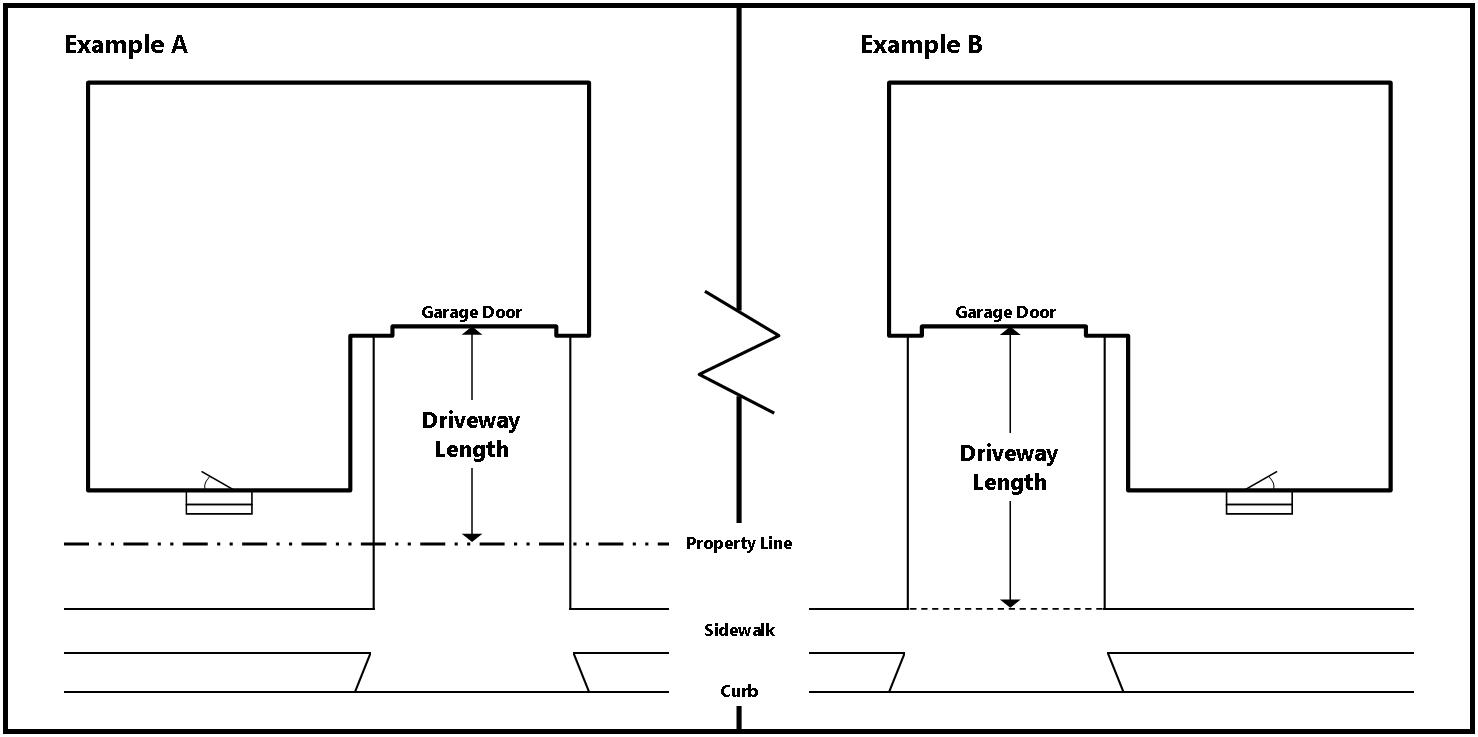
Driveway Length. No driveway shall be less than 20 feet in length. This shall be done to eliminate the parking of vehicles on or over curbs, sidewalks, or vehicle travel areas [SMC 17.10.855]. For the purposes of this chapter driveway length is measured conservatively as the shortest distance between a) a garage door or other physical obstruction to the parking of a vehicle and b) a curb, sidewalk, public pedestrian way [SMC 17.10.660], property line, or right-of-way line.
FIGURE 17.38.085-1 Driveway Length Illustration
I.
Adequate Storage and Mechanical Equipment.
1.
Each unit shall have at least 80 square feet of enclosed storage area (typically, in the garage area and in addition to area dedicated to parking requirements) so that residents will have some place to store bulky personal effects (such as recreational equipment) allowing garage space to remain available for parking.
2.
Garbage collection areas and ground-mounted electrical and mechanical equipment shall be fenced and/or screed from the street. Any remaining visual impacts to adjacent dwelling units shall be minimized.
(Ord. No. 1104, § 5, 6-15-2017)
17.38.090 - Rear setback—Projections restricted.
Eaves, cornices, steps, platforms, rear porches and similar projections, whether enclosed or not but not exceeding in width one-half that of the building nor more than one story in height, may extend into the rear setback not more than twenty percent of the distance from the exterior wall of the structure to the rear property line.
(Ord. 894 (part), 1994).
17.38.120 - Reserved.
Editor's note— Ord. No. 1103, § 11, adopted Feb. 16, 2017, repealed former § 17.38.120 in its entirety which pertained to mobile/manufactured housing requirements and derived from Ord. No. 894, 1994; Ord. No. 919, § 11, 1996.

