
Stevenson City Zoning Code
CHAPTER 17
17 - RESIDENTIAL PLANNED UNIT DEVELOPMENTS
17.17.010 - Purpose, intent.
A.
The residential planned unit development (R-PUD) is an alternative to the traditional approach to subdividing property. It accommodates changing social and economic needs of residents by:
1.
Allowing innovative residential land division design;
2.
Encouraging a range of residential land uses, housing sizes, types and price ranges;
3.
Allowing trade-offs as a development incentive.
B.
The R-PUD provisions of this chapter are intended to:
1.
Preserve historic and cultural resources; preserve ecologically sensitive areas; preserve scenic areas; provide open space and recreation areas, lands and facilities; provide pathways and trails.
2.
Promote housing affordability through inclusionary zoning;
3.
Promote the efficient and cost-effective extension of public utilities;
4.
Facilitate the expansion of high-speed communication utilities;
5.
Facilitate the burial of utility lines;
6.
Ensure a design that is compatible with the value, character, and integrity of surrounding areas that have been or are being developed under the Stevenson Comprehensive Plan.
(Ord. No. 1104, § 4, 6-15-2017)
17.17.020 - Applicability.
A.
An R-PUD may be permitted in any LDR low density residential or HDR high density residential area on the future land use map (SMC 17.10.400).
B.
An R-PUD may be permitted only when its lots will be served by municipal water and sanitary sewer systems.
C.
An R-PUD may be permitted for one or more contiguous properties. If there is more than one owner of the properties, the application shall show that the property is under unified control through the use of enforceable covenants or other commitments that run to the benefit of the city.
(Ord. No. 1104, § 4, 6-15-2017)
17.17.030 - Development area and site specific density calculations.
A.
Gross development area is calculated by subtracting the following from overall lot area (SMC 17.10.430):
1.
The area of any wetland delineated according the most recent Department of Ecology guidance and for which the US Army Corps of Engineers has determined to be jurisdictional;
2.
The area of any lands lying below any ordinary high water mark determined according to the most recent Department of Ecology guidance;
3.
The area of any slope exceeding 40%;
4.
Any area included in a public utility easement or public right-of-way identified within a current subdivision guarantee.
B.
The site specific density is calculated by dividing the gross development area by SMC Table 17.15.050-1's minimum lot area for single-family dwellings in the underlying zoning district.
(Ord. No. 1104, § 4, 6-15-2017)
17.17.040 - Allowed uses.
The uses permitted in an R-PUD shall be governed by the use regulations of the underlying zoning district, however, alternative housing types may be permitted according to SMC 17.17.160 and any development agreement terms entered into pursuant to SMC 17.17.190.
(Ord. No. 1104, § 4, 6-15-2017)
17.17.050 - Allowed modification of density and development standards.
A.
A R-PUD may be permitted to modify the density and dimensional standards of SMC Table 17.15.050-1 and SMC Table 17.15.060-01 and similar standards in SMC 16.02.190 - Review Standards—Lot Sizes, Dimensions and Proportions and SMC 16.30 - Design Standards.
B.
Under no circumstances shall an R-PUD permit:
1.
A lot width less than 20 feet;
2.
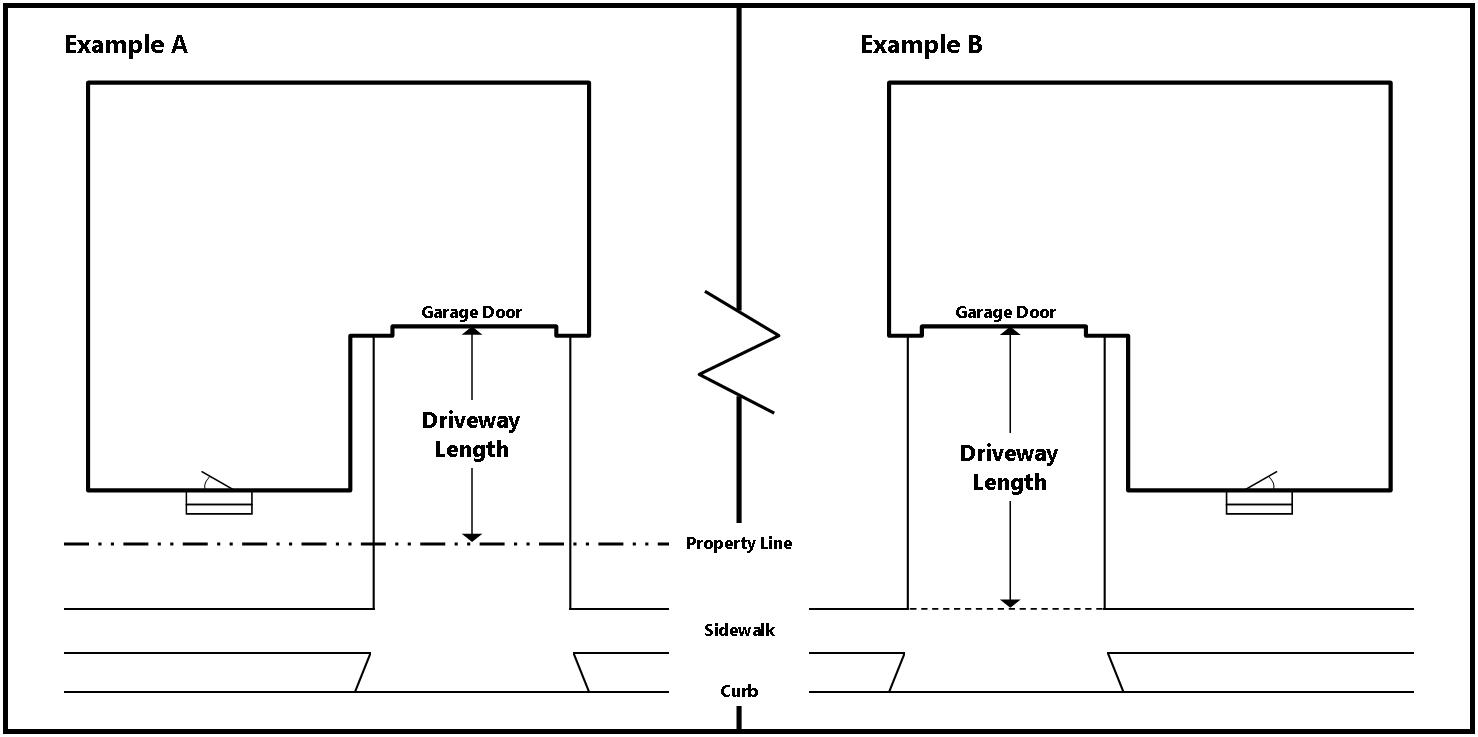
A driveway [SMC 17.10.250] less than 20 feet in length. This shall be done to eliminate the parking of vehicles on or over curbs, sidewalks, or vehicle travel areas [SMC 17.10.855]. For the purposes of this chapter driveway length is measured conservatively as the shortest distance between a) a garage door or other physical obstruction to the parking of a vehicle and b) a curb, sidewalk, public pedestrian way [SMC 17.10.660], property line, or right-of-way line.
Figure 17.17.050-1 Driveway Length Illustration
3.
A setback along the outside perimeter of the R-PUD which is less than ½ the distance required in SMC Table 17.15.060-1.
C.
An R-PUD may be permitted to modify the parking location requirements of SMC 17.15.130(B). If a location modification is approved, an R-PUD may be required to provide up to 20% more spaces than would otherwise be required under SMC 17.15.130(A).
D.
The provisions of all other applicable codes and ordinance of the City of Stevenson shall apply to any R-PUD.
(Ord. No. 1104, § 4, 6-15-2017)
17.17.060 - Density bonuses.
A.
Density Bonus Allowed. An R-PUD may be used to permit densities greater than the site specific density.
B.
Minimum Criteria. No density bonus shall be permitted unless the R-PUD agrees to:
1.
Underground all new and existing utility lines within the property boundaries and within the right-of-way immediately adjacent to the property. Proponents of an R-PUD are expected to underground all single-phase electrical lines, but may ask the city for relief from an obligation to underground any existing 3-phase electrical lines. Proponents of an R-PUD are not expected to underground existing utility lines if the lines are located across a right-of-way and immediately adjacent to a property under separate ownership;
2.
Install an underground fiber-to-the-home [SMC 17.10.306] system to serve all lots within the development. Proponents of an R-PUD are not expected to install the actual fiber optic cables as part of the system, however, the remainder of the underground fiber-to-the-home system shall be installed and reserved for future installation of fiber optic cables;
3.
Make one lot available for purchase by Columbia Cascade Housing Corporation or some other entity capable of creating and maintaining workforce housing [SMC 17.10.387] or affordable housing [SMC 17.10.385] options in Stevenson. As an alternative to selling a lot, an R-PUD proponent may develop such housing and attach CC&Rs to maintain the property as workforce or affordable housing for no less than 60 years.
C.
Optional Criteria. The city may increase site specific density within an R-PUD by up to 30%. All increases are calculated based on the percentage increase over the site specific density established for the property in SMC 17.17.130. Density bonuses will be considered if the R-PUD proposes to:
1.
Donate additional lots to the entity described in SMC 17.17.060(B)(3). A density increase of 10% is allowed for the first lot donated and a 2.5% increase for each additional lot. In its review of this density increase, the city may modify proposals to ensure that the donated lots are not unnecessarily clustered in one area of the development. As an alternative to donating these lots, an R-PUD proponent may develop such housing as described above.
2.
Create public pedestrian ways [SMC 17.10.660] beyond conventional sidewalk requirements. A density increase of up to 5% is allowed based on this provision.
3.
Create public open space, recreational amenities, or viewpoints for the benefit of the general public. A density increase of up to 5% is allowed based on this provision.
4.
Preserve significant landscape features, such as trees, rock outcrops, etc. A density increase of up to 5% is allowed based on this provision, depending on the size and significance of the area or feature being preserved.
5.
Preserve historic/cultural resources. A density increase of up to 5% is allowed based on this provision, depending on the size and significance of the area or feature being preserved.
6.
Restore and/or enhance critical areas and buffers. A density increase of up to 5% is allowed based on this provision, depending on the size and significance of the area or feature being restored and/or enhanced. Any critical area or buffer area restored or enhanced shall be set aside as designated open space.
(Ord. No. 1104, § 4, 6-15-2017)
17.17.100 - R-PUD Review—Process overview.
Review of R-PUDs occur over the following 4 stages:
A.
Concept planning between the applicant and city staff;
B.
Planning commission review and recommendation to city council;
C.
City council action on R-PUD and development agreement;
D.
Subdivision review according to SMC Title 16 - Subdivisions.
(Ord. No. 1104, § 4, 6-15-2017)
17.17.110 - R-PUD Review—Concept plan.
A.
Prior to submitting an R-PUD application, applicants shall consult with the zoning administrator and other city staff at a pre-application conference. The purpose of conference is to review the concept plan prepared by the applicant, and for city staff to explain whether the plan can comply with the purpose and code provisions of this chapter.
B.
The concept plan developed for this conference shall be prepared by a professional:
1.
Architect licensed by the State of Washington;
2.
Civil engineer registered in the State of Washington;
3.
Surveyor licensed in the State of Washington; or
4.
Landscape architect licensed by the State of Washington.
C.
The concept plan prepared for this conference shall include the following information:
1.
A vicinity map showing all properties, rights-of-way, parks, and recreational amenities within 1,000' of the site;
2.
A preliminary gross development area map of the project area displaying the approximate location of all ordinary high water marks, wetlands, slopes greater than 40%, and public easements and rights-of-way assumed to exist on the site;
3.
A preliminary development plan identifying:
a.
The general location of proposed building sites, utility systems, and pedestrian and vehicular circulation systems;
b.
The general locations where density and dimensional modifications and alternative housing types will be proposed;
c.
The general locations, amenities, and features to be used to achieve density bonuses, if applicable.
4.
A preliminary list of the provisions of SMC Title 16 - Subdivisions for which the developer intends to seek pre-clearance.
D.
At this conference, city staff will review the concept plan and discuss what items must be submitted with the application. A written summary of this conference and resulting submittal requirements may be prepared to assist the remainder of the review process.
(Ord. No. 1104, § 4, 6-15-2017)
17.17.120 - R-PUD Review—Submittal requirements.
A.
Application form.
B.
Application fee, which may be established and amended from time to time by resolution of the city council.
C.
An updated R-PUD concept plan including the following information:
1.
A vicinity map;
2.
A proposed gross development area map of the project area displaying the location of all ordinary high water marks, wetlands, slopes greater than 40%, and public easements and rights-of-way existing on the site;
3.
A proposed development plan identifying:
a.
The location of proposed building sites, utility systems, and pedestrian and vehicular circulation systems;
b.
The locations where density and dimensional modifications and alternative housing types are proposed;
c.
The locations, amenities, and features to be used to achieve density bonuses, if applicable;
D.
Any applicable written reports used to justify gross development area and site specific density. wetland jurisdictional determinations shall be prepared by the US Army Corps of Engineers. Habitat area assessments shall be prepared by a qualified professional. Slope assessment shall be prepared by a civil engineer registered in the State of Washington. Subdivision guarantees shall be prepared by a title company showing public utility easements and rights-of-way.
E.
Preliminary Plat Pre-Clearance Submittals. A final list of the provisions of SMC Title 16 - Subdivisions for which pre-clearance is sought.
F.
Traffic Impact Study. A study, prepared by a civil engineer registered in the State of Washington, documenting the existing traffic condition of the receiving roads in the vicinity, estimating the added traffic expected from the proposed R-PUD, and analyzing the resulting impacts on the receiving roads and intersections.
G.
Density Bonus Submittals.
1.
A signed statement indicating the developer's agreement to comply with the minimum criteria listed in SMC 17.17.060(B). This statement should be accompanied by agreements-in-principle and/or draft CC&Rs which demonstrate the R-PUD's ability to comply with the minimum criteria.
2.
Professionally prepared reports containing enough detail to review the significance and appropriateness of the amenity proposed for density bonus purposes.
H.
Any additional information the administrator deems necessary to adequately inform the planning commission of the R-PUD proposal, including any items necessary for the review of any provisions for which preliminary plat pre-clearance is sought.
(Ord. No. 1104, § 4, 6-15-2017)
17.17.130 - R-PUD Review—Site specific density, density and dimensional modifications."
A.
Site specific density and density and dimensional modifications are presumed to be design-dependent and approval of development at the maximum permissible density is not assured in every instance;
B.
Burden is on the applicant to demonstrate that innovative site planning techniques and/or buffering can be employed to accommodate densities and dimensional standards comparable with those provided for in other city residential zones in a manner that is: responsive to the specific characteristics of the R-PUD site and compatible with surrounding residential areas that have been or are being developed under the Stevenson Comprehensive Plan.
C.
Site Specific Density. The following minimum qualifications shall be reviewed by the city prior to the establishment of site specific density:
1.
The gross development area has been calculated based on written a wetland jurisdictional determination by the US Army Corps of Engineers, habitat area assessment by a qualified professional, slope assessment by a civil engineer registered in the State of Washington, and title report showing public utility easements and rights-of-way, as applicable.
D.
Density and dimensional modifications. An applicant requesting approval of an R-PUD has the burden of proving, by a preponderance of the evidence that:
1.
All applicable standards have been met, modified or can be adequately addressed by conditions of approval;
2.
The proposal uses an innovative approach to meet the purposes and intents stated in SMC 17.17.010;
3.
Structures located on the site are located on ground that is not subject to instability;
4.
Public services will not be overburdened by the proposed development:
a.
The R-PUD plan shall demonstrate that local, collector and arterial streets have the capacity to carry increased traffic from the R-PUD. Site design shall prioritize street connectivity and use of collector or arterial streets for R-PUD main access point with secondary access provided to adjacent local streets.
b.
The applicant shall work with the public works director and/or city engineer to confirm adequacy of water, sanitary sewer, onsite surface/stormwater, and all other utilities. If improvements are determined necessary to accommodate increased demand, improvements will be made at the developer's expense. The city and developer may agree on a cost sharing strategy if included in a development agreement adopted pursuant to SMC 17.17.190. All utilities shall be constructed to city approved standards of design, consistent with accepted engineering practices.
c.
The applicant shall submit proof of adequacy of services including but not limited to: fire and police protection, schools, health care.
E.
Any modification allowed under this section shall be clearly noted on the subdivision final plat.
(Ord. No. 1104, § 4, 6-15-2017)
17.17.140 - R-PUD Review—Density bonuses.
A.
Density bonuses are presumed to be design-dependent and approval of development at the maximum permissible density is not assured in every instance. The goal of a density bonus is to have added amenities offset any negative effects of increased density, and any proposed amenities must advance that goal to be permitted;"
B.
Burden is on the applicant to demonstrate that innovative site planning techniques and/or buffering can be employed to accommodate densities comparable with densities provided for in other city residential zones in a manner that is: responsive to the specific characteristics of the R-PUD site and compatible with surrounding residential areas that have been or are being developed under the Stevenson Comprehensive Plan.
C.
Required Standards. In addition to the statement required in SMC 17.17.120(G), the applicant shall meet the following standards prior to the city allowing any specific density bonus:
1.
Affordability Standard. The planning commission must find that any agreement-in-principle and/or draft CC&Rs submitted for this bonus has been reviewed by the city attorney and found to contain adequate provisions to ensure the lots will be developed and will remain as workforce and/or affordable housing.
2.
Adequacy of Amenities. The planning commission must find that any creation, preservation, or restoration of public amenities proposed for the purposes of obtaining a density bonus adequately considers the context of the proposal's location and its relative proximity and contribution to other existing or needed public amenities or resources.
(Ord. No. 1104, § 4, 6-15-2017)
17.17.150 - R-PUD Review—Preliminary plat pre-clearance.
When preliminary plat pre-clearance is sought as part of an R-PUD approval, the planning commission shall review all submittals according to the specific provision of SMC Title 16 - Subdivisions for which pre-clearance is sought.
(Ord. No. 1104, § 4, 6-15-2017)
17.17.160 - R-PUD Review—Alternative housing types.
The R-PUD process is created to support design innovation and a range of housing types. Land use standards and approval criteria provide essential guidance to applicants and administrators but not every circumstance can be anticipated in the drafting of standards and criteria. An applicant may request inclusion of an alternative housing type within an R-PUD subject to the conditional use standards of SMC 17.39. The Planning Commission review of such a proposal shall occur concurrently with the R-PUD review and shall only be valid upon City Council approval of the final plat.
(Ord. No. 1104, § 4, 6-15-2017)
17.17.170 - R-PUD Review—Planning commission recommendation.
A.
Density and Dimensional Modifications. Based on its review under SMC 17.17.130 the planning commission may recommend city council approval of site specific density and dimensional tables for the R-PUD. The tables should resemble SMC tables 17.15.050-1 and 17.15.060-1.
B.
Density Bonuses. Based its review under SMC 17.17.140 the planning commission may recommend city council approval of a density bonus. The total percentage of any density bonus recommended may be less than that requested but not more.
C.
Preliminary plat pre-clearance. Based on its review under SMC 17.17.150 the planning commission may recommend pre-clearance of any preliminary plat provision requested.
(Ord. No. 1104, § 4, 6-15-2017)
17.17.180 - R-PUD Review—City council action.
A.
Upon receipt of the planning commission's recommendation on an R-PUD, the council shall, at its next public meeting, either:
1.
Consider the planning commission recommendation; or
2.
Set a date for the public meeting at which the council shall consider the record established by the planning commission.
B.
The council shall, after reviewing the recommendations of the planning commission, the administrator, the public works director, the public utility district and any other relevant evidence presented to it, either concur in or reject the planning commission's recommendation.
C.
If the council does not summarily approve the planning commission recommendation on any R-PUD, it may remand the proposal back to the planning commission by citing the specific findings of fact and conclusions of law being remanded. The planning commission shall then reopen the public hearing to complete the R-PUD review of the remand. At the conclusion of such public hearing and receipt of a revised planning commission recommendation the council may approve, conditionally approve, or disapprove the R-PUD or a revised version thereof.
(Ord. No. 1104, § 4, 6-15-2017)
17.17.190 - Effect of approval—Development agreement.
A.
All approved R-PUDs shall be accompanied by a development agreement mutually approved by the applicant and the city pursuant to RCW 36.70B.170 through .210.
B.
The provisions of a development agreement authorized under this chapter shall be reviewed for acceptability by the city attorney and shall include:
1.
The approved site specific density for the development.
2.
Any approved modifications to the density and dimensional standards of SMC 17.15.
3.
Any approved density bonuses, including specific descriptions of how the developer intends to satisfy the minimum and optional criteria.
4.
Any approved pre-clearance of the provisions of SMC 16 - Subdivisions which has been reviewed for acceptability during the R-PUD process. Any such description vests the proposal in the subdivision ordinance effective at the time of the complete R-PUD application is received and may be cited in the preliminary plat application as prima facie evidence of compliance with the provision described.
5.
A preliminary understanding regarding the entity to be responsible for maintenance of all easements, open spaces, amenities, or areas to be provided in the R-PUD.
C.
Any development agreement authorized under this chapter shall expire 5 years after the effective date of the agreement. If a preliminary plat is not approved within the initial 5 years, the applicant may make written request for extension prior to the expiration date of the development agreement. The city council may grant an extension for up to 2 additional years upon demonstration of good faith effort to file for preliminary plat approval and finding by the city that such extension is in the city's best interests.
(Ord. No. 1104, § 4, 6-15-2017)

