
Walker City Zoning Code
ARTICLE XI
- PLANNED UNIT DEVELOPMENTS
Sec. 94-11.01. - Purpose.
(a)
Purpose. The provisions of this article provide requirements and standards for the submission, review and approval of applications for planned unit developments (PUD). The PUD regulations are designed to accomplish the objectives of this chapter through a land development project review process based on the application of site planning criteria to achieve integration of the proposed land development project with the characteristics of the project area. These PUD regulations are intended to permit flexibility in the regulation of land development; encourage innovation in land use and variety in design, layout and type of structures constructed; achieve economy and efficiency in the use of land, natural resources, energy and the provision of public services and utilities; encourage provision of useful open space; and provide adequate housing, employment and shopping opportunities particularly suited to the needs of the residents of the city. Further, it is the purpose of the planned unit development regulations to promote the intent and purpose of this chapter, and to ensure that the land use or activity authorized shall be compatible with adjacent uses of land, the natural environment, and the capacities of public services and facilities affected by the land use. The provisions of this article are not intended as a device for ignoring this chapter or the planning upon which it has been based.
(b)
Objectives. The objectives, principles, and standards of this article are intended to guide the applicant in the preparation of preliminary and final area site plans, consistent with the purposes stated in section 94-11.01. They shall be used as the basis for the evaluation of the plans by the planning commission and shall be considered in reviewing any application for a PUD to ensure a quality of construction commensurate with other developments within the city.
(Ord. No. 24-674, § 2(Exh. A), 1-22-24)
Sec. 94-11.02. - Planned unit development application, review and approval procedures.
The procedures contained in this section shall be followed when applying for the approval of any planned unit development as provided for by this article.
(a)
Preapplication conference.
(1)
Prior to the submission of an application for planned unit development approval, the applicant may meet with the planning director and the city engineer, together with such consultants as either the city or the applicant deem appropriate. The planning director shall invite officials from other departments of the city who might have an interest in the proposed development, or who might assist the city in the review process. The purpose of the meeting is to inform city officials of the concept of the proposed development and to provide the potential applicant with information regarding land development policies, procedures, standards and requirements of the city in terms of the proposed development. Statements made in the course of a preapplication conference shall not be legally binding commitments.
(2)
At the preapplication conference, the applicant shall submit a general concept plan of the proposed planned unit development, accompanied by other maps and by written statements conveying some or all of the following information:
a.
A legal description of the property in question;
b.
A recent map of the site, reflecting area size and boundary line dimensions;
c.
The total number of acres in the project;
d.
Existing and proposed land uses and their approximate locations;
e.
A statement of the approximate number of residential units, the approximate number and type of nonresidential units, and the approximate number of acres to be occupied by each type of use;
f.
The approximate net residential density and expected final population of the proposed PUD;
g.
The number of acres to be preserved as open or recreational space, and the general location of any such proposed open space or public use areas;
h.
Existing floodplains, bodies of water and other unbuildable areas, and all known natural resources and natural features to be preserved;
i.
Circulation patterns, including pedestrian walkways and arterial, collector or local streets;
j.
An explanation of the character of the PUD, the manner in which it has been planned to take advantage of the PUD regulations, the manner in which it reflects the "purpose" and "objectives" of planned unit developments as stated in sections 94-11.01 and 94-11.02, and its conformance to the city's master plan;
k.
A statement of ownership or option to purchase of all lands within the proposed PUD;
l.
A general indication of the expected schedule of development, including phases of development, if any; and
m.
Any other maps, plans, site data, or information that the applicant wishes to submit to explain the proposed development.
(b)
Preliminary area site plan requirements. After completion of the preapplication review, ten copies of a preliminary area site plan shall be submitted to the planning director who shall transmit the same to the planning commission. A preliminary area site plan shall consist of (i) a map or maps and (ii) accompanying written materials, as required by this section.
A preliminary area site plan shall include a map or maps on a scale of one inch equaling not more than 100 feet. The map or maps must provide the following information:
(1)
Dimensions of the land, including width, length, acreage and frontage.
(2)
Existing zoning and zoning of all adjacent properties within 500 feet.
(3)
A topographical map or maps showing present and proposed elevations at contour levels of not more than two feet.
(4)
Location of existing drainage courses, floodplains, lakes, streams and wetlands.
(5)
A description of the development including:
a.
The type and location of all uses.
b.
The acreage allocated to each use.
c.
The general location of proposed building areas.
d.
Density calculations and the number and types of residential units.
e.
A general description of all proposed nonresidential uses, including the types of stores and offices, hotels, motels, etc.
f.
The approximate square footage that will be devoted to office or retail purposes, and the approximate number of rooms in any proposed hotels or motels. The information related to square footage and number of rooms should be provided in sufficient detail to determine the demand for water, sewer, and transportation facilities that will result.
g.
The general location and size of all proposed open spaces, including preserves, recreational areas, and the like, and each purpose proposed for such areas. For purposes of this article, "open space" means an area designed and intended for use or enjoyment of residents of the PUD or of the general public. Open space may contain accessory structures and improvements necessary or desirable for recreational, cultural, or other noncommercial uses. Open space shall not include streets, rights-of-way, parking areas or commercial areas.
h.
The approximate location and description of proposed water, sanitary sewer, and storm drainage systems.
i.
All known natural resources and natural features to be preserved.
j.
A general landscape plan showing woodlands and vegetation to be preserved or added, topography, and similar features.
k.
The location and right-of-way width of existing streets and the proposed general location of public and/or private streets or drives.
l.
The general location of all proposed parking areas and number of spaces.
m.
The general location and area of each development phase of a multi-phased development.
n.
The general location of any buffer zones, berms and fences.
o.
The general location of any outdoor commercial activities, including, but not limited to, outdoor display and sales.
p.
In addition to the required map(s), a preliminary area site plan shall include written materials which contain the following information:
(6)
The owner's name and address; and the applicant's name and address, if other than the owner.
(7)
The name of the proposed development.
(8)
The name, address, city and phone number of the firm and of the individual who prepared the plan.
(9)
The common description and complete legal description of the property.
(10)
A statement of ownership or option to purchase of all lands within the proposed PUD.
(11)
A development and construction schedule indicating:
a.
The approximate date for commencement of construction.
b.
Stages or phases in which the project will be built and the expected starting and completion dates of each stage.
(12)
A general description of the organization(s) or individual(s) who will own and maintain all land areas within the PUD, including common open space.
(13)
A general description of the types of buildings to be constructed, including the number of units per building, proposed building heights, and the type of ownership proposed (i.e., individually owned or rental).
(14)
The proposed treatment of the perimeter of the PUD.
(15)
A statement of intent to subdivide under the subdivision regulation ordinance of the city (chapter 74).
(16)
An explanation of the manner in which the PUD has been planned to take advantage of the PUD regulations, the manner in which it reflects the purpose and objectives of planned unit development as stated in sections 94-11.01 and 94-11.02, and its conformance to the city's master plan.
(17)
Freestanding/pylon, ground-mounted and wall signage plans, showing all setbacks and dimensions and describing all exterior construction materials.
(18)
The planning commission may require a "pattern book" or similar guiding document as part of preliminary area site plan review. The pattern book contents would be contextually appropriate for the PASP but would focus on setting coordinated development standards for the project's design details in order to implement the city master plan. The planning commission may require design specifics regarding any or all of the following to be included in the "pattern book."
a.
Signage (ground, wall, directional, branding).
b.
Exterior lighting poles and fixtures.
c.
Exterior building materials.
d.
Automobile and/or truck parking and circulation.
e.
Pedestrian access and nonmotorized mobility features.
f.
Gateways and connections to adjacent sites.
g.
Bicycle parking.
h.
Public transportation stops and stations.
i.
Landscaping (onsite and in adjoining rights-of-way), buffering, or screening.
j.
Stormwater, low impact design, and the relationship between stormwater and landscape design.
k.
Fencing and walls.
l.
Dumpsters and dumpster enclosure.
m.
Open space and/or recreational space/amenities.
n.
Other aspects of the project requested by the planning commission.
(c)
Planning commission review and approval of PUD preliminary area site plans; planning commission review and recommendation of petition to rezone to PUD district.
(1)
An application for PUD approval shall require submission of a preliminary area site plan consisting of the map(s) and accompanying written materials as required by subsection (2). In addition, if the site of a proposed PUD has not previously been rezoned as a PUD district, as provided by sections 94-11.07, 94-11.08, 94-11.09, 94-11.10, 94-11.11, or 94-11.12 of this chapter, the applicant must apply for the necessary rezoning as a part of the application for PUD approval. A petition to rezone to a PUD district shall not be required as a part of an application for PUD approval if the site of a proposed PUD has previously been rezoned and is appropriately classified as a PUD district as required by this article at the time the application for preliminary area site plan approval is submitted.
(2)
An application for PUD approval for a parcel of land may be made by the owners of record or by any persons acting on behalf of the owners of record of the subject parcel. The applicant shall have a substantial interest in the subject property prior to filing for a PUD district classification, and such filing shall be in the name of and signed by all owners.
(3)
The application shall be filed with the planning director who shall transmit the preliminary area site plan and the petition for rezoning to the planning commission. The application must be filed at least 30 days prior to the planning commission hearing at which it is first to be considered. Fees shall be paid to the city treasurer; no transmittals shall be made unless the required fees have been paid in full.
(4)
The planning director shall schedule a public hearing before the planning commission on the plan and petition. Notice of the public hearing shall be provided as required by section 4a(3) of Act No. 207, Public Acts of Michigan of 1921 (MCL 125.581 et seq., MSA 5.2931 et seq.), as amended.
(5)
At the public hearing before the planning commission, the applicant shall present evidence regarding the following characteristics of the proposed development:
a.
The general character and substance of the proposed planned unit development.
b.
The objectives and purposes to be served by the planned unit development.
c.
Compliance with applicable regulations and standards.
d.
The scale and scope of the development proposed.
e.
Development schedules.
f.
Compliance with the city's master plan, and the effect of the PUD on the city's master plan, including compliance with subsection (c)(7)a.
g.
The impact of the planned unit development on public utilities, facilities or services, on surrounding properties, and on the natural environment.
h.
The economic impact of the planned unit development on surrounding property values or the city as a whole.
i.
The impact of the planned unit development on existing woodlands and wetlands.
j.
Status of ownership or control of the PUD such that there is a single person or entity having responsibility for completing the PUD in conformity with the approved plan.
(6)
At the public hearing or within a reasonable time following the public hearing, the planning commission shall take the following actions:
a.
The planning commission shall make its final consideration of the request to approve the preliminary area site plan, and shall deny, approve, or approve with conditions the request, provided that any approval shall not be official until an agreement as required by section 94-11.02(e) has been received by the city clerk. The planning commission shall prepare findings of fact stating its conclusions on the request to approve the preliminary area site plan, the basis for its decision, and any conditions relating to an affirmative decision.
b.
The planning commission shall also make a recommendation to the city commission on the proposed rezoning to a PUD district necessary to permit the proposed PUD.
c.
The planning commission shall make recommendations regarding the preliminary area site plan and the rezoning at the same meeting, except in the following circumstances:
1.
When the planning commission's recommendation regarding the rezoning is to deny, in which case the planning commission may decide not to make any recommendation regarding the preliminary area site plan until after the city commission makes a determination on the rezoning.
2.
When the planning commission determines that the preliminary area site plan meets all requirements of this chapter, but where changes to the preliminary area site plan may still occur on the recommendation of county, state, and/or federal agencies, or other outside reviewers. In that case, the planning commission may issue a recommendation on the rezoning, and wait to make a recommendation on the preliminary area site plan until all outside reviews are submitted.
3.
When the planning commission determines that the preliminary area site plan meets the approval criteria of this chapter, but requests changes to be made to specific design aspects of the PASP. In that case, the Planning Commission may issue a recommendation on the rezoning, and wait to make a recommendation on the preliminary area site plan until the requested revisions have been made.
(7)
The planning commission's findings of fact as required by subsection (c)(6) shall include its determination as to whether the PUD as described by the preliminary area site plan meets the following standards:
a.
The proposed development shall conform to the city's master plan. In addition to general consistency with the goals, objectives, and vision of the plan, the PUD must meet the following requirements:
1.
If the master plan designates a specific residential density range for the site, the number of residential units must fall within that range, except for RPUD-3, which may exceed the density listed if all other requirements are met.
2.
If the master plan envisions road connections through the site, those road connections must be included in the PUD design, though the specific route or network design need not follow the master plan exactly.
3.
If the master plan designates a portion of the site for open space, then the site must include open space consistent with the master plan's vision, though the precise boundaries of the open space need not match the master plan exactly.
4.
If the master plan includes a development vision for the site, the PUD design must include specific design elements, articulated in the application materials, that are clearly consistent with the vision, though the precise layout need not match the development vision exactly.
5.
The PUD design shall not render any aspect of the master plan impossible or very difficult to implement on the site in question, or on adjacent or nearby sites, in the future.
b.
The proposed development shall conform to the intent and to all regulations and standards of this article and of this chapter, as applicable.
c.
The proposed development shall be adequately served by public facilities and services such as highways, streets, police and fire protection, drainage courses, water and sanitary sewer facilities, refuse disposal, or that the persons or agencies responsible for the proposed development shall be able to provide in a manner acceptable to the planning commission any such facilities and services.
d.
The common open space, any other common properties, individual properties, and all other elements of the PUD are so planned that they will achieve a unified open and recreation area system with open space and all other elements in appropriate locations, suitably related to each other, the site, and the surrounding land.
e.
The location of the proposed uses, layout of the site, and its relation to streets giving access to it shall be such that traffic to, from, and within the site and assembly of persons in connection therewith will not be hazardous or inconvenient to the project or the surrounding area. In applying this standard, the planning commission shall consider, among other things, convenient routes for pedestrian traffic, particularly of children; relationship of the proposed project to arterial and collector roads and street intersections; and the general character and intensity of the existing and potential development of the surrounding area.
f.
The mix of housing unit types and densities and the mix of residential and nonresidential uses shall be acceptable in terms of convenience, privacy, compatibility, and similar measures.
g.
The planning commission shall determine that noise, odor, light or other external effect from any source whatsoever which is connected with the proposed use will not adversely affect adjacent and neighboring lands or uses.
h.
Streets shall follow topography, be properly spaced, and be located and aligned in accordance with the intended function of each street. The property shall have adequate access to public streets. The plans shall provide for logical extensions of public streets and shall provide suitable street connections to adjacent parcels, where applicable.
i.
Major pedestrian circulation shall be provided for within the site, and shall interconnect all residential areas, community areas, and commercial and other services where applicable. The pedestrian system shall provide a logical extension of the pedestrian ways from outside the site and shall provide pedestrian connections to the edges of the site where appropriate.
j.
Where a project is proposed for construction in phases, the planning and designing shall be such that, upon completion, each phase shall be capable of standing on its own in terms of the presence of services, facilities and open space, and shall contain the necessary components to ensure protection of natural resources and the health, safety and welfare of the users of the planned unit development and the residents of the surrounding area.
(8)
Reasonable conditions may be required by the planning commission in conjunction with the approval of a preliminary area site plan for the purpose of ensuring that public services and facilities affected by a proposed land use or activity will be capable of accommodating increased services and facility loads caused by the land use or activity, protecting the natural environment and conserving natural resources and energy, ensuring compatibility with adjacent uses of land, and promoting the use of land in a socially and economically desirable manner. Conditions imposed shall be designed to protect natural resources and the public health, safety and welfare of individuals in the project and those immediately adjacent, and the community as a whole, and shall be necessary to meet the intent and purpose of this article, and be related to the objective of ensuring compliance with the standards of this article. All conditions imposed shall be made a part of the record of the approved preliminary area site plan.
(9)
In considering a requirement for sidewalks or pedestrian lanes as a condition imposed pursuant to section 94-11.02(c)(8) above, the planning commission shall consider the criteria in section 94-13.04.
(10)
In addition to its authority pursuant to subsection (8) above, the planning commission may prohibit one or more specific uses otherwise permitted within a PUD district if it makes one or more of the following findings:
a.
The use would be detrimental to or endanger the public.
b.
The use would not be compatible with nearby uses of land.
c.
The use would be injurious to the use or enjoyment of other property in the immediate vicinity.
d.
The use would result in the significant adverse impact on the natural environment.
e.
The use would impede the normal and orderly development and improvement of surrounding property for uses permitted in that district.
f.
The affected public services and facilities would not be capable of accommodating increased services and facility loads caused by the use.
(d)
City commission review and approval of the petition to rezone.
(1)
The city commission shall be provided, for its information, with a copy of the planning commission's report and decision of denial, approval, or approval with conditions of the preliminary area site plan, along with a summary of comments received at the public hearing, minutes of all proceedings, and all documents related to the PUD request.
(2)
The city commission shall also be provided with the planning commission's recommendation on the proposed rezoning of the PUD site. After receipt of the recommendation of the planning commission on the proposed rezoning, the city commission may hold a public hearing to consider the rezoning request. Notice for the public hearing, if held, shall be provided as required by section 4a(3) of Act No. 207 of the Public Acts of Michigan of 1921 (MCL 125.581 et seq., MSA 5.2931 et seq.), as amended. In making its determination on the proposed rezoning, the city commission may consider the planning commission's report and decision regarding the planning commission's approval or denial of a preliminary area site plan (as provided by subsection (4)a), as well as the consistency of the proposal with the master plan, based on the criteria in section 94-11.02(c)(7)a, but the city commission review of the proposed rezoning is not a substitute for a substantive review of the details of a preliminary area site plan by the planning commission. The city commission shall approve or deny the petition to rezone, or refer the petition again to the planning commission for further review.
(3)
The city commission may approve a petition to rezone property to a PUD designation even though a preliminary area site plan has not yet been approved (or approved with conditions) for the property by the planning commission. However, no construction, grading, tree removal, soil striping, or other site improvements or changes shall commence, and no construction permits shall be issued therefor, for all or any phase of a PUD until a preliminary and final area site plan have been officially approved for the property by the planning commission as provided by this article.
(e)
Effect of approval of the preliminary area site plan by the planning commission and approval of the petition to rezone by the city commission. If the preliminary area site plan is approved by the planning commission and the petition to rezone is approved by the city commission, the approved petition and preliminary area site plan, including all approved maps and accompanying written materials, and the conditions of approval, shall be binding upon the applicant and owners of record and upon their heirs, successors and assigns with respect to all future development of the property, subject to the approval of a final area site plan by the planning commission. For any PASP approved prior to the effective date of any amendments to this chapter, the final area site plan approval described in section shall be subject to the provisions of this chapter as they existed at the time of PASP approval, and shall not be subject to the amendments adopted after PASP approval.
(f)
Final area site plan requirements. Upon approval of a preliminary area site plan, an applicant may submit, within the time limitations as provided by section 94-11.02(g) an application for approval of a final area site plan for all or any phase of a proposed PUD shown on the approved preliminary area site plan. An application for approval of a final area site plan may be submitted prior to approval of a petition to rezone by the city commission; provided, however, that the planning director shall not schedule the public hearing on the final area site plan pursuant to subsection (7)c. unless and until the rezoning petition is approved; and provided, further, that an application for approval of a final area site plan shall not be considered or approved by the planning commission if the rezoning petition is denied by the city commission. Ten copies of a final area site plan shall be submitted to the planning director. A final area site plan shall consist of (i) a map or maps and (ii) accompanying written materials, as required by this section.
A final area site plan shall include a map or maps on a scale of one inch equaling not more than 100 feet. The map or maps must provide the following information in sufficient detail to describe, where appropriate, adequate dimensions to show the size and location of all proposed structures, and adequate contour elevations to determine the existing and proposed configuration of the site for engineering purposes:
(1)
Dimensions of the land, including width, length, acreage and frontage.
(2)
Existing zoning and zoning of all adjacent properties within 500 feet.
(3)
A topographical map or maps showing present and proposed elevations at contour levels of not more than two feet.
(4)
Location of existing drainage courses, floodplains, lakes, streams and wetlands.
(5)
A description of the development including:
a.
The type and location of all uses.
b.
The square footage or acreage allocated to each use.
c.
The locations of all structures, including proposed setbacks, typical layout and elevation for each type of use.
d.
Density calculations, number and types of residential units, and floor area per habitable space.
e.
A description of all proposed nonresidential uses, including the types of stores and offices, hotels, motels, etc.
f.
The square footage that will be devoted to office or retail purposes, and the number of rooms in any proposed hotels or motels. The information related to square footage and number of rooms should be provided in sufficient detail to determine the demand for water, sewer and transportation facilities that will result.
g.
The location and size of all proposed open spaces, including preserves, recreational areas, and the like, and each purpose proposed for such areas.
h.
The location and description of proposed water, sanitary sewer, and storm drainage systems.
i.
All known natural resources and natural features to be preserved.
j.
A landscape plan showing woodlands and vegetation to be preserved or added, topography, and similar features.
k.
The location and right-of-way width of existing streets and the proposed location and surface width of public and/or private streets or drives.
l.
A circulation plan for internal streets, roadways and pedestrian walkways.
m.
Truck turning templates for any internal road which is intended to allow access to trucks, and designation of internal roads on which trucks will not be permitted.
n.
The location of all proposed parking areas and number of spaces by size.
o.
A description of easements on private roads to allow necessary city access to the roads, water lines, sanitary sewer and storm sewer, as well as provisions for access of emergency vehicles.
p.
Freestanding/pylon, ground-mounted and wall signage plans, showing all setbacks and dimensions and describing all exterior construction materials.
q.
A description of the type and location of all outdoor lighting facilities.
r.
The location and area of each development phase of a multiphased development.
s.
The location of any buffer zones, berms and fences.
t.
The location of any outdoor commercial activities, including, but not limited to, outdoor display and sales.
(6)
In addition to the required map(s), a final area site plan shall include written materials which contain the following information:
a.
The owner's name and address; and the applicant's name and address, if other than the owner.
b.
The name of the proposed development.
c.
The name, address, city and phone number of the firm and of the individual who prepared the plan.
d.
The common description and complete legal description of the property.
e.
A statement of ownership or option to purchase of all lands within the proposed PUD.
f.
A development and construction schedule indicating:
1.
The date for commencement of construction.
2.
Stages or phases in which the project will be built and the expected starting and completion dates of each stage.
g.
A description of the organization(s) or individual(s) who will own and maintain all land areas within the PUD, including common open space.
h.
A description of the types of buildings to be constructed, including the number of units per building, proposed building heights, and the type of ownership proposed (i.e., individually owned or rental).
i.
The proposed treatment of the perimeter of the PUD, including materials, dimensions and techniques used such as screens, fences, berms, walls or landscaping.
j.
A statement of intent to subdivide under chapter 74, subdivisions.
k.
An explanation of the manner in which the PUD has been planned to take advantage of the PUD regulations, the manner in which it reflects the purpose and objectives of planned unit development as stated in section 94-11.02(c)(7), and its conformance to the city's master plan.
(g)
Planning commission review and approval of PUD final area site plans.
(1)
Within two years following official approval of the preliminary area site plan and petition to rezone, the applicant shall submit to the planning director ten copies of a final area site plan in accordance with subsection (6). If the final area site plan has not been submitted within such period, the preliminary area site plan approval shall lapse and the applicant must recommence the review process, provided that the planning commission may extend the time for submission of the final area site plan if the applicant requests an extension prior to the expiration of the initial period and no material change of circumstance has occurred. Where a PUD is proposed for construction in phases, a final area site plan for at least the first phase of such construction shall be submitted within the time limitations contained in this section. Final area site plans for subsequent phases shall be submitted within similar successive periods thereafter from the date of approval of the final area site plan of the immediately preceding phase, unless a shorter period was required in connection with approval of the preliminary area site plan. Where a preliminary area site plan has lapsed due to failure of the applicant to submit a final area site plan within the time limitations contained in this section, the planning commission may require that a new preliminary area site plan be submitted and reviewed in accordance with then existing and applicable law and ordinance provisions.
(2)
The planning director shall transmit the final area site plan to the planning commission for planning commission review and approval. The final area site plan must be submitted at least 30 days prior to the planning commission hearing at which it is first to be considered.
(3)
The planning director shall schedule a public hearing on the request to approve the plan. Notice of the public hearing shall be provided as required by section 4a(3) of Act No. 207 of the Public Acts of Michigan of 1921 (MCL 125.581 et seq., MSA 5.2931 et seq.), as amended.
(4)
At the public hearing or within a reasonable time following the public hearing, the planning commission shall make its final consideration of the request to approve the final area site plan, and shall deny, approve, or approve with conditions, the request, provided that any approval shall not be official until an agreement as required section 94-11.02(g) of this section has been received by the city clerk. The planning commission shall prepare a report stating its conclusions on the request to approve the final area site plan, the basis for its decision, its recommendation, and any conditions relating to an affirmative decision.
(5)
The planning commission shall not approve the final area site plan unless each of the following is satisfied:
a.
The PUD as described by the final area site plan continues to meet the standards contained in section 94-11.02(c)(7) of this section and shall meet any other applicable standards for review.
b.
The final area site plan is in substantial compliance with the previously approved preliminary area site plan consisting of the maps and accompanying written materials required under subsection (2) of this section.
c.
The applicant shall have made provision, satisfactory to the planning commission, to ensure that those open space areas shown on the plan for use by the public or by residents of the development will be or have been irrevocably committed for that purpose. Provision satisfactory to the planning commission shall also have been made to provide for the financing of any improvement shown on the plan for open space areas, and common use areas which are to be included within the development, and that maintenance of such improvements is ensured by a means satisfactory to the planning commission.
d.
The PUD complies with the uses permitted by the PUD district and any prohibitions of specific uses by the planning commission pursuant to section 94-11.02(c)(10).
(6)
Reasonable conditions may be required by the planning commission in conjunction with the approval of a final area site plan as in accordance with subsections 94-11.02(h) and 94-11.02(j) of this section. All conditions imposed shall be made a part of the record of the approved final area site plan.
(h)
Effect of approval of the final area site plan by the planning commission.
(1)
If the final area site plan is approved by the planning commission, the approved final area site plan, including all approved maps and accompanying written materials, and the conditions of approval, shall supersede the previously approved preliminary area site plan and shall be binding upon the applicant and owners of record and upon their heirs, successors and assigns with respect to all future development of the property, absent revision or amendment in accordance with this article.
(2)
The city shall enforce any or all provisions of the approved final area site plan and conditions of approval, against the petitioners, owners, successors, assigns or agents.
(3)
No construction, grading, tree removal, soil stripping, or other site improvements or changes shall commence, and no construction permits shall be issued therefor, for all or any phase of a PUD until a final area site plan has been officially approved by the planning commission as provided in this article.
(4)
No construction of buildings or structures, or any other site improvements or changes, shall be made except in strict compliance with the final area site plan officially approved by the planning commission pursuant to this article.
(i)
Commencement and completion of construction. Construction shall be commenced within two years following official approval of a final area site plan for all or any phase of a PUD. Each phase of a multiphased project shall be commenced within two years of the schedule established for such project in the application submitted for the planned unit development. If construction is not commenced within such time, any approval of the final area site plan shall expire and be null and void; provided, an extension for a specified period may be granted by the planning commission upon good cause shown if such request is made prior to the expiration of the initial period. Moreover, if approval has expired, a new application for approval of preliminary and final area site plans shall be required where determined appropriate by the planning commission, and shall be reviewed in light of then existing and applicable law and ordinance provisions.
(j)
Amendment of approved preliminary and final area site plan.
(1)
Except as authorized section 94-11.02(j)(2) for minor modifications, an approved preliminary or final area site plan shall not be varied or modified in any respect without an amendment approved by the planning commission. An application for a proposed amendment to a preliminary area site plan shall be reviewed and approved, approved with conditions, or denied, by the planning commission pursuant to the procedure prescribed for original submittal and review of the preliminary area site plan. An application for a proposed amendment to a final area site plan shall be reviewed and approved, approved with conditions, or denied, by the planning commission pursuant to the procedure prescribed for original submittal and review of the final area site plan.
(2)
Minor modifications may be made to an approved preliminary or final area site plan as provided by this subsection (without the need to comply with the requirements of section 94-11.02(j)(1)).
a.
An application for a proposed minor modification to an area site plan may be reviewed, and approved, approved with conditions, or denied, by the planning director, without the need for review and approval by the planning commission. The planning director's decision to approve, approve with conditions, or deny a minor modification shall be made in writing. The planning director shall provide a copy of the written decision to the planning commission for its information at the planning commission's next regularly scheduled meeting.
b.
The planning director may, in his or her discretion, refer any application for a minor modification to the planning commission for review and approval by the planning commission. The planning commission's decision to approve, approve with conditions, or deny a minor modification shall be made in writing at a regularly schedule or special meeting of the planning commission. A public hearing shall not be required.
c.
In deciding whether or not to approve a minor modification, the planning director or the planning commission may consult with other city staff, officials, and departments, as appropriate. Neither the planning director or the planning commission, as applicable, shall approve a modification to an approved plan unless the modification conforms to the standards and requirements of this article. If a minor modification is approved by the planning director or the planning commission, the applicant shall prepare any required changes to the PUD documents (including, without limitation, maps, written materials, and any written agreements required by this article to be recorded with the county register of deeds) as necessary to show the approved modification. No approval of a minor modification shall become final and effective until the planning director has reviewed and approved the changes made to the PUD documents to reflect the modification, and the necessary documents as revised have been recorded with the county register of deeds. After a modification is final and effective, no activity or use on the property shall be conducted except in strict compliance with the plan as modified.
d.
Only the following changes to an area site plan as originally approved shall be eligible for consideration as minor modifications as provided by this section:
1.
A change of not more than 20 feet in the location of any building or structure is not within a buffer or open space area designated on the approved area site plan.
2.
A reduction of not more than ten percent in the size of any nonresidential building.
3.
A decrease in the total number of residential buildings or a reduction in the number of dwelling units provided that a reduction in the gross floor area of any individual residential unit shall not be considered a minor change.
4.
A change in the height of a building by not more than ten percent.
5.
The internal rearrangement of parking spaces in a parking lot provided that the total number of parking spaces is not reduced by more than ten percent.
6.
The substitution of landscaping or plant materials provided they are substituted with similar types of materials on a one-to-one or greater basis, as determined by the planning director and provided that there is no reduction in any buffer or open space area designated on the approved area site plan.
7.
A reduction in the number of signs, a decrease in the height or size of any signs, or an increase in the setback of any signs.
8.
A reduction in the number of curb cuts or a change in the location of any curb cut if the change is 20 feet or less in either direction.
9.
A decrease in the width of any curb cut or an increase of not more than 50 percent in the width of any curb cut.
10.
Improvements to access and circulation systems, such as the addition of acceleration/deceleration lanes, boulevard, curbing, and pedestrian paths provided that they are not located in any buffer area designated on the approved area site plan.
11.
The addition of accessory buildings or structures provided that: 1) the accessory building or structure is not more than 500 square feet in area, 2) is not designed for human occupancy.
12.
An increase in the area designated on a site plan as reserved for open space or a designated buffer area, or otherwise not being subject to development.
13.
A change in the location of any storm catch basins and utility connections as originally approved, provided that the planning director receives the approval of the city engineer before approving the minor change.
14.
A change in the name of the PUD or in the names of any private streets or drives within the PUD.
15.
Other similar changes of a minor nature proposed to be made to the configuration, design, layout, or topography of the PUD which the planning director determines would not have any significant adverse effect on adjacent or nearby lands or the public health, safety and welfare.
(k)
Performance guarantees. Performance guarantees to ensure compliance with an approved final area site plan and conditions of approval may be required by the planning commission at the time of approval of the final area site plan as authorized under Section 4e of Act No. 207 of the Public Acts of Michigan of 1921 (MCL 125.581 et seq., MSA 5.2931 et seq.), as amended.
(l)
Fees. Fees shall be paid at the time of filing of the application for PUD rezoning and preliminary area site plan approval. An additional fee shall be paid at the time of filing of the application for final area site plan approval. The amount of such fees shall be established by the city commission by resolution and may include escrow accounts to cover the city's costs of professional consultants and other expenses related to the application.
(m)
Violations.
(1)
A preliminary or final area site plan approved under the provisions of this article shall have the full force of this chapter. Any violation of such approved plan shall be grounds for the city to order that all construction be stopped, and to order that building permits and certificates of occupancy be withheld until the violation is removed or adequate guarantee of such removal is provided to the city.
(2)
Violations of any final or preliminary area site plan approved under this article, or failure to comply with any requirements of this article, including any agreements and conditions attached to any approved plan, shall be considered a violation of this chapter.
(Ord. No. 24-674, § 2(Exh. A), 1-22-24)
Sec. 94-11.03. - Signs.
(a)
The minimum and maximum requirements applicable within any PUD with regard to the area, height, type, construction, design and number of signs shall be determined by the planning commission upon application for approval of a PUD as provided by, and subject to the requirements of this section.
(b)
The requirements applicable to signs as provided by article XVI shall apply to any PUD unless the applicant demonstrates and the planning commission determines that a better or more appropriate overall project can be achieved by not applying the otherwise applicable requirements and that adherence to the otherwise applicable requirements is not required to ensure the health, safety and welfare of the inhabitants and users of the development and of adjoining property, or to comply with the intent and purpose of this article.
(c)
In making its decision whether to vary from the otherwise applicable signage requirements, the planning commission shall also consider the nature, size, density, location or design of the proposed project, including the design of the project's signage plan; the expected or projected long-and short-term signage needs for the project and in the immediate area; and characteristics of the project which will affect the project's signage needs, including factors such as the appropriateness of joint signs to be shared by different uses, anchor store signage requirements, signage for outlots, and any other factors reasonably related to the need for signage for the proposed project.
(d)
The standards of the I-96/US-131 large off-premises freestanding sign overlay in section 94-16.11 shall apply within PUDs, and shall not be altered or waived through the PUD process.
(Ord. No. 24-674, § 2(Exh. A), 1-22-24)
Sec. 94-11.04. - Parking, loading and circulation.
Off-street parking and loading requirements set forth in this zoning ordinance shall apply to any PUD, except as provided by this section.
(a)
Streets, building location, parking areas, pedestrian ways, and utility easements shall be designed to promote the public safety, compatibility of uses and to minimize friction between uses.
(b)
Private streets or other internal access may serve circulation and parking purposes if providing adequately for police and fire protection, rubbish collection, and lighting.
(c)
Adequate access for fire and other emergency vehicles shall be provided on the site.
(d)
Parking and loading requirements shall be equal to the sum of the parking and loading requirements for all uses proposed. However, where it can be demonstrated by the applicant that, due to nonconflicting hours of operation, design of the circulation and parking plan, or any other factor reasonably related to the need for parking and/or loading, the total parking and loading requirements can be reduced, the planning commission may do so. In making its determination, the planning commission may consider nationally recognized parking standards and studies.
(e)
Driveways and circulation roadways shall be designed to minimize traffic and congestion within the PUD and to minimize the amount of paving.
(f)
Where open parking areas or roadways are to be located immediately adjacent to any peripheral boundary, a separation or buffer of a type sufficient to ensure the privacy of the adjacent property shall be provided in the manner approved by the planning commission.
(g)
Trucks may be permitted on internal roads so long as a truck turning template is provided within a submitted site plan for all roadways or parking lots on which trucks are to be permitted. Entrance points and intersections to internal roadways where trucks are not permitted must include a sign, compliant with Michigan Vehicle Code PA 300 of 1949, as amended, indicating that trucks are prohibited.
(h)
Parking, loading, access, and street network design shall be consistent with the vision of the master plan.
(Ord. No. 24-674, § 2(Exh. A), 1-22-24)
Sec. 94-11.05. - Prior planned unit developments.
The approved final site plan of a planned unit development under a previous zoning ordinance or PUD section is hereby deemed to constitute an approved final area site plan for purposes of this article.
(Ord. No. 24-674, § 2(Exh. A), 1-22-24)
Sec. 94-11.06. - Residential planned unit developments—generally.
(a)
Intent. Under the requirements set forth in section 94-11.07, 94-11.08, and 94-11.09, approval may be granted for the construction and occupancy of an RPUD-1, RPUD-2, or RPUD-3, development, provided that the standards, procedures and requirements set forth in this section are satisfied.
(b)
Additional standards for review. In addition to the standards for review contained in section 94-11.02, the planning commission shall determine that the following standards are met as a prerequisite to approval of any RPUD-1 or RPUD-2 development:
(1)
An RPUD-1 site shall meet the requirements of section 94-11.07. An RPUD-2 site shall meet the requirements of section 94-11.08. An RPUD-3 site shall meet the requirements of section 94-11.09.
(2)
Public water and sewer facilities shall be provided as part of the site development of an RPUD-1, RPUD-2, or RPUD-3 development.
(c)
Clustering.
(1)
Purpose. The purpose of permitting residential clustering is to provide savings in sewer, water, facilities, land resources and energy use through the concentration of dwellings, construction and physical impact to specific areas of a tract. Cluster development permits variation in lot size, shape and orientation without an increase in overall site density.
(2)
Determination by planning commission. Clustering may be permitted by the planning director in the RPUD-1 or RPUD-2 districts. The decision of the planning director shall be guided by the following standards:
a.
Individual lots, buildings, streets and parking areas shall be designed and situated to minimize alteration of the natural features and topography.
b.
Individual lots and buildings shall be arranged and situated to relate to surrounding properties to provide improved views from the buildings.
c.
Individual lots, buildings, streets and parking areas shall be situated to avoid the adverse effects of shadows, noise and traffic on the residents of the site and to lessen the area devoted to motor vehicles.
d.
Diversity and originality in lot layout and individual building design shall be encouraged to achieve a more compatible relationship between development and the land.
e.
Cluster open space intended for recreation or public use shall be easily accessible to pedestrians. Open space intended for scenic value shall be visible from a significant number of units or buildings.
(3)
Lot dimensions. Front, side and rear yard requirements and lot areas which are otherwise required by this article shall not apply in a cluster development except for perimeter lots. Variations from these dimensions shall be shown on the preliminary and final area site plans and must be approved by the planning commission.
(4)
Density. The number of dwelling units permitted in a cluster development shall not exceed the density that would be permitted by the application of the area, height, bulk and placement requirements of this article without variation in lot size, shape or orientation.
(Ord. No. 24-674, § 2(Exh. A), 1-22-24)
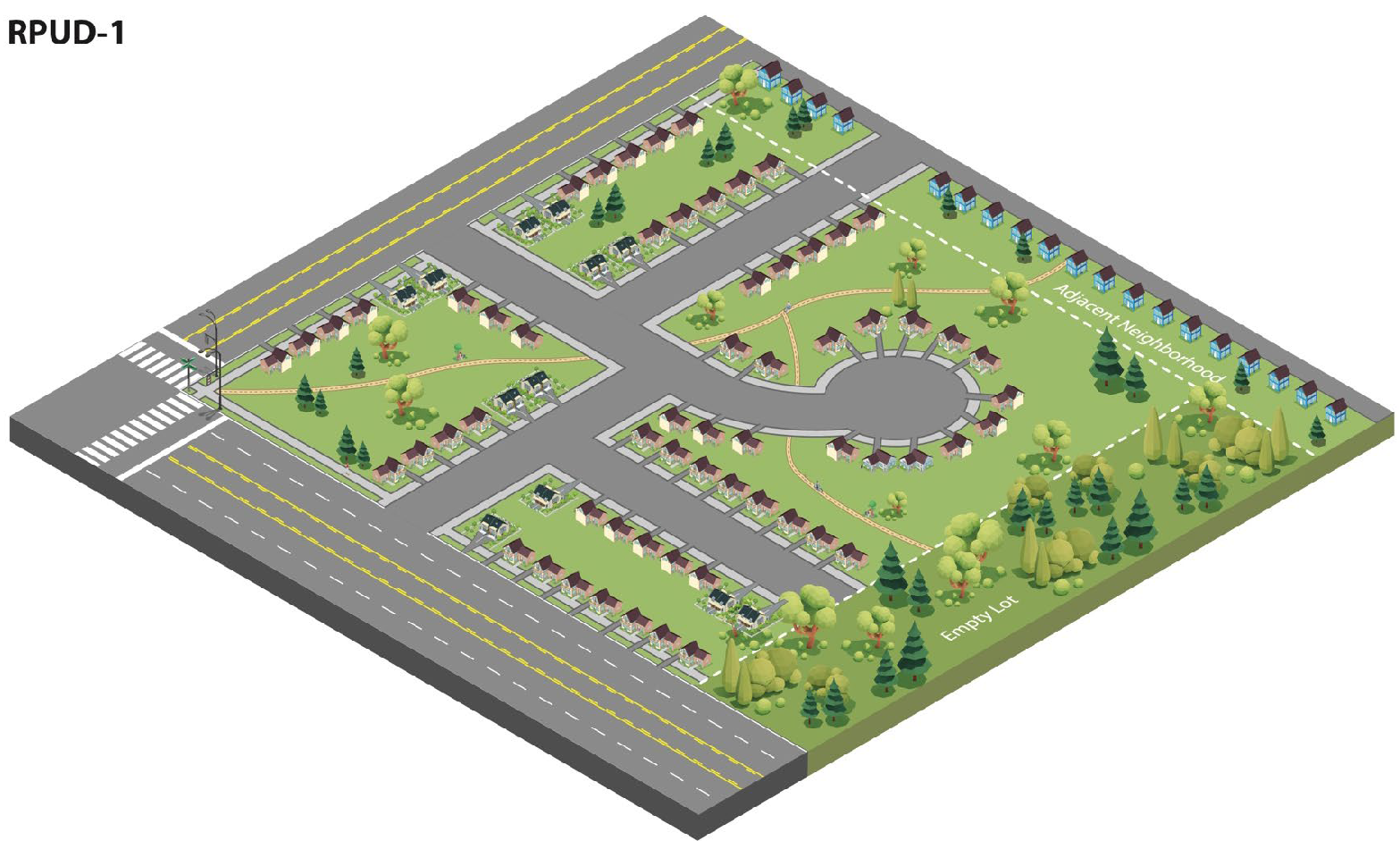
Sec. 94-11.07. - RPUD-1.
(a)
Intent. It is the intent of the "RPUD-1" district to encourage more imaginative and livable housing environments within that district, through a planned reduction, or averaging, of the individual lot area requirements for a planned unit development, provided that the overall density requirements for the planned unit development remain the same. Such averaging or reduction of lot area requirements shall only be permitted when a landowner, or group of owners acting jointly, can plan and develop a tract of land as an entity and thereby qualify for regulation of that tract of land as one complex land use unit in accordance with an approved final area site plan as provided by article VIII, rather than an aggregation of individual buildings located on separate, unrelated lots.
(b)
Permitted uses. Subject to subsection (e) below and the planning commission's authority to prohibit uses pursuant to section 94-11.02, the following uses of land and structures may be permitted within a low-density residential PUD as approved by the planning commission pursuant to, and subject to the requirements of, the planned unit development regulations contained in this article.
(1)
Any permitted use in the "A" and "A-2" districts, including housing up to the density limit for the A-2 district in section 94-10.02.
(2)
Permitted accessory uses as permitted in the "A" and "A-2" districts.
(3)
Special uses as permitted in "A" and "A-2" districts, as deemed appropriate by the planning commission.
(4)
Multi-family residential units with up to four units per building, provided that the overall housing density falls within the range designated for the site in the master plan, and also does not exceed the allowable housing density of the A-2 district.
(5)
Golf courses, tennis clubs and athletic clubs, when combined with any residential use.
(c)
Final area site plan approval required. No permits for any development or use of property included within an "RPUD-1" district shall be issued until a final area site plan has been approved by the planning commission, as required by section 94-11.02.
(d)
Minimum area, height, bulk and placement requirements. The area, height, bulk and placement requirements, as determined by the planning commission shall not be less than the minimum standards of this section, except as provided in section 94-11.06(c) or unless the applicant demonstrates and the planning commission determines that a better or more appropriate design can be achieved by not applying the minimum standards of this section and that adherence to the standards is not required to ensure the health, safety and welfare of the inhabitants and users of the development and of adjoining property:
(1)
Single-family detached dwellings shall meet, as a minimum, the regulations applicable in the A district as provided in section 94-7.01.
(2)
Two-family dwellings shall meet, as a minimum, the regulations applicable in the A-2 district as provided in section 94-7.01.
(3)
All other permitted uses shall meet, as a minimum, the regulations applicable in the A-2 district as provided in section 94-7.01.
(4)
Lots and site condominium units shall meet, as a minimum, 80 percent of the lot width and area applicable in the A-2 district.
(e)
Density. The maximum allowable density for the PUD district shall be determined by the planning commission after consideration of each of the following standards:
(1)
PUD shall be designed, constructed and maintained so as to be harmonious with the goals, objective, and vision of the master plan, and the specific requirements of section 94-11.02(c)(7).
(2)
The PUD shall be adequately served by essential public facilities and services, such as highways, streets, pedestrian ways, police and fire protection, drainage structures, refuse disposal, water and sewer facilities.
(3)
The PUD shall not create excessive additional requirements at public cost for public facilities and services.
(4)
The PUD shall be developed in accordance with the purposes and objectives of the planned unit development district.
(5)
In no case shall the proposed housing density fall outside the density range envisioned for the site in the master plan.
(Ord. No. 24-674, § 2(Exh. A), 1-22-24)
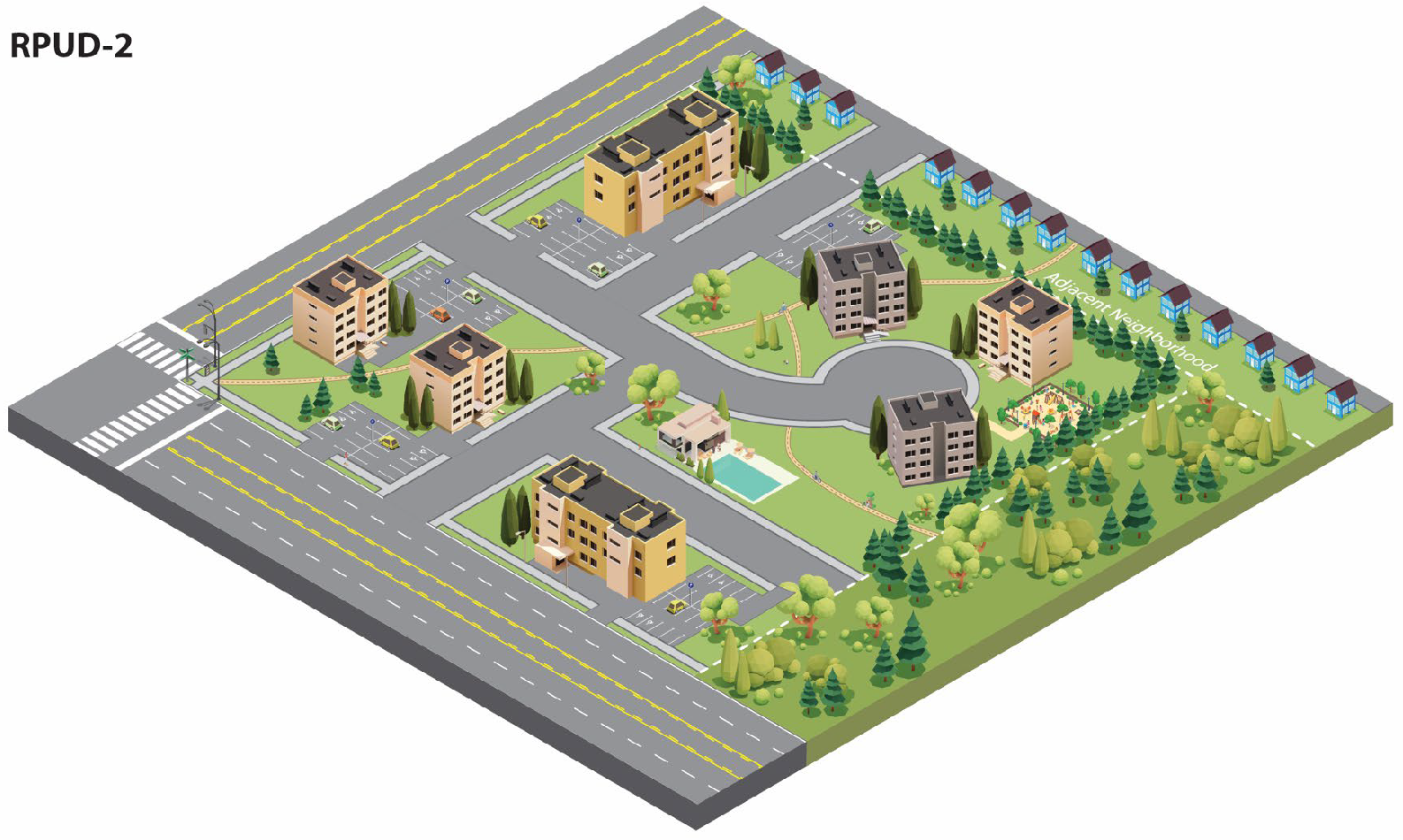
Sec. 94-11.08. - RPUD-2.
(a)
Intent. It is the intent of the "RPUD-2" district to encourage more imaginative and livable housing environments within that district, through a planned reduction, or averaging, of the individual lot area requirements for a planned unit development, provided that the overall density requirements for the planned unit development remain the same. Such averaging or reduction of lot area requirements shall only be permitted when a landowner, or group of owners acting jointly, can plan and develop a tract of land as an entity and thereby qualify for regulation of that tract of land as one complex land use unit in accordance with an approved final area site plan as provided by article VIII, rather than an aggregation of individual buildings located on separate, unrelated lots.
(b)
Permitted uses. Subject to subsection (e) below and the planning commission's authority to prohibit uses pursuant to section 94-11.02, the following uses of land and structures may be permitted within an RPUD as approved by the planning commission pursuant to, and subject to the requirements of, the planned unit development regulations contained in this article.
(1)
Any permitted use in the "ARM" district, including housing, up to the density limits for the ARM district in section 94-10.02.
(2)
Permitted accessory uses as permitted in the "ARM" district.
(3)
Special use uses as permitted in the "ARM" district, as deemed appropriate by the planning commission.
(4)
Multi-family housing with more than four dwelling units per building, including senior housing.
(5)
Golf courses, tennis clubs and athletic clubs.
(6)
Any permitted use within the "C-1" local commercial district, provided that any such commercial use must be primarily intended for the use and patronage of the development's residents, and provided further that the gross area designated for such commercial use shall not exceed five percent of the total usable floor area of the residential development. In addition, no use provided for in this subsection shall be constructed until not less than 30 percent of the dwelling units proposed in the development have been completed.
(c)
Final area site plan approval required. No permits for any development or use of property included within an "RPUD-2" district shall be issued until a final area site plan has been approved by the planning commission.
(d)
Minimum area, height, bulk and placement requirements. The area, height, bulk and placement requirements, as determined by the planning commission shall not be less than the minimum standards of this section, except as provided in section 94-11.06(c) or unless the applicant demonstrates and the planning commission determines that a better or more appropriate design can be achieved by not applying the minimum standards of this section and that adherence to the standards is not required to ensure the health, safety and welfare of the inhabitants and users of the development and of adjoining property:
(1)
Single-family detached dwellings, two-family dwellings, townhouses or other similar permitted single-family attached dwelling types, and multiple-family dwelling structures shall meet, as a minimum, the regulations in sections 94-7.01 and 94-15.04.
(2)
Commercial uses shall meet, as a minimum, the regulations applicable in the C-1 district as provided in section 94-7.01.
(3)
All other permitted uses shall meet, as a minimum, the regulations applicable in the ARM district as provided in section 94-7.01, except that the planning commission may allow additional building height, up to six stories, if the following criteria are met:
a.
The criteria in subsection (d).
b.
The additional height shall not lead to any upper floor unit having a view into a private residential back yard on an adjacent site.
c.
The building will not cast a shadow over a residential lot that is not part of the PUD.
d.
The design of the building ensure that the additional height will not create negative impacts or aesthetic degradation for neighboring residential properties.
(4)
Lots and site condominium units shall meet, as a minimum, 80 percent of the lot width and area applicable in the A-2 district.
(5)
Density. In no case shall the proposed housing density fall outside the density range envisioned for the site in the master plan.
(Ord. No. 24-674, § 2(Exh. A), 1-22-24)
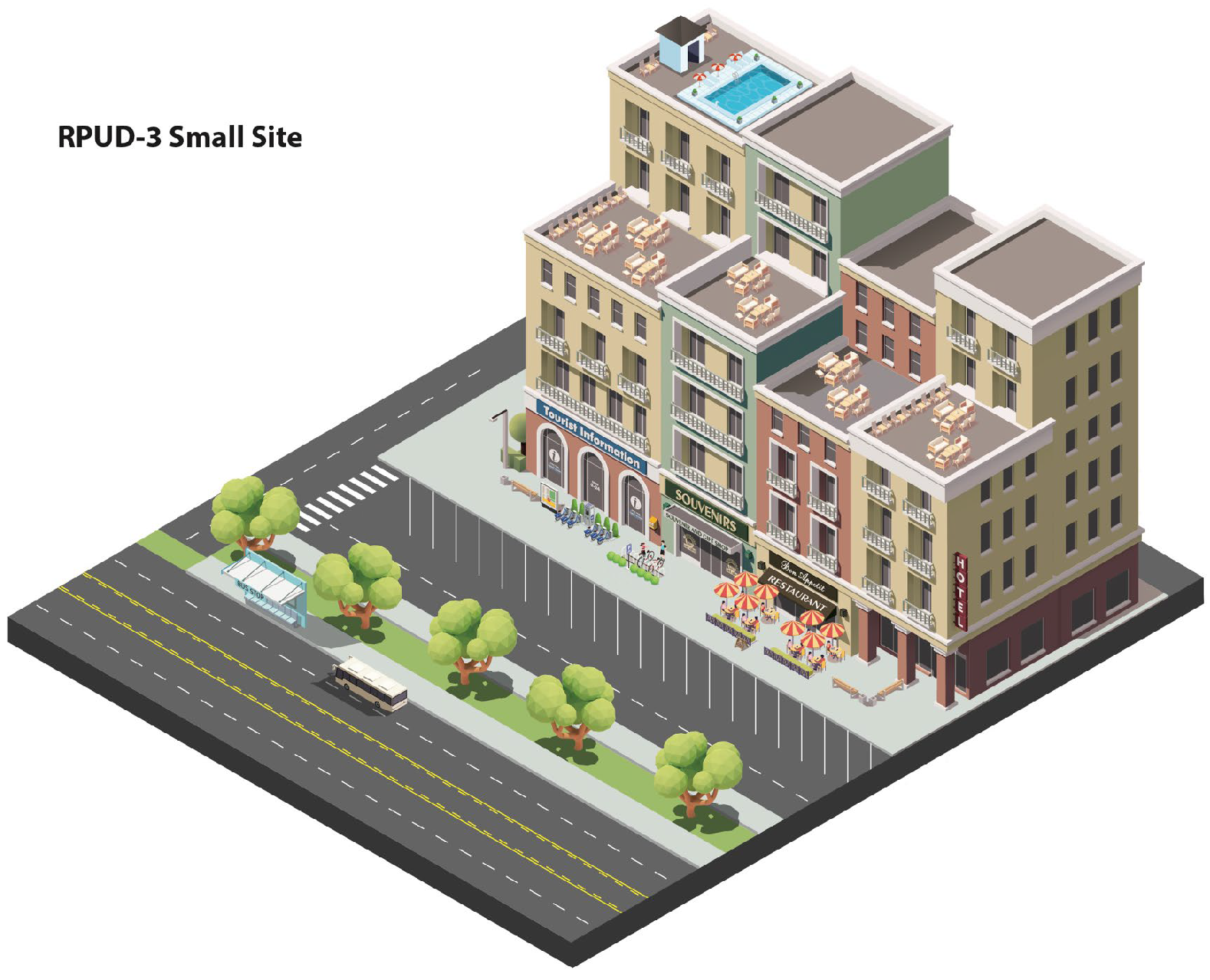
Sec. 94-11.09. - RPUD-3.
(a)
Intent. It is the intent of the "RPUD-3" district to allow for high density residential developments, in specific locations where such density can be supported by infrastructure, and also to require high image design standards and high value amenities to ensure quality of life for the residents of the high density developments.
(b)
Allowable location. A rezoning to RPUD-3 shall only be permitted on land designed for "redevelopment mixed use" in the City of Walker Master Plan and has public water and sewer service available OR land that meets all of the following criteria.
(1)
The land is within 500 feet of the platform of a bus rapid transit (BRT) station. In the event of a parcel that is only partially within 500 feet of the platform of a BRT station, the entire parcel may be developed under RPUD-3, except that the portion of the parcel that is more than 500 feet from the BRT station platform shall have a maximum housing density of eight units per acre.
(2)
The land in question is not with the Standale, Alpine, or Remembrance overlay.
(3)
The land in question must have public water and sewer service available.
(c)
Permitted uses. Subject to subsection (e) below and the planning commission's authority to prohibit uses pursuant to section 94-11.02, the following uses of land and structures may be permitted within an RPUD as approved by the planning commission pursuant to, and subject to the requirements of, the planned unit development regulations contained in this article.
(1)
Any permitted use in the "ARM" district, including housing, as described below.
(2)
Permitted accessory uses as permitted in the "ARM" district.
(3)
Special use uses as permitted in the "ARM" district, as deemed appropriate by the planning commission.
(4)
Multi-family housing, at a minimum density of eight units per acre. There shall be no maximum density, provided that all requirements of this section, and all relevant requirements of this chapter, are met.
(5)
Golf courses, tennis clubs and athletic clubs.
(6)
Any permitted use within the "C-1" local commercial district, provided that the gross area designated for such commercial use shall be at least five percent, and shall not exceed ten percent, of the total usable floor area of the residential development. In addition, no use provided for in this subsection shall be constructed until not less than 30 percent of the dwelling units proposed in the development have been completed.
(d)
Final area site plan approval required. No permits for any development or use of property included within an "RPUD-3" district shall be issued until a final area site plan has been approved by the planning commission.
(e)
Minimum area, height, bulk and placement requirements. The area, height, bulk and placement requirements, as determined by the planning commission shall not be less than the minimum standards of this section. The planning commission shall not have the authority to waive these standards as part of the PUD approval process.
(1)
Single-family detached dwellings, two-family dwellings, townhouses or other similar permitted single-family attached dwelling types, and multiple-family dwelling structures shall meet, as a minimum, the regulations in section 94-15.04.
(2)
Lots and site condominium units shall meet, as a minimum, 80 percent of the lot width and area applicable in the A-2 district.
(3)
Sidewalks must be constructed along all road frontages, including all private roads and internal access drives. Walking trails shall be constructed to preserved open space or areas designed for recreation to create a connected network.
(4)
The maximum building height shall be six stories and 80 feet.
(5)
Balconies shall be required for all upper floor dwelling units. Balconies must project at least four feet from the building wall. In lieu of balconies, the planning commission may permit communal rooftop gathering space.
(6)
Bicycle parking for at least one bicycle per five automobile parking spaces shall be required.
(7)
All applicable requirements of article XIII must be met.
(8)
All requirements of Sections 12.07, 12.08, 12.09, and 12.10 must be met. The Planning Commission's ability to waive landscape standards under Section 12.07.M shall not apply to RPUD-3 developments.
(9)
Small site requirements. The following shall apply only to RPUD-3 developments on lots under two acres.
a.
The front setback area, along both public roads and internal/private roads, shall meet the following requirements:
1.
There shall be no minimum setback from any abutting road right-of-way, including internal/private roads.
2.
The maximum setback from any abutting public road right-of-way shall be 150 feet. There shall be no maximum setback from internal/private roads.
3.
An attractive, safe, and efficient pedestrian walkway, including sidewalk and crosswalk paint, must be designed and constructed between the sidewalk required by Section E.3 and a pedestrian entrance to the building, on all adjacent roads (including internal/private roads).
i.
Buildings with no setback from the public sidewalk shall be deemed to meet this requirement.
ii.
On corner lots, the Planning Commission may consider a pedestrian walkway that connects to one adjoining sidewalk, which in turn then connects efficiently and seamlessly to a sidewalk along another abutting street, to count for this requirement as it applies to both streets.
4.
Parking shall be permitted within the front setback, provided that all dimensional requirements of Section 12.02 are met. However, the Planning Commission may determine that proposed front yard parking creates an unnecessary impediment to pedestrian mobility and require the front setback to be reduced and the parking re-located to the side or rear.
5.
Above-ground stormwater retention or detention shall not be located in a front yard unless the City Engineer determines, to the satisfaction of the Planning Commission, that no other option is feasible on a given site.
6.
Front setback areas may be used for parking, landscaping, outdoor dining, pedestrian circulation, recreational or gathering space, or public art, or some combination of those site design features. The Planning Commission may reject a front yard design as having too much space dedicated to passive open space or being inefficient or unsafe for the movement of pedestrians, and may require the front setback to be reduced in size and/or redesigned.
b.
Floors above the fourth floor shall be set back at least ten feet from the front of the building. The space created on the fourth floor rooftop may be counted as the required balconies or communal rooftop gathering space.
c.
Indoor recreational amenities for residents, such as a swimming pool, fitness center, or other amenity as approved by the planning commission, must be included.
(10)
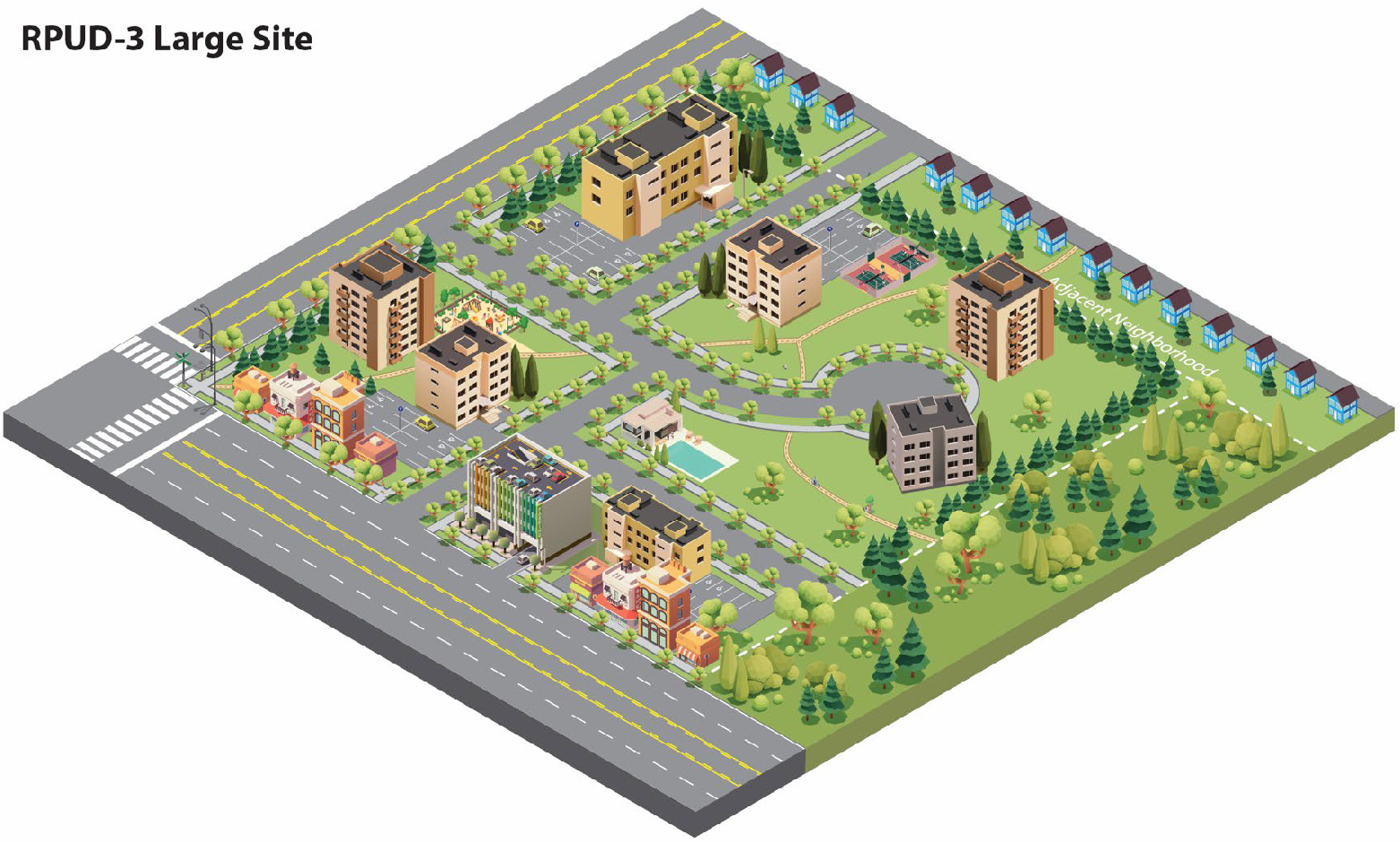
Large site requirements. The following shall apply only to RPUD-3 developments on lots over two acres.
a.
The road frontage must be designed as one of the following:
1.
Preserved wooded space, with old growth, pre-existing trees.
2.
A landscaped buffer, with berms, trees, and shrubs to buffer the dense development.
3.
Mixed use buildings, built with a front setback design consistent with Section 11.09.E.9.a.
b.
A communal clubhouse or recreation center must be included.
c.
Both indoor and outdoor recreational amenities for residents, such as a swimming pool, fitness center, playground or other amenity as approved by the planning commission, must be included.
(Ord. No. 24-674, § 2(Exh. A), 1-22-24; Ord. No. 25-677, § 1, 3-10-25)
Sec. 94-11.10. - CPUD.
(a)
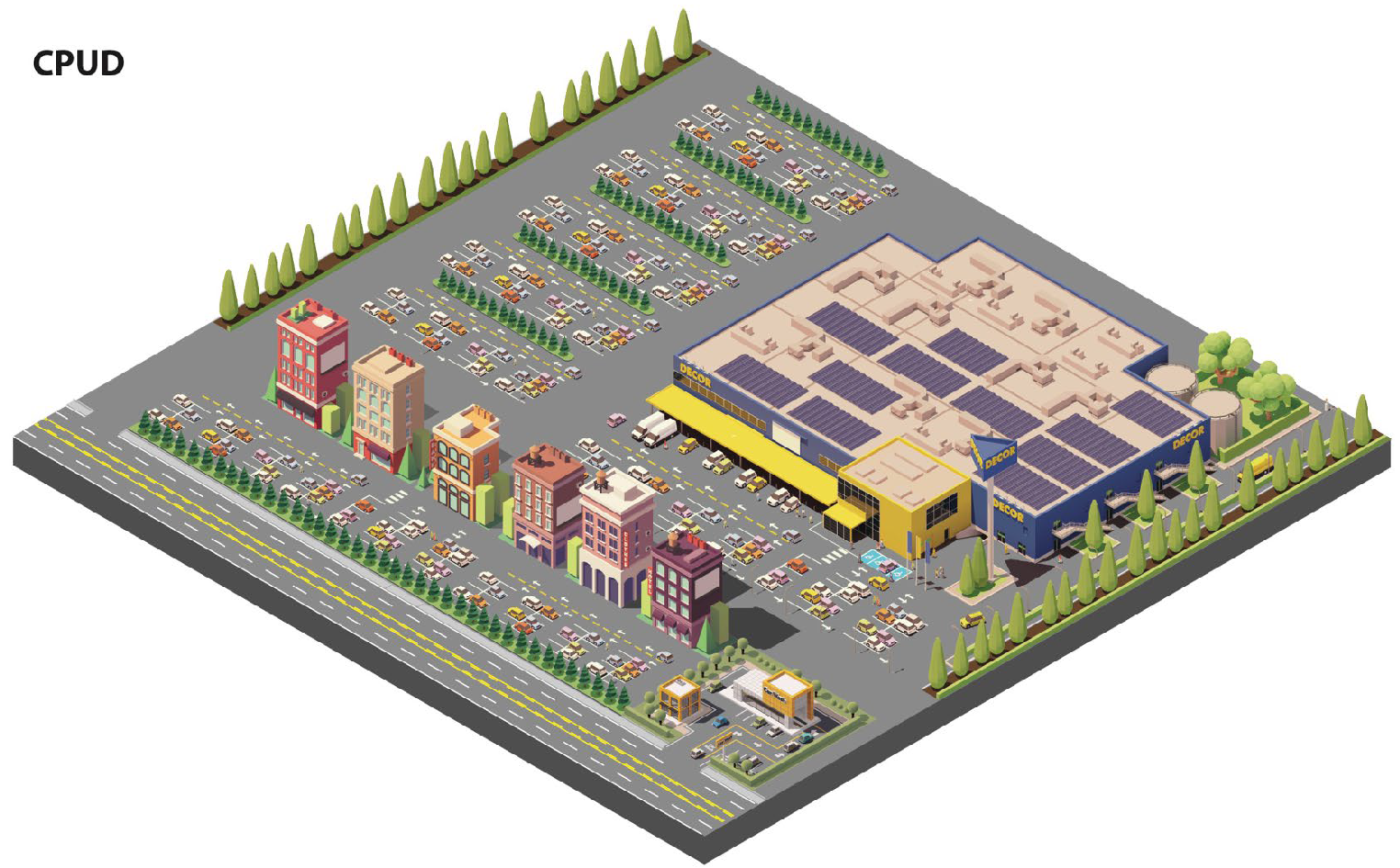
Intent. It is the intent of the "CPUD" district to allow design flexibility in accordance with an approved final area site plan as provided by article VIII of this chapter and to encourage development compatible with surrounding or abutting uses, with suitable open spaces, landscaping and parking areas. Further, it is the intent of the "CPUD" district to conserve the value of property which includes optimum utilization of areas devoted to commercial use together with protection of the immediate environment, both existing and intended, by the city's master plan; to promote a more complete urban design which includes necessary community service and employment opportunities conveniently located and attractively designed; and to encourage creative and imaginative approaches in the development of commercial elements of the city.
(b)
Permitted uses. Subject to the planning commission's authority to prohibit uses pursuant to section 94-11.02, the following uses of land and structures may be permitted within an CPUD as approved by the planning commission pursuant to, and subject to the requirements of, the planned unit development regulations contained in this article.
(1)
Any permitted use within the "ORP," "C-1," "C-2" districts.
(2)
Permitted accessory uses as permitted in the "ORP," "C-1," "C-2" districts.
(3)
Special Use uses as permitted in the "ORP," "C-1," "C-2," districts as deemed appropriate by the planning commission.
(c)
Final area site plan approval required. No permits for any development or use of property included within a "CPUD" district shall be issued until a final area site plan has been approved by the planning commission, as required by article VIII.
(d)
Additional standards for review. In addition to the standards for review contained in section 94-11.02, the planning commission shall determine that the following standards are met as a prerequisite to approval of any CPUD development:
(1)
The proposed PUD shall be designed and developed with a unified architectural treatment.
(2)
Utilities, roads, and other essential services must be available for immediate use of occupants purchasing or leasing sites in the PUD. This shall include all private utilities in public rights-of-way, including, but not limited to, communications, electricity, and heating fuel.
(3)
Compatibility of site use with nearby residential areas must be evidenced and can be determined in relationship to the following criteria:
a.
Uses have no harmful or unpleasant effects (noise, odors, fumes, glare, vibration, smoke, vapors and gases, electrical emissions, and industrial wastes).
b.
The PUD site has direct access to a collector or arterial street.
c.
Appearance is harmonious with adjacent uses. This determination shall include, but not be limited to, consideration of landscaping, enclosure of principal and accessory uses, height control, sign control, building profiles and architectural controls.
d.
The distances separating all proposed uses and buildings from the surroundings are great enough to in fact constitute a buffer.
e.
Loading docks and truck maneuvering areas and terminals should be designed and located so as not to adversely affect adjacent and neighboring lands or uses due to noise, odor, light or other external effect.
(e)
Minimum area, height, bulk and placement requirements. The area, height, bulk and placement requirements within a CPUD district, as determined by the planning commission, shall not be less than the minimum standards of the C-2 district, unless the applicant demonstrates and the planning commission determines that a better or more appropriate design can be achieved by not applying the minimum standards of this section and that adherence to the minimum standards is not required to ensure the health, safety and welfare of the inhabitants and users of the development and of adjoining property. The planning commission may also allow additional building height, up to six stories, if the following criteria are met:
(1)
The criteria in subsection 94-11.08(d).
(2)
The additional height shall not lead to any upper floor unit having a view into a private residential back yard on an adjacent site.
(3)
The building will not cast a shadow over a residential lot that is not part of the PUD.
(4)
The design of the building ensure that the additional height will not create negative impacts or aesthetic degradation for neighboring residential properties.
(Ord. No. 24-674, § 2(Exh. A), 1-22-24)
Sec. 94-11.11. - IPUD.
(a)
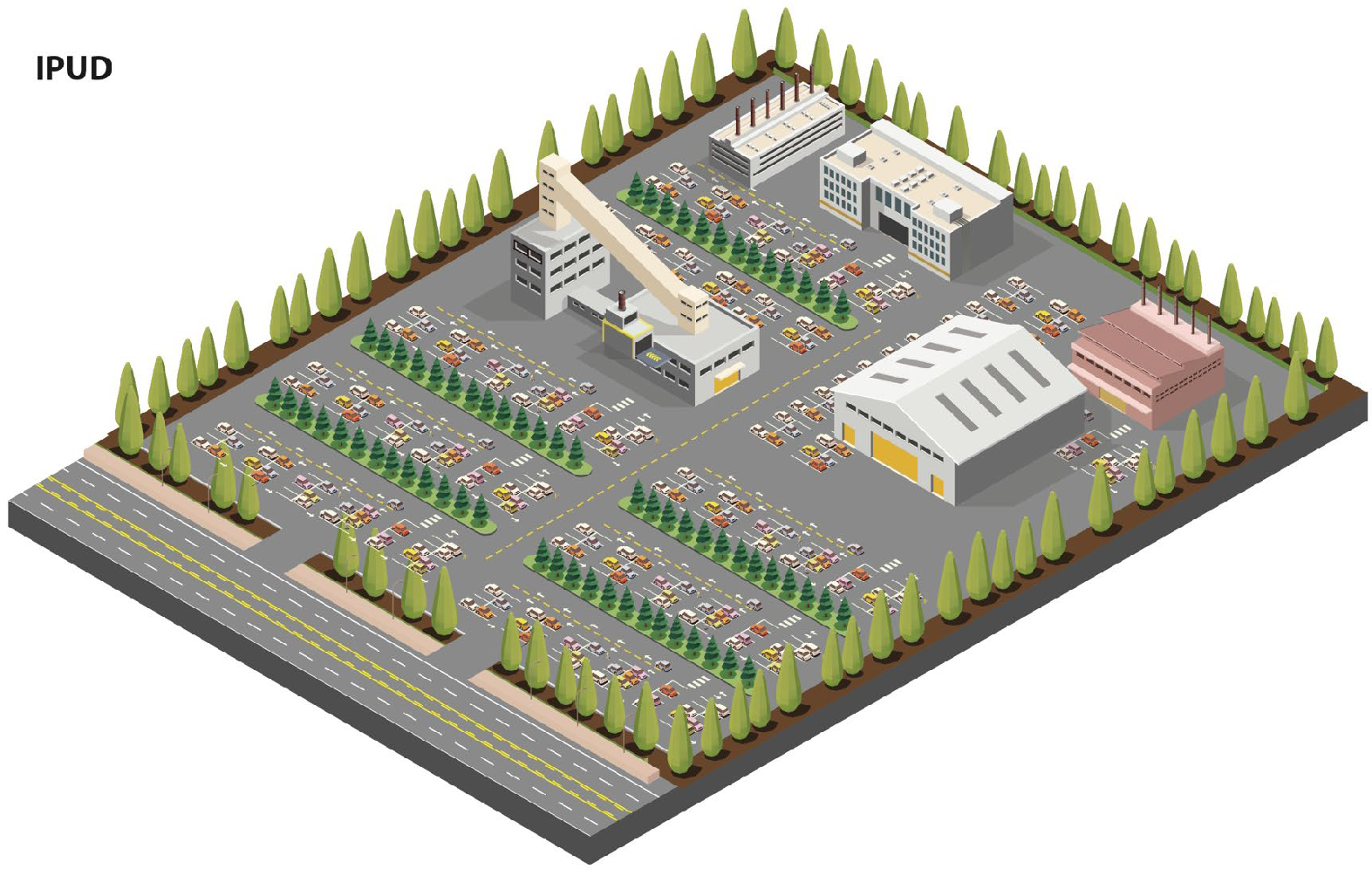
Intent. It is the intent of the "IPUD" district to permit and control the development of comprehensively planned industrial areas and research and development centers; to encourage development of comprehensively planned industrial areas that are compatible with surrounding or abutting uses, exhibit low to negligible levels of negative external impacts such as noise, dust, smoke, etc., and are enhanced with suitable buffering, landscaping and parking areas; and to allow design flexibility and creative approaches in the development of industrial elements of the city in accordance with the city's master plan and an approved final area site plan as provided by section 94-11.02.
(b)
Permitted uses. Subject to the planning commission's authority to prohibit uses pursuant to section 94-11.02, the following uses of land and structures may be permitted within an IPUD as approved by the planning commission pursuant to, and subject to the requirements of, the planned unit development regulations contained in this article.
(1)
Any use permitted by right or by special use in the "I-2" district.
(2)
Permitted accessory uses as permitted in the "I-2" district.
(3)
Industrial manufacturing, compounding, processing, packaging, treating or assembling from previously prepared materials the following:
a.
Fabricated metal products, including heavy machinery and transportation equipment.
b.
Plastic products.
(c)
Final area site plan approval required. No permits for any development or use of property included within an "IPUD" district shall be issued until a final area site plan has been approved by the planning commission, as required by article VIII.
(d)
Additional standards for review. In addition to the standards for review contained in section 94-11.02(c)(7), the planning commission shall determine that the following standards are met as a prerequisite to approval of any IPUD development:
(1)
Utilities, roads, and other essential services must be available for immediate use of occupants purchasing or leasing sites in the IPUD. This shall include all private utilities in public rights-of-way, including, but not limited to, communications, electricity, and heating fuel.
(2)
The IPUD site shall have direct access to a collector or arterial street.
(3)
All uses in the IPUD shall be designed, constructed and operated to comply with the performance standards as provided by article XV of this chapter.
(4)
Loading docks and truck maneuvering areas and terminals should be designed and located so as not to adversely affect adjacent and neighboring lands or uses due to noise, odor, light or other external effect.
(5)
Except as otherwise expressly approved by the planning commission, all permitted principal uses shall be conducted within a completely enclosed building except for loading and unloading operations, onsite parking of vehicles, and reasonable storage of materials and products which are related to the principal uses. Materials and products may be stored on the property as provided by, and subject to the screening requirements of, section 94-6.09.
(e)
Minimum area, height, bulk and placement requirements. The area, height, bulk and placement requirements within a CPUD district, as determined by the planning commission, shall not be less than the minimum standards of the I-1 district, unless the applicant demonstrates and the planning commission determines that a better or more appropriate design can be achieved by not applying the minimum standards of this section and that adherence to the minimum standards is not required to ensure the health, safety and welfare of the inhabitants and users of the development and of adjoining property.
(Ord. No. 24-674, § 2(Exh. A), 1-22-24)
Sec. 94-11.12. - MPUD.
(a)
Intent. The "MPUD" district is intended to permit the integrated development of significant residential-use components mixed with commercial uses as envisioned by the master plan, or in locations otherwise deemed appropriate under the standards of this article, in accordance with an approved final area site plan as provided by section 94-11.02.
This section is intended to provide greater flexibility for large or small projects that combine residential and commercial uses in an innovative way within a single integrated development. The vertical or horizontal mixing of commercial and residential uses is allowed. However, the mixing of uses shall be carefully designed in order to create the following:
(1)
An interconnected and hierarchical system of streets and service drives.
(2)
A pedestrian-friendly environment via the use of sidewalks, trails, paths and traffic calming devices.
(3)
A sustainable pattern of building location and form that enables long term site desirability, viability and the continued use of onsite structures.
(4)
A system of passive, active and natural open space areas, subject to the physical attributes and regulatory limitations of the site.
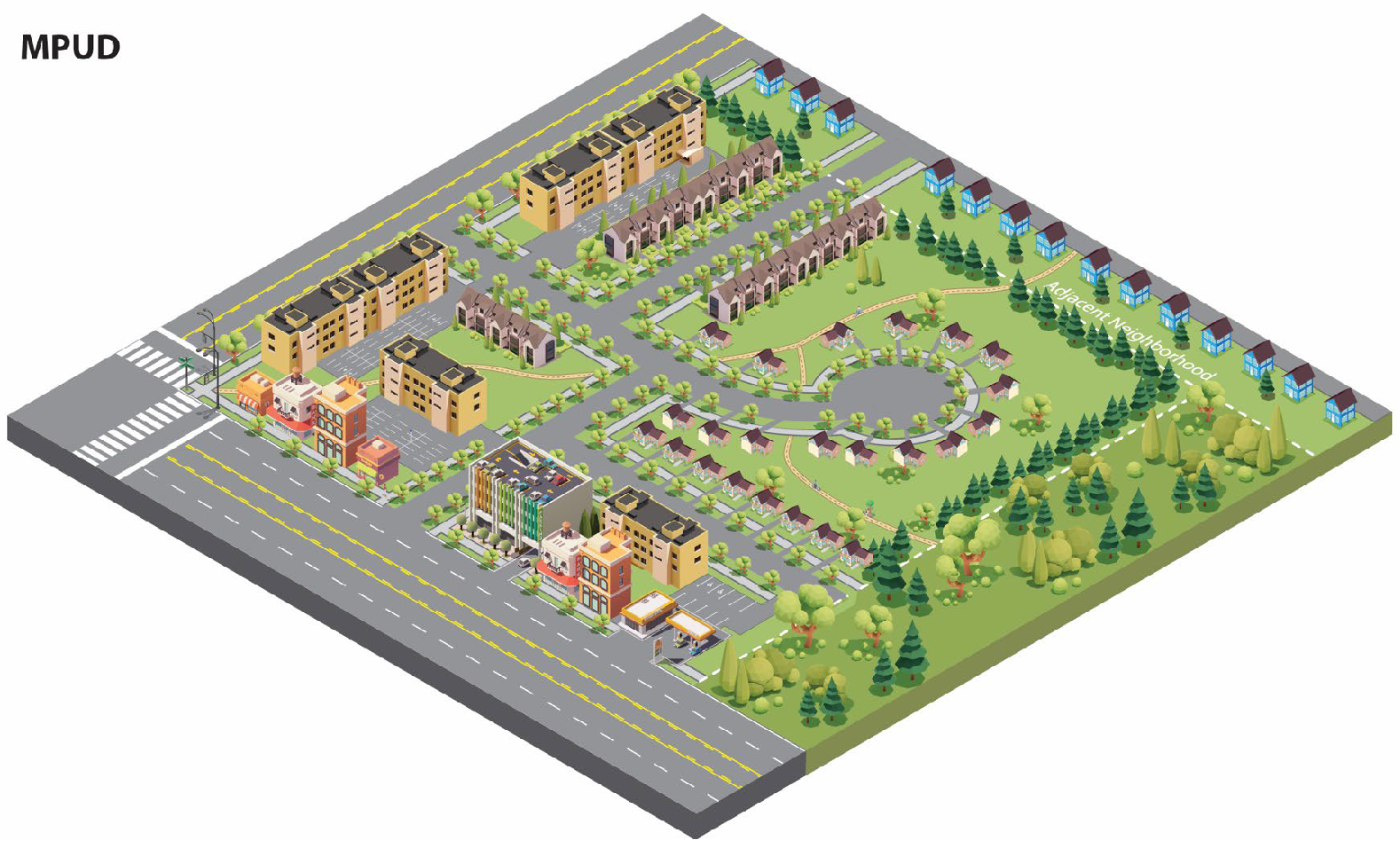
(b)
Permitted uses. Subject to the planning commission's authority to prohibit uses pursuant to section 94-11.02, the following uses of land and structures may be permitted within an MPUD as approved by the planning commission pursuant to, and subject to the requirements of, the planned unit development regulations contained in this article. No use of land shall be permitted in an MPUD except as described in this section.
(1)
Dwelling units may be permitted in the following locations within an MPUD. The density of dwelling units shall fall within the range envisioned for the site in the master plan. If the master plan does not designate a density of dwelling units for the site, then the site shall contain between four and eight dwelling units per acre net density (as defined in article X).
a.
In a detached single-family home, provided that the home is located at least at least 500 feet from both Leonard Street and Remembrance Road, and at least 1,000 feet from any of the following roadways:
1.
Lake Michigan Drive.
2.
Wilson Avenue.
3.
3 Mile Road.
4.
4 Mile Road.
5.
Alpine Avenue.
6.
Walker Avenue.
b.
In buildings with more than one dwelling unit, but containing no nonresidential uses, provided that the building is located at least 500 feet from any of the following roadways:
1.
Lake Michigan Drive.
2.
Wilson Avenue.
3.
3 Mile Road.
4.
4 Mile Road.
5.
Alpine Avenue.
6.
Walker Avenue.
c.
In a mixed use building containing a nonresidential first floor use, anywhere on the site deemed appropriate by the planning commission during the PASP and FASP processes.
(2)
The following nonresidential uses may be permitted in the following locations within an MPUD.
a.
The following uses may be permitted only if they are located within 500 feet of one of the roadways listed in subsection 2. below and are within 500 feet of a C-1, C-2, I-1, or I-2 zoning district.
1.
Uses.
i.
Drive-thrus.
ii.
Car washes.
iii.
Gas stations.
2.
Allowable roadways.
i.
Lake Michigan Drive.
ii.
Wilson Avenue.
iii.
3 Mile Road.
iv.
4 Mile Road.
v.
Alpine Avenue.
vi.
Walker Avenue.
b.
All other uses permitted in the C-2 zoning district may be permitted anywhere within an MPUD, except the following uses, which shall be prohibited in MPUDs.
1.
Self-storage.
2.
Automobile repair (major and minor).
3.
Automobile sales.
4.
Nursery, shrubbery, and garden supply center.
5.
Mineral mining.
c.
The planning commission may determine that another nonresidential use not specifically listed above is appropriate within an MPUD, and may allow such use.
(3)
Special Use.
(c)
Final area site plan approval required. No permits for any development or use of property included within an "MPUD" district shall be issued until a final area site plan has been approved by the planning commission, as required by article VIII.
(d)
Additional standards for review. In addition to the standards for review contained in subsection 94-11.02, the planning commission shall determine that the following standards are met as a prerequisite to approval of any MPUD development:
(1)
Grant of the PUD shall result in a recognizable and substantial benefit to the ultimate users of the project and to the community, where such benefit would otherwise be infeasible or unlikely to be achieved within the constraints of the otherwise applicable zoning districts.
(2)
The residential component(s) of an MPUD shall be completed concurrent with any nonresidential construction, or in such a manner so as to minimize disruption to any development component within an MPUD.
(3)
Minimum area, height, bulk and placement requirements. The area, height, bulk and placement requirements within an MPUD district shall be determined during the preliminary area site plan process, based on the proposed uses and the criteria of this article.
a.
The planning commission and city commission may choose to apply the dimensional requirements of the C-1, C-2, ORP, or ARM-MULT zoning districts to some or all of an MPUD site, or they may approve dimensions unique to the layout of the MPUD, or they may impose their own dimensional standards over the MPUD as a whole.
b.
The planning commission may allow additional building height, above and beyond what is allowed in any of the zoning districts listed in subsection a, up to six stories, if the following criteria are met:
1.
Adherence to the standards is not required to ensure the health, safety and welfare of the inhabitants and users of the development and of adjoining property
2.
The additional height shall not lead to any upper floor unit having a view into a private residential back yard on an adjacent site.
3.
The building will not cast a shadow over a residential lot that is not part of the PUD.
4.
The design of the building ensure that the additional height will not create negative impacts or aesthetic degradation for neighboring residential properties.
c.
The planning commission and city commission shall have final determination over the area, height, bulk, and placement requirements, and shall not be obligated to approve any layout that they do not deem to meet the requirements of this article, or of this chapter generally, or of the spirit, intent, or vision of the master plan.
(4)
The minimum residential floor area required in MPUDs for multiple-family dwellings shall be the same as required by the ARM district as provided by section 94-7.01 and the minimum residential floor area required in MPUDs for single-family or two-family dwellings shall be the same as required in subsection 94-15.04(a), unless the planning commission specifically allows reductions in these minimum residential floor areas to occur; but, in no case, shall more than a 20 percent reduction in minimum floor area be allowed.
(5)
All site design requirements, including, but not limited to, lighting, landscaping, parking, and signage, shall conform to the requirements of the C-2 district, unless an alteration to those requirements is specifically approved by the planning commission and city commission. On street parking may be counted towards parking requirements.
(6)
All MPUDs shall have a connected pattern of streets and pedestrian infrastructure meeting the following requirements:
a.
The street network must connect to all adjacent public roads at least once per 500 feet of frontage along the roadway.
b.
The street network must include connections to any stub streets that have been built up to the property line from adjacent developments. If there are not existing stub streets, the street network must include at least one stub street connecting to every property line. The planning commission may determine that an otherwise required road connection is impractical due to legal or physical impediments, or that a road connection does not further the vision of the master plan, and may waive this requirement.
c.
The street network must be fully interconnected internally. The MPUD shall not contain multiple street networks that do not connect to each other.
d.
The planning commission may allow for any of the requirements in Sections a-c to be met with paved bicycle paths (at least eight feet wide) or paved emergency access roads (meeting the requirements of the fire department).
e.
All internal streets must have sidewalks on both sides.
f.
There must a continuous sidewalk constructed along all public roads adjacent to the MPUD.
(Ord. No. 24-674, § 2(Exh. A), 1-22-24)

