
Walker City Zoning Code
ARTICLE VIII
- OVERLAYS
Sec. 94-8.01. - Standale overlay.
(a)
Applicability.
(1)
Within the overlay boundary designated on the official zoning map, the provisions of this section shall supersede the provisions of the underlying zoning district.
(2)
All provisions in this chapter, and of the underlying zoning district that are not directly contradicted by a provision of this overlay shall apply within the overlay as written elsewhere in this chapter.
(3)
The overlay shall not supersede the requirement in section 94-12.02 for parking lots to be set back from residential uses, nor shall the overlay supersede requirements for landscape buffer between commercial and residential uses in section [94-12.07]. Those requirements shall still apply, regardless of whether either or both lots in question are within the overlay.
(4)
The overlay shall not supersede the provisions of any PUD agreement.
(5)
Unless otherwise stated, a site must be brought into compliance with all provisions of the overlay in conjunction with any site improvement requiring site plan approval.
(b)
Permitted uses. The permitted uses in the Standale overlay shall be those designated on the chart in section 94-5.04. Where residential uses are listed as special land uses, the following requirements must be met in order for the special land use to be approved:
(1)
The residential use must be set back at least 200 feet from Lake Michigan Drive, and must have access to a public road other than Lake Michigan Drive.
(2)
The design of the residential use and its associated parking, landscaping, and other site design features shall not inhibit the construction of a nonresidential or mixed use building along Lake Michigan Drive that meets the requirements of this overlay.
(c)
Residential density. The maximum number of residential units on any parcel within the Standale overlay shall be one unit per 5,445 square feet of lot area (eight units per acre). Buildable lots with an area under 5,445 square feet may contain one dwelling unit.
(d)
Lake Michigan Drive front setback area and access management.
(1)
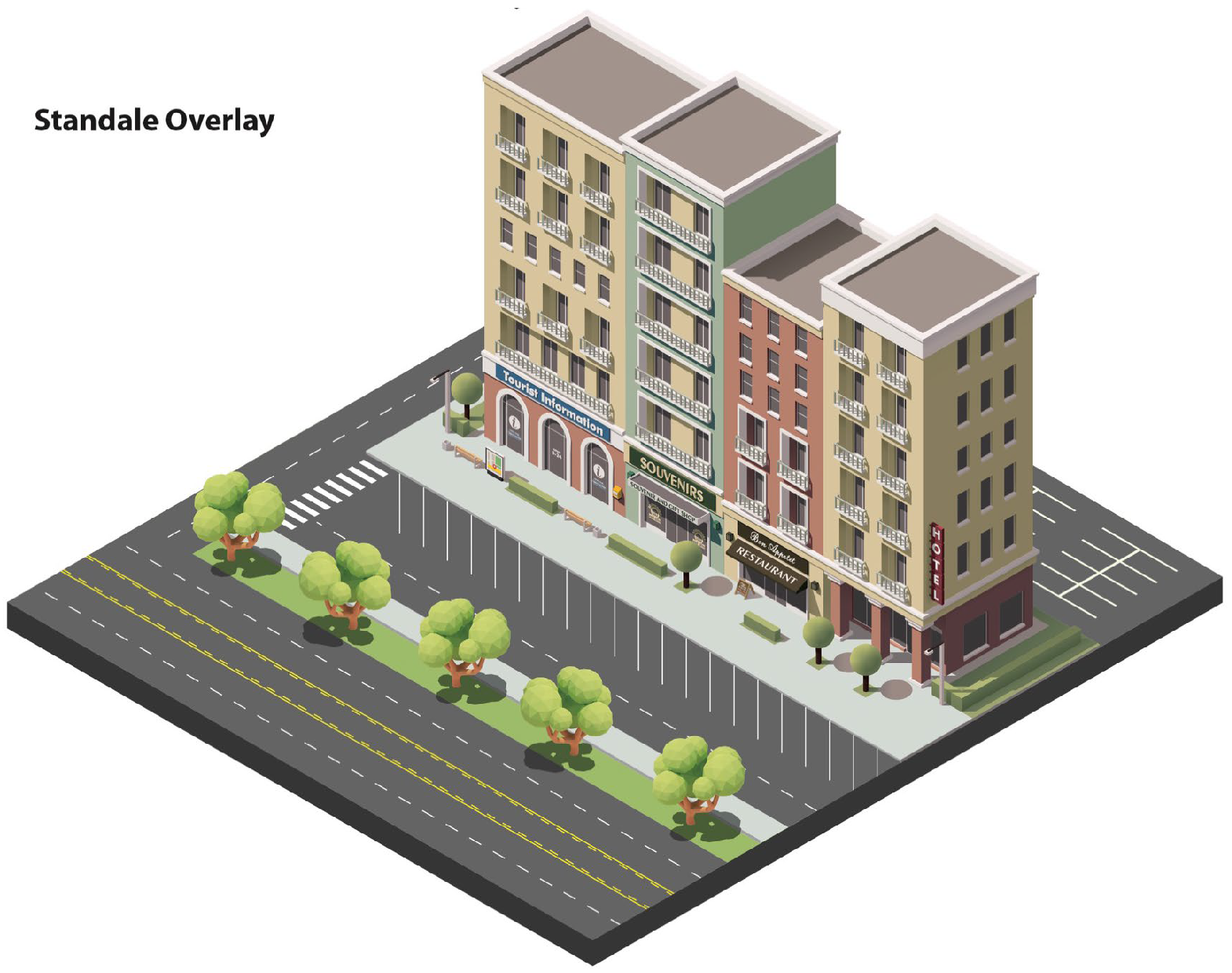
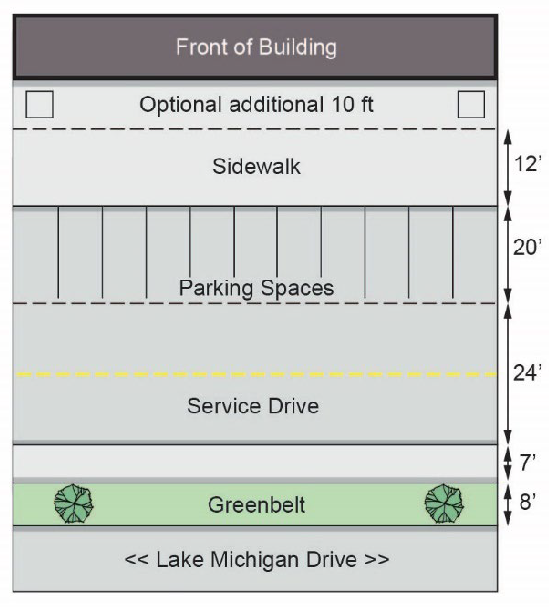
Front setback area. The required build-to-line along Lake Michigan Drive shall be parallel to the street and measure at least 70 feet from the back of the adjacent and existing curb line. The area within this setback shall include, in order from the curb to the front of the building:
a.
A eight-foot-wide greenbelt adjacent to the street. One three-inch-caliper canopy tree shall be planted for every 50 feet of frontage.
b.
A seven-foot-wide sidewalk adjacent to the greenbelt.
c.
A 24-foot-wide paved and curbed service drive.
d.
Twenty-foot-deep parking spaces.
e.
A 12-foot-wide sidewalk.
f.
Optionally, the setback may include an additional ten feet (bringing the total setback to 80 feet). The additional ten feet shall include outdoor dining space, landscaping, and/or pedestrian amenities such as benches, trash cans, bike racks, or public art.
g.
No setback from Lake Michigan Drive shall exceed 80 feet.
(2)
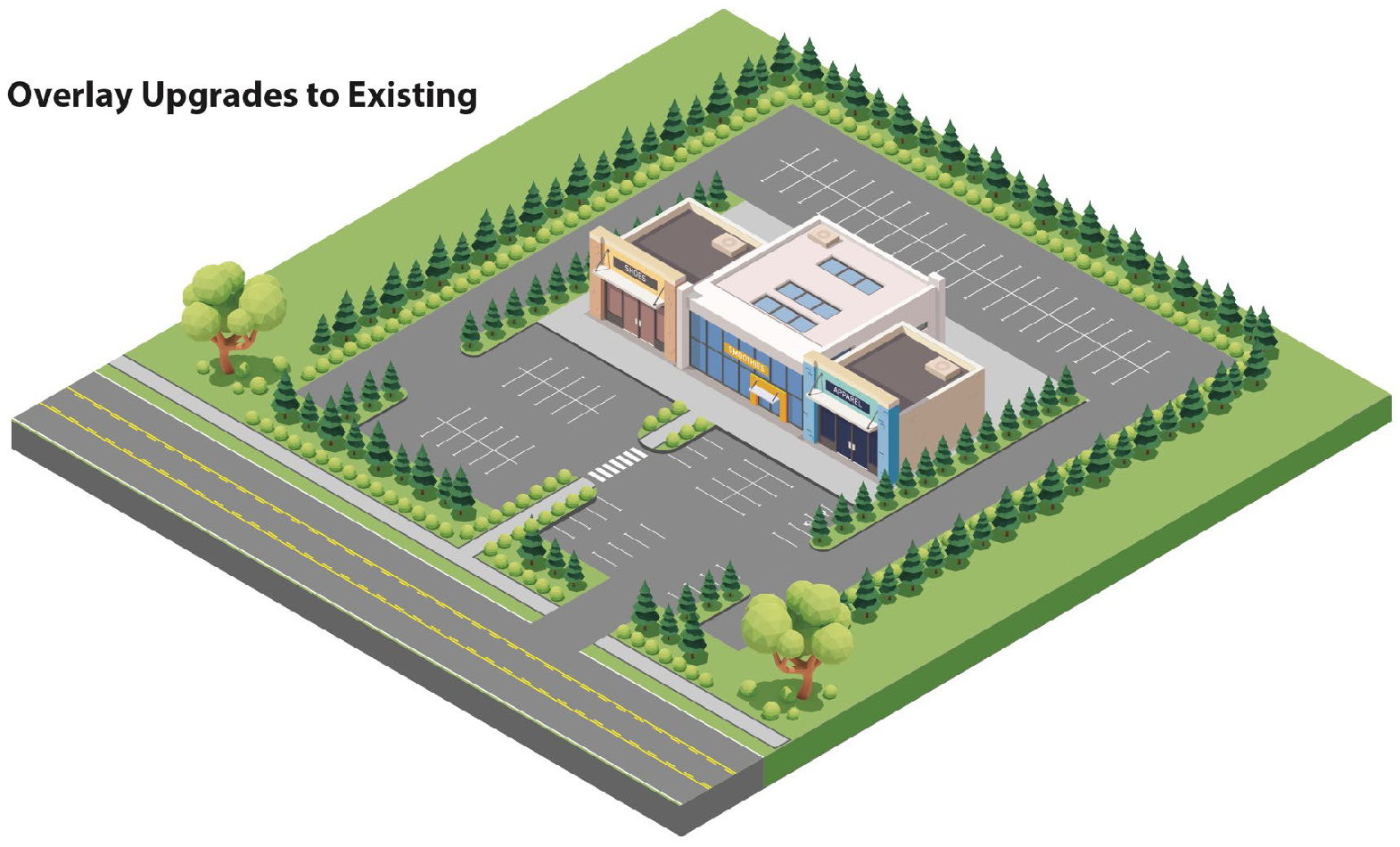
Upgrades to existing. During a site plan approval process for a parcel that already contains a principal building, the applicant may propose, and the planning commission may (but is not obligated to) accept the following upgrades to the frontage, in lieu of compliance with subsection (1) above.
a.
An attractive, safe, and efficient pedestrian walkway, including sidewalk and crosswalk paint, must be designated and constructed between the public sidewalk on all adjacent streets and the front entrance required by section [94-8.02(e)(1)].
b.
A sidewalk, at least five feet wide, must be constructed along the entirety of the building frontage facing all abutting streets.
c.
Drive aisles must be no more than 26 feet wide (and no narrower than 24 feet wide), and parking spaces must be exactly 20 feet deep.
d.
Any leftover space in the front yard once conditions a, b, and c have been satisfied shall be filled with landscape areas containing trees, shrubs, flowers, and ground cover as deemed appropriate by the planning commission.
(3)
Cross access required. The service drive described in section 94-8.01(d)(1)b shall connect to all adjacent parcels and/or public roads that abut the side lot lines of the subject parcel. Cross access easements must be granted to all connecting parcels allowing for unimpeded public access across and between all parcels connected by the service drive.
(4)
Driveway spacing. Driveways to Lake Michigan Drive shall be at least 100 feet apart. At the time of site plan approval, all existing driveways that do not comply with this standard shall be removed. The planning commission may waive this requirement if the following conditions are met:
a.
Eliminating the driveway would eliminate the only method of access to the parcel from a public street. This condition shall not be considered met if a driveway can connect to a street other than Lake Michigan Drive.
b.
The Michigan Department of Transportation (MDOT) has specifically stated that the driveway can remain in place.
(5)
Driveway design. Driveways to Lake Michigan Drive must meet MDOT guidelines for the design of access points to state highways. At the time of site plan approval, all driveways must be upgraded to meet MDOT guidelines. The planning commission may waive this requirement if the following conditions are met:
a.
Upgrading the driveway would substantially interfere with the ability of the site to comply with the requirements of section 94-8.01(d)(1), including, but not limited to, restricting access to parking, inhibiting pedestrian movement, substantially reducing the amount of green space or landscaping in the front setback area, and/or creating safety hazards for motorists, pedestrians, cyclists, or deliveries.
b.
MDOT has specifically stated that the driveway can remain as designed.
(e)
Road frontages other than Lake Michigan Drive. There shall be no minimum or maximum setback within the Standale overlay from roads other than Lake Michigan Drive, except that the requirements of section 94-8.01(g) must be met.
(f)
Side setbacks and building width.
(1)
Side setbacks. All side setbacks within the Standale overlay must comply with one of the following options:
a.
Option A: No side setback. The side walls of the building shall be built on the property line.
b.
Option B: 30-foot side setback. Within the setback, a 24-foot-wide drive aisle (to reach rear parking, loading, and deliveries) and a six-foot-wide sidewalk must be constructed. The following shall also apply to side setback option B:
1.
There shall be no more than 300 feet between option B side setbacks. The Planning Commission shall require a development to utilize option B on one side if that development opting for option A on both sides would cause the 300-foot rule to be violated.
2.
For any parcel utilizing option B, the cross access easements described in section 94-8.01(d)(2) shall include the drive-aisle, to allow access to rear parking lots for parcels that utilize option A on both sides.
(2)
Building width. All buildings within the Standale overlay must have a width, at their façade fronting Lake Michigan Drive, that is at least 75 percent of the width of the lot they are located upon. The planning commission may waive this requirement in order to enforce section 94-8.01(f)(1)b.i, but otherwise, this provision shall supersede all conflicting requirements of this chapter.
(g)
Rear setback and rear access. The minimum rear setback shall be 30 feet. There shall be no maximum rear setback. The planning commission may require rear parking areas to be designed to connect to adjacent parcels, an alley, or a public street, and for the required cross-access agreements described in section 94-8.01(d)(2) to apply to connections between rear parking lots.
(h)
Building height. The minimum building height for all newly constructed principal buildings in the Standale overlay shall be 25 feet, and all buildings must have two occupiable stories. The maximum building height in the Standale overlay shall be 80 feet, and no building shall have more than six occupiable stories.
(i)
Minimum parking requirement. The required parking for all uses included on a site shall be provided using the following standards:
(1)
Residential uses. The minimum parking requirement for residential uses in the Standale overlay shall be as listed in section 94-12.02.
(2)
Nonresidential uses. The minimum parking requirement for nonresidential uses in the Standale overlay shall be 90 percent of the number listed in section 94-12.02. Additionally, the minimum parking requirement for nonresidential uses may be further reduced by up to five automobile spaces by adding bike racks, at a rate of one automobile parking space for every five bicycle parking spaces.
(3)
Shared parking. The cross-access easements described in section 94-8.01(d)(2) may include provisions for the sharing of parking. If provisions for shared parking are included, then the area covered by the shared parking agreement shall be considered as a single unit, with all uses and all parking spaces on the parcels included in the shared parking agreement included in a single calculation to determine compliance with the minimum parking requirement.
(j)
Architectural standards, lighting, and signage. Buildings and sites in the Standale overlay shall project high quality community character via the following. Existing buildings must be upgraded to meet these requirements in conjunction with any improvements requiring site plan approval.
(1)
Front entrances. All buildings shall have clearly defined entryways that orient to Lake Michigan Drive. Entrances shall be designed so that architectural details enhance their appearance and prominence and so that they are recognizable from the street and parking areas. The planning commission may also require entryways facing other public roads.
(2)
Ground floor windows and transparency. At least 60 percent of the front ground floor façade shall be clear glass windows and doorways. Clear glass shall be transparent at the street level and possessing a measurement of greater than 60 percent visible light transmission (VLT). The view into the windows shall not be covered up by coolers, shelving, or any other interior structure. Residential uses approved by special use permit shall be exempt from this requirement, and shall only be required to provide 15 percent windows and doors on the front façade.
(3)
Upper floor windows and transparency. At least 30 percent of all upper floor façades shall be clear glass windows.
(4)
Awnings, arcades, and canopies. Awnings, arcades, or covered porches that protect users from the weather are optional, but, if included in the design, may project into required the front setback, provided that at least eight feet of clearance is maintained above the ground. Awnings shall not be internally illuminated.
(5)
Wide façades. For buildings wider than 100 feet, a minimum of one functional entrance shall be located for every 50 feet of street frontage. Additionally, every 100 feet of frontage, there shall be a distinct change in the architectural character of the building, including, for example, a change in materials, color, window design, roof line, or ornamentation. The planning commission shall determine whether the change in architectural character meets the spirit of this provision.
(6)
Corners. The architectural character of a building situated at a corner shall incorporate accents and details that accentuate its prominent location. This can be accomplished by vertical projections or changes in height that are incorporated into the design. Entrances oriented in the corner shall be deemed to meet the requirements of section [94-8.01(j)(1)].
(7)
Façade materials.
a.
All façades must be faced with brick, block, stone, or wood, or materials that mimic the appearance of brick, block, stone, or wood, except that up to 25 percent of any façade (exclusive of windows and doors) may be faced with metal or a material the mimics the appearance of metal.
b.
EIFS shall be prohibited on all façades.
c.
Unpainted or uncovered cinder block, or any other material that projects an "unfinished" image in the opinion of the planning commission, is prohibited on any visible face of the building.
(8)
Roofs and roof equipment. If a building has a flat roof, it must be enclosed on all sides visible from public roads by parapets. All rooftop-mounted equipment must be enclosed or screened from view on all sides of a building. Parapets and other screen treatments shall be composed of high-quality building materials and shall blend with the design of the building, as determined by the planning commission, in terms of color, materials, scale and height.
(9)
Lighting. Pedestrian-scale ornamental street lighting shall be provided along all sidewalks and within parking areas. Street lighting shall be no more than 20 feet high, spaced to prevent gaps in the lit area. Consistency with established street lighting fixtures in the overlay will be determined by the planning commission based on the proposed fixture location and function. The planning commission may waive or alter the requirements of section 94-10.03 within the Standale overlay in order to achieve quality, attractive light fixtures that effectively promote safety, security, and aesthetics.
(Ord. No. 24-674, § 2(Exh. A), 1-22-24)
Sec. 94-8.02. - Remembrance overlay.
(a)
Applicability.
(1)
Within the overlay boundary designated on the official zoning map, the provisions of this section shall supersede the provisions of the underlying zoning district.
(2)
All provisions in this chapter, and of the underlying zoning district that are not directly contradicted by a provision of this overlay shall apply within the overlay as written elsewhere in this chapter.
(3)
The overlay shall not supersede the requirement in section 94-12.02 for parking lots to be set back from residential uses, nor shall the overlay supersede requirements for landscape buffer between commercial and residential uses in section [94-12.07]. Those requirements shall still apply, regardless of whether either or both lots in question are within the overlay.
(4)
The overlay shall not supersede the provisions of any PUD agreement.
(5)
Unless otherwise stated, a site must be brought into compliance with all provisions of the overlay in conjunction with any site improvement requiring site plan approval.
(b)
Permitted uses. The permitted uses in the Remembrance overlay shall be those designated on the chart in section 94-5.04.
(c)
Residential density. The maximum number of residential units on any parcel within the Remembrance overlay shall be one unit per 5,445 square feet of lot area (eight units per acre). Buildable lots with an area under 5,445 square feet may contain one dwelling unit.
(d)
Front Setback options. The front setback for all parcels in the overlay must conform to one of the following options. The allowable options along each street frontage are described in the table below. At the time of site plan approval, the applicant shall propose an option to the planning commission. The planning commission may accept the option proposed, or may reject the option and require an alternative, in order to achieve consistency within a given block or series of parcels.
(1)
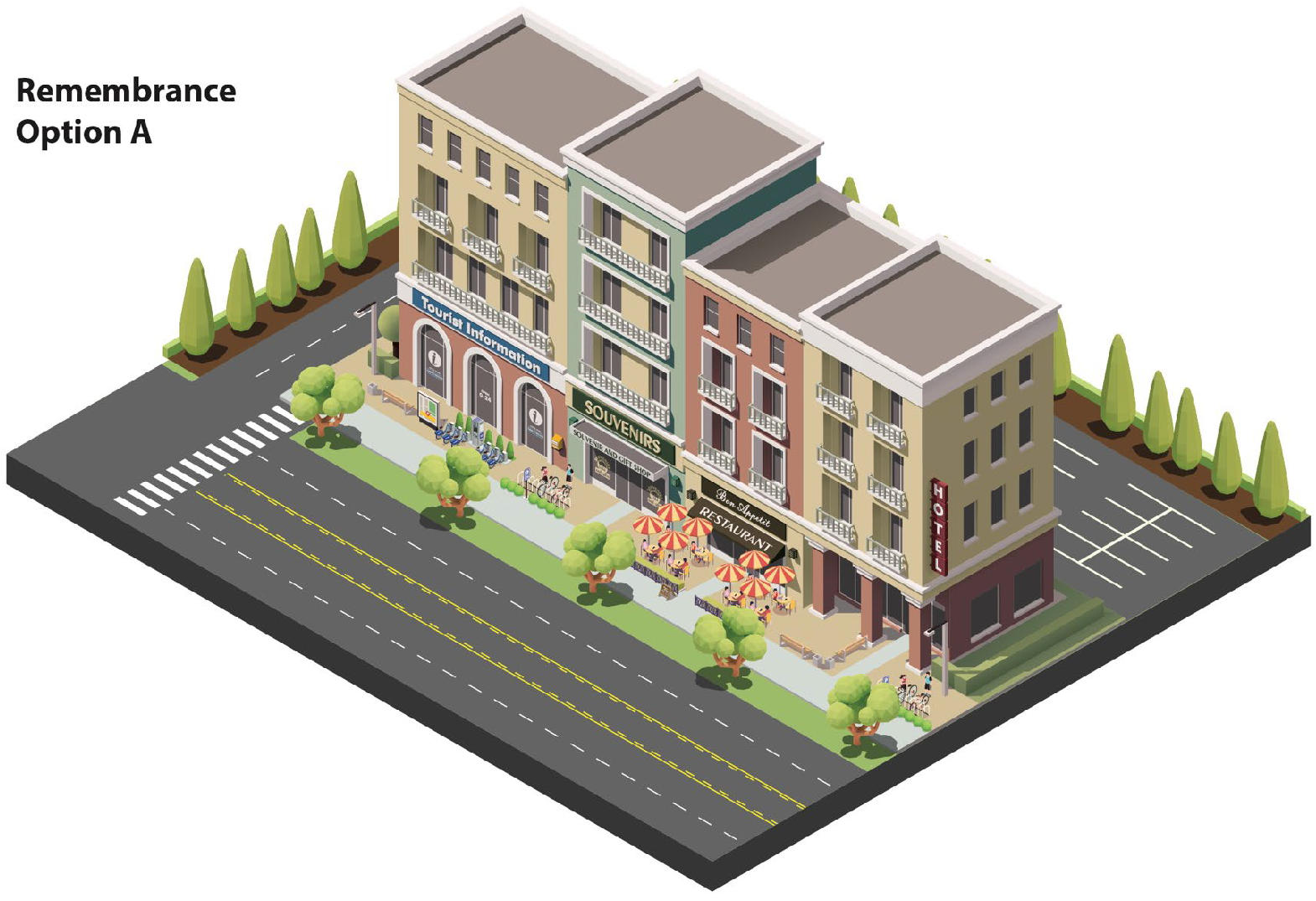
Option A—Enhanced sidewalk. Where option A is permitted, proposed, and accepted, the front façade shall be located ten feet from the front lot line. The ten feet between the building and the sidewalk shall contain some or all of the following: additional concrete to widen the sidewalk, landscaping, outdoor seating/dining areas, and/or pedestrian amenities such as benches, trash cans, public art, or bike racks.
(2)
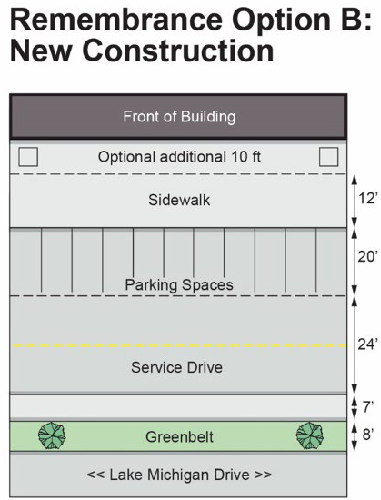
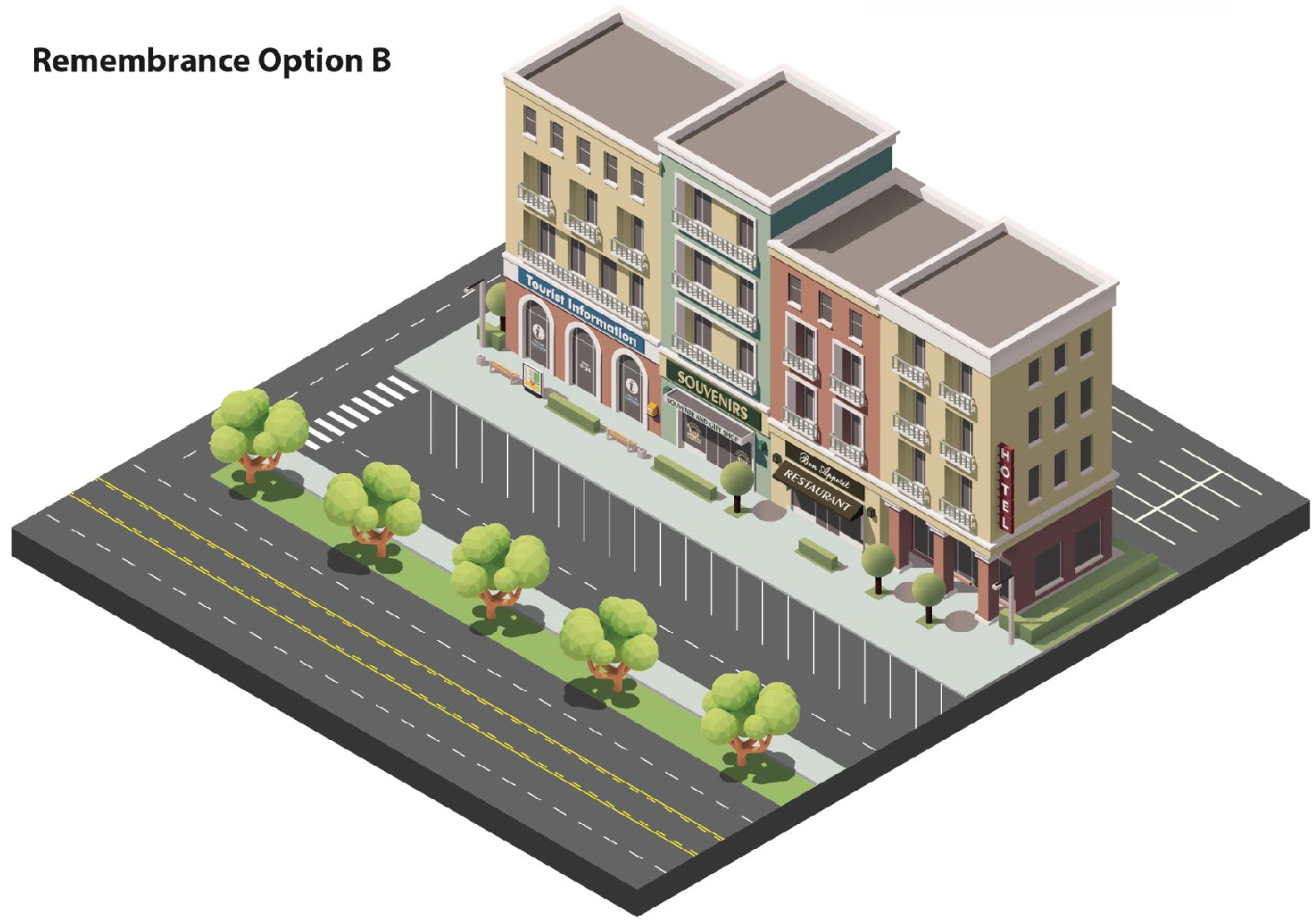
Option B—Service drive. Where option B is permitted, proposed, and accepted, the build-to line shall be parallel to the street and measure at least 70 feet from the back of the adjacent and existing curb line. The area within this setback shall include, in order from the curb to the front of the building:
a.
An eight-foot-wide greenbelt adjacent to the street.
b.
A six-foot-wide sidewalk adjacent to the greenbelt
c.
A 24-foot-wide paved and curbed service drive
d.
Twenty-foot-deep angled or 90-degree parking spaces
e.
A 12-foot-wide sidewalk
f.
Optionally, the setback may include an additional 13 feet (bringing the total setback to 80 feet). The additional 13 feet shall include outdoor dining space, landscaping, and/or pedestrian amenities such as benches, trash cans, bike racks, or public art.
g.
No front setback on an option B parcel shall exceed 80 feet.
(3)
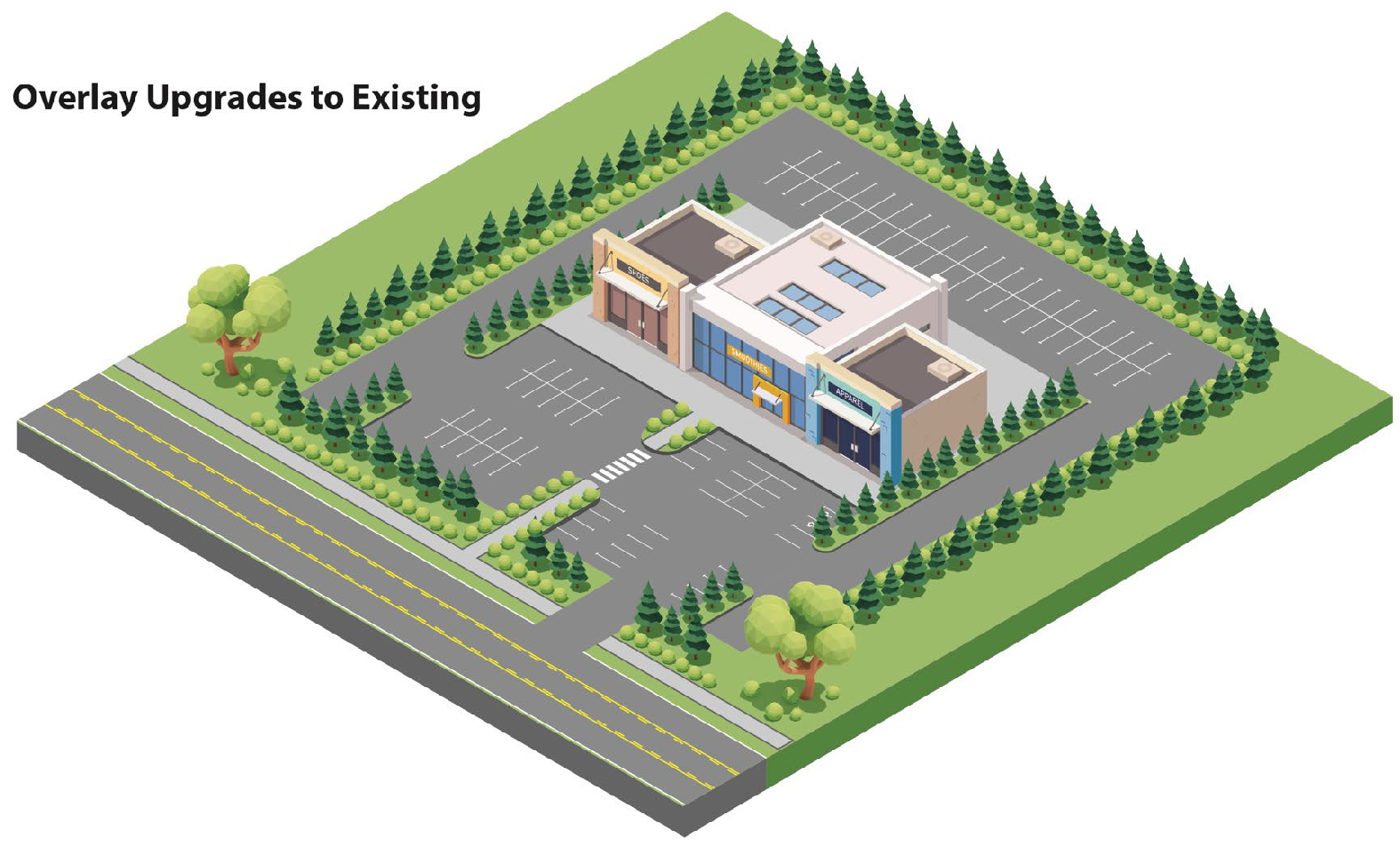
Upgrades to existing. During a site plan approval process for a parcel that already contains a principal building, the applicant may propose, and the planning commission may (but is not obligated to) accept the following upgrades to the frontage, in lieu of compliance with option A or B above.
a.
An attractive, safe, and efficient pedestrian walkway, including sidewalk and crosswalk paint, must be designated and constructed between the public sidewalk on all adjacent streets and the front entrance required by section [94-8.02(e)(1)].
b.
A sidewalk, at least five feet wide, must be constructed along the entirety of the building frontage facing all abutting streets.
c.
Drive aisles must be exactly 26 feet wide, and parking spaces must be exactly 20 feet deep.
d.
Any leftover space in the front yard once conditions a, b, and c have been satisfied shall be filled with landscape areas containing trees, shrubs, flowers, and ground cover as deemed appropriate by the planning commission.
(e)
Access management.
(1)
Cross access. The planning commission may require any parcel in the Remembrance overlay to connect to any adjacent parcels and/or public road that abut any lot line of the subject parcel. Cross access easements may be required to be granted to any or all connecting parcels allowing for unimpeded public access across and between all parcels included in the cross access agreement. The planning commission shall consider the overall connectivity, safety, and efficiency of the overlay area as well as the design of the sites in question, when determining whether to require cross access.
(2)
Driveway spacing. Driveways to Remembrance Road shall be at least 100 feet apart. At the time of site plan approval, all existing driveways that do not comply with this standard shall be removed. The planning commission may waive this requirement if eliminating the driveway would eliminate the only method of access to the parcel from a public street. This condition shall not be considered met if a driveway can connect to a street other than Remembrance Road.
(3)
Driveway design. Driveways to all streets within the overlay must meet the specifications in the City of Walker Construction Standards for Public Right-of-Way and Easements for the design of access points to public roadways. At the time of site plan approval, all driveways must be upgraded to meet city specifications. The planning commission may waive this requirement if upgrading the driveway would substantially interfere with the ability of the site to comply with the requirements of the chosen front setback option, including, but not limited to, restricting access to parking, inhibiting pedestrian movement, substantially reducing the amount of green space or landscaping in the front setback area, and/or creating safety hazards for motorists, pedestrians, cyclists, or deliveries.
(f)
Side setbacks and building width. There shall be no minimum or maximum side setback or building width in the Remembrance overlay.
(g)
Rear setback and rear access. The minimum rear setback shall be 30 feet. There shall be no maximum rear setback. The planning commission may require rear parking areas to be designed to connect to adjacent parcels, an alley, or a public street, and require cross-access agreements as described in section 94-8.02(f)(1) for connections between rear parking lots.
(h)
Building height. The minimum building height in the Remembrance overlay shall be 25 feet, and all buildings must have two occupiable stories. The maximum building height in the Remembrance overlay shall be 60 feet, and no building shall have more than four occupiable stories.
(i)
Minimum parking requirement. The required parking for all uses in the Remembrance overlay shall be as listed in section 94-12.02, subject to the following.
(1)
Parking reduction for bicycle parking. The minimum parking requirement may be reduced by up to five spaces by adding bike racks, at a rate of one automobile parking space for every five bicycle parking spaces.
(2)
Shared parking. The cross-access easements described in section 94-8.02(f)(1) may include provisions for the sharing of parking. If provisions for shared parking are included, then the area covered by the shared parking agreement shall be considered as a single unit, with all uses and all parking spaces on the parcels included in the shared parking agreement included in a single calculation to determine compliance with the minimum parking requirement.
(j)
Architectural standards, lighting, and signage. Buildings and sites in the Remembrance overlay shall project high quality community character via the following. Existing buildings must be upgraded to meet these requirements in conjunction with any improvements requiring site plan approval.
(1)
Front entrances. All buildings shall have at least one clearly defined entryway that orients towards a public road. Entrances shall be designed so that architectural details enhance their appearance and prominence and so that they are recognizable from the street and parking areas.
(2)
Ground floor windows and transparency. At least 60 percent of the front ground floor façade shall be clear glass windows and doorways. Clear glass shall be transparent at the street level and possessing a measurement of greater than 60 percent visible light transmission (VLT). The view into the windows shall not be covered up by coolers, shelving, or any other interior structure. Residential uses shall be exempt from this requirement, and shall only be required to provide 15 percent windows and doors on the front façade.
(3)
Upper floor windows and transparency. At least 30 percent of all upper floor façades shall be clear glass windows.
(4)
Awnings, arcades, and canopies. Awnings, arcades, or covered porches that protect users from the weather are optional, but, if included in the design, may project into required the front setback (but not over the public right-of-way), provided that at least eight feet of clearance is maintained above the ground. Awnings shall not be internally illuminated.
(5)
Wide façades. For buildings wider than 100 feet, a minimum of one functional entrance shall be located for every 50 feet of street frontage. Additionally, every 100 feet of frontage, there shall be a distinct change in the architectural character of the building, including, for example, a change in materials, color, window design, roof line, or ornamentation. The planning commission shall determine whether the change in architectural character meets the spirit of this provision.
(6)
Corners. The architectural character of a building situated at a corner shall incorporate accents and details that accentuate its prominent location. This can be accomplished by vertical projections or changes in height that are incorporated into the design. Entrances oriented in the corner shall be deemed to meet the requirements of section [94-8.01(j)(1)].
(7)
Façade materials.
a.
All façades must be faced with brick, block, stone, or wood, or materials that mimic the appearance of brick, block, stone, or wood, except that up to 25 percent of any façade (exclusive of windows and doors) may be faced with metal or a material the mimics the appearance of metal.
b.
EIFS shall be prohibited on all façades.
c.
Unpainted or uncovered cinder block, or any other material that projects an "unfinished" image in the opinion of the planning commission, is prohibited on any visible face of the building.
(8)
Roofs and roof equipment. If a building has a flat roof, it must be enclosed on all sides visible from public roads by parapets. All rooftop-mounted equipment must be enclosed or screened from view on all sides of a building. Parapets and other screen treatments shall be composed of high-quality building materials and shall blend with the design of the building, as determined by the planning commission, in terms of color, materials, scale and height.
(9)
Lighting. Pedestrian-scale ornamental street lighting shall be provided along all sidewalks and within parking areas. Street lighting shall be no more than 20 feet high, spaced to prevent gaps in the lit area. Consistency with established street lighting fixtures in the overlay will be determined by the planning commission based on the proposed fixture location and function. The planning commission may waive or alter the requirements of section 94-10.03 within the Remembrance overlay in order to achieve quality, attractive light fixtures that effectively promote safety, security, and aesthetics.
(10)
Street frontage landscaping. One three-inch-caliper canopy tree shall be planted for every 50 feet of frontage along all roads in the overlay.
(Ord. No. 24-674, § 2(Exh. A), 1-22-24)
Sec. 94-8.03. - Alpine overlay.
(a)
Applicability.
(1)
Within the overlay boundary designated on the official zoning map, the provisions of this section shall supersede the provisions of the underlying zoning district.
(2)
All provisions in this chapter, and of the underlying zoning district that are not directly contradicted by a provision of this overlay shall apply within the overlay as written elsewhere in this chapter.
(3)
The overlay shall not supersede the requirement in section 94-12.02 for parking lots to be set back from residential uses, nor shall the overlay supersede requirements for landscape buffer between commercial and residential uses in section [94-12.07]. Those requirements shall still apply, regardless of whether either or both lots in question are within the overlay.
(4)
The overlay shall not supersede the provisions of any PUD agreement.
(5)
Unless otherwise stated, a site must be brought into compliance with all provisions of the overlay in conjunction with any site improvement requiring site plan approval.
(b)
Permitted uses. The permitted uses in the Alpine overlay shall be those designated on the chart in section 94-5.04.
(c)
Residential density. The maximum number of residential units on any parcel within the Alpine overlay shall be one unit per 5,445 square feet of lot area (eight units per acre). Buildable lots with an area under 5,445 square feet may contain one dwelling unit.
(d)
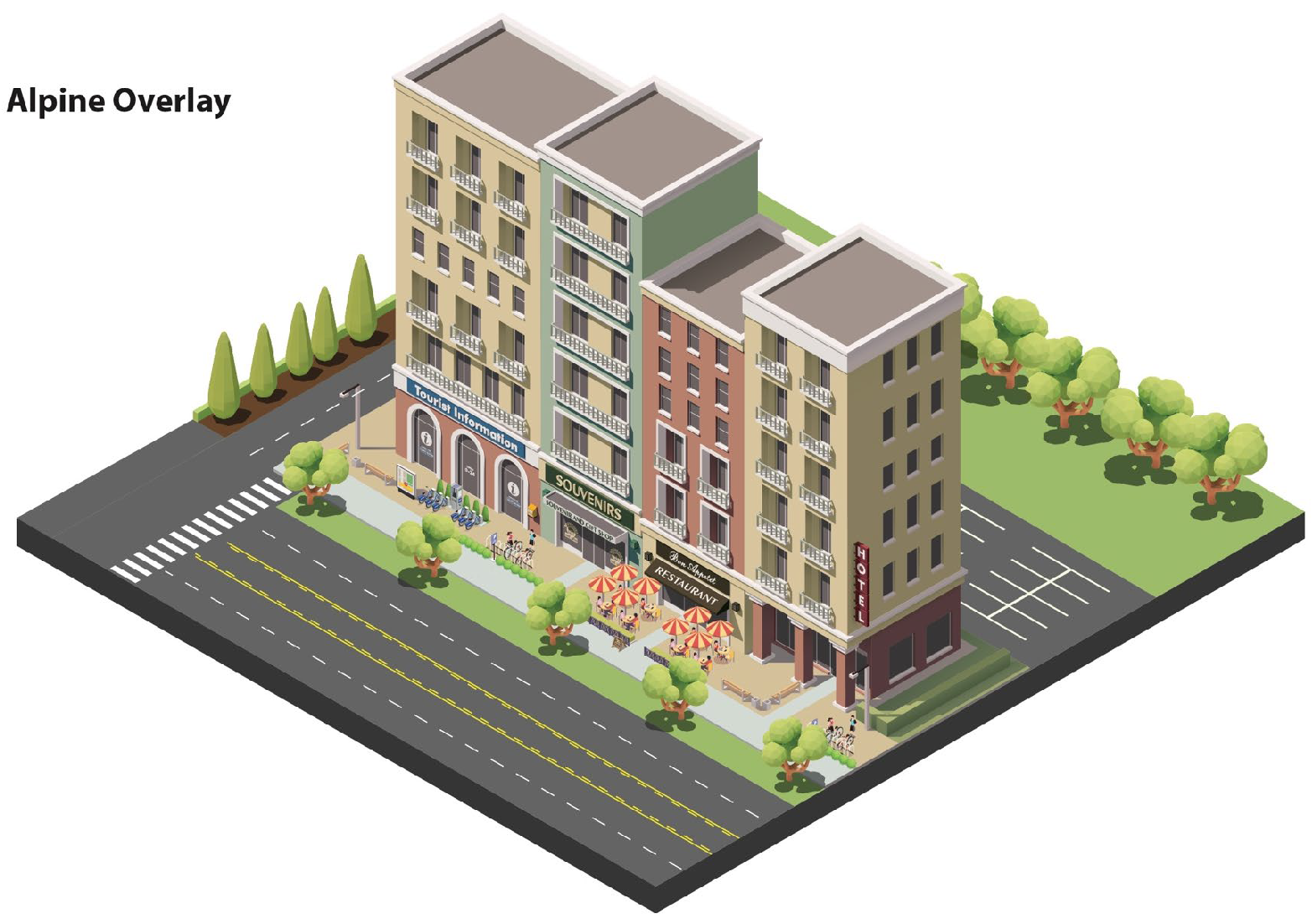
Front setback. There shall be a required build-to line within the overlay located ten feet from the right-of-way line. The ten feet between the building and the sidewalk shall contain some or all of the following: additional concrete to widen the sidewalk, landscaping, outdoor seating/dining areas, and/or pedestrian amenities such as benches, trash cans, public art, or bike racks.
(1)
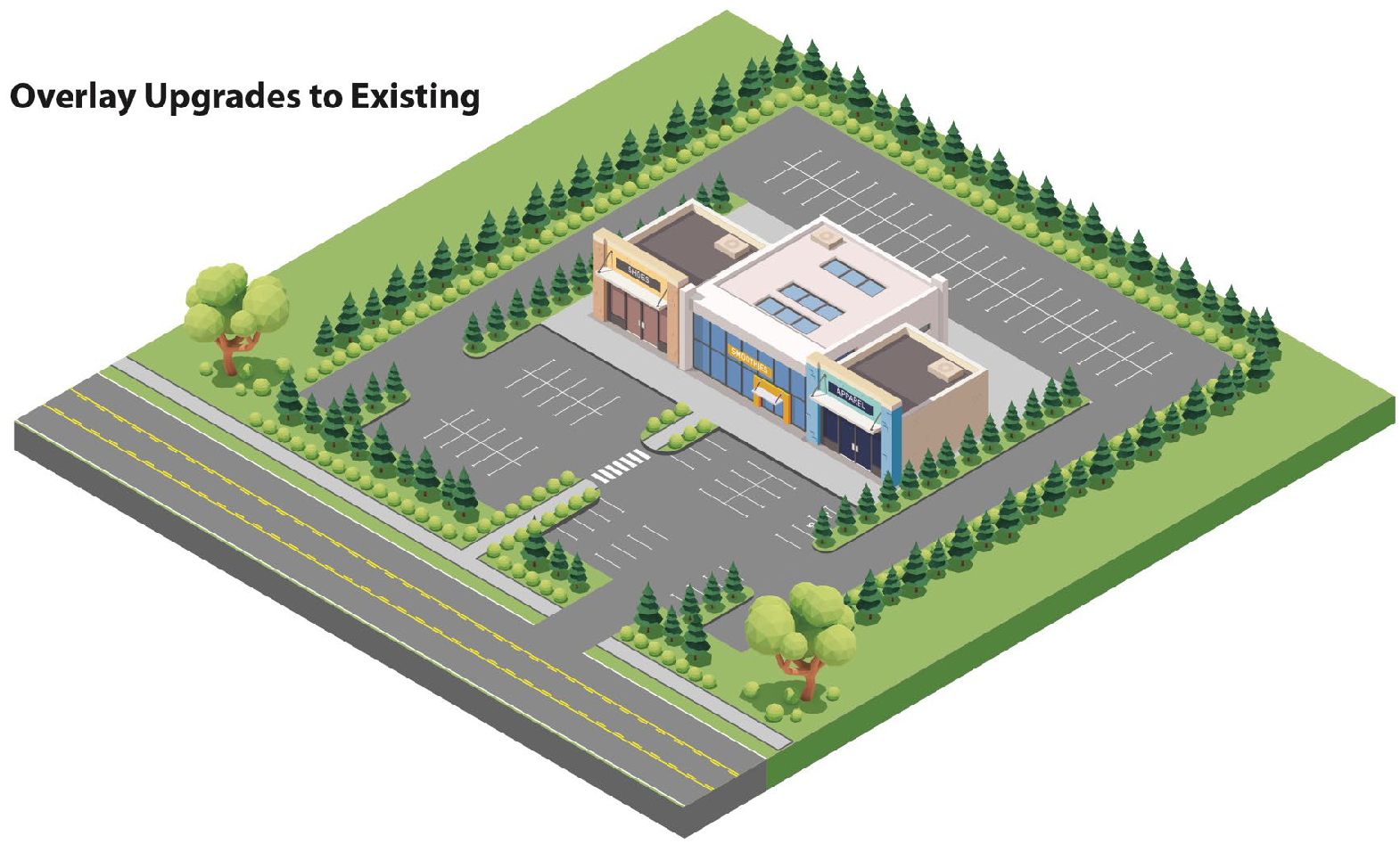
Upgrades to existing. During a site plan approval process for a parcel that already contains a principal building, the applicant may propose, and the planning commission may (but is not obligated to) accept the following upgrades to the frontage, in lieu of compliance with the ten-foot front build-to line.
a.
An attractive, safe, and efficient pedestrian walkway, including sidewalk and crosswalk paint, must be designated and constructed between the public sidewalk on all adjacent streets and the front entrance required by section [94-8.03(e)(1)].
b.
A sidewalk, at least five feet wide, must be constructed along the entirety of the building frontage facing all abutting streets.
c.
Drive aisles must be no more than 24 feet wide, and parking spaces must be no more than 20 feet deep.
d.
Any leftover space in the front yard once conditions a, b, and c have been satisfied shall be filled with landscape areas containing trees, shrubs, flowers, and ground cover as deemed appropriate by the planning commission.
(e)
Access management.
(1)
Cross access. The planning commission may require any parcel in the Remembrance overlay to connect to any adjacent parcels and/or public road that abut any lot line of the subject parcel. Cross access easements may be required to be granted to any or all connecting parcels allowing for unimpeded public access across and between all parcels included in the cross access agreement. The planning commission shall consider the overall connectivity, safety, and efficiency of the overlay area as well as the design of the sites in question, when determining whether to require cross access.
(2)
Driveway spacing. Driveways to Alpine Avenue shall be at least 100 feet apart. At the time of site plan approval, all existing driveways that do not comply with this standard shall be removed. The planning commission may waive this requirement eliminating the driveway would eliminate the only method of access to the parcel from a public street. This condition shall not be considered met if a driveway can connect to a street other than Alpine.
(3)
Driveway design. Driveways to all streets within the overlay must meet the specifications in the City of Walker Construction Standards for Public Right-of-Way and Easements for the design of access points to public roadways. At the time of site plan approval, all driveways must be upgraded to meet city specifications. The planning commission may waive this requirement if upgrading the driveway would substantially interfere with the ability of the site to comply with the requirements of the chosen front setback option, including, but not limited to, restricting access to parking, inhibiting pedestrian movement, substantially reducing the amount of green space or landscaping in the front setback area, and/or creating safety hazards for motorists, pedestrians, cyclists, or deliveries.
(f)
Side setbacks and building width.
(1)
Side setbacks. All side setbacks within the Alpine overlay must comply with one of the following options:
a.
Option A: No side setback. The side walls of the building shall be built on the property line.
b.
Option B: 30-foot side setback. Within the setback, a 24-foot-wide drive aisle (to reach rear parking, loading, and deliveries) and a 6-foot-wide sidewalk must be constructed. The following shall also apply to side setback option B:
1.
There shall be no more than 300 feet between option B side setbacks. The planning commission shall require a development to utilize option B on one side if that development opting for option A on both sides would cause the 300-foot rule to be violated.
2.
For any parcel utilizing option B, the planning commission may required cross access easements as described in section 94-8.03(f)(1) to allow access to rear parking lots for parcels that utilize option A on both sides.
(2)
Building width. All buildings within the Alpine overlay must have a width, at their façade fronting Alpine Avenue, that is at least 75 percent of the width of the lot they are located upon. The planning commission may waive this requirement in order to enforce section [94-8.03(f)(1)b.i], but otherwise, this provision shall supersede all conflicting requirements of this chapter.
(g)
Rear setback and rear access. The minimum rear setback shall be 30 feet. There shall be no maximum rear setback. The planning commission may require rear parking areas to be designed to connect to adjacent parcels, an alley, or a public street, and require cross-access agreements as described in section 94-8.03(f)(1) for connections between rear parking lots.
(h)
Building height. The minimum building height in the Alpine overlay shall be 25 feet, and all buildings must have two occupiable stories. The maximum building height in the Alpine overlay shall be 80 feet, and no building shall have more than six occupiable stories.
(i)
Minimum parking requirement. The required parking for all uses included on a site shall be provided using the following standards:
(1)
Residential uses. The minimum parking requirement for residential uses in the Alpine overlay shall be as listed in section 94-12.02.
(2)
Nonresidential Uses. The minimum parking requirement for nonresidential uses in the Alpine overlay shall be 90 percent of the number listed in section 94-12.02. Additionally, the minimum parking requirement for nonresidential uses may be further reduced by adding bike racks, at a rate of one automobile parking space for every five bicycle parking spaces.
(3)
Shared parking. The cross-access easements described in section 94-8.03(f)(1) may include provisions for the sharing of parking. If provisions for shared parking are included, then the area covered by the shared parking agreement shall be considered as a single unit, with all uses and all parking spaces on the parcels included in the shared parking agreement included in a single calculation to determine compliance with the minimum parking requirement.
(j)
Architectural standards, lighting, and signage. Buildings and sites in the Alpine overlay shall project high quality community character via the following. Existing buildings must be upgraded to meet these requirements in conjunction with any improvements requiring site plan approval.
(1)
Front entrances. All buildings shall have clearly defined entryways that orient toward Alpine Avenue. Entrances shall be designed so that architectural details enhance their appearance and prominence and so that they are recognizable from the street and parking areas. The planning commission may also require entryways facing other public roads.
(2)
Ground floor windows and transparency. At least 60 percent of the front ground floor façade shall be clear glass windows and doorways. Clear glass shall be transparent at the street level and possessing a measurement of greater than 60 percent visible light transmission (VLT). The view into the windows shall not be covered up by coolers, shelving, or any other interior structure. Residential uses shall be exempt from this requirement, and shall only be required to provide 15 percent windows and doors on the front façade.
(3)
Upper floor windows and transparency. At least 30 percent of all upper floor façades shall be clear glass windows.
(4)
Awnings, arcades, and canopies. Awnings, arcades, or covered porches that protect users from the weather are optional, but, if included in the design, may project into required ten-foot setback (but not over the public right-of-way), provided that at least eight feet of clearance is maintained above the ground. Awnings shall not be internally illuminated.
(5)
Wide façades. For buildings wider than 100 feet, a minimum of one functional entrance shall be located for every 50 feet of street frontage. Additionally, every 100 feet of frontage, there shall be a distinct change in the architectural character of the building, including, for example, a change in materials, color, window design, roof line, or ornamentation. The planning commission shall determine whether the change in architectural character meets the spirit of this provision.
(6)
Corners. The architectural character of a building situated at a corner shall incorporate accents and details that accentuate its prominent location. This can be accomplished by vertical projections or changes in height that are incorporated into the design. Entrances oriented in the corner shall be deemed to meet the requirements of section [94-8.03(j)(1)].
(7)
Façade materials.
a.
All façades must be faced with brick, block, stone, or wood, or materials that mimic the appearance of brick, block, stone, or wood, except that up to 25 percent of any façade (exclusive of windows and doors) may be faced with metal or a material the mimics the appearance of metal.
b.
EIFS shall be prohibited on all façades.
c.
Unpainted or uncovered cinder block, or any other material that projects an "unfinished" image in the opinion of the planning commission, is prohibited on any visible face of the building.
(8)
Roofs and roof equipment. If a building has a flat roof, it must be enclosed on all sides visible from public roads by parapets. All rooftop-mounted equipment must be enclosed or screened from view on all sides of a building. Parapets and other screen treatments shall be composed of high-quality building materials and shall blend with the design of the building, as determined by the planning commission, in terms of color, materials, scale and height.
(9)
Lighting. Pedestrian-scale ornamental street lighting shall be provided within parking areas. Street lighting shall be no more than 20 feet high, spaced appropriately and fully shielded. Consistency with established street lighting fixtures in the overlay will be determined by the planning commission based on the proposed fixture location and function. The planning commission may waive or alter the requirements of section 94-10.03 within the Remembrance overlay in order to achieve quality, attractive light fixtures that effectively promote safety, security, and aesthetics.
(10)
Street frontage landscaping. One three-inch-caliper canopy tree shall be planted for every 50 feet of frontage along all roads in the overlay.
(Ord. No. 24-674, § 2(Exh. A), 1-22-24)

