
Walker City Zoning Code
ARTICLE VII
- SCHEDULE OF DISTRICT REGULATIONS
Sec. 94-7.01. - Schedule of regulations table.
(a)
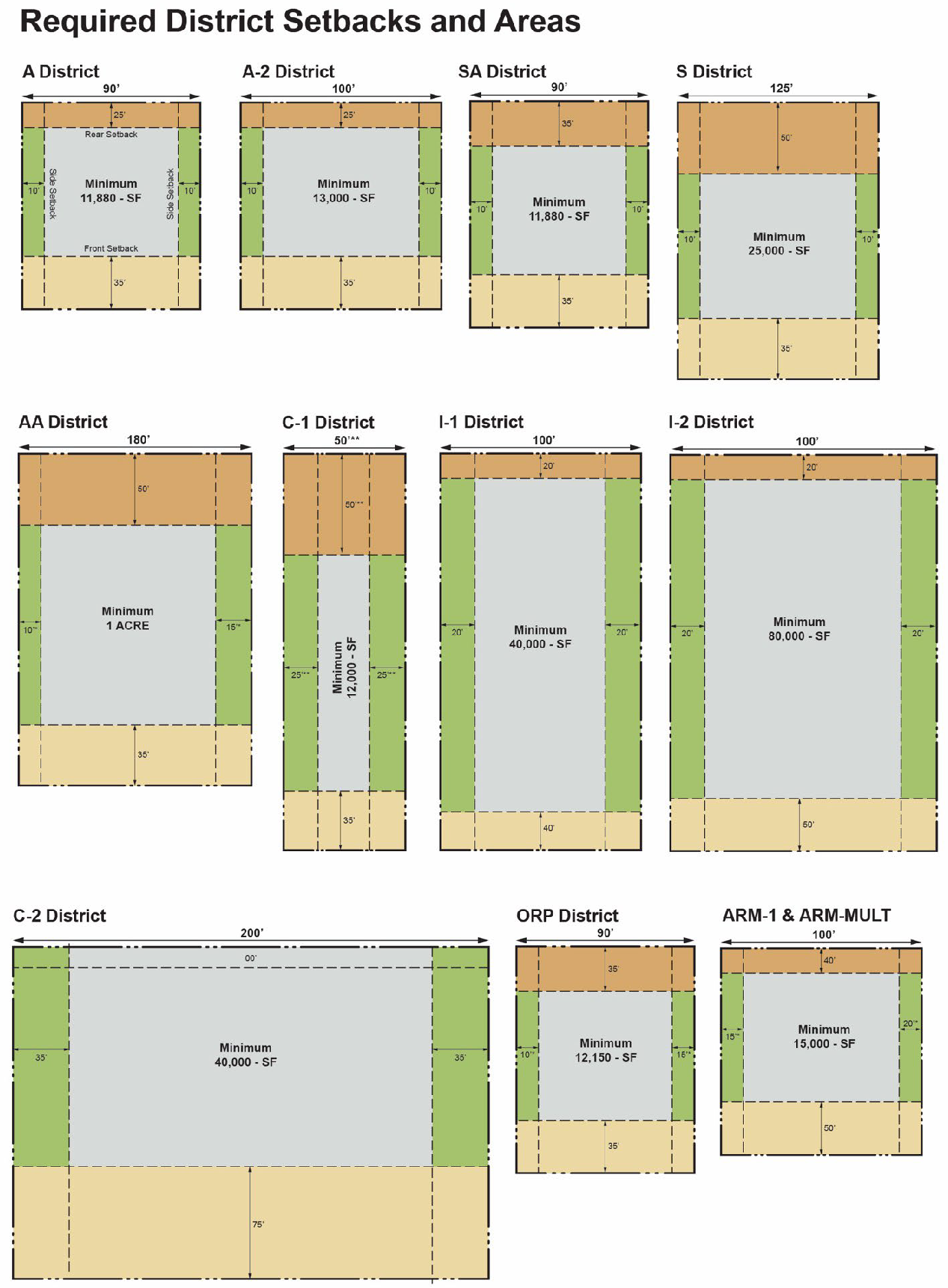
The area, height, bulk and placement requirements for principal and accessory uses, except as otherwise provided in this chapter, shall be as follows:
(b)
Notes to schedule of district regulations.
(1)
Setbacks shall be measured as follows:
a.
Front setback shall be measured from the edge of the street right-of-way to the principal building, excluding steps and unenclosed porches.
b.
Side and rear setbacks shall be measured from the nearest principal building to the lot line in question, excluding steps and unenclosed porches.
(2)
To permit subdivision into two lots when water and sewer services are available, provided side yard and other requirements can be met.
(3)
The distances in the schedule of district regulations govern the location of buildings other than trailer coaches and mobile homes. For trailer coaches and mobile homes, the following shall be met:
a.
No mobile home or trailer coach shall be placed closer than ten feet from the right-of-way of a public street or alley or closer than 15 feet from the inside edge of the sidewalk adjacent to a private street.
b.
A side yard of ten feet shall be maintained, except that a completely enclosed structure which is attached to a trailer coach or mobile home and not used for living purposes may be located not less than five feet from the side lot line. In addition, there shall be at least ten feet between each mobile home or tailer coach and its accessories including, but not limited to, full storage containers, storage sheds, cabanas and porches, and the closest neighboring mobile home or trailer coach or any of its accessories.
c.
There shall be a rear yard of at least 15 feet on each mobile home or trailer coach lot.
d.
Each lot shall have a minimum depth of 100 feet and a minimum width of 50 feet, measured at the foremost portion of the trailer coach or mobile home. The width shall be the length of the shortest line which can be drawn between the two side lot lines and across the foremost portion of the trailer coach or mobile home. Provided, however, that the 50-foot width shall not apply to lots which have their only access onto a cul-de-sac, are within 100 feet of the closed end of the cul-de-sac and are not corner lots.
(4)
No side yard is required if access is available from the rear through an alley or other means for fire and service vehicles; otherwise, a side yard is required and any side yard shall provide a minimum area of 15 feet.
(5)
A rear yard of at least 24 feet is required where property abuts any residential or agricultural district; provided, that when an alley separates the commercial district from the residential or agricultural district the full alley width shall be counted as part of the required rear yard.
(6)
A side yard of at least 50 feet is required where property abuts any residential or agricultural district.
(7)
The total side yards required pursuant to subsection (b)(6).
(8)
A rear yard of at least 50 feet is required where property abuts any residential or agricultural district; provided, that when an alley separates the I-1 district from the residential or agricultural district the full alley width shall be counted as part of the required rear yard.
(9)
A rear yard of at least 100 feet is required where property abuts any residential or agricultural district; provided, that when an alley separates the I-2 district from the residential or agricultural district the full alley width shall be counted as part of the required rear yard.
(10)
Accessory buildings. See section 94-15.02.
(11)
If more than one-half of the dwellings on 500 feet of either side of a proposed residential building have uniform front yard setbacks either greater or lesser than required in that district by this chapter, and the lots upon which those dwellings are located encompass more than 40 percent of the property located within 500 feet of either side of the lot on which the residential building is proposed, the setback line of the proposed residential building shall be the same as such uniform setback line. Provided, that no such setback line shall unreasonably restrict the use of such property; and provided further that no new residential building shall have a front yard less than 75 percent of the front yard required in that district, and none shall be required to have a front yard greater than 125 percent of the front yard required in that district.
(12)
When more than one-half of the buildings on 500 feet of either side of a proposed commercial building have uniform front yard setbacks either greater or lesser than required in that district by this chapter, and the lots upon which those buildings are located encompass more than 40 percent of the land on 500 feet of either side of the lot on which the building is proposed, the setback line of the proposed commercial building shall be the same as such uniform setback line. Provided, that no such setback line shall unreasonably restrict the use of such property; and provided that no new commercial building shall have a front yard less than 75 percent of the front yard required in that district.
(13)
Whenever a single-family residential dwelling is constructed within the "A-2" duplex district, two-family residential, the minimum lot size may be 11,880 square feet and the minimum lot width may be 90 feet.
(14)
Notwithstanding any other provisions of this chapter, any building or structure constructed upon any property adjacent to an interstate or other freeway shall maintain a rear or side yard setback from such highway right-of-way equal to the height of the building or 20 feet, whichever is greater.
(15)
Minimum lot size width in feet (as shown in the schedule of district regulations) shall be measured at the street right-of-way line, except that in the A, A-2, S and SA districts it may be measured at the minimum front yard setback line if the lot width measured at the street right-of-way line is at least 60 feet and in the A, A-2, and SA districts and is at least 85 feet in the S district and:
a.
Any part of the front lot line abuts a curved street right-of-way line at the terminus of a cul-de-sac (only the lots marked "a" on figure 1 meet this criteria); or
b.
Any part of the front lot line abuts the exterior of a curved street right-of-way line and the interior angle of the abutting curved street is not more than 105 degrees. The interior angle of a curved street is the angle formed by extending the centerline of the street in a straight line from the points where the abutting curve begins as shown on figure 4. (Only the lots marked "b" on figure 4 meets this criteria.)
Identifying Setbacks on Various Lot Types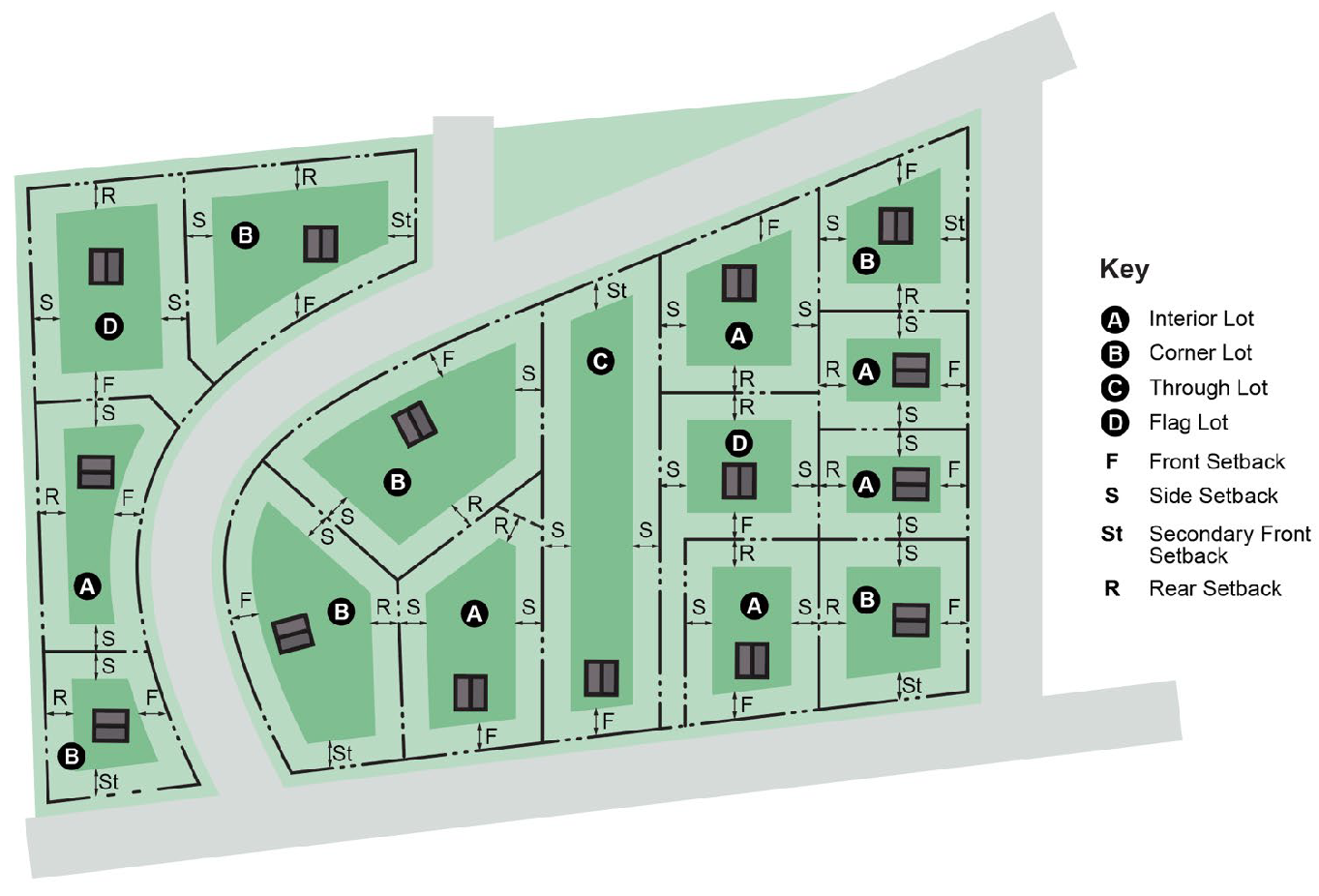
Identifying Setbacks on Various Lot Types
Determining Setbacks on Various Lot Types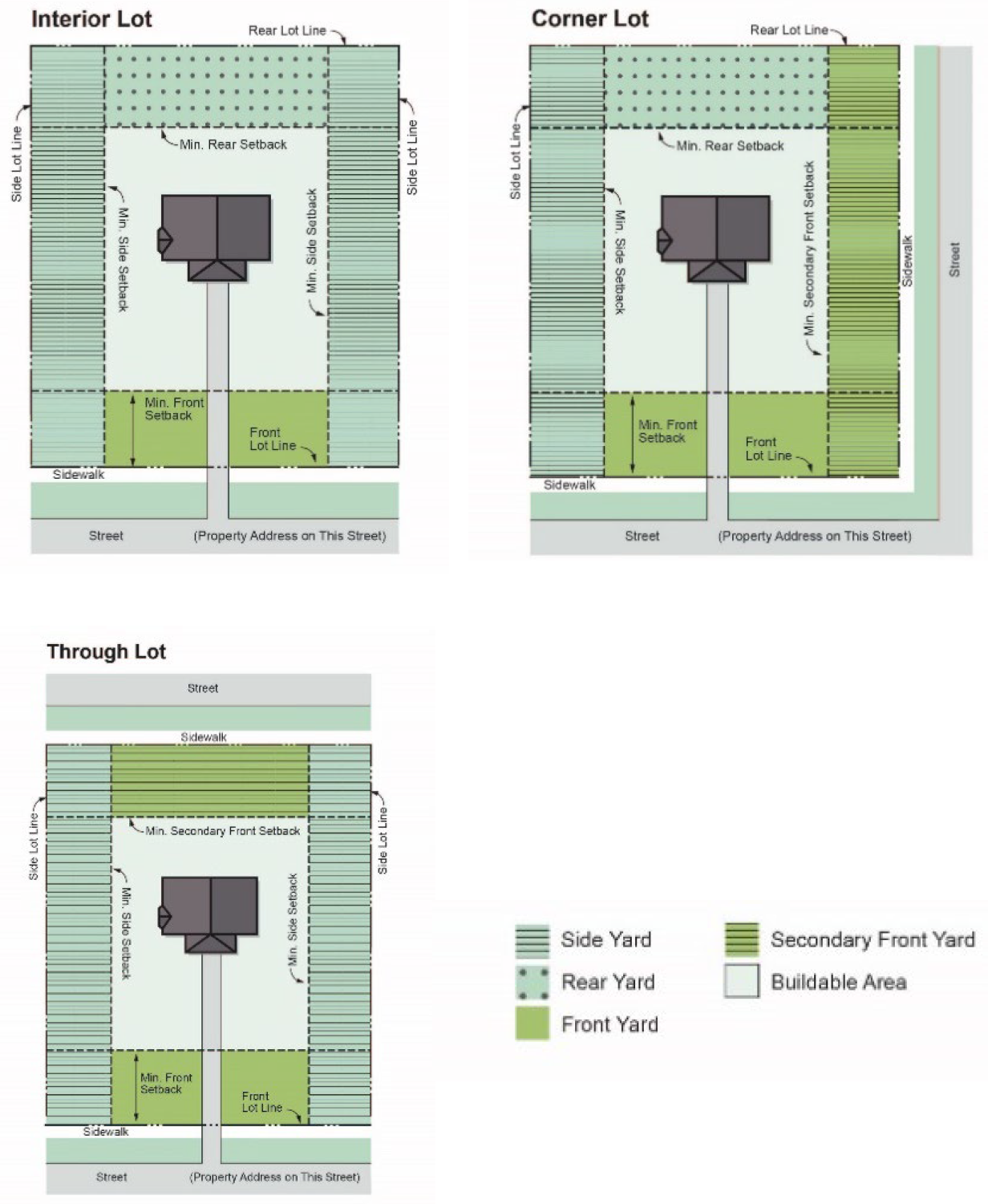
Front Setbacks on Irregular Lot Frontages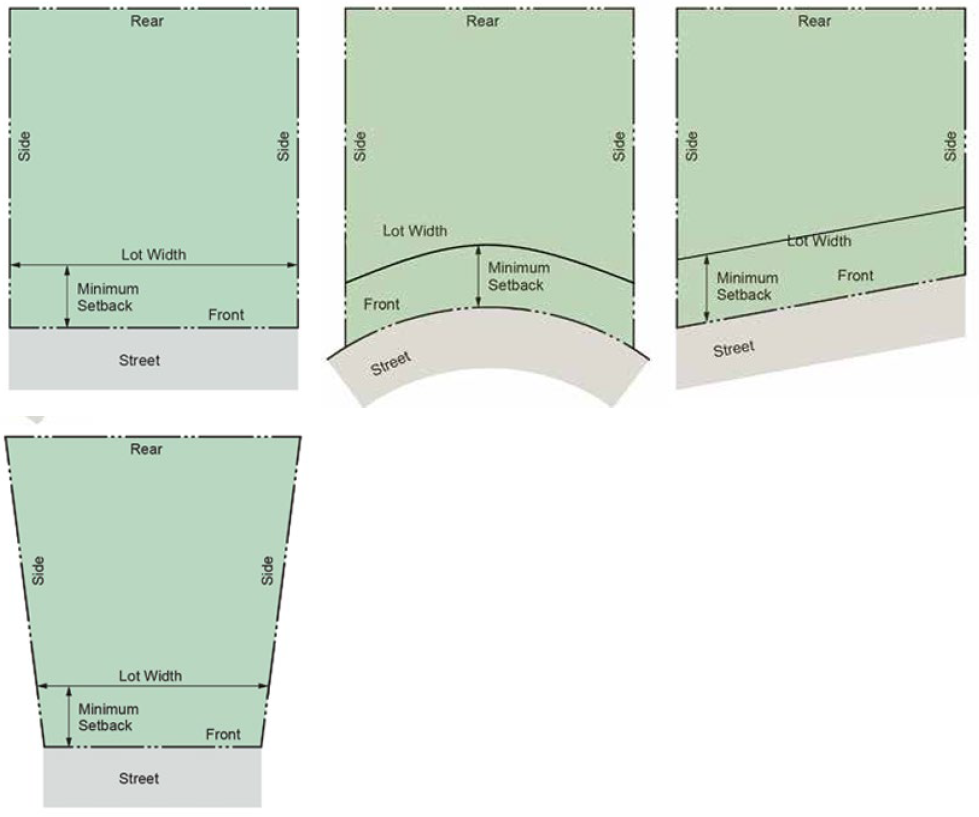
Measuring building Setbacks from Front Porches
Front Setbacks on Irregular Lot Frontages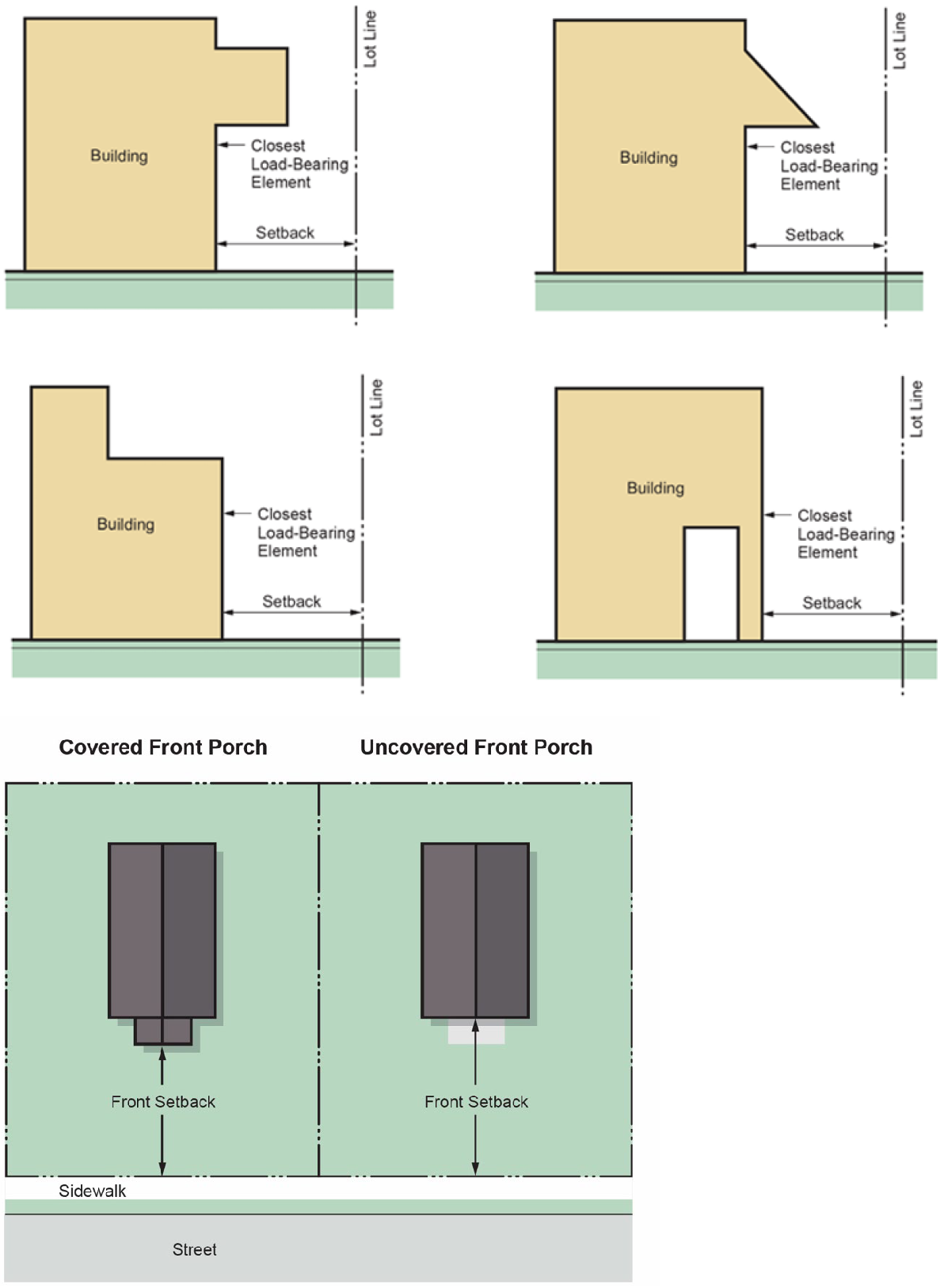
(Ord. No. 24-674, § 2(Exh. A), 1-22-24)
Sec. 94-7.02. - Exceptions to height regulations.
The height limitations contained in the schedule of district regulations do not apply to spires, belfries, cupolas, antennas, water tanks, ventilators, chimneys or other appurtenances (not to be construed to include signs) usually required to be placed above the roof level and not intended for human occupancy provided, however, that the height of wireless communications towers and antennas shall comply with section 94-15.05 of this chapter.
(Ord. No. 24-674, § 2(Exh. A), 1-22-24)
Sec. 94-7.03. - Bodies of water.
(a)
Notwithstanding any other provision of this chapter, no principal or accessory building shall be hereafter constructed, erected, installed, or enlarged within a minimum of 100 feet of the shoreline of the Grand River.
(b)
No clearance zone, Grand River.
(1)
A strip 50 feet bordering and parallel to the bank of the Grand River, as measured from the shoreline, shall be maintained in its natural vegetative state, except for the permitted clearing of dead or obnoxious plants.
(2)
The planning director may allow limited clearing of the no clearance zone, but only when required for construction of a permitted building or structure outside the no clearance zone, provided that the land cleared is returned to a vegetative state that is comparable to that which existed prior to the clearing. The planning director may also allow clearing of plant species identified as "invasive" by the Michigan Departments of Environment, Great Lakes, and Energy; Natural Resources; or Agriculture and Rural Development.
(c)
Notwithstanding any other provision of this chapter, no principal or accessory building shall be hereafter constructed, erected, installed, or enlarged within a minimum of 25 feet of a lake, creek, stream, open drain, or pond.
(d)
No clearance zone for creeks and streams.
(1)
A strip 25 feet bordering and parallel to the bank of creeks, streams, and other bodies of water with a current, as measured from the approximate average shoreline, shall be maintained in its natural vegetative state, except for the permitted clearing of dead or obnoxious plants.
(2)
The planning director may allow limited clearing of the no clearance zone, but only when required for construction of a permitted building or structure outside the no clearance zone, provided that the land cleared is returned to a vegetative state that is comparable to that which existed prior to the clearing. The planning director may also allow clearing of plant species identified as "invasive" by the Michigan Departments of Environment, Great Lakes, and Energy; Natural Resources; or Agriculture and Rural Development.
(e)
Seawalls prohibited for lakes and ponds. The installation, construction and operation of shoreline protection measures, including, but not limited to seawall, riprap, breakwater, bulkhead, groins, and sandbags, shall be subject to the following:
(1)
No shoreline protection measure shall be installed or constructed along the shore of any naturally occurring lake or pond greater than one acre in surface area within the City of Walker.
(2)
In the event the provisions of this section effectively prevent the development or use of a lot existing on the effective date of this chapter for all purposes permitted in the underlying zoning district, or create an unnecessary hardship for the use of such a lot, the property owner may seek a variance.
(3)
To the extent of any conflict between the regulatory provisions contained in this section and other provisions of the zoning ordinance, the restrictions contained in this section shall control with respect to all lots that abut or include a naturally occurring lake or pond over one acre in area.
(Ord. No. 24-674, § 2(Exh. A), 1-22-24)
Sec. 94-7.04. - Through lots.
(a)
As used in this section, the following terms shall mean as follows:
(1)
Local street means a right-of-way which is not a freeway, arterial road, or collector road, but which is owned and operated by a unit of government. Through lot (also referred to as a "double frontage lot") means a lot, other than a corner lot, with frontage on more than one street (as depicted in figure 1 under the definition of "lot types" in section 94-2.02 of this chapter).
(b)
Notwithstanding any other provision of this Code, through lots are prohibited in the A, A-2, SA, S, AA, ARM, ARM district one, RPUD-1, RPUD-2, and RPUD-3 zoning districts (and for lots used for residential purposes in the MPUD zoning district) unless determined by the city to be essential to provide separation of residential development from any street designed, intended or used for purposes other than a local street or to overcome disadvantages due to unique topography. If a through lot is proposed as a platted lot within a subdivision, the determination whether the through lot is essential as provided by this section shall be made by the planning commission and city commission pursuant to their review of the plat under section [94-18.06]. If a through lot is proposed as a building site within a site condominium development, that determination shall be made by the planning commission and city commission pursuant to their review of the site condominium project plan under section [94-18.10]. For lots other than platted lots or site condominium building sites, the determination shall be made by the planning commission.
(c)
If a through lot is determined essential as provided by section 94-7.04(b), and therefore not prohibited, the planning commission and/or the city commission (as applicable, depending on whether a platted lot, site condominium building site, or other lot is involved as provided by section 94-7.04(b) shall:
(1)
Determine which street the dwellings on the lot shall face.
(2)
Determine from which street all access to the lot (including driveway openings) shall be gained.
(3)
Designate the "primary" front yard and "secondary" front yard for the lot. The use, setback, width and area of the primary front yard shall conform with all requirements and limitations applicable to front yards under chapter 94 of this Code. The use, setback, width and area of the secondary front yard shall conform with all requirements and limitations applicable to rear yards under 94-7.01(a), provided that no accessory buildings, swimming pool or fence within the secondary front yard shall be located closer to the nearest edge of the adjoining street right-of-way than allowed by the applicable primary front yard setback.
(d)
The determinations made by the city under subsections (c)(1) through (3) above, shall be consistent with the direction faced, access gained and yards provided for a majority of dwellings and/or buildings on adjoining and adjacent lots, except as otherwise determined necessary by the city to mitigate any potential adverse traffic conditions or other public health, safety or welfare impacts caused, directly or indirectly, by the through lot.
(Ord. No. 24-674, § 2(Exh. A), 1-22-24)
Sec. 94-7.05. - General standards pertaining to lot design.
(a)
Side lot lines. Side lot lines, where practicable, shall be substantially at right angles or radial to the right-of-way lines of the street on which the lot abuts.
(b)
Corner lots. Corner lots shall have sufficient size to permit compliance with the setback requirements of the zoning ordinance on both rights-of-way.
(Ord. No. 24-674, § 2(Exh. A), 1-22-24)

