
Walker City Zoning Code
ARTICLE XVI
- SIGNAGE
Sec. 94-16.01. - Purpose and intent.
This article is intended to regulate the size, number, location, and manner of sign display within the city for the following purposes:
(a)
To protect the public health, safety, and welfare.
(b)
To provide legible site identification.
(c)
To protect freedom of speech.
(d)
To enhance traffic and pedestrian safety by limiting signs which obstruct vision, distract, disorient, confuse, or are improperly constructed.
(e)
To conserve and enhance community character by reducing visual clutter with signs that are compatible with their surroundings.
(f)
To promote uniformity in the size, number, and placement of signs within zoning districts.
(g)
To promote economic viability and allow for the safe placement of directional signs.
(h)
The regulations contained in this article involve a determination by the city that the sign owner's or user's right to convey a message must be balanced against the public's right to be free of signs that unreasonably compete for attention, distract drivers and pedestrians, or produce confusion. In balancing the sign owner's or user's desire to attract attention with the public's right to be free of unreasonable distractions, it is recognized that sign regulations should afford an owner or user a reasonable opportunity to communicate. It is also determined, however, that oversized, distracting, cluttered or crowded signs can lead to pedestrian and driver confusion, disorientation, distraction, and endanger the public health, safety, and welfare. To lessen such adverse consequences, reasonable limitations and restrictions are appropriate with respect to the placement, construction, size, type, and design of signs in relation to the location of buildings and uses and the availability of other means of communication.
(i)
It is further the purpose and intent of this article to regulate, in a manner appropriate to the city, signs which utilize advancements in technology. Technologies pose additional risks of impacting adjacent areas, and adversely dominating the environment in which they operate, unless regulated in a reasonable fashion, particularly in the case of larger signs. Reasonable regulations are necessary to minimize adverse secondary effects from electronic, digital and similar signage in terms of preserving the character and repose of adjacent areas, protecting property values, and reducing traffic hazards caused by undue distractions.
(Ord. No. 24-674, § 2(Exh. A), 1-22-24)
Sec. 94-16.02. - Definitions.
(a)
For the purposes of this article, the following words, terms, and phrases shall have the following meanings. For all word, terms, or phrases not defined in this article, the definitions in article I shall apply. For all terms not defined in Article I, the definition in the most recently published version of the Merriam-Webster Dictionary shall apply.
(1)
Architectural feature. An integral element of a building that does not contain any discernable message.
(2)
Artwork. Any decorative element that is not integral to a building and does not contain an immediately discernable message.
(3)
Awning. A roof-like cover intended to shade a window or door opening or provide protection from the weather, which is constructed of canvas or other opaque material, stretched over a supporting frame and attached directly to a building. Awnings may or may not be constructed to be raised or retracted to a position against the building when not in use.
(4)
Building frontage. The width of a building that faces the primary public or private street. For the purposes of this section, the primary public or private street will be that which moves the highest number of vehicles on a daily basis.
(5)
Canopy. A structure with a roof and support posts but no walls.
(6)
Electronic messaging. The use of changing lights or video screen(s) to form a sign message or messages, in text or graphic or video display form, wherein the messages and the rate of change can be modified by electronic process.
(7)
External illumination. Lights designed to illuminate a sign that are not located within the sign itself.
(8)
Footcandles. A unit of illuminance on a surface equal to one lumen per square foot.
(9)
Freestanding sign. A sign supported by a base placed in or otherwise affixed to the ground and not attached to any building or other structure.
(10)
Government sign. Signs erected by or on behalf of or pursuant to the authorization of a government body.
(11)
Illegal sign. A sign erected after the adoption of this article that is in violation of one or more provisions of this article.
(12)
Internal illumination. Lights designed to illuminate a sign from within the sign itself.
(13)
NIT. A unit of luminance equivalent to one candela per square meter.
(14)
Nonconforming sign. A sign that was legally installed and existing prior to the adoption of this article but which no longer complies with the provisions of this article.
(15)
Permanent sign. Any sign constructed and intended to be displayed for an indefinite, long-term period of time.
(16)
Permit. A sign permit issued by the community development department that must, where required herein, be obtained prior to the installation of a sign.
(17)
Projecting signs. A sign constructed to be attached at one end to a building and to extend out from the building wall. Awning signs are deemed to be projecting signs.
(18)
Sign panel (also known as sign face). The surface of a sign that the message is painted, drawn, attached to, or affixed upon.
(19)
Sign. A device, structure, fixture, or placard using graphics, symbols, and/or written copy, designed specifically for the purpose of conveying an explicit message. Architectural features, architectural gateway elements, and artwork that do not contain a discernible message shall not be considered signs.
(20)
Storefront. An entrance accessible to the public that allows direct access to a single ground floor business. This definition shall only apply to this article.
(21)
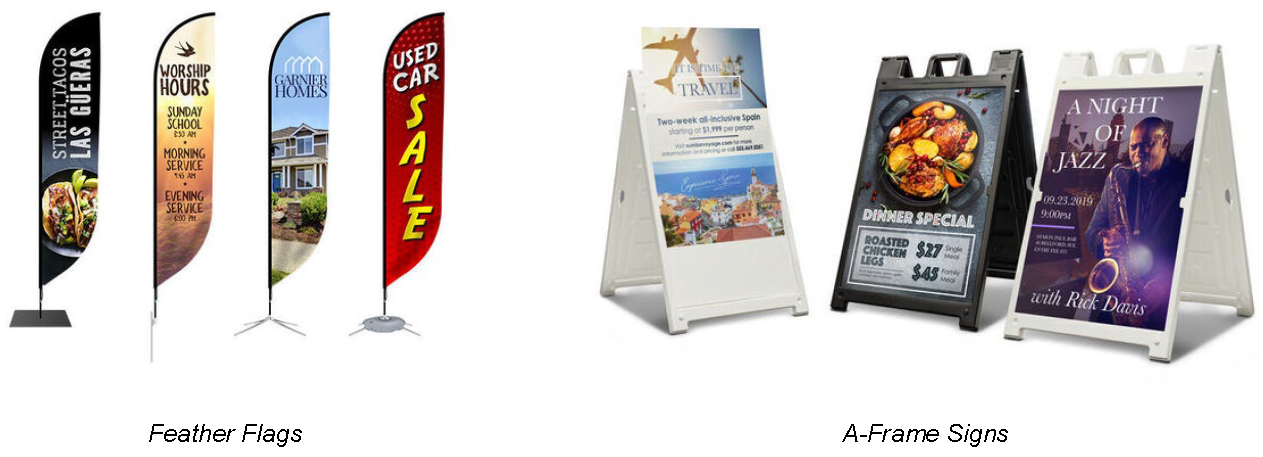
Temporary signs. A sign not constructed for permanent use or display. Examples of temporary signs include, but are not limited to, residential yard signs on metal stakes, banners, A-frame business signs, flags, feather flags, and signs with wooden or metal supports that are placed into the ground, without a permanent foundation.
(22)
Wall signs. Any sign attached to, painted on, inscribed, or otherwise set upon an exterior wall or surface of any building. projecting signs and awning signs are deemed to be wall signs.
(23)
Window signs. Any sign located within a building and affixed upon the inside of a window, which is intended to be visible from the exterior of the building.
(Ord. No. 24-674, § 2(Exh. A), 1-22-24)
Sec. 94-16.03. - Permit process.
(a)
Permits. It shall be unlawful for any person to erect, alter, or structurally change or replace a sign or a sign's supporting structure, unless the type of sign is exempt as set forth in this article, without first obtaining a permit in accordance with the processes set forth in the Walker Code of Ordinances, including payment of a fee, if established by the city commission.
(b)
Exceptions. A permit is not required to change the message of a previously approved sign so long as the size or shape of the sign is not changed, and so long as electronic messaging capability is not added. Permits shall also not be required for the normal cleaning or maintenance of a sign or a sign's supporting structure.
(c)
Signs exempt from permitting requirements. The following signs shall not require a permit to be installed:
(1)
All signs under one square foot or less in area.
(2)
All signs required to be erected by law, except required addresses on freestanding signage that would otherwise require a permit under this Article.
(3)
Integral decorative or architectural features of buildings or artwork, so long as such features or works do not contain an explicit message, words in any language, or moving parts. Artwork must be painted with the permission of the property owner.
(4)
Temporary signs specifically listed as exempt under section 94-16.04(b).
(5)
Government signs.
(Ord. No. 24-674, § 2(Exh. A), 1-22-24)
Sec. 94-16.04. - Temporary signs.
(a)
Temporary signs that require permits. Temporary signs in the C-1, C-2, I-1, I-2, ORP, P/SP, CPUD, MPUD and IPUD districts shall require permits as described in section 94-16.03 prior to installation. A maximum of two temporary sign permits, each good for 30 days, may be issued in a calendar year. One 30-day extension of an active permit may be approved by written request to the planning director. The foregoing shall be subject to the following: (1) No more than three temporary signs shall be allowed on any given lot at any time.
(1)
The maximum sign height of each temporary sign shall be four feet.
(2)
Temporary signs shall be located completely on private property outside of any street right-of-way or clear corner vision area (see section 94-6.10).
(3)
The total area of temporary signs on a single lot shall not exceed 18 square feet.
(b)
Temporary signs that do not require permits. Temporary signs in the AA, A, A-2, SA, S, ARM, ARM-1, RMT, RPUD-1, RPUD-2, and RPUD-3 districts shall not require permits prior to installation subject to the following:
(1)
No more than three temporary signs shall be allowed on any given lot at any time.
(2)
The maximum sign height of each freestanding temporary sign shall be four feet.
(3)
Temporary signs shall be located completely on private property and outside of any street right-of-way or clear corner vision area (see section 94-6.10).
(4)
The total area of temporary signs on a single lot shall not exceed the following:
(Ord. No. 24-674, § 2(Exh. A), 1-22-24)
Sec. 94-16.05. - Prohibited signs.
(a)
The following signs shall be prohibited:
(1)
Any sign or supporting object that has any visible motion, whether the movement is caused by machinery, wind, or otherwise. This prohibition shall not include electronic message signs, flags, or feather flags.
(2)
Any sign erected on a tree or public utility pole, except signs erected by a government agency or authority.
(3)
Roof signs or any sign which projects above the roof line or top of a canopy.
(4)
Any sign projecting into, within, or upon the public right-of-way.
(5)
Any sign erected on any property, public or private, without the consent of the property owner.
(6)
Any sign which simulates or imitates in size, color, lettering, or design, any traffic sign or signal or other word, phrase, symbol, or character in such a manner as to interfere with, mislead, or confuse the drivers of motorized vehicles.
(7)
Any sign erected in any place where it may, by reason of its position, shape, color, or other characteristics, interfere with, obstruct the view of, or be confused with any authorized traffic sign, signal, or device, or constitute a nuisance per se.
(8)
Any sign which incorporates any open spark or flame.
(9)
Portable manual reader board signs, which are defined as a sign that is intended to be moved from place to place and used to display a manually assembled letter message, which is often enhanced with internal or external light bulbs.
(10)
Any sign which, in the opinion of the planning director, has deteriorated to the point where it has become a blight on surrounding properties. Examples of deterioration include, but are not limited to, structural damage, unshielded lights, exposed electrical wiring, significant rust, or other deterioration of materials, and peeling or flaking paint.

Examples of Prohibited Portable Manual Reader Board Signs
(Ord. No. 24-674, § 2(Exh. A), 1-22-24)
Sec. 94-16.06. - Sign measurement.
(a)
Except as otherwise expressly provided for in this article, all signs shall comply with the following requirements:
(1)
The area of a sign shall be measured as the area within a single, continuous perimeter composed of any straight-line geometric figure which encloses the extreme limits of writing, representation, emblem, logo, or any other figure of similar character, together with any frame, architectural feature or other material or color forming part of the display or used to differentiate the sign from the background against which it is placed.
(2)
The area of a freestanding sign that has two faces shall be measured by including the area of all sign faces. However, if two such faces are placed back-to-back, and are no more than two feet apart at any point, the area of the two back-to-back faces shall be counted as one face with the larger of the two sign faces to be counted as the relevant sign face for sign area measurement purposes. The area of a freestanding sign shall include the base of the sign.
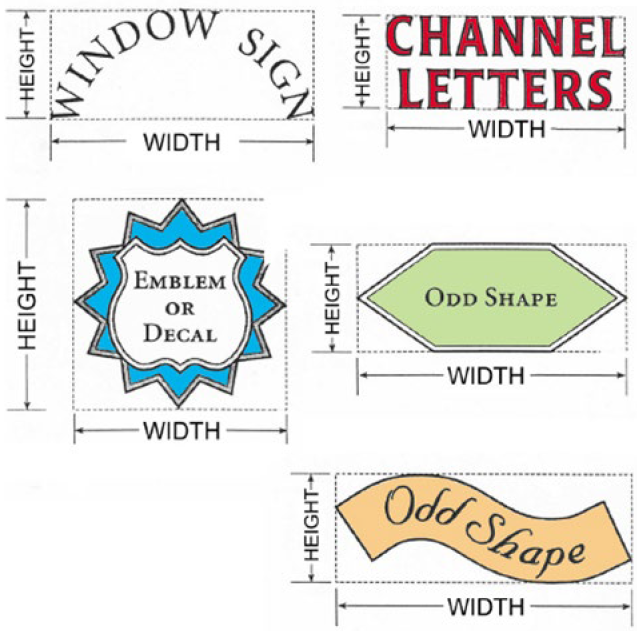
Computation of Sign Area
(3)
The height of a freestanding sign shall be measured as the vertical distance from the highest point on the sign to the grade of the adjacent street or parking lot, whichever is spatially closer to the sign.
(4)
The allowable square footage of wall signage for a building shall be measured in the following way:
a.
If a building has storefronts, as defined in this article, then the area of wall signage shall be measured based on the width of individual storefronts. The total wall signage for the sum of all storefronts will be determined by measuring the building frontage. If a building does not have storefronts, as defined in this article, then the area of wall signage shall be measured based on the width of the building, as calculated from the building frontage.
(Ord. No. 24-674, § 2(Exh. A), 1-22-24)
Sec. 94-16.07. - Construction standards for permanent signage.
(a)
All permanent signs shall comply with the following requirements:
(1)
All signs shall be properly maintained so as not to become unsightly through disrepair, damage, or because of the weather.
(2)
Sign supports, braces, guys, and anchors shall be maintained in such a manner as not to cause a public safety hazard.
(3)
Signs shall be constructed to withstand all wind and vibration forces that can be normally expected to occur in the vicinity, per the standards of the Michigan Building Code. The sub-grade base material of any freestanding sign must be constructed in a manner such that the sign and sign base will meet the wind loading capacity required under the Michigan Building Code.
(Ord. No. 24-674, § 2(Exh. A), 1-22-24)
Sec. 94-16.08. - Lighting and electronic messaging.
(a)
External illumination shall be permitted in all zoning districts. All external illumination fixtures shall be downward facing and shielded to conceal the source of the light.
(b)
Internal illumination shall be permitted only in nonresidential zoning districts (C-1, C-2, I-1, I-2, ORP, P/SP, CPUD, MPUD and IPUD).
(c)
No light emanating from any sign shall shine onto any lot other than the lot containing the sign in question. Light levels must reach 0.0 footcandles before any property line.
(d)
Electronic messaging. Electronic messaging signs shall be permitted in the C-1, C-2, I-1, I-2, ORP, P/SP, CPUD, MPUD and IPUD districts and accessory to approved special uses in residential zoning districts, subject to the following standards:
(1)
Number. Only one electronic messaging sign is permitted per lot.
(2)
Automatic copy change. Automatic copy change shall be no more frequent than once per eight seconds.
(3)
Light level. Glare shall be reduced and/or minimized in such a manner as to maintain an appropriate level of contrast during the day. To reduce driver distraction at night and light trespass into residential areas, an automatic dimmer shall be installed to control brightness, which shall not be manually overridden at any time. The maximum brightness of the sign shall not exceed 10,000 NITs during the day and no more than 1,000 NITs between dusk and sunrise.
(4)
Motion, animation and video. Video display, animation, scrolling text, flashing, whirling, fading, dissolving, transitions, or any other type of motion are prohibited.
(Ord. No. 24-674, § 2(Exh. A), 1-22-24)
Sec. 94-16.09. - General requirements for permanent freestanding signage.
(a)
Address required. At least one permanent freestanding sign per lot shall contain the address number of the lot it is located upon, in letters large enough to be read by first responders operating emergency vehicles. The purpose of this requirement is to ensure that public safety personnel can quickly find each address in the event of an emergency. This provision shall not in any way restrict the content of the signage in question other than the required address number.
(b)
Masonry base required. All permanent freestanding signs must have a base that is equal or greater in width than the width of the sign. The base must be made of masonry or brick. The base must be at least 18 inches above the grade that lies adjacent to the sign. The planning director may permit a material that replicates the appearance of masonry or brick in lieu of actual masonry or brick construction.
(Ord. No. 24-674, § 2(Exh. A), 1-22-24)
Sec. 94-16.10. - Clear corner vision.
All signs in all zoning districts must allow clear corner vision for all street intersections and driveway entrances. Permanent signs must be under three feet tall within a triangle formed by two points, each ten feet away from the intersection of the right-of-way line and the driveway, and the line connecting them. Signs must otherwise comply with intersection visibility standards put forth in section 94-15.01 of this chapter. Temporary signs are prohibited within the clear corner vision as described in this article.
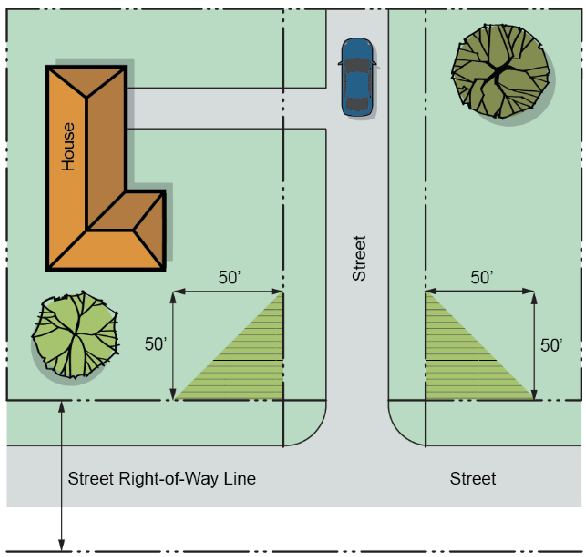
(Ord. No. 24-674, § 2(Exh. A), 1-22-24)
Sec. 94-16.11. - Permanent signage permitted by zoning district.
(a)
The following permanent signage shall be permitted in the zoning districts listed below. Within overlay districts, the standards of the underlying district shall apply unless specifically stated otherwise in this chapter.
(b)
In the A, A-2, SA, S, ARM, ARM-1, RMT, RPUD-1, RPUD-2, and RPUD-3 districts, freestanding signs up to 24 square feet in area and six feet in height shall be permitted in any of the following circumstances:
(1)
Accessory to a nonresidential use. The content of the signage must relate to the specific use on the premises.
(2)
Located within a general common element of an approved condominium or site condominium.
(3)
Located within a commonly accessible area of a multi-unit complex offered for rent and managed by a central property manager.
(4)
Signs that meet one of the circumstances in subsections (1) through (3), while also being visible from a public road, may be up to 48 square feet in area and up to eight feet in height. However, only one such sign shall be permitted per lot.
(c)
Additional freestanding signs shall be permitted in the following circumstances:
(1)
Signs may be placed in proximity to driveways in the following circumstances. Such signs shall be exempt from the masonry base requirement in section 94-16.09(b).
a.
The sign must be within ten feet of a driveway.
b.
No more than one sign per driveway shall be permitted.
c.
No sign shall exceed 12 square feet in area.
d.
No sign shall exceed four feet in height.
e.
All other applicable requirements of this Article must be met.
(2)
Signs may be placed in proximity to drive-thru stacking lanes and order windows in the following circumstances. Such signs shall be exempt from the masonry base requirement in section 94-16.09(b).
a.
The sign must be within ten feet of a drive-thru stacking lane.
b.
No more than six signs shall be permitted.
c.
The maximum area of any sign shall be 48 square feet.
d.
No more than two signs shall exceed 32 square feet in area.
e.
The maximum height of any sign shall be ten feet.
f.
No more than two signs shall exceed eight feet in height.
(d)
Wall signs must be placed on a building wall that faces a public or private road or a parking lot open to the public.
(e)
Awning signs and projecting signs shall be considered wall signs.
(f)
Canopy structures, such as those used for gas stations, shall be permitted 20 square feet of signage on each face of the canopy that faces a public or private road.
(g)
Signage in PUDs may be altered by the PUD agreement. If signage is not specifically altered in the PUD agreement, the provisions of this section shall apply. The planning commission may approve signage allowances that exceed those found in this article, in conjunction with an approved final area site plan.
(h)
Projecting signs must have a minimum eight-foot clearance from the ground and shall not extend more than four feet from the façade they are attached to.
(i)
Window signs in the I-1, I-2, and IPUD districts may cover 100 percent of a window, if they are made of a translucent material that allows light to shine through the sign.
(j)
I-96/US-131 large off-premises freestanding sign overlay.
(1)
Purpose and intent. Freeways are frequently characterized by freestanding signs that are significantly larger in size than other types of stand-alone signage allowed in the city, and their principal purpose is to attract the attention of the travelling public and to divert that attention from the road. The potential impact of such a sign on adjacent areas is significantly greater than other types of signage. Moreover, the potential for distraction to motorists and pedestrians is greater than for other signs. The intent of this section is to:
a.
Permit additional freestanding signage, of sufficient size and height to be visible to high-speed traffic, with appropriate restrictions for safety and community character.
b.
Establish size, illumination, location, spacing, and operating standards and regulations for large off-premises freestanding signs.
(2)
Sign overlay application. The provisions of this overlay shall apply to all land that meets both of the following criteria:
a.
Within 100 feet of the right-of-way of Interstate 96 and U.S. Highway 131.
b.
In the I-1, I-2, and IPUD zoning districts.
(3)
Sign overlay regulations. Within the overlay, additional freestanding signs shall be permitted, above and beyond those permitted in the zoning district, provided that these large off-premises freestanding signs meet the following requirements:
a.
Each sign shall not exceed a height of 35 feet above the preexisting grade at the base of the support pole(s).
b.
Each sign shall be located not less than 1,000 feet from residential zoning districts and not less than 1,500 feet from any existing residential dwelling or uses.
c.
Each sign shall be located not less than 2,000 feet from any other sign permitted by this overlay. For purposes of this subsection, the distance between signs on opposite sides of the freeway shall be measured as the distance between the points at which lines drawn perpendicular to the freeway from the location of each sign intersect with a line along the center of the freeway.
d.
Each sign shall be located not less than 500 feet from any other freestanding sign, conforming or not, which is located on the same side of the freeway within the city, and which is visible from the traveled portion of the freeway; provided, however, that the minimum distance between large off-premises freestanding signs shall be governed by subsection (c).
e.
Each sign shall have a minimum setback of 20 feet from the freeway right-of-way, as measured from the closest point or edge of the sign.
f.
All measurements provided for in this section shall be measured radially and without respect to political or jurisdictional boundaries.
g.
The height of a sign panel on an overlay sign shall not exceed 14 feet and the length of each sign panel on an overlay sign shall not exceed 48 feet.
h.
No overlay sign shall contain more than one sign panel facing the same direction of traffic on the freeway.
i.
No overlay sign shall contain more than two sign panels.
j.
Electronic messaging shall be permitted on both new and existing large off-premises freestanding signs within the overlay, provided that all of the following standards are met:
1.
No electronic messaging sign within the overlay shall be less than 1,000 feet from any other electronic messaging sign within the overlay. This setback shall apply to all electronic messaging signs, not just large off-premises freestanding signs.
2.
The requirements of section 94-16.08(d) are met.
3.
The requirements of this large off-premises freestanding sign overlay are met.
(4)
Exemptions. The standards of subsection (3) shall supersede all conflicting requirements of this article. All standards of this article that do not conflict with subsection (3) shall apply within the overlays, except that signs within the overlay shall be exempt from the requirements of section 94-16.09.
(Ord. No. 24-674, § 2(Exh. A), 1-22-24)
Sec. 94-16.12. - Nonconforming signs.
(a)
A nonconforming sign may continue in use and shall be maintained in good condition as described elsewhere in this article, except:
(1)
A nonconforming sign shall not be structurally altered or repaired so as to prolong its life or as to change its shape and size unless such change shall make the sign conforming; nor shall a nonconforming sign be replaced by another nonconforming sign. In addition to this provision, provisions of this chapter that pertain to structures shall apply to signage.
(2)
For any approval requiring site plan review by the planning commission, all nonconforming signs shall be removed from the site as a condition of the site plan approval.
(b)
If a nonconforming sign is destroyed, it cannot be rebuilt.
(Ord. No. 24-674, § 2(Exh. A), 1-22-24)

