
Walker City Zoning Code
ARTICLE II
- DEFINITIONS
Sec. 94-2.01. - Uses.
(a)
Residential uses. The following is a description of the uses listed in article V.
Dwelling, live/work means a use that contains both a dwelling unit and a workshop, storefront, or office within the same, single, leasable or for-sale unit.
Dwelling, mobile home means a detached residential dwelling unit designed for transportation after fabrication on streets or highways on its own wheels (whether or not such wheels have been removed) complete and ready for occupancy upon arriving at the site where it is to be located except for minor and incidental unpacking and assembly operations, location on jacks or other temporary or permanent foundations, connections to utilities, and the like. Mobile homes are also known as manufactured housing. A travel trailer is not to be considered as a mobile home.
Dwelling, five or more family means a residential building designed for or occupied by five or more families, with the number of families in residence not exceeding the number of dwelling units provided.
Dwelling, single-family, means a detached residential dwelling unit designed for and occupied by one-family only.
Dwelling, three-to-four family means a detached residential building containing three or four dwelling units, designed for occupancy by not more than the number of dwelling units. A three-to-four family dwelling is also sometimes referred to as a multiplex, as a triplex where there are three units, or a quadplex where there are four units.
Dwelling, two-family, means a detached residential building containing two dwelling units, designed for occupancy by not more than two families.
Farm labor housing means and includes dwellings, mobile homes, rooming and boarding houses and mess halls for farms and agricultural workers employed on the property of an agricultural use, usually on a seasonal basis.
Nursing home means a nursing care facility licensed as a "nursing home" by the State Department of Health and Human Services under Article 17 of the Public Health Code, Act No. 368 of the Public Acts of Michigan of 1978 (MCL 333.20101 et seq.), as amended. A "nursing home" as defined by this section shall include "extended care facility" and "convalescent home."
Senior housing (independent), also known as an "independent living facility" means a residential facility not subject to license or registration by the state, but that is eligible for public financial assistance under state or federal laws, having as its principal purpose the provision of barrier-free housing for individuals 55 years of age or older. Independent living facilities are not intended for adult dependent individuals without a head of household also in residence. Independent senior housing includes architectural design features which eliminate the type of barriers and hindrances that deter physically disabled persons from having access to and free mobility in and around the facility, and shall be specifically and primarily intended, designed, operated and located to allow its physically disabled occupants increased opportunities to function independently in the community.
State licensed residential facility means any structure constructed for residential purposes that is licensed by the State of Michigan pursuant to Michigan Public Act 116 of 1973 (The Child Care Licensing Act) or Michigan Public Act 218 of 1979 (The Adult Foster Care Facility Licensing Act). This definition includes adult foster care facilities, foster family homes, foster family group homes, family day care homes, and group day care house. Where the term "private residence" is used in the definitions of such facilities and/or homes, it shall mean a private home in which the licensee or registrant permanently resides as a member of the household, which residency is not contingent upon caring for children or employment by a licensed or approved child placing agency.
(1)
Adult foster care facility means a residential structure that is licensed to provide foster care, but not continuous nursing care, for unrelated adults ages 18 and older. Adult foster care facilities are subject to all applicable provisions, definitions, and regulations of Michigan Public Act 218 of 1979, as amended (MCL 400.701 et seq.). The following are types of adult foster care facilities provided for by this chapter:
a.
Adult foster care camp means an adult foster care facility with the approved capacity to receive more than four adults to be provided foster care in a natural or rural environment and shall be considered a "campground" for the purposes of land use designations in this chapter.
b.
Adult foster care congregate facility means an adult foster care facility with the approved capacity to receive more than 20 adults to be provided with foster care. An adult foster care congregate facility is considered a "state licensed residential facility (13 or more persons)" when determining permitted land use.
c.
Adult foster care family home means a private residence that provides foster care to at least three but no more than six adults and its licensee must be a member of the household and an occupant of the residence. An adult foster care family home is considered a "state licensed residential facility (six or fewer persons)" when determining permitted land use.
d.
Adult foster care large group home means a private residence that provides foster care to at least 13 but not more than 20 adults. An adult foster care large group home is considered a "state licensed residential facility (13 or more persons)" when determining permitted land use.
e.
Adult foster care small group home means a private residence that provides foster care to at least three but not more than 12 adults.
f.
Adult foster care facility does not include any of the following:
1.
A licensed child caring institution, children's camp, foster family home, or foster family group home, subject to the limitations contained in section 3(4f) of Michigan Public Act 218 of 1979, as amended (MCL 400.703).
2.
A licensed foster family home that has a person who is 18 years of age or older placed in the foster family home under section 5(7) of Michigan Public Act 116 of 1973, as amended (MCL 722.115).
3.
An establishment commonly described as an alcohol or a substance abuse rehabilitation center; a residential facility for persons released from or assigned to adult correctional institutions; a maternity home; or a hotel or rooming house that does not provide or offer to provide foster care.
4.
A veterans' facility created by 1885 PA 152, MCL 36.1 to 36.12.
(2)
Children's camp means a residential day, troop, or travel camp that provides care and supervision and is conducted in a natural environment for more than four children, apart from the children's parents, relatives, or legal guardians, for five or more days in a 14-day period. A children's camp is licensed, regulated, and defined by the state under Act No. 166 of the Public Acts of 1973 and the associated rules promulgated by the department of licensing and regulatory affairs bureau of community and health systems. A children's camp shall be considered a campground for the purposes of land use designations.
(3)
Child day care home, family means a private residence in which at least one but less than seven minor children are received for care and supervision for less than 24 hours a day, unattended by a parent or legal guardian, except children related to an adult member of the household.
(4)
Child day care home, group means a private residence in which at least seven but no more than 12 minor children are received for care and supervision for less than 24 hours a day, unattended by a parent or legal guardian, except children related to an adult member of the household.
(5)
Child caring institution means a child care facility, other than a private residence, that is organized for the purpose of receiving minor children for care, maintenance, and supervision, usually on a 24-hour basis, in buildings maintained by the institution for that purpose, and operates throughout the year.
(6)
Foster family home means the private home of an individual who is licensed to provide 24-hour care for one but not more than four minor children who are placed away from their parent, legal guardian, or legal custodian in foster care. The children residing in a foster family home shall be considered members of the family residing within a dwelling unit.
(7)
Foster family group home means the private home of an individual who has been licensed to provide 24-hour care for more than four but fewer than seven minor children who are placed away from their parent, legal guardian, or legal custodian in foster care. The children residing in a foster family home shall be considered members of the family residing within a dwelling unit.
Townhouse means an attached multiple-family dwelling unit with party walls, designed as part of a series of two or more dwellings, with its own front door which opens to the outdoors at ground level, and may each contain their own basement. Townhouses are also commonly known as rowhouses.
(b)
Commercial, office, and service uses. The following is a description of the uses listed in section 94-5.02.
Adult oriented business means the term as defined in section 94-6.02.
Animal rescue or shelter. A rescue or shelter operation shall be defined as a lot where five or more animals meeting the definition of either pets or livestock are kept permanently during a period of sickness or injury, or to keep them safe from abuse or neglect, with the intent to re-house the animal in a permanent home at the end of the temporary rescue or shelter period.
Automobile repair, major means any activity involving the general repairs, rebuilding or reconditioning of engines, motor vehicles or trailers; wrecker service with storage of vehicles included; collision servicing, including body, frame and fender straightening or repair; overall painting or paint shop; or vehicle steam cleaning.
Automobile repair, minor means any activity involving minor automotive repairs to passenger vehicles and commercial vehicles not exceeding one and one-half ton capacity service, without storage of vehicles, and in no case including any operation specified under "automobile repair, major."
Automobile sales means a building or premises used primarily for the sale of new or used automobiles and other motor vehicles, including new and used car sales, recreational vehicle sales, motorcycle/powersport sales, construction equipment sales, and boat sales.
Bank means a financial institution dedicated to accepting monetary deposits and providing loans. Credit unions shall be considered banks for the purposes of this chapter.
Bar/night club means an establishment where alcoholic beverages are prepared, served, and consumed on-site. If food is prepared and served on-site, the establishment will not be considered a bar/night club, but instead a "restaurant with alcohol." Subject to state law and other requirements of this Code, the sale of packaged alcohol (for either on-site or off-site consumption), dancing, and live entertainment may be allowed as accessory uses. All establishments which sell alcoholic beverages must conform to the requirements of chapter 6 of the Code of Ordinances for the City of Walker.
Car wash means any commercial place or premises open to the public and used for cleaning or washing of the interior or exterior of an automobile, for a charge or fee, using either a mechanized or manual process, including self-serve. A "car wash" does not include a facility used for washing or cleaning vehicles larger than a regularly manufactured pickup or panel truck of one and one-half ton capacity.
Contractor's shop means an enclosed space or enclosed spaces used for the housing and/or operating of light machinery, the provision of services, the light fabrication of building-related products, office space, and interior storage, but which does not use any exterior storage area.
Drive-in restaurant or refreshment stand means any place or premises used for the sale, dispensing or serving of food, refreshments or beverages to customers (i) in automobiles where it is intended or is common practice for such food, refreshments or beverages to be consumed in the automobile while parked upon the restaurant or refreshment stand premises; or (ii) where such customers may serve themselves and may eat or drink the food, refreshments or beverages on the premises outside the building. Restaurants which supply indoor seating capacity for a minimum of 40 customers and also utilize a drive-up window where customers, while remaining in their automobiles, place orders and/or receive food, refreshments or beverages intended for consumption off the premises shall not be considered drive-in restaurants.
Drive-thru means driveways, windows, and signage associated with a commercial use for the provision of goods and services directly to customers in their cars from a window in the building, so that cars are idled while being served, rather than parked.
Event space means a commercial use designed for temporary gatherings of people for entertainment, collaboration, celebration, or other reasons. Examples include banquet halls and meeting facilities. This definition does not include uses such as theaters, concert halls, or uses which fall under the definitions of major and minor indoor commercial recreation.
Fitness center or health club means a facility where individuals use equipment or space for the purpose of physical exercise.
Garden supply center means a retail use which usually has both indoor and outdoor shopping and storage areas, that sells gardening supplies including seeds, plants, fertilizer, landscaping materials, and tools.
Gas station, also known as an automobile service station or filling station, means a place where gasoline or any other motor fuel or lubricating oil or grease for operating motor vehicles is offered for retail sale to the public and delivered directly into motor vehicles and where there is a retail sale of accessories, where greasing, oiling and light motor service, not including activities defined as "major auto repair," is carried on. Permissible uses do not include the storage of automobiles not in operating condition or work involving noise, glare, fumes, or smoke greater than normally found in automobile service stations. A service station is not a repair garage or a body shop.
Hotel or motel means a commercial business operating as a temporary abiding place for no more than 30 consecutive days by a single individual (and any other individuals staying in the same unit). with or without meals provided, in rooms consisting of a minimum of one bedroom and a bath, occupied for hire, and which typically provides hotel services such as maid service, the furnishing and laundering of linens, telephone and desk service, the use of furniture, a dining room, and meeting rooms. A hotel may also include conference room or banquet facilities, an attached dining room, and/or an attached or detached standard restaurant. Facilities offering accommodation to individuals for more than 30 consecutive days will be considered residential uses.
Laundromat means a building where coin-operated laundry machines, using only water, detergents, and additives, are made available to the public for the purpose of laundry cleaning. A laundromat does not include industrial-scale dry cleaning or laundry, or services that are conducted exclusively by employees of the business.
Movie or film studio means a facility for the production of motion pictures, television entertainment, music and music-video entertainment, and similar products. A movie studio may include, but is not limited to, soundstages, sets, cafeterias, production studios, research and development operations and training and education areas. On-site housing of personnel and talent may be allowed as an accessory use, subject to state law and other requirements of this Code.
Medical or dental clinic means an establishment where human patients who are not lodged overnight are admitted for examination and treatment by a group of physicians, dentists, or similar professionals. A medical or dental clinic may incorporate customary laboratories and pharmacies incidental to or necessary for its operation or to the service of its patients, but may not include facilities for overnight patient care or major surgery. A massage parlor that does not meet the definition of an "adult regulated business" as defined in section 94-6.02, and is operated using licensed practitioners, shall be considered a "medical clinic" for the purposes of this chapter.
Microbrewery means a brewery that produces less than 60,000 barrels of beer or ale per year, as allowed by state law (a barrel is equivalent to 31 U.S. gallons). A microbrewery may also include retail sales, and/or a restaurant, bar, or tasting room. A use fitting the definition of "microbrewery" and the definition of a "restaurant with alcohol" will be considered a "microbrewery" for the purpose of this chapter. May also be referred to as a "brewpub." All establishments which sell alcoholic beverages must conform to the requirements of chapter 6 of the Code of Ordinances for the City of Walker.
Microdistillery means an establishment licensed as a small distiller by the State of Michigan to manufacture no more than 60,000 U.S. gallons of spirits per year. A microdistillery may also include retail sales, and/or a restaurant, bar, or tasting room. A use fitting the definition of "microdistillery" and the definition of a "restaurant with alcohol" will be considered a "microdistillery" for the purpose of this chapter. All establishments which sell alcoholic beverages must conform to the requirements of chapter 6 of the Code of Ordinances for the City of Walker.
Parking facility with no other principal use means a property used for off-street parking that is not located on the same property as the principal use it serves or on any property that does not have another principal use. A parking facility may be a ground-level parking lot or a parking structure or garage.
Personal service means an establishment which performs services on the premises including, but not limited to, repair shops (watches, computer, shoe, etc.), tailor shops, beauty and spa services, barber shops, permanent cosmetics, photographers, and dry cleaners. No service meeting the definition of "adult regulated business" in section 94-6.02 shall be considered a "personal service use" for the purposes of this chapter.
Professional office means a room, suite of rooms, or building in which are located desks, chairs, tables, couches, bookcases, and equipment (i.e. accounting, filing, recording, communication and/or stenographic equipment) for current use in the office business and personnel engaged in executive, administrative, professional, political, informative, research, and/or clerical duties.
Recreation, indoor means an indoor facility for leisure, exercise, and/or entertainment. Examples include: bowling alleys, theaters, sports arenas, arcades, indoor playgrounds, court or rink sport facilities, indoor obstacle courses, rock climbing and adventure sport facilities, trampoline parks, and similar activities.
Recreation, outdoor means uses that are designed to provide the user with the opportunity to relax, engage in athletic activity, or engage in other leisure pursuits. Examples include, but are not limited to, golf courses, archery ranges, off-road cycle tracks, and sports fields and facilities.
Rental, short-term is a residential dwelling unit made available for rent by for a period of less than 30 consecutive days, not meeting the definition of "hotel" in this chapter.
Restaurant with alcohol means an establishment where food and drink, including alcoholic beverages, are prepared, served, and consumed on-site or as take-out. Outdoor dining may be accessory to these uses, subject to other requirements of this Code. All establishments which sell alcoholic beverages must conform to the requirements of chapter 6 of the Code of Ordinances for the City of Walker.
Restaurant without alcohol means an establishment where food and drink, but not alcoholic beverages, are prepared, served, and consumed on-site or as take-out. Drive-up windows and outdoor dining may be accessory to these uses, subject to other requirements of this Code.
Retail means a commercial use that sells goods of merchandise to the public on-site. Retail does not include gas stations, automobile sales, or garden sales.
Self-storage, interior access means a building or group of buildings consisting of individual, self-contained storage units leased or licensed for self-service storage of personal property which allows access to each individual unit via interior doors and is temperature controlled.
Self-storage, exterior access means a building or group of buildings consisting of individual, self-contained units leased or licensed for self-service storage of personal property which allows access to each individual unit via exterior doors and is not temperature controlled.
Veterinary clinics and animal hospitals means a commercial use that provides medical and/or therapeutic services to animals.
(c)
Industrial uses.
Artisanal manufacturing means a use conducted to produce tangible goods by skilled craft persons, usually involving workers who practice a trade or handicraft, and produces unique products, often using traditional methods, involving the use of hand tools and small-scale, light mechanical equipment (e.g., art, crafts, custom cabinetry, software products, music, and games).
Battery energy storage system. One or more devices, assembled together, capable of storing energy in order to supply electrical energy at a future time, not to include a stand-alone 12-volt car battery or an electric motor vehicle. A battery energy storage system is classified as a tier 1 or tier 2 battery energy storage system as follows:
(1)
Tier 1 battery energy storage systems have an aggregate energy capacity less than or equal to 600kWh and, if in a room or enclosed area, consist of only a single energy storage system technology.
(2)
Tier 2 battery energy storage systems have an aggregate energy capacity greater than 600kWh or are comprised of more than one storage battery technology in a room or enclosed area.
Industrial means a building or structure housing a manufacturing process. Manufacturing means the mechanical or chemical transformation of materials or substances into new products, including the assembling of component parts, the manufacturing of products, and the blending of materials. "Industrial" uses may be high or low intensity:
(1)
Industrial, high intensity means industrial uses fitting the definition in subsection 94-6.05(a).
(2)
Industrial, low intensity means uses fitting the definition of "industrial" in this section, but do not fit the definition of high intensity industrial uses described in subsection 94-6.05(a).
Mineral mining means the excavation and removal of peat, gravel, sand, clay, or other soils, including overburden, or the separation and transporting of those materials on a mining site, or the reclamation of the site after removal or excavation of materials. However, the following excavation activities are not included within the definition of mineral mining:
(1)
Excavation approved by a governmental body of competent jurisdiction in conjunction with the installation or maintenance of publicly owned or operated utilities, drainage facilities, roads, or other publicly owned or operated improvements, where the excavation is limited to the site of the public utility or improvement.
(2)
Excavation which by its nature is of limited scope and duration and which is undertaken primarily for the immediate use and development of the land excavated, such as for purposes of building construction, septic tanks, swimming pools, graves, and similar limited excavations.
(3)
Excavation in conjunction with farming operations in accordance with generally accepted agricultural practices, including agricultural drainage work incidental to farming operations and irrigation or stock watering ponds, if no material is removed from the property.
(4)
Other excavations determined similar by the board of zoning appeals because of the type of excavation involved or the limited scope and duration of the excavation and if no material is removed from the property.
Mineral processing and material storage means the processing and/or storage of peat, gravel, sand, clay, concrete, asphalt, wood, or other similar minerals or materials. For purposes of this definition, "processing" includes, but is not limited to, crushing, dissolving, breaking up, pulverizing, grinding, shredding, mixing, combining, and other similar operations. Mineral processing and material storage does not include mineral mining as defined in this section. Recycling/composting operation means a business that receives, stores and processes waste products and organic materials. These products and materials are often transformed into new and different products via mechanical, organic or physical processes. This operation shall not be confused with the uses mineral processing and material storage or junkyard as defined herein.
Warehouse means lands, buildings, or structures used or designed for the storage of goods which will be sold elsewhere or subsequently transported to another location for sale, including the storage of goods by a distributor or supplier who markets goods for retail sale at other locations.
Wireless communication facility means a freestanding facility, building, pole, tower, or structure used to provide commercial cellular telecommunication services, that consists of antennae, equipment and storage, and other accessory structures.
(d)
Community, institutional, and educational uses.
Cemetery means land used for the burial of the dead, which may include a columbarium, crematory, and mausoleum.
Child care center means a facility, other than a private residence, receiving one or more children under 13 years of age for less than 24 hours a day, where the parents or guardians are not immediately available to the child. "Child care center" includes a facility that provides care for not less than two consecutive weeks, regardless of the number of hours of care per day. "Child care facility" does not include a facility operated by a religious organization where children are in the religious organization's care for not more than three hours while persons responsible for the children are attending religious services.
Hospital means an institution licensed by the Michigan Department of Health and Human Services (MDHHS) to provide in-patient and out-patient medical and surgical services for the sick and injured, and may include related facilities such as laboratories, medical testing services, central service facilities, and staff offices.
Institution of higher education means an institution that provides full-time or part-time education beyond secondary education. Examples include universities, community colleges, vocational schools, and art schools.
K-12 school means an institution that provides a curriculum of elementary and/or secondary academic instruction, which may include accessory uses such as gymnasiums, athletic fields, and cafeterias.
Public or community building means principal structures dedicated to the use of the public or government operations, including local, county, state, or federal offices, police and fire stations, and other buildings used by the public or government and are owned by a public entity.
Religious institution means any church, synagogue, mosque, temple, or other building which is used primarily for religious worship and related activities.
Research and development facility means a use within an engineering or testing laboratory that does not involve the mass manufacture, fabrication, processing, or sale of products.
(e)
Animal and agricultural uses.
Concentrated animal feeding operation (CAFO) means an agricultural animal feeding operation including more than 1,000 head of beef cattle or more than 700 dairy cattle or more than 2,500 swine or more than 125,000 broiler chickens or more than 82,000 laying hens confined on the site for 45 or more days in any calendar year.
Farm means a tract of land devoted principally to agriculture for the production, use, and/or sale of crops; for raising and/or sale of livestock and their products; for grazing and for other things and/or uses not named for which such lands are generally used. A farm may also include the home of the operator or owner of the farm.
Greenhouse means an enclosed structure used for the growing and cultivation of flowers, shrubbery, vegetables, trees, and other horticultural goods, a greenhouse is also commonly known as a nursery.
Kennel means a building or structure which has at its primary function and purpose the boarding of household pets on a temporary or permanent basis and may include indoor or outdoor cages or runs for such household pets. "Kennel" shall also mean any residential home containing more than three dogs, and such a home shall conform to all requirements for kennels under this chapter. "Kennel" shall not include establishments used for the sale of household pets.
(f)
Accessory, temporary, and other uses.
Homebased business means that term as defined in section 94-6.05(a)(3).
Home occupation means that term as defined in section 94-6.05(a)(3).
Outdoor dining means an area for serving and consuming food and drink on-site, and may be accessory to a restaurant or other establishment which prepares and serves food and beverages on-site.
Outdoor sales means a retail use selling a product other than motor vehicles that is located outside of a fully enclosed building. This definition shall include space that is accessory to an indoor retail space, including, but not limited to, garden centers or propane tank facilities. Un-staffed vending machines or kiosks are not considered outdoor sales spaces.
Outdoor storage means the storage of goods outside of a building or structure of any kind either as a principal use or as accessory to an on-site principal use.
Solar energy, large accessory means large accessory freestanding solar arrays as defined in section [94-6.13(b)(1)].
Solar energy, small accessory means small accessory solar arrays as defined in section [94-6.13(a)(1)].
Solar energy, principal means freestanding principal use solar arrays as defined in section [94-6.13(c)(1)].
Short-term outdoor camping event means the use of tents or other temporary structures maintained as a temporary living quarter for recreation, education, religious or vacation purposes for not more than three consecutive nights. Telecommuting means that term as defined in section [94-6.06(a)(1)].
Wind energy, accessory means small structure-mounted wind energy turbines (SSM-WET), small tower-mounted wind energy turbines (STM-WET), and medium structure-mounted wind energy turbines (M-WET), as defined in section [94-6.15(b)], when used as an accessory to a principal use.
Wind energy, principal means a medium wind energy turbine (M-WET) or a large wind energy turbine (L-WET), as defined in section [94-6.15(b)], when used as the sole principal use of a property.
(Ord. No. 24-674, § 2(Exh. A), 1-22-24)
Sec. 94-2.02. - Other terms.
For the purpose of this chapter, unless clearly otherwise required by the context, words used in the present tense include the future; words in the singular number include the plural and the words in the plural number include the singular; but the word; and the word "shall" is mandatory and not directory. Any words not defined in this section shall be construed, if applicable, as defined in the Housing Law of Michigan, Act No. 167 of the Public Acts of Michigan of 1917. Except as otherwise provided in this chapter, the terms and words in this chapter are defined as follows:
Abutting, adjoining, or contiguous, means as follows: "Abutting" means to reach, to touch, or to join at a border or boundary; and "adjoining" and "contiguous" have the same meaning, as distinguished from "adjacent" which as used in this chapter means lying near but not necessarily abutting, adjoining or contiguous.
Accessory building or structure means a subordinate building or structure on the same premises as a principal building or structure, such as a shed or garage.
Accessory use means a use naturally and normally incidental to, subordinate to, and devoted exclusively to the principal use on the same property.
Agriculture means the commercial cultivation, tilling or use of land for the purpose of growing and storing crops thereon, or of animal or poultry husbandry.
Backyard chickens means a specific type of livestock animal (chicken) that is housed and cared for by residents in a nonfarm and noncommercial setting for providing fresh eggs for personal consumption. "Backyard chickens" excludes other poultry and other egg-producing birds or animals. Backyard chickens are subject to the standards contained herein in section 94-15.07(B).
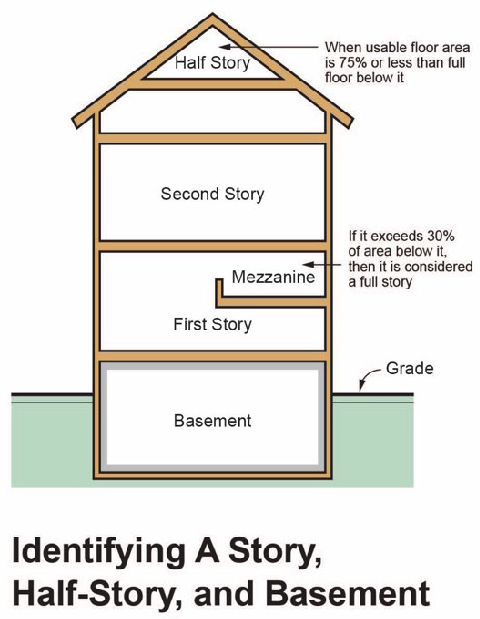
Basement means a story of a building having any part of one or more of its exterior walls located below the average finished grade. For purposes of this definition, "average finished grade" means the average level of the top of the ground resting against all exterior walls after construction of the building is completed.
Block means a unit of land abutting one side of a street and lying between the two nearest intersecting streets or bounded by a combination of streets and public land, waterways, or any other barrier.
Board or board of appeals means the zoning board of appeals established by this chapter in article XIX.
Building means a structure with a permanent foundation, at least four walls, and a roof.
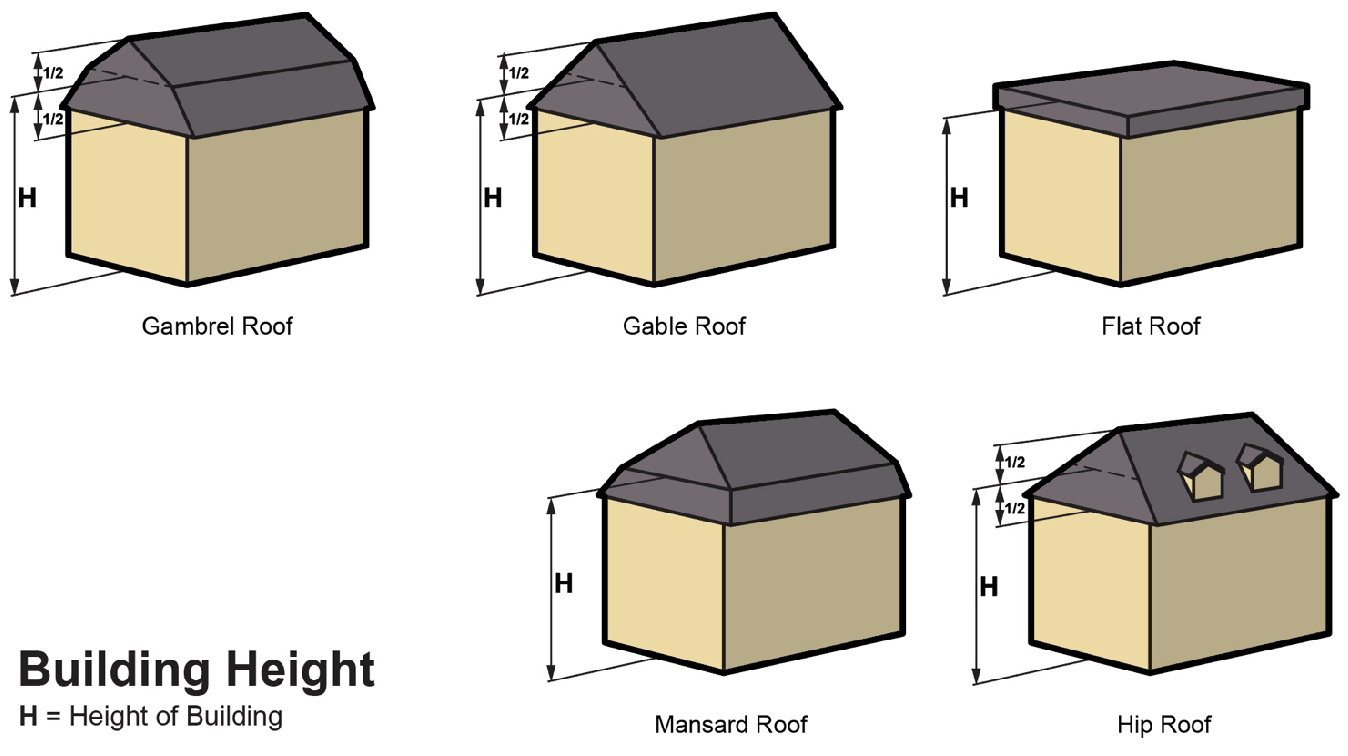
Building height means the vertical distance measured from the established grade to the highest point of the roof's surface for flat roofs, to the deck line for mansard roofs, and to the average height between the eaves and the ridge for gable, hip and gambrel roofs. Where a building is located on sloping terrain, height may be measured from the average ground level of the grade at the building wall.
City engineer. See section [94-18.06(c)(3)].
Contractor's shop means an enclosed space or enclosed spaces used for the housing and/or operating of machinery, the provision of services, the fabrication of building-related products, and interior storage, but which does not use any exterior storage area.
Deck means an unenclosed accessory platform attached to a principal structure (generally, though not exclusively, a residential home).
Livestock animal means an animal which is customarily domesticated by man to live and breed in a tame condition, other than household pets. Livestock animals include such animals as horses, cattle, hogs, sheep, goats and poultry.
Dustless and durable means a stable surface which is nonerodible and produces minimal dust, consisting of asphalt, concrete, permeable pavement, grass pavers, or another similar surface. Unsealed aggregates such as crushed concrete, asphalt millings, and stone may be considered dustless and durable when adequately maintained. Gravel is not considered a dustless and durable surface.
Dwelling unit means a room, or rooms connected, constituting a separate, independent housekeeping establishment for one-family occupancy, physically separated from any other rooms or dwelling units which may be in the same structure, and containing independent cooking, bathroom and sleeping facilities.
Dwelling unit, accessory means a dwelling unit that is subordinate to another unit on the same lot and cannot be rented or sold separately from the principal dwelling unit.
Easement. See section 94-18.06(C)(5).
Enclosed means having at least three walls, all extending from the floor to the ceiling, and a roof. The presence of windows shall not cause a structure to be "unenclosed." Columns or other nonwall supports shall not be considered walls, and a roof held up by columns or other supports, but walls, shall be considered "unenclosed." For an attached accessory structure, porch, or deck, a wall of the principal structure adjacent to the accessory structure in question shall be considered one of the three walls necessary for the structure be considered "enclosed."
Essential services means and includes the erection, construction, alteration or maintenance by public utilities or municipal departments or commissions of underground, surface or overhead gas, electrical, steam or water transmission or distribution systems, sewers, communication systems, including mains, drains, pipes, conduits, wires, cables, fire alarm boxes, police callboxes, traffic signals, hydrants, towers, poles and other similar equipment and accessories in connection therewith, but not including buildings except those reasonably necessary for the furnishing of adequate service by such public utilities or municipal departments or commissions or for the public health or safety or general welfare. Notwithstanding the foregoing, essential services shall not include wireless telecommunications towers or antennas as provided for in section 94-15.05 of this chapter.
Façade means any exterior wall of a building that faces and is visible from a public or private street, a freeway, a parking lot or area serving the premises on which the building is located, or an adjoining residential zoning district or residential use, except as otherwise provided in subsection [94-12.09(e)(6)] for industrial buildings.
Family means a person living alone in a single dwelling unit, or two or more persons whose domestic relationship is of a continuing, nontransient character and who reside together as a single housekeeping unit in one dwelling unit. "Family" does not include a collective number of individuals occupying a motel, fraternity, sorority, society, club, boarding or lodging house, or any other collective number of individuals whose domestic relationship is of a transient or seasonal nature.
Fence means an enclosure or barrier used as a boundary, means of protection, privacy screening, or confinement, composed of materials other than hedges, screen plantings, or other planted landscaping materials.
Floodplain. See section [94-18.06(c)(6)].
Foster care means the provision of "supervision," "personal care" and "protection," as those terms are defined by the adult foster care facility licensing act, Act No. 218 of the Public Acts of Michigan of 1979 (MCL 400.701 et seq., MSA 16.610(51) et seq.), as amended, in addition to room and board, for 24 hours a day, five or more days a week, and for two or more consecutive weeks for compensation.
Freeway means an access-controlled, divided highway designed for the unimpeded movement of large volumes of traffic characteristics of a freeway include controlled access through the use of interchanges, and use of underpasses or overpasses at intersections. Freeways within the City of Walker include U.S. Highway 131 and Interstate 96.
Garage, private, means a detached accessory building or a compartment of a residential dwelling used for noncommercial storage of passenger vehicles or not more than one truck of a rated capacity not exceeding one and one-half tons, or both. An unenclosed or partially enclosed structure commonly called a carport shall not be considered a garage.
Household pet means an animal such as a dog, cat, fish, or bird, customarily kept within the residential living quarters for the pleasure of the occupants of a dwelling and not for sale or commercial purposes.
Improvements. See section [94-18.06(c)(7)].
Junk means any motor vehicles, machinery, appliances, products or merchandise with parts missing; or scrap metals or materials that are damaged or deteriorated; or vehicles or machines in a condition which precludes their use for the purpose for which they were manufactured.
Land Division Act. See section [94-18.06(c)(8)].
Liquor store/party store/convenience store means a commercial retail use where the majority of the gross income of the business is from the sale of alcoholic beverages. Such uses must be operated with an SDD and/or SDM license, or similar off-premises liquor license, from the state.
Loading space, off-street, means space logically and conveniently located for bulk pickups and deliveries, scaled to delivery vehicles expected to be used, and accessible to such vehicles when required off-street parking spaces are filled. Required off-street loading space is not to be included as off-street parking space in the computation of required off-street parking space.
Lot means a parcel of land which is contiguous to an improved public street (or a private street approved in connection with a site condominium development) for an uninterrupted distance at least equal to the applicable minimum required lot width (as provided by section [94-17.09], which has sufficient size to meet the other applicable minimum zoning requirements for use, coverage, area, yards, and other open spaces and which provides convenient access for servicing and fire protection. A lot may consist of any of the following, or a combination of any of the following, excluding any portion of property subject to a public easement or right-of-way for highway purposes, and provided that in no case shall a division or combination of properties create a residual lot or parcel which does not meet the requirements of this chapter:
(1)
A platted lot, or a portion of a platted lot.
(2)
A parcel of land described by metes and bounds, or a portion of a parcel of land described by metes and bounds.
(3)
A "building site" as defined by section [94-18.10(c)] in connection with a site condominium development project.
(4)
See section [94-18.06(c)(10)] in connection with a subdivision project.
Lot coverage means that part or percentage of the lot occupied by buildings or structures, including accessory buildings or structures.
Lot frontage, street frontage and frontage mean the borders or boundaries of a lot or a parcel of land which abut an improved public street (or a private street approved in connection with a site condominium development).
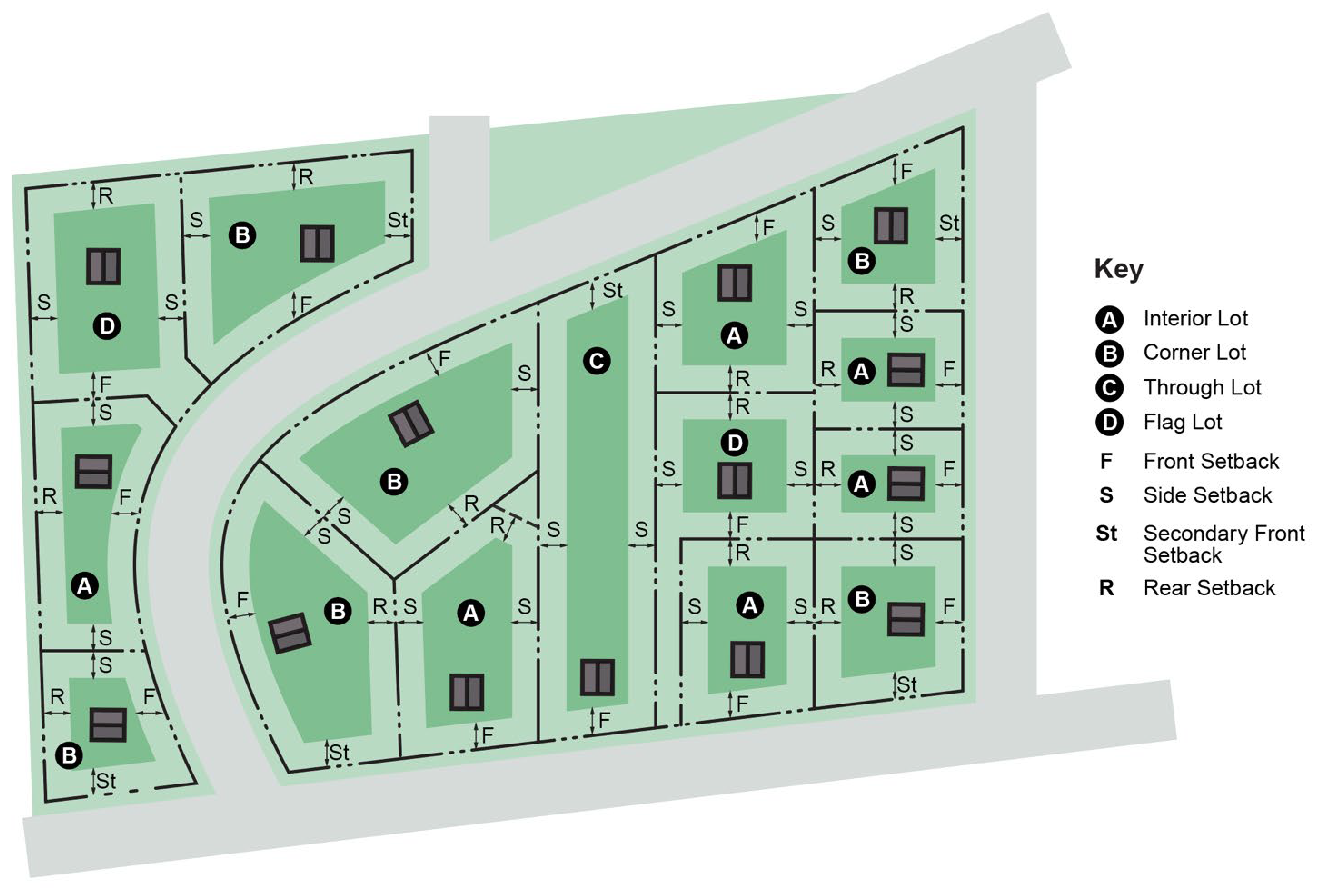
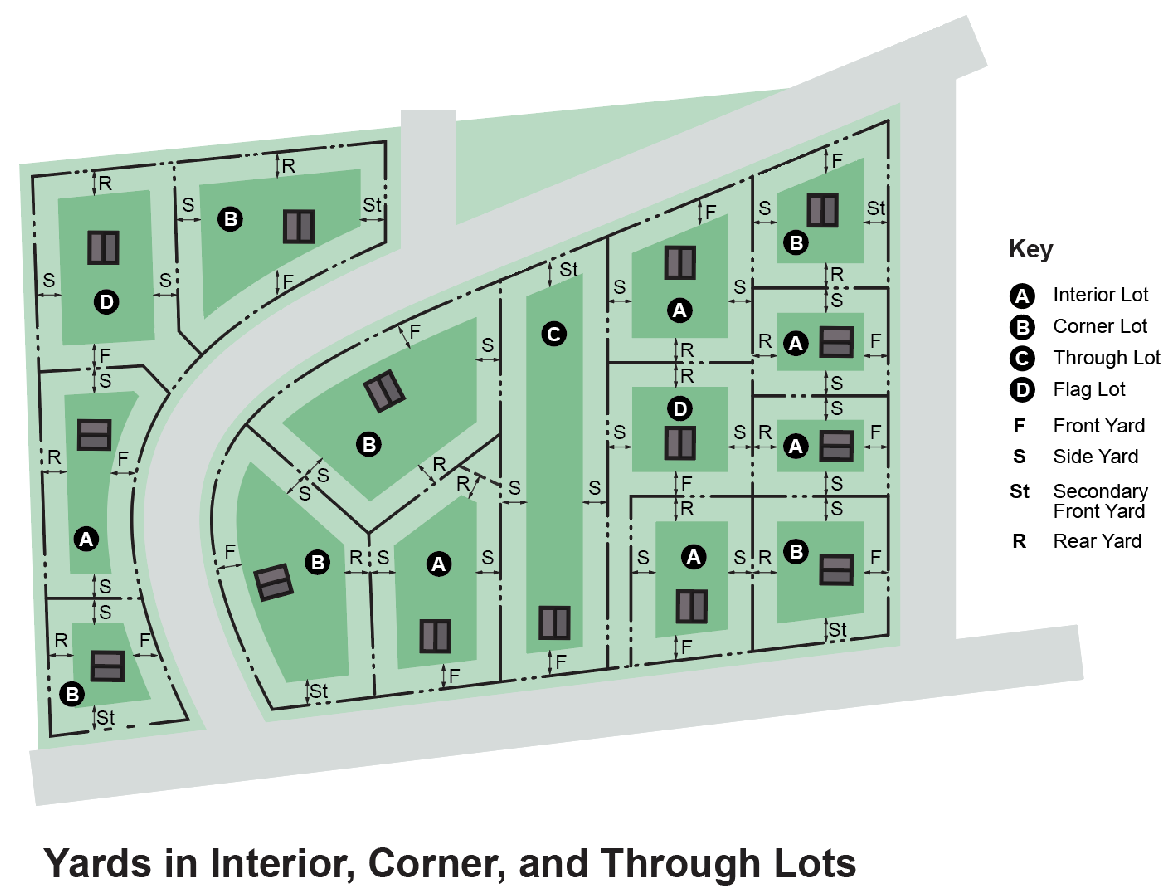
Lot types. The diagram above (lot types and setbacks) which follows illustrates terminology used in this chapter with reference to "corner lots," "interior lots," and "through lots":
(1)
In the diagram, "A" indicates a corner lot, defined as a lot located at the intersection of two or more streets. A lot abutting on a curved street or streets shall be considered a corner lot if straight lines drawn from the foremost points of the side lot lines to the foremost point of the lot meet at an interior angle of less than 135 degrees. See lots marked A(1) in the diagram.
(2)
"B" indicates an interior lot, defined as a lot other than a corner lot with only one frontage on a street.
(3)
"C" indicates a through lot, defined as a lot other than a corner lot with frontage on more than one street. Through lots abutting two streets may be referred to as double frontage lots.
Marihuana caregiver. See subsection [94-6.09(a)(1)].
Marihuana establishment. See subsection [94-6.09(a)(2)].
Marihuana facility. See subsection [94-6.09(a)(3)].
Master plan means the City of Walker's most recent master, comprehensive or other entitled plan adopted by the planning commission and which is on file in the office of the city clerk.
Mechanical billboard means a billboard that uses rotating panels, slats, blades, or the equivalent to change images at regular or irregular intervals. Tri-vision billboards are a type of mechanical billboard. A digital billboard is not a mechanical billboard.
Medical marihuana dispensary. See subsection [94-6.09(a)(4)].
Mezzanine means an intermediate floor in any story occupying not to exceed one-third of the floor area of such story.
Mobile food vending shall mean vending, serving, or offering for sale food and/or beverages from a mobile food vending unit which meets the definition of a food service establishment under Public Act 92 of 2000, which may include the ancillary sales of branded items consistent with the food or beverages, such as a t-shirt that bears the name of the organization engaged in mobile food vending. The mobile food vending unit shall be stationary on a single property. The operator of a mobile food vending unit shall meet the licensing requirements of chapter 22 of the City of Walker Code of Ordinances, and to the required extent therein.
Mobile food vendor shall mean any person engaged in the business of mobile food vending; if more than one person is operating a single stand, vehicle, cart or other means of conveyance, then vendor shall mean all persons operating such single stand, vehicle, cart or other means of conveyance. Mobile food vendors shall not include ice cream trucks or industrial meal vendors, which are not deemed stationary under the definition of transient merchants and solicitors in accordance with section 22-76 of the City of Walker Code of Ordinances.
Nonconforming structure means a structure lawfully existing at the time of the adoption of this chapter or any amendment thereto which does not conform to the regulations of the zoned district in which it is located.
Nonconforming use means a use which was lawfully made of a structure or land at the time of the adoption of this chapter or any amendment thereto and which does not conform with the regulations of the zoned district in which it is located.
Parking facility means an area or structure, either attached or detached to a principal use, which is used for off-street parking of vehicles. A parking facility includes parking lots and parking structures, also known as parking garages.
Parking space, off-street means, for the purposes of this chapter, an off-street parking space shall consist of the space designed or used for parking a vehicle which is not located within the public streets or rights-of-way.
Pedestrian way. See section [94-18.06(c)(15)].
Permanent cosmetics means the application of pigment placed in the skin for the purpose of permanently or semi-permanently changing the color or other appearance of the skin, including, but not limited to permanent eyeliner, eyebrow, or lip color. "Permanent cosmetics" shall be considered a "personal service" use for the purposes of this chapter.
Planning commission means the city planning commission created by section 58-26 of this Code under the Municipal Planning Commission Act, being Act No. 285 of the Public Acts of Michigan of 1931 (MCL 125.31 et seq.), as amended.
Plat. See section [94-18.06(c)(17)].
Porch. See "deck."
Private home means a private residence as defined by the child care organizations act, Act No. 116 of the Public Acts of Michigan of 1973 (MCL 722.11 et seq.) as amended, in which a child care facility licensee or registrant permanently resides as a member of the household, which residency is not contingent upon caring for children or employment by a licensed or approved child placing agency. Private home includes a full-time foster family home, a full-time foster family group home, a group day care home, or a family day care home, as defined by this section.
Proprietor. See section [94-18.06(c)(18)].
Public utility means all persons or municipal or other public authorities, or those organizations licensed or authorized by the city or other relevant government entity, providing gas, electricity, water, steam, sewer, storm drainage, telephone, or other services of a similar nature.
Residential zoning district or residential district means an "A" single-family residential district, "A-2" duplex district, "SA" suburban residential single-family district, "ARM-MULT" multiple-family district, "ARM-1" low density multiple-family district, "RMT" mobile home or trailer park district, "RPUD-1" residential planned unit development district one, and "RPUD-2" residential planned unit development district two.
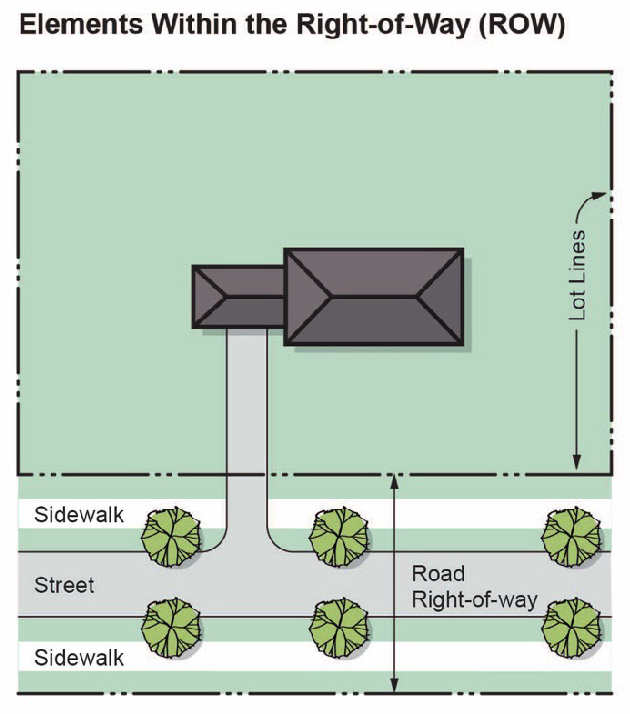
Right-of-way (ROW) means the land and/or property devoted to transportation purposes, including, but not limited to roads, sidewalks, and bike lanes. The following are types of roadways which can make up the ROW.
(1)
Access road means a service roadway which provides access to abutting properties and protection from through traffic.
(2)
Alley means a public or private drive which is intended only to provide supplemental access to a lot. An alley is not a part of the certified street system as a "public street."
(3)
Arterial road, principal is a road classification assigned by the Michigan Department of Transportation generally characterizing roads that carry long distance, through-travel movements, and may provide access to important traffic generators.
(4)
Arterial road, minor is a road classification assigned by the Michigan Department of Transportation generally characterizing roads which are similar to principal arterial roads, except they carry trips of shorter distances and to lesser traffic generators.
(5)
Collector road is a road classification assigned by the Michigan Department of Transportation which generally characterizes roads which provide access to more properties than do arterials and tend to funnel traffic from residential or rural areas to arterials.
(6)
Cul-de-sac means a street way or alley, either public or private, open only at one end.
(7)
Local road means a right-of-way which is not a freeway, arterial road, or collector road, but which is owned and operated by a unit of government.
(8)
Private road means a road which is privately owned by an organization or entity, rather than by a unit government (Not an NFC definition).
(9)
Stub street means a right-of-way which terminates abruptly without the provision of a vehicular turn-around, and constructed with the intention or possibility of future extension to connect the stub street to other roadways.
(10)
Roadway, road, or street means a right-of-way that is intended for the travel of motor vehicles.
Satellite dish antenna means an apparatus capable of receiving communications from a transmitter or transmitter relay located in planetary orbit.
Septic tank means a septic toilet, chemical closet, and any other watertight enclosure used for storage and decomposition of human excrement and domestic wastes.
Single ownership means a lot which is in separate and distinct ownership from adjacent lots when such adjacent lots are not at the applicable date owned by the same owner or the same owner in joint tenancy, tenancy in common or tenancy by the entireties with any other persons and where such adjacent lots are not owned by the same owner or by any person with whom he may be engaged in a partnership or joint venture or a corporation in which he owns more than 50 percent of the stock issued and outstanding.
Special use means a use or structure which, because of its unique characteristics, requires individual review and approval by the planning commission to ensure compatibility with the character of the surrounding area, the adjacent uses of land, the natural environment, the capacities of public services and facilities, and the public health, safety and welfare. Special use uses may be permitted only in those zoning districts as expressly provided by this chapter.
Steep slopes as noted herein are areas of land characterized by a significant incline or gradient, with slopes typically 20 percent or greater. In addition to a percentage of slope, the planning commission may also consider factors such as soil stability, groundwater seeps, erosion risk, and the potential for landslides when determining the designation and location of steep slopes.
Story means that part of a building, except a mezzanine, included between the surface of one floor and the surface of the next floor or, if there is no floor above, the ceiling next above.
Story, half means an uppermost story lying under a sloping roof, the usable floor area of which does not exceed 75 percent of the floor area of the story immediately below, and at least 200 square feet, with a clear height of at least seven but no more than eight feet. The usable floor area of a half story is only that area having at least four feet clear height between floor and ceiling, where the ceiling slopes upward toward a standing height. The half story must not be used or designed or intended to be used as an independent housekeeping unit or dwelling in order to fit this definition.
Street. See "right-of-way."
Structural changes or alterations means any change in the supporting members of a structure, such as bearing walls, columns, beams or girders or any substantial change in the roof.
Structure means anything constructed or erected which requires permanent location on the ground or attachment to something having such location.
Subdivision or subdivide. See section [94-18.06(c)(21)].
Substandard right-of-way. See section [94-18.06(c)(22)].
Temporary portable construction building means an occupied temporary portable unit for office use that is designated to be transported, after fabrication, on its own wheels or on a flatbed or other trailer, or have detachable wheels, which is used for activities related to current construction activities or the future use of the lot on which it is located.
Temporary portable leasing office building means a temporary portable construction building that is specifically used as a space for marketing, promoting and selling leases for rental units currently under construction on the lot on which it is located.
Temporary use means a use which by its nature is established for a limited duration with the intent to discontinue such use upon the expiration of the time period.
Special use means a use or structure which is similar to a special use, but which may be permitted in any zone district within the city upon approval of the planning commission and which may have the potential to affect a greater surrounding land area than a normal special use. Because of their unique characteristics, special uses require individual review and approval by the planning commission to ensure compatibility with the character of the surrounding area, the adjacent uses of land, the natural environment, the capacities of public services and facilities, and the public health, safety and welfare. Special uses may be permitted only as expressly provided for by article XVII, and in accordance with the standards and requirements of article IX of this chapter.
Yard means an open space on a lot, unoccupied and unobstructed except as specifically permitted by this chapter.
Yard, front means the minimum distance between the principal building, excluding steps and unenclosed porches, and the nearest edge of the street right-of-way, extending for the full width of the lot and unoccupied between the principal building and the nearest edge of the street right-of-way, except as permitted by this chapter. A lot which abuts two or more improved public streets (such as a corner lot or a through lot) shall have one front yard, which shall be the yard adjacent to the street included in the lot's address. All other yards meeting this definition, but not designated as the address of the lot, shall be considered "secondary front yards."
Yard, rear means the minimum distance between the rear lot line and the rear line of the principal building, extending for the full width of the lot and unoccupied except for that area occupied by a permitted accessory building. For irregular, triangular, wedge-shaped, or pointed properties, to determine the rear setback, the setback shall be measured from an imaginary ten-foot line drawn parallel to the front property line.
Yard, side means an open unoccupied space on the same lot with the building extending between the building and the side lot line from the front yard to the rear yard. In the case of through lots, side yards extend from the rear lines of the required front yards.
(Ord. No. 24-674, § 2(Exh. A), 1-22-24)

