
Walker City Zoning Code
ARTICLE XII
- SITE DESIGN
Sec. 94-12.01. - Access management.
(a)
Residential driveways. All residential driveways that are greater than 125 feet in length (measured from the public or private street right-of-way to the closest point of the residential structure to be measured along the center line of the driveway) shall comply with the following requirements:
(1)
The driveway must be approved by the planning director after review and recommendation by the fire chief or his designee for compliance with this section.
(2)
The inside radius of all horizontal curves shall be a minimum of 25 feet.
(3)
The design of any bridge or crossing of a culvert greater than 48 inches in diameter shall be approved by a registered professional engineer. All bridges and culverts shall be capable of supporting a vehicle with a front axle weight of 18,000 pounds and a rear axle weight of 30,000 pounds.
(4)
All gates blocking access to a residential driveway shall have any emergency access code determined by the fire department and shall cause the gate to remain open until the code is cancelled, or be equipped with a keyed switch that will keep the gate open. The keyed switch must use a Knox Box Key.
(5)
The driveway shall have a surface capable of supporting a vehicle with a front axle weight of 18,000 pounds and a rear axle weight of 30,000 pounds and shall be maintained in a condition which is accessible to and useable by fire and other emergency vehicles during construction on the lot or parcel served by the driveway.
(6)
The surface of the driveway shall have a minimum width of ten feet except that the driveway entrance at the road shall meet the requirements of the city for driveway approaches.
(7)
The area within two feet of each side of the driveway surface, and within 13 feet six inches above the driveway surface, shall be kept reasonably free of obstructions, such as tree trunks and large branches, which may interfere with use of the driveway by fire vehicles.
(8)
A clear area allowing for the maneuvering and turn-around of firefighting apparatus will be provided near the end of the driveway at the residential structure. The design and location of the clear area shall be approved by the planning director after review and recommendation by the fire chief or his designee.
(9)
Every driveway over 400 feet in length shall widen to 22 feet for 60 feet in length to provide a passing/pullout lane. Any driveway over 800 feet in length shall have at least two such passing/pullout lanes. The location of the passing/pullout lane(s) must be approved by the planning director after review and recommendation by the fire chief or his designee. When it is deemed necessary, because of the distance from a water source or for efficiency of operations to mark passing lanes, such lanes will be marked with a sign as required by the planning director after review and recommendation by the fire chief or his designee.
(b)
All residential driveways that are 800 feet or more in length, measured as provided in subsection (a) above, shall comply with the following requirements:
(1)
The requirements of subsection (a) of this section shall be met.
(2)
Marker posts, for purposes of providing distance information to the main structure(s) for fire or other emergency response personnel, may be required. The need for these posts and their locations shall be determined by the planning director after review and recommendation by the fire chief or his designee.
(3)
An adequate number of additional passing/pullout lanes so as to allow uninterrupted fire department access and operations shall be provided as approved by the planning director after review and recommendation by the fire chief or his designee.
(c)
For purposes of this section, a "residential driveway" means an improved or unimproved path, road, or ground surface that provides vehicular access from a public or private street to a single-family or two-family residential dwelling.
(d)
Residential-commercial shared driveways prohibited. No property within a residentially zoned area shall be used in conjunction with a commercial or industrial use for purposes of a driveway, service drive, access drive, or other such similar purpose unless such property shall be rezoned for commercial or industrial use.
(e)
Overlays. See article VIII.
(Ord. No. 24-674, § 2(Exh. A), 1-22-24)
Sec. 94-12.02. - Parking.
Off-street parking required in conjunction with all land and building uses shall be provided as prescribed in this section:
(a)
The minimum number of off-street parking spaces shall be determined in accordance with the table in section 94-12.03 For uses not specifically mentioned therein, off-street parking requirements shall be interpreted by the board of zoning appeals from requirements for similar uses.
(b)
Any area once designated as required off-street parking shall not be changed to any other use unless and until equally required facilities are provided elsewhere. Off-street parking existing at the effective date of the ordinance from which this section derives in connection with the operation of an existing building or use shall not be reduced to an amount less than would be required in this article for such building or use.
(c)
The off-street parking may be provided either by individual property owners or by a parking program carried out through public action, whether by a special assessment district or otherwise.
(d)
Two or more buildings or uses may collectively provide the required off-street parking, in which case the required number of parking spaces shall not be less than 75 percent of the sum of the requirements for each individual use computed separately. However, if an off-street parking area is shared by two or more buildings or uses, the operating hours of which do not overlap for more than four hours on a single day of the week, the total required number of parking spaces may be reduced to reflect the peak hour demand, as determined appropriate by the planning commission. The planning commission may request a third-party parking study to assist in making this determination.
(e)
Required off-street parking for nonresidential uses shall be for the use of occupants, employees, visitors and patrons and shall be limited in use to motor vehicles. The use of required off-street parking for storage of merchandise, motor vehicles for sale, or the repair of vehicles is prohibited. Off-street parking, whether public or private, for nonresidential uses shall be either on the same lot or within 300 feet of the building it is intended to serve, measured from the nearest point of the building to the nearest point of the off-street parking lot, without crossing any collector or arterial road.
(1)
Nonresidential off-street parking spaces may only be provided on an improved parking surface, which is defined as a uniform surface meeting the following minimum construction standards:
(2)
Gravel is prohibited.
(f)
Required off-street parking residential uses shall be for the use of occupants and shall be limited in use to motor vehicles. The use of required off-street parking for storage of merchandise, motor vehicles for sale, or the repair of vehicles is prohibited. Off-street parking, whether public or private, for residential uses shall be on the same lot of the dwelling unit it is intended to serve.
(1)
Residential off-street parking spaces may only be provided on an improved parking surface meeting the standards of section 94-12.02(e)(1) except when all of the following criteria are met, in which case a smooth, dustless, nonerodible unpaved surface meeting the standards of the city's engineering department shall be permitted:
a.
The lot in question contains no more than two dwelling units.
b.
If the lot in question is greater than one acre in area.
c.
The front setback of the frontmost principal building is at least 65 feet.
(2)
Residential off-street parking spaces for motor vehicles must be contiguous to the residential driveway.
(3)
Residential off-street parking spaces on any lot that contains one or two dwelling units cannot cover more than 30 percent of a required front yard.
(4)
Residential off-street parking spaces must maintain a three-foot setback from any property line.
(g)
If off-street parking in permanent public ownership and operation exists in quantity and location greater than would be necessary to fulfill the parking requirements of this article for the existing contiguous buildings, then the excess number of parking spaces may be prorated to the land area within 300 feet,The planning commission shall calculate the proration of the excess number of parking spaces and, based on that calculation, may apply a credit towards the minimum number of parking spaces otherwise required to be provided.
(h)
Table of off-street required parking spaces.
(1)
For purposes of this section, the following definitions shall apply:
a.
Floor area. The sum of all horizontal areas of the several floors of a building or dwelling unit, measured from the exterior fades of the exterior walls or form the centerline of walls separating dwelling units. Unenclosed porches, courtyards, patios and cellars shall not be considered as part of floor area, except when utilized for commercial or industrial purposes.
b.
Gross floor area (GFA). The area within the perimeter of the outside walls of the building, without deduction for hallways, stairs, closets, storage rooms, utility rooms, inventory rooms, thickness of walls, columns or other features (as illustrated below).
c.
Usable floor area (UFA). That area used for or intended to be used for the sale of merchandise or services, or for use to serve patrons, clients or customers (as illustrated below). Floor area used or intended to be used for hallways, stairways, elevator shafts, utility or sanitary facilities or for the storage or processing of merchandise or food products shall be excluded from this computation of UFA. Measurement of UFA shall be the sum of the horizontal areas of each story of a structure measured from the internal faces of the exterior walls.
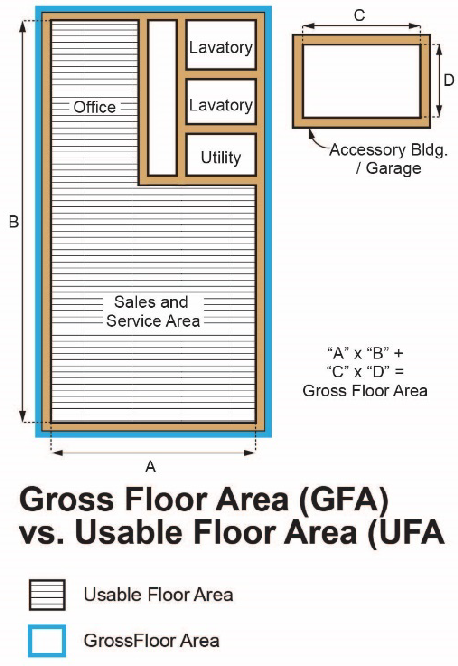
The minimum number of off-street parking spaces shall be determined in accordance with the following table:
(i)
Off-street parking lot layout, construction and maintenance. Off-street parking spaces shall be designed, constructed and maintained in accordance with the following requirements:
(1)
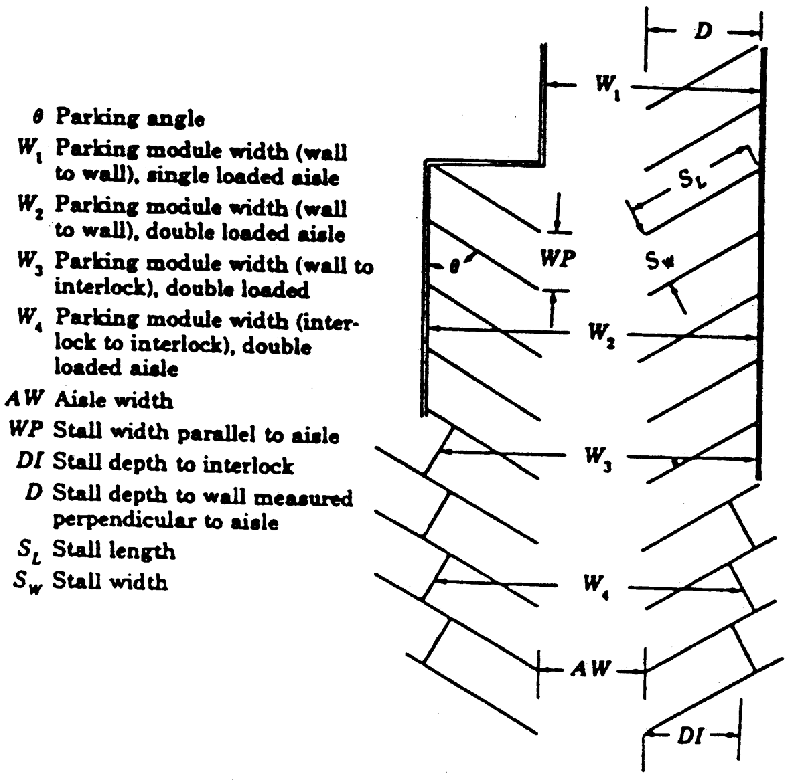
Off-street parking spaces shall comply with all minimum stall width, stall depth, aisle width, parking module width and other requirements prescribed by the table below.
(2)
Adequate ingress and egress shall be provided for vehicles to the parking lot by means of clearly limited and defined drives from the roadway to the parking area not less than 24 feet in width for two way traffic, or 12 feet in width for one-way traffic.
(3)
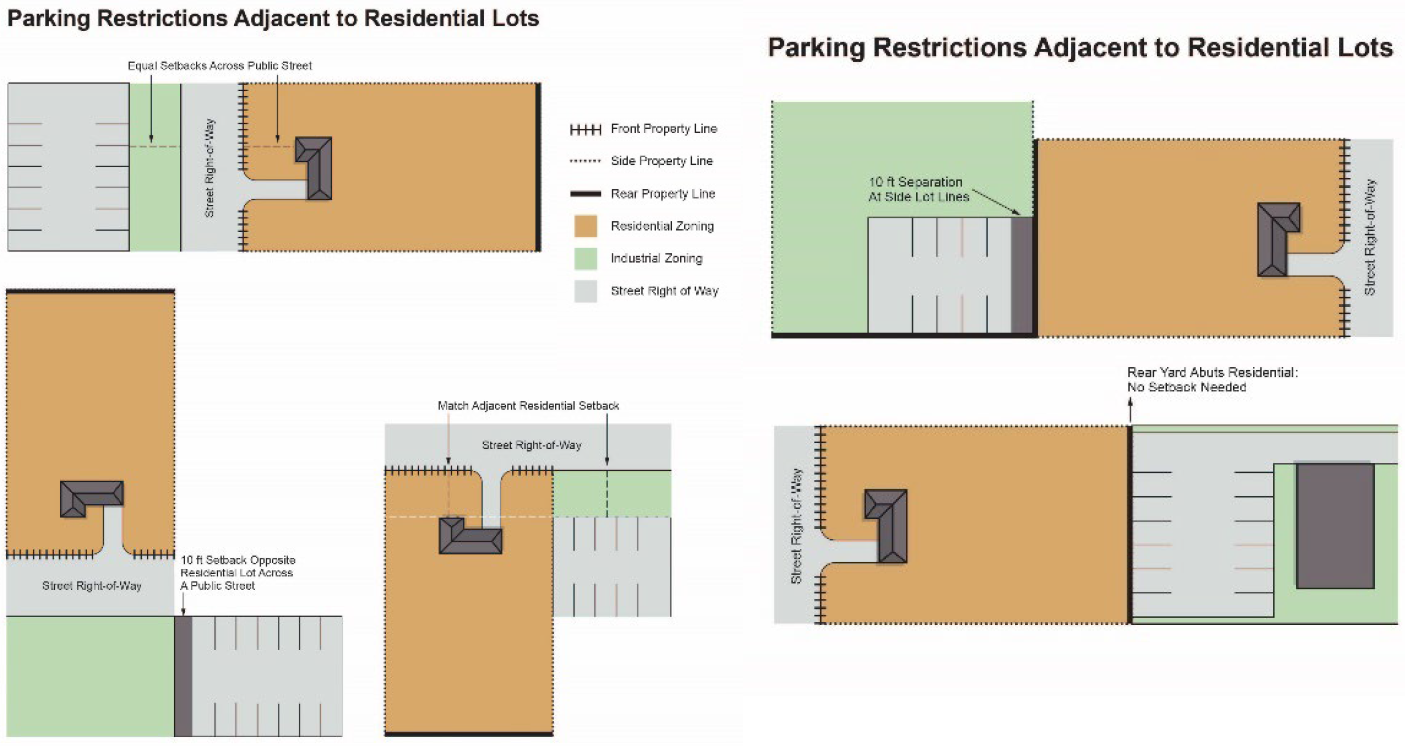
Parking spaces shall be set back from abutting residential districts as follows:
(4)
The land between the setback line and the lot line in a parking lot required by subsection (3) is called a buffer strip.
(5)
for the purposes of this article. There shall be bumper stops or curbs provided in order to prevent any vehicle from projecting over the buffer strip. The ground of the buffer strip shall be used only for the purpose of plant materials.
(6)
Where buffer strips are not required, bumper stops or another method approved by the planning commission shall be provided, so located as to prevent any vehicle from projecting over the lot line.
(7)
Where the boundary of any off-street parking space is located within 20 feet of property zoned for residential use, a suitable fence shall be provided which, in the judgment of the planning commission (or planning director, when planning commission approval is not required), serves the same function and is not detrimental to surrounding properties, but shall not extend into the required front open space of the abutting residential lot.
(8)
The parking lot shall be drained to dispose of surface water. On any off-street parking or loading area of 1,000 square feet or more, surface water must be disposed of through an underground drainage system meeting the requirements of the city stormwater ordinance (chapter 67). Surface water drainage must meet the requirements of the city stormwater ordinance.
(9)
The surface of the parking lot, including drives and aisles, excepting the buffer strips, shall be constructed of a dustless and durable all-weather surfacing material.
(10)
Parking structures may be built to satisfy off-street parking regulations when located in other than residential districts, subject to the area, height, bulk and placement regulations of such district in which located.
(j)
Required off-street parking areas for three or more vehicles shall have individual spaces marked and shall be so designed, maintained and regulated that no parking or maneuvering incidental to parking shall be on any public street, walk or alley, and so that any vehicle may be parked and unparked without moving another.
(k)
Parking areas intended to provide spaces for vehicles with more than two axles shall provide truck turning templates to demonstrate capacity for safe ingress and egress between the parking area and the roadway.
(Ord. No. 24-674, § 2(Exh. A), 1-22-24)
Sec. 94-12.03. - Off-street loading and unloading.
(a)
On the same premises with every building, structure or part thereof, erected and occupied for manufacturing, storage, warehousing, retailing, wholesaling or other uses involving the receipt or distribution of vehicles or materials or merchandise, there shall be provided and maintained on the lot adequate space for standing, loading and unloading services adjacent to the opening used for loading and unloading in order to avoid interference with public use of highways, streets or alleys.
(b)
The space for standing, loading and unloading services shall not include any portion of the layout for off-street parking pursuant to the requirements of section 94-12.02 (including, without limitation, off-street parking spaces, parking aisles, and defined drives for ingress and egress).
(c)
If determined to be necessary by the planning commission or planning director, truck turning templates shall be provided for all loading and unloading areas to confirm that all movements can be made safely on-site, and that safe ingress and egress between the loading area and the roadway is possible.
(d)
Such loading and unloading space shall be in an area minimum ten feet by 40 feet with a 14-foot height with a 14-foot height clearance and shall be provided according to the following table:
(Ord. No. 24-674, § 2(Exh. A), 1-22-24)
Sec. 94-12.04. - Parking, storage or use of major recreational equipment; parking and storage of mobile home dwellings.
(a)
For purposes of this article, "major recreational equipment" is defined as including boats and boat trailers; travel trailers; pickup campers or coaches (designed to be mounted on automotive vehicles); motorized dwellings; tent trailers; snowmobiles; ORVs (off-road vehicles) and similar vehicles or equipment; and cases or boxes used for transporting recreational equipment, whether occupied by recreational equipment or not. "Major recreational equipment" does not include "mobile home dwellings."
(b)
No major recreational equipment shall be parked or stored on any lot in a residential district except as follows:
(1)
All major recreational equipment shall be parked or stored either wholly within a carport or enclosed building, or within the rear yard or side yard of the lot, as provided by this section.
(2)
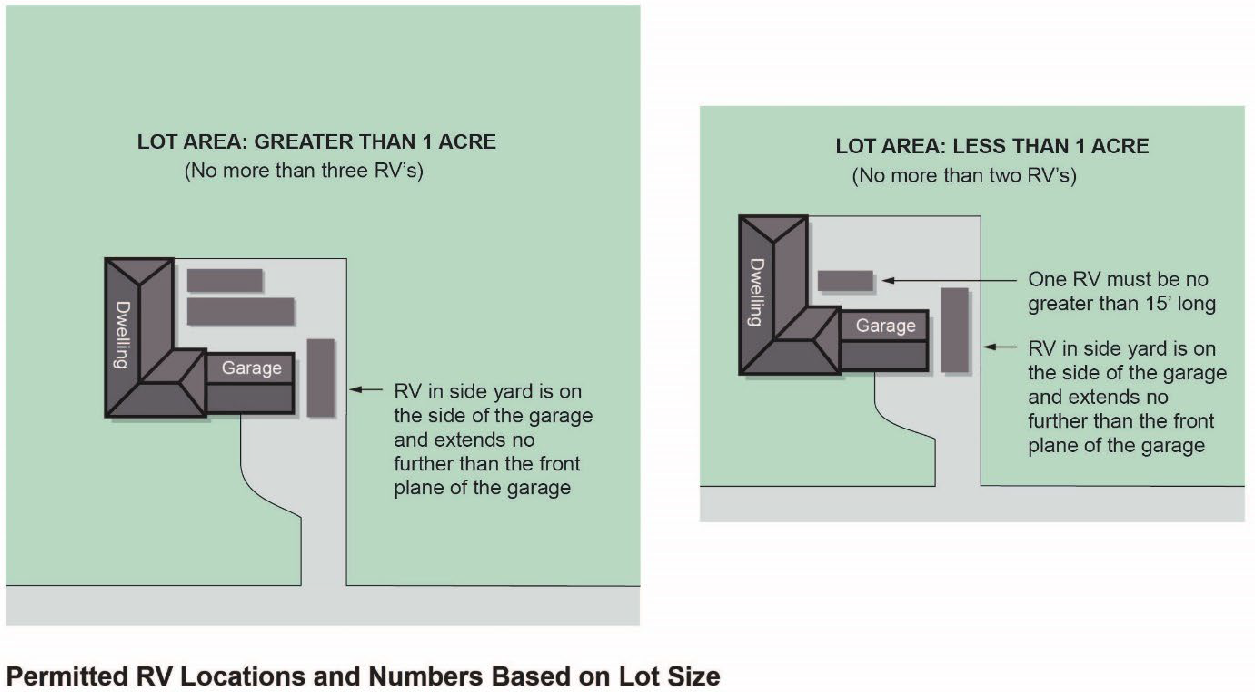
If the lot is less than or equal to one acre in size, a maximum of one piece of major recreational equipment, plus one additional piece of major recreational equipment that is not more than 16 feet long, may be stored on the lot outside of a carport or enclosed building. If the lot is larger than one acre, a maximum of three pieces of major recreational equipment may be stored on the lot outside of a carport or enclosed building. However, in no case shall more than one piece of equipment be parked or stored within the side yard of any lot at any one time.
(3)
If parked or stored within the side yard, the equipment shall be parked or stored only in the side yard which is adjacent to the garage and shall not extend any farther toward the street than the closest adjacent principal building (or closest adjacent portion of the building) next to which the equipment is parked or stored. In no case shall the equipment be parked or stored within, or extend into, the front yard of the lot or within a side yard that is not adjacent to a garage.
(c)
Notwithstanding any other provision of this section to the contrary, a maximum of one piece of major recreational equipment may be parked within the front yard of a residential lot during loading and unloading of the equipment, but in no case for a period to exceed 72 hours provided, however, that:
(1)
Major recreational equipment (except a boat) which exceeds 34 feet in length or eight and one-half feet in width shall not be parked or stored anywhere, or for any purpose, on a residential lot for more than 48 hours; and
(2)
A boat which either (i) exceeds 34 feet in length, or (ii) exceeds nine feet in width, shall not be parked or stored anywhere, for any purpose or for any period of time, on a residential lot unless it is within a wholly enclosed building.
(d)
Major recreational equipment shall not be used for living, sleeping or housekeeping purposes when parked or stored on a residential lot or in any other location not approved for those purposes.
(e)
The parking or storage of major recreational equipment shall comply with all other applicable laws and ordinances, including, without limitation, article V of chapter 78 of this Code.
(f)
For purposes of this section, the length of any major recreational equipment, other than trailers, shall be measured from the rear of the unit to the front of the unit or the front of the hitch attached to the unit, whichever is longer. The length of any major recreational equipment that is a trailer of any type shall be measured from the rear of the trailer to the front of the hitch.
(g)
No mobile home dwelling shall be parked or stored for any period of time on any residential lot or in any location not approved for such use, except as otherwise permitted by article IV or section 94-15.04.
(Ord. No. 24-674, § 2(Exh. A), 1-22-24)
Sec. 94-12.05. - Parking and storage of certain vehicles.
(a)
Automotive vehicles of any kind or type (except as permitted in section 94-12.04) without current license plates shall not be parked or stored on any residentially zoned property other than in completely enclosed buildings.
(b)
Automotive trailers of any kind or type (except as permitted in section 94-12.04) with or without current license plates shall not be parked or stored on any residentially zoned property other than in a completely enclosed building or within the rear yard or side yard of the lot. If parked or stored within the side yard, the automotive trailer shall be parked or stored only in the side yard which is adjacent to the garage and shall not extend any farther toward the street than the closest adjacent principal building (or closest adjacent portion of the building) next to which the trailer is parked or stored. In no case shall the trailer be parked or stored within, or extend into, the front yard of the lot or within a side yard that is not adjacent to a garage. Notwithstanding any other provision of this subsection, a maximum of one automotive trailer may be parked in the front yard of a residential lot during loading and unloading but in no case for a period to exceed 48 hours. For purposes of this subsection, an "automotive trailer" is any trailer designed or used to be drawn by a motor vehicle to carry persons or property.
(c)
It shall be illegal to park or garage a commercial vehicle on any lot in a residential or agricultural district except that one commercial vehicle per lot shall be permitted if such vehicle is not larger than a regularly manufactured pickup or panel truck of one and one-half ton capacity and is operated by a member of the family residing on such lot.
(Ord. No. 24-674, § 2(Exh. A), 1-22-24)
Sec. 94-12.06. - Lighting.
(a)
Intent. The regulations in this section are intended to require sufficient lighting for parking areas, walkways, driveways, building entrances, loading areas, and common areas to ensure the security of property and safety of persons. These regulations are also intended to prevent the adverse effects of inappropriate lighting, including glare, light trespass onto adjoining properties, light pollution and sky glow, and energy waste. These regulations are also intended to permit and encourage the use of lighting that promotes energy efficiency and conservation in the city.
(b)
Definitions. Words and phrases used in this section shall have the meaning set forth below. Words and phrases not defined herein but defined in article VIII shall be given the meanings set forth in article II. All other words and phrases shall be given their common, ordinary meaning, unless context clearly requires otherwise.
(1)
Correlated color temperature (CCT). A measure in degrees Kelvin (K degrees) of light's warmness or coolness. Lamps with a CCT of less than 3,200 degrees K are pinkish and considered warm. Lamps with a CCT greater than 4,000 degrees K are bluish-white and considered cool.
(2)
Diffuser. A device used to distribute light from a source.
(3)
Drop lens. A type of diffuser which extends below the shield or other opaque element of a light fixture.
(4)
Fixture. The assembly that holds the lamp in a lighting system. The fixture includes the elements designed to give light output control, such as a reflector (mirror), refractor (lens), the ballast, housing, and the attachment parts.
(5)
Footcandle. Illuminance produced on a surface one foot from a uniform point source of one candela or when one lumen is distributed into an area of one square foot.
(6)
Fully shielded fixture (also known as "hidden source"). An outdoor lighting fixture that is shielded or constructed so that the source of light is not visible when the fixture is viewed from a horizontal orientation. The light emanating from the fixture shall not emanate above any horizontal plane.
(7)
Glare. Intense and blinding light that reduces visibility. A light within the field of vision that is brighter than the brightness to which the eyes are adapted.
(8)
Laser source light. An intense beam of light in which all photons share the same wavelength.
(9)
Light source. The source of electric light (to be distinguished from the whole assembly, which is called the luminaire). "Lamp" denotes the bulb and its housing.
(10)
Light trespass. Light falling where it is not wanted or needed (also called spill light).
(11)
Luminaire. A lighting unit consisting of one or more electric lamps with all the necessary parts and wiring.
(12)
Lumens. The unit of luminous flux, equal to the luminous flux emitted in a unit solid angle by a point source of one candle intensity.
(13)
Ornamental light. Light fixtures designed to provide decorative light, rather than fixtures used to illuminate an area for safety or security reasons. Ornamental lighting is intended to set a mood, create a play of shadows, highlight a given area or element, but is not signage or advertising. This type of lighting is not intended to address the general lighting needs of the site.
(14)
Recessed canopy fixture. An outdoor lighting fixture recessed into a canopy ceiling so that the bottom of the fixture is flush with, or recessed within, the ceiling.
(15)
Rope lighting. Lighting that is primarily used as a decorative or ornamental lighting fixture, featuring small light sources linked together and which may be encased in a clear, flexible material so as to create a rope.
(16)
Sky glow. The effect of multiple lights that creates an unnaturally bright hue in the night sky, obscuring the view of celestial objects and/or negatively affecting bird migration.
(17)
Tube light. Any light fixture that has the appearance of a "tube" of light, including neon, LED, or other lighting types.
(c)
Applicability. The provisions of this section shall apply to any exterior light fixture installed on any property in the city.
(d)
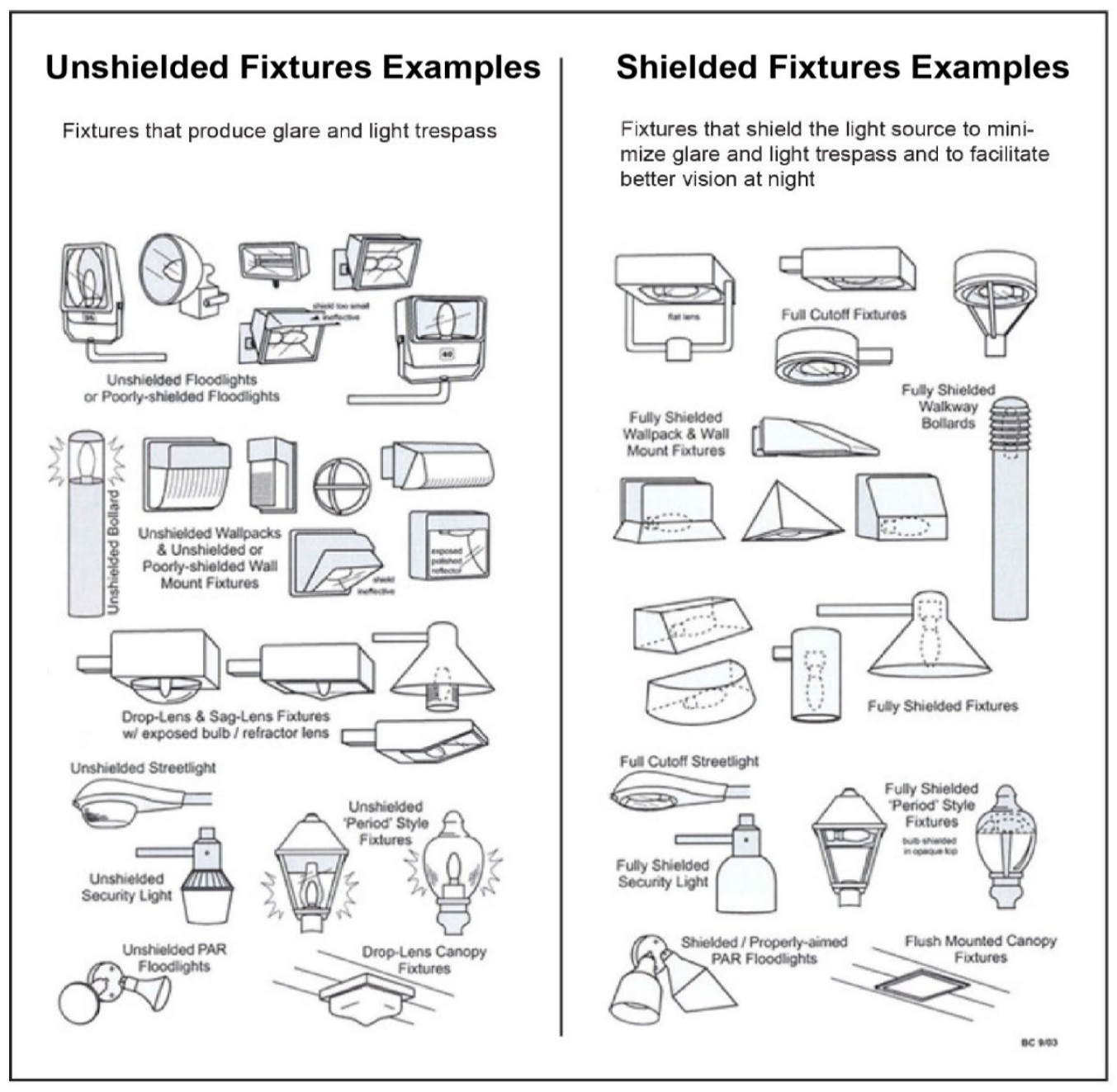
Examples of fixtures. The following chart shows examples of those unshielded fixtures that are prohibited and those shielded fixtures that are acceptable. The chart is merely to demonstrate options, and is not regulatory in and of itself.
(e)
Lighting zones.
(f)
Footcandles standards. The following table lists the required minimum and maximum footcandles at grade, during the hours of operation for the site, for the various outdoor site areas. A photometric topography map of the lot and all areas within 25 feet of the lot boundaries shall be submitted with all site plan applications where outdoor lighting is proposed. Lighting shall not be required in any area not listed below. This table shall not apply to single-family homes, which shall instead be subject to the standards of section [94-15.04].
(g)
General requirements for other than single-family residential uses.
(1)
All nonresidential outdoor light fixtures shall be installed and maintained in their directly downward facing position and shielded so as to conceal the source of the light, except as otherwise described in this chapter.
(2)
In the LZ1 and LZ2 districts, no light produced on a given lot shall trespass onto any adjacent lot. In the LZ3 district, no light produced on a given lot shall trespass more than 25 feet onto any adjacent lot. In all three lighting districts, no light produced on a given lot shall trespass more than 25 feet onto any adjacent right-of-way.
(3)
Gas station canopies and similar structures shall have fully recessed lighting fixtures.
(4)
Lighting poles shall be located in a manner that will not interfere with pedestrian or automobile circulation. Light fixtures shall not exceed 35 feet in height, measured from grade to the bottom of the fixture, except on lots within or adjacent to residential districts, in which case the height maximum shall be 20 feet.
(h)
General regulations for single-family homes.
(1)
No light fixture shall be installed or operated that causes glare or light on neighboring properties, and no light fixture shall be installed or operated that causes a danger to passing motorists or pedestrians through glare or light intrusion onto a public or private roadway.
(2)
The city shall remove or cause to be removed any light fixture that is in violation of this section.
(i)
Prohibited lighting.
(1)
The operation of searchlights for advertising purposes is prohibited.
(2)
Any outdoor light emitting "blue" light, which shall be defined as any light emitted at greater than 5,000 degrees Kelvin on CCT scale, is prohibited.
(3)
Flashing, pulsating, moving, chasing, or strobing lights, or any other lights that move or simulate movement, are prohibited.
(4)
Any light that creates glare (as defined in this chapter) outside of the site the fixture is located on, including lights shining from inside a building, must be removed or otherwise mitigated.
(j)
Exempt lighting. The following light fixtures shall be exempt from this section, including exempt from the list of "prohibited lighting":
(1)
Lighting necessary for construction or emergencies is exempt from the provisions of this article provided that said lighting is temporary and is discontinued immediately upon completion of the construction work or abatement of the emergency. Light fixtures may remain in place, but may not be activated except for emergencies.
(2)
Lighting that is required by the county, state, or federal government, including, but not limited to, airport lighting and lighting of wireless telecommunications facilities, shall be exempt from this section.
(3)
Lighting of the U.S. flag, as recommended by the Flag Code, is exempt from this section, provided that the fixtures must illuminate only the flag.
(k)
Lighting of public and private roadways. Lighting of roadways shall be subject to the following requirements ONLY, and shall be exempt from all other subsections of section 94-12.06.
(1)
The location and manner of lighting of public roads shall be determined by the city manager or their designee in accordance with this chapter, and be administered and maintained by the city or by an organization contracted with the city to provide such services. Lighting of public roads shall be determined by the city manager or their designee.
(2)
Lighting of private roads shall meet the following standards:, by zoning district:
a.
Street lighting in conformance with this section shall be required within all subdivisions or site condominiums where lot widths are less than 100 feet. The planning commission may also require street lighting in conformance with this section within any other subdivision or site condominium, or along any other private road.
b.
Light fixture design. Light fixtures 20 feet in height or greater shall be downward facing at a 90 degree angle and shielded so as to conceal the source of the light. Light fixtures under 20 feet in height shall be exempt from that requirement.
c.
Pole height. Light fixtures in residential districts and RPUDs shall not exceed 20 feet in height. Light fixtures in all other zoning districts shall not exceed 35 feet in height.
d.
Lighting required at intersections. Lighting shall be provided at all intersections, including intersections with a pre-existing road.
e.
Pole spacing. Light fixtures must be provided at least every 150 feet. The required poles at intersections shall count towards this requirement. At each location where a pole is required, there need only be a pole on one side of the street.
(3)
Private lighting is permitted in the public right-of-way, subject to design review by the city manager or their designee and the provision of a license agreement, or easement as appropriate, with the city or Michigan Department of Transportation, as applicable.
(l)
Special uses for lighting. Uses listed in this section may be approved for lighting that does not meet the requirements of this by special use approval, provided that the planning commission determines that they meet the following criteria as well as the general special use criteria elsewhere in this chapter.
(1)
The lighting must be accessory to a use for which lighting that does not meet the requirements of this chapter is an important and necessary component of the operation of the use, including the following:
a.
Sport fields and stadiums.
b.
Bridges.
c.
Specialized theme park lighting.
d.
Public monuments, public buildings and religious institutions.
e.
Industrial uses where operational needs require lighting that does not meet the requirements of this section is necessary, in the opinion of the planning commission.
(2)
To obtain a special use, applicants shall demonstrate that the proposed lighting installation:
a.
Utilizes fully shielded luminaires and, if required, side shielded and internally shielded luminaires that are installed in a fashion that maintains the shielding characteristics unless certified in writing by a registered engineer or by a lighting certified professional that such shielding is impractical. Where fully shielded fixtures cannot be utilized, acceptable luminaires shall include only those which are installed with minimum aiming angles of 25 degrees upward from the horizontal. Said aiming angle shall be measured from the axis of the luminaire's maximum lumens as certified by independent testing agency.
b.
Has received every reasonable effort to mitigate obtrusive light and artificial sky glow, supported by a signed statement from a registered engineer or by a lighting certified professional describing the mitigation measures.
c.
Will not create glare, sky glow, or light trespass.
d.
Meets all requirements of this chapter in order to be approved for a special use.
(3)
The planning commission may impose conditions on the special use related to the lighting, such as hours of operation, automatic dimmers, etc.
(Ord. No. 24-674, § 2(Exh. A), 1-22-24)
Sec. 94-12.07. - Landscaping.
(a)
Purpose. The purpose of this article is to:
(1)
Promote the health, safety, and welfare of the community by:
a.
Protecting the character, appearance, and thereby the value of land and residential neighborhoods
b.
Recognizing the role of trees and shrubs in enhancing the quality of the community.
c.
Reducing soil erosion and depletion and increasing water retention in the soil to reduce runoff.
(2)
Protecting the stability of each parcel and lot within the city by requiring screening or land use buffers between contiguous land uses of different or conflicting intensity of use.
(3)
Enhance the appearance of commercial developments, vehicular use areas, off-street parking areas, street and road rights-of-way, and land directly abutting said rights-of-way, thereby reducing or eliminating conditions which may lead to blighted conditions.
(4)
Enhance the public health, safety, and welfare of the community by assisting in the definition and recognition of traffic flows related to commercial, office and multiple-family residential developments, vehicular use areas, off-street parking areas, street and road rights-of-way, and land directly abutting said rights-of-way.
(5)
Implement the master plan objective to "… preserve important natural features, such as wetlands, lakefronts, and landmark trees, when new development occurs." (Page 38 of the 2017 city master plan).
(b)
When required. The provisions of this section regarding the design of new landscaping shall apply to all parcels or lots on which an improvement or development is proposed requiring site plan approval from the planning commission (including planned unit developments), or special use approval. The planning commission shall enforce the provisions of this section regarding design during the review process.
For existing sites with a previously approved landscape plan, the planning commission shall have the option of requiring the site to comply with its previously approved landscape plan, rather than altering the landscaping to comply with this section. In the event that an applicant is permitted to comply with the previously approved plan, rather than designing a new one, all plantings that are dead or otherwise in poor condition shall be replaced by a planting of similar species and size (at planting). If the applicant cannot produce a previously approved landscape plan, then the sites must be brought into compliance with this chapter.
The planning director shall enforce the provisions regarding installation and maintenance of landscaping during construction and the ongoing operation of the site in question.
(c)
Schedule of landscape regulations. The following landscaping requirements shall apply in the zoning districts listed. There shall be no landscaping requirements in the AA district.
Footnotes:
(a) The frontage landscape area must be entirely on private property, and shall not extend into the public right-of-way. A nonmotorized pathway/sidewalk (or associated easement) may be located in the frontage landscape area. However, if a pathway (or easement) is located within the frontage landscape area, the landscape area must be increased by the width of the pathway or sidewalk.
(b) In residential-only developments with interior roadways, the street frontage requirements shall only apply along adjacent public road ways, and shall not apply to interior access roadways.
(c) In residential developments, "paved area" shall include only parking lots that serve community amenities and/or multiple dwelling units. Roadways, driveways to individual units, and other paved areas shall not be included in the calculation of required landscaping.
(d) Landscape islands shall not be required for parking lots with fewer than 20 spaces.
(e) The minimum size for a landscape island shall be 200 square feet. However, designers are encouraged to consolidate the required landscaping into fewer large islands, rather than many small ones. The planning commission shall review the plan and may request that islands be consolidated into larger landscape areas.
(f) Landscape islands shall be covered with either grass, mulch, or salt tolerant native plantings.
(g) In locations where residential buildings have a side-to-side relationship across property lines, rather than a back-to-back relationship, this requirement shall not apply.
(h) This requirement shall not apply to individual single-family homes. It shall only apply when a subdivision, site condominium, RUD, or PUD is proposed.
(i) A snow storage area must be designated adjacent to all parking lots. The snow storage area shall not contain required landscape plantings.
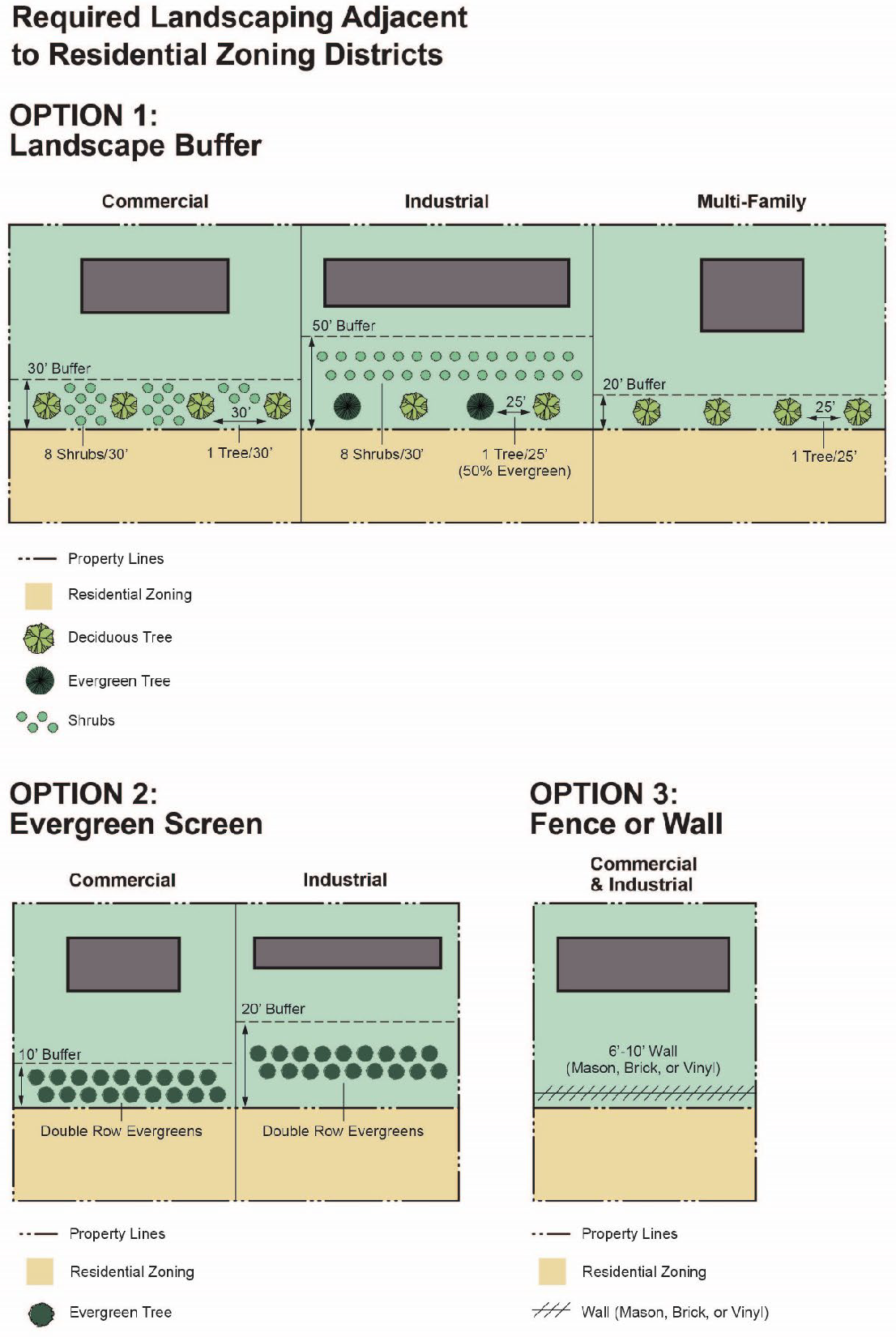
(j) At the time of site plan approval, the applicant shall propose a buffering option. The planning commission may require a specific option, rather than the one proposed, upon determining that the chosen option would be not provide sufficient screening and buffering for the proposed use.
(d)
City of Walker Street Tree Policy. In addition to the requirements in subsection (c), all developments subject to this section shall also be subject the City of Walker Street Tree Policy, as outlined in the City of Walker Construction Standards for Public Rights-of-Way and Easement.
(e)
Plan requirements. Landscape Plans must be prepared by a licensed landscape architect shall illustrate areas of existing trees or wood lots which shall be removed and those that will be retained, as well as the type, quantity, location, and size of plant material proposed. The landscape plan shall show the location of all buildings, paving, proposed lawn areas, and all other information necessary to permit the planning commission, and their associated staff and/or consultants, to fully evaluate the landscape treatment proposed to ensure conformity with the spirit and intent of this chapter.
(f)
Modifications to approved plan. The planning director may permit minor revisions and deviations from the approved landscape plan, provided:
(1)
The changes do not constitute a wholesale change of the approved landscape plan.
(2)
The revised plan is consistent with the spirit and intent of this article.
(3)
The revised plan is consistent with the spirit and intent of the original approved landscape plan.
(4)
The proposed revisions are approved by the administrative site plan review committee.
(g)
Installation.
(1)
Landscaping shall be installed in a manner consistent with accepted planting procedures set forth by the American Association of Nurserymen and approved by the American National Standards Institute, Inc., and the landscape plan approved by the city.
(2)
Installation of all landscaping, screen fences, screen walls, etc. shall be completed prior to issuance of a certificate of occupancy for the proposed development, unless it is determined that the weather conditions may jeopardize the landscape materials or the stability of the screen walls.
(3)
If it is determined that weather conditions are not suitable for the installation of plant materials, screen walls, etc., a temporary certificate of occupancy may be issued, provided the developer submits for review and approval a cost estimate for the completion of the landscape plan and provides the city with a cash deposit, certified check, or irrevocable letter of credit in the amount of the approved cost estimate. In no case shall a certificate of occupancy or temporary certificate of occupancy be issued without the aforementioned submission. It shall be the responsibility of the planning director to ensure that this policy is carried out. At the time of submission of the cash deposit, certified check, or irrevocable letter of credit, the planning director shall establish a completion date at which time all improvements proposed in the landscape plan shall be completed. Failure to complete all improvements by the established completion date shall result in the forfeiture of the deposit to the city and shall not release the developer from the obligation for installation and completion of the improvements proposed in the landscape plan. The planning director may grant one extension for 60 days after a written request from the developer, provided circumstances warrant such an extension. The planning director may release the cash deposit, certified check, or irrevocable letter of credit, after completion of the work to be performed. The planning director may permit periodic release of a portion of the cash deposit, certified check, or irrevocable letter of credit, provided the amount reduced is equal to the value of the plantings installed to date.
(h)
Protection of landscape areas. Landscape areas, that is, areas consisting of grass, ground cover, shrubs, flowering trees, deciduous trees, evergreen trees, etc., shall be protected from vehicles using one of the following options:
(1)
Curbs. If curbs are installed, inlets shall be created in the curb to allow stormwater flow into the island. Stormwater design must be approved by the city engineer.
(2)
Bumper blocks.
(3)
Small shrubs along the edge of the landscape area.
(4)
Locating the landscape area below the grade of the adjacent parking lot and designing the landscape area as a vegetated swale. Vegetated swale design must be approved by the city engineer.
(i)
Plant and landscape materials.
(1)
All plant material that is required to be installed by this section shall:
a.
Conform to size and description set forth in the current edition of "American Standard for Nursery Stock" sponsored by the American Association of Nurserymen, Inc., and approved by the American National Standards Institute, Inc.
b.
Be true to name in conformity with the current edition of "Standardized Plant Names," American Joint Committee on Horticultural Nomenclature.
c.
Be typical of their species or variety, have normal habits of growth, well branched, and densely foliated when in leaf.
d.
Be of sound health and vigorous in appearance, free from disease, insect pests, eggs, or larvae, and have healthy, well-developed root systems.
e.
Be freshly dug and nursery grown.
f.
Be chosen according to soil, climatic conditions, and environmental factors for the proposed development.
(2)
Trees shall have straight trunks with leaders intact, undamaged, and uncut.
(3)
Discouraged species. The following trees, because of various problems, shall be considered in conflict with a developing community and are of undesirable quality, and therefore shall not be installed in order to comply with a requirement of this section. However, if these trees are already existing, they may be counted to comply with a requirement.
a.
Acer negundo (Box Elder).
b.
Acer saccharinum (Silver Maple).
c.
Aesculucs hippocastanum (Horse Chestnut).
d.
Ailanthus altissima (Tree of Heaven).
e.
Betula papyrifera (Paper Birch).
f.
Catalpa varieties (Catalpa varieties).
g.
Elaegnus angustifolia (Russian Olive).
h.
Fagus varieties (Beech varieties).
i.
Ginkgo biloba — female (Female Ginkgo).
j.
Morus varieties (Mulberry varieties).
k.
Populus varieties (Poplar varieties).
l.
Pyrus calleryana (Bradford Pear).
m.
Salix varieties (Willow varieties).
n.
Ulmus Americana (American Elm).
(4)
Discouraged trees near a right-of-way. The following trees may be counted to comply with a requirement of this section, but they shall not be planted within a public right-of-way, and they may not be counted to comply with a requirement of this section if they are planted within ten feet of a public right-of-way. However, if these trees are already existing, they may be counted to comply with a requirement.
a.
Picea varieties (Spruce varieties).
b.
Pinaceae varieties (Pine varieties).
(5)
Exception to prohibition on discouraged species. The trees above may be installed to comply with the requirements of this section if the planning commission determines that the existing or proposed conditions are beyond the norm, such as use of willow varieties along a natural or man made pond, or retention of existing trees whose removal would result in a substantiated loss of an existing screen/buffer of adjacent lands or public right-of-way. If necessary, the planning commission can require the applicant to provide a report from a tree expert indicating health, state of insect infestation, and general life expectancy of the trees proposed for retention. The report may address the conditions of the general area to be retained and need not be an individual tree analysis.
(6)
Lawns. Lawn areas shall be planted in species of grass normally grown as permanent and maintained lawns in southeast Michigan. Grass may be sodded or seeded and mulched. When seeding and mulching, hydroseeding or similar method shall be used. Sod or seed shall be clean, free of weeds and noxious pests or disease.
(7)
Finished ground cover. Ground cover shall be planted in a manner which will present a finished appearance and be reasonably complete after a full growing season.
(8)
Hedges. Hedges, where provided, shall be planted and contained so as to form a continuous, unbroken, solid, visual screen within one full planting season. Where plants are to be used as a hedge for screening purposes, the maximum spacing will have to be determined based on the plant proposed.
(9)
Minimum size of plant material:
a.
Deciduous trees shall have a minimum caliper of two inches at the time of planting.
b.
Evergreen trees shall be a minimum of six feet in height at the time of planting.
c.
Shrubs shall be a minimum of two feet in height at the time of planting, or two feet in spread if the plants are low spreading evergreens.
d.
Vines shall be a minimum of 30 inches in length after one growing season.
(10)
Artificial plant material. Artificial plant material shall not be considered to fulfill landscaping requirements.
(11)
Plant variety. A variety of species shall be chosen, in order to avoid monoculture and promote a natural ecosystem within the landscape area.
(j)
Maintenance.
(1)
All landscape materials, plant materials, or manufactured materials, shall be maintained in a neat and orderly manner, free from debris and refuse.
(2)
All diseased, unhealthy, and dead plant material shall be removed immediately and replaced, unless it is determined that weather conditions may jeopardize the health of the landscape material. If the plant material is not planted immediately, the owner shall provide a cash deposit, certified check, or irrevocable letter of credit in the amount equal to the installation. Failure to complete the installation shall result in forfeiture of the deposit to the city and shall not release the owner from the obligation to replace the vegetation. Replacement material (trees or shrubs) shall be installed at or as close as possible to the size of the material at the time of their removal.
(3)
The approved landscape plan shall be considered a permanent record and integral part of the site plan approval. Unless otherwise approved in accordance with the aforementioned procedures, any revisions to, or removal of, plant materials will place the parcel in nonconformity with the originally approved landscape plan and shall be viewed as a violation of this chapter and the agreed upon terms of the final site plan approval.
(4)
The developer, at the time of the submission of the final site plan approval, shall demonstrate to the planning commission that adequate provisions have been made to supply water to all landscape areas. This may be accomplished by the installation of an irrigation system or outside hose bibs of sufficient quantity and location to provide water for the landscape areas where specified.
(5)
A contract for maintenance of all landscape area may be required by the building department.
(k)
Use of existing vegetation in lieu of required plantings. The planning commission may determine that existing vegetation is sufficient to meet the spirit of this chapter, even if it does not meet the letter of the specific regulations, and require the protection and ongoing maintenance of existing vegetation in lieu of enforcing some or all of the relevant landscaping requirements for a given site. In order for existing vegetation to be approved in lieu of landscaping requirements, the applicant must comply with the following:
(1)
Existing trees must have sufficient room for their root structures maintained both during construction and in the final design. Sufficient room shall be defined as the extent of the tree's canopy (its "dripline"), or another area proposed by a registered landscape architect and approved by the planning commission.
(2)
The applicant must submit a tree survey, completed by a professional landscape architect or arborist, identifying trees over six-inch caliper on the site. When the site contains existing wood lots or groups of trees, this survey may indicate the general species of trees and break down the woodlot by general size of material within the woodlot, rather than inventorying every tree
(3)
Existing vegetation used to comply with the requirements of this section must be kept in good condition. In the event that the plants die, they must be replaced by conforming plantings.
(l)
Limitations on removing existing trees.
(1)
Applicability. The tree removal regulations in this section shall apply when compliance with other landscaping standards is required under section [94-12.07(b)]. Consistent with that section, the regulations of this section shall not apply to properties in the AA district, nor for any construction project that does not require approval from the planning commission.
(2)
Exempt activities. The following activities shall be exempt from this section.
a.
Tree trimming and other routine maintenance that does not result in the destruction, relocation, or cutting of a tree so that no portion larger than a stump remains intact on the site, or the mutilation of a tree to the point of near certain death.
b.
Removal or trimming made necessary by emergency caused by natural events, such as tornado, windstorm, flood, or other natural disaster, in which the removal of the tree would prevent injury or damage to persons or property.
c.
The removal or trimming of dead or diseased trees.
(3)
Exempt organizations. The following organizations shall be exempt from this section.
a.
Public utilities. The removal or trimming of trees necessitated by the installation, repair or maintenance work performed in a public utility easement or approved private easement for public utilities grants such permission.
b.
Public agencies. The removal or trimming of trees if performed by or on behalf of the city, county, state or other public agencies in a public right-of-way, on public property or on an easement for public utilities in connection with a publicly awarded construction project, such as the installation of public streets or public sidewalks.
c.
Tree farms. Where the primary purpose of the operation is to grow trees for wholesale or retail.
(4)
Waiver limitation. Waivers from this section shall not be granted by the planning commission under section [94-12.07(m)]. Strict compliance with this section is required unless the property has obtained a variance from the zoning board of appeals.
(5)
Tree removal restriction. Any tree greater than six inches diameter breast height (DBH), except those designated as discouraged species in section [94-12.07(i)(3)] shall be replaced in accordance with section [94-12.07(l)(6)] if it is removed from a site. "Removed" shall mean the destruction, relocation, or cutting of a tree so that no portion larger than a stump remains intact on the site, or the mutilation of a tree to the point of near certain death.
(6)
Replacement requirement. Replacement trees shall be provided to replace each tree to be removed in accordance with the following schedule. When the number of replacement trees results in a fraction, any fraction up to one-half shall be disregarded, and any fraction over and including one-half shall require one replacement tree. The minimum size at planting for replacement trees is eight feet in height for coniferous trees and two and one-half inches DBH for deciduous trees.
a.
If the replacement trees are coniferous trees:
1.
A replacement tree under six feet tall replaces one-half removed trees.
2.
A replacement tree between six and eight feet tall replaces one removed tree.
3.
A replacement tree between eight and ten feet tall replaces one and one-half removed trees.
4.
A replacement tree over ten feet tall replaces two removed trees.
b.
If the replacement trees are deciduous trees:
1.
A replacement tree under two and one-half inches DBH replaces one-half removed trees.
2.
A replacement tree between two and one-half and three and one-half inches DBH feet tall replaces one removed tree.
3.
A replacement tree between three and one-half and four and one-half inches DBH replaces one and one-half removed trees.
4.
A replacement tree over four and one-half inches DBH replaces two removed trees.
(7)
Standards for replacement trees. Replacement trees must meet the requirements of section [94-12.07(l)].
(8)
Relationship to landscape requirements. Replacement trees may be counted as required trees for other requirements of this section, provided they are located in such a way as to fulfill the requirement in question. For example, a replacement tree may be located along the street frontage, and therefore fulfill a portion of the street tree requirement.
(9)
Public tree planting option. In lieu of planting a replacement tree (or trees) on the site of the removed tree(s), an applicant may choose to purchase a tree (or trees) for planting in a public park or other public site in the city of the city's choosing. The applicant shall pay $500.00 per tree, unless the city commission alters that amount by resolution at a future date. The tree(s), in combination with any replacement trees planted on the site of the removal, must meet the replacement requirements in section [94-12.07(l)].
(10)
Application materials. For any application where the removal of a tree over six inches DBH is proposed, a tree survey completed by a professional landscape architect or arborist must be submitted. The survey must show all trees over six inches DBH that will be removed. Additionally, the landscape plan for the site must show all replacement trees required under section 94-5.09(l)(6).
(m)
Waivers. The planning commission may alter or waive the standards of this section (except for those in section [94-12.07(l)]) upon determining that strict compliance with the regulations is not practical due to physical, legal, or regulatory constraints that are not the result of actions by the applicant, or that the proposed landscaping for the site sufficiently meets the spirit of this section, if not the letter.
(Ord. No. 24-674, § 2(Exh. A), 1-22-24)
Sec. 94-12.08. - Dumpster enclosures.
(a)
Waste dumpsters shall be screened on all sides by a continuous, opaque screen at least six feet in height.
(b)
The screen must be constructed of brick or block, and shall not be wood or chain link.
(c)
Gates shall be kept closed except when the waste dumpster is being utilized or serviced.
(d)
A paved pad of concrete, to a depth of eight inches, must be constructed within the enclosure, and extending eight feet in front of it to allow for safe access by garbage removal vehicles. A detail of the concrete pad must be included on the site plan.
(Ord. No. 24-674, § 2(Exh. A), 1-22-24)
Sec. 94-12.09. - Architecture and building design.
(a)
General. The purpose of this section is to provide design standards for the review of commercial, office and industrial buildings in order to achieve the following community objectives:
(1)
To ensure compatibility of land uses and to mitigate the impact of development on nearby properties.
(2)
To ensure that uses of land shall be situated in appropriate and harmonious relationships.
(3)
To promote the use of land in a socially and economically desirable manner.
(4)
To encourage building façade treatments that are articulated and enhanced in order to reduce the massive scale and impersonal appearance of large buildings.
(5)
To maintain and improve community character by creating a pedestrian scale element for urbanized sites.
(6)
To combine and coordinate architectural styles, building forms and building relationships.
(7)
To encourage developers to use a more creative approach in the design of buildings.
(8)
To create a sense of "place" and add elements of uniqueness to development projects, thereby boosting the value, quality and economic sustainability of the City of Walker's urbanized areas.
(9)
To enhance and protect property values on the site and throughout the city.
(b)
These standards are intended to balance the property owner's right to develop land with the cultivation of urban environments that are built to human scale, create an attractive street frontage, and incorporate means and materials that enhance visual interest, economic value and private market sustainability within the city.
(c)
The requirements and standards of this section shall apply to all uses in the ORP, C-1, C-2, I-1, I-2, RPUD-3, MPUD, CPUD and IPUD districts. The planning commission shall apply the requirements and standards of this section to the uses in these districts as part of the planning commission's site plan review pursuant to section 94-18.07 of this chapter or, for PUD districts, pursuant to article XI of this chapter.
(d)
In PUD districts, however, the requirements and standards of this section may be modified by the planning commission based on findings linked to section 94-11.02 and the following:
(1)
The proposed material quality, combinations and colors are consistent with the overall façade design plan and the building design concept.
(2)
The proposed façade design and materials are consistent or compatible with existing buildings on the site or in the general area.
(3)
Strict adherence to the requirements of this section is not necessary to achieve the purposes of this section due to the building's size, orientation, location or similar factors.
(4)
The PUD process, however, shall not be used only as a means to avoid or reduce the intent, purpose and standards of this section.
(e)
Building façades. All façades, as defined in section 94-2.02, of buildings in the zoning districts identified in subsection (a) shall comply with the requirements of this section. Façade materials shall be complementary to existing or proposed buildings within and around the site, provided that such buildings adhere to the standards herein. It is not intended to discourage contrasts in design materials, but special attention shall be given to avoid adverse effects on the economic stability and value of surrounding businesses.
(1)
Façade materials and colors.
a.
A significant percentage of the building façade must be constructed from one or more of the following materials:
1.
Traditional hard coat stucco;
2.
Brick;
3.
Natural or cast stone;
4.
Tinted and/or textured masonry block;
5.
Glass;
6.
Architectural precast panels;
7.
Textured concrete;
8.
Decorative steel siding, fascia or panels;
9.
Exterior cedar materials;
10.
Similar materials as approved by the planning commission.
b.
Smooth-faced gray concrete block and smooth-faced tilt-up concrete panels are discouraged as primary façade materials.
c.
Pole-barn-style metal siding, vinyl siding and aluminum siding are prohibited as primary façade materials. These sidings may be used as façade trim material.
d.
Façade colors should complement existing or adjacent structures.
e.
All façades shall include materials consistent with, but not necessarily identical to, those on the front. Use of markedly inferior materials for side and rear façades shall be prohibited.
(2)
Wall designs and features.
a.
Façades shall be designed to eliminate large expanses of blank walls. Among other methods, this can be accomplished via the application of two or more of the following every 50 feet in wall length:
1.
Doors with corniced parapets over the main entry door;
2.
Display windows that orient street-level customers to product;
3.
Arched entryways, awnings, arcades or outdoor patios;
4.
Recessed entryways;
5.
An expression of architectural or structural bays through a change in plane no less than 12 inches in width, such as offsets, reveals or projecting ribs. See figure 1.
6.
Change in texture, color or masonry pattern;
7.
Pilasters, piers or columns;
8.
Other applications as approved by the planning commission.
At least one of the elements above shall repeat horizontally or vertically.
b.
Façades that are side or rear walls and that do not face a public or private street may include false windows and door openings defined by frames, sills and lintels, or similarly proportioned modulations of the wall, but only when actual doors and windows are not feasible, as determined by the planning commission.
(3)
Building entrances.
a.
Building façades shall exhibit clearly defined, highly visible and articulated (see figure 2) entrances that feature at least two of the following:
1.
Canopies or porticos;
2.
Overhang;
3.
Recesses or projections of at least three percent of wall length;
4.
Arcades;
5.
Raised cornice parapets over the door;
6.
Distinctive roof forms;
7.
Arches;
8.
Outdoor patios;
9.
Display windows;
10.
Planters or wing walls that incorporate landscaped areas and/or places for sifting;
11.
Other applications as approved by the planning commission.
(4)
Bases and top treatments.
a.
All façades shall have a recognizable "base" consisting of one or more of the following:
1.
Thicker walls, ledges or sills;
2.
Integrally textured materials such as stone or other masonry;
3.
Integrally colored and patterned materials such as smooth-finished stone or tile;
4.
Lighter or darker colored materials, mullions or panels;
5.
Planters;
6.
Other applications as approved by the planning commission.
b.
All façades shall have a recognizable "top" consisting of one or more of the following:
1.
Cornice treatments, other than just colored "stripes" or "bands," with integrally textured materials such as stone or other masonry or differently colored materials;
2.
Sloping roof with overhangs and brackets;
3.
Stepped parapets;
4.
Other applications as approved by the planning commission.
(5)
Roofs.
a.
Screening devices shall be used to conceal flat sections of roofs and rooftop equipment, such as HVAC units, from public view.
b.
High-intensity and/or reflective primary colors are prohibited on any roof area visible from a public or private road, service drive, parking area or adjacent property.
(6)
Industrial buildings.
a.
For purposes of industrial buildings only, "façade," as used in this section, shall mean any exterior wall of a building that faces and is visible from a public or private street, a freeway, or an adjoining residential zoning district or residential use.
b.
Subject to subsection (b)(6)c. below, each separate entrance of a multitenant industrial building shall comply with subsection (3) regardless of whether the entrance is located on a façade as defined herein.
c.
For industrial buildings, the planning commission may modify the façade requirements of this section, with special consideration to exterior walls and loading dock areas that do not face a public or private street, based on the following standards:
1.
The proposed material quality, combinations and colors are consistent with the overall façade design plan and the building design concept.
2.
The proposed façade design and materials are consistent or compatible with existing buildings on the site or in the general area.
3.
Strict adherence to the requirements of this section is not necessary to achieve the purposes of this section due to the building's size, orientation, location or similar factors.
(7)
Building elevation plan submittal requirements. At the time of application for site plan review or PUD site plan review, the applicant shall submit the appropriate number of copies of the proposed building elevation plans and colored renderings and a materials list to the planning director. These will be distributed to the planning commission.
The planning commission may seek comment from the planning director and/or a third-party architect to determine if and how the submitted plans meet the standards of this section, fees for a third-party architect will be paid for via the standards of the city's escrow policy.
In order to assure compliance with this section, the building elevation plans and a materials list shall be approved as part of the final site plan or PUD site plan.
Presentation of material samples to the planning commission is encouraged.
(8)
Renovations and alterations to existing buildings. When renovations, alterations or additions are made to an existing building that require site plan review pursuant to article 94-18.07 of this chapter (except for minor changes to an approved site plan under section 94-18.07(l)) or modification of a PUD final area site plan pursuant to article XI of this chapter (except for minor modifications to an approved PUD final area site plan under subsection 94-11.02(j), all façades of the existing building shall comply or be brought into compliance with the requirements and standards of this section.
(9)
However, the planning commission may modify the extent of the façade improvements otherwise required by this section based on the following standards:
a.
The pre-existing building's size, shape and construction materials.
b.
The potential visual impact on adjacent sites.
c.
The pre-existing building's setbacks, location and orientation.
d.
The size of the expanded, altered, or renovated area in relation to the existing building.
e.
Whether the requirements of this section are necessary to achieve the purposes of this section.
This section shall apply to the façade requirements for renovations, alterations or additions to an existing building notwithstanding any contrary provision of article VII.
(f)
Planned Unit Developments. All building façades within an MPUD, CPUD, and IPUD district shall comply with the requirements and standards of section [94-12.09].
(g)
Overlays. See [article VIII].
(Ord. No. 24-674, § 2(Exh. A), 1-22-24)
Sec. 94-12.10. - Electric vehicle charging stations.
(a)
Accessory structures. Electric vehicle (EV) charging stations are exempt from rules governing accessory structures but cannot reduce the size of a parking space below minimum requirements provided in this chapter.
(b)
Public right-of-way. EV charging stations are permitted in the public right-of-way, subject to design review by the city engineer and the provision of a license agreement, or easement as appropriate, with the city (or MDOT, as appropriate).
(Ord. No. 24-674, § 2(Exh. A), 1-22-24)

