
Walker City Zoning Code
ARTICLE XV
- GENERAL PROVISIONS
Sec. 94-15.01. - Intersection visibility.
On a corner lot in any residential or agricultural district nothing, including, but not limited to, accessory structures, signs, fences, and landscaping, shall be erected, placed, planted or allowed to grow in such a manner as to impede vision between a height of two and one-half feet and ten feet above grade in the area bounded by the right-of-way lines of the intersecting streets and a line joining points along the right-of-way lines of such lot 50 feet along the right-of-way line from the point of their intersection. Standard may be waived if an engineering study sealed by a professional engineer and confirmed by the city engineer verifies that the sight distance is in compliance with American Association of State Highway and Transportation Officials and MDOT sight distance guidelines.
(Ord. No. 24-674, § 2(Exh. A), 1-22-24)
Sec. 94-15.02. - Accessory structures.
(a)
Accessory buildings and structures. Accessory buildings and structures, including private garages, may be erected in any zoning district for the purposes permitted in the zoning district in which the accessory building or structure is located, subject to the requirements of the applicable district regulations and the requirements of this section.
(1)
General. The following regulations are applicable to all accessory buildings and structure in any zoning district.
a.
Building vs structure. The terms "building" and "structure" shall have definitions given to them in section 94-2.02. The term structure shall include all buildings, but the term building shall not include all structures.
b.
Attached accessory buildings or structures. An accessory building or structure may be erected either attached as an integral part of, or detached from, the principal building to which it is accessory. If erected as an integral part of the principal building to which it is accessory, the accessory building shall comply with all of the requirements of this chapter applicable to the principal building. Accessory buildings shall be considered to be an integral part of the principal building when permanently connected by a to an element of the principal building that qualifies as part of the principal building under the building code.
c.
Vacant lots. No accessory building or structure shall be erected or maintained on a lot without a principal building.
d.
Lot coverage. A permanent accessory building shall not be permitted where its placement on the lot would exceed the maximum lot coverage requirement for the zoning district it is located within, as set forth in article VII.
e.
Lot coverage measurement. For purpose of determining the square footage of the footprint of an accessory structure, the measurement shall be the length times the width of the exterior of the structure, measured from the outside corners of the building frame, unless the structure has overhangs that exceed 24 inches, in which case the area under the overhangs shall also be included.
f.
Projections. No roof, cornice, or any other part of an accessory building may project more than 24 inches from the inside of the building frame, unless the entire structure's dimensions fall within the accessory building's allowable square footage.
(2)
Accessory buildings and structures in residential districts. In the A, S, SA, A2, ARM-1, ARM-MULT, RPUD-1, and RPUD-2 districts, the following shall apply to accessory buildings and structures.
a.
Approval process. Accessory buildings and structures in residential districts shall be reviewed by the planning director for compliance with this section prior to construction.
b.
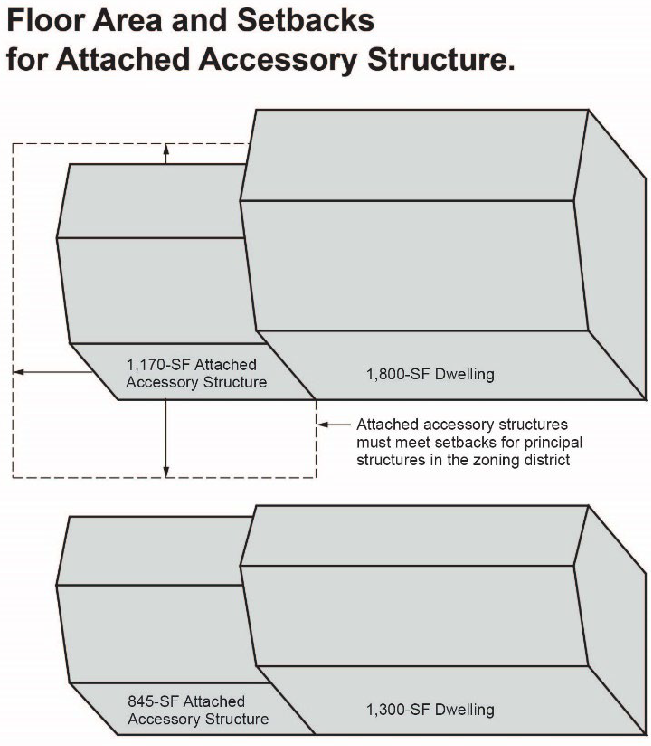
Residential attached accessory buildings or structures. Attached accessory buildings or structures, including attached garages, shall:
1.
Meet the setback requirements for principal buildings in the zoning district they are located within.
2.
Not exceed the height of the principal building.
3.
Shall have a footprint not exceeding 65 percent of the total habitable floor area of the principal building (i.e. house) they are attached to.
c.
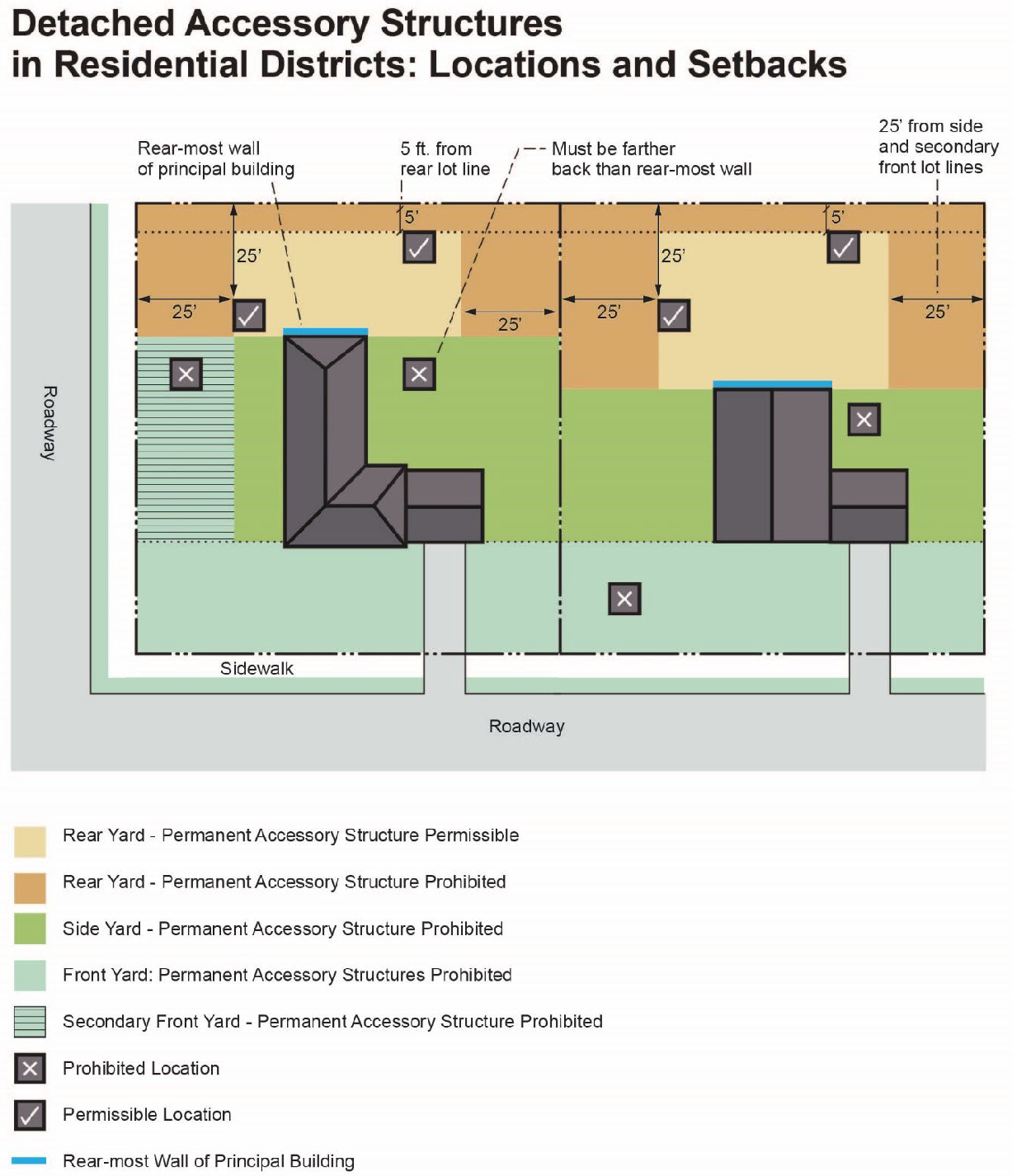
Residential detached accessory buildings or structures: Location and setbacks. The following setback requirements shall apply to detached accessory buildings and structures in residential districts, based on their location on the lot.
[Notes:]
(1) Accessory structures shall be considered permanent if they have a permanent foundation.
(2) Accessory structures shall be considered "temporary portable" if they do not have a permanent foundation.
(3) Temporary portable accessory structures shall be permitted in the front yard only in the following circumstances.
(i) No more than one portable accessory structure may be located in the front yard at any given time.
(ii) No portable accessory structure shall remain in the front yard for more than 30 days.
(iii) All portable accessory structures shall be set back at least ten feet from the front lot line.
(iv) Portable accessory structures must be placed on pavement or another approved surface clearly designed to be a driveway for vehicles to access the site, in the opinion of the planning director.
d.
Residential detached accessory building or structures: Setback from other buildings or structures. All detached accessory buildings or structures must be set back at least ten feet from other buildings or structures.
e.
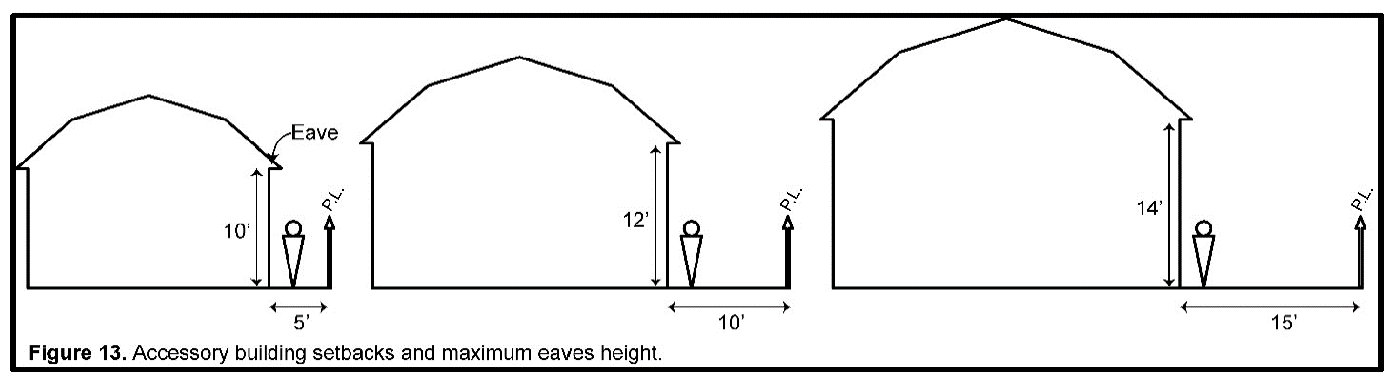
Residential detached accessory building or structures: Height. The following height limitations shall apply to detached accessory buildings and structures in residential districts, based on their setback.
f.
Residential detached accessory building or structures: Size. The following maximum size limitations shall apply to detached accessory buildings and structures in residential districts, based on the number of accessory structures on the site and the lot size.
g.
Residential accessory buildings: building materials. All accessory buildings in residential districts (attached or detached) shall be sided with wood, metal, vinyl, brick, or block. Wood must be painted a color compatible with nearby homes, in the opinion of the planning director. Accessory structures that do not meet the definition of "building" in section 94-2.02 shall be exempt from this requirement.
(3)
Accessory buildings and structures in commercial and mixed use districts. In the C-1, C-2, ORP, P-SP, CPUD, and MPUD districts, the following shall apply to accessory buildings and structures.
a.
Approval process. Accessory buildings and structures in commercial and mixed use districts shall be reviewed by the planning director for compliance with this section prior to construction. However, if the total area of accessory structures on a given lot is proposed to exceed 2,400 square feet, then site plan approval by the planning commission, as described in article XVIII, shall be required.
b.
Commercial or mixed use attached accessory buildings or structures. Attached accessory buildings or structures, including attached garages, shall:
1.
Meet the setback requirements for principal buildings in the zoning district they are located within.
2.
Not exceed the height of the principal building.
3.
Shall have a footprint not exceeding 65 percent of the total habitable floor area of the principal building they are attached to.
c.
Commercial or mixed use detached accessory buildings or structures: location and setbacks. The following setback requirements shall apply to detached accessory buildings and structures in commercial and residential districts, based on their location on the lot.
[Notes:]
(1) Accessory structures shall be considered permanent if they have a permanent foundation.
(2) Accessory structures shall be considered portable if they do not have a permanent foundation.
d.
Commercial or mixed use detached accessory buildings or structures: Setback from other buildings or structures. All detached accessory buildings or structures must be set back at least ten feet from other buildings or structures.
e.
Commercial or mixed use detached accessory buildings or structures: Height. Detached accessory structures shall not exceed 35 feet.
f.
Commercial or mixed use detached accessory buildings or structures: Size. The total area of all buildings and structures on a lot shall not exceed the maximum lot coverage described in article VII.
g.
Commercial or mixed use detached accessory buildings or structures building materials. All accessory buildings in residential districts (attached or detached) shall be sided with wood, metal, vinyl, brick, or block. Wood must be painted. Accessory structures that do not meet the definition of "building" in section 94-2.02 shall be exempt from this requirement.
(4)
Accessory buildings and structures in industrial districts. In the I-1, I-2, and IPUD districts, the following shall apply to accessory buildings and structures.
a.
Approval process. Accessory buildings and structures in industrial districts shall be reviewed by the planning director for compliance with this section prior to construction. However, if the total area of accessory structures on a given lot is proposed to exceed 2,400 square feet, then site plan approval by the planning commission, as described in article XVIII, shall be required.
b.
Industrial attached accessory buildings or structures. Attached accessory buildings or structures, including attached garages, shall:
1.
Meet the setback requirements for principal buildings in the zoning district they are located within.
2.
Not exceed the height of the principal building.
3.
Shall have a footprint not exceeding 65 percent of the total habitable floor area of the principal building they are attached to.
c.
Industrial detached accessory buildings or structures: Location and setbacks. The following setback requirements shall apply to detached accessory buildings and structures in industrial districts, based on their location on the lot.
[Notes:]
(1) Accessory structures shall be considered permanent if they have a permanent foundation.
(2) Accessory structures shall be considered portable if they do not have a permanent foundation.
d.
Industrial detached accessory buildings or structures: Setback from other buildings or structures. All detached accessory buildings or structures must be set back at least ten feet from other buildings or structures.
e.
Industrial detached accessory buildings or structures: Height. Detached accessory structures shall not exceed 45 feet, except that the planning commission may allow structures up to 100 feet tall by special use approval, upon finding that the additional height is necessary to support a permitted or approved industrial process, and provided that the provisions of section 94-18.25 are met.
f.
Industrial detached accessory buildings or structures: Size. The total area of all buildings and structures on a lot shall not exceed the maximum lot coverage described in article VII.
g.
Industrial detached accessory buildings or structures building materials. All accessory buildings in residential districts (attached or detached) shall be sided with wood, metal, vinyl, brick, or block. Wood must be painted. Accessory structures that do not meet the definition of "building" in section 94-2.02 shall be exempt from this requirement.
(5)
Accessory buildings and structures in the agricultural district. In the AA district, the following shall apply to accessory buildings and structures.
a.
Approval process. Accessory buildings and structures in agricultural districts shall be reviewed by the planning director for compliance with this section prior to construction, unless the building or structure has submitted a written designation of bona fide farming operation from the Michigan Department of Agriculture and Rural Development, and has been approved as an agricultural building exempt from zoning approval under the Michigan Right to Farm Act (Public Act 83 or 1981).
b.
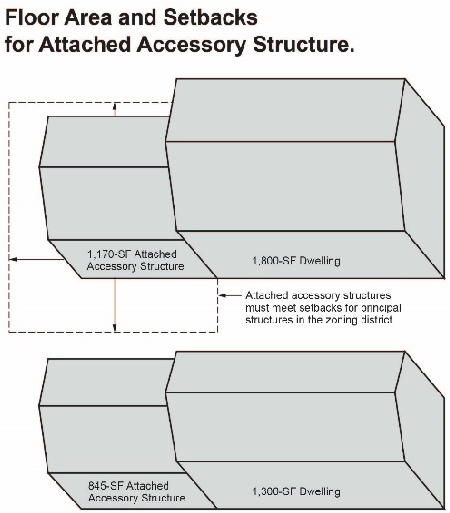
Agricultural attached accessory buildings or structures. Attached accessory buildings or structures, including attached garages, shall:
1.
Meet the setback requirements for principal buildings in the zoning district they are located within.
2.
Not exceed the height of the principal building.
3.
Shall have a footprint not exceeding 65 percent of the total habitable floor area of the principal building (i.e. house) they are attached to.
c.
Agricultural detached accessory buildings or structures: Location and setbacks. The following setback requirements shall apply to detached accessory buildings and structures in residential districts, based on their location on the lot.
[Notes:]
(1) Accessory structures shall be considered permanent if they have a permanent foundation.
(2) Accessory structures shall be considered portable if they do not have a permanent foundation.
(3) Portable accessory structures shall be permitted in the front yard only in the following circumstances.
(i) No more than one portable accessory structure may be located in the front yard at any given time.
(ii) No portable accessory structure shall remain in the front yard for more than 30 days.
(iii) All portable accessory structures shall be set back at least ten feet from the front lot line.
(iv) Portable accessory structures must be placed on pavement, gravel, or another surface clearly designed to be a driveway for vehicles to access the site, in the opinion of the planning director.
d.
Agricultural detached accessory building or structures: Setback from other buildings or structures. All detached accessory buildings or structures must be set back at least ten feet from other buildings or structures.
e.
Agricultural detached accessory building or structures: Height. The following height limitations shall apply to detached accessory buildings and structures in residential districts, based on their setback.
f.
Agricultural detached accessory building or structures: Size. The total area of detached accessory buildings and structures shall not exceed 4,800 square feet. There shall be no limit on the number of accessory buildings and structures, so long as the area does not exceed the 4,800-square-foot limit.
g.
Agricultural accessory buildings: building materials. There shall be no restrictions on building materials for detached accessory buildings in the AA district.
(6)
Accessory buildings and structures in the RMT district. See article XIV.
(b)
Accessory dwelling units. Accessory dwelling units are prohibited throughout the City of Walker.
(c)
Private residential garages. For each residential dwelling to be constructed, erected or moved upon any lot in the "A," "A-2," "SA," "S" or "AA" districts, there shall also be a private garage at least 12 feet in width by 22 feet in length; provided further, that there shall be a private garage, as described above, for each residential unit within a residential dwelling located in the "A-2" duplex district, two-family residential.
(d)
Swimming pools.
(1)
All accessory buildings shall be located within the rear yard and at least ten feet away from any other building. If any private garage is located less than ten feet from a dwelling house, the garage shall be made fire resistant in the manner required for attached garages.
(2)
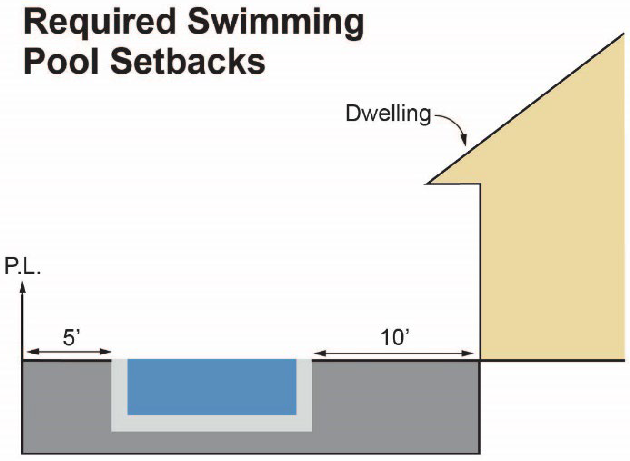
Swimming pools constructed, erected or placed in or on the ground as accessory to a residential dwelling unit shall be located within the rear yard. A wall of a swimming pool shall be located at least five feet from a side or rear property line and at least ten feet from a dwelling. The requirements of this subsection shall apply to any swimming pool for which a building permit is required under the building code of the city.
(e)
Drainage easements. No accessory building, swimming pool, or other structure that materially impedes the flow of stormwater shall be constructed or located within a drainage or utility easement described in a final subdivision plat or a final site condominium project plan, or within a drainage or utility easement of the city or other governmental entity which is recorded with the Kent County Register of Deeds or otherwise established by law.
(f)
Decks and porches. An unenclosed deck or porch may be erected as an accessory structure attached as a part of a residential dwelling. A deck or porch may be located in the rear or side yard provided that no part of the deck shall be less than five feet from the rear and side lot lines. An deck or porch may be located in the front yard, provided that the deck or porch does not extend more than 40 percent of the distance between the front wall of the frontmost principal building (i.e., the house) and the front lot line. See section 94-2.02 for the definitions of "deck," "porch," and "enclosed."
(Ord. No. 24-674, § 2(Exh. A), 1-22-24)
Sec. 94-15.03. - Walls and fences.
(a)
The following requirements apply to fences and walls:
(b)
Decorative fence tops, lattice and rails are allowed but shall be included in the overall fence height measurement.
(c)
Fences shall be installed with the finished side facing outwards, which does not show the supports, posts or similar structural components.
(d)
Commercial front yard fences and walls shall be primarily composed of one or a mix of the following materials:
(1)
Wrought iron or a similar metal alloy.
(2)
Brick.
(3)
Stone.
(4)
Other materials as deemed compatible with the intent of this chapter after review by the Walker Board of Zoning Appeals.
(e)
All fences and walls other than those in commercial front yards shall be primarily composed of one or a mix of the following materials:
(1)
Wrought iron or a similar metal alloy.
(2)
Stained, painted, or comparably finished lumber.
(3)
Vinyl or composite plastic.
(4)
Split rail.
(5)
Chain link, subject to the limitations of this section.
(6)
Pressure treated lumber.
(7)
Brick.
(8)
Stone.
(9)
Stucco.
(10)
Other materials as deemed compatible with the intent of this chapter after review by the Walker Board of Zoning Appeals.
(f)
Drainage easement. No fence, wall, or other structure shall be constructed or located within a drainage or utility easement described in a final subdivision plat or a final site condominium project plan, or within a drainage or utility easement of the city or other governmental entity which is recorded with the Kent County Register of Deeds or otherwise established by law. No fence, wall, or other structure will be constructed so as to prevent access to a drainage or utility easement which is lawfully established without written consent by the relevant agency maintaining the easement.
(Ord. No. 24-674, § 2(Exh. A), 1-22-24)
Sec. 94-15.04. - Dwelling unit size and design.
(a)
Single-family. All dwellings located outside of mobile home parks shall comply with the following requirements:
(1)
Area.
a.
Every dwelling unit shall have, exclusive of porches, garages, breezeways, terraces, attics and basements (except as provided in subsection ([(a)(2)]) a floor area of not less than:
1.
Single-family dwelling: 960 square feet.
2.
Two-family dwelling: 960 square feet per unit.
3.
Multiple-family dwelling: square footage as required for unit size as listed in section 94-7.01.
(2)
Finished basement; floor area. Notwithstanding any provision of this article to the contrary, a basement, or a part thereof fully enclosed by four walls, may be used for dwelling purposes and the floor area of the basement, or of the fully enclosed part thereof, as the case may be, shall be included in the floor area of a dwelling unit for the purposes of subsection [(a)(1)], provided that the following conditions are met:
a.
The basement, or the fully enclosed part thereof, shall comply with the building code of the city, as amended from time to time; and
b.
All walls and the ceiling of the basement, or of the fully enclosed part thereof, shall be covered with an interior finish. For purposes of this section, "interior finish" means wainscoting, paneling, drywall, plaster or other similar finish, excluding paint, applied structurally or for acoustical treatment, insulation, decoration or similar purposes.
(3)
Foundation. There shall be a foundation of concrete or block around the entire exterior perimeter of all dwellings. The foundation shall have a minimum depth of 42 inches below grade. The foundation shall provide maximum exposed foundation above grade of 16 inches and a minimum exposed foundation above grade of eight inches. A wood foundation is also acceptable provided it meets the standards established for wood foundations contained in the construction code adopted by the city. The requirement of a foundation around the exterior perimeter of a dwelling as set forth in this subsection shall not apply to a "four season" porch used as living space in the dwelling provided that such porch shall not exceed 250 square feet in area and that such porch is designed and constructed in accordance with applicable construction code requirements.
(4)
Attachment to foundation. All dwellings shall be firmly attached to the foundation so as to be watertight as required by the construction code adopted by the city, or, if a mobile home, shall be anchored to the foundation by an anchor system designed and constructed in compliance with the United States Department of Housing and Urban Development Regulations entitled "Mobile Home Construction and Safety Standards."
(5)
Minimum height required. All habitable space within a dwelling unit shall be provided a minimum height between floor and ceiling of seven feet six inches.
(6)
Storage areas required. All one- and two-family dwellings shall provide storage areas (either within a basement or in an attic, or in a separate, fully enclosed structure) of not less than 15 percent of the living area of the dwelling unit, exclusive of storage space for automobiles. Such storage areas shall not be counted in determining whether the dwelling unit complies with the minimum floor area requirements of this chapter.
(7)
Minimum width required. The minimum width of any single-family dwelling unit shall be 22 feet for at least 67 percent of its length, measured between the exterior part of the walls having the greatest length.
(8)
Minimum ingress and egress. All dwelling units shall provide a minimum of two separate points of ingress and egress.
(9)
Steps or porch areas required. All single-family dwelling units shall provide steps or porch areas permanently attached to the foundation where there exists an elevation differential of more than one foot between a door and the surrounding grade.
(10)
Interior access to basement or crawl space. All dwelling units shall provide from within the dwelling unit at least one means of access to any basement or crawl space.
(11)
Crawl space. All dwellings without basements shall provide a crawl space below the entire floor of the dwelling not less than 18 inches in depth with a vapor barrier consisting of two inches of concrete on the floor of the crawl space. Multilevel dwellings separated by a minimum of three steps between levels shall be exempt from the crawl space requirement. The crawl space shall be provided with adequate means of ventilation approved by the planning director.
(12)
Minimum roof requirements. All dwelling units shall have a roof assembly designed to carry a 30-pound live load and a ten-pound dead load. A minimum of six inches overhang shall be provided on roof drip edges.
(13)
Wheels, mechanism, tongue. The wheels, pulling mechanism and tongue of any mobile home shall be removed prior to placement on a foundation.
(14)
Dwelling maintenance. All dwellings shall be maintained in accordance with the currently adopted property maintenance code to protect against deterioration and/or damage.
(15)
Construction standards. All mobile homes shall meet the standards of the United States Department of Housing and Urban Development Mobile Home Construction Safety Standards in effect at the time the mobile home is located in the city. All mobile homes shall bear evidence of compliance with the mobile home construction safety standards in accordance with regulations promulgated by the United States Department of Housing and Urban Development in effect at the time the mobile home is located in the city. All other dwellings shall meet the requirements of the construction code adopted by the city.
(16)
Building permits. Prior to issuance of a building permit for any dwelling unit, construction plans, including a plot plan, adequate to illustrate compliance with the requirements of this section and all other requirements of this chapter, including, but not limited to the requirements of the district in which the unit is to be located, shall be submitted to the building inspector. If the dwelling unit is a mobile home, there shall also be submitted adequate evidence to ensure that the dwelling complies with the standards applicable to mobile homes set forth in this section before a permit will be issued.
(17)
Additions. All additions to dwellings located outside mobile home parks shall meet the requirements of the construction code adopted by the city.
(18)
Water and sewer connections. All dwellings shall be connected to a sewer system and water supply system approved by the city unless a well or septic system is otherwise permitted by this chapter.
(19)
Electrical connection. All dwellings shall be connected to overhead or underground electrical service. The service head, service mast or lateral, meter and service entrance conductor used to connect a dwelling to electrical service shall be attached to the exterior of the dwelling. The service panel used to connect a dwelling to electrical service shall be attached to the interior of the dwelling.
(b)
Multiple-family.
(1)
Each multiple-family unit shall have a floor area, exclusive of basements, unfinished attics, attached garages, breezeways, enclosed and unenclosed porches and utility rooms, of:
a.
Six hundred square feet for a one-bedroom housing unit;
b.
Seven hundred fifty square feet for a two-bedroom housing unit;
c.
Nine hundred square feet for a three-bedroom housing unit;
d.
An additional five square feet of floor area for each bedroom in excess of three.
(2)
No unit shall have more than six bedrooms per full kitchen provided. This requirement may be waived within a PUD.
(3)
Any multi-family development, including PUDs, providing one or more unit with more than four bedrooms shall require a special use permit, and must meet the following requirements in order to be approved:
a.
A unit with more than four bedrooms must be within 500 feet of a public transit stop, measured along a pedestrian-accessible route. The planning commission may determine if a route is accessible to pedestrians, considering the presence of sidewalks, crosswalks, and other pedestrian paths.
b.
The unit must be at least 500 feet from a pre-existing single-family home, unless there is a state highway between the unit and a single-family home.
c.
A landscape buffer in accordance with the standards of section [94-12.07] must be provided for units with more than four bedrooms adjacent to any land that is zoned residential.
(Ord. No. 24-674, § 2(Exh. A), 1-22-24)
Sec. 94-15.05. - Essential services.
Essential services shall be permitted in every district, provided that in residential districts the installation of essential service uses shall be reviewed by the planning commission. Pursuant to its review, the planning commission may prescribe conditions for essential service uses in residential districts, including conditions regarding architecture, landscaping, setback, enclosures, and other conditions as may be appropriate to protect the neighborhood.
(Ord. No. 24-674, § 2(Exh. A), 1-22-24)
Sec. 94-15.06. - Outdoor operations.
(a)
C-1 and C-2 districts. Except for car washes permitted by this chapter, all business, service or processing shall be conducted wholly within a completely enclosed building, provided that an outdoor display and sales area not to exceed 20 percent of the enclosed building area may be used for the display and sale of items normally exposed to the elements in their natural condition of location as to storage and use. Such display and sales area shall not diminish any required front yard setback or required parking area. This section shall not be construed as permitting outdoor storage in this district.
(b)
I-1 and I-2 districts. All permitted principal and special use uses shall be conducted wholly within a completely enclosed building, except for loading and unloading operations, and the on-site parking of vehicles, or as otherwise permitted by this chapter.
(Ord. No. 24-674, § 2(Exh. A), 1-22-24)
Sec. 94-15.07. - Animals.
(a)
Household pets and livestock animals. The keeping of household pets for the enjoyment or recreation of the occupants of a dwelling unit, and not for sale, boarding or breeding, shall be permitted as an accessory use on parcels used for residential purposes, as provided by this section.
(1)
No more than three dogs shall be kept or housed in or at any one dwelling unit, unless that dwelling unit meets all requirements of this chapter that pertain to kennels; however, any litter of dogs which causes the limit of three dogs to be exceeded shall not constitute a violation of this provision for a period of four months after birth.
(2)
Livestock animals are prohibited in any residential district, except horses which may be approved as a special use, subject to the following:
a.
No more than three horses shall be allowed per dwellings.
b.
The minimum lot size shall be three acres for the first horse, and one additional acre for each additional horse.
(3)
Racing pigeons.
a.
No more than 50 racing pigeons may be kept on any parcel which is zoned for residential, except that a maximum of 100 racing pigeons may be kept on a parcel if located within the "AA" agricultural zone district.
b.
The minimum parcel size for keeping racing pigeons on any parcel zoned for residential purposes or located with the "AA" agricultural zone district shall be one-half acre.
(b)
Backyard chickens.
(1)
The keeping of backyard chickens is permitted as an accessory use if all the following conditions are met:
a.
The parcel of land is located within a residential zoning district and the principal use of the parcel is a single-family residential dwelling.
b.
The parcel of land is not less than 11,800 square feet in size.
c.
No more than one chicken per 0.1 acres of lot area, up to a maximum of 20 chickens, shall be permitted.
d.
Chickens that crow and roosters shall not be permitted.
e.
The outdoor slaughtering of chickens is prohibited.
(2)
Chickens shall not be allowed to roam the parcel or any public streets, land, alleys, vacant lots or other open or public places, or upon any third-party premises.
(3)
The enclosed area where the chickens are kept shall be located within the rear yard (as defined in the zoning ordinance), not within the main building or any attached accessory buildings, and shall be at least 20 feet from any dwelling and at least ten feet from any property line.
(4)
Materials used to construct the enclosed areas shall exclude tarps, plastic, fabric, rubber, paper, cardboard, or other nontraditional building materials.
(5)
Chicken coops shall be kept and maintained in a manner so as to minimize to the greatest extent possible any adverse impacts to the property on which they are kept, surrounding properties, and any other areas of the city, including, without limitation, dust, dirt, noise, odor, vermin, the attraction of other birds or animals, the potential spread of infection, disease or contamination or other health or safety hazards or nuisance conditions. All chicken coops shall:
a.
Be constructed and maintained in compliance with all applicable building code regulations;
b.
Be of sufficient size and design, and constructed of such material, so that it can be maintained in a clean, orderly and sanitary condition;
c.
Be kept, at all times, in a clean, orderly and sanitary condition, in good repair, and in compliance with all applicable health and safety laws and regulations;
d.
Be a maximum of 80 square feet in area and eight feet in height;
e.
Contain sufficient square footage to allow the chicken housed within to move around freely, and provide an interior height of at least six inches higher than the head of the chicken in the enclosure when the chicken is in the normal standing position. A run for chickens shall be of a length, width, and height to provide adequate space for an animal to exercise.
f.
Be enclosed on all sides and from above.
g.
Be screened from view from the street and neighboring properties with a sight-obscuring fence, wall or landscaping in such quantities to sufficiently prevent the sight of the area from the street or neighboring properties during all seasons.
(6)
All chickens shall be fed only within the confines of the chicken coop. All feed for the animals shall be stored in sealed containers that will prevent intrusion by insects, rodents and other vermin.
(7)
Litter must be regularly removed and properly disposed of in compliance with all local, state, and federal regulations.
(8)
The keeping of chickens shall follow all other local, state, and federal regulations.
(9)
Prior to installation of any backyard chicken enclosure or keeping of any backyard chickens, a registration and application form must be submitted to the city planning director which includes a property address, a property parcel ID number, and a signed and dated acknowledgement of the terms of this section.
(Ord. No. 24-674, § 2(Exh. A), 1-22-24)
Sec. 94-15.08. - Performance standards.
It shall be unlawful to carry on or permit to be carried on any activity or operation or use of any land, building or equipment dangerous to human life or health or that produces irritants to the sensory perception greater than the measures established in this article which are hereby determined to be the maximum permissible hazards to humans or human activities.
(a)
Sound. The intensity levels of sound created by any activity or operation or use of any land, building or equipment shall be governed by the city noise control ordinance, article IV of chapter 34 of this Code.
(b)
Vibration. All machinery shall be so mounted and operated as to prevent transmission of ground vibration exceeding a displacement of 0.003 root-mean-square of one-inch r.m.s. measured at any lot line of its source.
(c)
Odor. The emission of noxious, odorous matter in such quantities as to be readily detectable at any point along lot lines, when diluted in the ratio of one volume of odorous air to four or more volumes of clean air or as to produce a public nuisance or hazard beyond lot lines, is prohibited.
(d)
Toxic gases. The escape of or emission of any gas which is injurious or destructive or explosive shall be unlawful and may be summarily caused to be abated, except as required in the provision of essential services.
(e)
Glare and heat. Any operation producing intense glare or heat shall be performed within an enclosure so as to completely obscure and shield such operation from direct view from any point along the lot line, except during the period of construction of the facilities to be used and occupied.
(f)
Light. All lighting shall be arranged to reflect light away from adjoining properties in residential and agricultural districts.
(g)
Electromagnetic radiation. The rules and regulations of the Federal Communications Commission as of the date of the adoption of the ordinance from which this article derives with respect to the propagation and dissemination of electromagnetic radiation are hereby made a part of this article and shall be on file in the office of the building inspector.
(h)
Smoke, dust, dirt and fly ash.
(1)
It shall be unlawful to discharge into the atmosphere from any single source of emission whatsoever any air contaminator for a period or periods aggregating more than two minutes in any one-half hour which is:
(2)
As dark or darker in shade as that designated as No. 2 on the Ringelmann Chart. The Ringelmann Chart, as published by the United States Bureau of Mines, which is hereby made a part of this article, shall be the standard. However, the umbra scope readings of smoke densities may be used when correlated with the Ringelmann Chart. A Ringelmann Chart shall be on file in the office of the administrative official.
(3)
Of such opacity as to obscure an observer's view to a degree equal to or greater than the smoke described in subsection (1), except when the emission consists only of water vapor.
(4)
The quantity of gas borne or airborne solids shall not exceed two-tenths of one grain per cubic foot of the carrying medium at a temperature of 500 degrees Fahrenheit.
(i)
Drifted and blown material. The drifting or airborne transmission beyond the lot line of dust, particles, or debris from any open stockpile or from sawing operations shall be unlawful and may be summarily caused to be abated.
(j)
Radioactive materials. Radioactive materials shall not be emitted so as to be unsafe to human health or life.
(Ord. No. 24-674, § 2(Exh. A), 1-22-24)
Sec. 94-15.09. - Moving buildings and structures.
Before the planning director shall issue a permit for moving any dwelling, building or structure into or within the city, the planning director shall inspect such dwelling, building or structure to determine whether the dwelling, building or structure complies with the provisions of the building code, and shall inspect the site to which it is proposed to move the dwelling, building or structure to determine that such dwelling, building or structure will comply with the requirements of the building code and of this chapter after such move. No permit shall be issued unless the planning director is satisfied that such building, dwelling or structure complies with the requirements of the building code and will comply with the requirements of this chapter and building code in such new site; provided that if deficiencies exist which can be remedied, a permit may be issued upon the deposit of a satisfactory performance bond with the city treasurer or the satisfactory escrow of sufficient moneys to ensure that the structure after moving will comply fully with the requirements of the building code and this chapter and, in such event, the permit shall specify the deficiencies and there shall be filed with the planning director plans and specifications for the remedying of such deficiencies. The moving of any such building or structure shall further be made under permits issued pursuant to and in compliance with the ordinances of the city specifically governing the moving of buildings and structures.
(Ord. No. 24-674, § 2(Exh. A), 1-22-24)
Cross reference— Moving of buildings, § 18-166 et seq.
Sec. 94-15.10. - Principal uses and buildings.
(a)
Every building to be erected or moved shall be located on a lot, and in no case shall more than one principal building used for residential purposes be located on one lot, except as may be otherwise provided by this chapter.
(b)
More than one principal building used for business, commercial or industrial uses may be located on a lot only if the additional building is an integral part of the same business, commercial or industrial operation, and provided the building otherwise complies with the provisions of this chapter.
(c)
No principal building used for business, commercial or industrial uses shall be located on the same lot as a principal building used for residential purposes, except as may be otherwise provided by this chapter.
(d)
No outdoor principal use may be established without a principal building on the lot.
(e)
More than one principal building may be located on a lot if all buildings on the site are within a single condominium association, pursuant to all laws governing condominiums, and provided that the site complies with all relevant requirements of this chapter.
(Ord. No. 24-674, § 2(Exh. A), 1-22-24)
Sec. 94-15.11. - Outdoor toilets.
(a)
All sewerage and toilets shall be connected to sewer mains or an adequate and effective septic tank and drain tile field as approved by the county department of health.
(b)
Outside portable toilets or privies will be permitted in zoned recreational districts for a maximum period of ten consecutive days, not renewable within the following ten consecutive days, upon issuance of a permit therefor by the city building inspector. The building inspector shall authorize the issuance of a permit for the aforesaid use where the applicant presents evidence that such outside toilet will be equipped with an adequate and effective chemical to sanitarily treat the sewerage, as approved by the county department of health, so that it will not constitute a health hazard and source of filth. A fee of $1.00 per each unit, with a maximum of $5.00 per project, shall be charged for the issuance of such permit.
(c)
Outside portable toilets or privies for construction personnel will be permitted at new construction projects until a time when sewerage and toilets are connected to sewer mains or an adequate and effective septic tank and drain tile field, as approved by the county department of health, or 120 days, whichever comes first, upon issuance of a permit by the building inspector. The building inspector shall not issue a permit for the aforesaid use unless the applicant presents evidence that such outside toilet will be equipped with an adequate and effective chemical to sanitarily treat the sewerage, as approved by the county department of health, so that it will not constitute a health hazard and source of filth.
(Ord. No. 24-674, § 2(Exh. A), 1-22-24)
Cross reference— Utilities, ch. 86.
Sec. 94-15.12. - Temporary quarters.
Where damage caused by fire, flood, wind, or other such calamity occasions the need for temporary living or office quarters, the planning director may approve by permit the conditions for use of a temporary structure for a period of 90 days. Such structure shall comply with the requirements of the building code and county health regulations.
(Ord. No. 24-674, § 2(Exh. A), 1-22-24)
Sec. 94-15.13. - Satellite dish antennas.
(a)
No satellite dish antenna shall be constructed, installed, maintained or located in any district except in conformance with subsection (b) of this section and the following requirements:
(1)
The satellite dish antenna shall be located only in the rear yard except that in a C-1, C-2, C-3, C-4, CPUD, MPUD, IPUD, ORP, I-2, I-1 and MP district, the satellite dish antenna may also be located in the side yard.
(2)
The satellite dish antenna shall be located at least ten feet from all lot lines.
(3)
The height of the satellite dish antenna, including any platform or structure upon which the antenna is mounted, shall not exceed 15 feet, except that (i) in a C-1, C-2, C-3, C-4, CPUD, MPUD, IPUD, ORP, I-2, I-1 and MP district, a satellite dish antenna may be mounted on the roof of the building provided that its height (including any platform or structure upon which the antenna is mounted) does not exceed 15 feet measured from the point where the satellite dish antenna is attached to the roof, and (ii) in an AA, A, A-2, SA, S, RPUD, ARM, ARM district one, or RMT district, a satellite dish antenna may be mounted on the roof of a building provided that its diameter does not exceed 24 inches and the height of the satellite dish antenna (including any structure upon which the antenna is mounted) does not exceed 36 inches measured from the point where the satellite dish antenna is attached to the roof.
(4)
The rear yard shall be planted with a compact hedge, or other plants or trees approved by the building inspector, which shall have a height, density and location so as to screen the satellite dish antenna from adjoining properties. This subsection shall not apply to roof-mounted satellite dish antennas permitted under subsection (3) above. This subsection shall also not apply in a C-1, C-2, C-3, C-4, CPUD, MPUD, IPUD, ORP, I-2, I-1 or MP district, unless the property on which the satellite dish antenna is located is contiguous with property in an AA, A, A-2, SA, S, RPUD, ARM, ARM district one or RMT district.
(5)
The satellite dish antenna shall be permanently attached to a foundation, except that roof-mounted satellite dish antennas permitted under subsection (3) above shall be permanently attached to the roof.
(6)
The satellite dish antenna and the construction, installation, maintenance and operation thereof shall comply with all applicable federal, state and local laws, statutes, codes, ordinances, rules and regulations.
(b)
Building permit required.
(1)
No satellite dish antenna shall be constructed, installed, maintained or operated unless a building permit therefor has been issued in accordance with the procedures in subsection (b)(2).
(2)
Prior to issuance of a building permit to construct, install, maintain or operate a satellite dish antenna, an application therefor and a site plan showing the proposed location of the satellite dish antenna, the foundation or roof to which the satellite dish antenna will be permanently attached, the height, density and location of required screening, and the dimensions of the satellite dish antenna, including any platform or structure upon which the antenna will be mounted, shall be submitted. Each application shall be accompanied by a fee established by resolution of the city commission to cover the costs of processing the application. No part of the fee shall be refundable. The building inspector shall review the application and the site plan and shall issue a building permit for the satellite dish antenna only upon finding that the satellite dish antenna conforms to the requirements of this section.
(Ord. No. 24-674, § 2(Exh. A), 1-22-24)
Sec. 94-15.14. - Clutter and refuse.
(a)
AA district. No piles or accumulations of refuse or manure shall be permitted in the "AA" district unless they are at least 200 feet from all public rights-of-way, and shall then be so maintained as not to constitute a nuisance.
(b)
ARM district. The yards shall be kept clear and unobstructed and shall not be used for the storage of materials, rubbish or debris, but may be used for gardening and planting. Permitted accessory buildings shall also be allowed as and where specified in this chapter.
(c)
ARM-1 district. The yards shall be kept clear and unobstructed and shall not be used for the storage of materials, rubbish or debris, but may be used for gardening and planting. Permitted accessory buildings shall also be allowed as and where specified in this chapter.
(Ord. No. 24-674, § 2(Exh. A), 1-22-24)

