
Walker City Zoning Code
ARTICLE VI
- USES WITH ADDITIONAL CONDITIONS
Sec. 94-6.01. - Adult regulated businesses.
(a)
In the development and execution of this article, it is recognized that there are some uses which, because of their very nature, have serious objectionable operational characteristics, particularly when several of them are concentrated under certain circumstances or when one or more of them are located in near proximity to a residential zone, thereby having a deleterious effect upon the adjacent areas. Special regulation of these uses is necessary to ensure that these adverse effects will not contribute to the blighting or downgrading of the surrounding neighborhood. These special regulations are itemized in this article. These controls are for the purpose of preventing a concentration of these uses within any one area, or to prevent deterioration or blighting of a nearby residential neighborhood. These controls do not legitimatize activities which are prohibited by this chapter or the City Code.
In regulating adult regulated or sexually oriented businesses, it is the purpose of this article to promote the health, safety, and general welfare of the citizens of the city and to establish reasonable and uniform regulations to prevent the deleterious secondary effects of sexually oriented business within the city. The provisions of this article have neither the purpose nor effect of imposing a limitation or restriction on the content or reasonable access to any communicative materials, including sexually oriented materials. Similarly, it is neither the intent nor effect of this article to restrict or deny access by adults to sexually oriented materials protected by the First Amendment, or to deny access by the distributors and exhibitors of sexually oriented entertainment to their intended market. Neither is it the intent nor effect of this article to condone or legitimize the distribution of obscene material.
(b)
Based on evidence of the adverse secondary effects of adult-uses presented in hearings and in reports made available to the city commission, and on findings incorporated in the cases of Pap's A.M. v. City of Erie, 529 U.S. 277 (2000); City of Los Angeles v. Alameda Books, Inc., 122 S. Ct. 1728 (2002); Thomas v. Chicago Park District, 122 S. Ct. 775 (2002); City of Renton v. Playtime Theatres, Inc., 475 U.S. 41 (1986); Young v. American Mini Theatres, 426 U.S. 50 (1976), Barnes v. Glen Theatre, Inc., 501 U.S. 560 (1991); California v. LaRue, 409 U.S. 109 (1972); DLS, Inc. v. City of Chattanooga, 107 F3d 403 (6th Cir. 1997); East Brooks Books, Inc. v. City of Memphis, 48 F3d 220 (6th Cir. 1995); Broadway Books v. Roberts, 642 F. Supp. 486 (E.D. Tenn. 1986); Bright Lights, Inc. v. City of Newport, 830 F. Supp. 378 (E.D. Ky. 1993); Richland Bookmart v. Nichols, 137 F3d 435 (6th Cir. 1998); Deja Vu v. Metro Government, 1999 U.S. App. LEXIS 535 (6th Cir. 1999); Bamon Corp. v. City of Dayton, 7923 F2d 470 (6th Cir. 1991); Threesome Entertainment v. Strittmather, 4 F. Supp. 2d 710 (N.D. Ohio 1998); J.L. Spoons, Inc. v. City of Brunswick, 49 F. Supp. 2d 1032 (N.D. Ohio 1999); Triplett Grille, Inc. v. City of Akron, 40 F3d 129 (6th Cir. 1994); Nightclubs, Inc. v. City of Paducah, 202 F3d 884 (6th Cir. 2000); O'Connor v. City and County of Denver, 894 F2d 1210 (10th Cir. 1990); Deja Vu of Nashville, Inc., et al. v. Metropolitan Government of Nashville and Davidson County, 2001 U.S. App. LEXIS 26007 (6th Cir. Dec. 6, 2001); Z.J. Gifts D-2, L.L.C. v. City of Aurora, 136 F3d 683 (10th Cir. 1998); Connection Distrib. Co. v. Reno, 154 F3d 281 (6th Cir. 1998); Sundance Assocs. V. Reno, 139 F3d 804 (10th Cir. 1998); American Library Association v. Reno, 33 F3d 78 (D.C. Cir. 1994); American Target Advertising, Inc. v. Gianni, 199 F3d 1241 (10th Cir. 2000); Z.J. Gifts D-2, L.L.C. v. City of Aurora, 136 F3d 683 (10th Cir. 1998); ILQ Investments, Inc. v. City of Rochester, 25 F3d 1413 (8th Cir. 1994); Bigg Wolf Discount Video Movie Sales, Inc. v. Montgomery County, 2002 U.S. Dist. LEXIS 1896 (D. Md., Feb. 6, 2002); Currence v. Cincinnati, 2002 U.S. App. LEXIS 1259 (6th Cir., Jan. 24, 2002); and other cases; and on testimony to Congress in 136 Cong. Rec. S 8987; 135 Cong. Rec. S 14519; 135 Cong. Rec. S 5636; 134 Cong. Rec. S 3750; and reports of secondary effects occurring in and around sexually oriented businesses, including, but not limited to, Phoenix, Arizona—1979; Minneapolis, Minnesota—1980; Houston, Texas—1997; Amarillo, Texas; Garden Grove, California—1991; Los Angeles, California—1977; Whittier, California—1978; Austin, Texas—1986; Seattle, Washington—1989; Oklahoma City, Oklahoma—1986; Cleveland, Ohio; Dallas, Texas—1997; St. Croix County, Wisconsin—1993; Bellevue, Washington—1998; Newport News, Virginia—1996; New York Times Square Study—1994; and from, "Sexually Oriented Businesses: An Insider's View," by David Sherman, presented to the Michigan House Committee on Ethics and Constitutional Law, Jan. 12, 2000, and the Report of the Attorney General's Working Group on the Regulation of Sexually. Oriented Businesses (June 6, 1989, State of Minnesota), the city commission finds that sexually oriented businesses as a category of establishments are correlated with harmful secondary effects, and that the foregoing reports are reasonably believed to be relevant to the problems that the city is seeking to abate and prevent in the future.
(c)
Definitions. The following definitions shall apply in the interpretation and enforcement of this article unless otherwise specifically stated:
(1)
Adult cabaret means a nightclub, restaurant, or other establishment which regularly features or displays:
a.
Live performances predominantly characterized by an emphasis on the exposure of any specified anatomical area or by any specified sexual activity; or
b.
Films, motion pictures, video cassettes, slides, other photographic reproductions or visual media predominantly characterized by an emphasis on the depiction or description of any specified sexual activity or any specified anatomical area.
(2)
Adult merchandise store means an establishment that emphasizes merchandise that is predominantly distinguished or characterized by its emphasis on matter depicting, describing or relating to any specified sexual activity or any specified anatomical area. An establishment emphasizes merchandise that is predominantly distinguished by its "emphasis on matter depicting, describing, or relating to any specified sexual activity or any specified anatomical area" if any one or more of the following applies to the establishment:
a.
Twenty-five percent or more of the establishment's retail display space (excluding bathrooms, office areas, fitting rooms, eating areas, storage areas, closets, and other nonpublic areas) is used for the sale of merchandise that is predominantly distinguished or characterized by its emphasis on matter depicting, describing or relating to any specified sexual activity or any specified anatomical area.
b.
Twenty-five percent or more of the establishment's visible inventory is comprised of merchandise that is predominantly distinguished or characterized by its emphasis on matter depicting, describing or relating to any specified sexual activity or any specified anatomical area.
c.
Twenty-five percent or more of the establishment's gross revenues are generated by the sale or rental of merchandise that is predominantly distinguished or characterized by its emphasis on matter depicting, describing, or relating to any specified sexual activity or any specified anatomical area.
d.
The establishment is operated consistently with its being an adult-orientated [adult-oriented] business (e.g., advertising is directed to an "adults only" market; the establishment self-imposes, or imposes consistent with the state or federal law, prohibitions on minors being present in the establishment, etc.).
(3)
Adult motel means a hotel, motel, or similar establishment that:
a.
Offers accommodation to the public for any form of consideration and provides patrons with close-circuit television (as distinguished from commercial cable services) transmissions, films, motion pictures, video cassettes, slides, other photographic reproductions or visual media that are characterized by an emphasis on the depiction or description of any specified sexual activity or any specified anatomical area; or
b.
Offers a sleeping room for rent, or allows a tenant or occupant of a sleeping room to sub rent the room, for a period of time that is less than ten hours, if the rental of such rooms accounts for more than ten percent of the establishment's gross revenues.
(4)
Adult-oriented business means a business or commercial establishment engaging in one or more of the following enterprises:
a.
Adult cabaret;
b.
Adult merchandise store;
c.
Adult motel;
d.
Adult theater;
e.
Escort agency;
f.
Nude model studio; or
g.
Sexual encounter center.
(5)
Adult theater means a theater, concert hall, auditorium, or similar establishment which regularly features live performances predominantly characterized by an emphasis on the exposure of any specified anatomical area or by any specified sexual activity or which regularly or primarily shows films, motion pictures, video cassettes, slides, other photographic reproductions or visual media predominantly characterized by an emphasis on the depiction or description of any specified sexual activity or any specified anatomical area. This definition includes, without limitation, establishments which offer individual viewing booths.
(6)
Body-art establishment means a body-piercing establishment or a tattoo parlor, or a combination of a body-piercing establishment and a tattoo operated on the same premises.
(7)
Body piercing means the perforation of human tissue, other than an ear, for a nonmedical purpose and other than perforation of human tissue by a licensed medical practitioner.
(8)
Body piercing establishment means an establishment where body piercing is performed, whether or not it is in exchange for compensation or any other form of consideration.
(9)
Escort means a person who, for any form of consideration and regardless of who pays that consideration, agrees to act or offers to act as a companion or date for another person, or who agrees or offers to privately model lingerie or to privately perform a striptease for another person.
(10)
Escort agency means a person or entity which furnishes, offers to furnish, or advertises to furnish escorts as one of its primary business purposes for a fee, tip, or other consideration. An escort agency is deemed to be operated in the location where (1) a request for an escort is received, or (2) the escort and the person requesting the escort are together.
(11)
Massage means a method of treating the external parts of the human body by rubbing, stroking, kneading, tapping, or vibrating with the hand or any instrument.
(12)
Massage establishment means any establishment having a fixed place of business where massages are administered for pay, including, but not limited to, massage parlors, health clubs, sauna baths, and steam baths. This definition shall not be construed to include (1) a hospital, nursing home, medical clinic, or the office of a physician, surgeon, chiropractor, osteopath, or physical therapist duly licensed by the state, (2) barbershops or beauty salons in which massages are administered only to the scalp, the face, the neck, or the shoulders, or (3) any other person or establishment exempted from the massage parlor or massagist licensing pursuant to section 22-50 of the City Code. This definition shall also not be construed to include a nonprofit or governmental organization owning or operating a community center, swimming pool, tennis court, fitness center, or other educational, cultural, recreational, and athletic facilities for the welfare of the residents of the area.
(13)
Material means anything tangible, whether through the medium of reading, observation, sound, or in any other manner, including, but not limited to, anything printed or written, any book, magazine, newspaper, pamphlet, picture, drawing, pictorial representation, motion picture, photograph, video tape, vide disk, film, transparency, slide, audiotape, audio disk, computer tape, holographic images, or any other medium used to electronically produce or reproduce images, or any mechanical, chemical, or electronic reproduction. Material includes undeveloped photographs, molds, printing plates, and other latent representational objects whether or not processing or other acts are required to make the content of the material apparent. This definition is intended to include material which is the project of any technology, whether that technology is available on the effective date of the ordinance that added this definition or becomes available after that date.
(14)
Merchandise means material and novelties.
(15)
Novelty means any instrument, device, or paraphernalia which depicts or describes any specific anatomical area or any specific sexual act, or which is designed for use, or commonly used, in connection with specific sexual activities, excluding condoms and other birth-control and disease-prevention products.
(16)
Nude model studio means any place where a person who displays any specified anatomical area is provided to be observed, sketched, drawn, painted, sculptured [sculpted], photographed, or similarly depicted by any other person who pays money or any form of consideration, but does not include the following:
a.
An educational institution funded, chartered, or recognized by the State of Michigan; or
b.
Any modeling session for a local, nonprofit organization that is not open to the public or to any persons other than members of the organization, that is for the purpose of instruction in the artistic depiction in two-dimensional or three-dimensional media of the human form, during which no specified sexual activities occur and during which the model remains in a fixed pose.
(17)
Sexual encounter center means an establishment, except that which is part of the practice of and under the supervision and control of a physician, psychologist, or psychiatrist licensed to practice in Michigan, that offers:
a.
Activities between male and female persons and/or persons of the same sex when one or more of the persons exposes or displays any specified anatomical area; or
b.
The matching and/or exchanging of persons for any specified sexual activities.
(18)
Specified anatomical area means any or more of the following:
a.
Less than completely and opaquely covered human genitals, pubic region, buttocks, anus, or female breast at or below the top of the areola; or
b.
Human male genitals in a discernibly turgid state, even if completely and opaquely covered.
(19)
Specified sexual activity means any of the following:
a.
The fondling or other erotic touching of human genitals, pubic region, buttocks, anus, or female breast; or
b.
A sex act, actual or stimulated, including intercourse, oral copulation, or sodomy; or
c.
Masturbation, actual or simulated; or
d.
Excretory functions as part of, or in connection with, any of activities set forth in a, b or c. above.
(20)
Tattoo, tattooed, tattooing means any method of placing permanent designs, letters, scrolls, figures, symbols, or any other marks upon or under the skin with ink or any other substance, by the aid of needles or other instruments designed to touch or puncture the skin, resulting in either the coloration of the skin, or the production of scars and scarring. "Permanent cosmetics" facilities as defined in section 94-2.02 are excluded from this definition.
(21)
Tattoo parlor means an establishment where persons are tattooed for consideration, other than by a licensed medical practitioner, or any place where tattooing is regularly conducted whether or not it is in exchange for compensation.
(d)
Regulated uses. The following uses are subject to the provisions of this article:
(1)
Adult-oriented businesses;
(2)
Body art establishments;
(3)
Massage establishments.
(e)
Location of regulated uses.
(1)
Any of the regulated uses listed in subsection (d) is permitted if:
a.
The use is located within a district where the use is permitted and complies with all other regulations applicable in such district.
b.
The use is located outside a 100-foot radius from any lot zoned or occupied for residential or agricultural purposes, or upon which is located a school, public park, library, childcare facility, or religious institution.
c.
The use is located outside a 500-foot radius from any other regulated use.
d.
For purposes of this section, the measurement of a radius shall be measured in a straight line from the nearest property line of the use to the nearest property line of the residential or agricultural property, school, public park, library, child care facility, or religious institution.
e.
The use is operated to comply with all applicable provisions of the City Code and applicable state and federal law. Nothing in this article shall be construed to permit activity that is otherwise prohibited by the City Code (including, but not limited to, "public nudity" which is prohibited by section 50-42 of the City Code) or by applicable state or federal law.
(2)
An adult-oriented business shall not be located in the same structure, building or on the same parcel as another adult-oriented business, body art establishment, or massage establishment.
(Ord. No. 24-674, § 2(Exh. A), 1-22-24)
Sec. 94-6.02. - Battery energy storage systems (BESS).
(a)
Tier 1 battery energy storage systems shall be permitted in all zoning districts as accessory uses, subject to the Michigan Building Code and the National Electric Code as applicable.
(b)
Tier 2 battery energy storage systems shall be subject to the following:
(1)
All on-site utility lines shall be placed underground to the extent feasible and as permitted by the serving utility, with the exception of the main service connection at the utility company right-of-way and any new interconnection equipment, including without limitation any poles, with new easements and right-of-way.
(2)
Signage. Signage shall be required in compliance with ANSI Z535 and shall include the type of technology associated with the battery energy storage systems, any special hazards associated, the type of suppression system installed in the area of battery energy storage systems, and 24-hour emergency contact information, including reach-back phone number.
a.
As required by the National Electrical Code, disconnect and other emergency shutoff information shall be clearly displayed on a light reflective surface. A clearly visible warning sign concerning voltage shall be placed at the base of all pad-mounted transformers and substations.
(3)
Lighting. Lighting of the battery energy storage systems shall be limited to that minimally required for safety and operational purposes and shall be reasonably shielded and downcast from abutting properties.
(4)
Vegetation and tree-cutting. Areas within ten feet on each side of tier 2 battery energy storage systems shall be cleared of combustible vegetation and other combustible growth. Single specimens of trees, shrubbery, or cultivated ground cover such as green grass, ivy, succulents, or similar plants used as ground covers shall be permitted to be exempt provided that they do not form a means of readily transmitting fire.
(5)
Noise. The one-hour average noise generated from the battery energy storage systems, components, and associated ancillary equipment shall not exceed a noise level of 60 dBA as measured at the outside wall of any nonparticipating residence or occupied community building. Applicants may submit equipment and component manufacturers noise ratings to demonstrate compliance. The applicant may be required to provide operating sound pressure level measurements from a reasonable number of sampled locations at the perimeter of the battery energy storage system to demonstrate compliance with this standard.
(6)
Decommissioning.
a.
Decommissioning plan. The applicant shall submit a decommissioning plan to be implemented upon abandonment and/or in conjunction with removal from the facility. The decommissioning plan shall include:
1.
A narrative description of the activities to be accomplished, including who will perform that activity and at what point in time, for complete physical removal of all battery energy storage system components, structures, equipment, security barriers, and transmission lines from the site;
2.
Disposal of all solid and hazardous waste in accordance with local, state, and federal waste disposal regulations;
3.
The anticipated life of the battery energy storage system
4.
The estimated decommissioning costs and how said estimate was determined;
5.
The method of ensuring that funds will be available for decommissioning and restoration;
6.
The method by which the decommissioning cost will be kept current;
7.
The manner in which the site will be restored, including a description of how any changes to the surrounding areas and other systems adjacent to the battery energy storage system, such as, but not limited to, structural elements, building penetrations, means of egress, and required fire detection suppression systems, will be protected during decommissioning and confirmed as being acceptable after the system is removed;
8.
A listing of any contingencies for removing an intact operational energy storage system from service, and for removing an energy storage system from service that has been damaged by a fire or other event.
(7)
Decommissioning fund. The owner and/or operator of the energy storage system, shall continuously maintain a fund or bond payable to the city in a form approved by the city for the removal of the battery energy storage system, in an amount to be determined by the city for the period of the life of the facility. This fund may consist of a letter of credit from a State of Michigan licensed-financial institution. All costs of the financial security shall be borne by the applicant.
(8)
Setbacks. Tier 2 battery energy storage systems shall comply with the setback requirements of the underlying zoning district for principal structures.
(9)
Height. Tier 2 battery energy storage systems shall comply with the building height limitations for principal structures of the underlying zoning district.
(10)
Fencing requirements. Tier 2 battery energy storage systems, including all mechanical equipment, shall be enclosed by a seven-foot-high fence with a self-locking gate to prevent unauthorized access unless housed in a dedicated-use building and not interfering with ventilation or exhaust ports.
(11)
Screening and visibility. Tier 2 battery energy storage systems shall have views minimized from adjacent properties to the extent reasonably practicable using architectural features, earth berms, landscaping, or other screening methods that will harmonize with the character of the property and surrounding area and not interfering with ventilation or exhaust ports.
(12)
Ownership changes. If the owner of the battery energy storage system changes or the owner of the property changes, the special use permit shall remain in effect, provided that the successor owner or operator assumes in writing all of the obligations of the special use permit, site plan approval, and decommissioning plan. A new owner or operator of the battery energy storage system shall notify the planning director of such change in ownership or operator within 30 days of the ownership change. A new owner or operator must provide such notification to the planning director in writing. The special use permit and all other local approvals for the battery energy storage system would be void if a new owner or operator fails to provide written notification to the planning director in the required timeframe. Reinstatement of a void special use permit will be subject to the same review and approval processes for new applications under this local law.
(Ord. No. 24-674, § 2(Exh. A), 1-22-24)
Sec. 94-6.03. - Drive-thrus.
(a)
The design and orientation of the drive-thru on the site shall be completed in a manner which will not impact the adjacent properties by way of traffic, noise, odors, light, litter or similar factors.
(b)
At least one separate stacking lane shall be provided to accommodate a minimum of five cars. In the event of a double drive-thru, the combined stacking spaces must be equal to or greater than five. All stacking lanes shall be a minimum of ten feet wide and shall be positioned in such a manner that stacking will not interfere with normal vehicular on site traffic, off-site traffic and entering and exiting traffic.
(c)
A ten-foot wide bypass lane shall be provided around the drive-thru lanes and stacking area.
(d)
Devices for the transmission of voices shall be so directed or muffled as to prevent sound from being audible beyond the boundaries of the site.
(e)
Signage shall be permitted as described in section 94-16.11.
(Ord. No. 24-674, § 2(Exh. A), 1-22-24)
Sec. 94-6.04. - Gas stations.
(a)
Setbacks. Gasoline service station pumps and unenclosed gasoline service station canopies shall have a minimum setback of 15 feet between the front property line and the closest part of the first island containing pumps and between the front property line and the closest part of the canopy, regardless of the zoning district they are located within.
(b)
Electric vehicle chargers. All gas stations must have at least one electric vehicle charging station for every two pumps for gasoline, diesel, or other fuel for internal combustion engines. Gas stations existing prior to January 22, 2024 shall be required to install the required electric vehicle chargers if site improvements are proposed that trigger site plan approval under this chapter.
(Ord. No. 24-674, § 2(Exh. A), 1-22-24)
Sec. 94-6.05. - High intensity industrial.
(a)
An industrial use shall be designated as "high intensity" if, in the opinion of the city manager (or designee), the use could have a substantial negative impact on surrounding residents, businesses, and/or the environment by virtue of any of the following: noise, dust, odor, vibration, aesthetics, truck traffic, rail traffic, structure height, environmental contamination, or causing land on neighboring properties to become unstable or unbuildable. If the use contains a heavy stamping or press apparatus that creates noise and vibration that could impact nearby properties, it shall be designated as a high intensity industrial use.
(b)
Uses that meet the definition in subsection (a), in the opinion of the city manager (or designee) shall be required to obtain a special use permit and be located in the I-2 district in order to operate.
(c)
Appeals of high intensity shall be made to the zoning board of appeals.
(Ord. No. 24-674, § 2(Exh. A), 1-22-24)
Sec. 94-6.06. - Telecommuting, home occupations, and home based businesses.
(a)
Definitions.
(1)
Telecommuting. A business, occupation, or profession that results in a product or service that is clearly an accessory, incidental, and secondary use of a residential dwelling unit with no exterior evidence that a business is being conducted from the premises. Telecommuting shall be permitted accessory to residential uses in all zoning districts, regardless of whether or not the residential use is conforming, and shall not require any approval from the city. The regulations of this section shall be enforced on a complaint basis.
(2)
Home occupation. A business, occupation, or profession that results in a product or service that is clearly an accessory, incidental, and secondary use of a residential dwelling unit, which has no employees that live off-site, and does not engage in any onsite, in-person, retail sales or repair of large-scale products such as vehicles, boats, or furniture. On-site lessons, such as fine arts or athletics, are permitted, with up to three students at any given time, as are hair salons with only one chair. Home occupations shall be permitted accessory to residential uses in the zoning districts designated in article V and shall not require any approval from the city. The regulations of this section shall be enforced on a complaint basis.
(3)
Home based business. A business, occupation, or profession that results in a product or service that is clearly an accessory, incidental, and secondary use of a residential dwelling unit, but which has employees that live off-site, and/or engages in onsite, in-person, retail sales and/or repair of large-scale products such as vehicles, boats, or furniture, and/or provides on-site lessons to more than three students at any given time. Multi-seat home hair salons shall be considered home based businesses. Home based businesses shall be permitted as designated in article V.
(b)
Regulations. The table below shows the regulations applicable to telecommuting, home occupations, and home based businesses.
(c)
Materials storage. Materials, supplies, and merchandise shall be stored within a principal or accessory structure in a manner that does not pose a safety hazard to the dwelling, dwelling occupants, or adjoining properties and occupants, and shall not result in a change of use of the property or an activity prohibited by the Michigan Building Code.
(d)
Performance standards. The business shall not generate noise, vibrations, smoke, dust, odor, heat, or glare which are detectable beyond the property lines. Lessons or instruction may produce noise generated by a person's voice or noise produced by a person's recreational activity that is detectable beyond the property lines. Furthermore, the business shall not generate any electrical interference with radio or television transmission in the area that would exceed that which is normally produced by a residential dwelling unit.
(e)
Marihuana caregivers. Licensed medical marihuana caregivers authorized by the State of Michigan under Initiated Law 1 of 2008 shall be considered home occupations and shall be subject to all regulations of this section applicable to home occupations. No more than one caregiver shall operate on any given lot.
(Ord. No. 24-674, § 2(Exh. A), 1-22-24)
Sec. 97-6.07. - Junkyards.
(a)
Requests for a special use permit for establishment of a junkyard shall also require submission of a detailed proposal identifying the predominant type of salvage or junk to be received, the methods of separation and/or recycling, and ultimate destination of waste materials. The applicant shall be required to submit written materials outlining measures taken to comply with all necessary state, county, and local laws.
(b)
The site shall be provided with suitable access to a collector or arterial road to ensure safe, direct transport of salvage to and from the site.
(c)
No portion of the storage area shall be located within 500 feet of any residential use or district.
(d)
Any outdoor storage area shall be completely enclosed by a fence or wall at least six feet in height constructed of a sturdy, durable material and sufficiently opaque to ensure that salvage is not visible from outside the storage area. The fence or wall shall have a minimum of two nontransparent gates each of which shall not exceed 48 feet in width providing access to the storage area for vehicles but shall not allow direct view of the storage area from adjacent properties or streets. Said fence or wall shall be continuously maintained in good condition and shall contain only approved signs.
(e)
Stored materials shall not be stacked higher than the height of the fence used to enclose the storage area and shall be stored in a manner so as not to be visible from adjoining properties or rights-of-way. In no case shall salvage or junk be stored at a height exceeding the height of the storage area fence or wall.
(f)
A management office shall be provided on site.
(g)
Conditions within the storage area shall be controlled to minimize the hazards of fire and other threats to health and safety.
(h)
All portions of the storage area shall be accessible to emergency vehicles.
(i)
Vehicles or vehicle bodies shall be stored in rows with a minimum of 20-foot continuous loop drives separating each row of vehicles.
(j)
All batteries shall be removed from any vehicle, and all radiators and fuel tanks shall be drained prior to the vehicle being placed in the storage yard. Salvaged batteries, oil and other such substances shall be removed by a licensed disposal company or be stored in a manner which prevents leakage of battery fluid. No fluids removed from vehicles shall be applied as a dust control method.
(k)
Vehicle parts shall not be stored, loaded, unloaded, or dismantled outside the fence enclosing the salvage yard.
(l)
The property shall include at least six acres.
(m)
All fences shall be setback a minimum of 500 feet from any residential use or district.
(n)
In order to protect surrounding areas, the crushing of vehicles or any part thereof shall be limited to daylight hours.
(o)
The planning commission may impose other conditions as are necessary to ensure compliance with this section. Such conditions shall comply with the requirements of section 94-6.08.
(Ord. No. 24-674, § 2(Exh. A), 1-22-24)
Sec. 94-6.08. - Kennels.
(a)
The minimum lot size for each kennel approved under this section shall be at least two acres in area.
(b)
Cages or runs located outdoors shall be setback a minimum of 100 feet from residential districts (not including the AA district).
(c)
Cages and runs may be located indoors or outdoors. All cages and runs at kennels shall be kept and maintained in a manner so as to minimize to the greatest extent possible any adverse impacts to the property on which they are kept, surrounding properties, and any other areas of the city, including, without limitation, dust, dirt, noise, odor, vermin, the attraction of other birds or animals, the potential spread of infection, disease or contamination or other health or safety hazards or nuisance conditions. All cages and runs shall:
(1)
Be constructed and maintained in compliance with all applicable building code regulations;
(2)
Be of sufficient size and design, and constructed of such material, so that it can be maintained in a clean, orderly and sanitary condition;
(3)
Be kept, at all times, in a clean, orderly and sanitary condition, in good repair, and in compliance with all applicable health and safety laws and regulations;
(4)
A cage for animals must contain sufficient square footage to allow the animal housed within to move around freely, and provide an interior height of at least six inches higher than the head of the animal in the enclosure when the animal is in the normal standing position. A run for animals shall be of a length, width, and height to provide adequate space for an animal to exercise and train.
(5)
All animals at kennels shall be fed only within the confines of the kennel structure. All feed for the animals shall be stored in sealed containers that will prevent intrusion by insects, rodents and other vermin.
(6)
All animals shall be confined to the kennel except for limited periods as necessary for exercise and training.
(Ord. No. 24-674, § 2(Exh. A), 1-22-24)
Sec. 94-6.09. - Marihuana.
(a)
Definitions.
(1)
Marihuana caregiver means a "caregiver" as defined in the Michigan Medical Marihuana Act, 2008 IL 1.
(2)
Marihuana establishment means that term as defined in the Michigan Regulation and Taxation of Marihuana Act, 2018 IL 1 as amended.
(3)
Marihuana facility means that term as defined in the Medical Marihuana Facilities Licensing Act, 2016 PA 281, as amended.
(4)
Medical marihuana dispensary means any business, facility, association, cooperative, firm business, location, or operation, whether fixed or mobile, where medical marihuana (also commonly known as marijuana or cannabis) is made available to, sold, used, grown, processed, delivered, or distributed by or to one or more of the following:
a.
A primary caregiver (i.e., a person who is at least 21 years old and who has agreed to assist with a qualifying patient's medical use of marihuana and who has never been convicted of a felony involving illegal drugs, as provided for and authorized pursuant to Michigan Initiated Law 1 of the Public Acts of 2008, as amended).
b.
A qualifying patient (i.e., a person who has been diagnosed by a physician as having a debilitating medical condition, as provided for and authorized pursuant to Michigan Initiated Law 1 of 2008, as amended).
c.
Members of the public.
d.
A medical marihuana dispensary shall also include any place, location, facility, or operation, whether fixed or mobile, where medical marihuana is smoked or consumed by three or more persons at one time.
e.
Medical marihuana dispensary shall NOT be deemed to include:
1.
A qualifying patient's medical use of marihuana in strict compliance with Michigan Initiated Law 1 of 2008, as amended, and all applicable state and local laws.
2.
The dispensation of medical marihuana by a primary caregiver personally dispensing to not more than five qualified patients in strict compliance with Michigan Initiated Law 1 of 2008, as amended, and all applicable state and local laws.
3.
Any other action taken or permitted in strict compliance with Michigan Initiated Law 1 of 2008, as amended and all applicable state and local laws.
(b)
Pursuant to law and Section 6 of the Michigan Regulation and Taxation of Marihuana Act, 2018 IL 1, as amended, marihuana establishments, marihuana facilities, and medical marihuana dispensaries, are prohibited within the boundaries of the city.
(c)
Marihuana caregivers authorized under Initiated Law 1 of 2008: See section [94-6.06(e)].
(Ord. No. 24-674, § 2(Exh. A), 1-22-24)
Sec. 94-6.10. - Mineral processing and material storage.
(a)
Lot and setback requirements.
(1)
The minimum lot size for such uses shall be 20 acres.
(2)
All principal and accessory buildings and structures, and all stored mineral materials shall meet the following minimum requirements:
(3)
All required yard areas shall be planted with ground cover suitable to prevent dust and erosion.
(b)
Screening.
(1)
The property or properties on which the use is established shall be planted with screening materials meeting one of the following requirements, or a combination thereof, as approved by the planning commission:
a.
Planting of staggered rows of coniferous trees along the boundaries of the property at least six feet in height at the time of planting. The planting of the rows of coniferous trees shall ensure a continuous screen along the property lines.
b.
Construction of a solid fence or wall of decorative wood or masonry materials, which shall be continuously maintained.
c.
Other methods approved by the planning commission that achieve the required screening, including the use of existing vegetation, earthen berms, etc.
(c)
Access and on-site circulation.
(1)
All such uses shall have direct access to a public street. Driveway approaches to the site must be constructed in accordance with the requirements of the City of Walker Construction Standards for Public Right-of-Way and Easements.
(2)
To minimize the deposit from trucks of mineral materials onto a public street, a paved or bituminous surface shall be provided for all on-site entrance and exit drives for a distance into the site of not less than 300 feet from the property line marking the entrance to the site. If such materials are deposited on the public street, it shall be the responsibility of the property owner to immediately remove the spilled or deposited material.
(d)
Erosion control measures shall be maintained to comply with the state Soil Erosion and Sedimentation Control Act (Part 91 of Act 451 of the Public Acts of Michigan of 1994, MCL 324.9101 et seq., as amended), and with any other applicable federal, state, or city requirements.
(e)
Any on-site lighting shall be shielded or otherwise directed away from adjacent properties. Poles or lighting fixtures shall not exceed a height of 35 feet.
(f)
All machinery, equipment, facilities, and operations shall be maintained and conducted in such a manner as to eliminate, to the maximum extent practical, noises, vibrations, dust or other adverse conditions which interfere with the reasonable use and enjoyment of property in the vicinity. To this end, the planning commission may impose such conditions as are necessary to achieve this objective. Such conditions shall comply with the requirements of section 94-18.08(e).
(g)
Separation, crushing, dissolving, breaking up, pulverizing, grinding, shredding, mixing, combining, or other similar operations shall not begin prior to 7:00 a.m. and shall end not later than 7:00 p.m., or as may be determined by the planning commission.
(Ord. No. 24-674, § 2(Exh. A), 1-22-24)
Sec. 94-6.11. - Outdoor storage.
(a)
Materials may be stored only in the side or rear yards, except that materials may not be stored on the street side of a corner lot. In no case shall materials be stored in any required setback.
(b)
All storage of materials shall be visually screened to a height of at least six feet above the elevation of the nearest adjacent road or property. Such screening shall consist of either a decorative fence, wall, or greenbelt (in accordance with section 94-12.08), or a combination of these materials.
(c)
In no case shall the outside storage of material be stacked higher than the height of the visual screen.
(d)
One nongated opening, no greater than 12 feet in width, shall be permitted in the screen for each 200 feet of property frontage on a public street.
(Ord. No. 24-674, § 2(Exh. A), 1-22-24)
Sec. 94-6.12. - Senior housing (independent).
Where permitted, independent senior housing may be permitted to contain up to twice the number of units per acre as would be permitted for other types of housing in the same zoning district. If the district does not otherwise allow housing, independent senior housing may contain the number of units that would be permitted on the site if it were in the ARM-1 zoning district.
(Ord. No. 24-674, § 2(Exh. A), 1-22-24)
Sec. 94-6.13. - Solar energy.
(a)
Small accessory solar arrays.
(1)
Definition. Small accessory solar arrays shall be defined as solar energy systems that are either wall-mounted, roof-mounted, or, in the case of freestanding solar arrays, located on the same lot as a nonsolar array principal use and smaller in total footprint that the building containing the principal use.
(2)
Criteria for the use of onsite solar energy systems.
a.
Building permit required. Onsite solar energy systems must receive a building permit prior to construction, installation, relocation, operation or modification. The owner/applicant or operator must apply for and receive the building permit from the Walker Community Development Department.
b.
Each system shall conform to applicable industry standards and all applicable laws.
c.
Onsite solar energy systems, including solar cells, collectors, panels, and other solar energy collection systems or equipment shall be installed, maintained, and used only in accordance with the manufacturer's directions. Upon request, a copy of such directions shall be submitted to the city prior to installation.
d.
Onsite solar energy systems that are roof-mounted, wall-mounted, or are otherwise attached to a building or structure shall be permanently and safely attached to the building or structure.
(3)
Visual appearance. All onsite solar energy systems:
a.
Onsite solar energy systems shall be a nonreflective, nonobtrusive color, such as matte black or grey.
b.
Onsite solar energy systems may not be positioned so as to direct glare toward eye level on public rights-of-way or toward windows of occupied buildings on adjoining properties.
c.
The appearance of the onsite solar energy system structure shall be maintained throughout the life of the structure.
d.
Onsite solar energy systems may not contain commercial signage, banners, flags or advertising logos, except for the identification of the turbine manufacturer and unit specifications for regulatory purposes.
(4)
Dimensional requirements. Wall-mounted onsite solar energy systems.
a.
Onsite solar energy systems that are wall-mounted shall not exceed the height of the building wall to which they are attached.
b.
Onsite solar energy systems that are wall-mounted shall not be mounted on any wall that faces public rights-of-way.
(5)
Dimensional requirements. Roof-mounted onsite solar energy systems.
a.
Roof-mounted onsite solar energy systems must confine to the dimensions of the roof.
b.
Onsite solar energy systems that are mounted on the roof of a building shall not project more than six feet above the highest point of the roof but, in any event, shall not exceed the maximum building height limitation for the zoning district in which it is located.
(6)
Dimensional requirements. Ground-mounted onsite solar energy systems.
a.
No ground-mounted onsite solar energy system may exceed six feet in height.
b.
On a property containing occupied buildings, ground-mounted onsite solar energy systems shall only be located in the rear yard.
c.
An onsite solar energy system shall be setback a minimum distance of five feet from any lot line.
(b)
Large accessory freestanding solar arrays.
(1)
Definition. Large accessory freestanding solar arrays are solar energy facilities that are located on the same lot as a nonsolar array principal use, but are larger in total footprint than the building containing the principal use.
(2)
Setbacks. Large freestanding accessory solar arrays must be set back at least 50 feet from all lot lines and 50 feet from all structures. All other accessory structures (i.e. nonsolar panel structures) associated with the solar energy system must meet the minimum setback requirements for principal structures in the zoning district where the solar energy system is located.
(3)
Height. The height of the solar panel and any mounts shall not exceed 20 feet when oriented at maximum tilt.
(4)
Visual appearance.
a.
Onsite solar energy systems shall be a nonreflective, nonobtrusive color, such as matte black or grey.
b.
Onsite solar energy systems may not be positioned so as to direct glare toward eye level on public rights-of-way or toward windows of occupied buildings on adjoining properties.
c.
The appearance of the onsite solar energy system structure shall be maintained throughout the life of the structure.
d.
Onsite solar energy systems may not contain commercial signage, banners, flags or advertising logos, except for the identification of the turbine manufacturer and unit specifications for regulatory purposes.
(5)
Screening. At least one of the following screening options must be installed surrounding the large accessory solar array. Gates or gaps may be left for access, but shall not exceed 24 feet in width and shall not be visible from a residential zoning district, unless the gate is opaque.
a.
Evergreen trees, planted in a staggered double row designed to form a dense visual screen while still allowing for healthy development of the trees. The trees must be at least six feet in height at the time of planting.
b.
A six-foot tall opaque screening fence.
c.
Existing trees and landscaping that, in the opinion of the zoning administration, sufficiently screen the solar array up to a height of six feet, as viewed from neighboring properties.
(c)
Freestanding principal use solar arrays.
(1)
Definition. Freestanding principal use solar arrays are solar energy systems that are the principal use of the lot they are located on.
(2)
Setbacks. Freestanding principal use solar arrays must be set back at least 50 feet from all lot lines. All other accessory structures associated with the solar energy system must meet the minimum setback requirements for principal structures in the zoning district where the solar energy system is located.
(3)
Height. The height of the solar panel and any mounts shall not exceed 20 feet when oriented at maximum tilt.
(4)
Visual appearance. All freestanding principal solar energy systems:
a.
Solar energy systems shall be a nonreflective, nonobtrusive color, such as matte black or grey.
b.
Solar energy systems may not be positioned so as to direct glare toward eye level on public rights-of-way or toward windows of occupied buildings on adjoining properties.
c.
The appearance of the solar energy system structure shall be maintained throughout the life of the structure.
d.
Solar energy systems may not contain commercial signage, banners, flags or advertising logos, except for the identification of the turbine manufacturer and unit specifications for regulatory purposes.
(5)
Side and rear screening. At least one of the following screening options must be installed along all side and rear lot lines.
a.
Evergreen trees, planted in a staggered double row designed to form a dense visual screen while still allowing for healthy development of the trees. The trees must be at least six feet in height at the time of planting.
b.
A six-foot tall opaque screening fence.
c.
Existing trees and landscaping that, in the opinion of the zoning administration, sufficiently screen the solar array up to a height of six feet, as viewed from neighboring properties.
(6)
Front yard treatments. At least one of the following landscape options must be installed along the front lot line and all other lot lines abutting public roads. These requirements shall supersede any other frontage landscape requirements in the ordinance.
a.
Evergreen trees, planted in a staggered double row designed to form a dense visual screen while still allowing for healthy development of the trees. The trees must be at least six feet in height at the time of planting.
b.
A mixture of evergreen and deciduous trees and shrubs, planted at a rate of one tree and eight shrubs per 50 feet of frontage and within the required 50-foot setback area.
(Ord. No. 24-674, § 2(Exh. A), 1-22-24)
Sec. 94-6.14. - Temporary uses.
(a)
Permitted uses upon obtaining a zoning permit from the planning director. Subject to the requirements of section 94-18.01, and subject to the requirements of this section, the planning director may, upon application, issue a zoning permit for any of the following uses:
(1)
Temporary outdoor sales or tent sales by retail merchants. The temporary outdoor sale and display of customary store goods and merchandise in connection with the promotional activities of retail merchants is permitted, subject to the following additional requirements:
a.
Maximum permit period. Fourteen days in a calendar year.
b.
Location. Such temporary outdoor sale and display of goods and merchandise is permitted only in the AA, C-1, C-2, or CPUD, zoning districts and shall be conducted on the same lot or parcel on which such goods and merchandise are sold in connection with an existing business.
c.
Outdoor display of used items prohibited. The long-term outdoor display of used appliances, used furniture, used housewares, used plumbing, used building materials, and other similar used merchandise shall not be authorized under this section.
(2)
Outdoor Christmas tree sales. The temporary sale of Christmas trees may be stored, displayed and sold outdoors subject to the following additional requirements:
a.
Maximum permit period. Sixty days in a calendar year.
b.
Location. Christmas trees may be sold outdoors on property located in the AA, C-1, C-2, CPUD, I-2, I-1, and IPUD zoning districts. Except as required by the Planning Director, the display of Christmas trees need not comply with the setback requirements of this chapter, provided that no tree shall be displayed within the public right-of-way.
(3)
Temporary roadside farm stands displaying and selling produce and associated items in certain zoning districts other than AA agricultural, subject to the following additional requirements:
a.
Maximum permit period. May 15 through November 15 of each year.
b.
Location. Temporary outdoor displays and sales of produce at a roadside stand outside of the AA district is permitted only in the C-1, C-2, CPUD, I-2, I-1, and ORP zoning districts. Except as required by the planning director, the roadside stand need not comply with the setback requirements of this chapter provided that no produce or the roadside stand shall be located within the public right-of-way.
c.
Prohibition on sales of other items. No items other than produce or eggs shall be displayed or sold at a roadside stand permitted under this section.
d.
Definition. For purposes of this section, "produce" shall mean fresh fruits, vegetables, baked goods, and similar food products provided for direct sale to retail customers. The term "produce" shall not include flowers or any other plants or plant materials (except fresh fruits and vegetables as provided herein). Eggs shall mean eggs that are produced on the property on which they are sold, and in conjunction with an approved backyard chickens permit per section 94-15.07(b).
e.
Parking. Parking areas shall have a dustless and durable surface.
(4)
Temporary outdoor events in nonresidential districts. The following temporary outdoor uses are permitted only in the C-1, C-2, CPUD, P-SP, ORP, I-2, and I-1 zoning districts, including, but not limited to: Carnivals, festivals, competitive athletic events, charitable walks and runs, concerts, auto shows, and similar uses as determined by the planning director. The temporary outdoor uses permitted in this subsection shall be subject to the following additional requirements:
a.
Maximum permit period. Seven days in any 12-month period for a single event and 30 days in a calendar year for all temporary outdoor uses permitted under this section.
b.
Hours. Such temporary uses shall not be permitted to operate between the hours of 11:00 p.m. through 8:00 a.m.
c.
Parking. Adequate parking shall remain on the premises or adequate off-street parking on nearby property to avoid traffic congestion and safety hazards. The applicant shall provide the planning director with written documentation of the consent of the property owner to parking on other property if such premises are not owned by the applicant.
d.
Security. Adequate security shall be provided to protect the public health and safety including private security guards and limited access points.
e.
Sanitation. Adequate facilities shall be provided on the premises for the proper disposal of wastes.
(5)
Mobile food vending is permitted in all zoning districts, subject to the following requirements:
a.
Each individual mobile food vendor must obtain a license from the clerk's office of chapter 22, article I of this Code to operate within the city limits.
b.
The property owner or event organizer offering mobile food vending shall obtain a zoning permit as required under section 94-18.01 of this Code.
c.
Mobile food vendors may not park overnight at any mobile food vending event location.
d.
A 12-foot one-way aisle where one-way vehicle circulation is required must be maintained around mobile food vending.
e.
A 26-foot two-way aisle where two-way vehicle circulation is required must be maintained around mobile food vending.
f.
Mobile food vending may not impede the use of a minimum number of parking spaces based on the site's parking demand according to section 94-12.02 of this chapter.
g.
Mobile food vending must be setback at least ten feet from any building.
h.
No alcoholic beverages may be sold via mobile food vending—unless this alcohol service part of an otherwise permitted event such as a temporary outdoor event in a commercial district or outdoor festivals, fairs, carnivals, craft shows, athletic tournaments and events, concerts, farmer's markets, auto shows permitted in the P-SP public/semipublic zoning district or as permitted by the Michigan Department of Licensing and Regulatory Affairs and/or the Michigan Liquor Control Commission
i.
All mobile food vending must comply with the City of Walker's noise ordinance.
j.
No mobile food vendor may be located within 200 feet of an open brick-and-mortar restaurant unless the restaurant or the restaurant's property owner gives written permission; and
k.
Mobile food vending may be located in a public right-of-way or on public property where all the following apply:
1.
The mobile food vending activity is stationary and is authorized by an owner of property adjacent to the right-of-way location.
2.
The front and rear ends of the mobile food vendor do not extend beyond the adjacent boundary of the hosting property.
3.
The public right-of-way is in a location where on-street parking is permitted.
4.
The mobile food vendor is not within 60 feet of an intersecting street.
5.
No portion of the mobile food vendor shall be parked directly across from a driveway.
6.
No portion of the mobile food vendor shall block any driveway.
l.
Outdoor restaurant seating is permitted only in C-1, C-2, C-3, C-4, CPUD, and SDD zoning districts, subject to the following requirements:
1.
Restaurants in possession of a current and valid business license from the City of Walker are eligible to apply for a permit to allow for temporary outdoor restaurant seating.
2.
The temporary use of parking lots or similar privately-owned spaces (such as grass surfaces, accessory concrete or paved surfaces, etc.) for outdoor restaurant seating must have adequate off-street parking remaining on the premises or adequate off-street parking on nearby property to avoid traffic congestion and safety hazards.
3.
The applicant must provide the planning director with written documentation from the property owner consenting to the use of the space in question for such purposes if the premises are not owned by the applicant.
4.
Hours of operation for outdoor restaurant seating are limited to 7:00 a.m. until 11:00 p.m.
5.
The applicant shall provide the planning director with the proposed date range for temporary outdoor restaurant seating.
6.
Outdoor restaurant seating operations must comply with all State of Michigan and Kent County codes and regulations.
m.
Home occupations are permitted as an accessory use in all residential zoning districts, subject to the following requirements:
1.
License. A home occupation shall be licensed with the city clerk as required under chapter 22 of the City Code.
2.
Zoning permit. A home occupation shall have a zoning permit as required under section 94-6.05(b) of the City Code.
3.
Maximum floor area. The home occupation shall be clearly incidental and subordinate to its residential purpose and shall not exceed 25 percent of floor area within the dwelling unit.
4.
Employees. No person other than occupants of the dwelling unit, residing on the premises shall be engaged in such home occupation.
5.
Use of accessory building or garage. The use of a garage or accessory building in connection with a home occupation is prohibited.
6.
Alterations. A home occupation shall not require alterations that are not customary to a residential use.
7.
Exterior storage. Outdoor storage in connection with a home occupation is prohibited.
8.
Signage. There shall be no change to the outside appearance of the building or other visible evidence of the conduct in connection with a home occupation.
9.
Traffic. No traffic shall be generated by such home occupation in greater volumes than would normally be expected in a residential neighborhood.
10.
Parking. Any need for parking generated by the conduct of such home occupation shall be met off the street and as allowed under section 94-12.02 of this Code. Additionally, one commercial vehicle may be allowed per the requirements of section 94-12.05 of this Code.
11.
Nuisance. No equipment or process shall be used in such home occupation which creates noise, vibration, glare, fumes, odors, or electrical interference detectable to the normal senses off the lot; and
12.
Prohibited home occupations. Uses prohibited as home occupations include, but are not limited to: Animal processing, automotive repairs, veterinary clinics and animal hospitals, animal kennels, furniture finishing and refinishing, warehousing, auto repair, landscaping operations, building and trade contractor shops and yards, welding and machine shops.
13.
Unlisted accessory uses substantially similar in nature and scope to the uses set forth in section 94-15.02 as determined by the planning director, reserving the right to defer such determination to the board of zoning appeals as to classification of use and nature of the approval required, based on proposed duration of event, relationship to surrounding properties and transportation network, and similar matters.
(Ord. No. 24-674, § 2(Exh. A), 1-22-24)
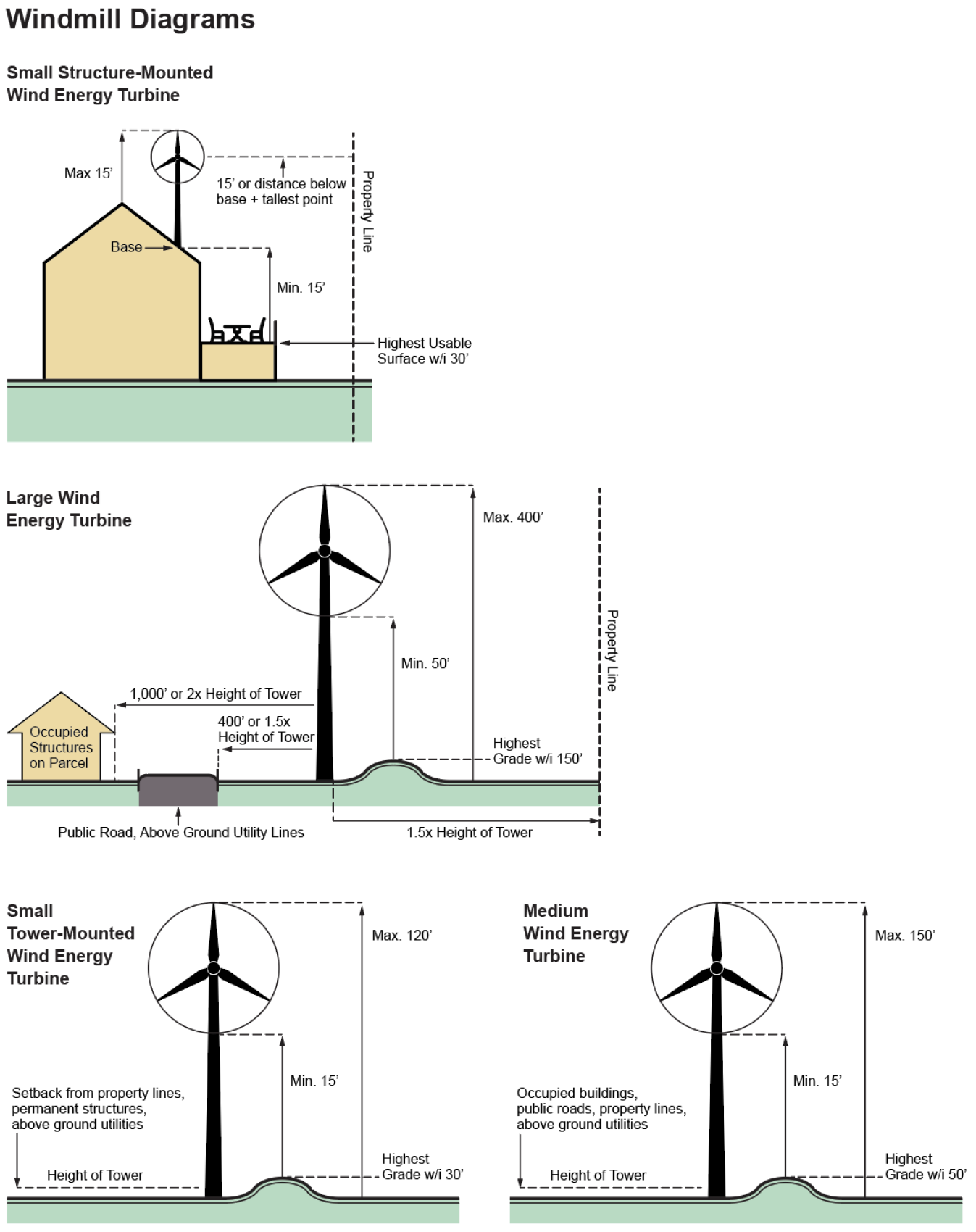
Sec. 94-6.15. - Wind energy.
(a)
Wind energy. The purpose of this section is to establish regulations for the location, installation and operation of wind energy turbines (WETs). Among other goals, the regulations in this section are intended:
(1)
To promote the safe, effective and efficient use of WETs to produce electricity and reduce the consumption of fossil fuels.
(2)
To preserve and protect public health, safety, welfare and quality of life by minimizing the potential adverse impacts of WETs.
(3)
To establish standards and quantifiable procedures to direct the site location, engineering, installation, maintenance and decommissioning of WETs.
(4)
To define and delineate between various types of WETs in order to properly regulate the different WET technologies.
(b)
Definitions.
(1)
Ambient sound level. The amount of background noise at a given location prior to the installation of a WET which may include, but is not limited to, traffic, machinery, lawnmowers, general human activity and the interaction of the wind with the landscape. Ambient sound level is measured on the decibel-dB(A)-weighted scale as defined by the American National Standards Institute (ANSI).
(2)
Anemometer. A wind speed indicator constructed for the purpose of analyzing the potential for installing a WET at a given location. An anemometer includes a tower, base plate, anchors, cables and hardware, wind direction vanes, booms to hold equipment, a data logger, instrument wiring and telemetry devices used to monitor or transmit wind speed and wind flow characteristics over a period of time. Telemetry data can include instantaneous wind speeds or characterizations of a wind resource at a given location.
(3)
Decommissioning. The process of terminating the operation of a WET by completely removing the entire WET and all related buildings, structures, foundations, supports, equipment and, as appropriate, onsite access roads.
(4)
Large wind energy turbine (L-WET). A tower-mounted wind energy system, standing greater than 150 feet tall and up to 400 feet tall, that converts wind energy into electricity through the use of equipment (e.g., base, blade, rotor, foundation, generator, nacelle, tower, transformer, vane, wire, inverter, batteries, etc.) L-WETs have nameplate capacities that identify maximum kilowatts.
(5)
Medium wind energy turbine (M-WET). A tower-mounted wind energy system standing greater than 120 feet tall and no more than 150 feet tall that converts wind energy into electricity through the use of equipment (e.g., base, blade, rotor, foundation, generator, nacelle, tower, transformer, vane, wire, inverter, batteries, etc.) M-WETs have nameplate capacities that do not exceed 250 kilowatts.
(6)
Nacelle. The encasement which houses the interior electricity-generating components, gear box, drive tram, brakes and related equipment of a WET.
(7)
Net metering. A special metering and billing agreement between utility companies and their customers which facilitates the connection of sustainable energy generating systems to the power grid.
(8)
Occupied building. A structure used by or which houses residents, customers, workers or visitors.
(9)
Operator. The entity responsible for the day-to-day operations and maintenance of a WET.
(10)
Owner/applicant. The person, firm, corporation, company, limited liability corporation or other entity seeking city approval under this section, as well as its successor(s), assign(s) or transferee(s), for a WET or anemometer. An owner/applicant must have the legal authority to represent and bind the landowner or lessee who will construct, own, and operate the WET or anemometer. The duties and obligations regarding a zoning approval for any approved WET or Anemometer shall be with the owner/applicant of the WET or anemometer, and jointly and severally with the owner and operator or lessee of the WET or Anemometer if different than the owner/applicant.
(11)
Rotor. A blade of a WET that is connected to the rotor hub and nacelle and acts as an airfoil assembly that exacts kinetic energy directly from the wind.
(12)
Rotor diameter. The cross-sectional dimension of the circle swept by the rotating blades of a WET.
(13)
Shadow flicker. The moving shadow created by the sun shining through the rotating blades of a WET. The amount of shadow flicker created by a WET is calculated by a computer model that measures WET location, elevation, and tree cover, location of adjacent structures, wind activity and sunlight angle.
(14)
Small tower-mounted wind energy turbine (STM-WET). A tower-mounted wind energy system standing up to 120 feet that converts wind energy into electricity through the use of equipment (e.g., base, blade, rotor, foundation, generator, nacelle, tower, transformer, vane, wire, inverter, batteries, etc.) STM-WETs have nameplate capacities that do not exceed 30 kilowatts.
(15)
Structure. Anything constructed or erected that involves permanent location on the ground or attachment to something having such a location.
(16)
Small structure-mounted wind energy turbine (SSM-WET). A structure-mounted wind energy system that converts wind energy into electricity through the use of equipment (e.g., base, blade, rotor, foundation, generator, nacelle, tower, transformer, vane, wire, inverter, batteries, etc.) SSM-WETs are attached to a structure's roof, walls or another elevated surface. SSM-WETs have nameplate capacities that do not exceed ten kilowatts. The total height of a SSM-WET unit does not exceed 15 feet as measured from the highest point of the adjacent roof or structure, excluding chimneys, antennae or other similar features.
(17)
Survival wind speed. The maximum wind speed, as designated by the WET manufacturer, at which a WET in an unattended state is designed to survive without damage to any structural equipment or the loss of the ability to function normally.
(18)
Total height. The vertical distance as measured from the ground level of the base of a WET tower to the uppermost vertical extension of a rotor blade, or the maximum height reached by any part of a WET.
(19)
Tower. A freestanding monopole that supports a WET.
(20)
Upwind turbines. As opposed to a "downwind turbine," an upwind turbine has the rotor blades facing into the wind source direction.
(21)
Wind energy turbine (WET). A structure-mounted or tower-mounted small, medium or large wind energy conversion system that converts wind energy into electricity through the use of specialized equipment and structures.
(c)
Applicability. This article applies to all WETs proposed for construction after the effective date of the ordinance adding this article. All WETs constructed prior to the effective date of the ordinance adding this article shall not be required to meet the standards of this article; however, any physical modification to an existing WET that materially alters the size, type, equipment or location shall require approval per the standards of this section.
(d)
Temporary uses. Anemometers are permitted in all zoning districts as a temporary use, subject to the provisions of this section.
(1)
The construction, installation or modification of an anemometer shall require a building permit;
(2)
Anemometers must conform to all applicable local, state and federal safety, construction, environmental, electrical, communications and FAA requirements;
(3)
Anemometers are subject to the requirements of this article for total height, setbacks, separation, location, safety and decommissioning that correspond to the size of the WET(s) proposed on the site;
(4)
An anemometer without an accompanying WET shall not be located on a site for more than 13 months when testing for SSM-WET, STM-WET or M-WET installation potential; and,
(5)
An anemometer without an accompanying WET shall not be located on a site for more than three years when testing for L-WET installation potential.
(e)
Permitted uses.
(1)
SSM-WETs and STM-WETs are a permitted use in all zoning districts, subject to the following:
a.
Building permit. SSM-WETs and STM-WETs must receive a building permit prior to construction, installation, relocation or modification. The owner/applicant or operator must apply for and receive the building permit.
b.
Minimum requirements. All SSM-WETs and STM-WETs shall be subject to the following minimum requirements:
1.
Upwind turbines. Upwind turbines shall be required unless otherwise approved by the planning commission, based on technical specifications and site-specific information.
2.
Visual appearance.
i.
SSM-WETs and STM-WETs, including accessory buildings and related structures, shall be a nonreflective, nonobtrusive color, such as white, gray or black.
ii.
The appearance of the WET and all accessory structures shall be maintained throughout the life of the unit.
iii.
Exterior lighting of a tower, rotor blades and nacelle shall only be allowed in order to meet FAA mandatory requirements.
iv.
Exterior lighting of accessory buildings or entrance points shall be permitted, provided that such exterior lighting fixtures shall be full cutoff "shoebox" fixtures. These fixtures shall not be mounted on poles or other structures that exceed a height of 20 feet, as measured from the grade at the base of the fixture.
v.
SSM-WETs and STM-WETs may not contain commercial signage, banners, flags or advertising logos, except for the identification of the turbine manufacturer and unit specifications for regulatory purposes.
c.
Ground clearance. The lowest extension of any rotor blade or other exposed moving component of an SSM-WET or STM-WET shall be at least 15 feet above the ground, as measured from the highest point of grade within 30 feet of the base of the WET. In addition, the lowest extension of any rotor blade or other exposed moving component of an SSM-WET or STM-WET shall be at least 15 feet above any outdoor areas intended for human use that are located below the WET. Examples include balconies, roof gardens, etc.
d.
Noise control.
1.
Where an adjacent parcel contains a residential use, the noise produced by a SSM-WET or STM-WET may not exceed the lowest ambient sound level that exists between the hours of 9:00 p.m. and 9:00 a.m. along any adjacent property line used for residential purposes.
2.
Where no adjacent parcel contains a residential use, the noise produced by a SSM-WET or STM-WET may not exceed the lowest ambient sound level that exists between the hours of 9:00 p.m. and 9:00 a.m. on the parcel, plus five decibels dB(A).
e.
Vibration. An SSM-WET or STM-WET shall not produce vibrations that are perceptible to humans beyond any property line upon which a WET is located.
f.
Wire supports. Guy wires or similar apparatus shall not be allowed as part of an SSM-WET or STM-WET installation.
g.
SSM-WET height. The mounted height of an SSM-WET shall not exceed 15 feet above the highest point of the adjacent roof or structure.
h.
SSM-WET setbacks.
1.
An SSM-WET shall be setback a minimum of 15 feet or the distance between the base and the highest point of the SSM-WET, whichever is greater, from any property line, public right-of-way, public easement or overhead utility lines.
2.
If the SSM-WET is affixed by any extension to a structure's walls, roof or other elevated surface then the setback from property lines, public rights-of-way, public easements or overhead utility lines shall be measured from the furthest outward extension of moving WET components.
i.
SSM-WET separation distances. If more than one SSM-WET is installed on a property, then a distance equal to the mounted height of the adjacent SSM-WET must be maintained between the bases of each SSM-WET.
j.
STM-WET height. The total height of a STM-WET shall not exceed 120 feet.
k.
STM-WET setbacks.
1.
On a property containing occupied buildings, STM-WETs shall only be located in the rear yard.
2.
An STM-WET shall be setback a distance equal to the total height of the STM-WET from all occupied buildings on the subject property. This setback will be measured from the base of the tower. This setback may be reduced by the planning commission as part of a special use permit if the applicant provides a registered engineer's certification that the WET is designed to collapse, fall, curl, or bend within a distance or zone shorter than the total height of the WET.
3.
A minimum setback equal to the total height of the STM-WET shall be required to any property line, public right-of-way, public easement or overhead utility lines. This setback will be measured from the base of the tower. This setback may be reduced if the applicant provides a registered engineer's certification that the WET is designed to collapse, fall, curl, or bend within a distance less than the total height of the WET.
l.
STM-WET separation distances. If more than one STM-WET is installed on a property, then a distance equal to the total height of the tallest STM-WET must be maintained between the bases of each STM-WET.
(2)
Site plan review. SSM-WETs and STM-WETs are subject to site plan review by the planning commission, subject to the following:
a.
SSM-WETs and STM-WETs shall be exempt from the site plan review standards found in article XVIII but shall be subject to the standards and requirements contained in this section.
b.
Owner/applicants of SSM-WETs and STM-WETs proposed for installation shall provide the following to the city:
1.
A completed application for site plan review plus any applicable fees and/or escrow deposit approved by the city commission;
2.
A scaled site plan drawing clearly illustrating the proposed WET(s) and all accessory structures/equipment in relation to all onsite and adjacent buildings, property lines, rights-of-way, public easements and overhead utility lines. Setbacks as required in this section shall be shown to scale on the site plan.
3.
A scaled site plan that clearly displays property dimensions, existing buildings on the subject property and on adjacent properties, sidewalks, nonmotorized pathways and streets.
4.
A scaled site plan that includes existing and proposed on-site grading/topography at two-foot contour intervals.
5.
Product-specific technical information from the manufacturer of the SSM-WET or STM-WET. This information shall include the proposed total height and type of WET, maximum noise output in decibels, total rated generating capacity, product dimensions, rotor blade diameter and a detail of accessory structures.
6.
Documented compliance with the noise and vibration generation requirements set forth in this article.
7.
Documented compliance with applicable local, state and federal regulations including, but not limited to, public safety, construction, environmental, electrical, communications and FAA requirements.
8.
Proof of liability insurance.
9.
Documented evidence that the utility company has been informed of, and approved, the owner/applicant's intent to install an interconnected, customer-owned generator. Off-grid systems shall be exempt from this requirement.
10.
A narrative that explains the proposed methods that will be used to perform maintenance on the WET(s) in compliance with the manufacturer's recommendations and requirements.
11.
A narrative that explains how the WET will be tested after installation for compliance with the noise and vibration regulations of this section.
(3)
Safety requirements.
a.
If the SSM-WET or STM-WET is connected to a public utility system for net metering purposes, it shall meet the requirements for interconnection and operation as set forth in the public utility's current service regulations that meet federal, state and industry standards applicable to wind power generation facilities. Any such connection shall be inspected and approved by the appropriate utility company.
b.
The SSM-WET or STM-WET shall be equipped with an automatic braking, governing or feathering system in order to prevent uncontrolled rotation, over-speeding or excessive pressure on the WET.
c.
A clearly visible warning sign regarding voltage shall be placed at the base of the WET.
d.
The structural integrity of the WET shall conform to the design standards of the International Electrical Commission; specifically IEC 61400-1 "Wind Turbine Safety and Design," IEC 61400-2 "Small Wind Turbine Safety," IEC 61400-22 "Wind Turbine Certification," and IEC 61400-23 "Blade Structural Testing," as amended or succeeded.
(4)
Signal interference. The SSM-WET or STM-WET shall not interfere with communication systems, such as, but not limited to, radio, telephone, television, satellite or emergency services communication systems.
(5)
Decommissioning.
a.
The SSM-WET or STM-WET owner/applicant shall complete decommissioning within 12 months after the end of the WETs useful life. The term "end of useful life" is defined as zero electricity generation for a period of 12 consecutive months from a particular WET.
b.
All decommissioning expenses are the responsibility of the owner/applicant.
c.
The planning commission may grant an extension of the decommissioning period based upon request of the owner/applicant. Such extension period shall not exceed one calendar year.
d.
If the SSM-WET or STM-WET owner/applicant fails to complete the act of decommissioning within the period described in this section, the SSM-WET or STM-WET shall thereafter be deemed a public nuisance and subject to abatement as provided by law.
e.
For STM-WETs, following removal of all items noted in (e) above, the site shall be graded and stabilized to prevent soil erosion in a manner consistent with the post-WET use of the property.
(6)
Public noise complaints. Should an aggrieved person allege that the SSM-WET or STM-WET is not in compliance with the noise requirements of this article, the administrative enforcement procedure shall be as follows:
a.
The complainant shall notify the city planning director in writing regarding the noise level.
b.
The planning director shall coordinate with the police department to test the decibel level for compliance with the standards of this article.
c.
If the test results are unsatisfactory, the complainant may request a noise level test by a certified acoustic technician. The complainant will be required to submit a cash deposit in an amount sufficient to pay for the noise level test.
d.
If the noise level test indicates that the noise level complies with the standards of this article, then the city will use the deposit to pay for the test.
e.
If the noise level test indicates that the WET is in violation of this article, then the owner/applicant shall reimburse the city for the noise level test while taking immediate action to bring the WET into compliance with this article. The city may require the WET to be shut down until compliance can be achieved.
f.
Under circumstances as noted in [subsection] e. above, the city shall refund the cash deposit to the complainant.
(f)
Special uses. Medium wind energy turbines (M-WETs) shall be considered a special use within the AA agricultural; ORP office, research and parking; C-1 general commercial; C-2 community commercial; I-1 light industrial, and I-2 heavy industrial. Large wind energy turbines (L-WETs) shall be considered a special use in the I-1 light industrial and I-2 heavy industrial districts.
(g)
M-WETs and L-WETs must receive a building permit prior to construction, installation, relocation or modification. The owner/applicant or operator must apply for and receive the building permit.
(h)
All M-WETs and L-WETs shall be subject to the following minimum requirements:
(1)
Upwind turbines. Upwind turbines shall be required unless otherwise approved by the planning commission, based on technical specifications and site-specific information.
(2)
Visual appearance.
a.
M-WETs and L-WETs shall be mounted on a tubular tower.
b.
M-WETs and L-WETs, including accessory buildings and related structures, shall be a nonreflective, nonobtrusive color, such as white, gray or black.
c.
The appearance of the WET and all accessory structures shall be maintained throughout the life of the unit.
d.
Exterior lighting of a tower, rotor blades and nacelle shall only be allowed in order to meet FAA-mandated requirements.
e.
Exterior lighting of accessory buildings or entrance points shall be permitted, provided that such exterior lighting fixtures shall be full cutoff "shoebox" fixtures. These fixtures shall not be mounted on poles or other structures that exceed a height of 20 feet, as measured from the grade at the base of the fixture.
f.
M-WETs and L-WETs shall not contain commercial signage, banners, flags or advertising logos, except for the identification of the turbine manufacturer and unit specifications for regulatory purposes.
(i)
Ground clearance.
(1)
M-WET. The lowest extension of any rotor blade or other exposed moving component of an M-WET shall be at least 15 feet above the ground, as measured from the highest point of grade within 50 feet of the base of the tower. In addition, the lowest extension of any rotor blade or other exposed moving component of an M-WET shall be at least 15 feet above any outdoor areas intended for human use that are located below the WET. Examples include balconies, roof gardens, etc.
(2)
L-WET. The lowest extension of any rotor blade or other exposed moving component of an L-WET shall be at least 50 feet above the ground, as measured from the highest point of grade within 150 feet of the base of the tower.
(j)
Shadow flicker. The owner/applicant(s) or operator(s) shall conduct an analysis of potential shadow flicker onto any occupied building with direct line-of-sight to the M-WET or L-WET. The analysis shall identify the locations of shadow flicker that may be caused by the WET and the expected durations of the flicker at these locations from sunrise to sunset over the course of a year. The analysis shall identify situations where shadow flicker may affect the occupants of the buildings for more than 30 hours per year, and describe measures that shall be taken to eliminate or mitigate the problems. Shadow flicker on a building shall not exceed 30 hours per year.
(k)
Noise control.
(1)
Where an adjacent parcel contains a residential use, the noise produced by an M-WET or L-WET may not exceed the lowest ambient sound level that exists between the hours of 9:00 p.m. and 9:00 a.m. along any adjacent property line used for residential purposes.
(2)
Where no adjacent parcel contains a residential use, the noise produced by an M-WET or L-WET may not exceed the lowest ambient sound level that exists between the hours of 9:00 p.m. and 9:00 a.m. on the parcel, plus five decibels dB(A).
(l)
Vibration. An M-WET or L-WET shall not produce vibrations that are perceptible to humans beyond any property line upon which a WET is located.
(m)
Wire supports. Guy wires or similar apparatus shall not be allowed as part of an M-WET or L-WET installation.
(n)
Electrical system. All electrical controls, control wiring, grounding wires, power lines, and all other electrical system components of the M-WET or L-WET shall be placed underground within the boundary of each parcel at a depth designed to accommodate the existing land use to the maximum extent practicable. Wires necessary to connect the wind generator to the tower wiring are exempt from this requirement.
(o)
Quantity of WETS.
(1)
No more than one M-WET shall be installed for every two and one-half acres of land included in the subject parcel.
(2)
The number of L-WETs shall be determined based on WET setbacks and separation distances as required in this section.
(p)
Total height.
(1)
The total height of an M-WET shall not exceed 150 feet.
(2)
The total height of an L-WET shall not exceed 400 feet.
(q)
M-WET setbacks and separation.
(1)
Occupied building setback. An M-WET shall be setback a distance equal to the total height of the M-WET from all occupied buildings on the subject parcel, as measured from the base of the tower. This setback may be reduced by the planning commission as part of a special use permit if the applicant provides a registered engineer's certification that the WET is designed to collapse, fall, curl, or bend within a distance or zone shorter than the total height of the WET.
(2)
Property line setbacks. With the exception of the locations of public roads (see below) and parcels with occupied buildings (see above), all internal property line setbacks shall be equal to the total height of the M-WET, as measured from the base of the tower. This setback may be reduced by the planning commission as part of a special use permit if the applicant provides a registered engineer's certification that the WET is designed to collapse, fall, curl, or bend within a distance or zone shorter than the total height of the WET.
(3)
Public road setbacks. Each M-WET shall be set back from the nearest public road a distance equal to the total height of the M-WET, as measured from the nearest boundary of the road right-of-way to the base of the tower.
(4)
Communication and electrical lines. Each M-WET shall be set back from the nearest above-ground public electric power line or telephone line a distance equal to the total height of the M-WET, as measured from the base of the tower to from the existing power line or telephone line.
(5)
Tower separation. M-WET separation shall be based on industry standards and the manufacturer's recommendations.
(r)
L-WET setbacks and separation.
(1)
Occupied building setback. Each L-WET shall be set back from the nearest occupied building located on the same parcel as the L-WET a minimum of two times its total height, or 1,000 feet, whichever is greater, as measured from the base of the tower.
(2)
Property line setbacks. With the exception of the locations of public roads (see below) and parcels with occupied buildings (see above), all internal property line setbacks shall be a minimum of one and one-half times the total height of the L-WET, as measured from the base of the tower. This setback may be reduced by the planning commission as part of a special use permit if the applicant provides a registered engineer's certification that the L-WET is designed to collapse, fall, curl, or bend within a distance or zone shorter than the total height of the WET.
(3)
Zoning district setbacks. There shall be a setback distance equal to two times the total height of the L-WET, as measured from the base of the tower, to any border of the I-1 or I-2 zoning districts, excepting borders between those two districts.
(4)
Public road setbacks. Each L-WET shall be set back from the nearest public road a minimum distance of 400 feet or one and one-half times the total height of the L-WET, whichever is greater, as measured from the nearest boundary of the road right-of-way to the base of the tower.
(5)
Communication and electrical lines. Each L-WET shall be set back from the nearest above-ground public electric power line or telephone line a distance no less than 400 feet or one and one-half times its total height, whichever is greater, as measured from the base of the tower to from the existing power line or telephone line.
(6)
Tower separation. L-WET tower separation shall be based on industry standards and manufacturer's recommendations.
(s)
Access driveway. All L-WETs shall be accessible from an access road in order to offer an adequate means by which public safety vehicles may readily access the site in the event of an emergency. All access roads shall be constructed to standards approved by the city engineer, police chief and fire chief.
(t)
Signal interference. An M-WET or L-WET shall not interfere with communication systems, such as, but not limited to, radio, telephone, television, satellite or emergency services communication systems.
(u)
Special use permit required. M-WET and L-WET projects require a special use permit prior to the commencement of any on-site construction. Special use permit applications for M-WET(s) and L-WET(s) shall follow the administrative procedures prescribed in article IX.
(v)
As part of the application for a special use permit, the owner(s)/applicant(s) of proposed M-WET and L-WET projects shall provide the following to the city:
(1)
A narrative explaining the proposed methods that will be used to perform maintenance on the WET(s) in compliance with the manufacturer's recommendations and requirements.
(2)
A copy of the lease, or recorded document, with the landowner(s) if the owner/applicant does not own the land for the proposed M-WET or L-WET.
(3)
A statement from the landowner(s) of a leased site that he/she will abide by all applicable terms and conditions of the special use permit, if approved.
(4)
In the case of a condominium development, a copy of the condominium development's master deed and bylaws addressing the legal arrangement for the M-WET or L-WET.
(5)
The proposed number, representative types and total height of each M-WET or L-WET to be constructed; including their manufacturer and model, product specifications including maximum noise output (measured in decibels), total rated capacity, rotor diameter, and a description of ancillary facilities.
(6)
Documentation verifying the developer/manufacturer's confirming specifications for M-WET or L-WET tower separation as proposed on the site plan.
(7)
Documented compliance with the noise, vibration and shadow flicker requirements set forth in this article.
(8)
Engineering data concerning construction of the M-WET or L-WET and its base or foundation, including soil boring information.
(9)
A certified, registered engineer's certification that certifies the M-WET or L-WET meets or exceeds the manufacturer's construction and installation standards.
(10)
The anticipated construction schedule.
(11)
A description of the routes to be used by construction and delivery vehicles and of any road improvements that will be necessary to accommodate construction vehicles, equipment or other deliveries.
(12)
An agreement or bond which guarantees the repair of damage to public roads and other areas caused by construction of the L-WET
(13)
A copy of the WET maintenance and operation plan, including anticipated regular and scheduled maintenance. Additionally, a description of the procedures that will be used for lowering or removing the M-WET or L-WET to conduct maintenance, if applicable.
(14)
Documented compliance with applicable local, state and national regulations including, but not limited to, all applicable safety, construction, environmental, electrical, and communications standards.
(15)
Documented compliance with Federal Aviation Administration (FAA) requirements, the Michigan Airport Zoning Act, the Michigan Tall Structures Act, and any applicable airport overlay zone regulations.
(16)
Proof of comprehensive liability insurance.
(17)
A statement indicating if hazardous materials will be used and stored on the site.
(18)
Evidence that the utility company has been informed of the customer's intent to install an interconnected, customer-owned generator and that such connection has been approved. Off-grid systems shall be exempt from this requirement.
(19)
A written description of the anticipated life of each M-WET or L-WET; the estimated cost of decommissioning; the method of ensuring that funds will be available for decommissioning and site restoration; and removal and restoration procedures and schedules that will be employed if the M-WET(s) or L-WET(s) become inoperative or nonfunctional.
(20)
A decommissioning plan that will be carried out at the end of the M-WET's or L-WET's useful life, which shall be submitted as a participating landowner agreement, regarding equipment removal upon termination of the lease.
a.
As part of the participating landowner agreement, an independent and certified professional engineer shall estimate the total cost of decommissioning ("decommissioning costs") with no regard to salvage value of the equipment, and the cost of decommissioning net salvage value of the equipment.
b.
When determining this amount, the city may also require an annual escalator or increase based on the Federal Consumer Price Index (or equivalent or its successor). Said estimates shall be submitted to the city after the first year of operation and every fifth year thereafter.
c.
M-WET and L-WET owner(s) shall post and maintain decommissioning funds in an amount equal to 100 percent of decommissioning costs. The decommissioning funds shall be posted and maintained with a bonding company or federal or state chartered lending institution chosen by the owner(s) and participating landowner(s) posting the financial security. The bonding company or lending institution shall be authorized to conduct such business as approved by city.
d.
Decommissioning funds shall be in the form of a performance bond made out to the city.
e.
A condition of the bond shall be notification by the bond company to the city when the bond is about to expire or be terminated.
f.
Failure to keep the bond in effect while an M-WET or L-WET is in place will be a violation of the special use permit. If a lapse in the bond occurs, the city may take action, up to and including requiring the cessation of operations of the WET until the bond is reposted.
g.
The owner(s)/applicant(s) shall be responsible to record, at its sole expense, a copy of the approved participating landowner agreement with the Kent County Register of Deeds and supply a copy, after recording, to the city.
(21)
A study assessing any potential impacts on the natural environment, including, but not limited to, assessing the potential impact on endangered species, bats, birds and/or other wildlife, wetlands and fragile ecosystems. The study shall conform to state and federal wildlife agency recommendations based on local conditions.
(22)
Other relevant information as may be requested by the city to ensure compliance with the requirements of this article.
(w)
Site plan review required. M-WETs and L-WETs are subject to site plan review by the planning commission consistent with the following:
(1)
M-WET and L-WET projects are exempt from the site plan review standards found in article XVIII.
(2)
Owner/applicants of proposed M-WET and L-WET projects shall provide the following to the city:
a.
A completed and signed application for site plan review by the planning commission plus any applicable fees and/or escrow deposit approved by the city commission;
b.
A scaled site plan, sealed by a professional engineer, including:
c.
Contact information for the owner(s)/applicant(s) and operator(s) of the M-WET or L-WET as well as contact information for all property owners on which the M-WET or L-WET is located.
d.
A site location map with identification and location of the properties on which the proposed M-WET or L-WET will be located.
e.
The location and dimensions of all proposed WET(s) and all accessory structures/equipment, including security fencing, exterior lighting and power grid connectivity equipment, whether buried or above ground.
f.
The location of all on-site and adjacent property lines, rights-of-way, public easements and overhead utility lines.
g.
The location and dimension of all setbacks as required in this section.
h.
All property dimensions, zoning districts, existing buildings on the subject property and on adjacent properties, sidewalks, nonmotorized pathways, large trees and streets.
i.
Existing and proposed on-site grading/topography at two-foot contour intervals.
j.
Soil erosion and storm water drainage plans per chapter 34 of the City Code.
k.
Plan view and cross sectional details of all proposed access drives.
(x)
Safety requirements.
(1)
If the M-WET or L-WET is connected to a public utility system for net metering purposes, it shall meet the requirements for interconnection and operation as set forth in the public utility's current service regulations that meet federal, state and industry standards applicable to wind power generation facilities. Any such connection shall be inspected and approved by the appropriate utility company prior to operation.
(2)
The M-WET or L-WET shall be equipped with an automatic braking, governing or feathering system in order to prevent uncontrolled rotation, over-speeding or excessive pressure on the WET.
(3)
Security measures shall be in place to prevent unauthorized trespass and access. Each M-WET or L-WET shall not be climbable up to 15 feet above ground surfaces. All access doors to M-WETs or L-WETs and accessory electrical equipment shall be locked and/or fenced as appropriate.
(4)
All spent lubricants, cooling fluids, and any other materials shall be properly and safely removed in a timely manner.
(5)
Each M-WET or L-WET shall have one sign, not to exceed two square feet in area, posted at the base of the tower and on the security fence if applicable. The sign shall contain at least the following:
a.
A warning of high voltage;
b.
Names of manufacturer and owner/operator(s);
c.
Emergency contact numbers (list more than one number).
(6)
The structural integrity of the WET shall conform to the design standards of the International Electrical Commission; specifically, IEC 61400-1 "Wind Turbine Safety and Design," IEC 61400-2 "Small Wind Turbine Safety," IEC 61400-22 "Wind Turbine Certification," and IEC 61400-23 "Blade Structural Testing," as amended or succeeded.
(y)
Decommissioning.
(1)
The M-WET or L-WET owner/applicant shall complete decommissioning within 12 months after the end of the WETs useful life. The term "end of useful life" is defined as zero electricity generation for a period of 12 consecutive months from a particular WET.
(2)
Decommissioning shall include the removal and disposal of each M-WET or L-WET, accessory buildings and structures, electrical components, and all foundations to a minimum depth of 60 inches.
(3)
All access drives to the M-WET or L-WET shall be removed, cleared, and graded by the owner/applicant, unless the property owner(s) requests, in writing, a desire to maintain the access drives. All access drives shall remain private and the city shall have no duty to undertake any maintenance or repair of such drives.
(4)
The WET site and any disturbed earth shall be stabilized, graded, and cleared of any debris by the owner/applicant of the M-WET or L-WET or its assigns. If the site is not to be used for agricultural practices following removal, the site shall be seeded to prevent soil erosion.
(5)
All decommissioning expenses are the responsibility of the owner/applicant.
(6)
The planning commission may grant an extension of the decommissioning period based upon a reasonable and explanatory request by the owner. Such extension period shall not exceed one calendar year.
(7)
The performance bond agent shall release the decommissioning funds noted in subsection [(v)(20)]. when the owner/applicant has demonstrated in writing, and the city concurs in writing, that decommissioning has been satisfactorily completed.
(8)
If the M-WET or L-WET owner/applicant fails to complete the act of decommissioning within the period described in this article, then, consistent with the participating landowners' agreement, the city may proceed as follows:
a.
The city may proceed to collect against the performance bond and request a release of the decommissioning funds.
b.
The commission shall designate a contractor to complete the decommissioning.
c.
All decommissioning expenses shall be charged to the performance bond of the owner/applicant, or its successors or assigns or such other means available at law or equity.
d.
All outstanding decommissioning expenses shall become a lien against the premises.
e.
Nothing herein shall limit the right of the city to pursue all means of enforcement otherwise available at law for a violation of this article including, without limitation, seeking injunctive relief.
(z)
Certification and compliance.
(1)
The city shall be notified of a change in ownership of an M-WET or L-WET or a change in ownership of the property on which the M-WET or L-WET is located within 60 days of such a transaction.
(2)
The city reserves the right to inspect any M-WET or L-WET, in order to ensure compliance with the article. Any cost associated with the inspections shall be paid by the owner/applicant of the WET.
(3)
A sound pressure level analysis shall be conducted from a reasonable number of sampled locations at the perimeter and in the interior of the property containing any M-WETs or L-WETs to demonstrate compliance with the requirements of this article. Proof of compliance with the noise standards is required within 90 days of the date the M-WET or L-WET becomes operational. Sound shall be measured by a third-party, qualified professional, with the associated fees being paid by the owner/applicant.
(4)
The M-WET or L-WET owner/applicant or operator(s) shall provide the city with a copy of the yearly WET maintenance inspection.
(aa)
Public noise and shadow flicker complaints.
(1)
Noise. Should an aggrieved person allege that the M-WET or L-WET is not in compliance with the noise requirements of this article, the administrative enforcement procedure shall be as follows:
a.
The complainant shall notify the city planning director in writing regarding the noise level.
b.
The planning director shall coordinate with the police department to test the decibel level for compliance with the standards of this article.
c.
If the test results are unsatisfactory, the complainant may request a noise level test by a certified acoustic technician. The complainant will be required to submit a cash deposit in an amount sufficient to pay for the noise level test.
d.
If the noise level test indicates that the noise level complies with the standards of this article, then the city will use the deposit to pay for the test.
e.
If the noise level test indicates that the WET is in violation of this article, then the owner/applicant shall reimburse the city for the noise level test while taking immediate action to bring the WET into compliance with this article. The city may require the WET to be shut down until compliance can be achieved.
f.
Under circumstances as noted in subsection (v) above, the city shall refund the cash deposit to the complainant.
(2)
Shadow flicker. Should an aggrieved person allege that the M-WET or L-WET is not in compliance with the shadow flicker requirements of this article, the administrative enforcement procedure shall be as follows:
a.
The complainant shall notify the city planning director in writing regarding the shadow flicker level.
b.
The planning director shall examine the shadow flicker complaint on the site.
c.
If the planning director finds justifiable cause, a shadow flicker level test by a certified technician may be authorized by the city. The complainant will be required to submit a cash deposit in an amount sufficient to pay for the shadow flicker level test.
d.
If the shadow flicker level test indicates that the shadow flicker level complies with the standards of this article, then the city will use the deposit to pay for the test.
e.
If the shadow flicker level test indicates that the WET is in violation of this article, then the owner/applicant shall reimburse the city for the shadow flicker level test while taking immediate action to bring the WET into compliance with this article. The city may require the WET to be shut down until compliance can be achieved.
f.
Under circumstances as noted in subsection (v) above, the city shall refund the cash deposit to the complainant.
(bb)
Summary of WET setbacks and separation.
(Ord. No. 24-674, § 2(Exh. A), 1-22-24)

