
Franklin Park City Zoning Code
CHAPTER 10
- Site Development Standards
9-10-1.- General requirements.
A.
Number of structures on a lot. With the exception of lots used for single-family and two-family dwellings, there may be more than one principal building on a lot. All structures must comply with all dimensional standards of the zoning district.
B.
All activities within an enclosed structure. Within all districts, all activities must be conducted entirely within an enclosed structure, with the exception of the following uses and activities.
1.
Parking lots, principal and ancillary.
2.
Parks/playgrounds, conservation areas, community garden, and similar open space uses.
3.
Uses that typically include an outdoor component as part of their operations, as verified by the Zoning Administrator. Any use may be limited or the outdoor component prohibited as a condition of a conditional use approval, when conditional use approval is applicable.
4.
Permitted accessory outdoor storage, and outdoor sales and display areas.
5.
Permitted outdoor temporary uses.
C.
Applicability of setbacks. No setback may be reduced so that it is less than required by this Ordinance unless a variance is approved. The required setbacks for a lot cannot be considered a setback for any other lot. No principal building or accessory structure may be located in a required setback unless specifically permitted by this Ordinance or a variance is approved.
D.
Applicability of dimensional requirements. All structures must meet the dimensional requirements of the zoning district in which the structure is located. No existing structure may be enlarged, altered, reconstructed, or relocated in such a manner that conflicts with the requirements of the district in which the structure it is located unless a variance is approved.
E.
Sight triangle.
1.
No structure, including fences, freestanding sign, or landscape can exceed a height of thirty-six (36) inches above the street grade within the sight triangle which extends twenty-five (25) feet of the intersection of any street centerlines or of street centerlines projected.
2.
No structure, including fences, freestanding sign, or landscape can exceed a height of thirty-six (36) inches above the street grade within the sight triangle which extends ten (10) feet from either side of an intersection of a driveway and a vehicular right-of-way, including alleys, as measured from the curb lines.
9-10-2. - Exterior lighting.
The following standards apply to all nonresidential uses, including mixed-use, multi-family, and townhouse developments.
A.
Lighting plan required. A lighting plan is required and must include the following:
1.
A plan showing all light pole locations, building-mounted lights, bollard lights, and all other lighting.
2.
Specifications for luminaires and lamp types, and poles, including photographs or drawings of proposed light fixtures.
3.
Pole, luminaire, and foundation details including pole height, height of building-mounted lights, mounting height, and height of the luminaire.
4.
Elevations of the site including all structures and luminaires sufficient to determine the total cut off angle of all luminaires and their relationship to abutting parcels may be required.
5.
Photometric plans that show the footcandle measurement at all lot lines.
6.
Other information and data reasonably necessary to evaluate the required lighting plan.
B.
Maximum lighting regulations.
1.
The maximum allowable footcandle at any lot line is one footcandle.
2.
When additional security lighting is required for security reasons in excess of the footcandle limit imposed by item 1 above, additional lighting may be allowed based on evidence for the need for additional security through site plan review.
3.
No glare onto adjacent properties is permitted.
C.
Luminaire with cut off standards.
1.
To be considered a cut off luminaire, the cut off angle must be seventy-five (75) degrees or less.
2.
The maximum total height of a cut off luminaire, either freestanding or attached to a structure, is twenty (20) feet.
3.
A cut off luminaire must be designed to completely shield the light source from an observer three-and-a-half (3½) feet above the ground at any point along an abutting lot line.
LUMINAIRE WITH CUT OFF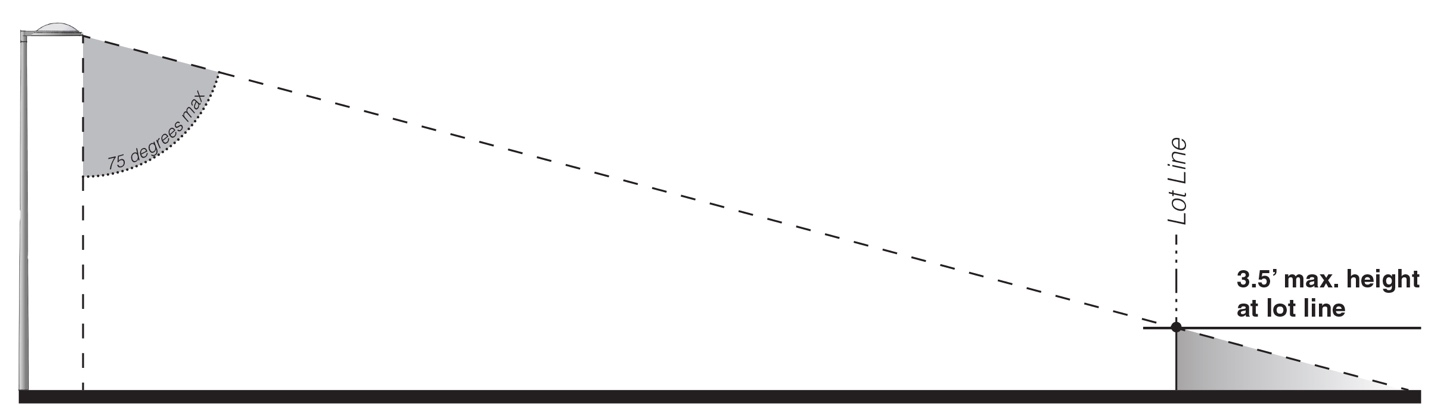
D.
Luminaire with no cut off standards. Nonresidential, including mixed-use, multi-family, and townhouse developments are allowed decorative and/or architectural lighting with no cut off if approved as part of site plan review, and subject to the following standards:
1.
A luminaire is considered to have no cut off if it is unshielded or has a cut off angle greater than seventy-five (75) degrees.
2.
The maximum permitted total height of a luminaire with no cut off is twelve (12) feet.
E.
Exceptions to lighting standards.
1.
Uplighting of buildings is allowed but all light must be directed onto the façade of the structure and cannot glare onto other properties.
2.
Because of their unique requirements for nighttime visibility and limited hours of operation, outdoor recreational facilities (public or private) such as, but not limited to, football fields, soccer fields, baseball fields, softball fields, tennis courts, golf driving ranges, show areas, and other similar uses are exempt from the requirements of this section. Recreational facilities are permitted a total luminaire height of sixty-five (65) feet in any district. Luminaires greater than sixty-five (65) feet in total height may only be approved by conditional use permit.
3.
Temporary uses.
4.
Holiday and seasonal lighting is not subject to the requirements of this section.
5.
Luminaires used for public roadway illumination are exempt from the requirements of this Ordinance.
6.
All temporary emergency lighting required by public safety agencies, other emergency services, or construction are exempt from the requirements of this Ordinance.
F.
Prohibited lighting.
1.
Flickering or flashing lights are prohibited.
2.
Searchlights, laser source lights, or any similar high intensity lights are prohibited.
3.
Rope lighting, neon, LED lighting, and similar lighting used to outline doors, windows, architectural features, and building facades is prohibited.
9-10-3. - Accessory structures and uses.
All accessory structures and uses are subject to the requirements of this section and the permitted encroachment requirements of Section 9-10-4. Additional accessory structures not regulated in this section may be regulated in Section 9-10-4.
A.
General regulations for accessory structures. All accessory structures are subject to the following regulations, unless otherwise permitted or restricted by specific regulations of this section and Ordinance.
1.
No accessory structure may be constructed prior to construction of the principal building to which it is accessory.
2.
No accessory structure can be used as a dwelling unit.
3.
Detached accessory structures, including those listed in this section and Section 9-10-4, must be setback as follows, unless otherwise permitted or restricted by this Ordinance:
a.
A minimum of three (3) feet from any interior side or rear lot line.
b.
No detached accessory structure may be located in a front or corner side yard unless specifically allowed by this Ordinance.
4.
Certain accessory structures may also be prohibited in certain yards. The use of the term "yard" refers to the area between the principal building and lot line. The distinction is made because certain principal buildings may not be built at required district setback lines, thereby creating a yard larger than the minimum setback dimension.
5.
The maximum height of any detached accessory structure is twenty (20) feet, unless otherwise permitted or restricted by this Ordinance.
6.
Detached accessory structures must be located a minimum of three (3) feet from any other accessory structure or principal building.
7.
Accessory structures are included in the calculation of all maximum impervious surface and building coverage requirements of the district.
8.
The footprint of any single detached accessory structure cannot exceed the footprint of the principal building.
B.
Amateur (ham) radio equipment.
1.
Towers that solely support amateur (ham) radio equipment and conform to all applicable performance criteria set forth in Section 9-10-5 are permitted in the rear yard only, and must be located ten (10) feet from any lot line. Towers are limited to the maximum building height of the applicable district plus an additional five (5) feet, unless a taller tower is technically necessary to engage successfully in amateur radio communications and a conditional use approval is obtained.
2.
Antennas may also be building-mounted and are limited to a maximum height of five (5) feet above the structure, unless a taller antenna is technically necessary to engage successfully in amateur radio communications and conditional use approval is obtained.
3.
Every effort must be made to install towers or antennas in locations that are not readily visible from adjacent residential lots or from the public right-of-way, excluding alleys.
4.
An antenna or tower that is proposed to exceed the height limitations is a conditional use. The operator must provide evidence that a taller tower and/or antenna is technically necessary to engage successfully in amateur radio communications. In addition, the applicant must provide evidence that the tower and/or antenna will not prove a hazard. As part of the application, the applicant must submit a plan showing the proposed location of the tower or antenna, as well as its relation to the principal building and accessory structures.
5.
Any such antennas and/or towers owned and operated by the Village are exempt from these requirements.
C.
Apiary.
1.
Apiaries are prohibited in the residential and downtown districts.
2.
Apiaries are permitted only in the rear yard and must be located ten (10) feet from any lot line.
3.
All bee colonies must be kept in a removable frame hive, which must be kept in sound and usable condition.
4.
The beekeeper must establish and maintain a flyway barrier at least six (6) feet in height consisting of a hedge, fence, solid wall, or combination that is parallel to the lot line and extends ten (10) feet beyond the colony in each direction so that bees are forced to fly at an elevation of at least six (6) feet above ground level over adjacent lots in the vicinity of the apiary.
5.
Each beekeeper must provide a convenient source of water available to the bees at all times.
D.
Book exchange box.
1.
Book exchange boxes are permitted in front or corner side yard only and must be located a minimum of one foot from any lot line, measured from the base of the book exchange box.
2.
No book exchange box may be located so that it impedes pedestrian access or circulation, obstructs parking areas, or creates an unsafe condition. Boxes cannot be located within the required sight triangle.
3.
Boxes are prohibited in the public right-of-way.
4.
Each box must be designed and constructed in such a manner that its contents are protected from the elements. All media must be fully contained within a weatherproof enclosure that is integral with the structure that comprises the book exchange box.
5.
Boxes are limited to a maximum height of sixty (60) inches to the highest point of the structure, and a maximum width and depth of three (3) feet.
6.
Foundations must be comprised movable materials, such as masonry pavers.
7.
No more than one book exchange box is permitted per lot.
E.
Coldframe gardening structures.
1.
Coldframe gardening structures up to three (3) feet in height are permitted in all yards.
2.
Coldframe gardening structures over three (3) feet in height and up to a maximum of six (6) feet are permitted in the rear and interior side yard.
3.
Coldframe gardening structures are limited to a maximum square footage of eighty (80) square feet. When part of a community garden, coldframe gardening structures are permitted a maximum square footage of one hundred sixty (160) square feet.
COLDFRAME GARDENING STRUCTURES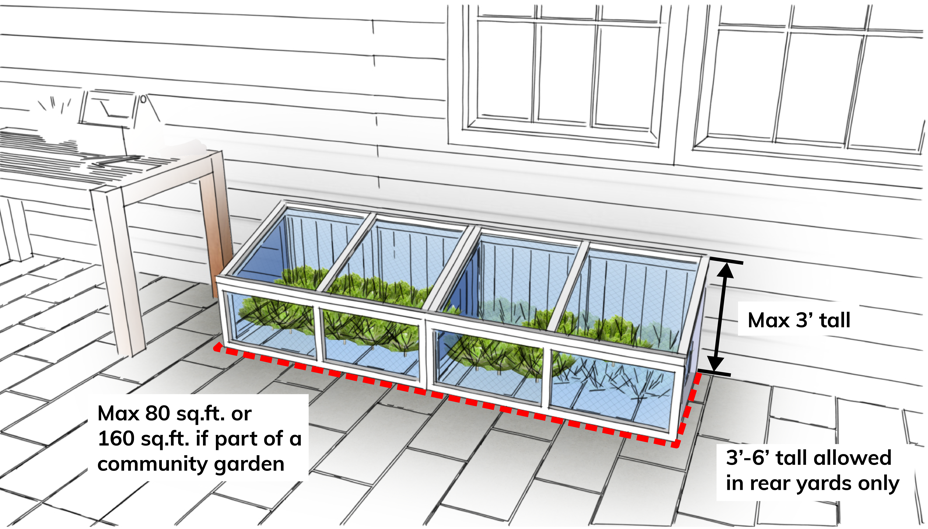
F.
Electric vehicle charging station. The following standards apply to electric vehicle charging stations located on private property.
1.
Electric vehicle charging stations are permitted as an accessory use within any principal or ancillary parking lot or parking structure, or gas station. Electric vehicle charging stations may be for public or private use.
2.
Private charging stations are permitted as an accessory use to all residential uses to serve the occupants of the dwelling(s) located on that property.
3.
Commercial electric vehicle charging stations must be either level 2 charging stations or level 3 fast charging stations, or the equivalent if standard industry categorizations change.
3.
Public electric vehicle charging station spaces must be posted and painted with a sign indicating the space is only for electric vehicle charging purposes. Days and hour of operations must be included if tow away provisions are to enforced by the owner of the property. Information identifying voltage and amperage levels and/or safety information must be posted.
4.
Charging station equipment must be maintained in good condition and all equipment must be functional. Charging stations no longer in functional use must be removed within thirty (30) days of discontinuance.
G.
Fences, hedges, and walls.
1.
General requirements.
a.
Every fence, wall, and hedge must be maintained in a good repair and safe condition at all times. Every damaged, rusted, or missing element must be repaired, removed, repainted, or replaced.
b.
When only one side of a fence is finished, the finished side of all fences must face away from the lot on which it is located. All fence posts must be placed on the inside of the fence.
c.
If a fence contains any pointed surfaces or sharp or hazardous materials, these elements must face downward and be located at the bottom portion of the fence.
d.
Arches of brick, masonry, ornamental metalwork, or wood, no greater than eight (8) feet above grade are allowed if incorporated into the fence or wall and are not within the required front setback.
e.
Fence height is measured from the adjacent ground to the highest point, except that decorative posts of a fence or wall may exceed the maximum height by nine (9) inches.
f.
If a fence of a greater height is required and/or a fence is required to be a solid fence by any other section of this Ordinance or other village ordinance, then such fence is required.
g.
Fences are prohibited within any right-of-way, drainage easement, or any designated floodway.
h.
The following materials are prohibited in the construction of fences and walls:
i.
Scrap metal.
ii.
Corrugated metal.
iii.
Sheet metal.
iv.
Electrical fences or any kind of electrically charged fences.
v.
Pallets.
vi.
Oriented strand board (OSB).
vii.
Plywood.
viii.
Chicken wire.
ix.
Plastic mesh (except if used in a manner accessory to a village-approved temporary use, event, maintenance, or construction).
x.
Barbed wire (except as used for a public utility).
2.
Fence, wall, and hedge height in residential districts. Fence, wall, and hedge height in the residential districts is subject to the following:
a.
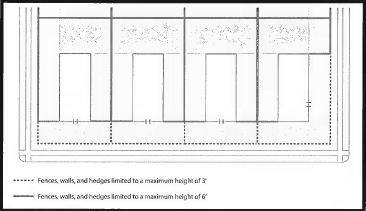
Fences, walls, and hedges may be built at the lot line and within all yards.
b.
Fences, walls, and hedges in the front yards are limited to a maximum height of three (3) feet.
c.
Fences, walls, and hedges in the interior side, corner side yards, and rear yards are limited to a maximum height of six (6) feet except for the following situations:
i.
When the rear yard shares a lot line with a front lot line of a lot: three (3) feet.
ii.
When the rear or side yard shares a lot line or public alley with a commercial or industrial district: eight (8) feet.
iii.
When the corner side yard contains the main entryway to the residence with access to the public right of way: three (3) feet.
iv.
When a six-foot (6') tall fence, wall, or hedge is located in any rear yard or side yard, there shall be no portion of such fence, wall, or hedge located within the ten-foot (10') sight triangle of any alley, driveway or street.
3.
Fence, wall, and hedge heights in nonresidential districts.
a.
Front and corner side yards.
i.
Fence, wall, and hedge heights in the downtown and commercial districts are limited to a maximum height of three (3) feet and must utilize a wrought iron or similar fence style approved by the Zoning Administrator.
ii.
Fence, wall, and hedge heights in the industrial districts are limited to a maximum height of eight (8) feet and must utilize a wrought iron or other similar fence style approved by the Zoning Administrator.
b.
Rear and interior side yards.
i.
Fence, wall, and hedge heights are limited to a maximum height of eight (8) feet.
c.
Required fences abutting railroad right-of-way. Nonresidential property abutting a railroad right-of-way must be screened from said railroad right-of-way by a wall or solid privacy fence eight (8) feet in height. All such property is required to comply upon the sale or lease of any portion of the applicable zoning lot, or upon a change in the principal use of the applicable zoning lot. Walls and/or solid fencing must consist of one or more of the following materials: masonry, brick, wood, composite panels, or other solid material as approved by the Zoning Administrator. The use of chain link, wire, and plywood is prohibited.
4.
Fencing and barbed wire for public utilities.
a.
Barbed wire is permitted only for public utility uses. Public utility uses must be enclosed by a solid fence.
b.
Only standard barbed wire is permitted. Razor wire, barbed selvedge, and concertina type barbed wire are prohibited.
c.
The use of barbed wire must meet the following standards:
i.
It is located a minimum of six (6) feet above the ground level.
ii.
It does not overhang any lot lines.
iii.
It is not comprised of more than three (3) strains.
iv.
It is angled inward to the property at an approximate forty-five (45) degree angle.
v.
It must be oriented inward toward the public utility use.
vi.
Spikes, nails, barbed selvedge, or any pointed instruments of any kind used in conjunction with barbed wire are prohibited.
d.
Fences, walls, and hedges in all public utility yards are required to be a minimum height of eight (8) feet and are limited to a maximum height of twelve (12) feet.
e.
Fences, walls, and hedges cannot be located within the minimum front setback of the applicable zoning district.
H.
Flagpoles.
1.
Lots are limited to a maximum of three (3) flagpoles.
2.
Flagpoles are limited to a maximum height of the district or forty (40) feet, whichever is less.
3.
Flagpoles must be setback a minimum of ten (10) feet from any lot line.
4.
External illumination of flags is permitted but must be focused on the flagpole and flag.
I.
Mechanical equipment. Mechanical equipment includes heating, ventilation, and air conditioning (HVAC) equipment, electrical generators, and similar equipment.
1.
Ground-mounted equipment.
a.
Mechanical equipment is permitted in the rear yard. Mechanical equipment may be allowed in the interior side yard by the Zoning Administrator, subject to verification by the Building Commissioner that placement in the rear yard is not feasible.
b.
For multi-family and nonresidential uses, ground-mounted mechanical equipment must be screened from public view by a decorative wall, solid fence, or year-round landscaping that is compatible with the architecture and landscaping of a development site. The wall, fence, or plantings must be of a height equal to or greater than the height of the mechanical equipment being screened.
2.
Roof-mounted equipment.
a.
For structures forty (40) feet in height, all roof equipment must be set back from the edge of the roof a minimum distance of one foot for every two (2) feet in height.
b.
For structures less than forty (40) feet in height and for any building where roof equipment cannot meet the setback requirement of item a above, there must be either a parapet wall to screen the equipment or the equipment must be housed in solid building material that is architecturally integrated with the structure.
3.
Wall-mounted equipment.
a.
Wall-mounted mechanical equipment is permitted only in the nonresidential district. Wall-mounted mechanical equipment is not permitted on the front or corner side façade of the building.
b.
Wall-mounted mechanical equipment that protrudes more than twelve (12) inches from the outer building wall must be screened from view by structural features that are compatible with the architecture of the subject building.
c.
Wall-mounted mechanical equipment that protrudes less than twelve (12) inches must be designed to blend with the primary color and architectural design of the subject building.
d.
These requirements do not apply to window air conditioning units or satellite dishes, which are regulated separately.
J.
Parking, carport.
1.
Carports must be located over a paved surface and accessed by a driveway.
2.
A carport is permitted only in the rear yard.
3.
Carports must be located three (3) feet from an interior side or rear lot line.
4.
The total length of a carport is limited to twenty-two (22) feet.
5.
A carport must be open on at least three (3) sides except for the necessary supporting columns and customary architectural features.
6.
A carport must be constructed as a permanent structure. Temporary tent structures are not permitted and are not considered carports.
K.
Parking, detached garage.
1.
Detached garages are permitted only in the rear yard.
2.
Detached garages must be set back three (3) feet from an interior side or rear lot line.
3.
A detached garage may not contain cooking facilities, sleeping space, or a bathroom. A detached garage may not contain plumbing fixtures above the first floor.
L.
Refuse and recycling containers. Refuse and recycling container regulations apply to new construction of multi-family dwellings and nonresidential uses as of the effective date of this Ordinance.
1.
Refuse and recycling containers are prohibited in the front or corner side yard. No containers may be located on any right-of-way.
2.
Enclosures are required as follows:
a.
Refuse and recycling enclosures must utilize a solid fence, wall, or wall extension of the principal building a minimum of six (6) feet and a maximum of eight (8) feet in height. The wall or wall extension must be constructed as an integral part of the building's architectural design
b.
The enclosure must be gated. Such gate must be solid and a minimum of six (6) feet and a maximum of eight (8) feet in height. This requirement does not apply to refuse containers located adjacent to an improved alley.
c.
The gate must be maintained in good working order and must remain locked except when throwing away or pick-ups of refuse/recycling occur. The gate must be architecturally compatible with other buildings and structures on the site.
d.
Refuse and recycling containers must remain in the enclosure with the gate closed and/or locked.
M.
Satellite dish antennas.
1.
General requirements.
a.
Satellite dish antennas must be permanently installed on a building, in the ground, or on a foundation, and cannot be mounted on a portable or movable structure.
b.
Subject to operational requirements, the dish color must be of a neutral color, such as white or grey. No additional signs or advertising is permitted on the satellite dish itself, aside from the logos of the satellite dish service provider and/or dish manufacturer.
c.
Antennas or dishes no longer in use must be immediately removed.
d.
Every effort must be made to install satellite dish antennas in locations that are not readily visible from neighboring properties or from the public right-of-way.
2.
Additional standards for large satellite dish antennas. Large satellite dish antennas, which are greater than one meter (3.28 feet) in diameter, are subject to the general requirements above as well as the following requirements:
a.
Large satellite dish antenna are permitted only in the rear yard, and must be set back a distance from all lot lines that is at least equal to the height of the dish, but in no case less than five (5) feet from any lot line.
b.
Roof-mounting is permitted only if the satellite dish antenna is entirely screened from public view along the right-of-way by an architectural feature.
c.
A large satellite dish antenna must be located and screened so that it cannot be readily seen from public rights-of-way or adjacent properties. Screening includes solid fences, walls, or hedges located to conceal the antenna and its support structure. Plants must be a minimum of five (5) feet tall at the time of installation.
N.
Solar panels.
1.
General requirements.
a.
A solar panel must be building-mounted. Freestanding systems are prohibited.
b.
Solar panels must be placed so that concentrated solar radiation or glare is not directed onto nearby properties or roadways.
2.
Building-mounted systems.
a.
A building-mounted system may be mounted on the roof or wall of a principal building or accessory structure.
b.
On pitched roof buildings, the maximum height a roof-mounted solar panel may rise is eighteen (18) inches.
c.
On flat roofed buildings up to forty (40) feet in height, the roof-mounted solar panel system is limited to a maximum height of six (6) feet above the surface of the roof. On flat roofed buildings over forty (40) feet in height, the roof-mounted solar panel system is limited to fifteen (15) feet above the height of such structure. Roof-mounted solar energy systems are excluded from the calculation of building height.
d.
Wall-mounted solar panels may project up to two-and-a-half (2½) feet from a building façade and must be integrated into the structure as an architectural feature.
3.
Co-location. Solar panels may be co-located on structures such as light poles.
SOLAR PANELS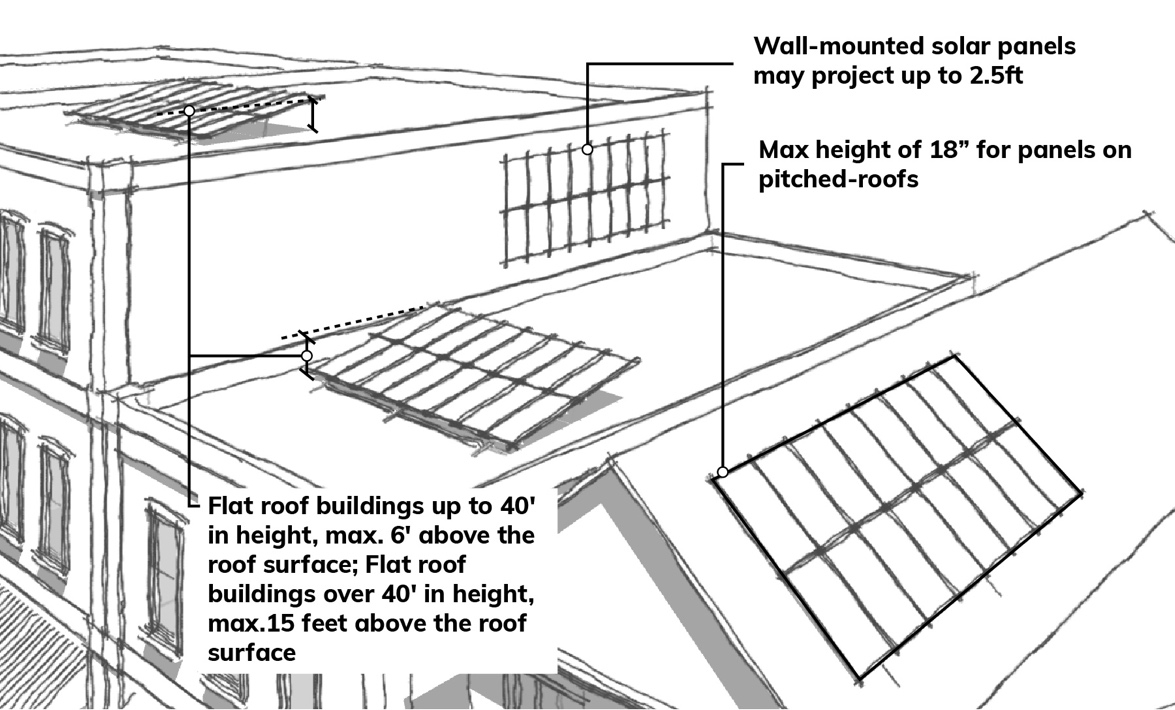
(Ord. 2223-VC-26, § 3; Ord. 2324-VC-07, § 3; Ord. 2324-VC-23, § 3; Ord. 2526-VC-28, § 5)
9-10-4. - Permitted encroachments.
An encroachment is the extension or placement of an accessory structure or architectural feature into a required setback. Permitted encroachments are indicated in Table 10-1: Permitted Encroachments into Required Setbacks.
A.
Section 9-10-3 contains regulations on accessory structures and architectural features not listed in Table 10-1, which may include additional permissions or restrictions for their permitted encroachment into required setbacks.
B.
Unless otherwise indicated, all accessory structures and architectural features must meet the requirements for general accessory structures (Section 9-10-3).
C.
Unless specifically indicated, reverse corner side setbacks are considered front setbacks for the purposes of Table 10-1.
D.
When an attached or detached accessory structure or architectural feature regulated by Table 10-1 is permitted to locate in a required setback, it also indicates permission to locate in the corresponding yard.
E.
When an accessory structure or architectural feature regulated by Table 10-1 is prohibited from encroaching in a required setback, the structure or architectural feature may be located in the corresponding yard beyond the required setback line unless specifically prohibited by the table.
(Ord. 2223-VC-11, § 6; Ord. 2526-VC-28, § 6)
9-10-5. - Environmental performance standards.
All uses must comply with the performance standards established in this section unless any federal, state, or local law, ordinance, or regulation establishes a more restrictive standard, in which case, the more restrictive standard applies.
A.
Noise. No activity or use must be conducted in a manner that generates a level of sound as measured on another property greater than that allowed by federal, state, and local regulations, as amended from time to time. These limits do not apply to construction noises, noises emanating from safety signals or warning devices, noises not directly under the control of the owner or occupant of the property, and transient noises from moving sources, such as motor vehicles, railroads, and aircraft.
B.
Glare and heat. Any activity or the operation of any use that produces glare or heat must be conducted so that no glare or heat from the activity or operation is detectable at any point off the lot on which the use is located. Flickering or intense sources of light must be controlled or shielded so as not to cause a nuisance across lot lines.
C.
Vibration. No earthborne vibration from the operation of any use may be detectable at any point off the lot on which the use is located.
D.
Dust, air, and water pollution.
1.
Dust and other types of air pollution, borne by the wind from sources, such as storage areas, yards, roads, conveying equipment and the like, within lot boundaries, must be kept to a minimum by appropriate landscape, screening, sheltering, paving, fencing, wetting, collecting, or other acceptable means.
2.
Storage of materials must include all proper precautions to protect any surface water or groundwater sources, whether natural or manmade, from contamination.
E.
Discharge and disposal of radioactive and hazardous waste. The discharge of fluid and the disposal of solid radioactive and hazardous waste materials must comply with applicable federal, state, and local laws, and regulations governing such materials or waste. Radioactive and hazardous material waste must be transported, stored, and used in conformance with all applicable federal, state, and local laws.
F.
Electromagnetic interference. Electromagnetic interference from any operation of any use must not adversely affect the operation of any equipment located off the lot on which such interference originates.
G.
Odors. Any condition or operation which results in the creation of odors of such intensity and character as to be detrimental to the public health and welfare, or which interferes unreasonably with the comfort of the public, must be removed, stopped, or modified so as to remove the odor.
H.
Fire and explosion hazards. Materials that present potential fire and explosion hazards must be transported, stored, and used only in conformance with all applicable federal, state, and local regulations.

