
Franklin Park City Zoning Code
CHAPTER 11
- Off-Street Parking & Loading
9-11-1.- General requirements.
A.
Existing facilities.
1.
The existing number of off-street parking and loading spaces may not be reduced below the requirements of this Ordinance. If the number of such existing spaces is already less than required, it may not be further reduced.
2.
Existing off-street parking and loading areas that do not conform to the requirements of this Ordinance, but were in conformance with the requirements at the time the parking or loading facilities were established, are permitted to continue as a nonconforming site element.
3.
If a building permit for a structure was issued prior to the effective date of this Ordinance, or any subsequent amendment, the number of off-street parking and loading spaces must be provided in the amount required at the issuance of the building permit unless the amount required by this Ordinance is less, in which case only the number required by this Ordinance must be installed, subject to site plan modification.
4.
On-street parking may not be counted toward existing facilities unless it has been previously approved in per Section 9-11-6.B.1.
B.
Completion of off-street parking and loading facilities. All off-street parking and loading facilities must be completed prior to the issuance of the certificate of occupancy for the use.
C.
Use of off-street parking and loading facilities.
1.
The sale, repair, dismantling or servicing of any vehicles, equipment, materials, or supplies is prohibited in off-street parking areas.
2.
The sales and display of goods in off-street parking areas is prohibited unless specifically permitted by this Ordinance.
3.
The property owner is responsible for ensuring that parking and loading facilities are used only by tenants, employees, visitors, and other authorized persons.
4.
Space allocated to any off-street loading space may not be used to satisfy the requirement for any off-street vehicle parking space or access aisle, or portion thereof. Conversely, the area allocated to any off-street vehicle parking space may not be used to satisfy the requirement for any off-street loading space or portion thereof.
5.
No off-street parking and loading facilities may be used as a truck parking area or yard, which is the storage or parking of trucks, trailers, tractors, and industrial or commercial vehicles that exceed one-and-a-half (1½) tons in capacity not associated with the principal use of the site or are not actively engaging in loading or unloading.
D.
Right-of-way truck parking prohibition. No trucks, trailers, tractors, and industrial or commercial vehicles that exceed one-and-a-half (1½) tons in capacity may be parked or idle on any public right-of-way.
9-11-2. - Location of required off-street parking.
A.
Residential uses.
1.
All required parking spaces for residential uses must be located on the same lot as the residential use.
2.
For additional parking requirements for single-family, two-family, and townhouse dwellings, see Section 9-11-4.
B.
Nonresidential uses.
1.
Required off-street parking spaces for nonresidential uses in residential districts must be located on the same lot as the use served, except as allowed in this section.
2.
Off-street parking spaces for nonresidential uses in nonresidential districts may be located on a lot not more than one thousand (1,000) feet from the lot served subject to the following:
a.
Such off-site parking area cannot be located in an R-1 or R-2 District.
b.
When such off-site parking area is located in a nonresidential district, approval by the Zoning Administrator is required.
c.
When such off-site parking area is located in a residential district (excluding the R-1 or R-2 District, per item a above) approval by the Village Board is required.
d.
When such off-site parking area is located on a lot not owned by the business, control must be established by a written agreement specifying that such parking will remain available for the entire time period the use is in operation.
3.
Parking spaces for the DT-1, DT-2, DT-3, DT-4, C-4, and C-5 Districts cannot be located between the front building line and the front lot line.
9-11-3. - Off-street parking facility design standards.
The following standards apply to off-street parking facilities, both parking lots and parking structures, as applicable, with the exception of single-family, two-family, and townhouse dwellings, which are subject to the standards of Section 9-11-4. However, if a townhouse dwelling development is designed with a common parking lot or parking structure, then it is subject to all the standards of this section.
A.
Dimensions.
1.
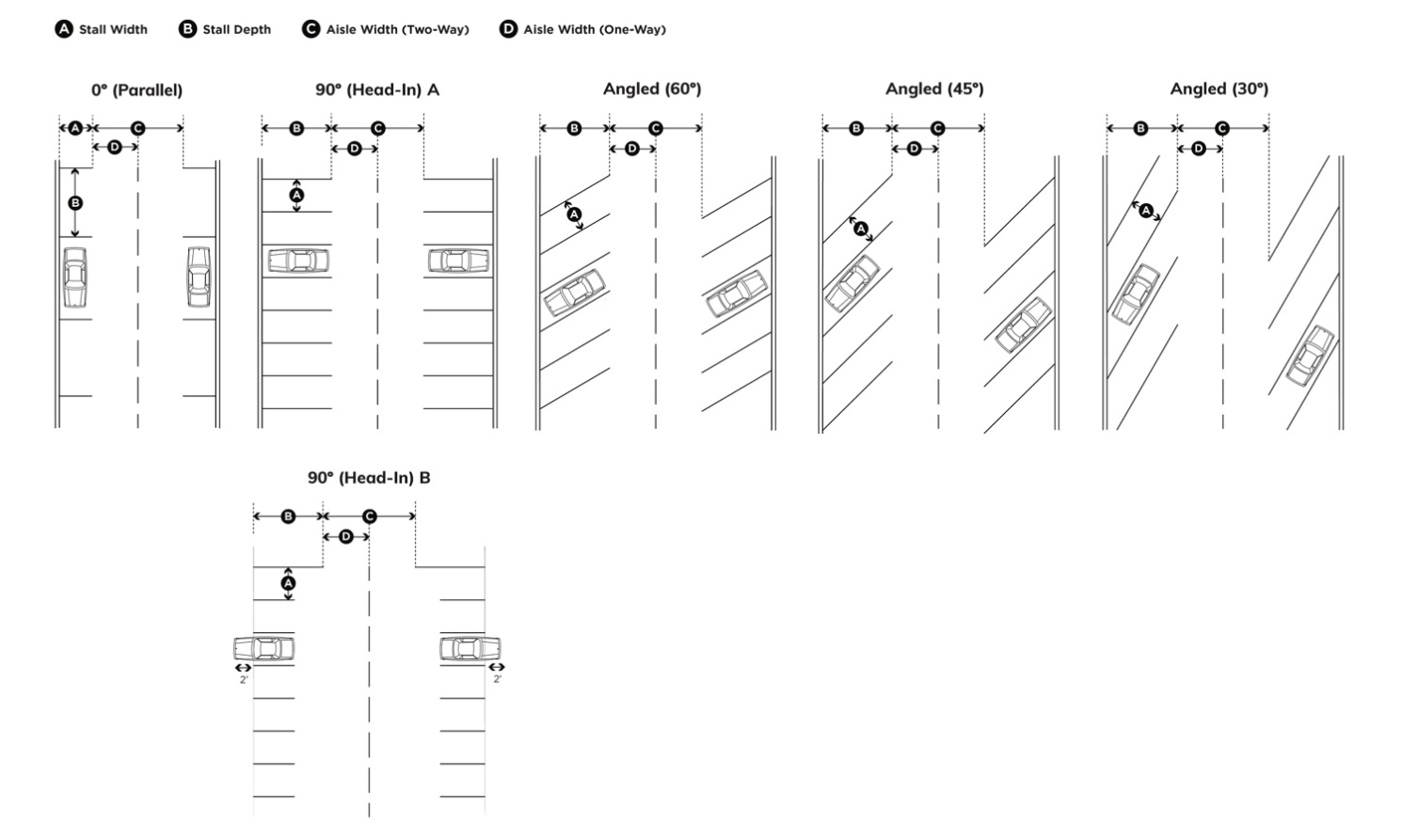
Off-street parking spaces and drive aisles within a parking lot or structure must be designed in accordance with the minimum dimensions in Table 11-1: Off-Street Parking Space Minimum Dimensions. Other parking angles other than those described in Table 11-1 are permitted but must be approved by the Zoning Administrator and provide evidence of safe and efficient parking configuration and traffic circulation.
2.
A maximum of two feet of vehicle bumper overhang is permitted within any adjacent required perimeter landscape area for 90° or 60° parking configurations. Such overhang may be counted toward the overall required parking space length. No vehicle bumper overhang area is allowed within the public right-of-way.
B.
Accessible spaces. All parking lots must comply with the "ADA Accessibility Guidelines for Buildings and Facilities" regulations issued by federal agencies under the Americans with Disabilities Act (ADA) and State of Illinois and local requirements for the amount and design of accessible vehicle parking spaces required in parking lots and structures.
C.
Access.
1.
All required off-street parking facilities must have vehicular access from a street, driveway, alley, or cross-access connection.
2.
All required off-street parking facilities must have an internal pedestrian circulation system that allows for safe passage between parking areas and any public sidewalk in the adjacent right-of-way and the use it serves. This includes, but is not limited to, interconnected sidewalks, striped walkways, and separated walkways.
3.
All parking facilities must be designed with vehicle egress and ingress points that least interfere with traffic movement. Parking facilities must be designed to allow the driver to proceed forward into traffic, rather than back out.
4.
Dead end parking lots without a turnaround space are prohibited. A turnaround space must have a minimum depth and width of nine (9) feet, and must be designated with signs stating "No Parking" and painted to indicate parking is prohibited.
D.
Surfacing. All driveways and parking areas shall be covered with a paved surface of asphalt, concrete or pavers. All such driveways and parking areas not in compliance shall be required to comply upon the sale or lease of any portion of the applicable zoning lot, or upon a change in the principal use of the applicable zoning lot.
E.
Striping. All off-street parking facilities must delineate parking spaces with paint or other permanent materials, which must be maintained in clearly visible condition.
F.
Curbing. Wheel stops or curbing are required when a parking space abuts a pedestrian walkway, landscape area, structure, or fence.
G.
Lighting. Parking lot and structure lighting must be in accordance with Section 10.2.
H.
Landscape and drainage. All parking lots and structures must be landscaped in accordance with Chapter 12.
I.
Parking structure.
1.
Location and access.
a.
A parking structure may not be located directly adjacent to another parking structure or a parking lot (principal use).
b.
Parking structures in the downtown districts must be located as follows:
i.
Parking structures may not be located on corner lots.
ii.
No façade of a parking structure may be located on Franklin Avenue.
c.
Vehicular access points must be no wider than twenty (20) feet. No more than two (2) access points may be located on any frontage. When two (2) access points are located on one frontage, the total width of both access points may not exceed twenty-four (24) feet.
d.
Vehicular access points in the downtown districts may not be located on a primary street unless no feasible alternative is available.
2.
Design.
a.
On facades that front on public streets, façade design and screening must mask interior ramps.
b.
Parking structures must be designed to minimize blank facades through architectural detail and landscape. Vertical divisions the full height of the structure are required every thirty (30) feet. Divisions must be a minimum of two (2) feet in width and must project a minimum of six (6) inches.
c.
On portions of the ground floor façade where parking spaces are visible, a decorative fence and landscape or a kneewall is required to screen parking spaces. Such fence or kneewall must be a minimum of four (4) feet in height.
d.
For parking structures with rooftop open-air parking, a four (4) foot parapet wall is required for screening.
e.
A defined pedestrian entrance area is required, separate from the vehicular entrance and directly accessing the sidewalk.
f.
A vehicular clear sight zone must be included at vehicular exit areas as follows:
i.
The ground floor façade of a parking structure must be setback a minimum of eight (8) feet from a public sidewalk or pedestrian walkway at the vehicular access point.
ii.
An additional minimum eight (8) foot ground floor façade setback is required at the edge of the access point for a minimum of eight (8) feet, This is determined by drawing a line from the edge of the vehicular access point along the abutting the public sidewalk or pedestrian walkway. In this area, groundcover, landscape, or decorative wall must be used to act as a buffer between the access aisle and the public sidewalk or pedestrian walkway. Landscape or a decorative wall must not exceed thirty (30) inches in height to maintain driver sightlines to pedestrians.
iii.
The upper story façade(s) of the parking structure may overhang the vehicular clear sight zone.
PARKING STRUCTURE DESIGN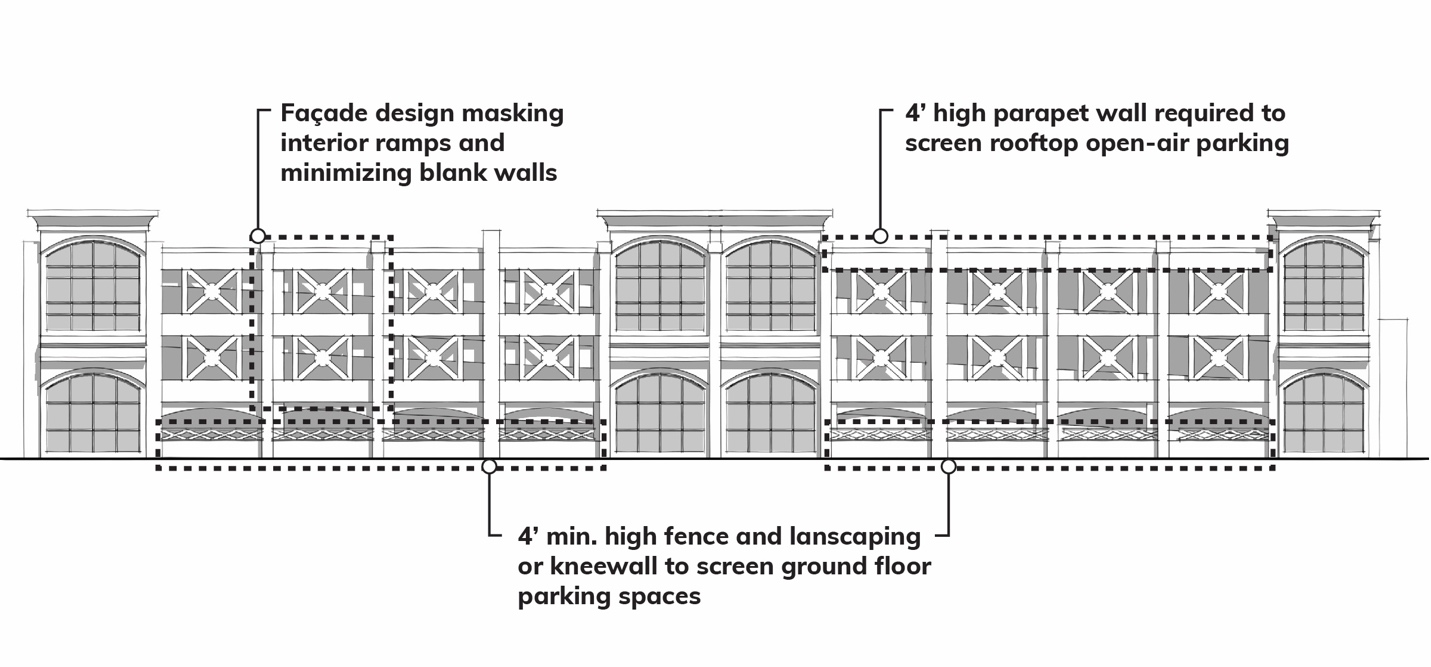
PARKING STRUCTURE - CLEAR ZONE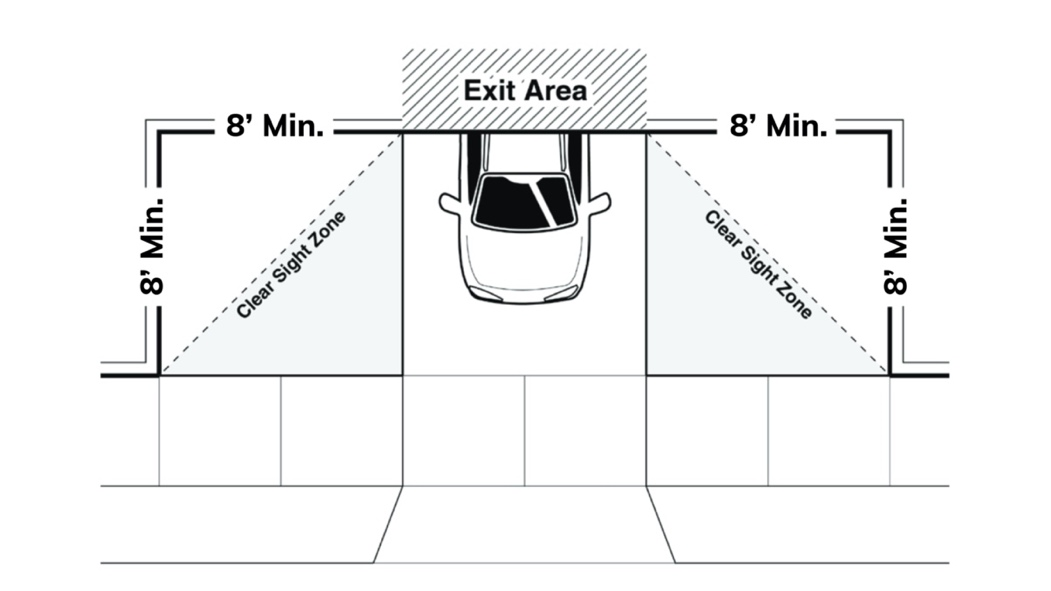
9-11-4. - Residential off-street parking spaces.
The following apply to single-family, two-family, and townhouse dwellings. However, if a townhouse dwelling is designed with a common parking lot or parking structure, then it is subject to the standards of Section 9-11-4.
A.
A designated parking space must have dimensions of at least eight (8) feet by sixteen (16) feet.
B.
All off-street parking spaces must have vehicular access from a driveway that connects to a street or alley.
C.
Vehicular access points may not be located off a public, primary street unless no feasible alternative is available. Vehicular access points for new or expanded detached garages must be located off a public alley if one is available.
D.
A driveway cannot be located in the front yard unless it leads to a conforming designated parking space in the rear, corner side, or interior side yard. A designated parking space cannot be located in any portion of the front yard. The following standards apply:
1.
For residences with an attached two (2) car garage or larger, a maximum driveway width of twenty (20) feet is permitted at the sidewalk to the street in the front or any side yard.
2.
For residences with a detached garage, a one car attached garage, or other parking area, a maximum driveway width of ten (10) feet is permitted in any portion of the front or any side yard.
E.
Only one curb cut crossing to a street or alley is permitted for a single-family or two-family dwelling unless the residential lot area is greater than fifteen thousand (15,000) square feet, in which case up to three (3) curb cut crossings to a street or alley is permitted.
F.
Townhouse developments are prohibited from constructing individual curb cuts for each dwelling unit along a public, primary street.
G.
Any impervious surface, including residential driveways, located within one foot of a property line cannot be pitched toward a neighboring lot.
H.
Parking spaces may be designed so that a driver could back out into traffic on the public way.
I.
Vehicles parked within a driveway or off-street parking space cannot project over the sidewalk or right-of-way.
J.
All off-street parking spaces and parking pads must be improved with a hard surfaced, all-weather dustless material. Pervious paving is encouraged and may also be used. Use of gravel is prohibited.
K.
For single-family dwellings, a parking space may consist of two (2) parallel parking strips of concrete or permeable pavers, each of which is at least eighteen (18) inches in width and eighteen (18) feet long. The center unpaved strip must contain non-invasive plants or groundcover, grass, mosses, or stones no smaller than one-and-a-half (1½) inch in diameter. Use of gravel or bare soil is prohibited.
L.
All parking pads, garages, carports, driveways, and other paved access points must adhere to the greenspace requirement.
M.
Parking elements that do not conform to the above requirements must be removed prior to the sale, lease, change of use, or the issuance of an occupancy permit.
(Ord. 2223-VC-19, § 3)
9-11-5. - Required off-street vehicle parking spaces.
A.
Required vehicle spaces. Table 11-2: Off-Street Vehicle Parking Requirements states the minimum number of off-street parking spaces to be provided for the designated uses. Table 11-2 lists parking requirements for the uses listed within the districts. These specific uses are listed only for the purposes of this section and do not indicate whether such uses are permitted or conditional uses within any district. Certain uses listed within the districts may not have parking requirements.
B.
Calculation of required vehicle spaces. The total number of required vehicle spaces is calculated by the principal use of the lot. When more than one use occupies the same lot, the number of required spaces is the sum of the separate requirements for each use, unless a parking flexibility per this Chapter is allowed or another provision of this Ordinance controls. The following standards for computation apply:
1.
In determining the number of spaces, when the result contains a fraction, any fraction less than one-half (½) is disregarded and any fraction of one-half (½) or more is counted as one parking space.
2.
Places of worship may apply for a variance to conditionally reduce the minimum number of vehicle parking spaces required by up to fifty (50) percent if a significant amount of the property can be left as greenspace and if such reduced parking will not unduly impact traffic upon the adjacent neighborhood.
C.
Calculation for multi-tenant commercial centers. Parking for multi-tenant commercial centers is calculated as one space required per six hundred fifty (650) square feet of gross floor area, rather than by the individual uses. A multi-tenant commercial center is a group of three (3) or more commercial establishments, primarily retail, service, and restaurant, but may also include recreation, office, or medical, that is planned, owned, and/or managed as a single property. A mixed-use development that includes one or more floors of commercial establishments also qualifies for this calculation; the residential component of a mixed-use development is calculated separately.
(Ord. 2223-VC-19, § 4; Ord. 2223-VC-27, § 3; Ord. 2324-VC-45, § 6)
9-11-6. - Parking flexibilities.
A.
Cooperative vehicular parking agreements. In the C-1 and C-2 Districts, when two (2) or more nonresidential or non-industrial district principle uses share a parking lot or are located on the same lot or adjacent lots, the following cooperative parking reduction may apply. This does not apply to a multi-tenant commercial center, as described in Section 9-11-5.C.
1.
Reductions are permitted as follows:
a.
A twenty-five (25) percent reduction is permitted for four (4) or more non-identical uses.
b.
A fifteen (15) percent reduction is permitted for three (3) non-identical uses.
c.
A ten (10) percent reduction is permitted for two (2) non-identical uses.
2.
All cooperative parking must be within one thousand (1,000) feet from the entrance of the use to the closest parking space within the cooperative parking lot, measured along a dedicated pedestrian path.
3.
All cooperative vehicular parking agreements approved by the Village Attorney and executed by the parties involved, will be subject to review and approval by the Zoning Administrator.
a.
Parking arrangements must continue in effect as long as the agreement remains in force.
b.
If an agreement is no longer in force, then parking must be provided as otherwise required by village ordinance.
B.
Parking credits. Vehicular parking standards may be reduced by achieving the following credits.
1.
On-street parking credits in all commercial and downtown districts only.
a.
With approval of the Zoning Administrator, each on-street public parking space located directly adjacent to the front or side lot line may be counted toward one parking credit of required off-street parking spaces.
b.
Spaces must be located along fifty (50) percent of the adjacent property line under consideration.
c.
Where on-street parking spaces are unmarked, the number of credits calculated is found by dividing the length of the on-street parking area located parallel to the lot line divided by twenty-two (22), rounded.
d.
Designated spaces must be accessible to the public and cannot be restricted to any specifically zoned lot or use.
e.
A fee in lieu for each credit is required for the C-4 and C-5 Districts.
f.
For properties within the C-4 District adjacent to Franklin Avenue only. With approval of the Zoning Administrator, each on-street public parking space on Franklin Avenue located within two-hundred fifty (250) feet of the front lot line may be counted toward one parking credit of required off-street parking spaces.
2.
Public parking lot credit in C-1, C-4, C-5, and DT districts only.
a.
With approval of the Zoning Administrator, each off-street public parking space located within one thousand (1,000) feet of any property line may be counted toward one parking credit of required off-street parking spaces.
b.
Designated spaces must be accessible to the public and cannot be restricted to any specifically zoned lot or use.
c.
A fee in lieu is required for each credit in the C-4 and C-5 Districts, as well as for each credit above five (5) in the DT Districts.
3.
Transit credit. Vehicular parking requirements may be reduced with proximity to any commuter rail station or transit line. Proximity is measured from any point along the property line to the platform or transit stop. When located within one thousand five hundred (1500) feet, a reduction of twenty (20) percent of the required off-street parking is permitted.
(Ord. 2324-VC-45, § 7; Ord. 2425-VC-26, § 3)
9-11-7. - Electric vehicle parking requirements.
A.
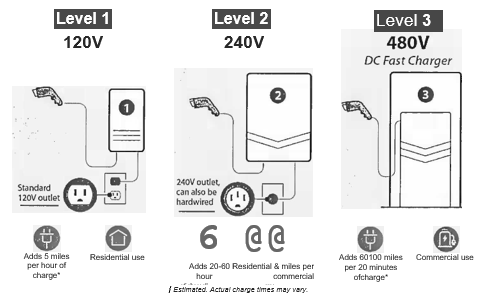
Infrastructure. There are three types of electric vehicle (EV) charging stations:
1.
EV-Capable. Installation of a circuit breaker panel with sufficient capacity, enclosed conduit leading to the parking area, and electric wiring forming a continuous raceway from the panel to the future EV parking stall.
2.
EV-Ready. Additional installation of a junction box or electrical outlet with appropriate voltage accessible to the EV parking stall.
3.
EVSE-Installed. Final installation of the electric vehicle charging station.
i.
Level 1, 120V appropriate for private residential garages.
ii.
Level 2, 240V appropriate for multi-family residential or commercial lots.
iii.
Level 3, 480V appropriate for fast charging and commercial applications.
B.
Residential dwellings.
1.
Single-family residential dwellings are required to have one EV-Capable parking stall if a designated parking space is provided.
2.
Residential buildings with four (4) or fewer units (two-family, townhome, or small multi-family) must provide one EV-Capable parking stall per dwelling unit.
3.
Residential buildings with five (5) or more units must provide one hundred (100) percent EV-Capable parking stalls for all required parking spaces as designated per Table 11-2 of Section 9-11-5.
C.
Commercial and industrial uses.
1.
Electric vehicle parking spaces are required in all parking lots and parking structures with more than twenty-five (25) spaces.
2.
A minimum of ten (10) percent of total stalls must be EV-Capable.
3.
A maximum of twenty (20) EV-Capable parking stalls are required.
4.
EV-Ready spaces shall count as 1.25 EV-Capable stalls.
5.
EVSE-Installed spaces with a Level 1 charger shall not count as an EV-Capable stall.
6.
EVSE-Installed spaces with a Level 2 charger shall count as 1.5 EV-Capable stalls.
7.
EVSE-Installed spaces with a Level 3 charger shall count as 2 EV-Capable stalls.
8.
Design Standards. Electric vehicle spaces must meet the standards of Section 9-11-3.
(Ord. 2425-VC-42, § 2)
9-11-8. - Required off-street loading spaces and truck parking.
A.
Loading space design.
1.
All off-street loading spaces must be located on the same lot as the use served with the exception of the I-1, C-4, and C-5 Districts.
2.
All required off-street loading spaces must be at least twelve (12) feet in width and at least fifty-five (55) feet in length, exclusive of aisle and maneuvering space, and have a minimum vertical clearance of at least fourteen (14) feet. The Zoning Administrator may approve alternate sizes when a cross-dock layout is used.
3.
All off-street loading spaces must be improved with a hard surfaced, all-weather dustless material.
4.
All off-street loading spaces must meet the lighting requirements of Section 9-10-2.
5.
Loading spaces should be located opposite any adjacent residential district lot line whenever possible.
B.
Minimum number of off-street loading spaces. Off-street loading spaces must be provided in accordance with the minimums of Table 11-3: Off-Street Loading Requirements. In the case of multi-tenant buildings or mixed-use developments, required loading spaces are calculated on the basis of each individual tenant (for example, if only one nonresidential use tenant of a multi-tenant building is over ten thousand (10,000) square feet, only one loading space is required; if all tenants are under ten thousand (10,000) square feet, no loading is required. Nothing herein prevents the construction of additional loading spaces above the minimums required here.
C.
Maximum number of off-street truck parking spaces. The maximum number of truck parking spaces for use by semitrailers, wheeled containers, or truck-trailer combinations (not including trailer positions immediately adjacent to a loading berth) at a facility cannot exceed the greater of either:
1.
1 parking space for every teo thousand five hundred (2,500) square feet of GFA under roof for the principal use
2.
Two-and-a-half (2½) parking spaces for each loading dock serving the principal use
D.
Truck parking.
1.
Truck parking is permitted only as accessory parking to a principal industrial use in the I-1 and I-2 Districts.
2.
Truck parking spaces intended for use by semitrailers, wheeled containers, or truck-trailer combinations means the temporary outdoor stationing of an operable vehicle, semitrailer, or wheeled container (or similar item capable of lawful intrastate or interstate travel without modification) that has been loaded or off loaded within the previous seven (7) days or that will be loaded or off loaded within the next seven (7) days.
3.
Outdoor stationing for longer periods of time is prohibited.
4.
Accessory parking of trucks as permitted in item 1 above is limited when located within seventy-five (75) feet of a residential district lot line as follows:
a.
Vehicles are limited to less than one-and-a-half (1½) tons capacity.
b.
Parking areas must be screened along lot lines that are within seventy-five (75) feet of a residential district by a wall, fence or densely planted compact hedge, not less than five (5) feet, nor more than eight (8) feet in height.
5.
Off-street truck parking dimensions for semi-truck, trailers, or a combination of both are as follows:
a.
Stall width: twelve (12) feet.
b.
Stall length: fifty-five (55) feet.
c.
Loading dock depth: sixty (60) feet.
d.
Loading zone aisle width: sixty (60) feet.
9-11-9. - Required bicycle parking.
A.
Required bicycle spaces. Where off-street parking facilities are provided, the number of bicycle parking spaces must be provided as indicated in Table 11-4: Required Bicycle Spaces. The Zoning Administrator will make the interpretation of the land use category in Table 11-4 that is appropriate for the use.
1.
Bicycle parking is not required in the I-1 and I-2 Districts.
2.
If a use is exempt from providing vehicle parking it is also exempt from providing bicycle spaces.
3.
Of those uses required to provide bicycle spaces, some are required to provide long-term spaces, where bicycles will be left for longer periods of time and require a safe and weatherproof storage area. The required number of long-term spaces is shown as a percentage of the required total bicycle spaces. All other required bicycle spaces must be designed as short-term spaces, which are areas where bicycles will be left for short stops, requiring a high degree of convenience.
4.
Nothing in this Ordinance prevents the provision of additional bicycle spaces in excess of that required; long-term spaces are required only in the amount calculated by the minimum number of spaces in Table 11-3, not of the total number of short-term spaces, which may exceed that required by the Table.
5.
With approval of the Zoning Administrator, a fee in lieu of providing spaces may be permitted for physically constrained sites.
B.
Design.
1.
Required bicycle spaces must provide each bike space within a row of bicycle parking a minimum of two (2) feet in width by six (6) feet in length, with a minimum vertical clearance of seven (7) feet. Each required bicycle parking space must be accessible without moving another bicycle. There must be an aisle at least five (5) feet wide between each set of bicycle parking rows to allow room for bicycle maneuvering.
2.
Long-term bicycle parking spaces must be located indoors or fully covered to protect bicycles from rainfall, snow, and inclement weather, such as by the use of an overhang or covered walkway, weatherproof outdoor bicycle lockers, or an indoor storage area.
3.
All lockers and racks must be securely anchored to the ground or a structure to prevent the racks and lockers from being removed from the location.
4.
If required bicycle parking facilities are not visible from the street or principal building entrance, signs must be posted indicating their location.
C.
Location.
1.
The bicycle parking area must be convenient to building entrances and street access, but may not interfere with normal pedestrian and vehicle traffic. Bicyclists must not be required to travel over stairs to access parking.
2.
Short-term bicycle parking spaces must be located no more than fifty (50) feet from the principal building entrance. Required bicycle parking spaces may be located in the public right-of-way, with approval from the Zoning Administrator.
3.
Required bicycle parking for residential uses may be provided in garages, storage rooms, and other resident-accessible, secure areas. Spaces within dwelling units or on balconies do not count toward satisfying bicycle parking requirements.
9-11-10. - Commercial and recreational vehicle storage.
A.
Commercial vehicles.
1.
Residential lots.
a.
No commercial vehicle may be parked outdoors on a residential lot, with the exception of vehicles engaged in loading or unloading or current work being done to the adjacent premises. This does not include standard size passenger motor vehicles (including, but not limited to, vans, sports utility vehicles (SUVs), standard passenger size livery vehicles, and pick-up trucks), which may be stored or parked outdoors overnight on lots in residential districts. Permitted standard size vehicles also include those owned and used for commercial purposes by the occupant of a dwelling or guest, provided that the vehicle is stored or parked in a permitted parking area. Permitted commercial vehicles may include the logo of the commercial business painted on or applied to the vehicle.
b.
All other commercial vehicles including, but not limited to, semi-truck tractor units, with or without attached trailers, commercial trailers, flatbed trucks, box vans and box trucks, buses, tow trucks, construction vehicles, livery vehicles that exceed standard passenger vehicle size, such as limousines, or other large commercial vehicles are not permitted to be stored or parked outdoors overnight on a residential lot. This includes such vehicles owned and used for commercial purposes by the occupant of a dwelling or guest.
2.
Nonresidential lots. On nonresidential lots, commercial vehicles with the logo of the commercial business painted on or applied to the vehicle that are being operated and stored in the normal course of business, such as signs located on delivery trucks, promotional vehicles, moving vans, and rental trucks, are permitted to be stored on the lot in areas related to their use as vehicles, provided that the primary purpose of such vehicles is not the display of signs. All such vehicles must be in operable condition.
B.
Recreational vehicles.
1.
Recreational vehicles must be stored within the interior side yard behind the front building line or in the rear yard. If a recreational vehicle and any trailer that is more than six (6) feet in height as measured to the highest point of the vehicle, it must be located at least ten (10) feet from any lot line. Storage of a recreational vehicle is prohibited in the front yard.
2.
The area devoted to recreational vehicle storage must be on a hard, improved surface as required for vehicle parking areas.
3.
There is no limit on the storage of recreational vehicle within fully enclosed structures. Temporary storage tents do not meet the requirement of a fully enclosed structure.
4.
No recreational vehicle may be used for living, sleeping, housekeeping, or home occupation purposes in any district and may not be hooked up to any public utilities.
5.
All recreational vehicles must be maintained in mobile condition. No recreational vehicle may be parked or stored in such manner as to create a dangerous or unsafe condition on the lot where it is parked or stored. If the recreational vehicle is parked or stored, whether loaded or not, so that it may tip or roll, it is considered to be a dangerous and unsafe condition.

