
Franklin Park City Zoning Code
CHAPTER 2
- Definitions
9-2-1.- Rules of interpretation.
The terms in the text of this Ordinance are interpreted in accordance with the following rules of construction:
A.
The singular number includes the plural, and the plural the singular.
B.
The present tense includes the past and future tenses, and the future tense includes the present.
C.
The terms "must," "shall," and "will" are mandatory.
D.
The term "may" is permissive.
E.
The terms "must not," "will not," "cannot," "may not," and "shall not" are prohibiting.
F.
Any gender includes all genders.
G.
Whenever a defined word or term appears in the text of this Ordinance, its meaning must be construed as set forth in the definition. Words not defined must be interpreted in accordance with the definitions considered to be normal dictionary usage.
9-2-2. - General abbreviations.
The following abbreviations may be used within this Ordinance:
A.
BTL is an abbreviation for "build-to line."
B.
BTZ is an abbreviation for "build-to zone."
C.
GFA is an abbreviation for "gross floor area."
D.
ft is an abbreviation for "feet."
E.
N/A is an abbreviation for "not applicable."
F.
sf is an abbreviation for "square feet."
G.
SF is an abbreviation for "single-family."
H.
2F is an abbreviation for "two-family."
I.
TH is an abbreviation for "townhouse."
J.
MF is an abbreviation for "multi-family."
K.
NR is an abbreviation for "nonresidential."
9-2-3. - Definitions.
The following are definitions of terms used throughout this Ordinance.
Abut. To share a common wall or lot line without being separated by a street or alley.
Accessibility ramp. A ramp or similar structure that provides wheelchair or similar access to a structure.
Accessory. In regards to the accessory, ancillary, or auxiliary use, building, structure, facility, or operation of a zoning lot. Subordinate to and requiring the prerequisite primary zoning.
Addition. Construction that increases the size of a structure in terms of building footprint, height, or floor area.
Adult use. An establishment where the principal portion of the business operates as an adult arcade, adult bookstore and/or adult video store, an adult entertainment cabaret, an adult motel/hotel, an adult motion picture theater, an adult card, gift, or novelty center, or any combination thereof.
1.
Adult arcade. Any place to which the public is permitted or invited wherein coin operated or slug operated or electronically, electrically, or mechanically controlled still or motion picture machines, projectors, or other image producing devices are regularly maintained to show images to five (5) or fewer persons per machine at any one time, and where the images so displayed are characterized by their emphasis upon matter exhibiting specified sexual activities or specified anatomical areas.
2.
Adult bookstore and/or adult video store. A commercial establishment which, as one of its principal business purposes, offers for sale or rental for any form of consideration any one or more of the following: books, magazines, periodicals or other printed matter, or photographs, films, motion pictures, videocassettes, compact discs, digital video disks, slides, or other visual representations, which are characterized by their emphasis upon the display of specified sexual activities or specified anatomical areas.
A business purpose shall be a principal business purpose if any one of the following applies:
a.
A principal portion of the business's displayed merchandise consists of the enumerated items in item f below.
b.
A principal portion of the wholesale value of the business's displayed merchandise consists of the enumerated items in item f below.
c.
A principal portion of the retail value of the business's displayed merchandise consists of the enumerated items in item f below.
d.
A principal portion of the business's revenues derive from the sale or rental, for any form of consideration, of the enumerated items in item f below.
e.
A principal portion of the business's interior business space is used for the display, sale, or rental of the enumerated items in item f below.
f.
The business regularly features the foregoing enumerated items, and prohibits access by minors, because of age, to the premises, and advertises itself as offering "adult" or "XXX" or "X-rated" or "erotic" or "sexual" or "pornographic" material on signage visible from a public right-of-way.
3.
Adult card, gift, or novelty store. An establishment having a principal portion of its stock in trade items, such as cards, games, articles of clothing and novelties, which are distinguished or characterized by an emphasis on depicting or describing specified sexual activities or specified anatomical areas.
4.
Adult entertainment cabaret. Means and includes a nightclub, bar, theater, restaurant, or similar establishment that regularly features one or more of the following:
a.
Live performances by seminude dancers, go-go dancers, exotic dancers, strippers, or similar entertainers, where such performances are distinguished or characterized by an emphasis on specified sexual activities or by exposure of specified anatomical areas.
b.
Films, motion pictures, videocassettes, slides or other photographic reproductions which are distinguished or characterized by an emphasis upon the depiction or description of specified sexual activities or specified anatomical areas for observation by patrons.
c.
Persons who appear in a state of semi-nudity.
d.
Persons who engage in erotic dancing or performances that are intended for the sexual interests or titillation of an audience or customer.
5.
Adult motel/hotel. A motel, hotel, or similar commercial establishment which offers one or more of the following:
a.
Offers accommodations to the public for any form of consideration; provides patrons with closed circuit television transmissions, films, motion pictures, videocassettes, other photographic reproductions, or live performances which are characterized by the display of specified sexual activities or specified anatomical areas; and which advertises the availability of such material by means of a sign visible from the public right-of-way, or by means of any on or off premises advertising, including, but not limited to, newspapers, magazines, pamphlets or leaflets, radio or television.
b.
Offers a sleeping room for rent for a period of time that is less than ten (10) hours.
c.
Allows a tenant or occupant of a sleeping room to sub-rent the room for a period of time that is less than ten (10) hours.
6.
Adult motion picture theater. A commercial establishment where films, motion pictures, videocassettes, slides, or similar photographic reproductions which are characterized by their emphasis upon the display of specified sexual activities or specified anatomical areas are regularly shown to more than five (5) persons for any form of consideration.
7.
Specified anatomical areas. Any of the following:
a.
Less than completely and opaquely covered: human genitals, pubic region; buttock; and female breast below a point immediately above the top of the areola; and
b.
Human male genitals in a discernibly turgid state, even if completely and opaquely covered.
8.
Specified sexual activities. Any of the following:
a.
Human genitals in a state of sexual stimulation or arousal.
b.
Acts of human masturbation, sexual intercourse or sodomy.
c.
Fondling or other erotic touching of human genitals, pubic regions, buttocks, or female breasts.
d.
Flagellation or torture in the context of a sexual relationship.
e.
Masochism, erotic, or sexually oriented torture, beating or the infliction of pain.
f.
Erotic touching, fondling, or other such contact with an animal by a human being.
g.
Human excretion, urination, menstruation, vaginal or anal irrigation as part of or in connection with any of the activities set forth above.
Adult-use cannabis. Cannabis or cannabis infused product that is produced for non-medical use and consumption.
Adult-use cannabis craft grower. A facility operated by an organization or business that is licensed by the Illinois Department of Agriculture to cultivate, dry, cure, and package cannabis and perform other necessary activities to make cannabis available for sale at a dispensing organization or use at a processing organization, per the Cannabis Regulation and Tax Act, (P.A.101-0027), as it may be amended from time-to-time, and regulations promulgated thereunder.
Adult-use cannabis cultivation center. A facility operated by an organization or business that is licensed by the Illinois Department of Agriculture to cultivate, process, transport, and perform necessary activities to provide cannabis and cannabis-infused products to licensed cannabis business establishments, per the Cannabis Regulation and Tax Act, (P.A.101-0027), as it may be amended from time-to-time, and regulations promulgated thereunder.
Adult-use cannabis dispensing organization. A facility operated by an organization or business that is licensed by the Illinois Department of Financial and Professional Regulation to acquire cannabis from licensed cannabis business establishments for the purpose of selling or dispensing cannabis, cannabis-infused products, cannabis seeds, paraphernalia or related supplies to purchasers or to qualified registered medical cannabis patients and caregivers, per the Cannabis Regulation and Tax Act, (P.A.101-0027), as it may be amended from time-to-time, and regulations promulgated thereunder.
Adult-use industrial cannabis facility. A facility related to the processing and cultivation of cannabis that is operated by an organization or business that is licensed by the Illinois Department of Agriculture and does not provide onsite retail sales of adult-use cannabis product. An industrial adult-use cannabis facility may include, but shall not be limited to, a cannabis cultivation center, cannabis craft grower, cannabis processing organization, or cannabis infuser organization. An industrial adult-use cannabis facility shall not include a cannabis transporting organization as a principal use.
Adult-use cannabis infuser organization. A facility operated by an organization or business that is licensed by the Illinois Department of Agriculture to directly incorporate cannabis or cannabis concentrate into a product formulation to produce a cannabis-infused product, per the Cannabis Regulation and Tax Act, (P.A.101-0027), as it may be amended from time-to-time, and regulations promulgated thereunder.
Adult-use cannabis processing organization. A facility operated by an organization or business that is licensed by the Illinois Department of Agriculture to either extract constituent chemicals or compounds to produce cannabis concentrate or incorporate cannabis or cannabis concentrate into a product formulation to produce a cannabis product, per the Cannabis Regulation and Tax Act, (P.A.101-0027), as it may be amended from time-to-time, and regulations promulgated thereunder.
Adult-use cannabis transporting organization. An organization or business that is licensed by the Illinois Department of Agriculture to transport cannabis on behalf of a cannabis business establishment or a community college licensed under the Community College Cannabis Vocational Training Pilot Program, per the Cannabis Regulation and Tax Act, (P.A.101-0027), as it may be amended from time to time, and regulations promulgated thereunder.
Alley. A public or private right-of-way not less than sixteen (16) feet wide, primarily designed to serve as secondary access to the side or rear of those properties whose principal frontage is on a street.
Amateur (ham) radio equipment. An amateur (ham) radio station licensed by the Federal Communications Commission (FCC), including equipment such as, but not limited to, a tower or building-mounted structure supporting a radiating antenna platform and other equipment.
Amusement facility — indoor only. A facility for spectator and participatory uses conducted entirely within an enclosed building including, but not limited to, movie theaters, indoor sports arenas, bowling alleys, escape room/physical adventure game facilities, and pool halls. An indoor amusement facility may include additional uses as part of the principal use such as, but not limited to, concession stands, restaurants, and retail sales.
Animal care facility. An establishment which provides care for domestic animals, including veterinary offices for the treatment of animals, where animals may be boarded during their convalescence, pet grooming facilities, animal training centers and clubs, and pet boarding facilities, where animals are boarded during the day and/or for short-term stays.
Architectural feature. A part or projection that contributes to the aesthetics of a structure, exclusive of signs, that is not necessary for the structural integrity of the structure or to make the structure habitable.
Art gallery or studio. An establishment where art or related creative activities are taught, created, sold, or displayed. This includes but is not limited to painting, drawing, sculpture, photography, video art, pottery, or any other kind of art which is non-intensive in nature. For more intensive artisan-related crafts, see industrial, artisan.
Awning. A roof like structure typically made of cloth, metal, or other material attached to a frame that extends from and is supported by a building. Awnings are typically erected over a window, doorway, or building front and they may be raised or retracted to a position adjacent to the building.
Balcony. A roofed or unroofed platform that projects from the exterior wall of a structure above the ground floor, which is exposed to the open air, has direct access to the interior of the building, and is not supported by posts or columns extending to the ground.
Banner. A temporary sign printed upon flexible material mounted with or without rigid frames on a building or the ground.
Bay window. A window that projects outward from the structure, which does not rest on the building foundation or on the ground.
Body modification establishment. An establishment that offers tattooing services, body piercing, and/or non-medical body modification. Body modification establishment does not include an establishment that offers only an ear-piercing service as an ancillary use to the operation of a main principal use.
Blank wall. The horizontal linear dimension of contiguous building wall that does not contain windows, doors, or decorative elements such as banding, medallions, artwork such as murals and mosaics, change in wall plane of at least three (3) inches, or other architectural or material embellishment. Any wall less than five (5) feet in height is not considered to be a blank wall.
BLANK WALL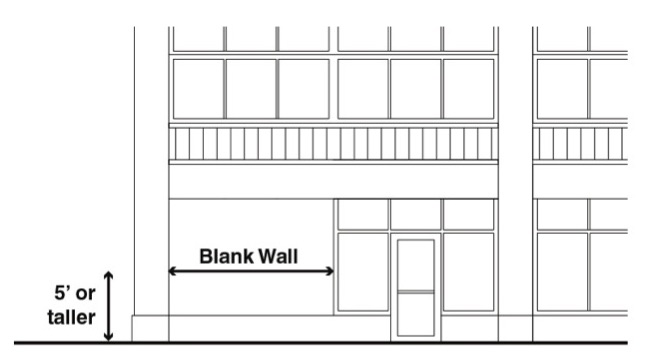
Block. A tract of land bounded by streets, or a combination of streets and railroad rights-of-way or municipal boundary lines.
Blockface. That portion of a block or tract of land facing the same side of a single street and lying between the closest intersecting streets.
BLOCK AND BLOCKFACE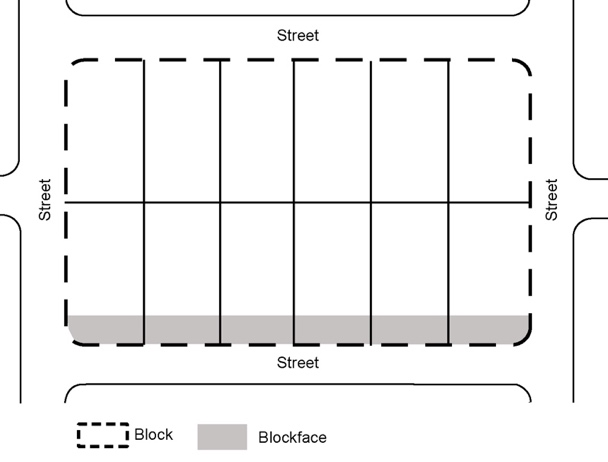
Blue roof. A roof designed to store water and discharge rainfall.
Book exchange box. An outdoor accessory structure maintained by a property owner on private property where books and recorded performing arts and media are kept for public and/or exchanges with no fees or sales and are publicly accessible.
Broadcasting facility. Commercial and public communications facilities, including radio, internet, television broadcasting and receiving stations, and studios. Permissions for broadcasting facilities may be divided between those with antennas located outdoors and those without antennas.
Buffer yard. Land area with landscape plantings and other components used to separate one use from another and to shield or block noise, lights, or other nuisances.
Build-to dimensions. Dimensional requirements with the district that require structures to be constructed at a specific dimension. A build-to requirement is a boundary or alignment, parallel to a lot line, where a structure must be placed.
1.
Build-to zone (BTZ). A build-to zone (BTZ) is the area on a lot, measured perpendicular from the applicable lot line, where the building line must locate within the minimum and maximum range of setback provided. The building line must be located within the build-to zone. Facade articulation, such as window or wall recesses and projections are not counted as the building line, which begins at the applicable building wall.
2.
Build-to percentage. A build-to percentage specifies the percentage of the building line that must be located within a build-to line or build-to zone. Build-to percentage is measured as a percentage of the total building façade, not lot width.
BUILD-TO ZONE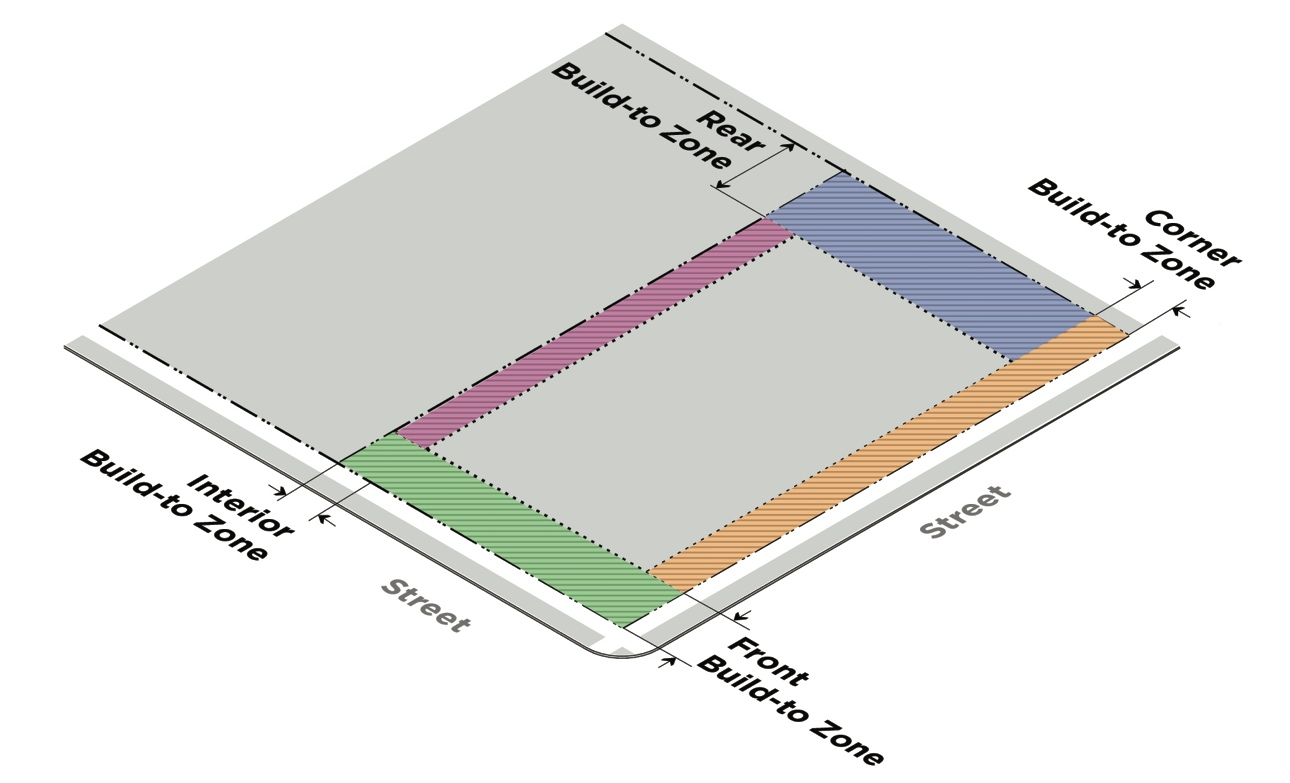
BUILD-TO PERCENTAGE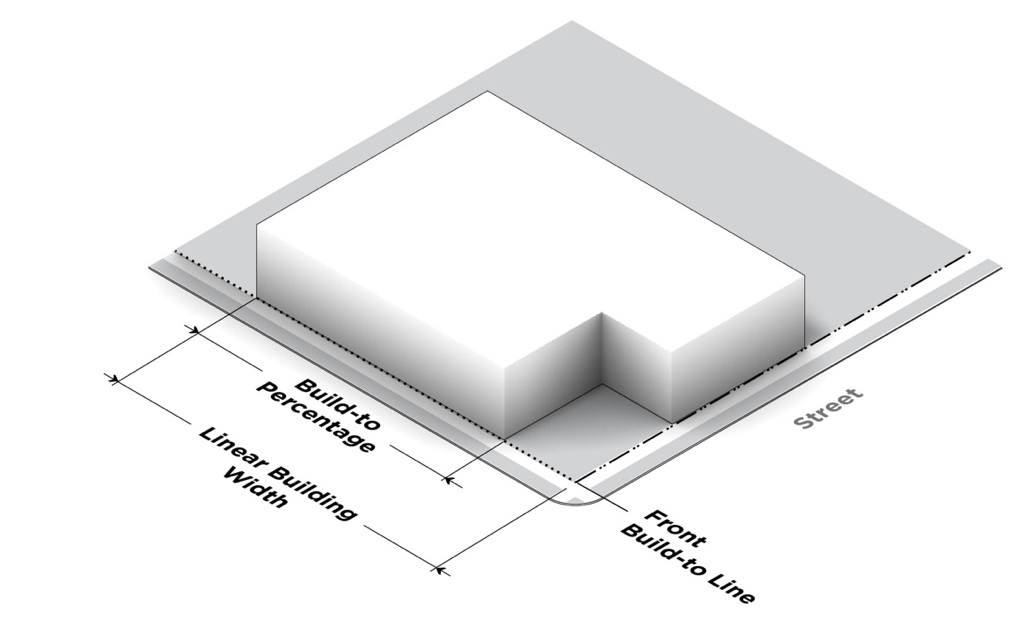
Buildable area. The portion of a lot, excluding required setbacks, where a structure or building improvements may be erected.
Building. Any structure used or intended for supporting or sheltering any use or occupancy.
Building envelope. The three-dimensional space within which a structure is permitted to be built on a lot and which is defined by regulations governing building setbacks, maximum height, and bulk, by other regulations, and/or by any combination thereof.
Building coverage. That portion of the lot that is or may be covered by buildings and accessory structures.
Building height.
1.
Maximum building height is measured from grade at each side of the building as follows:
a.
The top of a flat roof, including structures designed with a decorative mansard roof concealing a flat roof.
b.
The deck line of a mansard or gambrel roof.
c.
The midpoint height between the eaves and the ridge in the case of a pitched roof.
d.
Any dormers on the roof that extend past the roofline cannot exceed the maximum building height permitted in the district, as measured from the adjacent average grade, or its equivalent, to the top of the dormer.
2.
For the purposes of building height measurement, roof types are defined as follows:
a.
Flat roof: A roof that is not pitched and where the surface of the roof is generally parallel to the ground. A mono-pitched roof, also called a shed roof, is a single-sloping roof surface, and is also considered a flat roof.
b.
Mansard or gambrel roof: A two-sided roof with two (2) slopes on each side. The upper slope is positioned at a shallow angle, while the lower slope is steep. A gambrel roof has vertical gable ends, while a mansard roof is hipped at the four (4) corners of the building.
c.
Pitched roof: A gable or hip roof having a slope or pitch of at least one foot rise for each four (4) feet of horizontal distance in the direction of the slope or pitch of the roof. A hipped roof is sloped in two (2) pairs of directions compared to the one pair of direction for a gable roof.
3.
The following structures or parts thereof are exempt from maximum height limitations, unless otherwise limited by any height restriction imposed by any airport authority, or other similar federal, state, or local authority.
a.
Public utility poles, towers, and wires. Public utilities do not include wireless telecommunications, solar panels, and wind turbines unless operated by a government agency.
b.
Water tanks and standpipes.
c.
Building appurtenances such as chimneys, parapet walls, skylights, steeples, flag poles, smokestacks, cooling towers, elevator bulkheads, fire towers, monuments, water towers, stacks, stage towers, or scenery lofts, tanks, ornamental towers and spires, rooftop accessory structures, recreational facilities, necessary mechanical appurtenances, or penthouses to house mechanical appurtenances.
BUILDING HEIGHT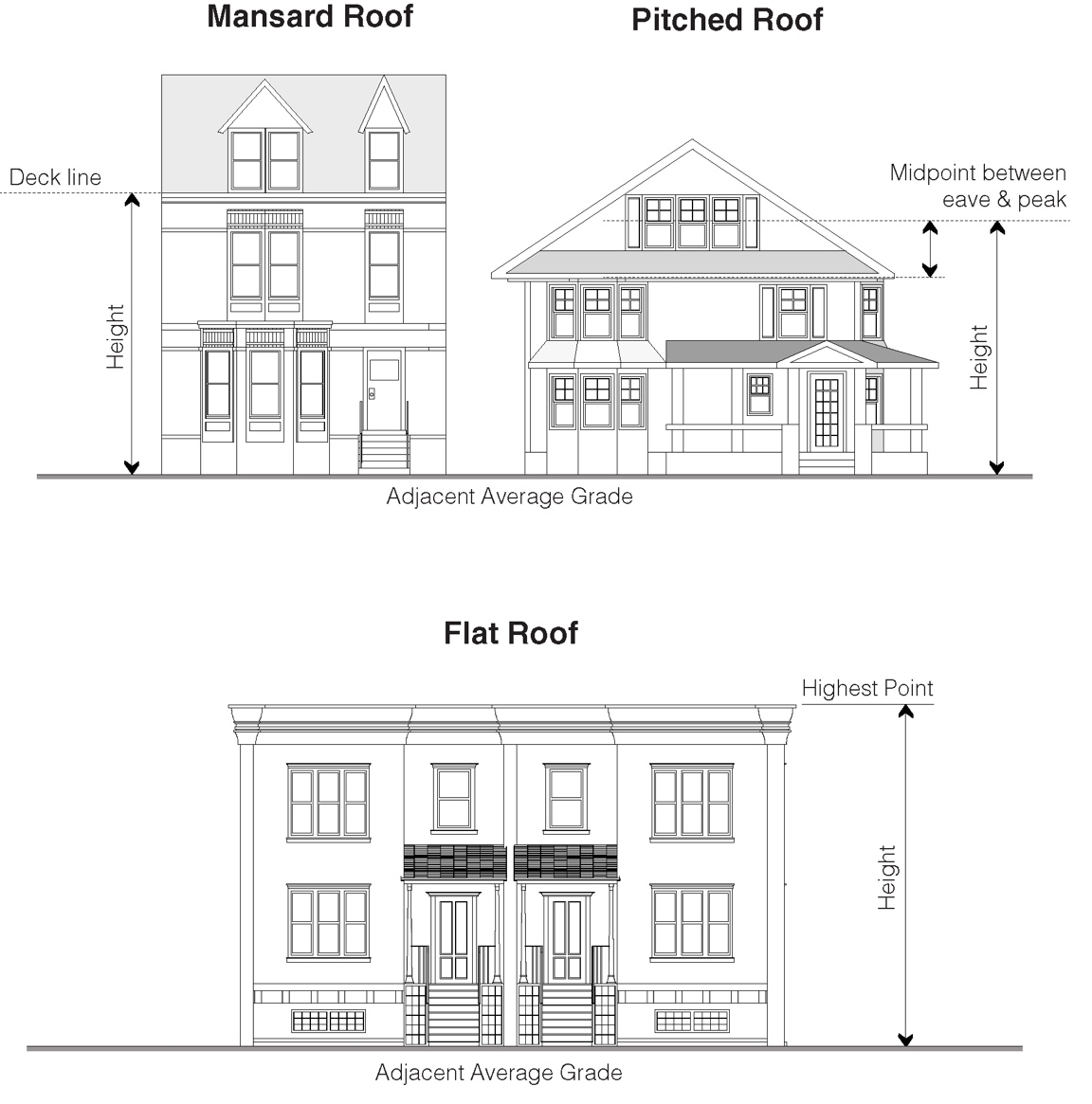
Building line. A line measured at the building wall of a structure between parallel lot lines. For the purposes of establishing a building line, the building wall does not include permitted encroachments of architectural features, such as bay windows, eaves, and steps and stoops.
BUILDING LINE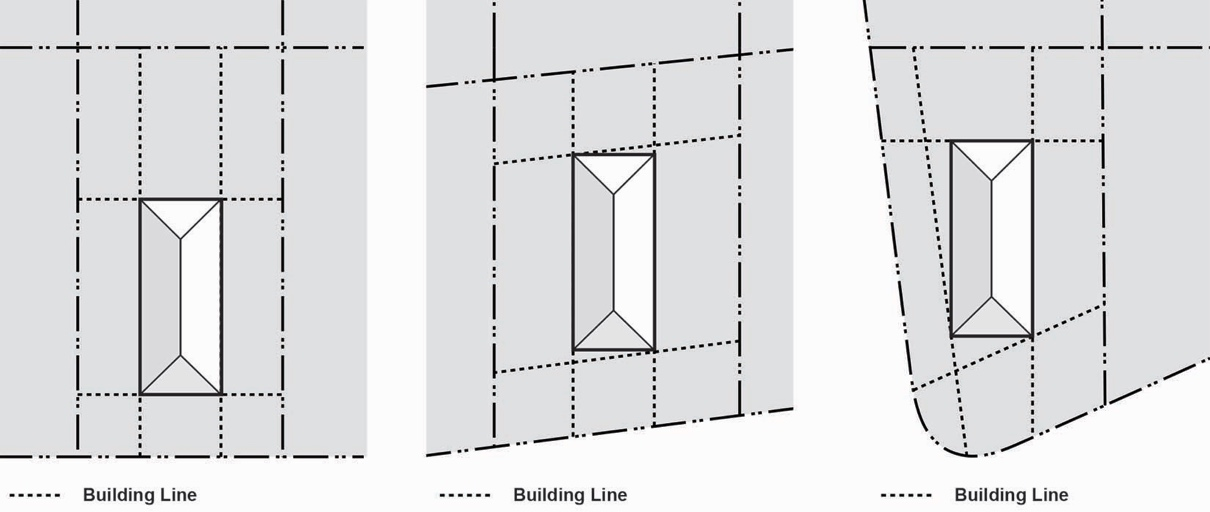
Caliper. Tree caliper is the diameter of a tree trunk, measured at four and one-half (4½) feet above the adjacent ground.
Cannabis — adult-use cannabis dispensing organization. See "Adult-Use — Cannabis Dispensing Organization."
Cannabis — adult-use industrial cannabis facility. See "Adult Use — Industrial Cannabis Facility."
Canopy. A canopy is a roof-like cover designed for protection from the weather or as a decorative embellishment affixed to a building or freestanding, with supports that extend to the ground.
Car wash. An establishment for the washing and cleaning of motor vehicles or other light duty equipment, whether automatic, by hand, or self-service. The car wash facility may be within an enclosed structure, an open bay structure, or other configurations.
Carport. An open-sided roofed vehicle shelter, usually formed by extension of the roof from the side of a building, but may be freestanding.
Cemetery. Land and structures reserved for the interring of human remains or the interring of animal remains. Cemeteries may include structures for performing religious ceremonies related to the entombment of the deceased, mortuaries, including the sales of items related to the internment of remains, and related accessory structures, such as sheds for the storage of maintenance equipment. Cemeteries may also include crematoriums and embalming facilities.
Changeable message board. A sign designed where a portion of the sign area allows for a message to be changed manually. A changeable message board sign does not include electronic message signs or portable reader-board sign.
Chimney. A vertical shaft of reinforced concrete, masonry or other approved material enclosing one or more flues, for the purpose of removing products of combustion from solid, liquid, or gaseous fuel.
Co-location. Placement of equipment from more than one service or service provider on a single tower or site.
Commercial kitchen. A certified shared commercial kitchen in which individuals or businesses prepare value-added food products and meals, usually paying an hourly, daily, weekly, or monthly rate to lease a space shared by others.
Community center. A facility used as a place of meeting, recreation, or social activity, that is open to the public and is not operated for profit, and offers a variety of educational and community service activities.
Community garden. Land used for the cultivation of fruits, flowers, vegetables, or ornamental plants by one or more persons, households, or organizations. Community gardens do not include the raising of any livestock or poultry or the use of heavy machinery.
Conservation area. Designated open space that preserves and protects natural features, wildlife, and critical environmental features, as well as undeveloped sites of historical or cultural significance. A conservation area may include opportunities for passive recreation, such as hiking trails and lookout structures, and environmental education facilities.
Contiguous. See abut.
Cross-access. A vehicular and/or pedestrian connection between abutting properties that connects the two (2) sites and allows vehicles and/or pedestrians to travel between sites without the having to exit to the street.
Cross-dock. A logistics technique where shipments are transferred from inbound trailers at the receiving dock, sorted in the central area of the facility, and crossed over through the facility to the outbound trailers on the other side.
CROSS-DOCK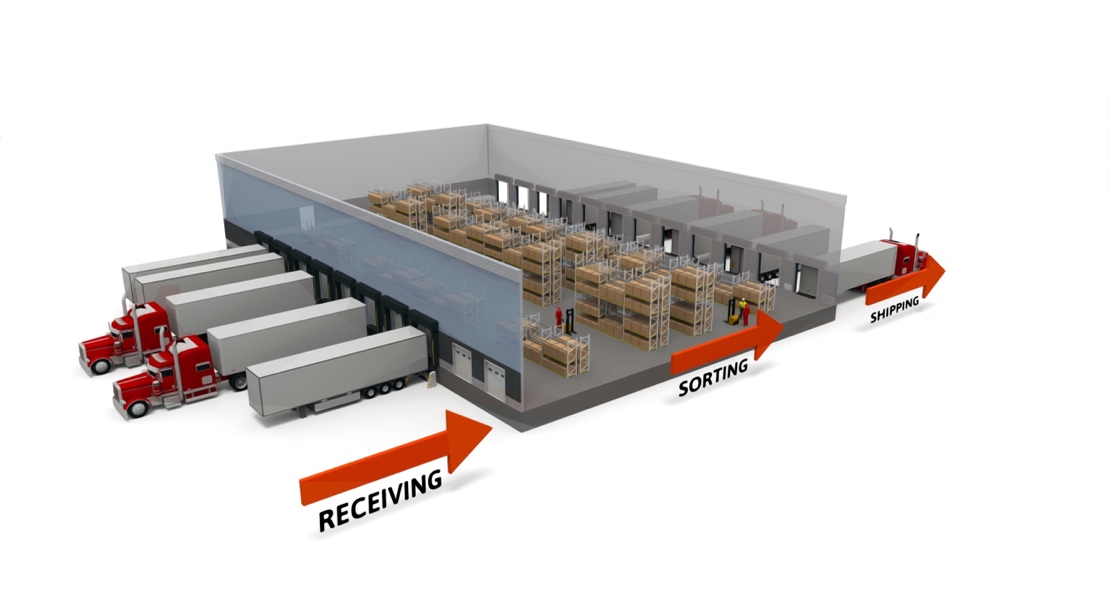
Cultural facility. A facility open to the public that provides access to cultural exhibits and activities including, but not limited to, museums, cultural or historical centers, non-commercial galleries, historical societies, and libraries. A cultural facility may include additional uses as part of the principal use such as, but not limited to, retail sales of related items and restaurants.
Day. A calendar day.
Day care center. A facility where, for a portion of a twenty-four (24) hour day, care and supervision is provided for children or the elderly and/or functionally-impaired adults in a protective setting that are not related to the owner or operator.
Day care home. A residential dwelling where, for a portion of a twenty-four (24) hour day, licensed care and supervision is provided by a permanent occupant of the dwelling for children or the elderly and/or functionally-impaired adults in a protective setting that are not related to the owner or operator of the facility.
Deck. A roofless outdoor space built as an above ground platform projecting from the wall of a structure and connected by structural supports at grade or by the structure.
Development. Any man-made change to land.
Donation box. An unmanned receptacle designed with a door, slot, or similar opening intended to accept and store donated clothes and household items.
Drive-thru lane. That portion of a business where transactions occur directly with customers via a service window, kiosk, or other configuration that allows customers to remain in their vehicle.
Driveway. A pathway for motor vehicles from a street to a lot used only for service purposes or for access to the lot.
Drug treatment clinic. A licensed facility authorized by the state to administer drugs including, but not limited to, methadone and suboxone, in the treatment, maintenance, or detoxification of persons.
Dwelling. A structure, or portion thereof, designed or used exclusively for human habitation, including single-family dwellings, two-family dwellings, townhouse dwellings, and multi-family dwellings. Each dwelling type must contain twenty-four (24) feet of width at its largest dimension and be located on a permanent foundation.
Dwelling — single-family. A structure containing only one dwelling unit.
Dwelling — two-family. A structure containing two (2) dwelling units, each with a separate entrance.
Dwelling — townhouse. A structure consisting of three (3) or more dwelling units, which are connected by party walls. A townhouse is designed with no other dwelling or portion of other dwelling, directly above or below, where each unit has a separate exterior entrance and direct ground level access to the outdoors with no opening between units. A townhouse dwelling does not include two-family or multi-family dwellings. A townhouse is also referred to as single-family attached dwelling. A townhouse dwelling refers to the design of a structure and not the type of ownership of the individual units.
Dwelling — multi-family. A structure containing three (3) or more dwelling units used for residential occupancy not designed as a townhouse dwelling as defined in this section.
Dwelling — above the ground floor. Dwelling units located above ground-floor nonresidential uses.
Dwelling — group home. A residence licensed, certified, or accredited for specialized residential care home by the appropriate state and/or federal agencies, that functions as a single housekeeping unit for the housing of unrelated persons with functional disabilities who share responsibilities, meals, recreation, social activities, and other aspects of residential living.
Dwelling — residential care facility. A licensed care facility that provides twenty-four (24) hour medical and/or non-medical care of persons in need of personal services, supervision, or assistance essential for sustaining the activities of daily living, or for the protection of the individual. A residential care facility includes nursing care, assisted living, hospice care, and continuum of care facilities. Continuum of care facilities may also include independent living facilities as part of the continuum.
Dwelling unit. A structure or portion of a structure providing complete, independent living facilities for one or more persons, including permanent provisions for living, sleeping, eating, cooking, and sanitation.
Easement. Land designed by lawful agreement between the owner(s) of the land and an entity(s) for a specified use only by such entity(s).
Eave. The projecting lower edges of a roof overhanging the wall of a structure.
Educational facility — primary or secondary. A facility that offers instruction at the elementary, middle, and/or high school levels.
Educational facility — university or college. A facility for post-secondary higher learning that grants associate, bachelor, master, and/or doctoral degrees. Such facilities may include ancillary uses such as research facilities, dormitories, cafeterias, restaurants, retail sales, indoor or outdoor recreational facilities, and similar uses.
Educational facility — vocational. A facility that offers instruction in industrial, clerical, computer, managerial, automotive, repair (electrical, plumbing, carpentry, etc.), or commercial skills, or a business conducted as a commercial enterprise, such as a school for general educational development or driving school. Educational facility - vocational also applies to privately operated schools that do not offer a full educational curriculum.
Electronic message sign. A sign designed where a portion of the sign area uses changing light emitting diodes (LEDs), fiber optics, light bulbs or other illumination devices within the electronic display panel(s) to form a message or messages in text and/or image from where the sequence of messages and the rate of change is electronically programmed and can be modified by electronic processes. Time/temperature signs are not considered electronic message signs. Flashing signs, animated signs, and video display signs are not considered electronic message signs.
Encroachment. The extension or placement of any structure, or a component of such, into a required setback or right-of-way.
Erect. To build, construct, attach, hang, place, suspend, or affix.
External illumination. Illumination by an artificial source of light not internal to the sign face.
Exterior lighting. The illumination of an outside area or object by any man-made device that produces light by any means.
Exterior stairwell. One or more flights of stairs, and the necessary landings and platforms connecting them, to form a continuous passage from the entryway of a floor or level to another in a structure located on the exterior of a principal building.
Family. A single housekeeping unit comprised of one or more persons each related to the other by blood, marriage, civil union, adoption, foster child relationship, and similar established legal relationships, or not more than three (3) unrelated persons, and maintaining a common household. In the case of unrelated persons, each person must be non-transient with full and unrestricted access to all areas of the dwelling unit and be a required participant only as to actual costs associated with the operation and maintenance of the common household. A family may include domestic servants and two (2) gratuitous guests whose residency is temporary. Total occupancy of any dwelling unit shall be limited by fire, building, and health laws as in effect within the Village.
Feather flag/sail. A freestanding attention-getting device, vertical in orientation, typically constructed of cloth held taut by a single post.
Fence. A structure used as a boundary, screen, separation, means of privacy, protection, or confinement, and is constructed of wood, vinyl, metal, masonry, or other similar material and is used as a barrier.
1.
Fence — open. A fence that has, over its entirety, more than twenty-five (25) percent of the superficial surface consisting of regularly distributed openings.
2.
Fence — solid. A fence that has, over its entirety, no distributed openings. A shadowbox design fence is considered a solid fence. A chain link fence with slats is not considered a solid fence.
OPEN FENCE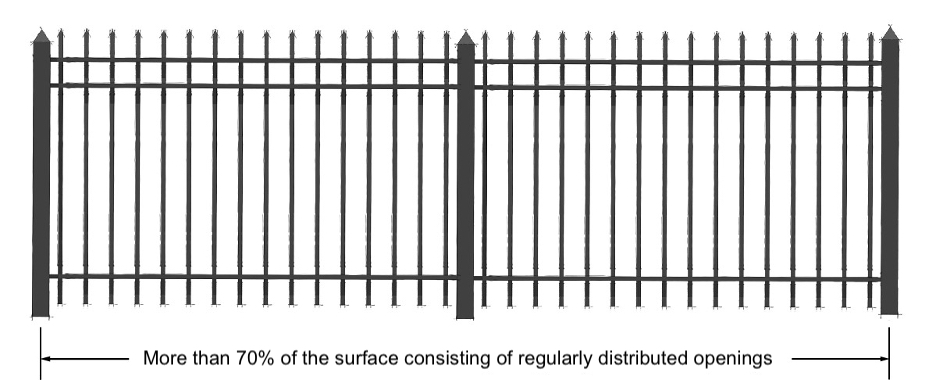
SOLID FENCE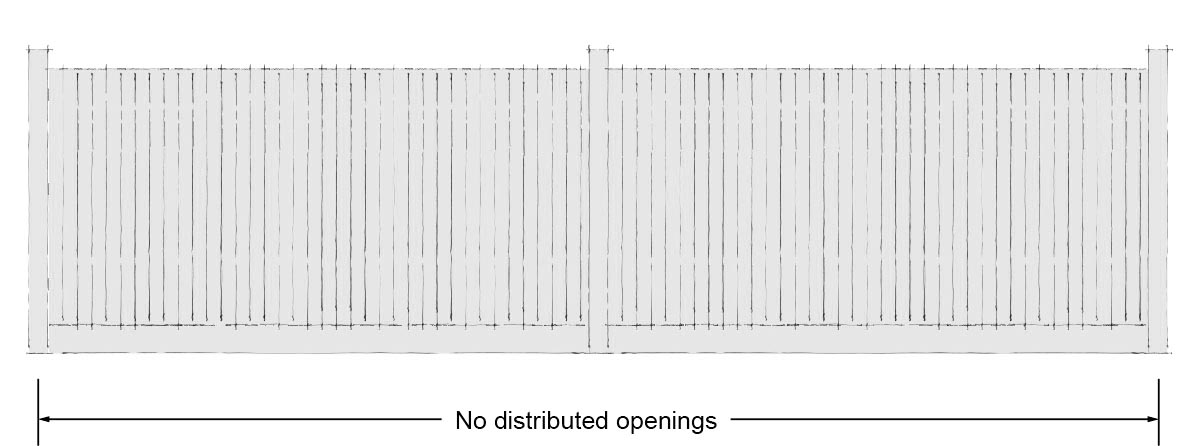
Financial institution, traditional. Any trust company, savings bank, industrial bank, savings and loan association, building and loan association, commercial bank, credit union, federal association, investment company or other business association, which is chartered under federal or state law, solicits, receives, or accepts money or its equivalent on deposit and loans money on a regular basis.
Financial institution, alternative. Non-chartered financial institutions offering check cashing services, currency exchange, pay-day loans, tax refund anticipation loans, car title loans, gold and other precious metal exchanges, and similar services.
Firearm ranges. A meeting place established for the principal purpose of discharging legal firearms.
Firearm sales. An establishment where one of the principal portions of the business is the sale of legal firearms.
Flag. Flags of any nation, state, municipality, or political subdivision, flags officially designated as a national, state, or local symbol, or flags of fraternal, religious, and civic organizations. Pennants and sails are not considered flags
Floodlight. A powerful light, typically in a grouping of several lights, used to illuminate the exterior of a building or sign.
Food bank. A non-profit organization that collects and distributes food to hunger relief organizations. Food is not distributed to individuals from a food bank.
Food pantry. A non-profit organization that provides food directly to individuals. Food pantries receive, buy, store, and distribute food. Food pantries may also prepare meals to be served at no cost to those who receive them.
Food trucks. A type of mobile food vendor operation in which a vendor utilizes a motorized vehicle or towed trailer which specifically can prepare, cook, sell, and serve food and/or beverages from the vehicle directly to consumers.
Foot-candle. A unit of measure of illuminance equal to one lumen of light spread over an area of one square foot.
Freight terminal. A use in which freight shipped by air, truck, boat, or rail is received and immediately distributed for intrastate or interstate commerce without any supplementary sorting, storage, or assembly.
Funeral home. An establishment where the dead are prepared for burial display and for rituals before burial or cremation, including chapels for the display of the deceased and the conducting of rituals before burial or cremation, and crematoriums.
Garage. An accessory building, either attached or detached, designed and/or used for the parking and storage of not more than four (4) private motor vehicles owned by residents living upon the premise. No more than one commercial vehicle or truck shall be allowed on the premises, and such commercial vehicle or truck shall not exceed a load capacity of three-fourths (¾) of a ton.
Gas station. An establishment where fuel for vehicles is stored and dispersed from fixed equipment into the fuel tanks of motor vehicles, which may include ancillary retail facilities. This does not include a truck stop.
Gazebo. A freestanding outdoor structure designed for recreational use and not for habitation.
Glare. Light emitting from a luminaire with an intensity great enough to reduce a viewers' ability to see, cause discomfort, and, in extreme cases, cause momentary blindness.
Government office/facility. Offices owned, operated, or occupied by a governmental agency to provide a governmental service to the public, such as Village offices and post offices. Government offices do not include public safety or public works facilities.
Grade. The average of the finished ground level of each wall of a building measured vertically along the façade and averaged.
Green roof. A building roof partially or completely covered with vegetation and a growing medium, planted over a waterproofing membrane. It may also include additional layers such as a root barrier and drainage and irrigation systems.
Greenhouse (accessory). A structure constructed chiefly of glass, glasslike or translucent material, cloth, or lath, which is devoted to the protection or cultivation of flowers or other tender plants.
Greenhouse/nursery — retail. An establishment where flowers, shrubbery, vegetables, trees, and other horticultural and floricultural products are propagated and sold, and may include gardening and landscape supplies and products, such as hardware, garden tools and utensils, paving stones and bricks, and other related items for sale. If all such activities are indoors with no outdoor component (growing, displays, storage, sales), then such use is considered a retail goods establishment.
Greenspace requirement. That area of each required setback in the zoning districts that does not contain any accessory structures or impervious surface areas including, but not limited to, pools, sheds, detached garages, decks or terraces, paved patios, walkways, loose gravel areas, driveways, parking pads, or aprons, and is open to the sky.
1.
When permeable paving is used, it is technically considered an impervious surface but is calculated at a reduced percentage of impervious coverage. Permeable pavers, such as permeable brick pavers or open grid paving systems, are calculated at eighty (80) percent of a normal impervious surface, provided that no barrier to infiltration is installed beneath the material.
2.
In order to be counted at the discounted rate, the Village Engineer must verify that the system has been installed correctly.
Gross floor area (GFA). The sum of the gross horizontal areas of all floors of the structure as measured from the exterior faces of the exterior walls or from the centerline of walls separating two (2) buildings.
Gym or fitness studio. An establishment where fitness-related activities are taught, studied, or practiced. This includes but is not limited to dance, martial arts, gymnastics, pilates, or yoga. This includes private exercise studios for private sessions with trainers and/or private classes.
Heavy retail, rental, and service establishment. An establishment of a larger-scale commercial character selling, renting, or providing services for home improvement, tools, construction equipment, appliances, and similar heavy goods or services. May include ancillary outside activities, storage, or sales of materials and equipment within partially enclosed structures. This does not include the retail, rental, or service of any motor vehicles, a large equipment repair facility, or any other industrial operation.
Hedge. A row of closely planted shrubs, bushes, or any kind of plant forming a boundary.
Home occupation. An activity carried out for economic gain by a resident, conducted as an accessory use in the resident's dwelling unit.
Hospital. Facilities for primary health services and medical or surgical care to people, primarily in-patient overnight care, and including related facilities such as laboratories, outpatient facilities, dormitories, educational facilities, cafeterias, retail sales, and similar uses.
Hotel. A commercial facility that provides sleeping accommodations for a fee and customary lodging services. Related accessory uses may include, but are not be limited to, meeting facilities, restaurants, bars, and recreational facilities for the use of guests. A hotel has common facilities for reservations, cleaning services, combined utilities, and on-site management and reception.
Industrial — artisan workshop. A facility where a limited number of skilled workers manufacture, fabricate, or process specialized crafts, foods, and other artisan goods. Such uses include, but are not limited to, metalworking, glassblowing, furniture making, and small-scale food production, preparation, canning, or packaging. Limited retail sales and services related to the primary use may occur on the premises. Micro-production of alcohol and more intensive industrial food service facilities are regulated separately from industrial artisan workshops.
Industrial — contractor office and storage. A facility where construction or contractor businesses may have an office, a limited shop floor, and an indoor storage area. Only vehicles, materials, goods, and equipment related to the primary use may be stored on site. The mass manufacture, fabrication, processing, reduction, and/or destruction of any material may not occur on the premises.
Industrial — data center. An establishment dedicated to computers, servers, communications infrastructure operated, and where information is stored, processed, received, and/or transferred.
Industrial — design workshop. A facility where the design, marketing, or brand development of various products are researched and developed typically integrating the fields of art, business, technology, science, or engineering. An industrial design workshop may have an office and create prototypes and products, but does not mass manufacture products on the premises. Limited retail sales and services related to the primary use may occur on the premises.
Industrial — heavy. The manufacture, fabrication, processing, reduction, and/or destruction of any article, substance, or commodity, or any other treatment thereof in such a manner as to change the form, character, and/or appearance, outdoor storage, and sales and distribution of such products. General industrial may produce noise, vibrations, illumination, or particulate that is perceptible to adjacent land users.
Industrial — light. Within a wholly enclosed building, the manufacture, fabrication, processing, reduction, and/or destruction of any article, substance, or commodity, or any other treatment thereof in such a manner as to change the form, character, and/or appearance. A light industrial use may also include a showroom, ancillary sales of products related to the items manufactured or stored on-site.
Industrial — research and development (R&D). A facility where research and development is conducted in industries that include, but are not limited to, biotechnology, pharmaceuticals, medical instrumentation or supplies, communication, and information technology, electronics and instrumentation, and computer hardware and software.
Industrial — specialty food service. A facility where the preparation, manufacturing, baking, processing, canning, or packaging of food products is completely enclosed and there are no outside impacts. Such business primarily specializes in the wholesale of specific food products, but may also offer areas for on-site retail sales or restaurants that serve the products processed on-site. Examples include wholesale bakeries, candy makers, and coffee roaster.
Industrial — warehouse and distribution. An enclosed facility for the storage and distribution of manufactured products, supplies, and/or equipment. Cross-docking operations, such as those found at a freight terminal, are prohibited.
Industrial — wholesale goods establishment. A business where goods are sold to either retailers, or to industrial, commercial, institutional, or other professional business users, or to other wholesalers and related subordinated services.
Infrastructure. Facilities and services needed to sustain residential, commercial, industrial, institutional, and other activities, including, but not limited to, water lines, sewer lines, and rights-of-way.
Intensity of use. Square feet of gross floor area, number of dwelling units, number of employees, or other factor used as a basis for requiring off-street parking or loading facilities.
Large equipment repair facility. A building or area used for the indoor repair of industrial and/or commercial equipment in excess of one-and-a-half (1½) ton capacity.
Light pole. Pole on which a luminaire is mounted.
Light pole banner. Banners mounted on and with arms installed perpendicular to light poles.
Live performance venue. A facility for the presentation of live entertainment, including musical acts (including disc jockeys), theatrical plays, stand-up comedy, and similar performances. Performances are scheduled in advance and tickets are required for admission and available for purchase in advance, though tickets may be purchased at the venue's box office on the day of the performance. A live performance venue is only open to the public when a live performance is scheduled. A live performance venue may include classroom and/or rehearsal space utilized during hours it is not open to the public for a performance. A live performance venue may include concession stands, including sale of alcohol, but only when it is open to the public for a performance. This does not include any adult use.
Loading berth. A space within a loading facility exclusive of driveways, aisles, maneuvering areas, ramps, columns, landscape, and structures for the temporary parking of a commercial delivery vehicle while loading or unloading goods or materials.
Lodge/social club. A facility operated by an organization or association for a common purpose, such as, but not limited to, a meeting hall for a fraternal or social organization or a union hall, but not including clubs organized primarily for-profit or to render a service which is customarily carried on as a business.
Lot. A lot is the basic development unit for determination of lot area, depth, and other dimensional regulations; or a parcel of land whose boundaries have been established by some legal instrument such as a recorded deed or recorded map and which is recognized as a separate legal entity for purposes of transfer of title.
1.
Lot, corner. A corner lot is a lot situated at the junction of, and abutting on, two (2) or more intersecting streets.
2.
Lot, interior. An interior lot is a lot other than a corner or through lot, bounded by two (2) interior side lot lines.
3.
Lot, flag. A flag lot is platted so that the main building site area (the "flag") is set back from the street on which it fronts and includes an access strip (the "pole") connecting the main building site with the street.
4.
Lot, through. A through lot is a lot which fronts upon two (2) parallel streets, or which fronts upon two (2) streets which do not intersect at the boundaries of the lot. A through lot is also called a double frontage lot.
LOT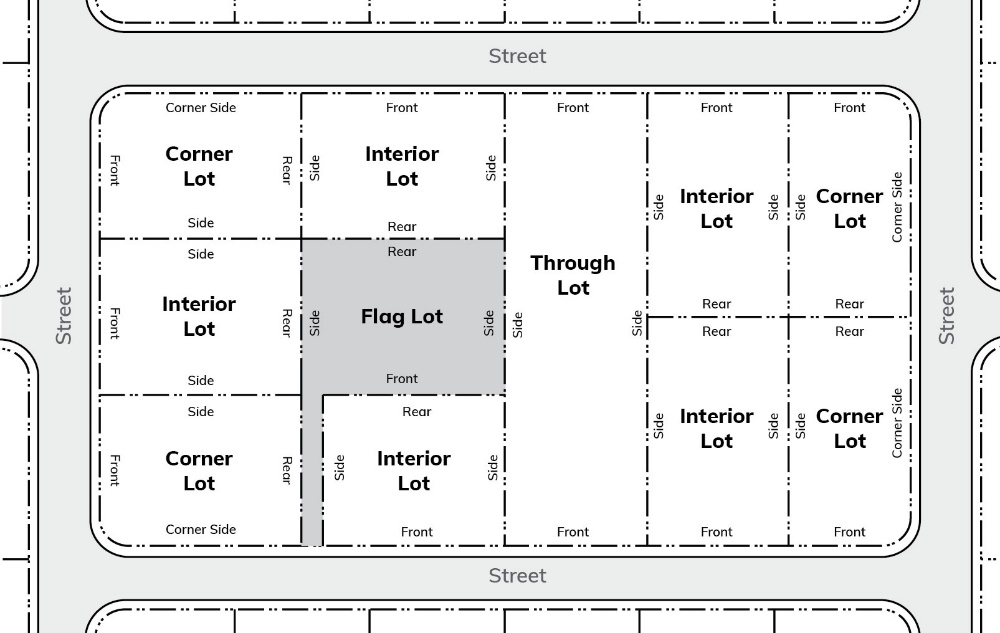
Lot area. The total area within the boundaries of a lot, excluding any street right-of-way, usually defined in square footage.
Lot line. A line of record bounding a lot, as indicated on an approved, filed, and recorded subdivision plat, which divides one lot from another lot or from a public or private street or any other public or private space.
1.
Lot line, front. The lot line separating a lot from a street right-of-way. The front lot line of a corner lot is the shortest street lot line of a corner lot abutting a street. A front lot line for a through lot is both lot lines that abut a street.
2.
Lot line, rear. The lot line opposite and most distant from the front lot line. In the case of triangular or similarly irregularly shaped lots, the rear lot line is a calculated line of ten (10) feet in length entirely within the lot, parallel to and at a maximum distance from the front lot line.
3.
Lot line, corner side. Ona corner lot, the corner side lot line and reverse corner side lot line is perpendicular or approximately perpendicular to the front lot line and is the longer street abutting lot line of a corner lot.
4.
Lot line, interior. Onan interior lot, the interior side lot line is perpendicular or approximately perpendicular to the front lot line and abuts an adjacent lot.
5.
Lot line, street. A street lot line is any lot line separating a lot from a street right-of-way.
LOT AREA AND LOT LINES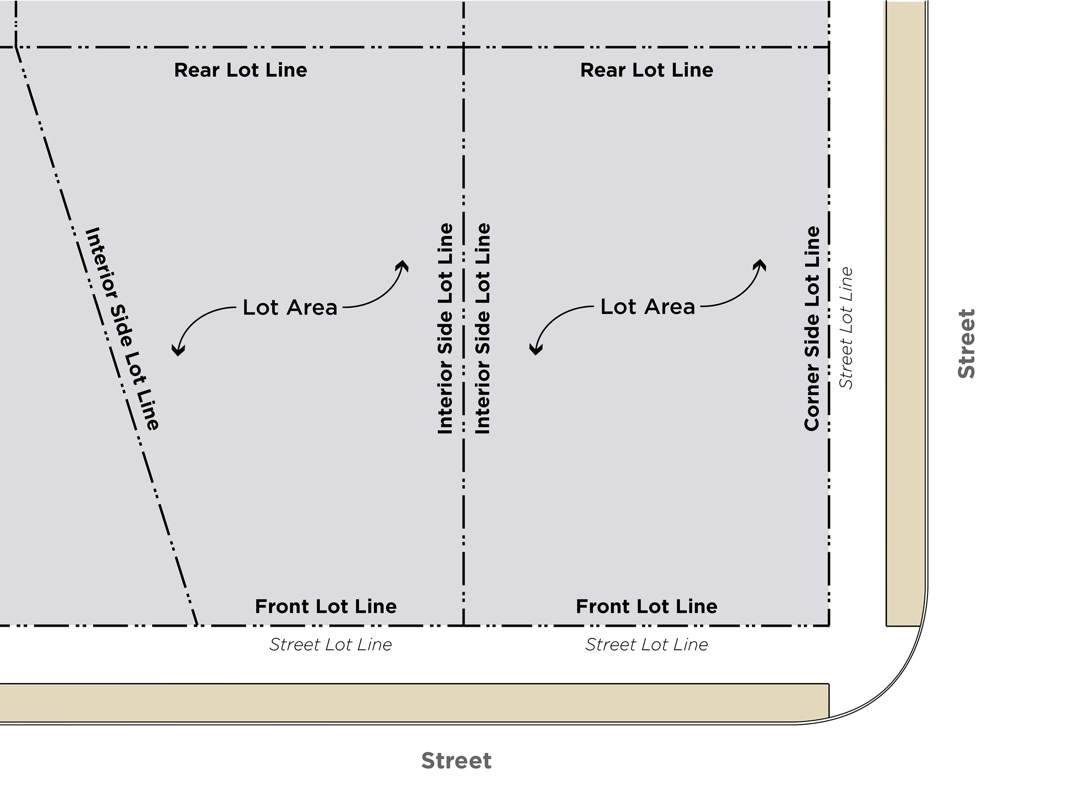
Lot width.
1.
For regular lots, lot width is the horizontal distance between the side lot lines measured at right angles to its depth along a straight line parallel to the required front setback, build-to line, or farthest build-to line comprising a build-to zone.
2.
For lots with a curved front lot line, lot width is measured as follows:
a.
A line is drawn at the midpoint of the lot between the side lot lines, extending from the front lot line to the rear lot line.
b.
Where the required front setback intersects the midpoint line at a right angle, a line is drawn perpendicular to the midpoint line.
c.
Lot width is determined as the length of the line between side lot lines.
d.
Where the side lot lines angle to increase width towards the rear, the required lot width measured at the required setback is seventy-five (75) percent of the lot width required by the zoning district.
3.
For flag lots, lot width is measured at the required front setback as defined in this section.
LOT WIDTH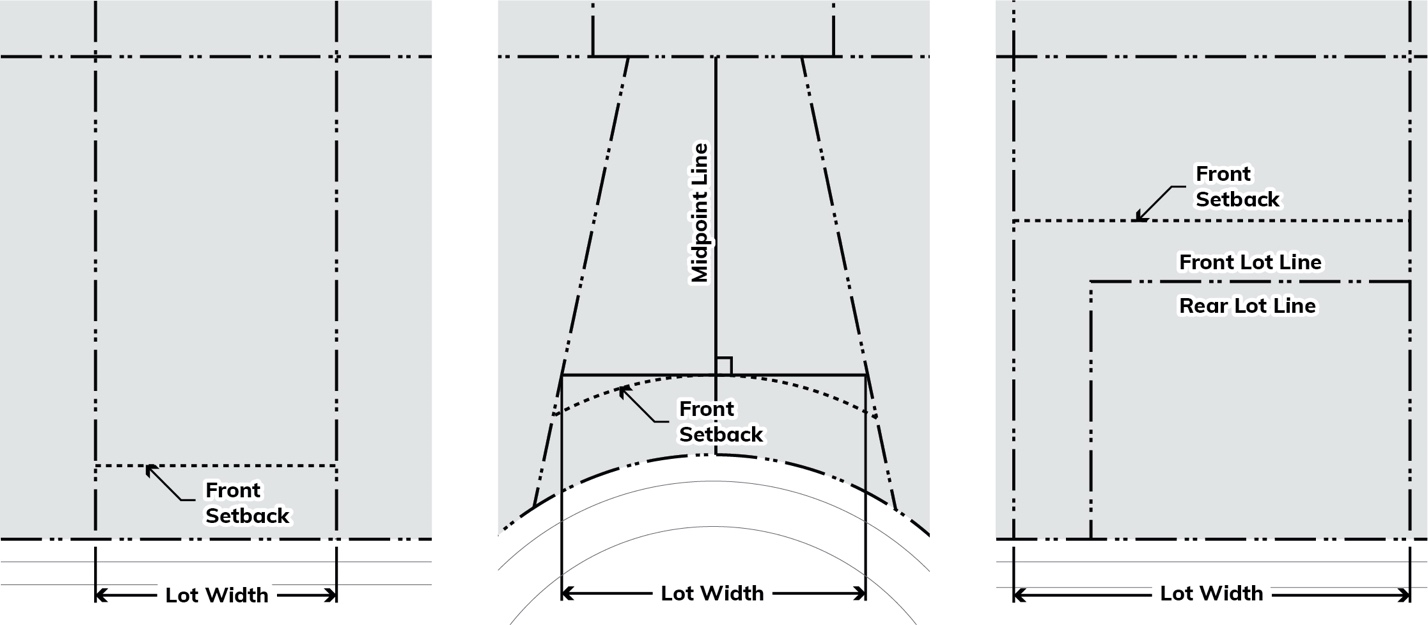
Marquee. A permanent roof-like structure constructed of permanent building materials that extends from the wall of a structure with no supports extending to the ground providing protection from the elements.
Massage establishment. An establishment where, for any form of consideration, massage, alcohol rub, fomentation, electric or magnetic treatment, or similar treatment or manipulation of the human body is offered by a licensed massage therapist as required by the State of Illinois. For the purposes of this definition, the following medical practices are not considered a massage establishment but are part of a medical/dental clinic per this Ordinance: massage treatment administered by licensed medical practitioners, licensed physical therapists, chiropractors, acupuncturist or other holistic medicine, or similar professional medical person licensed by the state. A massage establishment does not include ancillary services provided as part of a health club, school, or full-service spa or salon.
Medical/dental office. A facility operated by one or more physicians, dentists, chiropractors, psychiatrists, physical therapists, acupuncturists, or other licensed practitioners of the healing arts for the examination and treatment of persons solely on an outpatient basis.
Menuboard. A sign constructed as part of drive-through facilities.
Micro-production of alcohol. A facility for the production and packaging of alcoholic beverages, such as beer, wine, spirits, cider, and mead, for distribution and consumption on-premises. Facilities include a tasting room and may include retail areas for the purchase beverages manufactured on-site and related items. Facilities must include a bar/tasting room and/or restaurant for consumption and tasting on-premises. It may also include retail to purchase beverages manufactured on-site and related items. A tasting room is an area within the premises of the brewery's production facilities where guests may sample the brewery's products. When the production facilities exceed the maximum square footage allowed by any prescribed conditions, the facility is not considered micro-production of alcohol, but rather an industrial use.
Minimum dwelling unit size. The total floor area of a dwelling unit, excluding any attic or basement area, and excluding any garage space.
Mobile food vendor or dispenser. A food service operation in which a vendor utilizes a cart, motorized vehicle, or towed trailer to store, prepare, cook, display, sell, or serve food and/or beverages directly to consumers by traveling from place to place or upon the public ways. A mobile food vendor does not have a permanent location, but rather can temporarily operate at various locations in the Village during a permitted timeframe as designated via an approved license.
Motor vehicle. Any vehicle propelled by combustion, electric, or hybrid engine.
Noncommercial message. The expression of noncommercial ideas and messages. A noncommercial message does not promote a business, product, service, commercial entertainment, or other commercial activity offered on or off the premises.
Nits. A luminance unit equal to one candle per square meter measured perpendicular to the rays from the source
Off-premise commercial sign — temporary. A temporary sign directing attention to a specific business, product, service, entertainment event, activity, or other commercial activity that is not sold, produced, manufactured, furnished, or conducted at the property upon which the sign is located. This includes any ground-mounted, building-mounted, or sign painted, pasted, or otherwise affixed to any tree, rock, fence, utility pole, hydrant, bridge, sidewalk, parkway, curb or street, bench, or trash receptacle that directs attention off-premises.
Off-street parking. The storage space for an automobile on premises other than streets or rights-of-way.
Office. An establishment that engages in the processing, manipulation, or application of business information or professional expertise. Such an office may or may not offer services to the public. An office is not materially involved in fabricating, assembling, or warehousing of physical products for the retail or wholesale market, nor engaged in the repair or sale of products for immediate purchase and removal from the premise by the purchaser. Office does not include employment/labor service agencies.
Open space. That portion of land, either landscaped or left unimproved, which is used to meet active or passive recreation or spatial needs, and/or to protect water, air, or plant resources.
Outdoor dining. A seating area that is located outdoors and contiguous to a restaurant or bar, typically in addition to an indoor seating area. Outdoor dining areas are also permitted on rooftops, when determined by the Village to be structurally sound for such use.
Outdoor display. Part of a lot used for outdoor sales and/or display of goods accessory to the principal use.
Outdoor storage. The storage of materials, supplies, equipment, and similar items outdoors accessory to the principal use of land.
Outlot. An area of land set aside within a retail center for a separate principal building that shares a circulation system and may share common parking with the larger retail center development but is separated from the principal building or buildings, typically located along the property line.
Owner. Any person, including the owner of the title or a mortgage whose interest is shown of record in the mortgage and conveyance records; a person shown as owner in the records of the tax assessor of the county in which the property is situated; or the agent of any such person and those in possession of a dwelling, dwelling unit, or premises.
Parapet. The extension of a false front or wall above a roofline.
Park/playground. A publicly-owned facility that serves the recreational needs of residents and visitors. Park/playground includes, but is not limited to, playgrounds, ballfields, football fields, soccer fields, basketball courts, tennis courts, dog parks, skateboard parks, passive recreation areas, and gymnasiums. Public parks may also include non-commercial indoor or outdoor facilities, including zoos, recreational centers, and amphitheaters, additional uses such as, but not limited to, restaurant and retail establishments, and temporary outdoor uses such as festivals and performances.
Parking structure (principal use). A structure or portion of a structure used for the parking of operable vehicles, whether for compensation or at no charge.
Party wall. A wall starting from the foundation and extending continuously through all stories to or above the roof that separates one building from another, but is in joint use by each building.
Patio. A hard surface designed and intended for recreational use by people and not used as a parking space.
Pawn shop. An establishment that lends money on the deposit or pledge of physically delivered personal property, and who may also purchase of such property on the condition of selling it back again at a stipulated price. Consignment shops and antique shops are not considered pawn shops.
Pennants. Any lightweight plastic, fabric, or other material, whether or not containing printing of any kind, suspended from a rope, wire, or string, usually in a series, designed to move in the wind.
Pergola. An open structure, which may be either freestanding or attached to a structure, that forms a partially shaded pedestrian walkway, passageway, or sitting area, and is constructed of a semi-open roof and vertical posts that support cross-beams and a sturdy open lattice. It may also be used as an extension of a building entryway.
Permanent water feature/pool. Any outdoor above or below ground swimming pool, hot tub, spa, pond, or other water feature of two (2) feet of depth or greater.
Permeable pavers. A range of sustainable materials and techniques for permeable paving with a base and sub-base that allow the movement of stormwater through the surface. Gravel, loose rock, pervious concrete, and pervious asphalt are not considered pervious pavers.
Place of worship. A facility where persons regularly assemble for religious purposes and related social events, and may include group housing for persons under religious vows or orders. Places of worship may include additional uses as part of the principal use such as day care facilities, meeting rooms, food preparation and dining areas, auditoriums, and/or classrooms for religious instruction.
Portable reader-board. A sign whose principal supporting structure is intended, by design and construction, to rest upon the ground for support and may be easily moved or relocated for reuse. Portable reader-board signs include, but are not limited to, signs mounted upon a trailer, wheeled carrier, or other non-motorized mobile structure, with wheels or with wheels removed. Portable reader-board signs do not include a-frame signs.
Porch. An architectural feature that projects from the exterior wall of a structure, has direct access to the street level of the building, and is covered by a roof or eaves.
1.
Porch — unenclosed. A porch that is open on all sides that do not abut a principal building wall.
2.
Porch — enclosed. A porch enclosed by walls, screens, lattice, or other material. A screened-in porch is an enclosed porch.
Primary. In regards to the primary, main, or principal use, building, structure, facility, or operation of a zoning lot. Superordinate to any accessory zoning.
Prohibited. In regards to the prohibited, illegal, denied, or non-permitted use, building, structure, facility, or operation of a zoning lot. If a requested zoning action is not permitted, conditional, or temporary: it is de facto prohibited.
Property line. For the purposes of this Ordinance, a property line is a lot line. (See lot line definition.)
Reception facility. A facility that provides hosting and rental services of a banquet hall or similar facilities for private events including, but not limited to, wedding receptions, holiday parties, corporate events, and fundraisers, with food and beverages that are prepared and served on-site or by a caterer to invited guests during intermittent dates and hours of operation. Live entertainment may occur as part of an event. A reception facility is not operated as a restaurant with regular hours of operation.
Recreational vehicle. Any vehicle or boat designed for temporary living quarters, recreation, or temporary human habitation and not used as a commercial vehicle including, but not limited to, the following: boat/watercraft, camper trailer, motorized trailer, off-road vehicle, racing car or cycle, travel trailer, and camper.
Restaurant. An establishment where food is prepared and provided to the public for on-premises consumption and/or may be sold for off-premise consumption through carry-out or delivery service. Alcoholic beverages may be served for on-premise consumption in conjunction with on-premise food service.
Retail — Ecommerce facility. A facility that primarily sells and distributes products from online sales or services. Such sales or services may include but are not limited to apparel, housewares, jewelry, toys, books, arts & crafts, software, or website design. Ecommerce facilities may have ancillary office and storage areas, but do not permit manufacturing on the premises.
Retail — sales establishment. An establishment that provides physical goods, products, or merchandise directly to the consumer, where such goods are typically available for immediate purchase and removal from the premises by the purchaser. This does not include tobacco retail.
Retail — goods showroom. An establishment where products are displayed for sale, such as furniture, appliances, carpet, tile, or furnishings. Products are available for purchase but are generally not available for immediate removal from the premises and are rather delivered to the purchaser.
Retail — service establishment. An establishment that provides frequent or recurrent needed personal services. Typical uses include, but are not limited to, beauty shops, barbershops, personal electronics repair shops, nail salons, laundromats, dry cleaners, and tailors. This does not include massage establishments.
Right-of-way. A strip of land dedicated for use as a public way. In addition to the roadway, it typically incorporates the curbs, parkways, sidewalks, and shoulders.
Roofline. The top edge of a roof or building parapet, whichever is higher, excluding any cupolas, pylons, chimneys, or minor projections.
Satellite dish antenna. A dish antenna designed for transmitting signals to a receiver or receiving station or for receiving television, radio, data, communication or other signals from other antennas, satellites, or other services.
Searchlight. An attention-getting device where an artificial light of high intensity is shined upward in a focused beam and can turn in any direction to attract attention to a location. Also known as sky-beams or sky spotlights.
Separation measurement. When uses are required to be measured a certain distance from another use or district, such separation distance is measured from a point of the lot line on which such use is proposed to be located to the nearest point on the lot line where the other use or district is located.
Setback. A required setback is the required minimum distance a principal building must be located from a lot line, which is unoccupied and unobstructed by any projections of a principal building, unless permitted by this Ordinance. A build-to zone or build-to line is considered a required setback.
1.
Front setback. A front setback is the required minimum distance per the zoning district that a principal building must be located from the front lot line. The front setback extends the full width of the lot between side lot lines measured perpendicular to the front lot line.
a.
Front setbacks on irregular lots are subject to the additional provisions:
i.
On a lot with a radial (curved) front lot line, the required front setback, as measured from the right-of-way line follows the curve of the lot line.
ii.
For flag lots, the front yard and setback is measured from the rear lot line of the lot that separates the flag portion of the lot from the street. For multiple flag lots that utilize a common drive, the front yard and setback may be measured from the lot line of the pole or access strip, as extended into the lot.
b.
Where front setback averaging is permitted, the average front setback of the adjacent lots on either side of a lot may be used to establish the required front setback. Averaging is based on the two (2) adjacent lots on either side or, in the case of a corner lot, the next two (2) adjacent lots. In the case of a lot configuration where only one lot is available for averaging, the required front setback is that of the adjacent lot.
c.
For through lots, both the front and the rear required setbacks must meet the required front setback of the zoning district.
2.
Interior side setback. An interior side setback is the required minimum distance per the zoning district that a principal building must be located from the interior side lot line. The interior side setback extends along the interior side lot line between the front and rear setback, measured perpendicular to the interior side lot line.
a.
For townhouse developments, the interior side setback is only applicable to end units of the development.
3.
Corner side setback. A corner side setback is the required minimum distance per the zoning district that a principal building must be located from the corner side lot line. The corner side setback extends along the corner side lot line between the front yard or front setback and the rear yard or rear setback, measured perpendicular to the corner side lot line.
4.
Rear setback. A rear setback is the required minimum distance per the zoning district that a principal building must be located from the rear lot line. The rear setback extends the full width of the lot between interior-side lot lines, measured perpendicular to the rear lot line.
SETBACKS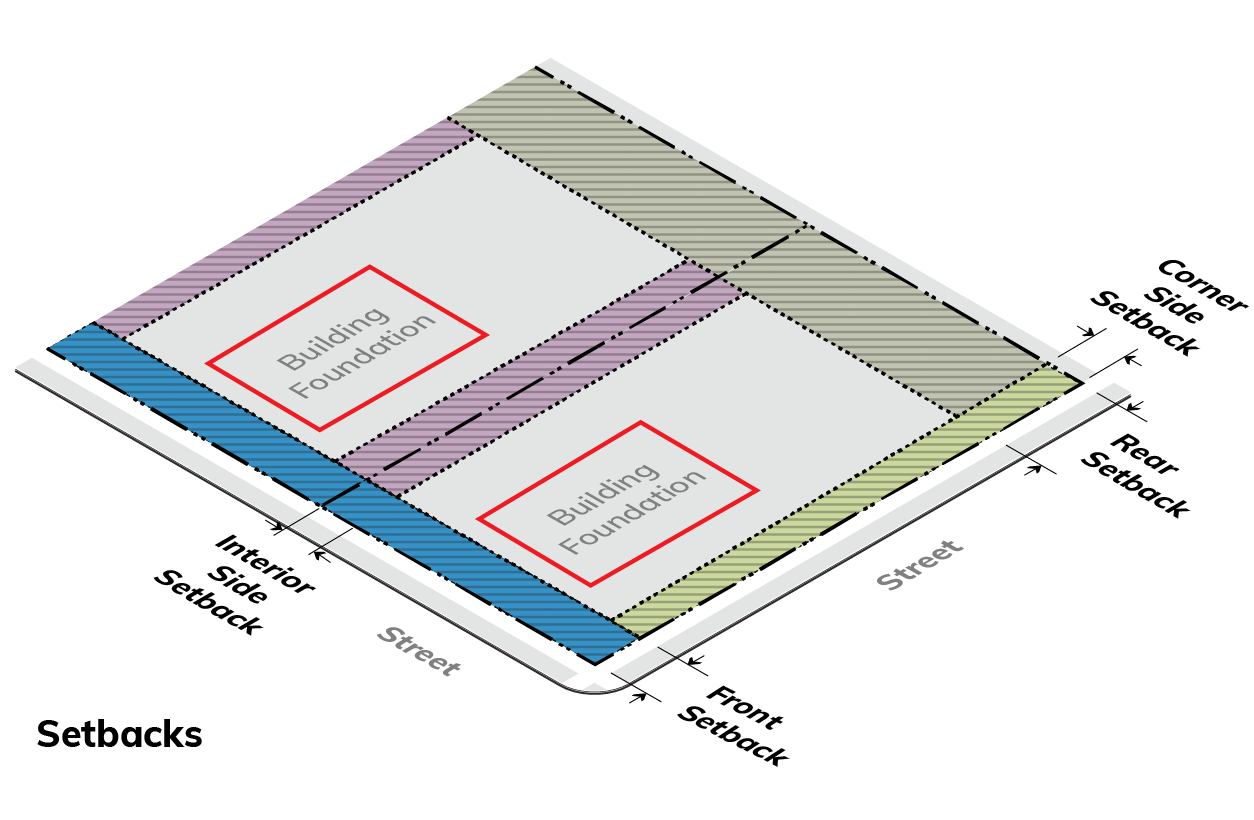
Shed. An accessory structure, often purchased pre-built or as a kit in pre-fabricated sections, that is not designed to be served by heat or plumbing and does not need to be placed on a permanent foundation. A shed is typically intended to store lawn, garden, or recreational equipment.
Short term rental unit. All or part of a residential building or dwelling unit located in any zoning district, being leased, rented, offered for rent, hired out, licensed, or otherwise let as an accessory use or occupancy to a person or persons other than the owner of the subject property or a family member of the owner thereof for a period or term that is less than thirty (30) consecutive days. Short term rental unit shall also include a dwelling unit or accessory building, or part thereof, used for overnight accommodation that is available for rent by transient guests for a period or term that is less than twenty (20) consecutive days. Short term rental unit shall not include a hotel that holds a permit as required in Section 4-6A-3 of the Municipal Code.
Sign. A lettered, numbered, symbolic, pictorial, or illuminated visual display designed to identify, announce, direct, or inform that is visible from a public right-of-way.
Sign, A-frame. A temporary sign ordinarily in the shape of the letter "A" or some variation thereof, which is displayed on the ground, not permanently attached to the ground, and usually two (2) sided, generally connected at the top and separated at the bottom.
Sign, animated. A sign that uses moving or changing lights to depict action, movement, or the optical illusion of movement of part of the sign structure, sign, or pictorial segment, or including the movement of any illumination or the flashing or varying of light intensity to create a special effect or scene. Animated signs do not include electronic message signs.
Sign area.
1.
The sign area of each sign is the total exposed surface devoted to the sign's message, including all ornamentation, embellishment, symbols, logos, letters, characters, other figures, or frames, whether structural or decorative. The calculation of sign area does not include any supports or bracing. For channel letters or freestanding logos/symbols, the sign area is calculated as the customary, applicable mathematical formula for the total area of each square, circle, ellipse, rectangle, or triangle, or combination thereof, that encompasses each word, logo, image, background, and/or display.
2.
Window area for the purpose of calculating maximum area of window signs is calculated as a continuous surface until divided by an architectural or structural element. Mullions are not considered an element that divides window area. Total window area is calculated as length times width of the window area. Only the individual letters or logos of the window sign shall be used in the calculation of surface area. The transparent film around the perimeter of the individual letters or logos comprising the window sign and used to affix the window sign to the interior or exterior of a windowpane or glass door shall be exempt from the area calculations, provided that such portion of the transparent film maintains one hundred (100) percent transparency of the window.
SIGN AREA - SIGN WITH BACKGROUND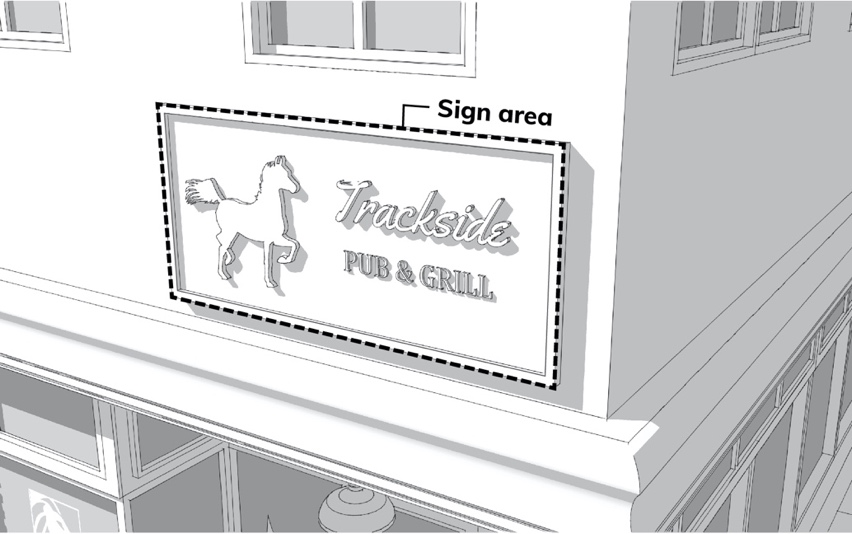
SIGN AREA - CHANNEL LETTERS/FREESTANDING LOGOS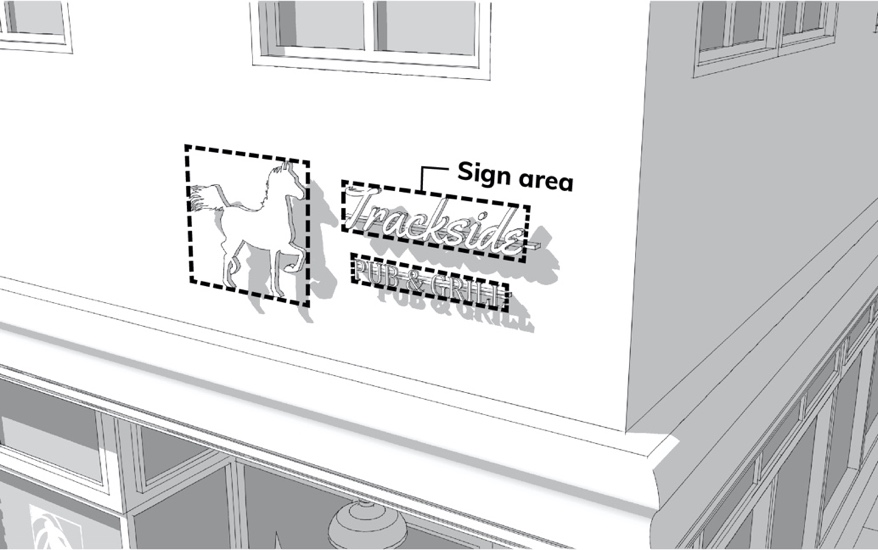
SIGN AREA - WINDOW SIGNS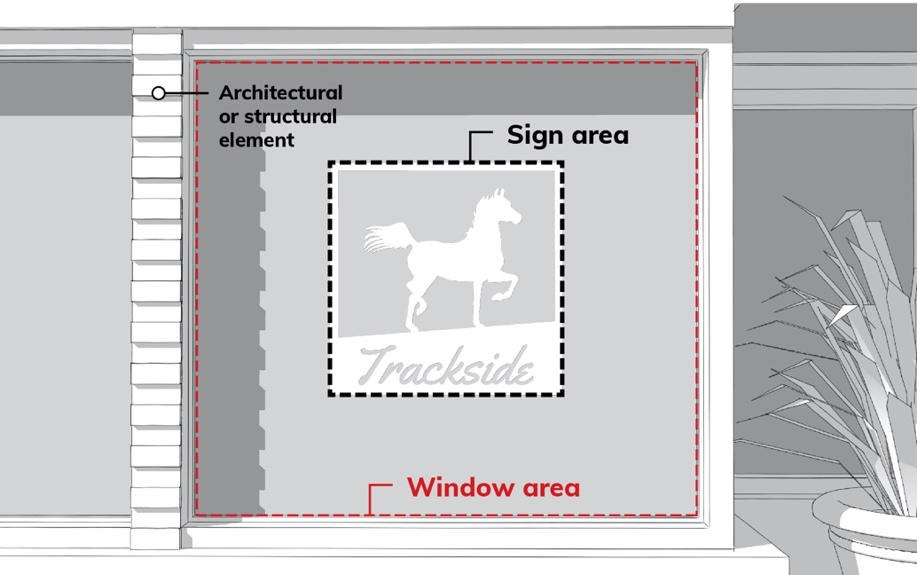
Sign, awning. An awning is a roof-like cover designed for protection from the weather or as a decorative embellishment, which projects from a wall or roof of a structure over a window, walkway, or door, with no supports that extend to the ground. An awning sign is a sign printed or displayed upon an awning.
Sign, balloon. A sign or advertising device designed to be airborne or inflated and tethered to the ground or other structure. This includes any air-inflated signs and any signs that inflate and move via air inflation.
Sign, canopy. A canopy sign is a sign printed, mounted, or installed upon a canopy. A sign canopy may be one of two (2) types:
1.
Canopy — non-structural. A roofed structure attached to a building, which is not integral to the structure, that is made of durable, weather-resistant material such as canvas, canvas-like material, nylon, or vinyl-coated fabric, placed to extend outward from the building and supported both by mountings on the structure wall and by supports that extend to the ground.
2.
Canopy — structural. A roofed structure constructed of permanent building materials, such as metal, brick, stone, wood or similar building materials, that is constructed as part of and attached to a building, and extends outward from the building and supported both by the structure and by supports that extend to the ground. Certain structural canopies may also be constructed freestanding accessory structures on the same lot with the principal use and/or structure.
Sign face calculation. If the interior angle between two (2) sign faces is forty-five (45) degrees or less, the sign area is computed as the area of one face only. If the angle between two (2) sign faces is greater than forty-five (45) degrees, the total sign area is computed as the sum of the areas of the two (2) faces.
SIGN FACE CALCULATION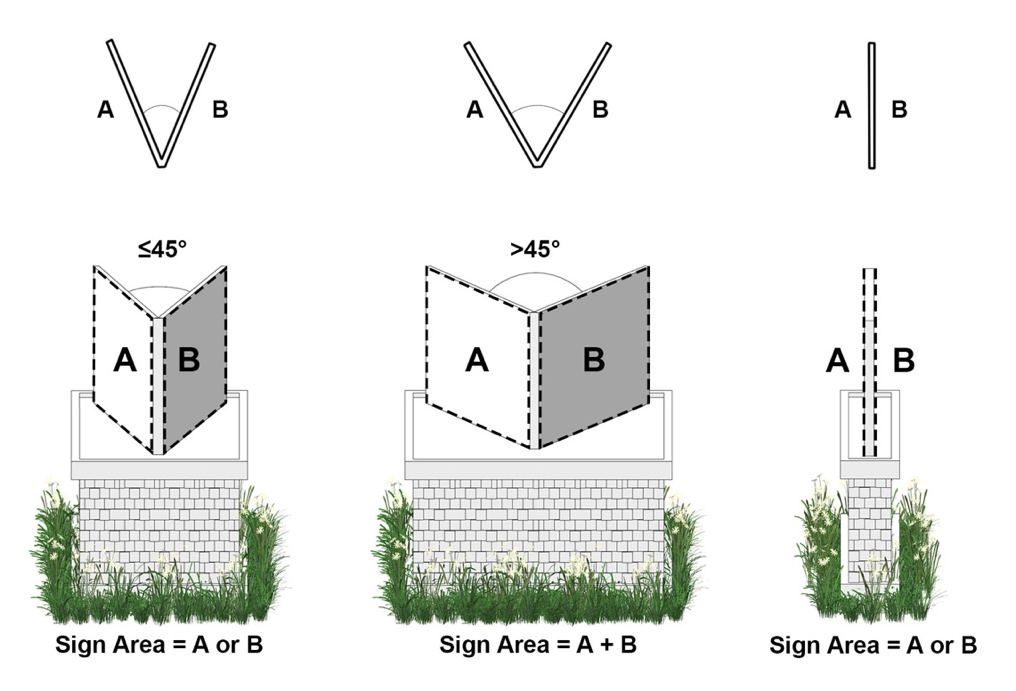
Sign, flashing. A sign with an intermittent or sequential flashing light source used primarily to attract attention. Flashing signs do not include electronic message signs.
Sign, freestanding. A sign that is placed on or supported by the ground, independent of the principal structure on the lot, designed with a monument base that is an integral part of the sign structure. There are three (3) types of freestanding signs regulated by this Ordinance:
1.
Freestanding sign — standard. A freestanding sign that identifies an establishment that is not specifically categorized as a residential subdivision freestanding sign or a multi-tenant retail center freestanding sign.
2.
Freestanding sign — multi-tenant retail center. A freestanding sign used to identify a commercial development with two (2) or more tenants.
Sign height. For ground signs, sign height is measured as the vertical distance measured from the normal grade at the base of the sign to the highest point of the sign, including any decorative elements. Normal grade shall be construed to be the existing grade prior to construction or the newly established grade after construction, exclusive of any fill, berm, mound, or excavation solely for the purpose of locating the sign, whichever is lower.
SIGN HEIGHT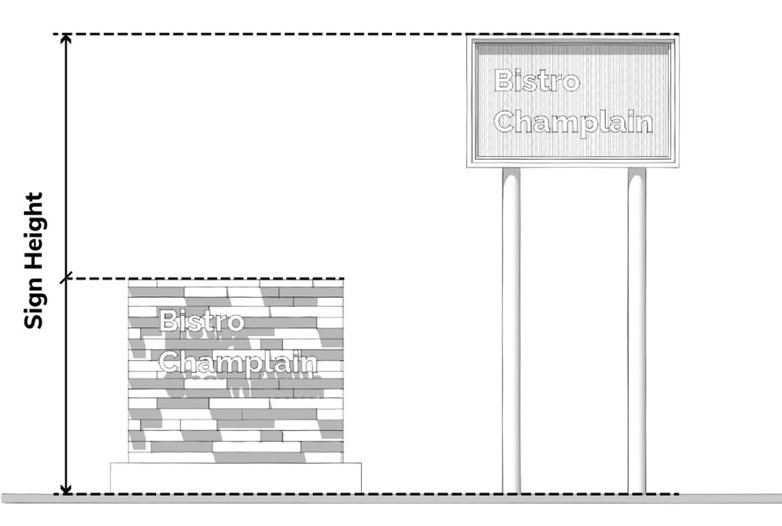
Sign, marquee. A sign that is a part of or attached to a marquee. Where designed as a changeable message, sign, the changeable message portion may be manually changed or electronically changed when permitted by this Code.
Sign, moving. A sign where the entire sign structure or a portion of which rotates, moves, elevates, or in any way alters position or geometry. A tri-vision sign where triangular prisms rotate inside a frame to show a new message and/or information are considered moving signs. Moving signs do not include clocks or barber poles.
Sign, projecting. A sign that is attached to a rigid structure that extends more than eighteen (18) inches beyond the surface of the structure to which it is attached. A marquee sign is not considered a projecting sign.
Sign, roof. A sign that is erected, constructed, or maintained on and/or extending above the roof structure or parapet of any building with the principal support attached to the roof structure.
Sign setback. A required sign setback is measured from the applicable lot line to the closest component of the sign or sign structure.
Sign, vertical clearance. Vertical clearance is measured as the vertical distance measured from the ground directly below the sign to the lowest point of the sign.
VERTICAL CLEARANCE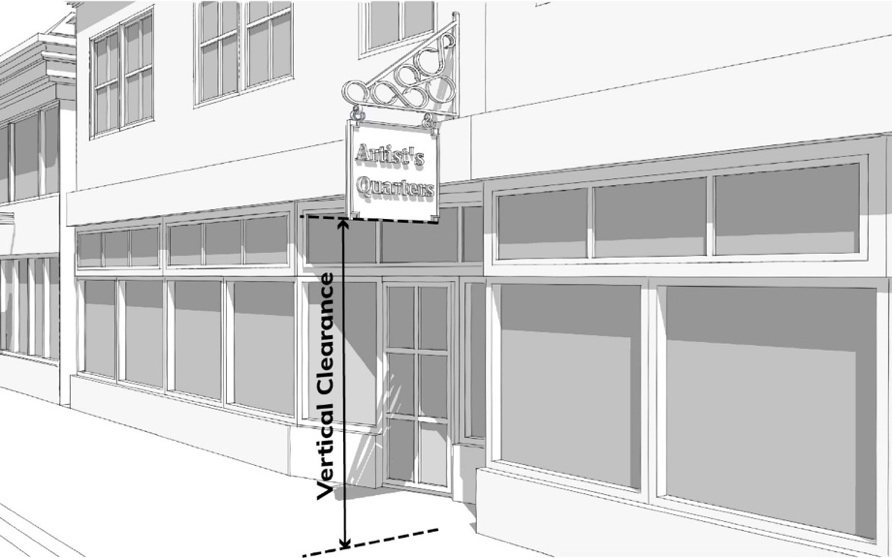
Sign, wall. A sign that is attached directly to an exterior wall of a building or dependent upon a building for support and projects eighteen (18) inches or less from the wall of a structure with the exposed face of the sign in a plane substantially parallel to the face of the wall. Window signs are not considered wall signs.
Sign, window. A sign that is attached to, placed upon, or printed on the interior or exterior of a window or door of a building, or displayed on the interior within two (2) feet of a window intended for viewing from the exterior of such a building. A window sign may be either permanent or temporary. Shadowbox design within display windows, where the window display is designed with a background enclosure against which signs are mounted that blocks view into the establishment, is considered a window sign and the entire area of the shadowbox is subject to the maximum sign area limitation.
Social service center. A service establishment that provides assistance for those recovering from chemical or alcohol dependency; survivors of abuse seeking support; those transitioning from homelessness or prior incarceration; and those with health and disability concerns. It does not include in-patient, overnight, or living quarters for recipients of the service or for the staff. Such service does not include medical examinations or procedures, or medical detoxification, dispensing of drugs or medications, or other treatments normally conducted in a medical office.
Stacking space. A space specifically designed and designated as a waiting area for vehicles patronizing a drive-through facility or service bay.
Standpipe. A rigid vertical or horizontal pipe to which fire hoses can be connected, which may be building, ground, or roof mounted.
Stoop. An exterior floor typically, constructed of stone, concrete, and/or masonry, with a finished floor elevation higher than the adjacent ground level, often with steps leading up to it, and utilized primarily as an access platform to a structure. A stoop may be roofed and designed with railings, but cannot be enclosed.
Storage facility. A facility for the long-term storage of property where either individual renters or a business control and access storage spaces located within a fully enclosed building that is climate controlled. It is expected that any individual storage space may not accessed more than once per day. No other operations may occur on the premises.
Street. A public or private right-of-way that affords a primary means of vehicular, and may include cyclist and pedestrian access to abutting property. A street does not include alleys or driveways.
Structural alteration. Any change, other than incidental repairs, which would prolong the life of supporting members of a structure, such as the addition, removal, or alteration of bearing walls, columns, beams, girders or foundations.
Structure. A combination of materials to form a construction for use, occupancy, or ornamentation, whether installed on, above, or below, the surface of land or water.
Substantial repair/rehabilitation. Substantial repair/rehabilitation occurs with any exterior change, other than routine exterior maintenance activities, that would prolong the life of the supporting members of a building. Routine exterior maintenance activities such as painting, tuckpointing, replacing trim in kind, railings in kind, or replacing other nonstructural architectural details in kind are not considered to constitute a substantial repair/rehabilitation unless the cost of exceeds fifty (50) percent of the assessed building or appraised value.
Temporary. In regards to the temporary, provisional, limited, or non-permanent use, building, structure, facility, or operation of a zoning lot: as permitted by the Zoning Administrator for a time period of fifteen (15) days or less, unless otherwise stated in the associated code section or permit. Exceeding such time period is prohibited.
Temporary contractor's office and contractor's yard. A temporary, portable, or modular structure utilized as a watchman's quarters, construction office, or equipment shed during the construction of a new development. This may include a contractor's yard where materials and equipment are stored in conjunction with a construction project.
Temporary outdoor event. A temporary event within an outdoor space where entertainment occurs and/or where goods are sold, including, but not limited to, festivals, carnivals, arts and crafts fairs, flea markets, rummage sales, and holiday sales, such as Christmas tree lots and pumpkin sales lots. This temporary use category does not include outdoor sales related to a retail goods establishment where such goods are part of the establishment's regular items offered for purchase.
Tobacco retail. A retail establishment that specializes primarily in sale of tobacco and vaping products, and accessory smoking paraphernalia.
Traditional lot. A lot in the R-2 District approved for single-family development prior to Sept. 20, 1999.
Transparency. The required amount of window area as a percentage of the specified facade area. Doors are included in ground floor transparency when such doors are designed with glass or other transparent materials. Garage entrances shall not be included in ground floor transparency.
Truck. Any motor vehicle used for commercial or industrial transportation of goods, materials, or products which exceeds one-and-a-half (1½) tons in capacity.
Truck parking area or yard. Any land used or intended to be used principally for the storage or parking of trucks, trailers, tractors, and industrial or commercial vehicles, while not loading or unloading, which exceed one-and-a-half (1½) tons in capacity. A truck parking area or yard includes the meaning customarily assigned to cartage facilities and/or truck dispatch yards.
Truck repair. A business that provides services in repairs to trucks and industrial or commercial vehicles that exceed one-and-a-half (1½) tons in capacity.
Truck sales — outdoor. An establishment that offers the sale of trucks, tractors, truck-trailers, and industrial and commercial vehicles in excess of one-and-a-half (1½) tons capacity with outdoor sales/display area.
Truck stop. An establishment providing a variety of services to trucks or heavy commercial vehicles, which may include, but are not limited to: truck washes, truck parking, truck repair, showers, laundry services, or other truck oriented uses.
Unified control. The combination of two (2) or more tracts of land wherein each owner has agreed that his tract of land will be developed under the same development approvals.
Use. The purpose or activity for which the land or structure is designed, arranged, or intended, or for which it is occupied or maintained.
Vehicle dealership or rental. An establishment that sells, leases, or rents automobiles, vans, pick-ups, motorcycles, or any other similar motorized transportation vehicles. A vehicle dealership or rental facility may maintain a limited outdoor inventory of vehicles in adherence to outdoor display accessory use standards (Section 9-9-9-F of the Municipal Code). Additionally, the sale, rental, parking, or storage of trucks, vans, tractors, truck-trailers, or any other industrial and commercial vehicles in excess of one-and-a-half (1½) tons capacity is prohibited unless completely enclosed with no outdoor sales/display area. Storage of vehicles in connection with online vehicle sales or auctions, without a majority of sales occurring on-site, is not permitted. A vehicle dealership or rental facility must be an authorized dealer or franchise, having legal agreement or certification from a manufacturer or rental company to sell, lease, or rent such vehicles.
Vehicle inspection facility. An establishment where motor vehicles or trucks are tested, including for air pollutants or engine exhaust emissions.
Vehicle operation facility. A facility for the dispatch, storage, and maintenance of emergency medical care vehicles, taxicabs and similar vehicles for hire, school buses, utility vehicles, delivery vehicles, and similar vehicles.
Vehicle repair/service. A business that provides services in repairs to automobiles, vans, pick-ups, motorcycles, and/or all-terrain vehicles (ATV), and other similar motorized transportation vehicles. This does not include a truck repair facility, large equipment repair facility, or a vehicle inspection facility.
Vehicle towing facility or yard. An establishment where tow trucks are dispatched to transport motor vehicles to impound, storage, or repair facilities. Includes yards which store impounded, broken, or otherwise inoperable motor vehicles.
Vertical clearance. The vertical distance measured from the ground directly below a sign or architectural feature to the lowest point of that sign or architectural feature.
Video display sign. A sign, or portion of a sign, that displays an electronic video, whether pre-recorded or streaming. This includes projection of an electronic video on a wall or other surface.
White roof. A roof designed to deliver high solar reflectance, reducing heat transfer to the building and the ability to radiate absorbed, or non-reflected solar energy.
Wireless telecommunications. Towers, antennas, and facilities used to transmit and receive signals that facilitate wireless telecommunications. The following definitions describe the wireless telecommunications infrastructure described within the general definition for wireless telecommunications:
1.
Wireless antenna. A specific device, the surface of which is used to transmit and/or receive signals transmitted to or from other antennas. This does not include satellite dish antennae.
2.
Wireless facility. A structure used to house and protect the equipment necessary for processing telecommunications signals, which may include air conditioning equipment and emergency generators. Facility also includes any necessary equipment that facilitates wireless transmission.
3.
Wireless tower. A structure designed and constructed to support one or more wireless telecommunications antennae and including all appurtenant devices attached to it.
Wrecking or scrap yard. An establishment where inoperable motor vehicles, metal scrap, junk, electronic or building salvage, or other potentially hazardous material is stored, dismantled, deconstructed, recycled, or otherwise processed.
Yard. The area between the building line of a principal building and the adjoining lot lines, exclusive of facade articulation, such as window or wall recesses and projections.
1.
Front yard. A front yard is located between a principal building line and the front lot line. The front yard extends the full width of the lot between side lot lines measured perpendicular to the front lot line.
2.
Interior side yard. An interior side yard is located between a principal building line and the interior side lot line. The interior side yard extends along the interior side lot line between the front and rear yards, measured perpendicular to the interior side lot line.
3.
Corner side yard. A corner side yard is located between a principal building line and the corner side lot line. The corner side yard extends along the corner side lot line between the front yard and the rear yard, measured perpendicular to the corner side lot line.
4.
Rear yard. A rear yard is located between a principal building line and the rear lot line. The rear yard extends the full width of the lot between side lot lines, measured perpendicular to the rear lot line.
YARDS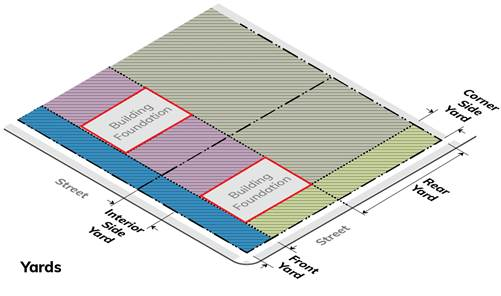
Zoning lot. A lot or combination of lots within a single block, which is designated by its owner or developer to be used, developed, or built upon as a unit. A zoning lot may coincide with a lot of record or may be comprised of one or more lots of record.
Zoning map. The map or maps that are a part of this Ordinance and which delineate the boundaries of all mapped zoning districts within the physical boundary of the Village.
(Ord. 2223-VC-11, § 3; Ord. 2223-VC-25, § 3; Ord. 2324-VC-11, § 3; Ord. 2324-VC-45, § 3; Ord. No. 2526-VC-02, § 3; Ord. 2526-VC-28, § 3; Ord. 2526-VC-41, § 3)

