
Franklin Park City Zoning Code
CHAPTER 9
- Uses
9-9-1.- General use regulations.
A.
No structure or land may be used unless allowed as a permitted or conditional use within the zoning district.
B.
A site may contain more than one principal use, so long as each principal use is allowed in the district. Each principal use is approved separately.
C.
All uses must also comply with any applicable federal and state requirements, and any additional federal, state, or Village ordinances.
D.
Certain uses are specifically prohibited in the Village. These are as follows:
1.
Body modification establishment.
2.
Food trucks (but permitted as accessory to a temporary outdoor event).
3.
Freight terminal.
4.
Large equipment repair facility.
5.
Truck parking area or yard.
6.
Truck repair.
7.
Truck sales—outdoor.
8.
Truck stop.
9.
Short term rental units (see Section 4-6E of the Municipal Code).
10.
Vehicle inspection facility.
11.
Vehicle operation facility.
12.
Vehicle towing facility or yard-
13.
Wrecking or scrap yard.
E.
All uses are defined in Chapter 2.
(Ord. No. 2223-VC-25, § 4; Ord. 2324-VC-11, § 4)
9-9-2. - Use matrix generally.
A.
Table 9-1: Use Matrix identifies the principal and temporary uses allowed within each zoning district. Cells are color-coded for ease of review only; the letter indicated in the cell controls over any errors in color-coding.
B.
"P" indicates that the use is permitted by-right in the district. "C" indicates that the use is a conditional use in the district and requires conditional use approval. If a cell is blank, the use is not allowed in the district. All principal uses, whether permitted or conditional, must comply with the use standards of Section 9-9-3, as applicable.
C.
In the case of temporary uses, "T" indicates the temporary use is allowed in the district. Temporary uses must comply with the use standards of Section 9-9-4, as applicable.
D.
In the case of accessory uses, "A" indicates the accessory use is allowed in the district. Accessory uses must comply with the use standards of Section 9-9-5, as applicable.
(Ord. No. 2223-VC-11, § 4; Ord. 2324-VC-36, § 3; Ord. 2324-VC-45, § 4; Ord. 2425-VC-21, § 4; Ord. 2526-VC-40, § 3)
9-9-3. - Principal use standards.
A.
Adult use.
1.
No adult use is allowed within five hundred (500) feet of another adult use.
2.
No adult use can be conducted in any manner that permits the observation from any point not on the lot on which the adult use has is located of any material depicting, describing, or relating to specified anatomical areas or specified sexual activity. This prohibition applies to any display, decoration, sign, show window, or other opening.
3.
Only one type of adult use is permitted per lot.
B.
Animal care facility. These standards do not apply to any animal shelters operated by a government agency.
1.
Animal care facilities must locate any exterior exercise areas in the rear yard only. Exterior exercise areas must provide covered areas over a minimum of thirty (30) percent of the exterior area to provide shelter against sun/heat and weather. A fence a minimum of six (6) feet and a maximum of seven (7) feet in height is required for all exterior exercise areas.
2.
Animal care facilities must locate all overnight boarding facilities indoors.
3.
All animal quarters and exterior exercise areas must be kept in a clean, dry, and sanitary condition.
4.
Any animal care facility with exterior exercise areas must not locate within five hundred (500) feet of a residential district.
C.
Cannabis—Adult-use cannabis dispensing organization.
1.
Location. Where authorized as a conditional use within the C-3 District, adult-use cannabis dispensing organizations shall only be located on zoning lots adjacent to Mannheim Road.
2.
Onsite consumption. The consumption, use, or ingestion of cannabis or cannabis infused products shall not be permitted on the premises of adult-use cannabis dispensing organizations.
3.
Preexisting adult-use cannabis dispensing organization/industrial adult-use cannabis facility. Adult-use cannabis dispensing organizations may not be located within 1.25 miles of a preexisting adult-use cannabis dispensing organization or five hundred (500) feet of an industrial adult-use cannabis facility.
4.
Hours. Adult-use cannabis dispensing organizations shall be permitted to be open to the public between the hours of 8:00 A.M. and 10:00 P.M.
5.
Business conducted within an enclosed building. All business, servicing, or processing, except as provided for in this section, shall be conducted within an enclosed building.
6.
Drive-thru prohibited. Drive-thru lanes are strictly prohibited in relation to the operation of adult-use cannabis dispensing organizations.
7.
Loading and unloading of product. Loading and unloading of product for adult-use cannabis dispensing organizations shall occur in a secure loading space and shall minimize the visibility
8.
Storage. All storage of materials, except for operational motor vehicles, shall be kept completely within the building from which the adult-use cannabis dispensing organization operations occur.
9.
Odor. Adult-use cannabis dispensing organizations shall operate in a manner that prevents odor impacts on neighboring premises or properties and, if necessary, adult-use cannabis dispensing organizations shall be ventilated with an odor control system.
10.
Parking.
a.
Chapter 11 contains parking requirements. However, the Village may require additional parking be provided as the impact or intensity of the use reasonably necessitates.
b.
Parking areas shall be well lit and monitored by video surveillance equipment whereby live images can be viewed by adult-use cannabis dispensing organization's employees in a format that is continually recorded and tamperproof.
11.
Exterior display. Adult-use cannabis dispensing organizations shall not maintain or operate in a manner that causes, creates, or allows public viewing of adult-use cannabis, adult-use cannabis infused products or cannabis paraphernalia, or similar products from any sidewalk, public or private right-of-way or any property other than within the premises of the adult-use cannabis dispensing organization.
12.
Signage and advertising.
a.
All advertising must comply with the advertising and promotions restrictions contained in the Cannabis Regulation and Tax Act (410 ILCS 705/55-20).
b.
Exterior electronic message boards and temporary signs are strictly prohibited.
13.
Security and video surveillance.
a.
Operations related to adult-use cannabis dispensing organizations shall occur in an enclosed secure facility and shall provide and maintain adequate security on the premises, including lighting, video surveillance and alarms reasonably designed to ensure the safety of persons and to protect the premises from theft.
b.
A sign shall be posted in a prominent location which includes the following language: "This area is under live/recorded video surveillance to aid in the prosecution of any crimes committed against this facility or its patrons."
D.
Cannabis—Adult-use industrial cannabis facility.
1.
Location. Where authorized as a conditional use within the I-2 District, industrial adult-use cannabis facilities shall only be located on zoning lots west of Mannheim Road.
2.
Preexisting adult-use cannabis dispensing organization/Industrial adult-use cannabis facility. Industrial adult-use cannabis dispensing organizations may not be located within one thousand five hundred (1,500) feet of a preexisting adult-use cannabis dispensing organization or one thousand (1,000) feet of an industrial adult-use cannabis facility.
3.
Business conducted within a single occupant enclosed building. All business, servicing, or processing, except as provided for in this section, shall be conducted within a single occupant building and shall be fully enclosed.
4.
Loading and unloading of product. Loading and unloading of product for industrial adult-use cannabis facilities shall occur in a secure loading space and shall minimize the visibility from the exterior of the building from which its operations occur or from the property.
5.
Storage. All storage of materials, except for operational motor vehicles, shall be kept completely within the building from which the industrial adult-use cannabis facility operations occur.
6.
Odor. Industrial adult-use cannabis facilities shall operate in a manner that prevents odor impacts on neighboring premises or properties and, if necessary, industrial adult-use cannabis facilities shall be ventilated with an odor control system.
7.
Parking.
a.
Chapter 11 contains parking requirements. However, the Village may require additional parking be provided as the impact or intensity of the use reasonably necessitates.
b.
Parking areas shall be well lit and monitored by video surveillance equipment whereby live images can be viewed by industrial adult-use cannabis facility employees in a format that is continually recorded and tamperproof.
8.
Signage and advertising.
a.
All signage for industrial adult-use cannabis facilities shall be limited to one flat wall sign not to exceed one square foot in area for every one linear foot of building frontage, and one identifying sign, which shall include only the address of the premises and shall not exceed two (2) square feet in area. The identifying sign shall not be directly illuminated.
b.
Exterior electronic message boards and temporary signs are strictly prohibited.
c.
Signs shall not include any realistic or stylized graphical representation of the cannabis plant or its parts or any realistic or stylized graphical representation of drug paraphernalia.
9.
Security and video surveillance.
a.
Operations related to industrial adult-use cannabis facilities shall occur in an enclosed facility and shall provide and maintain adequate security on the premises, including lighting, video surveillance and alarms reasonably designed to ensure the safety of persons and to protect the premises from theft.
b.
A sign shall be posted in a prominent location which includes the following language: "This area is under live/recorded video surveillance to aid in the prosecution of any crimes committed against this facility or its patrons."
E.
Car wash.
1.
Car washes must be screened along the interior side and rear lot lines with a solid fence or wall, a minimum of six (6) feet and a maximum of eight (8) feet in height. Shrubs, flowers, and trees must be utilized, with plantings facing towards the interior of the lot.
2.
The building containing the car wash must not be located within two hundred (200) feet of a residential district, measured from the nearest residential district lot line to the building. However, if the only residential district lot line within that distance is located on the opposite side of Grand Avenue or Mannheim Road, this restriction shall not apply.
3.
Six (6) stacking spaces or four (4) stacking spaces per car wash kiosk or bay, whichever is greater, are required.
4.
Development proposals must include architectural features, landscaping, or other design elements which benefit and preserve the character of the community.
5.
Development proposals must include an environmental impact and traffic study.
F.
Commercial kitchen, industrial — artisan workshop, and industrial — specialty food service.
1.
When located within five hundred (500) feet of a residential district, food odor impacts must be prevented though an odor control system, such as a commercial kitchen ventilation system.
G.
Community garden.
1.
Community gardens are limited to the cultivation of herbs, fruits, flowers, or vegetables. It may also include community-gathering spaces for active or passive recreation but playground equipment is prohibited.
2.
Greenhouses, including high tunnels/hoop-houses, cold-frames, and similar structures, are permitted to extend the growing season. Accessory structures, including but not limited to, sheds, gazebos, and pergolas, are also permitted. All accessory structures must be located a minimum of five (5) feet from any lot line.
3.
The keeping of livestock, including chickens, and aquaculture are prohibited. Apiaries are permitted.
4.
On-site composting is permitted.
5.
Farmstands are permitted and are limited to sales of items grown at the site. Farmstands must be removed from the premises during that time of the year when the use is not open to the public. Only one farmstand is permitted per lot.
H.
Day care center.
1.
Each day care center must have a state license and/or registration.
2.
A day care center must provide a pickup/drop off area. When a day care center is part of a multi-tenant development, the pickup/drop off area must not interfere with vehicle circulation in the parking lot, including blocking of the drive aisle.
3.
Must be compliant with home occupancy permit.
4.
Location. Where authorized as a permitted use within the C-3 District, day care centers shall only be located on zoning lots adjacent to Grand Avenue east of Mannheim Road.
5.
A day care must have a dedicated, secure, and well screened play area for children on-site.
I.
Dwelling — single-family and dwelling — two-family.
1.
The dwelling must have a primary entrance from a façade facing the street. The front entry must be a dominant feature on the front elevation of a home and an integral part of the structure, using features such as porches, raised steps and stoops, or decorative railings to articulate the front façade.
2.
Windows, entrances, porches, or other architectural features are required on all street-facing facades to avoid the appearance of blank walls.
3.
A ten (10) percent minimum transparency requirement applies to any façade facing a street and is calculated on the basis of the entire area of the façade.
4.
Front-loaded attached garages are limited to forty (40) percent of the width of the building facade line or twenty-four (24) feet, whichever is greater. Garage width is measured between the edges of the garage door; in the case of garages designed with multiple garage doors the distance is measure between the edge of the outermost doors. This applies to garages that take access from a front lot line or a corner side lot line.
5.
A front-loaded attached garage cannot project more than five (5) feet from the building facade line. This applies to garages that take access from a front lot line or a corner side lot line.
SINGLE-FAMILY DWELLING AND TWO-FAMILY DWELLING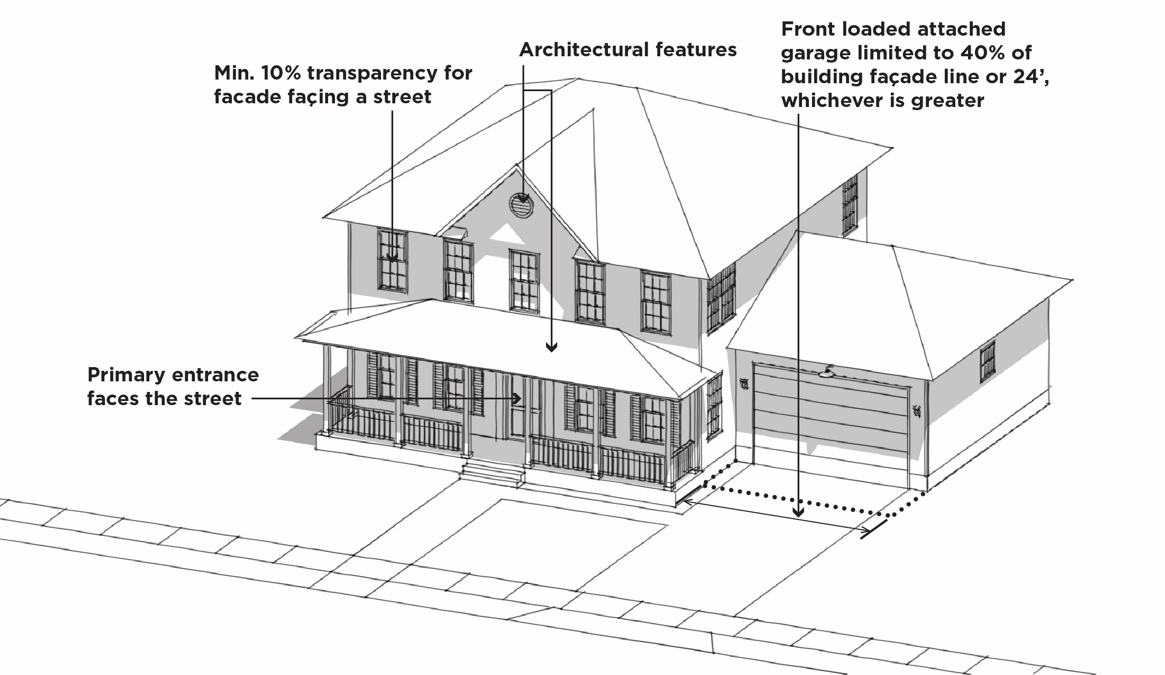
J.
Dwelling — townhouse. The following design standards new construction of townhouse dwellings and to any additions to a structure existing as of the effective date of this Ordinance that exceed thirty (30) percent or more of the existing structure's square footage.
1.
Façades must be designed with consistent materials and treatments that wrap around all façades. There must be a unifying architectural theme for the entire development, utilizing a common vocabulary of architectural forms, elements, materials, or colors in the entire structure.
2.
Building façades abutting a street must be articulated through the use of architectural elements to break up blank walls and add visual interest.
3.
A minimum transparency of ten (10) percent applies to any façade facing a street as calculated on the basis of the entire area of the façade.
4.
A minimum separation of fifteen (15) feet between buildings within a single development. However, where the front or rear wall of a building faces the front or rear wall of another building, the minimum required separation between such buildings must be thirty (30) feet. Driveways and parking areas may be located within this minimum separation area.
5.
Prohibited building materials are as follows:
a.
The following building materials are prohibited on any façade:
i.
Plain concrete block.
ii.
Exterior insulating finish systems (EIFS).
iii.
T-111 composite plywood siding.
b.
The following building materials are prohibited as a primary surface finish material on any façade. However, such materials may be used as decorative or detail elements for up to twenty-five (25) percent of the façade, or as part of the exterior construction that is not used as a surface finish material.
i.
Corrugated metal.
ii.
Aluminum, steel or other metal sidings.
iii.
Exposed aggregate (rough finish) concrete wall panels.
iv.
Plastic.
v.
Vinyl.
TOWNHOUSE DWELLING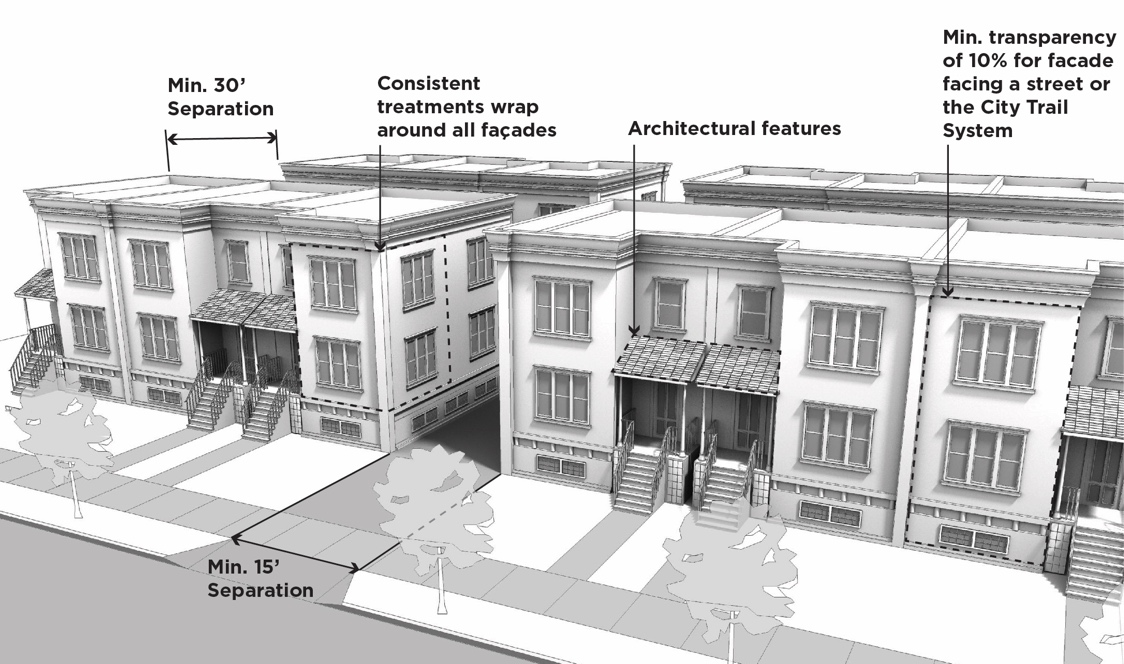
K.
Dwelling — multi-family. The following design standards apply to new multi-family construction and to any additions to an existing structure that exceed thirty (30) percent or more of the existing structure's square footage.
1.
Façades must be designed with consistent materials and treatments that wrap around all façades. There must be a unifying architectural theme for the entire development, utilizing a common vocabulary of architectural forms, elements, materials, or colors in the entire structure.
2.
Building façades abutting a street must be articulated through the use of architectural elements to break up blank walls, add visual interest, and present a residential character. Such articulation must occur at intervals a maximum of forty (40) feet linear feet. Two (2) or more of the following forms of building articulation must be incorporated:
a.
Modulation of the façade through the use of architectural features such as projections, indentations, overhangs, awnings, bays, canopies, and cornices. Building modulations must either projected or be set back a minimum of two (2) feet in depth, and must be a minimum of four (4) feet in width.
b.
Provision of a balcony, bay window, patio, porch, terrace, or visually prominent ground-level entry within each interval.
c.
Changes in color, texture, or material. Such changes should occur at inside corners to convey solidity and permanence, and should not occur on a flat wall plane or an outside edge.
d.
Provision of lighting fixtures or other building ornamentation such as artwork, trellises, or green walls within each interval.
3.
A minimum transparency of twenty (20) percent applies to any façade facing a street as calculated on the basis of the entire area of the façade.
4.
Prohibited building materials are as follows:
a.
The following building materials are prohibited on any façade:
i.
Plain concrete block.
ii.
Exterior insulating finish systems (EIFS).
iii.
T-111 composite plywood siding.
b.
The following building materials are prohibited as a primary surface finish material on any façade. However, such materials may be used as decorative or detail elements for up to twenty-five (25) percent of the façade, or as part of the exterior construction that is not used as a surface finish material.
i.
Corrugated metal.
ii.
Aluminum, steel or other metal sidings.
iii.
Exposed aggregate (rough finish) concrete wall panels.
iv.
Plastic.
v.
Vinyl.
MULTI-FAMILY DWELLING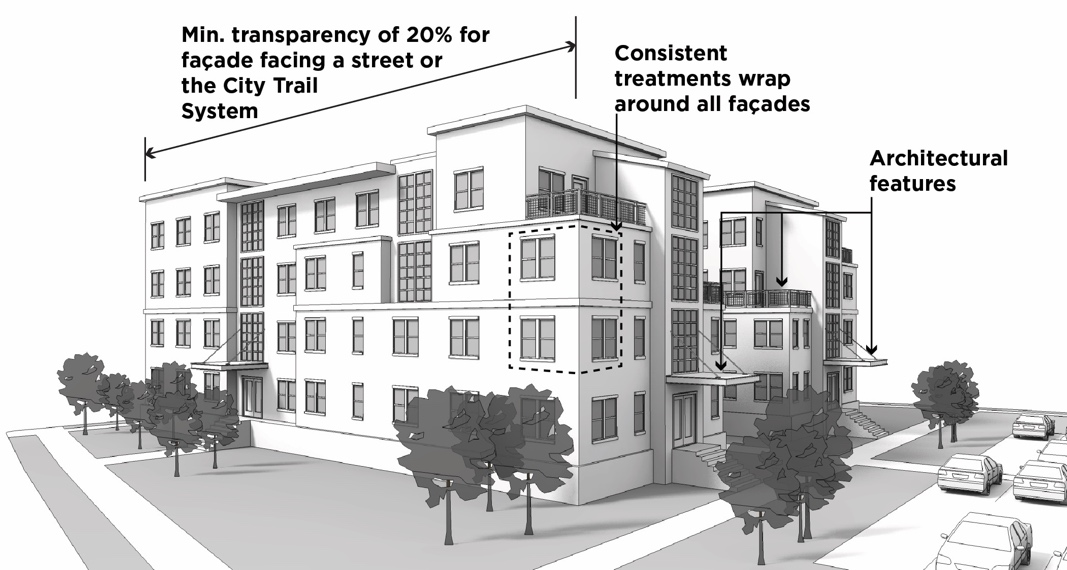
L.
Dwelling — group home.
1.
Group homes must be licensed by the state.
2.
When a group home is located within an existing residential structure, the location, design, and operation of such facility must not alter the residential character of the structure.
3.
No group home is allowed within five hundred (500) feet of another group home.
M.
Dwelling — residential care facility.
1.
Residential care facilities are subject to all federal, state, and village regulations, and must be licensed.
2.
Residential care facilities must comply with all standards for multi-family dwellings in the district in which they are located, including the standards for design of multi-family dwellings in this Chapter. This does not apply to mixed-use developments where the ground floor and any upper floors are designed for nonresidential uses with residential above; such developments must meet the dimensional and design standards of the district.
N.
Gas station.
1.
New gas stations may not be located within one thousand (1,000) feet of any existing gas stations, measured from the lot line.
2.
Structures are exempt from any setback or build-to lines required by the district. Instead, all structures, pump islands, compressed air connections, and similar equipment must be set back a minimum of fifteen (15) feet from front, side, and rear lot lines.
3.
The minimum distance a freestanding canopy for gas pumps must be from any street lot line is ten (10) feet and fifteen (15) feet from any interior lot line.
4.
A minimum of one stacking space per gas pump island is required.
5.
When a gas station shares a lot line with a residential district, a solid fence or wall must be placed as designated by Zoning Administrator. Shrubs, flowers, and trees must be utilized; plantings must face towards the interior of the lot.
6.
Development proposals must include architectural features, landscaping, or other design elements which benefit and preserve the character of the community.
7.
Development proposals must include an environmental impact and traffic study.
O.
Heavy retail, rental, and service establishment.
1.
When a heavy retail, rental, and service establishment must be screened along the interior side and/or rear with a solid fence or wall, a minimum of six (6) feet and a maximum of seven (7) feet in height. This does not apply when the abutting lot is in the C-3 District or the industrial districts.
P.
Industrial - data center.
1.
Industrial - data center facilities are allowed only south of Belmont Avenue, when permitted within the zoning district.
2.
All generators, mechanical equipment, and other significant noise-producing apparatus located outside of a building shall be set back a minimum of two hundred fifty (250) feet from the nearest residential zoning district.
3.
The applicant shall submit a noise study alongside a site plan prepared by a qualified professional analyzing the operational noise impacts of the proposed data center on the surrounding area, including projected noise levels at the property lines. The study shall also describe all noise mitigation measures used to achieve compliance with Village Code Section 5-6-16 regarding noises within the village limits.
4.
The site plan and noise study must be approved by the Zoning Administrator prior to the issuance of a building permit. Any modification to the location, configuration, or sound-attenuating measures of generators or other significant noise-producing equipment following site plan approval shall require submission and approval of a revised site plan, including an updated noise study demonstrating continued compliance with Village Code Section 5-6-16 regarding noises within the village limits.
Q.
Lodge/social club.
1.
No more than thirty (30) percent of the gross floor area may be used as office space for the lodge/meeting hall.
2.
Lodges/meeting halls are permitted to serve meals and alcohol on the premises for members and their guests only.
3.
Sleeping facilities are prohibited.
4.
Lodges/meeting halls leased or used as reception facilities must comply with the requirements for reception facilities.
R.
Reception facility. A general admission fee or any other monetary donations (payment at the door to the general public) for entrance is prohibited, with the exception of fundraisers or events for bona fide non-profit organizations, places of worship, or educational facilities.
S.
Restaurant.
1.
On-premise consumption of alcohol is only permitted where food is provided to the public for on-premises consumption.
2.
Restaurants with a drive-thru lane cannot serve alcohol.
3.
Incidental entertainment, which is defined as live or pre-recorded background music, is permitted within permanently enclosed areas.
4.
A restaurant where food is provided to the public for on-premises consumption may have areas designed for live performances and/or dancing if such areas are permanently enclosed.
5.
Restaurants with a drive-thru lane may count up to six (6) of their drive-thru lane stacking spaces towards the required minimum off-street vehicle parking.
T.
Social service center.
1.
A social service center does not include in-patient, overnight, or living quarters for recipients of the service or for the staff.
2.
A social service center does not include medical examinations or procedures, or medical detoxification, dispensing of drugs or medications, or other treatments normally conducted in a medical office.
3.
No social service center is allowed within five hundred (500) feet of another social service center.
4.
On-site management shall be required during the hours of operation. The manager shall be accessible to clients and any other individuals who need to establish communication upon or about the premises.
U.
Storage facility.
1.
Outdoor storage facilities are prohibited.
2.
All storage activities must be contained within a single building and conducted exclusively indoors. If there are multiple storage units on site, the individual storage units may only be accessed from inside the building.
3.
Storage facilities must be climate controlled.
4.
No storage units located on the first floor may be visible from any public right-of-way. If there are multiple storage units on site, no storage units located on the first floor may be located within the first twenty-five (25) feet of the front façade.
5.
Access to loading areas must be located in the rear yard of the building.
6.
All facilities must meet the design standards of the district.
7.
Storage units cannot be used for residential occupancy or business.
V.
Vehicle dealership or rental.
1.
Vehicle dealership or vehicle rental establishments are allowed only along Mannheim Road, when permitted or conditionally permitted within the zoning district.
W.
Vehicle repair/service.
1.
Vehicle repair/service establishments may not store the same vehicles outdoors on the site for longer than fifteen (15) days once repair is complete. Only vehicles that have completed servicing or are being serviced may be stored outdoors.
2.
Repair of vehicles is prohibited outdoors. Storage of all merchandise, auto parts, and supplies must be within an enclosed structure.
3.
No partially dismantled, wrecked, junked, or discarded vehicles may be stored outdoors on the premises. This standard does not apply to vehicles under repair.
4.
No motor vehicles may be stored and no repair work may be conducted in the public right-of-way.
5.
The sale of new or used vehicles is prohibited unless separately approved.
6.
Tow trucks are not allowed to be stored on site. Towing drop-off and pick-up of vehicles is limited to third party towing companies.
7.
Vehicle repair/service establishments that share a lot line with a residential district must be screened along interior side and rear lot lines with a solid wall or fence, a minimum of six (6) feet and a maximum of seven (7) feet in height.
X.
Wireless telecommunications.
1.
General regulations.
a.
Wireless telecommunications towers and facilities shall adhere to all applicable provisions of the Zoning Code unless otherwise stated below.
b.
Small wireless facilities are not subject to this code section, but instead shall be in compliance with Section 7-12-3 regarding the regulation of small wireless facilities.
c.
The applicant must submit a completed wireless facilities permit application and a conditional use packet with all required items.
d.
Upon recommendation of the Zoning Administrator and based upon evidence submitted by the applicant, the Zoning Board of Appeals may approve a reduction in one or more setback or separation requirements of this section where it finds that:
i.
The reduction will not materially increase visual, safety, or operational impacts on surrounding properties.
ii.
The proposed facility will better achieve the intent of this section through improved design, location, or screening.
iii.
The reduction is consistent with Village Code and benefits the public health, safety, and welfare of residents.
2.
Application requirements. All applications to erect, construct, or modify any part of a wireless telecommunications system require site plan review and must include the following items:
a.
A site plan showing:
i.
The location of the property with address and PIN(s).
ii.
The position, size, and design of all buildings and structures; including all outdoor accessory structures such as the antenna, lighting, mechanical equipment, and other telecom apparatus; with setbacks, dimensions, and scale.
iii.
A landscape plan showing all screening, landscape buffering, and camouflage elements.
iv.
Indication of the "fall zone" as a shaded circle of no less than one foot radius per ten (10) feet of antenna height.
v.
Elevations of the development showing antenna height.
b.
A disclosure letter stating what telecommunication services will be provided, along with the reason or purpose for the placement, construction, or modification in the proposed location with specific reference to the provider's coverage, capacity, and/or quality needs, goals, and objectives.
c.
The service area of the proposed wireless telecommunications system. If the proposal is for a new telecommunications tower, then a map showing collocation opportunities within the Village and surrounding area must be provided along with a justification as for why co-location at other facilities is not feasible in order to demonstrate the need for a new tower.
d.
A structural analysis by a professional structural engineer, licensed and registered in the State of Illinois, testifying to the structural integrity of the antenna tower provided along with an analysis describing the method by which the proposed facility is designed to fail.
e.
A maintenance plan and any applicable maintenance agreement designed to ensure long-term, continuous maintenance, such as maintenance of landscape, keeping the area free from debris and litter, and immediate removal of any graffiti.
3.
Setbacks.
a.
The setback standard established in this subsection shall supersede all underlying zoning district setback requirements for towers only and shall not apply to buildings or accessory structures such as equipment shelters, which shall comply with the underlying district setbacks unless otherwise conditionally approved.
b.
Wireless telecommunications towers shall be set back from all property lines a minimum distance of twenty (20) feet, or one (1) foot for every four (4) feet of tower height, whichever is greater, as measured from the base of the tower to the property line.
c.
Wireless telecommunications towers shall be set back a minimum of two hundred (200) feet from the nearest residential zoning district, as measured from the base of the tower to the property line.
4.
Height. The maximum height of a wireless telecommunications tower shall be the minimum height necessary to provide adequate service, as demonstrated by the applicant and reviewed as part of site plan approval, to a maximum of one hundred and fifty (150) feet. The Village may retain a qualified independent consultant to assist in the review of tower height, with all associated costs borne by the applicant.
5.
Lighting and marking. Wireless telecommunications systems must not be lit or marked unless required by the Federal Communications Commission (FCC) or the Federal Aviation Administration (FAA).
6.
Stealth design. Camouflage and stealth design are encouraged for all wireless telecommunications antennas. To qualify as a stealth design, wireless telecommunications antennas must comply with the following regulations:
a.
Stealth design antennas must be enclosed, camouflaged, screened, obscured, or otherwise not readily apparent to a casual observer.
b.
Stealth design antennas must be mounted at least thirty (30) feet above grade, as measured from grade to the base of the antenna.
c.
Stealth design antennas may be co-located on or in structures already built and/or permitted within zoning districts, such as water towers, clock towers, or behind parapet walls; and must be designed to blend in with the structure.
d.
Stealth design antennas that are co-located on existing structures may not increase the overall height of any structure on which it is mounted by more than twelve (12) feet.
7.
Specific standards for wireless telecommunications facilities.
a.
Any buildings, cabinets, or shelters may house only equipment and supplies for operation of the wireless telecommunication tower. Any equipment not used in direct support of such operation must not be stored on the site.
b.
Commercial advertising is prohibited. Only signage that is part of the equipment as manufactured or warning signage is permitted.
8.
Specific standards for wireless telecommunications towers.
a.
The use of guyed towers is prohibited. Towers must be monopoles, meaning self-supporting with no wires, cables, or beams.
b.
Wireless telecommunications towers must be designed to accommodate other telecommunications providers. The area surrounding a tower must be of a sufficient size to accommodate accompanying wireless telecommunications facilities for other telecommunications providers.
c.
Unless otherwise required by the Federal Communications Commission, the Federal Aviation Administration or the Village, towers must have a galvanized sky blue, silver or gray finish.
(Ord. 2223-VC-11, § 5; Ord. 2324-VC-45, § 5; Ord. 2526-VC-05, § 3; Ord. 2526-VC-28, § 4; Ord. 2526-VC-40, § 4)
9-9-4. - Temporary use standards.
Temporary uses are required to comply with the standards of this section, in addition to all other regulations of this Ordinance and any licensing requirements of the Municipal Code. These regulations are for temporary uses located on private property. Temporary uses do not require additional parking unless specifically cited in the temporary use standards or stipulated as a condition of approval.
A.
Temporary contractor's office and contractor's yard.
1.
A temporary contractor's office is allowed incidental to a construction project. A temporary contractor's office may be located in a manufactured home.
2.
The zoning certificate is valid for a six (6) month period and is renewable for six (6) successive periods at the same location.
3.
The temporary contractor's office must be removed within thirty (30) days of completion of the construction project.
4.
A contractor's yard is permitted on or on an adjacent lot to any construction demolition and can only be used during the life of the construction project.
B.
Temporary outdoor event.
1.
Temporary outdoor events in the residential districts are restricted to those events associated with and conducted by an institutional use within the district, such as a place of worship and educational facility.
2.
A management plan is required as part of the zoning certificate that demonstrates the following:
a.
The on-site presence of a manager during the event.
b.
General layout of:
i.
Performance areas, visitor facilities, such as any seating areas and restrooms, parking areas, and all ingress and egress points to the site.
ii.
Vendor stalls, visitor facilities, such as any seating areas and restrooms, parking areas, and all ingress and egress points to the site.
c.
Provision for waste removal and for recycling, if available.
d.
The days and hours of operation, including set-up and take-down times.
e.
A description of crowd control and security measures.
f.
A lighting plan describing all temporary lighting to be installed.
3.
Any temporary structures must be removed within five (5) days of conclusion of the event.
4.
Events are limited to four (4) events per calendar year and a maximum duration of five (5) days per event, with a minimum of thirty (30) days between events. This limitation applies to the lot, not the operator of the temporary use. The following exceptions apply:
a.
A zoning certificate for a carnival or circus is valid for a period of two (2) events per calendar year no more than fourteen (14) days per event, with a minimum of sixty (60) days between events.
b.
A zoning certificate for a seasonal sale, such as Christmas/holiday tree lots or pumpkin patches, are limited to three (3) events per calendar year and a maximum duration of forty-five (45) days. There is no minimum time between events.
c.
The timeframe of a farmers' market, including number of days per week and overall duration of the event, will be determined and approved as part of the zoning certificate. A zoning certificate for a farmers' market can be issued on a yearly basis, which allows for a schedule of days per week and number of weeks per year.
9-9-5. - Accessory use standards.
A.
Day care home.
1.
Each day care home must have a state license and/or registration.
2.
The exterior of a day care home must maintain its original appearance as a single-family dwelling. No visitor/client parking may be located in the front yard.
3.
Day care homes are not permitted to have outside employees.
4.
Day care homes require a home occupancy permit (see item D below).
B.
Donation boxes.
1.
Only one donation box is permitted per lot.
2.
Donation boxes are only permitted as accessory to the principal use of the site and shall be owned and managed by the operator of the principal use.
3.
Donation boxes shall be located to the rear of the principal building and entirely on the lot. No donation box may be located within a required parking space, required greenspace area, pedestrian pathways, or in any easements.
4.
Donation boxes shall be maintained in good condition and appearance with no structural damage, holes, or visible rust.
5.
The name and contact information of the operator shall be indicated on the front of each donation box.
6.
Donation boxes shall not create nuisance conditions in violation of the Health and Sanitation Ordinance.
7.
All items received by the donation box shall fit fully within in the box structure. Outdoor storage areas are prohibited.
C.
Drive-thru lane.
1.
All drive-thru lanes must provide minimum stacking spaces as follows:
a.
Restaurant: Ten (10) spaces per pick-up window. An establishment with a pay-window, a pick-up window, and a pull-forward window are considered an establishment with one pick-up window.
b.
Other uses: Six (6) spaces total or four (4) spaces per ATM, service kiosk, or pick-up window lane, whichever is greater.
2.
Stacking spaces must be:
a.
Nine (9) feet in width and eighteen (18) feet in length.
b.
Placed in an appropriate location as designated by the Zoning Administrator
3.
All drive-thru lanes must be located and designed to ensure that they do not adversely affect traffic circulation on principle streets.
4.
When a use with a drive-thru shares a lot line with a residential district or the OS District, it must be screened along the interior side and/or rear lot lines shared with the lot in a residential district or the OS District with a solid fence or wall, a minimum of six (6) feet and a maximum of seven (7) feet in height. One shrub is required for every three (3) linear feet along the fence, with plantings facing towards the interior of the lot.
5.
Each drive-thru lane must have a bailout capability for all vehicles that enter. The bailout lane must be a minimum ten (10) feet in width and run parallel to the drive-thru lane. If a bailout lane is also an interior drive providing access to parking spaces, the bailout lane is limited to a one-way traffic pattern following the direction of the drive-thru lane.
DRIVE-THRU LANE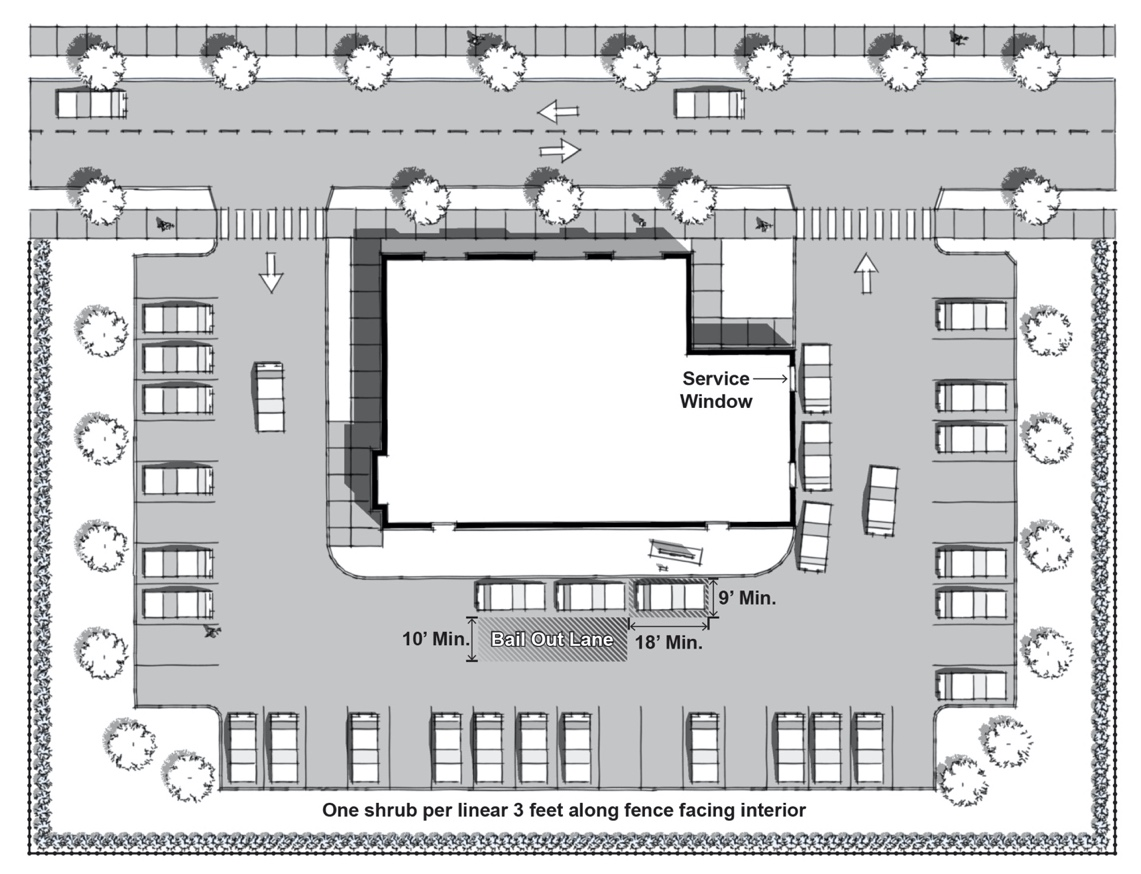
D.
Home occupation.
1.
General regulations. Home occupations must be:
a.
Incidental to the residential use of the zoning lot.
b.
Compatible with residential uses and cannot detract from the residential character of the neighborhood.
c.
Limited in extent.
2.
Conditions. A permitted home occupation is subject to the following conditions:
a.
A home occupation must be operated entirely within a dwelling unit or a permitted accessory structure. Space within a garage for a home occupation cannot occupy required vehicle parking spaces.
b.
A home occupation cannot have a separate entrance from outside the building, or otherwise involve an alteration in the residential appearance of any structure upon the property.
c.
A home occupation cannot display or create outside the building any external evidence of its operation. A home occupation cannot display any sign or advertisement visible from outside of the dwelling unit. No advertisement for the home occupation may be placed containing the address of the property.
d.
Only members of the household residing in the dwelling may work in connection with the home occupation.
e.
Performance standards:
i.
A home occupation cannot utilize mechanical or electrical equipment other than the type normally found in a dwelling unit or associated with domestic or hobby purposes. Electrical or mechanical equipment that creates visible or audible interference in radio or television receivers or causes fluctuation in line voltage outside the dwelling unit or that creates noise not normally associated with residential uses is prohibited.
ii.
The home occupation cannot produce offensive noise, vibration, smoke, electrical interference, dust, or other particulate matter, odors, heat, humidity, or glare detectable to normal sensory perception beyond the lot lines, or beyond the walls of the dwelling unit if the unit is part of a multi-family structure.
iii.
No toxic, explosive, flammable, combustible, corrosive, etiologic, or radioactive materials, or materials which decompose by detonation can be stored or used in connection with a home occupation.
f.
Merchandise cannot be displayed or offered for sale either within or outside of the building.
g.
No home occupation may involve outside customers or visitors that come to the home.
h.
A home occupation cannot use required off-street parking spaces.
i.
The home occupation cannot generate greater traffic volumes or have a greater impact upon availability of parking than would normally be expected from residential uses in a residential neighborhood.
j.
No exterior storage of home occupation materials, supplies, or equipment used is permitted. No waste resulting from any off-site operation of a home occupation may be stored in any manner on the lot associated with the home occupation or upon any right-of-way.
k.
All delivery of merchandise, goods, or equipment must be by a passenger motor vehicle or by parcel or letter carrier mail services using vehicles typically employed in residential deliveries.
l.
The use or storage of tractor trailers, semi-trucks, or heavy equipment, such as construction equipment used in a commercial business, is prohibited and is not allowed to be dispatched from the home.
m.
The following types of home occupations or operations are specifically prohibited:
i.
Repair and service of any vehicles, any type of heavy machinery or any type of engine, is prohibited.
ii.
Small electronic repair, including computers.
iii.
Rental services, where any materials for rent are stored on-site and customers visit the residence to pick-up and return the product, are prohibited.
iv.
Dispatching services, where workers report to the home for dispatching, are prohibited.
v.
Any administrative services associated with the home occupation, such as workers report to the home for paychecks.
vi.
The business of firearm transfers.
vii.
Short term rentals (See Village Code Section 4-6, Article E).
viii.
Any operation of an industrial use typically permitted in an industrial district is prohibited.
3.
Home occupation permit. A home occupation permit is a written agreement between the Village and a resident who wishes to establish a home occupation at his/her residence. The permit will establish the extent and duration of the home occupation in addition to allowing the home occupation as a nonintrusive exception to the strictly residential character of dwellings within residence districts. The home occupation permit may establish conditions of approval and procedures for revocation and renewal.
a.
Unless specifically excepted by this section, no person may operate a home occupation without first having obtained a home occupation permit.
b.
An application for a home occupation permit must be made upon a form provided by the Zoning Administrator, on which the applicant shall state:
i.
The location of the proposed home occupation.
ii.
The name or names of the designated permittee.
iii.
The type or types of occupation for which the permit is applied, specifying all services provided and activities in which the permittee or his/her designee will engage in performance of the home occupation.
iv.
The types and amounts of supplies used in conjunction with the home occupation and the types of equipment used in conjunction with the home occupation which will be present on the residential property.
v.
Projections of the number of persons not living within the dwelling unit who, owing to the establishment of the home occupation, will come to the residential property or any residentially zoned area in its immediate vicinity and the frequency of such visits.
vi.
The square footage and its location on the lot which is proposed to be devoted to the home occupation.
vii.
Any other information which the Zoning Administrator may, at his/her discretion, require.
c.
The home occupation permit may establish conditions of approval and procedures for revocation and renewal.
d.
The Village Board may establish fees for the issuance of home occupation permits or for the performance of inspections relative to their issuance.
e.
Home occupation permits expire April 30 of each year. The Zoning Administrator may reissue permits upon application.
f.
The Zoning Administrator will not issue a home occupation permit unless an inspection has been made of the property where it will be operating. In addition, the Zoning Administrator has the right at any time, upon reasonable request, to enter and inspect a property and the structures thereon, which are the subject of a home occupation permit. In the event the operator of a home occupation has reapplied for a home occupation permit no more than sixty (60) days after the expiration of the prior home occupation permit, the Zoning Administrator may find that the inspection requirement has been met by a previous inspection if there is no record of complaints relative to the operation of the home occupation.
g.
The Zoning Administrator will forward a copy of each application for a home occupation permit which he/she receives to the Department of Health and Human Services and to the Fire Prevention Bureau.
h.
A home occupation permittee's violation of any general conditions and/or any specific conditions associated with a home occupation permit is sufficient cause to revoke of the permit.
E.
Outdoor dining.
1.
Outdoor dining may only be established when allowed as an accessory use within a zoning district and in conjunction with another principal use such as a restaurant.
2.
Outdoor dining must not interfere with any pedestrian access or parking spaces and aisles.
3.
Outdoor dining areas must be located entirely on private property. Outdoor dining on public property is not controlled by this Ordinance. (Outdoor dining on public property requires an Outdoor Eating Cafe Permit on Village Right of Way.)
4.
All outdoor dining on private property, including when such accessory use is a permitted use, also requires an Outdoor Eating Cafe Permit on Private Property to be established.
5.
When a structure is required to be constructed at a build-to line, the structure may have up to fifty (50) percent or sixty (60) linear feet of the applicable façade, whichever is less, designated as outdoor dining may be setback up to thirty (30) feet from the required build-to line.
PERMITTED OUTDOOR DINING BUILDING SETBACK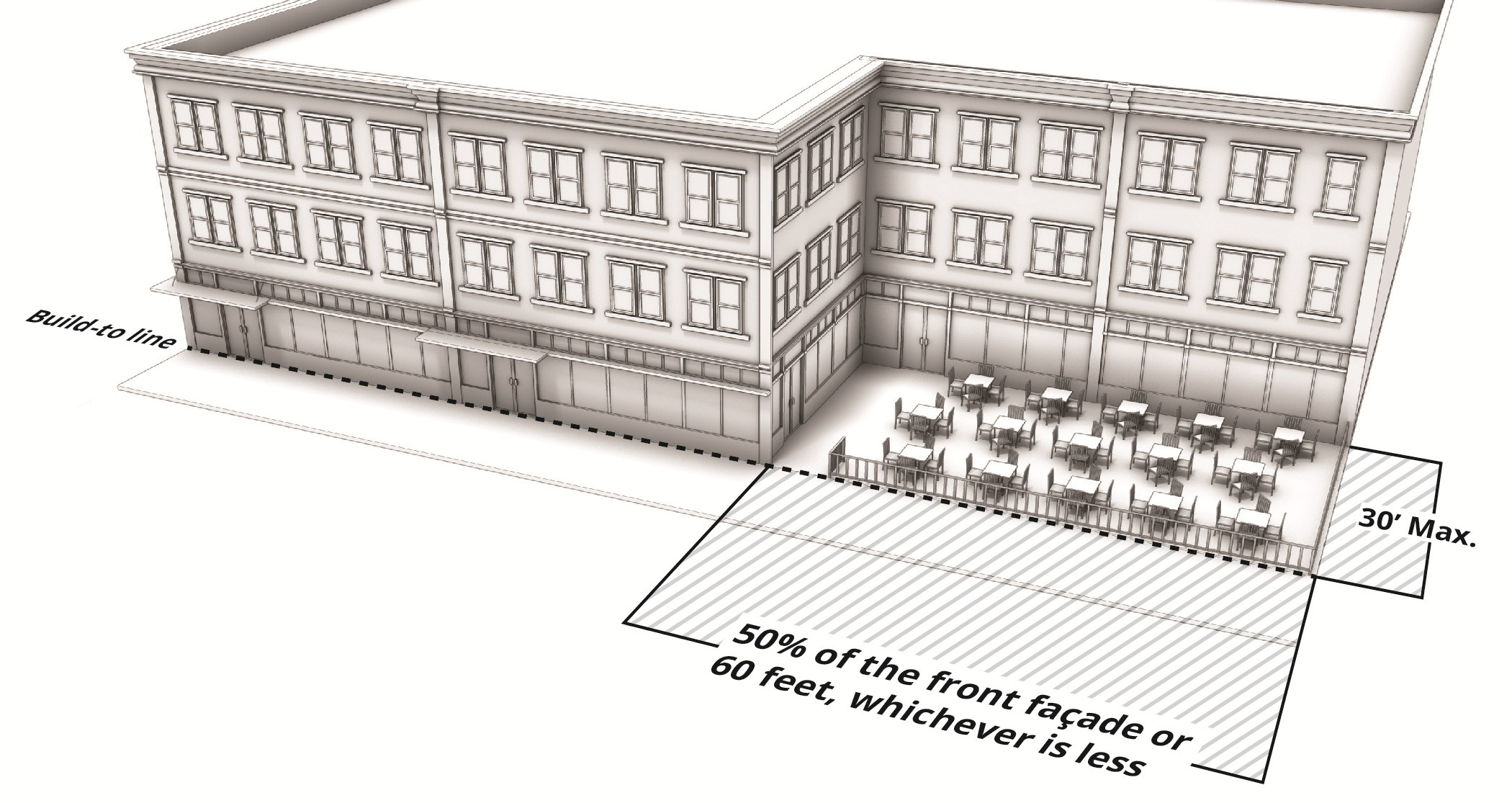
F.
Outdoor display.
1.
Retail establishments in the nonresidential districts are permitted to have accessory outdoor display of merchandise. Such merchandise must be customarily sold on the premises.
2.
All outdoor display of merchandise must be located adjacent to the storefront and not in parking spaces, drive aisles, loading zones, or fire lanes. Outdoor display is prohibited in any required setback.
3.
No display may be placed within five (5) feet of either side of an active door, or within fifteen (15) feet directly in front of an active door.
4.
A minimum clear width for pedestrian traffic of five (5) feet must be provided and maintained along any pedestrian way.
5.
Items stored outdoors must be weather resistant and be in good looking condition. Allowed items include, but are not limited to, flowers and plants, gardening materials, and seasonal products. Any items displayed outdoors must be such so that they will not be blown off-site in the event of weather.
G.
Outdoor storage.
1.
The storage area must be completely enclosed along all lot lines by a solid fence or wall a minimum of six (6) feet and a maximum of eight (8) feet in height with a gate of similar height for ingress and egress points.
2.
Storage of any kind is prohibited outside the fence or wall. No items stored within thirty-five (35) feet of the fence may exceed the height of the fence or wall for an outdoor storage yard.
3.
No outdoor storage may obstruct pedestrian or vehicular traffic.
4.
Outdoor Storage must take place on an impervious surface.
5.
Outdoor storage is prohibited in any required setback. Outdoor storage is prohibited in the front yard.
6.
No outdoor storage may take away from required off-street parking.
7.
Outdoor storage must adhere to Chapter 10 of Title 4.
8.
Outdoor storage may not take place within two hundred (200) feet of a residential district (excludes municipal property).

