
Franklin Park City Zoning Code
CHAPTER 12
- Landscape
9-12-1.- Landscape plan.
A.
Landscape plan required. A landscape plan is required for any townhouse development, multi-family dwelling, nonresidential development including mixed-use developments and parking structures, planned development, or parking lot of fifteen (15) or more spaces, and must be approved by the Zoning Administrator prior to the issuance of a building permit. A landscape plan must be prepared by a licensed landscape architect.
B.
Content of landscape plan. The following is required within the landscape plan:
1.
The location and dimensions of all existing and proposed structures, property lines, easements, parking lots and drives, rights-of-way, refuse disposal and recycling areas, pedestrian and bicycle paths, fences, mechanical equipment, overhead utility wires, and drainage facilities.
2.
The location, quantity, size, name, and condition, both botanical and common, of all existing plant materials on-site, indicating plant material to be retained and removed.
3.
The location, quantity, size, and name, both botanical and common, of all proposed plant material.
4.
The existing and proposed grading of the site indicating contours at two (2) foot intervals. Proposed berming must also be indicated using two (2) foot contour intervals.
5.
Elevations of all proposed fences, stairs, and retaining walls.
6.
Irrigation systems.
7.
Any other details as determined necessary by the Zoning Administrator.
C.
Changes to approved landscape plans. Changes to the landscape plan that do not result in a reduction in the net amount of required plant material may be approved by the Zoning Administrator.
9-12-2. - Enforcement of landscape plan.
Landscaping must be fully installed prior to the issuance of a certificate of occupancy. If seasonal conditions preclude the complete installation, a cash escrow or irrevocable letter of credit is required, equal to one-and-a-half (1½) times the installation costs as estimated by a qualified professional. Complete installation is required within nine (9) months of the issuance of the temporary certificate of occupancy or the cash escrow or letter of credit may be forfeited. A one year warranty is required for newly planted trees and a one month warranty on the establishment of sod is required.
9-12-3. - Installation, design, and maintenance.
A.
Installation.
1.
Best management practices and procedures according to the nationally accepted standards must be practiced.
2.
All landscaping and trees must be installed in conformance with the practices and procedures established by the most recent edition of the American Standard for Nursery Stock (ANSI Z60.1) as published by the American Horticulture Industry Association.
3.
All installed plant material must be fully maintained until established, including watering, fertilization, and replacement as necessary.
4.
Compost, mulch, and organic matter may be utilized within the soil mix to reduce the need for fertilizers and increase water retention.
B.
Selection. Landscaping materials used must be:
1.
Healthy and hardy with a good root system.
2.
Chosen for form, texture, color, fruit, pattern of growth, and suitability to local conditions.
3.
Tolerant of the natural and man-made environment, including tolerant of drought, wind, salt, and pollution.
4.
Appropriate for the conditions of the site, including slope, water table, and soil type.
5.
Protected from damage by grates, pavers, or other measures.
6.
Plants that will not cause a nuisance or have negative impacts on an adjacent property.
7.
Species native or naturalized to northeastern Illinois are required. Invasive species are prohibited.
C.
Energy conservation. Plant material placement should be designed to reduce the energy consumption needs of the development.
1.
Deciduous trees should be placed to provide shade from the summer sun and promote passive cooling of structures.
2.
Evergreens and other plant materials should be placed to provide a natural buffer and to dissipate the effect of winter winds.
C.
Planting standards.
1.
Plant material must be sized according to Table 12-1: Plant Material Size at Time of Installation, unless otherwise noted in this Ordinance.
2.
New trees are measured at six (6) inches above the mean grade of the tree's trunk when four (4) inch caliper or less and twelve (12) inches for tree trunks above four (4) inches (noted as caliper inches).
D.
Tree installation, planting, and maintenance.
1.
The Village maintains a list of permitted tree types, available at Village Hall.
2.
Trees planted on a site must be any combination of permitted species as follows:
a.
One genus cannot comprise more than thirty (30) percent of trees planted on a site.
b.
One species cannot comprise more than ten (10) percent of trees planted on a site.
c.
Exceptions to this provision may be granted by the Zoning Administrator.
3.
Tree trimming, fertilization, and other similar work shall be performed by or under the management of an ISA certified arborist.
4.
For each tree preserved or planted, a minimum amount of permeable surface area is recommended. Planted trees have a suggested minimum permeable area and soil volume based upon tree size as indicated in Table 12-2: Minimum Recommended Soil Volumes and Permeable Area per Planted Tree.
a.
At least seventy (70) percent of the canopy limits of preserved trees should have a permeable surface.
b.
Permeable area for one tree cannot count toward that of another tree.
5.
Trees must be planted at least thirty (30) feet apart for large trees and twenty (20) feet apart for medium trees.
6.
No trees may be planted closer to any curb or sidewalk, unless a permeable surface is provided: medium trees three (3) feet apart and large trees four (4) feet.
7.
Only trees that have a mature height of thirty (30) feet or less may be planted beneath powerlines. Trees with a mature height of greater than thirty (30) feet must be planted no closer than thirty-five (35) feet on either side of the powerline.
8.
When the soil surface area (per Table 12-2) of a tree will extend below any pavement, structural soil is required underneath that pavement. Structural soil is a medium that can be compacted to pavement design and installation requirements while still permitting root growth. It is a mixture of gap-graded gravels (made of crushed stone), clay loam, and a hydrogel stabilizing agent to keep the mixture from separating. It provides an integrated, root penetrable, high strength pavement system that shifts design away from individual tree pits (source: Cornell University, Urban Horticulture Institute).
9.
Tree topping is prohibited. When necessary, crown reduction thinning or pruning is permitted.
E.
Irrigation systems. The need for permanent irrigation beyond establishment must be determined by the requirements of the chosen plant material in combination with the growing medium in which they are installed. When used, irrigation systems must meet the following standards.
1.
All irrigation systems must be designed to minimize the use of water.
2.
Nonresidential landscape irrigation must have an automatic clock-activated permanent system.
3.
The irrigation system must provide sufficient coverage to all landscape areas.
4.
The irrigation system must not spray or irrigate impervious surfaces, including sidewalks, driveways, streets, and parking and loading areas.
5.
All systems must be equipped with a back-flow prevention device.
6.
All mechanical systems including controllers and back-flow prevention devices must be properly screened from public view.
7.
Any irrigation system must remain in good repair.
F.
Maintenance.
1.
All landscaping and trees must be maintained according to the most recent edition of the American National Standards Institute, including its provisions on pruning, fertilizing, support systems, lighting protection, and safety. All landscaping must be maintained in good condition at all times to ensure a healthy and orderly appearance.
2.
Unhealthy landscaping must be replaced with healthy, live plants by the end of the next applicable growing season. This includes all plant material that shows dead branches over a minimum of twenty-five (25) percent of the normal branching pattern.
3.
The owner is responsible for the maintenance, repair, and replacement of all landscaping, screening, and curbing required herein.
4.
Maintenance must preserve at least the same quantity, quality, and screening effectiveness as initially installed.
5.
Fences, walls, and other barriers must be maintained in good repair and free of rust, flaking paint, graffiti, and broken or damaged parts.
6.
All landscaped areas regulated by this Ordinance may be inspected by the Village.
9-12-4. - Required site landscape.
A.
All portions of a lot not covered by structures or paved surfaces must be landscaped with trees, shrubbery, live groundcover, and other plantings. Rain gardens, bioswales, and similar stormwater management landscape elements also meet this requirement.
B.
All existing plantings that are maintained on a site may be counted toward any required on-site landscape.
C.
Where a structure is setback seven (7) feet or more from a front or corner side lot line, the setback areas must be planted with a minimum of one shade or two (2) ornamental trees and ten (10) shrubs for every forty (40) linear feet of setback area. This does not apply to single-family, two-family, and townhouse dwellings.
9-12-5. - Required perimeter parking lot greenspace and landscape.
Landscaping is required along all edges of a parking lot that abut a right-of-way. The landscape treatment must run the full length of that edge, except for required access points. The landscaped area must be improved as follows:
A.
The landscape area must be a minimum of six (6) feet in width.
B.
A maximum of two (2) feet of vehicle bumper overhang is permitted within the required landscape area. Such overhang may be counted toward the overall required parking space length. No vehicle bumper overhang area is allowed within the public right-of-way.
C.
One shrub, a minimum of height of twenty-four (24) inches at planting and four (4) feet in height at maturity, must be planted for every three (3) linear feet of landscape area, spaced linearly. Alternatively, the landscape area may be planted with a mix of shrubs, perennials, native grasses, and other planting types that provide screening of a minimum of four (4) feet in height.
D.
One medium or large shade tree is required a minimum of every forty (40) feet. Spacing should alternate with street trees when street trees are present along the right-of-way.
E.
In the Downtown Districts, a fence is required within the perimeter landscape area. Such fence must meet the following requirements.
1.
A minimum height of three (3) feet to a maximum height of four (4) feet.
2.
Fences must be constructed of masonry, stone, brick, or wrought iron.
3.
A wrought iron fence must be black, red, or dark green in color.
F.
Landscape areas outside of shrub masses must be planted in live groundcover, perennials, grass, or trees.
G.
The above requirements may be reduced or waived by the Zoning Administrator if the perimeter landscape area is directly adjacent to an alley.
REQUIRED PERIMETER PARKING LOT GREENSPACE AND LANDSCAPING - ALL DISTRICTS EXCEPT DT
DISTRICTS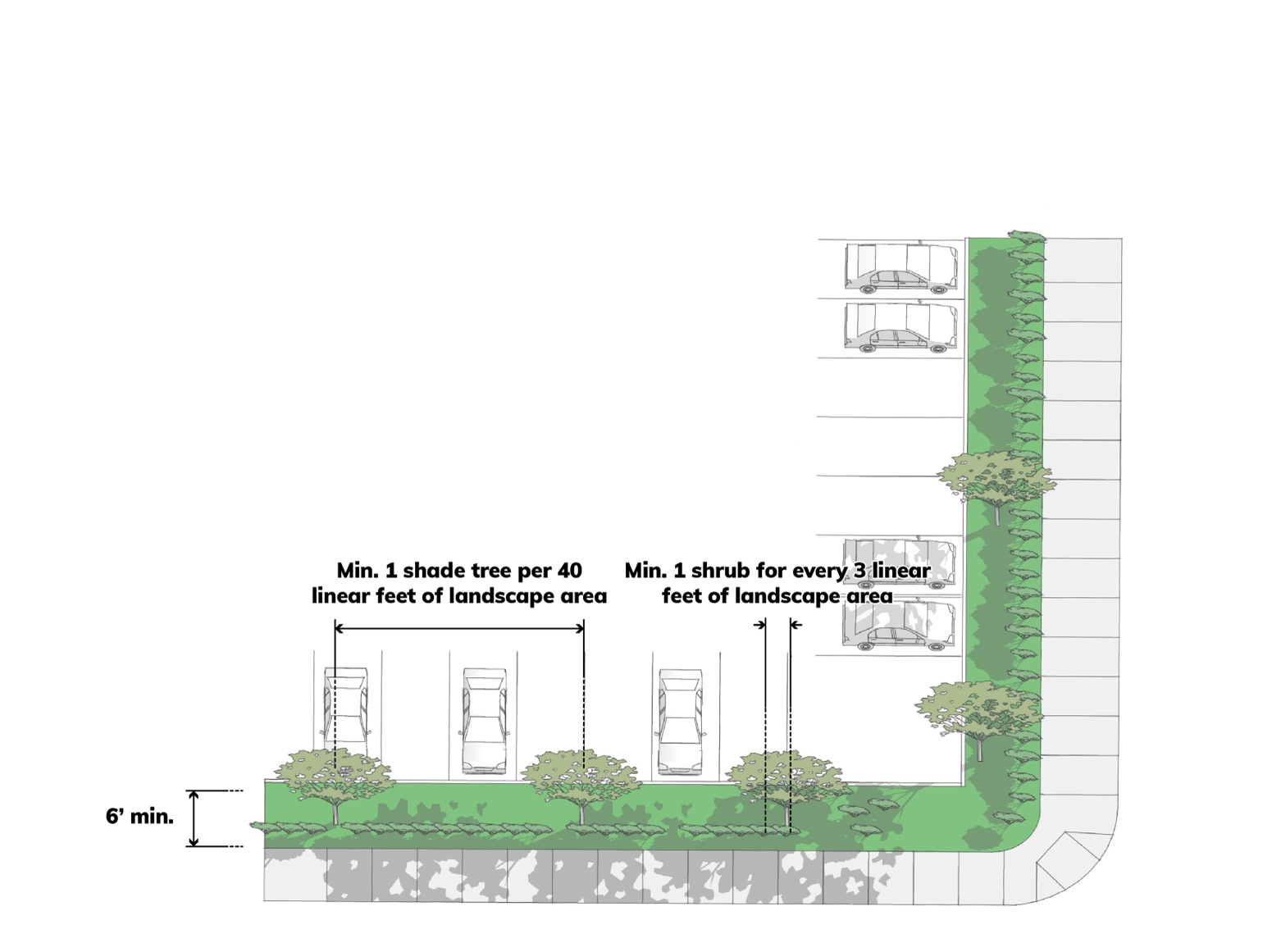
REQUIRED PERIMETER PARKING LOT GREENSPACE AND LANDSCAPING - DT DISTRICTS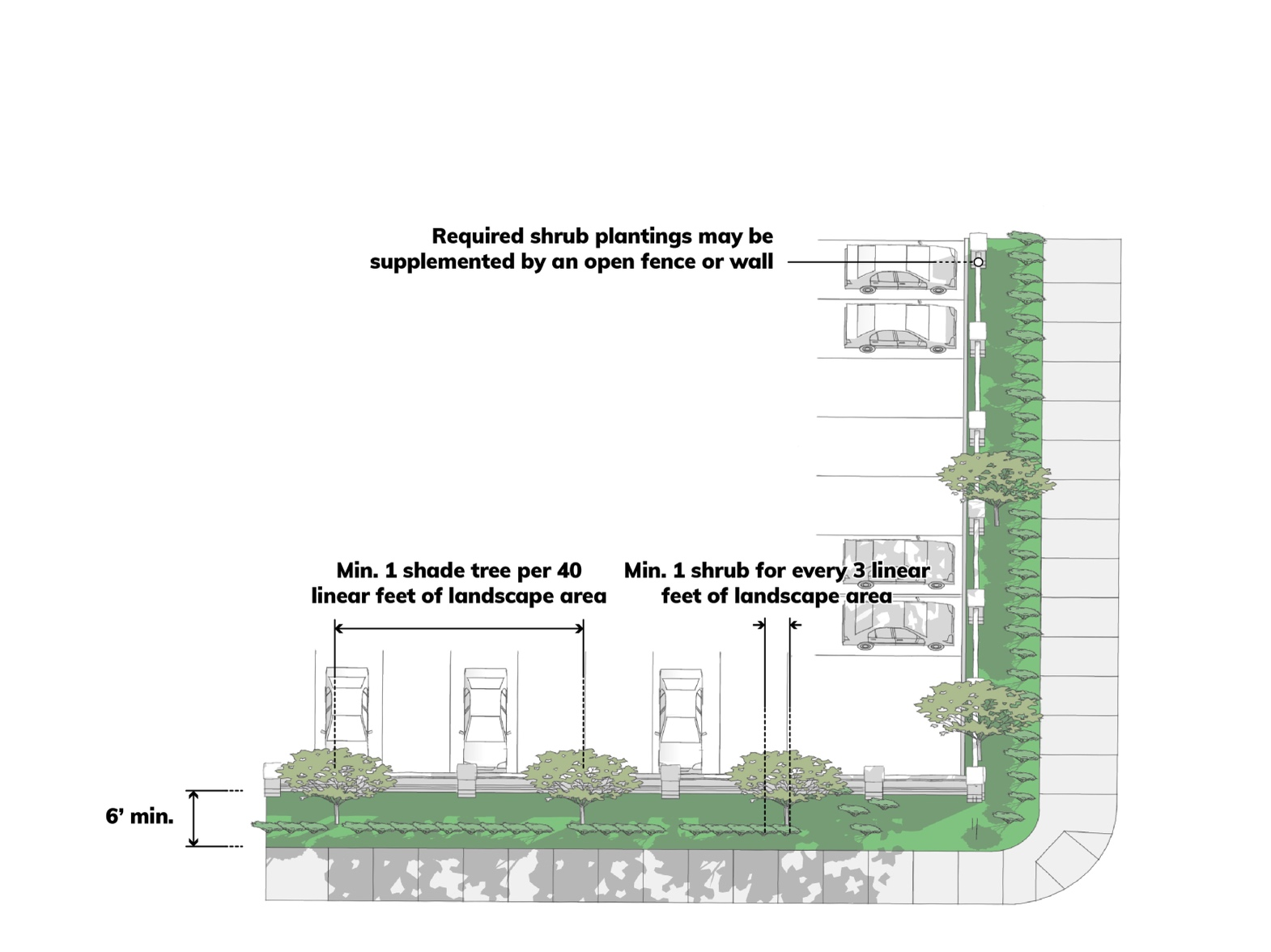
(Ord. 2324-VC-37, § 3)
9-12-6. - Required interior parking lot greenspace and landscape.
Interior parking lot landscape is required for parking lot of twenty (20) spaces or more.
A.
All rows of parking spaces must terminate in a landscaped endcap area.
B.
A maximum of ten (10) parking spaces are allowed between landscaped islands.
C.
It is recommended that parking lot islands be the same dimension as the parking stall but no less than one hundred sixty-two (162) square feet.
D.
A minimum of one shade tree must be provided for every landscape island or endcap area. Where a parking lot island is adjacent to two (2) rows of parking, two (2) shade trees are required. The remaining area of a parking lot island or endcap must be planted in ornamental trees, live groundcover, shrubs, perennials, or grass.
E.
The use of stormwater management elements, such as rain gardens and bioswales, is encouraged in landscape areas. When a parking lot island is designed for stormwater management, the tree requirement may be exempted as part of landscape plan approval when such trees are not typically part of such design.
F.
Perimeter parking lot landscape requirements (Section 9-12-5) are not counted as part of this requirement.
INTERIOR PARKING LOT LANDSCAPE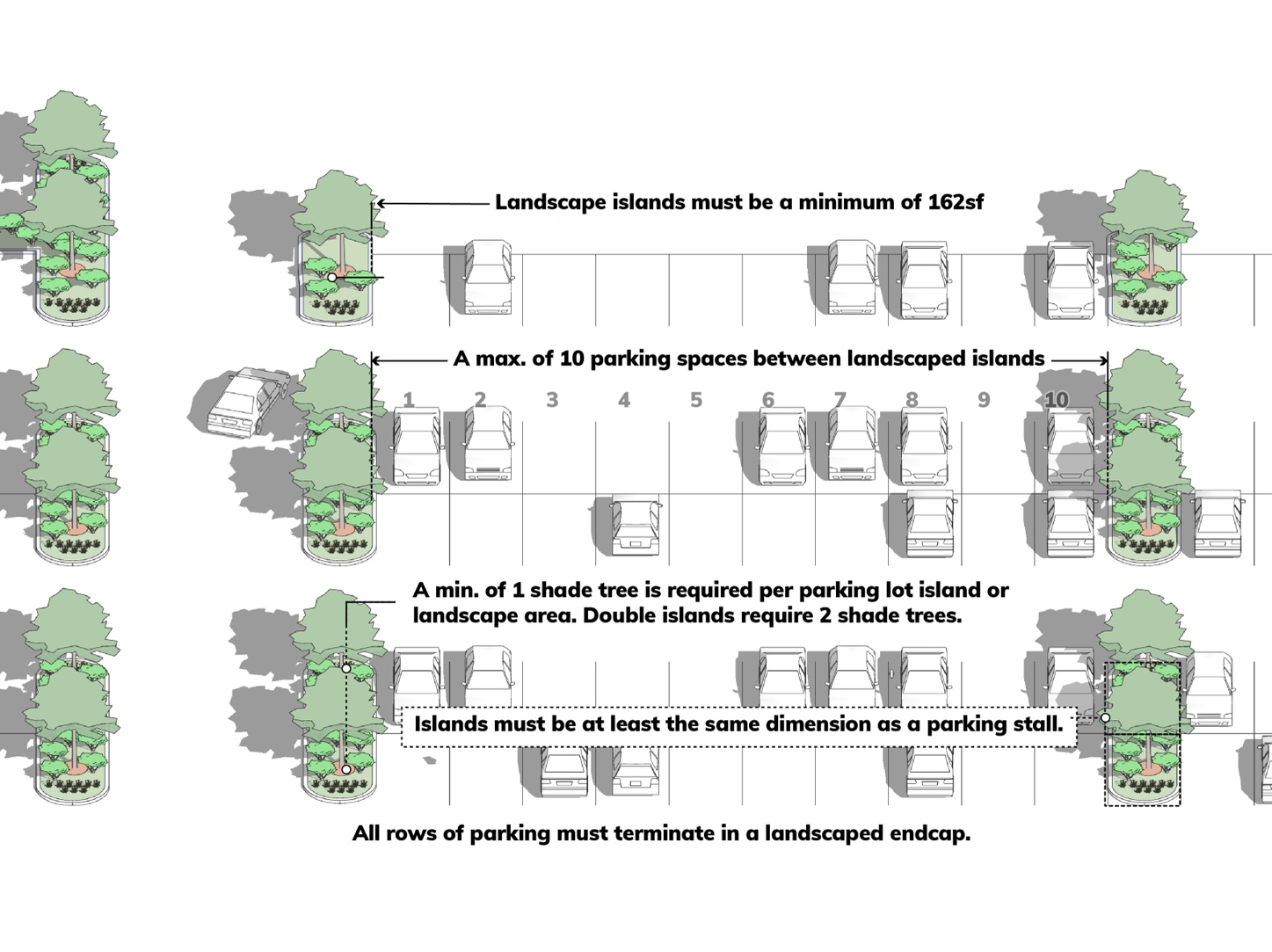
9-12-7. - Buffer yard requirements.
Buffer yards are located within rear and interior side setbacks, and must be reserved for planting material and screening as required by this section. No parking spaces or accessory structures are permitted within the required buffer yard.
A.
Buffer yards - excluding I-1 and I-2 districts.
1.
Required buffers. Interior side and rear setback buffer yards are required in the following situations:
a.
Where a multi-family dwelling abuts a single-family, two-family, or townhouse dwelling.
b.
Where a nonresidential use is located within a residential district.
c.
Where a nonresidential district abuts a residential district, excluding I-1 and I-2 Districts, which are subject to 9-12-7.B below. This does not include the OS District or parks/playgrounds.
2.
Interior side setback buffer yard plantings. The minimum size and improvement of interior side setback buffer yards is as follows:
a.
The buffer yard must be a minimum of seven (7) feet in width.
b.
A fence or wall a minimum of six (6) feet and a maximum of eight (8) feet in height must be erected along one hundred (100) percent of the yard length.
c.
One shrub must be planted for every three (3) linear feet of landscape area, spaced linearly. As part of the landscape plan approval, shrubs may be spaced at various intervals based on specific site requirements, but the total number of shrubs planted must be no less than one per three (3) linear feet of buffer yard length.
d.
The remainder of the buffer yard must be planted in live groundcover, perennials, grass, or trees.
INTERIOR SIDE SETBACK BUFFER YARD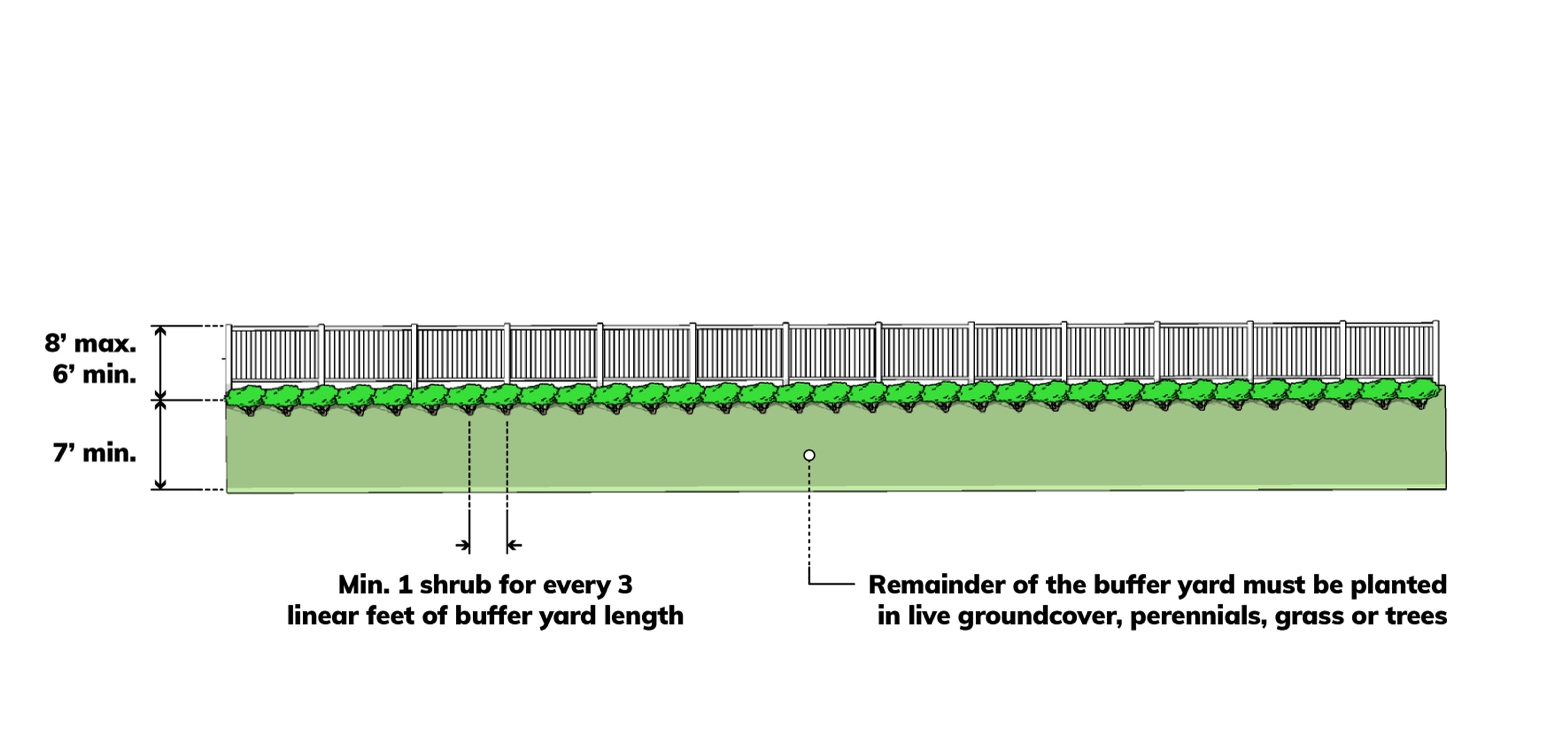
3.
Rear setback buffer yard plantings.
a.
Lots with more than ninety (90) feet of lot depth are required to provide a landscaped rear setback buffer yard as follows:
i.
A buffer yard must be a minimum of ten (10) feet in width.
ii.
One medium or large shade tree is required for every thirty (30) linear feet of buffer yard length. As part of the landscape plan approval, trees may be spaced at various intervals based on specific site requirements, but the total number of trees planted must be no less than one per thirty (30) linear feet of buffer yard length.
iii.
A solid fence or wall a minimum of six (6) feet and a maximum of eight (8) feet in height must be erected along one hundred (100) percent of the yard length.
iv.
One shrub must be planted for every three (3) linear feet of landscape area, spaced linearly. As part of the landscape plan approval, shrubs may be spaced at various intervals based on specific site requirements, but the total number of shrubs planted must be no less than one per three (3) linear feet of buffer yard length.
v.
The remainder of the buffer yard must be planted in live groundcover, perennials, grass, or trees.
b.
Lots with ninety (90) feet or less of lot depth are required to provide a solid fence or wall a minimum of six (6) feet and a maximum of eight (8) feet in height, erected along one hundred (100) percent of the rear setback buffer yard length and located at the rear lot line. Plantings are encouraged to soften the effect of the fence or wall, but are not required.
REAR SIDE SETBACK BUFFER YARD - LOT OVER 90' OF DEPTH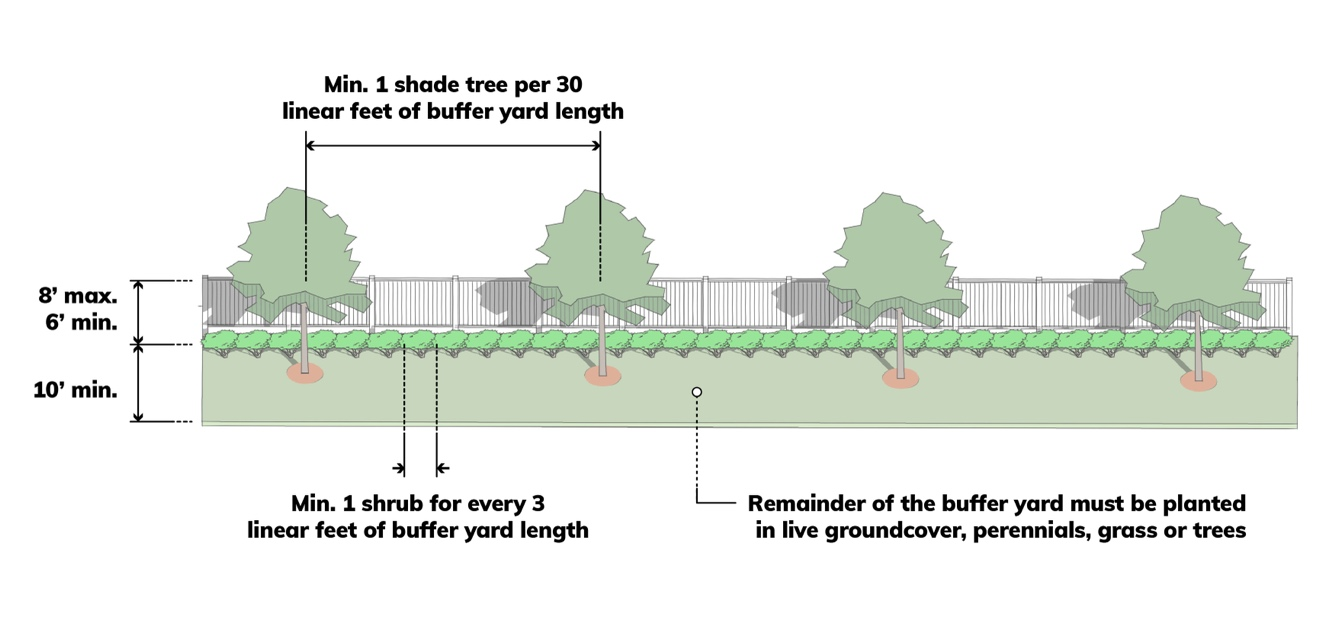
REAR SIDE SETBACK BUFFER YARD - LOT 90' OF DEPTH OR LESS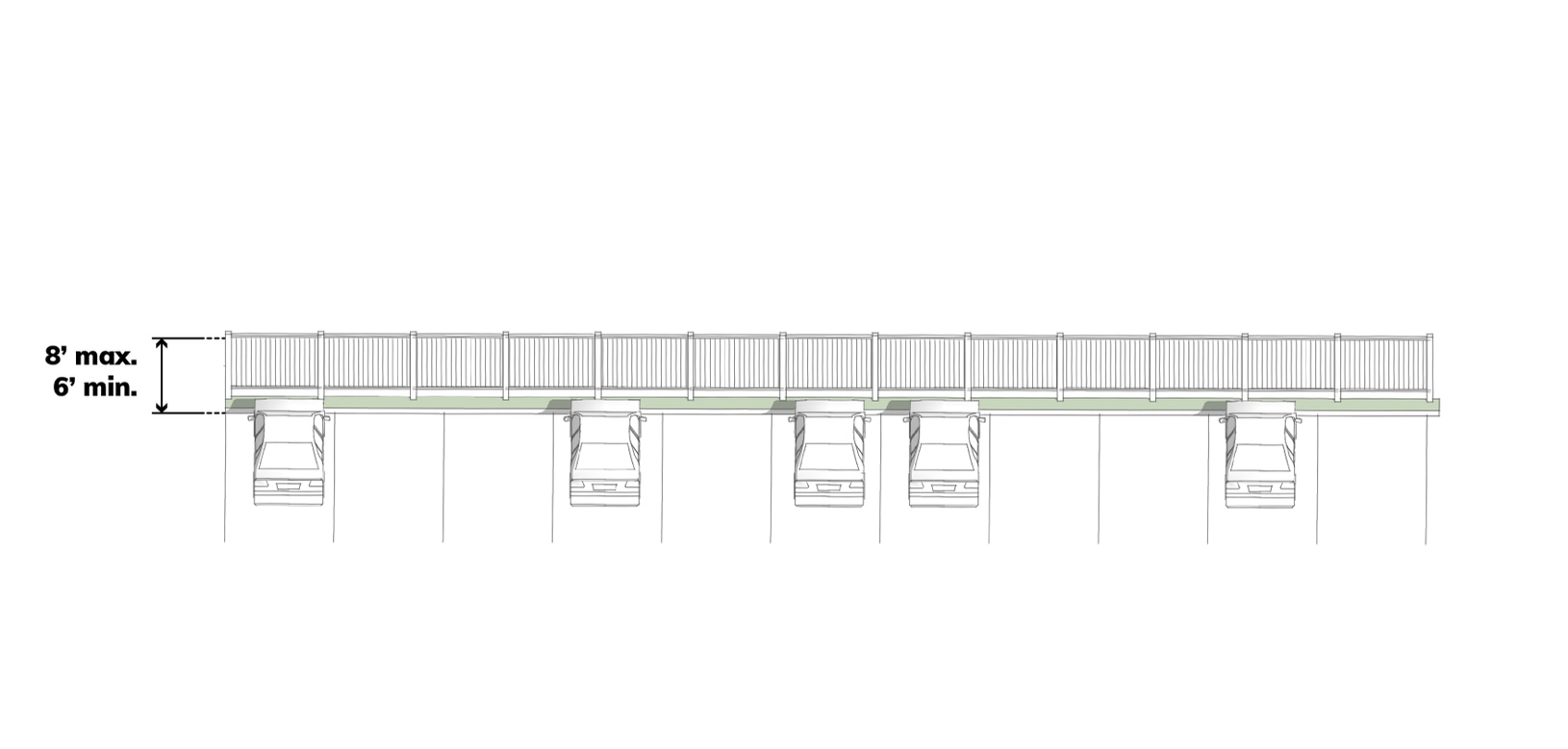
B.
Buffer yards - I-1 and I-2 districts.
1.
Required buffers. Interior side and rear setback buffer yards are required where the I-1 or I-2 District abuts another non-industrial district. Buffers are not required between the industrial districts.
2.
Buffer yard dimensions.
a.
The interior side and rear setback buffer yard must be a minimum of thirty-five (35) feet in width.
b.
The buffer yard is divided into Zone A and Zone B, with plantings required as per this section.
3.
Zone A. Zone A comprises the first fifteen (15) feet of the buffer yard, measured perpendicularly from the rear or interior side lot line. Requirements for plantings within Zone A are as follows:
a.
All areas outside of delineated planting beds must be seeded or sodded, except where natural vegetation is acceptable as approved by the Zoning Administrator.
b.
One shade tree must be planted for every thirty (30) linear feet of buffer yard length. As part of site plan approval, trees may be spaced at various intervals based upon specific site features or an overall design schema, but the total number of trees planted must be no less than one per thirty (30) linear feet of buffer yard length. Existing trees in the buffer yard may count toward the buffer yard tree requirement. This credit is a 1:1 ratio (one existing tree for one required tree) regardless of the size of the existing tree.
c.
One evergreen tree must be planted for every thirty (30) feet of buffer yard length. As part of site plan approval, trees may be spaced at various intervals based upon specific site features or an overall design schema, but the total number of trees planted must be no less than one per thirty (30) linear feet of buffer yard length. Existing trees in the buffer yard may count toward the buffer yard tree requirement. This credit is a 1:1 ratio (one existing tree for one required tree) regardless of the size of the existing tree.
d.
One evergreen shrub must be planted for every three (3) linear feet of buffer yard length. Required shrubs must be staggered, planted in two (2) or more rows to provide depth and visual interest, and to lessen the visual gaps between required tree plantings. As part of site plan approval, shrubs may be spaced at various intervals based upon specific site features or an overall design schema, but the total number of shrubs planted must be no less than one per three (3) linear feet of buffer yard length.
e.
A solid fence or wall, constructed of wood, brick, masonry, or stone a minimum of six (6) feet and a maximum of eight (8) feet in height must be erected at the lot line for one hundred (100) percent of the buffer yard length, with the exception of required ingress/egress points. If constructed on a berm, the height of the berm is included, and the maximum height of a fence and berm combined is eight (8) feet.
f.
Required plant material may not be located closer than five (5) feet from the fence line.
4.
Zone B. Zone B comprises the remainder of the required buffer yard outside of Zone A. Requirements for plantings within Zone B are as follows:
a.
All areas outside of delineated planting beds must be seeded or sodded, except where natural vegetation is acceptable as approved by the Zoning Administrator.
b.
One shade tree is required per two thousand (2,000) square feet of buffer yard area within Zone B. Ornamental trees may be substituted for shade trees at a ratio of one-and-a-half (1½) ornamental trees per one shade tree.
c.
One deciduous or evergreen shrub is required per three hundred (300) square feet of buffer yard area within Zone B.
d.
In lieu of required shrubs, as part of site plan review, alternative plantings including native landscape treatments such as prairie, meadow, or wildflower communities may be approved. Such alternative plantings must occupy forty (40) percent of the area of Zone B.
BUFFER YARDS - I-1 AND I-2 DISTRICTS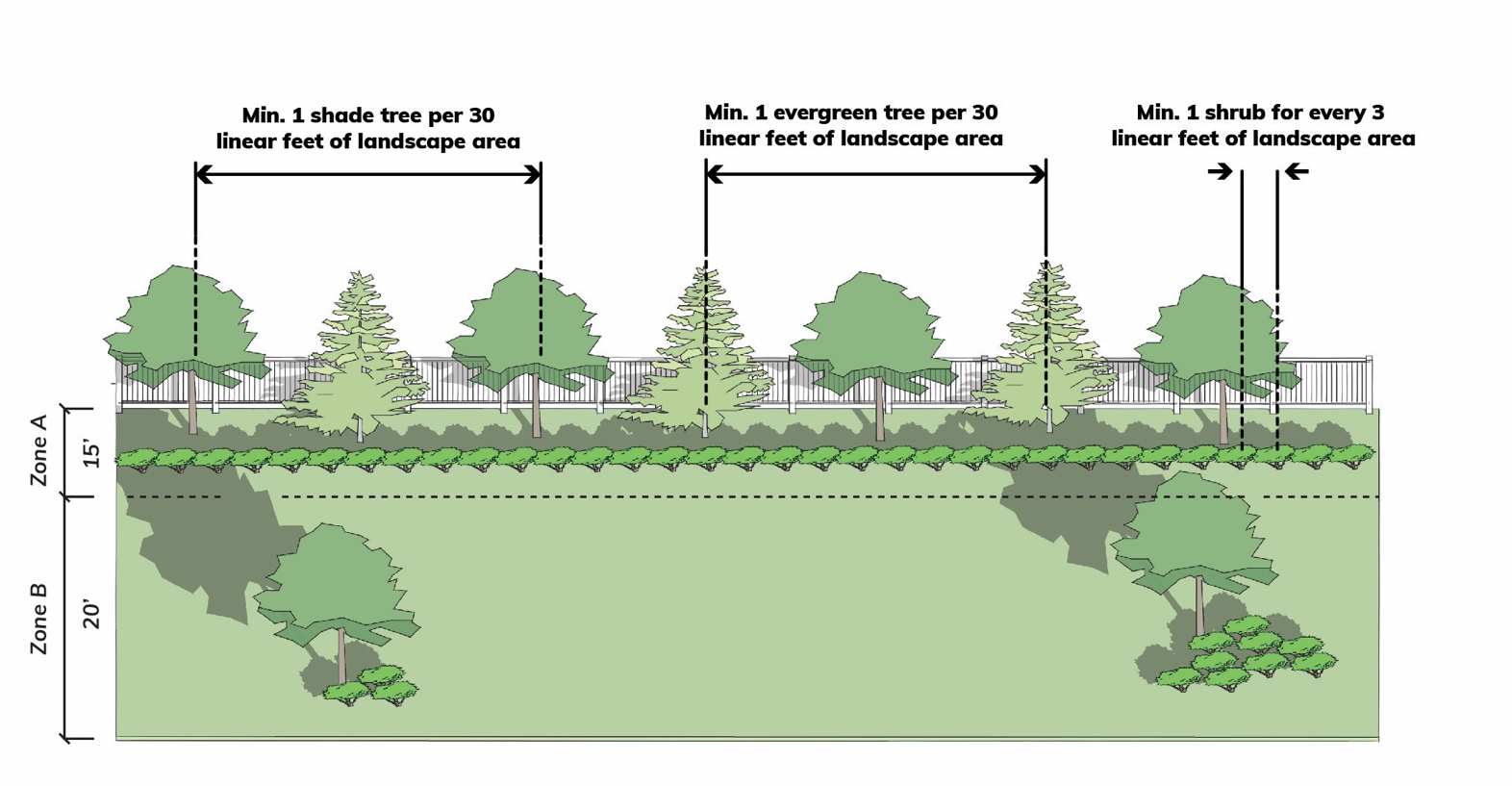
9-12-8. - Street trees and streetscape.
A.
Intent. The intent of these requirements is to line all new streets with a consistent and appropriate planting of trees, pavement design, and identity to establish tree canopy for environmental benefit and a sense of identity for all new streets.
B.
Applicability. Street trees are required for all new construction. Street trees are not required on alleys.
C.
Streetscape design submittal. A consistent streetscape design shall be submitted for approval for all new streets within the development as part of a landscape plan (Section 9-12-1). At a minimum, the submittal must include the following:
1.
Street trees must be included in the streetscape design, with details related to tree pits and tree plantings that meet the requirements of this Chapter.
2.
Sidewalk pavement design.
3.
Benches, seatwalls, planters, planter fences, trash receptacles, and bicycle racks at the least must be specified and quantities and locations listed.
4.
Ground plane vegetation must be designated for any landscape bed areas, planter areas, and tree wells.
5.
Pedestrian and vehicular lighting must be specified and locations and quantities noted.
6.
Any other elements designed to establish the identity of each street, such as banners, pavement markers, artwork, or signage, must be included.
D.
Minimum street tree requirements. The following standards apply to the installation of street trees.
1.
In nonresidential districts, minimum clear branch height is eight (8) feet. In all other districts, minimum clear branch height is six (6) feet.
2.
Medium and large shade trees are permitted to be installed as street trees.
3.
Street trees shall be planted as follows.
a.
Each lot is required to have one tree for every forty (40) feet of street frontage with a minimum of one street tree per street frontage.
b.
Large trees must be spaced a minimum of thirty (30) and a maximum of sixty (60) feet on center.
c.
Medium trees must be spaced a minimum of twenty (20) and a maximum of forty (40) feet on center.
d.
Where the distance from the back of the curb to the edge of the right-of-way or property line is less than nine (9) feet with a sidewalk, applicant must work with the Village Arborist to determine the appropriate tree species.
e.
The Zoning Administrator may waive the street tree requirement in spaces less than nine (9) feet.
4.
In nonresidential districts, where the sidewalk extends from the back of curb to the property line, tree wells must be utilized.
a.
For tree wells adjacent to sidewalks five (5) feet wide or less, open pit is not permitted.
b.
The opening must be covered with a tree grate or pervious pavement.
c.
The opening in a tree grate for the trunk must be expandable.

