
Grafton City Zoning Code
CHAPTER 1287
General District Regulations
1287.01 PURPOSE.
The purpose of general district regulations is to establish additional requirements for various uses, classifications of uses, or areas in order to promote the harmonious exercise of property rights without conflict. The general district regulations as set forth herein shall apply to all districts, unless otherwise noted herein. Where the requirements of a general district regulation and a district regulation differ, the more specific/restrictive requirement shall prevail.
(Ord. 01-014. Passed 7-17-01.)
1287.02 CONVERSION OF DWELLING TO MORE UNITS.
A residence shall not be converted to accommodate an increased number of dwelling units unless:
(a) The yard dimensions continue to meet the yard dimensions required by the Zoning Code for new structures in that district.
(b) The lot area per dwelling equals the lot area requirements for new structures in that district.
(c) The floor area per dwelling unit is not reduced to less than that which is required for new construction in that district.
(d) The conversion is otherwise in compliance with this Zoning Code (e.g., property is zoned for double- or multiple-family use) and all other relevant codes and Ordinances.
(Ord. 01-014. Passed 7-17-01.)
1287.03 GENERAL LOT AREA REGULATIONS.
No parcel of land shall hereafter be reduced or divided so as to provide less than the minimum lot size required in the district in which such land is situated.
(a) Minimum Lot Area. The minimum lot area without central water and sewer services shall be one acre per family for single-family dwellings unless a larger lot size is required by the County Health Board due to soil conditions.
(b) Nonconforming Existing Lot of Record. Any lot or parcel of land under one ownership and of record at the time of adoption of this Zoning Code or any amendment hereto, may be used as a building site even with less area or width than that required by the regulations for the district in which located. All applicable setbacks and other development standards shall apply to nonconforming existing lots.
(c) Setback Regulations for Corner Lots. On a corner lot, the principal building and its accessory structures shall be required to have the same setback distance from all street right-of-way lines as required for the front yards in the district in which the structures are located.
(d) Reduction of Area or Space. No lot, yard, parking area, or other space shall be reduced in area or dimension if such reduction has the effect of making the lot, yard, parking area, or other space less than the minimum required by this Zoning Code. Furthermore, any lot, yard, parking area, or other space which is already less than the required minimum shall not be reduced further. However, nothing in this section shall be interpreted to limit the power of the Board of Zoning and Building Appeals in properly granting variances under this Code.
(Ord. 01-014. Passed 7-17-01.)
1287.04 GENERAL YARD REQUIREMENTS.
In addition to all yard requirements specified in other sections of this Zoning Code, the following provisions shall be used for interpretation and clarification. Except as herein provided, every required yard shall be required open space other than a court unoccupied and unobstructed by any structure or portion of a structure from 3 feet above the general ground level of the graded lot upward, provided that accessories, ornaments, and furniture may be permitted in any yard, subject to height limitations and requirements limiting obstruction of visibility.
(a) Yard Requirements for Single Buildings. No required yard or other open space around a building shall be considered as a yard to open space for any other building. No required yard or other required open space on an adjoining lot shall be considered as providing the yard or open space on the lot whereon a building is to be erected or established.
(b) Yard Requirements for Multiple-Family Dwellings. Multiple-family dwellings shall be considered as one building for the purpose of determining front, side, and rear yard requirements. The entire group as a unit shall require one front, one rear, and two side yards as specified for dwellings in the appropriate district, except when the dwelling unit is located on a corner lot. Each individual building shall meet all yard requirements for the appropriate district as though it were on an individual lot.
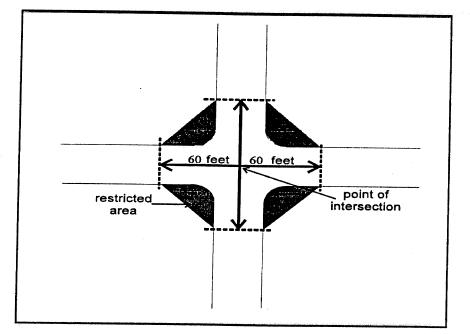
(c) Visibility at Intersections. On a corner lot at the intersection of two streets (existing or proposed), or at the intersection of an alley and a street within any district, nothing shall be installed, erected, placed, planted, or allowed to grow in such manner as to impede vision materially between a height of 2 1/2 feet and 10 feet above the center line grades of the intersecting streets, or of the intersecting alley and street in the area bounded by the right-of- way lines of such corner lots and a line joining points along said street lines, or alley and street lines 60 feet from the point of intersection.
(d) Accessory Buildings.
(1) One-story garages as accessory buildings: In existing residential districts, 1-story detached garages or other accessory buildings may not be located within 6 feet from any side or rear property line, and may not be located closer than 15 feet to any principal building upon the same lot with such garage. Additionally, such garages or accessory buildings may not be located closer to the front building line than the principal building, unless the garage or accessory building is attached thereto. Any accessory building on any residential lot may not be larger than 45% of the gross floor area of the principal use or structure and is not to exceed a maximum of 1,200 square feet. Additionally, accessory buildings, together with the principal dwelling/building, may not exceed lot coverage requirements for a given zoning district. In any R-1A or R-1B Residential District, no detached garage may not exceed a single story or 15 feet in height at any highest point, except that balconies properly designed may be constructed in a detached private garage for storage in connection with the use of a single-family or two-family residential structure. No detached private garage shall exceed 26 feet in length or width in such Residence Districts.
(2) Utility buildings. A utility building (shed) that is 200 square feet or less in area under roof, does not have a permanent foundation, and is accessory to a single family dwelling, may be constructed in the rear yard of any zoning district provided it meets the setback, lot area, and height requirements of the R1A Zoning District.
(e) Use of Front Yard. Front yards in all districts shall be landscaped with living plant material with the exception of required driveways or required off-street parking for single- and two-family dwellings in accordance with the provisions of this Zoning Code. Driveways shall be permitted for multiple-family dwellings in the front yard, however, all parking shall be located in the side or rear yard of the lot, and the remainder of the lot shall be landscaped with living plant material.
(Ord. 01-014. Passed 7-17-01; Ord. 05-040. Passed 1-17-05; Ord. 10-013. Passed 8-10-10.)
1287.05 BUILDING REGULATIONS.
(a) Generally. No building or other structure shall hereafter be erected or structurally altered:
(1) To exceed the height required.
(2) To accommodate or house a greater number of families than that permitted by the provisions of this Zoning Code.
(3) To occupy a greater percentage of lot area than permitted.
(4) To have narrower or smaller rear yards, side yards, front yards, or lot width at the building line than those permitted in this Zoning Code.
(b) Principal Building per Lot. No more than one principal building or structure may be constructed on any one lot for the purposes of this Zoning Code unless otherwise indicated.
(c) Buildings under Construction Prior to Enactment of this Code or Amendments. Nothing in this Zoning Code shall be deemed to require any change in plans, construction, or designated uses of any building upon which actual construction has lawfully begun prior to the adoption of this Zoning Code and provided construction is prosecuted diligently, and provided further that such building shall be completed within one year from the date of passage of this Zoning Code.
(d) Minimum Living Area per Single Family Dwelling Units.
(1) One story buildings. The minimum for a single-family dwelling without a basement shall be 864 square feet of living area. The minimum with a basement shall be 864 of first floor living area.
(2) One and one-half story buildings. The minimum for a single-family dwelling shall be 768 square feet of first floor living area and a total of not less than 1,152 square feet of living area on both floors. The floor area over which the finished ceiling is less than 61/2 feet from the finished floor shall not be counted in the total living area.
(e) Two-Story Buildings. The minimum for a single-family dwelling shall be 720 square feet of first floor living area, and a total of not less than 1,080 square feet of living area on both floors.
(f) Multi-Level Buildings. The minimum for a single-family dwelling shall be 1,296 square feet of living area, with a minimum lot coverage of 864 square feet.
(g) Frontage Required for Building. No principal building or groups of buildings approved by the Planning Commission shall be erected on a lot which does not abut on a street of record.
(h) Temporary Buildings. The following regulations are necessary to govern certain uses which are of a non-permanent nature. For such uses requiring a temporary zoning permit, an application for a zoning permit shall be made to the Responsible Authority at least seven days before the instigation of such use. This application shall contain a graphic description of the property to be used, a description of the proposed use, and a drawing with sufficient information to determine the yard, setback, parking, and sanitary/water/electric facility requirements for the proposed temporary use. The period during which such temporary buildings are to be permitted shall be no greater than the period of construction plus 30 days after the completion of such construction unless noted otherwise herein. The following uses are deemed to be temporary uses and shall be subject to the specified regulations and time limits which follow, as well as the regulations of any district in which they are located:
(1) Real estate offices containing no living accommodations shall be permitted within any district for any new subdivision for a period of 1 year. Two 6-month extensions may be granted if conditions warrant by the Responsible Authority. Such offices shall be removed upon the completion of the sales of the lots therein or upon the expiration of the zoning permit, whichever occurs first.
(2) Temporary buildings, construction trailers, offices, equipment, materials, and storage facilities required in conjunction with construction activity may be permitted in any district for a period of 1 year. Six-month extensions may be granted if construction is substantially underway. Such uses shall be removed immediately upon completion of the construction or upon expiration of the zoning permit, whichever occurs first.
(3) Temporary sales and services may be permitted in parking areas within any commercial district. A zoning permit valid for a period not to exceed 7 consecutive days shall only be issued 3 times within any 12-month period to any individual or organization. The Responsible Authority shall not issue a permit for such temporary use if he or she determines that it encroaches upon more than 25% of the required parking area.
(4) Temporary retail sales and services such as the sale of plants, flowers, arts and crafts, farm produce, or similar items on a lot(s) other than parking lots, including any lot on which an existing business is operating or on which a business is vacated, may be permitted in any commercial district. A zoning permit valid for a period not to exceed 2 consecutive days shall only be issued 3 separate times for any particular lot within any 12-month period, and not more than 1 permit may be issued at the same time for any lot. The applicant must submit a current vendor's license or transient vendor's license, and a written statement from the property owner giving his/her permission for such use. This section shall not be interpreted to prohibit any such use in any case where a valid covenant or deed restriction specifically authorizes such use. In any event, the zoning permit shall be prominently displayed at the site.
(i) Exceptions to Height. Height limitations do not apply to spires, belfries, cupolas, antennas, water tanks, ventilators, chimneys, or other appurtenances usually required to be placed above the roof level and not intended for human occupancy.
(j) Architectural Projections. Open structures such as porches, canopies, balconies, platforms, carports, covered patios, and similar architectural projections shall be considered parts of the building to which they are attached and shall not project into a required minimum front, side, or rear yard unless otherwise permitted in this Zoning Code
(k) Erosion and Sedimentation Control During Construction. A plan for erosion and sedimentation control during and after construction shall be included with all other plans upon application for a zoning permit for any construction activity involving excavation. The following principles shall be followed in developing and carrying out the plan:
(1) The smallest practical area of land should be exposed at any one time during development.
(2) When land is exposed during development, the exposure should be kept to the shortest practical period of time.
(3) Temporary vegetation and/or mulching shall be used to protect critical areas exposed during development.
(4) Sediment basins (debris basins, desilting basins, or silt traps) shall be installed and maintained to remove sediment from runoff waters from land undergoing development.
(5) Provisions shall be made to effectively accommodate the increased temporary and permanent runoff caused by changed soil and surface conditions during and after development per municipal standards specifications/development standards.
(6) Permanent final erosion control vegetation and structures shall be installed as soon as practical in the development.
(7) The development plan shall be fitted to the topography and soils so as to create the least erosion potential.
(8) Wherever feasible, natural vegetation should be retained and protected.
(Ord. 01-014. Passed 7-17-01.)
1287.06 REGULATION OF ACCESSORY USES AND BUILDINGS.
It is the purpose of this section to regulate accessory uses in order to promote the public health, safety, and welfare. It is the intent of this section to permit such uses to be established and maintained in a manner which makes them compatible with principal uses and harmonious with the existing environment.
(a) General Requirements. Except as otherwise provided in this Zoning Code, an accessory use or structure shall be permitted in association with a principal use or structure provided that:
(1) It shall be 45% or less of the gross floor area of the principal use or structure.
(2) It shall not contain or be used as a dwelling unit.
(3) It shall meet all yard requirements of the principal use, except as modified by the District Regulations, if applicable.
(b) Dwellings as Accessory Uses. Mobile homes or manufactured housing units shall not be permitted as accessory uses in any district.
(c) Additional Dwelling Units. Notwithstanding the provisions of Section 1287.05, an owner-occupied, single-family dwelling unit may be converted to allow the incorporation of one additional dwelling unit for the exclusive occupancy of an elderly household, a member of which shall be an elderly person related to the owner of the single-family dwelling unit. Such accessory elderly dwelling unit shall be wholly contained within the existing principal building or shall be attached to it by a common wall, floor, or ceiling but shall not include the construction of kitchen facilities.
The application for the zoning permit for such conversion shall be accompanied by an affidavit attesting to the owner's present occupancy of the dwelling unit and to the age and relationship of the elderly person.
(d) Retail Sales and Service as an Accessory Use. Retail sales and services are permitted as accessory uses when clearly incidental to the principal use. With the exception of restaurants in conjunction with a motel, such uses shall be conducted wholly within the principal building and without exterior advertising or display. These activities shall be conducted solely for the convenience of the employees, patients, patrons, students, or visitors, and not for the general retail public. In hospitals and clinics, these accessory uses may include drug stores, florists, gift and book shops; and in cafeteria institutional settings, office buildings, hotels, country club houses, and airports, such activities may include gift and book shops, restaurants, cafeterias and coffee shops, lounges, pro shops, beauty and barber shops.
(e) Accessory Buildings Used for Storage. Accessory buildings used for storage shall not include the use of temporary structures, including tents, trailers, mobile homes, auto or truck bodies, beds, boxes, trailers, truck caps and campers, or railroad cars whether affixed to a permanent foundation or not. Accessory buildings used for storage shall otherwise meet all other zoning setback, height, area, and percent of lot coverage requirements for the particular use or district in which located and shall be maintained in good condition.
(Ord. 01-014. Passed 7-17-01.)
1287.07 SEXUALLY-ORIENTED BUSINESSES.
In addition to complying with all regulations within the district where they are located, all sexually-oriented entertainment business shall comply with Chapter 1294 to mitigate and limit any secondary effects.
(Ord. 01-014. Passed 7-17-01.)
1287.08 ADULT GROUP HOMES.
In addition to all other applicable provisions of this Zoning Code, adult group homes shall comply with the following criteria:
(a) Evidence is presented that the proposed facility meets the certification, licensing, or approval requirements of the appropriate State agency.
(b) Evidence is presented that the proposed facility meets local fire safety requirements for the proposed use and level of occupancy.
(c) No such facility may be located within 600 feet of another such facility.
(d) The exterior of all such facilities shall not be altered in character and be compatible with other residential dwellings. Any improvement(s) required by code or necessitated by licensing requirements shall not be deemed incompatible.
(e) Such facility shall be reasonably accessible by virtue of its location or transportation provided by the applicant to medical, recreational, and retail services required by its residents, and to employment opportunities, if applicable, and shall be in a relatively safe and stable neighborhood.
(f) Such facility shall be located to provide adequate off-street parking.
(g) The applicant shall provide a plan indicating the manner in which the facility will maintain contact with neighborhood residents to include a structured procedure whereby their grievances may be filed and resolved.
(h) The applicant shall provide documentation indicating the need for the facility, the specific clientele it will serve, the location and type of similar facilities operated by the applicant.
(Ord. 01-014. Passed 7-17-01.)
1287.09 AMUSEMENT ARCADES.
Amusement arcades shall comply with the following in addition to all other regulations that apply in this Zoning Code.
(a) An adult who is a minimum of 18 years of age shall supervise the amusement arcade at all times during its hours of operation.
(b) It shall be the obligation of the exhibitor of an amusement arcade to maintain peace and quiet and order in and about the premises. Failure to do so shall constitute a nuisance.
(c) If the place of business or premises for which an amusement arcade is proposed is a freestanding building, an exterior lighting plan must be approved by the Planning Commission.
(Ord. 01-014. Passed 7-17-01.)
1287.10 CHILD DAY CARE OR ELDERLY ADULT DAY CARE FACILITIES.
Child or adult day care facilities shall comply with the following in addition to all other regulations that apply to this Zoning Code.
(a) Child or adult day care facilities with an average daily attendance of 6 persons or less are permitted in any residential district. No zoning permit is required for this type of child or adult day care.
(b) Child or adult day care facilities with an average daily attendance between 7 and 12 persons may be permitted or conditionally permitted in any district. The petitioner shall be required to obtain a zoning permit by proving that he or she has complied with all applicable State laws, and copies of the State permits shall be filed with the Responsible Authority. The zoning permit will expire without notice on a yearly basis.
(c) Child or adult day care facilities with an average daily attendance of more than 12 persons may be permitted or conditionally permitted in a zoning district and are subject to the following conditions:
(1) The petitioner obtains all necessary State licenses or certifications required for providing day care for infants, pre-school, and/or school age children, as well as adults.
(2) Provisions are made for off-street parking and loading facilities and such fencing, screening, and landscaping as required to prevent undue detriment to the area.
(d) Review of a child or adult day care facility as a conditional use shall include, but is not limited to the following conditions:
(1) Proof of all necessary State licenses or certifications required for providing day care for infants, pre-school, and/or school-age children, as well as adults.
(2) Location of the site, size, and configuration relative to development and adjoining areas.
(3) Number of children or adults to be accommodated in the center, service area, type of program, teacher-child ratios, caregiver/adult ratios, and personnel qualifications.
(4) Day care facilities shall comply with all laws, ordinances, and regulations pertaining thereto.
(Ord. 01-014. Passed 7-17-01.)
1287.11 HOME OCCUPATIONS.
Home occupations shall require a zoning permit, and shall comply with all of the following regulations:
(a) There shall be no nonresidential employees to be employed on the premises of the proposed home occupation.
(b) Sales of commodities not produced on the premises are not permitted.
(c) A home occupation may be permitted to be conducted in a structure accessory to the residence, provided the application so specifies.
(d) No outside storage related to the home occupation may be permitted.
(e) Not more than 30% of the gross floor area of any residence shall be devoted to the proposed home occupation.
(f) The external appearance of the structure in which the use is to be conducted shall not be altered and not more than 1 sign no larger than 2 square feet shall be mounted flush to the wall of the structure.
(g) Minor or moderate alterations (non-structural) may be permitted to accommodate the proposed use, but there shall be no substantial construction or reconstruction.
(h) No equipment, process, materials, or chemicals shall be used which create offensive noise, vibration, smoke, dust, odor, heat, glare, x-rays, radiation, or electrical disturbances.
(Ord. 01-014. Passed 7-17-01.)
1287.12 JUNK.
(a) The accumulation or storage of junk, junk motor vehicles as defined under Ohio R.C. 4513.65, disabled or inoperative machinery or equipment, vehicles or machinery parts, or any other discarded objects or debris defined as junk in this ordinance shall be prohibited, outside of an approved junk yard, in order to protect residents from conditions conducive to the infestation and breeding of vermin, insects, and rodents.
(b) No person shall permit litter and junk to accumulate on land owned or occupied to the extent that it blows or spills over onto the property of another.
(c) Uncontrolled accumulation of litter is a nuisance and is subject to abatement by the Village or owners of surrounding land.
(d) Upon repeated violations of this section, the Responsible Authority may require the violator to erect a fence or landscaping designed to contain litter, and the Village may take other actions deemed necessary.
(Ord. 01-014. Passed 7-17-01.)
1287.13 NOISE.
No person shall operate or use any machine, equipment, or mechanical device on a lot except for agricultural purposes so as to create any noise which would cause the noise level, measured at the lot line of the lot affected by the noise emission, to exceed the applicable fixed noise level set forth in this section. If the measurement location is on a boundary between two zoning districts, the lower noise level shall apply.
(a) Noise limits shall not exceed the following:
Zoning District | Time Period | Sound Level (dbA) |
R-1A, R-1B, R-2, R-3, MHP | 8:00 a.m. - 9:00 p.m. 9:00 p.m. - 8:00 a.m. | 55 70 |
GB, CB | 9:00 p.m. - 8:00 a.m. 8:00 a.m. - 9:00 p.m. | 65 70 |
LI, GI | Any time | 70 |
(b) Provisions of this section shall not be applicable to any emergency signaling devices required by law; nor to any standby equipment operated only in emergency situations, provided that such standby equipment shall not emit noise at a level in excess of 75 dbA when measured at the lot line of the lot on which it is located.
(Ord. 01-014. Passed 7-17-01.)
1287.14 SATELLITE DISH ANTENNAS.
(a) Ground-Mounted Satellite Dish Antennas. Ground-mounted satellite dish antennas are considered an accessory structure in any district. However, the applicant shall be required to obtain a permit from the Responsible Authority before constructing a ground-mounted satellite dish or any accompanying structures. In addition to the provisions of this Zoning Code pertaining to accessory structures, the following provisions shall apply to ground-mounted satellite dishes:
(1) The maximum diameter of any ground-mounted satellite dish shall not exceed 18 inches.
(2) The maximum height of any ground-mounted satellite dish shall not exceed 3 feet above the finished grade.
(3) The apparatus shall not be located in any required yard or between the principal structure and the right-of-way, and may not be located within 10 feet of a property line.
(4) All wiring between the apparatus and any other structure shall be placed underground in approved conduit in accordance with the National Electrical Code.
(5) The apparatus shall be bonded to an approved grounding rod as required by the National Electrical Code or by the Village.
(b) Roof-Mounted Satellite Dish Antennas. Roof-mounted satellite dish antennas are considered as accessory structures and are permitted as accessory uses in all districts and require a zoning permit. In addition to the provisions of this Code pertaining to accessory structures, the following provisions shall apply to roof-mounted satellite dishes:
(1) The maximum diameter of any roof-mounted satellite dish shall not exceed 3 feet in any residential zoning district.
(2) The height of any roof-mounted satellite dish shall not exceed the roof height of the building upon which it is mounted by more than 4 feet.
(3) All wiring and grounding of the apparatus shall be in accordance with the National Electrical Code.
(4) The apparatus, its mounting, and all supporting devices shall be constructed and erected in accordance with all applicable local, State, and national building code requirements. The apparatus shall be mounted directly upon the roof of the principal building, and shall not be mounted upon a spire, tower, turret, chimney, pole, or any appurtenances thereto attached.
(Ord. 01-014. Passed 7-17-01.)
1287.15 SWIMMING POOLS.
(a) Definitions. For the purposes of this chapter, the terms “swimming pool” and “pool” shall include the following defined classes unless specifically exempted in a particular section hereunder:
(1) “Above-ground semipermanent outdoor swimming pool.” Any artificial water pool, semipermanent in nature, of redwood or other wood, metal or plastic construction, which has a water surface area of 300 square feet or more, a depth at any point of more than 11/2 feet, or both.
(2) “Recessed outdoor swimming pool.” Any artificial water pool, permanent in nature, of steel, masonry, concrete, aluminum or plastic construction, located out-of-doors, which has a water surface area of 300 square feet or more, a depth at any point of more than 2 feet, or both.
(3) “Portable plastic or vinyl outdoor swimming pool.” Any artificial water pool, portable in nature, of plastic or vinyl construction, located out-of-doors, which has a water surface area of 300 square feet or less and a depth at any point of 11/2 feet or less (no building permit).
(b) Construction or Maintenance; Permit Required; Fee. No person shall construct or maintain an outdoor swimming pool without first making application to the Building Department and obtaining a permit.
(c) Plot Plan. There shall be filed with the Building Department a plot plan of the property showing the location of the swimming pool thereon and a detailed plan and specification for such swimming pool which contains full information as to the type, height, and location of the fence surrounding such swimming pool and the number of gates therein. Before any permit is issued, such plans and specifications shall be approved by the Building Department. All applications for a permit shall be accompanied by the proper fee.
(d) Location. Outdoor swimming pools may be erected on a side or rear yard. Every pool hereafter built shall be located upon the lot or parcel to allow a safe distance between the pool and the property lines so that any person or persons may be readily observed when approaching or in the vicinity of the pool. The swimming pool, its walks, decks, or paved areas, or any accessory structure adjacent thereto, whichever is closer, shall be situated 6 or more feet from any property line.
(e) Fencing. Every pool hereafter constructed, with the exception of semipermanent above-ground pools which have a built-in fence that is acceptable to the Building Inspector, shall be completely enclosed by a fence not less than 4 feet but not more than 6 feet in height. A fence which encloses the yard may be considered as complying with these requirements. Fence gates shall be of the self-closing, self- latching type with the latch on the inside of the gate, not readily available for children to open. All gates must be locked when the residents are away from the house or when the pool is not in use. A portable plastic or vinyl outdoor swimming pool 11/2 feet or under in height shall have a protective cover of plastic and shall be properly secured when not in use.
(f) Construction Requirements. The following regulations shall apply to the construction of swimming pools:
(1) Swimming pool construction shall conform to the Ohio Plumbing Code and the National Electrical Code.
(2) Non-portable fiberglass and plastic pools may be permitted, provided that they meet accepted safety and construction standards.
(3) Any accessory building which houses pumping and filtering equipment shall conform to the provisions of the Zoning Code and the Building Code.
(4) Illuminating lights may be erected with an intensity of no more than 2 footcandles, installed and shielded so as to eliminate direct rays and minimize reflected rays upon adjoining premises.
(5) All electrical wiring shall conform to the requirements of the National Electrical Code. Installation shall be underground wiring in an approved conduit.
(6) All plumbing necessary for the connection of the intake or the outlet of a swimming pool to the Village water system or sewer system shall conform to the requirements of the Ohio Plumbing Code.
(7) There shall be no direct cross-connection with the Village or home water supply and the water supply for the pool.
(8) The construction of the pool shall be made in such a manner that all scum, splash, and deck water shall not return to the pool except through the filter system.
(9) The pool shall be kept free at all times of floating material, sediment, and debris, either by an automatic surface skimmer, a scum gutter, or some other means approved by the Building Inspector.
(10) Every private swimming pool shall be equipped with an approved filtration system. The system shall have sufficient capacity to provide a complete turnover of the pool water in 24 hours or less when operated at a rate not to exceed 3 gallons per minute per square foot of filter area. Hair and lint strainers shall be provided so as to protect the pumps.
(11) A provision shall be made for positive germicidal or bacterial control by the use of chlorine, bromine, or other such disinfecting agents.
(12) All swimming pool installations must be completed and filled with water, and the filter system must be in operation, before final inspection.
(13) The pool sides and bottom shall be constructed of smooth, nonabsorbent materials, free from cracks, and be so constructed as to be properly drained through one or more metal grate openings. At all times when the pool is in use, water shall be sufficiently clear to see distinctly a bull's-eye target 6 inches in black, on a white disc 18 inches in diameter, from the sidewalk of the pool or the side of the pool.
(g) Operation. The following regulations shall apply to the operation of swimming pools:
(1) No person shall maintain a swimming pool on his or her premises without providing adequate supervision at all times when the pool is in use.
(2) A shepherd's crook shall be available at the pool at all times when the pool is in use as a method of rescuing floundering swimmers.
(3) During water shortages, the filling of swimming pools shall be regulated by the Village Administrator, regulating the use of water supply for lawn sprinkling.
(4) No swimming pool shall be drained during periods of excessive rainfall so as to overload the Village sewer system.
(h) Fencing of Existing Swimming Pools. Existing outdoor swimming pools which do not conform to the fencing requirements of this chapter shall be brought into compliance therewith by July 15, 1991. Any pool now in operation may be continued to be used with the present fence if the fence is adequate, as determined by the Building Inspector.
(i) Filtration Systems Required for Existing Swimming Pools. All swimming pools which, at the present time, have no filtration system, shall be required to install and have the same approved within one year of the effective date of this section.
(j) Inspection. The Building Inspector shall have the right, at any reasonable hour, to inspect any swimming pool for the purpose of determining that all provisions of this chapter are fulfilled and complied with. Before any swimming pool is used, a final inspection and approval must by made by the Building Inspector.
(k) Conflicts. In no way are the provisions of this chapter intended to amend or alter an existing Village ordinance or State statute.
(l) Violations as Nuisances; Abatement. Any outdoor swimming pool installed, operated or maintained in violation of the provisions of this chapter shall constitute a nuisance, and the Village may, in addition to the penalty provided in division (m) of this section, maintain any proper action for the abatement of such nuisance.
(m) Penalty. Whoever violates any of the provisions of this section shall be fined not more than one hundred dollars ($100.00) or imprisoned not more than 30 days, or both. Each day on which any such violation occurs or continues shall constitute a separate offense.
(Ord. 91-205. Passed 6-18-91; Ord. 01-014. Passed 7-17-01.)
1287.16 WIRELESS TELECOMMUNICATION TOWERS.
The purpose of this section is to regulate the placement, construction, and modification of wireless telecommunication facilities and their support structures in order to protect the public health, safety and welfare, while at the same time not unreasonably interfering with the development of the competitive wireless telecommunications marketplace in the Village. Specifically, the purposes of such sections are:
(a) Legislative Purposes for Regulation of Wireless Telecommunication Facilities.
(1) To direct the location of various types of towers and wireless telecommunications facilities into appropriate areas of the Village.
(2) To protect residential areas and land uses from potential adverse impacts of towers and wireless telecommunications facilities.
(3) To minimize adverse visual impacts of towers and wireless telecommunications facilities through careful design, siting, landscaping and innovative camouflaging techniques.
(4) To promote and encourage shared use/co-location of towers and antenna support structures as a primary option rather than construction of additional single-use towers.
(5) To avoid potential damage to adjacent properties caused by towers and wireless telecommunications facilities by ensuring such structures are soundly designed, constructed, and modified, are appropriately maintained, and are fully removed.
(6) To the greatest extent feasible, ensure that towers and wireless telecommunications facilities are compatible with surrounding land uses.
(7) To the greatest extent feasible, ensure that towers and wireless telecommunications facilities are designed in harmony with natural settings and in a manner consistent with current development patterns.
(b) Applicability of Wireless Telecommunication Facility Regulations. All towers, antenna support structures, and wireless telecommunication facilities, any portion of which are located within the Village, are subject to this section. Except as provided herein, any use being made of an existing tower or antenna support structure on the effective date of this Zoning Code shall be deemed a nonconforming structure and allowed to continue, even if in conflict with the terms of this Zoning Code. Any tower site that has received approval in the form of a zoning or building permit by the Village, but has not yet been constructed or located, shall be considered a nonconforming structure so long as such approval is current and not expired.
(c) Standards Applicable to All Wireless Telecommunication Facilities.
(1) Construction standards. All wireless telecommunication facilities and support structures shall be certified by an engineer licensed in the State of Ohio to be structurally sound and, at a minimum, in conformance with Ohio Basic Building Code.
(2) Natural resource protection standards. The location of the wireless telecommunication facility shall comply with all natural resource protection standards established either in this Zoning Code or in other applicable regulations, including those for floodplains, wetlands, groundwater protection, and steep slopes.
(3) Color and appearance standards. All wireless telecommunication facilities shall be painted a non-contrasting gray or similar color, minimizing its visibility, unless otherwise required by the Federal Communications Commission, and the Federal Aviation Administration. All appurtenances shall be aesthetically and architecturally compatible with the surrounding environment by the means of camouflage deemed acceptable by the Village.
(4) Advertising prohibited. No advertising is permitted anywhere upon or attached to the wireless telecommunication facility.
(5) Artificial lighting restricted. No wireless telecommunication facility shall be artificially lit except as required by the Federal Aviation Administration.
(6) Co-location. All wireless telecommunication facilities shall be subject to the co-location requirements set forth in division (d) of this section.
(7) Abandonment. All wireless telecommunication facilities shall be subject to the abandonment requirements set forth in division (h) of this section.
(8) Setback from edge of roof. Any wireless telecommunication facility and its appurtenances permitted on the roof of a building shall be set back one foot from the edge of the roof for each foot in height of the wireless telecommunication facility. However, this setback requirement shall not apply to antennas that are less than 2 inches in thickness mounted to the sides of antenna support structures and do not protrude more than 6 inches from the side of such an antenna support structure. This requirement is subject to change by the Village upon the review of the photo simulation provided in compliance with division (i)(3) of this section.
(9) Security enclosure required. All towers and equipment shelters shall be enclosed either completely or individually as determined by the Village. The Village and co-locators shall have reasonable access. Fencing shall be required, except no fence shall be required on top of a building or other structure if access to the roof or top of the structure or building is secure.
(10) Existing vegetation and buffer plantings. Existing vegetation (trees, shrubs, etc.) shall be preserved to the maximum extent possible. Buffer plantings shall be located around the perimeter of the security enclosure as deemed appropriate by the Village. An evergreen screen may be required around the perimeter of the property in lieu of such buffer plantings.
(11) Access control and emergency contact. “No Trespassing” signs shall be posted around the wireless telecommunications facility, along with a telephone number of who to contact in the event of an emergency.
(d) Co-Location Requirements.
(1) Jurisdiction study of potential public sites. In order to encourage the location of a wireless telecommunication facility on publicly-owned property, the Village shall cooperate with the entity desiring to locate a wireless telecommunication facility in the Village to determine if it is feasible to locate such a facility on publicly-owned property.
(2) Exemption from proof of co-location availability. Persons locating a wireless telecommunication facility upon a publicly-owned property shall be exempted from the requirements herein regarding presentation of proof that co-location is not available. However, persons locating a wireless telecommunication facility on publicly- owned property shall continue to be subject to the requirements contained in division (d)(4) of this section.
(3) Exemption from certain requirements. Persons locating a wireless telecommunication facility on a publicly-owned property identified by the Village to be suitable for such purposes shall be exempt from the requirements of divisions (e), (f) and (g) of this section.
(4) Co-location design required. No new tower shall be constructed in the Village unless such tower is capable of accommodating at least three carriers if height is sufficient for coverage
(5) Technically suitable space. Authorization for a tower shall be issued only if there is not technically suitable space reasonably available on an existing tower or structure within the geographic area to be served.
(6) Application requirements. With the permit application, the applicant shall list the location of every tower, building, or structure within a reasonably proximity that could support the proposed antenna. The applicant must demonstrate that a technically suitable location is not reasonably available on an existing tower, building, or structure within such area. If another communication tower owned by another party within such area is technically suitable, the applicant must show that an offer was made to the owner of such tower to co-locate an antenna on a tower owned by the applicant on reciprocal terms within the Village, and the offer was not accepted. If such co-location offer has not been attempted by the applicant, then such other tower is presumed to be reasonably available.
(e) Wireless Telecommunication Facilities in Residential Districts.
(1) Prohibited as permitted principal use. No wireless telecom- munication facility is permitted as a principal use upon a lot.
(2) Accessory use. The following wireless telecommunication facilities are permitted as an accessory use upon a lot, subject to the following requirements:
A. Tower. No wireless telecommunication tower is permitted as an accessory use within a residential district without a conditional use approval under the guidelines of division (f) of this section.
B. Antenna. An antenna for a wireless telecommunication facility may be attached to an existing residential building or to an existing nonresidential structure subject to the following conditions:
1. Maximum height. The antenna shall not extend more than 20 feet above the roof of the existing building or top of the existing structure.
2. Separate equipment shelter. If the applicant proposes to locate the telecommunications equipment in a separate equipment shelter, not located in or attached to the building, the equipment shelter shall comply with the accessory building regulations of the district and not be located above ground within any required front or side yard.
3. Vehicular access. Vehicular access to the equipment shelter shall be via the existing circulation system and be paved with asphalt or concrete.
(3) Conditional use. The following wireless telecommunication facilities are permitted as a conditional use upon a lot, subject to the following requirements:
A. Tower. A wireless telecommunications tower may be an accessory use to a public or institutional use within a residential zoning district, provided the Planning Commission with the consent of Council or Council without the consent of the Planning Commission finds the following standards have been met:
1. Minimum lot size for principal use. The minimum lot size for principal use for which the tower is accessory shall be five acres.
2. Minimum setback from property lines and residential structures. The minimum setbacks and yard requirements shall be established by the Planning Commission with the consent of Council or Council without the consent of the Planning Commission.
3. Maximum height. The height of such tower shall be subject to approval by the Planning Commission with the consent of Council or Council without the consent of the Planning Commission and be the minimum height necessary.
4. Equipment shelter. The minimum setbacks, height limits, bulk requirements, and screening standards shall be established by the Planning Commission with the consent of Council or Council without the consent of the Planning Commission during the conditional use process. Such shelter shall not be located above ground in any required front or side yard.
B. Antenna.
1. Location. The Planning Commission with the consent of Council or Council without the consent of the Planning Commission may approve the location of an antenna extending more than 20 feet above the roof of an existing building or structure.
2. Attachment to existing building or structure. An antenna for a wireless telecommunication facility may be attached to an existing residential building or to an existing nonresidential structure subject to the following conditions:
a. Roof setback. The pole structure supporting such antenna shall be set back 1 foot from the edge of such roof for each foot of height above such roof. This requirement shall not apply to antennas 2 inches or less in thickness without a supporting pole structure.
b. Separate equipment shelter. If the applicant proposes to locate the telecommunications equipment in a separate equipment shelter, not located in or attached to the building, the equipment shelter shall comply with the accessory building regulations of the district. Such shelter shall not be located above ground in any required front or side yard.
c. Vehicular access. Vehicular access to the equipment shelter shall be via the existing circulation system and be paved with asphalt or concrete.
(f) Wireless Telecommunication Facilities in the General Business District. The following wireless telecommunication facilities are permitted as a conditional use upon a lot in the General Business District, subject to approval by the Planning Commission with the consent of Council or Council without the consent of the Planning Commission and the following requirements:
(1) Tower in the GB District.
A. Maximum height. The maximum height shall be less than 200 feet. Towers 200 feet or more in height shall require approval as a conditional use under the guidelines of division (g) of this section.
B. Minimum setback from property lines. The minimum setbacks and yard requirements for principal structures shall apply.
C. Minimum setback from residential structure. No tower shall be located less than 200 feet from a structure used as a residence or a distance less than its height from a structure used as a residence.
D. Equipment shelter. The minimum setbacks and yard requirements for principal structures shall apply and such shelter shall not be located above ground in any required front or side yard.
(2) Antenna in the General Business District. The antenna shall not be attached to a residential structure.
(g) Wireless Telecommunication Facilities in Industrial/Institutional Development Districts. The following wireless telecommunication facilities are permitted as a conditional use, subject to approval by the Planning Commission with the consent of Council or Council without the consent of the Planning Commission and the following requirements:
(1) Tower.
A. Maximum height. The maximum height of such tower shall be less than the distance of such tower from the nearest property line.
B. Minimum setback from property lines. The minimum setbacks and yard requirements for principal or accessory structures shall apply.
C. Minimum setback from residential structure. No tower shall be located a distance less than its height from a structure used as a residence.
D. Equipment shelter. The minimum setbacks and yard requirements for principal or accessory structures shall apply and such shelter shall not be located above ground in any required front or side yard.
(2) Antenna. The antenna shall not be attached to a structure unless such structure is 4 or more stories in height.
(h) Abandonment of Wireless Telecommunication Tower.
(1) Required notification. All providers utilizing towers shall present a report to the Village notifying it of any tower facility located in the Village whose use will be discontinued and the date this use will cease. Such report shall be filed with the Village 30 days prior to the cessation date. If at any time the use of the facility is discontinued for 180 days, the Zoning Inspector may declare the facility abandoned. The 180-day period excludes any dormancy period between construction and the initial use of the facility. The owner/ operator of the facility will receive written notice from the Responsible Authority and be instructed to either reactivate use of the facility within 180 days, or dismantle and remove the facility. If reactivation or dismantling does not occur, the Village will either remove the facility or will contract to have the facility removed and assess the owner/operator the costs.
(2) Required notice to owner. The Village must provide the tower owner 30 days notice and an opportunity to be heard before the Planning Commission with the consent of Council or Council without the consent of the Planning Commission before initiating such action.
After such notice has been provided, the Village shall have the authority to initiate proceedings to either acquire the tower and any appurtenances attached thereto at the current fair market value at that time, or in the alternative, order the demolition of the tower and all appurtenances.
(3) Right to public hearing by owner. The Village shall provide the tower owner with the right to a public hearing before the Planning Commission with the consent of Council or Council without the consent of the Planning Commission, which public hearing shall follow the 30-day notice required in division (h)(2) of this section. All interested parties shall be allowed an opportunity to be heard at the public hearing.
(4) Order of abatement or demolition. After a public hearing is held pursuant to division (h)(3) of this section, the Village may order the abatement or demolition of the tower. The Village may require the licensee to pay for all expenses necessary to acquire or demolish the tower.
(i) Application and Review Requirements for Wireless Telecommunication Facilities.
(1) Information for applications. All applications for wireless telecommunication facilities, including towers, shall include the information required under this division.
(2) Plot Plan required. When a proposed wireless telecommunications facility or antenna support structure is to include a new tower, a plot plan at a scale of not less than 1 inch equals 100 feet shall be submitted. This plot plan shall indicate all building and land uses within 200 feet of the proposed facility. Aerial photos and/or renderings may augment the plot plan.
(3) Photo simulations required. Photo simulations of the proposed wireless telecommunication facility from affected residential properties and public rights-of-way taken at designated locations shall be provided.
(4) Proof why nonresidential tower location not feasible. In applying for authorization to erect a tower within any residential district, the applicant must present sufficient evidence as to why it is not technically feasible to locate such tower in a more appropriate nonresidential zone. The Village shall review this evidence. If the Village refutes the evidence, then the tower is not permitted.
(5) Technical necessity. The applicant shall demonstrate that the telecommunication tower must be located where it is proposed in order to provide adequate coverage to the applicant's service area. There shall be an explanation of why a tower and the proposed site are technically necessary.
(6) Review by Radio Frequency Engineer. A radio frequency engineer, who will support or refute the evidence, shall review the evidence submitted by the applicant.
(7) Land owner support and access. Where the wireless telecom- munication facility is located on a property with another principal use, the applicant shall present documentation that the owner of the property supports the application and vehicular access is provided to the facility.
(8) Required site and landscaping plan. The applicant shall present a site and landscaping plan showing the following:
A. Specific placement of the wireless telecommunication facility on the site.
B. The location of existing structures, trees, and other significant site features.
C. Type and locations of plant materials used to screen the facilities.
D. The proposed color of the facilities.
(9) Co-location and removal agreement. The applicant shall present signed statements indicating that:
A. The applicant agrees to allow for the potential co-location of additional wireless telecommunication facilities by other providers on the applicant's structure or within the same site location; and
B. The applicant agrees to remove the facility within 180 days after its use is discontinued.
(10) Denial by jurisdiction. Any decision to deny a request to place, construct or modify a wireless telecommunication facility and/or tower shall be in writing and supported by evidence contained in a written record.
(Ord. 01-014. Passed 7-17-01.)
1287.17 OPEN STORAGE AND DISPLAY OF MATERIAL AND EQUIPMENT.
The open storage and display of material and equipment incident to permitted or conditional uses in GB, CB, LI, and GI districts shall be permitted provided the area used for open storage and display shall be effectively screened from all adjoining properties in any residential district by means of walls, fences, or plantings. In no case shall this storage be maintained beyond the front building line except for items displayed for sale or rental. Walls or fences shall be a minimum of 4 feet in height without advertising thereon. In lieu of such wall or fence, a strip of land not less than 10 feet in width and planted and maintained with an evergreen hedge or dense planting of evergreen shrubs not less than 4 feet in height at the time of planting may be substituted.
(Ord. 01-014. Passed 7-17-01.)
1287.18 SINGLE-FAMILY CLUSTER DEVELOPMENTS; CONDITIONS FOR APPROVAL.
(a) The applicant shall graphically demonstrate the maximum number of residential lots that would normally be permitted on a subject property and show how clustering the same number of housing units will allow for an improved site design and layout.
(b) The applicant shall demonstrate how proposed reductions in lot sizes, setbacks and other requirements are necessary to achieve a preferred site design.
(c) All proposed reductions in lot sizes and other development requirements shall be proportionally related to the provision of a common and connected open space network. To the maximum extent possible, the open space network shall be designed as a network of spaces offering pedestrian access throughout the development and to a central passive or active recreational activity center. In all cases, the amount of common open space shall be not less than 25% of the site, nor more than 50% of the site.
(d) Only detached single-family dwellings may be included in a single-family cluster development, and should use common architectural and design elements such as color, building mass, roof lines, facade treatments, landscape elements and related features to produce a distinctive residential area.
(e) Where possible, existing landscape features shall be incorporated into the design of the cluster development. Stormwater detention areas may be included in the calculation of common open space if designed for recreational use (such as a lake or play field). Single purpose stormwater detention areas shall be excluded from the calculations of required open space.
(f) Legal instruments that guarantee that the open space shown on the development plan will remain forever undeveloped shall be provided by the applicant for the satisfaction of the Village's legal counsel.
(g) When a cluster development is proposed to be developed in phases, common open space and residential density shall be provided in proportional amounts for each phase.
(h) All cluster developments shall conform with applicable provisions of the Subdivision Regulations.
(Ord. 01-014. Passed 7-17-01.)
1287.19 PARKING OF RECREATIONAL VEHICLES IN RESIDENTIAL DISTRICTS.
The parking of recreational vehicles in residential districts shall be subject to the following regulations:
(a) Recreational vehicles may be connected to electric only. At no time shall said vehicles be used for living or housekeeping purposes while located on the residential premises. Said equipment shall have current licenses.
(b) If the recreational vehicle is parked outside of a garage, it shall be parked not less than ten feet from the front property line and not less than three feet from any other property line.
(c) The number of recreational vehicles parked outside any enclosed structure shall be limited to two, with not more than one located in the front yard.
(d) Recreational vehicles shall be parked on a fully improved or legally nonconforming driveway in a front, rear or side yard, or on paver bricks or similar surface in a side or rear yard.
(Ord. 05-028. Passed 12-20-05.)

