
Herriman City Zoning Code
CHAPTER 10
34 ACCESSORY BUILDINGS AND STRUCTURES
10-34-1 Purpose
The purpose of this chapter is to establish uniform regulations for accessory buildings and structures within the city. These requirements are intended to ensure that accessory buildings and structures are compatible with the character of the neighborhood and do not unduly disturb or impact adjacent property owners while also allowing residents flexibility to use their property for personal hobbies and outdoor and recreational pursuits.
(Code 2023, § 10-34-1; Ord. No. 2022-03, 2-23-2022)
Adopted by Ord. 2025-13 on 5/14/2025
Amended by Ord. Ord 2025-24 on 10/22/2025
10-34-2 General Requirements
In addition to the use limitations and other regulations for the zoning district in which the accessory building or structure is proposed to be located, no accessory building or structure shall be allowed unless it complies with the following general standards:
- All accessory buildings or structures are permitted in all zoning districts, provided they are:
- Incidental and subordinate to the principal use and/or structure on the property, and
- Compliant with the provisions of this chapter and the zone wherein they are located.
- An accessory building or structure shall be under the same ownership or control as the principal structure or use on the property.
- Except for agricultural zones, no accessory building or structure shall be established or constructed before the main dwelling or structure is under construction. Said accessory structure shall not be used prior to the issuance of a certificate of occupancy for the main dwelling or structure.
- No accessory building or structure shall include a residential dwelling unit nor may an accessory building or structure be rented, sold, or otherwise used as a separate living space, except as may be provided elsewhere in this Title.
- Accessory buildings and structures shall not be used for a home occupation except as provided in Section 10-22-6 of this Title.
- All accessory buildings and structures shall comply with any and all applicable standards and requirements of the International Building and Fire Codes.
- Recreational play structures less than 16 feet in height are exempt from all general restrictions of this chapter, except they shall comply with required setbacks as other accessory structures.
- Open-roofed structures (pergola, trellis, arbors, etc.), when lacking a solid roof and open on all sides, shall still be set back a minimum of three (3) feet from side and rear property lines. Open on all sides means that no solid wall is included in the structure. Lattice work that is 50 percent transparent is not considered solid, nor are walls constructed to support plant material.
- Yard measurement to determine the maximum size for an accessory building/structure.
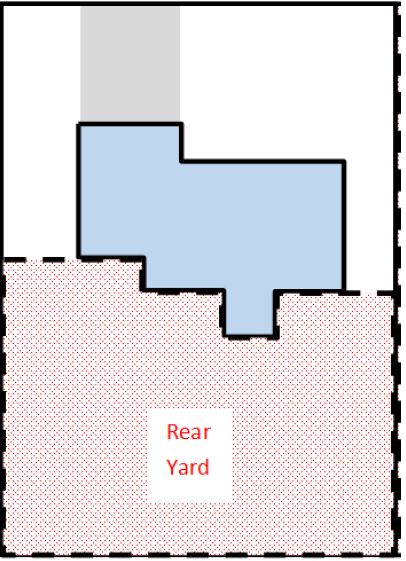
- Rear yard measurement.
- Rear yard measurement shall begin at a point on the property line parallel to the rear wall plane of the building at the most adjacent rear corner of the primary building, and follow the rear roofline of the building, excluding any feature attached to the primary building, such as covered patios, bump outs, or other projections connected to the primary structure.
- Extends the full width of the lot.
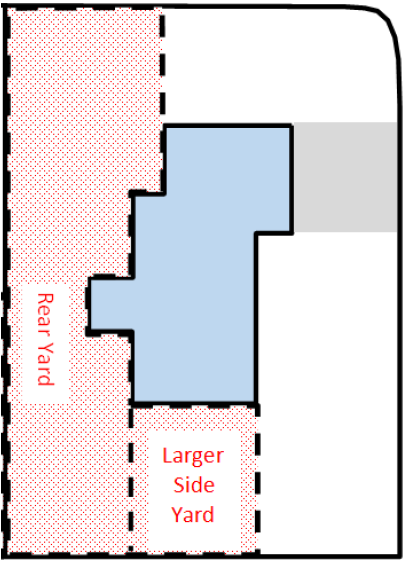
- Side yard measurement.
- Only applicable under a Special Exception for corner lots.
- Side yard measurement shall begin at the most rear corner of the primary building closest to the side property line, then along the side of the building following the wall of the building to the front yard setback line for the property in the given zone, and then parallel to the front plane of the building to the side property line, then following the side property line to the rear yard.
- Rear yard measurement.
(Code 2023, § 10-34-2; Ord. No. 2022-03, 2-23-2022)
Adopted by Ord. 2025-13 on 5/14/2025
Amended by Ord. Ord 2025-24 on 10/22/2025
10-34-3 Location Of Accessory Buildings And Structures
- For setback purposes, measurements shall be taken from the foundation of the accessory structure to the property line or to foundation of the main dwelling or other building. Roof eaves and roof overhangs of one (1) foot or less are not included in the required setback.
- Unless placed on the ground on movable skids, accessory buildings and structures less than 200 square feet may not encroach onto any public utility or other easement. However, as the sole responsibility of the property owner, construction may occur within said easement if permission is granted from the utility companies and any other entity holding rights to public utility or other easements on the property.
- Dripline. In no case shall the roof of any building extend over or toward an adjacent property in a manner that will direct water from said roof onto an adjacent property regardless of permitted setbacks.
(Code 2023, § 10-34-3; Ord. No. 2022-03, 2-23-2022)
Adopted by Ord. 2025-13 on 5/14/2025
Amended by Ord. Ord 2025-24 on 10/22/2025
10-34-4 Architectural Standards
- Except for accessory buildings and structures in Agricultural Zones that are used for agricultural purposes, for any accessory structure 200 square feet or larger in size, all façades facing the street shall either match the main finish materials of the principal structure, including colors, and roof lines, or be finished with one or more of the following materials:
- Stucco, cementitious fiber board siding, brick, cedar shake shingles, or stone or synthetic/cultured stone.
- Non-street-facing sides of the accessory building shall be finished with either the same materials listed above, or prefinished and painted metal siding.
- Roofing shall be made of materials designed for such application and shall match the material and/or color of the main structure on the property, including: composition asphalt/fiberglass shingles, wood shakes, slate, tile, or similar appearing materials, standing seam metal roof systems and metal shingles. Galvanized metal surfaces, reflective surfaces, or reuse of materials that are not originally designed as an exterior wall or roof finish material are not permitted.
- Prohibited exterior materials for all accessory buildings and structures: Exposed plywood or particle board, or similar unfinished materials, and non-rigid materials (i.e., canvas, coated canvas, and similar).
- Accessory structure openings, such as a minimum of one windows, doors, or skylight, or other architectural opening feature shall be required on all elevations visible from the street.
- Accessory buildings and structures shall be maintained in such a manner as to not detract from the existing neighborhood. Setback areas between accessory structures and property lines shall be maintained in a weed- and debris-free condition.
(Code 2023, § 10-34-4; Ord. No. 2022-03, 2-23-2022)
Adopted by Ord. 2025-13 on 5/14/2025
Amended by Ord. Ord 2025-24 on 10/22/2025
10-34-5 Standards Unique To Building And Structures In Agricultural Zones
- Accessory buildings and structures used for agricultural purposes must be designed such that the primary function of the structure is the keeping of farm animals, and the storage of feed, farm equipment, etc., for the lot on which the building or structure is constructed. Floor plans must be provided to show that more than 60 percent of the building will be for agricultural purposes related to the property on which the structure is located.
- Agricultural structures with animals shall not be located within forty (40) feet of any residential dwelling. Chicken coops shall not be placed closer than 15’ to the home on which the coop is located and no closer than 25’ from a home on an adjacent lot.
- Agricultural structures may utilize such exterior building materials that are appropriate to the use.
- Accessory structures which qualify as agricultural structures, as per 10-34-5(A), are not subject to architectural regulations in this chapter; however, all roofing shall be non-reflective.
- Greenhouses are not required to match the building materials of the primary structure.
CHART 10-34 ACCESSORY BULIDING AND STRUCTURE DEVELOPMENT STANDARDS
| Accessory Building and Structure Requirements | |||
| ACCESSORY BUILDING SIZE | ||
| SMALL | MEDIUM | LARGE 401 SF + | |
| <=200 SF | 201 - 400 SF | ||
| SETBACKS: | |||
| Distance From Primary Structure | 0' | 5' | |
| In Rear Yard - From Side and Rear Property Line (Interior, NOT adjacent to street) | 1' Min | 3' Min if height is <= 16' See "Height" table below for buildings taller than 16'. | |
| Side Yard Adjacent to Street | 1' Min if height <= 8' If height > 8' match primary building setback | Match required primary building setback | |
| From Any Building > 200 SF on Adjacent Lot | 2' if height < 8'; 4' if height > 8' | 6' | |
| From Accessory Building on Same Lot | 0' | 6' | |
| Front Yard | 5' Behind Front Yard Setback for Primary Structure, and 5' Behind Front of Primary Structure | ||
| Inside Yard - Between Front and Rear Yards | Same as Required for Primary Structure; When structure is in rear yard, see above, 'In Rear Yard' | ||
| HEIGHT: | |||
0 - 10,000 SF Lot | 16' | ||
10,001 - 21,780 SF Lot | 16' | 25 feet or Height of Primary Structure, Whichever is Less. For every 1 foot of building height above 16 feet, 1 additional foot in interior side and rear yard setback is required, except when a setback is adjacent to dedicated public or quasi-public open space. | 25 feet or Height of Primary Structure, Whichever is Less. For every 1 foot of building height above 16 feet, 1 additional foot in interior side and rear yard setback is required, except when setback is adjacent to dedicated public or quasi-public open space. |
21,781 + SF Lot | 16' | 30 feet; For every 1 foot of building height above 20 feet, 1 additional foot in interior side and rear yard setback required, except when setback is adjacent to dedicated public or quasi-public open space. | |
| SIZE: (MAX TOTAL LOT COVERAGE FOR ALL STRUCTURES) | |||
0 - 6,000 SF Lot | 15% of rear yard or 75% of footprint of home, whichever is less | ||
6,001 - 11,000 SF Lot | 25% of rear yard or 75% of footprint of home, whichever is less | ||
11,001 - 21,780 SF Lot | 25% of rear yard or 80% of footprint of home, whichever is less | ||
21,781 - 43,560 SF Lot | 40% of rear yard or 125% of footprint of home, whichever is less | ||
> 43,560 SF Lot | 40% of side and rear yards | ||
(Code 2023, § 10-34-5; Ord. No. 2022-03, 2-23-2022)
Adopted by Ord. 2025-13 on 5/14/2025
Amended by Ord. Ord 2025-24 on 10/22/2025
10-34-6 Special Exceptions
- In order to allow flexibility for specific unique circumstances addressed in subsection B below, an application for a special exception to specific requirements of this chapter may be approved. In determining the appropriateness and potential impacts of a special exception, additional mitigating requirements, conditions, and limitations may be imposed to prevent or minimize adverse effects on adjoining properties. These mitigating conditions may include, but are not limited to, the use, construction, operation, appearance, location, screening, and landscaping, as may be required as part of a special exception.
- When allowed.
- Application for a special exception to the provisions required for accessory structures as established by this chapter (10-34) shall only be allowed under the following circumstances:
- The applicant's lot has unique characteristics which may include:
- Irregular lot shape (see definitions).
- Topography which creates a unique situation.
- Flexibility in determining side/rear/front yards.
- Lot adjacency to other commercial/industrial/open space land uses on at least two (2) sides of the property.
- The applicant's lot has unique characteristics which may include:
- When the use of the building is strictly for Agricultural purposes and the applicant can demonstrate the following:
- Absolute need for a higher, or larger building to accommodate equipment used specific to the property for agriculture.
- Additional height of an accessory structure which is not intended for agricultural use shall be allowed for architectural purposes only.
- In cases of required parking, if a rear yard does not allow for a two-car garage that accommodates the requirement for single-family parking, a structure no larger than 520 square feet shall be allowed for said use.
- Corner lots as follows:
- If the rear yard is less than twenty-five (25) feet.
- For corner lots >= 10,000 square feet:
- If the existing rear yard setback is more than twenty (20) feet shallower than the nearest adjacent interior lot with the same orientation, a special exception can be considered.
- When a special exception for a corner lot is permitted, the applicant may include the rear and larger side yard in the calculation to determine the maximum size for an accessory structure. No additional exemptions are permitted with this exception for architectural (except agricultural), setback requirements.
- Special exceptions for corner lots shall be approved by the Planning Director. The Planning Director may request Planning Commission consideration when extenuating conditions exist.
- Application for a special exception to the provisions required for accessory structures as established by this chapter (10-34) shall only be allowed under the following circumstances:
- The Planning Commission shall approve a special exception to the specific requirements of this chapter, except as provided in this chapter, with conditions and limitations as may be appropriate. Adjoining property owners shall receive notice of said hearing for a special exception no less than ten (10) days prior to the public hearing.
- The following shall be considered by the Planning Commission in determining the appropriateness of a special exception:
- The special exception does not materially impact the goals and policies of the City's General Plan.
- The special exception is not in conflict with adopted restrictive covenants governing the property.
- The proposed exception for the structure is in keeping with the development block pattern of the area.
- The special exception will not have an adverse effect upon public health, safety, or general welfare of the community.
- Additional height and size greater than the maximum allowed can be mitigated by:
- Requiring additional setback from the property line or adjacent buildings.
- Requiring all sides of the accessory structure to match the home or comply with 10-34-4(A)(1).
- Requiring additional landscaping buffers and plantings to screen the building from adjacent properties.
- Impacts to adjoining properties can be mitigated by adjusting architectural elements, i.e., reducing or eliminating doors, windows, etc. that are visible from adjoining properties and streets.
- The accessory structure does not violate the sight visibility triangle on corner lots.
- Other development requirements could be required that will further mitigate and are directly associated with the impact of the special exception.
- In cases where an exception is requested due to an irregularly shaped lot, the Commission shall consider the following:
- Whether the irregularity of the lot shape restricts, or limits the placement of an accessory structure compared to a regular lot of similar size.
- It shall be the burden of the applicant to clearly demonstrate the hardship due to the shape of the lot.
- The requested exception cannot be considered to exceed the size, or height of any accessory structure except as provided in this chapter.
- Whether the impact of the exception will place an undue impact on adjacent properties which would not be typical if the lot was a regular shape.
(Code 2023, § 10-34-6; Ord. No. 2022-03, 2-23-2022)
Adopted by Ord. 2025-13 on 5/14/2025
Amended by Ord. Ord 2025-24 on 10/22/2025

