
Huron City Zoning Code
CHAPTER 23
10 - NONCONFORMING USES AND STRUCTURES
23.10.002 - Lawful use of existing structures—Property.
Any structure or use, of property lawfully existing upon the effective date of the ordinance codified in this title may be continued at the size and in a manner of operation existing upon such date except as hereinafter specified.
(Ord. 985, 1971).
23.10.004 - Repairs of unsafe structures.
Nothing in this title shall prevent the placing of a structure in safe condition when the structure is declared unsafe by the building inspector, providing the necessary repairs shall not constitute more than fifty percent of fair market value of such inspector, assessor, engineer, fire prevention bureau chief and an insurance adjuster.
(Ord. 985, 1971).
23.10.006 - Nonconforming use.
When any lawful nonconforming use of any structure or land in any district has been changed to a conforming use, it shall not thereafter be changed to any nonconforming use.
(Ord. 1873 (part), 2000: Ord. 985 (part), 1971).
23.10.008 - Nonconforming use change.
A lawful nonconforming use of a structure or parcel of land may be changed to a similar nonconforming use or to a more restrictive nonconforming use. Once a structure or parcel of land has been placed in a more restrictive nonconforming use, it shall not return to a less restrictive nonconforming use.
(Ord. 985 (part), 1971).
23.10.010 - Nonconforming use—Damaged.
Whenever a lawful nonconforming structure has been damaged by fire, flood, explosion, earthquake, war, riot or act of God, it may be reconstructed and used as before if it is reconstructed within twelve months after such calamity, unless the damage to the building or structure is fifty percent or more of its full and true value, as shown on the assessment records at the time of damage, in which case the whole thereof shall be demolished, and any construction thereafter shall be for a use in accordance with the provisions of this title.
(Ord. 1873 (part), 2000: Ord. 1680, 1992: Ord. 985 (part), 1971).
23.10.012 - Nonconforming use—Continuation.
Whenever a lawful nonconforming use of a structure or land is discontinued for a period of twelve months, any future use of the structure or land shall be in conformity with the provisions of this title.
(Ord. 985 (part), 1971).
23.10.014 - Nonconforming use—Removal.
Any lawful nonconforming use of land not involving a structure, and any lawful nonconforming use involving a structure with an assessor's full and true valuation upon the effective date of the ordinance codified in this title, of five hundred dollars or less, may be continued for a period of thirty-six months after the effective date of the ordinance codified in this title, whereupon such nonconforming use shall cease, unless brought into conformity.
(Ord. 985 (part), 1971).
23.10.016 - Nonconforming use—Construction.
Any unfinished structure which will, under this title, become nonconforming but for which a building permit has been lawfully granted, not more than six months prior to the ordinance codified in this title, may be completed in accordance with the approved plans; provided, construction is started within six months of the ordinance codified in this title, and continues to completion within two years. Such structure shall thereafter be a legally existing nonconforming structure.
(Ord. 985 (part), 1971).
23.10.018 - Nonconforming use—Maintenance.
Normal maintenance of a building or other structure containing or related to a lawful nonconforming use is permitted, including necessary nonstructural repairs and incidental alterations which do not extend or intensify the nonconforming use.
(Ord. 985 (part), 1971).
23.10.020 - Nonconforming use—Alterations.
Alterations may be made to a building containing lawful nonconforming residential units when they will improve the livability thereof, provided they will not increase the number of dwelling units or bulk of the building.
(Ord. 985 (part), 1971).
23.10.022 - Lot provisions.
A lot of record existing upon the effective date of the ordinance codified in this title in an "R" district, which does not meet the minimum requirements of this title as to area or width may be utilized for single family detached dwelling purposes, provided the area and width of such lot are not less than two-thirds of such minimum requirements.
(1)
Where no curb elevation has been established, the city engineer shall furnish such elevation.
(2)
Except in the case of planned developments as provided for hereinafter, not more than one principal building shall be located on a platted lot, outlot or street.
(3)
On a through lot, both street lines shall be front lot lines for applying this title.
(Ord. 985 (part), 1971).
23.10.024 - Accessory buildings and structures.
(1)
No accessory building or structure other than a fence or a temporary construction office shall be constructed on any lot in an "R" district prior to the time of construction of the principal building to which it is necessary.
(2)
Except in the "A" and "R-O" districts or unless otherwise herein specified, no accessory building shall exceed the height of the principal building. However, in no case shall accessory buildings in the "R-1," "R-2," "R-3," "R-6" or "R-7" districts exceed twenty-five feet in height.
(3)
In the "R" districts, with the exception of the "R-O" district, the aggregate square footage of all structures on the lot including any accessory buildings shall not exceed forty-five percent of the lot area. The area used in the determination of the lot area shall be considered a "lot" as defined in Section 23.08.096 and subject to the lot area and size requirements of this chapter.
(4)
An attached garage shall conform with the yard requirements of the principal building.
(5)
In the "R" district, with the exception of the "R-O" district, no detached accessory building shall be less than sixty feet from the front lot line unless it conforms with the yard requirements of the principal building and separation requirements as set forth in the currently adopted building codes; and if more than sixty feet from the front lot line, may be constructed three feet or more from the side and rear lot lines subject to subsections (6) and (7) of this section. Accessory buildings shall be five feet or more from the property line if there is solid waste collection along that lot line. In the "A" and "R-O" districts, detached accessory buildings shall conform with the yard separation requirements of the principal building as set forth in the currently adopted building codes. If a detached accessory building is constructed three feet (or less by variance) from the property line, the roof overhang on the building will be limited to one foot including stormwater gutters.
(6)
Whenever a garage is designed that it is to be entered directly from the side street or alley, the distance between the doors and the lot line shall be twenty feet or more.
(7)
On a corner lot, accessory buildings shall conform with the required side yard setback of the principal building on the side(s) adjacent to the street.
(8)
Subject to 23.10.024(11), in the "R" districts, with the exception of the "R-O" districts, and those properties abutting North Frontier Drive and South Frontier Drive, those "R-1" districts lying in the Northwest ¼ of Section 11, Township 110, Range 62 (Coutts Outlots 3, 5, 18 & 19), that area lying in the "R" districts west of Lincoln Avenue and North of 3 rd Street SW, that area lying East of Ravine Lake and North of U.S. Highway 14, the "R-2" district lying East of Highway 37 and North of 10 th Street Northeast and the "R-6" mobile home districts, the use of flat or corrugated sheet metal for the exterior walls or roof covering for a garage or carport is prohibited.
(9)
Plastic, canvas or corrugated metal sheeting (agricultural metal siding/roofing) is not permitted for carport accessory buildings.
(10)
Plastic or metal framing is not permitted for carport accessory buildings.
(11)
Standing seam metal roofing (architectural roofing) is allowed in all "R" districts on accessory buildings, including carports.
(12)
In all "R" districts, accessory buildings up to one hundred square feet, except carports, may be constructed using architectural or agricultural type metal siding and roofing, if the accessory building is made from a premade kit purchased at a store.
(13)
Subject to 23.10.024(12), all accessory buildings and all carports must be: (a) framed of typical dimension lumber and sheeted on sides and roof with at least one-half inch thick sheeting; (b) sided with residential type horizontal metal or vinyl, masonite, wood or similar material commonly used in residential construction; (c) roofed with wooden shakes, wooden shingles, asphalt shingles or rolled roofing; and (d) designed and constructed siding and roofing materials are permanently mounted and finished so the material is protected from the weather.
(14)
In no case may any structure except for fences be constructed in utility easement areas along front, side or rear property lines.
(15)
Sea/Land Metal Shipping Containers:
(a)
May be used for short-term storage in areas zoned Residential with the following conditions:
i.
Container must sit entirely on private property, and shall not be located on the boulevard in an alley right-of-way,
ii.
Container shall not be parked where it will block the visibility at a street or alley intersection or in a driveway or sidewalk safety zone,
iii.
Container may be parked for a maximum of 30 days per event with a total of two events or a maximum of 60 days per year.
(b)
May be used for long-term storage in areas zoned Business or Industrial with the following conditions:
i.
Container must sit entirely on private property,
ii.
Container must be setback according to the requirements of the zoning district,
iii.
Containers cannot be sited in any front or side yard setback area adjacent to a street,
iv.
Containers will not be sited in front of any commercial or industrial building.
(c)
Must be rodent proof.
(d)
Must have weatherproof roof, sides and doors.
(e)
Must have the entire container painted in a neutral (white, tan, beige, light grey, or similar color) so that the old shipping company logo does not show. The only signage or advertising allowed on the container is to identify the company that rents out the container. Any other signage on the container will be counted as on-site signage and must be permitted according to the municipal sign ordinance prior to placement of the container or the sign.
(f)
Applicants desiring to site a container on their property will contact the City Planning Office and pay the "Shed Moving Permit" fee prior to placing the container on their property. The permit process will ensure that the party siting the container understands the siting requirements of this ordinance.
(Ord. 2034, 2007; Ord. 2000 (part), 2005; Ord. 1924 (part), 2001: Ord. 1610, 1990; Ord. 1468, 1983: Ord. 1355, 1979: Ord. 985 (part), 1971).
(Ord. No. 2086, 9-27-2010; Ord. No. 2194-23-397, 6-18-2018; Ord. No. 2209-23-402, 3-16-2020; Ord. No. 2217-23-403, 11-2-2020; Ord. No. 2229-23-405, 8-30-2021; Ord. No. 2240-23-407, 10-3-2022; Ord. No. 2249-23-411, 2-27-2023)
23.10.025 - Metal siding and roofing on residences in areas zoned "R-1" through "R-6" inside city limits.
Corrugated metal siding typically used as siding and roofing on agricultural steel buildings is prohibited for use on any structure designed as a single, duplex or multiple-family dwelling in all areas zoned "R-1" through "R-6" inside city limits. Standing seam metal roofing, also called "architectural steel roofing," is allowed for use as a roofing material on residential structures in all areas zoned "R."
(Ord. 2000 (part), 2005).
23.10.026 - Required yards and open space.
No yard or other open space existing upon the effective date of the ordinance codified in this title shall be reduced in area or dimension so as to make such yard or other open space less than the minimum required by this title.
(1)
No required yard or open space allocated to a structure or lot in compliance with this title shall be used to satisfy yard, other open spaces, or minimum lot area requirements for any other structure or lot.
(2)
The following shall not be considered as encroachments on yard and setback requirements:
(a)
Chimneys, flues, belt courses, leaders, sills, pilasters, lintels, ornamental features, cornices, eaves, gutters and other similar projections, provided they do not exceed more than two feet into a yard;
(b)
Yard lights and name plate signs in R-1, R-2 and R-3 residential districts provided such lights are three feet or more from all lot lines and subject to Section 18.1. Lights for illuminating parking or loading areas or yards for safety and security purposes may be provided where necessary provided that glare is not visible from the public right-of-way or adjacent residential property and not more than three foot candles of light intensity are present at the residential property line;
(c)
Yard Exceptions. In front yards, uncovered, unscreened decks, steps, porches, landings, and terraces, in R-1, R-2, R-3, R-4 and R-5 residential districts, which extend six feet or less from the front of the house and cover an area of no more than 42 square feet (excluding the steps) and where decks and steps are setback ten feet or more from the front property line, which are constructed for the purpose of providing access to the main entrance of the dwelling; balconies that extend a distance of four feet or less, provided they are seven feet or more above the grade at building line;
(d)
Yard Exceptions. In side yards, terraces, steps, uncovered porches, uncovered decks or stoops which do not extend in elevation above the height of the ground level of the principal building and do not extend nearer than two feet from any lot line; bays not to exceed a depth of two feet nor to contain an area of more than twenty square feet;
(e)
Yard Exceptions. In rear yards, bays not to exceed a depth of two feet nor to contain an area of more than twenty square feet, fire escapes not to exceed a width of forty-four inches, balconies, detached outdoor picnic shelters, uncovered decks, recreational equipment and off-street parking except as hereinafter regulated;
(f)
On a through lot, both street lines shall be front lot lines for applying this title;
(g)
Whenever a park or play area is so located that it abuts on a public right-of-way or railroad right-of-way, either a landscaped yard area of at least thirty feet shall be maintained between such right-of-way and the nearest developed play space, or a fence in conformity with Section 23.10.042 and a six foot chain link fence may also be used. This section shall apply in all zoning districts and to all public and private parks, schools, churches and other areas where play space is provided.
(Ord. 1611, 1990; Ord. 1498, 1984; Ord. 985, 1971).
23.10.028 - Traffic visibility.
"R" districts: On corner lots of residential districts no structure, plants or shrubs in excess of thirty inches above the abutting curb line shall be permitted within a triangular area defined as follows:
"beginning at the intersection of the projected curb lines of two intersecting streets, thence thirty feet along one curb line, thence diagonally to a point thirty feet from the point of beginning on the other curb line, thence to the point of beginning."
(Ord. 985, 1971).
23.10.030 - Fences.
A "fence," for the purpose of this title, means any partition, structure, wall or gate erected as a dividing marker, barrier, or enclosure located on the boundary lines or within the required yard.
(Ord. 985, 1971).
23.10.032 - Permit required.
No person, firm or corporation, shall hereafter construct, or cause to be constructed or erected within the city, any fence without first making application for and securing a permit therefor from the building inspector.
(Ord. 985, 1971).
23.10.033 - Maintenance and repair of existing fences.
Any existing fence, whether conforming with the code or not, may be repaired if the repair is less than 25 percent of the linear length of the fence being replaced.
(Ord. No. 2160-23-389, 6-1-2015)
23.10.033a - Replacement of fence to bring fence into compliance with code.
Any fence that requires more than 25 percent of the length of the fence to be replaced shall be entirely removed. If replacement fence is installed on the same site, the new fence will comply with the setback requirements of this code.
(Ord. No. 2160-23-389, 6-1-2015)
23.10.034 - Location.
All boundary line fences shall be located entirely upon the private property of the person, firm or corporation constructing, or causing the construction, of such fence unless the owner of the property adjoining agrees, in writing, that such fence may be erected on the division line of the respective properties. The building inspector or city planner may require any applicant for a fence permit to cause to establish the boundary lines of his property by a survey thereof to be made by a registered land surveyor.
(Ord. 985, 1971).
(Ord. No. 2160-23-389, 6-1-2015)
23.10.035 - Fence setbacks and safety and visibility requirements.
(a)
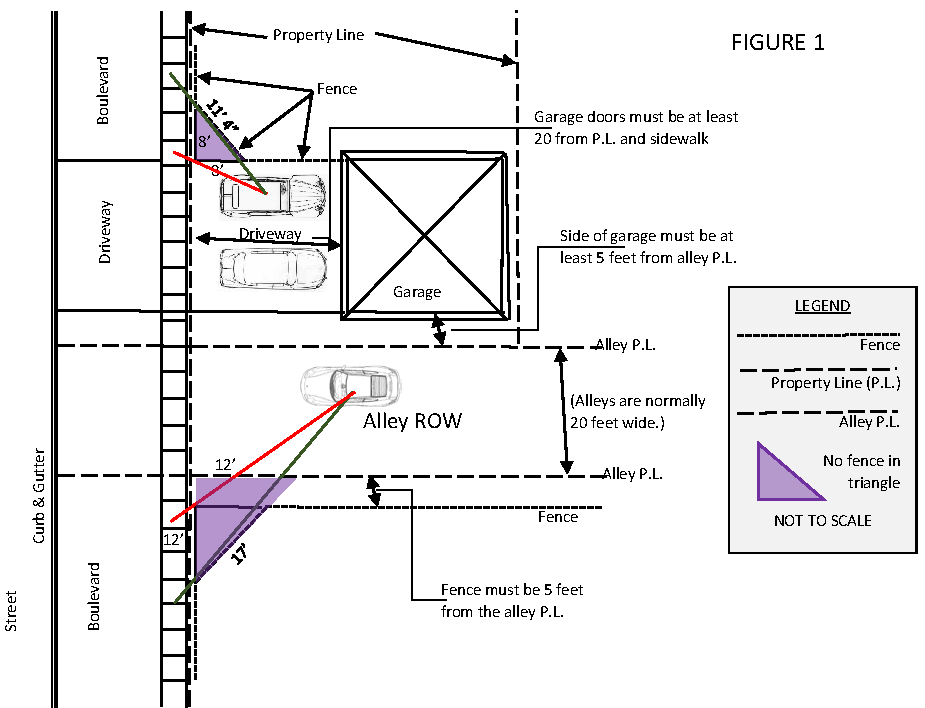
Alley Setback. Any fence built adjacent to a public alley will be set back at least five feet from the alley property line to provide room for alley storage of solid waste containers and room for storage of snow from alley snow removal activities. If, for any reason, the City allows the applicant to build fence closer than five feet from the alley property line, the property owner will sign and file a waiver of liability certifying that the owner will accept damage to the fence that may occur in the normal process of the city doing the business of the city. Owner will file the waiver of liability at the Beadle County Register of Deeds Office and owner will provide a copy of the filed document to the City. Refer to Figure 1.
(b)
Public Sidewalk Setback. Any fence built on the applicant's property but adjacent to the public sidewalk, or where the public sidewalk would be located if it were installed, will be set back at least one foot from the closest edge of the sidewalk or at least one foot from the property line if there is no sidewalk immediately adjacent to the property line.
(c)
Safety and Visibility at Alley Intersections with Streets. At the intersection of an alley and a city street no fence is allowed in a triangle shaped area defined as 12 feet along the alley side fence and 12 feet along the public sidewalk side fence. Nothing can be erected, installed or any plant established or transplanted with a mature height of more than 12 inches in the triangle that will obstruct the view through the area. Refer to Figure 1.
_____
(d)
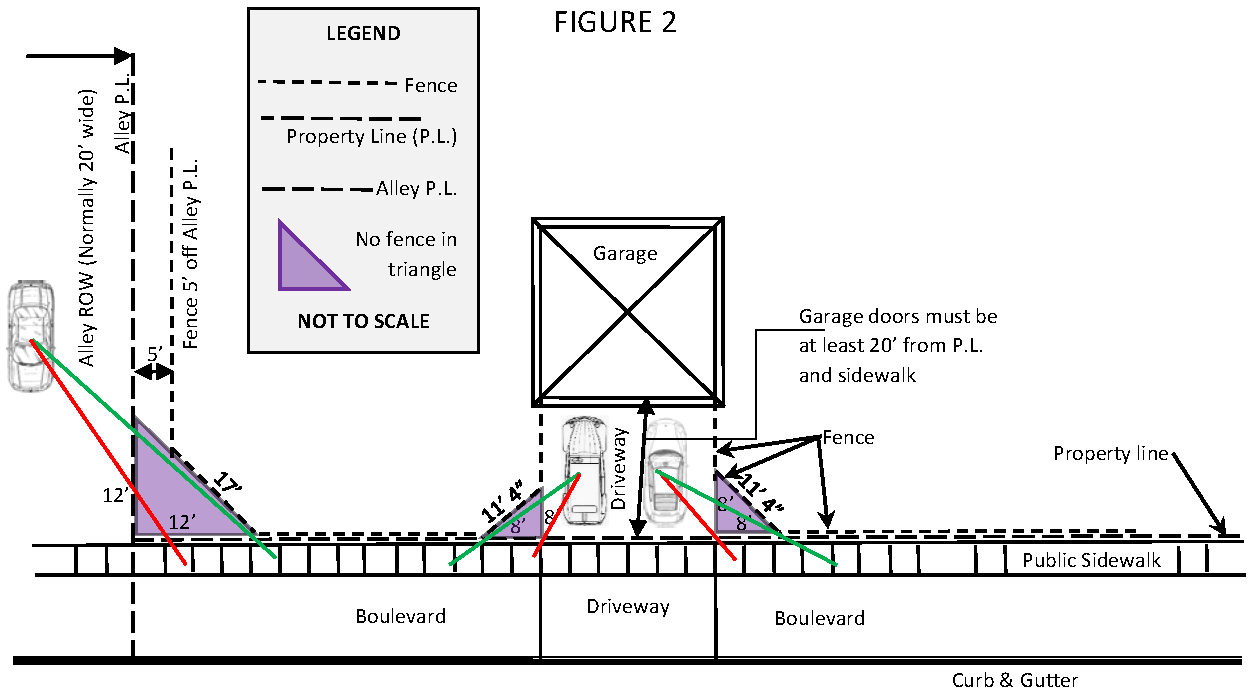
Safety and Visibility at Sidewalk and Driveway Intersection. At the intersection of a driveway (it is assumed that the driveway is at least as wide as the side of the garage that faces the street) and the public sidewalk no fence is allowed in a triangle shaped area defined as 8 feet along the side of the driveway and 8 feet along the sidewalk. Nothing can be erected, installed or any plant established or transplanted with a mature height of more than 12 inches in the triangle that will obstruct the view through the area. Refer to Figure 2.
_____
(e)
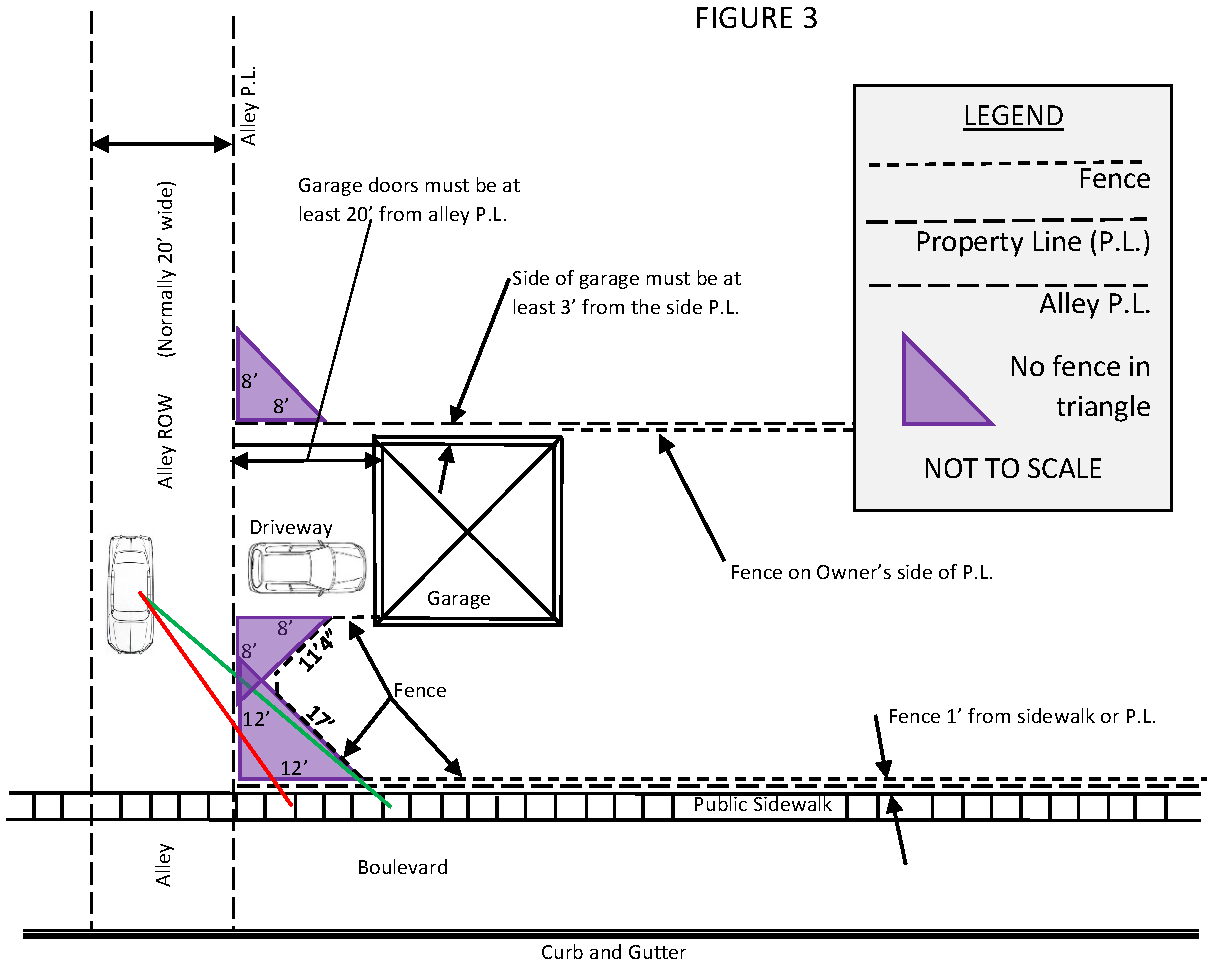
Safety and Visibility at Driveway and Alley Intersection. At the intersection of a driveway (it is assumed that the driveway is at least as wide as the side of the garage that faces the alley) and the public alley no fence is allowed in a triangle shaped area defined as 8 feet along the side of the driveway and 8 feet along the alley property line. Nothing can be erected, installed or any plant established or transplanted with a mature height of more than 12 inches in the triangle that will obstruct the view through the area. Refer to Figure 3.
(Ord. No. 2160-23-389, 6-1-2015)
_____
23.10.036 - Construction and maintenance.
Every fence shall be constructed in a substantial, workmanlike manner and of substantial material reasonably suitable for the purpose for which the fence is proposed to be used. Every fence shall be maintained in a condition of reasonable repair and shall not be allowed to become and remain in a condition of disrepair or danger, or constitute a nuisance, public or private. Any such fence which is, or has become dangerous to the public safety, health or welfare, is a public nuisance, the building inspector is authorized to commence prior proceedings in the municipal court for the abatement thereof. Link fences, wherever permitted shall be constructed in such a manner that the barbed end is at the bottom of the fence and the knuckle end is at the top thereof.
(Ord. 985, 1971).
23.10.038 - Barbed and electric wire fences.
Barbed wire and electric fences shall not be permitted, used or constructed except in industrial districts and as hereinafter provided relating to farms.
(Ord. 985, 1971).
23.10.040 - Residential district fences.
(a)
Fences on any corner lot erected within thirty feet of the intersecting curb line shall be subject to Section 23.10.028;
(b)
Except as provided in (a) of this section, fences not exceeding four feet in height may be erected on any part of a lot subject to the visibility and safety limitations in Section 23.10.035;
(c)
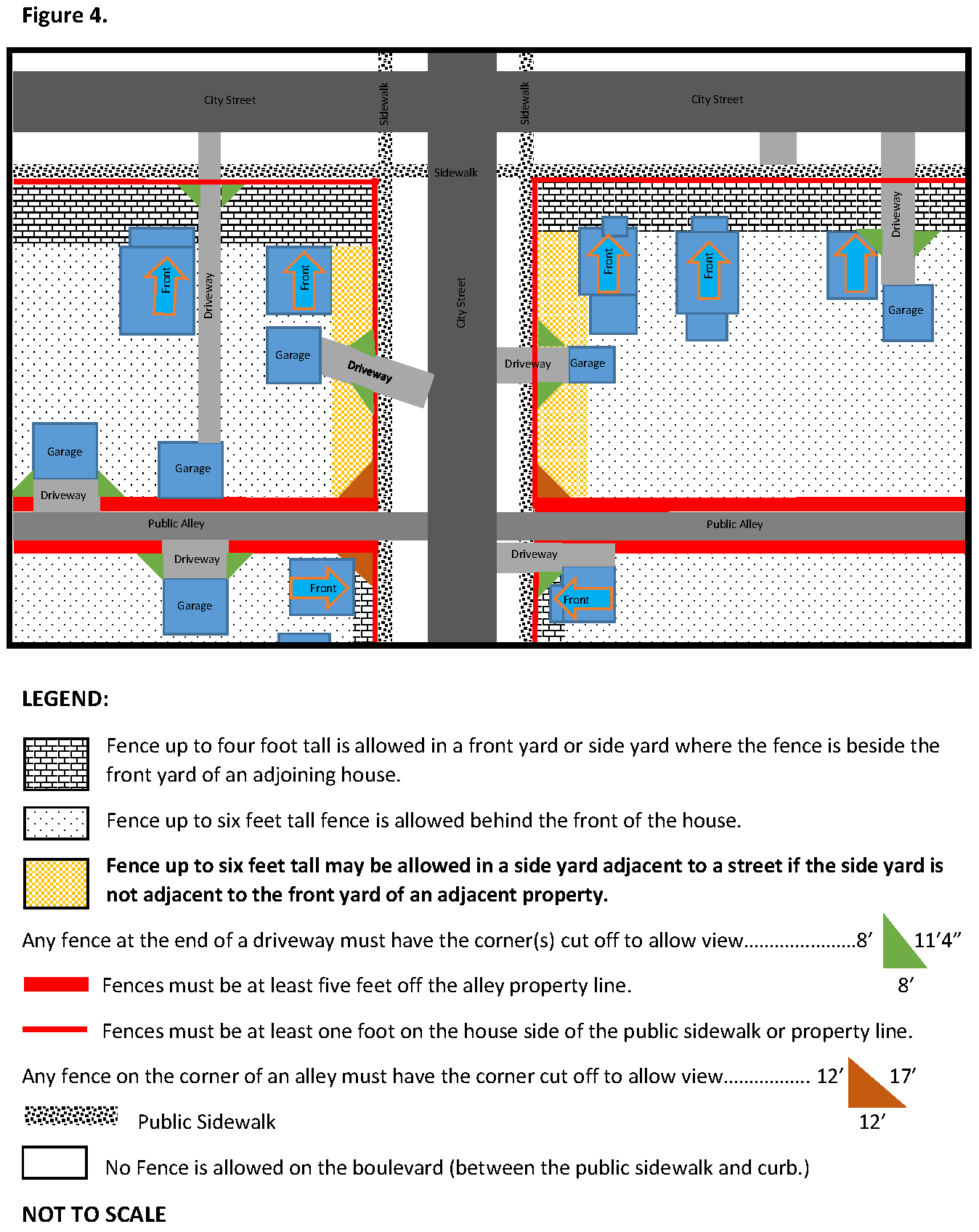
Except as provided in (a) of this section, fences not exceeding six feet in height may be erected on those parts of a lot that are not closer to the street than the principal building except as provided in (d) of this section;
(d)
On corner lots, six-foot fences shall be regulated as in (c) of this section, except that a six-foot fence may also be constructed within the rear yard adjacent to the side street when such yard does not constitute a front yard of an abutting lot. Refer to Figure 4.
(e)
The above regulations shall apply to all lots where the principal use is residential regardless of the type of zoning district in which the lot is located.
_____
(Ord. 1480, 1983: Ord. 985, 1971; Ord. No. 2160-23-389, 6-1-2015)
23.10.042 - Business district fences.
Property line fences within any business district shall not exceed six feet in height except that the governing body may grant a conditional use permit for a fence up to eight feet in height provided:
(a)
The applicant has an approved open sales lot; or
(b)
Open sales lot classified as a nonconforming use; or
(c)
Has a commercial or industrial operation which requires the storage of equipment outside the building; or
(d)
The use could be dangerous to the public; or
(e)
The use if for security purposes and the applicant can show that a fence of six feet will not be adequate to provide the security needed.
(Ord. 985, 1971).
23.10.044 - Industrial district fences.
Property line fences in any industrial district shall not exceed ten feet in height except that:
(a)
Fences erected along a property line in common with a "R" residential district shall be subject to the provisions herein described in "R" residential district fences;
(b)
Fences in industrial districts which are primarily erected as a security measure may have arms projecting into the applicant's property on which barbed wire can be fastened commencing to a point at least seven feet above the ground or may have arms projecting out on which barbed wire can be fastened commencing at least seven feet above the ground and set back from the property line so no part of the arms project over the property line.
(c)
Such fence shall not be erected within the landscaped portion of the front yard of any industrial establishment.
(Ord. 1612 (part), 1990: Ord. 985, 1971).
23.10.046 - Agricultural district fences.
Boundary line fences on land used for an agricultural purpose shall be constructed on private property and may be of such height and material to provide the security desired subject to Section 23.10.028.
(Ord. 985, 1971).
23.10.048 - Reserved.
Editor's note— Ord. No. 2160-23-389, adopted June 1, 2015, repealed § 23.10.048, which pertained to special purpose fences and derived from Ord. 1612(part), 1990; Ord. 985, 1971.
23.10.050 - Public utility services.
This title shall not apply to underground structures which are an integral part of a system for public transportation or for transmitting power, water, heat, communications, CATV, gas or sewage by any public utility, and located on public lands, easements or rights-of-way authorized or permitted by statutes, ordinances, franchise or permit. Provisions of this title shall apply to all such utility buildings.
(Ord. 985, 1971).
23.10.052 - Land reclamation and mining.
Land reclamation and mining shall be permitted in all districts by conditional use permit. The conditional use permit shall include as a condition thereof in approved finish grade plan which will not adversely affect the adjacent land, an approved program for regulating the type of fill permitted, for control of rodents, fire, vehicular ingress and egress, hours of operation, unstable slopes, material dispersed from wind or hauling of material to or from the site and general maintenance of the site.
(Ord. 985, 1971).
23.10.054 - Structures in public right-of-way.
No structure shall be located within the public right-of-way except in compliance with this title and other provisions of regulations contained in the municipal code.
(Ord. 985, 1971).
23.10.056 - Installation and location of wind energy conversion systems.
Wind energy conversion systems shall be considered as an accessory structure and shall be regulated as such except as amended in this section:
(1)
No systems shall be installed for the purpose of generating power as a commercial enterprise except in areas zoned B-3, I-1 and I-2, where such use shall require a conditional use permit. This section shall not preclude the sale of surplus energy to a local utility company;
(2)
The minimum distance the stem shall be from any property line and overhead utility lines shall be the height of the tower plus the radius of the rotor;
(3)
Access to the system shall be limited by either a six foot fence around the tower base or by not having any tower climbing apparatus within twelve feet of the ground;
(4)
The height of such towers constructed in R-O districts shall not exceed sixty feet in height;
(5)
All systems shall be located and installed in compliance with the Federal Aeronautics Administration regulations;
(6)
Systems are permitted in the A, R-O, B-3, I-1 and I-2 districts on lots two acres or more in size.
(Ord. 1504, 1984).
23.10.058 - Installation and location of transmission receiving antenna.
Transmission receiving antenna shall be considered a permitted accessory structure or building in all zoning districts and regulated as such except as herein amended:
(1)
Shall be anchored in place in accordance with the city's building regulations;
(2)
Except for temporary installations not exceeding fourteen days, shall not be mounted on any transportable chassis or trailer;
(3)
Antennas erected on a roof of a single-family or two-family structure or related accessory structure shall not exceed three feet in diameter;
(4)
An antenna erected on a roof shall be at least ten feet from the front face of the building;
(5)
Antennas erected on the ground or on a structural support shall:
(a)
Be located in compliance with the setback requirements established for accessory structures, and shall not be located to the front of a principal building,
(b)
If over ten feet in diameter and erected within the R-1, R-2, R-3, R-4, R-5, R-6 and R-7 districts on lots less than two acres in size shall require a conditional use permit.
(Ord. 1518, 1985).

