
Indian Trail City Zoning Code
DIVISION 1000
PARKING
Chapter 1040 Stacking Spaces For Drive-Through Businesses
In addition to meeting the off-street parking requirements of this section, drive-through facilities (as-defined) shall comply with the minimum stacking space standards established by the table below. The design and layout of required queuing lanes and stacking spaces must not interfere with circulation and traffic flow on the site and may not interfere with access to parking spaces.
Table 1000-4: Drive-Through Vehicle Stacking Space Requirements
| Type of Use | Minimum Stacking Spaces | Measured From |
| Bank, teller lane | 4 | Teller window |
| Bank, ATM | 3 | Teller machine |
| Restaurant, with drive through | 6 plus 4 to pick-up window | Order box |
| Car Wash, automatic | 6 | Bay entrance |
| Car Wash, self-service | 3 | Bay entrance |
| Car Wash, full service | 4 | Bay entrance |
| Auto Service Station, gas pump island | 30 feet from the end of each island | |
| Unlisted | ** |
** Requirement for uses not specifically listed may be determined by the Planning Director based upon the requirement for comparable uses and upon the particular characteristics of the use. As an alternative the applicant may submit a study on the need for queuing spaces from a qualified traffic engineer.
Figure 1000-1: Drive-through businesses must have adequate stacking spaces.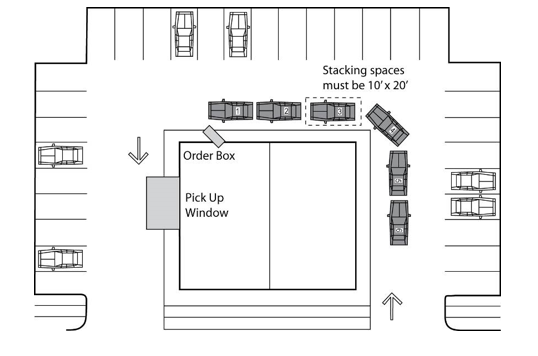
O210209-347
393
397
410
423
1010.010 Applicability And Basic Requirements
- All developments shall provide a sufficient number of parking spaces to accommodate the number of vehicles likely to be attracted to the development. However, in an effort to minimize impervious surfaces that can cause stormwater quantity and quality problems, the number of parking spaces needed should not be based upon rare seasonal peak demands.
- Each land use or activity within the Town shall provide and maintain off-street parking in compliance with these regulations for residents, employees, customers, visitors or others who use or occupy the homes, businesses, offices, or other types of establishments.
- Off-street parking will be constructed and available to serve the use or business at the time the business or use is established. Parking must be available at the following times:
- At the time a certificate of occupancy is issued for a building or structure to be occupied.
- At the time any principal or ancillary use or building is enlarged or increased in capacity such as adding dwelling units, guest rooms, seats, floor area, employees or other features that increase parking requirements.
- Before the conversion of a building or structure from one use to another where such conversion would trigger an additional parking requirement.
- The Table of Parking Standards represents both the typical minimum number of parking spaces required and the maximum number of parking spaces allowed. For those developments desiring additional parking beyond that required by the parking standards, the total number of parking spaces provided may be increased by up to 25% above that recommended by the parking standards. If additional parking, above the 25% increase, is still desired, the additional parking shall be constructed of permeable pavement or shall be drained directly to a bioretention area or other approved water quality BMP as approved by the Town of Indian Trail.
1010.020 Exemptions, Reductions, And Special Area Standards
- The number of parking spaces in lots of 20 or more spaces may be reduced by two (2) if the developer provides a bicycle rack offering a secure parking area for at least 10 bicycles.
- When the use of a nonresidential property changes additional off-street parking and loading facilities must be provided to serve the new use or occupancy only when the number of parking and loading facilities required for the new nonresidential use exceeds the number of spaces required for the use that most recently occupied the building, based on the minimum parking standards of this Unified Development Ordinance. However, the Planning Director may permit a 25% reduction in the number of parking spaces required for the new use if the Director determines that such a reduction would not adversely affect traffic congestion in the area, would not lead to parking “spillover” to adjoining residential neighborhoods, and that the grant of a parking reduction would encourage the reuse and redevelopment of vacant storefronts and other properties.
- The minimum parking ratios of Section 1020.010 are reduced by 25% within the Downtown Master Plan Districts, and the Mixed Use and Sub-Regional Activity Center Overlays. Within the Downtown districts, and the Mixed Use and Sub-Regional Activity Center Overlays, the parking ratios of Section 1020.010 may be further reduced through a planned development application that demonstrates a plan or strategy for centralized, shared parking accessible to all patrons and employees of a mixed use development. All downtown parking reductions allowed by this section are subject to the approval of the Planning Director.
Amended by Ord. O210209-347 on 2/8/2021
Adopted by Ord. 393 on 11/14/2023
Amended by Ord. 397 on 3/26/2024
1020.010 Minimum Parking Requirements
Except as otherwise expressly stated, off-street parking for motor vehicles must be provided in accordance with the following minimum ratios. The Town Council recognizes that the Table of Parking Requirements cannot cover every possible situation that may arise. Therefore, in cases not specifically covered, the permit-issuing authority is authorized to determine the parking requirements on the basis of the most similar use within this table.
Table 1000-1: Minimum Parking Requirements (1)
| Use Category | Specific Use | Parking Requirement | Bike Rack Requirement |
| Household Living (2) | Single-Family Detached | 2 spaces per unit plus 1 space per room after the first 3 bedrooms Garages do not count as parking spaces | NA |
| Two-Family Dwelling | 2 spaces for each unit, except that one-bedroom units require only 1 space Garages do not count as parking spaces | NA | |
| Townhouse/ Condominium | 2 spaces for each unit plus 1 guest space for every eight (8) units Garages do not count as parking spaces Townhouse units with corresponding dwelling parking spaces in the front or off an alley must have a minimum of three (3) feet between neighboring concrete dwelling parking spaces - a minimum of 1.5 feet divided between each townhouse unit owner. | NA | |
| Multifamily Dwelling including independent senior housing | 1 1/2 spaces per one-bedroom unit; 2 spaces per two-bedroom unit; 2 1/2 spaces per unit with three or more bedrooms. Plus 1 visitor parking for every 4 parking spaces Garages do not count as parking spaces | 1 space per 15 vehicle spaces | |
| Independent Senior Housing | 1 space per unit, plus 1 space per staff at maximum shift Garages do not count as parking spaces | NA | |
| Manufactured, Modular, Mobile Home | 2 spaces per unit Garages do not count as parking spaces | NA | |
| Clustered Mail Box Unit | 1 parking space (space must have sign for mail box use only) | NA | |
| Mail Kiosk | 2 parking spaces (spaces must have sign for mail box use only) | NA | |
| Group Living/ Care Facilities | Family Homes for Persons with Disabilities (small and large) | 1 space per 3 residents Garages do not count as parking spaces | NA |
| Homes for the Handicapped, Aged, or Infirm including Nursing Homes | 2 spaces for every 5 beds, except for uses exclusively serving children under 16, in which case 1 space for every 3 beds Garages do not count as parking spaces | NA | |
| Child Care Homes | 1 space for every two employees on maximum shift Garages do not count as parking spaces | NA | |
| Day Care Center | 1 space per employee plus 4 spaces per 1000 square feet of floor area. Required parking may be reduced for day care centers with designated pick-up and drop-off area in an amount determined by the Planning Director. Garages do not count as parking spaces | NA | |
| Halfway Houses | 1 space per 3 bedrooms and 1 space per employee Garages do not count as parking spaces | NA | |
| Animal Services | Horse Stables | 1 space per horse at maximum capacity | NA |
| Veterinarian/ Kennel - Indoor | 1 space per 400 square feet of floor area | 1 space per 25 vehicle spaces | |
| Veterinarian/ Kennel - Outdoor | 1 space per 400 square feet of floor area of building plus 1 space per 10 cages for outdoor facilities | 1 space per 25 vehicle spaces | |
| Other | 1 space per 400 square feet of floor area | 1 space per 25 vehicle spaces | |
| Commercial/ Retail/ Office | Adult Use/ Sexually Oriented Business | 10 spaces per 1,000 square feet of gross floor area plus 1 space for every 4 seats in any assembly area | 1 space per 20 vehicle spaces |
| Bar, Nightclub, Taverns | 10 spaces per 1,000 square feet of gross floor area plus 1 space per four seats located outdoors, or 1 space per 4 seats, whichever is greater | 1 space per 25 vehicle spaces | |
| Bed and Breakfast | 1 space per rented room plus parking for any permanent residents consistent with the other requirements of this table | 1 space per 25 vehicle spaces | |
| Car Wash | 1 space for every 3 employees on the maximum shift for a manual or conveyor type car wash and in the case of a self-serve car wash, 2 parking spaces per bay | NA | |
| Convenience Store | 5 spaces per 1,000 square feet of gross floor area | 1 space per 25 vehicle spaces | |
| Extended Stay Facility/ Hotel | 1 space per room plus 1 space for every 2 employees on the maximum shift | 1 space per 25 vehicle spaces | |
| Flex Space - Retail | 1 space per 500 square feet of retail/office space plus 1 space per 2,000 square feet of warehouse/light industrial space | 1 space per 25 vehicle spaces | |
| Fuel Sales | 5 spaces per 1,000 square feet of gross floor area of building devoted primarily to gas sales operation, plus 1 parking space per pumping station | 1 space per 25 vehicle spaces | |
| Hotel/ Motel | 1 space per room plus 1 space for every 2 employees on the maximum shift | 1 space per 25 vehicle spaces | |
| Indoor Entertainment Facility including Bowling Alleys, Skating Rinks, Squash Courts, Billiards and Pool Halls | 5 spaces per 1,000 square feet within an enclosed building plus 1 space for every 3 persons for facilities with seating for visitors to watch participant sports | 1 space per 20 vehicle spaces | |
| Office Uses | 3.5 spaces for every 1,000 square feet of gross floor area | 1 space per 25 vehicle spaces | |
| Restaurant - Drive-Thru | 1 space per 150 square feet of floor area or 1 space per 5 seats, whichever is greater | 1 space per 25 vehicle spaces | |
| Restaurant - Sit-Down | 1 space per 150 square feet of floor area or 1 space per 5 seats, whichever is greater | 1 space per 25 vehicle spaces | |
| Retail Store, General | 4 spaces per 1,000 square feet of floor area | 1 space per 25 vehicle spaces | |
| Retail Super Store | 4 spaces per 1,000 square feet of floor area; 4.5 per 1,000 square feet of floor area for stores over 100,000 square feet | 1 space per 25 vehicle spaces | |
| Shopping Center | 4 spaces per 1,000 square feet of floor area; 4.5 per 1,000 square feet of floor area for shopping centers over 100,000 square feet | 1 space per 25 vehicle spaces | |
| Theater | 1 space for every 4 seats | 1 space per 20 vehicle spaces | |
| Theater - Drive-In | 1 space per speaker outlet | 1 space per 20 vehicle spaces | |
| Vehicle Repair | 1 space per employee during the busiest shift plus 2 spaces per service bay | NA | |
| Vehicle Sales or Rental | 5 spaces per 1,000 square feet of floor area plus 1 space per employee during the busiest shift plus 1 space for each 5,000 square feet of outdoor storage area | 1 space per 25 vehicle spaces | |
| Water Slide, Miniature Golf, Skateboard Parks | 1 space for every 300 square feet of gross floor area | 1 space per 20 vehicle spaces | |
| Other | 1 space for every 300 square feet of gross floor area | 1 space per 20 vehicle spaces | |
| Community/ Civic/ Education/ Religious | Ambulance Service, Rescue Squad, Police Station | 5 spaces per 1,000 square feet of floor area | 1 space per 15 vehicle spaces |
| Business Schools | 1 space per 5 seats within classrooms or assembly spaces | 1 space per 15 vehicle spaces | |
| College/ University | 1 space per 5 seats within classrooms or assembly spaces | 1 space per 15 vehicle spaces | |
| Community Center | 3.3 spaces per 1,000 square feet of floor area | 1 space per 15 vehicle spaces | |
| Detention Center | 1 space per employee during the busiest shift plus 1 visitor space per 10 inmates | 1 space per 15 vehicle spaces | |
| Library, Museum, Art Gallery, Art Center | 3.3 spaces per 1,000 square feet of floor area per 15 vehicle spaces | 1 space per 15 vehicle spaces | |
| Religious Institution | 1 space for every 4 seats plus 4 spaces per 1,000 square feet of non-assembly space | 1 space per 15 vehicle spaces | |
| Schools - Public or Private | - 2 spaces per classroom or office in elementary schools - 5 spaces per classroom or office in high schools | 1 space per 15 vehicle spaces | |
| Trade/ Vocational | 1 space per 5 seats within classrooms or assembly spaces | 1 space per 15 vehicle spaces | |
| Other | 3.5 spaces per 1,000 feet of floor area | 1 space per 15 vehicle spaces | |
| Healthcare/ Medical | Child Care Institutions | 1 space per 3 beds | 1 space per 25 vehicle spaces |
| Continuing Care Facility | 3 spaces per 5 beds except government sponsored facilities for low income households or public/ private facilities for elderly populations which require 1 space per 5 beds | 1 space per 25 vehicle spaces | |
| Hospital | 2 spaces per bed | 1 space per 25 vehicle spaces | |
| Medical Clinic | 6.6 spaces per 1,000 feet of floor area | 1 space per 25 vehicle spaces | |
| Medical Office | 4 spaces for every 1,000 square feet of floor area | 1 space per 25 vehicle spaces | |
| Mental Health Facility | 1 space for every 2 employees on maximum shift | 1 space per 25 vehicle spaces | |
| Nursing Care Institutions and Intermediate Care Institutions | 3 spaces for every 5 beds | 1 space per 25 vehicle spaces | |
| Other | 4 spaces per 1,000 square feet of floor area | 1 space per 25 vehicle spaces | |
| Parks/ Recreation & Open Space | Cemetery | 1 space per 50 internment plots | NA |
| Golf Course or Country Club - Private | 5 spaces per 1,000 square feet within an enclosed building plus 2 spaces per tee box | 1 space per 20 vehicle spaces | |
| Golf Course - Public | 5 spaces per 1,000 square feet within an enclosed building plus 2 spaces per tee box | 1 space per 20 vehicle spaces | |
| Gym, Spa, Indoor Tennis Court or Pool - Private | 5 spaces per 1,000 square feet within an enclosed building plus 1 space for every 3 persons for facilities where visitors watch participant sports | 1 space per 20 vehicle spaces | |
| Outdoor Athletic Facility - Private | 5 spaces per 1,000 square feet within an enclosed building plus 1 space for every 3 persons for facilities with seating for visitors to watch participant sports | 1 space per 20 vehicle spaces | |
| Public Park | 5 spaces per 1,000 square feet within an enclosed building plus 1 space for every 3 persons for facilities where visitors watch participant sports | 1 space per 20 vehicle spaces | |
| Public Swimming Pool, Tennis Courts, Golf Course | 5 spaces per 1,000 square feet within an enclosed building plus 1 space per 3 persons for facilities like swimming pools where a maximum capacity has been established | 1 space per 20 vehicle spaces | |
| Other | 1 space per 5 seats in any facility with viewing stands or seating areas (permanent or temporary) | 1 space per 20 vehicle spaces | |
| Transportation Uses | Bus Passenger Terminal | 5 spaces per 1,000 square feet of floor area | 1 space per 20 vehicle spaces |
| Taxicab or Limousine Operations or Facility | 1 space per employee | NA | |
| Industrial | Aviation Service | 1 space per employee plus 1 visitor space per 200 square feet of office space | 1 space per 25 vehicle spaces |
| Flex Space - Light Industrial | 1 space per 2,000 square feet of warehouse/light industrial space plus 1 space per 500 square feet of retail/office support space | 1 space per 25 vehicle spaces | |
| Other | 1 space per 2,000 square feet of warehouse space plus 2 spaces per 1,000 square feet of office floor area plus 1 space per 1,000 square feet of outdoor work areas. When a proposed building would accommodate multiple tenants, the parking requirements will be calculated on the basis of the floor area for each tenant. | 1 space per 25 vehicle spaces | |
| Light Industrial Service | 2 spaces per 1,000 square feet of floor area | 1 space per 25 vehicle spaces | |
| Manufacturing and Production | 1 space per employee during the busiest shift | 1 space per 25 vehicle spaces | |
| Reclamation Landfill | 1 space per employee on the busiest shift plus 1 space per vehicle used in facility operations | NA | |
| Recyclable Materials Collection | 1 space per 2 employees on maximum shift plus 1 space per vehicle used in facility operations | NA | |
| Resource Extraction | 1 space per employee on the busiest shift | NA | |
| Salvage Yard | 1 space per 2 employees on the maximum shift but not less than 1 space per 5,000 square feet of area devoted to salvage yard use | NA | |
| Sanitary Landfill | 1 space per 2 employees on maximum shift plus 1 space per vehicle used in facility operations | NA | |
| Self-Service Storage | 1 space per employee during the busiest shift plus 2 spaces per 100 storage units | 1 space per 25 vehicle spaces | |
| Truck Terminal | 1 space per employee on maximum shift | NA | |
| Warehouse and Freight Movement | 1 space per employee on the busiest shift but not less than 1 parking space per 5,000 square feet of area devoted to warehousing or storage use (whether inside or outside) | 1 space per 25 vehicle spaces | |
| Wholesale Sales | 1 space for every 2 employees on maximum shift | 1 space per 25 vehicle spaces | |
| Other | 1 space per 2 employees on maximum shift plus 1 space per vehicle used in the operation of the business | 1 space per 25 vehicle spaces | |
| Agribusinesses | Farmers Markets | 1 space per 1,000 square feet of lot area used for product display or sales | 1 space per 25 vehicle spaces |
| Greenhouses | 1 space per 2 employees on maximum shift | 1 space per 25 vehicle spaces | |
| Utilities | Major Utility | 1 space per employee plus 1 space per each fleet vehicle kept at the site | NA |
| Minor Utility | None | NA | |
| Telecommunication Facility | 1 space for each service vehicle | NA |
(1) Electric vehicle charging stations shall be clearly marked "EV CHARGING ONLY".
(2) Refer to any applicable lot coverage limits in DIVISION 500 BASE ZONING DISTRICTS and "E." in Section 1020 for the residential front yard parking surface maximum.
1020.020 Parking Determinations Based On Need
- In recognition that inflexible application of the minimum parking requirements in Section 1020.010, may result inadequate or excessive parking requirements, the Planning Director may permit deviations from the presumptive requirements of this Chapter and may require more parking or allow less parking whenever they find that such deviations are more likely to satisfy the basic purposes of these parking requirements.
- Any allowed or required deviation from the presumptive parking requirements set forth in this Chapter shall be entered on the permit along with the reasons for allowing or requiring the deviation.
- If the applicant does not wish to accept the Planning Director's decision and requirements, the applicant may appeal the determination of the Director to the Planning and Zoning Board in a quasi-judicial proceeding as outlined in Chapter 380.
1020.030 Parking, Loading, And Vehicle/Equipment Storage For Residential Use
- Driveway and Dwelling Parking Space Design
- Parking and driveway areas must be constructed of permanent non-erodible surface treatment such as pavers, poured concrete or asphalt. Construction of these parking and driveway areas must follow the requirements in the Indian Trail Land Development Standards Manual. Any proposed deviations from these surface treatments must be considered by the Engineering Director.
- As confusion can occur with residential parking areas being called “driveways”, this ordinance shall refer to parking spaces in the front or side of detached or attached residential homes as “dwelling parking spaces”. Single-Family detached and attached residential developments shall meet the following size standards:
Table 1000-2: Single-Family Detached and Attached Dwelling Parking Spaces** All driveways shall be surfaced with permanent, non-erodible material such as concrete, asphalt, or pavers.Lanes Width Length Single Lane Dwelling Parking Spaces (min.) 10 feet 44 feet Double Lane Dwelling Parking Spaces (min.) 20 feet 22 feet
- Parking and driveway areas must be constructed of permanent non-erodible surface treatment such as pavers, poured concrete or asphalt. Construction of these parking and driveway areas must follow the requirements in the Indian Trail Land Development Standards Manual. Any proposed deviations from these surface treatments must be considered by the Engineering Director.
- General Residential Vehicles and Utility Trailers
For the purposes of administering and enforcing the provisions in this Section 1020.030, general residential vehicles and utility trailers are defined as follows:- General Residential Vehicles
General residential vehicles include but is not limited to passenger cars, passenger vans, pickup trucks, motorcycles, and small recreational vehicles 15 feet or less in length. These vehicles shall meet the following:- Licensed for use on public streets,
- Designed primarily for the transportation of people as opposed to equipment, freight or other vehicles, and
- Sold primarily to individuals for personal use.
- Licensed for use on public streets,
- Recreational Vehicles and Equipment
Recreational vehicles and equipment include but is not limited to camping structures with or without their own propulsion, boats, jet skis, and trailers used for hauling recreation vehicles or equipment. Recreational vehicles with and without propulsion are defined in Section 1620.180 Definitions - "R" under "Recreation Vehicles (RV) - Motorized and Non-Motorized. - General Residential Utility Trailers
General residential utility trailers include but is not limited to enclosed trailers, open-air or flatbed trailers, and various watercraft trailers.
- General Residential Vehicles
- Household Parking Locations
No person may park or store a general residential vehicle or utility trailer other than in an unenclosed area on any lot in a residential zoning district, except when necessary for loading and unloading or within the performance of a service to or upon property in the block the vehicle is parked, or as specifically authorized by a Home Occupation Permit. Recreational vehicles longer than 15 feet and equipment are subject to the additional requirements:- Operable Vehicles
All operable vehicles not stored in an enclosed area such as a garage shall be stored either in the driveway dwelling parking space or on-street in compliance with on-street parking standards. - Inoperable Vehicles
Inoperable vehicles of any type shall not be located on site unless in an enclosed garage or covered outbuilding.
- Operable Vehicles
- Large and Select Medium Commercial Vehicles
No person may park or store large commercial vehicles and select medium commercial vehicles, as defined in Division 1600 of this ordinance, in any off-street parking area in a residential zoning district, except when necessary for loading and unloading or within the performance of a service to or upon property in the block the vehicle is parked. - Recreational Vehicles and Utility Trailers
No person may park or store a recreation vehicle or utility trailer of any size in any off-street parking area in a residential zoning district. A recreation vehicle or utility trailer of any length shall not be stored in the driveway or dwelling parking spaces in the house front yard or side yard adjacent to a street. If lot access allows, recreation vehicles and utility trailers may be parked in the rear yard, or an interior side yard if it is placed behind the front building line. - Parking on Impervious Surface Locations
Parking on lawn and landscaped areas or on exposed soil areas is prohibited. - Dwelling Parking Expansion - Homes Not in a Subdivision
For single family detached, two-family, modular and manufactured (mobile) homes not in a subdivision, a maximum of 35% of the front yard may be used for parking. Driveway and dwelling parking space areas in the right-of-way, connecting to the roadway, shall not be expanded. Dwelling parking space and sidewalk expansions will require a review for a permit. Refer to the Indian Trail Land Development Standards (ITLDS) for requirements and details for road and sidewalk construction. - Dwelling Parking Expansion – Homes in a Major Residential Subdivision
Within a residential major subdivision, the maximum driveway and dwelling parking space coverage is per the parking area in the approved site construction plans. The following shall apply to dwelling parking space expansion requests:- Expansions will be allowed in such subdivisions up to a driveway and dwelling parking surface maximum of 35% of the front yard.
- Side-access dwelling parking spaces with or without garages shall have a maximum width of 40% of the distance from the front property line to the rear corner of the house, but the actual parking must be located behind the primary house front façade.
- For multifamily, refer to D. Parking Location/Orientation under Section 1310.070 Multiplex and Apartment/Condo Buildings: Attached and Multifamily.
- Expansions will be allowed in such subdivisions up to a driveway and dwelling parking surface maximum of 35% of the front yard.
- The Planning Director may approve driveways and required parking areas to be surfaced with four (4) inches of gravel or crush and run subject to the following criteria:
- A concrete apron meeting Indian Trail's Land Development Standards manual will need to be provided with any gravel driveways.
- Properties located outside an established subdivision that are over three (3) acres in size and where the residential properties near the property feature unpaved driveways.
- Properties where the public or private roadway providing direct access to the property is surfaced with an unpaved material.
- Existing properties constructed prior to the adoption of this section, 1020.030, on February 2, 2021 with parking area improvements in violation of this section shall be considered legally nonconforming.
- See Section 13120.020 for driveway, street and sidewalk requirements.
Adopted by Ord. O210209-347 on 2/8/2021
Amended by Ord. 397 on 3/26/2024
Amended by Ord. 423 on 1/13/2026
1030.010 Spaces Required
- No bicycle parking is required for residential uses except in the case of planned developments or cluster subdivisions with common recreation areas. Businesses and institutions providing the bicycle parking required by this section are eligible for a reduction in parking space requirements authorized by Section 1010.020.A. The following table establishes the minimum bicycle parking requirements for use groups and specific uses that typically generate significant amounts of traffic including bicycle traffic:
Table 1000-3: Bike Parking Space RequirementsUse Group Specific Use Types Minimum Bike Parking Public/Institutional Uses Libraries, Museums, Public Parks, Hospitals, Post Office 1 bike parking space per 15 parking spaces Planned Developments/Cluster Subdivisions (Residential) Club houses, recreational buildings or facilities, and other amenity areas or facilities 1 bike parking space per 15 parking spaces Assembly Uses Churches, Public and Private Schools, Auditoriums, Stadiums 1 bike parking space per 15 parking spaces Entertainment Uses Skating Rinks, Golf Courses, Theaters, Health Clubs 1 bike parking space per 20 parking spaces Retail and Business Services Convenience stores, Shopping centers, Restaurants 1 bike parking space per 25 parking spaces Employment Uses Offices, Industrial Services, Manufacturing 1 bike parking space per 25 parking spaces - No use is required to provide more than 25 bicycle parking spaces.
- The Planning Director is authorized to waive or modify the number of bicycle parking spaces required for a specific use when the applicant demonstrates to the satisfaction of the Director that the number of spaces required by this Section is not necessary because of the building’s occupancy or the characteristics of the building’s patrons or customers.
1030.020 Bike Parking Design And Location
- Required short-term bicycle parking spaces must be provided in bicycle parking racks and each bike space must have minimum dimensions of two (2) feet in width by six (6) feet in length and a minimum overhead clearance of seven (7) feet. Racks must be affixed securely to the ground or building.
- Bicycle racks must be high-quality, inverted “U”-type construction. Alternative high-quality designs may be required by the Planning Director within the Downtown Master Plan Districts so that there is a consistent design and appearance of bicycle racks within the downtown.
- A use that is required to provide more than 10 bicycle parking spaces may use up to two (2) required vehicle parking spaces for bicycle parking spaces.
1050.010 Accessible Parking Spaces Required
- Accessible parking spaces shall be provided in compliance with the following table and shall be identified with above-ground signs as specified in the U.S. Department of Transportation’s Manual on Uniform Traffic Control Devices and the specifications of the North Carolina Department of Transportation.
Table 1000-5: Accessible Parking Space RequirementTotal Parking Spaces Provided Minimum Number of Accessible Spaces Required Minimum Number Required By Type Regular (8’ + 5’) Van (8’ + 8’) Side Loaded Van 1 to 25 1 0 1 0 26 to 50 2 1 1 0 51 to 75 3 2 1 0 76 to 100 4 3 1 0 101 to 150 5 3 2 0 151 to 200 6 4 2 0 201 to 300 7 5 2 0 301 to 400 8 6 2 0 401 to 500 9 6 2 1 501 to 1,000 2% of total Required total less van spaces 1 in 4 total accessible spaces 1 for every 3 van spaces 1,001 and Over 20 plus 1 for each 100 over 1,000 Required total less van spaces 1 in 4 total accessible spaces 1 for every 3 van spaces Refer to 4.1.2 (5) of the Americans With Disabilities Act (ADA) and 4.1.2 (5) (d) for medical care facilities. - All accessible signs must conform to the Manual of Uniform Traffic Control Devises (MUTCD).
- All 12 inches x 18 inches accessible signs must be mounted at seven (7) feet from grade to the bottom edge of the sign face. The mounting height may be reduced to five (5) feet above grade if placed in an area between the sidewalk and the building face in which pedestrian are not expected to use.
- Accessible parking spaces serving a particular building shall be located on the shortest route of travel which shall be accessible from adjacent parking to an accessible entrance.
- In buildings with multiple accessible entrances with adjacent parking, the accessible parking spaces must be dispersed and located closest to the accessible entrances. In parking facilities that do not serve a particular building, accessible parking must be located on the shortest route of travel to an accessible pedestrian entrance of the parking facility.
- Parking access aisles must be part of an accessible route to the building or facility entrance. Two (2) accessible parking spaces may share a common access aisle.
- Persons using the accessible spaces must not be required to cross a travel way or maneuver behind a backing vehicle to reach the access aisle or accessible route to the building entrance.
- Accessible parking spaces may not be located adjacent to storm drains or stormwater retention facilities.
Figure 1000-2: Accessible Parking Spaces (13 feet by 18 feet) and Van Accessible Spaces (16 feet by 18 feet).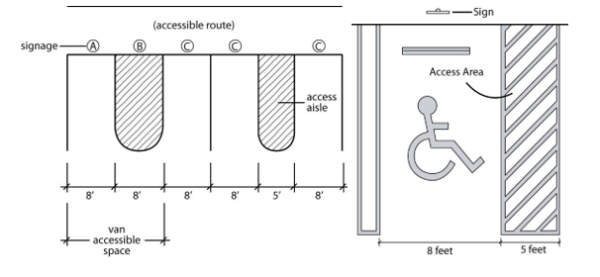
1060.010 Loading And Unloading Areas
- Off-street loading and unloading area must be provided in accordance with this Section in order to accommodate the delivery or shipment operations of businesses and institutions in a safe and convenient manner.
- The Planning Director may reduce or eliminate the requirements for off-street loading facilities within the Downtown Master Plan Districts.
- The loading and unloading area must be of sufficient size to accommodate the numbers and types of vehicles that are likely to use this area. The following table indicates the number and size of spaces that, presumptively, satisfy the standard set forth in this subsection. In recognition that inflexible application of the requirements in this Section may result in inadequate or excessive loading requirements, the Planning Director may require more or less loading or unloading space based on a determination of what is necessary to ensure safe and convenient shipping and deliveries to the property.
Table 1000-6: Loading and Unloading Area Size RequirementSpecific Land Use Type Size: (Square feet of gross floor area) Required Number and Size of Loading and Unloading Spaces 10 feet x 25 feet 10 feet x 50 feet Office, Restaurant, Hotel or Motel 10,000—99,999 1 0 100,000—149,999 0 1 150,000 and over 0 2 Retail establishments, shopping centers, and industrial uses 0—4,999 1 0 5,000-19,999 0 1 20,000—49,999 0 2 50,000-79,999 0 3 80,000-99,999 0 4 100,000-149,999 0 5 150,000 and over 0 6 - Required loading and unloading areas shall be so located and designed that the vehicles intended to use them:
- Can maneuver safely and conveniently to and from a public right-of-way; and
- Complete the loading and unloading operations without obstructing or interfering with any public right-of-way or any parking lot driving aisle.
- Complete the loading and unloading operations without the use or obstruction of any off-street parking required by this Unified Development Ordinance.
- Loading areas within the lots of industrial subdivisions shall be self-contained and each business must be capable of handling its own truck maneuvering and docking requirements. The use of public streets for commercial vehicle staging and/or maneuvering is prohibited. Loading areas shall be located either to the rear or the side of the industrial structures(s) to alleviate unsightly appearances often created by loading facilities. Where such locations are not feasible, loading docks and doors must be landscaped consistent with the requirements of this ordinance and, in addition, must be screened from the public right-of-way by walls, opaque fencing, and opaque entry gates.
1070.010 General Design Standards
Parking and loading areas must be designed so that:
- Vehicles may exit such area without backing onto a public street. This requirement does not apply to driveways serving one or two dwelling units.
- Vehicles cannot overhang property lines, public rights-of-way, or public sidewalks, or tend to bump against or damage any wall, vegetation or other obstruction.
- Vehicles can move without posing a danger to pedestrians or other vehicles and without interfering with parking areas.
- Each parking space and driving aisle will have the dimensions provided in Section 1070.020 and all accessible parking spaces will meet the requirements of Chapter 1050.
- Angled parking spaces shall conform to the dimensions illustrated below. Alternative designs may be allowed by the Planning Director provided it is consistent with the recommended dimensions contained in the latest edition of the Traffic Engineering Handbook published by the Institute of Traffic Engineers.
- The design of large parking areas (more than 250 parking spaces) at retail stores and shopping centers will be subject to site plan review and approval by the Planning Director. The site plans for large retail parking lots will be approved by the Director if the site plan:
- Segments the off-street parking area, visually and functionally, into smaller parking “pods” that reduce the visual and environmental impacts of the parking. Pods will be created by separating the field of parking into areas of no more than 50 parking spaces separated from each other by physical breaks consisting of:
- Landscape strips between parallel rows that are a minimum of seven (7) feet in width; or
- Pedestrian walkways a minimum of five (5) feet in width that incorporate landscaping, lighting, and other pedestrian amenities; or
- Buildings including outbuildings designed and located in a manner that physically separates one field of parking from another.
- Where the Planning Director determines that a site plan and landscape plan effectively reduces the visual impacts of a large field of parking then the size of any parking pod may be increased provided the parking lot design meets the overall objective of this Section.
- Incorporates safe access for pedestrians and bicyclists through the development site through the use of paths designated by special paving materials, separated pedestrian walkways, directional lighting for pedestrians.
- Incorporates traffic calming techniques designed to enhance pedestrian safety.
- Segments the off-street parking area, visually and functionally, into smaller parking “pods” that reduce the visual and environmental impacts of the parking. Pods will be created by separating the field of parking into areas of no more than 50 parking spaces separated from each other by physical breaks consisting of:
- Roll Up/Overhead Doors
Roll up/overhead doors shall not be visible from a street or thoroughfare. Facilities must be oriented on a site to eliminate visibility from the street or thoroughfare or provide adequate screening (i.e. landscaping, walls, fences, and berms) to be approved by the Planning Director.
1070.020 Required Widths Of Parking Spaces And Driving Aisles
Parking spaces and aisle widths shall conform to the following table, which relates aisle widths to parking angles.
Table 1000-7: Geometric Design Standards Parking
| Parking Angle (degrees) | Stall Width (ft) | Stall to Curb (ft) | Aisle Width (ft) | Curb to Curb Width (ft) |
| 0 | 8’-0” | 22’-0” | Parallel Space | |
| 45 | 9’-0” | 18’-8” | 12’ (One-way) | 50’-0” |
| 60 | 9’-0” | 20’-1” | 14’-5” (One-way) | 54’-7” |
| 90 | 9’-0” | 18’-0” | 24’ | 60’ |
1070.030 Location Of Parking And Access Design
- Except as otherwise expressly authorized in this ordinance, required parking spaces must be located on the same lot as the use to be served by the parking.
- No parking lot serving a multi-family use may be located within any required front yard.
- Driveways shall be not less than 10 feet in width for one-way traffic and 18 feet in width for two-way traffic, except that 10-foot wide driveways are permissible for two-way traffic when:
- It provides access to not more than six (6) spaces;
- Sufficient turning space is provided so that vehicles need not back into a public street;
- The use is a low traffic volume use and the public right-of-way has a low traffic volume.
Figure 1000-3: Illustration of Parking Layout and Access Standards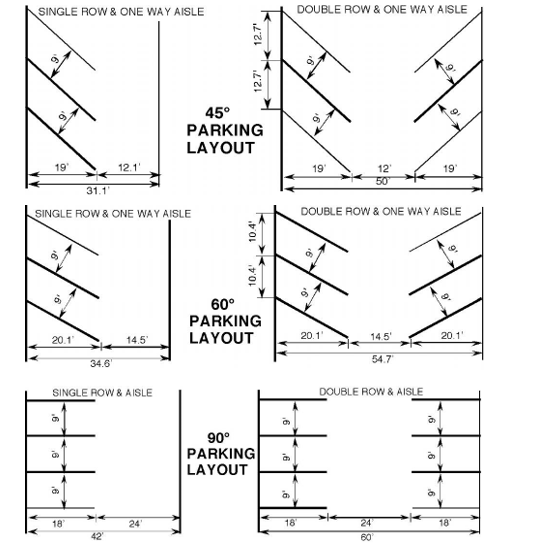
1070.040 Parking And Loading Area Improvement Standards
- All parking lots and vehicular use areas (i.e. parking, maneuvering, circulation, and loading areas) must be graded and surfaced with asphalt or concrete that will protect against potholes, erosion, and dust. The Planning Director may authorize an exception to this requirement for temporary parking associated with a special event or short-term, seasonal activity.
- The perimeter of parking areas with five (5) or more parking spaces shall be defined by curbs and gutter or similar improvements.
- Except in the case of temporary parking lots or parking lots with fewer than five (5) parking spaces, all parking spaces shall be clearly demarcated with painted lines or other markings.
- Where parking facilities are paved with concrete or asphalt such facilities must provide a drainage system along the periphery of the parking lot except where it is determined by the Planning Director that such system is not practical for storm drainage purposes. This provision is not intended to prevent the use of low-impact design (LID) techniques such as breached curb drainage inlets or curb cuts that allow runoff to flow into bioretention cells or biofiltration swales.
- All parking spaces on the interior of parking lots must be provided with wheel guards or curbs if they abut a sidewalk less than seven (7) feet in width or abut any landscape area less than (7) feet in width. Where wheel guards and curbs are required, such improvements must be located so that no part of a parked vehicle may encroach into a pedestrian walkway such that the width of the walkway is less than five (5) feet.
- Parking lots and vehicular use areas must be properly maintained. In particular, parking lot and vehicular use area surfaces shall be kept in good condition and parking space demarcations shall be kept clearly visible and distinct.
1080.010 Parking Determinations Based On Need
- In recognition that inflexible application of the parking standards in Section 1020.010 above, may result inadequate or excessive parking requirements, the Planning Director may permit deviations from the presumptive requirements of Section 1020.010, and may require more parking or allow less parking whenever they find that such deviations are more likely to satisfy the basic purposes of these parking requirements.
- Any allowed or required deviation from the presumptive parking requirements set forth in Chapter 1020 above shall be entered on the permit along with the reasons for allowing or requiring the deviation.
- If the applicant does not wish to accept the Planning Director’s decision and requirements, the applicant may appeal the determination of the Director to the Planning and Zoning Board in a quasi-judicial proceeding.
1090.010 Shared Parking
- Shared parking represents an arrangement where two or more non-residential uses with different peak parking demands (hours of operation) can use the same off-street parking spaces to meet their off-street parking requirements.
- The Planning Director is authorized to approve a shared parking arrangement for non-residential uses that operate at different hours or that operate at different days. The Planning Director may authorize shared parking after making a finding that there is no substantial conflict in the principal operating hours of the uses for which the shared parking is proposed.
- For the purposes of this section, the following uses are considered daytime uses: office uses, industrial uses; retail uses.
- For the purposes of this section, the following are considered nighttime or Sunday uses: school auditoriums; religious assembly facilities; theaters and similar entertainment uses; sit-down restaurants.
- Any use applying for shared parking must be located within 500 feet walking distance of the parking lot as measured from the entrance of the use to the nearest parking space in the shared use lot.
- An agreement providing for shared use of parking must be executed by the parties involved and be filed with the Planning Director and in a form approved by the Town Attorney. Shared parking facilities will continue in effect only as long as the agreement remains in force. If the agreement is no longer in force then the parking must be provided as otherwise required by this section.
1090.020 Remote Parking
- If some or all of the required number of off-street parking spaces cannot reasonably be provided on the same lot as the use they are serving then spaces may be provided on nearby lots in accordance with the provisions of this Section. These off-site spaces are referred to as satellite parking spaces.
- Satellite parking spaces (except spaces intended for employee use) must be located within 400 feet of the use to be served by such parking. Employee parking may be within 500 feet of the use to be served. These distances will be measured from the main entrance of the use to the nearest parking lot space following a reasonable and safe walking route.
- Such land used for off-site parking must be located in a zoning district within which the use served would be a permitted use or in a Conditional Zoning approval.
- There must be a pedestrian walkway or sidewalk connecting the parking area to the use it is intended to serve.
- There must be satisfactory written evidence of permission by the owner(s) of the area to be used for satellite parking spaces that it will be available to the users of the intended property. The developer must provide a contract or agreement acceptable to the Town’s legal counsel and the developer must also sign an acknowledgment that the continuing validity of the zoning permit depends upon the developers continuing ability to provide the requisite number of parking spaces.
- Satellite parking areas are required to satisfy the general design requirements of Chapter 1070.

