
Indian Trail City Zoning Code
DIVISION 700
SUPPLEMENTARY USE REGULATIONS
Chapter 740 Bed And Breakfast
Bed and breakfast establishments are permissible with a zoning permit in most business districts in accordance with Section 530.020.
Chapter 750 Cemeteries
Cemeteries must be set back at least 40 feet from adjacent property lines and street rights-of-way.
Chapter 760 Commercial Greenhouses And Nurseries
Commercial wholesale greenhouses and nurseries with on premises sales will be permitted by the Planning Director in the RSF district only after demonstrating compliance with the standards of this ordinance through a preliminary site plan review on lots that have street frontage along an arterial street. Commercial wholesale and retail greenhouses and nurseries will be permitted or permitted with conditional zoning as shown in the Table of Permitted Uses in Chapter 570.
Chapter 770 Electric Substations
Electric substations are permissible in all zoning districts with a development permit issued by the Planning Director, subject to the following requirements as well as other relevant provisions of this ordinance.
Chapter 790 Off-Premises Signs (RBD District)
Off-premises signs are permissible in the RBD zoning district for placement on Hwy 74/Independence Blvd with a zoning permit only if and to the extent that such signs comply with one of the two sections below as follows:
Chapter 7100 Livestock And Horse Stables
No person may keep livestock or poultry within 150 feet from an adjoining lot line. Nothing in this subsection shall be construed as authorizing poultry or livestock to be kept except where such uses are authorized under the zoning district regulations.
Chapter 7110 Apiaries/Domestic Beekeeping
The following regulations shall apply to all beehive facilities operating within Town limits.
Chapter 7120 Backyard Chicken Coops
Chicken coops shall be permitted on single-family residential properties provided that the property is at least 1/4 of an acre in size and the yard is sufficiently large to meet the dimensional standards for chicken coops in this section.
Chapter 7130 Landfills Other Than County Owned And/Or Operated
On-site demolition landfills and reclamation landfills less than one acre for noncommercial use shall be permitted in all zoning districts subject to the following provisions:
Chapter 7140 Non-Accessory Golf Driving Ranges And Golf Courses
Golf driving ranges and golf courses are permitted as provided in the Chapter 570 Table of Permitted Uses pursuant to either a zoning compliance permit if permitted by-right or permitted with a Conditional Zoning approval. The proposed use shall satisfy the following requirements.
Chapter 7150 Vehicle Sales And Rental Lots
The intent of this section is to provide standards to address the unique characteristics of this particular business type of new and used vehicle sales and rental lots within the Town of Indian Trail and to establish minimum criteria for all future sales and rental lots.
Chapter 7170 Indoor Firearm Shooting Range Facilities
Indoor Firearm Shooting Range facilities are permitted as provided in Chapter 570 pursuant to a conditional zoning approval or zoning compliance permit. The proposed use shall satisfy the following requirements and shall be entered into the face of the permit:
Chapter 7180 Outdoor Storage And Sales
The purpose and intent of this section is to allow outside storage, display, and sales/rental in the non-residential districts as an accessory use provided that such outside storage, display, and sales/rentals are designated areas that are adequately screened and meet the standards listed within this section.
Chapter 7190 Alcohol Beverage Control (ABC) Store
ABC Store use is permissible within the RBD, GBD, and O-VCD districts only if the proposed use meets the following requirements and permitting process.
O210209-347
397
423
393
410
03-08-2022-373
710.010 General
Accessory uses and structures are permitted in connection with any lawfully established principal use unless otherwise expressly provided in this ordinance, Also, unless otherwise expressly stated, accessory uses and structures are subject to the same regulations as the principal use or structure.
710.020 Time Of Construction
Accessory structures must be constructed in conjunction with or after the principal building. They may not be built prior to the construction of the principal building. Refer to Section 410.090, Expiration of Permits, for permit duration and associated requirements.
710.030 Subordinate Nature
- Accessory uses must be subordinate and clearly incidental to the principal use of the property. Refer to Table 700-1 for accessory structure floor area requirements.
- Accessory structures must be of secondary importance and subordinate to the principal building on the property.
- Accessory structures shall be constructed of similar building materials as the primary home. Refer to “G. Accessory Structure Materials” in Section 710.040 for accessory structure lot and building material standards. See Section 1310.040, Building Material Standards for All Site-Built and Modular Housing, for primary home material standards.
710.040 Lot And Building Standards
- General The lot and building standards of the base zoning district apply to accessory structures unless otherwise expressly stated.
- Interior and Rear Yard Accessory Structure Setbacks In the RSF district, detached accessory buildings must be set back at least 35 feet from all interior lot lines. In all other residential districts, detached accessory buildings must be set back at least five (5) feet from all interior and rear-yard lot lines if they are located behind the rear plane of the primary dwelling.
- Exterior Accessory Structure Setbacks (Street-side for Corner Lots) Street-side setback standards apply to accessory buildings in corner lots. In addition, no accessory building may be located closer to the street than the principal building.
- Separation Detached accessory buildings must be separated by a minimum distance of five (5) feet from all other accessory and principal buildings. Pergolas, gazebos, or other structures that are not enclosed (screened-in structures are considered enclosed) and that are placed adjacent to a rear door and patio, are exempt from this standard.
- Height of Accessory Structures Accessory structures may not exceed 12 feet in height, or the height of the principal building on the same lot, whichever is less. Request for heights beyond the 12-foot maximum shall require a setback from both the side and rear yard setback of two (2) feet for every extra one (1)-foot in height. Example: A 15-foot accessory structure will require a minimum setback of 11 feet from both side and rear yards (15 feet - 12 feet = 3 extra feet; 3 feet x 2 feet = 6 feet additional setback; 5 feet minimum setback + 6 feet additional setback = 11 feet total setback).
- Accessory Structure Maximum Size and Number
Size and number allowances for accessory structures may be found in the table below. In the event a conflict occurs between these provisions and the maximum lot coverage standards (DIVISION 500) then the more restrictive standard will control. Accessory structures exceeding these provisions may be permitted via a Conditional Zoning approval in accordance with this ordinance. In the RSF district, accessory structures associated with permitted agricultural uses may exceed these provisions only after the proposal is reviewed and approved by the Planning Director.
Table 700-1: Accessory Structure Maximum Size and Number of Structures Allowed* Permanently constructed in-ground pools are considered primarily an improvement and shall not count as a structure towards the maximum limit of structures. All in-ground pools shall not count in the calculation of lot coverage and above ground pools shall count in the calculation of lot coverage so a pool may impact permit approval. All surrounding in- or above-ground pool deck surfaces (ex. Concrete, wood, composite, etc. materials) shall count in the calculation of lot coverage with the exception of above-ground pool decking (ex. Wood or composite materials) that is "slatted" with some gap between the material slats.Lot Size
(acres)Maximum Footprint* Maximum
No. of
Structures*Less than 0.35 Lesser of 1,200 sf or 50% of the square footage of ground floor area of the principle structure as identified by tax parcel records. A minimum 400-sf structure is allowed regardless of home size. 1 0.35 to 1.0 Lesser of 1,800 sf or 50% of the square footage of ground floor area of the principle structure as identified by tax parcel records. A minimum 600 square-foot structure is allowed regardless of home size. Aggregate size shall not exceed 5% of the square footage of the lot, when multiple structures are proposed. 2 1.1 to 2.0 Aggregate size shall not exceed 5% of the square footage of the lot, when multiple structures are proposed; in no case shall a single accessory structure be more than 70% of the heated square footage of the principle structure. 3 2.1 to 3.0 Aggregate size shall not exceed 5% of the square footage of the lot, when multiple structures are proposed; in no case shall a single accessory structure be more than 80% of the heated square footage of the principle structure. 3 3.1 to 5.0 Aggregate size shall not exceed 5% of the square footage of the lot, when multiple structures are proposed; in no case shall a single accessory structure be more than 90% of the heated square footage of the principle structure. 3 5.1 or more Aggregate size shall not exceed 5% of the square footage of the lot, when multiple structures are proposed; in no case shall a single accessory structure be more than 125% of the heated square footage of the principle structure. 5 - Accessory Structure Materials
Accessory structures other than accessory apartments shall be constructed of the similar building materials as the primary home if it is visible from a street on any side of the property and not screened. If screened or not visible from a street view, accessory structures in residential and commercial properties may be materials consistent with the neighborhood or area businesses. Wall materials not allowed are CMU block and sheet metal or as determined by the Planning Director. Accessory apartments shall be constructed of same building materials as the primary home.
Amended by Ord. O210209-347 on 2/8/2021
Amended by Ord. 397 on 3/26/2024
Amended by Ord. 423 on 1/13/2026
710.050 Fences And Walls
- General
The general regulations of this subsection apply to all fences and walls, regardless of the zoning district in which they are located.
- Fences or walls shall:
- Be maintained and kept in a reasonable condition and vertical position, and any missing or deteriorated slats, pickets, other fencing material, or structural elements must be replaced in a timely manner with the same quality of material and workmanship.
- All fence support structures must be located on the inside of the fence covering material.
- Be constructed of materials manufactured and marketed for construction of permanent fences.
- Meet the intersection visibility standards of Section 1350.030, "Intersection Visibility Triangles" and follow applicable sections of the Indian Trail Land Development Standards (ITLDS) such as in "Prohibited Obstructions" under II. STREETS,E.,1.,iv.
- Fences shall be located on the property owner’s property unless otherwise directed by a homeowners or business park association. See the fence perimeter property line setback under the “Animal Services” requirement for outdoor perimeter animal runs in the Table of Permitted Uses.
- Fences or walls shall not:
- Be bright colors such as orange, yellow or red.
- Be used to display any sign or advertising material other than a small (maximum one (1) square foot) placard identifying the sign contractor/manufacturer.
- No fence shall be constructed within a storm drainage easement which may result in the impediment of the flow of the storm water runoff without the approval of the Engineering Director.
- No fences shall be constructed with chain-link material unless buffered with landscaping. See exception in No. 3 below.
- No fences shall be constructed in the public right-of-way or in stormwater easements.
- Exemptions and Prohibitions
- Fences or walls around tennis courts, swimming pools and other similar recreational facilities are expressly exempt from otherwise applicable fence or wall height limitations. Such fences or walls must comply with any other requirements of the Town code.
- Electrically charged and barbed-wire fences are prohibited except in the RSF district, where they may be used in conjunction with bona-fide farming activities.
- Barbed wire fencing may also be approved when deemed necessary to protect health and safety in association with utility structures, landfills, airports, or similar facilities. Barbed wire fencing is permitted in industrial districts, but shall be located behind the front building wall, and must be located at least seven (7) feet above grade.
- Powder-coated chain-link fence material may be used on the sides and rear of the property line, but not on a corner side property line. Note that lots in a property owners association (POA) for residential subdivisions or businesses may prohibit fence treatments allowed in this ordinance.
- Restricted Wire Fencing
Barbed wire, razor wire, concertina wire, and similar materials may only be used in the following instances:- Correctional institutions
- Public safety facilities including potable water storage or treatment
- Enclosing livestock
- Correctional institutions
- Underground electric fencing is allowed to contain domestic animals.
- Fences or walls shall:
710.060 Fences Or Walls In Residential Zoning Districts
The regulations of this subsection apply to all fences or walls in residential zoning districts.
- Fences or walls in residential zoning districts may not exceed four (4) feet in height when located in required front yards.
- No fence or wall located in the interior side yard setback, between the front and rear building plans (facades) of principal structure, shall be built to a height greater than six (6) feet above grade.
- No fence or wall located in the required rear yard setback shall exceed eight (8) feet in height.
- No fence or wall shall be constructed within a storm drainage easement which may result in the impediment of the flow of the storm water runoff.
710.070 Accessory Apartment, Temporary Health Care Structure And Prohibited Dwelling Units Standards
- Accessory Apartment
Accessory apartment is defined in UDO Section 1620.010. The following regulations shall apply to all accessory apartment uses:- Only one (1) accessory apartment may be permitted on a residential lot.
- An accessory apartment may be attached to the primary residential dwelling unit, or in a detached structure, on the same residential lot, provided that all lot coverage and setbacks for such an apartment are met as stated in the ordinance.
- Accessory apartments shall not be larger than 50% of the primary residence’s living area, or 900 square feet, whichever is smaller in size. Such uses shall also not exceed 25 feet in height or the height of the primary residence’s roof surface, whichever is less.
- At least one (1) additional off-street parking space shall be provided for the accessory apartment. In addition, the following shall apply for parking:
- There should be a minimum of three (3) off-street parking spaces present on a residential lot – two (2) spaces for the primary residence, and one (1) space for the accessory apartment.
- Such additional parking shall be constructed of the same materials as was completed for any existing parking for the primary residence.
- An accessory apartment shall be subordinate in nature to the principal building. This shall be accomplished by doing the following:
- If an accessory apartment is to be detached, then it shall be located behind the rear plane of the primary residence.
- For an accessory apartment, additional screening and/or landscaping may be required by the Town as part of the site plan for the use.
- Accessory apartments shall be constructed of the same building materials as the primary home. Refer to “G. Accessory Structure Materials” in Section 710.040 for accessory structure lot and building material standards. See Section 1310.040, Building Material Standards for All Site-Built and Modular Housing, for primary home material standards.
- Accessory apartments shall not be subdivided or otherwise separated in ownership from the primary residence.
- Accessory apartments permitted by the Town shall conform to all County, state, and/or federal building code requirements.
- Temporary Family Health Care Structure
Pursuant to G.S. 160D-915, a temporary family health care structure is permitted on a residential lot in any residential single-family zoning district with the Planning Director's approval of a Temporary Family Health Care Structure Permit that abides by the following:- Applicants: Only owners or occupants living on the property who are the named legal guardian of the mentally or physically impaired person for whom they are providing care may apply.
- Application: Initial application is subject to a permit fee (see fee schedule) and requires documentation showing the doctor’s certification.
- Temporary Family Health Care Structures are subject to an annual renewal fee and requires an annual renewal of the doctor’s certification.
- Only one transportable, temporary family health care structure shall be allowed on a lot or parcel of land and no larger than 300 feet.
- The structure must comply with all setback requirements that apply to primary structures.
- Placing the structure on a permanent foundation is not permitted.
- No advertising signage related to this temporary structure shall be permitted either on the exterior of the temporary structure or elsewhere on the property.
- When the permit is no longer needed or can no longer be supported with documentation, the temporary family health care structure shall be removed and site cleaned and ground soil stabilized with grass or approved ground cover.
- This permit does not transfer with new ownership.
- Prohibited Primary and Accessory Dwelling Units
Recreational vehicles, campers and work trailers are not permitted on any site for a dwelling unit or just sleeping. This includes short-term, regular use, or for construction periods. Vehicles to be used for overnight security at construction sites shall be reviewed with a construction trailer permit request (see Section 440.020 Types of Temporary Uses) and the Planning Director will make a final determination for approval or denial.
Amended by Ord. O210209-347 on 2/8/2021
Amended by Ord. 397 on 3/26/2024
Amended by Ord. 423 on 1/13/2026
710.080 Accessory Residential Uses In Non-Residential Zoning Districts And Downtown Land Uses
- Applicability Accessory residential uses shall be permitted on properties located in all business and commercial, industrial, and institutional uses permitted within the Downtown Districts, subject to the standards identified in subsections B.1 through B.6 below. Accessory residential uses may also be permitted on properties located within all businesses and commercial, industrial and institutional zoning districts outside the Downtown zoning districts, when utilized as a dwelling unit for an onsite caretaker or guard, subject to the standards identified in subsections B.1 through B.6 below.
- Standards
- There shall be no more than one (1) accessory residential use for each building and/or parcel of land; and
- Accessory residential buildings or units shall be consistent in appearance with the primary building unless the accessory building is existing. Freestanding accessory residential buildings shall not exceed the height of the primary building’s roof surface unless accessory building is existing; and
- Accessory residential uses shall have independent and private entrances, self-sufficient and private bathroom/sanitation facilities, and a self sufficient and private kitchen or food preparation facility; and
- The size of accessory residential uses shall be limited to 25% of the gross floor area of the principal building or buildings or 1,500 square feet of gross floor area for the accessory building or unit; whichever is smaller in size; and
- Accessory residential uses made available for lease shall have a minimum lease term of ninety (90) consecutive days; and
- Accessory residential uses shall comply with applicable County, State, and Federal building, fire, and environmental health code requirements.
710.090 Short-Term Rentals Accessory Use, Whole House
Even though a permit is not required for the Short-Term Rental use, the following requirements shall apply where the use is allowed:
- The owner or operator shall ensure that all refuse is stored in appropriate containers, and that the containers are set out for collection on the scheduled collection day and removed from the street or alley on the scheduled collection day.
- No display of goods, products, services, or other advertising related to the short-term rental shall be visible from outside of the dwelling.
- Short-term renters shall not utilize the premises for holding special events or gatherings.
- Short-term rental operators shall comply with all applicable State and local laws, including those relating to fire and building codes, smoke detecting and carbon monoxide detecting equipment, housing codes, and payment of taxes to appropriate governmental entities, including occupancy taxes.
720.010 Introduction
Adult uses/establishments are subject to the following restrictions because such uses may have significant secondary effects on the neighborhoods in which they are located. Numerous studies from cities such as Kansas City, Minneapolis, Los Angeles, and the following specific studies (A Report on the Secondary Impacts Impact of Adult Use Businesses in the City of Denver, City of Denver, January, 1998; Adult Entertainment Study, New York Department of City Planning, New York, 1994; Adult Entertainment Businesses in Indianapolis, An Analysis, City of Indianapolis, 1984) have indicated that a concentration of adult businesses can have significant negative impacts on the use and enjoyment of surrounding properties and that the establishment of adult uses offering on-premise entertainment frequently results in secondary impacts related to public safety and neighborhood property values. Studies have shown that a concentration of adult businesses is correlated to an increase in crime rates in the areas where such businesses are clustered. Regulation of these uses is necessary to ensure that these adverse secondary effects do not contribute to the blighting of surrounding neighborhoods.
720.020 Use Separation
The Town Council has also determined that adult uses should be separated from schools, churches, child care centers, parks and playgrounds, and residential neighborhoods where children and young adults may congregate. According to the testimony of the Planning Director, the negative secondary impacts of adult uses/establishments are heightened when such uses are in proximity of residential areas or uses where children or young adults assemble. It is the intent of this Section to establish reasonable regulations to prevent the concentration of adult establishments within the Town of Indian Trail and to require the separation of adult establishments from sensitive uses such as schools, churches, and homes.
720.030 Use Description
- Adult uses/establishments include: adult arcades, adult bookstores or adult video stores, adult cabarets, adult massage parlors, adult motels, adult motion picture theaters, adult novelty shops, adult theaters, adult modeling studios, sexual encounter centers or adult entertainment uses.
- Adult uses will always be considered a principal use of the property except where otherwise specifically provided.
720.040 Permits For Adult Uses/Establishments
- Required Submittals A site plan and vicinity map along with any other information as required by this ordinance must be submitted to the Planning Director to verify compliance with the requirements of this ordinance.
- Review Criteria
The Planning Director will review all applications for adult uses/establishments to determine compliance with the spacing criteria of Section 720.050A and the general regulations of the RBD, Regional Business District. The Planning Director may approve a proposed adult use/establishment provided it is determined that the proposed use complies with all of the following criteria:
- The use is proposed to be located in an the RBD, Regional Business District and complies with all of the requirements of this district;
- The proposed use complies with all of the location, use, and other restrictions of Section 720.050;
- The proposed use complies with the Town’s parking standards. Where no specific parking standard is listed for a proposed adult use, the Planning Director will determine the required amount of parking based on the most similar use.
720.050 Districts Where Adult Uses May Be Authorized
Adult uses/establishments may be permitted in any RBD, Regional Business District subject to the following restrictions. All applications will demonstrate compliance with the following standards and will be subject to review consistent with the criteria established in this Section.
- Property Separation
Where these standards establish locational restrictions for an adult use/establishment such restriction will be measured by a straight line in all directions and will not be measured as a walking or street distance. Since adult uses are likely to have adverse secondary effects on surrounding properties whether located inside and outside of the Town of Indian Trail, all measurements will be taken from the proposed location of an adult use to surrounding land uses and zoning districts irrespective of the corporate boundaries of the Town of Indian Trail. All measurements must be from property line to property line except in the case where an adult use/establishment is proposed to be located within a multi-tenant building, in which case, all measurements will be in a straight line from the public entrance to the adult use/establishment.
- No adult use/establishment is permitted to be located within 2,000 feet of any other adult use/establishment.
- No adult use/establishment may be located within 1,500 feet of any residential use within the Town limits, and within 1000 feet of any residential use outside of the Town limits. A residential use will include any building designed, used or intended to be used for residential occupancy by one or more families and buildings intended for mixed residential and nonresidential occupancy in which the residential occupancy represents 50% or more of the building’s total floor area.
- No adult use/establishment is permitted to be located within 1,000 feet of a church, synagogue, temple or other place of worship, public or private elementary or secondary school, child day care center or nursery school, or public park or playground. The required separation from the above listed uses applies whether the place of worship, school, child day care center, playground or park is the principal use or an accessory use of the property. For example, the required separation applies to a child day care center located within a medical facility, community center, or office building.
- Prohibition of Sleeping Quarters Except for an adult motel, no adult use/establishment is permitted to have sleeping quarters.
- Restriction of Uses on the Same Property or in the Same Building There shall not be more than one adult use/establishment in the same building, structure, or portion thereof. No other principal or accessory adult use may occupy the same building, structure, property, or portion thereof with any other adult use/establishment.
- Signs Except for business signs permitted by the sign regulations of this ordinance, no adult use/establishment is permitted to have promotional materials visible to the public from sidewalks, walkways, or streets.
- Size Limitation The maximum total floor area of any allowed adult use/establishment shall not exceed 5,000 square feet.
730.010 General Requirements
Agribusiness uses are permissible or permissible with a conditional zoning approval within the districts indicated in the Table of Permitted Uses in Chapter 570 only if the proposed use satisfies the following requirements:
- The lot where the agribusiness use is located must have sufficient frontage along an arterial street or major arterial access street so that the principal means of ingress and egress for the use lies along such street.
- No building or structure that houses any part of the agribusiness use may be located within 500 feet of any pre-existing residence (other than a residence owned by the applicant) that is occupied, held ready for occupancy, or under construction on the date the permit is issued.
- A 25 foot bufferyard must be installed on all sides of the property containing the agribusiness use (except a side that borders a public street) to the extent necessary to protect adjacent residential properties from the agribusiness use.
- The proposed use shall comply with parking, landscaping, flood plain and other standards applicable to residential districts.
- The maximum square footage of sign surface area advertising the proposed use shall be 32 square feet, and not more than one (1) freestanding sign may be erected.
740.010 General Requirements
The building that houses the dwelling unit may not be expanded by more than 10% of its original floor area, nor may rooms for rent be added onto or created within accessory buildings.
740.020 Signage
Not more than one sign advertising the existence of a bed and breakfast operation may be erected on the lot where such use is located. No side of this sign may exceed four (4) square feet in surface area. The sign may not be internally illuminated.
770.010 General Requirements
All structures shall maintain a minimum front yard setback of one hundred (100) feet measured from the highway right-of-way to the required fence enclosing said structure.
770.020 Design Of Structures
The design of structures shall conform as closely as possible to the character of the neighborhood in which located.
770.030 Protective Fencing Or Walls
Fences or walls which are not easily climbed and other safety devices shall be installed and maintained around electric substations in order to make such facilities inaccessible to the general public.
770.040 Buffer Yard
A 25-foot buffer yard must be installed consistent with Section 810.040.
780.010 General Provisions
Some types of business operations can be conducted at home with little or no effect on the surrounding neighborhood. The regulations of this section are intended to permit home occupations while ensuring these businesses will not have any detrimental impact on the use and enjoyment of surrounding properties. The regulations require that home businesses remain clearly incidental and subordinate in floor space to the residential use of the property and that the home occupation will not change the essential residential character of the dwelling. In the Town of Indian Trail there will be two classifications of home occupations including “minor” home businesses and “major” home businesses.
780.020 General Exemptions
Nothing in this Section will be interpreted to require a permit or zoning certification for after-hours paperwork and similar activities performed by residents on evenings and weekends where the residents have a primary office elsewhere. Furthermore, no home occupation permit or zoning certification is required for home offices with incidental storage (e.g. storage of telecommuting equipment in the home). Incidental storage shall not exceed 50 square feet in area.
780.030 Permits Or Conditional Zoning Approval Required
- Unless otherwise exempted by this Section or other provision of the Town Code, all home occupations must receive a zoning permit issued consistent with the procedures and standards established by this ordinance. All home occupations will comply with the standards and requirements of Section 780.070, "General Standards".
- Any applicant requesting a home occupation outside the standards listed in this chapter shall be required to request a Conditional Zoning approval from the Town Council.
780.040 Where Permitted
A home occupation shall be permitted as an accessory use to any dwelling unit in accordance with the requirements of this Section.
780.050 Prohibited Home Occupations
The following businesses are not permitted as home occupations. This list of businesses is not intended to be all inclusive and the Planning Director may prohibit others upon a determination that a proposed home occupation is similar to those listed below. The following specific prohibitions apply even if an applicant can demonstrate compliance with the general standards of Section 780.070:
- Auto or vehicle repair; engine and mechanical repair; commercial production (i.e. cabinets, furniture), or welding and machine shops.
- Barber shops and beauty salons with more than one chair.
- Funeral parlor and undertaking.
- Adult businesses.
- Clubs or drinking establishments.
- Food vendors, caterers or restaurants.
- Commercial bakeries.
- Vehicle sales.
- Veterinarian clinics.
- Medical or dental clinics.
- Animal hospital or animal care facilities.
- Other uses with similar impacts to the residential character of an area, as determined by the Planning Director.
Any applicant requesting a home occupation for a use listed above shall be required to request a Conditional Zoning approval from Town Council.
780.060 General Standards
- The home occupation must be clearly incidental to the residential use of the dwelling and must not change the essential residential character of the dwelling. There shall be no evidence on the exterior of the property that is used in any way other than for a dwelling including and not limited to parking, signs, lights, or display of products.
- Use of the dwelling for all home occupations must be limited to no more than 25% of the total floor area of the principal building, or 500 square feet, whichever is less. Areas used for storage of materials shall be included in determining the percentage of the structure devoted to a home occupation. Incidental storage of 50 square feet or less, shall not count toward determining the percentage devoted to the home occupation.
- Permits for home occupations issued prior to the effective date of this section that do not meet the requirement of this Section shall be considered legal non-conforming home occupations. However, any subsequent home occupation permit issued at the same address must conform to these standards.
- Storage outside of a fully enclosed structure is prohibited. No accessory building (other than the primary garage structure serving the home) or outside storage may be used in connection with the business.
- No use of explosives or highly combustible materials or storage of hazardous material is permitted.
- The home may not be altered in any way that changes its residential character or appearance especially if the change could advertise that a business is conducted here.
- Only residents of the dwelling may be engaged in the home occupation. Employees may not come to the residence for work purposes, including pick-up of materials, vehicles, assignments, mobilization, or similar purposes.
- Machinery that causes noises, vibration, glare, fumes, odors, dust, detectable at the property line is prohibited. Machinery that causes electrical interference with radio or television reception is also prohibited.
- No chemical, mechanical, electrical, construction, paint, landscaping equipment and materials/supplies that are not normally a part of domestic or household equipment may be used or stored outdoors with exception of trailers meeting the standards of Section 1020.030, "Parking, Loading, and Vehicle Equipment Storage for Household Living". No industrial or construction equipment may be stored on any trailer.
- No on-premises sale of goods is permitted except for incidental sale of materials produced on-site.
- Clients or business-related visitors shall be by appointment only.
- Hours of operation for deliveries, clients, and operation of mechanical or electrical equipment shall be limited to 7:00 am to 8:00 pm.
- The number of vehicles used by clients or business related visitors to any home occupation shall be limited to two (2) at any given time. For businesses anticipating to generate client or business-related visitors, the applicant will be required to demonstrate how this parking may be accommodated on the residential lot.
- Vehicles used in conjunction with the conduct of the customary home occupation shall comply with the requirements of Section 1020.030, "Parking, Loading, and Vehicle Equipment Storage for Household Living" and shall be parked on the residential lot.
- Home Child Care shall comply with all requirements of the NC Division of Child Development and NC G.S. Chapter 110.
Any applicant requesting changes to any of the standards listed above which exceed these thresholds shall be required to request a Conditional Zoning approval from Town Council.
780.070 Revocation And Permits
- The Planning Director shall have the authority to revoke a home occupation permit, upon a determination that the use as operated or maintained creates one or more of the following conditions:
- A nuisance, or other undesirable condition interfering with the public health, safety or general welfare;
- A violation of the provisions of this title or any other applicable law or ordinance, or a violation of the conditions imposed upon the home occupation permit.
- The applicant may appeal the Planning Director’s decisions to the Planning and Zoning Board in a quasi-judicial proceeding.
- Additional Requirements
If the applicant is not the property owner, then a signature from the property owner is required to consent to the home occupation.
790.010 Non-Residential Use Advertisements
Advertisement for a non-residential use located within the 74-Bussiness corridor or RBD where such use does not have frontage on Hwy 74 subject to the following:
- Comply with all of the applicable requirements of Division 900 of this ordinance or as authorized in this section; and
- Are located within a 1,000-foot radius of any principal building used for non-residential purposes advertised on said sign; and
- Are not located within a 500-foot radius of a pre-existing residence not owned by the owner of the land where the sign is to be located. A residence shall be deemed pre-existing for purposes of this subsection if, at the time an application is filed for a sign permit authorizing initial construction of the sign, the residence was constructed or under construction or if there is outstanding a valid building permit authorizing the construction of such residence.
- No off-premises sign may be located within a 1,000 foot radius of any other pre-existing off-premises sign.
- All off-premise signs authorized under this section shall:
- Be located a minimum of 50-feet from any other freestanding sign on the property; and
- Have a maximum area of 65 square feet; and
- Have a maximum height of 10-feet in area.
790.020 Large Venue Advertisements
Advertisement for various types of large entertainment, sports, or meeting hall venues in compliance with Section 9110.110.
7100.010 Planned Development Exception
Horseback riding stables are subject to the following requirements with the exception of stables that are integrated in the design and layout of a planned development consistent with Chapter 350.
7100.020 Acres Required Per Horse
The tract must contain at least one (1) acre for every horse kept thereon, provided that, if this density figure is exceeded as a result of a mare giving birth, the colt or filly may remain for weaning purposes for a period not to exceed six (6) months.
7100.030 Horse Structure Setbacks
The structure that houses a horse must be located in the rear yard when accessory to a residential structure and must be located at least 30 feet away from such principal structure. In addition, the structure that houses a horse must be set back at least 50 feet from adjacent property lines and not less than 100 feet from pre-existing adjacent residences.
7110.010 General Standards
- Up to five (5) beehives may be installed on a single lot.
- The permit application must include a plot plan that indicates the number of beehives, shows the location of each beehive and water source(s), and their respective distances from property lines.
- All beehives shall either be installed at ground level or securely affixed to a rood structure. Beehives shall be setback a minimum of 20 feet from property lines if installed at ground level and a minimum of five (5) feet from principle buildings if installed on roofs.
- A constant and adequate on-site source of fresh water shall be provided and shall be located closer to the hive than any water source on adjacent property.
7110.020 Nuisance Provisions
- It shall be unlawful for any person to own, keep, posses, harbor or maintain bees or beehives in such a manner as to unreasonably annoy humans, endanger the life or health of persons or animals, or substantially interfere with the rights of citizens (other than their owners) to enjoyment of life or property, or otherwise constitute a public nuisance. By way of example and not of limitation, the following activities are hereby declared to be a public nuisance and are, therefore, unlawful:
- Multiple bees stinging, attacking, or otherwise molesting others including pedestrians, bicyclists, motor vehicle passengers, or domestic animals.
- Hive placement and related bee movement such that the bees, without provocation, interfere with the freedom of movement of persons in a public right-of-way, or the location of the bees poses a threat to the general safety, health and welfare of the general public.
- The keeping of overcrowded, diseased or abandoned hives.
- Upon their own initiative or upon a complaint being made to the Town by any of its residents that any person is maintaining nuisance bees, the Zoning Enforcement Officer may cause the owner of the bees in question to be notified that a complaint has been received or take immediate action to abate the nuisance if deemed necessary.
- If investigation by the Zoning Enforcement Officer indicates that the complaint is justified, but that action by Town staff to immediately abate the nuisance is not deemed necessary, then the Enforcement Officer shall cause the owner to keeper of the bees in question to be so notified and ordered to abate such nuisance and may issue a citation for the violation. However, if immediate abatement of the nuisance is deemed necessary, then the investigating Zoning Enforcement Officer may cause the bees and/or hive in question to be seized and relocated, or if the nuisance bees and/or hive cannot be reasonably seized and relocated, the Zoning Enforcement Officer may request expert consultation to determine the most effective measure for corrective action. In such instances, the owner of the bees shall be responsible for any costs incurred to effectuate the seizure, relocation, or destruction of the bees and/or hive.
- If any person, or constructively receiving notice in the manner herein described shall fail or refuse to abate the nuisance upon order of the Zoning Enforcement Officer within the specified time, the Zoning Enforcement Officer may cause the domesticated bees and/or hive in question to be seized and relocated. In such instances, the owner of the bees shall be responsible for any costs incurred to effectuate the seizure and relocation of the bees and/or hive.
- Upon seizing bees and/or their hive, the Zoning Enforcement Officer shall cause a prompt and reasonable effort to be made to locate and notify the owner of the bees, if the owner is known or reasonably ascertainable. A notice of seizure shall be left with the owner or affixed to the premises of he owner, if the owner is known or reasonably ascertainable.
- If the owner shall so request in writing five (5) days of the seizure of the bees and/or hive, the bees and/or hive that have been seized and relocated may be redeemed upon the owner's execution of a written agreement to comply with the abatement order and payment of all fines due hereunder. If not such written request is made, or if such a request is made, but a written agreement to comply with the abatement is not delivered to the Zoning Enforcement Officer within five (5) days of the seizure, then the bees and hive shall be deemed abandoned and shall be destroyed in a humane manner, or become the property of a member of a legitimate beekeeping association provided that bees are maintained in compliance with the provisions of this Chapter and provisions related to beekeeping found in this ordinance.
- In instances where the owner fails or refuses to abate the nuisance within the specified time, and has not appealed the determination by the Zoning Enforcement Officer, the Planning Director may request removal of the hives, and/or recommend revocation of the owner's permit, and the owner shall be unable to maintain new hives, or reapply for another permit for beekeeping for a period of twelve (12) months.
7120.010 General Standards
- Chicken coops on single-family lots shall house no more than 20 hens per acre. The number of fowl should be proportionate to the acreage.
- Roosters shall not be permitted.
- Chickens shall be confined in a coop, or fowl house not less than 18 inches in height.
- The coop must be used for fowl only and must be well ventilated.
- The coop, or fowl house shall have a minimum of four (4) square feet of floor area for each fowl.
- The run must be well drained so there is no accumulation of moisture.
- The coop, or fowl house shall be kept clean, sanitary and free from accumulation of animal excrement and objectionable odors. It shall be cleaned daily, and all droppings and body excretion shall be placed in a flyproof container and double-bagged in plastic bags.
- The coop or fowl house shall be a minimum of 25 feet from any property line.
7130.010 Permit Maintenance
Landfill operations must maintain a valid permit from and comply with the standards of the Union County Health Department and the State of North Carolina, as applicable.
7130.020 Site Operation Period
No such site may be operated for more than 24 months, after which time it must be closed in an approved fashion.
7130.030 Plat Requirement
The location of any such site must be indicated on any required final subdivision plat. Further, even where no subdivision plan is required, the owner of any parcel or lot which contains any part of any such landfill must have notification of the existence and extent of the site from the developer. Such site must be recorded by metes and bounds legal description as part of the deed for the lot or parcel and/or be recorded by a plat map. The zoning compliance permit shall not be issued until proof of recordation is presented to the Planning Director.
7130.040 Property Line Setback
No portion of any such site may be located within 15 feet of any exterior property line of a subdivision or any unsubdivided parcel.
7130.050 Site Operation Period Exemption
Any on-site demolition waste disposal site which is located in an industrial district or industrial park shall be exempt from the 24-month closing requirement provided that no portion of the site is located within 100 feet of any adjoining existing residence or residentially zoned property.
7140.010 Lighting
Lighting must be directed away from residential areas or shielded to protect them such that the use does not substantially interfere with the use or enjoyment of neighboring properties.
7140.020 Perimeter Buffer Yard
A 25-foot buffer yard shall be installed on all sides of the property that do not border public streets to the extent necessary to protect adjacent properties from any of the uses authorized herein.
7140.030 Advertising Sign
The maximum square footage of sign surface area advertising the proposed use shall be 16 square feet within a residential zone. Signage within a commercial zoning shall continue to utilize the computation formula under DIVISION 900, Signs.
7140.040 Vehicular Access
Vehicular access to a site with residential zoning shall be provided from a two lane thoroughfare or higher road classification as specified in the Indian Trail Thoroughfare Plan, and not from local residential streets.
7140.050 Accessory Use Setbacks
Within a residential zone, no accessory use, such as snack bars, club houses, and pro shops, shall be closer than 300 feet, and no parking area shall be within 200 feet, of any pre-existing residence (other than a residence owned by the applicant), or a residence under construction on the date the permit is issued.
7140.060 Netting
Netting shall be placed where necessary to keep golf balls within the golf driving range and off adjacent property.
7140.070 Green Property Line Setback
No green shall be nearer to any property line than 100 feet.
7140.080 Range Depth And Breadth
The depth of a golf driving range along the driving axis shall be not less than 350 yards measured from the location of the tees and the breadth not less than 200 yards at a distance of 350 yards from the tees.
7140.090 Residential Zoning District Minimum Area
Within a residential zone, there shall be a 10-acre minimum area requirement.
7150.010 Minimum Lot Size
The minimum lot size shall be two (2) acres in size along Highway 74 and Old Monroe Road. The minimum lot size along all other roadways shall be five (5) acres and subject to the following Table:
Table 700-2: Retail and Wholesale Vehicle Sales and Rental Uses:
| Type of Vehicle Sales and Rental Use | Use Regulation/Permitted |
| Automobile, Boat, Motorcycle, and RV Sales and Rentals | Permitted By-Right in districts indicated per Section 570.010 Table of Permitted Uses |
| Wholesale Sales - Office Only (No Vehicle Display or Storage) | Exempted from this Chapter; allowed where permitted in Section 570.010 Table of Permitted Uses |
Amended by Ord. O210209-347 on 2/8/2021
Amended by Ord. 03-08-2022-373 on 3/8/2022
Amended by Ord. 397 on 3/26/2024
7150.020 Parking Spaces And Vehicle Display Areas
All required parking spaces and display areas within general traffic circulation areas shall be paved and striped in accordance with the Town of Indian Trail UDO and no cars shall be displayed within a public right-of-way or within access driveways.
7150.030 Defining Edge Of Display Parking Spaces Area Exterior
Wheel stops, curbs or bollards are required along the exterior parking spaces of the display area to prohibit parking within landscaped areas, unless otherwise expressly permitted in this Chapter.
7150.040 Lighting
All lighting shall be directed toward the interior of the site to reduce light pollution and no outdoor intercom will be permitted for use when a car dealership abuts a residential zoning district.
7150.050 Front Landscaping Area Encroachment Requirements
A special street frontage vehicle display area may be permitted and can encroach into the required landscaping area located adjacent to a public right-of-way, subject to the following requirements:
- A maximum of 65% of the linear road frontage may be used for vehicle display. (Example: 100-feet of linear frontage shall not exceed 65-linear feet of street frontage display.) For any increases beyond the maximum 65% up to a total 85% vehicle display area, approval from the Planning Director will be required, subject to the following two requirements:
- The vehicle sales lots requesting the additional display area must be adjacent to another vehicle sales lot in the Town; and
- The adjacent vehicle sales lot must conform to this ordinance.
- The parking display space shall be paved with a suitable material (asphalt or cement) and equipped with a wheel stop, bollard, or curb to prevent overhang into the public right-of-way, sidewalk, or adjacent landscaped areas. Such a display space shall conform to the Town’s minimum parking space dimensions requirements provided in Section 1070.020.
- A minimum of five (5) feet of landscape area is required between property line at right-of-way and special street frontage display area.
- All street frontage vehicle display areas proposed shall be approved through the site plan review process. Flexibility in the placement location and orientation of the display space is permitted subject to approval of the Planning Director.
7160.010 Purpose
In recognition of the Telecommunications Act of 1996 and the North Carolina General Statute Senate Bill 831, it is the intent of the Town of Indian Trail to allow communication providers the opportunity to locate towers and related facilities within its jurisdiction in order to provide an adequate level of service to its customers while protecting the health, safety, and welfare of the citizens of Indian Trail. Wireless towers must be design, constructed, and located so as to minimize the aesthetic impact of the tower on adjoining properties. Communication towers must be located and designed to prevent any interference with radio, TV, or other electrical appliances.
All wireless communication facilities must meet or exceed current standards and regulations of the Federal Communications Commission (FCC), Federal Aviation Administration (FAA), and other agency of the federal government with authority to regulate wireless communication facilities.
- Location and Installation of New Antennas
- Co-location on an existing tower
- Installation of a wireless communication tower and antenna on an existing wireless communication tower is a permitted use in any zoning district, and are subject to the permitted height regulations set forth in Section 7160.020, C.
- All new monopole towers shall be designed to accommodate at least three telecommunications providers and all lattice towers must accommodate at least four telecommunications providers.
- Stealth wireless communications facilities shall be designed to accommodate the collocation of other antennas whenever feasible and aesthetically appropriate as determined by the Planning and Zoning Board in a quasi-judicial proceeding or Planning Director.
- Co-location by attachment to an existing structure
The antennas and associated accessory equipment required for wireless communication facilities may be located on an existing building, light pole, water tower, church steeple, and any other freestanding structure. Such co-located facilities including any accessory structures are subject to the following minimum standards:
Placing antennas on existing buildings, existing structures and existing towers should be easy. State law indicates these permits should be granted within 45 days unless the applicant has not submitted the correct information.- Residential and Planned Districts In any residential district or Planned District wireless communication antennas and associated accessory equipment may not extend more than 10 feet above the highest point of any existing structure that is 40 feet or less in height. Such equipment may not extend more than 15 feet above the highest point of any existing structure that is more than 40 feet in height.
- Non-Residential Districts In any business, commercial, downtown, or industrial district wireless communication antennas and associated accessory equipment may be attached to any existing structure and may extend up to 20 feet above the highest point of the existing structure.
- Co-location on an existing tower
- Antenna Dimensions No antenna attached to an existing building or structure may exceed the height limits established above and no such antenna may exceed four (4) feet in width.
- Antenna Projection No antenna or associated accessory equipment attached to a building or structure may project more than three (3) feet from the side of the structure. No antenna or associated accessory equipment mounted on the roof of an existing building may be located within five (5) feet of the outer edge of such structure.
- Antenna Design The antenna and associated equipment attached to an existing building or structure must be of a neutral color that is identical to, or closely compatible with, the color of the supporting structure or building so as to make the antenna and accessory equipment as visually unobtrusive as possible.
7160.020 Freestanding Facilities
- An application for a freestanding wireless communication tower must include an affidavit of intent that commits the property owner or operator, their assigns or successors, to allowing the shared use of the tower and proofs sufficient to the Town attorney that the tower will be offered to at least one potential additional user under reasonable terms and conditions.
Smaller towers that meet all the height, setback, separation, and landscaping requirements of this Section should be allowed by permit from the Planning Director. Any tower that cannot meet the requirements of this Section should require a conditional zoning. - When a freestanding tower requires conditional zoning approval, it may not be approved by the Town Council until the applicant demonstrates to the Council’s reasonable satisfaction that no existing tower or structure could accommodate the applicant’s needs. Evidence submitted to demonstrate that no existing facility or structure can accommodate the applicant’s proposed facility may consist of the following:
- Evidence showing that no existing wireless communication towers are located within the geographic area required to meet the applicant’s engineering requirements.
- No existing towers have sufficient height to meet the applicant’s engineering requirements.
- No existing towers have sufficient structural strength to support the applicant’s antenna and associated accessory equipment.
- The fees, costs, rent required by the owner in order to share an existing tower or to adapt an existing wireless communication facility for sharing are unreasonable. Costs that exceed the costs of building a new tower are presumed unreasonable.
- Height Limits for Wireless Communication Towers
- No freestanding tower is permitted in any residential zoning classification without the approval of a Conditional Zoning issued by the Town Council.
- Towers are subject to the following height limits:
Table 700-3: Permitted Height of Wireless Communication TowersPermitted Height of Wireless Communication Towers* Zoning District Adjacency to Residential or Rural Zoning District Adjacency to Non-residential Zoning Districts Conventional Tower (Single/Multiple User) Stealth Tower* (Single/Multiple User) Conventional Tower (Single/Multiple User) Stealth Tower* (Single/Multiple User) Neighborhood Business District (NBD) Not Permitted 80/100 Not Permitted 100/120 Downtown Districts, (DCD, DTD and
DTD-R)Not Permitted 80/100 Not Permitted 100/120 (GBD) General Business District RBD, Regional Business District 70 80/100 140 140/160 Industrial Districts, LI and HI Districts 80 80/100 160 160/180 Planned Unit Development Districts As approved by Town Council As approved by Town Council As approved by Town Council As approved by Town Council Floodplain and Floodway Overlays Not Permitted 80/100 Not Permitted 100/120 Overlay Zoning Districts Not Permitted 50*** Conditional Zoning Not Permitted 50*** Conditional Zoning Residential Zoning Districts Not Permitted 50 Conditional Zoning Not Permitted 50 Conditional Zoning *These height limits do not apply to the mounting of antennas on existing structures as provided for in Section 7160.010.A.2. Any proposed wireless communication tower that exceeds the height limits permitted in this chart will require approval through the Conditional Zoning process. ** Stealth towers must be approved by the Planning Director and must be enclosed, camouflaged, screened, obscured, or otherwise not readily apparent to a casual observer. The structure utilized to support the antennas must be allowed within the underlying zoning district. Such structures may include, but are not limited to, flagpoles, bell towers, clock towers, crosses, monuments, smoke stacks, parapets, and steeples. Setbacks for the structure enclosing a stealth tower shall be governed by the setback requirements of the underlying zoning district. *** All stealth towers in the overlay districts may be approved up to 50 feet in height through the Conditional Zoning process. If an applicant can demonstrate to the Town Council that added height above the 50 foot limit is necessary and that such an increase would not adversely affect adjoining properties or run counter to the Town’s plans protecting unique environments, then the Town Council may allow a maximum tower height up to 70 feet from finished grade.
- Setbacks for Wireless Communication Towers
- No wireless communications tower of any type is permitted within any required landscaped setback or bufferyard.
- In all districts the minimum setback requirement in all directions will be 1.5 feet for every one (1) foot of tower height (e.g. a 150 foot tower would require a 225 foot setback.) If the applicant can submit documentation acceptable to the Planning Director that the collapse area needed for the tower is less than the setbacks required by this Section then the setback will be based on that documentation.
- Separation between Wireless Communication Towers
No freestanding tower may be located the distances required within the following table. These distances will be measured as a radial distance from the proposed freestanding tower.
Table 700-4: Required Separation Distance Between TowersProposed Tower Height Required Separation Between Towers Less than 80 feet 1,200 feet 80 to 199 feet 1,800 feet 200 to 299 feet 2,500 feet 300 + 3,000 feet - Required Landscaping of Freestanding Towers Wireless communication towers (e.g. monopole towers or stealth towers disguised as trees) must be landscaped with an opaque planting hedge and fence subject to a determination by the Planning Director that the landscaping and fence effectively screens the base of the tower from adjoining properties. The tower owner and the property owner shall be jointly and severally be responsible for the maintenance of all screen materials. Such maintenance shall include all actions necessary to keep the screened area free of litter and debris, to keep all landscaping healthy, and to keep planting areas neat in appearance.
- Fencing of Freestanding Towers Freestanding towers must be enclosed by security fencing not less than six (6) feet high must also be equipped with an appropriate anti-climbing device. The anti-climbing device may not include barbed wire, razor wire, or a similar sharp barrier.
- Construction and Design
- Towers must be of monopole construction (cylindrical, tapering steel tubes without guy wires). The Town Council may authorize the use of a “guyed” tower or a “lattice” tower only upon the approval of a conditional zoning application for such a tower if a technical need for a “lattice tower” or “guyed tower” can be shown to provide a greater benefit to the community than a less visually obtrusive monopole tower.
Figure 700-1: Monopole Tower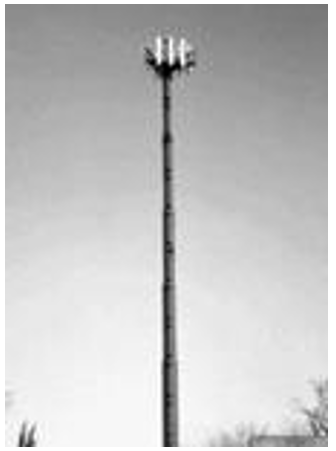
Figure 700-2: Stealth Tower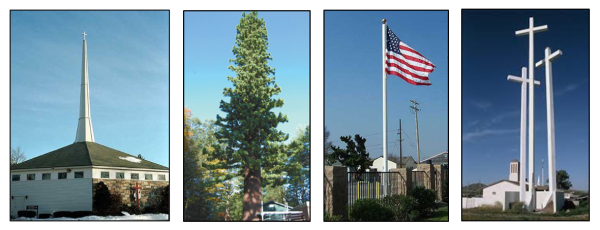
- All accessory structures containing switching equipment and other equipment housing must be designed to closely resemble the architecture of any buildings on the lot or the architecture of buildings on adjoining lots.
- Free-standing or attached signs proposed to be located on a freestanding tower site are prohibited. Incidental signs identifying the tower owner/operator, emergency phone numbers or contacts or signs warning “no trespassing” are permitted provided that no sign may exceed eight (8) square feet.
- Towers shall not have lighting unless specifically required by the FAA. If FAA lighting is required, strobe lights shall be avoided unless specifically required by the FAA. Lighting of all towers in any district shall be directed toward the tower and/or equipment shelters.
- Freestanding wireless communication tower sites may not be combined with a use involving outdoor storage of equipment, vehicles, or equipment display. Wireless communication tower sites must be fenced and secured from other activities on the property.
- In terms of load requirements for freestanding wireless communication towers and/or facilities, such towers and/or facilities must also conform to the Electronic Industries Alliance (EIA) and Telecommunications Industry Association (TIA) standards for construction and design, which deal with loading and wind velocity requirements.
- In addition, wireless communications towers and/or facilities must also conform to the guidelines of the International Building Code (IBC), particularly with respect to additional construction requirements for such structures (IBC Chapter 16, Section 1609 (1.1). Furthermore, any wireless communications towers and/or facilities must conform to the regulations and requirements of the Federal Communications Commission (FCC).
- Towers must be of monopole construction (cylindrical, tapering steel tubes without guy wires). The Town Council may authorize the use of a “guyed” tower or a “lattice” tower only upon the approval of a conditional zoning application for such a tower if a technical need for a “lattice tower” or “guyed tower” can be shown to provide a greater benefit to the community than a less visually obtrusive monopole tower.
- Abandonment or Discontinuation of Use
- At such time as the owner of a wireless communication tower plans to abandon or discontinue operation of the facility, the owner must notify the Planning Director by certified mail of the proposed date of abandonment or discontinuation of operation. Such notice shall be given no less than 30 days before abandonment or discontinuation of operation.
- In the event that the owner fails to give such notice, the facility will be deemed abandoned upon discontinuation of operation.
- Upon such abandonment or discontinuation of use, the owner must physically remove the wireless communication facility within 120 days from the date of abandonment or discontinuation of use. This will mean the removal of the tower, antennas, mount, equipment shelters, platforms and security barriers from the property.
- In the event that the owner fails to remove the wireless communication facility in accordance with the provisions of this section, then the Town may seek an order of abatement, providing the town with a lien for the cost of executing the order. At such time as the operator of a wireless communication tower plans to abandon or discontinue operation of the facility, the operator must notify the Planning Director by certified mail of the proposed date of abandonment or discontinuation of operation. Such notice shall be given no less than 30 days before abandonment or discontinuation of operation.
7160.030 Review And Approval Procedures
- Permits Issued by the Planning Director The Planning Director may authorize the establishment of a wireless communication tower and antenna by issuing a Zoning Permit and Zoning Certificate of Compliance (where a conditional zoning approval is not required) only when the applicant demonstrates full compliance with this Chapter. The Town may retain the services of a consultant to evaluate technical submittals by the applicant and seek an independent judgment on the safety of the proposed tower. The Planning Director shall be responsible for selecting the technical expert hired for the review of a wireless communication application; however, all costs associated with this technical review will be paid by the applicant. The technical expert must make investigations consistent with all the terms and conditions of this ordinance and will advise the Planning Director and/or Town Council as to whether any existing towers or structures could be used to accommodate the applicant’s needs. The fees charged for the technical expert’s review will be the customary fees required for site inspections, analysis of surrounding land uses, building plan review, and for the preparation of a technical report. Charges for such consulting services will be fixed in advance of the processing of applications and will be incorporated into the overall permit application fee.
- Streamlined Collocation Permits
- Applications for collocation are entitled to streamlined processing under this section shall be reviewed for conformance with applicable site plan and building permit requirements but shall not otherwise be subject to zoning requirements, including design or placement requirements, or public hearing review.
- Applications for collocation of wireless facilities are entitled to a streamlined processing if the addition of the additional wireless facility does not exceed the number of wireless facilities previously approved for the wireless support structure on which the collocation is proposed and meets all the requirements and conditions of the original approval. This provision applies to wireless support structures which are approved on or after December 1, 2007.
- The streamlined process set forth in subsection 1 of this section shall apply to all collocations, in addition to collocations qualified for streamlined processing under subsection 2 of this section, that meet the following requirements:
- The collocation does not increase the overall height and width of the tower or wireless support structure to which the wireless facilities are to be attached.
- The collocation does not increase the ground space area approved in the site plan for equipment enclosures and ancillary facilities.
- The wireless facilities in the proposed collocation comply with applicable regulations, restrictions, or conditions, if any, applied to the initial wireless facilities placed on the tower or other wireless support structure.
- The additional wireless facilities comply with all federal, State and local safety requirements.
- The collocation does not exceed the applicable weight limits for the wireless support structure.
- A collocation application shall be deemed complete unless the city provides notice in writing within 30 days of submission or within some other mutually agreed upon timeframe. The notice shall identify the deficiencies in the application which, if cured, would make the application complete. The application shall be deemed complete on resubmission of the additional materials cure the deficiencies identified.
- The Town shall issue a written decision approving or denying an application within 45 days of a complete application.
- Conditional Zoning Approvals
All Conditional Zoning approvals required for wireless telecommunications towers and antennas pursuant to Sections 7160.020.C and 7160.020.H will be considered for approval by the Town Council. Applications for Conditional Zonings must include the following information and must be accompanied by payment for the evaluation of technical submittals by the applicant from a consultant retained by the town as per Section 7160.030.A.
- Identification of intended service provider(s).
- Evidence that the property owners of residentially zoned property within 500 feet of the site have been notified by the applicant of the proposed tower height and design.
- Documentation that towers over the height allowed by Section 7160.020.C are necessary for a minimal level of service;
- Documentation called for in Section 7160.020.C for proposed freestanding towers;
- Landscaping and screening detailing the type, amount of plantings, and location;
- Documentation of collapse area;
- A statement regarding possible interference, if any, with respect to radio and/or television reception.
- Documentation, photo simulations and a coverage map that show that the new structure or facility is necessary and cannot be co-located;
- Proof of insurance from the provider;
- A written consultants report from a North Carolina State Certified Real Estate Appraiser that conforms to Standard 5 of the Uniform Standards of Professional Appraisal Practice.
- Zoning Certification
- A zoning certification is required for each for each new or collocated wireless communication antenna or tower. When a wireless communication tower requires a conditional zoning approval, such approval must be obtained before any zoning certification or building permit may be issued.
- A zoning certification is required wherever an antenna is added to an existing tower or whenever and existing tower is substantially modified. An increase in tower height above the limits established in Section 7160.020C is considered a substantial modification that requires approval as a conditional zoning permit by the Town Council. The relocation of any existing tower such that it would violate the setback or separation requirements of Sections 7160.020D and 7160.020E is considered a substantial modification that requires approval as a conditional zoning approval by the Town Council.
- Each applicant requesting a permit for a wireless communication antenna or tower must submit with the application a scaled site plan and scale elevation drawing and other supporting materials, signed and sealed by appropriate licensed professionals showing:
- The location and dimensions of all improvements;
- Information concerning the properties topography;
- Radio frequency coverage;
- Tower height and setbacks;
- Drives, parking, fencing, landscaping; and adjacent land uses;
- Any other information deemed necessary by the Planning Director in order to judge whether the proposed antenna or tower complies with this ordinance.
- Variances If an applicant wishes to install a tower or antenna higher than allowed in Section 7160.020.C, with less separation than called for in Section 7160.020.E, or in any manner that exceeds or is contrary to the requirements set forth in this ordinance. The applicant may pursue a variance as per this ordinance.
7170.010 Agency Design And Operations Standards
All facilities shall be designed, constructed, and operated in accordance with the NRA Range Source Book.
7170.020 Licensed Engineer Requirement For All Plans
All plans for indoor range facility (including interior up-fit of existing buildings) shall be prepared by a licensed engineer and obtain site plan approval by the Town.
7170.030 NRA Range Technical Advisor Evaluation
An evaluation in the area of use, procedural, range safety and design prepared by a NRA Range Technical Advisor shall be submitted to the Town prior to receiving a certificate of compliance, a power name change, or a privilege license by the Town. Recommendations identified within the evaluation shall be constructed or implemented prior to obtaining approval by the Town.
7180.010 Permit Required
Unless specifically permitted for a particular use and on a site-specific development plan, no outdoor storage, display, or sales/rental are permitted within any district without obtaining the appropriate permit.
7180.020 General Standards For Accessory Outdoor Storage, Displays, Or Sales/Rentals
- Must only be those areas designated as outdoor storage, display, or sales/rentals on a site-specific development approval.
- Must meet building setbacks.
- See Table 500-4: Table of Permitted Uses in DIVISION 500 for what districts permit or conditionally permit, Accessory Outdoor Storage.
- For industrial uses, must be located within the back 50% of the side-yard and/or in the rear yard; no outdoor storage, display, or sales/rentals are permitted in the front 50% of the side yard or in the front yard.
- For commercial uses, must be located within the side and/or rear yard and/or in the front yard if located entirely under the permanent primary building canopy.
- For commercial uses displaying outdoor sales of plants, produce, and cut flowers, the following applies:
- The display area shall not extend more than 75% of the linear distance from the building or fenced outside sales area to the edge of the sidewalk or improved display area.
- The display must not exceed 25% of the length of the building.
- The display racks must not exceed eight (8) feet in height.
- The display area must not interfere with pedestrian flows. Outdoor displays shall maintain five (5) feet of sidewalk clear for pedestrian flow. Sidewalks also maintaining a display area must continue to meet NC State Building Code and ADA compliance requirements.
- Is limited to areas that are surfaced with asphalt, concrete or other materials that are equal in quality (if approved by the Planning Director).
7180.030 Environmental Concerns
Is the case of storage of materials posing an environmental hazard, such as soil, fertilizer, lumber, or other loose, unprotected material, shall be fully contained to prevent leaching or run-off.
7180.040 Pedestrian Flow And Safety
Must not interfere with pedestrian flows. Outdoor displays shall maintain five (5) feet of sidewalk clear for pedestrian flow. Sidewalks also maintaining a display area must continue to meet NC State Building Code and ADA compliance requirements.
7180.050 Restrictions On Designated Parking Space Encroachment
In no case shall any parking space designated on a site-specific development plan be used for outdoor storage, display, or sales/rental unless authorized by the Planning Director in writing.
7180.060 Screening
The areas shall be screened from off-site view, except under the permanent primary building canopy, where goods simply cannot extend past the canopy unless otherwise allowed in this Chapter. Screening shall be achieved through the use of opaque fencing and/or evergreen plants. Chain link fencing with vinyl slats is not considered opaque fencing and is not allowed for screening purposes. Plants must be six (6) feet tall or the height of goods stored, displayed, or for sale/rental at the time of planting and must reach the height of the goods stored, displayed, or for sale/rental within three (3) years of planting.
7190.010 Permitting
The proposed location for the construction of or establishment thereof, an ABC Store shall be considered by the Indian Trail Town Council. Permits associated with the request shall be processed as follows:
- Staff shall notify the Council upon receipt of an initial permit for all ABC Store use within the Town.
- The Council shall consider the proposed location at the next Town Council meeting and determine whether it objects to the proposed said location. If Council does object by majority, a public hearing date shall be set and the local ABC Board notified.
- If a public hearing is required, the Council shall:
- Notice the public hearing consistent with Chapter 310 of this ordinance;
- Take evidence and testimony at the public hearing;
- Pass a Town resolution objecting to or supporting the proposed location of the ABC Store;
- Resolutions passed objecting to the location shall be sent to the NC ABC Commission.
7200.010 General Requirements
The following regulations shall apply to all Second Hand Thrift/Consignment Sales and Antique Shops uses as defined in Section 1610.050, that are located within the Neighborhood Business District, Downtown Districts, and Mixed Use and Sub-Regional Activity Center Overlays.
- All merchandise or donated goods shall be delivered to, stored and processed within the interior of the building with the exception of the establishment of an outdoor merchandise receiving area as described in Subsection B below. The exterior storage of merchandise and donated material shall be prohibited with the exception of outdoor display/sales areas as permitted in Chapter 7180; and
- Outdoor merchandise receiving areas may be established to accommodate the occasional delivery/donation of oversized merchandise or for the delivery/donation of merchandise from individuals with physical limitations subject to the following requirements:
- Establishment of outdoor merchandise receiving areas must be approved by the Planning Director; and
- The applicant will need to demonstrate to the Planning Director that the receiving area will only be utilized for the occasional delivery of oversized items or for those with limited physical abilities and is not intended to serve as a continuously used drive thru type facility; and
- The applicant will need to demonstrate to the Planning Director how delivered merchandise will be immediately received and transferred into the building; and
- Receiving area shall be located to the side or rear (preferred) of the primary building and shall not interfere with the normal circulation of on or off-site traffic; and
- Receiving areas shall be screened from view of adjacent roadways and properties in compliance with UDO 810.080.B unless approved otherwise by the Planning Director; and
- The use of drive thru facilities for merchandise or donated goods drop off shall be prohibited; and
- The use of exterior donation drop off bins or areas shall be prohibited; and
- The use of tractor trailers, pods, shipping containers, and similar portable storage units for merchandise or donated goods storage or processing shall be prohibited.
Amended by Ord. O210209-347 on 2/8/2021
Adopted by Ord. 393 on 11/14/2023
Amended by Ord. 397 on 3/26/2024
7210.010 General Requirements
The following regulations shall apply to all Brewery, Distillery and Winery Uses as described in UDO Section 1610.100.
- Uses within the Industrial Zoning District (Light Industrial (L-I) and Heavy Industrial (H-I)), and applicable overlay zoning districts:
- Uses in the H-I District shall not be open to the general public for activities such as onsite tours, product tasting room activities, and/or other food and beverage service activities; and
- Uses shall not produce odors, gas, dust or any other pollutants detrimental to the health, safety or general welfare of persons living or working in the surrounding properties; and
- Size limitations for non-production related activities in the L-I district (i.e., tap or tasting room, food service and similar) shall not exceed 50% of the total floor area. For non-production related activities exceeding 50% of the total floor area, a Conditional Zoning approval shall be required; and
- Parking requirements shall be calculated in accordance with Chapter 1020.010, Parking Ratios under the “Industrial” use category for “Manufacturing and Production.” Parking requirements for uses in the L-I District that include a taproom or tasting room and/or a food and beverage service area shall be calculated under the “Restaurant” use category and shall ensure vehicular access, parking and circulation areas that are designed to minimize conflicts with access, parking and circulation for adjacent industrial establishments; and
- Outdoor storage shall comply with the provisions of UDO Section 7180, Outdoor Storage, and
- Outdoor activities, such as live or recorded music, shall not be audible from any occupied residential home and/or from within the enclosed building of any adjacent business establishment; and
- Uses shall comply with all applicable Federal, State and County regulations.
- Uses within Commercial Zoning Districts (Regional Business District (RBD), General Business District (GBD), Downtown Zoning Districts (DCD, DTD and DTD-R)), and applicable overlay zoning districts:
- Shall include at least one (1) of the following associated uses: restaurant, taproom or tasting room; and
- Uses shall not produce odors, gas, dust or any other pollutants detrimental to the health, safety or general welfare of persons living or working in the surrounding properties; and
- Size limitations for production related activities (i.e., production of alcohol or alcoholic beverages) shall not exceed 50% of the total floor area. For production activities exceeding 50% of the total floor area, a Conditional Zoning approval shall be required; and
- Parking requirements for the production related activities shall be calculated in accordance with Chapter 1020.010, Parking Ratios under the “Industrial” use category for “Manufacturing and Production.” Parking for non-production related activities (i.e., taproom or tasting room, food service, and similar) shall be calculated under the “Restaurant” use category and shall ensure vehicular access, parking and circulation areas that are designed to minimize conflicts with the access, parking and circulation for adjacent establishments; and
- For uses located within new buildings, the street facing or front facing façade(s) shall maintain a commercial appearance with fenestration through store fronts, windows and doors. Uses located within existing buildings shall comply with this requirement as much as possible; and
- Outdoor storage shall comply with the provisions of UDO Section 7180, Outdoor Storage; and
- Uses located within new buildings shall not have outdoor storage or loading docks located within a front yard. For uses located within existing buildings, outdoor storage or loading docks may be located within the front yard if provided by the existing building and site layout; and
- Outdoor loading or distribution activates outside RBD between the hours of 10 pm and 7 am shall require a Conditional Zoning approval; and
- Outdoor activities, such as live or recorded music, shall not be audible from any occupied residential home and/or from within the enclosed building of any adjacent business establishment; and
- Uses shall comply with all applicable Federal, State and County regulations.
- Uses within the Neighborhood Services Activity Center (O-NSAC), Mixed Use Activity Center (O-MUAC) and Sub-Regional Activity Center (O-SRAC) Overlays:
- Shall comply with the requirements of the base zoning district as stated in UDO Section 7210 A or B; and
- Any outdoor storage operations shall require a Conditional Zoning approval.
Amended by Ord. O210209-347 on 2/8/2021
Adopted by Ord. 393 on 11/14/2023
Amended by Ord. 397 on 3/26/2024
Amended by Ord. 423 on 1/13/2026
7220.010 General Requirements
The following regulations shall only apply to Car Wash uses within the Old Monroe Mixed Use Activity Center Overlay legally permitted on or before December 30, 2008.
- Any car wash use within the Old Monroe Mixed Use Activity Center Overlay legally permitted on or before December 30, 2008 shall be considered a permitted use.
- Notwithstanding any applicable designation or classification under Chapter 250.020 of the Unified Development Ordinance, the owner of any permitted car wash use legally permitted on or before December 30, 2008 shall be allowed to expand the current permitted car wash use onto, or utilize in furtherance of that permitted car wash use, any adjoining parcels of real property acquired after December 30, 2008 if the owner of the legally permitted car wash compiles with all other provisions of this ordinance.
7230.010 General Requirements
The following regulations shall apply to all businesses under the three uses: Body Piercing and Tattooing; Electronic Gaming; and Tobacco and Vape Operations. Definitions for these three uses are described in Chapter 1620, Definitions:
- Any of the three uses may be a principal use or an accessory use to a principal business, within the same structure.
- Property Separation
Where these standards establish locational restrictions for these establishments, such restriction will be measured by a straight line in all directions and will not be measured as a walking or street distance. All measurements must be from property line to property line except in the case where one of the three operations is proposed to be located within a multi-tenant building, in which case, all measurements will be in a straight line from the public entrance to any of the three operations.- No body piercing and/or tattooing, electronic gaming, or tobacco and/or vape operation shall be permitted within 2,000 feet of any:
- Matching body piercing and/or tattooing, electronic gaming, or tobacco and/or vape operation (i.e. Electronic gaming operation within separation distance of another electronic gaming operation.); and
- Dwelling or dwelling unit, a church, mosque, synagogue, temple or other place of worship, public or private school, child day care center or nursery school, or public park or playground; and
- Business or facility that possesses an On-Premises alcoholic beverage permit from the North Carolina Alcohol Beverage Control Commission (ABC).
- The Town Council may consider modifications to the established criteria referenced in the above section B.1.i thru iii upon request in accordance with Chapter 330, Conditional Zoning Districts, of this ordinance. In considering a modification request, the Town Council shall consider the following factors:
- The number and location of existing businesses from any of the three types of operations in the allowed districts; and
- The proximity and/or visibility of one of the proposed electronic gaming establishment to a dwelling or dwelling unit, church, mosque, synagogue, temple or other place of worship, public or private school, child day care center or nursery school, and/or public park or playground; and
- The overall health, safety, and welfare of the Town.
- No body piercing and/or tattooing, electronic gaming, or tobacco and/or vape operation shall be permitted within 2,000 feet of any:
- Alcohol Consumption
The sale and consumption of alcoholic beverages is prohibited on the premises. - Public Official Ingress
Representatives of government agencies shall be granted the right of entry into the facility at all reasonable hours for the purpose of examination in accordance with §58-79-20 of the North Carolina General Statutes. - Occupancy
The maximum building occupancy set by the Union County Fire Marshall’s Office and/or other government agency shall be posted in a conspicuous location near the main entrance to the building. - Minimum Age
Users of the electronic gaming machines or devices shall be at least 18-years of age unless a higher age threshold is established within the North Carolina General Statutes or other governing laws. For tobacco and vape sales, the federal law prohibits the sale of these products to people under 21 years of age. North Carolina law prohibits sales to anyone under 18 years old. - Accessory Use
Electronic gaming operations permitted as accessory uses shall be subject to the following standards:- Number of Machines: Limited to no more than two (2) devices or machines for each principal use or establishment.
- Parking: One (1) space for each machine shall be provided in addition to required parking for the principal use.
- If an electronic gaming operation is an accessory use with a maximum of two (2) devices or machines, then the property separation requirements noted in Section B above may not apply.
- Maximum Square Footage
Each of the use types shall be limited to one (1) parcel or one (1) unit within a multi-tenant structure and shall not exceed 2,000 square feet of gross building or unit floor area. - Issuance of a zoning permit pursuant to the provisions of Chapter 7230 does not authorize any deviation from compliance with North Carolina General Statutes requirements for Piercing and Tattooing Operations, Tobacco and Vaping Operations, and Electronic Machines and Devices for Sweepstakes and/or other gambling related statutes.
7240.010 General Requirements
The following regulations shall apply to all mobile food vending units (MFVU) as described in UDO Chapter 1620:
- Mobile food vending units within the Town of Indian Trail must meet one (1) of the following criteria:
- Be located in one of the following areas: Downtown Districts DCD and DTD, Light-Industrial and Heavy-Industrial Districts, Regional Business District, Mixed Use and Sub-Regional Activity Center Overlays – Non-Residential District of overlays only,
- Be part of a temporary sponsored event (such as a non-profit fundraiser, neighborhood festival or commercial grand-opening celebration), or
- Be operating under contract with the Town of Indian Trail on Town owned property.
- Exemption: A fundraiser held by a non-profit organization (i.e. – BBQ hosted by Boy Scouts) where 100% of the proceeds go to the non-profit shall be exempt from these regulations if proof of the non-profit 501(c)(3) documentation is provided and the non-profit organization is only selling food for a fundraiser one time a month for up to two (2) consecutive days. If a non-profit organization would like to sell food more than one (1) time a month for up to two (2) consecutive days, then a Temporary Use Permit will be required.
- Submittal: Applications must be submitted for review at least ten (10) business days prior to the date of the event.
- Duration of Permit: Permits for mobile food vending units shall be valid for twelve (12) months unless permitted as part of a temporary event. Permits for mobile food vending units selling food with multiple stops for individual sales (i.e. ice cream sales to homes in subdivisions) shall be valid for six (6) months.
- Mobile Food Vending Unit (MFVU) Requirements:
Food vendors shall provide the following documentation when applying for a permit:
- Union County Health Department documents, including, but not limited to: inspection report, sanitation rating and health permit.
- North Carolina Department of Agriculture approval, if necessary.
- The vendor must submit proof of property owner’s permission to locate on site.
- Any mobile food vending unit driver must possess a valid driver’s license, as required by State law.
- Copy of vehicle registration.
- Color photo of MFVU.
- If MFVU will be located on Town of Indian Trail property or within public rights-of-way, the vendor shall be required to meet the general liability insurance coverage policy and risk management requirements of the Town of Indian Trail.
- General Requirements:
- Town of Indian Trail MFVU approval certificate posted in conspicuous location.
- Trash receptacle and recycling bin for the customers which the vendor shall remove from site at the end of each day. The vendor shall be responsible for removing all trash and refuse from the site at the end of each business day.
- There shall be no signage used by vendors except what is allowed on the mobile unit itself and one (1) portable menu sign no more than six (6) square feet in display area on the ground no further than ten (10) feet from the truck.
- No vendor shall utilize any electricity or power without the prior written consent of the power customer.
- Food trucks shall not be located in a manner that impacts the primary use from meeting minimum parking requirements.
- Location: In order to locate on a property there must be a primary use.
- Food trucks may only conduct business on privately owned non-residential property with the exception of operations on Town owned property or when conducted as part of a neighborhood event subject to the approval of the property owner.
- Limit: Up to two (2) MFVUs may be located on one parcel. More than two (2) MFVUs shall require a temporary event permit or a special event permit, in accordance with Chapter 450.
- Minimum Separation. Mobile food vendor units shall:
- Not be located closer than 200 feet from the front door of any existing, non-affiliated restaurant and/or outdoor dining area. Multi-tenant commercial centers located on the same parcel will be exempt from this requirement.
- Not park in fire lanes and must be located at least 20 feet from fire hydrants.
- Not block any driveway, sidewalk, utility box or vault, ADA accessible parking area, building entrance or exit, drive aisles, sight distance lines, emergency call box or any other area deemed unsafe by Town code enforcement staff or the Union County Sheriff Office.
- Not park within 250 feet of any residential district, except when part of a neighborhood event or Town sponsored event.
- Hours of Operation:
- Sunday through Thursday: 6 am to 10 pm
- Friday and Saturday: 6 am to 12 am (midnight)
- Alcohol: Alcohol sales shall only be permitted during special events or temporary events which have been approved by the Town of Indian Trail. Mobile food vendors must provide approval from the ABC Commission and Union County Environmental Health if applicable.
- Modification, Suspension and Revocation of Permit:
- The permit issued for the food truck business may be revoked if the vendor violates any of the provisions contained in this article.
- The Planning Director may revoke a permit if he or she determines that the food truck vendor’s operations are causing parking, traffic congestion, noise, odor or litter problems either on or off the property where the use is located or that such use is otherwise created a danger to the public health or safety.
- The Planning Director reserves the right to temporarily suspend food truck permits during the times of special events in the Town of Indian Trail.
- The Planning Director further reserves the right to modify the provisions of this ordinance in order to grant further latitude for enabling MFVUs to address unforeseen scenarios.
- Food truck businesses with revoked or suspended permits may not be permitted to apply for a new permit for six (6) months.
7250.010 Findings
Union County Public Schools (UCPS) is currently subject to 13 different sets of local land use regulations (12 different municipalities and Union County). Regulations vary from jurisdiction to jurisdiction, making it difficult to build new schools, renovate existing schools or locate mobile units in a consistent, timely, and cost-effective manner. As a part of the Union County Board of Education's adopted "Building Program Cost Saving Principles", UCPS is endeavoring to establish a standard zoning classification and standardized requirements for school construction regardless of the school's locale in Union County. Such standardization will result in 1) equitable school facilities throughout the county; 2) more efficient permitting of school facilities; and 3) cost savings for the benefit of the taxpayers of Union County.
7250.020 Cooperative Planning
Staffs from UCPS, Union County and all local municipalities have met and have agreed to make recommendations to their elected boards as follows:
- UCPS staff will involve local municipal staff early in the site selection process. The local municipal staff will make recommendations regarding target sites or areas within their respective jurisdictions that are suitable for school uses. Pursuant to state statute, final decisions regarding the selection of school sites are made by the Union County Board of Education.
- Allow all new schools, additions, or renovation uses by right with supplemental standards. This will eliminate the costly and time-consuming discretionary zoning (Conditional Zoning) process and site-by-site negotiations. All local government entities benefit by having expectations regarding school design and construction identified in advance.
- Jurisdictions may consider an optional Conditional Zoning review process if unique conditions exist as determined by the Planning Director. The Planning Director shall consider if the proposed project poses a negative impact on the public health and safety.
7250.030 Supplemental Standards
All applications are subject to the following supplemental standards:
- Exterior of Buildings
- Exterior building materials shall be limited to masonry brick (brick or pre-finished block), natural or synthetic stucco, pre-finished insulated or non-insulated metal panel system, pre-finished metal fascia and wall coping, standing seam metal roof (for sloped roof only), painted hollow metal and/or pre-finished aluminum door and window frames, glass, painted or pre-finished steel.
- UCPS staff will work with municipality staff to follow any requirements of municipality "special overlay districts" as it relates to the exterior design of the facility.
- Exterior of buildings will be articulated to enhance the area of the site.
- Mobile Classrooms (MCR)
- MCR's shall be located in rear yard if possible. If rear yard cannot accommodate the MCR's then they can be placed in the side yard. MCR's can be placed in the front yard only if the MCR's cannot be accommodated in the rear or side yards.
- MCR underpinning and crawl spaces shall be screened.
- Landscaping/planting shall be provided between the MCR and any adjacent roads from which the MCR's are visible.
- Sidewalks
- Sidewalks will be required consistent with Town adopted regulations. The Indian Trail UDO provides for publicly owned, tax supported facilities to apply for an exemption of this provision of the ordinance. If such exemption is granted by the Town Council then UCPS shall comply with 4.3.2-4.3.4 of this section.
- UCPS will dedicate appropriate easement or road right of way needed for sidewalks if requested by municipality.
- UCPS will grade areas for sidewalks if requested by municipality.
- UCPS will cooperate with municipality to apply for grants for sidewalks.
- Exterior Illumination
- Driveway and parking area lighting shall be no more than 10 foot candles. Spill over to adjacent properties shall not exceed 1 foot candle for non-residential use and/or zoning and 0.50 foot candle for residential use and/or zoning. Lighting fixtures shall be shielding type.
- Lighting fixtures located on the building exterior shall not emit more than 5 foot candles and shall be shielding type.
- Lighting for athletic fields shall follow the current standards as set forth by the North Carolina High School Athletic Association Lighting Standard. A lighting control package shall be included and lights shall be shut-off no later than one (1) hour after the end of the event.
- Signs
- Materials for sign base and structure shall match the primary building materials.
- Sign face shall not exceed 40 square feet and does not include the sign support structure. The bottom of the sign face shall be no less than 24 inches above nor more than 72 inches above the ground surface. The sign support structure can include columns and walls on either side of and below the sign face and shall not be more than 16 inches taller than the sign face.
- Changeable Copy Signs may be incorporated within said freestanding sign. The changeable copy portion may be a manually or electronically changed reader board. Electronically Changed Boards shall be of a LED Static Message Board type and comply with all related requirements of this ordinance.
- Changeable Copy Signs may be incorporated within said freestanding sign. The changeable copy portion may be a manually or electronically changed reader board. Electronically Changed Boards shall be of a LED Static Message Board type and comply with all related requirements of this ordinance.
- One sign shall be permitted per school. Alternatively, if multiple schools use the same driveway access, then the allowable square footage may be increased by 10 square feet for each additional school.
- One wall sign per school shall be permitted and only for the name of the school and shall be reviewed by the Planning Director.
- External illumination is allowed.
- Parking
- At elementary and middle schools provide one (1) space per staff member plus 1.6 spaces per classroom or one (1) space for each three (3) seats used for assembly purposes whichever is greater.
- At high schools provide five (5) spaces per instructional classroom or one (1) space for each three (3) seats used for assembly purposes whichever is greater.
- No more than 20% of the required spaces can be compact spaces.
- Minimum size of spaces shall be nine (9) feet wide by 19 feet long for regular, 7.5 feet wide by 15 feet long for compact, and accessible spaces shall meet current accessibility codes.
- Student Drop Off Stacking
- On-site vehicle stacking for student drop-off shall be based on NCDOT requirements using the NCDOT required calculator.
- On-site vehicle stacking for student drop-off shall be based on NCDOT requirements using the NCDOT required calculator.
- Landscaping and Screening/Buffering
- Trees and shrubs shall be as indicated within the municipality species list.
- Parking Area: one (1) large or two (2) small trees shall be provided for each 12 parking spaces. Each parking space shall be located within 65 feet of a tree. Rows of parking spaces shall be terminated with a landscaped island and shall be the same size as a parking space.
- Parking areas shall be screened from adjacent public roads with shrubs based on the municipality's species list.
- Storm Detention Basins shall be screened with fencing and/or shrubs as determined by the Planning Director and shall be dependent upon the size, location, and use of the basin.
- Land berms will not be permitted between school facilities and roads.
- Land berms can be used in conjunction with required screening/buffering to adjacent uses as determined by the local regulations.
- Screening/buffering from adjacent uses will be opaque and shall consist of:
- Small trees planted at a rate of three (3) per 100 feet and six (6) feet high evergreen shrubs planted at a rate of 25 per 100 feet, or
- Large trees planted at a rate of 2.5 per 100 feet and a six (6) foot high solid wood fence, or
- Tall evergreen trees with branches touching the ground planted in a stagger.
- If the adjoining property is of similar or compatible use, the Planning Director may reduce or eliminate the screening/buffer.
- Screening/buffering requirements may be waived when screening/buffering is already provided. There may be cases where the unusual topography or elevation of a site or the size of the parcel involved, or the presence of screening on adjacent property would make the strict adherence to the regulation serve no useful purpose. In those cases, the Planning Director is empowered to waive the requirements for screening so long as the spirit and intent of this section and the general provisions of this section pertaining to screening are adhered to. This section does not negate the necessity for establishing screening for uses adjacent to vacant property.
- UCPS will endeavor to adhere to all Tree Preservation ordinances of the municipalities and shall preserve natural buffers between the school facility and adjacent properties as much as practical.
- UCPS will endeavor to retain as much existing trees and vegetation on school sites as practical and will re-introduce common local species into the project as possible.
- The provisions of this section shall not be interpreted to be all encompassing. In the event any provisions do not clearly address or are silent on any requirements of the Town of Indian Trail, the requirements of the Town requirements shall control.
7260.010 Planning And Site Selection
- Electric Vehicle Charging Stations (EVCS) developers look at a variety of factors in selecting sites for charging electric vehicles (EV). Whether the EVCS area is commercially open to the public (in a restaurant parking lot) or in a private area (such as an employee parking lot), the Town has the following factors that a proposed site must consider:
- Permitting is required from the Town and Union County.
- Evaluate the site giving consideration to access for drivers and amenities to occupy a driver’s charge time such as a restaurant, coffee shop, gas station, or park.
- Present agreement between station developer and property owner if separate. Agreement shall include responsibility for removing Electric Vehicle Supply Equipment (EVSE) and site restoration if (1) equipment/use is no longer needed, (2) the permit is revoked or allowed to expire, or (3) EVSE equipment is abandoned.
- Are the vehicles light- or medium-duty vehicles? See section below for medium-duty vehicles.
- Confirmation of electrical capacity from the local electrical company.
- Impact on existing parking requirements.
- Space available on site for the charging equipment – including setbacks (follow accessory setback of 5 feet?)
- Landscape screening shall be provided to screen support equipment on the EVCS site such as a power converter cabinet or a transformer/switching substation cabinet. This is not screening at each of the EV charging dispenser units.
- Site restoration if construction disturbs condition of the property.
- Permitting is required from the Town and Union County.
7260.020 Considerations For Medium-Duty Electric Vehicles
- As the demand for electric vehicles expands, so will the need to charge larger vehicles such as in commercial fleets. The Town will expect station developers to consider the following general factors:
- Stations require extra clearance in parking and parking lot circulation.
- Potential need for more power due to vehicle size. This may result in the need for more space for larger utility transformers.
- May be additional interest in power storage and renewable power generation to offset higher power demands.
7260.030 Considerations For Heavy-Duty Electric Vehicles
Heavy-duty electrical commercial vehicles demand a more robust infrastructure for charging. When planning to upgrade to an electric vehicle fleet or even building a new site when fleet vehicles have not switched to electric vehicles, consider that being proactive and installing conduit for future possible electrification of vehicles may save money and time in the future. Conduit may include provision for internet conduit as well.
7260.040 EV Station Accessibility
The design of electric vehicle stations shall follow ADA requirements to consider accessibility, ease of use, and safety for drivers with disabilities and vehicle occupants, including those using wheelchairs or other assistive equipment. Refer to Figure 700-3 for a Sample Layout for ADA-Compliant EV Charging Parking Space. Examples of important considerations include the following:
- Adequate space for exiting and entering the vehicle.
- Unobstructed access to the charger.
- Free movement around the charger and connection point on the vehicle.
- Clear paths and proximity to building entrances.
Figure 700-3: Sample Layouts for ADA-Compliant EV Charging Parking Space (1)
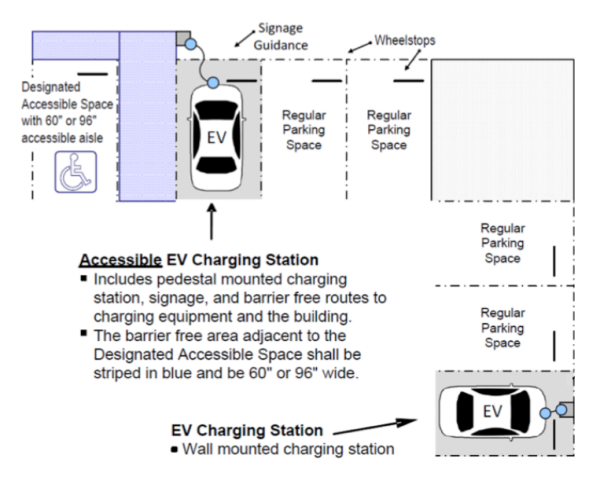
(1) Source is from the Alternative Fuels Data Center, U.S. Department of Energy.
7270.010 General Requirements
- Space Distribution
- Retail/Office Flex Space
Retail/Office Flex Space shall have a minimum 50% and a maximum of 80% retail and/or office space with the balance consisting of warehouse and/or distribution space. - Light Industrial Flex Space
Light Industrial Flex Space shall have a minimum of 50% and a maximum of 90% light industrial use (see definition of Light Industrial Flex Space in DIVISION 1600) with the balance consisting of office and/or retail space.
- Retail/Office Flex Space
- Architectural Requirements
- Overhead Doors
Overhead doors are permitted; however, all overhead doors shall be located in the rear or side of the building. Refer to Section 1060.010 (Loading and Unloading Areas),D,4 for loading area door locations and screening requirements. - Parking Locations
Public parking for a flex space building shall follow Chapter 1020 Off-Street Parking Requirements. Fleet vehicle parking greater than three (3) company vehicles per any unit, shall be located in the rear of the flex space building.
- Overhead Doors

