
Indian Trail City Zoning Code
DIVISION 1200
SPECIALIZED SUBDIVISIONS
O210209-347
1210.010 Purpose
The regulations of this section are intended to encourage subdivision design that is more efficient and provides greater protection of open space and natural resources than conventional subdivision designs. Cluster and Open Space Subdivisions shall be processed in accordance with Chapter 330 of this UDO. Cluster and open space subdivision designs allow more compact and less costly networks of roads and utilities. They also help reduce stormwater run-off and non-point source pollutant loading rates and may help to preserve an area’s rural character. Cluster and open space subdivisions are intended to encourage the provision of needed open space and recreational amenities for residents, while also helping to retain an area’s character and preserve natural, environmentally sensitive and historic resources. Any open space to be set aside pursuant to this section shall be above and beyond what is minimally required of a standard subdivision pursuant to Chapter 1160.
1210.020 General Description
The cluster and open space subdivision standards of this section require that a specified portion of each subdivision be set aside and permanently preserved as open space. The primary difference between cluster subdivisions and open space subdivisions is the amount of open space that must be preserved. Cluster subdivisions are required to set aside a modest amount of open space, while open space subdivisions are required to set aside a far greater amount. The required open space area within cluster or open space subdivisions can be used to provide recreational opportunities for the subdivision's residents, to conserve and protect significant natural resources, or to conserve productive farming and forestry uses.
1210.030 Minimum Subdivision Site Size
- Cluster Subdivision
The minimum required land area for a cluster subdivision is 10 acres and that meets the density, lots size, and yard requirements of Sections 1210.050A and 1210.060.
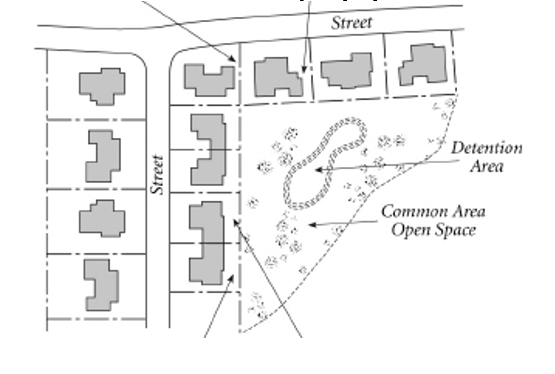
Figure 1200-1: Flexibility with lot sizes and yards can allow for conservation of woodlands and protection of creeks and streams. Detention area not counted towards required open space.
- Open Space Subdivision
The minimum required land area for an open space subdivision is 25 acres density and that meets the density, lots size, and yard requirements of Section 520.040.B.
Figure 1200-2: Open Space Subdivision Allow for Significant Preservation of Green Space
Standard Subdivision Open Space Subdivision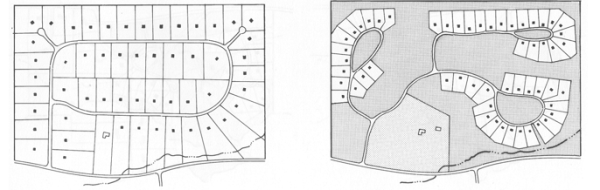
1210.040 Minimum Open Space
- Cluster Subdivision
- At least 15% of the net land area within a cluster subdivision must be set aside and permanently preserved as open space if the development is located within an area served by public water and sewer systems.
- Cluster subdivisions located in an area that is not served by public water and sewer systems must set aside and permanently preserve at least 20% of the subdivision’s net land area as open space.
- Open Space Subdivisions
- At least 25% of the net land area within an open space subdivisions must be set aside and permanently preserved as open space if the development is located within an area served by public water and sewer systems.
- Open space subdivisions located in an area that is not served by public water and sewer systems must set aside and permanently preserve at least 30% of the subdivision’s net land area as open space.
1210.050 Density, Lot Size And Setback Requirements
The density, lot size, and setback requirements for conventional, cluster, and open space developments must be consistent with the requirements of this Section.
- Cluster Subdivisions
The following density and lot size standards apply to all cluster subdivisions.
Table 1200-1: Flexible Lot Size; No Density IncreaseZoning District Cluster Subdivision Maximum Density (Units Per Acre) Minimum Lot Size Minimum Frontage RSF 1 30,000 100 SF-1 2 15,000 80 SF-2 2.9 12,000 70 SF-3 3.6 10,000 60 - Open Space Subdivisions
The following density and lot size standards apply to all open space subdivisions Table 1200-2: Ten Percent Density Increase for Preserving Open SpaceZoning District Open Space Subdivision Maximum Density (Units Per Acre) Minimum Lot Size Minimum Frontage RSF 1.1 20,000 100 SF-1 2.2 15,000 75 SF-2 3.2 12,000 60 SF-3 4.0 10,000 60
1210.060 Additional Lot And Building Standards
The following additional lot and building standards apply to cluster and open space subdivisions.
Table 1200-3: Front, Side and Rear Yard Flexibility: Cluster and Open Space Subdivisions.
| Minimum Setbacks | RSF | SF-1 | SF-2 | SF-3 |
| Cluster Subdivisions | ||||
| Front | 20 | 20 | 20 | 20 |
| Corner | 18 | 18 | 15 | 15 |
| Side | 12 | 12 | 12 | 12 |
| Rear | 20 | 20 | 20 | 20 |
| Open Space Subdivisions | ||||
| Front | 20 | 20 | 20 | 20 |
| Corner | 15 | 15 | 15 | 15 |
| Side | 12 | 12 | 6 | 6 |
| Rear | 20 | 20 | 20 | 20 |
1210.070 General Requirements
- Maximum Density
- The maximum number of dwelling units allowed within a cluster or open space subdivision will be consistent with the density provisions of Section 1210.050.
- If the cluster or open space development site (subdivision) is located in more than one zoning district, the maximum number of dwelling units allowed must be determined separately for each portion of the site lying within a different zoning district. Density may be transferred from one portion of the site to another, provided that such transfers do not result in an increase in the number of dwelling units allowed on the overall site.
- Lot Design Each lot must be regularly shaped and meet or exceed the minimum lot area and lot width standards in this section. Side lot lines extending from a road must be approximately perpendicular or radial to the road’s right-of-way boundary.
- Open Space
- The amount of open space within a cluster or open space subdivision must be in addition to required open space of conventional subdivision as referenced in Section 1160.010 of this UDO. Open space provided to meet minimum open space requirements must be in one or more parcels dedicated or otherwise protected as permanent, active or passive open space. Open space must be at least 75 feet wide for all cluster and open space subdivisions, with houses facing towards the open space where possible and the open space being accessible to all residents of the subdivision.
- Use, Location, and Design: Open space must be dedicated or reserved for one or more of the following uses:
- conservation of, and avoidance of development in, any readily identifiable natural hazard areas, i.e., areas that potentially pose a significant hazard to people or property (e.g., designated floodways, other perennially wetlands, and lands whose slope and/or soils make them particularly susceptible to erosion when disturbed by development activities);
- conservation and protection of any identified significant natural areas (e.g., rare plant communities, important wildlife habitat) or other environmentally sensitive areas where development might threaten water quality or ecosystems (e.g., watershed buffers, groundwater recharge areas);
- conservation and protection of any identified important historic resources (e.g., homesteads, mills, barns, archeological sites);
- provision of active and/or passive outdoor recreation opportunities (e.g., ball fields, playgrounds, tennis courts, swimming pools, basketball courts, golf courses, bikeways, walking trails, nature trails, and picnic areas), either for the general public or for the subdivision’s residents or employees and their guests; or
- retention of productive farmland or forestland for continued agricultural and/or forestry use.
- Highest priority for the location, design, and use of open space must be given to conserving, and avoiding development in, any open space that is set aside.
- Open space may contain only such buildings, structures, accessways, and parking facilities as are necessary and accessory to its principal uses (e.g., pedestrian path, utility lines, driveway, barns and other farm storage and processing facilities).
- Open space may contain individual water supply wells or subsurface sewage disposal fields serving dwelling units on adjacent lots, or community wells, provided they do not conflict with the principal uses of the open space.
- The location, size, character, and shape of required open space must be appropriate to its intended use(s). (e.g., open space proposed to be used for recreation, particularly active recreation, should be located and designed so that it can be accessed conveniently and safely by intended users, and open space to be used for ball fields, playing fields, or other active recreational facilities should be located on land that is relatively flat and dry.)
1210.080 Open Space Dedication Or Reservation
- Cluster and/or open space subdivision occupants must be ensured direct access to and use of the entirety of the subdivision’s open space on the development site, by conveying that open space to a property owners association or similar legal entity meeting the provisions of Section 1110.060I for this UDO, or to a public agency or nonprofit organization that is organized for, capable of, and willing to accept responsibility for managing the open space for its intended purpose, and that will ensure subdivision occupants direct access to and use of the open space. Any other open space provided may be conveyed to such organizations as listed above or to any agency, organization, person, or other legal entity that is organized for, capable of, and willing to accept responsibility for managing the open space for its intended purpose, provided such conveyance is restricted to ensure continued maintenance and preservation of the open space and provided that the subdivision residents enjoy direct access and use of the open space.
- Each dedicated or reserved open space parcel must be shown on all subdivision plans and on a record plat recorded with the Union County Register of Deeds, with a notation of its area and its intended open space use. The owner of an open space parcel may re-dedicate or re-reserve the parcel for another open space use allowed under this subsection by recording a record plat showing the parcel and its new intended open space use.
1210.090 Maintenance
- The owner of the open space is responsible for maintaining the open space so that it continues to effectively function for its intended use, and any dedication or conveyance of an open space parcel must provide for such responsibility.
- Where the cluster or open space subdivision is located within a RSF or the Goose Creek Village area, retention of undeveloped open space in a vegetated or natural state must be ensured by maintenance provisions filed with the Union County Register of Deeds, either as part of recorded documentation providing for establishment of an appropriate legal entity (e.g. homeowners association, property owners association or land conservation organization) that is to be responsible for maintenance and control of open space or in a maintenance agreement recorded with the property deeds.
1220.010 Purpose
- Equestrian Oriented Subdivisions are developments of a residential character that are designed with particular emphasis on equestrian activities and incorporate such facilities as community stables, riding rings, pastures, game fields, and riding trails.
- Private stables may be located on individual residential lots subject to the provisions of Section 1220.020E and Section 1220.020F below.
- Pastures, riding trails, community stables must be established, and these facilities must be accessible by a drive to allow easy ingress and egress. The access drive may be gravel in lieu of asphalt or concrete. Single stables may also be established on individual lots with equestrian oriented subdivisions.
- Equestrian oriented subdivisions are permitted in the RSF, SF-1, and SF-1 Cluster Districts and require Conditional Zoning district approval based on the applicant compliance with the requirements of this Chapter. However, where an existing approved subdivision is proposed to be converted to an equestrian subdivision then the applicant shall apply for conditional zoning approval from the Town Council.
1220.020 General Provisions
- All buildings and structures related to the care of horses and to the operation of the riding facilities shall be located no nearer than 100 feet to any property line outside the development.
- Corral or yard areas used for keeping horses shall be located no closer than 35 feet from any property line outside of the development.
- All areas used for keeping horses shall be fenced. Chain link and electric fences as well as sharp fence materials such as barbed wire and razor wire are prohibited.
- Generally, riding trails shall be located within the interior of the development and should not extend along adjoining property lines. Where a proposed trail is to be located along the exterior property line of the project, such trail shall be a minimum of 20 feet wide with adequate fencing provided to maintain all equestrian traffic within the project. Where buffer yards and landscape setbacks are provided along the exterior property lines these buffer yards and setbacks may be counted as part of the required 20 feet. However, any area improved and designated as a riding trail must have a minimum clear dimension of at least 20 feet in width.
- Private stables for horses on residential lots shall be accessory to the residential structure and located on lots no smaller than 20,000 square feet. Only two (2) horses on any one (1) lot shall be allowed.
- Private stables for horses on residential lots shall be located at the rear of the property behind the principal residential structure but no closer than 10 feet to any rear lot line; 20 feet from any side property line; and no closer than 35 feet from any corner yard property line.
- Individual barns and community barns must be located so there is easy access to 3/4 acre of fenced pasture land per horse.
- No minimum shall be placed on the number of horses boarded by the community stable. However, the site shall be of adequate size to handle the horses housed on-site and properly maintained to protect adjacent uses from adverse impacts.
- Private stables, community stables, corrals, and other related facilities must be maintained in sanitary condition through the proper use of lime and pesticides.
- All grain on the lot shall be stored in rodent-proof containers.
1220.030 Required Plans
A development for an Equestrian Oriented Subdivision shall delineate the following in addition to other subdivision requirements:
- Lots to have private stables shall be designated and the general location for such stables shall be indicated.
- All proposed community riding facilities, including community stables, riding rings, pastures, game fields, and riding trails. A written statement describing the proposed means of ownership and proposed program for the maintenance of these facilities shall be included. The approved statement shall be recorded as a covenant at the Union County Register of Deeds.
- The location and design of any walls, fencing, or screen planting proposed.
- Plans shall include calculation table detailing the maximum amount of horses allowed as per the horse to pasture ratio found in Section 1220.020.
1220.040 Conditional Zoning Approval And Public Notice For Conversion
- A subdivision of record shall file for a conditional zoning request when considering converting to equestrian oriented status. The application shall be accompanied by a notarized petition signed by each property owner within the existing subdivision. The Town Council may approve the Conditional Zoning upon finding that the applicant complies with the requirements of this Chapter.
- Notice and proceeding for the public hearing shall be in compliance with Chapter 310.
- If the Conditional Zoning is granted, standard site plan review pursuant to Chapter 370 of the Unified Development Ordinance is required.

