
Indian Trail City Zoning Code
DIVISION 800
LANDSCAPING
Chapter 870 Tree Planting Standards
All trees planted to meet the requirements of this ordinance shall be selected from the Approved Tree List (See Appendix 1: Tree List) and must adhere standards of Appendix 3 (Caliper to Height Ratios for Deciduous and Coniferous Trees) and the following requirements:
O210209-347
393
397
423
410
810.010 Scope And Purpose
These regulations establish minimum requirements for buffer yards, perimeter landscaping, and parking lot landscaping. The intent and purposes of these provisions include:
- To minimize the adverse aesthetic impacts of certain land uses (e.g. outdoor storage yards, junkyards, recycling facilities) by requiring buffer yards between different land uses.
- To encourage tree planting and landscaping as a means of improving and protecting the Town’s environment and ecological balance. Trees, shrubs, and plants will be used to mitigate the ill effects associated with some land uses by filtering noise, dust, and fumes, modifying the rate of stormwater runoff and soil erosion; reducing glare from vehicle headlights and parking lot area lighting; and providing shade and reducing the heat-island effect of large asphalt parking lots.
- To enhance the environment and visual character of the Town of Indian Trail and to safeguard property values of adjacent properties, to protect public and private investments, and to promote high-quality development within the Town. Landscaping is intended to add beauty and value to property in the Town of Indian Trail by enhancing parking lots, home sites, and new commercial and industrial developments through the installation of trees and vegetation.
- To reduce the incompatibility between zoning districts of different land use intensities and type. To lessen the adverse impacts of more intense land uses upon adjacent residential areas and other less intense land uses, thereby reducing the ill effects of large expanses of paved areas, outside storage yards, and parking lots.
- To coordinate policies regarding the removal of existing trees and to require the planting and replacement of trees removed from private property within the Town of Indian Trail. In so doing, this will safeguard the ecological and aesthetic environment of the community.
810.020 Relationship To Tree Ordinance Requirements
- Trees that are required to be preserved or planted under the tree save area or canopy planting requirements (see Section 830.040, "Tree Preservation and Protection Requirements", and Section 840.010, "Canopy Tree Planting Requirements") of the Tree Ordinance will be credited toward the applicant’s landscaping obligations established by the requirements of this Chapter. The Planning Director will determine whether saved trees or trees required to be planted to establish a minimum amount of tree canopy are credited toward the buffer yard, perimeter, or parking lot landscaping requirements of this Chapter. Where the Tree Ordinance establishes bonuses (see Chapter 850, "Incentives for Exceeding Minimum Requirements", of the Tree Ordinance) for saving existing stands of trees or heritage trees, the Planning Director will credit those bonuses to the requirements of this Chapter.
810.030 Applicability
The requirements of this Chapter apply to the construction of any principal structure or building and to the construction of any new parking area with more than five (5) parking spaces. Where any provisions of this Chapter overlap or conflict with the requirements of the Tree Ordinance requirements, the most restrictive requirements will apply. The following apply to all new development, unless specifically exempted:
- All ground surfaces, not otherwise built on or required to be paved, must be maintained with appropriate ground cover. Appropriate ground cover must include ground cover plants, turf, grass, mulch, or natural vegetation.
- As illustrated in Figure 800-1, landscaped buffer yards are required to be placed along the boundaries of a zoning lot that abuts properties in a different, less intensive zoning district, as determined by 810.040.D. Where buffer yards are required, these requirements will be considered the most restrictive requirements and will apply in lieu of any other perimeter planting requirements.
Figure 800-1: Illustration of Bufferyard Concept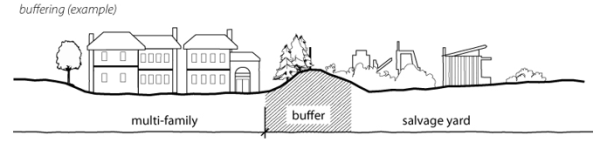
- If a buffer yard is not required, then a landscaped setback consistent with Section 810.130.A (Perimeter Landscaping of Parking Lots) will be required for any parking lot or vehicular use area with more than five (5) parking spaces or 2,000 square feet of area, whichever is less. In addition, building landscaping and interior landscaping will be installed consistent with the requirements of Section 810.140 "Landscaping Adjacent to Buildings" and Section 810.160 "Interior Parking Area Landscaping Requirements - New Parking Areas", respectively.
- If a buffer yard is not required and the development does not trigger the parking lot landscaping requirements of Section 810.120 "Parking Lot Landscaping", then perimeter landscaping consistent with Section 810.180 "Perimeter Lot Line Landscaping Requirements" or street tree plantings consistent with Section 810.190 "Street Tree Planting in Downtown Districts" will be required.
- The requirements of this Chapter apply to existing properties that do not currently conform to the requirements of this Chapter when such existing properties are changed or altered as described below. However, the Planning Director is authorized to permit exceptions and to authorize alternative means of compliance for existing properties when such changes are consistent with the Town’s overall landscaping goals and where such exceptions or alternatives are appropriate given the size and scale of the proposed property improvements.
- A new building or new parking lot (more than five (5) spaces) is proposed;
- An addition to an existing building or parking lot is proposed where such addition represents an expansion of 1,000 square feet or a 50% increase in the existing floor area, whichever is less. In addition, where an outdoor storage yard that is expanded by more than 2,000 square feet of land area;
- When a zoning application for a conditional zoning, variance or other discretionary permit is filed for the property, approval of the zoning application may be granted with the condition that requires the entire property to be brought into compliance with the minimum landscaping requirements of this ordinance. In addition, landscaping over and above the minimums may also be required.
- When an existing parking lot is dug up, removed or reconstructed where such reconstruction involves the removal of existing paving, asphalt, or concrete devoted to parking, loading, or driving aisles. This provision does not apply to simple resurfacing or restriping of asphalt or concrete.
Most parking lots are resurfaced every few years; occasionally when properties are rebuilt or altered existing parking lots are reconstructed. Landscaping is not required when parking is resurfaced but is required when the parking lot is dug up, removed, or reconstructed.
810.040 Landscape Buffer Yards
A buffer yard is required at the edge or boundary of a parcel or development site that is adjacent to a less intensive land use.
- Buffers must be improved with trees, shrubs, ground covers, and screening but the Planning Director may also permit bufferyards to be occupied by stormwater retention areas provided such stormwater retention facilities are setback at least 10 feet from any property line and provided such retention areas incorporate state of the art improvements (e.g. wet pond fountains with circulations systems or rain gardens) that make the facilities a significant amenity to the development.
- The required size of buffers required between a proposed land uses and an existing land use on adjoining zoning lots is set forth in the Buffer Matrix, Table 800-1, below. If the land next to the proposed development is vacant, the buffering required shall be determined on the basis of the most intensive use permitted by the existing zoning on the adjacent vacant parcel. If the adjacent parcel is vacant, but is zoned for a more intensive zoning district, no buffer area shall be required of the less intensive use.
- In mixed-use development projects, bufferyards will not be required between different land uses within a development project. Bufferyards will only be required along the perimeter property lines forming the boundaries of the development. The Planning Director will determine the appropriate buffer yard requirement based on an analysis of the character and intensity of land uses nearest to the project boundaries.
- The relative degree of intensity between different land uses shall be determined as follows:
- Single-family shall be the least intensive.
- Attached single-family homes and two-family homes will be the next least intensive.
- Multiple-family development will be the next least intensive.
- Group 1 shall be the next least intensive.
- Group 2 shall be the next least intensive.
- Group 3 shall be the most intensive.
- Notwithstanding the foregoing, if a shared driveway subdivides two lots, not grassed/vegetative strip shall be required where such shared driveway is located, but the area of the grassed strip that would have been required without the shared driveway shall be relocated, as a whole or in parts, to either side or the front lot line of the lot served by the shared driveway. This provision would apply to non-residential driveways exclusively.
Table 800-1: Buffer Matrix
| Buffer Matrix (Required Buffer Width [feet]) | ||||||
| Proposed Use | Abutting Use or Zoning and Required Buffer Width | |||||
| Single-Family/Two Family | Attached Single-Family | Multiple-Family | Group 1 | Group 2 | Group 3 | |
| Single-Family/Two-Family | 0 | 0 | 0 | 0 | 0 | 0 |
| Attached Single-Family | 50 | 25 | 0 | 0 | 0 | 0 |
| Multi-Family | 50 | 50 | 0 | 0 | 0 | 0 |
| Group 1 Use | 25 | 25 | 15 | 0 | 0 | 0 |
| Group 2 Use | 25 | 25 | 15 | 15 | 0 | 0 |
| Group 3 Use | 50 | 50 | 50 | 15 | 15 | 0 |
810.050 Land Use Groups
Land uses shall be assigned to land use intensity groups in accordance with the following table:
Table 800-2: Land Use Intensity Groupings
| Land Use Intensity Group Designation | |
| Group 1 | |
| Cultural Facilities | Residential Support Uses |
| Art Galleries | Child Care Center |
| Libraries | Church/Synagogue/Religious Assembly |
| Museums | College/University |
| Schools | |
| Group 2 | |
| Communication Facilities | Public Facilities |
| Motion Picture Studio | Public Service Facilities |
| Radio And Television Studio | Public Use Facilities |
| Radio And Television Transmitting/Receiving Facility | |
| Telecommunications Tower | |
| Retail | Services |
| Bicycle Sales | Animal Hospital/Veterinary Clinic |
| Commercial Vehicle Sales | General |
| Convenience Goods | Small Animal |
| Domestic Vehicle Sales | Large Animal |
| Gas Station | Automatic Teller |
| General Merchandise | Bank |
| Liquor Stores | Business Services |
| Lumber And Other Building Materials | Financial Services |
| Mail Order Delivery/Pickup Facility | Health Services |
| Manufactured Home Sales | Health Practitioner's Office |
| Motor Vehicle Sales | Medical And Dental Laboratories |
| Service Station | |
| Used Merchandise Sales | |
| Services – Miscellaneous | |
| Bicycle Repair Rehabilitation Centers | Off Premise Signs |
| Business Schools | Parking, Off Street |
| Dry Cleaners Hotels/Motels | Personal Services |
| Electrical/Electronic Repair – Small | Professional Services |
| Flea Markets, Enclosed | Repair Services |
| Food Catering Recreation and Amusement Services | Research Activities |
| Funeral Parlor | Sanitarium/Mental Institution |
| Furniture Refinishing And Repair | Small Motor Repair |
| Gunsmith | Small Motor Repair |
| Locksmith Photography Studio | Technical Schools |
| Mail Order Office Rental Of Light Equipment | Trade Schools |
| Membership Organizations | Vocational Schools Miscellaneous |
| Nursing, Convalescent, and Extended Care Facilities | Watch, Clock And Jewelry Repair |
| Office-Miscellaneous | |
| Group 3 | |
| Junkyards | Transportation Facilities |
| Manufacturing, Processing, Assembly | Truck Terminal |
| Open Storage | Warehousing |
| Open Uses Of Land –Salvage and Recycling | Warehouse |
| Places Of Assembly (Entertainment) | Warehouse, Mini |
| Railroad Switching And Classification Yard | |
| Group 3 Miscellaneous | |
| Adult Uses | Motor Vehicle Repair – Minor |
| Car Wash (Primary Use) | Publishing And Printing |
| Crematorium | Rental Of Vehicles Or Heavy Equipment |
| Electrical/Electronic Repair – Large | Reupholster |
| Exterminator | Sign Painting Services |
| Flea Markets, Open | Slaughterhouse |
| Lawn Care/Landscaping | Stadium |
| Lumberyard | Wholesale Distribution |
810.060 Unlisted Uses
In the case of uses not listed above, the Planning Director will make a determination of the group appropriate for such uses. In reaching the determination, the Director must determine the most similar use that has comparable impacts.
810.070 Buffer Yard Screening Required
Screening shall be required along the property boundaries of the zoning lot with the exception that screening such as hedges, fences or walls, as described in this section, shall not be over four (4) feet tall within front yards unless otherwise expressly authorized in this ordinance. Trees required to be saved or planted as provided in the Tree Ordinance will be counted toward the buffer yard requirements of this Section when such trees are located within the required buffer yard area.
810.080 Size And Design Of Required Buffers
- 15-Foot Buffers
Within buffers that are required to be 15 feet in width, partial screening is required and shall consist of a mix of large deciduous trees planted at an average rate of one (1) tree for every 50 linear feet of buffer with maximum spacing of 70 feet and small deciduous trees planted at an average rate of one (1) tree for every 25 linear feet with maximum spacing of 50 feet of buffer plus one of the following options:- A masonry wall (e.g. brick, stone, or stucco) with a minimum height of five (5) feet (above finished grade); or
- A privacy fence made of wood, vinyl or similar high-quality material that is six (6) feet in height; or
- An evergreen screen; or
- A solid evergreen hedge of densely planted shrubs not less than 24 inches tall at the time of installation and planted not more than three (3) feet apart to achieve a minimum height of six (6) feet and 75% opacity within two (2) years.
Figure 800-2: Berm Detail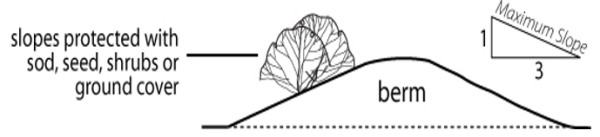
- 25-Foot Buffers
Within buffers that are required to be 25 feet in width, trees and screening are required and will consist of the following:
- Large or medium deciduous trees planted at an average rate of one (1) tree for every 25 linear feet of buffer, small deciduous and ornamental trees planted at an average rate of one (1) tree for every 20 linear feet of buffer with the maximum distance between two (2) trees of 40 feet; and
- A solid evergreen hedge to be placed between the taller elements required below and the adjacent property line.
- And one of the following:
- A solid wall or fence.
- A berm having a minimum height of three (3) feet and integrated with the plantings noted in number 1 above. The maximum slope of any berm will be 3:1 and side slopes will be designed to ensure the prevention of soil erosion.
- An evergreen screen.
Figure 800-3: Illustration of tall evergreens as screen.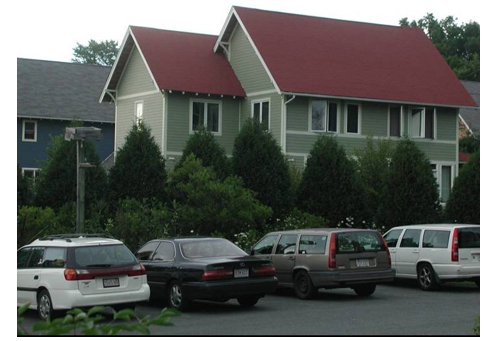
Source: Metropolitan Design Center Image Bank; University of Minnesota
- 50-Foot and Greater Buffers
Within buffers that are required to be 50 or more feet in width, screening is required and shall consist of either an undisturbed tree preservation area of sufficient screening or the following:
- The standards applicable to 25-foot buffers; and
- A double evergreen tree screen.
810.090 Alternative Buffers And Screening
- In lieu of compliance with the 15-foot, 25 foot or 50-foot buffer standards of this section, an applicant may submit an alternative landscape and buffer plan to the Tree Advisory Committee for review. Upon review of the alternate plan, the Committee may recommend that the Planning Director approve the alternative buffering and screening upon finding that the proposal will afford a degree of buffering and screening, in terms of height, separation, and opacity that is equivalent to or exceeding that provided by the applicable 15, 25, or 50-foot and greater buffer standards of this section.
- The Planning Director may not take final action approving an alternative plan until a recommendation from the committee is received or until forty-five (45) days have passed since the proposal was heard by the committee, whichever is first.
- For any required buffer yard measuring 25 foot or greater, the Planning Director shall be authorized to require the construction of a berm wall meeting the standards of this Chapter. This requirement shall be based on thoughtful consideration of the potential impacts of the proposed land use as it relates to surrounding, established. land uses.
- Where a reduction in buffer width is required due to site constraints in a 25- or 50-foot buffer (not in the case for 15-foot buffer requirements), a berm over three (3) feet in height with a wall installed on the top of the berms can be utilized to reduce the buffer width by up to 50%. The wall shall be six (6) feet in height for a total of nine (9) feet with the berm height. If homes over one (1) story are adjacent somewhere on a side of this berm/wall buffer, then a nine (9)-foot wall is required for a total height of eleven (11) feet with the berm height.
810.100 Screening Of Accessory Open Storage
Accessory open storage areas shall be screened from view of any street and from any residential use through the use of the same screening standards provided for 25-foot buffers. See Section 810.080.B, "25-Foot Buffers".
Figure 800-4: Screening of Outdoor Storage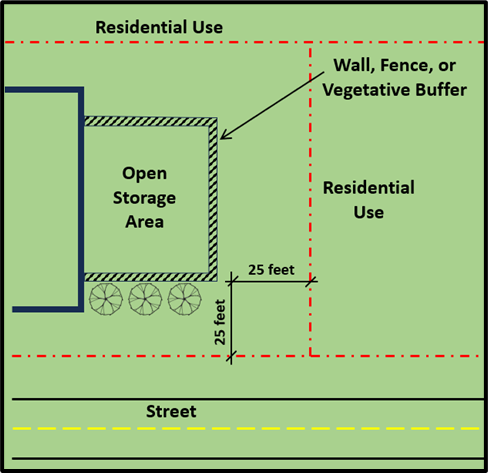
810.110 Screening Of Mechanical And Utility Equipment
- General
All ground (air conditioners, heat pumps, etc.) and wall (antennas, meters, pipes, vents, etc.) mounted mechanical or other utility equipment must be screened from the adjacent street using of features such as berms, fences, false facades or dense landscaping. Consider site topography in design for rooftop equipment screening and adjust accordingly. For example, if a portion of the perimeter road is elevated so more of the rooftop equipment is visible even though the parapet or screen on the roof is adequate from the ground view adjacent to the building, the height of the parapet or screen on the roof should be increased. - Standards
When landscaping is used it should have a minimum height of four (4) feet at the time of installation and should achieve a minimum 75% opacity within two (2) years. Landscaping screening must follow any minimum clearance requirements recommended by the manufacturer and/or utility entity. - Post Site Plan Review Approval Additions or Relocations
If there are any additions or relocations of mechanical and utility equipment after the site construction plans are approved by Indian Trail, a proposed drawing with revisions to the approved plan (RTAP) shall be submitted to the Planning Department for review.
810.120 Parking Lot Landscaping
All parking areas must comply with the following minimum screening and landscaping standards except for parking associated with single-family or two-family dwellings, parking facilities with five (5) or fewer parking spaces, and parking areas entirely enclosed or constructed underground. Trees required to be saved or planted as provided in Chapter 830, "Tree Preservation and Protection", of the Tree Ordinance will be counted toward the parking lot landscaping requirements of this Section when such trees are located within the areas of a parking lot required to be landscaped. The Planning Director will make a determination as to whether trees required by Chapter 840, "Canopy Trees, Parking Lot Plantings, and Street Trees", of the Tree Ordinance are credited toward the landscaping requirements for parking lot perimeters, interiors, or the landscaping required adjacent to buildings.
810.130 Perimeter Landscaping Of Parking Lots
- Surface parking lots shall be screened from adjacent streets and rights of way by means of an effective screening device consisting of at least the following:
- A setback the width of which will vary according to the street type. This setback must be at least 20 feet in width adjacent to a freeway, thoroughfare, boulevards, or expressways as designated by the Indian Trail Comprehensive Plan. These setbacks apply both in street yards and rear yards of properties along these road typologies unless a denser arrangement of landscaping is required to meet buffering and screening requirements of this ordinance. A setback of at least 10 feet in width is required if adjacent to a private street or any other public street. (See Figure 5.) These setbacks may be reduced to 15 feet and 7.5 feet respectively if the applicant installs a masonry wall no taller than 3.5 feet in height that screens parked cars from the street.
- Trees must be medium/large deciduous trees planted an average of 30 feet on center between the parking lot and street and no further than 15 feet from the edge of the parking lot. The Planning Director will authorize exceptions where there are overhead utility lines present. In such cases, small deciduous or ornamental trees may be used; however, the minimum spacing requirements shall be increased to an average of one (1) tree for every 20 linear feet.
Figure 800-5: Parking Lot Perimeter Plantings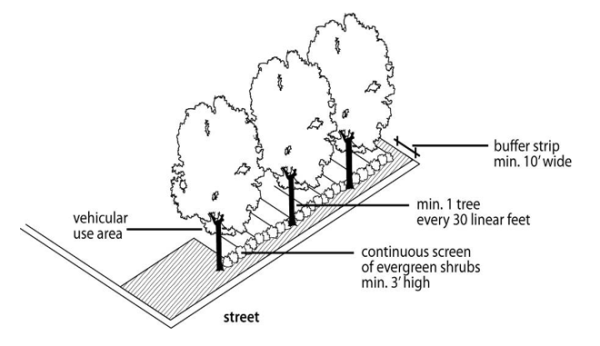 Trees are required at an interval of 1 tree every 30 feet.
- A solid evergreen hedge installed no further than 10 feet from the edge of the parking lot. Where such a hedge would be required in any sight distance triangle, the hedge shall be maintained at a height not to exceed three (3) feet tall.
810.140 Landscaping Adjacent To Buildings
Exterior building walls adjacent to parking lots, driving aisles, or public sidewalks that are visible from a public or private right-of-way must be improved with a landscaped buffer strip at least three (3) feet in width. Where the exterior building façade provides public access to the building and is adjacent to a surface parking lot and/or a driving aisle there shall be a combined landscape strip and walkway with a width of at least eight (8) feet.
Figure 800-6: Landscaping Adjacent to Building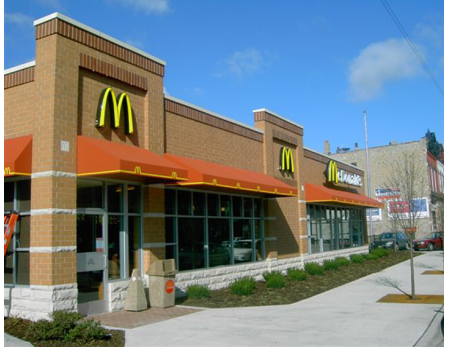 Landscaping is required at the edge of the building in addition to the walkway.
810.150 Landscaped Entryways
- The principal entryway (i.e. driveway) into parking facilities with more than 200 parking spaces must be bordered by a buffer strip that is landscaped with one (1) tree for every 200 square feet of landscaped area and densely planted hedges at least 24 inches in height at the time of installation. This landscaping strip must extend an appropriate distance into the property in order to frame the property’s entryway as determined by the Planning Director.
Figure 800-7: Landscaped entryway to large parking lot.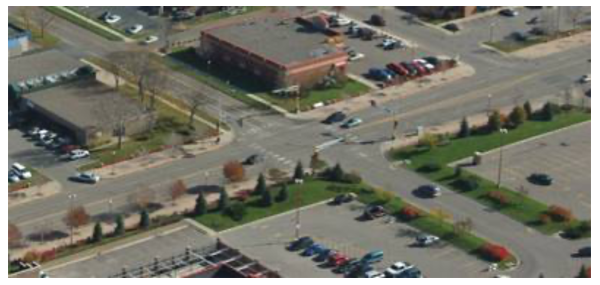 Source: Metropolitan Design Center Image Bank; University of Minnesota
810.160 Interior Parking Area Landscaping Requirements - New Parking Areas
- Canopy Coverage in Parking Lots
- All parking lots over 12 parking spaces must provide a minimum of 35% canopy cover or one tree per every 15 parking spaces whichever results in more trees. For example, a parking area of 12,000 square feet x 0.35 = 4,200 square feet. To achieve this 4,200 square feet, the applicant will be given tree canopy credits in the following manner: a planted large maturing tree shall be counted as equivalent to 1,600 square feet of canopy; a medium maturing tree shall be counted as the equivalent of 900 square feet of canopy; and a small maturing tree shall be counted as the equivalent of 400 square feet of canopy.
- Parking lots containing over 250 parking spaces shall provide at least half of the required 35% canopy cover with large trees.
- In the review of parking lot landscaping plans, the Planning Director will be responsible for ensuring that trees are appropriately dispersed so that significant portions of parking lots are shaded. In general, trees will be considered adequately dispersed if all vehicular parking spaces have at least one (1) tree trunk within 60 feet of each parking space. Where the Planning Director determines that trees saved or planted within the perimeter setback area are located so that they provide significant shading of parking areas then these trees may be counted toward meeting both the perimeter planting requirements of Section 810.180 and the interior planting requirements of this Section.
- A mix of tree species shall be provided for rows of parking spaces over 10 and provide a minimum of three (3) types of tree species.
- A minimum size planting island shall be provided for different size trees:
- Small trees shall have a minimum planting island of 162 square feet with a minimum width of nine (9) feet.
- Medium maturing trees shall have a minimum planting island of 225 square feet with a minimum width of nine (9) feet.
- Large maturing trees shall have a minimum planting island of 288 square feet with a minimum width of nine (9) feet.
- Planting islands that serve to break up every 15 parking spaces shall be a minimum of 162 square feet with a minimum width of nine (9) feet.
- Developers shall have the option of small, medium or large canopy trees so as long as 25% of the trees provided are large trees.
- Existing, healthy, well-formed trees may be preserved and used for credit in satisfying the requirements of this section consistent with the tree save area requirements of Section 830.040.B (Tree Save Area Requirements) of the Tree Ordinance. Trees may be credited toward the parking lot landscaping requirements if they provide some shade to the parking area. Saving existing trees will be credited at the rate of one (1) saved tree for every one (1) new tree required except in the case of the saving of tree stands or heritage trees in which case the Planning Director may authorize greater credits consistent with the Tree Ordinance.
- If any vegetation dies, replacement is required not later than the next planting season.
- Any fraction of these requirements must be rounded up to the next whole number.
- Landscaping must not obstruct the view of motorists using any street, private driveway, parking aisles or the approach to any street intersection so as to constitute a traffic hazard.
- All trees required by this section shall be at least eight (8) feet in height above ground level and at least 2.5 inches in caliper at the time of installation, and shall have an expected mature height of at least 30 feet, unless otherwise expressly stated herein. All shrubs required by this section shall be at least 24 inches in height when planted and shall attain a minimum size of 30 inches in height within three (3) years of plantings. The standards for all trees and shrubs required, including the minimum height, root ball size, number of branches and width shall conform to the American Standard for Nursery Stock published by the American Association of Nurserymen for that type of tree or shrub at the time of installation. The selection and planting of trees and shrubs shall conform to the suggested plant list in Appendix 1.
810.170 Modification Of Interior Landscaping Requirements
When a zoning permit is requested for the redevelopment of an existing property, then interior parking landscaping is required per Section 810.160 above, subject to the following allowances for modification:
- The Planning Director may allow landscaping to be placed in alternative locations than those described in this Section if such alternative locations are necessary to maintain the existing parking arrangement.
- Existing street trees and shrubs located within the future public right-of-way may count toward meeting these interior-landscaping requirements. New trees and shrubs installed to meet these requirements may be placed in the future right-of-way only if approval is obtained from the Town of Indian Trail and North Carolina Department of Transportation. The applicant is responsible for replacing these trees if they are damaged or lost when a right-of-way is widened.
- Under circumstances where the application of these requirements is ineffective or inappropriate because application would significantly reduce the available parking due to the site design, topography, unique relationships to other properties, natural vegetation or other special circumstances relative to the proposed development, the developer may submit an alternative plan for planting to the Planning Director. The Planning Director must review the plan and may approve an alternate, interior parking landscaping plan upon making a finding that the alternate plan achieves the purpose of this section to the greatest degree that is reasonable and practical. Plans designed to simply avoid landscaping are not an option.
810.180 Perimeter Lot Line Landscaping Requirements
The following perimeter landscaping requirements apply to all new developments unless the stricter requirements for bufferyards (see Section 810.040) or parking lot landscaping (see Section 810.120) are applicable.
- Front Lot Line Landscaping
- Front lot line landscaping will consist of a landscape strip of at least 20 feet in width adjacent to a thoroughfare or boulevard as designated by the Indian Trail Comprehensive Plan of 2005 (Plate 21) and at least 10 feet in width adjacent to a private street or any other public street. This landscape strip must be located on private property immediately adjacent to a public or private street except within the Downtown Master Plan Districts. Within the Downtown Master Plan Districts, street trees must be planted in the sidewalk or parkway consistent with the permit requirements of the North Carolina Department of Transportation if applicable.
- Any major subdivision, any multiple-family residential development, or any business, commercial or industrial development that has frontage on a public or private street must install landscaping as specified in this section. See Figure 800-8. Where this ordinance requires a landscape buffer yard or perimeter parking lot landscaping, the requirements of this section will not apply. The street frontage landscaping must be installed between the use to be screened and the property line adjacent to any street except within the Downtown Master Plan Districts.
Figure 800-8: Front Lot Line Landscaping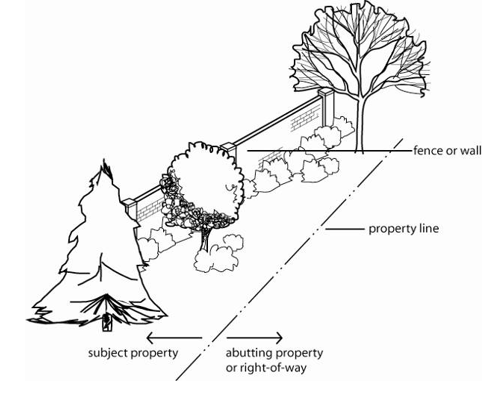 Street frontage landscaping is required when there are no buffer yard or parking lot landscaping requirements.
 - Trees required to be saved or planted as provided in the Tree Ordinance will be counted toward the street frontage landscaping requirements of this Section when such trees are located within the required setback from the right-of-way.
- Design Choices
The required front lot line landscape strip must be comprised of a combination of various plants and structures. The required landscape strip must include both of the following:- Tree Plantings
A row of medium or small deciduous or ornamental trees planted an average of 30 feet on center in the portion of the front lot line landscaping strip near the front property line; and - Shrubs, Wall/Fence or Berm
In addition to the required “Tree plantings”, choose one of the following three options to be installed between the “Tree plantings” and the remaining portion of the landscaping strip closer to the center of the property:- A row of evergreen shrubs not less than 24 inches tall at the time of installation planted not more than three (3) feet apart to form a continuous hedge; or
- A solid brick, stone, or stucco wall; or a wooden, vinyl, wrought iron, aluminum wrought iron design, or similar high-quality material fence, a maximum of four (4) feet high; or
- A berm and planting combination behind the row of evergreen shrubs in "(1)" above, with all of the following:
- The berm having an average height of three (3) feet;
- Dense evergreen shrubs on top of the berm which, when combined with the berm, achieves a height of six (6) feet of continuous screening within two (2) years of installation; and
- The maximum slope of any berm will be 3:1 and side slopes will be designed to ensure the prevention of soil erosion.
- Tree Plantings
- Properties abutting the right-of-way of US-74 in Indian Trail will meet a higher standard for landscaping and screening because of the visibility of this corridor and because of the size and character of businesses located adjacent to this highway. All commercial and other nonresidential developments are required to provide a landscape strip with a minimum width of 20 feet. This strip must be planted with a minimum of one (1) tree for each 30 linear feet of required landscape strip and at least one (1) shrub for each three (3) linear feet of required landscape strip.
- Side and Rear Lot Line Landscaping
- Where no bufferyard is required, a 10 foot wide landscaped setback must be installed alongside or rear lot lines for any non-residential development. This 10-foot landscaped setback must be planted with ground cover and a mix of shrubs and trees acceptable to the Planning Director.
- Where two properties share a driveway then no landscaped setback will be required along the abutting property lines but the amount of landscaped area that would have otherwise been required must be relocated and installed on other portions of the lot. The Planning Director will be responsible for determining that the otherwise required landscaped setback area is appropriately relocated.
Amended by Ord. O210209-347 on 2/8/2021
Adopted by Ord. 393 on 11/14/2023
Amended by Ord. 397 on 3/26/2024
810.190 Street Tree Planting In Downtown Districts
Street trees will be planted consistent with the requirements of Section 840.030 "Street Tree Planting Requirements" of the Tree Ordinance except as provided herein for the Downtown Master Plan Districts.
- New construction within the Downtown Master Plan Districts must install one (1) street or parkway tree for every 30 feet of lot frontage on a public or private street. Street or parkway tree means a tree planted along a street, road, or thoroughfare either in the sidewalk or in a landscaped area between the sidewalk and the curb. Figure 800-9 shows trees planted in the parkway.
Figure 800-9: Trees will be planted in the sidewalk within the Downtown Districts.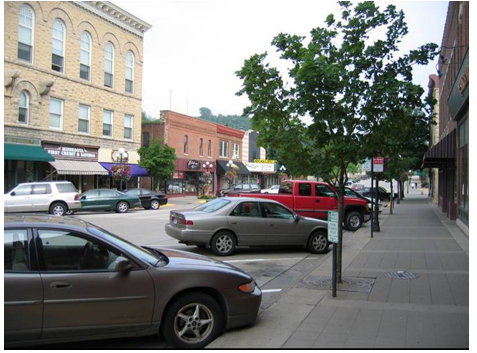 Source: Metropolitan Design Center Image Bank; University of Minnesota
 - Street/parkway trees planted in the Downtown Master Plan Districts must have a minimum caliper size of 2.5 inches at the time of planting.
- No medium/large deciduous tree is required in any existing sidewalk or parkway that is less than six (6) feet in width measured from the edge of the sidewalk to the curb, however, on these smaller sidewalks small deciduous trees must be planted consistent with the recommendation of the Parks, Greenway, and Tree Committee.
- All street/parkway trees must be installed in accordance with standard practices of horticultural professionals and in a good and workmanlike manner and must be maintained by the property owner in good condition for a period of not less than five (5) years. After the five (5) year period, tree maintenance will be the responsibility of the Town of Indian Trail.
810.200 Coordination Of Landscaping And Pedestrian Improvements
Development projects containing multiple buildings and activities are required to provide safe and direct pedestrian connections between the different buildings and land uses. Such sidewalk and walkway improvements must be coordinated with the layout and design of required landscape improvements. The Planning Director is authorized to allow modifications in the design of bufferyards, perimeter landscaping, and parking lot landscaping when such modifications are necessary to accommodate the required pedestrian improvements between buildings and uses. See figure below:
Figure 800-10: Green pathways highlight pedestrian connections between buildings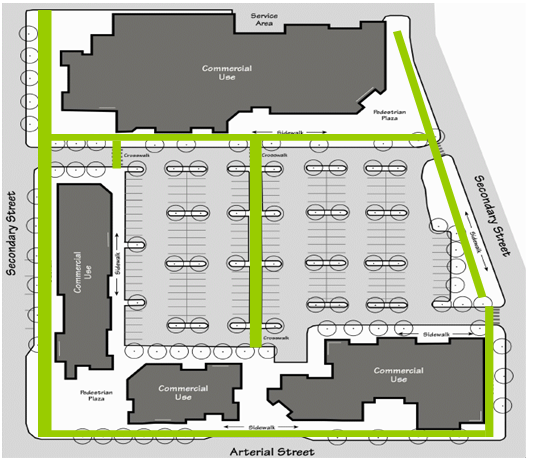
810.210 Maintenance And Irrigation Of Landscaping
All landscaping and screening that provides required buffering and screening shall be maintained. Landscape plans must indicate the proximity and source of water to irrigate trees and landscaping. Business or commercial centers located within Neighborhood Business, Downtown, General or Regional Business Districts that exceed 10 or more acres in size must have an automated sprinkler system for landscaped areas. All such systems shall be equipped with a rain sensor. The Town may require a performance guarantee if there is any delay in the installation of the irrigation system.
820.010 Security For Landscape Improvements
All required landscape materials must be installed prior to the issuance of a zoning compliance permit. The Planning Director may grant a deferral to the next planting season based on consideration of seasonal extremes in weather and unique problems with soil conditions that may be incompatible to landscaping. Where the Planning Director allows a deferral of the required landscaping, the applicant will be required to post a bond or other form of financial guarantee and no zoning compliance permit will be issued until:
- The required landscaping is completed in accordance with the approved plan; or
- A bond or certified check, payable to the Town of Indian Trail, in the amount of 125% of the estimated cost to assure installation of the required landscaping.
- An irrevocable letter of credit issued by a bank in the form approved by the Town Attorney may be accepted in lieu of bond under the terms and conditions applicable to bonds in Subsection 820.010.B above.
- No surety or portion thereof, as provided for in this section shall be released by the Town until all landscaping has been installed, inspected and approved.
- When parking is provided underground or within buildings, the performance guarantees shall not apply.
830.010 Purpose And Findings
The regulations of this section are intended to reduce tree canopy loss and implement urban forest improvements through requirements for tree protection, tree preservation, and the planting or replanting of trees and the maintenance of existing trees within the Town of Indian Trail. The tree preservation requirements are intended to enhance the quality of life through sustainable urban forest practices and increase benefits that trees provide, including, but not limited to the following:
- Absorption of carbon dioxide and returning oxygen.
- Reduction of soil erosion and the increase of rainwater infiltration.
- Provision of shade for cooling.
- Screening of noise, dust and glare.
- Improvement of stormwater runoff.
- Maintenance and improvement of Town appearance and aesthetics.
- Provision of habitat for wildlife.
- Preservation, protection, and enhancement of the natural environment.
830.020 Applicability
The provisions of this ordinance shall apply to the following:
- All major subdivisions, non-residential developments, and multi-family developments.
- Changes in use, expansions, and new buildings for already existing non-residential or mixed use land uses as per the following:
- Changes in use from residential to non-residential, such as a change from commercial to residential, or residential to industrial;
- Vehicle Accommodation Areas – Only expanded portions of existing parking lots shall be held to the shading requirements that appear in section 840.010, "Canopy Tree Planting Requirements", of this ordinance.
- Non-Residential Expansions – Any expansion of any existing land use (buildings, parking lots, etc) shall comply with the Tree Preservation and Protection Requirements in Section 830.040 of this ordinance with the following exception:
- All non-residential expansions of less than 25% of existing impervious surfaces (i.e. buildings, parking lots, etc.) shall be exempt from all provisions of this ordinance except those that deal specifically with heritage Trees and vehicle accommodation areas subject to item "2" above.
830.030 Exemptions
The requirements of this Chapter do not apply to any of the following:
- Existing or proposed single family detached dwellings or two family dwellings on individually owned lots.
- Forestry activity on forestland that is taxed on the basis of its present-use value as forestland under Article 12 of Chapter 105 of the North Carolina General Statutes.
- Activity that is conducted in accordance with a forest management plan that is prepared or approved by a forester registered in accordance with Chapter 89B of the North Carolina General Statutes.
830.040 Tree Preservation And Protection Requirements
- General Rules/Objectives
A tree protection plan and a tree inventory are required. The tree inventory must be done and submitted by a certified arborist or a licensed surveyor before it is submitted to the Town for review. The inventory is intended to serve as the basis for formulating a tree protection plan. In delineating areas to protect, the following general objectives apply:
- The protection of tree stands, rather than individual trees, is strongly encouraged. Where a project saves a stand of trees and is subject to the tree save area tree requirements of this Chapter, 110% of the canopy area shall count toward the required tree save area requirements.
Figure 800-11: Preserving Stand of Trees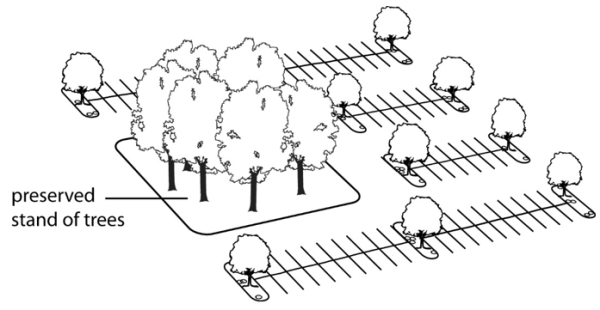
- The protection of large, heritage trees is a priority.
- Quality natural areas, free of exotic invasive species, should be the focus of tree preservation and tree save areas whenever possible.
- If an area proposed for tree preservation or as a tree save area contains exotic invasive species at the time of such proposal, such species must be removed prior to development in order to promote the growth of larger, healthier trees. The removal of invasive species will be required prior to the issuance of certificate of compliance for major subdivisions or non-residential developments.
- The decision of which trees to preserve as shown on the tree inventory shall be made jointly by the Planning Director, developer and design team during project approval process.
- The protection of tree stands, rather than individual trees, is strongly encouraged. Where a project saves a stand of trees and is subject to the tree save area tree requirements of this Chapter, 110% of the canopy area shall count toward the required tree save area requirements.
- Tree Save Area Requirements
All development subject to the requirements of this Chapter must designate tree save areas on site plans in an amount consistent with this Section. Generally, tree save areas should preserve and protect existing trees but such areas may also designate tree planting areas consistent with this Section. The requirements for protecting existing tree canopy or protecting existing canopy and establishing new canopy will be consistent with Table 800-2 below.
Table 800-2: Requirements for Protecting Existing Tree Canopy and Creating New Tree CanopyLand Use Classification Standard for Saving Existing Tree Canopy Standard for Sites Lacking Existing Tree Canopy Low to Medium Density Districts: RSF, SF-1, SF-2, SF-3 Where the existing tree canopy is at least 20% of the property area, a tree save area equal to at least 20% of the property must be protected. Where the existing tree canopy is less than 20% of the property area, a tree save area equal to 20% of the property must be achieved by saving all existing tree canopy and planting new trees consistent with Chapter 870, "Tree Planting Standards". Medium to High Intensity Residential: SF-4, SF-5, and MFR Where the existing tree canopy is at least 15% of the property area, a tree save area equal to at least 15% of the property must be protected. Where the existing tree canopy is less than 15% of the property area, a tree save area equal to 15% of the property must be achieved by saving all existing tree canopy and planting new trees consistent with Chapter 870. All Non-Residential Districts Where the existing tree canopy is at least 10% of the property area, a tree save area equal to at least 10% of the property must be protected. Where the existing tree canopy is less than 10% of the property area, a tree save area equal to 10% of the property must be achieved by saving all existing tree canopy and planting new trees consistent with Chapter 870. Downtown Core District: DCD A tree save area requirement is not applicable to properties in the DCD. A tree save area requirement is not applicable to properties in the DCD. Downtown Transitional District: DTD Where the existing tree canopy is at least 5% of the property area, a tree save area equal to at least 5% of the property must be protected. Where the existing tree canopy is less than 5% of the property area, a tree save area equal to 5% of the property must be achieved by saving all existing tree canopy and planting new trees consistent with Chapter 870. Downtown Transitional, Residential District: DTD-R Where the existing tree canopy is at least 10% of the property area, a tree save area equal to at least 10% of the property must be protected. Where the existing tree canopy is less than 10% of the property area, a tree save area equal to 10% of the property must be achieved by saving all existing tree canopy and planting new trees consistent with Chapter 870. - Method of Calculation The total property area will be calculated by taking the square footage for the entire site and subtracting the square footage for existing or dedicated road right-of-ways, utility easements, and any area covered by existing ponds and lakes. The property designated as a tree save area must be equal to 20%, 15%, 10%, or 5% of the property after rights-of-way, easements, and ponds and lakes are subtracted consistent with the requirements of this Section.
- Method for Designating Tree Save Areas
A tree save area shall be considered the combined areas of the tree protection zone and the critical root protection zone. The critical root and tree protection zone will be measured as a radial distance from the tree truck and will be equivalent to the greater area of: the drip line; a minimum of six (6) feet from the trunk; or a distance of 1.5 feet for every inch of trunk diameter as measured at breast height. If root disturbance or construction activities occur within the drip line of any tree designated as protected, only the area actually being protected will be included in the tree save area.
Figure 800-12: Critical Root/Tree Protection Zone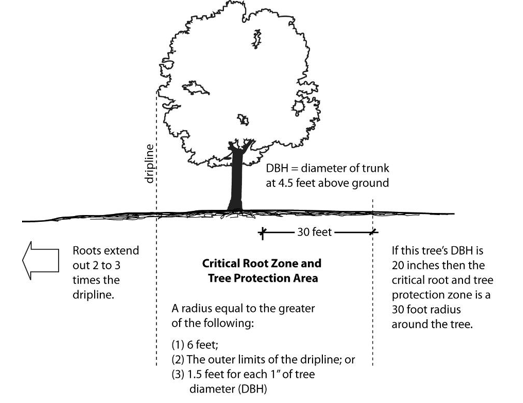
- Limitations on the Removal of Existing Tree Canopy
Any existing tree canopy must be saved to meet the requirements of this Section and may only be removed if:
- The existing trees are located in a project’s future right-of-way, within the outline of the building envelope, or within the project’s required parking area. Preservation of existing trees is not intended to prevent development of property or otherwise unreasonably restrict the use of the property, or
- The existing trees pose a threat to property or public safety because the trees are diseased, in danger of falling, or otherwise present a hazard to other vegetation or surrounding properties; and
- The existing trees that are removed under this Section are replaced with new trees consistent with the requirements of Table in Section 840.010.A, "Canopy Tree Planting Requirements".
Figure 800-13: Tree save areas should include tree stands outside of the building envelope and outside driveway/parking areas.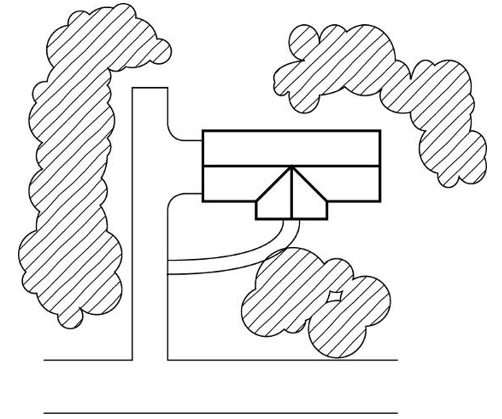
- Credit for newly planted trees The area devoted to newly planted areas may be counted as part of the tree save area. The land devoted to tree save areas that is represented by newly planted trees will be calculated on the basis of the following credits for new trees. A planted large maturing tree shall be counted as equivalent to 1,600 square feet of canopy; a medium maturing tree shall be counted as the equivalent of 900 square feet of canopy; and a small maturing tree shall be counted as the equivalent of 400 square feet of canopy.
- Heritage Tree Protection
- Applicability To the maximum extent feasible, heritage trees located on any site subject to tree preservation requirements of this Chapter must be preserved. Where a project saves heritage trees and is subject to the canopy tree requirements of this Chapter, 150% of the heritage tree canopy area shall count toward the required canopy tree requirements. Anyone who removes a heritage tree without plan approval, except as noted below in the emergency subsection of Section 2, Exemptions, is subject to one or more of the civil penalties in Section Chapter 8120. Standard for plans representing the removal of heritage trees shall meet the requirements listed in Section (3), Heritage Tree Removal, below.
- Exemptions
This Chapter shall not apply to the removal of heritage trees under the following circumstances.
- Diseased, Dying or Dead Trees and Dangerous Trees
Diseased, dying or dead trees causing a probable safety hazard to buildings, utilities, and/or pedestrian or vehicular travel paths may be removed with written approval from the Planning Director, unless deemed an emergency, as described in subsection (2) below. The removal request shall include the number, location, species and diameter of the trees to be removed along with the condition of the tree and reason for the proposed removal. The Planning Director shall review all heritage tree removal proposals and consider the following:
- The condition of the tree or trees with respect to their health, danger of falling, proximity to existing structures or utilities, and their location near pedestrian or vehicular travel paths and the probability of implementing tree maintenance techniques as an alternative to heritage tree(s) removal.
- The emergency removal of trees that pose an immediate public health and safety hazard, as determined by a Town, County, and/or State emergency services professional, may be removed without first obtaining written approval from the Planning Director. Written documentation of the removed tree(s) shall be provided to the Planning Director and include the tree species, diameter, location and a description of photographic evidence of the emergency condition.
- Trees Within ROW and Utility Easements All reasonable efforts shall be made to minimize the removal of heritage trees located within Right-of-Way (ROW) and within public utility easements. Heritage trees located within the existing public ROW or within public utility easements or heritage trees located in future public ROW or utility easements being dictated as part of an active land development permit are exempt from this chapter once it has been demonstrated to the Town that all reasonable efforts to minimize removal have been implemented. For purposes of this exemption, public ROW shall consist of ROW associated with public roads, sidewalks, and trails/greenways. Public utility easements shall consist of easements associated with water, sewer, electric, natural gas and other infrastructure.
- Diseased, Dying or Dead Trees and Dangerous Trees
Diseased, dying or dead trees causing a probable safety hazard to buildings, utilities, and/or pedestrian or vehicular travel paths may be removed with written approval from the Planning Director, unless deemed an emergency, as described in subsection (2) below. The removal request shall include the number, location, species and diameter of the trees to be removed along with the condition of the tree and reason for the proposed removal. The Planning Director shall review all heritage tree removal proposals and consider the following:
- Heritage Tree Removal
Plans associated with an active land development application that represent the removal of heritage trees will be granted only where:
- The tree(s) is located within the portion of the site where buildings or related improvements are permitted. The applicant should demonstrate that there is no other reasonable location for the building or improvement and that preservation would unreasonably restrict use of the property.
- Removal is necessary to allow construction of a road or drive that is essential for access to site.
- Where removal of healthy heritage trees is approved as part of an approved site plan, subdivision plat or tree removal, new trees will be planted according to the Mitigation Planting standards in Section (4), Mitigation Planting, below (also refer to Chapter 880, Tree Planting Standards).
- Mitigation Planting
The Mitigation Planting standards below are cumulative caliper inches approach to tree mitigation and replanting. For example, for every caliper inch of heritage trees(s) removed, a percentage of those caliper inches must be replaced with a tree or trees equal to that total percentage of those caliper inches. Each replacement tree shall be at least 2.5 inches caliper at the time of replanting. See below for the respective percentages to be replaced based on the type of development.
Where removal of healthy Heritage trees is approved as part of an approved site plan or subdivision plat, new trees shall be planted according to the following in addition to Chapter 870, Tree Replanting Standards:
- Single-Family Residential Use Replanting Ratio – replacement for residential development, excluding single-family lots not developed as part of a subdivision, shall be at a 50% ratio (e.g., 18-inch caliper tree X 50% = 9-inch caliper replacement tree or trees equivalent to that cumulative caliper)
- Non-Single Family Residential Use Replanting Ratio – replacement for all non-single family development shall be at a 25% ratio (18”-inch caliper tree X 25% = 4.5-inch caliper replacement tree or trees equivalent to that cumulative caliper)
- Canopy Retention Option: In instances where site or other constraints prohibit planting the required number of Heritage mitigation trees described in sections (4)(a) and (b) above, any acreage exceeding the tree canopy retention acreage requirements specified in UDO Section 830.040.B may be utilized to satisfy a portion of the Heritage tree mitigation requirements.
Any additional tree canopy acreage used to meet the Heritage tree mitigation requirements shall be comprised of retained existing tree canopy versus newly planted trees/canopy. Qualifying trees within the additional tree canopy area used to meet the Heritage tree mitigation requirement must be a minimum of 15 feet in height. Each Heritage mitigation tree shall equate to 900 square feet (sf) of additional canopy retention area. See below for a sample calculation:
Table 800-3: Sample Calculation for Canopy Retention OptionSite Area Canopy Required Canopy Provided Surplus Canopy (trees over 15’ in height) Canopy Credit Formula Heritage Tree Mitigation Equivalent 45,000 sf 4,500 sf 9,000 sf 4,500 sf 4,500 sf/900 sf 5 Note: In the example above, a total of five trees may be credited toward the Heritage Tree replanting rate. A combination of the two methods described above may also be applied.
- Alternative Mitigation Option
In the event the project site does not have sufficient area or is otherwise unsuitable to accommodate the required heritage tree mitigation planting described in subsection (4), Mitigation Planting, above, one or more of the alternative mitigation measures listed in this section may be proposed.
Alternative Mitigation Plans shall include the number, location, species, and diameter of the trees to be remove, and the number, species, and diameter of trees with which they are being replaced. The review shall evaluate the appropriateness of the Alternative Mitigation Plan by considering the individual development site, the development intensity along with the surrounding uses and other relevant site features. The plans shall be reviewed by Tree Board and recommendation made to the Planning Director, who makes the final decision. Approved Alternative Mitigation Plans shall be integrated into the associated site plan application unless otherwise approved as part of a Conditional Zoning Permit and may include one or more of the following:
- In-Lieu-Fees – Where the Planning Director in consultation with the Tree Board determines that on-site replanting is not feasible and/or appropriate, the Director may require that a payment not to exceed the cost of replanting replacement trees be made to a tree planting fund. Funds will be used for tree planting and maintenance of planted trees on public sites within the Town of Indian Trail such as parks, schools, municipal facilities, and similar locations. Replacement value shall be determined utilizing a professional source and by the Town. Fee Recovery as stated in Section (6), Fee Recovery, below may also apply.
- Alternative Planting Plan – The developer shall submit a heritage tree alternative mitigation plan.
- Such a plan must include a scope of work to be reviewed by the Planning Department.
- The scope of work shall include, at a minimum, the number, location and specifications of the trees to be removed as well as alternative mitigation or conservation measures through which trees or tree area will be saved or replace.
- Fee recovery stated in Section (6), Fee Recovery, below may also apply.
- Off-site Planting – An alternative site(s) may be identified for additional tree planting. Off-site plantings may include parks, schools or other public facilities located in the Town of Indian Trail to the satisfaction of the Planning Director.
- Other method(s) may be considered as deemed appropriate by Planning Director.
- Fee Recovery The Town may retain the services of a consultant to evaluate technical submittals by the applicant and seek an independent judgment on the appropriateness of the heritage tree alternative mitigation plan. The Planning Director shall be responsible for selecting the technical expert hired for the review of the proposed mitigation plan. The Town may seek financial reimbursement for the actual cost of any technical review undertaken. The technical expert must make investigations consistent with all the terms and conditions of this ordinance. The fees charged for the technical expert’s review will be customary fees for plan review and for the evaluation/preparation of a technical report. Charges for such consulting services will be fixed in advance of the processing of applications and will be incorporated into the overall site plan/subdivision/conditional zoning application fee.
840.010 Canopy Tree Planting Requirements
- All developments subject to the tree save area requirements of Section 830.040.B that cannot save the required amount of canopy through the preservation of existing trees will be required to meet the canopy requirement through the planting of new canopy trees consistent with this Section. The area of newly planted canopy trees will be calculated on the basis of the estimated canopy at maturity as described in Section 830.040.D. (i.e. 1,600 square feet for large maturing trees; 900 square feet for medium maturing trees; and 400 square feet for small maturing trees) The minimum canopy tree cover shall be provided as follows:
Table 800-4: Minimum Canopy Tree CoverLand Use Classification Zoning District Minimum Tree Canopy COMMERCIAL NBD, Neighborhood Business District 10% GBD, General Business District 10% RBD, Regional Business District 10% Mixed Use Activity Center Overlay 10% Sub-Regional Activity Center Overlay 10% DOWNTOWN DCD, Downtown Core District NA DTD, Downtown Transitional District 5% DTD-R, Downtown Transitional, Residential District 10% INDUSTRIAL L-I Light Industrial 10% H-I Heavy Industrial 10% CONDITIONAL ZONING DISTRICTS MXD 10% TND Traditional Neighborhood Development 10% Cluster and Open Space Subdivision 10% RESIDENTIAL MFR 15% SF-5 15% SF-4 15% SF-3 15% SF-2 20% SF-1 20% RSF 20% - All tree canopy cover requirements may be met through the preservation of existing trees and/or the planting of trees. Existing trees that are suitable for use in compliance with the provisions of this ordinance must be used to meet the tree shade requirements. Refer to Section 860.020, Tree Protection Standards for a description of the fencing and other protections necessary in order to receive credit for saving existing tree canopy.
Amended by Ord. O210209-347 on 2/8/2021
Adopted by Ord. 393 on 11/14/2023
Amended by Ord. 397 on 3/26/2024
840.020 Parking Lot Tree Planting Requirements
All new or expanded parking areas must comply with the following tree planting requirements. In order to meet the parking lot planting requirements, required canopy tree areas shall be located within the parking lots and adjacent to parking spaces, inside medians at the end of parking bays, or tree islands and shall adhere to the following:
- All trees shall be a minimum of 2.5 inches in caliper and at least eight (8) feet in height above ground level at time of installation, and shall have an expected mature height of at least 30 feet.
- All parking lots over 12 parking spaces must provide a minimum of 35% canopy cover or one tree per every 15 parking spaces whichever results in more trees. For example, a parking area of 12,000 square feet x .35 = 4,200 square feet. To achieve this 4,200 square feet, the applicant will be given tree canopy credits in the following manner: a planted large maturing tree shall be counted as equivalent to 1,600 square feet of canopy; a medium maturing tree shall be counted as the equivalent of 900 square feet of canopy; and a small maturing tree shall be counted as the equivalent of 400 square feet of canopy.
- Parking lots containing over 250 parking spaces shall provide at least half of the required 35% canopy cover with large trees.
- All vehicular parking spaces must have at least one tree trunk within 60 feet of each parking space.
- A mix of tree species shall be provided for rows of parking spaces over 10 and provide a minimum of three (3) types of tree species.
- A minimum size planting island shall be provided for different size trees:
- Small trees shall have a minimum planting island of 162 square feet with a minimum width of nine (9) feet.
- Medium maturing trees shall have a minimum planting island of 225 square feet with a minimum width of nine (9) feet.
- Large maturing trees shall have a minimum planting island of 288 square feet with a minimum width of nine (9) feet.
- Planting islands that serve to break up every 15 parking spaces shall be a minimum of 162 feet with a minimum width of nine (9) feet.
- Developers shall have the option of small, medium or large canopy trees so as long as 25% of the trees provided are large trees.
840.030 Street Tree Planting Requirements
- All major subdivision and non-residential developments that have frontage on a public or private street must install tree plantings.
- Where the landscape Section of the UDO or this tree planting and protection Chapter requires a landscape buffer or plantings within parking lots within similar locations as this Section then the requirements of this section will not apply.
- The required perimeter planting strip must be comprised of a row of canopy or ornamental trees including a mix of tree species, planted an average of 30 feet on center and located between the street and sidewalk with a planting strip of no less than nine (9) feet in width.
- The applicant will be required to secure all necessary permits from the North Carolina Department of Transportation.
850.010 Credits For Additional Tree Save Area Or Additional Tree Cover
A 20% or greater increase in the land area within tree save areas or a 20% or greater increase the percentage of land area devoted to canopy tree cover will result in the following allowances and credits:
- Reduction in setbacks The Planning Department may permit a maximum up to 15% reduction in the front and rear yard setbacks.
- Reduction in parking The Planning Department may permit a maximum up to 15% reduction in required parking.
850.020 Credits For Preserving Existing Trees
- Where an applicant saves a stand of trees and that applicant is subject to the tree canopy requirements of Section 830.020 then 110% of the existing tree canopy area will be counted toward meeting the requirements of Chapter 840.
- Where an applicant saves heritage trees and is subject to the canopy tree requirements of Section 840.010, Canopy Tree Requirements, then the percentage in Section 830.040.E.1, Tree Preservation and Protection Requirements, may be applied to the heritage tree canopy to count toward meeting the requirements of Chapter 840.
860.010 Maintenance Of Trees
- All property owners shall be responsible for the maintenance of all existing trees to be preserved and new plantings.
- All tree plantings required by or installed pursuant to the tree planting plan approved under this Section or other requirements shall be maintained in good condition so as to present a healthy, neat and orderly appearance.
- All required tree plantings shall be kept free from refuse, debris, and dead, diseased or severely damaged plants or vegetation.
- All dead or unhealthy trees shall be removed and replaced within one growing season.
- All existing and proposed trees used to comply with this Section shall not be sheared, topped or disfigured by improper pruning. Trees shall be allowed to grow to their natural height and form (See Appendix 2: ANSI Pruning Standards).
Figure 800-11: Proper Pruning Techniques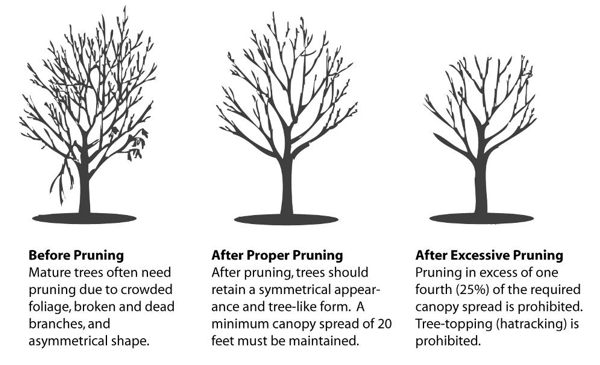
860.020 Tree Protection Standards
- Existing trees must be protected during construction. To receive credit for the protection of existing trees, trees must be protected from direct or indirect root damage and trunk and crown disturbance. The following standards shall apply:
- The tree protection zones and tree save areas shall remain open and unpaved.
- Construction site activities such as parking, material storage, dirt stockpiling, concrete washout and other similar activities shall be prohibited within the tree save area or tree protection zone.
- Changes that significantly raise the grade of soil adjacent to tree save area or a tree protection zone are prohibited.
- If an underground utility must cross the drip line area, the contractor must tunnel or auger underneath major roots of the tree without cutting them. Permission may be granted for auguring of 1/3 distance of the drip line to the trunk of the tree only if there no other feasible way. Depth of auguring shall be a minimum of two (2) feet. The illustration below highlights both inappropriate and appropriate practice for auguring near saved trees.
Figure 800-12: Proper and Improper Auguring Techniques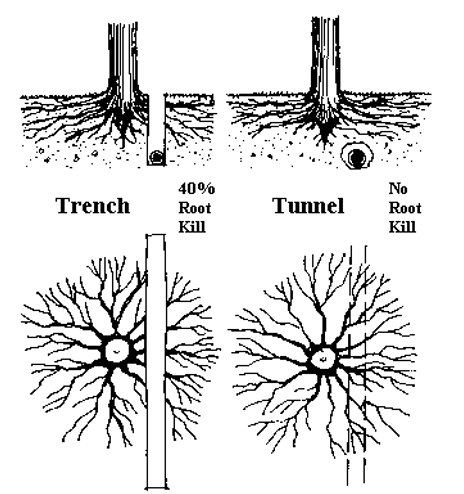
- Protective fencing shall be installed around the tree save area or tree protected zone of preserved trees prior to any land disturbing activities. Fencing shall remain in place until construction is complete and other planting requirements have been installed, and the Planning Director or Enforcement Officer has given approval for removal. The illustration below highlights appropriate fencing.
Figure 800-13: Fencing should be placed to prevent trucks and equipment from damaging tree roots.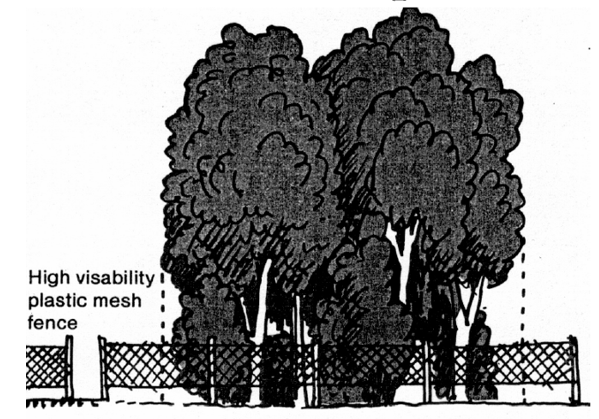 Figure 800-14: Protective fencing should be placed at the outer limits of the tree protection/critical root zone.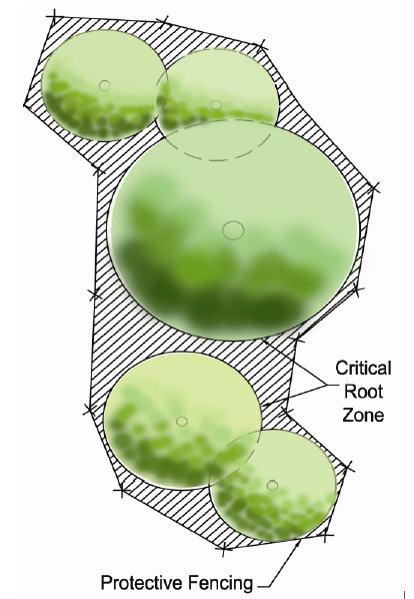
- All tree save areas shall be designated as such with “Tree Save Area” signs posted visibly on the outside of the fenced-in area. Signs may not be posted on the trees, within public right-of-ways or site triangles.
870.010 Tree Height And Diameter
All trees planted to meet the provisions of this ordinance shall be at least eight (8) feet in height above ground level and at least 2.5 inches in caliper at the time of installation.
870.020 Planting Hole
All prepared planting holes shall be a minimum of 18 inches in depth.
870.030 Planting Strip Or Island
All planting strips or planting islands shall be a minimum of nine (9) feet in width measured from face of curb.
870.040 New Plant Material
All new plant material shall be of good quality, installed in a manner to meet the standards set forth in the American Standard for Nursery Stock by the American Association of Nurserymen.
870.050 Species Mix
All tree plantings shall be required to provide a mix of species.
870.060 Soil And Proper Planting Method
Installation and construction practices shall be utilized which preserve existing topsoil or amend the soil to reduce compaction (See Figure below for an illustration of proper planting techniques).
Figure 800-15: Proper Planting Method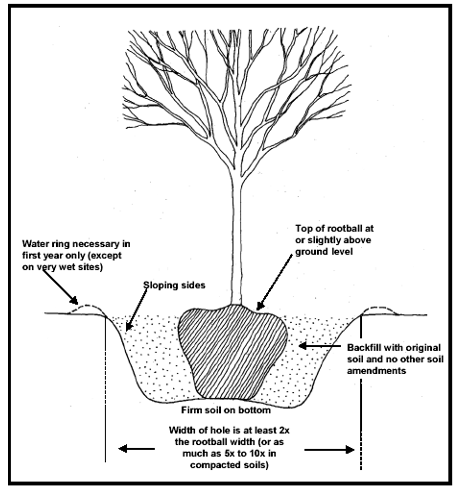
870.070 Tree And Soil Stabilization
All trees shall be properly guyed or staked (where required due to grade changes, steep slopes, creek embankments, or man-made hazards), fertilized and mulched (3 to 4-inch layer) (See illustration below and the ANSI standards for fertilization and mulching).
Figure 800-16: Proper Tree Mulching Technique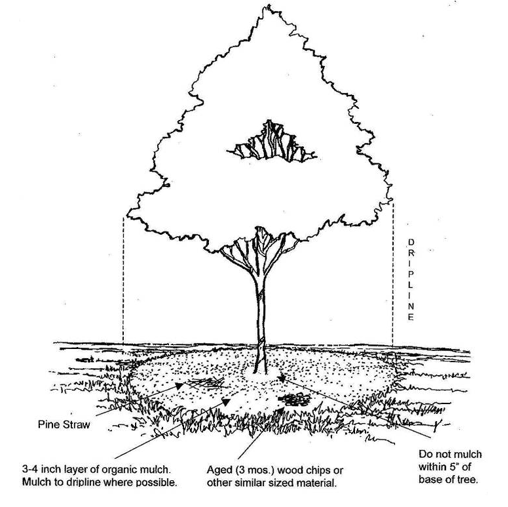
870.080 Tree Size Substitution Due To Overhead Utility Lines
Where large canopy trees are required and overhead utility lines exist, two (2) small canopy trees may be substituted and planted no closer than 25 feet of the overhead distribution lines.
870.090 No Trees In Sight Triangle
No tree shall be planted directly within the sight triangle.
880.010 Responsibilities And Enforcement
- The Planning Director or designee shall have the power and authority to administer and enforce this ordinance. The Planning Director or designee may serve notice to any person in violation of this ordinance and/or institute legal proceedings as may be required, and the Town Attorney is hereby authorized to institute appropriate proceedings to that end.
- Tree Advisory Committee will have the power and authority to the following:
- Review and propose revisions to the tree preservation standards.
- Review alternative methods of compliance with the tree planting and tree protection requirements and make recommendations to the Planning Department.
- Provide community outreach and public education.
- Participate in the Town’s Arbor Day Event.
890.010 Tree Inventory
- Tree Inventory A tree inventory shall serve as the foundation for all decisions concerning site planning and layout of new development. The inventory will provide the Town and applicant with a resource for planning landscaping and aesthetic improvements of the proposed development and a basis for encouraging preservation of existing forests, tree canopies and specimen trees. The tree inventory and tree preservation plan required by this Section must be reviewed and approved by the Planning Department.
- Tree Inventory Review
A tree inventory shall accompany all preliminary plat and construction plan submissions for major subdivisions and all non-residential development prior to any land disturbing activities. Such tree inventory will accurately depict the current condition of the site and existing trees to the satisfaction of the Planning Director. The tree inventory shall identify the following:
- Description and location of all trees that are 12 inches in diameter at breast height (DBH) or greater. Include the condition, species and height of each tree.
- General description of stands of trees 12 inches or less DBH with the size, species and density of trees per acre.
890.020 Tree Preservation/Protection Plan Required
A tree preservation/protection plan shall accompany all preliminary plat and construction plan submissions for major subdivisions and all non-residential developments. Such plans must be reviewed and approved by the Planning Department prior to any land disturbing activities. All site development must adhere to the tree preservation/protection plan and all tree preservation/protection plans must include a description of the following:
- Boundaries of the required tree save areas.
- Protected trees and/or stands of trees within the tree save area, including type and size as well as a general assessment of the health of existing trees with special notice of the presence of any harmful insects or any indicators of health problems with the trees (e.g. canopy color or density).
- A tree protection zone established and maintained on site for all trees that are to be preserved (See Figure 800-12 for illustration of Tree Protection Zone and Critical Root Zone).
- Designated future open space areas.
- Future tree save areas and buffers.
- Identification of where and how existing trees are to be protected during the clearing and construction of sites.
- If the applicant is removing existing stands of trees and such removal means the project falls below the tree save requirement of Section 830.040.B then the applicant must indicate within the tree preservation plan an explanation why it is impractical to save the existing trees.
- If the applicant is removing an existing heritage tree(s) and such removal means the project falls below the tree save requirement of Section 830.040.B then the applicant must provide within the tree preservation plan an explanation why it is impractical to save the existing heritage trees. See Section 830.040.E for a description of the limited conditions in which heritage trees may be removed.
8100.010 Tree Planting Plan
A tree planting plan shall accompany all preliminary plat and construction plan submissions. Such plans must receive approval from the Planning Department. The tree planting plan shall adhere to the following:
- The tree planting plan shall be drawn to scale, including dimensions and distances, and it will identify the location of building sites, utilities and clearly delineate all existing and proposed parking spaces or other vehicle areas, access aisles, and driveways.
- The proposed location, size and species of mitigation or replacement trees shall be indicated on the tree planting plan.
- Location of existing and proposed utilities.
8100.020 Combining Plans
Applicants may combine the Tree Preservation/Protection Plan with the Tree Planting Plan when it would more clearly convey their vision for the site, aiding the Planning Department in the review process.
8110.010 Modifications
Alternate tree protection/planting plans, plant materials, planting standards or reforestation may be used where it would be unreasonable or impractical to strictly apply the tree protection/planting requirements. Such situations may be the result of streams, natural rock formations, topography, or other physical conditions; utility easements, a unified development design, or unusual site conditions. An alternate plan may be approved as part of a Conditional Zoning or when:
- The Tree Advisory Committee makes a recommendation to planning staff regarding all alternate tree protection/planting plans, plant materials, planting standards or reforestations.
- The Planning Director approves an alternate plan that proposes different plant materials or methods provided that the quality, effectiveness, durability, and performance are equivalent to that required by this ordinance. This determination shall take into account the land use classification of adjacent property, number of plantings, species, arrangement, coverage, location of plantings on the lot, and the level of screening, height, spread and canopy of the plantings at maturity. The Planning Director may not take final action approving an alternative plan until a recommendation from the committee is received or until forty-five (45) days have passed since the proposal was heard by the committee, whichever is first.
- In order to allow planting to occur at the optimal time, the Planning Director may allow for a delay in the installation of the required plantings after the approval of a tree protection or planting plan provided the applicant provides an acceptable form of performance bond, letter of credit, or other type of surety that will ensure future installation of the required trees.
- The Planning Director may grant relief on the tree canopy cover requirements (Chapter 840) if enforcing the minimums would require planting new trees to a degree that would cause undue burden to the property owner counter to the purposes of this UDO. This applies to already existing land uses seeking to change or expand.
- Any decision of the Planning Director regarding alternate methods of compliance may be appealed to the Planning and Zoning Board in a quasi-judicial proceeding.
8110.020 Denial Of Zoning And Subdivision Approval
The Town may deny site plan or subdivision plan approval for a period of up to three (3) years after completion of a land clearance, if the clearance results in the removal of all or substantially all of the trees that would be protected under this ordinance. The denial period may be extended to a period of up to five (5) years if the Town has evidence that the timber harvest was a willful violation of this ordinance.
8110.030 Inspections
Planning department staff and authorized representatives of the Town may periodically inspect sites subject to the provisions of this ordinance to determine compliance. The Town shall have the power to conduct such investigations as it may be necessary to carry out its duties as prescribed in this ordinance and for this purpose may enter at reasonable times upon the property, public or private, for the purpose of inspecting the site(s) subject to the provisions of this UDO.
8110.040 Emergencies
During emergencies, such as windstorms, ice storms, fire, or other disasters, the requirements of this ordinance may be waived by the Planning Director for purpose of restoring order in the town. Requirements shall be waived during the emergency period only. This section shall not be used to circumvent the tree preservation protection requirements.
8120.010 Penalties
Any person who violates any of the provisions of this ordinance, or rules of orders adopted or issued pursuant of this ordinance shall be subject to any one or all of the combination of penalties authorized by this UDO. If a party continues to fail to comply with a particular provision, the party shall continue to remain subject to the penalties prescribed by this Section for the period of the continued violation of the particular provision. Penalties assessed under this Section are in addition to, and not in lieu of, compliance requirements of the UDO. The town may employ any of the remedies authorized for a municipality pursuant to G.S. 160A-175. Civil penalties for violation of this ordinance will be one or more of the following:
- Destruction or removal of trees greater than 12 inches DBH without approval of the Town of Indian Trail will incur a civil penalty equal to the amount of the value of trees as listed in the “The Guide for Plant Appraisal 9th Edition” published by The Council of Trees and Landscape Appraisers. Appraisals shall be done at the violator’s cost and the appraiser shall be selected by the Town of Indian Trail.
- For purposes of this Chapter, a separate offense shall be deemed to have occurred for each tree greater than 12 inches in DBH that have been destroyed or removed without the approval of the Town of Indian Trail.
- If the Planning Director or designee has determined that a violation of the requirements of this Chapter has occurred, no certificate of compliance shall be issued until compliance has been achieved.
8120.020 Variances And Appeals
- Variances A request for a variance from the Planning and Zoning Board in a quasi-judicial proceeding shall be made by filing a copy of the completed application with the Planning Department. A variance may be granted by the Planning and Zoning Board after a public hearing has been held in a quasi-judicial manner and advertised in accordance with the UDO and only if it concludes that the strict enforcement of the ordinance would result in practical difficulties or unnecessary hardships for the applicant and that, by granting the variance, the spirit of the ordinance will be observed, public safety, and welfare secured, and substantial justice done.
- Appeals
An appeal from any final order or decision by the Planning Director may be taken to the Planning and Zoning Board in a quasi-judicial proceeding by any person aggrieved. An appeal is taken by filing with the Planning Director a written notice of appeal specifying the grounds therefore. An appeal must be taken within 30 days after the date of the decision or order appealed from. See Chapter 380, "Appeals and Variances", for appeal requirements.

