
Indian Trail City Zoning Code
DIVISION 1300
GENERAL DEVELOPMENT AND DESIGN STANDARDS
Chapter 1360 Flood Damage Reduction Ordinance
See the Flood Damage Reduction Ordinance on the Town's website under the Engineering Department.
Chapter 1370 Storm Water Management Permits
All developments will be constructed and maintained so that adjacent properties are not unreasonably burdened with surface waters as a result of such developments. More specifically:
Chapter 1380 Post Construction
All developments shall comply with the Indian Trail Post Construction Ordinance dated September 11, 2007. See DIVISION 1700 APPENDICES, Chapter 1740 Appendix 4: Post-Construction Storm Water Ordinance for a link to the document.
Chapter 1390 Sedimentation Pollution Control
In order to prevent soil erosion and sedimentation pollution of waterways, the applicant shall comply with all requirements of the North Carolina Pollution Control Act. A plan shall be submitted and approved by North Carolina Department of Environmental and Natural Resources and a copy of the plan and DENR permit shall be provided to the Town prior to Zoning Certificate permit issuance.
Chapter 13110 Fire Protection For Developments
Fire hydrants shall be installed according to the fire code adopted by the Union County Fire Service and fire hydrant improvements and locations shall be installed consistent with the following:
O210209-347
397
393
410
1310.010 Purpose
The regulations of this Chapter are intended to promote quality, aesthetically pleasing development throughout Indian Trail and to provide a wide range of nonresidential and residential structure types to accommodate the life-styles and economic levels of the projected population. The regulations are further intended to promote quality development that complies with all Town and state regulations and minimizes land use conflicts.
1310.020 Compliance
Plans demonstrating compliance with the design standards of this Chapter will be reviewed by the authorizing permit authority at the time of development’s initial review and consideration for approval. The authorizing permit authority may approve plans that deviate from these standards if the plan is consistent with the statement of purpose and utilize equal or better design strategies and materials.
- Any proposed changes to an approved Integrity and Design Permit such as a change in building design or building materials, shall require approval by the Planning Director.
- Any proposed changes to an approved Integrity and Design Permit associated with a Conditional Zoning shall be bound by the conditions of approval, this Chapter, and the following:
- Building materials and colors shall be similar to the materials already being used in the neighborhood, and/or if dissimilar materials are being proposed, other characteristics such as scale, proportion, form, architectural detailing, color, and texture shall be used to ensure that enough similarity exists for the buildings to relate to the rest of the neighborhood.
- Any proposed deviation from conditions of approval of a Conditional Zoning approved by the Town Council shall require an amendment of the Conditional Zoning approval.
- In the event of conflict with the Downtown Master Plan design guidelines, the master plan shall apply.
- Standards for accessory structures and apartments are provided in “G. Accessory Structure Materials” of Section 710.040 Lot and Building Standards.
1310.030 Articulation Standards For Residential Buildings
- Required Articulation Standards for All Residential Buildings
All residential buildings on individual lots in residential districts must include the following design feature:- Front loading garages shall not extend further than four (4) feet past the predominant front façade of the house unless a front porch is used and then the garage shall not extend further than four (4) feet past the porch excluding side loading garages. A maximum of ¼ of the front façade is allowed to be front facing garage door(s).
- Front loading garages shall not extend further than four (4) feet past the predominant front façade of the house unless a front porch is used and then the garage shall not extend further than four (4) feet past the porch excluding side loading garages. A maximum of ¼ of the front façade is allowed to be front facing garage door(s).
- Desired Articulation Standards for Residential Buildings in Conditional Zoning Developments
- The following are desired design features for residential structures in Conditional Zoning districts. Residential structures are encouraged to include at least five (5) of the following desired design features:
- Bay or bow windows on the front façade (Note: the provision of one such window is sufficient);
- Dormers (Note: the provision of one such roof feature is sufficient);
- A roof pitch greater than or equal to a 6 to 12 (6:12) for primary roof;
- Eaves with a minimum 10-inch projection on all sides of the building;
- Rear decks or patios with a minimum size of 64 square feet;
- Front porch and entry facing the front lot line (Note: entryway can be located on the long or short axis of the dwelling;
- Off-sets on building face with a minimum depth of 12 inches;
- Decorative pillars or posts. Square post or columns may not be less than six (6) nominal inches on any side and round columns may not be smaller than eight (8) nominal inches in diameter from the bottom of the column unless consistent with a distinct architectural style. (Note: suggested at least one pair, decorative or plain, but finished in manner that is consistent with the dwelling exterior);
- Distinct Architectural Style (2 point value). The use of a distinct architectural style may be determined by a qualified professional contracted by the Town at the cost of the applicant unless the Planning Director is confident in the determination of the style.
- Each of the following design features are desired on residential structures in a Conditional Zoning development:
- Openings including doors and/or windows on street facing building facades. Windows are suggested to have appropriate window trim per style of architecture. Blank walls are not desired.
- Masonry (preferably brick) perimeter enclosure at base but also including poured concrete so that each home has the appearance of a raised foundation (Note: wood products covered with a treatment to appear as masonry do not qualify). Poured concrete shall be treated with brick, stone, or color and textured material appropriate foundation style per style of architecture.
- Changes in the use of wall facing materials should occur at wall setbacks or projections, or to articulate the transition between the building base middle and top. Material changes should return to inside corners of front façade. Those materials however, are not required to wrap the outermost front corner of the home.
- Front loading garages shall not extend further than four (4) feet past the predominant front façade of the house unless a front porch is used and then the garage shall not extend further than four (4) feet past the porch excluding side loading garages. A maximum of ¼ of the front façade is allowed to be front facing garage door(s).
- The following are desired design features for residential structures in Conditional Zoning districts. Residential structures are encouraged to include at least five (5) of the following desired design features:
- Build-To Line
Infill development in existing residential subdivisions or new home construction on a lot along a street corridor with developed home lots within 300 feet on each side of such lot shall be constructed at a distance from the front property line consistent with the developed homes or to be known as the “build-to line”. The build-to line distance is the average of the developed home lots within 300 feet on each side of the new home lot from the front property line to the front primary elevation façades. The new residential structure shall front on the same street as the developed homes. Setbacks must still be met with the following exception in “D”. - Reduced Front Yard Setback in Developed Areas
The minimum front yard setback may be reduced for any lot where the build-to line (the average established front setback on developed lots located within 300 feet on each side of such lot) is less than the minimum required setback. In such cases, the front setback on such a lot may be less than the required front setback but not less than the average of the existing front setbacks on the developed lots within 300 feet of each side.
1310.040 Desired Building Material Standards For Site-Built And Modular Housing In Conditional Zoning Developments
Residential buildings in a Conditional Zoning constructed on-site may be improved with quality materials that are durable, safe, and require limited maintenance. It is recommended that materials be selected for suitability to the type of building and design for which they are used. All facades visible from public or private streets are desired to be constructed of the following materials:
- Brick, natural stone, wood, architectural cast stone, hardcoat stucco, cementitious siding, glass or EIFS – Exterior Insulation Finishing System (when applied according to manufacturer specifications and the North Carolina Building Code).
- Vinyl siding (minimum of .44mm), galvanized, aluminum coated, or zinc-aluminum coated metal finishes provided such materials do not exceed 20% of those façades visible from public or private streets.
- Roof material standards are not provided for site-built and modular housing that is not under a Conditional Zoning, but the roof material shall be consistent in appearance to the existing neighborhood materials on primary homes for new infill development. For Conditional Zonings, the following is suggested if the consistency of the neighborhood does not imply otherwise:
- Only roof asphalt shingles, slate and terracotta tile materials are used on site-built and modular housing structures.
- Metal and synthetic rubber are not allowed roof materials.
- Metal roof materials may be used in the RSF zoning district.
- When replacing an existing roof on a housing structure, the new materials shall follow the standard listed in “C” above. In an established residential subdivision, the roofing material shall be consistent in appearance to the primary homes in the subdivision.
- See "G. Accessory Structure Materials" in Section 710.040 Lot and Building Standards for accessory structure material requirements.
1310.050 Manufactured Housing Units On Individual Lots
This section and Section 1630.060 Household Living Category provides standards for manufactured homes. Permitted Class A or B manufactured housing units may be placed on individual lots in residential districts that permit or conditionally permit detached manufactured houses only if they meet all the following standards:
- Shall be used for residential purposes only;
- Shall be served with a public water supply and sanitary sewer or approved septic system;
- Are constructed in accordance with the National Manufactured Housing Construction Safety Standards Act of 1974 as amended on August 22, 1981;
- Minimum Size
- General
Enclose a floor area of not less than 1,000 square feet in any residential zoning districts (Note: single-wide manufactured dwellings that include expandable units, pop-outs and tilt-outs are not permitted.). - Class A Manufactured HomeHas a minimum width of sixteen (16) feet.
- Class B Manufactured HomeHas no minimum width.
- General
- Foundation and Crawl SpaceThe manufactured home shall be placed on an excavated and/or backfilled foundation and the open portion under the home enclosed with pressure treated wood, masonry, or concrete walls, so that the top of the perimeter wall is not more than eight (8) inches above the finished ground level, except on a sloping lot where the top of the perimeter wall may be no more than eight (8) inches above the finished ground level at its highest point along the perimeter wall (Note: when pressure treated wood is used for the perimeter wall, a covering similar in appearance to the manufactured housing unit siding, or a finished concrete wall will be used to cover the wall). Metal or materials resembling metal (i.e. vinyl panels) shall not be used to enclose the crawl space.
- Exterior Wall Materials
- Class A Manufactured Home
Has exterior siding, comparable in composition, appearance, and durability to the exterior siding commonly used in standard residential construction, consisting of one or more of the following:- Vinyl or aluminum lap siding whose reflectivity does not exceed that of flat white paint;
- Cedar or other wood siding;
- Wood grain, weather resistant press board siding;
- Stucco siding;
- Brick or stone siding.
- Vinyl or aluminum lap siding whose reflectivity does not exceed that of flat white paint;
- Class B Manufactured HomeNo specific wall material standards except for no bare metal siding.
- Class A Manufactured Home
- Roof Shape and Materials
- Class A Manufactured Home
The Class A home shall have the following:- Has a roof finished with roofing material with a fire rating of Class C or better and that is commonly used in standard residential construction.
- Has a gable roof having a pitch with a minimum vertical rise of three and one-half (3.5) feet for each twelve (12) feet of horizontal run.
- Has a roof structure that provides an eave projection of no less than six (6) inches, which may include a gutter.
- Has a roof finished with roofing material with a fire rating of Class C or better and that is commonly used in standard residential construction.
- Class B Manufactured HomeThe home shall have a gable roof with a pitch having a minimum vertical rise of three and one-half (3.5) feet for each twelve (12) feet of horizontal run.
- Class A Manufactured Home
1310.060 Two-Family Dwellings, Town Homes And Rooming Houses
- General Two-unit houses, town homes and rooming houses are subject to the standards of Section 520.040, "Lot and Building Standards," (density, frontage and yard requirements) except as expressly modified or supplemented by the following standards.
- Maximum Units
Town homes are limited to no more than five (5) dwelling units per building. - Varied Building Placement
Town home neighborhoods shall position buildings in a manner to avoid long, uninterrupted runs along a street block. Where possible, buildings should be clustered into shorter blocks and/or around common open space. - Entrances
- The street-facing façade of a rooming house may have only one (1) visible entrance to the building. If the building is located on a corner lot, one (1) building entrance may be visible from each street.
- Patio-style doors, such as sliding glass doors, may not be used for main entrance doors.
- Pedestrian Circulation A pedestrian circulation system must be provided that connects residential entrances to adjacent public rights-of-way and to parking areas and other on-site facilities.
- Parking Location/Orientation Surface parking and parking within accessory structures must be located behind principal building or otherwise concealed from view of abutting streets. Parking areas may not be located directly between the principal building and the street or within any required interior side setback area. Any portion of a parking area that is not completely concealed from view of an abutting street must be screened in accordance with the parking lot landscaping requirements of DIVISION 800.
- Outdoor Living Space
Each individual lot or building shall provide an adequate quantity of outdoor living space for the use of recreation, eating, and storage of customary outdoor items such as garbage receptacles.
1310.070 Multi-Unit Apartment/Condo Buildings: Attached And Multi-Family
- General Multi-unit apartment/condominium buildings are subject to the standards of Section 520.040 (density, frontage, and yard requirements) except as modified or supplemented by the standards of this Chapter.
- Varied Building Placement
Buildings shall be positioned in a manner to avoid long, uninterrupted runs within interior drives and parking areas. Where possible, buildings should be clustered into smaller groups and/or around common open space. - Façade Materials
All buildings and other structures must be constructed with brick, natural stone, EIFS (Exterior Insulation Finishing System), glass, cementitious (i.e. Hardie) plank, panel or shingle siding or other comparable, durable materials that are consistent with the purpose and intent of this chapter and approved during the plan review process. A minimum of 30% of the building façade shall consist of brick and/or stone materials.
Use of architecturally finished/treated cast stone, precast panels or concrete masonry units as a primary building material may allowed in visible areas that are suitable for use on multifamily buildings and are consistent with the purpose and intent of this chapter and approved by the Planning Director during the plan review process.
Unfinished/treated concrete masonry units, unfinished/treated precast panels, and similar utility/economical grade materials (with exception of metal siding) may be allowed in service areas and in exterior corridors or stairwells that are not generally visible to the public. - Façade Colors
Façade colors must be low-reflectance, subtle, neutral or earth tone colors. Building trim and accent areas may feature brighter colors, as approved during the plan review process. - Building Design
The following standards apply to all building facades and exterior walls that are visible from adjoining streets, properties or parking areas.- Façade design and materials shall be consistent on all building elevations.
- All building designs must express a distinct “base”, “middle”, and “top” through the building’s architecture details and the use of building materials.
- Roofs must have multiple planes and elements such as hips, gables, dormers, raised parapets, or other offsets and features with at least one additional plane or feature every 60-ft of façade frontage.
- Buildings must have architectural features that conceal rooftop equipment, such as HVAC units, from public view. All flat roof buildings must include parapet screening (maximum five (6) feet in height), and cornice or decorative coping elements along rooflines.
- Vehicular parking shall not be placed between residential buildings and public streets. On-street parking is permitted and encouraged.
- For proposed buildings located within the Downtown Overlay, exposed stairwells, corridors, or breezeways shall not be permitted. In the event of conflict with the design guidelines of the Downtown Master Plan the master plan shall apply.
- Façade design and materials shall be consistent on all building elevations.
- Articulation
Buildings visible from public streets, adjacent properties, and parking areas must include at least three (3) of the following features:- Clearly pronounced recesses and projections (articulation) at multiple locations for any building with a front façade exceeding 50 feet in width.
- Wall plane off-sets (minimum two (2) foot depth and spacing every 30’) at multiple locations, reveals, projections, and changes in texture and color for wall surfaces for any building with a front façade exceeding 50 feet in width.
- Multiple windows grouped together to establish a design feature that can be either recessed or projecting with a minimum 4’’ wide trim.
- Multiple ornamental pilasters, columns or other similar architectural features integrated into the overall architectural design.
- A projecting or recessed balcony on at least 50% of the units of an individual façade and a covered porch for each unit at the ground-level.
- Other features that reduce the apparent mass of a building subject to approval by the Planning Director.
- Clearly pronounced recesses and projections (articulation) at multiple locations for any building with a front façade exceeding 50 feet in width.
- Entrances
- Entrance doors to dwelling units located above the ground floor must be provided from an enclosed lobby or corridor and stairwell. Unenclosed or partially enclosed stairs may not be used as the primary means of access to upper-floor dwellings units.
- Patio-style doors, such as sliding glass doors, may not be used for main entrance doors.
- Each building must have a clearly defined, highly visible entrance featuring at least 3 of the following elements:
- Canopies or porticos;
- Overhangs;
- Recesses/projections;
- Raised corniced parapets over the door;
- Peaked roof forms;
- Arches;
- Architectural details such as tile work and moldings that are integrated into the building structure and design; or
- Integral planters or wing walls that incorporate landscaped areas and/or places for siting.
- Canopies or porticos;
- Pedestrian Circulation A pedestrian circulation system must be provided that connects residential entrances to adjacent public rights-of-way and to parking areas and other on-site facilities.
- Parking Location/Orientation Surface parking and parking within accessory structures must be located behind principal building or otherwise concealed from view of abutting streets. Parking areas may not be located directly between the principal building and the street or within any required interior side setback area. Any portion of a parking area that is not completely concealed from view of an abutting street must be screened in accordance with the parking lot landscaping requirements of DIVISION 800.
- Open Space
- General
- Every applicant who proposes a multi-family apartment or condominium building shall set-aside a portion of land, in accordance with this Chapter, for a private or public park, greenway, recreation, and open space sites to serve the recreational needs of the residents of the development.
- At least 15% of the gross acreage of the site (outside of Downtown Overlay) shall be set-aside for park, recreation, greenway, or open space sites to serve the recreational needs of the residents of the subdivision or development A minimum of 10% of the gross acreage shall be set aside for sites within the Downtown Overlay District.
- To the extent feasible, areas with environmental limitations (e.g. designated flood plain areas, wetlands, and areas with a slope in excess of 15%) should be dedicated as open space and the Town may require these areas to be dedicated in excess of the minimum standard provided in this Section provided that reasonable economic use of the property is permitted.
- At the time of filing a site plan or conditional rezoning application, the applicant shall designate thereon the area or areas to be set-aside.
- Every applicant who proposes a multi-family apartment or condominium building shall set-aside a portion of land, in accordance with this Chapter, for a private or public park, greenway, recreation, and open space sites to serve the recreational needs of the residents of the development.
- Design and Active Amenities
- Open space shall be designed to provide maximum accessibility and visibility to residents within the development. Opportunities for both passive and active recreation should be provided. Indoor amenity areas such as indoor pools, etc. may be used towards compliance with the open space acreage requirements.
- Multi-family and condominium uses must provide fully developed, targeted amenities (indoor or outdoor) of an appropriate size and scale with the number of units as follows.
- Fewer than 75 units = 1 amenity
- 75 to 150 units = 2 amenities
- 151 to 300 units = 3 amenities
- More than 300 units = as determined by Planning Director
- Fewer than 75 units = 1 amenity
- Examples of indoor amenities include, but are not limited to: Fitness center with fitness equipment, recreation or game room including features such as billiards tables, game tables, or movie viewing area, solarium, sauna, steam room, or other type of relaxation room, common cooking and/or dining facility, and swimming pools.
- Examples of outdoor amenities include, but are not limited to fenced dog park with dog wash station, bike workshop and storage area, community vegetable and flower garden, outdoor lounge area such as with a fire pit and grills or outdoor kitchen, playground with commercial-grade equipment basketball court (full or half court); tennis court; pickleball court; volleyball court; or soccer field that is graded properly to an amateur or practice-level facility, is grassed, and has goals, putting green, bocce courts, horseshoe courts, or shuffleboard courts, and swimming pools.
- Open space shall be designed to provide maximum accessibility and visibility to residents within the development. Opportunities for both passive and active recreation should be provided. Indoor amenity areas such as indoor pools, etc. may be used towards compliance with the open space acreage requirements.
- General
- Site Plan Review Site plan review, pursuant to Chapter 370, is required for all multi-unit apartment/condo buildings containing more than three (3) dwelling units.
1320.010 Applicability
Unless otherwise expressly stated, the material and color standards of this section apply to all facades visible from a public or private street or public areas of adjacent sites for non-residential/commercial development in all zoning districts that are subject to site plan review. This section excludes industrial land uses.
1320.020 Pedestrian Circulation
- A pedestrian circulation system must be provided that interconnects building entrances to adjacent public rights-of-way and other on-site facilities. Buildings with parking abutting them shall have a concrete pedestrian walkway with a minimum five (5)-foot width. Such walkways must be located three (3) feet from the facade of the building to provide planting beds for foundation landscaping, except where features such as arcades, display windows, planters, or entryways are part of the facade.
- All internal pedestrian walkways that cross parking aisles or driveways must be distinguished from driving surfaces through the use of durable, low-maintenance surface materials such as pavers, bricks, scored concrete or scored and painted asphalt designed to enhance pedestrian safety and comfort. Raised walkways may be installed if elevated six (6) inches with tapered side slopes and meet ADA standards.
1320.030 Facade Materials
- All buildings and other structures must be constructed with brick, cementitious panels or siding, natural stone, architecturally finished and integrally colored concrete masonry units, EIFS (Exterior Insulation Finishing System), glass or other comparable, durable materials that are consistent with the purpose and intent of this chapter and approved during the site plan review process.
Use of architecturally finished/treated cast stone or precast panels as a primary building material may be allowed in visible areas that are suitable for use in commercial locations and are consistent with the purpose and intent of this chapter and approved by the Planning Director during the site plan review process. - For buildings 40,000 square feet and larger, a minimum of 30% of the building facade that is visible from streets or other public areas, excluding doors and windows, shall consist of brick and/or stone.
- Unfinished/treated concrete masonry units, unfinished/treated precast panels, and similar utility-/economical-grade materials may be allowed in service areas and on exterior walls that are not generally visible to the public unless otherwise stated in this ordinance.
- Facade Colors Facade colors must be low-reflectance, subtle, neutral or earth tone colors. Building trim and accent areas may feature brighter colors, as approved during the site plan review process. Traditional or standard franchise colors shall also comply with this section.
1320.040 Building Design
- The following standards apply to all building facades and exterior walls that are visible from adjoining streets or properties.
- All building designs must express a distinct “base”, “middle”, and “top” through the building’s architecture details and the use of building materials.
- Buildings visible from public streets must include at least three (3) of the following features:
- Variations in roof form and parapet heights;
- Clearly pronounced recesses and projections at multiple locations for any building with a front façade exceeding 50 feet in width;
- Wall plane off-sets (dimension established by building module) at multiple locations for any building with a front façade exceeding 50 feet in width;
- Reveals and projections and changes in texture and color of wall surfaces;
- Deep set windows with mullions;
- Ground level arcades and second floor galleries/balconies; or
- Other features that reduce the apparent mass of a building.
- Buildings must have architectural features that conceal rooftop equipment, such as HVAC units, from public view. All flat roof buildings must include parapets and cornice or decorative coping elements along rooflines.
- Each building must have a clearly defined, highly visible customer entrance featuring at least four (4) of the following elements:
- Canopies or porticos;
- Overhangs;
- Recesses/projections;
- Arcades;
- Raised corniced parapets over the door;
- Peaked roof forms;
- Arches;
- Outdoor patios;
- Display windows;
- Architectural details such as tile work and moldings that are integrated into the building structure and design; or
- Integral planters or wing walls that incorporate landscaped areas and/or places for sitting.
- Building height may not exceed 35 feet for a one-story building or as otherwise authorized within the UDO.
1320.050 Large-Stores And Shopping Centers
- Applicability In addition to the requirements listed in Division 1300, "General Development and Design Standards," the standards of this section apply to all retail uses and food and beverage retail sales uses on sites that include, in aggregate, more than 70,000 square feet of gross floor area.
- Pedestrian Circulation
At least one continuous internal pedestrian connecting walkway must be provided from the public sidewalk or right-of-way and the principal customer entrance of all principal buildings on the site. Such pedestrian connections must be at least six (6) feet in width. Refer to the Indian Trail Land Development Standards for the required sidewalk construction standards. At a minimum, walkways must connect focal points of pedestrian activity such as, but not limited to, transit stops, street crossings, building and store entry points, and feature items such as adjoining landscaped areas that includes trees, shrubs, benches, flower beds, planters, groundcover, or other such materials for no less than 30% of its length.
- Walkways must be provided along the full length of the building along any facade featuring a customer entrance, and along any facade abutting public parking areas. Such walkways must be located a minimum of three (3) feet from the facade of the building to provide planting beds for foundation landscaping, except where features such as arcades, display windows, planters or entryways are part of the facade.
- Customer entrances must have weather protection features, such as awnings, arcades, or vestibules.
- All internal pedestrian walkways that cross parking aisles or driveways must be distinguished from driving surfaces through the use of durable, low-maintenance surface materials such as pavers, bricks, scored concrete or scored and painted asphalt or applied surface materials (e.g. bubbled runner mats) designed to enhance pedestrian safety and comfort. Raised walkways may be installed if elevated six (6) inches with tapered side slopes and meet ADA standards.
1320.060 Industrial Centers/Business Parks
- Industrial Buildings (for individual properties and parks)
Unless otherwise expressly stated, the material and color standards of this section apply to all facades visible from a public or private streets or public areas of adjacent sites for allowable uses in Chapter 570, "Permitted Uses".
Figure 1300-1: Preferred Industrial Design
- Facade Materials
- All buildings and other structures must be constructed with brick, cementitious (i.e. Hardie) panels, natural stone, architectural cast stone, EIFS (Exterior Insulation Finishing System), glass, architecturally finished and integrally colored concrete masonry units, precast wall panels that incorporate architectural treatment such as integral coloring and texture, or other comparable, durable materials that are consistent with the purpose and intent of this chapter and approved during site plan review process. The use of various materials to produce effects of texture and relief is encouraged to produce diversity and visual interest while reducing building scale.
- Unfinished/treated concrete masonry units, unfinished/treated precast panels, metal siding, and similar utility/economical grade materials may be allowed in service areas and on exterior walls that are not generally visible from public or private streets or public areas of adjacent sites unless otherwise stated. The use of metal siding as a primary material visible from the street or public areas of adjacent sites must be approved through the conditional rezoning process.
- Facade Colors
Facade colors must be low-reflectance, subtle, neutral or earth tone colors. Building trim and accent areas may feature brighter colors, as approved during the site plan review process. - Building Articulation
The following standards seek to promote high-quality and creative development and shall apply to all building facades and exterior walls that are visible from adjoining streets or properties. Each business park should have a distinct architectural concept that is consistent in theme, architecture details and the use of building materials. Buildings must include the following features:- Facade offsets, modulation, indentations and architectural details occurring every 80 feet to create clearly pronounced buildings and to avoid large, blank surfaces. Offsets or offsetting details shall be a minimum of two (2) feet in width;
- Screening of equipment and storage areas (if allowed) that is consistent with the primary structure(s);
- Reveals, projections, and changes in texture and color of wall surfaces;
- Landscaping to soften building exteriors;
- Varying building heights/massing and setbacks to define different functions such as offices and warehouses;
- Loading facilities shall not be located in front of the building or side facing a public street or entryway and shall be located at the rear or side of the site; and
- Architectural features that conceal rooftop equipment such as HVAC units, from public view. All flat roof buildings must include parapet screening that includes variations to avoid long, continuous planes. Roof line areas that are not visible from public or private streets or public areas of adjacent sites, are not required to have parapets.
- Entrances
Entrances to individual buildings shall create visual interest and be readily identifiable to visitors, architecturally integrated within the overall building compositions, and shall incorporate at least two (2) of the following design standards:- Overhangs and canopies;
- Recesses/projections with raised parapets, gabled roof forms or arches;
- Outdoor patios;
- Architectural details such as tile work and moldings that are integrated into the building structure and design; and
- Integral planters or wing walls that incorporate landscaped areas and/or places for sitting.
1330.010 Purpose And Intent
- It is the purpose and intent of this Chapter to encourage the use of lighting design practices and systems that will: 1) minimize glare, light trespass and light pollution; 2) conserve energy and resources while maintaining nighttime safety, security and productivity; and 3) to curtail the degradation of the nighttime visual environment.
- It is the purpose and intent of this Chapter to establish clear and comprehensive outdoor lighting standards with an emphasis on reducing glare and light trespass by requiring, in most circumstances, the installation of both semi-cutoff (minimum required) and full cut-off (preferred) lighting fixtures.
- It is the purpose and intent of this Chapter to allow for outdoor lighting that is appropriate for the task and to establish light fixture height limits that will help prevent light trespass to adjacent properties.
- It is the purpose and intent of this Chapter to establish specific standards for certain land uses that typically have unique lighting requirements, such as (but not limited to) automotive dealerships, service stations, and outdoor sporting facilities.
1330.020 Applicability
- New Construction
This outdoor lighting standard applies to the development of all new multi-family housing, new major residential and non-residential subdivisions, non-residential construction, and the construction of parking lots where such developments include the installation of new outdoor lighting fixtures or the replacement of existing lighting fixtures. All new construction projects shall have enough exterior lighting to meet the minimum safety and security requirements of the Southern Building Code (SBC), National Electrical Code (NEC) and North Carolina Building Code (NCBC). The replacement of an existing lighting fixture is defined as a change of the type of fixture; a change in the mounting height of a fixture on a pole, building, or other structure; or a change in the location of a lighting fixture. All of these applications require compliance with this section. Routine lighting fixture maintenance such as replacement of lamps, ballast, starter, photo control, or similar components will not constitute the need to comply with this ordinance, and is permitted provided such changes do not result in a higher wattage or higher lumen output. - Expansions or Improvements
This outdoor lighting standards shall apply to any redevelopment, expansion, or improvement exceeding 50% of a site's existing floor area as established by the Tax Department and will require compliance with this section.
1330.030 General Exemptions
The following lighting is exempt from the requirements of this Section:
- Emergency lighting: Lighting required for public safety in the reasonable determination of public safety officials with authority.
- Decorative lighting: Low-wattage fixtures (comprised of incandescent bulbs of less than eight (8) watts each or other lamps of output less than one hundred (100) lumens each) used for holiday decoration.
- DOT lighting: Department of Transportation highway signage luminaires, which must comply with national D.O.T. standards.
1330.040 Light Measurement Technique
Measurements shall be made at finished grade (ground level), with the light registering portion of the meter held parallel to the ground, pointing up. The meter shall have an accuracy tolerance of no greater than plus or minus 5%. Measurements shall be taken with a light meter that has been calibrated within one (1) year. Light levels are specified, calculated and measured in footcandles (FC), and should be taken after a one hundred (100) hour burn-in time, which will more accurately read “maintained” lighting levels.
1330.050 General Lighting Standards
All outdoor lighting (other than lighting for automotive dealerships and outdoor sporting facilities) shall comply with the following standards: All exterior lighting should be provided as to minimize the amount of light that is distributed towards an adjacent property, thereby limiting light trespass.
- Lighting Levels
- All new lighting installations adjacent to a residential property (and renovations to existing lighting fixtures), shall show the intent to limit FC levels at property lines to a maximum amount of one (1) footcandle maintained. All new lighting installations adjacent to a commercial property (and renovations to existing lighting fixtures), shall show the intent to limit FC levels at property lines to a maximum amount of two (2) footcandles maintained.
- The maximum light level allowed at any point on a given parcel or property (with the exception of automobile dealerships, gas and service station canopies, and sporting facilities) shall not exceed twenty (20) footcandles maintained. The maximum light level allowed at any point on an automobile dealership (display or parking area) shall not exceed fifty (50) footcandles maintained.
- The minimum light level allowed at frequently used building entrances and public areas of sites (i.e. parking lots, refuse or delivery areas, etc.) is one (1) footcandle maintained.
- Fixture Shielding
- All lighting fixtures, (regular lamps and flood lamps) rated 100 watts or less (see Table 1300-1 for LED equivalent) may be used without restriction to light distribution (non-cutoff classification) except when the luminaire creates direct glare perceptible to persons on a public right of way, or into the window openings of a residential dwelling unit. Care should be taken to minimize light trespass across property lines. Internal louvers or “glare or house side shields” should be provided where the emitted light becomes a hindrance.
Table 1300-1: Metal Halide / High Pressure Sodium to LED Wattages Conversion.Original Lamp (Watts) LED Lamp (Watts) METAL HALIDE TO LED 70 30 100 40-50 150 60-70 175 80-90 HIGH PRESSURE TO LED 70 40 100 50-60 150 80-90 250 90-125 - All lighting fixtures rated greater than 100 watts (regular lamps and flood lamps) shall be listed as a “full cutoff” distribution only (see Figure 1300-2) and shall not emit any light above the horizontal plane of the fixture. With exception of sporting facilities, the light source should not be visible (within reason) from adjacent properties or the public street right-of-way.
Figure 1300-2: Full Cutoff Style Light (left) and Non-Cutoff Style (right)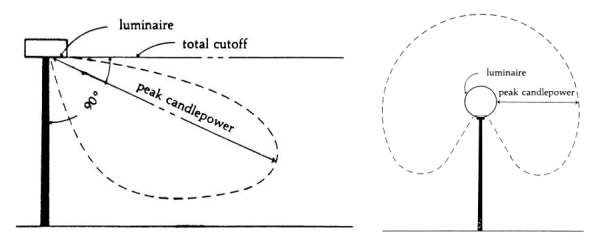
- All parking lot lighting fixtures shall use a "house side shield" when within 100 feet of a residential use or when abutting a public road.
- All building wall mounted lighting fixtures, or “wallpacks”, shall be of the full cutoff type.
- The Planning Director is authorized to approve modifications to shielding requirements for decorative and security lighting.
- All lighting fixtures, (regular lamps and flood lamps) rated 100 watts or less (see Table 1300-1 for LED equivalent) may be used without restriction to light distribution (non-cutoff classification) except when the luminaire creates direct glare perceptible to persons on a public right of way, or into the window openings of a residential dwelling unit. Care should be taken to minimize light trespass across property lines. Internal louvers or “glare or house side shields” should be provided where the emitted light becomes a hindrance.
- Pole Structures
- The maximum fixture height (grade to top of fixture) for all ground mounted lighting fixtures, except those used for sports facilities, shall be as follows:
- Commercial - 32 feet or 22 feet when within 100 feet of residentially zoned property
- Residential - 22 feet
- Pedestrian Pathways - 15 feet
- All new lighting fixtures shall be mounted on metal or concrete poles with underground utilities for all new developments, redevelopments, and subdivisions except when:
- New lights are proposed within existing subdivisions or non-residential sites where utility poles and overhead utilities exists.
- New security lights are proposed on commercial property where utility poles and overhead utilities exist.
- New wood poles may be permitted for temporary lighting and for lighting services areas of industrial and institutional uses that are not visible from the street or public areas of adjacent sites.
- All new lighting poles shall be a minimum of ten (10) feet from an existing or proposed tree planting, measured from center of fixture to center of tree.
- The maximum fixture height (grade to top of fixture) for all ground mounted lighting fixtures, except those used for sports facilities, shall be as follows:
1330.060 Prohibited Uses Of Lighting
- Unshielded flood lights, except for residential flood lights rated 100 watts or less, that are permitted but must be aimed towards the ground and not towards adjacent properties.
- Unshielded lamps or fixtures, except for those used for swimming pools, hot tubs, semi-enclosed decks or porches and similar accessory structures.
- Searchlights used for advertising purposes.
- Laser sourced lighting fixtures used for advertising purposes.
- Other than architecturally aesthetic neon signs or other signs permitted elsewhere in this ordinance, all exposed light “striping” on or around commercial buildings or associated structures shall be prohibited.
1330.070 Standards For Specific Uses
- Gas and Service Station Canopies
- Any linear light striping around the edge or exterior of the canopy shall be prohibited if not shielded to illuminate back onto the canopy edge.
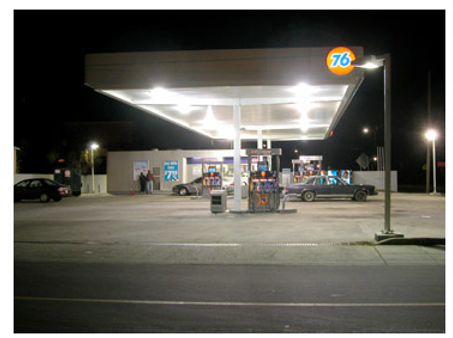
- All lighting fixtures mounted on the underside of canopies must be “full-cutoff” classified, being either completely recessed/flush in the canopy, or having solid sides on a surface mounted fixture (canopy edges do not qualify as shielding).
Figure 1300-3: Recessed (full cutoff) service station lighting on the top; surface mounted (non-cutoff) on the bottom.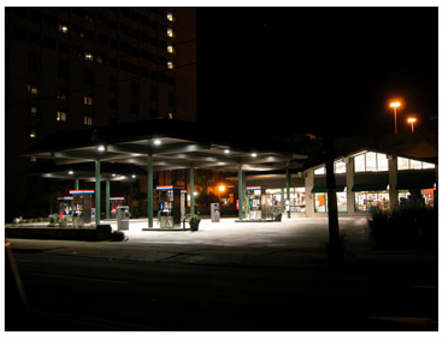
- The light source shall be metal halide, ceramic metal halide or LED.
- Lighting levels under the canopy shall be no greater than thirty (30) footcandles. Areas outside the pump island canopy shall be illuminated as to provide proper safety to customers, but shall be limited and not exceed ten (10) footcandles maintained. General Outdoor Sporting Facility/Performance Area Lighting Standards
- Any linear light striping around the edge or exterior of the canopy shall be prohibited if not shielded to illuminate back onto the canopy edge.
- General Outdoor Sporting Facility/Performance Area Lighting Standards
- The mounting height of outdoor sports field and outdoor performance area lighting fixtures shall not exceed eighty (80) feet from finished grade unless approved prior to construction by the Planning and Zoning Board in a quasi-judicial proceeding or Town Council.
- All outdoor sports field and outdoor performance area lighting fixtures shall be equipped with a glare control package (louvers, shields, visors or similar devices). The fixtures must be aimed so that their beams are directed and fall within the primary playing field or performance area.
- The hours of operation for the FIELD lighting system for any game or event shall not exceed one (1) hour after the end of the event. The security and egress illumination lighting systems may remain turned on for any amount of time deemed necessary to remove people safely.
- Light levels for sports field illumination shall comply with, but not exceed IESNA standards. Where new sporting facility lighting is installed adjacent to an existing residential property, the INTENT shall be made for all installations to limit property line light levels to a maximum of two (2) footcandles at grade level. When not installed adjacent to a residential property, light levels at the property line shall not exceed four (4) footcandles at grade level. ALL possible means of shielding must be applied if this level has not been met. Owner must prove to the appropriate permitting authority that these means have been exhausted, and the intent has been made to meet these goals.
- Security and Display Lighting
- Outdoor security lighting should be designed to provide safety to a building occupant, while effectively allowing proper surveillance, though not to exceed lighting levels described in Section 1330.050, subsection A.
- The use of motion sensors, timers, photocells or other means to activate lighting during nighttime hours is required to conserve energy, provide safety, and promote compatibility between different land uses.
- In order to direct light downward and minimize the amount of spill light, all security lighting fixtures shall be shielded and aimed so that the main beam is directed toward the ground or designated area where security lighting is needed.
- Security Lighting for ATM’s shall be consistent the Illuminating Engineering Society North America (IESNA) standards for that industry.
- Architectural Accent Lighting
- Lighting fixtures used to accent architectural features, materials, colors, style of buildings, landscaping, signs, and/or art shall be located, aimed and shielded so that light is directed only on those features. Such fixtures shall be aimed or shielded to minimize light spill from the source in conformance with the luminaire standards.
- Fixtures shall not exceed 175 watts or LED equivalent, with the exception of Department of Transportation highway signage luminaires, which must comply with National Department of Transportation standards. Lighting fixtures shall be selected, located, aimed and shielded so that direct illumination is focused exclusively on the item being illuminated, and away from adjacent properties and the public street right-of-way.
- Accent lighting shall not generate excessive light levels, cause glare, or direct light beyond the façade onto neighboring properties, streets or night sky.
- National flags may be illuminated from below provided such lighting is focused primarily on the individual flag or flags, and to limit light spill into the night sky. These fixtures must conform with Section 1330.050, subsection B of this document.
- Temporary Outdoor Lighting Any temporary outdoor lighting that conforms to the requirements of this Chapter shall be allowed. Any temporary lighting that does not conform to these outdoor lighting standards may be permitted after considering: (a) the public and/or private benefits that will arise from the temporary lighting; (b) any annoyance or safety problems that may result from the use of the temporary lighting, and (c) the duration of the temporary nonconforming lighting. The applicant shall provide a detailed description of the proposed temporary outdoor lighting to the Engineering Director for review and approval.
- Public and Private Roadways
All streets and sidewalks shall be sufficiently illuminated to ensure the security of the street right-of-way and safety of pedestrians present in the area.
- Street lighting must be included on all new residential and commercial streets. In addition, street lighting must be installed on the perimeter of the development along a thoroughfare, boulevard, and/or collector road that lack such lighting, unless deemed unsafe or unsuitable by the Director of Engineering and/or NCDOT.
- For a new subdivision, a lighting layout and overall design is required in the subdivision design submittal documents. Lighting submittals shall include the fixture, lamp, pole height and the method of shielding being used.
- Subdivision developers are required to have the lighting design approved by the Planning Department, and shall then submit the approved design to the power company prior to installing the assemblies. An accurate scale reference must be included on all layout drawings.
- In general, the layout of roadway lighting should conform to the RP-8-00 Roadway Lighting Manual and the following standards:
- All light poles shall be placed approximately 200 feet apart. Due to geometric limitations, this distance between poles can be adjusted up to forty (40) feet. Light fixture assemblies shall be placed on the side of the street where the sidewalk is located. If both sides have a sidewalk, lights shall be alternated.
- All corners shall have at least one (1) light fixture assembly for a three-way intersection, and two (2) light fixture assemblies for a four-way intersection.
- All cul-de-sacs shall have a minimum of one (1) light fixture assembly, located such that the entire cul-de-sac right-of-way has an ample amount of illumination.
- Lights should be placed on the outside of the curve and the spacing should be lessened.
- Photometric calculations shall be required by the Town of Indian Trail for outdoor lighting applications. Average footcandle values shall be taken from the table below:
Figure 1300-2: Recommendations for Roadway Average Maintained Horizontal IlluminationSource: “Roadway Lighting Handbook”, U.S. Department of Transportation, Federal Highway Administration 1978, as revised.Vehicular Roadway Classification Commercial Urban Intermediate Residential Foot-candle Lux Foot-candle Lux Foot-candle Lux Freeway* 0.6 6 0.6 6 0.6 6 Expressway* 1.4 15 1.2 13 1.0 11 Major 2.0 22 1.4 15 1.0 11 Collector 1.2 13 0.9 10 0.6 6 Local 0.9 10 0.6 6 0.4 4 Alleys 0.6 6 0.4 4 0.4 4
* Both the mainline of freeways and expressways and the ramps.
Note: The recommended illumination levels shown are only meaningful when designed in conjunction with other elements. The most critical elements as described in this practice are as follows:- Illumination depreciation;
- Quality;
- Uniformity;
- Luminaire mounting heights;
- Spacing;
- Traverse location of luminaire;
- Luminaire selection;
- Traffic conflict areas;
- Border areas;
- Transition lighting;
- Alleys;
- Roadway lighting layouts.
- All new lighting fixtures must be installed on new metal poles. Wood poles shall not be permitted except when installing light fixtures within an existing residential subdivision where wood utility poles exist.
- New residential subdivision street lights or street lights within the Downtown Districts shall be semi or full cutoff fixtures in compliance with Section 1330.050. Poles shall be free standing painted black. Refer to Section 1330.050 C for allowable pole heights. No overhead service wires shall be allowed.
Figure 1300-4: Decorative street lighting fixture (example) with semi-cutoff classification. Internal glare shielding preferred for residential applications.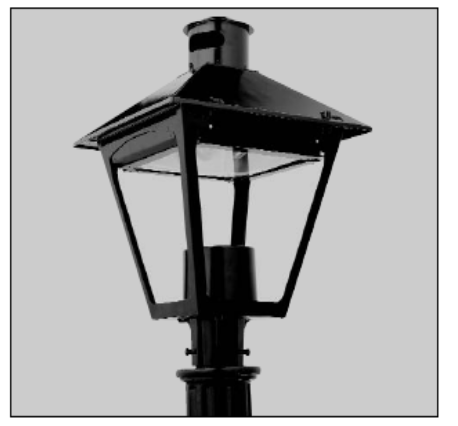
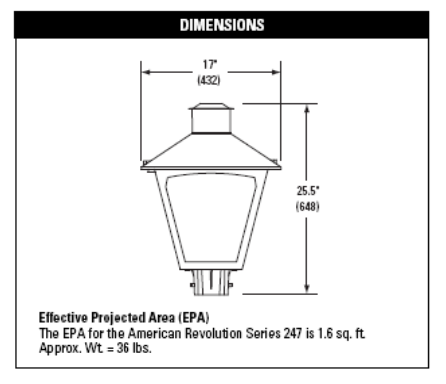
- Collector and thoroughfare lighting shall be AEL 125 full cutoff style cobrahead, 400 watt high pressure sodium or metal halide, and shall conform to NC DOT standards. Sag lens shall not be allowed. Poles shall be free standing with an aluminum finish. No overhead service wires shall be allowed.
Figure 1300-5: Collector or thoroughfare cobrahead lighting fixture (example) with full cutoff style.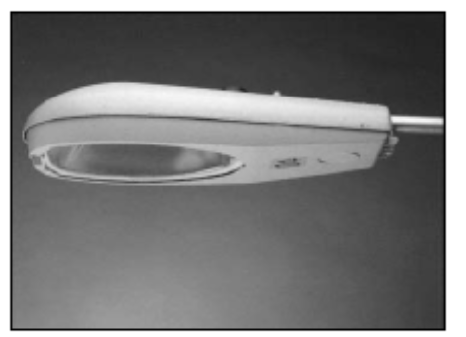
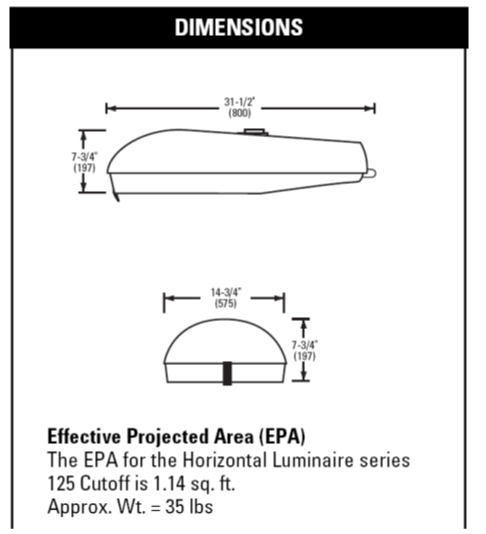
- New residential subdivision street lights or street lights within the Downtown Districts shall be semi or full cutoff fixtures in compliance with Section 1330.050. Poles shall be free standing painted black. Refer to Section 1330.050 C for allowable pole heights. No overhead service wires shall be allowed.
Amended by Ord. O210209-347 on 2/8/2021
Adopted by Ord. 393 on 11/14/2023
Amended by Ord. 397 on 3/26/2024
Amended by Ord. 410 on 12/10/2024
1330.080 Compliance
- A photometric site plan and lighting fixture cut sheets for all proposed exterior fixtures shall be included with the required application for a subdivision of land or a site plan. Depending on the size and type of the project, the Planning Director shall require that the photometric site plan include the following:
- The location of pole and building mounted lighting relative to the principal land uses and relative to the abutting streets.
- The zoning district classifications of all properties abutting the site.
- The location and site coverage of service station canopies and outdoor sales and display areas.
- The location and height of all lighting poles, building mounted lights, and ground mounted lighting fixtures.
- A photometric diagram showing the predicted levels of illumination from the proposed lighting fixtures.
- The manufacturer’s product descriptions showing that the proposed lighting fixtures meet the requirements of this ordinance.
- Minimum, maximum, and average lighting levels of the proposed lighting fixtures.
- The Planning Director shall require the installation of full-cutoff shielding or directional shielding when a zoning applicant proposes repairing or replacement of any component of any luminaire where the Town has found that the existing lighting fixture has created a public hazard due to excessive glare or light trespass.
- The Town shall have the authority to require an “As-Built Lighting Photometric Plan” in the event that actual field conditions appear to not be in accordance with an approved permit. The cost for the study and to make any corrective action shall be borne by the property owner. Issuance of a Zoning Compliance Certificate may be withheld until completion of the plan and demonstration of compliance with the UDO.
1330.090 Violations
- Any person, firm or company, whether principal, agent, employee or otherwise, who violates any of the provisions of this Section shall be fined an amount not to exceed the lighting standards violation amount listed on the Town Fee Schedule for each such violation, such fine shall be paid to the Town of Indian Trail. Each day of the documented existence after written notification of any situation held to be in violation shall be deemed an equal and separate offense.
The Town may withhold certificates of occupancy for any use that installs luminaries that do not comply with this Section.
1340.010 Consistency With Traffic Impact Study Policy
Consistent with the terms and conditions of the Town of Indian Trail’s Traffic Impact Study Policy, new developments must demonstrate that they are served by roads with adequate traffic capacity and that any proposed development will not lead to conditions of excessive traffic congestion or dangerous driving conditions.
1340.020 Town To Require Traffic Impact Study
Consistent with the terms and conditions of the Town of Indian Trail’s Traffic Impact Study Policy, the Town may require a traffic impact study as part of development approvals consistent with the terms and conditions of this Unified Development Ordinance. Said traffic impact study is subject to review and approval by the Engineering Director.
1340.030 Town To Require Traffic Impact Mitigation
Consistent with the terms and conditions of the Town of Indian Trail’s Traffic Impact Analysis Policy, the Town may require a traffic impact mitigation and roadway improvements as part of development approvals consistent with the required Traffic Impact Study as approved by the Engineering Director and terms and conditions of this Unified Development Ordinance.
1350.010 Scope And Purpose
The intersection visibility standards of this article establish triangular areas on corner lots, referred to as “intersection visibility triangles,” within which the placement of buildings, fences, hedges, walls, and other structures is restricted in order to maintain clear lines of sight at street intersections for the purposes of traffic and pedestrian safety.
1350.020 Applicability
Lots located at the corner of any street intersection must comply with the requirements of this article.
1350.030 Intersection Visibility Triangles
- At the intersection of 2 local streets, a local street and a collector street, or 2 collector streets, the legs of the intersection visibility triangle must be at least 35 feet in length, as measured along the curbline from the point where the curbs of the 2 streets intersect. In the absence of a curb, the legs of the triangle must be at least 35 feet in length, as measured along the edge of the street pavement from the point where the pavement of the 2 streets intersect.
Figure 1300-5: Sight or Visibility Triangle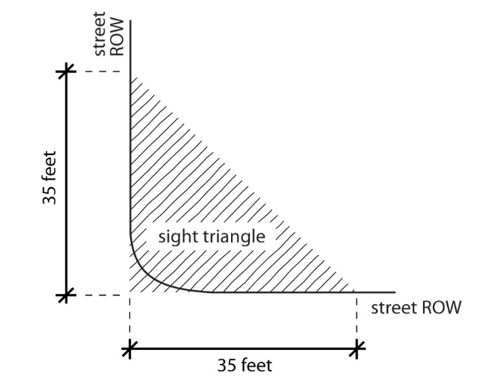
1350.040 Prohibited Obstructions
The following obstructions are prohibited within intersection visibility triangles:
- Hedges and walls higher than two (2) feet above curb level.
- Fences higher than two (2) feet above curb level. However, fences that are less than 20% solid, such as split rail, open weave, or wrought-iron are permitted within the intersection visibility triangle if they are kept free from plantings and other materials that are more than two (2) feet in height. The “20% solid” threshold must be determined based on the proportion of the fence over a random area that is made up of solid, opaque material that does not allow light or air to pass through.
- Signs, except as expressly exempted.
- Structures of any type, including principal and accessory buildings, except as expressly exempted.
- Items of outdoor display or storage, including ornamental features, such as fountains, statues, garden structures and similar features.
- Parking and vehicular display areas.
1350.050 Exemptions
The following structures are exempt from the provisions of the intersection visibility standards of this section subject to review and approval by the Engineering Director.
- Structures including signs within the Downtown Districts.
- After review by the Town, buildings on lots at intersections where both streets are signalized. The Town may approve or deny a request to construct a building within the intersection visibility triangle based on such factors as street right-of-way width, speed and volume of traffic through the intersection, and the number of turning movements.
- Utility and street light poles.
- Traffic control equipment, including control boxes, traffic signs, and structures that support traffic signals.
- Signs attached to buildings that are exempt from the intersection visibility triangle requirements as specified in paragraphs “A” and “B,” above.
- A sign established in accordance with all applicable requirements of DIVISION 900 provided the bottom edge of the sign and any supporting structure is at least nine (9) feet above the adjacent curb level, so that visual clearance is maintained within the intersection visibility triangle. Poles and supporting structures for signs are prohibited within the intersection visibility triangle.
1370.010 Stormwater Detention
The purpose of flood control detention requirements is to protect downstream properties from increased flooding due to upstream development. Development or redevelopment creating a total of 20,000 square feet or more of impervious area shall be designed to control the peak discharges from the 2-, 10-, and 25-year, 24-hour storm events to pre-development levels. The emergency overflow and outlet works for any stormwater BMP shall be capable of safely passing a discharge with a minimum recurrence frequency as specified in the Town of Indian Trail Stormwater Design Manual.
Development or redevelopment that proposes to use existing detention facilities shall comply with the requirements of this Section 1370.
Detention facilities shall not be located within FEMA Special Flood Hazard Areas, drainage areas where the 100-year storm event is greater than 50 cfs, or within 10 feet of any property lines. Design of detention facilities shall be consistent with the Town of Indian Trail Stormwater Design Manual except as stated herein.
Stormwater detention design must be performed by a North Carolina Registered Professional Engineer.
1370.020 Downstream Impact Analysis
- Hydrologic Analysis The Owner shall cause a downstream hydrologic analysis to be performed to determine if there are any additional impacts in terms of peak discharge increase or downstream flooding due to the difference in the pre and post-development 50- and 100-year storm events. The analysis shall be performed at the outlet(s) of the site and downstream at each tributary junction to the point in the conveyance system where the area of the portion of the site draining into the system is 10% of the total drainage area above that point. Key detention structures in the study area must be modeled.
- Hydraulic Analysis
If during the site plan review process the Engineering Director determines that as a result of an increase in peak discharge between the pre and post-development 50-year storm event, detrimental impacts at thoroughfare culvert crossings are probable, the Owner shall cause a hydraulic analysis to be performed to determine flood elevations for the areas impacted by increased flows. No existing or proposed thoroughfare culvert crossing shall be designed to have stormwater encroach upon the roadway pavement.
If during the site plan review process the Engineering Director determines that as a result of an increase in peak discharge between the pre and post-development 100-year storm event, detrimental impacts on building footprints are probable, the Owner shall cause a hydraulic analysis shall to be performed to determine flood elevations for the areas impacted by increased flows. No existing or proposed building or habitable structure shall be designed to be flooded or have water impounded against it.
Downstream Impact Analysis must be performed by a North Carolina Registered Professional Engineer and shall comply with the requirements in Appendix 7, “Downstream Impact Analysis”.
1370.030 100 Plus 1 Flood Analysis
All streams in Indian Trail which drain more than one square mile (640 acres) are regulated by Section 1360, “Flood Damage Reduction Ordinance”. Streams that drain less than one square mile will also experience flooding and require regulation as well. This regulation is known as the “100 + 1 Flood Analysis”. For drainage systems which are expected to carry 50cfs of more in the 100-year storm event, both the 100-year + 1 Storm Water Elevation Line (SWEL) and the Storm Water Protection Elevation (SWPE) shall be shown on the site, grading plan, and recorded map.
Flood Analysis must be performed by a North Carolina Registered Professional Engineer.
1370.040 Ponds
- All plans that include a proposed natural pond, and all plans that include stormwater runoff to any existing natural ponds, shall be subject to the review of the State Dam Safety Engineer. An Evaluation of the pond dam shall be made by the designer, in accordance with the Dam Safety Law of 1967, and submitted to the Dam Safety Engineer for review.
- All existing natural ponds proposed to comply with Section Error! Reference source not found. shall be evaluated to verify the ponds will safely withstand the post-development 50-year storm event with a minimum of 0.50 feet of freeboard at the dam. Design calculations shall include the assumption of future build out of the drainage basin.
- Where ponds are proposed to be constructed, the owners, heirs, assigns or successors of the land will agree to perpetual maintenance of the pond and will release and hold harmless the Town of Indian Trail from any liability, claims, demands, attorney’s fees, and costs or judgments arising from said pond. At a minimum, ponds will be inspected by a North Carolina Registered Professional Engineer on a yearly basis. The annual inspection report will be submitted to the Engineering Director for purposes of compliance.
1370.050 Embankments
All stormwater detention and water quality facilities with embankments that are designed to hold water shall comply with the requirements in Appendix 6, “Embankment Requirements”.
1370.060 General Requirements
No certificate of occupancy or release of sureties will be issued for any development until:
- As-built drawings of all storm drainage, detention, and water quality features have been submitted by a professional land surveyor.
- Any required revised calculations have been submitted and approved by the Town. Said revised calculations must be sealed by a North Carolina Registered Professional Engineer.
- The facility has been stabilized consistent with the North Carolina Department of Environment and Natural Resources standards and specifications.
- The as-built survey, final calculations, and facility will be inspected and approved by the Town.
1370.070
When a detention facility serves more than one property, a permanent detention easement that encompasses the detention facility will be shown on a recorded plat. This easement will be described by metes and bounds.
1370.080
There will be a note placed on the recorded plat that clearly describes who is responsible for maintenance of the detention facilities, pipes and/or channels located within the permanent detention facility.
1370.090
Deviations from the Stormwater Manual may be necessary to accommodate soil types found in Union County and site constraints subject to approval by the Engineering Director.
1370.100
Additions to existing non-residential structures over 50% of the existing floor area (square footage) or demolition of existing structures for purposes of redevelopment will be subject to the requirements of this section.
1370.110
Minor residential subdivisions and individual single-family residences are exempt from said requirements.
1370.120
All non-conforming developments (existing impervious area > 20,000 sq. ft.) adding impervious area (structural or non-structural) shall provide detention for the newly added impervious area only in compliance with this section.
13100.010 General Requirements
Any developments which has either public water or public sewer system or both legally available or to be made available within 300 feet of its boundary shall have such available systems extended by the developer to provide service to each lot in the subdivision. Water and sewer installations shall be in accordance with the standards of the Union County Public Works Department.
13100.020
Proof of public water/or sewer availability is required prior to issuance of a zoning permit to start construction. If public water/or sewer is not available proof of service by private system (well and/or septic, etc) authorized by the Union County Environmental Health Department or other authorizing agency shall be provided.
13100.030
Electrical, television, and telephone utility lines installed within subdivisions must be underground unless the Technical Review Committee determines that underground installation is unreasonable of infeasible.
13100.040
Utility easements with a width acceptable to public and private utility providers must be provided to accommodate electric, telephone, gas, and community antenna television services; conduits; and sewer or water lines. The location of such easements must be reviewed and approved by the Town, with advice from utility providers, before site plan approval.
13100.050
Utility easements must be kept free and clear of any buildings or other improvements that would interfere with the proper maintenance or replacement of utilities. The Town is not liable for damages to any improvement located within the utility easement area.
13110.010 General Requirements
Every development (subdivided or unsubdivided) that is served by a public water system shall include a system of fire hydrants sufficient to provide adequate fire protection for the buildings located or intended to be located within such development.
13110.020
Fire hydrants must be located in accordance with the rules and regulations identified in North Carolina Fire Prevention Code. Appeals of these codes shall be filed with the North Carolina Building Code Council and the North Carolina Department of Insurance.
13110.030
The Planning Staff and Union County Fire Service shall review all fire hydrant locations and fire hydrant specifications. A letter shall be provided from the Union County Fire Marshal’s Office to the Town stating the proposed development is in compliance with said Code. Final approval of locations and specifications shall be by the permit issuing authority.
13110.040
Water lines that serve hydrants shall be at least six (6)-inch lines, and, unless no other practicable alternative is available, no such lines shall be dead-end lines.
13110.050
The permit issuing authority may modify any previously issued permit to bring that project into compliance based on the Fire Marshal’s certification that said project is in compliance with the North Carolina Fire Prevention Code.
13120.010 Driveway, Street And Sidewalk Requirements
All new developments shall comply with the requirements of Section 1110.090 Street and Sidewalk Improvements.
13120.020 Requirements
Driveways, streets and sidewalks shall comply with the following:
- Follow the Indian Trail Land Development Standards (ITLDS) for any design and construction standards for driveways, streets, sidewalks, parking, and loading storage for requirements such as the following:
- Top and base material composition,
- Depth of each layer of materials, and
- Driveway and parking dimensions.
- Top and base material composition,
- Any person desiring to construct a driveway or other connection within the right-of-way of a public street must secure a permit prior to construction. Connections from single family and duplex dwellings are excluded unless access is requested to a thoroughfare as identified on the Thoroughfare Plan. Failure to secure a permit prior to construction may result in the removal of the driveway(s) at the expense of the property owner and/or denial of access at that location. All driveways must conform to the design and construction standards established by the Town ITLDS.
- Any development located adjacent to public or private streets must provide curb, gutter, and sidewalks, along its street frontage in accordance with the Town of Indian Trail Comprehensive Plan, ITLDS, and this ordinance.
- All lots or parcels are entitled to at least one (1) driveway connection per street frontage on any street except those which access is otherwise limited or controlled. Requests for two (2) driveways will only be accepted for lots with a street frontage of 350 feet or more. Request for three (3) driveways will be considered for tracts with 600 feet or more street frontage. Artificial division of a single parcel or development to increase the number of access points is not permitted.
- No driveway may be located within 50 feet of the corner of two intersecting thoroughfare streets. No driveway may be located within 10 feet of any non-residential property line or within 20 feet from an existing driveway.
- Nothing in this section exempts any person from complying with any regulations or requirements of the North Carolina Department of Transportation regarding driveway connections to NCDOT maintained roads, nor does compliance with any or all NCDOT requirements exempt any person from the requirements of this ordinance. In the case where these regulations may overlap or conflict, the more restrictive provision will control. The granting of a driveway permit by the Town of Indian Trail does not ensure the granting of the permit by NCDOT. The requirements in this section apply to all zoning districts.
- Alteration/Maintenance of Existing Driveways: Existing driveways shall not be altered within the right-of-way without a permit and the maintenance of all driveways located on or within the public right-of-way shall be the responsibility of the property owner.
- Changes in Land use: When the use of the property is to be changed or altered, a new driveway permit must be obtained prior to a land use change.
- Any driveway or other connection for residential development with minimum of 20 residential lots, 20 residential units or 100 trips per peak hour requires a turn lane.
- The driveways or other connection of any subdivision directly or indirectly intersecting with any state maintained road in the town limits that have more than 4000 ADT (Average Daily Traffic) require a turn lane.
- Any commercial and industrial site with minimum of 1000 ADT (Average Daily Traffic) or 100 trips per peak hour having a driveway or other connection directly or indirectly intersecting with any state maintained road in the Town that has more than 4000 (Average Daily Trips) requires a turn lane.
- The Town shall require a traffic study for applicants in accordance with the adopted Traffic Study Policy or from applicants seeking a variance on any proposed driveway or other connection to be designed to accommodate both current conditions and traffic projections for 10 years into the future. In any case, the location of the proposed driveway or other connection can not interfere with the daily function of the roads or intersections.
- Intersection corner- A minimum 35’x35’ sight triangle (measured along right-of-way lines) shall be provided at each intersection corner. An additional 10’x70’ sight triangle shall be provided at each intersection corner. An additional 10’x70’ sight triangle shall be provided at intersections connecting to NCDOT maintained roadways. Additional sight distance requirements may be required by the NCDOT or the Engineering Director. When designing a TND (Traditional Neighborhood Development) the sight distance standards may be approved by the Engineering Director on a case by case basis depending on the speed limit.
- Applicants may apply for a variance to the Planning and Zoning Board in a quasi-judicial proceeding.
Amended by Ord. O210209-347 on 2/8/2021
Amended by Ord. 397 on 3/26/2024
Amended by Ord. 410 on 12/10/2024
13130.010 General Requirements
Every development with the exception of individual single-family residential dwellings will be required to provide one (1) or more trash enclosures for solid waste collection. Said trash enclosure and/or grease trap facility shall be located so as to:
- Facilitate collection and minimize any negative impact on persons occupying the development site, neighboring properties, or public rights-of-way; and
- Constructed according to specifications established by the Town of Indian Trail Land Development Standards and/or the Planning Director to allow for collection without damage to the development site or the collection vehicle. When not in use, the trash enclosure and/or grease trap facility must remain closed as to not unduly cause any vehicular traffic interference.
13130.020
When required, all trash enclosure and/or grease trap facility shall be screened pursuant to the following:
- Trash enclosures and/or grease trap facilities constructed to serve new buildings or expansions greater than 50% of the existing building’s gross floor area shall be fully enclosed with a wall to a minimum height of eight (8) feet to block 100% of the view into the enclosed area. The trash enclosure and/or grease trap facility shall match the primary color and material of the building when viewed from the public or private right-of-way. Said trash enclosure and/or grease trap facility shall also include an opaque gate(s) constructed of either synthetic wood or painted metal affixed to a metal frame.
- Trash enclosures and/or grease trap facilities constructed to serve existing buildings or building expansions constituting less than 50% of the existing building’s gross floor area shall be fully enclosed with a wall to a minimum height of eight (8) feet to block 100% of the view into the enclosed area. The trash enclosure and/or grease trap facility shall match the primary color and be constructed of a material consisting of brick, natural or synthetic masonry stone, architecturally finished block material, fiber cement (i.e. Hardie products) panels or siding, or EIFS, or painted metal panels when viewed from the public or private right-of-way. Said trash enclosure and/or grease trap facility shall also include an opaque gate(s) constructed of either synthetic wood or painted metal affixed to a metal frame.
- The trash enclosure panels and gate may be constructed of vinyl on metal posts/supports if they are not visible from the right-of-way and are located within one of the business/industrial parks identified below. The minimum 8-foot tall gate shall include a self-latching mechanism.
- Indian Trail Business Park
- Indian Trail Industrial Park
- Industrial Ventures I &II
- Old Hickory Business Park
- 74 Industrial Park
- Sun Valley Industrial Park
- Town industrial Park
Plant material shall supplement the trash enclosure. Planting material shall screen 25% of the trash enclosure wall area. Planting material shall consist of a minimum of six (6) low branching evergreen shrubs a minimum of three (3) feet in height at time of planting.
13140.010 General Requirements
Requests for single-family and multifamily residential developments consisting of 50-lots/units or more shall include a school impact study estimating the number of students generated by the proposed development.
- Minimum Study Requirements: School impact studies shall provide an estimate of the student generation by the proposed residential development over a minimum ten (10) year horizon between preschool and twelfth (12) grades. School impact studies shall be prepared by a professional demographer possessing at a minimum a master’s degree in the subjects of demography, sociology, economics, urban planning, geography, and/or similar field. The demographer shall also have previous professional work experience in preparing population projections and other demography work products. A qualifications summary demonstrating the demographer’s compliance with these requirements shall be included with each study. School impact studies shall be based on local, Union County specific population and student data and identify all data sources and assumptions used in the analysis.
- Submittal: School impact studies shall be submitted with the conditional rezoning or planned development application corresponding to the proposed residential development. If the residential development is not associated with the conditional rezoning or planned development application, the study shall be submitted with the site plan or major subdivision application corresponding to the proposed residential development.
- Exceptions: Nursing care or skilled care facility uses are exempt from the requirements of UDO Chapter 13140.

