Inverness City Zoning Code
Sec. 2.13
Concurrency, Level of Service Maintenance Requirements.
A.
Purpose and Intent. In order to establish that concurrency requirements of Chapter 163, Part II, Florida Statutes, and Rule 9J-5.055, FAC, have been met, this section describes requirements for maintaining the level of service adopted in the City of Inverness. In general, state law requires that no development be approved for which services and facilities are not available concurrent with development. It is the intent of this section to describe those level of service requirements for each system.
This section provides a basis for determining the level of service compliance required in subsection 3.0 for the purposes of reviewing and approving applications for development approval.
B.
Potable Water.
1.
Level of service. The potable water supplement of the city's comprehensive plan contains the following level of service requirements for the distribution of potable water:
2.
Methods of compliance. An application for a proposed development approval or a building permit shall indicate that one of the following requirements has been met:
a.
Capacity exists at the city's water facility to serve the project or the first phase of the project. Determination of the existence of capacity shall be based upon estimated demand by the project, consideration of the other approved but not built developments to be served by the same facility in the same time period, and total capacity of the facility.
b.
Capacity shall exist at the city's facility at the time of occupancy of the project based upon plans for expansion of capacity. Capacity shall be ensured through one of the following:
1)
Existence of valid contracts for construction;
2)
Existence of funds budgeted and appropriated for construction.
c.
Additional requirements: An application for a proposed development shall provide complete documentation to indicate compliance with the following requirements:
1)
An agreement that the proposed development shall connect to the city's potable water facility as soon as the service is available.
C.
Wastewater.
1.
Level of service. The sanitary sewer supplement of the city's comprehensive plan contains the following level of service requirements for collection and treatment of wastewater:
* per square foot of building
2.
Methods of compliance. An application for a proposed development approval or a building permit shall indicate that one of the following requirements has been met:
a.
Capacity exists at the city's wastewater treatment facility to serve the project or the first phase of the project. Determination of the existence of capacity shall be based upon estimated demand by the proposed project, consideration of other approved but not built developments to be served, and the actual capacity authorized by operating permit, and actual flow at the time of application.
b.
Capacity shall exist at the time of occupancy of each phase at the city's wastewater treatment facility concurrent with need.
c.
No city facility/capacity exists or is expected to exist to provide service to the proposed development. However, on-site wastewater treatment is proposed through:
1)
Individual septic tanks on lots meeting minimum lot area standards of Citrus County Health Department.
3.
Additional requirements. An application for a proposed development shall provide complete documentation to indicate compliance with the following requirements:
a.
An agreement that the proposed development shall connect to the city's wastewater treatment facility as soon as the service is available.
b.
Proposed use of septic tanks for on-site treatment shall be in compliance with standards of Chapter 1-D-6, FAC, and permit requirements of Citrus County Health Department.
D.
Traffic Circulation.
1.
Level of service. The transportation circulation element of the city's comprehensive plan contains the following level of service requirements for roadways in the city:
2.
Determination of project impact. An application for preliminary approval of a proposed development, or a building permit shall determine the impact of the project by the following procedure:
a.
The area of impact of the development (a traffic shed) shall be determined. The traffic shed shall be that area where the primary impact of traffic to and from the site occurs. If the city has designated sectors of the city for determining development impacts and planning capital improvements, such sectors or planning areas may be used.
Where the development will have access to more than one (1) collector or arterial, the study shall show the nature of the split in generated traffic and state the assumptions used in assignment of traffic to each facility.
b.
The existing level of service for arterials and collectors within the traffic shed for the project shall be determined by using the Generalized Daily Level of Service Maximum Volume (January 1989) Published by the Florida Department of Transportation.
c.
The projected level of service for arterials and collectors within the traffic shed shall be calculated based upon estimated trips to be generated by the project, or where applicable, the first phase of the project, taking into consideration other developments under construction or holding valid development orders within the traffic shed area. Information on committed development within the traffic shed shall be provided by the city and shall be those projects for which occupancy will occur on or before occupancy of the proposed development project. To further refine the functional classification of local roads within the city methodology cited in the Department of Transportation Functional Classification of Public Roads (March 1986 Supplement) by using the system attribute score approach may be used.
d.
The projected levels of service and existing levels of service shall be compared to determine whether the proposed project will degrade the adopted level of service.
3.
Methods of compliance.
a.
Where the capacity exists to serve a proposed development as shown by comparing existing and proposed levels of service, the project shall be found in compliance with the transportation level of service.
b.
Where there is an existing or anticipated deficiency, one of the following requirements shall be met:
1)
Improvements to the affected roadways will increase the capacity of the roadway(s) so that the level of service requirement shall be met before occupancy of the development (or, where applicable, the first phase of the development). Capacity shall be ensured through one of the following:
(a)
Improvements are under construction at the time of application and are sufficient to maintain the adopted level of service. Where improvements are under construction, the level of service may be degraded during that period of time between occupancy of the development and completion of construction; such occurrence shall not constitute non-compliance.
(b)
A contract has been executed for improvements necessary to maintain the adopted level of service. The schedule of the contract shall be reasonably expected to provide the capacity at the time of occupancy. However, the level of service may be degraded during that period of time between occupancy and completion of construction; such occurrence shall not constitute non-compliance.
(c)
Funds are budgeted and appropriated by the City of Inverness, Citrus County or Florida Department of Transportation for improvements necessary to maintain the adopted level of service. Funds shall be for actual construction and not for preliminary planning, design or engineering. The anticipated construction schedule shall be reasonably expected to provide the capacity at the time of occupancy, or within two (2) years following occupancy. The temporary degradation of level of service under this paragraph shall not constitute non-compliance.
2)
Where no improvements are to be provided as described in paragraph (a) above, the following methods may be used to maintain adopted level of service:
(a)
The project owner or developer may provide necessary improvements to maintain level of service. In such case the application shall include appropriate plans for roadway improvements, documentation that such improvements are designed to provide capacity necessary to maintain the level of service, and recordable instruments guaranteeing the construction. Documentation that improvements are designed to provide necessary capacity shall be prepared and sealed by a professional traffic engineer, registered in the State of Florida. The provision of improvements shall be reasonably scheduled to provide necessary capacity at the time of occupancy; however, a temporary degradation of the level of service may be allowable and shall not constitute non-compliance. A temporary degradation may be allowable for a period not to exceed one (1) year, and may be allowable only if construction is taking place. Failure to meet this provision shall constitute violation of the development order and may result in cancellation of the development order and discontinuance of project construction and/or further occupancy.
(b)
The developer may contribute funds to the city necessary to provide roadway improvements. Contribution of funds shall result in an appropriate budget amendment by the city in order to implement roadway improvements.
Approval of the development project shall be delayed until all appropriate government action has occurred necessary to meet one of the requirements of section 3.b.(1) above.
3)
The proposed project may be altered such that projected level of service is no less than the adopted level of service.
(a)
The proposed development shall dedicate necessary rights-of-way for roadway improvements on adjacent roadways, or rights-of-way necessary for new roadways to serve the project.
(b)
All roads and roadway improvements shall be constructed in compliance with standards and specifications of section 2.12.
(c)
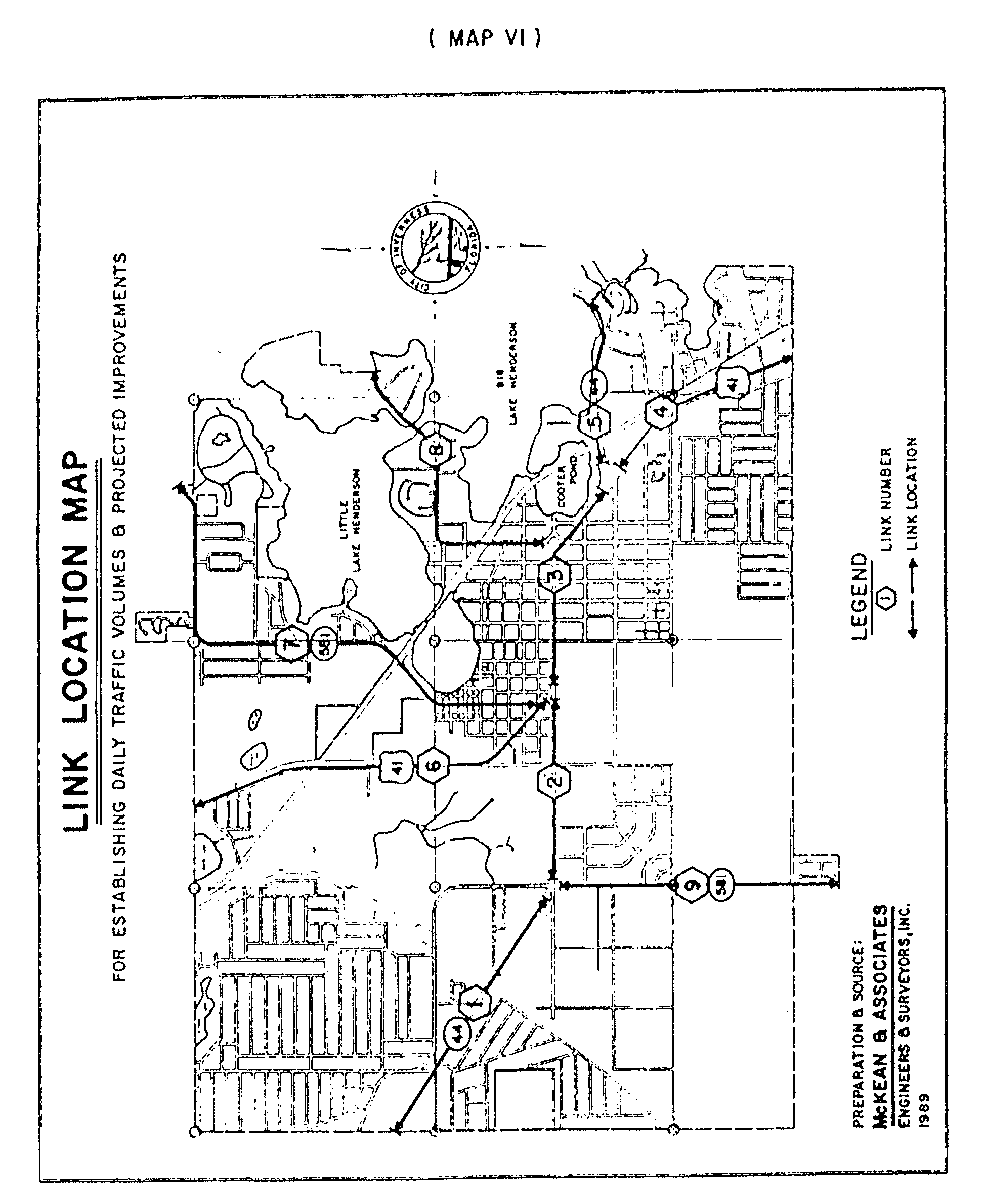
The city in cooperation with the state and county in a monitoring program of traffic using designated link location as specific on Map V on a quarterly basis.
E.
Drainage System.
1.
Level of service. The drainage supplement of the city's comprehensive plan contains the following level of service requirements for stormwater facility design and drainage plans:
2.
Methods of compliance.
a.
All development proposed on or after the date of enactment of this Code shall meet stormwater management requirements of Chapter 19, Inverness Code of Ordinances and design and construction specifications of Appendix B. Compliance with these requirements constitute compliance with level of service requirements for new development.
3.
Maintenance of drainage system.
a.
Maintenance of private drainage systems shall be the responsibility of the property owner. Failure to maintain drainage areas and/or other features of a required drainage system in an attractive and functioning state shall be considered a violation of this Code.
(Ord. No. 98-573, § 1, 10-6-98)
F.
Solid Waste.
1.
Level of service. The solid waste supplement of the city's comprehensive plan contains the following level of service requirements for collection and disposal of solid waste:
2.
Methods of compliance.
a.
All applications for proposed development shall include a solid waste management plan comparing capacity at the county sanitary landfill with demand generated by the development. The statement shall describe the means of collection and disposal, including provisions for yard trash, hazardous materials and construction debris. Alternatives to disposal at the county sanitary landfill shall be described, including recycling, composing and/or incineration.
b.
Where capacity does not exist to dispose of solid waste, based on the above level of service and alternatives proposed to reduce solid waste from the proposed development, no development order shall be issued.
G.
Recreation.
1.
Level of service. The recreation and open space element of the city's comprehensive plan contains the following level of service requirements: (See attached Tables II and III).
2.
Determination of project impact.
a.
The estimated population of a proposed residential development shall be used to calculate total acreage required to serve the project.
b.
The amount of land in the current inventory of recreation lands in the city (supply) shall be compared to the land required by the current population and the population to be served by projects under construction (demand). This calculation shall produce the current remaining level of service capacity.
3.
Determination of compliance.
a.
If capacity exists, based on the calculation in subsection G.2.b above (supply minus demand) to provide acreage needed for the proposed project, the level of service requirement is met.
b.
If capacity does not exist, one of the following requirements shall be met:
1)
Funds are budgeted and appropriated for acquisition of recreation lands and construction of facilities within the current budget year.
2)
Funds are budgeted and appropriated in the immediately succeeding fiscal year for acquisition and development of recreation lands.
c.
Funds are budgeted and allocated for park maintenance annually.
Table II
Park Classification Standards
Source: Outdoor Recreation in Florida, 1987 , Department of Natural Resources, Division of Recreation and Parks, February, 1987.
Table III
User Standards for User-Oriented
Recreation Areas and Facilities
Source: Outdoor Recreation in Florida, 1976 , Department of Natural Resources, Division of Recreation and Parks, May, 1976.