Inverness City Zoning Code
Sec. 2.7
Requirements for On-site Traffic Flow and Parking.
A.
Purpose and Intent. The purpose of this section is to define City regulations that apply to parking, loading, unloading and vehicle access requirements. The intent is to create and implement an efficient, safe and convenient parking and/or loading facility.
B.
Applicability. The provisions of this section shall apply to all development within the City including redevelopment, or amendments to existing development approvals, as follows:
1.
Non-residential development. A change in use of a non-residential property, building or structure, or conversion of an existing residential use to a non-residential use, shall require that the total parking requirement for the new use be met. An increase in total floor area of a building or structure shall require that the total parking requirement, based upon the existing floor area of the building or structure and the increased floor area, be met.
2.
Residential development. Changes to approved development plans that result in an increase in the number of dwelling units shall include provisions for the total parking requirement specified in this section.
3.
Status of prior approvals. Projects with unexpired, non-amended development plans approved prior to October 30, 1990 must meet only the parking requirements in effect at the time of development plan approval.
4.
Maintenance. All off-street parking areas shall be well maintained, free of potholes, debris, weeds, broken curbs and broken wheel stops, clearly striped and with all lighting in working condition. Facilities shall be maintained as soon as the use exists which the facilities were designed to serve.
5.
Central Business District (CBD) Development. Due to the unique characteristics of the downtown area and the provision of public parking on streets as well as in public parking lots, the requirements of this section shall not apply to properties within the CBD. However, where on-site parking currently exists, it shall not be reduced without approval of the Development and Plan Review Committee and new development, which has property available for on-site parking, may be required to provide areas for on-site parking by the Development and Plan Review Committee.
6.
Mixed use development spaces. Where a mixed use development is proposed, the parking standards for each individual proposed use shall be required.
7.
Large scale development spaces. Certain large scale uses, such as planned development projects, normally have a diversity and variability in parking demand. In such cases, a parking study is required to be submitted with the development proposal to identify the necessary parking requirement. The final decision on the amount of parking shall be determined by the Planning and Zoning Commission in consideration of the parking study along with traffic engineering and planning data that are appropriate to the proposed development and intended use(s).
C.
Off-street parking space. An off-street parking area including required parking spaces, accessways, buffers and related off-street parking appurtenances, shall be provided for all buildings and uses on the premises.
1.
Adjustments to required parking. However, if approved by the Planning and Zoning Commission, such off-street parking may be located a maximum distance of three hundred (300) feet from the premises it serves and/or may be consolidated into a large parking area serving other buildings and uses provided that such off-street parking shall be regulated, enforced and maintained as if it were actually, physically located on the premises it is designed to serve. The location of the off-site parking spaces shall not create unreasonable:
a.
Hazards to pedestrians;
b.
Hazards to vehicular traffic;
c.
Traffic congestions;
d.
Interference with access to other parking spaces in the vicinity;
e.
Detriment to any nearby use.
2.
Deed required. The Administrative Official shall require a deed or other legal and binding instrument necessary to show that the required parking area, if approved to be off-site of the premises it serves, is controlled by and available to the applicant for as long as the use(s) it is intended to serve is in existence. In addition, the applicant must submit and receive approval of the site plan for the proposed parking area with regard to landscape, buffers, setbacks and other development criteria just as if the parking area were on the same premises as the intended building(s) or use(s). The following requirements shall apply:
a.
Each off-street parking space shall consist of a minimum net area of two hundred (200) square feet, with a minimum width of ten (10) feet and a minimum length of twenty (20) feet.
b.
In all non-residential districts, off-street parking spaces shall not be located within five (5) feet of the front lot line or five (5) feet of a side lot line. No parking spaces shall be located so as to necessitate the use of any portion of the right-of-way for access to individual parking spaces.
c.
Each off-street parking space shall open directly onto an aisle or driveway and not a public street.
d.
Aisles and driveways shall not be used for parking vehicles when driveways shall be counted as determined by the Administrative Official based on the size and accessibility of the driveway.
e.
Parking spaces shall be designed to permit entry and exit without moving any other motor vehicle. Any pull-in parking space where driver error would result in a vehicle penetrating a structure where people are assembled shall be discouraged and with an adequate barrier installed.
f.
Off-street parking spaces shall be delineated by lines, bumpers or some other means approved by the Administrative Official.
g.
Parking areas which will be used after sunset shall provide lighting for the safety and protection of persons using said parking lot.
h.
For any use not shown on the schedule below, off-street parking requirements shall be the same as that use which, in the opinion of the Administrative Official, is the most similar to the proposed use.
3.
Exempted uses. One and two family structures and the Central Business District.
4.
Number of spaces. The following table includes the minimum off-street parking space requirements:
a.
Calculation of certain parking requirements. Where parking requirements relate to the number of seats, and seating is in the form of individual pews, benches or similar seating, twenty (20) lineal inches shall be construed to be equal to one (1) seat. Where parking requirements relate to movable seating in auditoriums and other assembly rooms, ten (10) sq. ft. of net floor area shall be constructed to be equal to one (1) seat, except where otherwise specified. Net floor area shall be the actual area occupied by seating and related aisles, and shall not include accessory unoccupied areas or the thickness of walls.
b.
Determination for unlisted uses or alternative parking. The Administrative Official shall make a determination, in the cases of uses not listed in the table above, of the minimum required off-street parking spaces. In reaching the determination, the Administrative Official shall be guided by the requirements for similar uses, the number and kind of vehicles likely to be attracted to the proposed use and parking requirements of such uses in other jurisdictions.
5.
Overflow parking in planned development projects.
a.
Screened overflow. Where thirty (30) dwelling units are exceeded on a development site, a screened overflow parking area shall be provided in an inconspicuous location.
b.
Buffering reduced. A reduction in requirement for buffering or landscaped areas shall be considered, when overflow parking is required.
D.
Off-street parking structures. All off-street parking structures designed to accommodate four (4) or more vehicles shall comply with all area and dimension regulation(s) for principal buildings as well as all off-street parking area buffer strip requirements included within this Code. All off-street parking structures designed to accommodate three (3) or less vehicles shall be considered as accessory buildings unless attached to a principal building. If attached to a principal building, such off-street parking structures shall be subject to all regulations of this Code for principal buildings and, if detached, shall be subject to all the regulations of this Code for accessory buildings.
E.
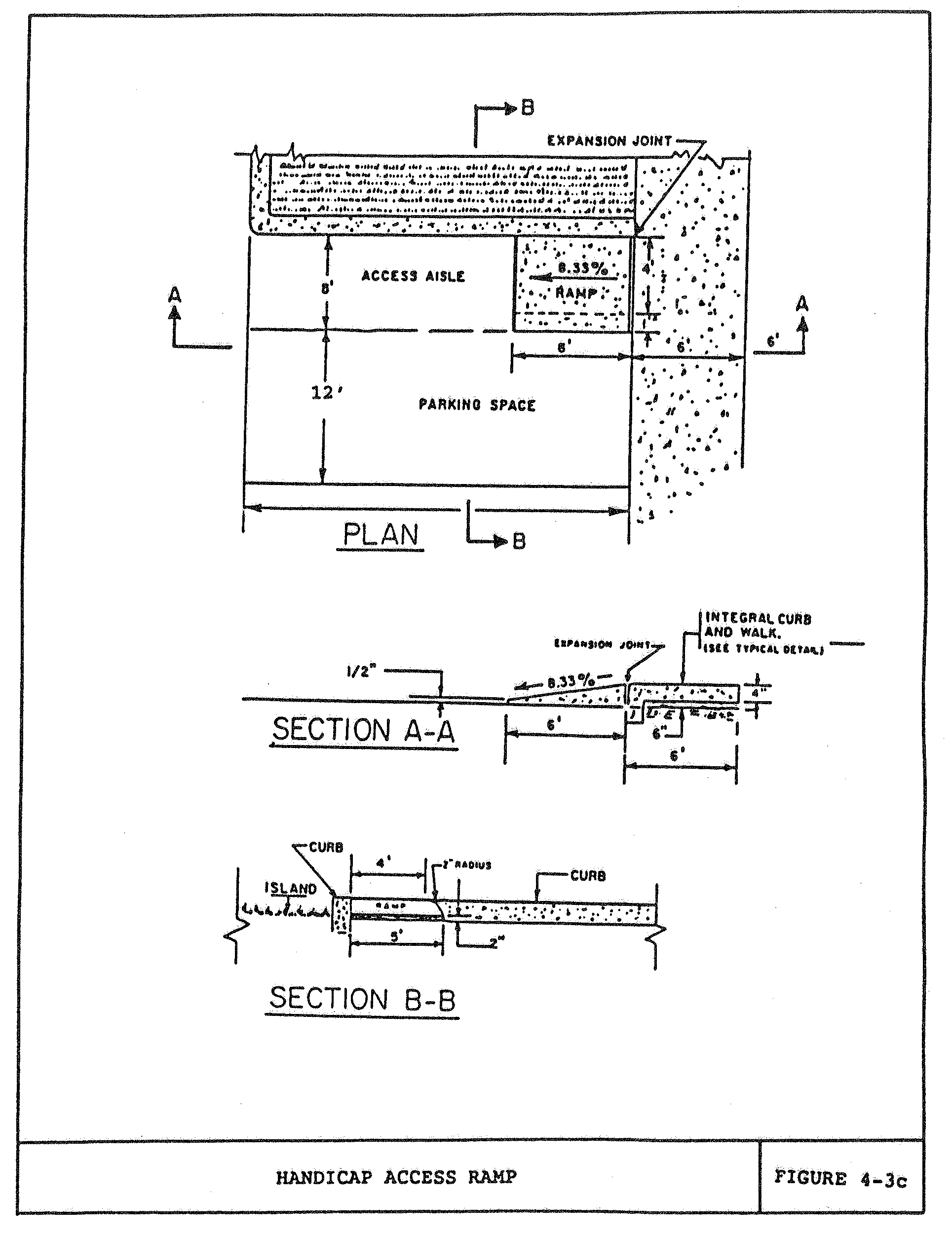
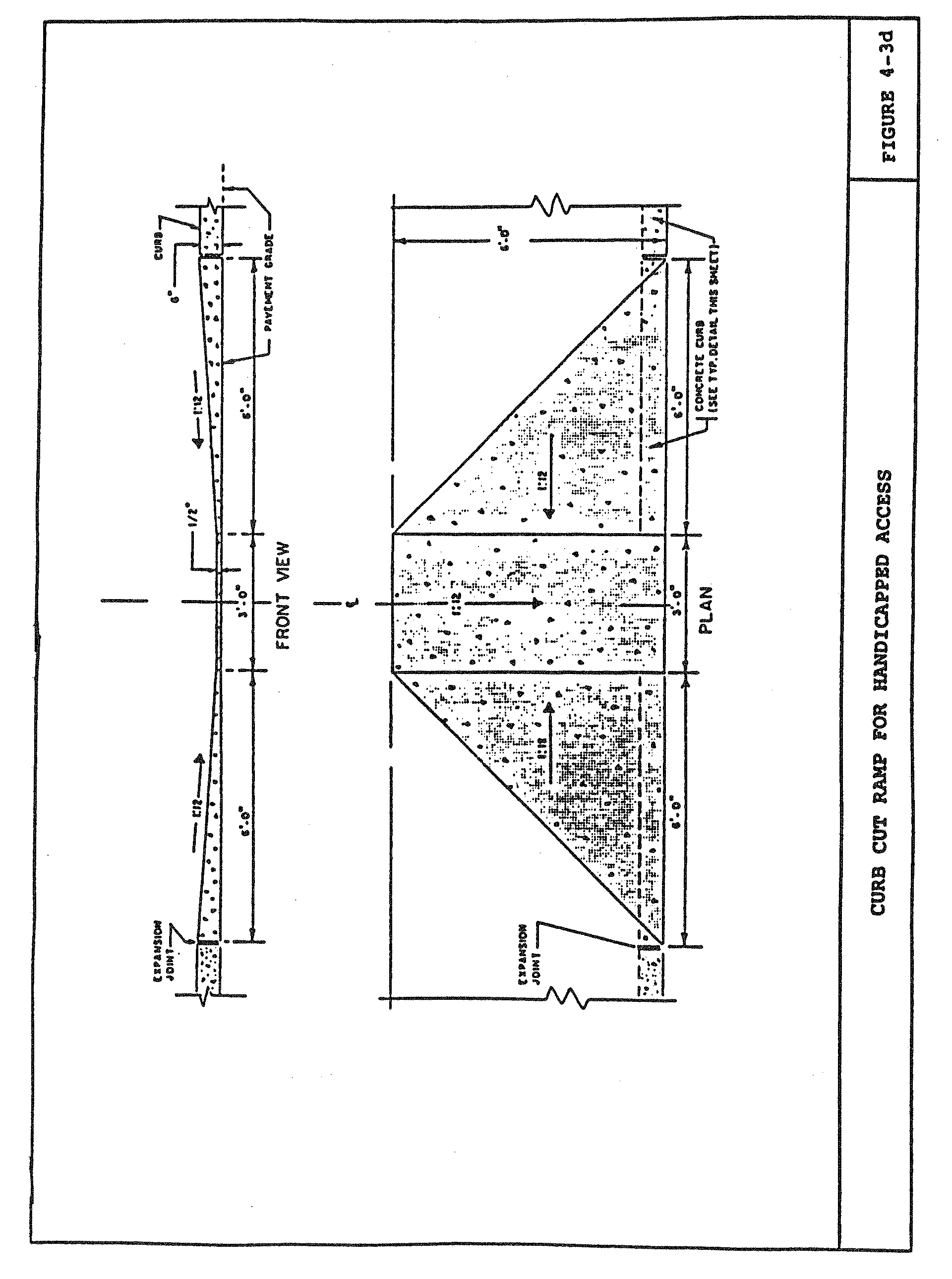
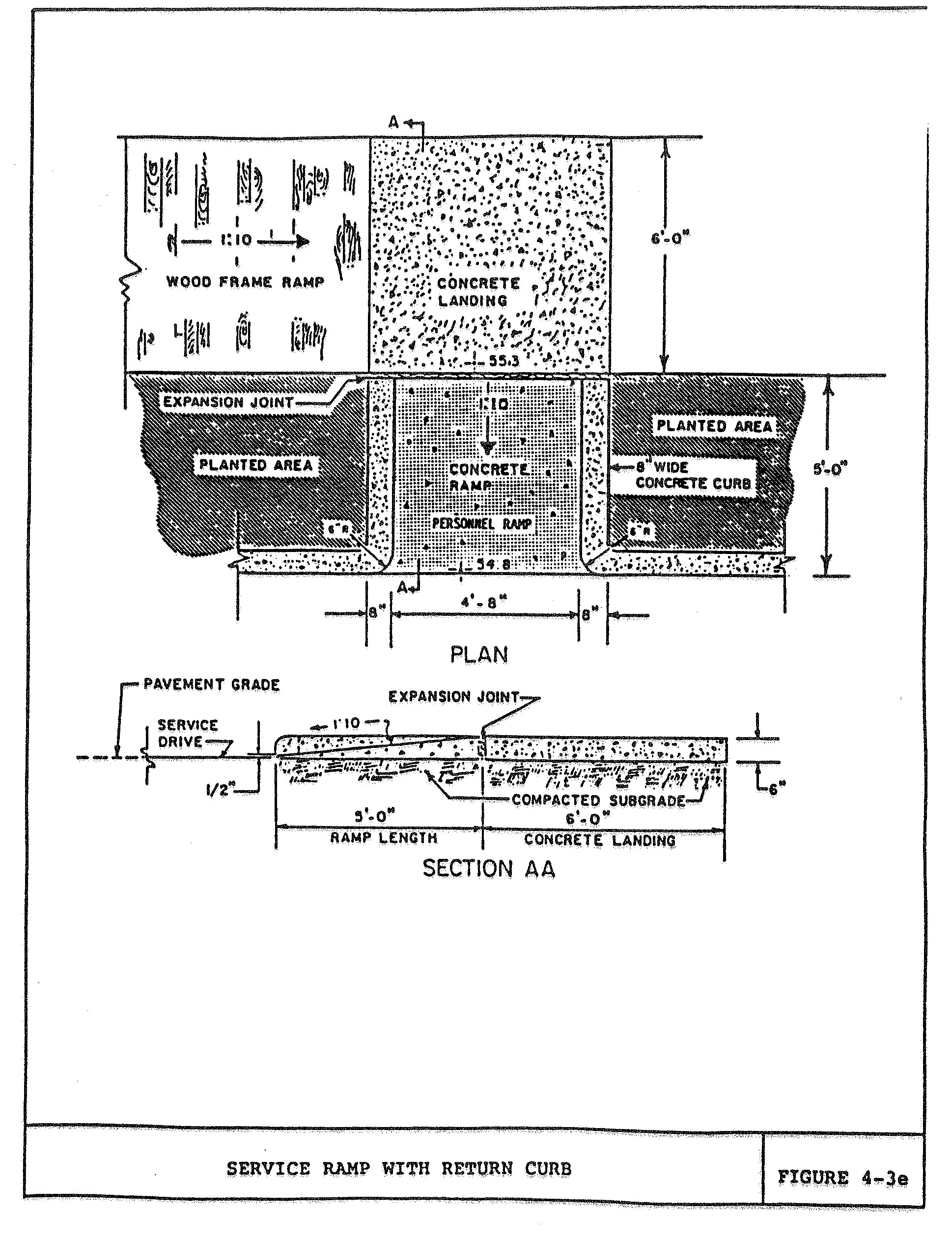
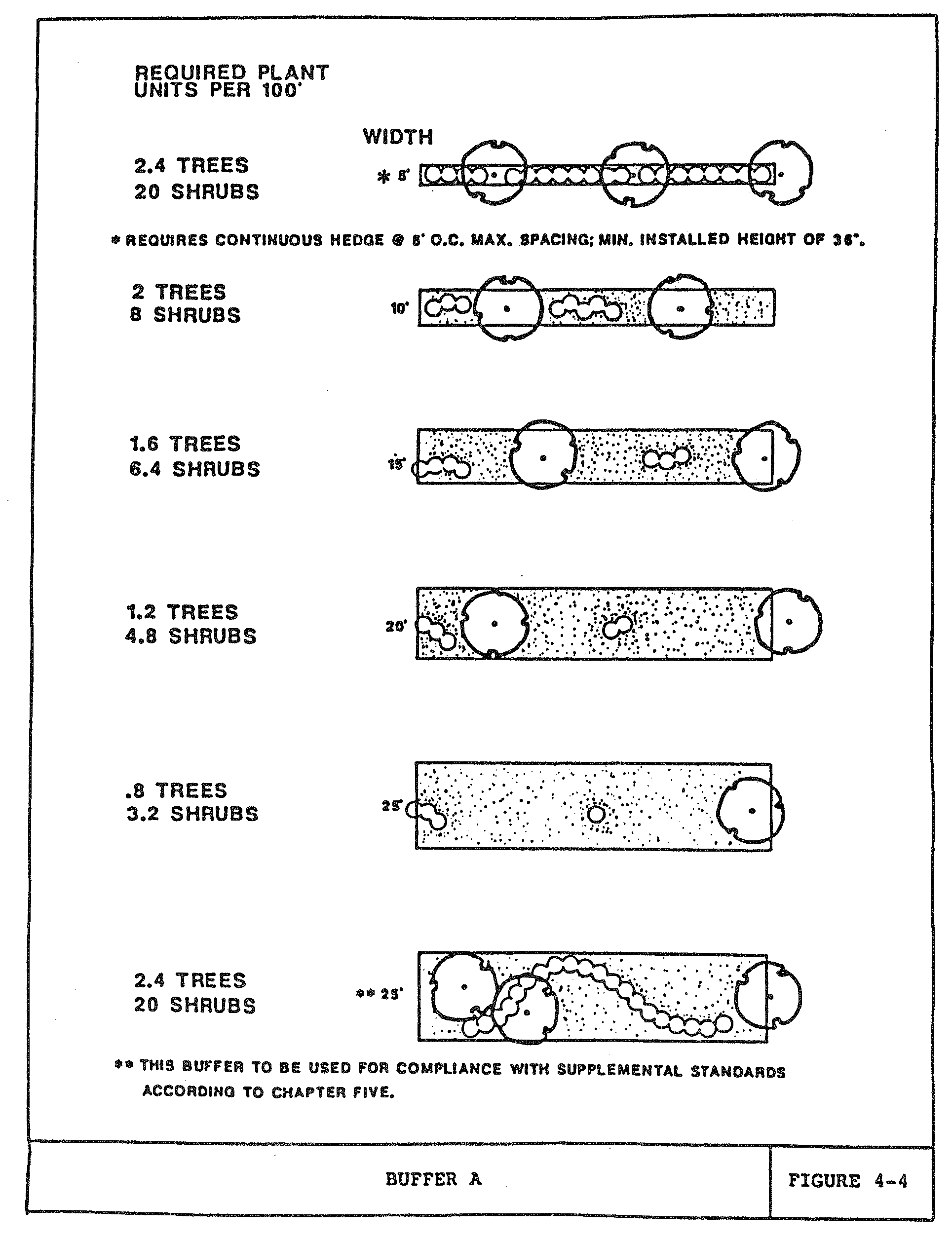
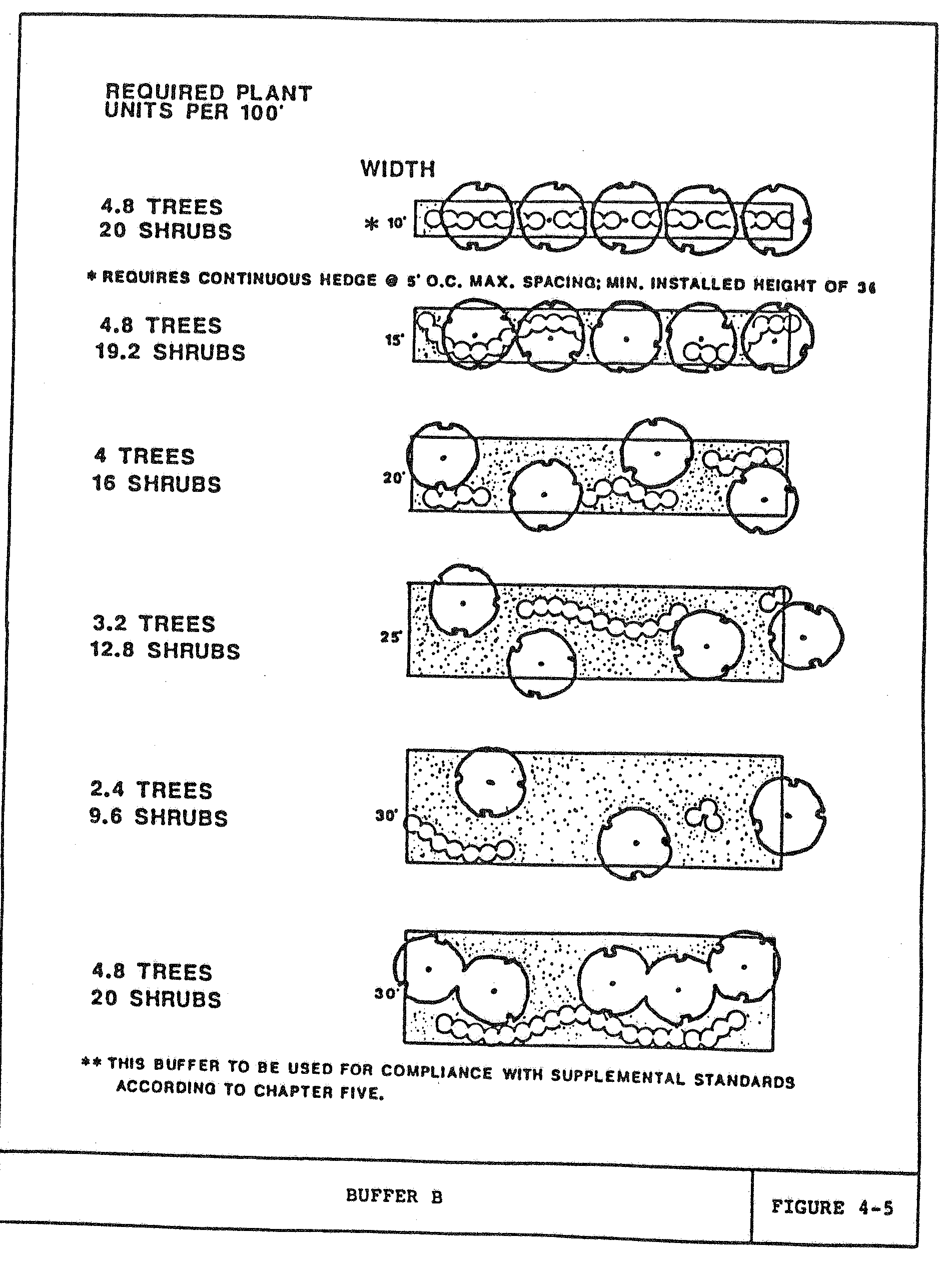
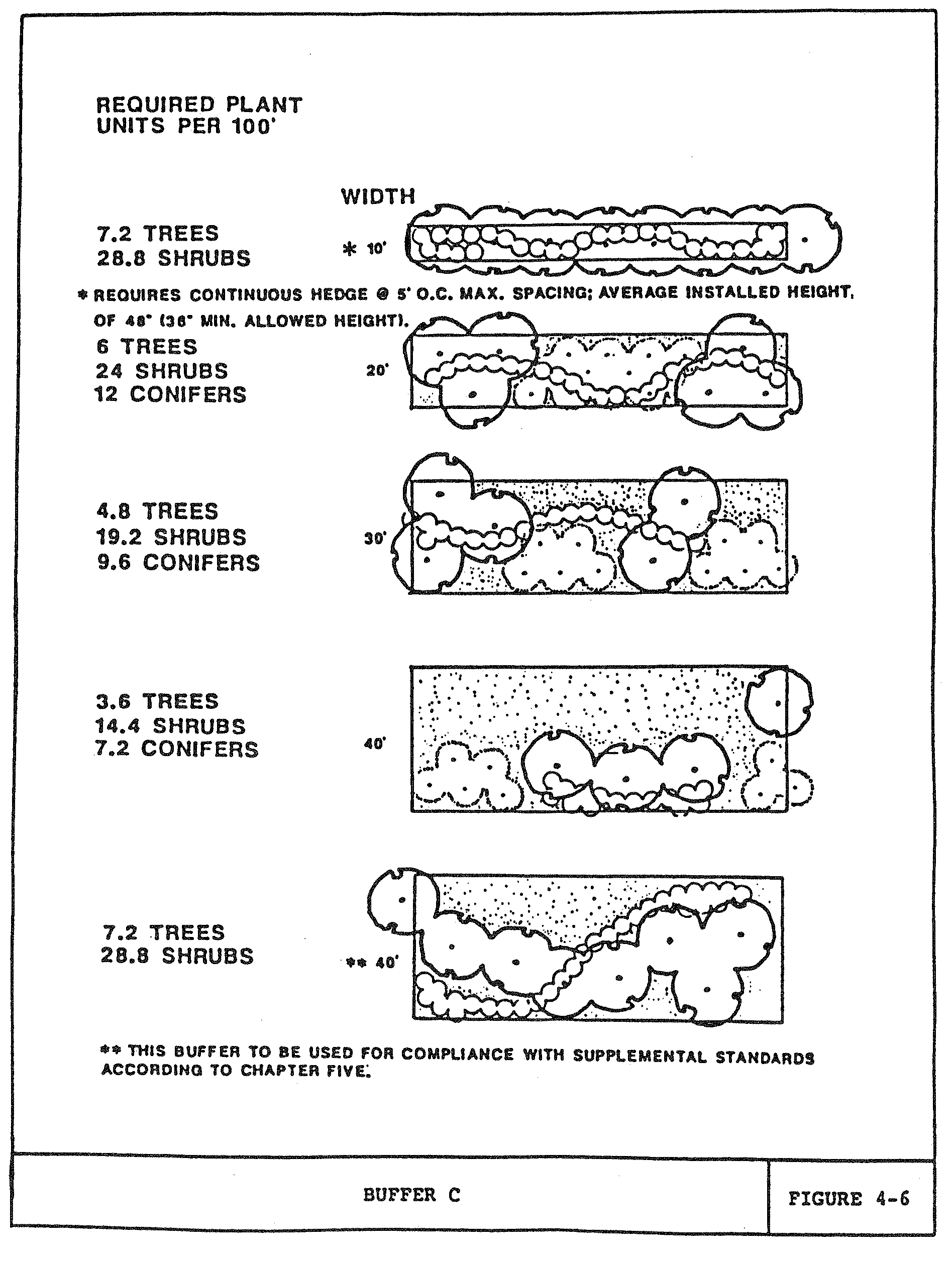
Parking lot design. The parking lot design, including but not limited to, arrangement of spaces, width of aisles and access drives, angle of spaces and installation of curbing, shall be as specified in Figure 4-3a—4-3e of this schedule. The specific design of each facility shall take into consideration the necessity of required landscape in accordance with Figures 4-4, 4-5 and 4-6. All parking lots shall be paved in accordance with Florida Department of Transportation Road Paving Standards, except as follows:
1.
Up to one hundred (100) percent of the parking spaces may be grass area, provided that spaces are defined and that aisles, handicapped spaces and circulation areas shall be paved. This exemption may be approved upon a finding by the Development and Plan Review Committee that seasonal use or non-daily use, such as for churches or other similar uses where parking needs are limited to one (1) or two (2) days per week, justifies the request. In addition, historic properties may be exempt if it would result, in the property maintaining its historic character. Historic properties, where feasible, would be encouraged to incorporate period design materials in development of parking areas. All exemptions would be conditioned upon a finding that there would not be a detrimental effect due to erosion or other degradation of the natural or surrounding environment or properties.
2.
Parking areas, which have grass parking spaces, shall not use the unpaved spaces in calculations to meet minimum requirements for setbacks, buffers, landscaping or stormwater retention areas. Stormwater retention area requirements shall be calculated based upon the assumption that all spaces are paved.
F.
Handicapped access. Handicapped accessibility spaces shall comply with the standards of the Americans with Disabilities Act and the Florida Accessibility Code for Building Construction as amended. The Administrative Official or the Administrative Official's designee shall make determinations of compliance.
G.
Off-street loading, unloading and service area space.
1.
Required areas. The off-street loading, unloading and service area requirements of this section are intended to provide necessary minimum standards so that no loading, unloading or servicing of building or structures by refuse collection, fuel or other public or private service type vehicular activity shall adversely impact the public safety, generate excess capacity on the City street system, or cause undue congestion or conflict resulting from such activities. The requirements of this section shall apply to all public, semi-public, commercial and industrial development, whether new structures or alteration to existing structures. Off-street facilities shall be available for use prior to the issuance of any certificate of occupancy or occupational license, and its continued maintenance shall be the obligation of the property owner and occupant as long as the use(s) requiring such facility continues. No off-street facility shall be altered or discontinued except in accordance with this schedule.
2.
Arrangement.
a.
The off-street loading, unloading and service area space shall be designed and arranged such that it may be used without blockage or interference with the function and safety of adjacent uses, street, accessways or off-street vehicular and/or pedestrian traffic circulation.
b.
The required space(s) shall not be used for the storage of vehicles or materials, and shall not be used to meet off-street parking requirements.
c.
All loading facilities shall be located on the same premises as the use they serve and shall not encroach on any rights-of-way or dedicated easement(s). All such facilities shall be well separated and buffered from adjacent uses in accordance with the provisions contained within Section 2.8 of this Code.
3.
Dimension.
a.
All loading spaces shall meet the minimum size requirements as follows:
(1)
When normal delivery of merchandise and materials is via trucks not exceeding two (2) tons in size; twelve (12) feet by twenty-five (25) feet; and a fourteen (14) foot height clearance.
(2)
When normal delivery of merchandise and materials is via trucks exceeding two (2) tons in size; twelve (12) feet by fifty-five (55) feet; and a fourteen (14) foot height clearance.
b.
Loading areas shall be constructed in accordance with the requirements of this Code. (See also Figure 4-3e).
c.
Loading spaces shall be striped and marked to insure adequate reservation for all loading and unloading activities.
4.
Number of spaces. The Administrative Official shall interpret and approve the amount of loading, unloading and service area required for all uses based upon the following total aggregate floor area of each structure located on the lot:
Loading, Unloading and Service Area Space Requirements
H.
Access, circulation and improvements, vehicular access, general. All off-street parking, off-street loading and service area space shall have vehicular access to a street or frontage road and there shall be only one (1) vehicular access point, not to exceed fifty (50) feet in width, or two (2) vehicular access points, not to exceed thirty (30) feet in width each, located on any one (1) street or frontage road to serve the premises in question. All access facilities shall require the approval of the Development and Plan Review Committee for design or redesign and location.
I.
Guidelines for landscaping in off-street parking areas. All off-street parking areas, except single family and multi-family with a density of five (5) units or less shall have the following landscape requirement guidelines:
1.
A permit shall be required for development or redevelopment of any off-street parking area to serve an existing use. Such permit is required when the parking area is redeveloped separately from the existing use, or is not part of a development order application process.
2.
An off-street parking area that abuts a public right-of-way shall include a landscaped strip on the perimeter of the parking area adjacent to the right-of-way. This landscaped strip shall be similar to Buffer "A", as provided for in Figure 4-4.
3.
In addition to landscaping suggested above, additional landscaping equal to ten (10) percent of the total off-street parking area shall be provided in the interior of the parking area. Perimeter landscaping beyond the minimum required may be counted as part of the interior landscaping requirement. Interior landscaping may be in one or more areas to total the ten (10%) percent requirement. Interior landscaping shall include at least one (1) tree for each four hundred (400) square feet, or fraction thereof, of interior landscaped area.
4.
An off-street parking area that abuts an area designated, approved or developed for residential use shall provide a landscaped strip along the perimeter of the parking area adjacent to the residential area. This landscaped strip shall be similar to Buffer "B", provided for in Figure 4-5.
5.
All landscaped areas required in this section shall be protected from encroachment by a barrier such as curbs, wheel stops or similar devices consistent with parking lot specifications in Figures 4-3a and 4-3b.
6.
All parking spaces adjacent to any structure shall be separated from that structure by a minimum of an eight (8) foot buffer. The buffer may contain landscaping and walkways but in no case shall the landscaping area be less than twenty-five (25) percent of the total buffer area.
(Ord. No. 2004-621, § 1, 1-6-04)
Editor's note— Ordinance No. 2004-621, § 1, adopted January 6, 2004, replaced § 2.7 in its entirety with a new § 2.7 as herein set out. Formerly, such section pertained to similar provisions. See Code Comparative Table for history.
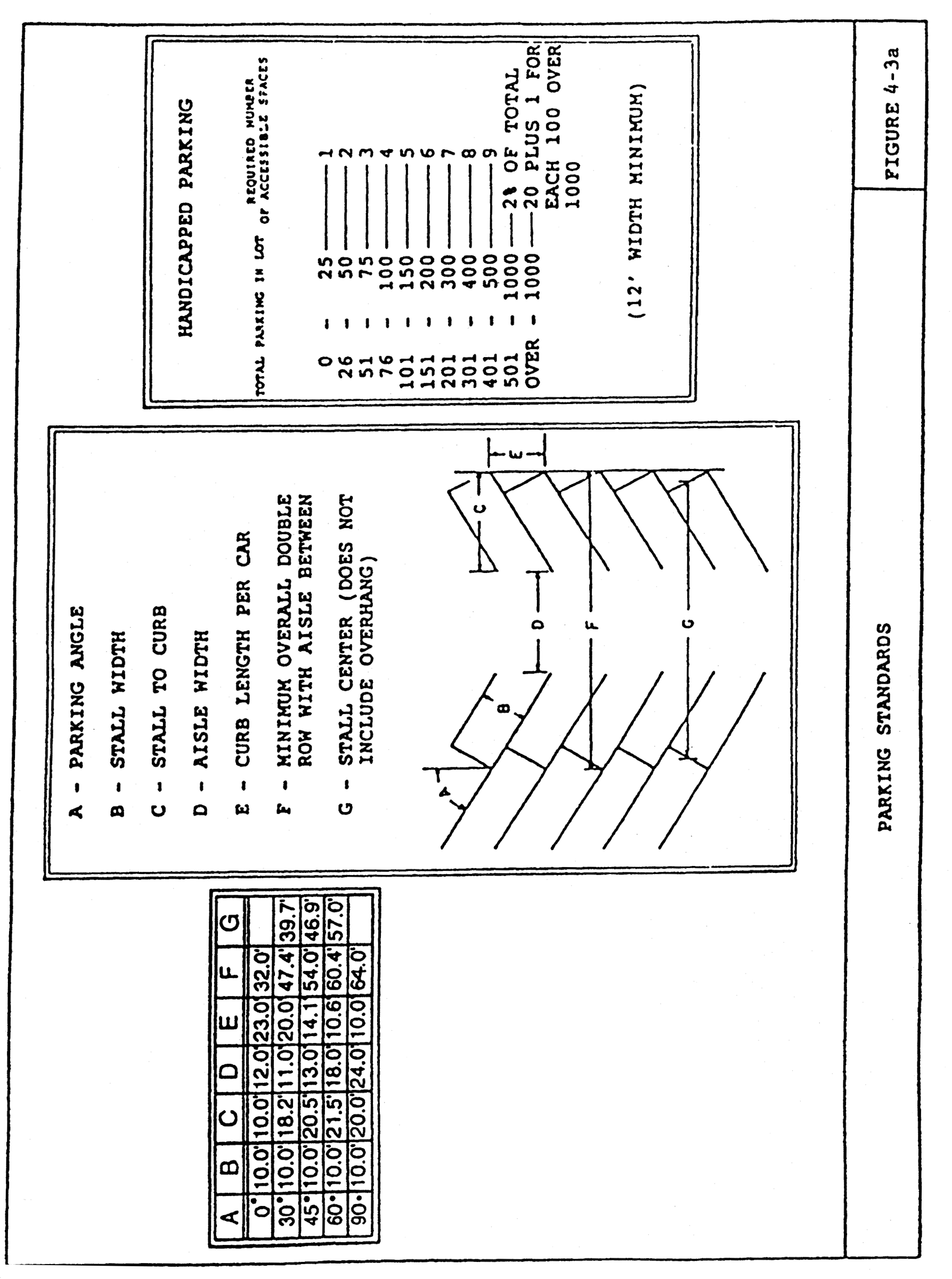
Parking Standards, Figure 4-3a