Inverness City Zoning Code
Sec. 2.14
Traffic Circulation.
A.
Purpose.
1.
The purpose of this section is to describe regulations that apply to the transportation system, including bikeways, pedestrian access and level of service. This section shall be construed and implemented to create an efficient, safe and balanced system of traffic circulation accommodating vehicles, bicycles and pedestrians.
2.
Engineering design and construction standards are found in section 2.12 of this Code. All required elements of the transportation system shall be provided in compliance with those minimum design and construction standards. The city will seek assistance and cooperate with the FDOT in the care and management of our road network. The city will work with the county in solving common problems in the fringe area of the city.
B.
Traffic Study Requirements.
1.
An application for development approval for any proposed development project, e.g. Subdivision, PUD or special exception use will have to supply data pertaining to traffic impact of that development that meets one of the following criteria (project size in total, cumulative area or dwelling units):
a.
Non-residential projects, whether proposed to be located within a single structure or a group of two (2) or more structures, that total thirty thousand (30,000) or more square feet of floor area, in aggregate.
b.
Residential development of fifty (50) or more dwelling units, in aggregate.
2.
The traffic study shall be designed to predict the impact of the proposed development on the transportation system. The study shall include, but is not limited to, the following information:
a.
A statement explaining the assumptions used in the study, including existing average daily background traffic, background traffic growth rate, directional splits, average trip length, major attractions, etc.
b.
Estimated and projections of average daily background traffic, and the effect of projected development generated on the level of service adopted by the city.
c.
The need for frontage or access roads parallel to the primary access road.
d.
The need for signalization.
e.
Provisions for maintaining the minimum level of service adopted by the city for affected roadways and affected intersections.
f.
The traffic study may be required to be prepared and signed by a professional traffic engineer. Estimates of trip generation for proposed uses shall be based upon current information from the Citrus County model.
g.
The use of the police department data on high accident areas in prioritizing the improvements to these areas.
C.
Access and Circulation Plan Required. All proposed development projects required to submit a preliminary site plan shall provide an access and circulation plan with the application for development approval. The plan shall demonstrate that the following standards for vehicular access and circulation are met by the proposed development:
1.
All projects shall have access to a public right-of-way. The minimum number of access points shall be as follows:
a.
A non-residential development on a corner lot may be allowed two (2) points of access, provided that neither point of access is onto an arterial and that any access onto a collector shall be a minimum of three hundred (300) feet from the intersection of a center line of the right-of-way.
b.
Schools and/or uses requiring emergency vehicle access may have one (1) additional access; provided that, the additional access drive is limited to school bus or emergency vehicle use only.
c.
A service station/filling station may be allowed one (1) point of access for each one hundred fifty (150) feet of street frontage. Each access shall not exceed thirty (30) feet in width and shall be separated from all property lines and all other access points by a minimum fifteen (15) feet curb island.
2.
All streets and roads proposed in a new development shall be designed and constructed pursuant to standards in section 2.12. Streets and roads shall be dedicated to the city upon completion, inspection and acceptance by the city.
3.
Private streets may be allowed within manufactured housing developments, parks, recreational vehicle parks, multi-family residential projects, PUD or commercial, office or industrial projects. However, private streets shall be designed and constructed pursuant to standards in Sections 48.10 through 51.60 of the Policy Handbook.
4.
Proposed development shall not degrade the level of service adopted by the city for affected roadways. Refer to section 2.13 (traffic circulation) of this Code.
5.
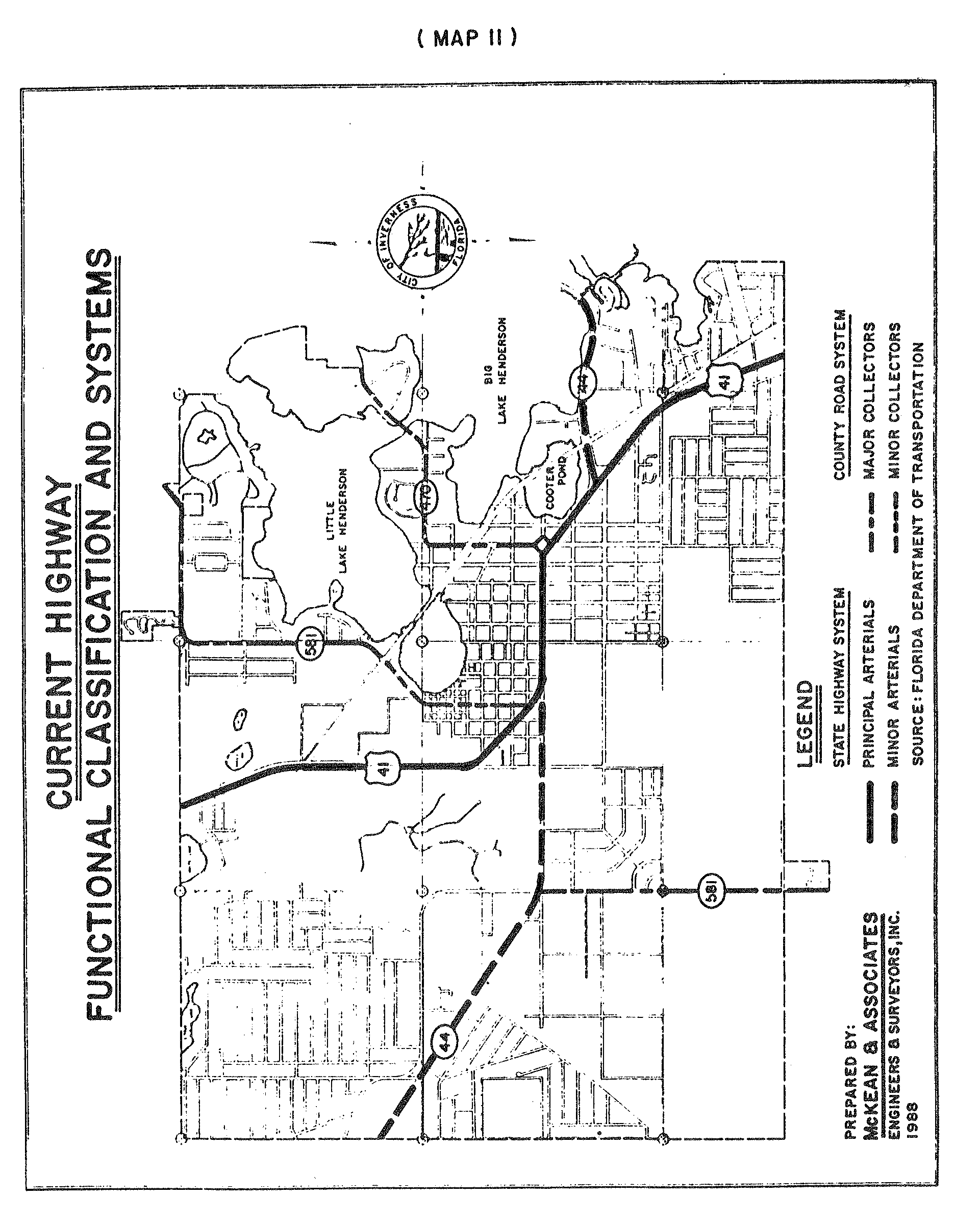
Projects proposed on principal and minor arterials and major collectors (see Map II) shall include frontage or service roads, and shall take access from the frontage road rather that the arterial or major collector. This requirement may be met through interconnecting parking lots which abut the arterial or major collector facility. Where natural features cause this requirement to be physically infeasible, alternate designs may be approved.
6.
Access points on arterial roadways shall be separated a minimum of one hundred (100) feet. However, two (2) adjacent projects may share a common driveway, provided that appropriate access easements are granted between or among property owners.
7.
All proposed rights-of-way shall be located and sized in compliance with the traffic circulation element of the city's comprehensive plan.
8.
The street layout in all new development shall be coordinated with and interconnected to the street system of the surrounding area. Streets in proposed subdivisions shall be connected to rights-of-way in adjacent areas to allow for proper inter-neighborhood traffic flow. If adjacent lands are unplatted, stub outs in the new development shall be provided for future connection to the adjacent unplatted land.
9.
All structures, not including accessory or temporary uses, hereafter erected or relocated shall be on a lot adjacent to or abutting on a public street, or with access to a public street by means of a private street or approved legal easement which has been recorded in the Official Records of Citrus County, Florida.
10.
All access points shall be by a paved apron connecting paved city roads with the project driveway. Access to commercial and industrial districts shall not be permitted through residential districts.
11.
All appropriate agencies, county and state, will be notified should a project have the potential to increase traffic volume.
(Ord. No. 98-573, § 1, 10-6-98)
D.
Pedestrian Access Standards.
1.
Projects abutting collector or arterial facilities shall provide sidewalks adjacent to the collector or arterial roadway. Location of sidewalks shall be consistent with planned roadway improvements.
2.
Where a proposed development includes improvements or new construction of collector or arterial facilities, facility designs shall include provision for sidewalks and bikeways within the right-of-way.
3.
Residential projects adjacent to or in the immediate vicinity of an activity center comprised of commercial, office, service or recreational activities shall provide pedestrian and bicycle access from the development to the activity center.
4.
Design and construction of sidewalks and bikeways shall conform to the requirements of section 2.12.L, including provisions for access by physically handicapped persons as provided in Florida Statutes and this Code.
E.
Standards for Drive-up Facilities. All facilities providing drive-up or drive-through service shall provide on-site stacking lanes in accordance with the following standards:
1.
Drive-in facilities and stacking lanes shall be located and designed to minimize turning movements relative to driveway access to streets and intersection.
2.
Drive-in facilities and stacking lanes shall be located and designed to minimize or avoid completely conflicts between vehicular traffic and pedestrian areas such as sidewalks, crosswalks, bikeways or other pedestrian access ways.
3.
A by-pass lane shall be provided.
4.
Stacking land distance shall be measured from the service window to the property line bordering the furthest street providing access to the facility.
5.
Minimum stacking lane distance shall be as follows:
a.
Financial institutions shall have a minimum distance of two hundred (200) feet. Two (2) or more stacking lanes may be provided which together total two hundred (200) feet.
b.
All other uses shall have a minimum distance of one hundred twenty (120) feet.
6.
Alleys or driveways in or abutting areas designed, approved or developed for residential use shall not be used for circulation of traffic or for drive-up facilities.
7.
Where turns are required in the exit lane, the minimum distance from any drive-up station to the beginning point of the curve shall be thirty-four (34) feet. The minimum inside turning radius shall be twenty-five (25) feet.
8.
Construction of stacking lanes shall conform to the specifications of FDOT.
F.
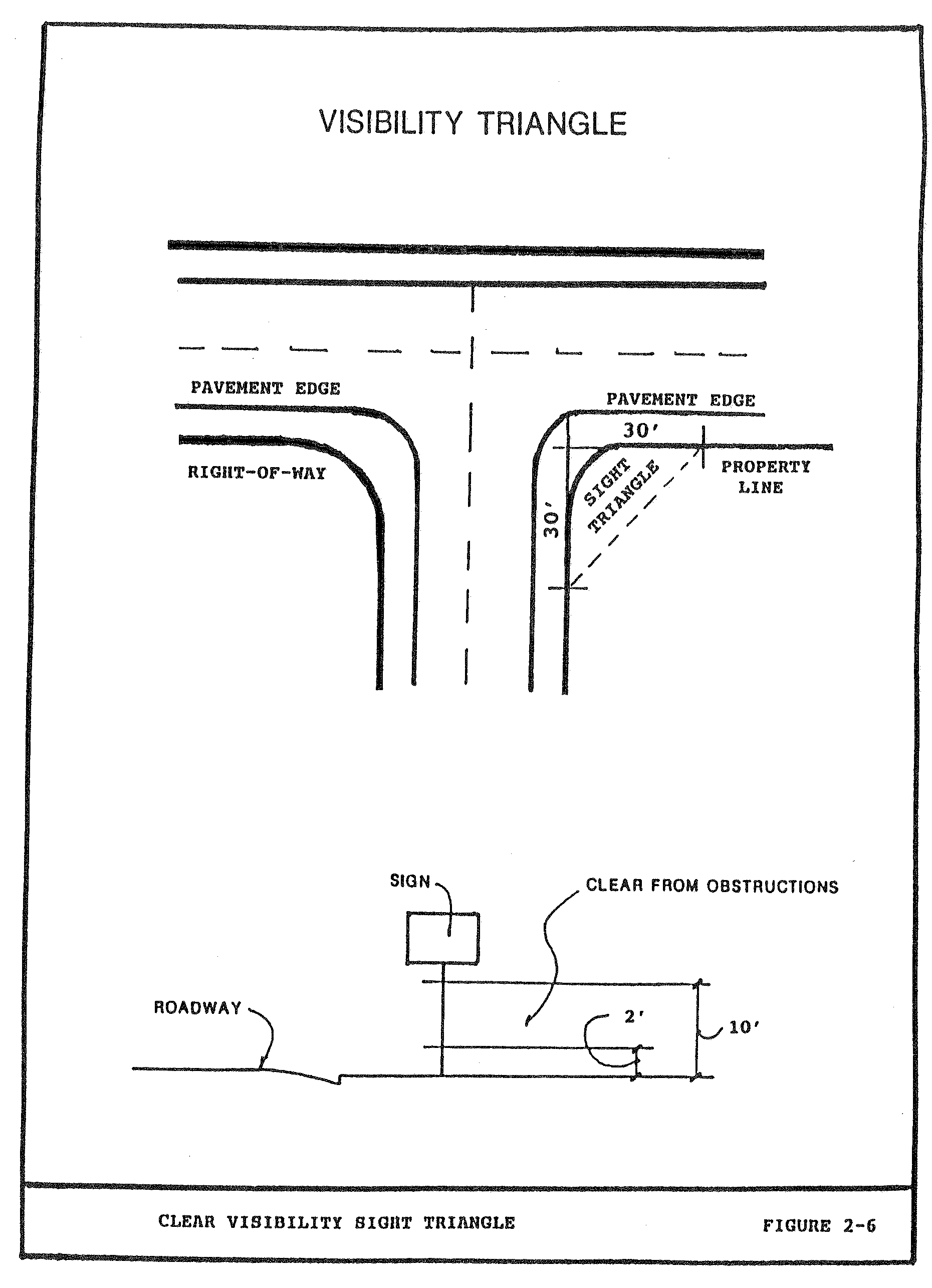
Clear Visibility Triangle. In order to provide a clear view of intersecting streets to the motorist, there shall be a triangular area of clear visibility formed by two (2) intersecting streets. The following standards shall be met:
1.
Nothing shall be erected, placed, parked, planted or allowed to grow in such a manner as to materially impede vision between a height of two (2) feet and ten (10) feet above the grade, measured from the property line. (See Figure 2.6 at the end of this section.)
2.
Intersections of driveways with streets. Beginning at the intersection of the driveway edge with the street right-of-way, as projected where rounded, thence along the street right-of-way, for a distance of thirty (30) feet, thence in a straight line across the property to a point on the edge of the driveway thirty (30) feet from the point of beginning. Where driveways are curved or intersect with the street at other than right angles, a visibility triangle shall be provided giving equivalent visibility to drivers of cars on and entering the street. The visibility triangle shall be provided on each side of a driveway.