
Jackson County Unincorporated
City Zoning Code
City Zoning Code
ARTICLE 1
- GENERAL PROVISIONS
Sec. 101. - Title.
This appendix shall be known and may be cited as "The Unified Development Code of Jackson County, Georgia" or, for brevity, "UDC."
(Ord. No. 17-003, § 1, 10-2-2017)
Sec. 102. - Authority.
This UDC is adopted under authority of the following laws and rules:
(a)
Article 9, section 2, paragraph 3 and 4 of the Constitution of the State of Georgia;
(b)
The Zoning Procedures Law (O.C.G.A. § 36-66-1 et seq.);
(c)
The Georgia Planning Act of 1989, (Georgia Laws, 1989, pp. 1317—1391, Act 634) which among other things provides for local governments to adopt plans and regulations to implement plans for the protection and preservation of natural resources, the environment, vital areas, and land use;
(d)
Minimum Standards and Procedures for Local Comprehensive Planning (chapter 110-3-2 of Rules of the Georgia Department of Community Affairs) to implement the Georgia Planning Act of 1989, as ratified by the Georgia General Assembly, and as have since been amended;
(e)
Rules for Environmental Planning Criteria, commonly known as the "Part V" Standards, promulgated by the Georgia Department of Natural Resources and ratified by the Georgia General Assembly which provide for local governments to plan for the protection of the natural resources, the environment, and vital areas of the state;
(f)
The Georgia Erosion and Sedimentation Act of 1975 (O.C.G.A. tit. 12, ch. 7), as amended;
(g)
The Georgia Water Quality Control Act (O.C.G.A. tit. 12, ch. 5, art. 2);
(h)
Pursuant to O.C.G.A. 36-65-1, it is declared by the General Assembly of Georgia that in the exercise of powers specifically granted to them by law, local governing authorities of cities and counties are acting pursuant to state policy;
(i)
Other applicable laws enacted by the Georgia General Assembly and the United States government.
(Ord. No. 17-003, § 1, 10-2-2017)
Sec. 103. - Purposes.
(a)
Jackson County has adopted a comprehensive plan in accordance with the requirements of the Georgia Planning Act of 1989, Rules of the Georgia Department of Community Affairs, and Rules of the Georgia Department of Natural Resources, and said plan has been revised from time to time. This UDC helps assure the implementation of the adopted comprehensive plan.
(b)
This UDC is needed and intended to: promote the health, safety, welfare, morals, convenience, order, and prosperity of the citizens of the county; promote responsible growth, lessen congestion in the public thoroughfares, secure safety from fire and health dangers, and promote desirable living conditions; regulate the distribution and density of uses on the land to avoid both the undue concentration of population and the inappropriate dispersion of population; maintain the integrity and individual character of established communities and settlements, and promote desired character in new developments; prevent the encroachment of incompatible land uses within residential areas and preserve property values; and provide for economically sound and stable land development by assuring the provision in land developments of adequate streets, utilities, services, traffic access and circulation, public open spaces, and maintenance continuity.
(c)
In addition to the purposes articulated in this section, this UDC is also intended to serve the several purposes articulated in different articles of this UDC.
(Ord. No. 17-003, § 1, 10-2-2017)
Sec. 104. - Jurisdiction.
This UDC applies to all lands within the unincorporated areas of Jackson County, Georgia.
(Ord. No. 17-003, § 1, 10-2-2017)
Sec. 105. - Definitions.
Access: A way or means of approach to provide physical entrance to a property.
Buffer: A strip of land located between a side or rear property line and a building, structure, or use, intended to separate and obstruct the view of the site on which the buffer is located from an abutting property; a strip of land between a stream or other natural feature and a building, structure, or use, intended to protect the stream or other natural feature.
Building: Any structure having a roof supported by columns or walls and intended for the shelter, housing, or enclosure of any individual, animal, process, equipment, goods, or materials of any kind.
Building coverage: The horizontal area measured within the outside of the exterior walls of the ground floor (i.e., "footprint") of all principal buildings, accessory buildings, and accessory structures on the lot, not including steps, terraces, and uncovered porches.
Building coverage, maximum: The greatest percentage of a given lot that may be occupied by all principal and accessory buildings and structures on said lot, measured within the outside of the exterior walls of the ground floor (i.e., "footprint") of all principal and accessory buildings and structures on the lot, not including steps, terraces, and uncovered porches.
Building floor area: The gross floor area of all heated spaces within a building. Heated floor area does not include garages, unheated basements, attic storage areas or partially enclosed decks or patios. Gross floor area comprises the area within the inside perimeter of the exterior walls with no deduction for corridors, stairs, closets, thickness of walls, columns or other features, exclusive of area open and unobstructed to the sky.
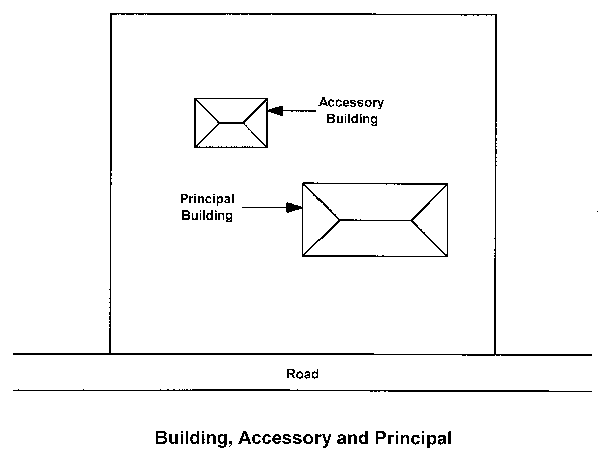
Building, accessory: A building subordinate to the main building on a lot and used for purposes incidental to the main or principal building and located on the same lot therewith.
Building, principal: A building in which is conducted the principal use of the lot on which said building is situated. In any residential zoning district, any structure containing a dwelling unit shall be defined to be the principal building on the lot on which same is situated, unless otherwise specifically provided in this UDC.
Comprehensive plan: The Comprehensive Plan for Jackson County, adopted by the Jackson County Board of Commissioners, as readopted or amended from time to time in accordance with the Georgia Planning Act of 1989 and administrative rules of the Georgia Department of Community Affairs. Comprehensive plan also broadly includes any other functional plans adopted by the Jackson County Board of Commissioners pertaining to land use, transportation, community facilities, natural and historic resources, and the environment.
Condition of zoning or use approval: A requirement adopted by the Jackson County Board of Commissioners at the time of approval of a rezoning, or conditional use; placing greater or additional requirements or restrictions on the property than provided in this UDC to reduce an adverse impact of the request and to further protect the public health, safety, or general welfare.
Cul-de-sac: A paved area terminating a cul-de-sac street, provided for the purpose of enabling vehicles to reverse direction while driving continuously in a forward but circular manner.
Cul-de-sac street: A street having one end open to traffic and the other end terminated with a turnaround.
Density: The quantity of building per unit of lot area; for example, the number of dwellings per lot area (gross square foot or per acre).
Development:
(1)
A land development project involving the construction of streets, utilities, buildings, or other improvements required for the habitation or use of property, such as a residential neighborhood, an apartment complex, a store, or a shopping center;
(2)
Any manmade change to improved or unimproved real estate, including, but not limited to, buildings or other structures, mining, dredging, filling, grading, paving, excavating, drilling operations, or permanent storage of materials;
(3)
The act of constructing or carrying out a land development project, including the alteration of land or vegetation in preparation for construction activity.
Dwelling: A building or portion of a building arranged or designed to provide living quarters for one or more families or households on a permanent or long-term basis.
Dwelling, single-family detached: A residential building, whether site-built or a manufactured home or an industrialized building, designed for occupancy by one family or household and which is not attached to any other separate dwelling unit.
Floor: The top surface of an enclosed area in a building, from the top of slap in concrete slab construction or top of wood flooring in wood frame construction, to the top of ceiling of enclosed area.
Floor-area ratio (FAR): The ratio of the floor area of a building to the area of the lot in which the building is located.
Frontage or street frontage: The width in linear feet where it abuts the right-of-way of any street from which access may be gained.
Governing body: The Jackson County Board of Commissioners.
Height of building: The vertical distance measured from the grade to the highest point of the coping of a flat roof; to the deck lines of a mansard roof; or to the mean height level between the eaves and ridge of a gable, hip or gambrel roof. Grade is defined as the average elevation of the ground on all sides of a building.
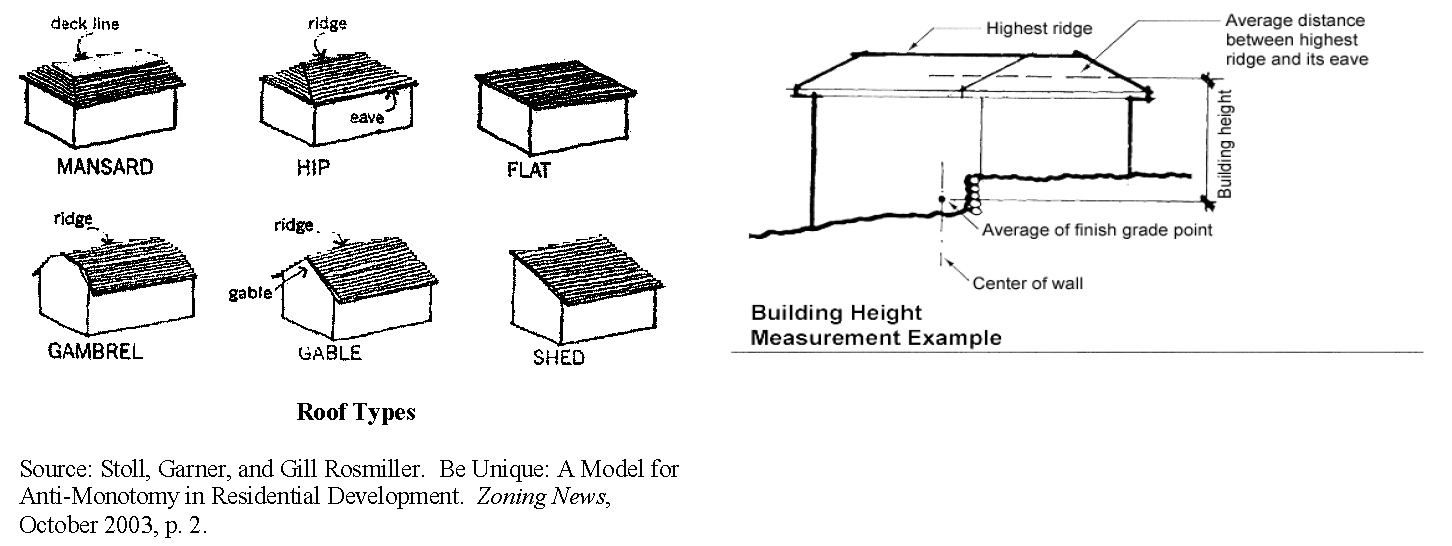
Height of structure: For all structures other than buildings, height shall be the vertical distance to the highest point of a structure, as measured from the average grade at the base of the structure or directly below a projecting structure.
Landscaped open space: That portion of a given lot, not covered by buildings, parking, access and service areas, or detention ponds, that is designed to enhance privacy and the amenity of the development by providing open spaces and/or landscaping features, screening and buffering for the benefit of the occupants or those in neighboring areas, or a general appearance of openness. Landscaped open space may include, but need not be limited to, grass lawns, decorative planting, berms, walls and fences, pervious walkways, ornamental objects such as fountains, statues and other similar natural and man-made objects, wooded areas, and water courses, any or all of which are designed and arranged to produce an aesthetically pleasing effect within the development.
Landscaping: Shrubs, vines, turf, ground cover and other landscape materials which are utilized to enhance the aesthetic and functional qualities of a site.
Lot: A parcel or tract of land held in single ownership.
Lot area: The total horizontal area included within lot lines. Street rights-of-way shall not be considered a part of a lot for the purpose of meeting the minimum requirements of this UDC.
Lot frontage: The distance in linear feet of a lot where it abuts the right-of-way of any street from which access may be directly gained.
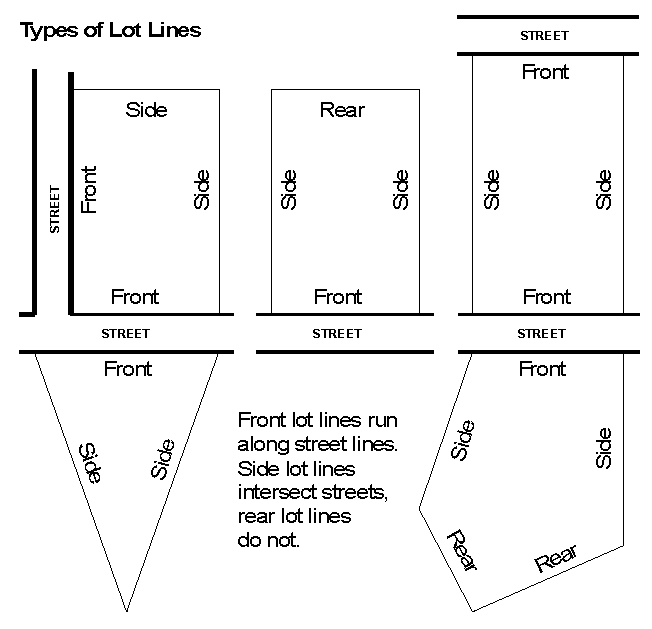
Lot line: The boundary dividing a given lot from the street or adjacent lots; the boundary defining the limit of ownership of a property.
Lot line, front: Any boundary line of a lot that abuts a street right-of-way line. A lot adjacent to more than one street will have more than one front lot line.
Lot line, rear: Any boundary line of a lot that does not intersect with a public street right-of-way line and is not a front lot line.
Lot line, side: Any boundary line of a lot that intersects with a public street right-of-way line and is not a front lot line.
Lot of record: A lot which is part of a subdivision lawfully recorded in the plat books of the office of the Clerk of the Superior Court of Jackson County, Georgia, or a lot described by metes and bounds, the description of which has been lawfully recorded. A tax parcel is not necessarily a lot of record. A lot of record may not conform to the requirements of this UDC, in which case it is a nonconforming lot of record. A lot shall not be considered a lot of record if it is:
(1)
Described in a deed recorded in the county deed books with reference to an attached boundary survey or plat that has not been recorded in the plat books;
(2)
Not described in a deed recorded prior to the original adoption of zoning and subdivision regulations in Jackson County.
Lot width: The distance, in feet, measured across the lot between side lot lines. The lot width is measured parallel to the road frontage, where it exists. Where a lot does not have road frontage, the public development director shall decide which lot lines are considered side lot lines for purposes of determining lot width.
Occupied: The word "occupied" as applied to any land or building shall be construed to include the words "intended, arranged or designed to be used or occupied."
Open space: An area of land or water that is permanently set aside through dedication, designation or reservation to remain in a nature and unimproved state or that may be improved only for active or passive recreation or enjoyment. Land conservation and impervious cover reduction is a major goal of open space.
Overlay district: A defined geographic area established by article 4 of this UDC that encompasses one or more underlying zoning districts and that imposes additional requirements above those required by the underlying zoning district or relaxes certain requirements of an underlying zoning district.
Permitted use: A use by right which is specifically authorized in a particular zoning district, or permitted by right in a particular overlay district.
Setback: The straight-line distance between a street right-of-way or lot line and the nearest point of a structure or building or projection therefrom (excluding roof overhangs of 18 inches or less).
Setback, minimum: The shortest distance allowed between a street right-of-way line or any other lot line and any principal or accessory building on a lot. Minimum setback requirements for buildings are associated with the type of lot line from which the setback is taken; for instance, a "side yard setback" is measured from a side lot line. Street rights-of-way shall not be considered a part of a front yard setback for the purpose of meeting the minimum requirements of this UDC.
Story: That portion of a building comprised between a floor and the floor or roof next above. The first floor of a two- or multi-story building shall be deemed the story that has no floor immediately below it that is designed for living quarters or for human occupancy.
Street: A dedicated and accepted public right-of-way, or a private street approved by the Jackson County Board of Commissioners, which affords the principal means of access for motor vehicles to abutting properties.
Structure: Anything constructed or erected with a fixed location on the ground or attached to something having a fixed location on the ground, and extending vertically from the ground by one foot or more. Tents, vehicles, trailers, and play equipment attached to the ground in some permanent or temporary way shall be considered structures. A structure may or may not be easily moved from a given location on the ground. Among other things, unless the context clearly indicates otherwise, structures include but are not limited to buildings, walls, fences, signs, and swimming pools.
Unincorporated: Any land within the boundaries of Jackson County, Georgia, which are not a part of the corporate limits of a municipality.
Use, accessory: A use that is permitted on a lot in conjunction with a principal use. An accessory use is incidental to the principal use of the lot and would not exist independent of the principal use.
Used: The word "used" as applied to any land or building shall be construed to include the words "intended, arranged, or designed to be used or occupied."
Variance: A grant of relief from the requirements of this UDC which permits construction or use in a matter otherwise prohibited by this UDC, which may be approved in individual cases upon application and applied to specific property.
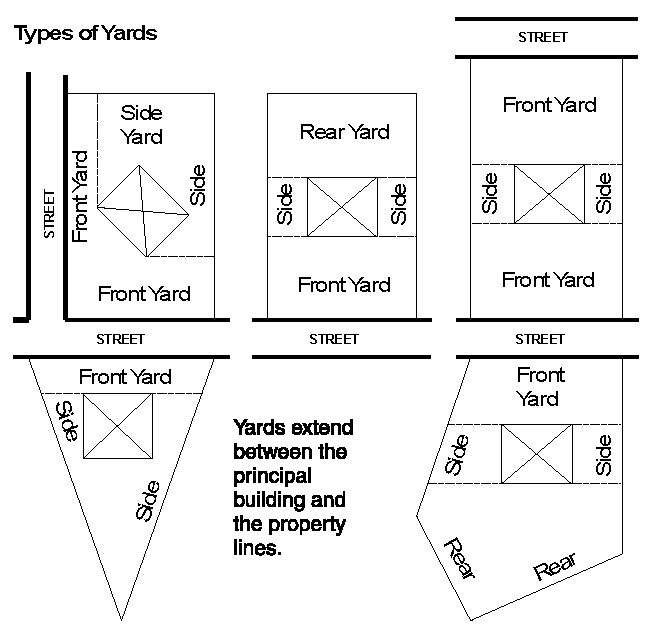
Yard: An area that lies between the principal building on a lot and a lot line. A yard is unoccupied and unobstructed by buildings or structures from ground to sky except where encroachments and accessory buildings are expressly permitted.
Yard, front: A yard situated along any public street right-of-way or private street or access easement. In the case of a double frontage lot, if there is an established no access easement along one of the frontages, the yard adjacent to the no access easement shall not be considered a front yard for purposes of this UDC.
Yard, rear: A yard situated along a rear lot line.
Yard, side: A yard situated along a side lot line, but not extending into a front or rear yard.
Zoning district: A district established in article 2 of this UDC.
(Ord. No. 17-003, § 1, 10-2-2017; Ord. No. 19-002, 10-21-2019)
Sec. 106. - General applicability.
No building, structure, device or land or water shall hereafter be used or occupied, erected, located, extended, established, moved, converted, or structurally altered except in full compliance with the provisions of this UDC.
(Ord. No. 17-003, § 1, 10-2-2017)
Sec. 107. - Exemptions.
All governmental bodies and authorities legally exempt from regulation under the police power of Jackson County are exempt from the requirements of this UDC.
(Ord. No. 17-003, § 1, 10-2-2017)
Sec. 108. - Minimum requirements.
Within each zoning district and overlay district established by this UDC, the regulations set forth shall be minimum requirements and shall apply uniformly to each class or kind of building, structure or land, except as may be altered through conditions of zoning applied to specific properties.
(Ord. No. 17-003, § 1, 10-2-2017)
Sec. 111. - Use, occupancy, and erection.
(a)
No building, structure, land, or water shall hereafter be used or occupied, and no building or structure or part hereof shall be erected, constructed, reconstructed, moved, or structurally altered except in conformity the use provisions for the zoning district in which it is located, as established in article 2 of this UDC.
(b)
No building, structure, land, or water shall hereafter be used or occupied, and no building or structure or part hereof shall be erected, constructed, reconstructed, moved, or structurally altered except in conformity the use provisions for overlay district in which it is located, if applicable, as established in article 3 of this UDC.
(c)
For those uses that have specific restrictions associated with them, a reference is given in article 2 of this UDC to the pertinent section in article 3 of this UDC. No building, structure, use, or activity shall commence or be established or maintained except in conformity with the provisions in article 3 of this UDC as applicable for the building, structure, use, or activity.
(Ord. No. 17-003, § 1, 10-2-2017)
Sec. 112. - Use prohibited when not specified.
(a)
Unless otherwise specifically provided in this UDC, any use not specifically permitted as a use by right or specifically indicated as a special use in any given zoning district as provided under article 2 of this UDC shall be prohibited in that zoning district.
(b)
Unless otherwise specifically provided in this UDC, any use not specifically permitted as a use by right or specifically indicated as a special use in any given overlay district as provided under article 3 of this UDC, as applicable, shall be prohibited in that overlay district.
(Ord. No. 17-003, § 1, 10-2-2017)
Sec. 113. - Every use must be upon a lot of record.
No building or structure shall be erected or use established unless upon a lot of record as defined by this article.
(Ord. No. 17-003, § 1, 10-2-2017)
Sec. 114. - One principal house on a lot.
(a)
Unless otherwise specifically provided in this UDC, only one single-family detached dwelling and its customary accessory buildings and structures may be erected on any one lot.
(b)
This provision shall not be construed to prevent the construction of more than one detached single-family condominium, multiple-family dwelling, office, institutional, commercial or industrial building upon a single lot, in districts where permitted, subject to compliance with other applicable provisions of this UDC.
(Ord. No. 17-003, § 1, 10-2-2017)
Sec. 115. - Lot area (size) and density.
(a)
No lot shall hereafter be created or subdivided unless it meets or exceeds the minimum lot area (size) for the zoning district in which the lot is located as established by article 2 of this UDC, except as otherwise specifically provided in this UDC.
(b)
No lot shall be reduced below the minimum lot area (size) of the zoning district in which said lot and building are located as established by article 2, except as otherwise specifically provided in this UDC.
(c)
No lot shall be developed with a density in number of dwelling units per acre that exceeds the maximum density for the zoning district in which the lot is located as established by article 2 of this UDC, except as otherwise specifically provided in this UDC.
(d)
Notwithstanding the minimum lot area requirements of this section and table 2-2 of this UDC, any lot in the A-2, Agricultural-Rural Farm District which contains eight or more acres may be divided into no more than two lots (including the original tract) each with a minimum lot area of one and one-half acre, provided that such lots shall meet the minimum lot width requirements of section 116 for the A-2 zoning district as shown in table 2-2 and the minimum lot frontage requirements of section 117 of this UDC. No such lots shall be further subdivided except as a major subdivision.
(e)
The Jackson County Environmental Health Department may require larger lot sizes than the minimums established for zoning districts in this UDC, when the use of the lot will be served by an on-site sewage management system (e.g., septic tank).
(Ord. No. 17-003, § 1, 10-2-2017; Ord. No. 22-002, § 1, 3-21-2022)
Sec. 116. - Lot width.
A minimum lot width requirement helps prevent irregular, oddly shaped lots, assures sufficient side yards between the structure that might be erected on the lot and the lot line, confers privacy and space for recreation by providing distance between houses or buildings on adjacent lots, and permits access of light and air to the building or structures on the lot.
(a)
No lot shall hereafter be created or subdivided unless it meets or exceeds the minimum lot width established for the zoning district in which it is located by article 2 of this UDC.
(b)
No lot shall be reduced below the minimum lot width for the zoning district in which said lot is located as established by article 2, except as otherwise specifically provided in this UDC.
(c)
Where this UDC requires a minimum lot width, the lot width shall be measured at the front building setback line required by this UDC or as established on a recorded plat. If the required minimum lot width cannot be achieved at the front setback line required by this UDC, as is the case with "flag" lots and "pie shaped" lots fronting on cul-de-sac streets, the required front building setback line shall be moved further interior to the lot where the minimum lot width can be achieved.
(d)
Where a lot has frontage only on an access easement rather than frontage on an existing county standard paved road, the lot width for purposes of meeting the minimum lot width requirement shall be measured at the proposed building line fronting the access easement.
(e)
The Jackson County Environmental Health Department may require a greater lot width at the front minimum building setback line than the minimum lot width required by a zoning district established in this UDC, where an on-site sewage management system is to be installed (e.g., septic tank).
(Ord. No. 17-003, § 1, 10-2-2017)
Sec. 117. - Lot frontage.
(a)
Except as otherwise specifically provided in this UDC, every lot must front at least 60 feet on a street from which direct access can be gained that has been opened and accepted as a public street or a private street meeting public standards as specifically approved by the Jackson County Board of Commissioners.
(b)
Any lot that fronts on a cul-de-sac must have at least 35 feet on frontage on the cul-de-sac street.
(c)
Any lot for the purposes of constructing a fee-simple townhouse shall front at least 25 feet on a street.
(d)
No lot shall hereafter be created or subdivided unless it meets or exceeds the minimum lot frontage requirement established by this section, except as otherwise specifically provided in this UDC.
(e)
No lot shall be reduced in width below the minimum lot frontage requirement established by this section.
(f)
Notwithstanding the lot frontage requirements of this section, in the A-2, Agricultural-Rural Farm District, lots that contain a lot area of eight acres or greater shall only be required to front on an access easement that has a minimum width of 60 feet and which requires a paved or unpaved access way at least ten feet in width. At the end of the 60 foot access easement, an 80 foot diameter cul-de-sac must be installed if more than two lots are created. No lot created pursuant to this paragraph shall be further subdivided except as a major subdivision.
(Ord. No. 17-003, § 1, 10-2-2017; Ord. No. 22-002, § 2, 3-21-2022)
Sec. 118. - Floor area per dwelling unit.
(a)
No new dwelling shall hereafter be constructed or occupied that fails to meet the minimum heated floor area for a dwelling unit as established by the zoning district in which the property is located, except as otherwise specifically provided in this UDC.
(b)
No dwelling shall be reduced below the minimum heated floor area for a dwelling unit as established by this UDC, except as otherwise specifically provided in this UDC.
(Ord. No. 17-003, § 1, 10-2-2017)
Sec. 119. - Nonresidential density.
No nonresidential development shall be erected or occupied that exceeds the maximum floor-area ratio (FAR) established by the zoning district in which the property is located as established by article 2 of this UDC, except as otherwise specifically provided in this UDC.
(Ord. No. 17-003, § 1, 10-2-2017)
Sec. 120. - Building coverage.
No lot shall hereafter be developed to exceed the maximum building coverage specified for the zoning district in which it is located as established by article 2 of this UDC unless otherwise specifically provided in this UDC.
(Ord. No. 17-003, § 1, 10-2-2017)
Sec. 121. - Floor area per establishment.
No building shall be erected or occupied that exceeds the maximum heated floor area per establishment established by this UDC, except as otherwise specifically provided in this UDC.
(Ord. No. 17-003, § 1, 10-2-2017)
Sec. 122. - Landscaping.
No lot shall be developed with less than the minimum landscaped open space specified for the zoning district in which said lot is located, or as may be established by any other article or section of this UDC.
(Ord. No. 17-003, § 1, 10-2-2017)
Sec. 123. - Height of buildings and structures.
No building or structure shall hereafter be erected, constructed, reconstructed, or altered, to exceed the maximum height of buildings and structures or the maximum number of stories established for the zoning district in which the building is located as provided by article 2, except as otherwise specifically provided in this UDC.
(Ord. No. 17-003, § 1, 10-2-2017)
Sec. 124. - Exceptions to height regulations.
The height limitations established by this UDC shall not apply to the following:
(a)
Agricultural buildings such as but not limited to barns, silos, windmills, grain elevators, and other farm structures, but not including dwellings.
(b)
Cooling towers, gas holders, or other industrial structures where required as part of the manufacturing process.
(c)
Church spires, belfries, cupolas, domes, monuments, water towers, observation towers, chimneys, smokestacks, and steeples, domes, flag poles, public monuments, non-commercial radio and television towers and antennas, electricity transmission towers, utility poles, and similar structures.
(Ord. No. 17-003, § 1, 10-2-2017)
Sec. 125. - Buffers, yards and building setbacks.
(a)
No building or structure shall hereafter be erected in a manner to have narrower or a smaller than minimum required buffer or front yard, side yard, or rear yard (building setback) than specified for the zoning district in which the property is located as established in article 2, or for the specific use if a minimum required buffer or yard (building setback) is established for the specific use as provided in article 3 of this UDC, or for an overlay district as established in articles 4 or 5 of this UDC.
(b)
For purposes of establishing required building setback lines, if a lot has frontage only on an access easement rather than a public street, the minimum front yard or minimum required building setback line required by table 2-2 shall be measured from the boundary of the access easement fronting the lot.
(c)
The buffer requirements established in this UDC, when applicable, supersede minimum required yards established by article 2, of this UDC.
(d)
No lot shall be reduced in size so that the minimum required front, side, or rear yards (building setbacks) of the zoning district in which said lot and building are located are not maintained, except as otherwise specifically provided in this UDC.
(e)
No part of a yard shall be included as a part of the yard required for another building.
(Ord. No. 17-003, § 1, 10-2-2017)
Sec. 131. - Definitions.
Nonconforming building or structure: A building or structure (excluding signs) that does not meet one or more setbacks for the zoning district or overlay district if applicable in which said building or structure is located, or a building or structure (excluding signs) that exceeds the maximum building coverage for the zoning district or overlay district if applicable in which said building or structure is located, or a principal building or accessory structure that otherwise does not comply with dimensional requirements established by this UDC for the particular principal building or accessory structure or for the zoning district or overlay district in which the nonconforming building or structure is located.
Nonconforming lot: A lot which does not conform to the lot requirements of the zoning district or if applicable overlay district in which the lot is located as established by this UDC but which was a lot of record prior to the effective date of this UDC or its amendment. A lot created pursuant to an act of subdivision of land which was unlawful shall not be considered a nonconforming lot.
Nonconforming situation: Any development, land improvement, or activity, not otherwise included within the definition of nonconforming lot, nonconforming building or structure, or nonconforming use, which does not meet the provisions of this UDC at the time of its adoption or amendment. Examples of nonconforming situations include but are not limited to, noncompliance with off-street parking regulations, access requirements, failure to adhere to landscape strip or tree protection requirements, and signs not meeting height or area restrictions.
Nonconforming use: Any building or use of land or building which lawfully existed on or before the effective date of this UDC or on or before subsequent amendments to this UDC, which does not conform to the use provisions of the zoning district or overlay district if applicable in which it is located. In addition, any building or use of land or building which lawfully existed on or before the effective date of this UDC or on or before subsequent amendments to this UDC, which does not conform to the specific use provisions of article 4 if applicable shall be considered a nonconforming use.
(Ord. No. 17-003, § 1, 10-2-2017)
Sec. 132. - Nonconforming use—Continuance.
(a)
A nonconforming use may be continued even though such use does not conform with the use provisions of the zoning district in which said use is located, except as otherwise provided in this division.
(b)
It shall be the responsibility of the owner of a nonconforming use to prove to the public development director that such use was lawfully established and existed on the effective date of adoption or amendment of this UDC.
(Ord. No. 17-003, § 1, 10-2-2017)
Sec. 133. - Nonconforming use—Change of use.
(a)
A nonconforming use may be changed to a conforming use.
(b)
A nonconforming use shall not be changed to another nonconforming use.
(c)
A change in tenancy or ownership shall not be considered a change to another nonconforming use, provided that the use itself remains unchanged.
(Ord. No. 17-003, § 1, 10-2-2017)
Sec. 134. - Nonconforming use—Discontinuance or abandonment.
A nonconforming use shall not be re-established after discontinuance or abandonment for 12 months. Vacancy and/or non-use of the building, regardless of the intent of the owner or tenant, shall constitute discontinuance or abandonment under this section; provided, however, that if any required occupational tax license is maintained and renewed in a timely fashion for the subject nonconforming use, said nonconforming use shall not be considered discontinued or abandoned even if the building containing the nonconforming use remains vacant. If an occupational tax license is required for said nonconforming use and the license pertaining to said use has lapsed for more than 12 months, said lapse of occupational tax license shall constitute discontinuance or abandonment.
(Ord. No. 17-003, § 1, 10-2-2017)
Sec. 135. - Nonconforming use—Expansion.
A nonconforming use shall not be expanded, enlarged or extended, in land area or in floor space or volume of space in a building or structure, except for a use which complies with the zoning district in which said use is located.
(Ord. No. 17-003, § 1, 10-2-2017)
Sec. 136. - Nonconforming use—Repair after damage.
A nonconforming use shall not be rebuilt, altered or repaired after damage exceeding 75 percent of its replacement cost at the time of damage as determined by the public development director, except for a use which conforms with the zoning district in which said use is located, and provided such rebuilding, alteration or repair is completed within 12 months of such damage.
(Ord. No. 17-003, § 1, 10-2-2017)
Sec. 137. - Nonconforming building or structure.
(a)
A nonconforming building or structure may be expanded, enlarged, or extended if such expansion, enlargement, or extension is for a use that conforms to the use requirements for the zoning district in which the building or structure is located.
(b)
Any such expansion, enlargement, or extension of a nonconforming building or structure shall meet the minimum yard, setback, buffer, height, density, and other dimensional requirements for the zoning district in which said non-conforming building or structure is located, and all other requirements of this UDC.
(Ord. No. 17-003, § 1, 10-2-2017)
Sec. 138. - Nonconforming lot.
A lot of record, as defined, that does not conform to the minimum lot frontage requirements of this UDC, or that does not conform to the minimum lot size or minimum lot width for the zoning district or overlay district if applicable in which it is located, may be used as a building site, provided that the access, height, buffer, setback, and other dimensional requirements of the zoning district or overlay district if applicable in which the lot of record is located are complied with or a variance is obtained, and, provided further, that the lot meets all the current standards and requirements of the Jackson County Environmental Health Department.
(Ord. No. 17-003, § 1, 10-2-2017)
Sec. 139. - Combination or reconfiguration of nonconforming lots.
If the owner of two or more abutting lots, at least one of which is a nonconforming lot, decides to subdivide, develop or sell one or more of said lots, then prior to approval of land subdivision or building or development the public development director shall require the owner to combine said lots to comply with the dimensional requirements of the zoning district in which the lots are located, or if compliance cannot be fully achieved, revise the nonconforming lot or lots to more closely approximate the dimensional requirements of the zoning district in which the lot or lots are located.
(Ord. No. 17-003, § 1, 10-2-2017)
Sec. 140. - Nonconforming situations.
(a)
Intent. It is the intent of this section to require the complete correction of nonconforming situations at the time of any building addition or significant modification of a use or development on a given parcel of land.
(b)
Determination of nonconforming situations. For any proposed subdivision, building or development, or modification of a subdivision, building or development, it shall be the duty of the public development director to identify the extent to which the subdivision and any improvements on land on which the building or development is proposed constitutes a nonconforming situation, as defined in this division. The public development director shall conduct a review and identify such nonconforming situation(s) at the time plans for such proposed building or development are submitted for review, and at any earlier opportunity, if presented. If one or more nonconforming situations are found to exist by the public development director, they shall be documented and notice of the need to correct said nonconforming situations shall be provided by the public development director to the building or development applicant.
(Ord. No. 17-003, § 1, 10-2-2017)
Sec. 151. - Adoption and effective date.
The Board of Commissioners of Jackson County hereby ordains that the articles, divisions, and sections, which collectively constitute the Jackson County Unified Development Code (UDC), are hereby adopted. This UDC shall take effect and be in force from and after the adoption and enactment of this UDC, the public health, safety, and welfare demanding it.
(Ord. No. 17-003, § 1, 10-2-2017)
Sec. 152. - Conflict with other laws.
(a)
Whenever the regulations of this UDC require: a greater width or size of yards; a lower height of buildings; a smaller number of stories; a greater percentage of lot to be left unoccupied; or impose other more restrictive standards than are required in or under any other statute, the requirements of this UDC shall govern.
(b)
Whenever the provisions of any other statute require more restrictive standards than are required by this UDC, the provisions of such more restrictive statute shall govern.
(Ord. No. 17-003, § 1, 10-2-2017)
Sec. 153. - Severability.
Should any article, division, section or provision of this UDC be declared invalid or unconstitutional by any court of competent jurisdiction, such declarations shall not affect the validity of the UDC as a whole or any part thereof which is not specifically declared to be invalid or unconstitutional.
(Ord. No. 17-003, § 1, 10-2-2017)
Sec. 154. - Repeal of conflicting ordinances.
All ordinances and parts of ordinances in conflict herewith are repealed to the extent of their conflict.
(Ord. No. 17-003, § 1, 10-2-2017)
Sec. 155. - Codification and recodification.
It is the intention of the Board of Commissioners of Jackson County, and it is hereby ordered that this UDC shall become and be made a part of the Code of Laws of Jackson County, Georgia, and the articles, divisions, and sections of this UDC may be renumbered if necessary to fit most appropriately into the code of the county.
(Ord. No. 17-003, § 1, 10-2-2017)
Sec. 156. - Relationship to private agreements.
This UDC is not intended to repeal, abrogate, or impair any valid easement, covenant, or deed restriction duly recorded with the Clerk of the Superior Court of Jackson County, Georgia, to the extent that such easement, covenant or deed restriction is more restrictive than the requirements imposed by this UDC.
(Ord. No. 17-003, § 1, 10-2-2017)
Sec. 157. - Status of prior zoning approvals.
Notwithstanding the repeal of prior ordinances in conflict with this UDC upon its adoption, if a property was zoned subject to conditions or use approved subject to certain conditions existing and in effect at the time of adoption of this UDC by the Jackson County Board of Commissioners, such zoning conditions or conditions of use approval shall continue to apply to said property.
(Ord. No. 17-003, § 1, 10-2-2017)
Sec. 158. - Status of previously issued permits.
The provisions of this UDC and any subsequent amendments shall not affect the validity of any lawfully issued and effective building permit or development permit if the development activity or building construction authorized by the permit has been commenced prior to the effective date of this UDC or the amendment, or will be commenced after such effective date but within six months of issuance of the permit, and the development activity or building construction continues without interruption (except because of war or natural disaster) until the development or construction is complete. If the permit expires, any further development or construction on that site shall occur only in conformance with the requirements of this UDC in effect on the date of the permit expiration.
(Ord. No. 17-003, § 1, 10-2-2017)

