
Jackson County Unincorporated
City Zoning Code
City Zoning Code
ARTICLE 7
- SIGNS AND ADVERTISING DEVICES
Sec. 701. - Findings.
It is a substantial and compelling governmental interest to control signs and other advertising devices for the following reasons, among others:
(a)
Signs by their very nature are intended to gain the attention of motorists and therefore distract them from the primary purpose of maneuvering a vehicle along a road. Sign controls are needed to promote traffic safety and avoid traffic accidents; and
(b)
Signage, if left unregulated, can cause confusion and delay in responding to emergencies, because unregulated signs can degrade the utility and reduce the visibility and effectiveness of public safety signs; and
(c)
Unregulated signage can contribute to clutter and lack of organization in the wayfinding system of a community and thereby increase the stress levels of motorists; and
(d)
The appearance of the county is substantially influenced by signs, and it is essential to the county's long-term economic viability to maintain a positive appearance. Signs and advertising, without regulation, can detract from the character, beauty, and visual attractiveness of the county; and
(e)
The size, height, construction materials, location, condition, and attributes of signs can have an adverse impact on surrounding and nearby land uses and properties if not regulated and properly maintained, including the lowering of property values. Abandoned and antiquated signs and sign structures (e.g., a pole with a blank structure for a sign face) can have a particularly detrimental effect on adjacent properties and contribute to an overall image of blight in the community; and
(f)
Sign regulations help to assure that public benefits derived from expenditures of public funds for the improvement and beautification of streets and other public structures and spaces are protected. Unregulated signs can neutralize the value and benefit of public investments in streetscapes; and
(g)
Sign regulations benefit businesses that seek to advertise. Unregulated commercial signage can be detrimental to individual businesses, because business owners may be compelled to erect larger and costlier signs to outperform neighboring or nearby businesses. Such competition for visibility among business can result in too many signs and excessive sizes and heights, to a point of diminishing returns where individual business signs are no longer adequately visible. If unregulated, the competition for visual recognition can defeat the purpose of the signs, which is to carry a message. If signs are left unregulated, patrons of individual businesses may miss their destinations because they cannot find the particular business of choice in the sea of advertising devices; and
(h)
The regulations contained in this article are no more extensive than necessary to serve the substantial governmental interests and purposes identified in this article.
(Ord. No. 17-003, § 1, 10-2-2017)
Sec. 702. - Purposes.
The purposes of this article are to promote and protect the public health, safety, general welfare, and aesthetics, specifically including but not limited to the following:
(a)
To provide for the expression of commercial and noncommercial speech by citizens and businesses in the county, and to afford adequate opportunity for self-expression through free speech;
(b)
To reduce clutter and to improve the general attractiveness of the county;
(c)
To enable the public to locate goods, services, and facilities in the county without difficulty and confusion;
(d)
To ensure the reasonable, orderly, and effective display of signs;
(e)
To reduce the probability of traffic accidents due to signs obstructing or confusing the vision of drivers, bicyclists, or pedestrians;
(f)
To ensure that signs are compatible with their surroundings and to protect property values;
(g)
To facilitate and aid in the identification and location of businesses in the county in the event of police, fire, or other emergencies and to avoid confusion and delay in response to such emergencies;
(h)
To insure proper maintenance, for safety and structural soundness, as well as the appearance and functionality of signs; and
(i)
To balance the rights of individuals to convey their messages through signs with the rights of the public to be protected against the unrestricted proliferation of signs.
(Ord. No. 17-003, § 1, 10-2-2017)
Sec. 703. - Intentions.
(a)
Time, place, and manner restrictions. It is the intent of this article to regulate the composition, type, location, placement, height, size, quantity, illumination, duration, and manner of signs and advertising devices that may be displayed. The regulation of these aspects of signs and sign structures is a valid and lawful means of achieving the intentions and purposes of this article. These intentions and purposes are valid and lawful governmental interests. The regulations contained herein are no more extensive than necessary to serve the substantial governmental interests identified in this article.
(b)
Content neutrality. The county intends to adopt and implement regulations which are content-neutral. It is not the intent to regulate the content of messages in any way. To accomplish this, these regulations do not distinguish between on-site or off-site sign content, nor do they distinguish between commercial and non-commercial content. It is the intent of this article to allow political, religious, or personal (non-commercial) messages on any sign permitted to be erected by this article.
(Ord. No. 17-003, § 1, 10-2-2017)
Sec. 704. - Jurisdiction and general applicability.
No sign or advertising device may be erected, placed, established, painted, created, or maintained within the unincorporated area of Jackson County except in conformity with this article.
(Ord. No. 17-003, § 1, 10-2-2017)
Sec. 705. - Sign variance.
(a)
A property owner or sign owner may apply for a variance from the provisions of this article.
(b)
The application shall be accompanied by an elevation drawing and/or plot plan, drawn to scale, showing the dimensions and arrangement of the proposed sign. An inventory of signs and sign areas and heights existing on the property shall also be submitted. The department of public development may require other information about the variance requested and its relationship to the surrounding properties. Variance applications shall be accompanied by a fee as established by resolution of the board of commissioners.
(c)
Applications to vary the sign regulations in this article shall be filed, considered and decided subject to the procedures and notice requirements of article 14 of this UDC.
(Ord. No. 17-003, § 1, 10-2-2017)
Sec. 706. - Uniform sign plan.
(a)
The purpose of this section is to provide a mechanism for administrative approval of signs for development, where uniformity of design is desired. A uniform sign plan ensures that there is coherence and coordination among the various signs proposed, such that the materials, letter style, color, shape, etc. present a uniform design concept for signage on the parcel.
(b)
A uniform sign plan application shall consist of such drawings and specifications as may be required to clearly illustrate the location, materials, size, letter style, and color of all ground and building signs to be placed on the parcel.
(c)
All tenants or future uses within the parcel, whether an owner, lessee, subtenant, purchaser, or other occupant, shall comply with the approved uniform sign plan. Individual signs shall still be subject to the sign permit requirements of this article, as applicable, even if it may have been shown as part of the uniform sign plan.
(Ord. No. 17-003, § 1, 10-2-2017)
Sec. 707. - Overlay zoning requirements.
More restrictive requirements than specified in this article may apply to signs within overlay districts established in article 4 of this UDC.
(Ord. No. 17-003, § 1, 10-2-2017)
Sec. 711. - General definitions.
Accessory ground sign: A secondary sign allowance provided for in this article, for a sign erected on the ground.
Advertising device: Any structure or device erected or intended for the purpose of displaying advertising situated upon or attached to real property. For purposes of this article, an advertising device is a "sign."
Derelict sign: A sign that is dilapidated or in such condition as to create a hazard or nuisance, or to be unsafe or fail to comply with the building or electrical codes applicable in the county's jurisdiction.
Erect: To construct, build, raise, assemble, place, affix, attach, create, paint, draw, or in any other way bring into being or establish. Activities performed as an incident to the change of advertising message or the normal maintenance or repair of a sign structure are excluded from this definition.
Holiday decorations: Signs or displays including lighting which are a non-permanent installation celebrating national, state, and local holidays, religious or cultural holidays, or other holiday seasons (also known as seasonal decorations).
Interstate 85 sign: A supplemental or additional sign allowance only for parcels adjacent to Interstate Highway 85, erected in accordance with the requirements of this article and applicable state law and administrative rules.
Mural: A picture or image (including but not limited to painted art) which is painted, constructed, or affixed directly onto a building wall, which may or may not contain text, logos, and/or symbols.
Nonconforming sign: Any sign which lawfully existed on the effective date of this article but which does not conform to the provisions of this article, or which does not comply with this article due to amendments to this article since the date of erection of the sign.
Portable sign: Any sign whether on its own trailer, wheels, or otherwise, which is designed to be transported from one place to another. It is characteristic of a portable sign that the space provided for advertising messages may be changed at will by the replacement of lettering or symbols (i.e., a changeable copy sign). Even if the wheels or supports of such sign are removed and the sign converted and attached, temporarily or permanently, to the ground or other structure, said sign shall remain a portable sign.
Principal use sign: Any notice or advertisement, which is permitted in conjunction with a principal use or principal building or use located on the property, and which may display a noncommercial, commercial, or other message, the content of which is not regulated by this article.
Scoreboard: A sign contained within an athletic venue and which is directed so as to be visible to the attendees of an athletic event.
Sign: A lettered, numbered, symbolic, pictorial, visual display, device, or communication designed or used for the purpose of identifying, announcing, directing, informing, or bringing to the attention of others the subject thereon, that is visible from the public right-of-way, a driveway or parking lot with access to a public right-of-way, or from an adjacent property, except as specifically noted otherwise in this article. The term sign includes but is not limited to "banners," "balloons," "flags," "pennants," "streamers," "windblown devices," and "advertising devices." Furthermore, the term "sign" includes the sign structure, supports, lighting system, and any attachments, ornaments, or other features used to draw the attention of the observers.
Sign in need of maintenance: Any sign or advertising device that includes any of the following or similar condition as identified by the county: lettering or other elements of the sign have become detached or have fallen off the sign or become misaligned; painted surfaces on the sign or sign structure have begun to peel, flake over a significant portion of the sign, or have faded or oxidized to an extent that the sign no longer displays the message as originally intended; a significant number of the bricks, stones, or other materials on the structural base of a sign have become detached or have fallen off, or have become misaligned; or one or more illumination devices are not working and have not been replaced.
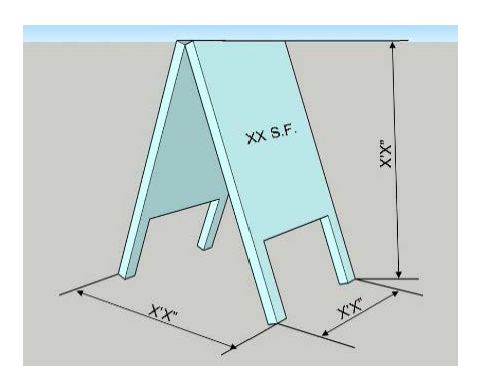
Sandwich board sign: A portable sign that typically consists of two faces connected and hinged at the top and with a message targeted to pedestrians. They are also commonly referred to as A-frame signs.
Temporary ground sign: A sign of a nonpermanent nature and erected for a limited duration. This term includes signs constructed from cardboard, coated paperboard, or corrugated plastic and which are either attached to a wooden post or stake in the ground, or set with a wire metal frame in the ground.
Uniform sign plan: A set of drawings and specifications that illustrate the location, materials, size, letter style, and color of all signs to be installed or erected on a given parcel to ensure uniformity of design, coherence and coordination among the various signs on the parcel, and which is binding on tenants or future uses within the parcel.
Visible: Capable of being seen (whether or not legible) without visual aid by a person of normal visual acuity.
(Ord. No. 17-003, § 1, 10-2-2017)
Sec. 712. - Sign definitions related to placement on objects.
(a)
Description. Signs can be distinguished according to the object or portion thereof to which it is attached; or physical location. Signs can be attached to the ground (also referred to as freestanding), or attached to a building. Further distinctions are made as to which part of the building (wall, window, door, roof) the sign is affixed to. There are other types of structures to which signs can be attached, such as on a freestanding canopy, or suspended underneath a canopy or awning. Signs can also be attached to some object other than the ground or a building or part of a building, such as a fence, power pole, wall, vehicle, trailer, bench, on a gasoline pump, etc.). Signs can also be hand-held, as in the case of human sign "spinners."
(b)
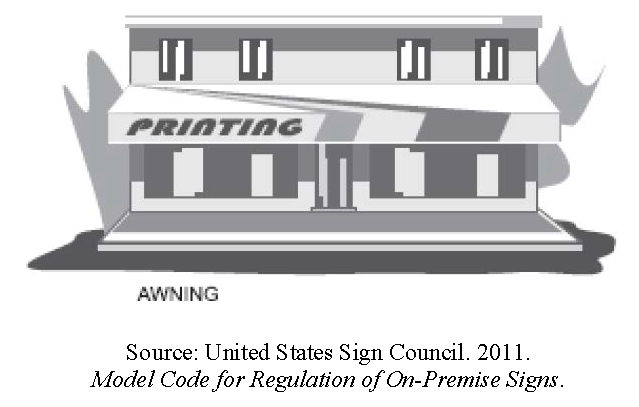
Awning sign: An awning that contains letters, numbers, symbols, pictures, logos, or visual display, or other communication, attached, painted on, or made an integral part of an awning. An awning is an architectural projection or shelter projecting from and supported by an exterior wall of a building and composed of a covering of rigid or non-rigid materials and/or fabric on a supporting framework that may be either permanent or retractable. Awning signs are "wall signs" for the purposes of this article.
(c)
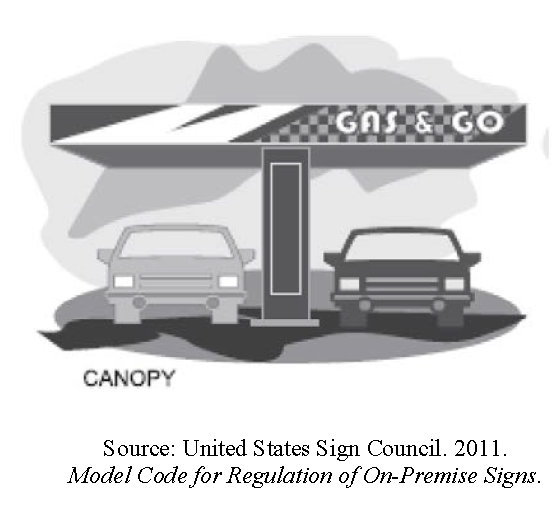
Canopy sign: A sign attached, painted on, or made an integral part of a canopy, whether that canopy is attached to a building or structure or freestanding. An attached canopy is a multi-sided structure or architectural projection supported by attachment to a building on one or more sides and also supported by columns or supports at additional points. Canopy signs, whether attached, painted on, or made an integral part of an attached canopy (including suspension underneath an attached canopy), are wall signs for the purposes of this article.
(d)
Ground sign: A sign or advertising device which is wholly independent of a building or structure for support (i.e., freestanding). A ground sign may contain more than one sign face, and it is typically double-faced.
(e)
Hand-held sign: Any sign or advertising device designed to be used while being held in a parson's hands or attached to a human body, except for signs and devices used for traffic control when conducted as part of a county-approved traffic control function such as the case for road construction purposes through lane closures.
(f)
Incidental sign: A sign, emblem, decal, or other message no larger than one square foot, designed and sized to be read only from close range (i.e., five feet or less), attached to or integrated into a device or structure more than 25 feet from the right-of-way of a road, and not readily legible from any public rights-of-way.
(g)
Interior sign: Any sign erected within a building, including product displays, more than two feet inside an exterior window within a business or establishment and which is not intended to be seen from outside the business or establishment in which the sign is located.
(h)
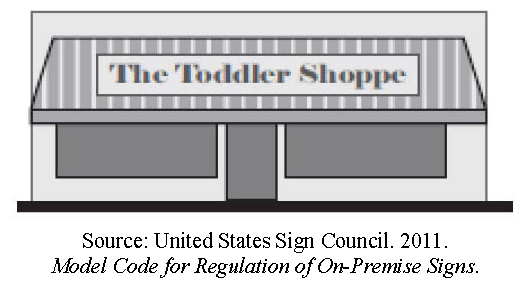
Marquee sign: A sign painted on, attached to, or hung from a marquee. A marquee is a roof-like structure attached to and supported by a building wall without vertical supports and that projects in a cantilever fashion from the wall of a building. For purposes of this article, marquee signs are "wall signs."
(i)
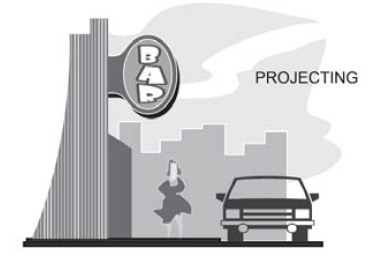
Projecting sign: A sign affixed to a wall and extending more than four inches from the surface of such wall, usually perpendicular to the wall surface.
(j)
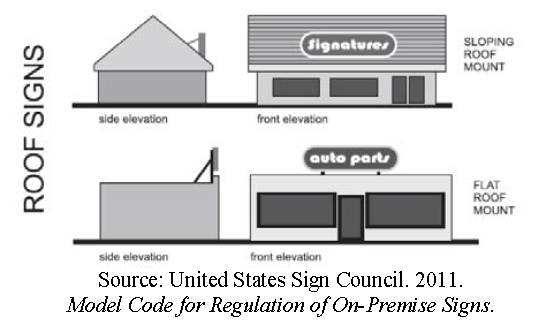
Roof sign: A sign projecting to a greater height than the front building wall, or any sign supported by or attached to a roof, including a sign painted on or adhered to a roof. A sign placed on the fascia portion of a mansard roof is not a roof sign.
(k)
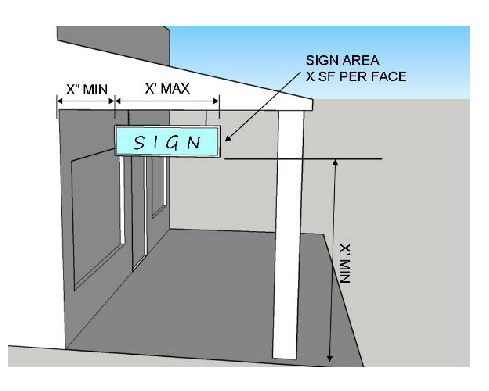
Suspended sign: A sign that hangs or is suspended beneath an awning or the cover of a walkway or beneath a support extending from a building. A suspended sign is distinguishable from an animated sign even if the sign copy area is attached to a building or structure in a way that can be set in motion with wind pressure. This term does not include any freestanding signs.
(l)
Vehicular sign: Any sign placed, mounted, painted on or affixed to a motor vehicle, freight, flatbed or storage trailer or other conveyance when same are placed or parked in such a manner that can be viewed from the public right(s)-of-way; provided, however, that this definition shall not apply when (1) such conveyances are actively being used to transport persons, goods or services in the normal course of business; or (2) such conveyances are actively being used for storage of construction materials for, and on the same parcel where a construction project for which building is underway and required permits have been issued. Even if the wheels or supports of such sign are removed and the sign converted and attached, temporarily or permanently, to the ground or other structure, said sign shall remain a vehicular sign for purposes of this article.
(m)
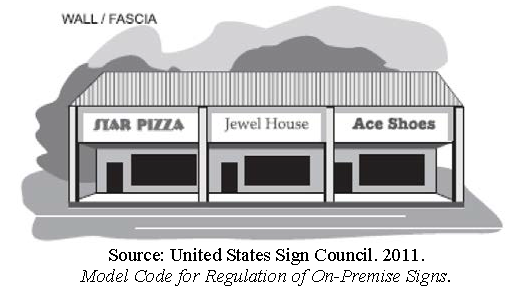
Wall sign: A single-sided sign with one visible face applied to or mounted to the wall or surface of a building or structure, in a parallel fashion, and which does not project more than five inches from the outside wall of such building or structure.
(n)
Window sign: A sign that is placed on or behind a windowpane or a glass door or a sign installed within two feet of an exterior window or door and intended to be visible from the exterior of the building. Displays which show products or depict services sold on the premises and which are more than two feet from an exterior window or door shall not be classified as window signs.
(o)
Findings. The object to which a sign is attached has important implications for compatibility with surroundings. Signs placed on building walls and in windows can be excessive if not regulated as to the area of the sign face, and it is in the public interest to ensure that building and window signs are proportional to the building wall or window on which the signs are placed. It is considered inappropriate to attach signs to certain objects like rocks and benches, thereby justifying certain prohibitions. It is also considered inappropriate to allow signs on roofs of buildings, justifying prohibition, since roof signs interrupt the silhouette of the building, overpower the architecture of the building, and can also block views.
(Ord. No. 17-003, § 1, 10-2-2017)
Sec. 713. - Signs that move by wind or air.
(a)
Description. Some signs are not movable in the wind, while others are designed to move in the wind. For instance, a flag, or feather banners (also called "wind blades"), or ribbons on strings, etc. are designed to capture attention due to movement in the wind. Further, movement by wind may be naturally generated or power driven, as in the case of machines that blow air through an advertising device.

(b)
Air-blown device: Any device not otherwise specifically defined in this article, that is designed to inform or attract, whether or not such device carries a message, and which all or part of the device is set in motion by mechanically forced air. For purposes of this article, air-blown devices are advertising devices.
(c)
Banner: A sign with or without characters, letters, illustrations, or ornamentation applied to cloth, paper, plastic, or natural or synthetic fabric of any kind with only such material for a backing. For purposes of this article, a banner is a "sign." A banner may be installed on a building or structure or may be attached to poles or other supports and freestanding. It is characteristic of a banner that, even though tied to a support, there is some movement in the wind.

(d)
Feather banner: a vertical portable sign, made of lightweight material that is prone to move in the wind, and that contains a harpoon-style pole or staff driven into the ground for support or supported by means of an individual stand. This definition includes such signs of any shape including flutter, bow, teardrop, rectangular, shark, feather, and U-shaped. For purposes of this article, a feather banner is an advertising device and sign.
(e)
Festoon: A string of ribbons, tinsel, streamers, pinwheels, or other devices or long narrow strips of fabric, plastic, or other pliable material designed to move in the wind. For purposes of this article, festoons are advertising devices.
(f)
Flag: A device made of cloth, plastic, or natural or synthetic fabric, with or without characters, letters, illustrations, or ornamentation applied to such surface, and which is designed to move in the wind. For purposes of this article, except as specifically authorized, a "flag" is an advertising device and "sign."
(g)
Inflatable sign: Any sign or balloon that is or can be filled with air or gas. This includes any three-dimensional ambient air-filled depicting a container, figure, or product. For purposes of this article, inflatable signs and balloons are considered advertising devices.
(h)
Pennant: A small, triangular or rectangular flag or multiples thereof, made of lightweight plastic, fabric, or other material, individually supported or attached to each other by means of a string, rope, or other material and meant to be stretched across or fastened to buildings, or between poles and/or structures, and which is designed to move in the wind. For purposes of this article, pennants are advertising devices.
(i)
Windblown device: Any device that is designed to inform or attract, whether or not such device carries a message, and which all or part of the device is set in motion by wind. This device includes streamers, ribbons, or long narrow strips of fabric, plastic, or other pliable material designed to move in the wind. For purposes of this article, windblown devices are advertising devices.
(j)
Findings. These signs and advertising devices are addressed by this article separately, because they have greater potential for attracting attention to them given their movement. Without regulations and prohibitions on these types of advertising, the result would be clutter and degradation of community appearance.
(Ord. No. 17-003, § 1, 10-2-2017)
Sec. 714. - Signs with changeable messages.
(a)
Description. Signs can be classified according to whether messages on the sign can be changed, and further, how the change is accomplished. Messages can be changed by hand, by louvered slats, or they can be changed electronically. Or the sign may display a permanent message which does not change, except or unless the manufactured sign panel itself is changed.
(b)
Changeable copy sign, electronic: A sign on which the sign copy (words, numbers, images, etc.) changes or can be changed by electronic means. This definition includes any sign which results in the illuminated display of messages or information by the use of a matrix of electric lamps, for example, digital, LED (light emitting diode) or similar or refined display technology, or other electric methods, which allows the message change to be actuated by an electronic control mechanism. It is characteristic of such signs that the sequence of messages and the rate of change can be electronically programmed and modified by electronic processes. Electronic changeable copy signs are also "internally illuminated" signs.
(c)
Changeable copy sign, manual: A sign on which the sign copy (words, numbers, images, etc.) changes or can be changed manually on the sign itself, such as by replacement of letters, or in the case of a chalkboard which can be erased and the message rewritten.
(d)
Changeable copy sign, mechanical: A sign on which the sign copy (words, numbers, images, etc.) changes or can be changed by movement or rotation of panels or slats.
(e)
Findings. A change in copy of any sign is not in itself a matter of public concern, except in a few instances. This article does not intend to regulate the actual copy (message) of a sign, but yet the frequency with which it changes is a matter of public concern deserving of regulation. In particular electronic changeable copy signs pose specific issues that need regulation because the change of sign copy can occur instantaneously and therefore become more distracting or better able to attract attention than signs which change copy less frequently.
(f)
Allowances. Manual changeable copy is permitted and may be utilized on any sign permitted by this article. Mechanical changeable copy signs are permitted but regulated the same as an electronic, changeable copy sign.
(Ord. No. 17-003, § 1, 10-2-2017)
Sec. 715. - Sign definitions related to lighting.
(a)
Description. Signs are unlit, or internally illuminated, or externally illuminated. Also, lighting is classified as static and continuous, or there are flashing lights. Intensity of lighting is also another potential distinction.
(b)
Externally illuminated sign: Any sign that is partially or completely illuminated at any time by an artificial light source that directly or indirectly illuminates the face of the sign from outside the sign structure.
(c)
Internally illuminated sign: A sign illuminated by an internal light source which is viewed through a transparent or translucent panel. An electronic changeable copy sign is an internally illuminated sign.
(d)
Nit: A standard unit of luminance; a measurement of direct light (i.e., looking directly at the light source), used to describe displays. A "nit" is an amount of emanating light equal to one candela per square meter (cd/m2).
(e)
Findings. Signs which are lighted at night give the appearance of activity or operation that is not consistent with residential character of certain parts of the county. Signs that are internally illuminated also tend to give the appearance of a business area. It is appropriate to control the lighting of signs and to make distinctions on where signs may need to remain unlit, and also where internally illuminated signs are permitted. Lights that flash or blink, or vary in intensity have greater potential to attract attention but also a greater probability of distracting motorists. It is in the interests of the community to prohibit lighting practices on signs that are likely to distract motorists. The luminance of a sign (a measurable quantity) can also be perceived by humans as too bright or imposing glare, or causing a nuisance, and it is in the interest of the community to control the intensity of lighting. Electronic changeable copy signs pose special issues and deserve individual regulation specific to that type of sign.
(Ord. No. 17-003, § 1, 10-2-2017)
Sec. 716. - Sign definitions related to area and height.
(a)
Description. Definitions of different aspects of the area and height of signs are necessary in order to adequately regulate signs. Signs may be regulated on the basis of the percentage of area of the surface on which it is placed (as in the case of a window or wall sign), and signs may also be regulated on the basis of the linear frontage of a parcel or building, as appropriate. Ground signs may have more than one face, while wall signs are one-sided.
(b)
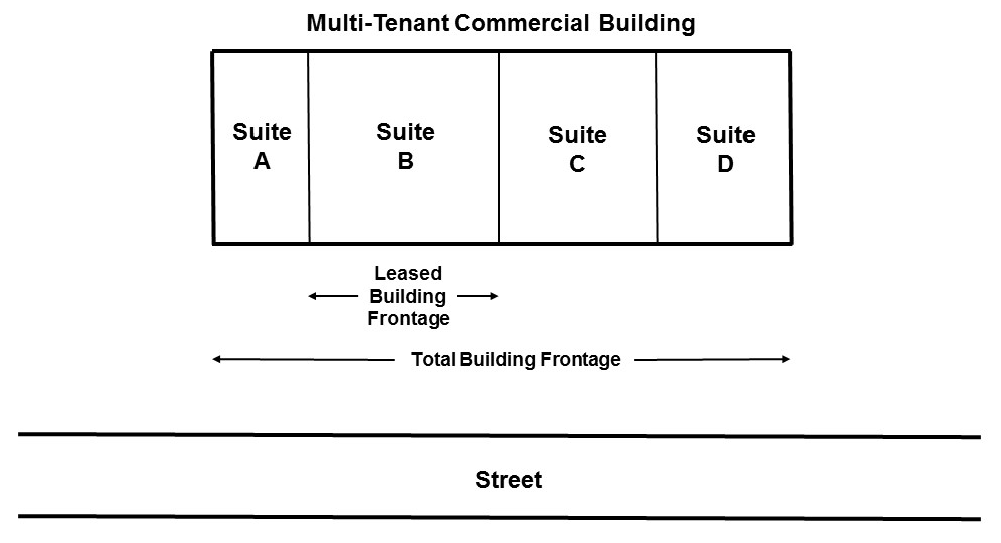
Building frontage: The width in linear feet of the front exterior wall of a particular building in which an establishment is located.
(c)
Double-faced sign: A sign structure with two sign faces that are parallel (back-to-back) or that form an angle to one another of no more than 60 degrees, where each sign face is designed to be seen from a different direction.
(d)
Road frontage: The distance in linear feet of a parcel where it abuts the right-of-way of any public street.
(e)
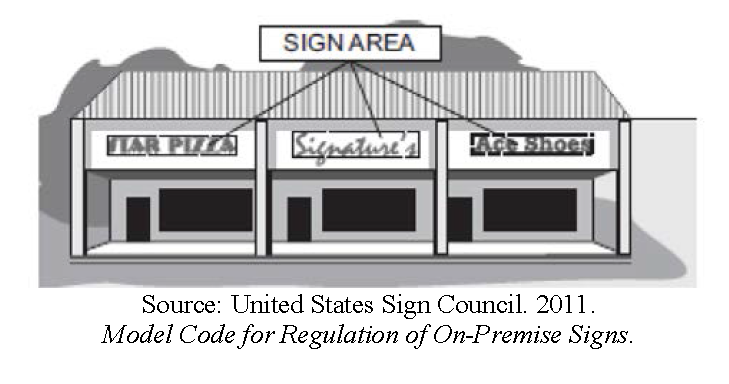
Sign area: The area within a continuous perimeter enclosing the limits of writing, representation, emblem, figure, or character together with any frame, other material, open space, or color forming an integral part of the display or used to differentiate such writing, representation, emblem, figure, or character from the background against which it is placed, measured by the smallest possible rectangle or combination of rectangles enclosing the display surface of the sign.
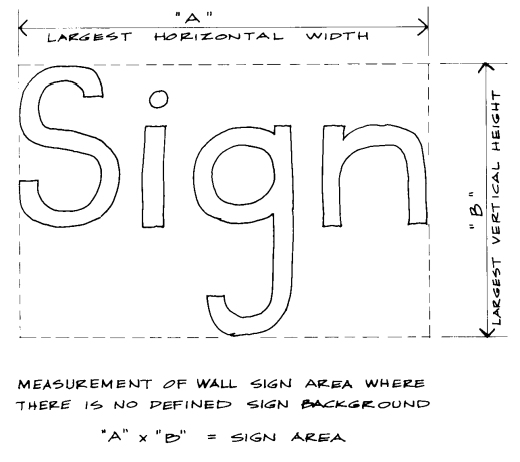
For signs that have no identifiable frame or border, the smallest rectangle that includes all of the sign's words, letters, figures, symbols, logos, fixtures, colors, or other design elements intended to convey the sign's message shall establish the area of the sign's face.
(f)
Sign height: The height of a sign shall be equal to the vertical distance from the average grade at the base of the sign, or from the crown of the roadway of the nearest street within 50 feet of any portion of the sign, to the highest point of any portion of the sign, whichever results in the greater sign height. Any earthen berms and elevated foundations supporting signs, signposts or other sign supports shall be included in the height of the sign.
(g)
Signable area: In the case of a wall sign, signable area is the building face on which the sign is proposed, excluding windows and doors. In the case of marquees or canopies, signable area shall be the area of the marquee or canopy wall on which the sign is proposed. For window signs, signable area shall be measured and calculated on the basis of the proportion of area within each individual window frame, not the total window area of all building windows visible from a street.
(h)
Findings. Not all parcels, or properties are equal when it comes to the need for signs. Signs along routes with three or more lanes generally need to be larger in area and height than signs placed on two-lane roads because motor vehicle travel speeds (i.e., posted speed limits) are typically greater and there is less time to view the messages. In addition, three-or more lane highways tend to have greater widths of right-of-way, which increases the distance the motorist has to view sign messages and thus decreases legibility and visibility. This is the rationale for larger sizes and heights for signs along routes with three or more lanes when compared with routes with two lanes of travel.
(i)
Provisions relative to the area of sign.
1.
Sign area for wall signs is measured on the basis of one sign face only since wall signs are mounted flush to a building wall, marquee, awning, or canopy.
2.
When a sign incorporates a property address, the area devoted to the property address shall not be included in any calculations for purposes of determining the maximum permissible sign area.
3.
Maximum area allowances for ground signs are given for one sign face only, but such signs are allowed to have two sign faces, since they are allowed to be read from two or more different directions (i.e., they are double-faced); provided, however, that the two sign faces are flush or the interior angle formed by the faces is not more than 60 degrees. The area of any double-faced sign with an interior angle of more than 60 degrees shall include both sign faces.
4.
Sign area for ground signs does not include the structural support for the ground sign (e.g., pole or monument base), unless the structural support is internally illuminated or otherwise so designed to constitute a display device, or a part of a display device.
(Ord. No. 17-003, § 1, 10-2-2017)
Sec. 721. - Exemptions.
The following types of messaging and signs are exempt from this article. No sign permit is required, and this article does not impose regulations on the following:
(a)
Building markers and decorative or architectural features integral to buildings.
(b)
Cemetery stones and markings of individual graves or burial plots.
(c)
Incidental signs, unlighted.
(d)
Interior signs, unlighted.
(e)
Murals, when erected as part of a public art program or other program recognized by the board of commissioners.
(f)
Public notice signs and signs of a public interest, erected by or on the order of a public officer in the performance of his duty, such as public notices, safety signs, memorial plaques, and signs of historical interest, including street pole banners erected by a public entity.
(g)
Scoreboards that are permitted as a part of an approved plan for a public or private recreational facility.
(h)
Signs identifying disabled parking spaces required pursuant to applicable state law or this UDC.
(i)
Signs not oriented or intended to be legible from a public right-of-way or adjacent property, or from outdoor areas of public property.
(j)
Street/property address identifiers and building identification numbers.
(k)
Traffic safety signs, installed within the right-of-way of a public street under the authority of the state or a local government, or traffic safety signs installed along driveways and in off-street parking lots, per the requirements of the county road department and consistent with the Manual on Uniform Traffic Control Devices.
(Ord. No. 17-003, § 1, 10-2-2017)
Sec. 722. - Signs prohibited outright.
The following signs and advertising devices are prohibited unless otherwise specifically provided in this article:
1.
Airblown advertising devices.
2.
Festoons and pennants.
3.
Hand-held signs.
4.
Signs erected within a state or county right-of-way without the permission of the owner. Any unauthorized traffic control device or sign or message placed in a public right-of-way by a private organization or individual constitutes a public nuisance and is subject to removal.
5.
Signs erected at a height of between three and eight feet within a site visibility triangle established by this UDC, or a sign at any height that obstructs or interferes with the vision of a motor vehicle operator's view of approaching, merging, or intersecting traffic.
6.
Signs erected without the permission of the property owner.
7.
Signs that are painted on or attached to trees, fences, fence posts, utility poles, or rocks or other natural features.
8.
Signs that emit smoke, vapor, or odor.
9.
Signs that rotate, revolve, or have moving parts.
10.
Signs that obstruct any fire escape, window, door, or opening usable for fire prevention or suppression, or that prevent the free passage from one part of a roof to any other part thereof.
11.
Signs shaped in a manner and with a color that imitates, or could be mistaken for, an official traffic control sign, such as a red, octagonal "stop" sign or yellow, triangular "yield" sign.
12.
Signs containing reflective elements that sparkle in the sunlight or otherwise simulate illumination during daylight hours or that contain luminous paint that glows in the dark.
13.
Umbrellas used for advertising or with sign copy.
14.
Portable signs.
15.
Roof signs.
16.
Vehicular signs, and signs or advertising devices attached to vehicles operating within public rights-of-ways (also commonly referred to as mobile billboards).
(Ord. No. 17-003, § 1, 10-2-2017)
Sec. 731. - Land use and land-use sign-related definitions.
Agricultural use: Any parcel where agriculture, farming, or agriculturally related uses (see agritourism, defined in article 2 and section 3-005) constitute the principal use of the property, as interpreted by the director of public development.
Commercial use: A property containing one or two for-profit entities, including but not limited to those uses identified under the "commercial," "construction," "restaurant," "retail trade establishment, enclosed," "recreation," "transportation" and "waste management" categories in table 2-2 "Principal and Accessory Uses Allowed by Zoning District" of this UDC. Any property containing two commercial uses shall be considered a commercial use, not a multi-tenant property. A use categorized as "temporary event," or another use specified in table 2-2 may be interpreted by the director of public development as a commercial use, even if such event or use is on agricultural property or agriculturally zoned property.
Industrial use: A property containing one or two for-profit entities, including but not limited to those uses identified under the "industrial," "warehousing" and "wholesale trade" categories in table 2-2 of this UDC.
Institutional use: Any property containing one or two not-for-profit entities, including but not limited to those uses identified under the "institutional uses" category in table 2-2 of this UDC, including but not limited to churches, hospitals, and professional, civic and charitable organizations. A use listed under the "institutional" or "recreational" categories of table 2-2 that is a for-profit entity shall be considered a commercial use for purposes of this article.
Multi-tenant property: Any parcel designed, occupied, or intended for occupancy for three or more leasable spaces or parcels under one ownership or management. This article distinguishes between multi-tenant properties based on use as follows: residential (a "major" residential subdivision, a multiple-family apartment complex, or a manufactured home park); institutional (e.g., government or nonprofit complex); commercial (an office park with multiple buildings on individual parcels or multiple office buildings on a single parcel, a commercial shopping center, or a single commercial building with three or more leasable spaces); and industrial (industrial park with separate parcels or a single industrial building with three or more leasable spaces).
Residential use: Any parcel with a single dwelling unit or a two-family dwelling unit on it, or any other principal use listed as 'residential and related uses" in table 2-2 of this UDC except those interpreted by the director of public development as a multi-tenant residential or institutional property.
Vacant property: Any property that contains no building or principal use; or a building that contains a building or structure which has not been occupied for six or more consecutive months.
(Ord. No. 17-003, § 1, 10-2-2017)
Sec. 732. - Maximum sign height.
(a)
Unless otherwise specifically provided in this article, signs shall not exceed the height allowances provided in table 7-1:
Table 7-1
Maximum Ground Sign Height by Land Use by Sign Type
(b)
Wall signs shall not exceed the height of the building wall on which it is attached.
(c)
Temporary signs shall not exceed ten feet in height.
(Ord. No. 17-003, § 1, 10-2-2017)
Sec. 733. - Maximum sign allowances and maximum sign area.
Unless otherwise specifically provided in this article, signs shall not exceed the number and area allowances provided in table 7-2 for individual uses or table 7-3 for multi-tenant uses, whichever is applicable:
(Ord. No. 17-003, § 1, 10-2-2017)
Table 7-2
Sign Allowances and Area by Land Use by Sign Type
(Ord. No. 17-003, § 1, 10-2-2017)
Table 7-3
Sign Allowances and Area for Multi-Tenant Properties by Land Use
;adv=6;(Ord. No. 17-003, § 1, 10-2-2017)
Sec. 734. - Location restrictions.
(a)
Signs in public right-of-way. No sign shall be erected on or encroach on any public right-of-way.
(b)
Visibility clearance area. No portion of a sign face, and no portion of a sign structure wider than 12 inches, between the heights of two and one-half feet and 12 feet shall be located within 20 feet of the intersection of the right-of-way lines of streets, roads, highways or railroads, or within 20 feet of the intersection of a street right-of-way and either edge of a driveway. In addition, no sign shall obstruct or impair the vision of any vehicle operator at the intersection of any public rights-of-way, at any entrance onto or exit from a public road, or any other location where said obstruction would create a hazard to life or property.
(c)
Obstruction of visibility of public sign. No sign shall be located so as to obscure or otherwise interfere with the effectiveness of an official traffic sign, signal, or device.
(d)
Height clearance. Projecting signs and any sign suspended from a canopy shall provide a minimum of eight feet of clearance from ground level to the bottom of the sign.
(Ord. No. 17-003, § 1, 10-2-2017)
Sec. 735. - Illumination of signs and illumination for advertising purposes.
(a)
It shall be unlawful to utilize strobe, laser, and search lights except for emergency or public safety operations.
(b)
Neon tubes or other exposed tubes containing luminescent gas on the outside a building or located inside a building and outlining a window or door, are prohibited.
(c)
Signs shall not flash or blink, except as allowed for electronic changeable copy signs.
(d)
Signs located on properties utilized exclusively for a single-family dwelling (including manufactured home), two-family dwelling (duplex), exclusively for agricultural use, or combination of agricultural and residential use, shall not be illuminated.
(e)
Temporary signs shall not be illuminated.
(Ord. No. 17-003, § 1, 10-2-2017)
Sec. 741. - Banner, interim.
The occupant or prospective occupant of a building or leased space, may erect a temporary banner not exceeding 32 square feet in area on a front building wall, prior to the issuance of a certificate of occupancy, provided that the occupant or prospective occupant has applied for a permanent wall sign for the building or leased space.
(Ord. No. 17-003, § 1, 10-2-2017)
Sec. 742. - Drive-through lane signage.
Drive-through lanes may have a maximum of two display boards not exceeding six feet in height or 36 square feet in area each.
(Ord. No. 17-003, § 1, 10-2-2017)
Sec. 743. - Electronic changeable copy signs.
Electronic changeable copy signs may be permitted in conjunction with any permanent ground sign, or any wall or window sign, that is permitted by this article, subject to the following additional requirements:
(a)
Zoning limitations. Such signs shall be permitted in commercial zoning districts and on properties designated on the Future Land Use Plan as "Public Institutional";
(b)
Permits. Such signs require the issuance of an electrical permit in addition to a sign permit, and a building permit may be required depending on size and construction;
(c)
Limit one per parcel. No more than one such sign shall be permitted for any single parcel and only one such sign may exist on a single parcel;
(d)
Nature of display. Signs must automatically adjust to ambient light levels. Sign content/messages shall remain static except during transition. Sign content/messages shall not move, blink, animate, flash, travel, scroll, vary in light intensity, or behave in any other way which constitutes or implies motion, except as specifically provided in this section during transition time;
(e)
Duration of message. Each message on such sign shall remain fixed for at least six seconds;
(f)
Transition time. The change sequence of messages shall either occur immediately, or there shall be a transition time of less than one second between different messages. A "fade" or "dissolve" mode, may be used to accomplish a gradual transition from one message to another. For purposes of this paragraph, "fade" shall mean a mode of message transition on a multiple message electronic sign accomplished by varying the light intensity, where the first message gradually reduces intensity to the point of not being legible and the subsequent message gradually increases intensity to the point of legibility. For purposes of this paragraph, "dissolve" shall mean a mode of message transition on a multiple message electronic sign accomplished by varying the light intensity or pattern, where the first message gradually appears to dissipate and lose legibility simultaneously with the gradual appearance and legibility of the subsequent message;
(g)
Lighting and brightness limitations. The maximum brightness level for LED signs during daylight hours shall not exceed 5,000 nits (candles per square meter) when measured at the sign's face at its maximum brightness and 250 nits when measured at the sign's face at its maximum brightness between dusk and dawn. LED signs shall be required to have an automatic dimming function to reduce brightness to prescribed levels at dusk. The owner of the parcel on which such a sign is placed shall submit, with the sign permit application, certification from an electrical engineer or other qualified professional that all requirements of this subsection are met, along with supporting documentation ensuring said certification; and
(h)
Freeze of display when malfunction occurs. Such signs shall include a default designed to freeze a display in one still position if a malfunction occurs.
(Ord. No. 17-003, § 1, 10-2-2017; Ord. No. 21-007, § 1, 12-20-2021)
Sec. 744. - Flags.
(a)
Generally. Any residence, establishment, or institution may display as many as three flags per parcel, when displayed in accordance with this section. Flags may be displayed on a freestanding pole, projecting from a building or door or placed in a window.
(b)
Pole flags. No flag displayed from a pole shall be flown at a height of greater than 24 feet. An individual flag shall not exceed an area of 40 square feet.
(c)
Projecting flags. Flags may be flown from a metal or wooden pole attached to a bracket projecting from the side of a building or doorframe. The pole shall not exceed six feet in length, or one inch in diameter. The flag flying from such pole shall not exceed three feet from top to bottom and five feet in length. Additionally, flags displayed in such a manner shall not impede pedestrian or vehicular traffic.
(d)
Window flags. Flags may be hung in the window of any non-residential property. The area of the flag shall be used in the calculation of allowable window signage.
(Ord. No. 17-003, § 1, 10-2-2017)
Sec. 745. - Interstate signs.
In addition to other sign allowances provided in this article, interstate signs are permitted on properties with frontage on an interstate highway subject to the following requirements:
(a)
Zoning districts permitted. Interstate signs are permitted only in commercial and industrial zoning districts as shown on the official zoning map of Jackson County.
(b)
Limit to one per parcel. Only one sign shall be allowed to face the same direction per parcel. This allows back to back or "v" formation signs but prohibits two signs facing the same direction.
(c)
Location restriction. Each interstate sign shall be located within 660 feet of the Interstate 85 Highway and within an area 1,500 feet long beginning 500 feet from the point where the pavement widens on the main traveled way to accommodate the longest entrance or exit ramp.
(d)
Number of signs per interchange quadrant. No more than three interstate signs are allowed per quadrant of any interchange.
(e)
Area. The area of such signs shall not exceed 672 square feet.
(f)
Height. "Monopole" signs shall not exceed 70 feet in height; all other types shall not exceed 35 feet in height.
(g)
Ground clearance. All signs shall be a minimum of ten feet above adjacent interstate pavement measuring from the lower portion of the sign face.
(h)
Spacing. Signs shall be located no less than 500 feet apart from any other permitted and authorized interstate sign, measured from the two closest points.
(i)
Setback. No part of an interstate sign shall be closer to a property or right-of-way line than ten feet.
(j)
State approval. Prior to permitting by the county, the applicant for an interstate sign shall submit with the application evidence of approval by the Georgia Department of Transportation as complying with the state's outdoor advertising statutes and administrative rules.
(Ord. No. 17-003, § 1, 10-2-2017)
Sec. 746. - Projecting signs.
Projecting signs are permissible, subject to the limitations for wall signs and the following limitations:
(a)
Projecting signs shall project perpendicularly from the building.
(b)
Projecting signs shall not project more than three feet beyond the face of the building.
(c)
Projecting signs shall be secured in place with a frame mount assembly.
(d)
Projecting signs shall have a ground clearance of no less than eight feet above the lowest ground elevation.
(Ord. No. 17-003, § 1, 10-2-2017)
Sec. 747. - Sandwich board signs.
For commercial uses in buildings with a private hard-surfaced walkway in front of the building, one sandwich board sign is permitted for each 100 feet of leased frontage of a building, during times when the business is open.
(Ord. No. 17-003, § 1, 10-2-2017)
Sec. 761. - Duration and continuance.
Signs which do not meet all requirements of this article on its effective date, or which do not meet provisions of this article at the time of its amendment, may stay in place until or unless provided otherwise by this article.
(Ord. No. 17-003, § 1, 10-2-2017)
Sec. 762. - Changes, repair, and maintenance.
(a)
No structural repairs, change in shape, height, or size of a nonconforming sign shall be permitted except to make the sign comply with the requirements of this article.
(b)
Nonconforming signs shall not be modified to add additional lighting or altered in any way that increases the value of said nonconforming sign.
(c)
A nonconforming sign which has been damaged to such extent that repairs equal to or exceeding 50 percent of the sign's current replacement value, as may be determined by independent appraisal or the director, shall not be repaired or replaced except in conformity with this article.
(d)
Minor repairs and maintenance of nonconforming signs shall be permitted.
(Ord. No. 17-003, § 1, 10-2-2017)
Sec. 763. - Replacement.
A nonconforming sign shall not be replaced by another nonconforming sign unless in conformity with this article, except that the substitution or interchange of poster panels, painted boards or dismountable material on nonconforming signs shall be permitted.
(Ord. No. 17-003, § 1, 10-2-2017)
Sec. 771. - Building and electrical permits for signs.
(a)
Building permit. A building permit, if required by the building code, shall be obtained from the building inspector prior to installation or placement of any sign. It shall be unlawful for any person to post, display, or erect a sign in the county without first having obtained a building permit, if required by the building code for said sign.
(b)
Electrical permit. An electrical permit, if required by the building or electrical code, shall be obtained prior to the installation or placement of any illuminated sign. All electrical service to a sign once installed shall be in compliance with the electrical code. It shall be unlawful for any person to post, display, or erect a sign with an electrical connection in the unincorporated portion of the county without first having obtained an electrical permit, if required by the electrical code for said sign.
(c)
Conformity. All signs for which a building permit or electrical permit is required shall be constructed and maintained in conformance with all applicable building code and electrical code requirements.
(d)
Application and structural plans. The applicant for a building permit shall submit application materials as specified by the building inspector, including a sketch or print drawn to an engineering or architectural scale showing pertinent information such as wind pressure requirements and display materials in accordance with requirements of the building code.
(e)
Plan certification. Plans required for issuance of a building permit for any projecting sign shall be certified as to conformance with all structural and wind-load resistive standards of the building code by a qualified structural engineer, or be prepared using standard drawings prepared by a structural engineer or other qualified professional meeting or exceeding all requirements of the building code.
(f)
Process. For signs requiring a building or electrical permit, the county shall process such permit applications in the same manner as required for any other building or electrical permit, according to procedures specified in the building or electrical code, whichever is applicable, and as administratively established by the building inspector and as administered by the department of public development.
(Ord. No. 17-003, § 1, 10-2-2017)
Sec. 772. - Sign permit required.
A sign permit shall be required for the following.
(a)
Any ground, projecting, wall, or other sign for which a building permit is required.
(b)
Any ground, wall, or other sign for which an electrical permit is required.
(c)
Any ground or wall sign with a sign area of 16 square feet or more.
(Ord. No. 17-003, § 1, 10-2-2017)
Sec. 773. - Who may apply for sign permit.
An application for a sign permit shall require the authorization of the property owner(s). Only the property owner or authorized agent of the property owner may make application for a sign permit. Sign permits shall be issued only to the owner of the real property where the sign is to be located; or to an authorized agent of the property owner, or to a lessee who has the right to maintain a sign on the real property where the sign is to be located; or to the sign contractor, constructor, or erector as the agent of the owner or lessee.
(Ord. No. 17-003, § 1, 10-2-2017)
Sec. 774. - Contents of sign permit application specified.
Application materials required for a sign permit are supplemental and in addition to the application materials for a building or electrical permit for the sign, if required. An application for a sign permit shall be made on an application form furnished by the public development department. The application form and application materials shall include the following:
(a)
The names, mailing addresses, telephone numbers, and e-mail addresses of the sign owner, sign erector, property owner, lessee (if applicable), and the agent (if applicable) making the application; approval of the property owner shall be evidenced by signature on the application form by the property owner or authorized agent (in which case a power of attorney or other evidence of legal authority to act on behalf of the property owner shall also be submitted);
(b)
A non-refundable application fee as may be established by resolution of the board of commissioners;
(c)
The address and description (e.g., tax parcel number) of the property on which the sign is to be erected;
(d)
An itemized list and/or a keyed site and/or building façade sketch at a suitable scale showing the location, size, and height of all existing signs on the property, and if applicable, an indication of which signs are not in compliance and to be removed;
(e)
The type of sign to be permitted, as classified by this article;
(f)
The number of sign faces and the height and area of the sign to be permitted; and
(g)
The proposed placement location, shown on a sketch of the building façade if a wall sign or on a plot plan or boundary survey of the property if a ground sign.
(Ord. No. 17-003, § 1, 10-2-2017)
Sec. 775. - Procedures for sign permitting.
(a)
Submission. When required, a sign permit application shall be submitted to the department of public development for review and disposition.
(b)
Other permits. If a building or electrical permit is required, the application for sign permit shall be submitted simultaneously with an application for a building or electrical permit for the sign. Sign permit applications requiring a building or electrical report shall be submitted to the public development department for consideration by the building inspector in conjunction with an application for building and/or electrical permit, if required, for a sign. Building or electrical permits for a sign shall not be issued until a sign permit if required is issued.
(c)
Review. Incomplete applications will be returned to the applicant and will not be processed. Processing times from the date a complete application for a sign permit has been received, shall not exceed 15 calendar days, during which time the building inspector shall review the application for building and electrical permits, if required, and the public development department shall review the sign permit application for compliance with this article.
(d)
Decision. Upon determination that the application fully complies with the provisions of this article, and building and electrical codes if applicable, the department of public development shall issue the sign permit. Issuance of a sign permit shall be considered sufficient notice to the applicant that such sign permit is approved. Applications for sign permits which do not comply with the provisions of this article or applicable building or electrical codes shall not be approved by the county. A sign permit may be denied by the public development department if the applicant, landowner or lessee is responsible for and is presently maintaining any sign on the subject property in violation of this article.
(e)
Denial. If an application for a sign permit is denied, the applicant shall be given written notice stating the reason(s) for the denial. A property owner may reapply for the same sign which was previously denied a sign permit, in order to secure permission for a sign which complies with this article and applicable building and electrical codes. An applicant may appeal the denial of a sign permit in accordance with the provisions for appeals of administrative decisions, as specified in this UDC.
(Ord. No. 17-003, § 1, 10-2-2017)
Sec. 781. - Findings.
Signs, if improperly maintained, present an unkempt appearance and may present an image of blight to visitors, residents, and employees. It is in the interest of the county to ensure that signs are properly maintained to avoid the appearance of blight and also to prevent possible detrimental impact on property values that may result from such blight.
(Ord. No. 17-003, § 1, 10-2-2017)
Sec. 782. - Maintenance.
(a)
All signs, together with all their supports, braces, guys, and anchors shall be kept in good repair. If a sign is in need of maintenance, it shall be the responsibility of the property owner to promptly maintain such sign in good repair.
(b)
Painting and cleaning of a sign shall be considered maintenance and shall not require a sign permit.
(Ord. No. 17-003, § 1, 10-2-2017)
Sec. 783. - Enforcement of sign maintenance.
In cases of a sign in need of maintenance, the department of public development shall notify the property owner of the need to maintain the sign. If a condition of sign in need of maintenance still exists for more than 30 calendar days after the date such notification was mailed, the department of public development or other county designee for enforcement shall issue a notice of violation and compliance order to the property owner.
(Ord. No. 17-003, § 1, 10-2-2017)
Sec. 784. - Enforcement of illegal signs.
(a)
In addition to enforcement mechanisms permissible with regard to violations of this UDC generally, no new sign shall be authorized to be erected on the same property, and no new sign shall be permitted by the county, unless the property on which the new sign is proposed is in compliance with the requirements of this article in all respects.
(b)
At the discretion of the public development director, sign permits may be withheld if the site on which the sign is proposed to be located contains a prohibited sign, a derelict sign, or a sign for which maintenance is required and which has not been maintained in accordance with the requirements of this article.
(Ord. No. 17-003, § 1, 10-2-2017)

