
Klickitat County Unincorporated
City Zoning Code
City Zoning Code
CHAPTER 19
39 - ENERGY OVERLAY ZONE1
Sections:
Editor's note— Ord. No. O081710, adopted Aug. 17, 2010, amended Chapter 19.39 in its entirety to read as herein set out. Former Chapter 19.39, §§ 19.39.010—19.39.100, pertained to similar subject matter and derived from Ord. No. O031505, § 1(part), adopted 2005.
19.39:1 - Purpose.
A.
To provide areas suitable for the establishment of energy resource operations based on the availability of energy resources, existing infrastructure, and locations where energy projects can be sensitively sited and mitigated.
B.
To provide siting criteria for the utilization of wind and solar energy resources. Each energy resource project will be subjected to individualized review and the imposition of conditions based on site specific information which will be tailored to address project impacts in accordance with the siting criteria. The ultimate goal is to achieve a predictable but sensitive siting process which effectively and efficiently addresses project impacts.
(Ord. No. O081710, 8-17-10)
19.39:2 - Applicability.
A.
The energy overlay zone is an overlay over existing zones. Projects permitted through the energy overlay zone shall comply with the standards of this chapter rather than the standards of the existing zone.
B.
The energy overlay zone applies to the area demarcated on the zoning map. The energy overlay does not apply to lands within the Columbia River Gorge National Scenic Area, except that lands within the urban areas designated by 16 U.S.C. § 544b(e), may utilize the provisions in section E below for siting small-scale energy systems.
C.
Any applicant who has applied for a conditional use permit for an energy project authorized by this chapter, may, in the alternative, elect to be sited through the procedures in this chapter. The applicant need not re-apply for a permit under this chapter. However, the county may require any supplementary information needed to complete review under this chapter and comply with its requirements.
D.
Energy systems listed in KCC 19.39:4 are subject to the requirements of this chapter.
E.
Small-Scale Energy Systems. An energy system listed in KCC 19.39:4 with a rated capacity of not more than one hundred kilowatts (kW) and which is intended to primarily generate power for on-site consumption is permitted outright by KCC 19.39:4, but is not subject to 19.39:6-9(B) or 20.08.080. Wind turbines exceeding one hundred forty feet in height, as measured from the uppermost point, shall not be considered a small-scale energy system. The mitigation summary developed in the Klickitat County Energy Overlay Environmental Impact Statement, and the conditions listed in this chapter, shall be used as a guide by the county to develop conditions that are appropriate and reasonable to mitigate project impacts. Conditions shall include setbacks from property lines, public rights-of-way, and public utility lines to address public safety, noise, aesthetics, and compatibility among land uses. All other code requirements still apply.
(Ord. No. O081710, 8-17-10)
19.39:3 - Other applicable requirements.
A.
Project applicants will need to comply with other applicable county requirements, such as the critical areas ordinance, environmental review regulations, and building code requirements.
(Ord. No. O081710, 8-17-10)
19.39:4 - Permitted uses.
A.
Principal Uses Permitted Outright.
1.
Wind turbines.
B.
Uses Permitted Conditionally. Solar energy facilities, except that large scale solar projects over one acre in size, located within Townships-Ranges 3-14, 3-15, 3-16, 4-14, 4-15, 4-16, 4-17, 5-15, 5-16 and 5-17 in Klickitat County, Washington are prohibited.
C.
Accessory and Temporary Uses. Accessory buildings, uses, and structures needed for operation of the above permitted uses, including utilities and utility infrastructure needed for the principal use. For purposes of this chapter, accessory uses include the mining, crushing, processing and utilization of on-site gravel for development of the permitted energy resource operation only, as necessary for the energy development. Battery energy storages systems do not classify as accessory buildings, uses, or structures.
(Ord. No. O081710, 8-17-10; Ord. No. O080525, Att. A, 8-5-2025)
19.39:5 - Review process for energy resource operations.
A.
Energy resource operations listed in KCC 19.39:4 are permitted outright. However, a permit is required for all energy resource operations, including small-scale energy systems, under this chapter to ensure compliance with mitigation conditions developed in accordance with the requirements of this chapter.
B.
All energy resource operations will be reviewed by the Klickitat County Planning Department and project conditions will be developed and imposed by the Klickitat County Planning Department.
C.
Micro-Siting.
1.
All terrestrial habitat, critical area assessments, and cultural resource studies required shall be conducted within identified study corridors of sufficient width and dimension to enable comprehensive environmental assessment while allowing flexibility in the final layout.
2.
Actual final locations of wind turbine generators, below-ground electrical cables, and above-ground electrical transmission towers will be established during the micro-siting process, occurring after permit review and prior to actual construction. During the micro-siting process (when the final, exact locations of the turbines and other project elements and equipment are determined) the applicant will typically balance a number of technical and engineering factors, including limitations imposed by the terrain, wind data (speed, wind sheer, etc.), wake effects of turbines on others, feasibility of access, setbacks (internally established or based on permit requirements), geotechnical considerations (subsurface conditions), environmental restrictions (avoidance of sensitive habitat), cultural/archaeological restrictions, telecommunications constraints (line of sight microwave paths), FAA requirements, and other site-specific criteria that are not fully resolved until final engineering is completed.
3.
The planning department shall review final project lay-out, which must be completed before construction activities occur. If final turbine lay-out extends beyond the initial corridors approved in the EOZ permit, before completing review, the department shall provide at least two weeks' notice to parties who have requested notice with respect to the project and to all individuals and entities who have notified the county they wish to be on the county's energy resource operations e-mail notification list. The lay-out must be consistent with the permit conditions and all other applicable county requirements.
D.
The planning department may approve minor revisions to EOZ permit text or project area. Minor revisions are revisions which are within the scope of previous environmental review, are generally consistent with permit conditions, and do not constitute a major deviation from the EOZ permit. Minor revisions include the addition of property to a project which does not exceed one hundred sixty acres of leased property and would not increase the number of permitted turbines or permitted power output. A survey may be required to confirm the acreage. If multiple requests for minor revisions to the same project are submitted, they shall be considered cumulatively. The total acreage outside the originally approved project area for all minor revisions approved for a single project shall not exceed one hundred sixty acres of leased property. Any parties who have requested notice with respect to the project and all individuals and entities who have notified the county they wish to be on the county's energy resource operations e-mail notification list shall be sent e-mail notification at least fourteen days before the revision review is completed. In addition, if the revision involves an expansion of project area, all owners of land adjacent to newly included parcels shall be mailed notice at least fourteen days before the review is completed. Any minor revision that involves expansion of the project area which may impact wildlife/habitat values, shall include WDFW consultation.
E.
The planning department shall review final turbine layout before building permits are issued to ensure compliance with permit conditions.
(Ord. No. O081710, 8-17-10)
19.39:6 - Public notice requirements.
A.
When an application is deemed complete, the county will post a notice of application on its website.
B.
The project applicant is responsible for holding at least one informal community meeting within the county to inform the public about the proposed energy facility. The community meeting must be held after the project application is deemed complete and at least two weeks before SEPA review is completed. If an EIS is being prepared, notice shall be provided in the same manner used for issuing either the scoping notice or draft EIS. The community meeting notice may be combined with the SEPA notice. If a DNS is being prepared, community meeting notice procedures shall include: (1) mailed notice to property owners within three hundred feet of the project; (2) posted notice on the county's website; (3) e-mailed notice to individuals who have notified the county they wish to be on the county's energy resource operation e-mail notification list; and (4) published notice in a newspaper of general circulation for two consecutive weeks at least fourteen days before the community meeting.
C.
Additional public notice specific to energy resource operations is required by the county's SEPA regulations. See20.08.080.
(Ord. No. O081710, 8-17-10)
19.39:7 - Application requirements.
A.
Expanded Checklist.
1.
An expanded checklist shall be submitted to the Klickitat County Planning Department. The expanded checklist may be submitted simultaneously with any other permit applications that may be required from the county.
2.
The expanded checklist shall (in addition to being consistent with the SEPA Checklist required under Title 20) provide analysis of impacts to elements of the environment as noted in the SEPA Checklist required by Title 20 and Chapter 197-11 WAC, and explain the mitigation proposed to minimize those impacts.
3.
Site specific studies for impacts to habitat/wildlife impacts (including avian impacts), a road impact impact assessment, cultural resource impacts, and a grading and stormwater management plan complying with state best management practices stormwater quality standards, shall be attached to the expanded checklist.
4.
Because additional studies may be required by the planning director for effective review and sensitive siting, a pre-application meeting with a representative from the planning department is recommended. The level of detail and analysis necessary is dependent on the type of project proposed, its location, and the currently available environmental review relevant to the proposal. In general, smaller projects will require less analysis than larger, more complex ones.
5.
In drafting the expanded checklist the applicant may review Klickitat County's Energy Overlay Environmental Impact Statement ("Energy Overlay EIS"). The Energy Overlay EIS provides information on environmental conditions within the county and suggested mitigation for addressing energy development impacts.
6.
The expanded checklist shall include sufficient information, including a preliminary site lay-out map, to adequately describe the proposal and its impacts, including but not limited to, information on the maximum megawatts of the project, the total square footage of buildings to be constructed, probable sources/quantities of aggregate to be used in construction, the maximum height and number of wind turbines and solar panels (if applicable), expected noise generation levels, the length and widths of new roads and the lengths of power lines, sources of water (for dust suppression, concrete batch plant, etc.) and transportation impacts. Survey corridor locations shall be described and included on the preliminary site layout map.
7.
An application for review under this chapter shall not be deemed complete until the identified reports are provided. Except for site specific studies for impacts to habitat/wildlife, upon a clear showing by the applicant that the study is not applicable or is unnecessary, the planning director may waive specific application requirements. Such a determination shall be documented in writing in the project file. The department may defer preparation of the grading and stormwater management plan.
8.
Should the applicant prepare an EIS, the expanded checklist is not required, as this information will be provided as part of the EIS.
B.
Other Application Requirements.
1.
Project applicants shall comply with all other applicable county application requirements.
2.
For projects with an estimated value of over one million dollars, KCC 19.08.110 shall be complied with before review under this chapter may commence.
(Ord. No. O081710, 8-17-10)
19.39:8 - Development standards.
A.
Setbacks.
1.
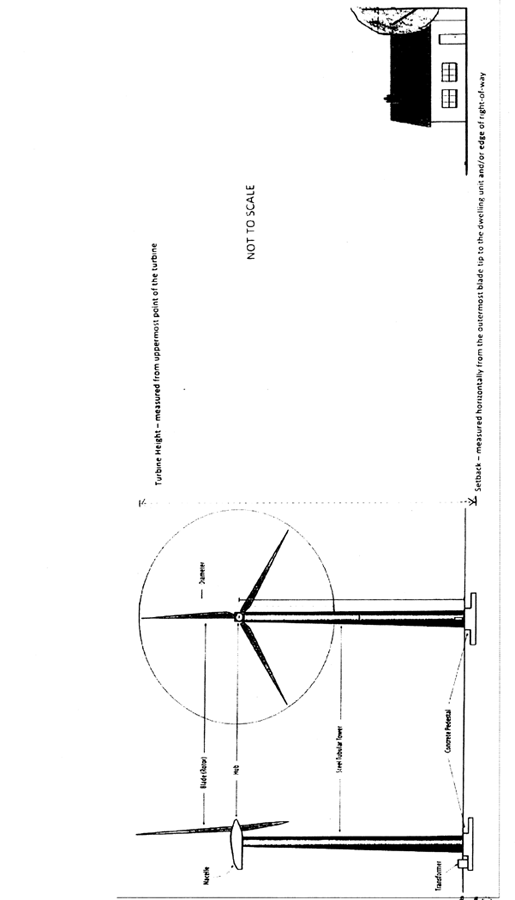
Wind turbines shall be sited a minimum of one thousand six hundred feet, as measured from the outermost blade tip away from existing residential structures. The planning department may reduce the setback in limited instances for residences which are part of the project (meaning they have recorded agreements, such as leases or easements with the project applicant, and the subject turbine is included in that agreement) following consultation with the owner of the residence, but in no event shall setbacks be less than eight hundred feet. Solar panels shall be sited a minimum of five hundred to one thousand five hundred feet from existing residential structures. The setback shall be determined during permitting based upon factors including aesthetic impacts, geography, and project size. The location and density of residential uses in the vicinity and the nature of the project may require increased setback requirements. See Figure 1.
2.
External and Internal Property Line Setbacks.
i.
There shall be a minimum setback of no less than 1.1 times turbine height (as measured from the uppermost blade tip) from the project's external property lines to the outermost blade tip of the turbine. This setback does not apply to power lines and access roads.
ii.
A project's external property line is the boundary along legal lot lines surrounding the project, which encompasses all property within the project. A project's internal lot lines are those property or lot lines which are inside the project's boundaries, and which do not abut property located outside the project area.
3.
There shall be a minimum distance of five hundred feet from a turbine tower to a public road or private access roads providing access to more than five existing residences. Setback shall be measured from the edge of the rights-of-way to the outermost blade tip of the turbine.
4.
Additional distances for setbacks may be required for the purpose of addressing public safety or based upon other project impacts. Substations, transformers, and other components of energy resource operations shall be set back to provide compatibility with existing uses.
B.
Height Limits.
1.
Height limits are not set for wind turbines, transmission towers, wind data collecting devices such as anonometers, and towers required by the energy resource operation for air emissions. However, the county may place reasonable limitations on height (or impose other alternative mitigation) if necessary to mitigate impacts to existing uses or if necessary to address impacts to public safety.
2.
Building structures shall not exceed sixty-five feet unless additional height is necessary for the energy resource operation and impacts to existing uses can be mitigated to below a level of probable, adverse significance.
(Ord. No. O081710, 8-17-10)
19.39:9 - Use and construction standards.
A.
Project Conditions Tailored to Energy Resource Operation.
1.
Permits shall incorporate project specific mitigation measures and conditions to mitigate adverse project impacts. The conditions and mitigation measures shall be based on site specific studies provided by the applicant and other relevant environmental review.
2.
Conditions shall be designed to address each element of the environment discussed in the expanded checklist (or EIS), including but not limited to surface/groundwater; plants; habitat/wildlife (including avian impacts); cultural resources; health and safety; and traffic/transportation.
3.
The expanded checklist (or EIS) shall assess habitat type and value, presence of sensitive species, and the relative abundance of vulnerable species. Based on the expanded checklist (or EIS), an assessment will be made as to the sensitivity of various areas of the site for impacts to wildlife habitat, and a management plan ("plan") shall be prepared. The plan may be utilized to also address critical areas ordinance requirements. The plan shall describe existing habitat conditions and the project's impacts on the habitat. The plan shall detail mitigation measures to be implemented for temporary and permanent losses of habitat. Mitigation may include participation in a county habitat banking program, or other county approach to facilitate and better coordinate mitigation strategies among projects.
B.
Conditions and Standards Applicable to all Energy Resource Operations.
Noise
(a)
Maintain sound levels at project boundaries that are under the maximum levels for the adjacent receiving properties based on the receiving properties' environmental designation for noise abatement per state regulations.
(b)
Comply with applicable noise control regulations.
Air Quality
(c)
All applicable air emission permits shall be obtained and all conditions complied with.
(d)
Revegetate any disturbed areas that are not permanently occupied by the project features.
(e)
Provide a minimum of fifteen-cm (six-inch) gravel surface on project roads to reduce wind erosion.
(f)
Maintain a water truck on-site during construction for dust-suppression.
Vegetation and Wildlife
(g)
Limit construction disturbance by flagging the limits of construction and conduct ongoing environmental monitoring during construction to assure that flagged areas are avoided.
(h)
Develop a reseeding/restoration and weed management plan in consultation with the Klickitat County Weed Control Board.
(i)
Compliance with all applicable local requirements is required.
(j)
Overhead collector lines and transmission lines should be constructed consistently with the existing Avian Power Line Interaction Committee (APLIC) recommendations for raptor protection on power lines (including minimum conductor spacing and the use of anti-perch guards).
(k)
Additional conditions for wind projects.
(i)
Conduct project pre-assessment studies consistent with the Washington Department of Fish and Wildlife Wind Power Guidelines effective on the date of ordinance adoption. Consultants preparing the studies shall consider any later amendments to the guidelines. Project applicants are further advised to consult with WDFW and local habitat/wildlife experts regarding turbine siting before making final siting decisions.
(ii)
Use bird flight deflectors on guyed permanent meteorological towers or use unguyed meteorological towers.
(iii)
Monitor raptor nests on site for activity prior to construction and modify construction timing and activities to avoid impacts to nesting raptors. At a minimum, one raptor nest survey during breeding season within one mile of the project site should be conducted to determine the location and species of active nests potentially disturbed by construction activities, and to identify active and potentially active nest sites with the highest likelihood of impacts from the operation of the wind plant. A larger survey area (e.g., a two-mile buffer) is recommended if there is some likelihood of the occurrence of nesting state and/or federally threatened and endangered raptor species, or if empirical data on displacement impacts may be monitored after construction.
(iv)
A minimum of one full season of avian use surveys is recommended following current state-of-the-art protocols to estimate the use of the project area by avian species/groups of interest during the season of most concern (usually spring/early summer). Additional seasonal data (e.g. fall or winter) is recommended in the following cases: 1) use of the site for the avian groups of concern is estimated to be high relative to other projects, 2) there is very little existing data regarding seasonal use of the project site, and/or 3) the project is especially large. This additional avian use data should be collected to refine impact predictions and make decisions on project layout.
(v)
Identify and remove all carcasses of livestock, big game, etc. proximate to turbines within the project site, after project start up that may attract foraging bald eagles or other raptors.
(vi)
Monitor the project for a minimum of one year following project start-up to estimate bird and bat fatality rates using standard protocol. Report bird fatalities observed for the life of the project to WDFW and USFWS on a quarterly basis.
(vii)
The applicant (in consultation with Klickitat County) shall form a technical advisory committee (TAC) before project construction and after all permit appeal periods have closed. Representatives of Washington State Department of Fish and Wildlife, the U.S. Fish and Wildlife Service, landowners, the applicant, the Yakama Nation, and local environmental groups shall be invited to participate. The planning department will review and approve TAC membership as meeting the intent of the EOZ; at the discretion of the department, TACs may serve more than one project wherein it is more efficient to have one TAC serving several projects (such as in the situation where a developer has several separate wind projects with the same landowners or other situations). TAC consolidation does not alter each project owner's independent monitoring obligations. The TAC will consider problems and impact mitigation issues and will serve for the life of the project. Where feasible, all post-construction monitoring TAC reports shall identify the species of each carcass and the turbine responsible for the fatality. TAC will examine information relevant to assessing project impacts to avian and bat species. TAC will determine whether further mitigation measures would be appropriate, considering factors such as the species involved, the nature of the impact, monitoring trends, and new scientific findings regionally or at a nearby wind power facility. If appropriate in the TAC's judgment with respect to the significance of the impact identified, and the county concurs with the recommendation, or takes no position, the TAC shall recommend mitigation measures to the developer. The ultimate authority to implement additional mitigation measures, including any recommended by the project TAC, will reside with the project owner. The TAC's participation is intended to ensure that monitoring data is considered in a forum in which independent and informed parties can collaborate with the owner to develop appropriate responses.
Stormwater
(l)
Design and implement stormwater drainage systems in consultation with a professional engineer to ensure that minimal erosion will occur.
(m)
After construction, monitor the site for erosion on a weekly basis and after large rainfall or snowmelt events, and take corrective action as necessary.
Geologic and Flood Hazards
(n)
Design structural foundations and buildings in accordance with International Building Code requirements for appropriate seismic zone.
(o)
Compliance with all applicable local requirements is required.
Water Resources
(p)
Except for wind projects, water availability shall be demonstrated as needed for the project.
(q)
For all projects, water required for onsite use shall be obtained in accordance with state and local requirements.
Cultural Resources
(r)
Complete a cultural resource survey of areas of the project site that will be disturbed temporarily or permanently. The cultural resource survey shall be submitted to the county planning department for review at least sixty days prior to any kind of land disturbing activities.
(s)
During construction, flag and avoid cultural resources and monitor construction activities to ensure that all cultural properties are avoided.
(t)
An approved inadvertent discovery plan (IDP) shall be prepared for each project. The IDP will outline the procedures to be followed in the case of inadvertent archaeological finds and/or human remains. Train construction workers on the need to avoid cultural properties and procedures to follow if previously unidentified cultural properties, including Indian graves, are encountered during construction.
(u)
If any previously unidentified cultural resource properties are encountered during construction, cease construction activities in the immediate vicinity of the site pending evaluation by a professional archeologist and consultation with the county planning department and Washington State Department of Archaeology and Historic Preservation to identify appropriate mitigation measures such as avoidance or scientific data recovery. All projects shall develop a cultural resources management plan.
Visual Resources
(v)
Lighting for security shall be minimized and lighting fixtures shall be directed away from adjacent properties.
(w)
Provide a clean looking facility free of debris and unused or broken down equipment by: storing equipment and supplies off site, promptly removing damaged or unusable equipment from the site.
(x)
Coordinate paint colors and use non-reflective paints to reduce glare.
(y)
A bond, letter, or other security acceptable to the county is required to ensure proper decommissioning of energy resource facilities, including turbines and solar panels. The amount of the security shall be determined on the basis of the site-specific conditions affecting the costs of decommissioning, access, depth of foundation, terrain, etc., to include credit for salvage value of the equipment. Security shall be coupled with a decommissioning plan approved by the county planning department.
(z)
Effects of "shadow flicker" to surrounding existing residential uses and potential residential uses in areas (with residential zoning such as GR, RR, SR or RC) may need to be assessed. "Shadow flicker" can be minimized by a combination of strategic placement of turbines and/or cessation of blade rotation/operation with relation to key times of daybreak, sunset or seasonal fluctuations of sunlight angles. Consult with the planning department to confirm whether residential buffering will address this issue.
(aa)
Except to the extent clearly demonstrated by the project applicant to not be feasible, developers shall use common transmission easements and facilities. Every practicable effort shall be made to consolidate transmission infrastructure.
Public Safety
(bb)
Develop and maintain an on-site health and safety plan that informs employees and others on-site what to do in case of emergencies, including the locations of fire extinguishers and nearby hospitals, telephone numbers for emergency responders, and first aid techniques. Employees shall be trained to address healthy and safety emergencies, and to safely operate and maintain the turbines and other mechanical equipment.
(cc)
For projects in which hazardous substances are stored or used, a spill prevention and emergency cleanup plan will be designed to assist on-site workers with accidental releases. Any large spill will require emergency response through the local fire department or designated contractor.
(dd)
During project construction and all project welding operations, have a readily accessible water truck and chemical fire suppression materials available on-site to allow immediate fire response.
(ee)
Provide project staff with cellular or on-site phones to enable timely communication with the fire department and other emergency services.
(ff)
Fence site as appropriate and post signs warning of electrical dangers/with emergency contact numbers e.g. phone numbers of emergency responders.
(gg)
Monitor the site for evidence of unauthorized use and provide additional security as appropriate.
(hh)
Design an ice throw monitoring plan to protect against ice throw into public and private rights-of-way; to protect project workers; and nearby properties.
Roads
(ii)
A road impact assessment shall be prepared for roads to be used by the project. The assessment shall include an analysis of project-related traffic routes to be used during phases of construction, project operation and decommissioning (i.e. traffic volumes, weights, frequency, time of year of use, etc.); the plan shall include an assessment of existing road conditions (e.g. pavement width, intersection designs, subgrade condition, surface conditions, existing traffic use/volumes). The assessment should also address project-related developments of new surface aggregate mines and batch plants necessary for road construction.
(jj)
A road haul agreement shall be prepared in consultation with the county public works department. The agreement shall address impacts to county-maintained roads.
Communication Interference
(kk)
For wind turbines, determine location and frequency of existing tight beam directional communications transmitters and receivers when siting turbine strings to avoid any material signal interference. Should the project create electromagnetic interference which interferes with reception, the project will eliminate such interference, reach an agreement with the property owner experiencing the interference, or prepare a mitigation plan and submit it to the planning department for approval.
Mitigation conditions shall also be developed, as appropriate, based on the mitigation summary developed in the Klickitat County Energy Overlay Environmental Impact Statement. For wind power projects, the county shall consider recommended conditions listed in the current, and as amended, Washington State Department of Fish and Wildlife Wind Power Guidelines.
C.
Compliance with Project Conditions.
1.
County officials shall have the right to enter the project site to verify compliance with project conditions.
2.
Compliance with project conditions and code requirements is required. In addition to such other remedies available under law, any county department or other decision maker issuing any decision, environmental determination (such as a mitigated determination of non-significance), approval, authorization, or other determination, including a determination on the conditions to apply to a particular project under this chapter ("authorization"), has the authority to rescind such authorization for failure to substantially comply with any required condition, mitigation, or code requirement.
3.
The number of megawatts and number of turbines approved per the EOZ permit will be reduced by the number of megawatts and number of turbines not completed at the end of five years from the date of approval, except that the planning department may approve a period up to ten years for a wind energy project exceeding two hundred megawatts, and for which a phased development plan is provided in the draft and final environmental impact statements issued in connection with the EOZ permit. If the permit is appealed, the five years shall be counted from when the appeal is resolved. If the litigation ceases to be diligently pursued, the five years shall count from when such diligent pursuit ceases. The planning department may grant extensions not exceeding two years in total, upon demonstration of progress, and may condition the extension on bonding being obtained to ensure work is completed. For energy resource operations permitted prior to adoption of this ordinance, whether through an EOZ permit or conditional use permit, the five years shall be counted from the date of adoption of this ordinance [August 17, 2010].
4.
Transferring an EOZ permit to a new permit holder requires county planning department approval, which requires confirmation of compliance with project conditions, and may require re-execution of agreements or other documents entered into during and after project permitting to address impacts or related issues. The department may also confirm the new permittee has the ability (financial or otherwise) to comply with project conditions. Approval shall not be unreasonably withheld.
(Ord. No. O081710, 8-17-10; Ord. No. OO5311, 5-31-11)
19.39:10 - Appeal.
A.
Appeals may be filed to the Klickitat County Hearing Examiner within twenty days of the decision on project consistency with this chapter, which shall be heard consistent with applicable procedures in Chapter 19.60.
B.
If other appeal hearings are provided or available, then all appeal hearings shall be consolidated before a single hearing body. If more than one appeal hearing is provided or available and is before a hearing body other than the Klickitat County Hearing Examiner, then the energy resource permit appeal hearing shall be before the board of county commissioners or to such hearing officer as may be designated by the board. The decision of the board of county commissioners shall be final unless appealed to superior court within twenty-one days of issuance.
(Ord. No. O081710, 8-17-10)

