
Madison City Zoning Code
SUBCHAPTER 28C
- RESIDENTIAL DISTRICTS
28.031 - GENERAL PROVISIONS FOR RESIDENTIAL DISTRICTS.
(1)
Setback Averaging, Front Setback.
Where at least fifty percent (50%) of the front footage of any block is built up with principal structures, the minimum front yard setback for new structures shall be the average setback of the existing principal structures on the block face or the normal setback requirement in the district whichever is less, but no less than ten (10) feet. Setback averaging on lakefront lots is as specified in Sec. 28.138. For the purpose of calculating the average setback:
(a)
If the setback of an existing structure is greater than the required setback, the required setback shall be used.
(b)
Setback averaging uses only front yard setbacks; side yards and reverse corner side yards on corner lots shall not be included.
(c)
Projection into setbacks shall not be included.
(d)
Setback reductions approved by variance or special exception shall not be included.
(e)
If a block face is at least seventy-five percent (75%) built, a vacant lot on the block face shall not be included.
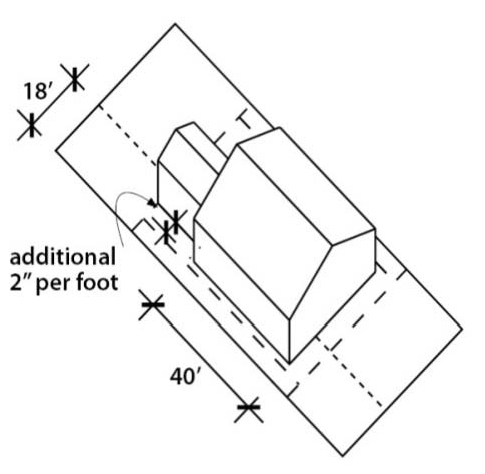
Figure C1: Sidewall Offset
(2)
Sidewall Offset.
A maximum of forty (40) feet of a principal building's side wall may be placed at the minimum sidewall setback. In order to avoid the monotonous appearance of long unbroken building facades from streets or abutting properties, any portion of a building side wall located within eighteen (18) feet of the side lot line that exceeds forty (40) feet in depth shall be set back an additional two (2) inches from the side lot line for every foot over forty (40) feet in depth. This requirement applies to all new construction with the following exceptions:
(a)
Within the TR-P, TR-C3 and TR-C4 districts, alley-loaded residential buildings are exempt from this requirement as it applies to building side walls within interior side yards.
(b)
Any residential building provided that windows, doors, or other architectural features are provided to articulate the appearance of the façade. (Cr. by ORD-13-00128, 7-26-13; ORD-14-00036, 3-6-14)
(Am. by ORD-13-00007, 1-15-13; ORD-14-00137, 8-13-14)
(3)
Attached Garage Design. In new buildings constructed after the effective date of this code, in order to avoid the monotonous and pedestrian-unfriendly appearance of facades dominated by garage doors, the following standards must be met. The Plan Commission may reduce or eliminate this requirement as part of the conditional use process in the case of lakefront lots where physical constraints make compliance infeasible.
(a)
For any street-facing façade containing an attached garage door, the total width of all garage doors on that façade may occupy no more than fifty percent (50%) of the width of that building facade, measured at grade.
(b)
Any portions of a street-facing façade that contain an attached garage door may be no more than four (4) feet forward of at least fifty percent (50%) of the width of the remainder of that building façade, measured at grade.
(Rpld & Recr. by ORD-25-00011, 3-8-25)
(4)
Parking Location: Residential Buildings. For new, Single-Family Attached, Small Multi-Family, Large Multi-Family, and Courtyard Multi-Family Building Forms, or additions that exceed the original building's floor area by more than one hundred percent (100%), surface parking shall not be located between any street and the plane of the principal building's corresponding street-facing facade. If located on the side of the building within the side yard, surface or structured parking shall occupy no more than twenty-five percent (25%) of the frontage along the primary abutting street. (Am. by ORD-15-00033, 4-8-15; Am. by ORD-24-00018, 3-20-24)
(5)
Parking Location: Nonresidential Buildings. For new nonresidential buildings in residential districts or additions that exceed the original building's floor area by more than one hundred percent (100%), that are constructed after the effective date of this zoning code, surface parking shall not be permitted between the primary street and the plane of the principal building's primary street-facing facade. (Am. by ORD-15-00033, 4-8-15; Am. by ORD-24-00018, 3-20-24)
(6)
When other chapters of the Madison General Ordinances refer to residential districts, the Downtown Residential Districts, DR1 and DR2, shall be included. (Cr. by ORD-13-00007, 1-15-13)
(7)
The rear lot(s) in a deep residential lot division pursuant to Sec. 28.135(3) shall have a fifteen (15) foot front yard setback measured from the shared rear lot line of the front lot. This setback shall apply only to rear lots and shall not supersede any district-specific front yard setbacks for the front lot. The rear lot(s) shall meet all other applicable setbacks required by the district(s). (Cr. by ORD-25-00049, 7-25-25)
28.032 - RESIDENTIAL DISTRICT USES.
(1)
Table 28C-1 lists all permitted and conditional uses in the residential districts.
(a)
"P" means permitted in the districts where designated.
(b)
"C" means allowed as conditional uses in the districts where designated, in compliance with all applicable standards.
(c)
"P/C" means permitted or conditional, depending on specific requirements in Supplemental Regulations, Sec. 28.151. (Am. by ORD-22-00096, 9-15-22)
(d)
"Y" means there are specific requirements in Sec. 28.151 in associated with a use. (Am. by ORD-22-00096, 9-15-22)
(e)
"SR-C1" means Suburban Residential-Consistent 1 District.
(f)
"SR-C2" means Suburban Residential-Consistent 2 District.
(g)
"SR-C3" means Suburban Residential-Consistent 3 District.
(h)
"SR-V1" means Suburban Residential-Varied 1 District.
(i)
"SR-V2" means Suburban Residential-Varied 2 District.
(j)
"TR-C1" means Traditional Residential-Consistent 1 District.
(k)
"TR-C2" means Traditional Residential-Consistent 2 District.
(l)
"TR-C3" means Traditional Residential-Consistent 3 District.
(m)
"TR-C4" means Traditional Residential-Consistent 4 District.
(n)
"TR-V1" means Traditional Residential-Varied 1 District.
(o)
"TR-V2" means Traditional Residential-Varied 2 District.
(p)
"TR-U1" means Traditional Residential Urban 1 District.
(q)
"TR-U2" means Traditional Residential Urban 2 District.
(r)
"TR-R" means Traditional Residential-Rural District.
(s)
"TR-P" means Traditional Residential-Planned District.
Table 28C-1
(Am. by ORD-13-00007, 1-15-13; ORD-13-00054, 4-24-13; ORD-13-00134, 8-14-13; ORD-13-00177 & ORD-13-00178, 10-23-13; ORD-13-00185, 11-5-13; ORD-13-00189, 11-26-13; ORD-14-00015, 1-29-14; ORD-14-00028, 2-18-14; ORD-14-00115, 7-11-14; ORD-15-00008 & ORD-15-0015, 1-28-15; ORD-15-00079 & ORD-15-00081, 8-12-15; ORD-16-00049, 5-25-16; ORD-16-00069, 8-13-16; ORD-16-00092, 11-9-16; ORD-17-00127, 12-18-17; Am. by ORD-18-00048, § 1, 5-14-18; Am. by ORD-18-00049, 5-14-18; Am. by ORD-18-00068, 7-19-18; Am. by ORD-18-00114, 11-9-18; Am. by ORD-19-00048, 7-2-19; Am. by ORD-21-00012, 2-10-21; Am. by ORD-21-00044, 6-14-21; Am. by ORD-21-00062, 9-13-21; Am. by ORD-21-00087, 12-15-21; Am. by ORD-22-00050, 6-21-22; Am. by ORD-22-00096, 9-15-22; Am. by ORD-22-00106, 10-21-22; Am. by ORD-22-00107, 10-21-22; Am. by ORD-23-00013, 1-25-23; Am. by ORD-23-00022, 3-10-23; Am. by ORD-24-00001, 1-17-24; Am. by ORD-24-00018, 3-20-24; Am. by ORD-25-00036, 6-13-25; Am. by ORD-25-00050, 7-25-25; Am. by ORD-25-00094, 12-20-25; Am. by ORD-00095, 12-20-25; Am. by ORD-26-00036, 7-23-26)
28.033 - RESIDENTIAL DISTRICT BUILDING FORMS.
(Am. by ORD-14-00028, 2-18-14; Am. by ORD-22-00106, 10-21-22; Am. by ORD-24-00001, 1-17-24; Am. by ORD-25-00050, 7-25-25)
28.034 - SUBURBAN RESIDENTIAL - CONSISTENT DISTRICTS.
(1)
Statement of Purpose.
The SR-C Districts are established to stabilize and protect the essential characteristics of low- to moderate-density residential areas typically located in the outlying parts of the City, and to promote and encourage a suitable environment for family life while accommodating a full range of life cycle housing. The districts are also intended to:
(a)
Ensure that new buildings and additions to existing buildings are designed with sensitivity to their context in terms of building placement, facade width, height and proportions, garage and driveway placement, landscaping, and similar design features.
(b)
Maintain and improve the viability of existing housing of all types, while providing for updating of older housing in a context-sensitive manner.
(c)
Maintain or increase compatibility between residential and other allowed uses, and between different housing types, where permitted, by maintaining consistent building orientation and parking placement and screening.
(d)
Facilitate the preservation, development or redevelopment goals of the Comprehensive Plan and of adopted neighborhood, corridor or special area plans.
(e)
In new development, use of the SR-C1 District, in conjunction with other residential districts, should be limited to insuring a mix of housing types, or for reasons related to topography, stormwater management, or other environmental considerations.
28.035 - SR-C1 DISTRICT.
(1)
Permitted and Conditional Uses.
See Table 28C-1 for a complete list of allowed uses within the residential districts.
(2)
Dimensional Requirements, Permitted and Conditional Uses.
Requirements represent minimums unless otherwise noted. Dimensions are in feet unless otherwise noted.
(Am. by ORD-25-00011, 3-8-25; Am. by ORD-25-00050, 7-25-25; Am. by ORD-25-00066, 10-16-25; Am. by ORD-26-00037, 7-23-26)
(a)
If the existing principal structure and any additions to it, covers twenty percent (20%) or less of the lot area, the rear yard setback may be reduced by twenty-five percent (25%). (Am. by ORD-25-00066, 10-16-25)
(b)
Only a one-story, alley-accessed attached garage projection for garage purposes may have a minimum rear yard setback of three (3) feet. (Cr. by ORD-25-00066, 10-16-25)
(c)
Additional Height. Building heights exceeding the maximum may be allowed with conditional use approval, to a maximum of fifty (50) feet. (Am. by ORD-26-00037, 7-23-26)
28.036 - SR-C2 DISTRICT.
(1)
Permitted and Conditional Uses.
See Table 28C-1 for a complete list of allowed uses within the residential districts.
(2)
Dimensional Requirements, Permitted and Conditional Uses.
Requirements represent minimums unless otherwise noted. Dimensions are in feet unless otherwise noted.
(Am. by ORD-25-00011, 3-8-25; Am. by ORD-25-00050, 7-25-25; Am. by ORD-25-00066, 10-16-25; Am. by ORD-26-00037, 7-23-26)
(a)
If the existing principal structure and any additions to it, covers twenty percent (20%) or less of the lot area, the rear yard setback may be reduced by twenty-five percent (25%). (Am. by ORD-25-00066, 10-16-25)
(b)
Only a one-story, alley-accessed attached garage projection for garage purposes may have a minimum rear yard setback of three (3) feet. (Cr. by ORD-25-00066, 10-16-25)
(c)
Additional Height. Building heights exceeding the maximum may be allowed with conditional use approval, to a maximum of fifty (50) feet. (Am. by ORD-26-00037, 7-23-26)
28.037 - SR-C3 DISTRICT.
(1)
Permitted and Conditional Uses.
See Table 28C-1 for a complete list of allowed uses within the residential districts.
(2)
Dimensional Requirements, Permitted and Conditional Uses.
Requirements represent minimums unless otherwise noted. Dimensions are in feet unless otherwise noted.
(Am. by ORD-13-00007, 1-15-13; ORD-14-00133, 8-13-14; ORD-17-00127, 12-18-17; ORD-21-00044, 6-14-21; Am. by ORD-25-00011, 3-8-25; Am. by ORD-25-00037, 6-27-25; Am. by ORD-25-00050, 7-25-25; Am. by ORD-25-00066, 10-16-25; Am. by ORD-26-00037, 7-23-26)
(a)
If the existing principal structure and any additions to it, covers twenty percent (20%) or less of the lot area, the rear yard setback may be reduced by twenty-five percent (25%). (Am. by ORD-21-00044, 6-14-21; Am. by ORD-25-00066, 10-16-25)
(b)
Only a one-story, alley-accessed attached garage projection for garage purposes may have a minimum rear yard setback of three (3) feet. (Cr. by ORD-25-00066, 10-16-25)
(c)
Additional Height. Building heights exceeding the maximum may be allowed with conditional use approval, to a maximum of fifty (50) feet. (Am. by ORD-26-00037, 7-23-26)
28.038 - SUBURBAN RESIDENTIAL - VARIED DISTRICTS.
(1)
Statement of Purpose.
The SR-V Districts are established to stabilize and protect the essential characteristics of residential areas of varying densities and housing types, typically located in the outlying parts of the City, and to promote and encourage a suitable environment for family life while accommodating a full range of life-cycle housing. The districts are also intended to:
(a)
Ensure that new buildings and additions to existing buildings are designed with sensitivity to their context in terms of building placement, facade width, height and proportions, garage and driveway placement, landscaping, and similar design features.
(b)
Maintain and improve the viability of existing housing of all types, while encouraging the updating of older housing in a context-sensitive manner.
(c)
Maintain or increase compatibility between residential and other allowed uses, and between different housing types, where permitted, by maintaining consistent building orientation and parking placement and screening.
(d)
Facilitate the preservation, development or redevelopment goals of the comprehensive plan and of adopted neighborhood, corridor or special area plans.
28.039 - SR-V1 DISTRICT.
(1)
Permitted and Conditional Uses.
See Table 28C-1 for a complete list of allowed uses within the residential districts.
(2)
Dimensional Requirements, Permitted and Conditional Uses.
Requirements represent minimums unless otherwise noted. Dimensions are in feet unless otherwise noted.
(Am. by ORD-17-00127, 12-18-17; Amd. by ORD-18-00049, 5-14-18; Am. by ORD-21-00044, 6-14-21; Am. by ORD-25-00011, 3-8-25; Am. by ORD-25-00066, 10-16-25)
(a)
Only a one-story, alley-accessed attached garage projection for garage purposes may have a minimum rear yard setback of three (3) feet. (Cr. by ORD-25-00066, 10-16-25)
(Am. by ORD-18-00049, 5-14-18; Am. by ORD-21-00044, 6-14-21; Am. by ORD-24-00001, 1-17-24; Am. by ORD-25-00011, 3-8-25; Am. by ORD-25-00066, 10-16-25; Am. by ORD-26-00037, 7-23-26)
(a)
Only a one-story, alley-accessed attached garage projection for garage purposes may have a minimum rear yard setback of three (3) feet. (Am. by ORD-18-00049, 5-14-18; Rpld. by ORD-21-00044, 6-14-21; Cr. by ORD-25-00066, 10-16-25)
(b)
Additional Height. Building heights exceeding the maximum may be allowed with conditional use approval, to a maximum of fifty (50) feet. (Am. by ORD-26-00037, 7-23-26)
28.040 - SR-V2 DISTRICT.
(1)
Permitted and Conditional Uses.
See Table 28C-1 for a complete list of allowed uses within the residential districts.
(2)
Dimensional Requirements, Permitted and Conditional Uses.
Requirements represent minimums unless otherwise noted. Dimensions are in feet unless otherwise noted.
(ORD-17-00127, 12-18-17; Amd. by ORD-18-00049, 5-14-18; Am. by ORD-21-00044, 6-14-21; Am. by ORD-25-00011, 3-8-25; Am. by ORD-25-00066, 10-16-25)
(a)
Only a one-story, alley-accessed attached garage projection for garage purposes may have a minimum rear yard setback of three (3) feet. (Cr. by ORD-25-00066, 10-16-25)
(Amd. by ORD-18-00049, 5-14-18; Am. by ORD-21-00044, 6-14-21; Am. by ORD-25-00011, 3-8-25; Am. by ORD-25-00066, 10-16-25; Am. by ORD-26-00037, 7-23-26)
(a)
Only a one-story, alley-accessed attached garage projection for garage purposes may have a minimum rear yard setback of three (3) feet. (Am. by ORD-25-00066, 10-16-25)
(b)
Additional Height. Building heights exceeding the maximum may be allowed with conditional use approval, to a maximum of fifty (50) feet. (Am. by ORD-26-00037, 7-23-26)
28.041 - TRADITIONAL RESIDENTIAL - CONSISTENT DISTRICTS.
(1)
Statement of Purpose.
The TR-C Districts are established to stabilize, protect and encourage throughout the City the essential characteristics of the residential areas typically located on the Isthmus, near East and near West portions of the City, and to promote and encourage a suitable environment for family life while accommodating a full range of life-cycle housing. The districts are also intended to:
(a)
Promote the preservation, development and redevelopment of traditional residential neighborhoods in a manner consistent with their distinct form and residential character.
(b)
Ensure that new buildings and additions to existing buildings are designed with sensitivity to their context in terms of building placement, facade width, height and proportions, garage and driveway placement, landscaping, and similar design features.
(c)
Maintain and improve the viability of existing housing of all types, while providing for updating of older housing in a context-sensitive manner.
(d)
Maintain or increase compatibility between residential and other allowed uses, and between different housing types, where permitted, by maintaining consistent building orientation and parking placement and screening.
(e)
Facilitate the preservation, development or redevelopment goals of the comprehensive plan and of adopted neighborhood, corridor or special area plans.
28.042 - TR-C1 DISTRICT.
(1)
Permitted and Conditional Uses.
See Table 28C-1 for a complete list of allowed uses within the residential districts.
(2)
Dimensional Requirements, Permitted and Conditional Uses.
Standards represent minimums unless otherwise noted. Dimensions are in feet unless otherwise noted.
(Am. by ORD-15-00099, 9-11-15; Am. by ORD-25-00011, 3-8-25; Am. by ORD-25-00050, 7-25-25; Am. by ORD-25-00066, 10-16-25; Am. by ORD-26-00037, 7-23-26)
(a)
If the existing principal structure and any additions to it, covers twenty percent (20%) or less of the lot area, the rear yard setback may be reduced by twenty-five percent (25%). (Am. by ORD-25-00066, 10-16-25)
(b)
Only a one-story, alley-accessed attached garage projection for garage purposes may have a minimum rear yard setback of three (3) feet. (Cr. by ORD-25-00066, 10-16-25)
(c)
Additional Height. Building heights exceeding the maximum may be allowed with conditional use approval, to a maximum of fifty (50) feet. (Am. by ORD-26-00037, 7-23-26)
28.043 - TR-C2 DISTRICT.
(1)
Permitted and Conditional Uses.
See Table 28C-1 for a complete list of allowed uses within the residential districts.
(2)
Dimensional Requirements, Permitted and Conditional Uses.
Requirements represent minimums unless otherwise noted. Dimensions are in feet unless otherwise noted.
(Am. by ORD-15-00099, 9-11-15; Am. by ORD-18-00115, 11-9-18; Am. by ORD-25-00011, 3-8-25; Am. by ORD-25-00050, 7-25-25; Am. by ORD-25-00066, 10-16-25; Am. by ORD-26-00037, 7-23-26)
(a)
Only a one-story, alley-accessed attached garage projection for garage purposes may have a minimum rear yard setback of three (3) feet. (Cr. by ORD-25-00066, 10-16-25)
(b)
Additional Height. Building heights exceeding the maximum may be allowed with conditional use approval, to a maximum of fifty (50) feet. (Am. by ORD-26-00037, 7-23-26)
28.044 - TR-C3 DISTRICT.
(1)
Permitted and Conditional Uses.
See Table 28C-1 for a complete list of allowed uses within the residential districts.
(2)
Dimensional Requirements, Permitted and Conditional Uses.
Requirements represent minimums unless otherwise noted. Dimensions are in feet unless otherwise noted.
(Am. by ORD-15-00099, 9-11-15; Am. by ORD-18-00115, 11-9-18; Am. by ORD-25-00011, 3-8-25; Am. by ORD-25-00050, 7-25-25; Am. by ORD-25-00066, 10-16-25; Am. by ORD-26-00037, 7-23-26)
(a)
Only a one-story, alley-accessed attached garage projection for garage purposes may have a minimum rear yard setback of three (3) feet. (Am. by ORD-25-00066, 10-16-25)
(b)
Additional Height. Building heights exceeding the maximum may be allowed with conditional use approval, to a maximum of fifty (50) feet. (Am. by ORD-26-00037, 7-23-26)
28.045 - TR-C4 DISTRICT.
(1)
Permitted and Conditional Uses.
See Table 28C-1 for a complete list of allowed uses within the residential districts.
(2)
Dimensional Requirements, Permitted and Conditional Uses.
Requirements represent minimums unless otherwise noted. Dimensions are in feet unless otherwise noted.
(Am. by ORD-25-00011, 3-8-25; Am. by ORD-26-00037, 7-23-26)
(Am. by ORD-13-00007, 1-15-13; Am. by ORD-14-00028, 2-18-14; ORD-15-00099, 9-11-15; Am. by ORD-17-00127, 12-18-17; Am. by ORD-18-00115, 11-9-18; Am. by ORD-21-00044, 6-14-21; Am. by ORD-24-00061, 9-20-24; Am. by ORD-25-00066, 10-16-25)
(a)
Only a one-story, alley-accessed attached garage projection for garage purposes may have a minimum rear yard setback of three (3) feet. (Cr. by ORD-14-00028, 2-18-14; Rpld. by ORD-21-00044, 6-14-21; Cr. by ORD-25-00066, 10-16-25)
(b)
Additional Height. Building heights exceeding the maximum may be allowed with conditional use approval, to a maximum of fifty (50) feet. (Am. by ORD-26-00037, 7-23-26)
28.046 - TRADITIONAL RESIDENTIAL - VARIED DISTRICTS.
(1)
Statement of Purpose.
The TR-V Districts are established to stabilize, protect and encourage throughout the City the essential characteristics of mature residential areas and to accommodate a full range of life-cycle housing while encouraging a suitable environment for family life. The districts are also intended to:
(a)
Promote the preservation, development and redevelopment of traditional residential neighborhoods in a manner consistent with their distinct form and residential character.
(b)
Ensure that new buildings and additions to existing buildings are designed with sensitivity to their context in terms of building placement, facade width, height and proportions, garage and driveway placement, landscaping, and similar design features.
(c)
Maintain and improve the viability of existing housing of all types, while providing for updating of older housing in a context-sensitive manner.
(d)
Maintain or increase compatibility between residential and other allowed uses, and between different housing types, where permitted, by maintaining consistent building orientation and parking placement and screening.
(e)
Facilitate the preservation, development or redevelopment goals of the comprehensive plan and of adopted neighborhood, corridor or special area plans.
28.047 - TR-V1 DISTRICT.
(1)
Permitted and Conditional Uses.
See Table 28C-1 for a complete list of allowed uses within the residential districts.
(2)
Dimensional Requirements, Permitted and Conditional Uses.
Requirements represent minimums unless otherwise noted. Dimensions are in feet unless otherwise noted.
(Am. by ORD-15-00099, 9-11-15; Am. by ORD-17-00127, 12-18-17; Am. by ORD-18-00049, 5-14-18; Am. by ORD-21-00044, 6-14-21; Am. by ORD-23-00078, 8-10-23; Am. by ORD-25-00011, 3-8-25; Am. by ORD-25-00066, 10-16-25)
(Am. by ORD-18-00049, 5-14-18; Am. by ORD-21-00044, 6-14-21; Am. by ORD-23-00078, 8-10-23; Am. by ORD-25-00011, 3-8-25; Am. by ORD-26-00037, 7-23-26)
(a)
Only a one-story, alley-accessed attached garage projection for garage purposes may have a minimum rear yard setback of three (3) feet. (Cr. by ORD-25-00066, 10-16-25)
(b)
Additional Height. Building heights exceeding the maximum may be allowed with conditional use approval, to a maximum of fifty (50) feet. (Am. by ORD-26-00037, 7-23-26)
28.048 - TR-V2 DISTRICT.
(1)
Permitted and Conditional Uses.
See Table 28C-1 for a complete list of allowed uses within the residential districts.
(2)
Dimensional Requirements, Permitted and Conditional Uses.
Requirements represent minimums unless otherwise noted. Dimensions are in feet unless otherwise noted.
(Am. by ORD-15-00099, 9-11-15; Am. by ORD-18-00049, 5-14-18; Am. by ORD-21-00044, 6-14-21; Am. by ORD-23-00078, 8-10-23; Am. by ORD-25-00011, 3-8-25; Am. by ORD-25-00066, 10-16-25; Am. by ORD-26-00037, 7-23-26)
(a)
Only a one-story, alley-accessed attached garage projection for garage purposes may have a minimum rear yard setback of three (3) feet. (Cr. by ORD-25-00066, 10-16-25)
(b)
Additional Height. Building heights exceeding the maximum may be allowed with conditional use approval, to a maximum of fifty (50) feet. (Am. by ORD-26-00037, 7-23-26)
Requirements represent minimums unless otherwise noted. Dimensions are in feet unless otherwise noted.
(Am. by ORD-15-00099, 9-11-15; Am. by ORD-17-00127, 12-18-17; Am. by ORD-18-00049, 5-14-18; Am. by ORD-21-00044, 6-14-21; Am. by ORD-23-00078, 8-10-23; Am. by ORD-25-00066, 10-16-25)
(a)
Only a one-story, alley-accessed attached garage projection for garage purposes may have a minimum rear yard setback of three (3) feet. (Cr. by ORD-25-00066, 10-16-25)
(Am. by ORD-18-00049, 5-14-18; Am. by ORD-23-00078, 8-10-23; Am. by ORD-25-00011, 3-8-25)
28.049 - TRADITIONAL RESIDENTIAL - URBAN DISTRICTS.
(1)
Statement of Purpose.
The TR-U Districts are established to stabilize and protect and encourage the essential characteristics of high-density residential areas and to accommodate a full range of life-cycle housing. The districts are also intended to:
(a)
Ensure that new buildings and additions to existing buildings are designed with sensitivity to their context in terms of building placement, facade width, height and proportions, garage and driveway placement, landscaping, and similar design features.
(b)
Promote the preservation of historic buildings and districts within or close to concentrations of high-density housing.
(c)
Maintain and improve the viability of existing housing of all types, while providing for updating of older housing in a context-sensitive manner.
(d)
Encourage restoration of single-family dwellings previously converted to multi-family units back to single- or two-family dwellings.
(e)
Maintain or increase compatibility between residential and other allowed uses, and between different housing types, where permitted, by maintaining consistent building orientation and parking placement and screening.
(f)
Facilitate the preservation, development or redevelopment goals of the comprehensive plan and of adopted neighborhood, corridor or special area plans.
28.050 - TR-U1 DISTRICT.
(1)
Permitted and Conditional Uses.
See Table 28C-1 for a complete list of allowed uses within the residential districts.
(2)
Dimensional Requirements, Permitted and Conditional Uses.
Requirements represent minimums unless otherwise noted. Dimensions are in feet unless otherwise noted.
(Am. by ORD-15-00099, 9-11-15; Am. by ORD-18-00049, 5-14-18; Am. by ORD-21-00044, 6-14-21; Am. by ORD-23-00078, 8-10-23; Am. by ORD-25-00011, 3-8-25; Am. by ORD-25-00066, 10-16-25; Am. by ORD-26-00037, 7-23-26)
(Am. by ORD-15-00099, 9-11-15; Am. by ORD-17-00127, 12-18-17; Am. by ORD-18-00049, 5-14-18; Am. by ORD-21-00044, 6-14-21; Am. by ORD-23-00078, 8-10-23; Am. by ORD-25-00011, 3-8-25; Am. by ORD-25-00066, 10-16-25)
(a)
Only a one-story, alley-accessed attached garage projection for garage purposes may have a minimum rear yard setback of three (3) feet. (Cr. by ORD-25-00066, 10-16-25)
(b)
Heights exceeding the maximum may be allowed with conditional use approval. If non-residential, conditional use may allow a maximum of fifty (50) feet. (Am. by ORD-18-00049, 5-14-18; Am. by ORD-23-00078, 8-10-23; Am. by ORD-25-00066, 10-16-25; Am. by ORD-26-00037, 7-23-26)
28.051 - TR-U2 DISTRICT.
(1)
Permitted and Conditional Uses.
See Table 28C-1 for a complete list of allowed uses within the residential districts.
(2)
Dimensional Requirements, Permitted and Conditional Uses.
Requirements represent minimums unless otherwise noted. Dimensions are in feet unless otherwise noted.
(Am. by ORD-13-00122, 7-10-13; ORD-15-00099, 9-11-15; Am. by ORD-18-00049, 5-14-18; Am. by ORD-21-00044, 6-14-21; Am. by ORD-22-00050, 6-21-22; Am. by ORD-23-00078, 8-10-23; Am. by ORD-25-00011, 3-8-25; Am. by ORD-25-00066, 10-16-25; Am. by ORD-26-00037, 7-23-26)
(Am. by ORD-13-00122, 7-10-13; ORD-15-00099, 9-11-15; Am. by ORD-17-00127, 12-18-17; Am. by ORD-18-00049, 5-14-18; Am. by ORD-21-00044, 6-14-21; Am. by ORD-22-00050, 6-21-22; Am. by ORD-23-00078, 8-10-23; Am. by ORD-25-00011, 3-8-25; Am. by ORD-25-00066, 10-16-25)
(a)
Only a one-story, alley-accessed attached garage projection for garage purposes may have a minimum rear yard setback of three (3) feet. (Cr. by ORD-25-00066, 10-16-25)
(b)
Heights exceeding the maximum may be allowed with conditional use approval. If non-residential, conditional use may allow a maximum of fifty (50) feet. (Am. by ORD-18-00049, 5-14-18; Am. by ORD-23-00078, 8-10-23; Am. by ORD-25-00066, 10-16-25; Am. by ORD-26-00037, 7-23-26)
28.052 - TRADITIONAL RESIDENTIAL - RUSTIC (TR-R) DISTRICT.
(1)
Statement of Purpose.
The TR-R District is established to stabilize and protect the natural beauty, historic character and park-like setting of certain heavily wooded low-density residential neighborhoods. The district is also intended to promote the preservation of the neighborhood's historic buildings, tree cover and landscape plan. This district is not intended for use in new development.
(2)
Permitted and Conditional Uses.
See Table 28C-1 for a complete list of allowed uses within the residential districts.
(3)
Dimensional Requirements, Permitted and Conditional Uses.
Requirements represent minimums unless otherwise noted. Dimensions are in feet unless otherwise noted.
(Am. by ORD-25-00050, 7-25-25; Am. by ORD-25-00066, 10-16-25)
(a)
Only a one-story, alley-accessed attached garage projection for garage purposes may have a minimum rear yard setback of three (3) feet. (Am. by ORD-25-00066, 10-16-25; Am. by ORD-26-00037, 7-23-26)
(b)
Additional Height. Building heights exceeding the maximum may be allowed with conditional use approval, to a maximum of fifty (50) feet. (Am. by ORD-26-00037, 7-23-26)
28.053 - TRADITIONAL RESIDENTIAL - PLANNED (TR-P) DISTRICT.
(1)
Statement of Purpose.
The TR-P District is established to encourage the development of new traditional neighborhoods in close-in or outlying parts of the City that incorporate the characteristics of existing traditional neighborhoods. Features include a variety of lot sizes and integrated housing types, detached or alley-loaded garages, traditional architectural features such as porches, an interconnected street system and the creation of a high-quality public realm.
A large-scale TR-P development will be designed through a master planning process. Where a TR-P District is developed in conjunction with or in proximity to an existing or planned mixed-use or higher-density district (for example, a Neighborhood Mixed-Use District, Traditional Shopping Street District, or Traditional Residential-Urban District) the TR-P District is also intended to meet the goals of traditional neighborhood development as established by the State of Wisconsin and Dane County. These goals include the following:
(a)
Reduce public costs by making more efficient use of infrastructure.
(b)
Protect the environment through reduced land consumption, preservation of on-site environmental features, and reduced automobile travel.
(c)
Increase public safety and welfare through street design that results in slower driver speeds and reduced accidents, injuries and fatalities.
(d)
Promote the reinvestment in existing developed areas.
(e)
Foster community through attractive streets and public spaces that create opportunities for encounters and gatherings.
(2)
Permitted and Conditional Uses.
See Table 28C-1 for a complete list of allowed uses within the residential districts.
(3)
Required Mix of Residential Uses.
After the effective date of this ordinance, development sites or projects within the TR-P District that are ten (10) acres or more in size or that include fifty (50) or more dwelling units shall meet the following standards:
(a)
A minimum of three (3) residential building types from the following categories shall be included within the site:
1.
Single-family detached dwellings with street-accessed garages.
2.
Single-family detached dwellings with alley-accessed garages.
3.
Two-family and single-family attached buildings.
4.
Accessory dwelling units.
5.
Multi-family dwellings (3 units or more), including senior housing.
6.
Special-needs housing such as community living arrangements and assisted living facilities.
(b)
A minimum of ten percent (10%) of the units on the site shall be in two-family, attached or multi-family residential dwelling types.
(c)
For infill development, the required mix of residential uses may be satisfied by existing adjacent residential uses within a one-quarter (¼) mile radius.
(d)
All residential lots shall be located within one-quarter (¼) mile of existing or planned public or common open space.
(4)
Dimensional Requirements, Permitted and Conditional Uses.
Standards represent minimums unless otherwise noted. Dimensions are in feet unless otherwise noted.
(Am. by ORD-13-00134, 8-14-13; ORD-15-00099, 9-11-15; Amd. by ORD-18-00049, 5-14-18; Am. by ORD-18-00094, 10-5-18; Am. by ORD-20-00096, 11-2-20; Am. by ORD-25-00050, 7-25-25; Am. by ORD-25-00066, 10-16-25)
(Am. by ORD-13-00134, 8-14-13; ORD-15-00099, 9-11-15; Am. by ORD-20-00096, 11-2-20; Am. by ORD-25-00066, 10-16-25)
(a)
Only a one-story, alley-accessed attached garage projection for garage purposes may have a minimum rear yard setback of three (3) feet. (Cr. by ORD-25-00066, 10-16-25; Am. by ORD-26-00037, 7-23-26)
(b)
Heights exceeding the maximum may be allowed with conditional use approval. If non-residential, conditional use may allow a maximum of fifty (50) feet. (Am. by ORD-26-00037, 7-23-26)
(5)
Site Design Standards.
(a)
Open Space. Open space shall be available to the residents of the district for recreational purposes or similar benefit. Land reserved for stormwater management and other required site improvements shall not be applied to this requirement, unless designed as open space that will meet resident needs.
1.
Open space shall be designed to meet the needs of residents of the district and the surrounding neighborhoods to the extent practicable for parks, playgrounds, playing fields, and other recreational facilities.
2.
A diversity of open spaces shall be provided within the TR-P district, including but not limited to community parks, neighborhood squares and commons, and playgrounds.
3.
Open spaces included with the subdivision shall be dispersed throughout the development and walkable from most areas within the subdivision.
4.
Land donated for any public purpose, which is accepted by the City, may be credited towards the open space requirement at the discretion of the Common Council.
(b)
Street Layout. A TR-P site development plan shall maintain the existing street grid where present and restore the street grid where it has been disrupted. In newly developing areas, streets shall be designed to maximize connectivity, except where environmental or physical constraints make this infeasible. All streets shall terminate at other streets, at public land, or at an environmentally sensitive area, except that local streets may terminate in stub streets when those will be connected to other streets in future phases of the development or adjacent developments.
(c)
Street Design. Flexibility in street design may be allowed within a TR-P District in order to create a safe and pleasant environment for residents, emphasizing pedestrian and bicycle circulation.
(d)
Non-Residential Uses. Non-residential land uses, including but not limited to schools, places of worship and neighborhood-serving commercial uses located within a subdivision zoned TR-P, shall be designed in a compact fashion and reflect the design of other uses within the master-planned development. Surface parking for such uses shall not be located between the primary street and the plane of the principal building's primary street-facing facade and shall be well screened to preserve the continuity of the public realm. (Am. by ORD-24-00018, 3-20-24)
(6)
Submittal Requirements.
(a)
After the effective date of this ordinance, a Master Plan shall be required for all TR-P projects that are proposed to be ten (10) acres or larger in size or those that will include fifty (50) dwelling units or more. All TR-P Master Plans shall include each of the following elements:
1.
A map of the proposed development that identifies all of the lots and outlots to be contained in the proposed development and which contains all of the information required for preliminary plats in Sec. 16.23(5)(a), MGO. The map shall identify each of the following items:
a.
The use of each lot or outlot, including any spaces to be dedicated to the public.
b.
The number of dwelling units to be provided on each lot.
c.
The number of floors of all buildings to be constructed on a lot - minimum and maximum.
d.
The orientation of buildings in relation to all streets.
e.
The yards and building setbacks for each developable lot.
f.
Stormwater management, including proposed treatments at the lot, block and subdivision level.
2.
A phasing plan for the implementation of the master planned development.
3.
Building design standards for the proposed development recorded in the covenants, conditions and restrictions for the subdivision, shall include:
a.
Massing and composition of structures, orientation of windows and entries; doors and other elements of the facade, and primary facade materials and colors.
b.
A process for the application of such building design standards, through an architectural review committee or similar review body.
4.
A detailed letter of intent for the project that outlines the specific goals and objectives for the master planned development.
(b)
Standards for Approval of Master Plans.
1.
The proposed TR-P Master Plan shall be consistent with the recommendations of the Comprehensive Plan and any adopted neighborhood plan, including the objectives established for traditional neighborhood development in the Comprehensive Plan.
2.
The proposed TR-P Master Plan shall contain a highly connective circulation pattern and shall be conducive to multiple forms of transportation.
3.
The proposed master planned development shall include a variety of integrated residential dwelling unit types. Segregation of dwelling unit types shall be avoided.
4.
The proposed TR-P Master Plan shall be consistent with the statement of purpose of this section.
5.
The TR-P Master Plan shall also comply with all of the requirements for preliminary plats in Section 16.23(4)(c) Madison General Ordinances.
(7)
Review Procedures.
A Master Plan for a TR-P district will be reviewed as part of the zoning map amendment and subdivision plat.
(8)
Changes to Master Plan.
No alteration of an approved Master Plan shall be permitted unless approved by the Plan Commission, provided however, the Zoning Administrator may following consideration by the alder person of the district, issue permits for minor alterations that are approved by the Director of Planning and Community and Economic Development and are consistent with the concept approved by the Common Council. If a change or addition constitutes a substantial alteration of the original plan, the procedure in Sec. 28.052(7) and (8) is required.

