


Madison City Zoning Code
SUBCHAPTER 28O
- DEFINITIONS AND RULES OF CONSTRUCTION
28.210 - RULES OF CONSTRUCTION.
(1)
In the construction of this ordinance, the following rules shall be observed and applied, except where the context clearly indicates otherwise:
(a)
Words used in the present tense shall include the future.
(b)
Words used in the singular number shall include the plural number, and the plural the singular.
(c)
The words "shall," "must," and "will," are mandatory and not discretionary.
(d)
The word "may" is permissive.
(e)
The words "Director of the Department of Planning and Community and Economic Development", "Director of the Building Inspection Division", "Director of the Planning Division" and "Zoning Administrator" shall include any designee of those persons.
(f)
All words not defined shall have their common meaning.
(g)
If there is any ambiguity between the text of this ordinance and any caption or illustration, the text shall control.
28.211 - DEFINITIONS.
Accessory Building or Structure. A subordinate building or structure, the use of which is clearly incidental to that of the main building and which is located on the same lot as the principal building, and is subordinate to the principal building in height and floor area. An Accessory Dwelling Unit does not need to be subordinate to the principal building in regard to height and floor area. (Am. by ORD-21-00087, 12-15-21)
Accessory Dwelling Unit. An additional dwelling unit contained within a principal building with up to eight (8) dwelling units or within a detached building located on the same lot as a principal building with up to eight (8) dwelling units. This definition includes accessory buildings constructed in connection with a private garage or a private garage converted into a dwelling unit. (Am. by ORD-23-00013, 1-25-23; Am. by ORD-24-00022, 4-26-24)
Accessory Retail Alcohol Sales. The accessory sales of alcohol at a retail establishment for offsite consumption. (Cr. by ORD-14-00083, Pub. 4-16-14, Eff. 7-1-14; Am. by ORD-25-00042, 6-27-25)
Accessory Use. See "Use, Accessory."
Addition. Any walled and/or roofed expansion to the perimeter and/or height of a building in which the addition is connected by a common load-bearing wall or foundation.
Adult Family Home. A State of Wisconsin licensed or certified place where three (3) or four (4) adults reside and receive care, treatment or services that are above the level of room and board and that may include up to seven (7) hours per week of nursing care per resident. Adult family homes are further defined in Wis. Stat. § 50.01(1).
Adult Entertainment Establishment. An adult entertainment establishment is an adult book or video store or an adult motion picture theater.
(a)
Adult Book or Video Store. An establishment which is used for selling, renting or loaning, for monetary consideration, the following materials, when such activity constitutes a substantial or significant part of the business conducted therein:
1.
Any pictures, photographs, drawings, motion picture films or similar visual representations or images of a person or portions of a human body which are distinguished or characterized by their emphasis on matters depicting, or describing or relating to "specified sexual activities" or "specified anatomical areas" as defined herein; or
2.
Any book, pamphlet, magazine, printed matter, however reproduced, or sound recording which contains any matter enumerated in Paragraph 1. above.
3.
Significant part of the business means dedication or use of more than ten percent (10%) of the available floor, wall and display space to the sale, rental or loan of the subject matter referenced in Paragraphs 1. and 2. above, including space devoted to the viewing of videotapes or films, or display and advertisement of subject matter referenced herein in excess of ten percent of the total merchandise for sale, rental or loan.
4.
Material, however distributed, which is published by a medical products manufacturer, a medical or health association, an insurance company, or by a consumer education organization shall not be considered part of the business of operating an adult book or video store.
5.
Words used in this definition shall be defined as provided by Sec. 26.05(1).
(b)
Adult Motion Picture Theater. An establishment where motion picture films, shows or other presentations containing dominant themes related to "specified anatomical areas" or "specified sexual activities" are regularly shown as one of its primary or principal business purposes. (Am. by ORD-15-00025, 3-11-15)
Adult Entertainment Tavern. Any establishment, including those licensed to sell fermented malt beverages or intoxicating liquor pursuant to Chapter 38, of these ordinances, which is used for presentations or services distinguished or characterized by an emphasis on "specified anatomical areas" or "specified sexual activities" as defined herein.
Agriculture, Animal Husbandry. All operations primarily oriented to the on-site raising and/or use of animals, at an intensity of less than one animal unit per acre. Fish farms are considered animal husbandry land uses.
Agriculture, Cultivation. The use of land for growing or producing field crops, including field crops for consumption by animals located off-site or for tree farming or nursery operations.
Agriculture, Intensive. All operations primarily oriented to the on-site raising and/or use of animals at an intensity equal to or exceeding one (1) animal unit per acre, or agricultural activities requiring large investments in permanent structures.
(a)
To calculate number of animal units, use the most current Animal Units Calculation Worksheet of the Department of Natural Resources. This worksheet is used to determine whether an operation will reach or exceed one thousand (1,000) animal units, in which case a WPDES permit is required under Wis. Admin. Code ch. NR 243.
Airport. Any area of land which is used or intended for the landing and takeoff of aircraft, and any appurtenant areas which are used or intended for use for airport buildings or other airport facilities or rights-of-way, including taxiways, aircraft storage and tiedown areas, hangars and other related building and open spaces.
Alley. A public right-of-way usually of reduced width compared to a street, which affords a secondary means of access to the side or rear of an abutting property and is not intended for general traffic circulation.
Alteration. For floodplain regulations, an enhancement, upgrading or substantial change or modifications other than an addition or repair to a dwelling or to electrical, plumbing, heating, ventilating, air conditioning and other systems within a structure. (Cr. by ORD-14-00146, 9-12-14)
Animal Boarding Facility, Kennel, Animal Shelter. Any lot or premises on which dogs, cats and other household pets are kept, boarded or raised for sale.
Animal Day Care. An establishment that provides care of dogs and other domestic pets for periods of less than twelve (12) hours a day.
Animal Grooming Facility. An establishment where domestic animals are bathed, clipped, or combed, including boarding for not more than forty-eight (48) hours incidental to the grooming services.
Antenna. Any exterior transmitting or receiving device mounted on a tower, building, or structure and used in communications that radiate or capture electromagnetic waves, digital signals, analog signals, radio frequencies (excluding radar signals), wireless telecommunications signals or other communication signals.
AO Zone. See "Area of Shallow Flooding." (Cr. by ORD-14-00146, 9-12-14)
Archival Facilities, Publicly-owned. A facility used for storage, research and restoration of historical documents, artifacts and similar items.
Art Center. A nonprofit association which owns or leases a building, or space within a building, used for the creation, production, rehearsal or teaching of any visual art or craft, including but not limited to painting, drawing, graphic design, photography, video, film, sculpture, and pottery; of written works of fiction or nonfiction; or of any performing art, whether for live or recorded performance, including music, dance, and theater, and accessory sales of art, food, and drink, including alcohol. (Cr. by ORD-19-00024, 4-29-19)
Artisan Workshop. A use primarily involving the limited on-site production of goods by hand manufacturing which involves only the use of hand tools or domestic mechanical equipment that does not exceed two (2) horsepower each or a single kiln not exceeding eight (8) cubic feet in volume and the incidental direct sale to consumers. Typical production includes: custom furniture, ceramic studios, glass blowing, candle making, custom jewelry, stained and leaded glass, woodworking, custom textile manufacturing and crafts production.
Artist, Photographer Studio. A use primarily involving the limited on-site production of art, including, but not limited to, paintings, drawings, prints, and photographs, the incidental direct sale of art to consumers, and the limited provision of art classes to the general public. (Cr. by ORD-16-00050, 5-25-16)
Assisted Living Facility. Housing primarily for the elderly in which assistance with daily activities, dining services, and limited health care are provided.
ATM (Automated Teller Machine). Machine for dispensing currency and providing electronic transactions and services but not including the sale or provision of other products. (Cr. by ORD-13-00147, 9-11-13)
Auto Body Shop. A shop in the business of making substantial repairs to the shell or body of any automobile. Such repairs may include substantial painting of the shell or body.
Auto Repair Station. A shop or business where the following services may occur: general motor vehicle repair; engine rebuilding or reconditioning of motor vehicles; and minor collision service. (Am. by ORD-17-00021, 2-20-17)
Auto Sales. An establishment providing wholesale and retail sales or leasing of new or used automobiles, trucks, trailers, boats, or outdoor recreational vehicles, including outdoor sales area, incidental storage and maintenance and warranty repair work, or other repair service conducted as an accessory use. (Am. by ORD-15-00026, 3-11-15)
Auto Service Station. A place where gasoline or any other automobile engine fuel, kerosene, motor oil, lubricants, or grease (for operation of motor vehicles) is retailed directly to the public on the premises and/or where the servicing or minor repair of automobiles may occur, and which may include electric vehicle charging stations or the sale of minor automobile accessories. (Am. by ORD-17-00021, 2-20-17; Am. by ORD-21-00001, 1-19-21)
Auto Title Loan Business. Any person who makes a loan that is secured by an interest, other than a purchase money security interest, in the borrower's motor vehicle.
Automobile Infrastructure. An area on a lot used for the storage, parking, circulation, maneuvering or outdoor servicing of motor vehicles including, but not limited to, motor vehicle parking, loading, drives, drive aisles, driveways, backing areas, drive-through windows and drives, gas pumps, gas station canopies, car wash vacuum stalls and electric vehicle charging facilities. (Am. by ORD-24-00018, 3-20-24; Am. by ORD-24-00033, 6-3-24)
Awning. A roof-like cover, temporary in nature, which projects from the wall of a building and is fully supported by said wall.
Basement. That portion of a building which is included between the surface of a floor and the floor next above it, or if there be no floor above it, then the space between the floor and the ceiling next above it and the floor of which is wholly or partly below ground level. For the purposes of floodplain regulations, a basement is any enclosed area of a building having its floor sub-grade, i.e., below ground level, on all sides.
Bathroom. A room with lavatory, water closet and tub or shower.
Bay Window. A structure projecting through an exterior wall that contains a window and is at least eighteen (18) inches above the finished level of the floor. (Cr. by ORD-19-00026, 4-29-19)
Bed and Breakfast Establishment. A private residence that rents rooms as temporary lodging and which is the personal residence of the operator. (Am. by ORD-13-00185, 11-5-13)
Bedroom. Any habitable space in a Dwelling Unit other than a kitchen or living room that is intended for or capable of being used for sleeping with a door that closes the room off from other common space such as living and kitchen areas, is within the dwelling unit thermal envelope, that is at least seventy (70) square feet in area, exclusive of closets and other appurtenant space, and meets Building Code standards for egress, light and ventilation according to the Uniform Dwelling Code, Wis. Admin. Code chs. SPS 320-325, or the Uniform Multifamily Dwelling Code, Wis. Admin. Code ch. SPS 366. A room identified as a den, library, study, office, dining room, or other extra room that satisfies this definition will be considered a bedroom. (Am. by ORD-20-00036, 4-14-20)
Bicycle-Sharing Facility. Per Section 10.33, MGO, facility and all attachments and operational aspects thereto that are part of a bicycle-sharing program, including but not limited to, rental station, informational signs, bicycles, solar panels or other equipment attached to and necessary for the facility's operation.
Bicycle Parking, Long-Term. Bicycle parking that is designated for multiple-day or storage use.
Bicycle Parking, Short-Term. Bicycle parking that is designated for daily or intermittent use.
Blasting Resultants mean flyrock, airblast, and ground vibration as regulated by Wis. Admin. Code § SPS 307.44, as may be amended. (Cr. by ORD-17-00014, 2-20-17)
Block. A tract of land bounded by streets, or by a combination of streets and public parks, cemeteries, railroad rights-of-way, bulkhead lines or shorelines of waterways. A block may be located in part beyond the boundary lines of the corporate limits of the City.
Boathouse. As defined in Wis. Stat. § 30.121(1)(a), boathouse means a permanent structure used for the storage of watercraft and associated materials and includes all structures which are totally enclosed, have roofs or walls or any combination of structural parts.
Brewery. A facility used for the manufacture of fermented malt beverages or a fermented malt beverage manufacturer with a mechanized bottling capability.
Brewpub. An establishment that operates as a restaurant and manufactures fermented malt beverages on premise for consumption either on or off premise in hand-capped, machine-capped or other sealed containers sold directly to the consumer. (Am. by ORD-14-00094, 5-14-14; Am. by ORD-18-00118, 12-3-18; Am. by ORD-25-00042, 6-27-25)
Building. A structure with a permanent location on the land, having a roof that may provide shelter, support, protection or enclosure of persons, animals or property of any kind.
Building, Attached. A building joined to another building or structure by a shared wall.
Building, Completely Enclosed. A building separated on all sides from the adjacent open space, or from other buildings or structures by a permanent roof and by exterior walls or party walls, pierced only by windows and normal entrance or exit doors.
Building Coverage. The proportion of the lot area expressed as a percent, that is covered by the maximum horizontal cross-section of a building or buildings.
Building, Detached. A building surrounded on all sides by open space on the same lot.
Building Envelope. The area of a lot between the front, side and rear setback lines, within which an allowed building or structure may be placed.
Building Material Sales. An establishment that sells or rents building supplies, construction equipment, or home decorating fixtures and accessories. This term does not include a lumberyard. (Am. by ORD-13-00007, 1-15-13)
Building, Mixed-Use. A building that houses multiple uses, which may include residential and nonresidential uses.
Building, Nonresidential. A building that houses no residential uses, with the exception of a caretaker's dwelling.
Building, Principal. A building in which the principal use of a lot is conducted.
Building, Residential. A building which is arranged, designed, used or intended to be used for residential occupancy by one or more families or lodgers, and which includes, but is not limited to, the following types:
(a)
Single-family detached dwellings.
(b)
Two-family detached dwellings.
(c)
Single-family attached dwellings.
(d)
Multiple-family dwellings.
(e)
Lodging houses.
(f)
Fraternity and sorority houses.
Bulk. Bulk is the term used to indicate the size and setbacks of buildings or structures and the location of such buildings or structures with respect to one another, and includes the following:
(a)
Size and height of building;
(b)
Location of exterior walls at all levels in relation to lot lines, streets or to other buildings;
(c)
Floor area of buildings in relation to lot area (floor area ratio); (Am. by ORD-15-00033, 4-8-15)
(d)
All open spaces allocated to buildings; and
(e)
Amount of lot area provided per dwelling unit or lodging room.
Business Sales and Services. An establishment primarily providing services to businesses or individual businesspeople on a fee or contract basis, including, but not limited to:
(a)
Business equipment and furniture sales or rental.
(b)
Copy center, excluding offset printing and publishing.
(c)
Commercial photography studio.
(d)
Mailing and packaging service.
(e)
Building maintenance, janitorial.
Campground. Any parcel of land which is designed, maintained, intended or used for the purpose of providing sites for nonpermanent overnight use by four (4) or more camping units, or which is advertised or represented as a camping area.
Capacity in Persons. The maximum number of persons that can avail themselves of the services or goods of an establishment or use at any one time, as determined by the required floor space per person as established in the Building Code.
Car Wash. An establishment where washing, drying, polishing, or vacuuming of an automobile or other motor vehicle is done by service personnel, the driver, or by automated machinery.
Cartage Establishment. A business engaged in the hauling and moving of goods.
Catering. A business that prepares food and beverages to be delivered off premises for consumption at a social, business, or civic function and may also provide service at the function.
Cemetery. Any land, including any mausoleum on the land, that is used for the burial of human remains. (Cr. by ORD-24-00001, 1-17-24)
Central Area. The central area shall mean all lands located in that area bounded by Blair Street to the northeast; the shoreline of Lake Monona to the southeast; Proudfit Street and Regent Street to the south; Park Street, University Avenue and Lake Street to the west; and the shoreline of Lake Mendota to the northwest (also known as Capitol Square and W-1 Plan Districts).
Central Area Zone 1. All the lands located in that part of the Central Area bounded by Lake Mendota, the northern prolongation of Butler Street, Gilman Street, Broom Street, Dayton Street, Park Street, University Avenue, and Lake Street Channel.
Change of Use. A change in the use of a property from one land use category to another, or the addition of a new use category to an existing use.
City. The City of Madison, Wisconsin.
Civic Auditorium Complex. A site consisting of a parcel of land under the ownership or control of the City of Madison, for one or more civic auditoriums, theatres, art centers, music halls, convention or community centers and assembly halls including, without limitation, parking and dining facilities and other related or accessory buildings, facilities and uses. Such site may include lake bed and air rights over contiguous property.
Class 1 Collocation. The placement of a new mobile service facility on an existing support structure such that the owner of the facility does not need to construct a free standing support structure for the facility but does need to engage in substantial modification. (Cr. by ORD-13-00189, 11-26-13)
Class 2 Collocation. The placement of a new mobile service facility on an existing support structure such that the owner of the facility does not need to construct a free standing support for the facility or engage in substantial modification. (Cr. by ORD-13-00189, 11-26-13)
Clinic, Health. A building in which a group of physicians, dentists, or other health care professionals are associated for the purpose of carrying on their professions. The clinic may include an accessory laboratory, but not inpatient care or operating rooms for major surgery.
Coffee Shop, Tea House. An establishment engaged principally in the sale of coffee, tea, and other nonalcoholic beverages for consumption on the premises or for carryout, which may also include the sale of a limited number of food items.
Cohousing Community. A living arrangement that combines private living quarters with common dining and activity areas in a community whose residents share in tasks such as childcare. Living quarters may range from detached units to townhouses or multifamily units, but do not include lodging rooms.
College, University, or Similar Institution of Higher Learning. An institution for post-secondary education, public or private, offering courses in general, technical, or religious education and not operated for profit, which operates in buildings owned or leased by the institution for administrative and faculty offices, classrooms, laboratories, chapels, auditoriums, lecture halls, libraries, student and faculty centers, athletic facilities, dormitories, fraternities, and sororities, but not including colleges or trade schools operated for profit.
Collocation. The provision of multiple antennas of more than one commercial wireless communication service provider or government entity on a single tower or structure.
Commercial Use. A use that involves the exchange of cash, goods or services, barter, forgiveness of indebtedness, or any other remuneration in exchange for goods, services, lodging, meals, entertainment in any form, or the right to occupy space over any period of time.
Community Event. An occasional or seasonal outdoor event operated by a government entity and open to members of the general public. (Cr. by ORD-13-00054, 4-24-13)
Community Living Arrangement. Community living arrangement is any facility licensed or operated by the State of Wisconsin Department of Health and Family Services, including child welfare agencies, group homes for children, foster homes, treatment foster homes, and community based residential facilities, where care, treatment or services above the level of room and board but less than skilled nursing care are provided to persons residing in the facility. Such care, treatment or services are provided as the primary function of such facility. Adult family homes, day care homes, nursing homes, general hospitals, special hospitals, prisons, jails and foster family homes that are the primary domiciles of a foster parent and four (4) or fewer children are not community living arrangements for purposes of this ordinance.
Community Garden. An area of land or space managed and maintained by a group of individuals to grow and harvest food crops and/or non-food, ornamental crops, such as flowers, for personal or group use, consumption or donation. Community gardens may be divided into separate plots for cultivation by one or more individuals or may be farmed collectively by members of the group and may include common areas maintained and used by group members.
Composting. The purposeful biodegradation of organic matter, such as yard and food waste.
Concrete, Asphalt, and Rock Crushing Facility. A use in which the principal activity is the processing, handling, sale and transport of concrete, asphalt, rock, brick, cement, or other similar paving or building materials.
Congregate Care Facility. A facility with private living quarters, centralized dining, some communal space and transportation, social, and some personal-care services.
Contractor's Businesses with Showroom or Workshop. Office of a contractor, builder, painter, etc. that includes an enclosed showroom for display of samples, appliances, supplies, and other materials used in the business and/or an enclosed workshop for limited assembly or preparation of building materials.
Contractor's Yard. An establishment providing general contracting or building construction services, including outdoor storage of machinery or equipment.
Convenience Store. An establishment where motor fuel products or other minor accessories are retailed directly to the public on the premises, in combination with sale of items typically found in a convenience market or supermarket.
Convent, Monastery or Similar Residential Group. A place of residence for members of a religious order who carry on religious, medical, educational or charitable work within related or unrelated institutions.
Correctional Facility. A public or private facility providing for the confinement of juvenile or adult offenders, for the incarceration, confinement, rehabilitation or detention of individuals arrested or convicted of a crime.
Counseling/Community Service Organization. An organization that provides a variety of social and community-based services within a single tenant space. Activities include but are not limited to day treatment services, job training, office functions, counseling, neighborhood/group meetings, physical therapy, food bank, and transportation services. (Am. by ORD-21-00007, 2-2-21)
Courtyard. Space on a building with three (3) or more sides, open to the sky, with direct access to a point of ingress or egress for a building.
Crawlways/Crawl Space. An enclosed area below the first usable floor of a building, generally less than five (5) feet in height, used for access to plumbing and electrical utilities.
Curb Level. The level of the established curb in front of any building measured at the center of the building's front. Where no curb elevation has been established, the City Engineer shall establish such curb elevation.
Cutting of Timber, Clear Cutting. One-time, cumulative or continuous clearing, cutting or other destruction of trees (including by fire) comprising more than thirty percent (30%) of the woodlands on the property. Clear cutting does not include timber harvesting for commercial purposes.
Cutting of Timber, Selective. One-time, cumulative or continuous clearing, cutting or other destruction of trees (including by fire) comprising less than or equal to thirty percent (30%) of the woodlands on the property.
Day Care Center. A facility licensed by the State Department of Health and Family Services, or any other government agency that assumes its authority and responsibility, in which qualified persons, other than a relative or guardian provide care and supervision for children, adolescents, or adults for less than twenty-four (24) hours per day. Day Care Centers include nursery schools that are similarly licensed.
Day Care Home, Family. An occupied residence in which a qualified person or persons residing in the dwelling provides care for four (4) to eight (8) children or adults. The care of fewer than four (4) people is not subject to the regulations of this Chapter.
Daytime Shelter. A place of assembly operated by a religious institution or nonprofit organization, open to the public during typical daytime hours, that provides food or supportive services, but which shall not provide lodging. (Cr. by ORD-14-00115, 7-11-14)
Deck. An unenclosed exterior structure that has no roof or sides, but has a permeable floor which allows the infiltration of precipitation.
Demolition. An act or process that removes, pulls down, tears down, razes, deconstructs, or destroys an existing building wall facing a public street or, during any ten (10) year period, removes, pulls down, tears down, razes, deconstructs or destroys fifty percent (50%) or more of the area of the exterior walls of a building. This provision does not apply to the repair or replacement of windows, doors, or siding.
Development. Any person-made change to improved or unimproved real estate, including, but not limited to, the construction of buildings, structures or accessory structures; the construction of additions or substantial alterations to buildings, structures or accessory structures; the placement of buildings or structures; ditching, lagooning, dredging, filling, grading, paving, excavation or drilling operations; and the deposition or extraction of earthen materials.
Director. The Director of Planning and Community and Economic Development.
Distillery/Winery. A facility that produces, by distillation or fermentation, intoxicating liquors for consumption. (Am. by ORD-25-00042, 6-27-25)
Dormer. A structure projecting through a sloping roof that contains a window or opening. (Am. by ORD-13-00144, 9-11-13)
Dormitory. A building designed for or used as group living quarters for students of a high school, college, university or seminary, organized and owned by a high school, college, university or seminary.
Drainage System. One or more artificial ditches, tile drains or similar devices which collect surface runoff or groundwater and convey it to a point of discharge.
Drive-Through Window. A facility consisting of a driveway and window, opening, canopy or other facility used for serving patrons in automobiles or on bicycles and the driveway immediately adjacent to it and which may be associated with principal uses such as restaurants, banks, drugstores or coffee shops. Car washes are not drive-through windows. (Am. by ORD-24-00033, 6-3-24)
Dry Cleaning Plants, Commercial Laundry. An establishment that launders or dry cleans fabric, textiles, wearing apparel, or similar articles, including drop-off of articles by customers or cleaning of articles dropped off at other locations.
Dwelling. A building or portion thereof designed or used primarily as living quarters for one or more families, but not including hotels or other accommodations for the transient public, lodging houses, housing cooperative or other group living arrangements.
Dwelling Types.
(a)
Dwelling, Single-Family Detached. A building designed exclusively for and occupied exclusively by one (1) family in one (1) dwelling unit, with yards on all sides.
(b)
Dwelling, Two-Family - Two-Unit. A building containing two dwelling units, other than a two-family twin , with a separate entrance to each unit and with yards on all sides.
(c)
Dwelling, Two-Family - Twin. A single-family dwelling which is attached on one side to another single-family dwelling with a common side wall, each of which may be located on an individual lot.
(d)
Dwelling, Three-Family, or "Three-Unit". A building containing three (3) dwelling units with a separate entrance to each unit and with yards on all sides.
(e)
Dwelling, Single-Family Attached. A one-family dwelling unit, with a private entrance, which is part of a structure whose dwelling units are attached horizontally in a linear arrangement, and having totally exposed front and rear walls to be used for access, light and ventilation.
(f)
Dwelling, Multi-Family. A building, or portion of a building, designed exclusively for occupancy by four (4) or more families living independently of each other in individual dwelling units. (See also "Residential Building Complex") (Am. by ORD-13-00134, 8-14-13)
(Am. by ORD-25-00011, 3-8-25)
Dwelling Unit. One or more rooms which are arranged, designed or used as living quarters for one family only. Individual bathrooms and a complete kitchen facility, permanently installed, shall always be included with each dwelling unit. Dwelling units may have more than one kitchen facility provided the dwelling is designed, arranged or used as living quarters for one family only. (Am. by ORD-23-00022, 3-10-23)
Electric Power Production and/or Heating and Cooling Plant. A facility that, regardless of fuel or energy source, is operated by a public utility or independent power producer and whose primary function is the provision of electricity to the electric distribution system.
Electric Substation. An assemblage of equipment, at a location other than where power is produced, through which electric energy in bulk is passed for the purposes of switching or modifying its characteristics to meet the needs of consumers.
Electric Vehicle or EV means any motor vehicle that is licensed and registered for operation on public and private highways, roads, and streets, and that operates either partially or exclusively, on electrical energy from the grid, or an off-board source, that is stored on-board via a battery for motive purpose. Electric Vehicle does not include an electric bicycle. Electric Vehicle includes:
(1)
A battery electric vehicle; and
(2)
A plug-in hybrid electric vehicle.
(Cr. by ORD-21-00001, 1-19-21)
Electric Vehicle Charging Facility. A facility where electricity is provided directly to the public on the premises for purposes of charging electric vehicles at one or more electric vehicle charging stations. An Electric Vehicle Charging Facility may also retail minor accessories but may not provide other types of vehicle fuel, such as gasoline. (Cr. by ORD-21-00001, 1-19-21)
Electric Vehicle Charging Station. A parking space, or parking spaces, that is, or are, equipped with and served by electric vehicle supply equipment for the purpose of transferring electric energy to a battery or other energy storage device in an electric vehicle. The terms Level l, 2, and 3 charging stations are the most common electric vehicle charging levels, and include the following specifications:
(1)
Level l is considered slow charging and operates on a 15 to 20 amp breaker on a 120 volt AC circuit.
(2)
Level 2 is considered medium charging and operates on a 40 to 100 amp breaker on a 208 or 240 volt AC circuit.
(3)
Level 3 is considered "fast" or "rapid" charging and typically operates on a 60 amp or higher breaker on a 480 volt or higher three phase circuit with special grounding equipment. Level 3 stations are primarily for commercial and public applications and are typically characterized by industrial grade electrical outlets that allow for faster recharging of electric vehicles.
(Cr. by ORD-21-00001, 1-19-21)
Electric Vehicle Supply Equipment or EVSE are the conductors, including the ungrounded, grounded, and equipment grounding conductors, and the electric vehicle connectors, attachment plugs, and all other fittings, devices, power outlets, or apparatus installed specifically for the purpose of transferring energy between the premises wiring and the electric vehicle. (Cr. by ORD-21-00001, 1-19-21)
Emergency Electric Generator. An electric generator capable of providing electricity for on-site or off-site use, that powered by internal combustion engines which are fueled by gaseous fuels, gasoline or distillate fuel oil and whose purpose is to provide electricity if normal electrical service is interrupted.
Entrance, Principal. The building entrance which faces the front lot or is closest to the front lot line and which entrance provides direct access to the principal use.
Environmental Control Facility. Any facility, temporary or permanent, which is designed to abate, reduce or aid in the prevention, measurement, control or monitoring of noise, air or water pollutants, solid waste and thermal pollution, radiation or other pollutants.
Equipment Building, Shelter or Cabinet. A cabinet or building used to house equipment.
Equipment Compound. An area surrounding or adjacent to the base of an existing support structure within which is located mobile service facilities. (Cr. by ORD-13-00189, 11-26-13)
Establishment, Business. A place of business carrying on operations which are physically separate and distinct from those of any other place located on the same zoning lot.
EV Ready Space means a designated parking space which is provided with electrical panel capacity and space to support a minimum 40-ampere, 208/240-volt branch circuit, and the installation of raceways, both underground and surface mounted, to support the future installation of EVSE to serve the parking space. (Cr. by ORD-21-00001, 1-19-21)
EV Installed Space means a parking space that is served by an electric vehicle charging station, at a minimum of Level 2. (Cr. by ORD-21-00001, 1-19-21)
Existing Structure. For the purposes of mobile service facilities, existing structure means a support structure that exists at the time a request for permission to place mobile service facilities on a support structure is filed with a political subdivision. (Cr. by ORD-13-00189, 11-26-13)
Fall Zone. The area over which a mobile support structure is designed to collapse. (Cr. by ORD-13-00189, 11-26-13)
Family.
(a)
A family is one of the following:
(1)
An individual; or
(2)
Two (2) or more people related by blood, marriage, domestic partnership, or legal adoption, living together as a single household in a dwelling unit, including foster children; up to four (4) roomers, and their dependents; or
(3)
Up to five (5) unrelated adults and the dependents of each, living together as a single household in a dwelling unit; or
(4)
Up to six (6) unrelated people who have disabilities under the Fair Housing Amendment Act (FHAA) or the Americans with Disabilities Act (ADA), who are living as a single household because of their disability and requiring assistance from a caregiver.
(b)
Up to two (2) personal attendants who provide assistance or support to people with disabilities under the FHAA or ADA shall be considered part of a family. Such services may include support and assistance with activities, daily living or independence, including but not limited to, personal care, housekeeping, meal preparation, laundry and companionship.
(Am. by ORD-23-00008, 1-12-23; Am. by ORD-23-00022, 3-10-23)
Farm Stand. An open air stand for the seasonal sale of agricultural produce produced on the same property.
Farmers Market. An indoor or outdoor establishment involving sale of farm products, personally prepared food and handcrafted goods as defined in Sec. 9.13(6)(e), MGO. May include concurrent special events, including cooking demonstrations, activities for children, and small scale theatrical, musical and educational presentations.
Fence. A structure providing enclosure or serving as a barrier, such as wooden posts, wire, iron, brick, stone or other manufactured material or combination of materials erected to enclose, screen or separate areas. Structures designed to enclose recreational facilities, such as tennis courts or backstops, shall not be considered fences. (Am. by ORD-14-00001, 1-14-14)
Fence, Ornamental. A fence that is no more than fifty percent (50%) opaque.
Fence, Screening. A fence that is more than fifty percent (50%) opaque. (Cr. by ORD-14-00001, 1-14-14)
Fence, Solid. A fence that is at least ninety percent (90%) opaque.
Fissile Material. Any material fissionable by thermal (slow) neutrons. The five primarily fissile materials are uranium-233, uranium-235, plutonium-238, plutonium-239 and plutonium-241.
Fissionable Non-Fissile Material. Any material that can be fissioned by fast neutrons or lacking uranium-233, uranium-235, plutonium-238, plutonium-239 or plutonium-241.
Fixed Houseboat. As defined in Wis. Stat. § 30.121(1), a structure not actually used for navigation which extends beyond the ordinary high-water mark of a navigable waterway and is retained in place either by cables to the shoreline or by anchors or spudpoles attached to the bed of the waterway.
Floor Area. The sum of all gross horizontal areas under the roof of a building. The floor area of a building includes, but is not limited to:
(a)
Basement floor space.
(b)
Elevator shafts and stairwells at each floor.
(c)
Floor space used for mechanical equipment, except equipment, open or enclosed, located on the roof.
(d)
Penthouses, attic space used for human occupancy, interior balconies and mezzanines.
(e)
Enclosed porches;
(f)
Floor area devoted to accessory uses;
(g)
Areas used for grade-level parking.
When calculating floor area for determining off-street parking requirements, common areas shall be divided proportionately according to the usage of the building. (Am. by ORD-15-00033, 4-8-15)
Floor Area Ratio (F.A.R.). The floor area of the building or buildings on a zoning lot divided by the area of the zoning lot. Maximum floor area ratio, where specified in this ordinance, limits the total floor area of both principal and accessory buildings in direct ratio to the area of the zoning lot.
Food and Related Goods Sales. An establishment required to be licensed under Wis. Stats. § 97.30, and all other commercial enterprises, fixed or mobile, where food is processed or sold or offered for sale at retail. It includes retail grocery stores, meat markets, poultry markets, fish markets, delicatessens, bakeries, candy stores, catering establishments, ice cream shops, cheese stores, convenience marts, milk cases, spice and herb shops, temporary retail food establishments and all other establishments where food is processed or sold or offered for sale at retail.
Fraternity or Sorority House. A building used as group living quarters for students of a college, university, or seminary, who are members of a fraternity or sorority that has been officially recognized by the college, university, or seminary.
Free-Standing Vending. The activity of selling or offering for sale of any foodstuffs by placing a cart or equipment on private property; preparing food, beverage or articles for sale; or in any other manner participating in the vending operation or attempting to publicly sell or offer for sale any foodstuffs from private property. (Cr. by ORD-18-00068, 7-19-18)
Frontage. The relationship between the front facade of a building and the abutting street, encompassing the placement of the building and its entrances, and the treatment of front setback areas.
Front Façade. The wall of building closest to the street that separates interior living spaces from exterior. An open porch without living space above it shall not be considered a front façade. For buildings on corner or through lots, the front façade is usually that façade that fronts the street of higher classification.
Garden Center. An establishment that includes indoor and outdoor retail sales of plants not grown on the site, lawn furniture and garden supplies.
Greenhouse, Nursery. An establishment whose principal activity is the sale of plants grown on the site, which may include outdoor storage, growing or display, and may include sales of lawn furniture and garden supplies.
Health/Sports Club, Fitness Center or Studio. An establishment for the conduct of indoor sports and exercise activities, including yoga, martial arts, and other similar uses, and which may include related locker and shower rooms, offices and classrooms. (Am. by ORD-18-00114, 11-9-18)
Heavy-Traffic Vehicle. Any commercial motor vehicle having a gross weight of more than eight thousand (8,000) pounds designed or intended to be transported upon a highway. (Cr. by ORD-14-00037, 3-6-14)
Heavy-Traffic Vehicle Sales. An establishment providing wholesale and retail sales or leasing of new or used Heavy-Traffic Vehicles, including outdoor sales area, incidental storage and maintenance and warranty repair work, or other repair service conducted as an accessory use. (Cr. by ORD-15-00026, 3-11-15)
Hedge. A row of closely planted shrubs or low-growing trees, forming a boundary or barrier, installed to enclose, screen or separate areas. (Cr. by ORD-13-00148, 9-11-13)
Hedge, Ornamental. A hedge that is no more than fifty percent (50%) opaque. (Cr. by ORD-13-00148, 9-11-13)
Hedge, Screening. A hedge that is more than fifty percent (50%) opaque. (Cr. by ORD-14-00001, 1-14-14)
Hedge, Solid. A hedge that is at least ninety percent (90%) opaque.
Historic Structure. Any structure that is either:
(a)
Listed individually in the National Register of Historic Places or preliminarily determined by the Secretary of the Interior as meeting the requirements for individual listing on the National Register; or
(b)
Certified or preliminarily determined by the Secretary of the Interior as contributing to the historical significance of a registered historic district or a district preliminarily determined by the Secretary to qualify as a registered historic district; or
(c)
Individually listed on a state inventory of historic places in states with historic preservation programs which have been approved by the Secretary of the Interior; or
(d)
Individually listed on a local inventory of historic places in communities with historic preservation programs that have been certified either by an approved state program, as determined by the Secretary of the Interior; or by the Secretary of the Interior in states without approved programs.
Home Occupation. An office or studio, service business or limited production of goods within a dwelling unit by a resident of the dwelling, provided that the use is limited in extent and incidental and secondary to the use of the dwelling unit for residential purposes.
Hospital. An institution, licensed by the state department of health, providing primary health services and medical or surgical care to persons, primarily in-patients, suffering from illness, disease, injury, deformity and other abnormal physical or mental conditions, and including as an integral part of the institution, related facilities such as laboratories, outpatient facilities, or training facilities.
Hostel. A place where transient guests may stay for a limited duration, for compensation, as recognized by the Hostelling International organization. Typically includes shared cooking facilities and dormitory-style accommodations.
Hotel, Motel. An establishment providing rooming units for temporary lodging accommodations for tourists, transient or semi-permanent lodgers and which may provide additional services, such as restaurants, meeting rooms, entertainment, and recreational facilities. (Am. by ORD-25-00023, 4-24-25)
Housing Cooperative. A residential occupancy where one hundred percent (100%) of the ownership is held by a Cooperative Corporation organized under Wis. Stat. ch. 185, for the purpose of residential living where the residents share common areas and cooking, dining, and maintenance duties. For purposes of this definition, common areas do not include kitchens, bathrooms, living rooms, dining rooms and similar areas within an exclusive living area. All residents shall be members of the Cooperative Corporation. (Am. by ORD-21-00012, 2-10-21)
Incidental Alcohol Sales. The sale of alcohol when such sales are affiliated with but subordinate to a principal use or structure, where the owner or operator of the principal use or structure holds a Class B license under Sec. 38.06, and where the sale of alcohol does not exceed 25% of the gross receipts of the owner's uses on the land. (Cr. by ORD-19-00051, 7-2-19)
Junkyard. A junkyard is an open area where waste or scrap materials are bought, sold, exchanged, stored, baled, packed, disassembled or handled, including, but not limited to, scrap iron and other metals, paper, rags, rubber tires, bottles and unlicensed or inoperable motor vehicles and parts thereof. A junkyard includes an automobile wrecking or dismantling yard, but does not include uses established entirely within enclosed buildings.
Kennel. See "Animal Boarding Facility, Kennel, Animal Shelter."
Kitchen Facility. A kitchen facility is one which includes kitchen fixtures such as cabinets, sinks, refrigerators and stoves, or articles used or intended to be used for cooking.
Laboratories for Research, Development and Testing. Establishments which conduct research, development, or controlled production of high-technology electronic, industrial, or scientific products or commodities for sale; or establishments conducting educational or medical research or testing. May include limited accommodations for researchers or research subjects.
Laboratory Scale. Work with substances in which the containers used for reactions, transfers, and other handling of substances are designed to be easily and safely manipulated by one person and in containers, in quantities no greater than their original shipment quantities. Laboratory scale excludes those workplaces whose function is to produce commercial quantities of materials.
Limited Production and Processing. Uses that produce minimal off-site impacts due to their limited nature and scale, are compatible with office, retail and service uses, and may include wholesale and off-premises sales. Limited production and processing includes, but is not limited to, the following:
(a)
Apparel and other finished products made from fabrics.
(b)
Blueprinting.
(c)
Computers and accessories, including circuit boards and software.
(d)
Electronic components, assemblies, and accessories.
(e)
Film, video and audio production.
(f)
Food and beverage products, except no live slaughter, grain milling, cereal, vegetable oil or vinegar processing.
(g)
Jewelry, watches and clocks.
(h)
Milk, ice cream, and confections.
(i)
Musical instruments.
(j)
Novelty items, pens, pencils, and buttons.
(k)
Precision dental, medical and optical goods.
(l)
Signs, including electric and neon signs and advertising displays.
(m)
Toys.
(n)
Wood crafting and carving.
(o)
Wood furniture and upholstery; and
(p)
Wholesale production of foods. (Cr. by ORD-15-00124, 11-11-15)
Limousine. Any of the various large passenger vehicles, especially a luxurious motor vehicle, usually driven by a chauffeur and sometimes having a partition separating the passenger compartment from the driver's seat.
Liquor Store. An establishment in which the principal use is the sale of alcohol for offsite consumption. (Cr. by ORD-14-00083, Pub. 4-16-14, Eff. 7-1-14; Am. by ORD-25-00042, 6-27-25)
Live/Work Unit. A dwelling unit in combination with a shop, office, studio, or other work space within a mixed-use building, where the resident occupant both lives and works.
Lodge or Club, Private. A nonprofit association of persons who are bona fide members paying annual dues, which owns, hires or leases a building, or space within a building, which is restricted to members and their guests. The affairs and management of such private club or lodge are conducted by a board of directors, executive committee or similar body chosen by the members at their annual meeting.
Lodging House. A house that contains a minimum of five (5) lodging rooms where paying guests are provided with lodging on a monthly or longer-term basis. (Am. by ORD-16-00049, 5-25-16)
Lodging Marketplace. This regulation adopts the definition of Lodging Marketplace contained in Wis. Stat. § 66.0615(1)(bs). (Cr. by ORD-20-00036, 4-14-20)
Lodging Room. A room rented as sleeping and living quarters, but without kitchen facilities, and with or without an individual bathroom. In a suite of rooms without kitchen facilities, each room which provides sleeping accommodations shall be counted as one lodging room for the purpose of this ordinance. A lodging room designed for more than two (2) people shall be counted as one lodging room for each two (2) persons of total occupancy, for park impact fee and parking requirements. (Am. by ORD-16-00073, 9-15-16; Am. by ORD-25-00011, 3-8-25)
Lot. A tract of land, designated by metes and bounds, land survey, minor land division or plat, and recorded in the office of the county register of deeds.
Lot Area. The area of a horizontal plane bounded by the front, side and rear lot lines, excluding any wetland area or any area dedicated or reserved by easement to the public for stormwater management. (Am. by ORD-17-00017, 2-20-17)
Lot, Corner. A lot of which at least two (2) adjacent sides abut for their full lengths upon a street, provided that the interior angle at the intersection of such two (2) sides is less than one hundred thirty-five (135) degrees. A lot abutting upon a curved street or streets shall be considered a corner lot if the tangents to the curve at its point of beginning within the lot or at the points of intersection of the side lot lines with the street line intersect at an interior angle of less than one hundred thirty-five (135) degrees.
Lot Coverage. The total area of all buildings, measured at grade, all accessory structures including pools, patios, etc., and all paved areas as a percentage of the total area of the lot, with the following exceptions: sidewalks or paved paths no wider than five (5) feet, pervious pavement, green roofs and decks.
Lot Depth. The mean horizontal distance between the front lot line and the rear lot line of a lot measured within the lot boundaries.
Lot Line, Front. The boundary of a lot which abuts an existing, dedicated or officially mapped street or a park per Sec. 28.135(2). In the case of lot abutting more than one street, the owner may choose any street lot line as the front lot line, with the consent of Zoning Administrator, based on the effects of such choice on development of the lot itself or on adjacent properties. (Am. by ORD-13-00176, 10-23-13)
Lot Line, Rear. That lot line which is opposite and most distant from the front lot line. In the case of a triangular or gore-shaped lot, a line ten (10) feet in length entirely within the lot, parallel to and most distant from the front lot line shall be considered to be the rear lot line. In the case of an irregular lot, the Zoning Administrator shall select a line or lines generally opposite the front lot line for the purpose of providing a rear lot line across the entirety of the lot. (Am. by ORD-17-00035, 3-29-17)
Lot Line, Side. Any lot line that is not a front lot line or a rear lot line.
Lot, of Record. A lot that is part of a subdivision or certified survey map recorded in the Office of the Dane County Register of Deeds; or a parcel of land, the deed to which was recorded in the office of the Dane County Register of Deeds. Any lot or parcel of land created through the violation of any applicable laws or ordinances of the state of Wisconsin and the City of Madison shall not, in this instance, be considered a lot of record.
Lot, Reversed Corner. A corner lot the street side lot line of which is substantially a continuation of the front lot line of the first lot to its rear.
Lot, Through. A lot having a pair of opposite lot lines along, and access to, two (2) more or less parallel public streets, and which is not a corner lot. On a through lot, both street lines shall be deemed front lot lines.
Lot Width. The horizontal distance between the side lines of a lot measured at right angles to its depth along a straight line parallel to the front lot line at the minimum required structure setback line.
Lot, Zoning. A planned multi-use site or a lot or lots that comprise a single tract of land located within a single block which, at the time of filing for a building permit, is to be used, developed or built upon as a unit. Therefore, a zoning lot or lots may or may not coincide with a lot of record.
Lumberyard. A facility where building materials, such as lumber, plywood, drywall, paneling, cement building products, and other building products are stored and sold. Lumberyards also may process lumber by performing millwork, planing, cutting, and other customizing processes. Lumberyards may provide for the sale of associated products, including tools and fasteners.
Machinery Equipment Sales and Service. An establishment providing wholesale or retail sales or rental of industrial, construction and/or agricultural equipment, including storage, inventory display, maintenance, servicing or repair. (Cr. by ORD-13-00055, 4-24-13; ORD-15-00014, 1-28-15)
Maintenance. For purposes of floodplain regulations, the act or process of restoring to original soundness, including redecorating, refinishing, non structural repairs, or the replacement of existing fixtures, systems or equipment with equivalent fixtures, systems or structures. (Cr. by ORD-14-00146, 9-12-14)
Manufactured Home Park or Subdivision, Existing. A parcel of land, divided into two (2) or more manufactured home lots for rent or sale, on which the construction of facilities for servicing the lots is completed before the effective date of this ordinance. At a minimum, this would include the installation of utilities, the construction of streets and either final site grading or the pouring of concrete pads.
Manufactured/Mobile Home Park, Expansion. The preparation of additional sites by the construction of facilities for servicing the lots on which the manufactured homes are to be affixed. This includes installation of utilities, construction of streets and either final site grading, or the pouring of concrete pads.
Manufacturing, General. An establishment engaged in manufacturing, assembly, fabrication, packaging or other industrial processing of products primarily from extracted or raw materials or the bulk storage and handling of such products and materials, or an industrial establishment having potential to produce noise, dust, glare, odors or vibration beyond its property line. Some activities may occur outside of enclosed buildings. This term includes, but is not limited to:
(a)
Animal, poultry slaughter or processing facility. Processing of byproducts from industrial operations
(b)
Processing and packaging of alcohol beverages.
(c)
Chemical manufacturing.
(d)
Stonework or concrete product manufacturing.
(e)
Fabrication of metal products.
(f)
Manufacturing of agricultural, construction or mining machinery.
(g)
Motor vehicle manufacturing.
(h)
Lumber milling.
(i)
Paper manufacture.
Manufacturing, Light. An establishment engaged in the indoor manufacturing, assembly, fabrication, packaging or other industrial processing of finished parts or products, primarily from previously prepared materials, or the indoor provision of industrial services. This term includes, but is not limited to, a business engaged in the processing, fabrication, assembly, treatment or packaging of food (not including meat and fish products), beverages, textile, leather, wood, paper, chemical, plastic or metal products, but does not include basic industrial processing from raw materials.
Market Garden. An area of land managed and maintained by an individual or group of individuals to grow and harvest food crops and/or non-food, ornamental crops, such as flowers, to be sold for profit
Massage Therapy. A profession in which the practitioner applies massage techniques, and may apply adjunctive therapies, with the intention of positively affecting the health and well-being of the client. Massage therapy does not include diagnosis, except to the extent of determining whether massage therapy is indicated. Further, "massage" is manual manipulation of the human body, including holding, positioning, causing movement, and applying touch and pressure to the body; "therapy" is action aimed at achieving or increasing health and wellness; "adjunctive therapies" may include (1) application of heat, cold, water, mild abrasives, topical preparations not classified as prescription drugs, (2) the use of mechanical devices and tools which mimic or enhance manual actions and (3) instructed self care and stress management.
Mission Box (Accessory). A structure constructed or authorized by the owner of a parcel for the purpose of providing free items to the public, including, but not limited to, books, food, clothing and home goods. (Cr. by ORD-22-00107, 10-21-22)
Mission Camp. A facility owned, operated, or funded by a non-profit organization, religious institution, or governmental entity that provides a campground area where individuals may live temporarily or permanently in tents or other portable shelter units. The use may also include the provision of meals, worship services, or other supportive services. (Cr. by ORD-21-00060, 9-13-21)
Mission House. A facility operated by a religious institution or nonprofit organization that provides lodging. May also include the provision of meals, worship services, or other supportive services. (Am. by ORD-14-00015, 7-11-14)
Mobile Grocery Store. A vehicle designed for over-the-road hauling that has been modified to sell groceries inside and that moves among sites on zoning lots on a daily basis.
Mobile Home, Manufactured Home. A structure transportable in one or more sections, which is built on a permanent chassis and is designed to be used with or without a permanent foundation when connected to required utilities. The term "manufactured home" includes a mobile home but does not include a "mobile recreational vehicle."
Mobile Recreational Vehicle. A vehicle which is built on a single chassis, four hundred (400) square feet or less when measured at the largest horizontal projection, designed to be self-propelled, carried or permanently towable by a licensed, light-duty vehicle, is licensed for highway use if registration is required and is designed primarily not for use as a permanent dwelling, but as temporary living quarters for recreational, camping, travel or seasonal use. Manufactured homes that are towed or carried onto a parcel of land, but do not remain capable of being towed or carried, including park model homes, do not fall within the definition of "mobile recreational vehicles."
Mobile Service. A radio communication service carried on between mobile stations or receivers and land stations, and by mobile stations communicating among themselves, and includes
(a)
Both one-way and two-way radio communication services,
(b)
A mobile service which provides a regularly interacting group of base, mobile, portable, and associated control and relay stations (whether licensed on an individual, cooperative, or multiple basis) for private one-way or two-way land mobile radio communications by eligible users over designated areas of operation, and
(c)
Any service for which a license is required in a personal communications service established pursuant to the proceeding entitled "Amendment to the Commission's Rules to Establish New Personal Communications Services" (GEN Docket No. 90-314; ET Docket No. 92-100), or any successor proceeding.
(Cr. by ORD-13-00189, 11-26-13)
Mobile Service Facility. The set of equipment and network components, including antennas, transmitters receivers, base stations, power supplies, cabling, and associated equipment, that is necessary to provide mobile service to a discrete geographic area, but does not include the underlying support structure. (Cr. by ORD-13-00189, 11-26-13)
Mobile Service Provider. A person who provides mobile service. (Cr. by ORD-13-00189, 11-26-13)
Mobile Service Support Structure. A freestanding structure that is designed to support a mobile service facility. See also, "Telecommunications Tower" (Cr. by ORD-13-00189, 11-26-13)
Motor Freight Terminal. A building or area in which freight brought by motor truck is assembled and/or stored for routing in intrastate or interstate shipment by motor truck.
Motor Vehicle Salvage Yard, Scrap Yard. A facility where used motor vehicles and vehicle parts are sorted, stored, dismantled, assembled, and distributed, including wholesale and retail sales of such materials. Scrap or salvage materials include, but are not limited to, scrap iron and other metals, rubber tires, plastics, and other material which has been a part of or is intended to be a part of a motor vehicle.
Motorcycle and Moped Sales. An establishment providing wholesale or retail sales or rental of motorcycles and mopeds, including storage, maintenance, servicing, repair, outdoor display, and may also include accessory retail sales. (Cr. by ORD-15-00026, 3-11-15)
Multiple Unassociated Parties. Two (2) or more individuals who separately book accommodations at the same TRH on any shared date. (Cr. by ORD-20-00036, 4-14-20)
National Geodetic Vertical Datum (NGVD). Elevations referenced to mean sea level datum, 1929 adjustment.
Natural Grade. The grade of a site before it is modified by moving earth, adding or removing fill, or installing a berm, retaining wall or other earthwork feature. Natural grade is determined by reference to a survey, or other information as determined by the zoning administrator.
Navigable Waters. All natural inland lakes, and all streams, ponds, sloughs, flowages and other waters which are navigable under the laws of this state. Under Wis. Stat. § 144.26(2)(d), notwithstanding any other provision of law or administrative rule promulgated thereunder, shoreland ordinances required under Wis. Stat. § 62.231, and Wis. Admin. Code ch. NR 117, do not apply to lands adjacent to farm drainage ditches if:
(a)
Such lands are not adjacent to a natural navigable stream or river.
(b)
Those parts of such drainage ditches adjacent to such lands were not navigable streams before ditching; and
(c)
Such lands are maintained in nonstructural agricultural use.
Nonconforming Building. Any building which:
(a)
Does not comply with all of the regulations of this ordinance or any amendment hereto governing bulk for the zoning district in which such building is located; or
(b)
Is designed or intended for a nonconforming use.
Nonconforming Use. Any principal use of land or buildings which does not comply with all the regulations of this ordinance or of any amendment hereto governing use for the zoning district in which such use is located.
Nonmetallic Mineral. Nonmetallic mineral means a product, commodity or material consisting principally of naturally occurring, organic or inorganic, nonmetallic, nonrenewable material. Nonmetallic minerals include, but are not limited to, stone, sand, gravel, beryl, diamond, clay, feldspar, peat, talc and topsoil. (Cr. by ORD-17-00014, 2-20-17)
Nonmetallic Mining. Nonmetallic mining means:
(a)
Operations or activities at a nonmetallic mining site for the extraction from the earth of mineral aggregates or nonmetallic minerals for sale or use by the operator. Nonmetallic mining includes use of mining equipment or techniques to remove materials from the in-place nonmetallic mineral deposit, including drilling and blasting, as well as associated activities such as excavation, grading and dredging. Nonmetallic mining does not include removal from the earth of products or commodities that contain only minor or incidental amounts of nonmetallic minerals, such as commercial sod, agricultural crops, ornamental or garden plants, forest products, or plant nursery stock, or the removal of products or commodities for the primary purpose of constructing a building.
(b)
Processes carried out at a nonmetallic mining site related to the preparation or processing of the mineral aggregates or nonmetallic minerals obtained from the nonmetallic mining site. These processes include, but are not limited to stockpiling of materials, blending mineral aggregates or nonmetallic minerals with other mineral aggregates or nonmetallic minerals, blasting, grading, crushing, screening, scalping, and dewatering.
(c)
Processes carried out at a nonmetallic mining site related to the preparation or processing of mineral aggregates or nonmetallic minerals or construction materials (such as asphalt shingles and metal rebar) obtained from outside the mining site. These processes include, but are not limited to, recycling, stockpiling of materials, blending mineral aggregates or nonmetallic minerals with other mineral aggregates or nonmetallic minerals or construction materials, crushing, screening, and dewatering.
(Cr. by ORD-17-00014, 2-20-17)
Nonmetallic Mining Operator. Nonmetallic mining operator means any person who is engaged in nonmetallic mining, whether individually, jointly or through subsidiaries, agents, employees, contractors or subcontractors. (Cr. by ORD-17-00014, 2-20-17)
Nonmetallic Mining Reclamation. Nonmetallic mining reclamation means the rehabilitation of a nonmetallic mining site to achieve a land use specified in an approved nonmetallic mining reclamation plan, including removal or reuse of nonmetallic mining refuse, grading of the nonmetallic mining site, removal, storage and replacement of topsoil, stabilization of soil conditions, reestablishment of vegetative cover, control of surface water and groundwater, prevention of environmental pollution and, if practicable, the restoration of plant, fish and wildlife habitat. (Cr. by ORD-17-00014, 2-20-17)
Nonmetallic Mining Refuse. Nonmetallic mining refuse means waste soil, rock and mineral, as well as other natural site material resulting from nonmetallic mining. (Cr. by ORD-17-00014, 2-20-17)
Nonmetallic Mining Site. Nonmetallic mining site means the area zoned as a nonmetallic mineral extraction district. (Cr. by ORD-17-00014, 2-20-17)
Nonprofit. A group, often a corporation, organized for purposes other than generating profits; for example, a charitable, educational, religious, or scientific organization, the income of which is exempt from taxation under the Internal Revenue Code. When used with respect to a recreational building or community center, "nonprofit" means a facility owned or operated by a nonprofit corporation or association.
North American Vertical Datum (NAVD). Elevations referenced to mean sea level datum, 1988 adjustment.
Office, Professional and General. Use of a building for administrative, executive, professional, research, or similar organizations. A general office is characterized by a low proportion of vehicle trips attributable to visitors or clients in relationship to employees. Examples include, but are not limited to, firms providing architectural, computer software consulting, data management, engineering, interior design, graphic design, or legal services.
Office, Residential Services. Office operated by the owner of residential dwelling units to provide administrative and convenience services to the residents of the owner's residential dwelling units, including but not limited to leasing services, laundry, fitness, and common areas. (Cr. by ORD-19-00048, 7-2-19)
Ordinary High Water Mark. The point on the bank or shore up to which the presence and action of surface water is so continuous as to leave a distinctive mark such as by erosion, destruction or prevention of terrestrial vegetation, predominance of aquatic vegetation, or other easily recognized characteristic.
Outdoor Cooking Operation. Outdoor preparation of food, including by grilling or smoking, as an accessory use of a restaurant, grocery store, catering business, or other use that prepares food for consumption by the public. (Cr. by ORD-13-00178, 10-23-13)
Outdoor Display. The display of goods for sale or rental outside of an enclosed building on a permanent or recurring basis.
Outdoor Eating Area Associated with Food and Beverage Establishment. An extension of a premise outside an enclosed building which is open to the public, where food and beverages are served and consumed. (Cr. by ORD-22-00016, 4-7-22)
Outdoor Eating Area, Temporary, Associated with Food and Beverage Establishment. An extension of a premise, in parking facilities or other on-site areas, temporarily repurposed for the public service and consumption of food and beverages. (Cr. by ORD-22-00016, 4-7-22; Am. by ORD-24-00018, 3-20-24)
Outdoor Sales Events. A seasonal or occasional sale held on the sidewalk or other location outside a building.
Outdoor Storage. Permanent storage of goods, materials, equipment or service vehicles outside of an enclosed building. Off-street parking is not considered "outdoor storage."
Parking Facility. An area used for parking vehicles and includes surface parking lots and parking structures. (Am. by ORD-24-00018, 3-20-24)
Parking Facility, Private. A parking facility owned or operated by any entity other than the City of Madison.
Parking Facility, Public. A parking facility owned and/or operated by the City of Madison.
Parking Lot, Surface. A one-level, surfaced, open-to-the-air area used for parking vehicles. (Am. by ORD-24-00018, 3-20-24)
Parking Structure. A multi-level parking area, wherein one or more levels are supported above the lowest level, and is commonly called a parking garage or parking ramp.
Payday Loan Business. Any person licensed pursuant to Wis. Stat. § 218.05, or a person licensed pursuant to Wis. Stat. § 138.09, who accepts a check, holds the check for a period of time before negotiating or presenting the check for payment, and pays to the issuer an agreed-upon amount of cash, or who refinances or consolidates such a transaction.
Peer Run Respite Facility. A facility operated by a religious institution or non-profit organization which offers short-term lodging, peer support and non-medical services for individuals living with mental health or substance use concerns. (Cr. by ORD-16-00069, 8-13-16)
Person. An individual, or group of individuals, corporation, partnership, association, municipality or state agency.
Personal Wireless Services. Commercial mobile services, unlicensed wireless services and common carrier wireless exchange services as now defined in 47 U.S.C. 332 § (7)(C), as the same may be amended from time to time.
Pervious Pavement. Pavement that is designed and maintained to allow precipitation to infiltrate into the ground, in order to reduce the volume and velocity of stormwater runoff. Pervious pavement materials include pervious interlocking concrete paving blocks, concrete grid pavers, perforated brick
Physical, Occupational or Massage Therapy. An establishment where licensed professional therapists provide services to clients on an outpatient basis.
Place of Worship. A facility where people regularly assemble for religious worship and any incidental religious education which is maintained and controlled by a religious body.
Planned Multi-Use Site. A specified area of land comprised of one or more contiguous ownership parcels or building sites that share access and circulation or off-street parking. (Am. by ORD-15-00012, 1-28-15)
Porch. A floor-like platform structure with a roof-like covering, attached to the exterior walls of the building and extending from the structure, and which may be enclosed by screen, latticework, windows or other similar materials.
Portable Shelter Mission. An accessory use of a religious institution or a nonprofit organization which hosts, without compensation, outdoor overnight sleeping in tents or in other temporary portable shelters, may provide meals, and shall offer or provide worship services or supportive services. A Portable Shelter Mission may charge guests a one-time application fee. (Cr. by ORD-13-00177, 10-23-13)
Portable Storage Units. A portable structure used for temporary storage of household goods in residential areas.
Primary Residence. A dwelling unit that serves as an individual's true, fixed and permanent home for at least 183 days in a calendar year and to which, whenever absent therefrom, that individual intends to return. Additional characteristics of a primary residence include, but are not limited to, where an individual receives mail, claims residence for purposes of voter registration, pays for utilities, and lists as their address on state issued identification cards. An individual can have only one primary residence. (Am. by ORD-20-00036, 4-14-20)
Public Safety or Service Facility. A government facility for public safety, service, and emergency services, including a facility that provides police or fire protection and public-related services.
Public Utilities. Those utilities using underground or overhead transmission lines such as electric, telephone and telegraph, and distribution and collection systems such as water, sanitary sewer and storm sewer.
Public Utility. See Wis. Stat. § 196.01 (5). (Cr. by ORD-13-00189, 11-26-13)
Radio Broadcast Services. The regular provision of a commercial or non-commercial service involving the transmission, emission or reception of radio waves for the transmission of sound or images in which the transmissions are meant for direct reception by the general public. (Cr. by ORD-13-00189, 11-26-13)
Radio Broadcast Service Facilities. Commercial or non-commercial facilities intended for the provision of radio broadcast services. (Cr. by ORD-13-00189, 11-26-13)
Recreation, Indoor. A facility for the indoor conduct, viewing, or participation in recreational activities. This term includes, but is not limited to, an indoor driving range, volleyball court, tennis court, bowling alley, ice or roller skating rink, swimming pool, billiard hall, or basketball court.
Recreation, Outdoor. A facility for outdoor conduct, viewing, or participation in recreational activities, which may include one or more structures. This term includes but is not limited to a golf facility, tennis, basketball or volleyball court, soccer, baseball or football field, sporting club, amusement park, miniature golf course, swimming pool, water park, an outdoor stage, band shell, or amphitheater. (Am. by ORD-14-00083, Pub. 4-16-14, Eff. 7-1-14)
Recreational Equipment. Equipment used by residents of a principal building for on-premises games and sports, including but not limited to swings, slides, climbers, teeter-totters, basketball baskets and backboards, badminton nets and similar equipment, but not including recreational devices normally utilized off the premises, including but not limited to boats, boat trailers, campers, travel trailers and snowmobiles.
Recreational Equipment, Major. Major recreational equipment includes boats, canoes and snowmobiles not on vehicles, camping units, mobile recreational vehicles, and camping and luggage carrying devices designed or intended to be mounted on a vehicle.
Recycling Collection Center, Drop-Off Station. A facility for the deposit, sorting, or batching but not processing of post-consumer recyclable materials, including limited compacting or crushing of recyclable materials.
Regional Flood. A flood determined or approved by the Department which is representative of large floods known to have generally occurred in Wisconsin and which is a flood with a one percent (1%) chance of being equaled or exceeded in any given year, and, if depicted on the Flood Insurance Rate Map, the regional flood elevation is equivalent to the base flood elevation.
Residential Building Complex. A group of two (2) or more residential buildings on a single parcel or tract of land, developed under single ownership and common management. (Am. by ORD-13-00134, 8-14-13)
Restaurant. A commercial establishment where the principal and primary use is serving meals and where fermented malt beverages or intoxicating liquors may be sold for consumption upon the premises. (Am. by ORD-14-00083, Pub. 4-16-14, Eff. 7-1-14; Am. by ORD-22-00033, 5-19-22; Am. by ORD-25-00042, 6-27-25)
Retail, General. General retail sales include the retail sale of products to the general public, sometimes with provision of related services, and produce minimal off-site impacts. For the purpose of this ordinance, general retail sales include but are not limited to the following:
(a)
Antiques and collectibles store.
(b)
Art gallery.
(c)
Bicycle sales and repair.
(d)
Book store, music store.
(e)
Clothing and accessories.
(f)
Drugstore, pharmacy.
(g)
Electronics sales and repair.
(h)
Florist.
(i)
Jewelry store.
(j)
Hardware store.
(k)
News stand, magazine sales.
(l)
Office supplies.
(m)
Pet store.
(n)
Photographic equipment, film developing.
(o)
Stationery store.
(p)
Picture framing.
(q)
Video store.
Roof Deck. A deck constructed on top of another structure.
Room. A partitioned part of the inside of a building. For the purpose of this definition, partition shall mean something that divides interior space, especially an interior dividing wall. A wall is one of the sides of a room or building connecting floor and ceiling and may also include anything which encloses or separates space. A partition or wall which intrudes into the space by more than one-third (⅓) of the least dimension of an existing room may be regarded as creating an additional separate room. The partitioned space shall be considered as a room if privacy is implied; light and ventilation are affected; or a bedroom through a bedroom, bathroom through a bedroom or bedroom through a bathroom situation is created.
Roomer. A roomer is a person living in a dwelling unit who is part of the household but not related by blood, marriage, domestic partnership or legal adoption, and is other than a foster child. (Am. by ORD-23-00022, 3-10-23)
Rowhouse. A dwelling not more than three (3) stories in height, arranged to accommodate two (2) or more attached row dwelling units in which each dwelling unit is separated from the adjoining unit by a wall extending the full height of the building. Also known as "single-family attached."
Schools, Arts, Technical or Trade. Business, professional, trade, or other specialty schools, including but not limited to schools offering instruction in music, art, dance, GED preparation, computer use or programming, or cosmetology. (Am. by ORD-18-00114, 11-9-18)
Schools, Public and Private. Public, parochial, or private schools which provide an educational program for one or more grades between kindergarten and grade twelve (12) and which are commonly known as elementary schools, grade schools, middle schools, junior high schools, or high schools.
Screening. A hedge, wall or fence to provide a visual separator and physical barrier. Screening is typically used to conceal or shield site elements such as refuse disposal areas, outdoor storage areas, loading areas, mechanical equipment, district boundaries or similar features. (Am. by ORD-14-00001, 1-14-14)
Search Ring. A shape drawn on a map to indicate the general area within which a mobile service support structure should be located to meet radio frequency engineering requirements, taking into account other factors including topography and the demographics of the service area. (Cr. by ORD-13-00189, 11-26-13)
(R. by ORD-14-00143, 9-12-14)
Service Business. Business that provide services to the general public that produce minimal off-site impacts. Service businesses include but are not limited to the following:
(a)
Barber and beauty shops.
(b)
Tattoo shop. (Cr. by ORD-17-00106, 10-25-17)
(c)
Dry-cleaning pick-up station. (Renum. by ORD-17-00106, 10-25-17)
(d)
Interior decorating/upholstery. (Renum. by ORD-17-00106, 10-25-17)
(e)
Locksmith. (Renum. by ORD-17-00106, 10-25-17)
(f)
Mailing and packaging services. (Renum. by ORD-17-00106, 10-25-17)
(g)
Photocopying, document reproduction services. (Renum. by ORD-17-00106, 10-25-17)
(h)
Consumer electronics and repair. (Renum. by ORD-17-00106, 10-25-17)
(i)
Shoe repair. (Renum. by ORD-17-00106, 10-25-17)
(j)
Tailor shop; and (Renum. by ORD-17-00106, 10-25-17)
(k)
Watch repair, other small goods repair. (Renum. by ORD-17-00106, 10-25-17)
Setback, Maximum. The maximum distance by which any building or structure may be separated from a street right-of-way, lot line, or Ordinary High Water Mark.
Setback, Minimum. The minimum distance by which any building or structure may be separated from a street right-of-way, lot line, or Ordinary High Water Mark. Also known as "required yard."
Setback (Maximum or Minimum), Front Yard. The maximum or minimum distance by which any building or structure may be separated from the front lot line.
Setback (Maximum or Minimum), Rear Yard. The maximum or minimum distance by which any building or structure may be separated from the rear lot line. In the case of a triangular or gore-shaped lot, a line ten (10) feet in length entirely within the lot, parallel to and most distant from the front lot line shall be considered to be the rear lot line for the purpose of determining the rear yard setback. In the case of an irregular lot, the Zoning Administrator shall select a line or lines generally opposite the front lot line for the purpose of providing a rear yard area across and within the entirety of the lot as generally shown in the diagrams below. (Am. by ORD-17-00035, 3-29-17)
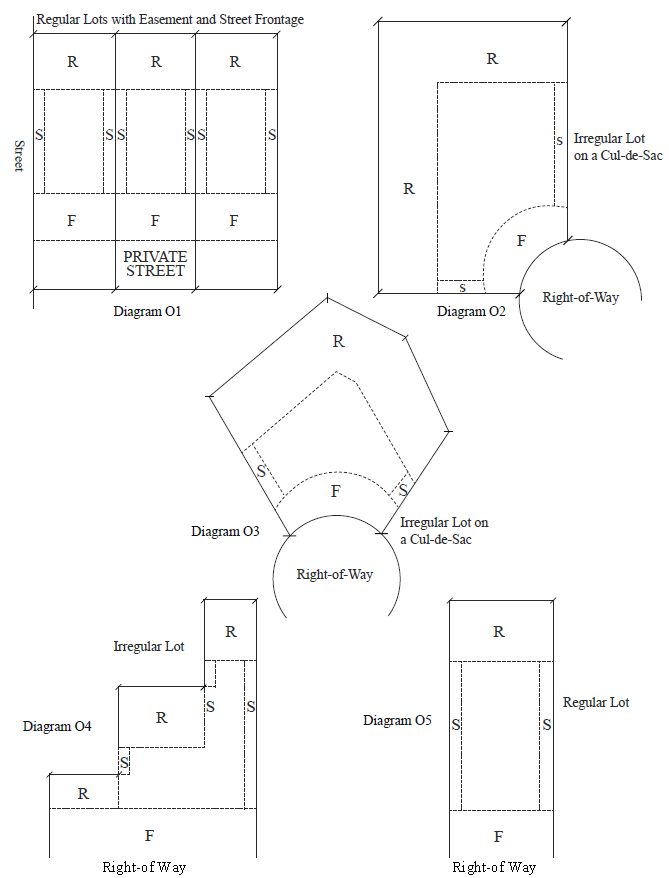
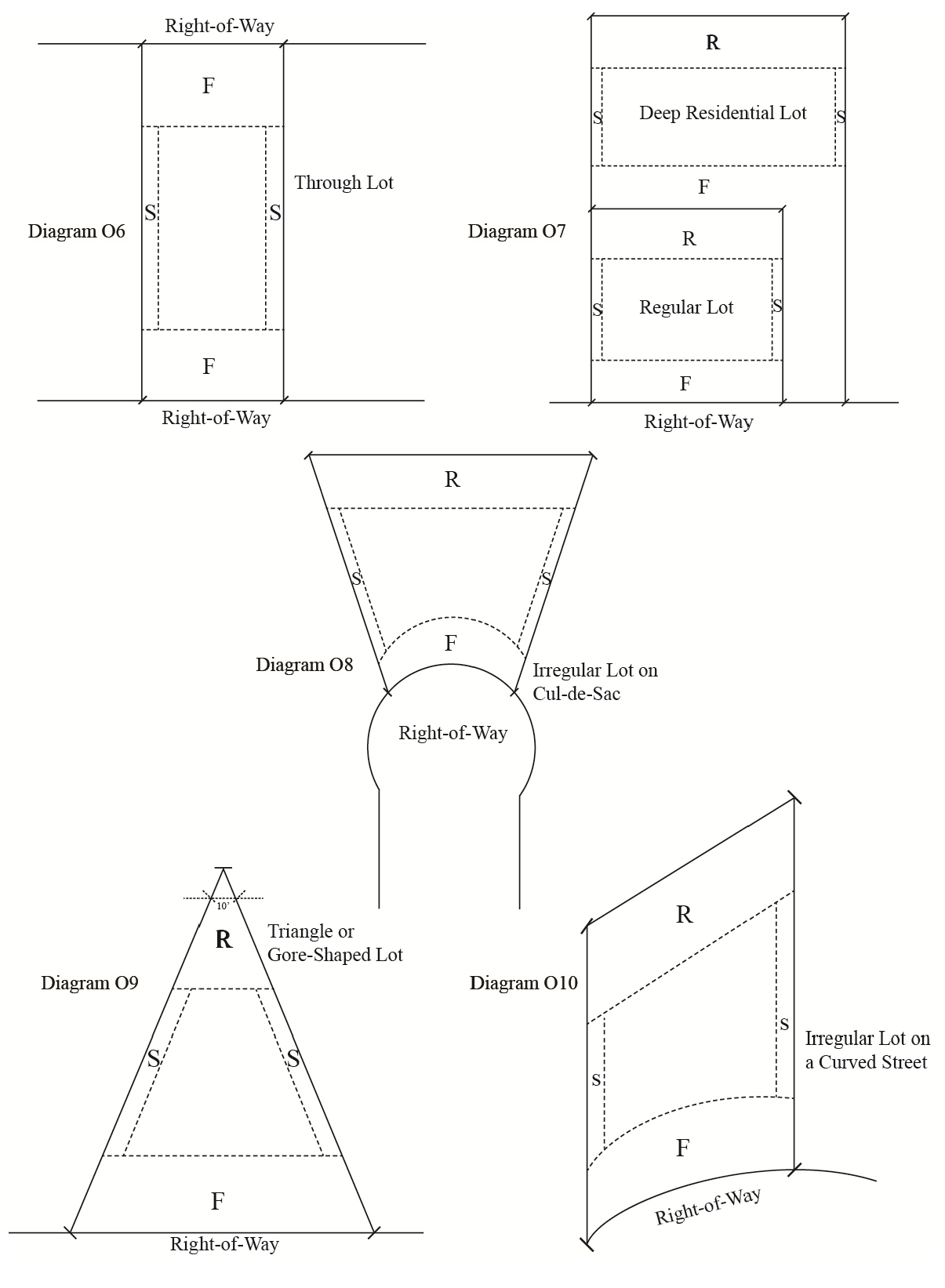
Setback (Maximum or Minimum), Side Yard. The maximum or minimum distance by which any building or structure may be separated from the side lot line.
Setback (Maximum or Minimum), Street Yard. The maximum or minimum distance by which any building or structure may be separated from the front, side or rear lot line when such lot line abuts a street right-of-way.
Shoreland. Lands within the following distances from the ordinary high-water mark of navigable waters: one thousand (1,000) feet from a lake, pond or flowage; three hundred (300) feet from a river or stream or to the landward side of the floodplain, whichever distance is greater.
Signage. An emblem, name, identification, description or illustration which is affixed to or appears directly or indirectly upon a building, structure or piece of land and which directs attention to an object, product, place, activity, person, institution, organization or business. Neither official court or public notices, nor the flag, emblem or insignia of a nation, political unit, school or religious group, shall be considered a sign under this ordinance.
Skilled Nursing Care. A facility for the chronically ill that provides long-term nursing care, rehabilitation, and other services.
Specified Anatomical Areas:
(a)
Less than completely and opaquely covered human genitals, pubic region, buttocks and female breasts below a point immediately above the top of the areola.
(b)
Human male genitals in a discernible turgid state, even if opaquely covered.
Specified Sexual Activities, Simulated or Actual:
(a)
Showing of human genitals in a state of sexual stimulation or arousal.
(b)
Acts of masturbation, sexual intercourse, sodomy, bestiality, necrophilia, sadomasochistic abuse, fellatio or cunnilingus.
(c)
Fondling or erotic touching of human genitals, pubic region, buttock or female breasts.
Split Two-Family Dwelling. See "Dwelling, Two-Family - Twin."
Stepback. A step-like recession in an exterior wall located at a level above the ground floor.
Start of Construction. For the purpose of floodplain regulation only, means the date the building permit was issued, provided the actual start of construction, repair, reconstruction, rehabilitation, addition, placement, or other improvement was within one hundred eighty (180) days of the permit date. The actual start means either the first placement of permanent construction on a site, such as the pouring of slab or footings, the installation of piles, the construction of columns, or any work beyond initial excavation, or the placement of a manufactured home on a foundation. Permanent construction does not include land preparation, such as clearing, grading and filling, nor does it include the installation of streets and/or walkways, nor does it include excavation for a basement, footings, piers or foundations or the erection of temporary forms, nor does it include the installation on the property of accessory buildings, such as garages or sheds not occupied as dwelling units or not part of the main structure. For an alteration, the actual start of construction means the first alteration of any wall, ceiling, floor or other structural part of a building, whether or not that alteration affects the external dimensions of the building.
Storage Facility, Personal Indoor Storage. A facility consisting of individual self-contained storage units or spaces leased to individuals, organizations, or businesses for storage of personal or business property.
Storage Locker (Personal) - A structure operated by a religious institution or nonprofit organization that provides space for individuals to store personal belongings. (Cr. by ORD-16-00109, 12-14-16)
Storefront. The street-level side of a commercial space, such as a store, shop or restaurant that faces the street.
Story. A story is that portion of a building, other than a basement or mezzanine, included between the surface of any floor and the surface of the floor next above it, or if there be no floor above it, then the space between the floor and the ceiling next above it.
(a)
For the purposes of this ordinance, there shall be only one basement which shall be counted as a story when the front exterior wall of the basement level is exposed more than fifty percent (50%).
(b)
Any part of a building that is above the second story and between the eaves and the ridge line of pitched roofs is not a story, but may be occupied as long as the requirements for human occupancy are met. (Am. by ORD-11-00144, 9-11-13)
Street. A public right-of-way which affords traffic circulation and a principal means of access to abutting property. For the purpose of this ordinance, an alley shall not be considered a street.
Street, Primary. On a lot with more than one (1) street frontage, the primary street shall be determined by characteristics including, but not limited to, the frequency of transit service, the level of pedestrian activity, building entrance locations, and the street classification. May be a public or private street. In cases where multiple streets could be the primary street, the owner may choose the primary street, with the consent of Zoning Administrator, based on street characteristics and the effects of such choice on development of the lot itself and on adjacent properties. (Am. by ORD-24-00018, 3-20-24)
Street, Private. A named private right-of-way on a plat designed to public street standards which affords traffic circulation and a principal means of access to abutting property. For the purpose of this ordinance, an alley shall not be considered a private street. (Am. by ORD-23-00013, 1-25-23)
Street, Public. A public right-of-way which affords traffic circulation and a principal means of access to abutting property. For the purpose of this ordinance, an alley shall not be considered a street. Includes officially-mapped streets. (Am. by ORD-23-00013, 1-25-23)
Structural Alteration. Any change other than incidental repairs which would prolong the life of the supporting members of a building, such as bearing walls, columns, beams, girders or foundations.
Structure. A structure is anything constructed or erected, the use of which requires more or less permanent location on the ground, or attached to something having permanent location on the ground, and in the case of flood plain areas, in the stream bed or lake bed.
Structure, Habitable. Any structure or portion thereof used or designed for human habitation.
Substantially Underway. Substantially underway means that a use is commenced or construction is begun and diligently prosecuted toward completion.
Support Structure. For the purposes of mobile service facilities, an existing or new structure that supports or can support a mobile service facility, including a mobile service support structure, utility pole, water tower, building, or other structure. (Cr. by ORD-13-00189, 11-26-13)
Tasting Room. An establishment which offers fermented malt beverages or intoxicating liquors for consumption on the premises that are manufactured or rectified on the premises or at an off-site location associated with the premises. Tasting Rooms may include food sales. (Am. by ORD-18-00118, 12-3-18)
Tavern. An establishment where the principal and primary use is serving fermented malt beverages or intoxicating liquors for consumption on the premises and where food or packaged alcoholic beverages may be served or sold only as accessory to the primary use, and which may serve meals and include kitchen facilities. (Am. by ORD-14-00083, Pub. 4-16-14, Eff. 7-1-14; ORD-16-00050, 5-25-16; Am. by ORD-22-00033, 5-19-22)
Taxicab, Limousine, or Bus Business. A service which offers transportation in passenger automobiles, vans, or busses to persons including those who have a disability in return for remuneration. The business may include facilities for dispatching, servicing, repairing, and fueling the taxicabs, vans or busses. (Am. by ORD-24-00001, 1-17-24)
Telecommunications Center. An office facility that is responsible for transmission, receipt, acceptance, processing, and distribution of incoming and outgoing communications.
Telecommunication Facilities. Any plant or equipment used to carry wireless commercial telecommunications services by radio signal or other electromagnetic waves, including towers, antennas, equipment buildings, parking area and other accessory development.
Telecommunications Tower, Communication Tower. A mast, pole, monopole, guyed tower, lattice tower, free-standing tower, or other structure designed and primarily used to support antennas. A ground or building mounted mast greater than fifteen (15) feet tall and six (6) inches in diameter supporting one or more antennas, dishes, or arrays shall be considered a telecommunications tower. This definition specifically includes Mobile Service Support Structures. (Am. by ORD-13-00189, 11-26-13)
Temporary Outdoor Event. A seasonal or occasional event held on the sidewalk or other location outside a building, where the principal use is non-residential.
Theater, Assembly Hall. A facility for presenting motion pictures or live performances for patrons that provides fixed or designated seating. This term does not include an adult entertainment establishment. (Am. by ORD-14-00083, Pub. 4-16-14, Eff. 7-1-14)
Tiny House. Any movable sleeping or living quarters used as an individual's place of habitation. (Cr. By ORD-21-00061, 9-13-21)
Tiny House Village. Any site, lot, parcel, or tract of land designed maintained, intended or used for the purpose of supplying a location or accommodations for more than three (3) Tiny Houses and may include all buildings included or intended for use as part of the Tiny House Village. (Cr. By ORD-21-00061, 9-13-21)
Tobacco Paraphernalia. Tobacco paraphernalia means cigarette papers or wrappers, pipes, holders of smoking materials of all types, cigarette rolling machines, and any other item designed for the smoking or ingestion of tobacco products. Tobacco paraphernalia includes electronic cigarettes, personal vaporizers, electronic nicotine delivery systems, or any item designed to atomize liquid solutions that simulate smoking. (Cr. by ORD-15-00054, 5-27-15)
Tobacco Products. Tobacco products means any substance containing any tobacco leaf, including but not limited to cigarettes, cigars, bidis, pipe tobacco, snuff, chewing tobacco, and smokeless tobacco. Tobacco products includes e-liquids such as propylene glycol, glycerin, nicotine, flavorings, or other products for use in electronic cigarettes, personal vaporizers, or electronic nicotine delivery systems. (Cr. by ORD-15-00054, 5-27-15)
Tobacco Retailer. A tobacco retailer is any establishment that either devotes twenty percent (20%) or more of floor area or display area to the sale or exchange of tobacco products or tobacco paraphernalia. (Cr. by ORD-15-00054, 5-27-15)
Tourist or Transient. A person who travels to a location away from their permanent address for a short period of time, not to exceed thirty days for vacation, pleasure, recreation, culture, business or employment. (Cr. by ORD-13-00185, 11-5-13)
Tourist Rooming House. A dwelling unit, other than a Hotel, Motel, Bed and Breakfast Establishment or Hostel, in which sleeping accommodations are offered for pay to tourists or transients for stays between one (1) and twenty-nine (29) days. The definition does not include private boarding, lodging or rooming houses not accommodating tourists or transients. (Cr. by ORD-13-00185, 11-5-13; Am. by ORD-20-00036, 4-14-20)
Towing and Wrecker Service Business. A service that includes pulling, pushing or hauling motor vehicles to automobile service station for immediate service, to a garage or body shop for repairs or to a motor vehicle storage or salvage yard.
Traffic. The passage of pedestrians or vehicles along routes of transportation.
Trailer. Any structure which is or may be mounted upon wheels for moving about, and is propelled by its own power or drawn by other motive power, and which is used as a dwelling or as an accessory building or structure in the conduct of a business, trade or occupation, or is used for hauling purposes.
Use. The use of property is the purpose or activity for which the land or building thereon is occupied or maintained.
Use, Accessory. A use on the same lot with, and of a nature customarily subordinate to, the principal use or structure, and serving the occupants of the principal use or structure. (Am. by ORD-19-00051, 7-2-19)
Use, Conditional. A conditional use is a use which, because of its unique or varying characteristics, cannot be properly classified as a permitted use in a particular district.
Use, Incidental. A use that is affiliated with but subordinate to a principal use of land or structure. (Cr. by ORD-19-00051, 7-2-19);p0; Use, Land. In floodplains, any nonstructural use made of unimproved or improved real estate.
Use, Permitted. A permitted use is a use which may be lawfully established in a particular district or districts, provided it conforms with all requirements and regulations of the district in which such use is located.
Use, Principal. A principal use is the main use of land or buildings as distinguished from a subordinate, incidental, or accessory use. (Am. by ORD-19-00051, 7-2-19)
Utility Pole. A structure owned or operated by an alternative telecommunications utility, as defined in s. 196.01 (1d); public utility, as defined in s. 196.01 (5); telecommunications utility, as defined in s. 196.01 (10); political subdivision; or cooperative association organized under ch. 185; and that is designed specifically for and used to carry lines, cables, or wires for telecommunications service, as defined in s. 182.017 (1g) (cq); video service, as defined in s. 66.0420 (2) (y); for electricity; or to provide light. (Cr. by ORD-13-00189, 11-26-13)
Variance, Area. An authorization by the Zoning Board of Appeals for the construction or maintenance of a building or structure in a manner which is inconsistent with dimensional standards contained in the zoning ordinance.
Variance, Use. An authorization by the Zoning Board of Appeals for the use of property in a manner which is inconsistent with the listed uses contained in the zoning ordinance.
Vehicle. Any device in, upon or by which any person or property is or may be transported or drawn upon a highway.
Vending Machine. A stand-alone, self-contained or connected appliance machine located inside or outside a principal building or structure and that dispenses a product.
Veterinary Clinic, Animal Hospital. An establishment for the routine examination, medical or surgical treatment and care of domestic animals, generally with overnight boarding facilities for animals in care but without kenneling of animals.
Violation. In a floodplain, the failure of a structure or other development to be fully compliant with the floodplain zoning ordinance. A structure or other development without required permits, lowest floor elevation documentation, floodproofing certificates or required floodway encroachment calculations is presumed to be in violation until such time as that documentation is provided.
Walk-Up Service Window. A window or door in a commercial establishment which is used for the sale of food or drinks to pedestrians.
Wetland Alteration. Any filling, flooding, draining, dredging, ditching, tiling, excavating, temporary water level stabilization measures or dike and dam construction in a wetland area.
Wetlands. Those areas where water is at, near or above the land surface long enough to support aquatic or hydrophytic vegetation and which have soils indicative of wet conditions.
Warehousing and Storage. An establishment providing storage and distribution of merchandise and bulk goods, typically involving heavy truck and/or freight rail traffic.
Wholesale Establishment. An establishment providing storage, distribution and sale of merchandise and bulk goods, including mail order and catalog sales, importing, wholesale or retail sales of goods received by the establishment but not sale of goods for individual consumption.
Yard. Open space on a zoning lot between the principal building and the adjoining lot lines.
Yard, Front. A yard extending along the full length of the front lot line between the side lot lines.
Yard, Rear. A yard extending along the full length of the rear lot line between the side lot lines.
Yard, Required. See "Setback."
Yard, Side. A yard extending along a side lot line from the front yard to the rear yard.
Yard Sale. Any lawn sale, garage sale, attic sale, rummage sale, moving sale or other similar sale involving the display and/or sale of new and/or used goods on a zoning lot where the principal use is residential.
Zoo. A park that is open to the public, where live wild animals from different parts of the world are kept in enclosures for people to view, and where said animals may be bred or studied.
(Section 28.211 Am. by ORD-13-00086, 5-29-13; Am. by ORD-13-00189, 11-26-13; Am. by ORD-14-00146, 9-12-14; Am. by ORD-20-00059, 6-29-20; Am. by ORD-23-00022, 3-10-23; Cr. by ORD-16-00097, 11-9-16; Am. by ORD-17-00116, 12-1-17; Am. by ORD-24-00001, 1-17-24; Am. by ORD-25-00011, 3-8-25; Am. by ORD-25-00013, 3-20-25; Am. by ORD-25-00023, 4-24-25)