


Madison City Zoning Code
SUBCHAPTER 28I
- GENERAL REGULATIONS
28.129 - BIRD-SAFE GLASS REQUIREMENTS.
(1)
Statement of Purpose. The Bird-Safe Glass Requirements in this section are intended to reduce the heightened risk for bird collisions with glass on specified building designs and configurations.
(2)
Applicability. Subsection (4) applies to all exterior construction and development activity, including the expansion of existing buildings and structures, as specified therein.
(3)
Measuring Glass Area. Under this Ordinance, glass area shall be measured as one (1) continuous panel of glass or other transparent material, or a set of two (2) or more such panels divided by mullions of six (6) inches in width or narrower. Panels surrounded on all sides by solid walls or mullions wider than six (6) inches shall be considered individual windows. Spandrel or opaque glass with reflectivity of 14% or less shall not be included in the calculation of glass area. See Revised Figure 1. (Am by ORD-21-00073, 11-17-21)
Figure 1 - Window Mullion Graphic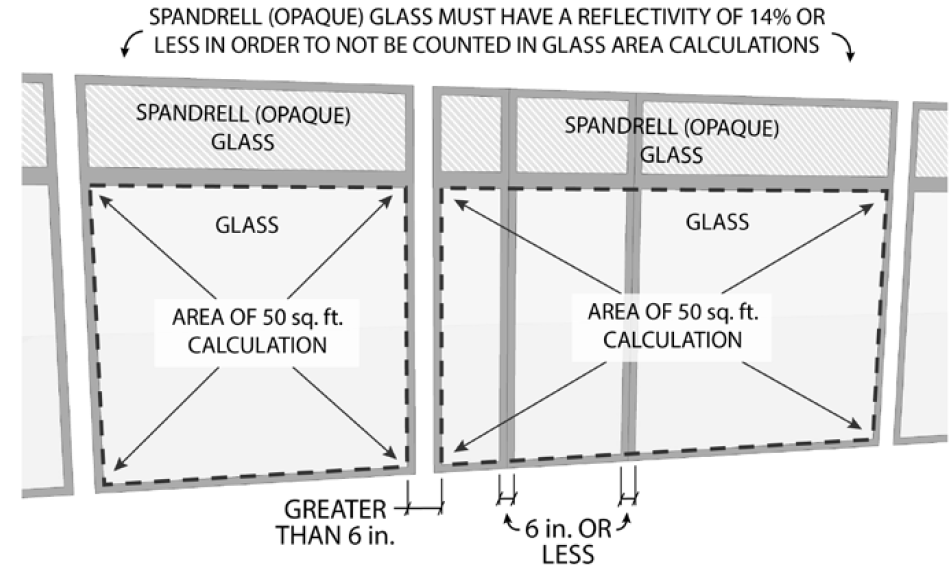
(4)
Bird-Safe Glass Treatment Requirements. Glass areas on the following buildings or structures shall be treated to reduce the risk of bird collisions by incorporating a pattern of visual markers that are either: a) dots or other isolated shapes that are ¼" in diameter or larger and spaced at no more than a two-inch (2") by two-inch (2") pattern; or b) lines that are ⅛" in width or greater and spaced no more than 2" apart; low reflectance opaque materials; building-integrated structures like non-glass double-skin facades, metal screens, fixed solar shading, exterior insect screens, and other features that cover the glass surface; or other similar mitigation treatments approved by the Zoning Administrator.
(a)
Buildings or structures over 10,000 square feet. For any building or structure over 10,000 square feet in size (floor area of above-grade stories), bird-safe glass treatment is required as follows:
1.
For building façades where the first sixty (60) feet (see REVISED Figure 2) from grade are comprised of greater than or equal to fifty percent (50%) glass:
a.
At least eighty-five percent (85%) of the glass must be treated; and
b.
All glass within fifteen (15) feet of a building corner must be treated when see through or fly through conditions exist. See Figure 3.
2.
For building façades where the first sixty (60) feet from grade are comprised of less than fifty percent (50%) glass:
a.
At least eighty-five percent (85%) of the glass on glass areas fifty (50) square feet or over must be treated; and
b.
Of all glass areas over fifty (50) square feet, any glass within fifteen (15) feet of a building corner must be treated.
3.
All glass railings must be treated.
4.
All glass on enclosed building connections shall be treated up to sixty (60) feet above-grade.
(b)
Sky-bridges. For buildings and structures of any size, all glass on above-ground bridges must be treated.
(c)
At-grade glass. For buildings and structures of any size, all at-grade glass features such as sound walls or glass screens must be treated."
(5)
This Ordinance shall become effective on October 1, 2020.
Figure 2 - 60 ft. Graphic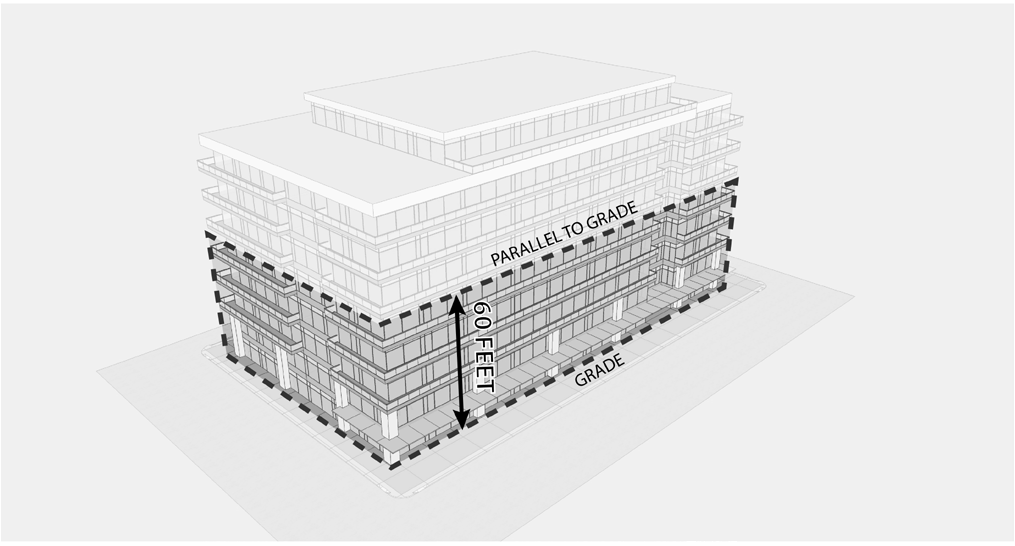
Figure 3 - Glass Corner Graphic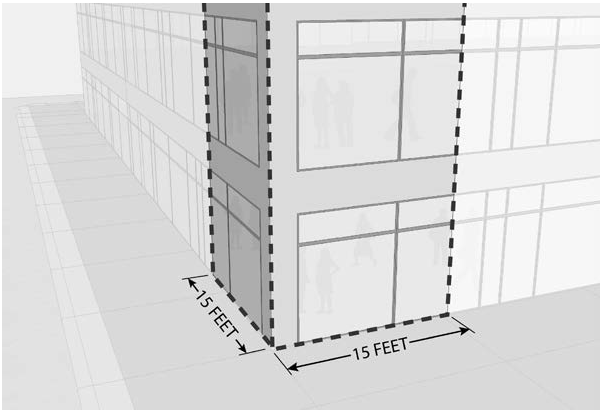
(Cr. by ORD-20-00069, 8-14-20)
28.130 - LOTS WITH INCIDENTAL USES.
Any lot containing a principal use may also contain incidental uses that are affiliated with but subordinate to the principal use. Allowed incidental uses are those specifically included and identified as incidental uses in the district use tables as well as any principal use identified in the district use tables. Incidental uses do not include uses identified as accessory uses in the district use tables.
(Cr. by ORD-19-00051, 7-2-19)
28.131 - ACCESSORY BUILDINGS AND STRUCTURES ON LOTS USED EXCLUSIVELY FOR RESIDENTIAL AND MIXED-USE PURPOSES.
(1)
All accessory buildings and structures on lots in any district used exclusively for residential and mixed-use purposes shall comply with the following requirements:
(a)
Maximum Area Per Lot. Total area of accessory buildings measured at ground floor may not exceed one thousand (1,000) square feet. A larger total building area may be allowed by conditional use approval. The footprint of accessory structures that contain accessory dwelling units shall not be included in the one thousand (1,000) square feet calculation. (Am. by ORD-25-00068, 10-16-25)
(b)
Maximum Height. The height of the principal building or fifteen (15) feet, whichever is lower. The following are exempt from this requirement:
1.
The maximum height of accessory dwelling units shall be determined by the district requirements for zoning districts where such units are allowed.
2.
The maximum height of carriage houses within historic district may be the same as the original height.
(c)
Reserved. (Rpld by ORD-18-00049, 5-14-18)
(d)
Placement. Accessory buildings may be located in the following locations:
1.
Within the building envelope.
2.
In a rear yard setback, a minimum of three (3) feet from any property line.
3.
In a side yard setback, if located behind the rear plane of the principal building at the time of construction, a minimum of three (3) feet from any property line.
4.
In the side or rear yard setback of a corner lot, a minimum distance from the street side lot line equal to the setback required for a principal building in the district.
5.
In the rear yard setback of a reversed corner lot, no closer to the street side lot line than the front yard setback of the adjacent property, for the first twenty-five (25) feet from the common property line. Beyond this distance, the minimum setback shall be equal to the setback required for a principal building in the district.
6.
A minimum of three (3) feet from any principal building and any other accessory building. (Cr. by ORD-13-00007, 1-15-13)
Figure I1: Accessory Building Placement Accessory buildings may be located in shaded
areas.
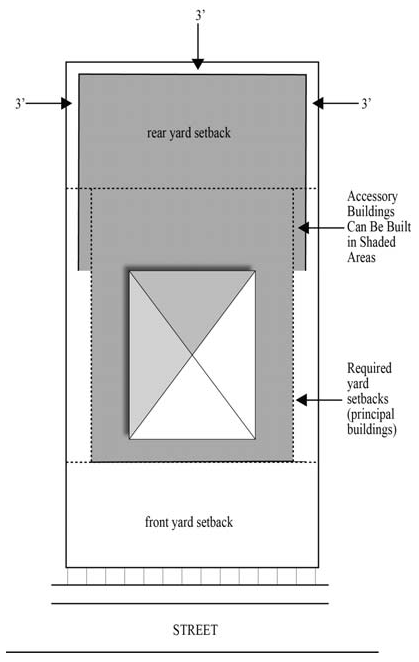
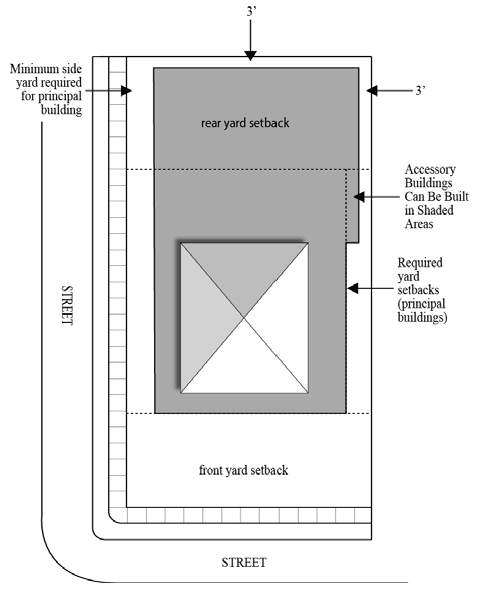
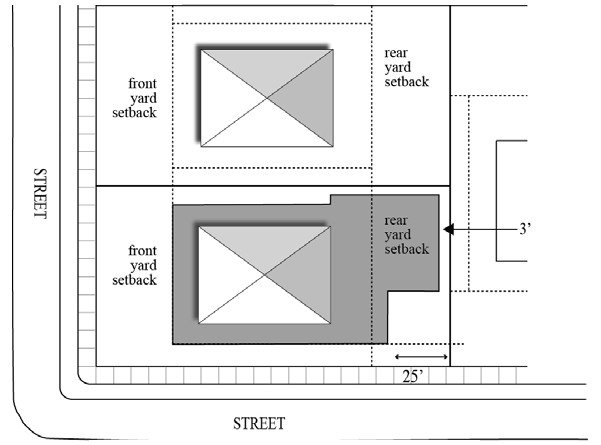
Figure I3: Accessory Building Placement for Reverse Corner Lots. Accessory buildings
may be located in shaded areas.
(Am. by ORD-13-00007, 1-15-13)
(e)
Shared Garages. A detached garage may be constructed across a lot line by abutting property owners, where a garage is permitted within three (3) feet of the lot line, provided that:
1.
A joint driveway shall lead to the garage; and
2.
The property owners shall provide a joint access and maintenance agreement for the use of the garage.
(f)
Side and Rear Yard Garage Replacement. A detached garage located in a side or rear yard may be replaced within the existing setbacks provided that:
1.
The garage is replaced within one (1) year of demolition.
2.
The location and size of the existing or demolished garage shall be verified by the Zoning Administrator.
3.
The replaced garage shall not exceed twenty-four (24) feet in length or width.
4.
Neither the length, width, nor height of the replaced garage shall be more than two (2) feet greater than the length, width, or height of the demolished garage.
5.
No side of the enlarged structure is moved closer to any lot line with which there is a non-conforming setback.
6.
Reserved. (Rpld. by ORD-24-00001, 1-17-24)
(g)
Garages in Embankments in Front Yards. Where the mean natural grade of a front yard is more than eight (8) feet above curb level, a private garage may be erected within the front yard setback, provided that:
1.
The garage shall be located at least five (5) feet from the front lot line; and
2.
At least one-half (½) of the height of the garage shall be below the mean grade of the front yard.
(Am. by ORD-21-00087, 12-15-21)
(2)
Reserved for Future Use. (Rep. by ORD-15-00116, 10-28-15)
28.132 - ENCROACHMENTS INTO SETBACK AREAS.
(1)
Permitted Setback Encroachments.
The following structures or features are allowed encroachments in setback areas. For those encroachments with siting limitations, the maximum distance in feet that the encroachment shall extend into the setback is provided. No subterranean encroachments are allowed except as noted in Table 28I-1.
Table 28I-1.
(Am. by ORD-13-00143, 9-11-13; ORD-16-00051, 5-25-16; ORD-16-00093, 11-9-16; ORD-16-00109, 12-14-16; Am. by ORD-21-00086, 12-15-21; Am. by ORD-22-00107, 10-21-22; Am. by ORD-24-00071, 11-8-24; Am. by ORD-25-00011, 3-8-25)
(2)
Other Encroachment Requirements.
(a)
One (1) story bay windows shall not occupy, in the aggregate, more than one-third (⅓) of the front or side wall or one-half (½) of the rear wall of the building, and shall be located entirely within planes drawn from either main corner of the wall, making an interior angle of twenty-two and one-half (22.5) degrees in the horizontal plane with the wall.
(b)
Compost bins also shall comply with the requirements of Sec. 7.361, MGO.
(c)
Uncovered entrance platforms necessary to comply with current ingress and egress regulations shall be no wider than six (6) feet. Steps from the platform may extend into the setback area for the distance needed to meet minimum building code requirements for risers and treads. Replacement steps for porches may be as wide as the steps being replaced and may extend into the setback area for the distance needed to meet minimum building code requirements for risers and treads.
(d)
Accessibility accommodations as follows:
1.
Wheelchair ramps when the maximum size of the ramp is not greater than the minimum requirements for ramps under Wis. Admin. Code § SPS 321.045. All ramps that are in front or side yard setbacks and are more than three (3) feet from the level of the adjoining ground shall have skirting covering the opening under the ramp and a landscape buffer shall be provided along the base of the ramp.
2.
Off-street parking and loading spaces only if any vehicle parked in the space displays a current parking identification card or license plate for persons with disabilities, issued to a resident at the address; the space has access from a public street, and all other applicable off-street parking requirements are met. If a person requiring a parking space for people with disabilities no longer resides in the dwelling unit, the off-street parking and loading space shall be made to conform to the zoning code either by removal or being rendered incapable of use as an off-street parking or loading space.
(e)
Single-story unheated open or enclosed porches attached to single-family or two-family dwellings may encroach into the rear yard setback if the porch extends no more than fourteen (14) feet from the exterior wall of the building and is no more than sixteen (16) feet wide. In the case of a home with a walk-out basement to the rear yard, the porch may have an additional basement level. (Cr. by ORD-13-00143, 9-11-13)
(f)
For zoning lots located on plats approved before October 1, 1994, the lowest point of the top edge of any egress well projecting into the sideyard setback area shall be at least six (6) inches above the adjoining grade. For zoning lots on plats approved after October 1, 1994, no egress well may project into the sideyard setback area. (Cr. by ORD-15-00082, 8-12-15; Rpl./Rec. by ORD-18-00031, 3-28-18)
(g)
Attached Garage. For single-family or two-family dwellings, a one-story attached garage projection for garage purposes only may project up to thirty percent (30%) into a required rear yard setback, provided the balance of the rear yard setback area shall remain unoccupied and unobstructed from the ground upward. (Cr. by ORD-14-00133, 8-13-14; Renum. by ORD-15-00082, 8-12-15; Am. by ORD-18-00049, 5-14-18; Am. by ORD-18-00094, 10-5-18; Am. by ORD-24-00071, 11-8-24)
(h)
Underground Parking. In any district, underground parking may extend into the rear yard setback if it is located completely below pre-construction existing grade or under a slope of no greater than one (1) to three (3) feet to the lot line and is completely covered by landscape. (Cr. by ORD-16-00051, 5-25-16)
28.133 - ENVIRONMENTAL PROTECTION STANDARDS.
(1)
General Standards.
(a)
All uses shall be conducted so as to prevent or substantially minimize any nuisance, hazard, or commonly recognized offensive conditions, including creation or emission of dust, gas, smoke, noise, fumes, odors, vibrations, particulate matter, chemical compounds, electrical disturbance, humidity, heat, cold, glare, or night illumination.
(b)
No use shall result in the harmful discharge of any waste materials across the boundaries of the subject property or into the ground, into any sanitary or storm sewer system, into ay water body or water system, or into the atmosphere.
(c)
The Zoning Administrator may require evidence of adequate controls on any potential nuisances or hazards prior to issuing a zoning or occupancy certificate.
(2)
Activities Which May Be Potential Hazards or Nuisances.
(a)
Productive Processes. All activities involving the production, processing, cleaning, servicing, testing or repair of materials, goods or products shall be conducted in such a manner whereby there shall be no danger of fire or explosion, no offensive noise, vibration, smoke, dust, odor, glare or heat, and no objectionable influence detrimental to the public health, safety, comfort or general welfare of the immediate neighborhood or community.
(b)
Explosives. Laboratory scale quantities of divisions 1.1 to 1.3 explosives and forbidden explosives as defined by the United States Department of Transportation in 49 CFR § 173.50 and § 173.54, respectively, as amended from time to time, are allowed outside the IG zoning district when stored according to National Fire Protection Association standards and provided that the total amount of all said explosives are two (2) pounds or less per building. Laboratory scale quantities of explosive chemicals must be stored in containers, in quantities no greater than their original shipment quantities.
(c)
Fissionable Non-Fissile Material. The storage, utilization or manufacture of fissionable non-fissile material is allowed in zoning districts other than the Industrial-General District when such use is accessory to a principal use allowed within the zoning district and when licensed or registered, as may be required by state or federal law.
(d)
Fissile Material. The storage, utilization or manufacture of more than one (1) gram of fissile material is permitted only in the Industrial-General (IG) district and only when not less than three hundred (300) feet of a boundary of any other zoning district. However, utilization of fissile material outside the IG district is allowed when the use of such material is in nuclear gauges or calibration instruments, for medical purposes or fission chambers operated by a college or university for instructional purposes and only when said uses are licensed or registered, as may be required by state or federal law.
(3)
Drainage Courses.
(a)
Statement of Purpose. This subsection is established to promote the public health, safety and general welfare of the community by regulating and restricting the development of areas along or in drainageways, channels, streams and creeks. The regulations which follow are intended to protect and to preserve the location, character and extent of such drainageways, channels, streams and creeks, and to protect persons and property from the hazards of development in areas which may be subject to inundation.
(b)
General Regulations.
1.
No building or structure shall be erected within a drainage course. For the purpose of this and the following paragraphs, a drainage course shall include any area such as drainageways, channels, streams and creeks, designated as such on the zoning map and any area designed or intended for use for drainage purposes as shown in a recorded subdivision.
2.
No filling of land shall be permitted within a drainage course, or on any lands within two hundred (200) feet, or more than two hundred (200) feet when so designated on the zoning map, of the center line of such drainage course, except upon issuance of a certificate by the City Engineer that such filling will not obstruct the flow of water or otherwise reduce the water carrying capacity of such drainage course, or impair the design and character of such drainage course.
3.
No excavating of land shall be permitted within a drainage course, or on any lands within two hundred (200) feet, or more than two hundred (200) feet when so designated on the zoning map, of the center line of such drainage course, except upon issuance of a certificate by the City Engineer that such excavating will not divert water from the established channel, will not cause flooding of lands outside such drainage course, will not cause any erosion, and will not otherwise impair the design and character of such drainage course.
4.
No relocation, enclosure or bridging of a drainage course shall be permitted except upon issuance of a certificate by the City Engineer that the location, character and extent of such relocation, enclosure or bridging of the drainage course shall be in the public interest.
5.
The City Engineer may require the submittal of any such information which they consider essential for the proper enforcement of the above regulations.
28.134 - HEIGHT AND BULK REGULATIONS.
(1)
Height Measurements.
(a)
For accessory buildings and structures, height is measured from the average elevation of the approved grade at the front of the building to the highest point of the roof in the case of a flat roof, to the deck line of a mansard roof, and to the midpoint of the ridge of a gable, hip, or gambrel roof. The average height shall be calculated by using the highest ridge and its attendant eave. The eave point used shall be where the roof line crosses the side wall.
(b)
For principal buildings and structures, height is the average of the height of all building facades. For each facade, height is measured from the midpoint of the existing grade to the highest point on the roof of the building or structure. No individual facade shall be more than fifteen percent (15%) higher than the maximum height of the zoning district.
(c)
For new buildings, alterations, additions, or replacement of existing buildings, height shall be measured from the natural grade prior to redevelopment. Natural grade shall be determined by reference to a survey or other information as determined by the Zoning Administrator. (Am. by ORD-13-00007, 1-15-13)
(d)
Height in the DC, UOR, UMX, DR1 and DR2 districts shall be measured from the highest ground elevation point at the building base adjacent to any street facing facade to the highest point on the roof of the building or structure, including all parapets. In these districts accessible roofs, including the minimum structure necessary to provide access, shall not be counted as a story. However, this provision shall not be applied in violation of the Capitol View Preservation Section 28.134(3). (Am. by ORD-23-00043, 3-16-23)
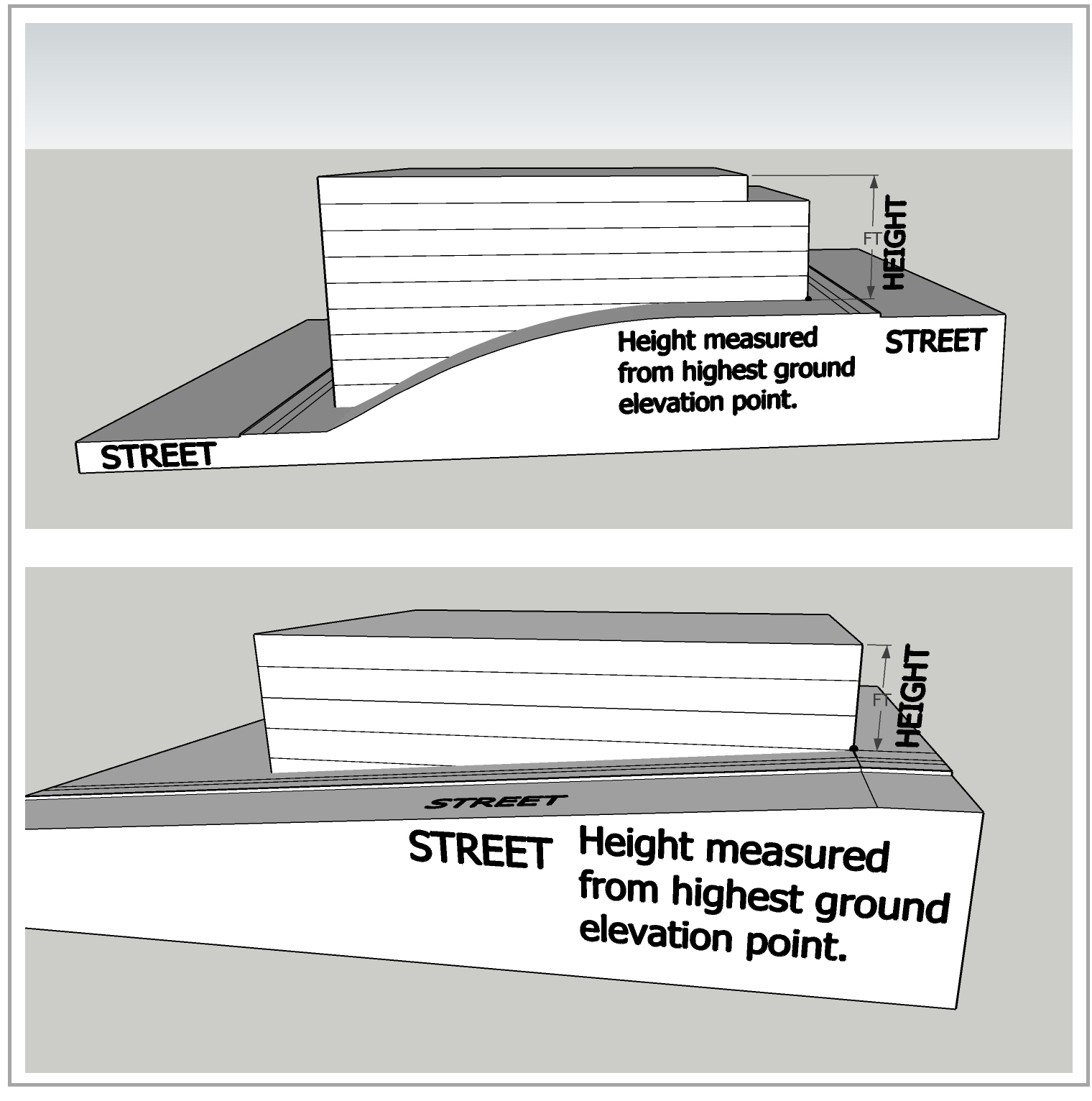
Figue A1: Downtown Building Height
(Am. by ORD-23-00043, 3-16-23)
(2)
Height Limit Exceptions.
The following structures are permitted to exceed the maximum height regulations within any district where the use is allowed: church spires, belfries, cupolas and domes, water towers, flagpoles, chimneys, communication towers and elevator penthouses. All structures shall comply with the provisions of sub. (3) below. (Am. by ORD-13-00189, 11-26-13)
(3)
Capitol View Preservation.
No portion of any building or structure located within one (1) mile of the center of the State Capitol Building shall exceed the elevation of the base of the columns of said Capitol Building or one hundred eighty-seven and two-tenths (187.2) feet, City datum. Provided, however, this prohibition shall not apply to any church spires, flagpoles, communication towers, elevator penthouses, screened air conditioning equipment and chimneys exceeding such elevation, when approved as conditional uses. For the purpose of this subsection, City datum zero (0.00) feet shall be established as eight hundred forty-five and six-tenths (845.6) feet above sea level as established by the United States Coast and Geodetic Survey. (Am. by ORD-19-00081, 11-13-19)
(4)
Airport Height Restrictions.
The regulations contained in the Dane County Code of Ordinances regulating the height and bulk of obstructions to aerial navigation apply to buildings and structures in and around the Dane County Regional Airport. The City of Madison does not enforce these regulations.
(5)
Public Utility Exemptions.
(a)
The following public utility uses, which are essential in most districts, shall be permitted in any zoning district: poles, wires, cables, conduits, vaults, pipelines, laterals or any other similar distributing equipment for a public utility. However, where such public utility uses are proposed to be located across unplatted lands, conditional use approval is required.
(b)
The regulations in this ordinance governing lot size, bulk requirements, and access to improved public streets shall not apply to any lot designed or intended for a public utility and public service use when approved by the Plan Commission.
28.135 - LOT DIVISION, CREATION AND ACCESS.
(1)
Division of Improved Zoning Lots.
Lot division shall be governed by the provisions of Chapter 16, MGO, and the following regulations:
(a)
An improved zoning lot shall not be reduced in size or divided into two (2) or more separate lots unless each lot that results from such reduction or division meets all requirements of the zoning district in which it is located.
(b)
Lot divisions shall comply with the minimum lot size requirements of each zoning district, except that non-buildable lots such as outlots are exempt from minimum lot requirements.
(2)
Access to Public Street.
Every zoning lot shall front on an improved public street, with a minimum of thirty (30) feet of street frontage, with the following exceptions:
(a)
Lots located in an approved planned multi-use site or planned development district, and deep residential lots pursuant to Section 28.135(3), MGO;
(b)
Residential lots not fronting directly onto a public street may be permitted provided that the lots front onto a public or private park and are accessed from a dedicated public alley and meet the following conditions:
1.
The lots and park are shown on an approved subdivision plat or Certified Survey Map;
2.
The lots are addressed and have vehicular access from the public alley;
3.
The residences constructed on the lots abutting the park should have entry doors facing the park; (Am. by ORD-25-00009, 3-8-25)
4.
The park abutting the lots contains an improved walkway or path that provides pedestrian access for the public to the front of the residences abutting lots in the same fashion as a sidewalk adjacent to a street;
5.
The residences provide the minimum required front yard of the zoning district as measured from the lot line formed by the park; and
6.
The park abuts a public street.
(Am. by ORD-13-00176, 10-23-13)
(3)
Development of Deep Residential Lots.
(a)
Statement of Purpose. This subsection is established to allow more intensive development of certain deep residential lots which could not otherwise be fully developed under this or any other development control ordinance.
(b)
General Regulations. The development of a deep residential zoning lot into not more than four (4) zoning lots shall be allowed provided that:
1.
The front lot(s) shall have a width not less than that required in the district in which it is located.
2.
The rear lot shall have frontage onto an improved public street for a width not less than ten (10) feet.
3.
The strip of land of land between the improved public street and the remainder of the rear lot shall not contain any buildings or structures and said strip of land shall not be used to satisfy any area or yard requirement for the rear lot. The rear lot shall be connected to the public street by a strip of land no narrower than 10 (ten) feet.
4.
All of the lots proposed shall comply with the minimum required lot area.
(c)
A building permit for residential construction shall be issued for any zoning lot legally created, pursuant to this section, prior to the effective date of this ordinance.
(Am. by ORD-25-00051, 7-25-25)
28.136 - USE OF TRAILERS AND CONTAINERS.
Trailers and containers used for over-the-road hauling shall not be used for or converted for office, commercial, residential or storage use in any district.
28.137 - ZONING LOTS AND PLANNED MULTI-USE SITES.
(1)
Residential Zoning Lots.
Except in the case of multifamily complexes and planned multi-use sites within the Mixed-Use Center District, no more than one (1) principal detached residential building shall be located on a zoning lot, nor shall a principal detached residential building be located on the same zoning lot with any other nonresidential principal building or use.
(2)
Planned Multi-Use Sites.
The purpose of this subsection is to allow efficient and economical design and greater coordination and flexibility in the development of a variety of building types and land uses, while ensuring substantial compliance with the basic intent of the Zoning Code and Subdivision Regulations.
(a)
A planned multi-use site, as defined, shall have a plan and reciprocal land use agreement approved by the Director of Traffic Engineering, City Engineer and Director of Planning and Community and Economic Development recorded in the office of the Dane County Register of Deeds. (Am. by ORD-23-00098, 10-26-23)
(b)
An existing planned multi-use site may not be changed without approval by the Director of Traffic Engineering, City Engineer and Director of Planning and Community and Economic Development, or approval of the Plan Commission. (Am. by ORD-23-00098, 10-26-23)
(c)
The uses allowed within a planned multi-use site are limited to those uses that are allowed within the zoning district(s) in which the site is located.
1.
A property containing a non-conforming residential use shall not be made part of a planned multi-use site.
(d)
Every planned multi-use site shall front on a public street.
(e)
A planned multi-use site containing more than forty thousand (40,000) square feet of floor area and where twenty-five thousand (25,000) square feet of floor area is designed or intended for retail use or for hotel or motel use, shall require conditional use approval following a recommendation on the design of any specific proposal by the Urban Design Commission. (Am. by ORD-15-00012, 1-28-15; ORD-15-00033, 4-8-15)
(f)
All new retail establishments with a total floor area of forty thousand (40,000) square feet or more that are part of a planned multi-use site are subject to review by the Urban Design Commission under the provisions of Sec. 33.24(4)(f). (Am. by ORD-15-00033, 4-8-15)
(g)
A plan for building placement, shared parking and access and any easement documents necessary to facilitate those plans shall be submitted. Plans shall show the following:
1.
The arrangement of buildings, parking facilities, internal circulation of pedestrians and vehicles, access to individual development sites from public streets and internal drives, and the location of storm drainage facilities, open spaces and any ground-mounted signage.
2.
Identification of uses within the site and the gross square footage of building sites, either for the overall development or for the individual sites within the planned multi-use site.
3.
The general arrangement of individual lots, outlots, tracts, easements, and all dedications to the public resulting from the planned development. The planned multi-use site plan may be used as a preliminary subdivision plat if it includes all of the information required for a preliminary plat under Sec. 16.23(5)(a), MGO.
(Am. by ORD-13-00191, 11-26-13)
28.138 - LAKEFRONT DEVELOPMENT.
(1)
Statement of Purpose. This subsection is established to further the maintenance of safe and healthful conditions by preserving and enhancing water quality, habitats, viewsheds, and other environmental and aesthetic qualities of lakes through the regulation of zoning lots abutting lakes within the City.
(2)
Applicability.
(a)
With the exception of (b) below, all new principal buildings, additions to principal building totaling in excess of five hundred (500) square feet during any ten (10) year period, or any accessory building on zoning lots abutting Lake Mendota, Lake Monona, Lake Wingra, Monona Bay, and associated bays, shall require conditional use approval and shall meet the requirements of this subsection.
(b)
Conditional use approval and the requirements of this subsection shall not apply to any part of a zoning lot abutting Lake Mendota, Lake Monona, Lake Wingra, Monona Bay, and associated bays that is more than three hundred (300) feet from the Ordinary High Water Mark (OHWM) or is separated from the OHWM by a street or public right of way.
(3)
General Regulations.
(a)
Upon the filing of an application for a conditional use, the development plan shall show a complete inventory of shoreline vegetation in any area proposed for building, filling, grading or excavating. In addition, the development plan shall indicate those trees and shrubbery which will be removed as a result of the proposed development. The cutting of trees and shrubbery shall be limited in the strip thirty-five (35) feet inland from the normal waterline. On any zoning lot not more than thirty percent (30%) of the frontage shall be cleared of trees and shrubbery. Within the waterfront setback requirements tree and shrub cutting shall be limited by consideration of the effect on water quality, protection and scenic beauty, erosion control and reduction of the effluents and nutrients from the shoreland.
(b)
Any building development for habitation shall be served with public sanitary sewer.
(c)
Filling, grading and excavation of the zoning lot may be permitted only where protection against erosion, sedimentation and impairment of fish and aquatic life has been assured.
(d)
Where the City's adopted Comprehensive or other Plans include a pedestrian walkway or bike path along the shoreline, the proposed development shall not interfere with its proposed location.
(e)
Construction of marine retaining walls or bulkhead may be permitted providing such construction does not protrude beyond the established shoreline of the adjacent properties. Said retaining walls and bulkheads will be permitted only for the purpose of preventing shoreline recession. The filling and grading of the shoreline shall occur only in the construction of such retaining walls or bulkheads.
(f)
Lot coverage within thirty-five (35) feet of the OHWM shall not exceed twenty percent (20%). Public paths within this area shall not be included in the lot coverage limit.
(g)
In addition to complying with the above standards, boathouses shall not be constructed for human habitation.
(4)
Lakefront Zoning Lots Where the Principal Use is One (1) or Two (2) Family Residential.
(a)
Lakefront Yard Setback. The yard that abuts the lake shall be referred to as the "lakefront yard." The minimum depth of the lakefront yard setback from the Ordinary High Water Mark shall be calculated using one of four (4) following methods, provided that in no case shall principal buildings be located closer to the OHWM than twenty-five (25) feet. (Am. by ORD-24-00071, 11-8-24)
1.
The average setback of the principal building on the two (2) adjoining lots, provided that the setbacks of those buildings are within twenty (20) feet of one another; or
2.
If the subject property only abuts one developed lot, the setback of the existing principal residential structure on that abutting lot; or
3.
The median setback of the principal building on the five (5) developed lots or three hundred (300) feet on either side, whichever is less (see illustration).
4.
If none of the three (3) methods above apply, the minimum lakefront yard setback is seventy-five (75) feet.
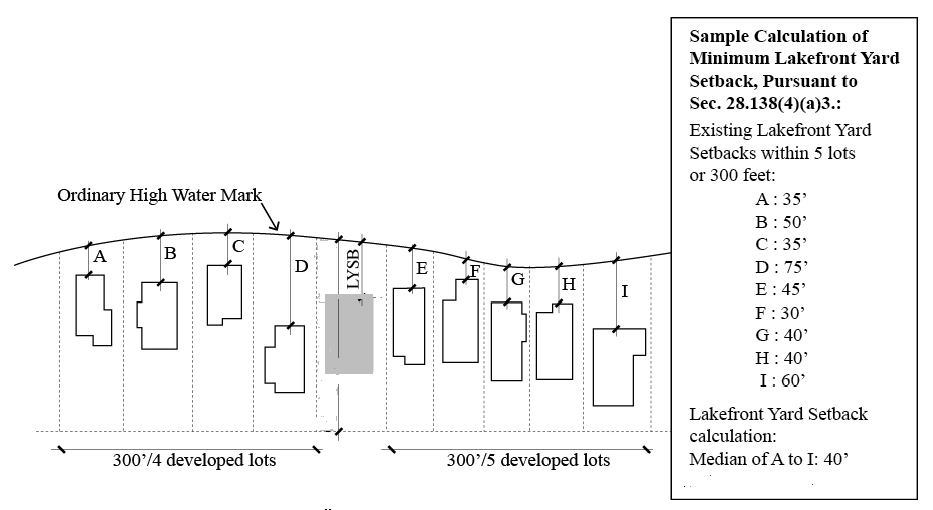
Figure I4: Lakefront Yard Setback.
(Am. by ORD-13-00190, 11-26-13; Am. by ORD-25-00039, 6-27-25)
(5)
Lakefront Zoning Lots Where the Principal Use is Other Than One (1) or Two (2) Family Residential or Public Park Land.
(a)
Lakefront Yard Setback. The yard that abuts the lake shall be referred to as the "lakefront yard". (Am. by ORD-13-00190, 11-26-13Am. by ORD-24-00071, 11-8-24)
(b)
The minimum setback from the OHWM shall be calculated using one of the following three (3) methods, provided that in no case shall a new principal building be located closer to the OHWM than seventy-five (75) feet.
1.
The average setback of the principal buildings on the two (2) adjoining lots, provided that the setbacks of those buildings are within twenty (20) feet of one another, or
2.
The median setback of the principal building on the five (5) developed lots or three hundred (300) feet on either side, whichever is less.
3.
If neither of the two (2) methods above apply, the minimum lakefront yard setback is seventy-five (75) feet.
(c)
Where the existing principal building setback is less than the lakefront average or median setback as identified in paragraphs 1. and 2. above, an addition to the existing principal building may only be constructed provided that:
1.
The addition shall not be located closer to the OHWM than the lakefront setback of the existing principal building; and
2.
The addition shall not exceed fifty percent (50%) of the width of the principal building façade facing the lake.
(Am. by ORD-25-00039, 6-27-25)
28.139 - DEVELOPMENT ADJACENT TO PUBLIC PARKS.
(1)
Nonresidential development immediately adjacent to the boundary of a City-owned public park shall be reviewed as a conditional use. The purpose of this requirement is to assess the impact of proposed development on natural resources, drainage patterns, pedestrian traffic and recreational uses of the park. Conditional use applications shall include the following:
(a)
A complete inventory of vegetation in any area proposed for development within one hundred (100) feet of the park boundary.
(b)
Any proposed cutting of trees or removal of vegetation within one hundred (100) feet of the park boundary. Removal of vegetation may be limited within thirty-five (35) feet of the park boundary.
(c)
Grading and drainage within thirty-five (35) feet of the park shall be reviewed for its effect on drainage patterns and vegetation within the park.
(Am. by ORD-14-00068, 4-16-14)
28.140 - RESERVED.
Editor's note— ORD-25-00011, published March 8, 2025, repealed § 28.140, which pertained to usable open space and derived from ORD-14-00148, 9-12-14; ORD-16-00039, 4-8-16; ORD-16-00107, 12-14-16; ORD-18-00049, 5-14-18.
28.141 - PARKING AND LOADING STANDARDS.
(1)
Statement of Purpose.
This section establishes minimum and maximum parking requirements, and standards for the layout and design of parking spaces, lots and structures. It also includes shared parking incentives, and reduction of off-street parking in favor of transit or other travel modes. The standards in this section are intended to:
(a)
Encourage reduction of surface parking as a means of reducing dependence on private automobiles and reducing the pollution and congestion that are associated with automobile use.
(b)
Encourage reduction of impervious surface to control run-off.
(c)
Encourage reduction of surface parking as a means of fostering more compact development patterns and encouraging transit, bicycle and pedestrian circulation.
(d)
Minimize the adverse effects of off-street parking and loading on adjacent properties.
(e)
Minimize spillover of on-street parking in neighborhoods. (Am. by ORD-23-00013, 1-25-23)
(f)
Encourage shared parking arrangements that will support mixed-use development and compact development patterns.
(g)
Encourage bicycle circulation by providing bicycle connections, adequate parking, and storage space for bicycles.
(h)
Encourage parking locations that do not disrupt Madison's traditional streetscape.
(2)
Organization of this Section.
Certain districts do not require off-street parking, as set forth in Table 28I-2. Where off-street parking is required, Table 28I-3 establishes the minimum number of automobile parking spaces required, the maximum number of automobile parking spaces permitted, and the minimum number of bicycle parking spaces required, for the uses indicated. Off-street parking may be waived or reduced under specific conditions, as set forth in Table 28I-4.
(3)
No Minimum Parking Required.
In the Central area, as defined, and the following districts, there is no specified minimum requirement for off-street parking of automobiles, with the exceptions specified in Table 28I-2 below. Maximum parking and bicycle parking requirements apply as specified in Table 28I-3. For conditional uses, parking requirements may be established as a condition of approval in cases with minimum parking requirements. (Am. by ORD-23-00013, 1-25-23)
Table 28I-2. Districts With No Minimum Automobile Parking Requirements; Exceptions.
(Am. by ORD-14-00168, 12-3-14; ORD-15-00033, 4-8-15; Am. by ORD-21-00008, 2-10-21; Am. by ORD-23-00013, 1-25-23; Am. by ORD-25-00042, 6-27-25)
(4)
Off-Street Parking Requirements, Applicability.
Table 28I-3 establishes the minimum number of automobile parking spaces required, the maximum number of automobile parking spaces permitted, and the minimum number of bicycle parking spaces required, for the uses indicated. Compliance with this Section is required in the case of any change in use or occupancy. Where the Zoning Administrator determines the minimum or maximum parking requirement, consideration shall be given to the expected number of public visiting the site, as well as the number of persons employed or residing on the site.
(a)
Number of Employees. Where number of employees is used to determine parking, it shall be based on the number of employees on the maximum working shift at the time the occupancy permit is requested. Parking requirements based on number of employees will not change unless new construction or expansion is proposed.
(b)
Floor Area Calculation. Floor area used to calculate parking and loading requirements is defined as the sum of the gross horizontal areas of the floors or parts of a building devoted to the use, measured from the exterior faces of the exterior walls or from the center line of walls separating two buildings. It does not include porches, garages, or space in a basement or cellar when used for storage or incidental uses.
(c)
Bicycle Space Minimum. A minimum number of two (2) bicycle spaces (the equivalent of one two-sided bike rack) is required for nonresidential uses.
(d)
Computation. Fractional space requirements of up to one-half (½) space shall be rounded down to the next whole number and greater than one-half (½) rounded up to the next whole number.
(e)
Parking Requirements For Persons With Disabilities. The provisions contained in Wis. Stat. §§ 101.12, 346.503, and 346.56 and any related Wisconsin Administrative Code sections are hereby adopted by reference and made applicable to all parking facilities whenever constructed.
(f)
Unspecified Uses. Where buildings are constructed without uses specified, the use with the highest parking requirement among all uses specified for the zoning district where the site is located shall be used to calculate off-street parking requirements.
(g)
Unlisted Uses. For uses not listed in Table 28I-3, the Zoning Administrator also may consider the following:
1.
Documentation regarding the actual parking and loading demand for the proposed use.
2.
Evidence in available planning and technical studies relating to the proposed use.
3.
Required parking and loading for the proposed use as determined by comparable jurisdictions.
4.
Examination of the parking and loading requirements for uses most similar to the proposed use.
Table 28I-3. Off-Street Parking Requirements.
(Am. by ORD-13-00007, 1-15-13; ORD-14-00143, 9-12-14; ORD-16-00052, 5-25-16; Am. by ORD-23-00013, 1-25-23)
(5)
Adjustments to Minimum Number of Required Spaces. Where minimum parking is required, the following adjustments may be made, as outlined in Table 28I-4.
Table 28I-4. Minimum Parking Adjustments/Reductions.
(Am. by ORD-23-00013, 1-25-23; Am. by ORD-24-00018, 3-20-24)
(6)
Parking in Excess of the Maximum Number of Spaces.
(a)
Underground or structured parking may exceed the maximum requirement in Table 28I-3.
(b)
Surface parking exceeding the maximum may be allowed as follows:
1.
For non-residential uses, the applicant may exceed the maximum parking requirement by the lesser of five (5) parking spaces or ten percent (10%) of the maximum parking requirement.
2.
An additional increase of up to twenty (20) spaces above the maximum requirement may be approved by the Zoning Administrator.
3.
An increase of more than twenty (20) parking spaces but not more than ten percent (10%) of the maximum parking requirement may be approved by the Director.
4.
An increase of more than twenty (20) parking spaces that is also more than ten percent (10%) of the maximum parking requirement may be approved by conditional use.
(c)
Approval of surface parking exceeding the maximum shall be granted only after considering the following:
1.
Documentation regarding the actual parking demand for the proposed use.
2.
The impact of the proposed use on the parking and roadway facilities in the surrounding area.
3.
Whether the proposed use is located near a parking area that is available to the customers, occupants, employees and guests of the proposed use.
4.
The availability of alternative forms of transportation and actions being taken by the applicant to enhance or promote those alternatives.
5.
Structured parking, rain gardens or other bioretention facilities, additional landscaping, pervious pavement, or other mitigation measures may be required as conditions for an exception.
6.
Whether the proposed use is new or is an alteration, addition or expansion of an existing use.
(d)
Zoning lots and uses that exceed maximum parking requirements as of the effective date of this ordinance may continue to maintain existing parking but shall not increase that parking without conditional use approval.
(7)
Shared Parking Requirements.
The Zoning Administrator may authorize a reduction in the total number of required parking spaces for two or more uses jointly providing off-street parking when their respective hours of peak operation do not overlap. Shared parking shall be located within one thousand three hundred twenty (1,320) feet of each use served.
(a)
Computation. The number of shared spaces for two or more distinguishable land uses shall be determined by the following procedure:
1.
Multiply the minimum parking required for each individual use, as set forth in Table 28I-3, by the appropriate percentage indicated in the table, for each of the six (6) designated time periods.
2.
Add the resulting sums for each of the six (6) columns.
3.
The minimum parking requirement shall be the highest sum among the six (6) columns resulting from the above calculations.
4.
Select the time period with the highest total parking requirement and use that total as the shared parking requirement.
(b)
Other Uses. If one or more of the uses proposing shared parking is not found in Table 28I-5, the applicant shall submit sufficient data to indicate the principal operating hours of the uses. Based upon this information, the Zoning Administrator shall determine the appropriate shared parking requirement for use in the calculation in (a) above.
(c)
Alternative Procedure. The Zoning Administrator may authorize a greater reduction in the total number of required parking spaces for two (2) or more uses where an applicant believes that Table 28I-5 does not adequately account for circumstances unique to the particular property or properties in question and the applicant submits, at a minimum, a parking study with a detailed description of the proposed uses, hours of operation, anticipated peak parking demand, and anticipated hours that such peak parking demand would occur. The Zoning Administrator may impose reasonable conditions to mitigate potential negative effects.
Table 28I-5. Shared Parking Calculations.
(d)
The shared parking spaces shall be maintained as long as the uses they serve are in operation.
(e)
The required number of bicycle parking spaces will be provided.
(f)
The property owner or owners shall sign and record, with the Dane County register of deeds, a written agreement, in a form satisfactory to the City Attorney, that there will be no substantial change in the use or occupancy of the property or properties that will increase the demand for parking in the shared parking facility. This agreement shall also include a statement that the property owner or owners and their tenants shall be provided access to, and use of, the shared parking facility. A copy of the agreement shall be filed with the Director.
(8)
Parking Design and Location.
Parking for automobiles and other motor vehicles shall be designed according to the requirements of Sec. 10.08, MGO and the following standards.
(a)
Surfacing. All parking lots and driveways shall have paved or approved surfaces, as required in Sec. 10.08, MGO. The use of permeable paving, as defined, is encouraged for all parking spaces provided above the minimum number required by this chapter.
1.
Residential drives serving single- to two-family dwellings may contain a grass center provided that the areas on which the vehicle's wheels touch are a minimum of twelve (12) inches in width.
(b)
Snow Removal. In winter months, required parking areas, including bicycle parking areas, shall be cleared of snow within a reasonable time. Areas used for snow storage shall be approved by the zoning administrator.
(c)
Parking Locations for Single and Two-Family Dwellings. (Am. by ORD-24-00018, 3-20-24)
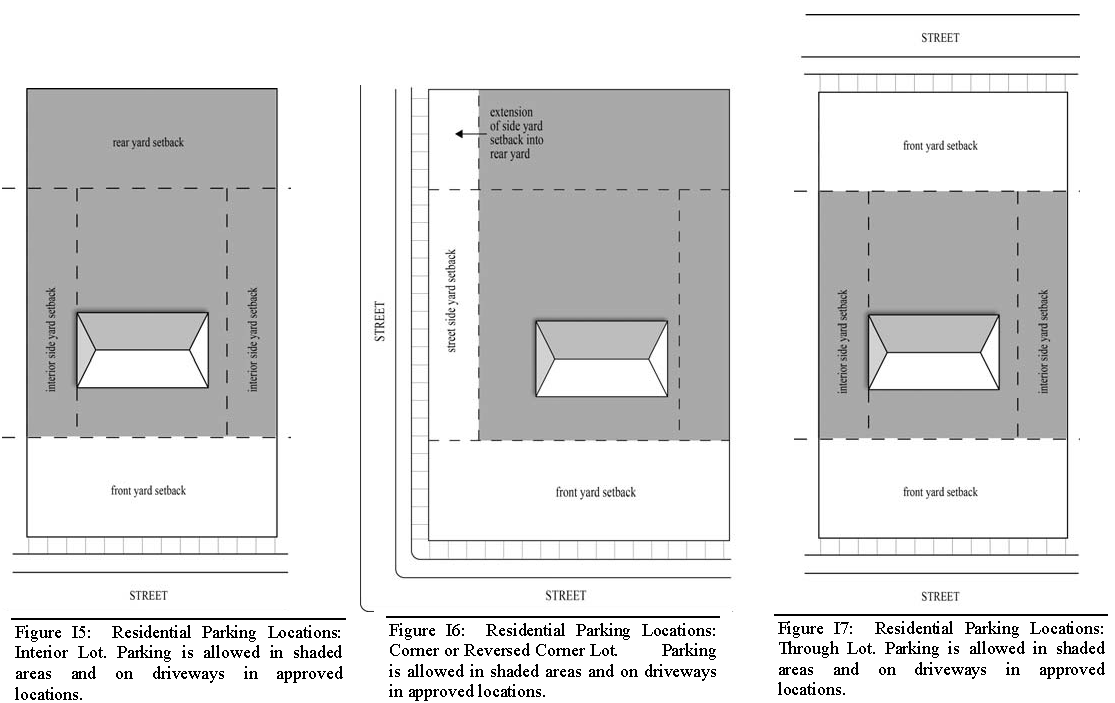
(See Figures I5, I6, and I7)
1.
Parking is not permitted within front yard setbacks, or any street side yard setback, including the side yard setback extension into the rear yard, except on a driveway meeting the standards of Subsection (9) below.
2.
Parking shall not be located on street terraces, driveways, or any other areas located within a public right-of-way not explicitly designated by the Director of Public Works.
3.
Parking spaces may be located within:
a.
an interior side yard setback.
b.
a rear yard setback, except as in sub. 1 above. (Am. by ORD-14-00133, 8-13-14)
c.
the building envelope.
4.
Parking on a Through Lot. Through lots are defined as having two (2) front yards and no rear yard. Parking on a through lot may be located within the building envelope, or an interior side yard setback, but not in either front yard setback.
5.
A maximum of forty percent (40%) of the front setbacks may be paved and used for driveway and parking purposes provided lot coverage requirements are not exceeded. (Am. by ORD-18-00049, 5-14-18)
(d)
Landscaping and Screening. All off-street surface parking areas shall be landscaped according to the standards of Sec. 28.142, with the exception of parking for single-family detached, two-family and three-family dwellings. (Am. by ORD-24-00018, 3-20-24)
(e)
Electric Vehicle Charging Station Requirements. Parking facilities shall be designed and built to meet the following requirements:
1.
Applicability. The requirements of this subdivision shall apply to any new parking facility, or to any parking facility that is expanded by 10,000 square feet, as measured in parking spaces being created after January 1, 2021. A parking facility may be maintained or reconstructed without triggering the requirements of this subdivision. However, where more than 10,000 square feet of the paving and base in place on January 1, 2021 is removed from an existing surface parking lot and new paving and base is installed, these requirements shall apply. (Am. by ORD-24-00018, 3-20-24)
2.
Where 6 or more parking spaces are being provided for residential uses, the following standards must be met:
3.
Where parking is being provided for certain uses where people park vehicles in excess of six hours, as specified in this paragraph, the following standards must be met:
a.
The requirements of this paragraph shall apply to the following uses:
i.
College, University or Similar Institutions of Higher Learning;
ii.
Hotel, Inn, Motel;
iii.
Hospital and Health Clinic;
iv.
Office;
v.
Parking Facility, Private and Public;
vi.
Schools, Arts, Technical or Trade; or,
vii.
Any other use, except for those specified in subparagraph b., where people are typically expected to park vehicles in excess of six hours.
b.
The requirements of this paragraph shall not apply to the following uses:
i.
Manufacturing;
ii.
Restaurants;
iii.
Retail;
iv.
Service Business; or,
v.
Warehousing and Storage.
4.
Accessible Stations. Accessible charging stations shall be provided based on the following:
5.
Computation. Fractional space requirements of up to one-half (½) space shall be rounded down to the next whole number and greater than one-half (½) rounded up to the next whole number.
(Am. by ORD-21-00001, 1-19-21)
(9)
Driveway Design and Location for Single and Two-Family Dwellings. (Am. by ORD-24-00018, 3-20-24)
Driveways shall be designed according to the requirements of Sec. 10.08, MGO, and the following standards.
(a)
Driveways shall be a minimum of eight (8) feet in width, except where otherwise specified in Sec. 10.08, MGO.
(b)
Driveways may be located in the following locations:
1.
Within a front yard setback or street side yard setback, including the extension of the side yard setback into the rear yard setback (see Figures I8 and I9). The driveway must lead only from a street to the nearest garage or to a parking area located in compliance with Subsection (8)(c) above. Maximum driveway width is the width of the garage entrance or parking area, up to a maximum of twenty-two (22) feet.
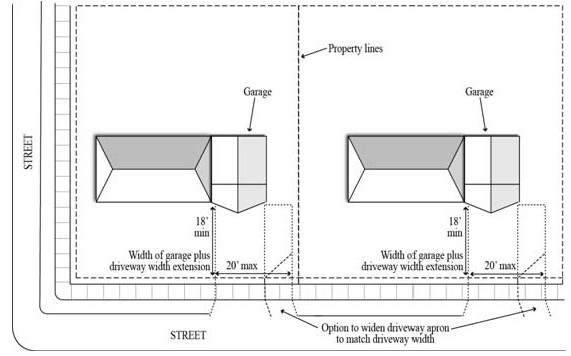
Figure I17: Driveway width extension
2.
Driveways leading to an attached or detached garage at a single- or two-family dwelling may be located in the front setback area and be wider than the width of the garage entrance if the driveway width extension meets the following standards (see Figure I17):
i.
The total width of the driveway and driveway width extension in the front yard setback does not exceed twenty (20) feet.
ii.
The total depth of the driveway including the driveway width extension shall be no less than eighteen (18) feet, and no vehicle parked in the driveway shall extend over or otherwise obstruct any portion of the public right-of-way.
iii.
The driveway width extension shall only project toward the nearest interior side lot line, beyond the exterior side wall of the garage structure.
iv.
Access to the driveway and driveway width extension shall be no wider than the width of the driveway and driveway width extension at the sidewalk or street property line.
(Sec. 28.141(9)(b)2. Cr. by ORD-17-00018, 2-20-17)
3.
Within an interior side yard setback, leading to a garage or parking area located in compliance with Subsection (8)(c) above (see Figure I8). Maximum driveway width is ten (10) feet, which shall not be exceeded within the front yard setback. No setback between the driveway and the side lot line is required. (Renum. by ORD-17-00018, 2-20-17)
(c)
Two (2) driveways may be constructed within a front yard setback or, on a corner lot, within the street side yard setback, including the extension of the side yard setback into the rear yard setback, if the following standards are met (see Figure I10):
1.
Each driveway is a maximum of eleven (11) feet wide, or ten (10) feet within an interior side yard setback.
2.
Both driveways meet at a point outside the required front, street side or side yard extension setbacks.
3.
Both driveways lead to the same garage or to the same paved or graveled parking area located in compliance with Subsection (8)(c) above.
(d)
Two (2) driveways may be constructed to serve twin dwellings (two-family dwellings separated by a common wall). Each dwelling may have one (1) driveway that meets the requirement of par. (c) above, with a maximum width equal to the width of the garage entrance or parking area, not to exceed twenty-two (22) feet.
(e)
A maximum of two (2) curb cuts are permitted for any residential lot.
(f)
Driveways may be shared between two single- or two-family lots, provided that appropriate easements or other agreements are established. Shared driveways shall meet the minimum and maximum width requirements of this section.
(g)
Driveways shall be oriented in a perpendicular fashion to the street from which they take access, and shall cross required setbacks in a perpendicular fashion, to the extent feasible.
(h)
Driveways serving commercial or industrial uses shall not cross residentially-zoned properties, except where allowed by conditional use.
Figure I8: Interior and Street Side Yard Driveway
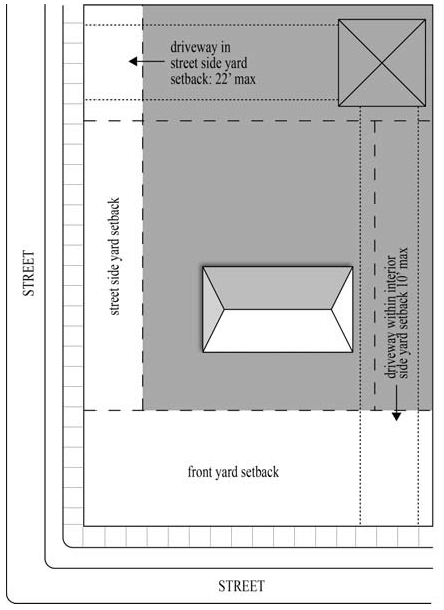
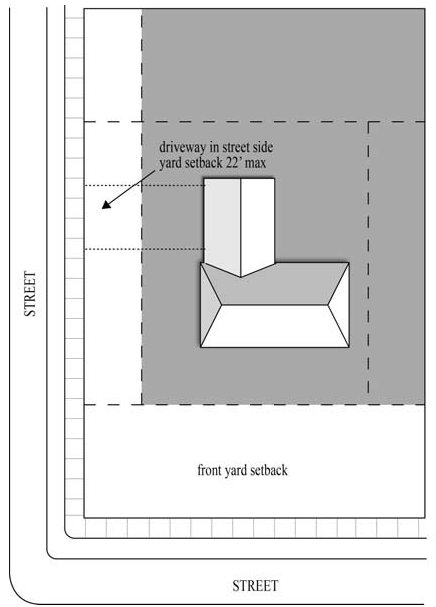
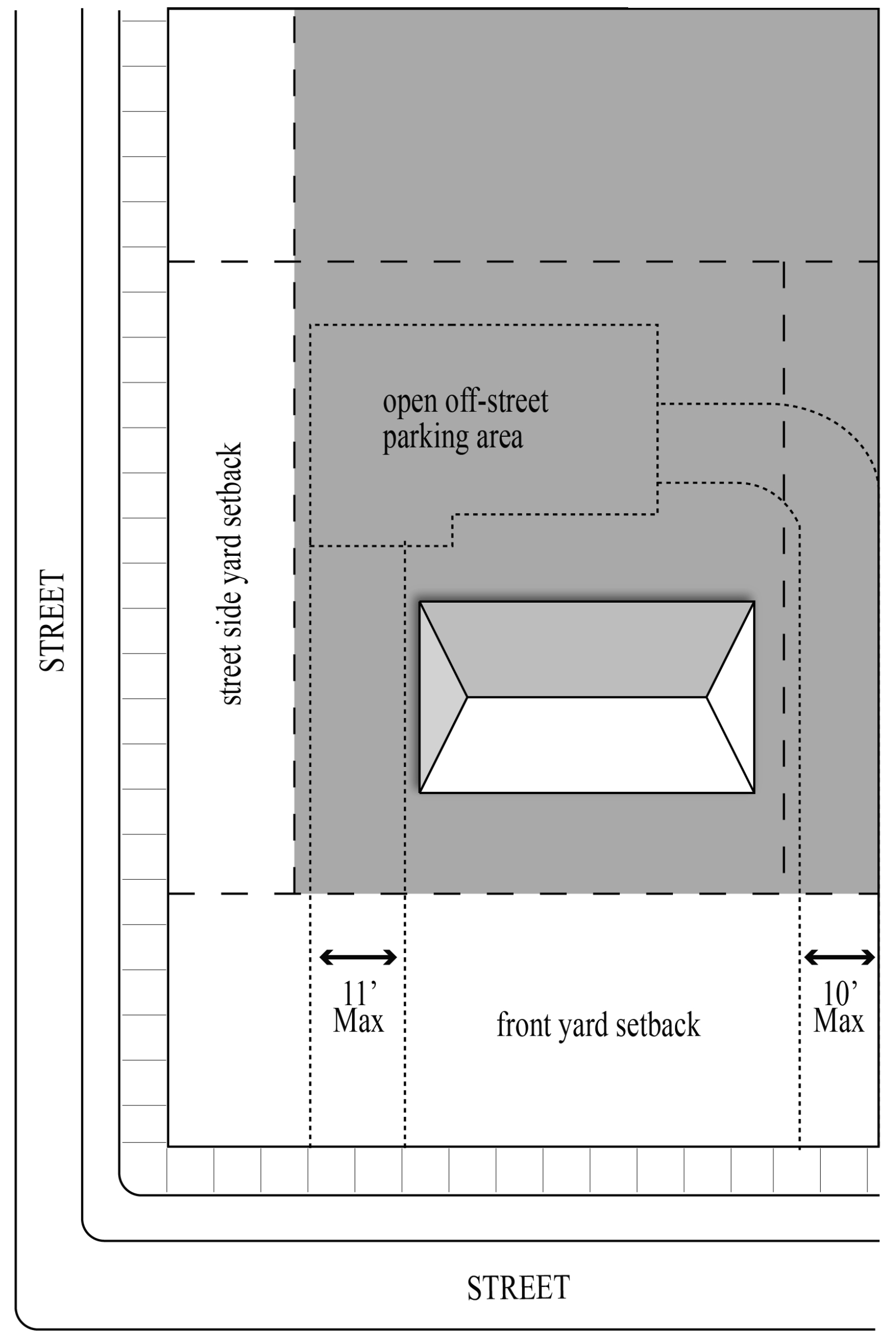
Figure I10: Two Driveways on a Residential Lot
(10)
Restrictions on Residential Parking.
(a)
A maximum of one (1) commercial vehicle per dwelling unit may be parked outdoors on residential property if the vehicle is:
1.
Used by a resident of the dwelling unit.
2.
Has a manufacturer's gross vehicle weight rating of ten thousand (10,000) pounds or less and is less than twenty-one (21) feet in length.
(b)
Vehicles and/or equipment not normally associated with a residential use are specifically prohibited from being parked or stored on residential property. Such vehicles include, but are not limited to:
1.
Construction equipment, such as bulldozers, backhoes, skid steers, and forklifts.
2.
Dump and stake body style trucks.
3.
Cube type vans and trucks.
4.
Landscaping business equipment such as tractors, tree spades, graders and scrapers.
5.
Semi-trailers and tractors.
6.
Concession, vending and catering trailers.
7.
Commercial/Industrial equipment trailers and lifts.
8.
Tow trucks, wreckers or car carriers.
9.
Limousines.
(c)
A mobile recreational vehicle (RV) associated with residential uses may be parked as a passenger vehicle but shall not be utilized for living space or storage of goods, materials or equipment other than is considered part of the RV or essential to its function. (Am. by ORD-13-00086, 5-29-13)
(d)
All vehicles parked on a residential lot shall display current license plates and be in safe, functional and operable condition.
(11)
Bicycle Parking Design and Location.
(a)
Parking Designation. Bicycle parking requirements are as shown in Table 28I-3 and shall be designated as long-term or short-term parking.
1.
For all residential uses, including those in combination with other uses, at least ninety percent (90%) of required resident bicycle parking shall be designed as long-term parking. Any guest parking shall be designed as short-term parking. Except as allowed in Secs. 28.141(11)(f)-(h) below, all bicycle parking shall be ground mount non-vertical, and have a six (6) foot vertical clearance.
2.
For all other uses, at least ninety percent (90%) of all bicycle parking shall be designed as short-term parking.
(b)
Required short-term bicycle parking spaces shall be located in a convenient and visible area at least as close as the closest non-accessible automobile parking and within one hundred (100) feet of a principal entrance and shall permit the locking of the bicycle frame and one (1) wheel to the rack and shall support a bicycle in a stable position. No fee shall be charged for resident bicycle parking where free auto or moped parking is provided on-site.
(c)
Required long-term bicycle parking spaces shall be located in enclosed and secured or supervised areas providing protection from theft, vandalism and weather and shall be accessible to intended users. Required long-term bicycle parking for residential uses shall not be located within dwelling units or within deck, patio areas, or private storage areas accessory to dwelling units. With permission of the Zoning Administrator, long-term bicycle parking spaces for non-residential uses may be located off-site within three hundred (300) feet of the site. No fee shall be charged for resident bicycle parking where free auto or moped parking is provided on-site.
(d)
Bicycle parking spaces shall be located on paved or pervious, dust-free surface with a slope no greater than three percent (3%). Surfaces shall not be gravel, landscape stone, or wood chips.
(e)
Bicycle parking spaces shall be a minimum of two (2) feet by six (6) feet. There shall be an access aisle a minimum of five (5) feet in width. Each required bicycle parking space must be accessible without moving another bicycle and its placement shall not result in a bicycle obstructing a required walkway. Bicycle racks shall be installed to the manufacturer's specifications, including the minimum recommended distance from other structures. (Am. by ORD-13-00007, 1-15-13)
(f)
Up to twenty-five percent (25%) of bicycle parking may be structured parking, vertical parking or wall mount parking, provided there is a five (5) foot access aisle for wall mount parking.
(g)
Bicycle parking not meeting dimensional or access aisle requirements may be installed but shall not count towards a minimum bicycle parking requirement.
(h)
All racks shall accommodate cable locks and "U" locks including removing the front wheel and locking it to the rear fork and frame.
(i)
Bicycle parking substituted for auto parking may be horizontal or vertical, as long as dimensional requirements are met.
(j)
For multi-building development, bicycle parking shall be provided for each building.
(12)
Moped Parking Design and Location.
Where moped or scooter off-street parking is provided, it shall meet the following standards:
(a)
Spaces shall be a minimum of three (3) feet by six (6) feet in size with a vertical clearance of six (6) feet and with a drive aisle of five (5) feet.
(b)
The spaces may be located close to bicycle parking areas but kept separate and out of the way of conflict with other motor vehicle traffic. Moped parking shall not be located within front yard setback areas.
(c)
Spaces shall be located and access should be provided such that the use or crossing of pedestrian facilities, including wheelchair ramps, by mopeds is discouraged and such that mopeds do not come into conflict with pedestrians on foot or in wheelchairs.
(d)
Access to moped areas should be provided using a separate driveway via a curb cut and ramp or mountable curb with a reduced slope after taking into account traffic movements on the street from which safe access must be provided.
(e)
Moped driveways may cross a sidewalk as may any driveway but must not use the sidewalk to provide access to moped stalls. Moped parking areas behind a sidewalk should be separated by a curb when possible.
(13)
Off-Street Loading Requirements.
Any use which has a floor area of ten thousand (10,000) square feet or more, and which requires deliveries or makes shipments, shall provide off-street loading facilities in accordance with the regulations of this Section. (Am. by ORD-15-00033, 4-8-15)
(a)
Location. All loading berths shall be located twenty-five (25) feet or more from the intersection of two street right-of-way lines. Loading berths shall not be located within any required front yard or street side yard setback area. All loading areas shall be located on private property and shall not be located within, or interfere with, any public right-of-way.
(b)
Required number of spaces are based on the size of the establishment as follows, but may be reduced through conditional use approval:
(Am. by ORD-13-00097, 6-12-13; ORD-15-00033, 4-8-15)
(c)
Size of Spaces. A required off-street loading space shall be at least ten (10) feet wide by at least thirty-five (35) feet in length for structures less than twenty thousand (20,000) square feet in floor area, and at least ten (10) feet wide by fifty (50) feet in length for larger structures. The above areas shall be exclusive of aisle and maneuvering space, and shall have a vertical clearance of at least fourteen (14) feet. (Am. by ORD-15-00033, 4-8-15)
(d)
Shared Loading. Two or more uses on adjacent zoning lots may share a loading area.
(e)
Uses for which off-street facilities are otherwise required but which are located in structures of less than twenty thousand (20,000) square feet of floor area may use drive aisles or other suitable areas on the same lot for loading purposes.
(f)
Surfacing. All open off-street loading areas shall be paved with a bituminous pavement or Portland cement concrete pavement in accordance with City of Madison standards and specifications.
(g)
Motor Vehicle Idling.
1.
No property owner shall cause or permit the engine of any motor vehicle to operate in idle for longer than five (5) consecutive minutes while stopping, standing, or parking except when actively loading or unloading of property or passengers.
2.
Exceptions. The following periods of idling by any motor vehicle shall be exempted from sub. (1) of this Section:
(a)
Idling as needed when the ambient temperature is below twenty degrees Fahrenheit (20°F) or above ninety degrees Fahrenheit (90°F);
(b)
Idling as needed to operate defrosters, heaters, air conditioners, or other equipment, to prevent a health or safety emergency, including for the purpose of providing shelter;
(c)
Idling as needed for testing, servicing, repairing, or diagnostic purposes;
(d)
Idling as needed to operate auxiliary equipment for which the motor vehicle was designed, other than transporting goods, including, but not limited to, operating a transportation refrigeration unit, lift, crane, pump, drill, hoist, or ready mixed concrete mixer; and
(e)
Idling as needed for traffic conditions over which the driver has no control, including, but not limited to, traffic congestion, an official traffic control device or signal, a railroad crossing while a train is passing or the crossbars are down, traffic controls in a construction zone, or at the direction of a law enforcement official.
3.
Any property owner violating Paragraph 1. shall be subject to a forfeiture of not less than twenty dollars ($20) nor more than three hundred fifty dollars ($350) for the first offense, a forfeiture of not less than three hundred fifty dollars ($350) nor more than five hundred dollars ($500) for the second or subsequent conviction within seven (7) years, and a forfeiture of not less than five hundred dollars ($500) nor more than seven hundred dollars ($700) for the third or subsequent conviction within seven (7) years.
(Am. by ORD-17-00091, 9-13-17)
28.142 - LANDSCAPING AND SCREENING REQUIREMENTS.
(1)
Statement of Purpose.
The landscaping and screening requirements specified in this section are intended to:
(a)
Protect and restore the natural environment throughout the development process.
(b)
Reduce the negative environmental effects of development while fostering aesthetically pleasing development which will protect and enhance the appearance, character, health, safety and welfare of the community.
(c)
Reduce the "heat island" effect of impervious surfaces such as surface parking lots by cooling and shading the surface area. (Am. by ORD-24-00018, 3-20-24)
(d)
Increase the compatibility of adjacent uses, by minimizing adverse impacts of noise, dust and other debris, motor vehicle headlight glare or other artificial light intrusions and other objectionable views, activities or impacts to adjacent or surrounding uses.
(e)
Enhance the environment for successful plant establishment and growth.
(f)
Enhance the green infrastructure of the city to help reduce air pollutants, create ambiance, mitigate the urban heat island effect and stormwater run-off issues.
(2)
Applicability.
(a)
Subsections (3) through (10) apply to all exterior construction and development activity, including the expansion of existing buildings, structures and surface parking lots, except the construction of detached single-family and two-family dwellings and their accessory structures. The entire development site must be brought up to compliance with this section unless all of the following conditions apply, in which case only the affected areas need to be brought up to compliance: (Am. by ORD-24-00018, 3-20-24)
1.
The area of site disturbance is less than ten percent (10%) of the entire development site during any ten-(10) year period.
2.
Floor area is only increased by ten percent (10%) during any ten-(10) year period. (Am. by ORD-15-00033, 4-8-15)
3.
No demolition of a principal building is involved.
4.
Any displaced landscaping elements must be replaced on the site and shown on a revised landscaping plan.
(b)
Subsection (11) applies to all exterior construction and development activity, including the expansion of existing buildings, structures and surface parking lots and the construction of detached single-family and two-family dwellings and their accessory structures. (Am. by ORD-24-00018, 3-20-24)
(Am. by ORD-16-00021, 3-7-16)
(3)
Landscape Plan and Design Standards.
Landscape plans shall be submitted as a component of a site plan, where required, or as a component of applications for other actions, including zoning permits, where applicable. Landscape plans for zoning lots greater than ten thousand (10,000) square feet in size must be prepared by a registered landscape architect.
Overall composition and location of landscaped areas shall complement the scale of the development and its surroundings. In general, larger, well-placed contiguous planting areas shall be preferred to smaller, disconnected areas.
(a)
Elements of the landscape plan shall include the following:
1.
Plant list including common and Latin names, size and root condition (i.e. container or ball & burlap).
2.
Site amenities, including bike racks, benches, trash receptacles, etc.
3.
Storage areas including trash and loading.
4.
Lighting (landscape, pedestrian or parking area).
5.
Irrigation.
6.
Hard surface materials.
7.
Labeling of mulching, edging and curbing.
8.
Areas of seeding or sodding.
9.
Areas to remain undisturbed and limits of land disturbance.
10.
Plants shall be depicted at their size at sixty percent (60%) of growth.
11.
Existing trees eight (8) inches or more in diameter.
12.
Site grading plan, including stormwater management, if applicable.
(b)
Plant Selection. Plant materials provided in conformance with the provisions of this section shall be nursery quality and tolerant of individual site microclimates.
(c)
Mulch shall consist of shredded bark, chipped wood or stone installed at a minimum depth of two (2) inches. If stone is used, it shall be spread over weed barrier fabric. (Am. by ORD-18-00086, 9-14-18)
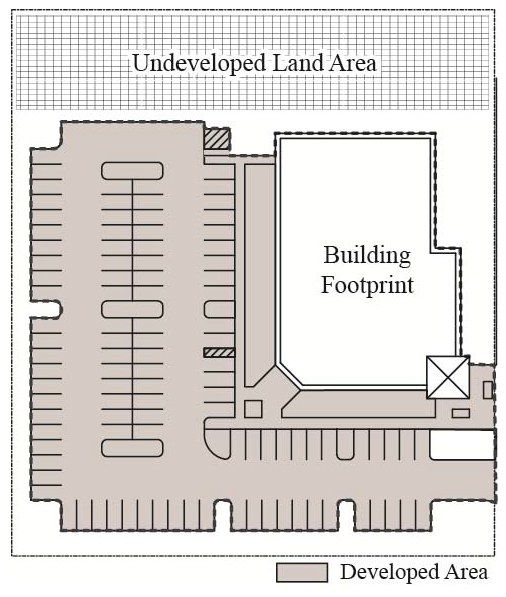
Figure I11: Developed Area for Calculating Landscape Requirements.
(4)
Landscape Calculations and Distribution.
Required landscaped areas shall be calculated based upon the total developed area of the property. Developed area, for the purpose of this requirement, is defined as that area within a single contiguous boundary which is made up of structures, surface parking, driveways and docking/loading facilities, but excluding the area of any building footprint at grade, land designated for open space uses such as athletic fields, and undeveloped land area on the same zoning lot. (Am. by ORD-24-00018, 3-20-24)
(a)
Five (5) landscape points shall be provided for each three hundred (300) square feet of developed area. However,
1.
For lots larger than five (5) acres, points shall be provided at five (5) points per three hundred (300) square feet for the first five (5) acres, and one (1) point per one hundred (100) square feet for all additional acres.
2.
For the IL and IG districts, one (1) point shall be provided per one hundred (100) square feet.
(b)
Where required landscaping cannot be accommodated due to building placement on site, the Zoning Administrator may modify or waive the point requirements.
(c)
Landscape points are calculated as shown in the following table.
*as determined by ANSI, ANLA—American standards for nursery stock. For each size, minimum plant sizes shall conform to the specifications as stated in the current American Standard for Nursery Stock.
(Am. by ORD-25-00036, 6-13-25)
(d)
Landscaping shall be distributed throughout the property along street frontages, within surface parking lot interiors, and as foundation plantings as specified in subsections (5) through (8) below, or as general site landscaping. (Am. by ORD-24-00018, 3-20-24)
(e)
Planting beds or planted areas must have at least seventy-five percent (75%) vegetative cover mulched.
(f)
Canopy tree diversity requirements for new trees:
1.
If the development site has fewer than five (5) canopy trees, no tree diversity is required.
2.
If the development site has between five (5) and fifty (50) canopy trees, no single species may comprise more than thirty-three percent (33%) of trees.
3.
If the development site has more than fifty (50) canopy trees, no single species may comprise more than twenty percent (20%).
(g)
Not more than four (4) of any one species of canopy tree shall be used to meet a canopy tree requirement.
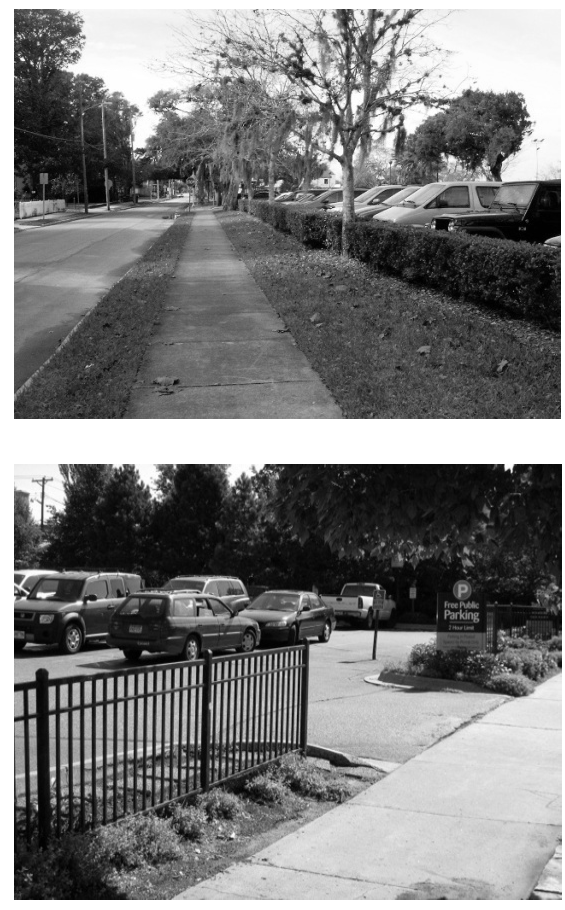
Figures I12-13: Development Frontage Landscaping Examples.
(5)
Development Frontage Landscaping.
Landscaping and/or ornamental fencing shall be provided between buildings or parking areas and the adjacent street(s), except where buildings are placed at the sidewalk. Landscape material shall include a mix of plant material meeting the following minimum requirements:
(a)
One (1) overstory deciduous tree and five (5) shrubs shall be planted for each thirty (30) lineal feet of lot frontage. Two (2) ornamental trees or two (2) evergreen trees may be used in place of one (1) overstory deciduous tree.
(b)
In cases where building facades directly abut the sidewalk, required frontage landscaping shall be deducted from the required point total.
(c)
In cases where development frontage landscaping cannot be provided due to site constraints, the zoning administrator may waive the requirement or substitute alternative screening methods for the required landscaping.
(d)
Fencing shall be a minimum of three (3) feet in height, and shall be constructed of metal, masonry, stone or equivalent material. Chain link or temporary fencing is prohibited.
(6)
Interior Surface Parking Lot Landscaping.
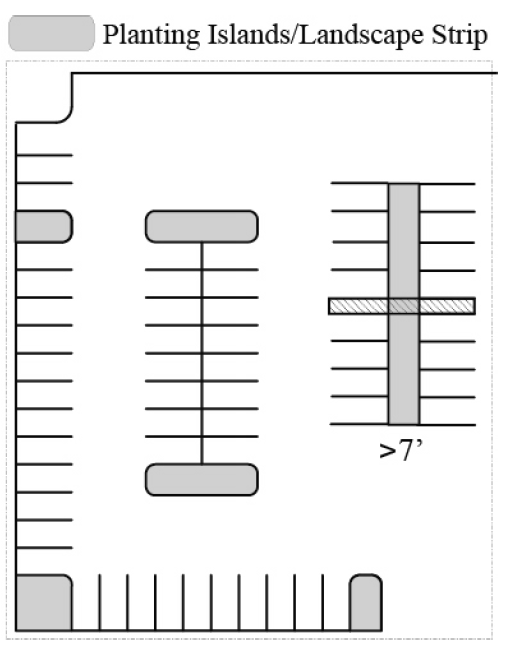
Figure I14: Interior Surface Parking Lot Landscaping.
The purpose of interior surface parking lot landscaping is to improve the appearance of surface parking lots, provide shade, and improve stormwater infiltration. All surface parking lots with twenty (20) or more parking spaces shall be landscaped in accordance with the following interior surface parking lot standards.
(a)
For new development on sites previously undeveloped or where all improvements have been removed, a minimum of eight percent (8%) of the asphalt or concrete area of the surface parking lot shall be devoted to interior planting islands, peninsulas, or landscaped strips. For changes to a developed site, a minimum of five percent (5%) of the asphalt or concrete area shall be interior planting islands, peninsulas, or landscaped strips. A planting island shall be located at least every twelve (12) contiguous stalls with no break or alternatively, landscaped strips at least seven (7) feet wide between parking bays.
(b)
The primary plant materials shall be shade trees with at least one (1) deciduous canopy tree for every one hundred sixty (160) square feet of required landscaped area. Two (2) ornamental deciduous trees may be substituted for one (1) canopy tree, but ornamental trees shall constitute no more than twenty-five percent (25%) of the required trees. No light poles shall be located within the area of seventy-five percent (75%) of mature growth from the center of any tree.
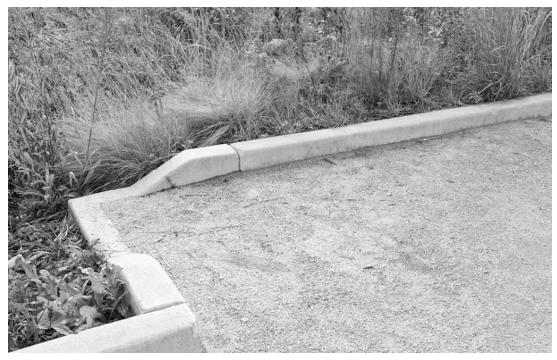
Figure I15: Interior Surface Parking Lot Landscaping Example.
(c)
Islands may be curbed or may be designed as uncurbed bio-retention areas as part of an approved low impact stormwater management design approved by the Director of Public Works. The ability to maintain these areas over time must be demonstrated. (See Chapter 37, Madison General Ordinances, Erosion and Stormwater Runoff Control.)
(Am. by ORD-24-00018, 3-20-24)
(7)
Foundation Plantings.
Foundation plantings shall be installed along building facades, except where building facades directly abut the sidewalk, plaza, or other hardscape features. Foundation plantings shall consist primarily of shrubs, perennials, and native grasses. The Zoning Administrator may modify this requirement for development existing prior to the effective date of this ordinance, as long as improvements achieve an equivalent or greater level of landscaping for the site.
(8)
Screening Along District Boundaries.
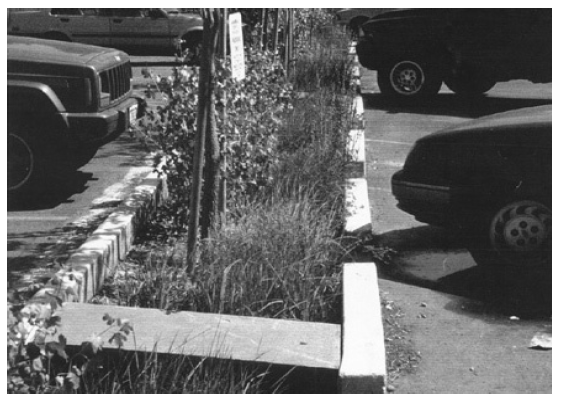
Figure I16: Interior Surface Parking Lot Landscaping Example.
Screening shall be provided along side and rear property boundaries between commercial, mixed-use or industrial districts and residential districts. Screening shall consist of a solid wall, solid fence, or hedge with year-round foliage, between six (6) and eight (8) feet in height, except that within the front yard setback area, screening shall not exceed four (4) feet in height. Height of screening shall be measured from natural or approved grade. Berms and retaining walls shall not be used to increase grade relative to screening height. For conditional uses, the Plan Commission may modify these requirements.
(9)
Screening of Other Site Elements.
The following site elements shall be screened in compatibility with the design elements, materials and colors used elsewhere on the site, as follows:
(a)
Refuse Disposal Areas. All developments, except single family and two family developments, shall provide a refuse disposal area. Such area shall be screened on four (4) sides (including a gate for access) by a solid, commercial-grade wood fence, wall, or equivalent material with a minimum height of six (6) feet and not greater than eight (8) feet.
(b)
Outdoor Storage Areas. Outdoor storage areas shall be screened from abutting residential uses with a building wall or solid, commercial-grade wood fence, wall, year-round hedge, or equivalent material, with a minimum height of six (6) feet and not greater than eight (8) feet. Screening along district boundaries, where present, may provide all or part of the required screening.
(c)
Loading Areas. Loading areas shall be screened from abutting residential uses and from street view to the extent feasible by a building wall or solid, commercial-grade wood fence, or equivalent material, with a minimum height of six (6) feet and not greater than eight (8) feet. Screening along district boundaries, where present, may provide all or part of the required screening.
(d)
Mechanical Equipment. All rooftop and ground level mechanical equipment and utilities shall be fully screened from view from any street or residential district, as viewed from six (6) feet above ground level. Screening may consist of a building wall or fence and/or landscaping as approved by the Zoning Administrator.
(Am. by ORD-14-00001, 1-14-14)
(10)
Maintenance.
The owner of the premises is responsible for the watering, maintenance, repair and replacement of all landscaping, fences, and other landscape architectural features on the site. All planting beds shall be kept weed free. Plant material that has died shall be replaced no later than the upcoming June 1.
(11)
Fences, Walls and Hedges.
Fences and hedges may be erected, placed, or maintained in any yard along or adjacent to a lot line in accordance with the requirements identified in this section. The owner shall be responsible for properly locating all property lines before construction or installation of any fence or hedge.
(a)
Height in Residential Districts.
1.
The maximum height of a screening fence or screening hedge within required interior side and rear setbacks in a residential zoning district shall not exceed six (6) feet. An ornamental fence or ornamental hedge may exceed six (6) feet in height. A screening fence or screening hedge of up to eight (8) feet in height may be placed on a district boundary line between a residential district and a mixed-use, commercial or employment district, or where adjacent to a public utility or public service use.
2.
Screening fences around pools shall not exceed eight (8) feet.
3.
Screening fences within the building envelope shall not exceed eight (8) feet.
4.
The maximum height of a screening fence or screening hedge within a required front or street side yard setback shall not exceed four (4) feet, in height with the following exceptions:
a.
A screening fence or screening hedge of up to six (6) feet in height may be placed within a street side yard setback behind the rear plane of the principal building.
b.
The height of a screening fence or screening hedge within a street side yard setback may be increased to a maximum of six (6) feet in height if it is set back a minimum of four (4) feet from the street side yard property line.
5.
The maximum height of an ornamental fence located in a front yard is five (5) feet if the fence is less than fifty percent (50%) opaque, and six (6) feet if the fence is less than twenty percent (20%) opaque.
(b)
Height in Mixed-Use or Nonresidential Zoning Districts. The maximum height of a screening fence or screening hedge shall not exceed eight (8) feet except in required front or street side yard setbacks where the maximum height of a screening fence or screening hedge shall not exceed four (4) feet.
(c)
Height Measurement. Fence or hedge height shall be measured from natural or approved grade. In the case of grade separation, such as the division of properties by a retaining wall, fence or hedge height shall be determined based on measurement from the average point between highest and lowest grade. If the fence or hedge is set back from the retaining wall by a distance of at least four (4) feet, the height shall be measured from the base of the fence or hedge. Berms and retaining walls shall not be used to increase grade relative to screening height.
(d)
Fences or hedges shall comply with the vision clearance triangle requirements of Subsection 27.05(2)(bb).
(e)
Fences located in the front or street side yard setback areas must be made of materials such as wood, ornamental metal, brick, vinyl-coated chain link or stone. Uncoated chain link fences may be used in interior side or rear yards.
(f)
Temporary fencing, including the use of wood or plastic snow fences for the purposes of limiting snow drifting between November 1 and April 1, protection of excavation and construction sites, and the protection of plants during grading and construction is permitted for a time period consistent with an approved building permit or up to one hundred eighty (180) consecutive days per calendar year.
(Sec. 28.142(11) Am. by ORD-14-00001, 1-14-14)
(Sec. 28.142 Am. by ORD-13-00148, 9-11-13)
28.143 - MOBILE TOWER SITING REGULATIONS.
(1)
Statement of Purpose.
The purpose and intent of this section is to strike a balance between the state and federal interest concerning the construction, modification and siting of mobile service facilities and mobile service support structures for use in providing personal wireless services, and the interest of the City in regulating local zoning. The goals of this section are to:
(a)
Protect residential areas and land uses from the potential adverse impacts of towers and antennas.
(b)
Minimize the total number of towers throughout the community.
(c)
Encourage the joint use of new and existing tower sites as a primary siting option rather than construction of additional single-use towers.
(d)
Avoid potential damage to adjacent properties from tower failure through engineering and careful siting of tower structures.
(2)
New Construction and Substantial Modification of Facilities and Support Structures.
(a)
An application for a permit to engage in the siting or construction of a new mobile service support structure and facilities or to engage in a Class 1 collocation shall be submitted in writing to the Building Inspection Division and shall contain the following:
1.
The name and business address of, and the contact individual for, the applicant.
2.
The location of the proposed or affected support structure.
3.
The location of the proposed mobile service facility.
4.
If the application is to substantially modify an existing support structure, a construction plan which describes the proposed modifications to the support structure and the equipment and network components, including antennas, transmitters, receivers, base stations, power supplies, cabling, and related equipment associated with the proposed modifications.
5.
If the application is to construct a new mobile service support structure, a construction plan which describes the proposed mobile service support structure and the equipment and network components, including antennas, transmitters, receivers, base stations, power supplies, cabling, and related equipment to be placed on or around the new mobile service support structure.
6.
If an application is to construct a new mobile service support structure, an explanation as to why the applicant chose the proposed location and why the applicant did not choose collocation, including a sworn statement from an individual who has responsibility over the placement of the mobile service support structure attesting that collocation within the applicant's search ring would not result in the same mobile service functionality, coverage, and capacity; is technically infeasible; or is economically burdensome to the mobile service provider.
(b)
The Building Inspection Division Director or their designee shall inform the applicant within ten (10) days of receipt of the application if the application is not complete. Notification shall be in writing and shall specify in detail the information that was incomplete.
(c)
Within ninety (90) days of receipt of a completed application, the Building Inspection Division Director or designee shall issue a written decision to approve or deny the application. However, the Director or designee and the applicant may agree in writing to an extension of the ninety-(90) day period.
(d)
Decisions to deny an application shall be supported by substantial evidence. Such evidence shall be included in the written decision.
(e)
If an applicant provides an engineering certification showing that a mobile service support structure, or an existing structure, is designed to collapse within a smaller area than the setback or fall zone area required in a zoning ordinance, that zoning ordinance does not apply to such a structure unless the Building Inspection Division Director or designee provides the applicant with substantial evidence showing that the engineering certification is flawed.
(f)
The decision of the Building Inspection Division Director or designee is a final decision appealable to circuit court.
(3)
Abandonment.
If a mobile service support structure shall cease to be used for a period exceeding one year and a day, the owner or operator of said structure shall remove the structure upon the written request of the City Building Inspection Division Director at no cost to the City within ninety (90) days of said request. Prior to the issuance of any building or zoning permits, a performance bond shall be provided to guarantee that a support structure that has ceased being used for mobile service facilities purposes is removed. The bond amount shall be the lesser of twenty thousand dollars ($20,000) or an amount based on a written estimate of a person qualified to remove such structures.
(4)
Structural Requirements.
Every mobile service support structure and mobile service facility shall be designed and constructed so as to comply with the requirements of Chapter 17, MGO, and International Building Code (IBC) 3108, as amended from time to time. If, upon inspection, the Building Inspection Division Director concludes that a structure or facility fails to comply with such codes in effect at the time of construction, and constitutes a danger to persons or property, then upon notice being provided to the owner of the structure or facility, the owner shall have thirty (30) days or such time as determined by the Building Inspection Division Director to bring such tower into compliance with said codes.
Failure to bring such structure or facility into compliance within said thirty (30) days or such time as determined by the Building Inspection Division Director shall constitute grounds for the removal of the structure or facility at owner's expense.
(5)
Basic Tower and Building Design.
All new mobile service support structures and facilities, except exempt facilities as defined in subsection (8), below, shall be designed as follows:
(a)
Mobile service facilities and mobile service support structures shall be constructed out of metal or other nonflammable material.
(b)
Mobile service facilities and mobile service support structures shall insure that sufficient anti-climbing measures have been incorporated into the facility, as needed, to reduce potential for trespass and injury.
(c)
Emergency back-up generators shall be completely enclosed on all sides. Other efforts to mitigate noise from such generators may be required.
(6)
Location.
A good faith effort in achieving collocation shall be required of the requestor and host entity, subject to existing collocation contracts, and all of the following measures shall be implemented for new mobile service support structures and Class 1 Collocations:
(a)
No mobile service support structure shall be installed closer than one-quarter (¼) mile from another mobile service support structure, measured from the base of the existing structure to the base of the proposed structure, unless the applicant provides a sworn statement from an individual who has responsibility over the placement of the mobile service support structure attesting that collocation within the applicant's search ring:
1.
Would not result in the same mobile service functionality, coverage, and capacity;
2.
Is technically infeasible, or
3.
Is economically burdensome to the mobile service provider.
For the purposes of this requirement, exempt mobile service facilities unavailable for collocation shall not be included in the one-quarter (¼) mile computation.
(b)
No mobile service support structure shall be located on a lot in a residence district, unless said lot is greater than two (2) acres in area and the principal use is other than residential.
(c)
Mobile service support structures towers, guy wires, appurtenant equipment and buildings shall comply with the yard and set back requirements of the zoning district in which they are located.
(7)
Collocated and Multiple-User Facilities.
(a)
An application for a permit to engage in Class 2 Collocation shall be submitted in writing to the Building Inspection Division and shall contain the following:
1.
The name and business address of, and the contact individual for, the applicant.
2.
The location of the proposed or affected support structure.
3.
The location of the proposed mobile service facility.
(b)
The Building Inspection Division shall inform the applicant within five (5) days of receiving the application if the application is not complete. Notification shall be in writing and shall specify in detail the information that was incomplete.
(c)
Within forty-five (45) days of receipt of a completed application, the Building Inspection Division Director or designee shall issue a written decision to approve or deny the application, except that the Building Inspection Division Director or designee and the applicant may agree in writing to an extension.
(d)
Decisions to deny an application shall be supported by substantial evidence. Such evidence shall be included in the written decision.
(e)
The decision of the Building Inspection Division Director or designee is a final decision appealable to circuit court.
(f)
Design for Collocation. All new mobile service support structures shall be structurally and electrically designed to accommodate at least three (3) separate antenna arrays, unless credible evidence is presented that said construction is economically and technologically unfeasible.
Multi-user mobile service support structures shall be designed to allow for future rearrangement of antennas and to accept antennas mounted at varying heights. Parking areas, access roads, and utility easements shall be shared by site users.
(8)
Exempt Facilities.
(a)
Amateur radio towers installed, erected, maintained and/or operated in any residential zoning district, by a federally-licensed amateur radio operator, complying with the provisions contained in Chapter 17, MGO, so long as all the following conditions are met:
1.
The antenna use involved is accessory to the primary use of the property which is not a telecommunication facility.
2.
In a residential zone, no more than one support structure for licensed amateur radio operator is allowed on the parcel.
3.
Sufficient anti-climbing measures have been incorporated into the facility, as needed, to reduce potential for trespass and injury.
(b)
Publicly owned and operated telecommunications facilities required in the public interest to provide for and maintain a radio frequency telecommunication system, including digital, analog, wireless or electromagnetic waves, for police, fire and other municipal services.
(Sec. 28.143 Rep. & Rec. by ORD-13-00189, 11-26-13)
28.144 - DEVELOPMENT ADJACENT TO A LANDMARK OR LANDMARK SITE.
Any development on a zoning lot adjoining a landmark or landmark site for which Plan Commission or Urban Design Commission review is required shall be reviewed by the Landmark Commission to determine whether the proposed development is so large or visually intrusive as to adversely affect the historic character and integrity of the adjoining landmark or landmark site. Landmark Commission review shall be advisory to the Plan Commission and the Urban Design Commission.
28.145 - LOTS WITH SPLIT ZONING.
For any lot with two (2) or more zoning district designations, each portion of said lot shall be subject to the requirements of the district in which it is located.
28.146 - HISTORIC DISTRICT SUFFIXES.
(1)
Statement of Purpose and Applicability. Historic District suffixes are created to provide an effective means of identifying zoning lots which are either located within a designated Historic District or upon which is located a designated landmark, pursuant to the provisions of Chapter 41, MGO. The appropriate suffix for a designated landmark or respective Historic District as created hereunder shall be appended to the current and any future zoning district classification of each zoning lot so affected and the suffix shall also be appended to zoning district classifications on Zoning District Maps maintained by the Zoning Administrator. The suffix designation has no effect upon the principal zoning district classification of said zoning lots. However, the applicable regulations of Chapter 41 which are referenced by the respective suffix shall apply to each said zoning lot in addition to the applicable requirements of the Zoning Code.
(2)
HIST-L Designated Landmark. The HIST-L suffix applies to all zoning lots on which a designated landmark is located pursuant to Sec. 41.07, MGO, and the owner of each such zoning lot is notified that the landmark located thereon and the landmark site shall be maintained in a condition consistent with the provisions of Chapter 41, in addition to the applicable requirements of the Zoning Code.
(3)
HIST-MH Mansion Hill Historic District. The HIST-MH suffix applies to all zoning lots located within the Mansion Hill Historic District and the owners of such zoning lots are notified that any improvements thereon, whether present or proposed, shall be constructed, maintained, altered and demolished or reconstructed in accordance with the applicable general provisions of Chapter 41 and the specific provisions of Sec. 41.22, in addition to the applicable requirements of the Zoning Code.
(4)
HIST-TL Third Lake Ridge Historic District. The HIST-TL suffix applies to all zoning lots located within the Third Lake Ridge Historic District and the owners of such zoning lots are notified that any improvements thereon, whether present or proposed, shall be constructed, maintained, altered and demolished or reconstructed in accordance with the applicable general provisions of Chapter 41 and the specific provisions of Sec. 41.23, in addition to the applicable requirements of the Zoning Code.
(5)
HIST-UH University Heights Historic District. The HIST-UH suffix applies to all zoning lots located within the University Heights Historic District and the owners of such zoning lots are notified that any improvements thereon, whether present or proposed, shall be constructed, maintained, altered and demolished or reconstructed in accordance with the applicable general provisions of Chapter 41 and the specific provisions of Sec. 41.24, in addition to the applicable requirements of the Zoning Code.
(6)
HIST-MB Marquette Bungalows Historic District. The HIST-MB suffix applies to all zoning lots located within the Marquette Bungalows Historic District and the owners of such zoning lots are notified that any improvements thereon, whether present or proposed, shall be constructed, maintained, altered and demolished or reconstructed in accordance with the applicable general provisions of Chapter 41 and the specific provisions of Sec. 41.25, in addition to the applicable requirements of the Zoning Code.
(7)
HIST-FS First Settlement Historic District. The HIST-FS Suffix applies to all zoning lots located within the First Settlement Historic District and the owners of such zoning lots are notified that any improvements thereon, whether present or proposed, shall be constructed, maintained, altered, and demolished or reconstructed in accordance with the applicable general provisions of Chapter 41 and the specific provisions of Sec. 41.26, in addition to the applicable requirements of the Zoning Code.
(Am. by ORD-15-00072, 7-29-15)
28.147 - NEGATIVE USE RESTRICTIONS PROHIBITED AS AGAINST PUBLIC POLICY.
(1)
Purpose and Intent. The public health, safety and general welfare of the City are compromised when private parties impose negative use restrictions upon real property in the City which prohibit or have the economic or practical effect of prohibiting the use of such real property for grocery store or drug store purposes after a grocery store or drug store owner or operator has terminated grocery store or drug store operations upon such real property. Such negative use restrictions are separate and distinct from commercially reasonable non-compete clauses included in shopping center development agreements whereby a landlord may agree with a tenant that is a grocery store or drug store not to lease another space in the same shopping center to a second grocery store or drug store, respectively, in order to induce the first tenant to sign a long-term lease as an anchor tenant at such shopping center development.
(2)
Prohibitions. Notwithstanding Sec. 28.004(4), a private agreement that purports to impose negative use restrictions upon real property in the City so as to prohibit or have the economic or practical effect of prohibiting the use of such real property for grocery store or drug store purposes after a grocery store or drug store owner or operator has terminated grocery store or drug store operations on such real property, when such use would otherwise be permitted (including as a conditional use) under the zoning ordinance, shall be against public policy, void, and unenforceable. The foregoing prohibition shall apply whether the private agreement is incorporated in a deed restriction, a restrictive covenant, a lease or memorandum of lease, or any other instrument. This prohibition applies to all such private agreements, including those created prior to the effective date of this section. In addition to any penalty imposed by Sec. 28.207(1), the City may institute appropriate action relating to any such private agreement pursuant to Wis. Stat. § 62.23(8). The penalty provisions of Sec. 28.207(1) shall not apply to such private agreements entered into prior to the effective date of this section. (Am. by ORD-17-00109, 10-25-17)
28.148 - RADIO BROADCAST SERVICE FACILITY REGULATIONS.
(1)
Statement of Purpose.
The purpose and intent of this section is to strike a balance between the state interest concerning the construction, modification and siting of Radio Broadcast Service Facilities, and the interest of the City in public health and safety. The regulations in this section, and elsewhere in these ordinances as they relate to Radio Broadcast Service Facilities, are determined to be the minimum necessary to protect public health and safety. The goals of this section are to
(a)
Avoid potential damage to adjacent properties from tower failure through engineering and careful siting of tower structures.
(b)
Avoid potential harm or injury caused by the ability to trespass or climb on a tower.
(c)
Avoid potential harm or injury caused by ice or other debris falling from towers.
(2)
Application.
An application for the placement, construction or modification of a radio broadcast service facility shall be made to the Building Inspection Division.
(a)
A Placement Plan shall be submitted at the time of application for a zoning certificate. The Plan shall show the proposed location of the Radio Broadcast Service Facility on the lot, the design of facility, the location of improvements on adjoining lots, as well as landscaping on the lot and adjoining lots that impacts the location of the Radio Broadcast Service Facility. Additional materials may be required.
(b)
The Placement Plan shall be approved by the Director of the Department of Planning and Community and Economic Development prior to installation of the facility
(c)
Any denial shall be in writing, and shall provide the applicant with substantial evidence which supports the reasons for the denial.
(3)
Structural Requirements.
Every Radio Broadcast Service Facility shall be designed and constructed so as to comply with the requirements of Chapter 17, MGO, and International Building Code (IBC) 3108, as amended from time to time. If, upon inspection, the Building Inspection Division Director concludes that a tower fails to comply with such codes in effect at the time of construction, and constitutes a danger to persons or property, then upon notice being provided to the owner of the tower, the owner shall have thirty (30) days or such time as determined by the Building Inspection Division Director to bring such tower into compliance with said codes.
Failure to bring such tower into compliance within said thirty (30) days or such time as determined by the Building Inspection Division Director shall constitute grounds for the removal of the tower or antenna at owner's expense.
(4)
Basic Tower and Building Design.
All new Radio Broadcast Service Facilities, except exempt facilities as defined in subsection (7), below, shall be designed as follows:
(a)
Radio Broadcast Service Facilities shall be constructed out of metal or other nonflammable material.
(b)
Radio Broadcast Service facilities shall insure that sufficient anti-climbing measures have been incorporated into the facility, as needed, to reduce potential for trespass and injury.
(5)
Location.
Radio Broadcast Service Facilities, towers, guy wires, appurtenant equipment and buildings shall comply with the yard and set back requirements of the zoning district in which they are located and, in addition thereto, all towers shall be set back at least one hundred (100) feet from any property devoted to residential use or two hundred (200) feet from any residential building, whichever is less.
(6)
Abandonment.
If a Radio Broadcast Service Facility shall cease to be used for a period exceeding one year and a day, the owner or operator of said facility shall remove the facility upon the written request of the City Building Inspection Division Director at no cost to the City within ninety (90) days of said request. Prior to the issuance of any building or zoning permits, a performance bond shall be provided to guarantee that a facility that has ceased being used for telecommunication purposes is removed. The bond amount shall be the lesser of twenty thousand dollars ($20,000) or an amount based on a written estimate of a person qualified to remove such structures.
(7)
Exempt Facilities.
(a)
Amateur radio towers installed, erected, maintained and/or operated in any residential zoning district, by a federally-licensed amateur radio operator, complying with the provisions contained in Chapter 17, MGO, so long as all the following conditions are met:
1.
The antenna use involved is accessory to the primary use of the property which is not a telecommunication facility.
2.
In a residential zone, no more than one support structure for licensed amateur radio operator is allowed on the parcel.
3.
Sufficient anti-climbing measures have been incorporated into the facility, as needed, to reduce potential for trespass and injury.
(b)
Publicly owned and operated telecommunications facilities required in the public interest to provide for and maintain a radio frequency telecommunication system, including digital, analog, wireless or electromagnetic waves, for police, fire and other municipal services.
(Sec. 28.148 Cr. by ORD-13-00189, 11-26-13)
28.149 - REGULATION OF WIND ENERGY SYSTEMS.
(1)
Statutory Authorization. The ordinance codified in this section is adopted pursuant to authority contained in Wis. Stat. §§ 62.23(7) & 66.0401 and Wis. Admin. Code ch. PSC 128.
(2)
Definitions. For the purposes of this section, all definitions contained within Wis. Stat. §§ 66.0401 & 66.0403, Wis. Admin. Code §§ PSC 196.378 and PSC 128.01 apply. In addition:
"Large wind energy system" means a wind energy system that has a total installed nameplate capacity of more than three hundred (300) kilowatts and that consists of individual wind turbines that have an installed nameplate capacity of more than one hundred (100) kilowatts.
(3)
Pre-application Notice.
(a)
At least ninety (90) days before an owner files an application to construct a large wind energy system, an owner shall use commercially reasonable methods to provide written notice of the planned wind energy system to all of the following:
1.
Landowners within one (1) mile of a planned wind turbine host property.
2.
Political subdivisions within which the wind energy system may be located.
3.
Emergency first responders and air ambulance service providers serving a political subdivision within which the wind energy system. may be located.
4.
The Wisconsin Department of Transportation.
5.
The Public Service Commission of Wisconsin.
6.
The Wisconsin Department of Natural Resources (DNR).
7.
The Wisconsin Department of Agriculture, Trade and Consumer Protection.
8.
The Office of the Deputy Undersecretary of the U.S. Department of Defense.
(b)
At least one hundred eighty (180) days before filing an application to construct a wind turbine with a "maximum blade tip height" exceeding six hundred (600) feet, the owner shall provide written notice of the planned wind energy system to the Public Service Commission.
(c)
For small wind energy systems, an owner shall provide written notice at least sixty (60) days prior to filing application to the City and adjacent landowners.
(d)
Written notice shall include:
1.
A complete description of the wind energy system, including the number and size of the planned wind turbines.
2.
A map showing the planned location of all wind energy system facilities.
3.
Contact information for the owner.
4.
A list of all potential permits or approvals the owner anticipates may be necessary for construction.
5.
Whether owner seeks joint application with another jurisdiction.
(4)
Application Notice Requirements.
(a)
Upon filing an application, an owner shall use commercially reasonable methods to provide written notice of the filing of the application to property owners and residents located within one (1) mile of the proposed location of any wind energy system facility. For small wind energy system, notice shall only be provided to property owners and residents located adjacent to the wind energy system. The notification shall include all of the following:
1.
A complete description of the wind energy system, including the number and size of the wind turbines.
2.
A map showing the locations of all proposed wind energy system facilities.
3.
The proposed timeline for construction and operation of the wind energy system.
4.
Locations where the application is available for public review.
5.
Owner contact information.
(b)
Upon receipt of an application, the City shall publish a class 1 notice, under Wis. Stat. ch. 985, that includes:
1.
A brief description of the proposed wind energy system.
2.
The proposed location of the wind energy system.
3.
The locations where the application is available for public review.
4.
The method for submitting public comments on the application to the City.
5.
The approximate schedule for review of the application.
(5)
Real Property Requirements.
(a)
Easements and leases shall be recorded in accordance with Wis. Stat. § 706.
(b)
All leases and waivers of noise and shadow flicker shall hold harmless and indemnify the real property owner for violation by the owner of any federal state or local laws and damages or bodily injury caused by the construction, operation or decommissioning of the wind energy system.
(6)
Existing Property Uses.
(a)
An owner shall make reasonable efforts to ascertain and accommodate any land use or commercial enterprise located on a nonparticipating property within 0.5 mile of a proposed wind turbine site if the land use or commercial enterprise exists when the owner gives notice under (3)(a), or if complete publicly—available plans for construction are on file with a political subdivision within thirty (30) days of the date the owner gives notice under (3)(a). However, for small wind energy systems, this subdivision applies only to existing land uses and enterprises that are located on adjacent nonparticipating properties.
(b)
An owner shall design a wind energy system to reasonably minimize the conversion of land from agricultural use.
(7)
Siting.
(a)
An owner shall design and construct a large wind energy system using the wind turbine setback distances shown in Table 1:
Table 1
(b)
An owner shall design and construct a small wind energy system using the wind turbine setback distances shown in Table 2:
Table 2
(c)
An owner shall measure wind turbine setback distances as a straight line from the vertical centerline of the wind turbine tower to the nearest point on the permanent foundation of a building or residence or to the nearest point on the property line or feature, as applicable.
(d)
For wind energy systems within the Airport Affected Area, the maximum blade tip height shall not exceed the height limits in Sec. 78.05, Dane County Ordinances.
(e)
For wind energy systems within four thousand (4000) feet of a heliport the maximum blade tip height shall not exceed the total of five hundred (500) feet plus the height of the heliport landing area.
(f)
An owner shall work with a political subdivision and owners of participating and nonparticipating properties to site wind turbines to minimize individual hardships.
(g)
The owner of a nonparticipating residence or occupied community building may waive the setback distances from a non-participating residence or an occupied community building to a minimum setback of one-point-one (1.1) times the maximum blade tip height for large wind energy system or to 0 for a small wind energy system.
(h)
The owner of a nonparticipating residence or occupied community building may waive the setback distances from a non-participating property line or an occupied community building property line.
(8)
Noise.
(a)
The noise attributable to a wind energy system shall not exceed 50dBA between the hours of 6:00 a.m. and 10:00 p.m., and shall not exceed 45dBA at all other times.
(b)
For large wind energy systems, the owner shall evaluate compliance with the above noise limits pre- and post-construction as specified in PSC 128.50.
(c)
The noise limits in this section apply at the outside wall of a nonparticipating residence or occupied community building that exists when the owner gives notice under (3)(a) or for which complete publicly—available plans for construction are on file with a political subdivision within thirty (30) days of the date on which the owner gives notice.
(d)
An owner shall design the proposed wind energy system to minimize noise at a residence or occupied community building to the extent reasonably practicable.
(e)
If the noise from a wind energy system contains noise other than that from normal operating conditions such as a whine, whistle, screech, or hum, the owner shall promptly act to permanently eliminate such noise. Until such time as the noise is permanently eliminated, the owner shall use operational curtailment to eliminate the noise.
(f)
Upon receipt of a noise complaint, the owner shall test for compliance with the noise limits above, except that testing is not required if the owner provides results of an accurate noise test completed within two (2) years of the date of the compliant showing compliance with the above noise limits at the location of the compliant.
(g)
An owner of an affected nonparticipating residence or occupied community building may waive compliance with the above noise limits by written contract with the owner of the wind energy system. Such written contract shall be recorded and shall be an encumbrance on the real property and run with the land per Wis. Stat. § 706 until the wind energy system is decommissioned.
(h)
Before entering into a contract under (g), an owner of a wind energy system shall provide written notice of the requirements of this section to the owner of an affected nonparticipating residence or occupied community building.
(i)
Prior to the initial operation of a wind energy system, the owner of a wind energy system shall provide notice of the requirements of this section to any owner of a nonparticipating residence or occupied community building within one-half (0.5) miles of the constructed wind turbine that has not entered into a contract under (g). For a small wind energy system, this requirement applies to adjacent nonparticipating residences or occupied community buildings.
(9)
Shadow Flicker.
(a)
Shadow flicker requirements apply to a nonparticipating residence or occupied community building that exists when the owner gives notice under (3)(a) or for which complete publicly-available plans for construction are on file with the City within thirty (30) days of the date on which the owner gives notice under (3)(a).
(b)
An owner of a wind energy system shall work with an owner of a residence or occupied community building to mitigate the effects of shadow flicker to the extent reasonably practicable.
(c)
No wind energy system shall cause more than thirty (30) hours per year of shadow flicker at a nonparticipating residence or occupied community building. If this limit is exceeded, the owner of wind energy system shall use operational curtailment to bring the wind energy system into compliance.
(d)
An owner of a large wind energy system shall provide shadow flicker computer modeling indicating that no nonparticipating residence or occupied community building will experience more than thirty (30) hours per year of shadow flicker under planned operating conditions.
(e)
An owner of a large wind energy system shall provide reasonable shadow flicker mitigation, at the owner's expense, for a nonparticipating residence or occupied community building experiencing twenty (20) hours or more per year of shadow flicker. The amount of shadow flicker shall be determined by the shadow flicker computer model or by records kept by the resident of a nonparticipating residence or the occupant of an occupied community building. Mitigation is required only when the owner of the wind energy system receives a complaint or request for mitigation from a nonparticipating residence or occupied community building that receives twenty (20) hours or more per year of shadow flicker. If mitigation is required, the owner of a large wind energy system shall allow the owner of the non-participating residence or the occupied community building to choose a preferred reasonable mitigation technique, including the installation of blinds or plantings at the wind energy system owner's expense.
(f)
The owner of an affected nonparticipating residence or occupied community building may waive the shadow flicker limit or shadow flicker mitigation requirements by written contract with the owner of the wind energy system. Unless otherwise provided for in the contract, the waiver shall be an encumbrance on the real property, run with the land, and shall be recorded per Wis. Stat. § 706.
(g)
Before entering into a contract under (f) above, an owner of a large wind energy system shall provide notice of the requirements of this section to an owner of a nonparticipating residence or occupied community building.
(h)
Before beginning operation of a large wind energy system, the owner shall provide notice of the requirements of this section to an owner of a nonparticipating residence or occupied community building within one-half (0.5) miles of a constructed wind turbine that has not entered into a contract under (f) above.
(10)
Signal Interference.
(a)
An owner of a wind energy system shall use reasonable efforts to avoid causing interference with commercial communications and personal communications in use when the wind energy system begins operation.
(b)
No wind energy system shall be located within existing line-of-sight communication paths that are used by government or military entities to provide services essential to protect public safety. An owner shall provide documentation showing compliance.
(c)
If interference with commercial or personal communications occurs, the owner of a large wind energy system shall use reasonable and commercially available technology to mitigate interference. Following consultation with the affected parties, the owner shall implement the affected party's preferred reasonable mitigation solution effective until the large wind energy system is decommissioned or the communication is no longer in use.
(11)
Stray Voltage. An owner of a wind energy system shall provide the City with results of pre-and post-construction testing for stray voltage if such testing is required pursuant to Wis. Admin. Code § PSC 128.17.
(12)
Construction and Operation.
(a)
Physical Characteristics.
1.
An owner shall not allow display of advertising or signage other than warnings, equipment information, or indicia of ownership on a wind turbine.
2.
Except for a safety feature or wind monitoring device, an owner shall not allow any flag, decorative sign, streamers, pennants, ribbons, spinners, fluttering, or revolving devices to be located on a wind turbine.
3.
An owner shall ensure that a wind turbine has an unobtrusive finish.
4.
An owner shall install and maintain lighting that meets FAA standards.
5.
An owner shall ensure that a wind energy system is not readily climbable except by authorized personnel.
6.
An owner shall ensure that all wind turbine access doors and electrical equipment are locked when authorized personnel are not present.
7.
An owner shall place appropriate warning signage on or at the base of each wind turbine.
8.
An owner shall clearly mark guy wires and supports for a wind energy system, meteorological tower or other device for measuring wind speeds so that they are visible to low flying aircraft under fair weather conditions.
9.
For large wind energy systems, an owner shall post and maintain signs containing a twenty-four (24) hour emergency contact telephone number, information identifying the owner, and sufficient information to identify the location of the sign within the wind energy system. Signs shall be posted at every intersection of a wind energy system access road with a public road and at each wind turbine location.
(b)
Electrical Standards.
1.
An owner shall construct, maintain and operate wind energy systems in a manner that complies with the national electrical safety code.
2.
An owner shall construct, maintain and operate collector circuit facilities in compliance with both the national electrical safety code and Wis. Admin. ch. PSC 114.
3.
For large wind energy systems, an owner shall ensure that collector circuit facilities are located underground to the extent practicable. If collector circuit facilities are located overhead, owner shall not allow third-party facilities to be attached or bonded to the collector circuit grounding. The owner of the wind energy system shall establish a regular inspection schedule for all overhead facilities and shall ensure that any attached third-party facilities are promptly removed.
(c)
Construction, Operation and Maintenance.
1.
An owner shall ensure that all wind energy systems are constructed, operated, repaired, maintained, and replaced as needed to keep the wind energy system in good repair and operating condition and in a manner that protects individuals from injury.
2.
An owner of a large wind energy system shall minimize soil compaction, topsoil mixing and damage to drainage systems on agricultural land during the construction and decommissioning of the wind energy system.
3.
An owner shall ensure that topography, soils, and vegetation are restored to their original condition following construction of a large wind energy system, unless otherwise provided in a contract signed by an affected landowner, considering modifications needed to comply with DNR requirements.
4.
An owner of a large wind energy system shall provide the City documentation of general liability insurance covering claims for property damage or bodily injury arising from the construction, operation, or decommissioning of the wind energy system and shall include turbine host property owners as additional insured persons on the policy.
(d)
Emergency Procedures.
1.
An owner of a wind energy system shall notify the City of the occurrence and nature of a wind energy system emergency within twenty-four (24) hours of the wind energy system emergency.
2.
An owner of a large wind energy system shall establish and maintain a liaison with the City Fire Department, City Police Department and other appropriate first responders to create emergency plans that include the following:
a.
A list of the types of wind energy system emergencies that require notification of the City within twenty-four (24) hours.
b.
Current emergency contact information for first responders and for the wind energy system owner, including names and phone numbers.
c.
Procedures for handling different types of wind energy system emergencies, including written procedures that provide for shutting down the wind energy system or a portion of the system as appropriate.
d.
Duties and responsibilities of the owner and of first responders in the event of a wind energy system emergency.
e.
An emergency evacuation plan for the area within one-half (0.5) miles of any wind energy system facility, including the location of alternate landing zones for emergency services aircraft.
3.
An owner of a large wind energy system shall review the emergency plan at least annually in collaboration with fire, police and other appropriate first responders to update and improve the emergency plan as needed.
4.
An owner of a large wind energy system shall distribute current copies of the emergency plan to the City, Madison Police Department, Madison Fire Department and other appropriate first responders identified by the City.
5.
An owner of a large wind energy system shall provide the wind energy system's operator, supervisors, and employees who are responsible for emergency action a copy of the current edition of the emergency procedures established in (e)2. above, train the appropriate operating personnel to ensure they have knowledge of the emergency procedures and verify that the training is effective. As soon as possible after a wind energy system emergency, the owner shall review employee activities to determine whether the procedures were effectively followed.
(13)
Decommissioning.
(a)
An owner of a wind energy system shall decommission and remove the wind energy system when the system is at the end of its useful life, which is presumed to be when a large wind energy system generates no electricity for a continuous three hundred sixty (360) day period or a small wind energy system generates no electricity for a continuous five hundred forty (540) day period.
(b)
For large wind energy systems, the City shall grant one or more additional one hundred eighty day (180) extension periods if it is likely that the wind energy system will operate again in the future and if any of the following occur:
1.
The owner submits a plan to the City that demonstrates an ongoing good-faith effort to return the wind energy system to service and outlines the steps and schedule for returning the wind energy system to service in a reasonable period of time, including by repairing, replacing or repowering the wind energy system facilities as necessary to generate electricity.
2.
The owner demonstrates that the wind energy system is part of a prototype or other demonstration project being used for ongoing research or development purposes.
3.
The owner demonstrates that the wind energy system is being used for educational purposes.
(c)
The City may deny a request for an extension under (b) above if the wind energy system has not generated any electricity for a continuous period of five hundred forty (540) days or more and the City finds that the owner is not capable of returning the wind energy system to service within a reasonable period of time.
(d)
A large wind energy system is irrebuttably presumed to be at the end of its useful life if the wind energy system generates no electricity for a period of five hundred forty (540) days and the owner has not requested an extension or the City has denied an extension under (c) above and any appeal rights have expired.
(e)
When decommissioning is required, the owner shall begin decommissioning within three hundred sixty (360) days after the wind energy system has reached the end of its useful life and shall complete the process, including the removal of the wind energy system, within five hundred forty (540) days after the wind energy system has reached the end of its useful life.
(f)
An owner of a wind energy system shall file a notice of decommissioning completion with the City and the Public Service Commission when a wind energy system that has been approved by the City has been decommissioned and removed. Within three hundred sixty (360) days of receiving such notice, the City shall determine whether the owner has satisfied the requirements of (a) above and any applicable site restoration requirements.
(14)
Financial Responsibility.
(a)
Prior to construction of a large wind energy system with a nameplate capacity of one (1) or more megawatts, an owner shall provide a bond, deposit, escrow account, irrevocable letter of credit, or some combination of these financial assurances to fund the actual and necessary cost to decommission the wind energy system and shall ensure the availability of such financial assurances and funds throughout the expected life of the wind energy system and the decommissioning period. Such assurance must provide that the secured funds may be used only for decommissioning the wind energy system and are accessible only to the City.
(b)
Throughout the lifetime of a large wind energy system, the City may require, no more than once every five (5) years, an updated estimate of the actual and necessary costs to decommission the wind energy system and if such estimate is at least ten percent (10%) higher than the amount of financial assurance provided, the City may require a corresponding increase in the financial assurance.
(15)
Site Restoration.
(a)
Except as provided in (b) below, if a large wind energy system is constructed on land owned by a person other than the owner of the wind energy system, the owner of the wind energy system shall ensure that the property is restored to preconstruction condition, unless otherwise provided in a contract signed by an affected landowner, considering any modification needed to comply with DNR requirements.
(b)
If a wind energy system was constructed on a brownfield, as defined in Wis. Stat. § 238.13(1)(a), the owner shall restore the property to eliminate effects caused by the wind energy system, except for the effects of environmental remediation activities, as defined in Wis. Stat. § 238.13(1)(d).
(16)
Application.
(a)
All applicants for a wind energy system permit shall submit an application that includes the following:
1.
A description of the wind energy system and maps showing the locations of all proposed wind energy facilities.
2.
A technical description of the wind turbines and wind turbine sites.
3.
The proposed timeline for construction of the wind energy system.
4.
Information regarding the anticipated impact of the wind energy system on local infrastructure.
5.
Information regarding the noise anticipated to be attributable to the wind energy system.
6.
Information regarding shadow flicker anticipated to be attributable to the wind energy system.
7.
Information regarding the anticipated effects of the wind energy system on existing land uses within one-half (0.5) miles of the wind energy system.
8.
Information regarding the anticipated effects of the wind energy system on airports and airspace.
9.
Information regarding the anticipated effects of the wind energy system on line-of-sight communication.
10.
A list of all state and federal permits required to construct and operate the wind energy system.
11.
Information regarding the planned use and modification of roads within the City during the construction, operation, and decommissioning of the wind energy system, including a process for assessing road damage caused by wind energy activities and for conducting road repairs at the wind energy system owner's expense.
12.
A copy of all notices required under subsections (3) and (4)
13.
A copy of all emergency plans developed in collaboration with appropriate first responders under (12)(e) above.
14.
For large wind energy systems, a decommissioning and site restoration plan and any required financial assurance.
15.
Any additional information necessary to understand the construction, operation, or decommissioning of the proposed wind energy system.
16.
The City shall notify the applicant in writing no later than forty-five (45) days after the application is filed whether the application is complete. The application is considered filed on the date the owner notifies the City in writing that all application materials have been filed. If the City determines that the application is incomplete, it shall provide notice to the owner of the reasons for such determination. The owner may file a supplement to an application based on the stated reasons for the determination that the application was incomplete and another forty-five (45) day completeness review period begins. If the City fails to make a determination of completeness and notify the owner within the required forty-five (45) days, the application is deemed complete.
(17)
Decision.
(a)
Within ninety (90) days of determining that the application is complete, the Plan Commission shall issue a written decision with findings of fact based on evidence in the record. If an application is denied, the reason for denial shall be specified. The written decision, including the findings of fact, shall be provided to the owner and the Public Service Commission.
(b)
Upon written extension, the Plan Commission may extend the ninety (90) day period in (a) above by no more than an additional ninety (90) days if the Plan Commission needs additional information in order to review the application, if the applicant makes a material modification to the application or for other good cause specified by the Plan Commission. Any extension requires written authorization by the plan commission.
(c)
The owner shall record a duplicate original of the decision with the Dane County register of deeds.
(d)
Within ninety (90) days of the date a large wind energy system begins operating, the owner shall file, with the City and the Public Service Commission, an as-built description of the wind energy system, an accurate map of the wind energy system showing the location of all wind energy system facilities, geographic information system information showing the location of all wind energy system facilities, and current information identifying the owner of the wind energy system. Each wind turbine location shall have a unique identifier consistent with the information posted pursuant to (12)(a).
(18)
Modification To Wind Energy System.
(a)
An owner of a wind energy system may not make a material change in the approved design, location or construction of a wind energy system without the prior written approval of the Plan Commission.
(19)
Complaints.
(a)
An aggrieved person may make a complaint regarding failure by an owner to comply with an obligation under this ordinance.
(b)
A complaint shall be made first to the owner of the wind energy system.
(c)
An owner shall use reasonable efforts to resolve complaints regarding a wind energy system at the owner's expense.
(d)
A complainant may petition the Plan Commission, pursuant to its continuing jurisdiction over a conditional use, for review of a complaint that is not resolved within forty-five (45) days of the day the owner receives the original complaint.
(e)
The Plan Commission's decision on a complaint is subject to appeal under Wis. Stat. § 66.0401(5).
(f)
Before construction of a large wind energy system, an owner shall provide written notice of the process for making complaints and obtaining mitigation measures to all residents and landowners within one-half (0.5) miles of any wind energy facility. The notice shall contain the requirements for submitting a complaint, a petition for review by the Plan Commission, and appeal to the Public Service Commission. The notice also shall contain the name and phone number of a contact person for the owner for the receipt of complaints. The owner also shall provide the Plan Commission with a copy of such notice.
(g)
For large wind energy systems, when an owner receives a complaint, they shall provide the complainant with a copy of the notice required in (f) and within thirty (30) days of receiving the complaint, the owner shall provide an initial response to the complainant.
(h)
An owner of a large wind energy system shall make a good faith effort to resolve complaints within forty-five (45) days of receiving a complaint and shall notify the Plan Commission of any complaints that have not been resolved.
(i)
An owner of a large wind energy system shall maintain a log of all complaints received regarding the wind energy system. The log shall include the name and address of each complainant, the nature of each complaint, and the steps taken to resolve each complaint. An owner shall provide a copy of the complaint log to the Plan Commission on a monthly basis.
(20)
Appeals.
(a)
Any person aggrieved by the decision of the Plan Commission to approve, deny, or modify a wind energy system may appeal the decision to the Common Council pursuant to Sec 28.183(5)(b). If a person remains aggrieved following appeal to the Common Council, they may appeal to the Public Service Commission within thirty (30) days of the Common Council decision. Alternatively, an aggrieved person may appeal directly to the Public Service Commission within 30 days of the Plan Commission decision to approve, deny, or modify a wind energy system. An owner who petitions for review by the Public Service Commission shall serve a copy of the petition on the City and on any other person specified in Wis. Admin. Code § PSC 2.07(3). Any person other than an owner who files a petition for review by the Public Service Commission shall service a copy of the petition on the owner, the City, and any other person specified in Wis. Admin. Code § PSC 2.07(3). The City shall make a copy of any such petition it receives available for public inspection and shall publish notice of such petition.
(Sec. 28.149 Cr. by ORD-14-00027, 2-18-14)
28.150 - RESIDENTIAL DEVELOPMENT.
For all new residential development allowed by this chapter, the applicant shall be required to dedicate land for park and recreation purposes or pay a fee in lieu of land dedication in accordance with the current standards in Sec. 16.23(6)(f), MGO, and pay Park Impact Fees in accordance with Sec. 20.08, MGO. Credit shall be given for any prior dedication or fee paid under those sections.
(Sec. 28.150 Cr. by ORD-15-00013, 1-28-15; Am. by ORD-16-00073, 9-15-16)