
Montebello City Zoning Code
CHAPTER 17
52 - OFF-STREET PARKING
17.52.010 - Purpose.
The purpose of the off-street parking regulations is to alleviate and prevent congestion of the public streets and so promote the safety and welfare of the public by establishing minimum off-street parking requirements for every use permitted by this code.
(Prior code § 9246)
17.52.020 - New uses.
Any building or structure erected or located, and any use of land established after the effective date of this code or any subsequent amendments, shall be required to provide off-street parking facilities in accordance with the provisions hereof.
(Prior code § 9246.1)
17.52.030 - Existing uses—Requirements when intensity of use increases.
When the intensity of use of any building, structure or premises is increased through the addition of dwelling units, floor area, seating capacity or other units of measurement specified herein, the additional required parking and loading facilities for such increase shall be provided. In addition, the required parking and loading facilities existing cannot be reduced unless substitute spaces are provided in accordance herewith.
(Prior code § 9246.2)
17.52.040 - Establishment of facilities in excess of those required.
Nothing in this code shall prevent the voluntary establishment of off-street parking facilities in excess of those required; provided, that all regulations governing the location, design and operation of such facilities are adhered to.
(Prior code § 9246.3)
17.52.050 - Parking space requirements.
For parking requirements, refer to Exhibit 17.52.050, off-street parking requirements.
EXHIBIT 17.52.050
OFF-STREET PARKING REQUIREMENTS*
* See Sections 17.52.070 through 17.52.170 for general regulations and development standards.
(Prior code § 9246.4)
(Ord. No. 2415A, § 2, 9-11-2019)
17.52.060 - Parking space requirements for uses not specified.
The requirement for a use not specifically mentioned will be the same as for a use specified which has similar traffic generating characteristics. The planning commission will determine what constitutes a similar use.
(Prior code § 9246.5)
17.52.070 - Development standards—Size of parking spaces.
A.
Residential Zones. All parking spaces required for residential use shall be at least ten feet in width, nor less than twenty feet in depth. The width of each required enclosed parking space may be reduced in order to accommodate columns and end walls where necessary; provided, that no such parking space shall have a width of less than nine feet six inches.
B.
All Other Zones. The minimum size of a parking space (whether or not required) shall be a width of eight feet and six inches and a length of eighteen feet, with no obstructions allowed. Such spaces shall be striped with double lines spaced six inches apart.
C.
Each parallel off-street parking space shall have a length of twenty-two feet.
(Prior code § 9246.6 (A))
17.52.080 - Development standards—Parking area circulation.
A.
Minimum aisle widths shall be provided depending upon the angle of the parking spaces they serve. (See Exhibit B at the end of this chapter, parking standards chart.)
B.
Parking areas and driveways serving five or more dwelling units, and serving any commercial or industrial use shall be arranged to permit traffic to move in and out of parking areas, driveways and ramps without the backing of any vehicle onto a street or highway.
C.
One-way driveways, ramps and aisles shall have directional markings to indicate one-way circulation.
D.
Parking areas, driveways, maneuvering aisles, ramps and turnaround areas shall be kept free of obstructions at all times.
E.
Required parking spaces shall be located a sufficient distance from any access opening onto a warehouse building so as to provide for unobstructed vehicle loading in these areas.
(Prior code § 9246.6 (B))
17.52.090 - Development standards—Access driveways.
A.
Driveways serving parking areas shall have the following widths:
1.
Parking areas for four or less vehicles, one driveway at least ten feet in width;
2.
Parking areas for five to eleven vehicles, one driveway at least twelve feet in width;
3.
Parking areas for twelve or more vehicles, one driveway for entrance, and one driveway for exit, each at least ten feet in width; or a single driveway at least sixteen feet in width;
4.
Garage door openings serving a single parking space shall be at least eight feet in width.
B.
Common driveways shall be allowed when proper easement or agreements have been executed and filed with the city. The driveway shall not be more than five hundred feet from the street or alley to the parking area served.
(Prior code § 9246.6 (C))
17.52.100 - Development standards—Entrances and exits.
The location and design of all street or alley entrances and exits to off-street parking facilities shall be subject to the approval of the city engineer.
(Prior code § 9246.6 (D))
17.52.110 - Development standards—Vertical clearance.
A.
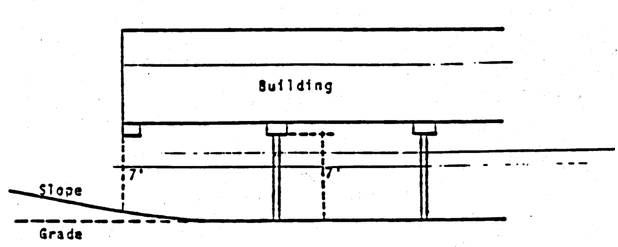
Off-street Parking Facilities. Spaces, driveway, maneuvering aisles, turnaround areas and ramps shall have a vertical clearance of at least seven feet for their entire required area.
B.
The R-3 and R-4 zones shall provide a minimum vertical clearance of fourteen feet for the full required width of all required driveways.
(Prior code § 9246.6 (E))
17.52.120 - Development standards—Surfacing.
A.
All parking spaces, maneuvering areas, turnaround areas and driveways used for access shall be paved with:
1.
Concrete surfacing to a minimum thickness of three and five-eights inches; expansion joints shall be included as necessary; or
2.
Asphalt-type surfacing compacted to a minimum thickness of one and one-half inches, laid over a base of crushed rock, gravel or similar material compacted to a minimum thickness of three inches.
B.
Such surfacing shall be designed, constructed and maintained so as to dispose of all surface water. In no case shall such drainage be allowed to flow over or across public sidewalks.
(Prior code § 9246.6 (F))
17.52.130 - Development standards—Striping and marking.
All parking spaces shall be striped with double lines spaced six inches apart. (C and M zones).
(Prior code § 9246.6 (G))
17.52.140 - Development standards—Wheel stops.
Every parking space that is not separated by a fence or wall from any street or alley property line upon which it abuts, and every parking space which fronts a building wall or fence with no separation between the front end of the parking space and the wall or fence, shall be provided with a suitable concrete wheel stop or curb barrier not less than two feet from such street or alley, wall or fence property line. Such wheel stop or curb barrier shall be securely installed and maintained.
(Prior code § 9246.6 (H))
17.52.150 - Development standards—Landscaping.
A.
The design, development and maintenance of all landscaping required by the development standards shall be subject to approval of the city planner.
B.
All landscaping provided in conjunction with the development of parking facilities serving commercial and manufacturing zoned properties shall be surrounded by a continuous six inch concrete curb.
(Prior code § 9246.6 (I))
17.52.160 - Development standards—Screening.
A.
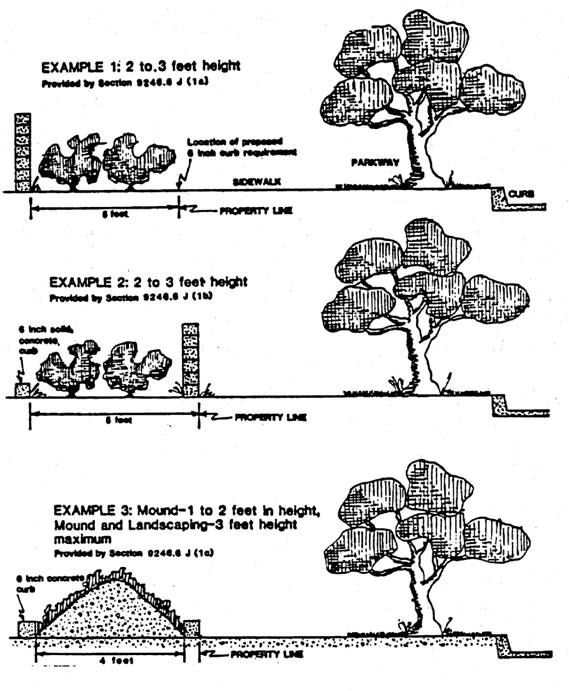
In any zone, except zones R-1 and R-2, where parking spaces, driveways, maneuvering aisles or turnaround areas are located adjacent to and within fifty feet of any property line separating the site from any public street, the following screening techniques shall be used (See Exhibit 17.52.160).
1.
A solid masonry wall, between two and three feet in height, shall be constructed and maintained parallel to and not nearer than five feet to such property line; or
2.
A solar screen type decorative masonry wall or combination solid masonry wall and decorative masonry wall between two and three feet in height shall be constructed and maintained at such property line with a minimum continuous six-inch solid concrete curb located parallel to and not nearer than five feet to such property line; or minimum continuous six-inch solid concrete curb located parallel to and not nearer than five feet to such property line; or minimum continuous six-inch solid concrete curb located parallel to and not nearer than five feet to such property line; or
3.
An earthen mound between one and two feet in height and four feet in width, upon which landscaping shall be installed and permitted to grow to a maximum height of three feet. The mounded area shall be surrounded by a minimum continuous six-inch high solid concrete curb.
B.
In all cases the minimum five-foot setback distance shall be developed and maintained with suitable landscaping and irrigation. Development plans indicating the quantity, type and location of landscaping shall be submitted and be subject to the approval of the city planner.
C.
The maximum height of the screen walls mentioned herein may be increased on properties in the M zone where higher walls or fences are required for enclosure of outdoor storage areas.
D.
Every parking area for five or more cars which abuts an R zone shall be screened by a decorative masonry wall (or nondecorative wall with landscaping). No wall is required if the elevation of the parking area is six feet below the elevation of the residential property along the common property line.
(Prior code § 9246.6 (J))
EXHIBIT 17.52.160
SCREENING
17.52.170 - Development standards—Signs.
Where required for public safety, appropriate exit, entrance and directional signs shall be erected in the manner prescribed by the city engineer. (See Chapter 17.62 of this code for sign regulations.)
(Prior code § 9246.6 (K))
17.52.180 - Plot plans.
A.
A plot plan for any proposed parking area shall be submitted subject to the approval of the city planner at the time of an application for a building permit for any building or structure for which the parking area is to be used. Where no building permit is required, such plot plan shall be submitted prior to use and occupancy of such parking facilities. The plan shall clearly indicate the proposed development, including location, size, shape, design, curb cuts, lighting, landscaping and other features of the proposed parking facilities.
B.
Notwithstanding any other provisions of this code, where the city planner finds, from an examination of an application for a building permit, that a proposed off-street parking facility or use, would or could cause a traffic hazard or unreasonable congestion in the flow of such traffic upon the subject property, or on any public street or alley adjacent to the property upon which such parking facility or use is proposed to be located, she/he shall refuse to approve such plan. The city planner shall, within one working day after such determination, notify the building official of such action. The building official shall refuse to approve any building permit for any building or structure proposed to be used in conjunction with such parking facilities. The building official shall, within five days of receipt of such notice from the city planner, advise the applicant of the action taken, and the reason therefor. The notice shall be by United States mail, postage prepaid, addressed to the applicant at the last known address.
C.
The city planner's decision shall be final, unless within thirty days after the mailing of such notice, the applicant appeals the city planner's decision to the planning commission, by filing a written letter of appeal with the secretary of the commission, who shall set the same for hearing upon the next most convenient agenda of the planning commission. The secretary of the planning commission shall give the applicant at least five working days' written notice of the time and place of hearing.
D.
At the time of such hearing, the planning commission shall permit the applicant a reasonable opportunity to be heard. The planning commission shall also consider any applicable staff report, in order to determine whether the proposed parking facilities or use, will or might create or cause a traffic hazard, or unreasonable congestion of the traffic flow upon adjacent public street or alleys. The burden of proof to show that such conditions do not exist shall be upon the applicant.
E.
The planning commission's decision shall be final in the absence of an appeal to the city council in the time and manner described in Chapter 17.78 of this code.
F.
In case of such appeal, the city council shall conduct a hearing, and determine the case in the same manner as that prescribed herein with reference to the planning commission.
(Prior code § 9246.7)
17.52.190 - Setbacks and useable areas.
Parking areas shall be located on a lot only where main or accessory buildings are permitted, excluding land within the rights-of-way of a proposed street or highway or within the planned ultimate right-of-way width of a street or highway. All ramps, structures, parking or loading facilities shall be designed and constructed to meet ultimate highway, street and alley construction.
(Prior code § 9246.8)
17.52.200 - Location of parking facilities.
Off-street parking facilities shall be located as follows. Where a distance is specified, such distance shall be the walking distance measured from the nearest point of the parking facility to the nearest point of the building that the facility is to serve:
A.
For dwelling units, parking facilities shall be on the same lot or building site as the dwelling unit;
B.
For hospitals, sanitariums, homes for the aged, asylums, orphanages, roominghouses, lodginghouses, club rooms, fraternity and sorority houses, not more than one hundred fifty feet from the buildings they are required to serve;
C.
For retail, commercial, office and assembly uses, not more than three hundred feet from the building they serve;
D.
For use other than those specified in subsections A, B and C of this section, not over one thousand feet from the building they serve, except as provided herein.
(Prior code § 9246.9)
17.52.210 - Computing parking for mixed occupancies in a building.
In the case of mixed uses in a building or on a lot, the total required number of off-street parking spaces shall be the sum of the requirements for the various uses.
(Prior code § 9246.10)
17.52.220 - Common facilities.
Common parking facilities serving more than one use may be provided in lieu of individual requirements, but such facilities shall be approved by the city planner, as to size, shape and relationship to business sites to be served.
The total of such off-street parking spaces shall not be less than the number required for various uses.
(Prior code § 9246.11)
17.52.230 - Computation of required parking spaces.
A.
Consideration of Fractional Remainders. Where calculation of the number of spaces required results in a fractional number, any fraction equaling one-half or more shall be rounded to the next higher whole number.
B.
Parking in Buildings:
1.
Where required parking computations are based on floor area, floor space devoted to parking within the building shall not be included in this computation.
2.
Covered sheds with open side walls shall be deemed to be enclosed buildings for purposes of this subsection, when the same are used only for lumber storage, loading docks, hay barns, pipe or metal storage, or any similar use.
C.
Loading Spaces:
1.
Required spaces.
2.
Size. Each off-street loading space shall be not less than twelve feet in width and thirty feet in length and fifteen feet in height. Where four or more spaces are required, one-quarter (twenty-five percent) of the spaces shall have a minimum width of fourteen feet and a minimum length of sixty feet. Loading facilities shall be designed such that the largest anticipated trucks shall not (when loading or unloading) extend into parking or back-up and maneuvering area for required parking.
3.
Location. Off-street loading facilities shall be located and designed so that the largest anticipated vehicles shall not encroach into public sidewalks, streets or required driveways in the course of loading or unloading goods.
D.
Handicap Accessible Parking Spaces. The size and location of handicap accessible parking spaces shall be provided in a manner consistent with applicable state statutes.
(Ord. 2193 § 5(d), 1999; prior code § 9246.12)
17.52.240 - Joint use parking.
The planning commission may authorize the joint use of parking facilities by the following type of uses under the following conditions:
A.
Up to fifty percent of the parking facilities used primarily for a daytime use may be provided by the parking facilities used primarily for a nighttime and/or Sunday use. The reverse is also true: up to fifty percent of the parking facilities used primarily for a nighttime and/or Sunday use may be provided by the parking facilities used primarily for a daytime use.
B.
Up to one hundred percent of the parking facilities required herein for a church or for an auditorium incidental to an educational institution may be supplied by parking facilities used primarily for daytime use.
C.
Conditions Required for Joint Use.
1.
The applicant shall show that there is no substantial conflict in the principle operating hours of the buildings or uses for which the joint use of off-street parking facilities is proposed.
2.
Parties concerned in the joint use of off-street parking facilities shall show legal agreement for such joint use. The agreement, when approved as conforming to the provisions hereof shall be recorded in the office of the county recorder and copies filed with the city.
(Prior code § 9246.13)
17.52.250 - Ownership of parking facilities.
Property on which required parking facilities are established shall be:
A.
Under the same ownership as the lots or parcels or land containing the use or uses to be served: or
B.
When required parking facilities are located on a lot which is not in the same or joint ownership as the lot containing the use or uses to be served, the affected property owner(s) shall show agreement for the use of such property by a legal document approved by the city attorney. Such agreement shall provide that if the same is terminated, the use served by the parking facilities shall also be terminated if other adequate parking facilities are not provided.
(Prior code § 9246.14)
17.52.260 - Maintenance of parking facilities.
A.
All parking areas shall be kept clean and free of dust, mud or trash. Parking areas shall be used only for the purposes of parking vehicles. Where landscaping is provided within or along parking areas, adequate irrigation and maintenance shall be provided.
B.
Striping, marking, directional signs, lighting, screening and all other improvements required by this title shall be adequately maintained.
(Prior code § 9246.15)
17.52.270 - Parking districts.
Properties which are included in a planned comprehensive parking district, formed under a special assessment district proceeding, shall be exempted from the provisions hereof under the following circumstances:
A.
That the planning commission shall conduct a public hearing with notice in the same manner as variances or conditional use permits (See Chapter 17.78 of this code, public hearings); and
B.
That at the public hearing the commission shall determine and recommend to the council whether or not the district should be formed, based upon the following:
1.
Whether the public interest, convenience and necessity so requires, and
2.
Whether the district, as established, will substantially comply with the purpose and intent hereof, and
3.
Whether the exemption, if granted, should be conditional to insure that the purpose and intent of the provisions hereof are met.
C.
Upon receipt of a recommendation by the planning commission, the city council shall conduct a hearing in the same manner as that held by the planning commission, and shall determine whether the exemption from the provisions hereof should be granted, it shall have the authority and power to grant the exemption, with conditions, if necessary, to insure that there is compliance with the provisions hereof, and to insure compatibility of the physical facilities with surrounding and adjacent properties and uses. Such conditions may include, but are not limited to, a limitation upon the extent to which the construction of new buildings and structures, or the reconstruction or expansion of existing buildings or structures located on the lots included in the district shall be permitted.
(Prior code § 9246.16)
17.52.280 - Tandem, stacked, valet and/or attended parking.
A.
Tandem, stacked, valet and attended off-street parking are subject to approval of a parking management plan by the planning commission.
B.
The planning commission may allow the off-street parking supply requirements of this chapter to be met through approval of the following types of tandem or stacked off-street parking for a commercial and/or industrial use of an existing building through a parking management plan (Section 17.52.310), provided that no fee is charged to the users of such alternative methods for meeting the off-street parking requirements of this chapter:
1.
Employee-only parking (when tandem spaces are assigned to employees of the same business);
2.
Attended parking for medical-oriented businesses or other uses approved by the planning commission;
3.
Valet parking for uses such as restaurants or other uses approved by the planning commission.
(Ord. 2193 § 5(a), 1999: prior code § 9246.17 (A))
17.52.290 - Parking charges.
The parking of motor vehicles shall be without monetary charge when such parking is required in conjunction with uses permitted hereby.
(Prior code § 9246.17 (B))
17.52.300 - Storage of vehicles prohibited.
The parking facilities required hereby shall be only for the temporary parking of vehicles used in conjunction with the uses they serve.
(Prior code § 9246.17 (C))
17.52.310 - Parking management plan.
Application for a parking management plan shall be submitted by the property owner, the owner of an existing or proposed business on the site, or an authorized agent thereof, to the planning commission on a form provided for that purpose by the city. Such an application shall be submitted to the planning department accompanied by the required filing fees in an amount established by resolution of the city council. Such applications shall be considered and may be approved or approved with conditions by the planning commission subsequent to conducting a public hearing consistent with the procedures contained in Chapter 17.78 of this code.
A.
Application. The following shall be submitted as a part of the application:
1.
A completed application on a form provided for this purpose by the planning department; and
2.
A narrative which explains in detail the intent and operation of the parking management plan, and including information on the hours of operation for the applicant business and the building, the terms of any parking attendant agreement, any provisions for monitoring implementation of the plan, and any other relevant information.
3.
Seventeen copies of the following:
a.
A fully dimensioned and detailed plot plan of the subject site indicating the location and dimensions of all existing and proposed off-street parking areas; and
b.
Any other material the director of planning may deem necessary to accurately describe the proposal to the planning commission.
B.
Findings. A parking management plan may be approved or conditionally approved by the planning commission only if the following findings can be made:
1.
The proposed use is consistent with the general plan, any applicable specific plans, and the general intent of the zoning code;
2.
The surrounding properties will not be adversely affected by approval of the proposed parking management plan; and
3.
The proposed parking management plan is appropriate for the proposed land use; and
4.
That adequate off-street parking for customers, clients, visitors, and employees will be available for the proposed land use; and
5.
The parking management plan includes provisions for periodic monitoring by the city to identify any problems associated with implementation of the plan and to adjust the plan as necessary. Any costs to the city incurred as a result of such monitoring shall be paid by the property owner upon request of the city.
(Ord. 2193 § 5(b), 1999)
17.52.320 - Parking reduction for alternate modes of transportation.
In conjunction with approval of a parking management plan, the planning commission may authorize a reduction in the number of required off-street parking spaces when trip reduction and travel demand measures are provided for any business seeking to occupy an existing building. The applicant shall document the mode(s) of transportation to be used by each employee (to be updated on an annual basis), and that the available supply of off-street parking for the applicant business will be adequate to meet the demand for such parking without imposing any fee for the use of such parking.
A.
Application Form, Filing Fee. Application for such a reduction in the required supply of off-street parking shall be made by the property owner, or the business owner of an existing or proposed business on the site, or by an authorized agent thereof, to the planning commission on a form provided for that purpose by the city. Such application shall be submitted to the planning department accompanied by filing fees in an amount established by resolution by the city council.
B.
Additional Submittal Requirements. In addition to the parking management plan submittal requirements, the following shall be submitted as a part of the application for a parking reduction based on documenting modes of employee transportation:
1.
A fully dimensioned and detailed plot plan of the subject site indicating the location of all existing and proposed parking;
2.
A narrative describing alternative modes of transportation to be used by each employee, the permanency of such modes, the extent of the program, and other pertinent information;
3.
Other material the director of planning may deem necessary to accurately describe the proposal to the planning commission.
(Ord. 2193 § 5(c), 1999)
EXHIBIT A
MINIMUM TURNING RADII
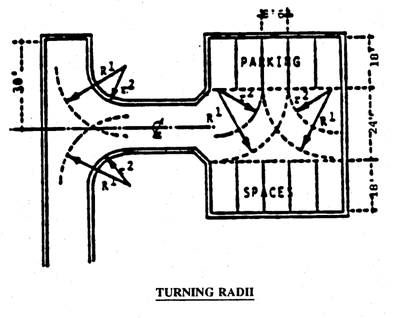
PART A - MINIMUM TURNING RADII
R 1 Minimum turning radius 24 feet outside front bumper.
r 2 Minimum turning radius 14 feet inside rear wheel.
EXHIBIT B
STANDARDS CHART - 8′6″ × 18′ SPACES
PARALLEL, ANGLE AND RIGHT ANGLE PARKING— OVERLAPPED AND HERRINGBONE
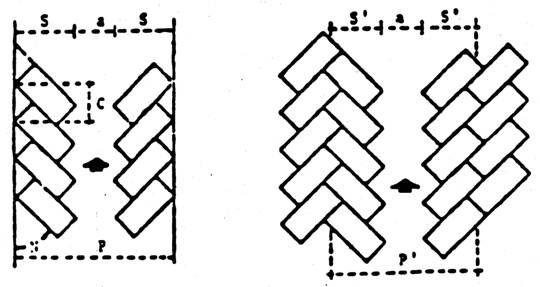
(1) Width of aisle permits two-way circulation only when a turnaround is provided.
(2) Width of aisle permits two-way circulation.
EXHIBIT C
DIAGRAMS
8½′ × 18′ SPACES—8½′ × 20′ SPACES
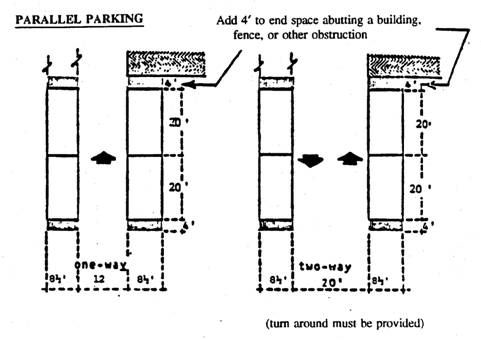
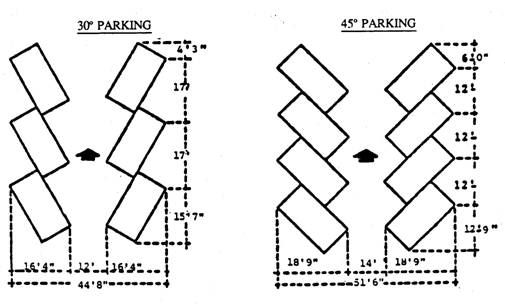
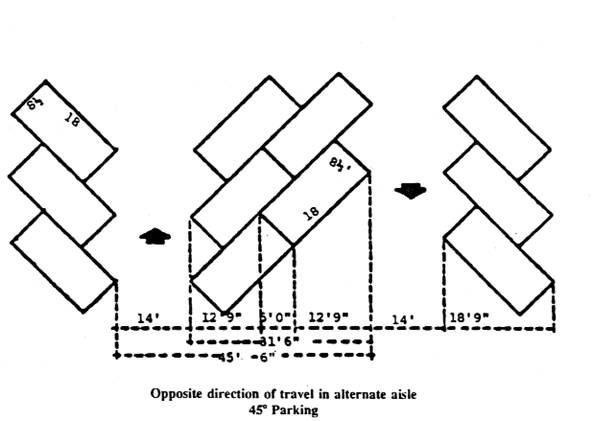
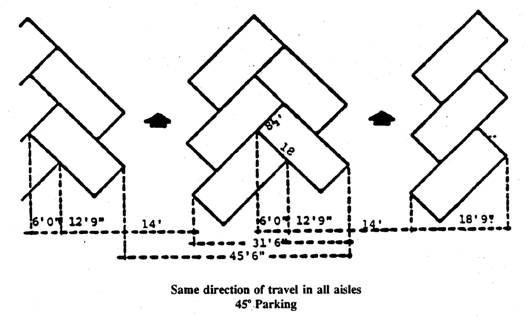
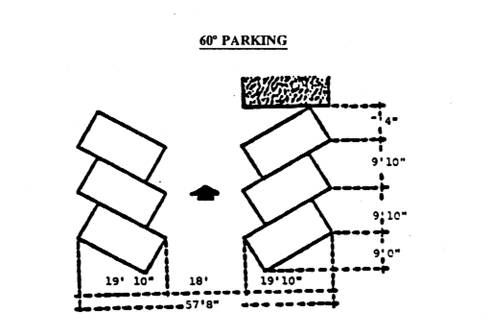
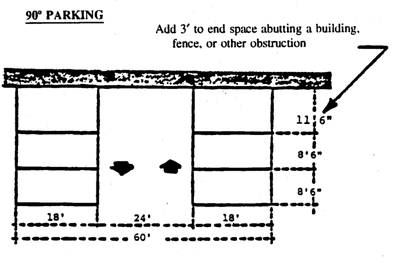
EXHIBIT D
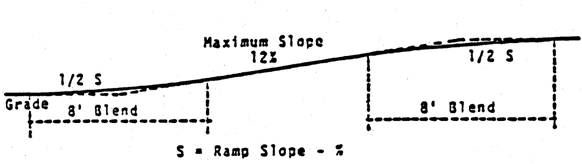
RAMPS AND RAMP GRADES
NOTE:
1. Ramp profiles shall be submitted as part of parking plan.
2. Public sidewalk will not be modified to accommodate blend.
3. Ample pedestrian and vehicular sight distance shall be maintained.
4. Short ramps, under 65′ in length shall not exceed a maximum slope of 16% with a 10′ blend.

