
Montebello City Zoning Code
CHAPTER 17
62 - SIGNS
17.62.010 - Purpose and intent.
The intent of this chapter is to promote community appearance and effective business identification through the regulation of signs and sign structures within the city of Montebello. The location, number, size and design of signs and graphics have a significant influence upon the community's environment and appearance. The regulation of signs and outdoor advertising is therefore necessary for the following purposes:
A.
To promote and protect the public health, safety and welfare by minimizing hazards and obstructions to traffic and promoting traffic safety, and through consideration of the aesthetics of signs and outdoor advertising to be installed within the city;
B.
To protect persons and property values from damage due to indiscriminate and harmful use of signs, outdoor advertising and advertising structures;
C.
To preserve a pleasing and attractive appearance in all areas of the city.
(Ord. 2160 § 5 (part), 1997)
17.62.020 - Location and code provisions.
Signs shall be constructed and located in compliance with the provisions of this chapter and with the applicable requirements of the California Outdoor Advertising Act, Uniform Building Code and Uniform Sign Code, and the California Electrical Code, whichever code or code provision(s) is more restrictive, as may be adopted and amended from time to time. Approval from the city of Montebello departments of planning and building services shall be obtained prior to erecting, constructing, altering, rebuilding, replacing, or moving any sign. Approval by the department of public works is also required for any freestanding or projecting sign located within twenty feet of, or projecting over, the public right-of-way.
(Ord. 2160 § 5 (part), 1997)
(Ord. No. 2375, § 1, 2-24-2016)
17.62.030 - Materials, construction and identification.
A.
All signs shall be constructed of permanent materials and shall be permanently attached to the ground, a building, or another structure by direct attachment to a rigid wall, frame or structure.
B.
All wooden signs must be at least three-quarter-inch thick.
C.
All electric signs shall be composed entirely of noncombustible materials.
D.
Unless specifically exempted, all signs shall be identified with a durable label or tag specifying the name and date of the manufacture, weight, installation date and permit number. In addition, for electrical signs the voltage, amperage and any other information required for the safety certification or listing for the equipment shall be included. This information shall be placed where it is readily visible for inspection after the sign has been installed.
E.
Every electrical sign of any type shall be constructed, inspected and approved by the Underwriters Laboratories (UL) or equal and display a label of approval from said laboratory.
(Ord. 2160 § 5 (part), 1997)
17.62.040 - Maintenance.
A.
All signs and sign structures including those otherwise specifically exempt from the provisions of this chapter, including all parts, portions, and materials, shall be maintained and kept in good repair. The display surface of all signs shall be kept clean, neatly painted, and free from rust and corrosion. Any crack, broken surfaces, malfunctioning light(s), missing sign copy or other unmaintained or damaged portion of a sign shall be repaired or replaced within thirty calendar days following notification by the city. Noncompliance with such a request shall constitute a public nuisance.
B.
All businesses must service and wash their signs at least once every twelve months.
C.
Upon vacating a business location, the business or property owner shall remove the sign copy that advertises the business. At no time shall a sign cabinet remain empty and without copy exposing the internal lighting and electrical fixtures. During any period when a sign cabinet is not being utilized for identification of a business, a blank opaque face shall be installed in the sign cabinet structure. Any damage to a building caused by the removal of a sign structure shall be repaired to the condition the building was in prior to the installation of the sign.
(Ord. 2160 § 5 (part), 1997)
17.62.050 - Prohibited signs.
A.
The following signs are prohibited except as provided in Section 17.62.160, Nonconforming Signs, Section 17.62.110, Temporary Signs, Section 17.62.140, Planned sign program, and Section 17.62.105, Off-Premises Digital Display Signs:
1.
Signs that include video, blink, or move in any manner, have any portions that move, or have the appearance of moving, including animated or scrolling electronic text, and digital displays as defined in Section 17.62.170. Clocks, time and temperature displays, and civic and public services displays, are exempt from this prohibition;
2.
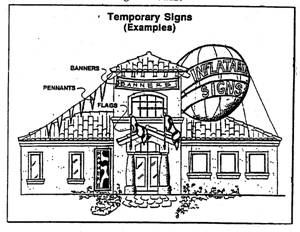
Flags (except those which are raised and lowered on permanently fixed flag poles), pennants, banners, paper, wind driven signs (except where specifically provided for within this code);
3.
Roof signs;
4.
Sign structures and supports no longer in use;
5.
Portable signs;
6.
Commercial advertising statuary;
7.
Signs painted directly onto exterior wall surfaces (such as exterior building walls and masonry block walls, etc.);
8.
Inflatable signs (except as provided in Sections 17.62.110 and 17.62.170 of this chapter);
9.
New off-premises signs, except those permitted pursuant to this chapter;
B.
No person shall construct, place or maintain any sign, signboard, billboard, street bulletin board, sign or advertisement in, over, along, across or upon any public street or public parkway, or other public place within the city, except as provided in Section 17.62.110 or Section 17.62.105 of this chapter.
C.
Nothing contained in this title shall be construed to prohibit the erection or placing in any public street, parkway or other public place, of signs, notices or signals under the authority of the city council or of this code.
D.
No person shall paint, post, attach or affix any handbill, notice, sign or advertisement upon any object in the public right-of-way, or to any bridge, fence, light pole, building, structure, or other property within public view, nor to any tree in any public right-of-way or public place; nor shall any person deface, mar or disfigure any such bridge, fence, light pole, building, tree, etc.
(Ord. 2160 § 5 (part), 1997)
(Ord. No. 2375, § 2, 2-24-2016; Ord. No. 2465, § 5, 9-13-2023; Ord. No. 2466, § 5, 10-11-2023)
17.62.060 - Exemptions.
The provisions and regulations hereof shall not apply to the following types of signs:
A.
Official notices issued by any court, public body or officer;
B.
Notices posted by any person or public officer in performance of a public duty;
C.
Signs required or authorized by any federal, state, county or city regulation, ordinance or resolution;
D.
Any signs used for emergency purposes only;
E.
Official flags of the United States of America, the state of California, the county of Los Angeles or the city of Montebello.
(Ord. 2160 § 5 (part), 1997)
17.62.070 - Sign measurements.
A.
Sign Area.
1.
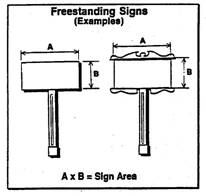
Cabinet Signs. The area of a cabinet sign is determined by the area of the sign face(s) enclosed by a frame or cabinet and is determined by the outer dimensions of the frame or cabinet surrounding the sign area. This includes the total area of the copy and the background. This applies to wall mounted cabinet signs and cabinet signs mounted on freestanding pole structures. (See Figures 17.62.070A and 17.62.070B) Architectural features are not considered in the sign area. (See Figure 17.62.070B)
Figure 17.62.070A
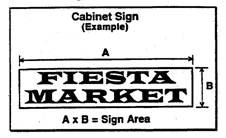
Figure 17.62.070B
2.
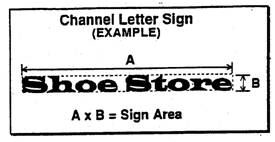
Channel Letters and Individual Elements. When signs are constructed of individual elements such as channel letters and attached to a building wall, the sign area is determined by calculating the area of an imaginary box drawn around the most exterior area of all the letters and/or elements. (See Figure 17.62.070C)
Figure 17.62.070C
3.
Awnings. When signs are incorporated into an awning, the sign area is determined by computing the area of an imaginary box drawn around the sign elements.
4.
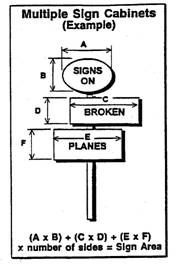
Multiple Sign Cabinets. For freestanding signs that contain multiple cabinets on one structure, the area of each cabinet counts toward a combined total. If these are double or multiple faced cabinets, the sign area shall be calculated to include all faces of the sign. (See Figure 17.62.070D)
Figure 17.62.070D
B.
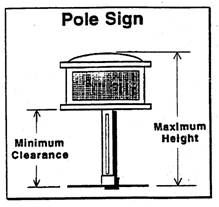
Height. The overall height of a sign or sign structure is measured from the ground directly below the sign to the highest point of the sign or sign structure. (See Figure 17.62.070E)
C.
Clearance. Clearance is measured from the ground directly below the sign to the bottom of the sign structure enclosing the sign face. (See Figure 17.62.070E)
Figure 17.62.070E
(Ord. 2160 § 5 (part), 1997)
17.62.080 - Signs—Residential zones.
Signs are allowed in residential zones in accordance with the following:
A.
In All R Zones:
1.
One nonilluminated sign a maximum of twelve square feet in area pertaining only to the sale or lease of the particular building or property upon which it is displayed.
2.
Outdoor advertising structures in conjunction with model homes (See Chapter 17.58 of this title, Model Homes).
3.
Temporary architect's or builder's sign identifying persons engaged in construction on a site are permitted as long as construction is in progress.
B.
R-A Zone. One sign a maximum of twelve square feet in area advertising the sale of agricultural products raised on the premises.
C.
R-3 and R-4 Zones. One wall sign a maximum of twenty square feet in area, provided the sign contains no advertising copy except the name and street address of the building upon which it is placed.
(Ord. 2160 § 5 (part), 1997)
17.62.090 - Signs—C-R zone.
A.
Signs are allowed in the C-R zone in accordance with the following:
1.
The sign area shall not exceed one square foot per two linear feet of building frontage, or three linear feet of lot width for outdoor uses.
2.
No sign may exceed fifty square feet in area.
3.
No more than two signs are permitted for each use or business on a lot.
4.
Freestanding signs are prohibited.
5.
Each legally established use or business on a lot may have one additional accessory sign that is a maximum size of six square feet in area.
B.
For the purpose of giving information on the availability of the premises for sale or lease, one sign not exceeding twelve square feet in area shall also be allowed.
(Ord. 2160 § 5 (part), 1997)
17.62.100 - Signs—C-1, C-2, C-M, M-1 and M-2 zones.
A.
Individual Sign Criteria.
Figure 17.62.100A
1.
Wall and Marquee Signs.
a.
Maximum Size.
i.
Front Facade. For wall and marquee signs, the total sign area on the front facade of a building shall not exceed two square feet of sign area per one linear foot of the building facade (front) width of the subject business. On lots which are occupied by more than one business, the sign area for each business shall not exceed two square feet per one linear foot of building frontage for the respective business. However, in no event must the overall sign area on the front facade be less than twenty square feet. This sign area allotment for the front facade cannot be transferred to other facades on the building.
ii.
Side and Rear Building Facades. The total sign area for wall and marquee signs on the side and rear facades of a building shall not exceed one square foot of sign area per two linear feet of the facade length of the building or subject business, except that when the facade faces a side street, total sign area shall not exceed one square foot of sign area per one linear foot of facade length. This sign area allotment cannot be transferred to other facades on the building.
iii.
No limit shall be placed on the number of wall or marquee signs except that the combined total sign area shall not exceed the allowable sign area ratio per facade.
iv.
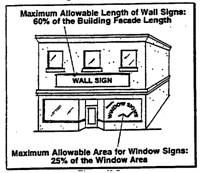
The combined length of all signs placed on a building facade shall not be greater than sixty percent of the length of the facade on which the sign is attached. (See Figure 17.62.100B)
Figure 17.62.100B
b.
Placement.
i.
Wall and marquee signs shall not extend beyond the surface of the wall or marquee to which they are attached nor shall they extend above the roof line the building on which the sign is placed.
ii.
In multiple story buildings, wall and marquee signs may be used by businesses which are located in stories above the ground level subject to the same limitations which would apply if the business were located on the ground level.
2.
Pole Signs.
a.
Site Requirements.
i.
One pole sign may be permitted on a site provided that the site has a minimum street frontage of seventy-five feet in length. On corner lots, one additional pole sign may be established provided that each street frontage is at least seventy-five feet in length. Each pole sign shall be oriented to the street frontage on which it is erected.
ii.
The area of a double faced pole sign shall be calculated to include both sides of the sign cabinet. The area of a multi-cabinet sign shall be calculated to include all the cabinets.
b.
Maximum Size and Height.
i.
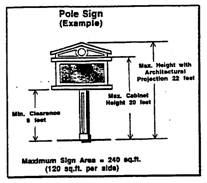
The total sign area of a pole sign shall not exceed one square foot of sign area for every one linear foot of street frontage on which the business is located, and shall not exceed a total sign face area of two hundred forty square feet, with a maximum of one hundred twenty square feet per individual sign face. (See Figure 17.62.100C)
ii.
The maximum height of a pole sign shall not exceed twenty feet. (See Figure 17.62.100C)
Figure 17.62.100C
iii.
Architectural projections of not more than two feet may be added to the top of a pole sign. At no time shall the total height of a pole sign exceed twenty-two feet. The architectural projection shall be used for design purposes only and no sign copy or internal illumination shall be located within this area.
c.
Location.
i.
Pole signs shall be located in a landscape planter the size of which is at least half the size of the sign's total sign area.
ii.
Pole signs shall be located at a distance of at least five feet from the street abutting property line. This setback distance shall be measured from the property line to the leading edge of the pole sign. (See Section 17.62.170 of this chapter.)
iii.
If a pole sign is located within twenty feet of the public right-of-way, only one supporting column shall be permitted.
iv.
Pole signs shall be located at a distance of at least ten feet from any driveway access. This setback distance shall be measured from the edge of the driveway closest to the freestanding sign to the leading edge of the pole sign closest to the driveway.
v.
Pole signs shall be located at a distance of at least twenty-five feet from a lot line of any residential zoned property.
vi.
For property which qualifies for two pole signs, the pole signs shall be located at least one hundred and fifty feet apart.
vii.
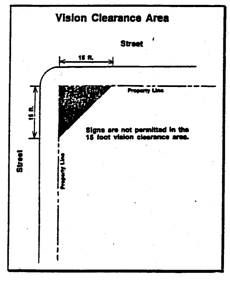
On corner lots, no pole sign or support structure shall be located within the triangular vision clearance area which covers the area between the two street abutting property lines for a length of fifteen feet along each property line from their point of intersection. (See Figure 17.62.100D)
Figure 17.62.100D
viii.
No pole sign or portion thereof shall be located so as to project across any property line except as provided for in Section 17.62.120 of this chapter.
d.
Appearance.
i.
All pole signs shall be architecturally compatible with the building(s) on the site where the pole sign is located. In most cases, square or box sign cabinets which have no architectural treatment compatible with the building(s) on the site are discouraged.
ii.
All pole signs shall be constructed so as to conceal any structural members, bracing, wiring and/or lighting fixtures.
iii.
The supporting structure(s) of any pole sign shall be of a design and material consistent with that of the exterior of the building(s) on the site. Pole covers/sleeves shall be provided as a decorative feature around the supporting structure of a pole sign.
e.
Minimum Height and Clearance.
i.
Pole signs projecting over a pedestrian way shall have a minimum height clearance of eight feet. Signs projecting over a vehicular access, parking or circulation area shall have a minimum height clearance of fifteen feet. Signs projecting over public property shall comply with the Montebello Municipal Code requirements for such sign.
ii.
Pole signs shall not project over any building.
3.
Monument and Pylon Signs.
a.
Site Requirements.
i.
One monument or pylon sign may be permitted on a site provided that the site has a minimum street frontage of seventy-five feet in length. On corner lots, one additional monument or pylon sign may be established provided that each street frontage is at least seventy-five feet in length. Each sign shall be oriented to the street frontage on which it is erected.
ii.
The total sign area of a monument or pylon sign with two or more faces shall be calculated to include the area of all faces.
b.
Maximum Size and Height.
i.
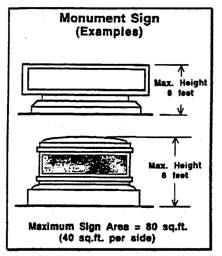
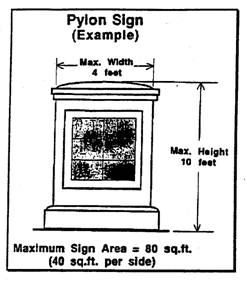
The total sign area of a monument or pylon sign shall not exceed eighty square feet, with a maximum of forty square feet per individual sign face.
ii.
The maximum height of a monument sign shall not exceed six feet measured from grade level to the uppermost edge of the sign cabinet. (See Figure 17.62.100E)
Figure 17.62.100E
iii.
The maximum height of a pylon sign shall not exceed ten feet measured from grade level to the upper most edge of the sign face cabinet. The maximum width of a pylon sign shall not exceed four feet. (See Figure 17.62.100F)
Figure 17.62.100F
c.
Location.
i.
Monument or pylon signs shall be located in a landscape planter the size of which is at least half the size of the sign's total sign area.
ii.
Monument and pylon signs shall be located at a distance of at least five feet from the street abutting property line. This setback distance shall be measured from the property line to the leading edge of the monument or pylon sign.
iii.
Monument or pylon signs shall be located at a distance of at least ten feet from any driveway access. This setback distance shall be measured from the edge of the driveway closest to the monument or pylon sign to the leading edge of the sign closest to the driveway.
iv.
Monument or pylon signs shall be located at a distance of at least of twenty-five feet from a lot line of any residential zoned property.
v.
For property which qualifies for two monument or pylon signs, the monument or pylon signs shall be located at least one hundred fifty feet apart.
vi.
On corner lots, no monument or pylon sign shall be located within the triangular vision clearance area which covers the area between the two street abutting property lines for a length of fifteen feet along each property line from their point of intersection. (See Figure 17.62.100D)
vii.
No monument or pylon sign or portion thereof shall be located so as to project across any property line except as provided for in Section 17.62.120 of this chapter.
d.
Appearance.
i.
All monument or pylon signs shall be architecturally compatible with the building(s) on the site on which the monument sign is to be located. In most cases, square or box sign cabinets which have no architectural treatment compatible with the building(s) on the site are discouraged.
ii.
All monument and pylon signs shall be constructed so as to conceal any structural members, bracing, wiring and/or lighting fixtures.
iii.
No exposed concrete bases are permitted without providing a decorative treatment such as a textured or stucco finish or other treatment which is compatible with the architecture or materials of the building(s) on the site where the sign is located.
4.
Mansard Signs.
a.
Maximum Size. Mansard signs are subject to the regulations in Section 17.62.100(A)(1) relating to wall and marquee signs.
b.
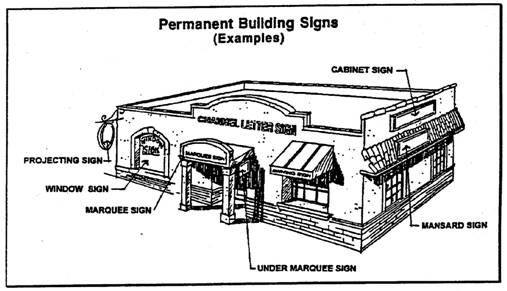
Placement. Such signs shall be mounted on a mansard roof so that the lowest portion of the sign cabinet is recessed into the roof structure and the uppermost portion of the cabinet is flush with the roof. At no point shall there be an open area behind the sign cabinet and the mansard roof. (See Figure 17.62.100A)
5.
Under Marquee.
a.
Maximum Size. The sign area of an under marquee sign shall not exceed three square feet per sign face, not to exceed two faces.
b.
Placement. Mounted underneath a marquee and over a sidewalk, under marquee signs shall be no lower than eight feet above ground level. Signs projecting over public property shall comply with Section 17.62.120 of this chapter. (See Figure 17.62.100A)
6.
Projecting Signs.
a.
Maximum Size. The sign area of a projecting sign shall not exceed three square feet per sign face, not to exceed two faces.
b.
Placement. Projecting signs shall be placed no lower than eight feet above ground level and shall extend no higher than twelve feet. (See Figure 17.62.100A)
7.
Changeable Copy Signs.
a.
Maximum Size. The sign area of a changeable copy sign shall not exceed twenty square feet.
b.
Placement. Changeable copy signs shall be placed in a permanently mounted sign structure either attached to the building or freestanding, consistent with the other provisions of this chapter.
8.
Awning Signs.
a.
Maximum Size. The sign area of signs on awnings shall not exceed thirty percent of the exterior surface of the awning. The length of the sign shall not be greater than sixty percent of the length of the awning. (See Figure 17.62.100A)
9.
Window Signs.
a.
Maximum Size. The sign area of signs located on the glazed area of a building window shall not exceed twenty five percent of the area of the window containing the sign. (See Figure 17.62.100B)
b.
Placement. Window signs shall be placed on the interior of a building within a window frame. (See Figure 17.62.100A)
10.
Outdoor Business Signs. For outdoor businesses (such as auto dealerships, nurseries, and auto rentals, but not service stations and carwashes) the total sign area on the site shall not exceed one square foot of sign area for every one linear foot of street frontage on which the business is located. All other applicable requirements as set forth in this chapter shall apply.
11.
Fence Mounted Signs. In the M-1 or M-2 zones when a building is not visible from the public right-of-way and visually blocked by a view obscuring fence, one twenty square foot sign shall be permitted to be mounted on a fence facing the public right-of-way. The sign shall be mounted in a permanent manner flush with the fence and visible to the public right-of-way. The sign shall also not extend above the top of the fence upon which it is mounted.
12.
For Sale or For Rent Signs. The area of for sale, for lease or for rent signs shall not be included in the calculation of overall sign area for a site. Although a building permit is not required for this type of sign, all ground mounted for sale and for lease signs shall be reviewed and approved by the planning department and the department of public works.
a.
Maximum Size. The area of a for sale or for rent sign shall not exceed twenty square feet.
b.
Number. The number of for sale or for rent signs on a site shall be limited to one per building or one per business. For large commercial and industrial centers, one freestanding for sale or for rent sign shall be permitted per street frontage.
c.
Placement. For sale or for rent signs may be displayed in the same location as permanent signs.
i.
For sale or for rent signs shall not be placed in the path of pedestrian traffic.
ii.
Ground mounted for sale and for rent signs shall be located at a distance of at least five feet from the street abutting property line. This setback distance shall be measured from the property line to the leading edge of the freestanding for sale or for rent sign.
iii.
Ground mounted for sale and for rent signs shall be located at a distance of at least ten feet from any driveway access. This setback distance shall be measured from the edge of the driveway closest to the for sale or for rent sign to the leading edge of the for sale or for rent sign closest to the driveway.
13.
Flags. Flags (not including official national, state or local flags per Section 17.62.060 of this chapter) which can be raised and lowered on permanently fixed flag poles are not limited to the height and area requirements of freestanding signs; however, the area of the flag will be calculated as part of the total sign area for a site. The height of a flag pole supporting such a flag is subject to the maximum building height limitation of the zone in which it is located.
B.
Freeway-Oriented Signs.
1.
In addition to any other signs permitted on a site subject to the provisions of this chapter, one freeway-oriented sign may be located on any site which is within five hundred feet of a freeway right-of-way, and which is developed with either:
a.
A service station or detached restaurant; or
b.
A commercial, industrial or recreational center or a single business provided that such center or business is located on a site with an area of at least two acres.
2.
Such signs may be erected subject to the following criteria:
a.
Maximum Height. Twenty-five feet above the grade of the freeway or above the grade of the location where the sign is erected, whichever is greater;
b.
Maximum Size.
i.
Service Stations. One hundred sixty square feet per sign face.
ii.
All Others. One hundred sixty square feet per sign face plus one square foot of sign face per one thousand square feet of the building housing the advertised use, and shall not exceed a maximum sign face area of six hundred square feet.
c.
Support Structures. The supporting structures of any sign must:
i.
Be of a design and material(s) consistent with that of the exterior of the building(s) on the site. Pole covers/sleeves shall be provided as a decorative feature around the supporting structure of a freeway-oriented sign;
ii.
Not create any visual obstruction or adverse safety or aesthetic impact.
d.
No freeway-oriented sign or portion thereof shall be located so as to project across any property line except as provided for in Section 17.62.120 of this chapter.
(Ord. 2160 § 5 (part), 1997)
17.62.105 - Off-premises digital display signs.
A.
Intent. The provisions of this section shall apply to all off-premises digital display signs as defined under Section 17.62.170, within the city. With authority provided to the City in Government Code Section 65864 and Business and Professions Code section 5412 to enter into development and relocation agreements, the intent of this section is reduce visual clutter, eliminate non-conforming signage, facilitate the orderly development and relocation and redistribution of existing displays to more appropriate locations within the city, to allow for the incorporation of modern technology into relocated displays and limited new displays; and to eliminate the need for the city to pay compensation for removal of existing displays to accommodate a public project. The provisions of this section shall govern the processing of applications for off-premises digital display signs.
B.
Off-Premises Digital Display Sign Corridors. The construction of a new off-premises digital display sign or the relocation of an off-premises sign shall be permitted only within the Interstate 5 Freeway Digital Display Sign Corridor or the California State Route 60 Freeway Digital Display Sign Corridor.
1.
For purposes of this section, "Interstate 5 Freeway Digital Display Sign Corridor" shall mean any area along the southern terminus of the city within two hundred feet of the I-5 Interstate Freeway right-of-way boundary.
2.
For purposes of this section, the "California State Route 60 Freeway Digital Display Sign Corridor" shall mean any area within six hundred feet of the California State Route 60 Freeway right-of-way boundary.
C.
Off-Premises Digital Display Poster Conversion. The replacement of existing off-premises signs with an off- premises digital display shall only be permitted where:
1.
The existing and replacement sign face measures no less than two hundred square feet and no more than three hundred square feet (cabinetry and trim excluded);
2.
The sign face is not primarily viewed from a freeway;
3.
The existing off-premises sign is located on a commercial or industrial zoned property and is not within five hundred feet, measured from the sign structure, of residentially zoned property;
4.
The replacement digital display face is no less than one thousand feet from any other off-premises digital sign face on the same side of the street or roadway;
5.
The existing off-premise sign is not attached to a building rooftop;
6.
No structural alteration to the existing sign structure is required; and
7.
The existing off-premises sign is not located on real property owned or controlled by a public entity. For the purposes of this section, an "Off-Premises Digital Display Poster Conversion" shall mean any off premises digital display consistent with the standards of this subsection (C).
D.
Development Agreement Required.
1.
New Off-Premises Digital Display Signs. The construction of a new off-premises digital display sign within either digital display sign corridor shall be allowed only with the approval of a development agreement by the city council, containing appropriate standards and public benefits to be negotiated between the sign owner and the city, and in compliance with all other standards imposed by this chapter.
2.
Relocation of Off-Premises Sign. The relocation of an off-premises sign, and its replacement with a new off- premises digital display sign, is allowed only upon approval of a development agreement by the city council, containing appropriate standards and public benefits to be negotiated between the sign owner and the city, and compliance with all other standards imposed by this chapter.
3.
Off-Premises Digital Display Poster Conversion. An off-premises digital display poster conversion shall be allowed only upon approval of a development agreement by the city council containing appropriate standards and public benefits to be negotiated between the sign owner and the city, which public benefits shall include removal of other existing off-premises signage on a one to one ratio, at a minimum, and in compliance with all other standards imposed by this chapter.
E.
Off-Premises Digital Display Sign Permit. No person or entity shall construct, build, erect, or relocate an off-premises display sign or an off-premises digital display sign without first being issued an off-premises digital display sign permit by the planning manager or designee. The planning manager shall issue an off-premises digital display sign permit only if the applicant satisfies all of the general conditions set forth in Section 17.62.105(E). An applicant shall provide visual simulations or renderings of the proposed off-premises digital display sign as may be directed by the planning manager and a photometric study prepared by a city approved lighting engineer.
F.
General Standards and Conditions. The provisions of this subsection, are in addition to any standards imposed in the development agreement. To be issued an off-premises digital display sign permit, the off-premises digital display, including off-premises digital display poster conversions, must comply, at a minimum, with all of the following requirements, as applicable:
1.
The city council shall have approved a development agreement pursuant to Section 17.62.105(C) between the city and applicant.
2.
Off-premises digital display signs shall be located within the Interstate 5 or California State Route 60 Freeway Digital Display Sign Corridor, as defined in Section 17.62.1 05(8). and off-premises digital display poster conversions shall be located consistent with the location standards in Section 17.62.105(C) and shall not be limited to being located within the Interstate 5 or California State Route 60 Freeway Digital Display Sign Corridor.
3.
An off-premises digital display shall not be erected within five hundred feet of any off-premises display on the same side of the freeway. An off-premises digital display shall not be erected within one thousand feet of any other off-premises digital display on the same side of the freeway.
4.
An off-premises digital display sign face area shall not have more than six hundred and seventy-two square feet, but excluding border, trim, base or apron supports, and other special advertising features or additions or other structural members.
5.
The interval between the change in digital content shall be a minimum of eight seconds and the images shall change instantaneously, without special transitional effects.
6.
No digital display sign may include any illumination or message change that is in motion or that changes intensity.
7.
The height of any off-premises digital display sign structure shall not exceed seventy-five feet measured from the lower of either the ground level at the base of the sign structure or the finished grade of highway the sign is advertising thereto, subject to specific site conditions and visibility factors as determined by the planning manager. For purposes of this section, "finish grade" shall be measured from the shoulder elevation of the highway immediately next to the "slow lane."
8.
An off-premises digital display shall not be permitted to structurally attach on the roof of a building.
9.
An off-premises digital display shall not encroach over public rights-of-way.
10.
An off-premises digital display shall not be permitted within two-hundred feet of a residentially zoned property.
11.
The back or rear of an off-premises digital display structure, which is visible to the public, shall be suitably covered to conceal the inner structures and shall be properly maintained.
12.
An off-premises digital display must utilize automatic dimming technology to adjust the brightness of the sign relative to ambient light so that at no time will the sign exceed a brightness level of 0.3 footcandle above the ambient light for both daytime and nighttime condition.
Pre-set distances to measure the foot candles impact vary with the face size of each size sign. Measurement distance criteria:
After commencement of operation, the city may, at the permittee's expense, retain a lighting engineer to conduct follow-up testing and recommend any necessary corrective measures if the city reasonably believes brightness levels exceed this code's requirement. If directed to take corrective measures by city staff based on the lighting engineer's report, the permittee must promptly implement such corrective measures at its sole expense within seven days of the date of the city's demand for corrective measures.
13.
All off-premises digital displays must revert to a black screen or turn off immediately if ten percent of the digital display screen malfunctions.
14.
Bidirectional or double-faced signs shall be located on the same structure. For parallel double-faced signs, the distance between the back sides of the sign faces shall not exceed eight feet. For "V-shaped" double-faced signs, the distance between sign faces shall not exceed thirty-five feet at their widest point and shall not exceed eight feet at their closest point.
15.
Except for off-premises digital display poster conversions, an off-premises digital display structure shall have a single support structure (monopole).
16.
All off-premises digital displays shall be constructed of noncombustible material.
17.
All off-premises digital displays shall be maintained in good condition and working order, as determined by the city manager or designee, and free of graffiti, peeling paint, faded colors and/or broken and damaged materials. Violators shall be subject to any and all penalties or remedies authorized under the Montebello Municipal Code, state law, and federal law.
18.
Except for off-premises digital display poster conversions, the permittee shall underground all utilities installed in connection with off-premises digital display.
19.
No off-premises digital display shall be placed or maintained in violation of the state Outdoor Advertising Act or any other applicable state, federal, or local law.
20.
Off-premises digital displays shall be oriented away from residential areas.
(Ord. NO. 2375, § 3, 2-24-2016; Ord. No. 2466, § 5, 10-11-2023)
17.62.110 - Temporary signs.
The area of temporary signs shall not be subject to the limitations of this chapter on maximum permissible sign area for a site's permanent signs. However, areas of a window devoted on a continuous basis to paper signs or other such advertisements which are changed on a regular basis, will be subject to the limitations of this chapter on maximum permissible sign area.
A.
Duration. Temporary signs may be displayed subject to a temporary use permit. A minimum of fifteen days between display periods shall be required. Temporary signs may be displayed up to one hundred twenty days in any given three-hundred-sixty-five-day period subject to one of the following alternatives:
1.
Thirty-day display periods, not to exceed four in any given three-hundred-sixty-five-day period;
2.
Fifteen-day display periods, not to exceed eight in any given three-hundred-sixty-five-day period;
3.
Any combination of individual temporary use permits for thirty-day display periods or fifteen-day display periods, provided that the total number of display days does not exceed one hundred twenty days in any given three-hundred-sixty-five-day period, and at least fifteen days are provided between display periods;
4.
An annual temporary use permit for any combination of thirty-day periods and fifteen-day periods, provided that the total number of display days does not exceed one hundred twenty days in any given three-hundred-sixty-five-day period, and at least fifteen days between display periods are provided; or
5.
An annual temporary use permit which would allow the applicant, subject to the approval of the director of planning, to tailor a permit to the particular needs of a business, provided that the total number of days does not exceed one hundred twenty days in any given three-hundred-sixty-five-day period.
Figure 17.62.110
B.
Maximum Size. The sign area of a temporary sign shall not exceed thirty square feet per facade (except inflatable signs).
C.
Placement. Temporary signs may be displayed in the same location as permanent signs. At no time may temporary signs be affixed to a temporary structure. All components of a temporary sign shall be removed when the permit expires. Paper signs shall not be displayed on the exterior of any building and shall be limited only to interior window displays.
D.
Types. The use of temporary signs shall be limited to the following purposes:
1.
Change of ownership or new management announcements;
2.
Announcements of special sale events or promotional activities.
E.
Exemptions. Temporary election posters and posters for charitable causes are exempted from the preceding limitations, but must be placed on private property and must be removed after the event to which the poster is associated has ended.
F.
Inflatable Signs. The use of inflatable signs shall be limited to a total of twenty-eight days in any given three-hundred-sixty-five-day period. A temporary use permit shall be required for the use of an inflatable sign, and each such permit shall be valid for a display period not to exceed seven days. A minimum of fifteen days between display periods shall be required. Days on which an inflatable sign is displayed shall be included among the maximum of one-hundred twenty days per year for the display of temporary signs by a business.
G.
Cabinet Cover Signs. Where one business vacates a property and a new business occupies the same site, the new business may utilize a cabinet cover(s) over the existing sign cabinet structure(s) subject to issuance of a temporary use permit until permanent sign faces can be installed in the existing freestanding or wall mounted sign cabinet(s). The use of a cabinet cover(s) shall be limited to a period not to exceed one hundred twenty days. This one hundred twenty-day period shall not be counted among the maximum number of days per year for which the display of temporary signs is allowed.
H.
Public Works Contingency. Where a business sign or entrance is obstructed due to a public works project, or where such a project creates the need for additional directional signage, such business may be granted a temporary use permit for the duration of the obstruction. Such a temporary sign shall be used for business identification or directional purposes only. There shall be no charge for a permit for such a sign, nor shall the display period be counted among the maximum number of days per year for which the display of temporary signs is allowed.
I.
Fees. Fees for temporary use permits shall be established per resolution by the city council.
J.
Prohibited Signs. The following temporary signs shall be prohibited at all times:
1.
Temporary signs in the public right-of-way;
2.
Inflatable signs made of mylar, or other similar metal-coated plastics.
(Ord. 2160 § 5 (part), 1997)
(Ord. No. 2466, § 5, 10-11-2023)
17.62.120 - Limits on projecting into pedestrian or vehicular use areas.
No sign shall project over public right-of-way without first obtaining permission in writing from the city council. Otherwise, no sign, or portion thereof, shall extend or project over any public sidewalk, parkway, street, or other public property, or over any private property used, or intended to be used as a sidewalk, pedestrian path, bikeway, street, driveway, parking lot, driving aisle, parking space, loading area or other pedestrian or vehicular access area, except as provided for in the following provisions:
A.
Below Eight Feet. No part of any sign may project or extend into such a pedestrian or vehicular use area below a height of eight feet above ground level.
B.
Between Eight and Twelve Feet. Above a height of eight feet and below a height of twelve feet, no sign shall project more than twelve inches into such a pedestrian or vehicular use area.
C.
Above Twelve Feet. Above a height of twelve feet, no sign shall project or extend more than thirty inches into such a pedestrian or vehicular use area.
(Ord. 2160 § 5 (part), 1997)
17.62.130 - Business identification.
A.
Legibility. Every business utilizing any signs pursuant to this chapter must identify itself to the public with a sign which identifies the business using Roman letters and/or Arabic numerals at the front of the business facing the street, and in contrasting colors to the background. This business identification shall be legible from the same or greater distance as any other sign copy for the business on the site.
B.
Address. In addition to any signs permitted under the provisions of this chapter, the correct street address number of every commercial and industrial building shall be displayed on the building facing the street, and shall be illuminated during the hours of darkness so that it shall be easily visible from the street. The numerals in these numbers shall be no less than six inches in height and be of a color contrasting to the background. In addition, any business which affords vehicular access to the rear through any driveway, alleyway or parking lot shall also display the same numbers on the rear of the building. (See Section 15.08.110(L) of this code)
(Ord. 2160 § 5 (part), 1997)
17.62.140 - Planned sign program.
The purpose of a planned sign program is to encourage consistency of design and regulation and to allow flexibility of design for signs which are harmonious throughout a commercial or industrial development and which promote a positive identification and image. A planned sign program may be approved for freeway signs or for commercial or industrial centers on sites of twenty thousand square feet or more. An application for such program must be reviewed and approved by the planning commission. A planned sign program is intended to provide maximum incentive and latitude to encourage variety and good design of signs, and to allow response to special circumstances, but shall not be used to circumvent the objectives of this chapter. It is intended that signs approved per a planned sign program not be subject to the specific limitations contained in the foregoing provisions of this chapter, but that such signs be equal to or better than that which the specific code standards would otherwise yield. A planned sign program shall be evaluated on the merit of the program being presented (i.e., comprehensiveness, consistency, aesthetics, orientation and need of the advertisement). Conditions may be imposed to the extent that findings required for a sign program cannot be made without imposition of those conditions.
A.
Review Standards. A planned sign program may be approved or conditionally approved by the planning commission only if the following findings are made:
1.
The proposed signs are consistent with the intent of this chapter, the general plan and any applicable specific plans;
2.
The proposed signs are aesthetically and architecturally consistent with each other;
3.
The proposed signs are aesthetically and architecturally compatible with the buildings and developments they identify, taking into account building materials, colors and design;
4.
The proposed signs are aesthetically compatible with the surrounding commercial development and existing sign treatment in the vicinity; and
5.
Approval does not constitute a grant of special privilege or allow substantially greater overall visibility than the standard provisions of this chapter would otherwise provide.
B.
Planned Sign Program—Application Form, Filing Fee. Application for a planned sign program shall be made by the property owner, the owner of an existing or proposed business on the site, or an authorized agent thereof, to the planning commission on a form provided for that purpose by the city. Such application shall be submitted to the planning department accompanied by filing fees in an amount established by resolution of the city council.
1.
The following shall be submitted as a part of the application:
a.
A completed application on a form provided for this purpose by the planning department;
b.
A planned sign program narrative which provides a written description of the goals, objectives and sign criteria; and
c.
Seventeen copies of the following:
i.
A fully dimensioned and detailed plot plan of the site indicating the location of all existing and proposed signs,
ii.
Facade elevations of all buildings showing all existing or proposed signs,
iii.
Architectural details of all signs and sign structures, and
iv.
Other material the city planner may deem necessary to communicate the intent of the proposal to the planning commission.
(Ord. 2160 § 5 (part), 1997)
17.62.150 - Deviation from requirements.
When it is found that the strict or literal interpretation of the provisions set forth in this chapter would cause undue difficulties and unnecessary hardship inconsistent with the purpose and intent of this chapter, a minor deviation or deviation may be granted subject to specific requirements and findings as set forth in this chapter.
A.
Minor Deviations. When an application for a sign permit has been submitted to the planning department, the director of planning shall have authority to grant or conditionally grant a minor deviation to allow no more than one of the following: a ten percent increase in the height or area of an allowable sign, or a ten percent decrease in the area of a required landscape planter, subject to the findings contained in subsection D of this section.
B.
Planning Commission Deviations. The planning commission shall have the authority to grant deviations that are greater than the limitations on minor deviations per subsection A of this section; and to the provisions relating to: (1) the placement of the sign on the land or building; (2) the separation from other signs; (3) the abatement of nonconforming signs. Deviations approved by the planning commission shall be processed in the same manner as a zone variance except that public notice of the hearing is not required.
C.
Planning Commission Deviations—Application Form, Filing Fee. Application for a planning commission deviation shall be made by the property owner, or the business owner of an existing or proposed business on the site, or by an authorized agent thereof, to the planning commission on a form provided for that purpose by the city. Such application shall be submitted to the planning department accompanied by filing fees in an amount established by resolution by the city council.
The following shall be submitted as part of the application:
1.
A completed application on a form provided for this purpose by the planning department; and
2.
Seventeen copies of the following:
a.
A fully dimensioned and detailed plot plan of the site indicating the location of all existing and proposed signs,
b.
Facade elevations of all buildings with existing or proposed wall signs,
c.
Architectural details of all signs and sign structures, and
d.
Other material the city planner may deem necessary to communicate the intent of the proposal to the planning commission.
D.
Deviation Findings. Deviations may be approved or conditionally approved only if the granting authority finds that:
1.
The strict or literal interpretation of the provisions set forth in this chapter would cause undue difficulties and unnecessary hardships inconsistent with the purpose and intent of this chapter;
2.
The sign is in proportion to the structure or use to which it relates;
3.
The sign's external features are in balance and unity, and present a harmonious appearance;
4.
The sign is compatible with the style or character of improvements on adjacent property; and
5.
The sign is consistent with the objectives of the general plan or any applicable specific plan.
(Ord. 2160 § 5 (part), 1997)
17.62.160 - Nonconforming signs.
It is the intent of this section to recognize that the eventual elimination, as expeditiously as possible, of existing signs that are not in conformity with the provisions of this chapter is as important, as is the prohibition of new signs that would violate these regulations. It is also the intent of this section that any elimination of nonconforming signs shall be effected so as to avoid any unreasonable invasion of established property rights.
A.
Definition. A nonconforming sign is a sign which had been lawfully established prior to the time of the adoption of these standards which:
1.
Does not now conform to these standards; or
2.
Is neither specifically permitted or prohibited under these standards.
B.
General Requirements. A nonconforming sign shall be properly maintained m accordance with Section 17.62.040 of this chapter but may not be:
1.
Changed to another nonconforming sign;
2.
Improved or structurally altered so as to extend its useful life, outside of a change in copy; or
3.
Expanded, moved or relocated, except as provided in Section 17.62.105, Off-Premises Digital Display signs.
C.
Removal or Replacement. Nonconforming signs and other signs must be removed or replaced by conforming signs when any of the following applies:
1.
A sign which was erected without first complying with all ordinances and regulations in effect at the time of its construction and erection or use;
2.
A sign which was lawfully erected but the use of which has ceased, or the structure upon which the display was erected has been abandoned by its owner for a period of not less than ninety days;
3.
The business represented by the sign replaces or expands the existing signs on the site;
4.
A sign which has been more than fifty percent destroyed and the destruction is other than facial copy replacement, and the display cannot be repaired within thirty days of the date of its destruction;
5.
A sign for which there has been an agreement between the sign owner and the city for its removal as of any given date;
6.
A sign which may become a danger to the public or is unsafe;
7.
A sign which constitutes a traffic hazard not created by relocation of streets or highway or by acts of any city or county; or
8.
In addition to the preceding, any nonconforming sign located within a redevelopment project area must also be removed according to the amortization period as specified in the following table and as measured from 10/12/87 or the subsequent date of adoption of any amendment of this chapter which created the nonconformity:
Amortization Table
(Ord. 2160 § 5 (part), 1997)
(Ord. No. 2375, § 4, 2-24-2016)
17.62.170 - Definitions.
For the purpose hereof, the following definitions shall apply:
"Awning sign" means a sign which is painted, sewn, stained, etc., permanently onto the exterior surface of an awning. For the purpose of this chapter, an awning is a permanent or temporary structure attached to and entirely supported by a wall of a building and installed over and partially in front of doors, windows or other openings in a building and over all or any portion of a building wall. Said awning consists of a frame with a canvas or other similar material covering the entire frame.
"Cabinet cover sign" means a temporary sign cover constructed of cloth, vinyl, plastic, canvas, or other similar light-weight materials. This temporary sign is designed to cover a sign cabinet of a freestanding or wall mounted sign.
"Cabinet sign" means a sign which contains all the text and/or logo symbols within a plastic single faced area, which may or may not be internally illuminated, and is held within a structural casing usually fabricated of sheet metal. This metal sign structure shall be referred to as a sign cabinet. Cabinet signs that are mounted on a building shall be referred to as a wall sign.
"Changeable copy sign" means a sign that is designed so that the individual characters, letter, or illustrations can be changed or rearranged on a regular basis without altering the face of the surface of the sign.
"Channel letter sign (individual letter sign)" means individual three dimensional letters, characters, logos or figures mounted individually on a wall surface or on a race-way. Channel letter signs shall be referred to as wall signs.
"Clearance of a sign" means the vertical space or distance between the lowest most horizontal ornamental or structural element of the sign to the ground immediately below such point.
"Commercial advertising statuary" means a statue or other three dimensional structure in the form of an object that identifies, advertises or otherwise directs attention to a product or business.
"Digital display" means "message center" as defined in Business and Professions Code section 5216.4, which is any advertising display where the message is changed more than once every two minutes, but not more than once every four seconds.
"Elevation" means the exterior walls of a building exposed to public view.
"Facade" means the exterior walls of a building which are exposed to public view.
"Front facade" means the main building elevation containing the primary entrance of the building which typically faces a public street. In cases where a business is located in a multiple tenant commercial or industrial center, the front facade shall be the main entrance to the business.
"Flag," "pennant" or "banner" means a device generally made of flexible materials, usually cloth, paper or plastic. They may or may not contain any sign copy and are primarily intended to draw attention.
"Flashing illuminated sign" means any directly or indirectly illuminated sign which exhibits changing natural or artificial light or color effects by any means whatsoever.
"For sale sign" or "for rent sign" means a sign indicating the availability for sale, rent or lease of the specific lot, building or portion of a building upon which the sign is displayed.
"Freestanding sign" means a sign that is independent of or not affixed to any building or structure, permanent in nature, entirely supported by one or more poles with a solid base or other structural elements and either placed on or anchored in the ground. Pursuant to this chapter, pole signs, monument signs, and pylon signs are all considered to be freestanding signs.
"Freeway sign" means a sign whose purpose is to identify a specific service-oriented business (those offering eating facilities, lodging accommodations or automobile services) which is located adjacent to the freeway right-of-way, or separated from the right-of-way by a frontage road.
"Height of a sign" means the vertical distance measured from the highest point of the sign including any architectural, ornamental or structural element of the sign to the ground immediately below such point.
"Inflatable sign" means a balloon or other object inflated with lighter-than-air gaseous elements for buoyancy, which is attached or anchored to any building, structure or the ground, and shall include all parts, portions, units and material composed of the same, including the support or anchor.
"Leading edge" means the closest vertical edge of a sign to the property line or other point of reference as specified in this chapter.
"Linear" refers to length only.
"Mansard sign" means any cabinet sign that is mounted permanently to a mansard roof or other similar roof structure such as an angled roof structure directly above a marquee.
"Marquee" means any permanent construction/structure which projects from the wall of a building and which usually extends out over the front entrance of a building.
"Marquee sign" means any sign mounted to the top of a marquee but which is below the roof line or top of a building parapet.
"Monument sign" means a freestanding, low profile structure with a solid base which may be internally or externally illuminated and is affixed in or upon the ground with no air space between the ground and the bottom of the sign cabinet. The sign's horizontal dimension is greater than its vertical dimension.
"Mural" means a large painting or picture, which may be pictorial or abstract, applied to or made a part of a wall, or a large painting done on a panel which is then affixed to a wall.
"Off-premises sign" means any sign which directs attention to a business, commodity, service or entertainment conducted, sold, or offered at a location other than the premises on which the sign is located. The phrase "off-premises sign" includes signs referred to as subdivision or tract advertising and/or directional signs and billboards.
"Painted wall sign" means any sign which is painted directly to the exterior wall of a building or masonry block wall.
"Planned sign program" means an adopted master sign plan providing coordinated signs for a site using one or more common design elements such as colors, materials, lettering, sign type or style, or illumination.
"Pole cover" means a decorative architectural feature which covers the supporting pole(s) or other structural supports of a sign.
"Pole sign" means a freestanding structure which is supported by a structural member(s) with air space between the ground level and the bottom of the sign.
"Portable sign" means any sign capable of being carried or moved from one spot to another and which is not permanently affixed or attached to the ground or to any structure.
"Projecting sign" means a sign attached to an exterior wall and/or to the roof of a building, which sign is oriented at an angle up to ninety degrees to or from the building.
"Pylon sign" means a freestanding structure which is affixed in or upon the ground with no air space between the ground and the bottom of the sign cabinet. The sign's vertical dimension is greater than its horizontal dimension.
"Relocation" means removal of an existing off-premises display or advertising structure and the construction of a new digital display to substitute or replace the display or advertising structure removed.
"Roof sign" means a sign supported by or attached to the roof of a building or projecting higher than the roof line, parapet wall or cornice of a building.
"Setback" means the distance between the property line abutting the street right-of-way line and the front line of a building, structure, freestanding sign or any projection thereof.
"Sign" means any device for visual communication, including any announcement, declaration, demonstration, display, illustration or insignia, which is used to advertise or promote the interests of any person, business group or enterprise, including, but not limited to, outdoor advertising structures.
"Sign area" means the entire surface area of the sign copy, which includes the total area of the copy and background whether or not there is sign copy on all surfaces. Architectural design embellishments and structural elements such as sign pedestal or pole are not part of the sign area. The sign face includes the smallest square, circle, rectangle, triangle or combination of irregular shapes that will encompass the extreme limits of the copy together with the frame or structural trim of the display such as a sign cabinet.
"Sign copy" means any words, characters, logos, letters, numbers, figures, designs or other symbolic representations incorporated into a sign. The sign copy may consist of individual channel letters or a plastic, lexan or plexiglass face of a cabinet sign.
"Site" means one or more contiguous lots or parcels which are jointly used or developed in any manner.
"Street frontage" means the length of a lot or parcel of land contiguous with or adjacent to a public right-of-way, street or highway.
"Temporary sign" means a sign or display constructed of cloth, plastic, canvas, or similar lightweight materials, with or without frames, or an inflatable sign, other than a standard twelve-inch latex balloon, which are intended to be displayed for a temporary period, and which is used for advertising, promotion or directing of the public interest to: the sale or lease, or change of ownership or management of a business or property, announcement of special sale events or promotional activities, election posters and campaign literature, charitable causes.
"Under marquee sign" means any sign mounted beneath and affixed to the marquee of a building.
"Wall sign" means any sign posted on, suspended from, or otherwise affixed in an essentially flat position to the wall of a building. Such signage shall not include signs painted directly onto the building.
"Wind driven sign" means any sign consisting of one or a series of two or more banners, flags, pennants, ribbons, spinners, streamers, captive balloons, or other objects or material fastened in such a manner as to move upon being subjected to pressure by wind or breeze.
"Window sign" means any sign affixed to a window or within twelve inches of a window that is intended to be seen from the exterior of a building through a window.
(Ord. 2160 § 5 (part), 1997)
(Ord. No. 2375, § 5, 2-24-2016; Ord. No. 2466, § 5, 10-11-2023)

