
North Aurora City Zoning Code
CHAPTER 11
USE STANDARDS
11.1 - Use of land and buildings.
No land, building, structure, or premises shall be used or occupied except in conformity with the regulations for the zoning district in which it is located. No building or structure shall be erected, reconstructed, extended, enlarged, altered, or moved except in conformity with the regulations of the zoning district in which it is located.
(Ord. No. 12-08-20-02, § 2, 8-20-2012)
11.2 - Use standards.
In addition to the use standards below, all uses are required to comply with the provisions of this ordinance including, but not limited to, Chapter 12: Site Development Standards, Chapter 13: Off-Street Parking and Loading, and Chapter 14: Landscaping and Screening, as well as all applicable Village ordinances.
A.
Residential Uses.
1.
Assisted Living Facility, Independent Living Facility, and Nursing Home. Assisted living facilities, independent living facilities, and nursing homes shall meet all federal, state and local requirements including, but not limited to, licensing, health, safety and building code requirements. In addition, the following criteria shall be considered:
a.
The facility shall be harmonious with surrounding buildings with respect to scale, architectural design, and building placement.
b.
The street network shall be capable of accommodating the traffic generated by the facility.
2.
Community Residence. Community residences shall meet all federal, state and local requirements including, but not limited to, licensing, health, safety and building code requirements. In addition, the following criteria shall be considered:
a.
The cumulative effect of such uses will not alter the residential character of the neighborhood.
b.
The facility shall retain a residential, rather than institutional, character.
c.
The operation of the facility shall not adversely impact surrounding properties.
3.
Dwelling, Multiple-Family and Dwelling, Townhouse.
a.
All townhouse developments and multiple-family dwellings shall be designed with the front facade facing the street. When the side walls of a townhouse development and multiple-family dwelling also face the street, building facades shall be designed with elements of a front façade, including doors and/or windows, to avoid the appearance of blank walls.
b.
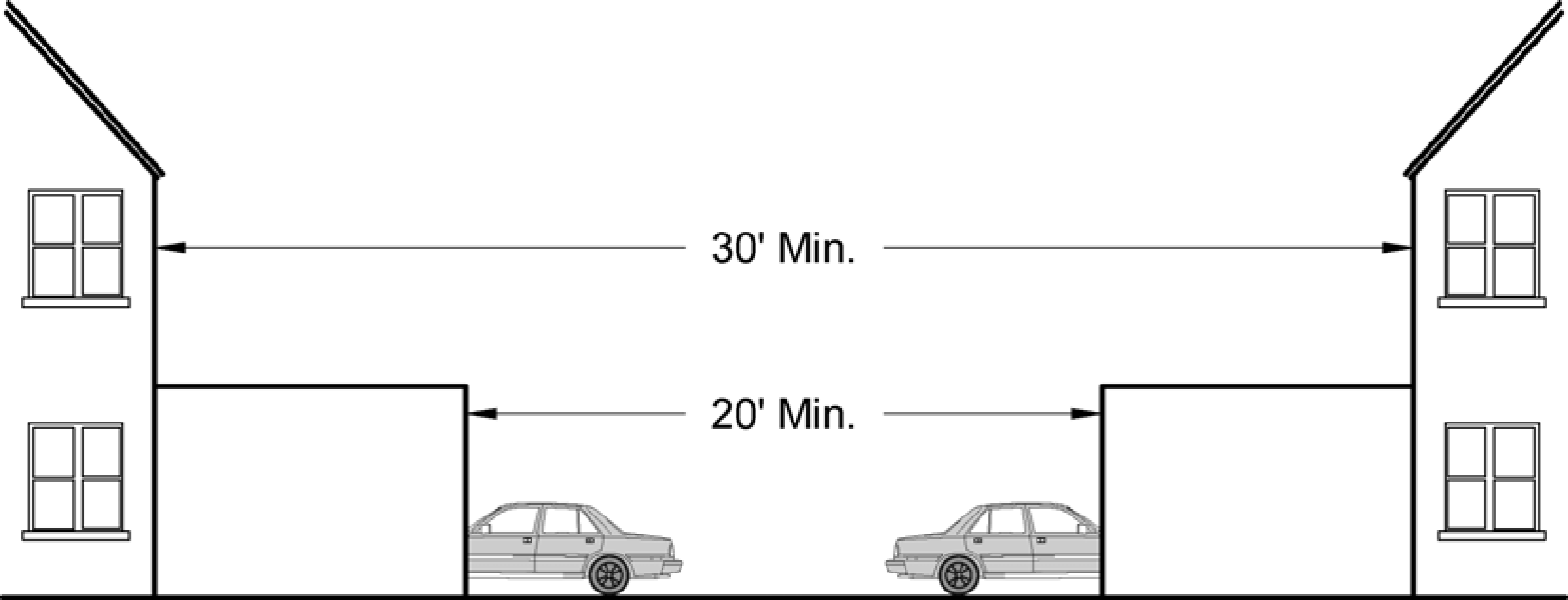
There shall be a minimum separation of twenty (20) feet between sidewalls among rows of townhouse developments and multiple-family dwellings. (See Figure 11-1: Sidewall Separation) Where the front or rear wall of a row of townhouse developments and multiple-family dwellings faces the front or rear wall of another row of townhouse developments and multiple-family dwellings, the minimum required separation between such buildings shall be a minimum of thirty (30) feet. Driveways and parking areas may be located within this minimum separation area. The minimum separation at the ground-floor may be reduced to twenty (20) feet for interior drives with garage doors facing garage doors, provided that the upper-story living spaces comply with the thirty-foot separation requirements. (See Figure 11-2: Upper-Floor Separation)
FIGURE 11-1: SIDEWALL SEPARATION
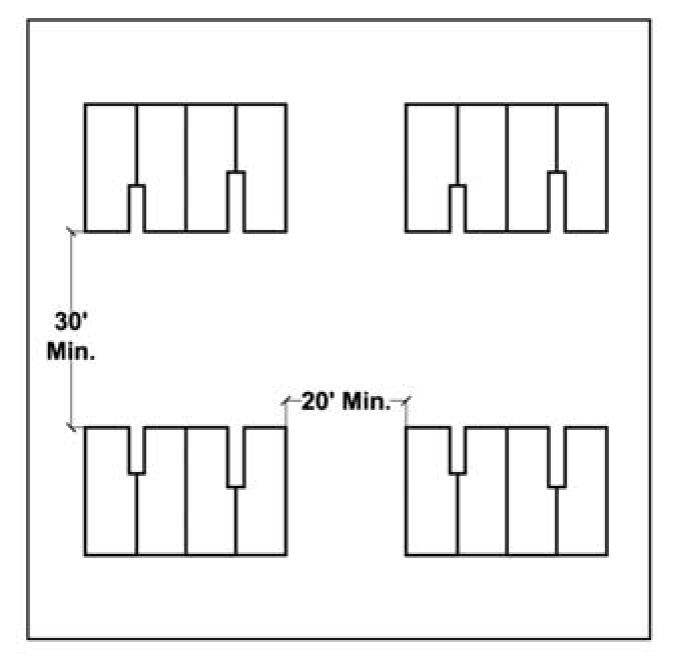
FIGURE 11-2: UPPER-FLOOR SEPARATION
c.
No more than six townhouse dwelling units shall be attached to one another in a single structure.
d.
Townhouses shall be designed with either detached garages located in the rear yard, or attached garages oriented to the rear or side of the units.
e.
Private yards a minimum of two hundred (200) square feet in area shall be required for each townhouse dwelling unit. This private yard may be located adjacent to a front wall, rear wall, or side wall, provided that it is immediately adjacent to the townhouse unit it serves and directly accessible from the townhouse unit by way of a door or stair. Required private yards must be at-grade or, if located on a terrace or patio, within two feet of grade. All private yards must be landscaped with turf, groundcover, shrubs, trees or other landscape improvements, including hardscape such as patios or terraces.
4.
Mobile Homes. Mobile homes, modular housing and prefabricated housing shall be allowed only in the R-4 General Residence District as a special use.
5.
Tents. Tents may be erected for up to ten (10) days for the purposes of temporary carnivals, places of worship, charitable uses, and revival meetings which are not detrimental to the public health, safety, morals, comfort, convenience, or general welfare, provided however, that such tents or operations are in conformance with all other Village ordinances and codes.
6.
Mixed Use Development. Uses allowed to be mixed in one development are limited to residential, office, retail, educational and civic. When uses are mixed in a single building, a minimum of fifty (50) percent of the ground floor shall be office or retail uses. Mixed use buildings shall be designed so that the location of entrances and exits to the office or retail uses shall front a public street. Service areas and parking and loading facilities shall be located to the rear of the building and designed to minimize traffic congestion, pedestrian hazards, and adverse impacts on adjoining properties.
B.
Cultural and Religious Uses.
1.
Cultural Facility or Museum. Cultural facilities and museums shall be designed so that the location of entrances and exits, exterior lighting, service areas, and parking and loading facilities will minimize traffic congestion, pedestrian hazards, and adverse impacts on adjoining properties.
2.
Place of Worship. Places of worship shall be designed so that the location of entrances and exits, exterior lighting, service areas, and parking and loading facilities will minimize traffic congestion, pedestrian hazards, and adverse impacts on adjoining properties.
C.
Recreational and Entertainment Uses.
1.
Club, Lodge or Hall.
a.
Clubs, lodges or halls shall be designed so that the location of entrances and exits, exterior lighting, service areas, and parking and loading facilities will minimize traffic congestion, pedestrian hazards, and adverse impacts on adjoining properties.
b.
No more than twenty (20) percent of the gross floor area may be used as office space.
c.
Clubs, lodges or halls are permitted to serve food and meals on the premises provided that adequate dining room space and kitchen facilities are available.
d.
The sale of alcoholic beverages to members and their guests is permitted provided it is secondary and incidental to the promotion of some other common objective by the organization, and further provided that such sale of alcoholic beverages is in compliance with all applicable federal, state and local laws.
2.
Entertainment/Recreational Facility, Indoor.
a.
Entertainment and recreational uses shall be designed so that the location of entrances and exits, exterior lighting, service areas, and parking and loading facilities will minimize traffic congestion, pedestrian hazards, and adverse impacts on adjoining properties.
b.
Live music is permitted in compliance with Title 5 Chapter 5.2 and Title 8 Chapter 8.2.
c.
Entertainment and recreational uses are permitted to serve food and meals on the premises provided that adequate dining room space and kitchen facilities are available.
d.
The sale of alcoholic beverages is permitted provided it is secondary and incidental to the sale of food, and further provided that such sale of alcoholic beverages is in compliance with all applicable federal, state and local laws.
3.
Entertainment/Recreational Facility, Outdoor.
a.
Entertainment and recreational uses shall be designed so that the location of entrances and exits, exterior lighting, service areas, and parking and loading facilities will minimize traffic congestion, pedestrian hazards, and adverse impacts on adjoining properties.
b.
Live music is permitted in compliance with Title 5 Chapter 5.2 and Title 8 Chapter 8.2.
c.
Outdoor uses shall be effectively screened from adjacent residential uses with a buffer yard in compliance with Title 17 Chapter 14.11.C.
d.
Entertainment and recreational uses are permitted to serve food and meals on the premises provided that adequate dining room space and kitchen facilities are available.
e.
The sale of alcoholic beverages is permitted provided it is secondary and incidental to the sale of food, and further provided that such sale of alcoholic beverages is in compliance with all applicable federal, state and local laws.
D.
Retail and Service Uses.
1.
Contractor Office. The parking of contractor vehicles or equipment or the outdoor storage of materials in a contractor storage yard are accessory to the use of a contactor office. If these items exist, the following must be submitted:
a.
Site plan detailing the location of all parking and outdoor storage. Parking shall comply with Title 17Chapter 13.
b.
Landscape plan detailing screening in accordance with Title 17Chapter 14.
c.
Contractor offices and storage yards shall be designed so that the location of entrances and exits, exterior lighting, service areas, and parking and loading facilities will minimize traffic congestion, pedestrian hazards, and adverse impacts on adjoining properties.
2.
Day Care Center, Adult and Day Care Center, Child. Day care centers shall meet all federal, state and local requirements including, but not limited to, licensing, health, safety and building code requirements. Day care centers shall include facilities, other than residential dwelling units, providing care for more than three children or elderly and/or functionally impaired adults in a protective setting for less than twenty-four (24) hours per day. In addition, the following criteria shall be considered by the Plan Commission:
a.
The provision of adequate on-site drop-off zones, sidewalks, and exterior lighting.
b.
The amount of traffic or noise to be generated.
c.
The provision of adequate open space.
3.
Day Care Home, Adult and Day Care Home, Child. Day care homes shall meet all federal, state and local requirements including, but not limited to, licensing, health, safety and building code requirements. Day care homes shall include residential dwelling units providing care for up to twelve (12) children or elderly and/or functionally impaired adults in a protective setting who do not spend the night at the dwelling. The number counted includes the family's natural or adopted children and all other persons under the age of twelve (12). In addition, the following criteria shall be considered by the Plan Commission:
a.
The provision of adequate on-site drop-off zones, sidewalks, and exterior lighting.
b.
The amount of traffic or noise to be generated.
c.
The provision of adequate open space.
d.
The day care home shall retain a residential character and the affect of the day care home will not alter the residential character of the neighborhood.
e.
The operation of the day care home shall not adversely impact surrounding properties.
4.
Drive-Through Facility. A drive-through facility is considered an accessory use to the principal use on the zoning lot. A drive-through facility must meet the following standards in addition to the special use standards found in Section 4.3, Special Use. For the purposes of this Ordinance, car washes, gas stations and motor vehicle service and repair facilities shall be exempt from the following standards.
a.
Drive-through facilities shall provide adequate stacking spaces, in accordance with Chapter 13: Off-Street Parking and Loading.
b.
All drive-through lanes must be located and designed to ensure that they will not adversely affect the safety and efficiency of traffic circulation on adjoining streets.
c.
The volume on all intercom menu displays shall be maintained at a level so as not to create a public nuisance for adjoining residential districts.
d.
The operator of the drive-through facility shall provide adequate on-site outdoor waste receptacles and shall provide daily litter clean-up along the rights-of-way abutting the property.
5.
Gas Station.
a.
Gas station canopies shall be designed with luminaires recessed under the canopy to minimize light pollution. Light intensity directly under the canopy shall not exceed twenty (20) footcandles at any location. All lighting mounted under the canopy, including auxiliary lighting within signage and panels over the pumps shall be included in the twenty (20) footcandle limit.
b.
All gas station driveways must be located and designed to ensure that they will not adversely affect the safety and efficiency of traffic circulation on adjoining streets.
c.
Gas stations may offer a car wash and/or convenience store.
6.
Home Occupation.
a.
Purpose. The purpose of the home occupation standards and requirements is to allow a home occupation to be conducted in a dwelling unit that is compatible with the neighborhood in which it is located.
b.
Standards. The following standards apply to all home occupations conducted in a dwelling unit, provided that the home occupation must be compatible with the neighborhoods in which they are located, and must not interfere with the rights of surrounding property owners to enjoy the established character of the neighborhood:
i.
The home occupation shall be conducted entirely indoors on the premises.
ii.
A home occupation shall not be established prior to the member(s) of the family conducting the home occupation take possession of, and reside in, the dwelling unit in which the home occupation is located.
iii.
Only one nonresident of the premises may be employed to work at or from the premises, such person shall not be employed more than twenty-five (25) hours within any one-week period.
iv.
The home occupation shall not generate excessive vehicular or pedestrian customer traffic.
v.
A home occupation shall not generate noise, solid waste, vibration, glare, fumes, odors, water use, or electrical interference beyond what normally occurs in a residential use.
vi.
No outside storage or display of materials, merchandise, inventory or heavy equipment shall be permitted.
vii.
No exterior signs shall be permitted.
viii.
Day care homes are not considered a home occupation and are subject to the standards of paragraph 3 (Day Care Home, Adult and Day Care Home, Child) above.
ix.
No wholesale or retail business shall be permitted unless it is conducted entirely by mail, telephone or small package delivery, except for the sale of items made on the premises or incidental to a service provided.
x.
The receipt or delivery of merchandise, goods, or supplies for use in a home occupation shall be limited to the United States mail, similar parcel delivery service, or private passenger automobile.
xi.
No permanent or temporary alterations of the principal or accessory buildings shall be made which change the residential character of the structure.
xii.
No more than twenty (20) percent of the area of any residential dwelling shall be devoted to the home occupation.
xiii.
No mechanical or electrical equipment or chemicals may be used or stored except such types as are customary for purely domestic, household, or hobby purposes. No home occupation shall be permitted which requires the use of toxic, hazardous or noxious matter in such concentrations as to be detrimental to or endanger the public health, safety, comfort or welfare or cause injury or damage to property.
xiv.
There may be more than one home occupation permitted per dwelling unit; however, the total combined home occupations for any single dwelling unit may not exceed any of the standards set forth in this section.
xv.
A home occupation that services customers or clients at the dwelling unit may attract no more than eight customers or clients per day, but not between the hours of 9:00 p.m. and 8:00 a.m.
xvi.
A home occupation is subject to the commercial vehicle standards in section 13.11.
xvii.
A home occupation conducted in a rental unit must have written permission from the property owner.
c.
Uses. The uses listed below are expressly prohibited as home occupations except that a home office for any use is permitted.
i.
Animal hospitals, animal boarding/kennel (more than four animals), and veterinary clinic;
ii.
Banquet hall;
iii.
Catering establishment;
iv.
Clinics or hospitals;
v.
Clubs, lodge or hall;
vi.
Contractor yard;
vii.
Dry cleaning or laundry establishments;
viii.
Entertainment/recreation facility, indoor or outdoor;
ix.
Food store/grocery store;
x.
Funeral homes;
xi.
Gas station;
xii.
Machine shops;
xiii.
Motor vehicle repair, Major or Minor;
xiv.
Motor vehicle dealership or rental establishment;
xv.
Restaurants and taverns;
xvi.
Short term rentals;
xvii.
Tattoo/body piercing establishment;
xviii.
Taxidermy;
xix.
Tobacco shop;
xx.
Towing service or tow truck operator.
7.
Animal Daycare Center, Training, Pound, Shelter and/or Kennel.
a.
Floors of runs shall be made of impervious material to permit proper cleaning and disinfecting.
b.
All animal quarters and runs are to be kept in a clean, dry, and sanitary condition.
c.
The perimeter of such structures must be at least one hundred fifty (150) feet from any residential zoning districts.
d.
Outdoor areas are restricted to use during daylight hours.
8.
Motor Vehicle Dealership and Motor Vehicle Rental Establishment. Motor vehicle dealership or rental establishment shall have a minimum lot size of fifteen thousand (15,000) square feet.
9.
Motor Vehicle Repair Major and/or Minor.
a.
Motor vehicle repair shops may not store the same vehicles outdoors on the site for longer than five days unless fully screened and enclosed.
b.
All driveways must be located and designed to ensure that they will not adversely affect the safety and efficiency of traffic circulation on adjoining streets.
c.
All repair operations shall be fully enclosed. Wrecked or junked vehicles shall not be stored for longer time periods than those specified above and shall be screened from the public right-of-way and any adjacent residential districts.
10.
Outdoor Dining.
a.
Outdoor dining is considered accessory to the principal use.
b.
Outdoor dining shall be limited to a designated outside area.
c.
The designated outside area shall be contiguous to the building.
d.
The designated outside area may not be located on any portion of a public road, public sidewalk or bike path or similar public way.
e.
The designated outside area shall not obstruct vehicular or pedestrian traffic or be in violation of any North Aurora codes or ordinances.
f.
There shall be no entertainment with the use of amplified sound in the designated outside area except in conformance with the requirements of the North Aurora Code.
g.
The operation and use shall be carried on so as not to create a health or safety hazard, to create a nuisance or to interfere with the use and enjoyment of surrounding property.
h.
Any designated outside area adjacent to or within five hundred (500) feet of the lot line of residential property shall require screening and/or buffering in a way as to reduce noise.
11.
Adult-Oriented Business. Adult uses shall be subject to the following standards:
a.
No adult use shall be located within one thousand (1,000) feet of any residential district, school, place of worship, or other adult use.
b.
The adult use shall be so designed, located and proposed to be operated so that the public health, safety, comfort, convenience and general welfare will be protected.
c.
It shall not cause substantial injury to the value of other property in the neighborhood in which it is located.
d.
It shall not unduly increase traffic congestion in the public streets and highways in the area in which it is located.
e.
It shall not cause additional public expense for fire or police protection.
f.
No adult use shall be conducted in any manner that permits the observation of any material depicting, describing or relating to "Specified Sexual Activities" or "Specified Anatomical Areas" from any public way or from any adjacent property. This provision shall apply to any display, decoration, sign, show window or door.
E.
Manufacturing, Storage, Food Production and Research Uses.
1.
All manufacturing activities shall be conducted within completely enclosed buildings.
2.
Any use projected to use more than five thousand (5,000) gallons of water per day shall follow the guidelines in Title 13 Chapter 24.060.
3.
Manufacturing, Storage, Food Production and Research Uses shall be designed so that the location of entrances and exits, exterior lighting, service areas, and parking and loading facilities will minimize traffic congestion, pedestrian hazards, and adverse impacts on adjoining properties. Truck entrances, truck courts, and trailer parking shall be designed to avoid stacking or idling of trucks in street right-of-way or drive aisles.
F.
Utilities.
1.
Amateur Radio Operations/Receive Only Antennas. Any tower or antenna that is under forty-five (45) feet in height and is owned and operated by a federally licensed amateur radio station operator or is used exclusively for receive-only antennas is permitted as an accessory use. No receive-only antenna shall exceed the highest point on the nearest residential rooftop of a dwelling by more than ten (10) feet. Existing towers and existing antennas which predated this Ordinance shall not be required to meet the requirements of this chapter.
2.
Wireless Telecommunications Antenna, Facility and Tower.
a.
Purpose. The following standards for wireless telecommunications antennas, facilities, and towers are intended to:
i.
Ensure public health, safety, convenience, comfort, and general welfare.
ii.
Ensure access to reliable wireless telecommunications services throughout all areas of North Aurora.
iii.
Encourage the use of existing towers and other structures for the co-location of wireless telecommunications antenna.
iv.
Encourage the location of towers, to the extent possible, in areas where the adverse impact on the Village will be minimal and preferably in nonresidential districts, as opposed to residential districts.
b.
Application Requirements. In addition to the requirements for a special use permit, all applications to erect, construct, or modify any part of a wireless telecommunications antenna, facility, or tower shall include the following items, unless waived by the Village:
i.
A site plan showing:
(A)
The location, size, screening, and design of all buildings and structures, including fences.
(B)
The location and size of all outdoor equipment.
(C)
The location, number, and species of proposed landscaping.
ii.
A maintenance plan, and any applicable maintenance agreement, designed to ensure long-term, continuous maintenance to be determined by the Community Development Director.
iii.
A disclosure of what is proposed, demonstrating the need for the proposed wireless telecommunications tower to be located as proposed based upon one or more of the following factors:
(A)
Proximity to a major thoroughfare.
(B)
Areas of population concentration.
(C)
Concentration of commercial or other business centers.
(D)
Areas where signal interference has occurred due to buildings, masses of trees, or other obstruction.
(E)
Topography of the proposed facility location in relation to other facilities with which the proposed facility is to operate.
iv.
The reason or purpose for the placement, construction or modification with specific reference to the provider's coverage, capacity, and/or quality needs.
v.
The service area of the proposed wireless telecommunications facility.
vi.
The nature and extent of the provider/applicant's ownership, easement or lease interest in the property, building or structure upon which facilities are proposed for placement, construction or modification.
vii.
The identity and address of all owners and other persons with a real property interest in the property, building, or structure upon which facilities are proposed for placement, construction, or modification.
viii.
A map showing all existing and proposed wireless telecommunications, antennas, facilities and towers within the Village, and one and one-half miles from the Village jurisdictional boundary.
ix.
Certification by a State of Illinois licensed and registered professional engineer as to structural integrity. The certification may be utilized, along with other criteria, in determining if additional setback should be required for the structure and other facilities.
x.
The Village Board shall have the discretion to require the applicant to provide a visual simulation or rendering of the proposed support structure that illustrates the relationship between the height and the visual appearance of the structure. If required, the visual simulation shall be provided from two different perspectives and accurately depict the scale of the proposed structure in the context of the surrounding area.
xi.
Co-location shall be deemed to be feasible for purposes of this section where all of the following are met:
(A)
The wireless telecommunications provider under consideration for co-location will provide fair compensation for co-location.
(B)
The site on which co-location is being considered, taking into consideration reasonable modification or replacement of a facility, is able to provide structural support.
(C)
The co-location being considered is technologically feasible, where the co-location will not result in unreasonable interference, given appropriate physical and other adjustments in relation to the tower, antenna and the like.
(D)
The height of the structure necessary for co-location shall not exceed the maximum height allowed by this section.
c.
Location. Wireless telecommunications antennas, facilities and tower antennas shall be designated as special uses in the zoning districts in which they are allowed in the following locations:
i.
On property owned, leased, or otherwise controlled by the Village provided that a lease has been approved by the Village.
ii.
On the Commonwealth Edison easement parallel to Oak Street and the East-West Tollway (Interstate 88).
iii.
On the Northern Illinois Gas Company easement and property located north of the Commonwealth Edison easement, west of Randall Road, and south of Oak Street.
iv.
On property in the O-R zoning district that is owned by a governmental body other than the Village that is located east of Randall Road, but does not abut or adjoin property which is zoned for residential use.
d.
Setback.
i.
Wireless telecommunications towers shall be set back from all property lines a distance equal to their height as measured from the base of the structure to its highest point.
ii.
Wireless telecommunications facilities shall be setback from all property lines in accordance with the minimum setback requirements in the zoning district.
e.
Height. The maximum height of a wireless telecommunications tower shall not exceed one hundred fifty (150) feet, including all attachments (antennas, lightning rods, arrays, etc.). A special use application for approval of a wireless telecommunications tower shall demonstrate that the tower does not exceed the minimum height requirement necessary to function satisfactorily.
f.
Lighting and Marking. Wireless telecommunications antennas, towers and facilities shall not be lit or marked unless required by the Federal Communications Commission (FCC) or the Federal Aviation Administration (FAA).
g.
Landscaping. Landscaping is required to enhance compatibility with adjacent land uses. Opaque screening six feet in height equipped with an appropriate anti-climbing device must be erected around the wireless telecommunications tower and/or facility. Landscaping shall be installed on the outside of fencing in accordance with the following:
i.
One shade tree shall be provided for every twenty-five (25) feet of fence length, not including gates or other fence openings.
ii.
One shrub for every five linear feet of fence length, not including gates or other fence openings.
iii.
The landscaping may be flexible in its arrangement by appropriately aggregating the required plant materials and maintaining open areas around gates or other fence openings so long as it provides access.
h.
Access. All sites on which wireless telecommunications antennas, facilities and tower antennas are located must have a hard surfaced driveway of asphalt or concrete.
i.
Additional Standards for Wireless Telecommunications Antennas.
i.
Wireless telecommunications antennas do not include satellite dishes, as regulated in Section 12.3.G (Satellite Dish Antenna) of this Ordinance.
ii.
Antennas shall be of a color that is identical or similar to the color of the supporting structure to make the antenna visually unobtrusive.
iii.
No antenna shall increase the height of any structure on which it is mounted by more than ten (10) percent, or ten (10) feet, whichever is less.
j.
Additional Standards for Wireless Telecommunications Facilities.
i.
Any buildings, cabinets, or shelters shall only house equipment and supplies for operation of the wireless telecommunication tower. Any equipment not used in direct support of such operation shall not be stored on the zoning lot.
ii.
Signs for the wireless telecommunications facility shall be limited to ownership and contact information, FCC antenna registration number (if required), and any other information required by government regulation. Commercial advertising is strictly prohibited.
k.
Additional Standards for Wireless Telecommunications Towers.
i.
Wireless telecommunications towers shall be designed to accommodate at least three telecommunications providers.
ii.
The area surrounding a tower must be of a sufficient size to accommodate wireless telecommunications facilities for at least three telecommunications providers.
iii.
Unless otherwise required by the Federal Communications Commission, the Federal Aviation Administration or the Village, towers shall have a galvanized silver or gray finish.
l.
Stealth Design for Wireless Telecommunication Antennas. Stealth design for wireless antennas is encouraged and shall be considered a permitted use in all districts, subject to site plan review. All applications for site plan review shall include all information required by this section. In addition to the standards of this section for wireless telecommunications antennas, stealth design shall comply with the following regulations:
i.
To qualify as a stealth design, wireless telecommunications antennas and towers must be enclosed, camouflaged, screened, obscured, or otherwise not readily apparent to a casual observer.
ii.
Antennas located on structures already permitted within zoning districts, such as flagpoles, bell towers, clock towers, crosses, monuments, smoke stacks, parapets and steeples, and designed to blend in to the structure are considered stealth design.
iii.
Setbacks for the any stealth design tower shall be governed by the setback requirements of the zoning district.
iv.
Stealth design shall accommodate the co-location of other antenna where economically and technically feasible or aesthetically appropriate, as determined by the Village Board.
m.
Abandonment. Any wireless telecommunications tower or facility that is not operated for a period of twelve (12) consecutive months shall be considered abandoned. The owner shall remove the tower or facility within six months of its abandonment.
G.
Cannabis, Dispensing Organization.
1.
Purpose and Applicability. It is the intent and purpose of this Section to provide regulations regarding the cultivation, processing and dispensing of adult-use cannabis occurring within the corporate limits of the Village. Such facilities shall comply with all regulations provided in the Cannabis Regulation and Tax Act (P.A. 101-0027) (Act), as it may be amended from time-to-time, and regulations promulgated thereunder, and the regulations provided below. In the event that the Act is amended, the more restrictive of the state or local regulations shall apply.
2.
There shall be a maximum of two (2) Adult-Use Cannabis Dispensing Organizations located in the Village of North Aurora.
3.
Adult-Use Cannabis Dispensing Organizations shall be located a minimum of one thousand (1,000) feet from the property line of any school grounds, public playground, public recreation center, child care center, public park, public library, or game arcade to which admission is not restricted to persons twenty-one (21) years of age or older located in the Village of North Aurora. When any use listed above locates within the 1,000-foot setback of a previously approved dispensary, the 1,000-foot setback shall not apply to the previously approved dispensary or any future dispensaries approved to use the same space.
4.
On-site consumption of cannabis shall be prohibited.
5.
Adult-Use Cannabis Dispensing Organizations shall be located a minimum of one thousand five hundred (1,500) feet from the property line of any pre-existing Adult-Use Cannabis Dispensing Organization located in the Village of North Aurora.
(Ord. No. 12-08-20-02, § 2, 8-20-2012; Ord. No. 13-08-19-02, § 2, 8-19-2013; Ord. No. 19-10-21-01, §§ 3, 4, 10-21-2019; Ord. No. 24-10-07-05, § 6(Exh. E), 10-7-2024; Ord. No. 25-09-15-02, § 2, 9-15-2025)
11.3 - Temporary uses.
A.
Temporary Use Permit Application.
1.
Any person, firm, or corporation desiring to obtain a temporary use permit, as required by this Ordinance, shall file a written application with the Community Development Director on a form provided by the Village, together with an application fee as set forth in Title 15, Chapter 15.56.
2.
The Community Development Director shall grant temporary use permits for those uses listed in paragraph C., below, so long as he/she determines that the proposed use, including the erection of any temporary building or structure, complies with the requirements of this section and this Ordinance. Unless expressly provided in this section, every temporary use shall comply with the bulk requirements applicable in the district in which the temporary use is located.
3.
Temporary uses not specifically listed here shall require the specific approval of the Village Board. Such uses may be allowed in any zoning district, provided that such temporary use is consistent with the purpose and intent of this Ordinance and the zoning district in which it is located.
B.
General Provisions. Every temporary use shall comply with the standards listed below.
1.
No temporary use shall be permitted that causes, or threatens to cause, an on-site or off-site threat to the public health, safety, comfort, convenience and general welfare.
2.
Every temporary use shall be operated in accordance with such restrictions and conditions as the Fire Department may require. If required by the Village, the operator of the temporary use shall employ appropriate security personnel.
3.
No temporary use shall be permitted if the additional vehicular traffic reasonably expected to be generated by such use would have undue detrimental effects on surrounding streets and uses as determined by the Community Development Director.
4.
No temporary use shall be authorized that would unreasonably reduce the amount of parking spaces available for use in connection with permanent uses located on the lot in question. The Community Development Director may make an assessment of the total number of parking spaces that will be reasonably required in connection with a proposed temporary use, on the basis of the particular use, its intensity and the availability of other parking facilities in the area. The Community Development Director shall approve such temporary use only if such parking spaces are provided.
5.
Signs shall be permitted only in accordance with the regulations of the Sign Ordinance.
C.
Permitted Temporary Uses.
1.
Carnivals/Circuses. The requirements for carnivals/circuses are addressed in Chapter 5.48 of the North Aurora Municipal Code.
2.
Christmas Tree Sales Lot and Pumpkin Sales Patch. Christmas tree sales and pumpkin sales lots are allowed in any nonresidential zoning district. Any such use shall be evaluated based on the adequacy of the parcel size, parking provisions, traffic access, and the absence of undue adverse impact on other properties by the Community Development Director. Such use shall be limited to a period not to exceed forty-five (45) days. Display of Christmas trees need not comply with the yard requirements of the district in which the lot is located.
3.
Farmstands and Farmers Markets. Farmstands and farmers markets are allowed in any nonresidential district. No product may be exhibited or offered for sale except the following: fresh dairy goods, meat, eggs, fruits, vegetables, juices, flowers, plants, herbs, and spices produced or grown by the vendor and baked goods made by the vendor(s). Such uses shall be limited to a period not to exceed two days per week.
4.
Art Exhibits and Craft Fairs. Art exhibits and craft fairs are allowed in any nonresidential district. No product may be exhibited or offered for sale except paintings, drawings, sculptures, prints, ceramics and other similarly handcrafted objects made by the vendor(s). These uses shall be evaluated based on the adequacy of the parcel size, parking provisions, traffic access, and adverse impact on other properties. These uses shall be limited to a period not to exceed three days and no more than three sales shall be permitted in any twelve-month period.
5.
House, Apartment, Garage and Yard Sales. Such sales are allowed in any residential district, but only when limited to personal possessions of, or arts and crafts made by, the owner or occupant of the dwelling unit where the sale is being conducted. Such use shall be limited to a period not to exceed three consecutive days and no more than two such sales shall be conducted from the same residence in any twelve-month period.
6.
Temporary Contractor Trailers and Real Estate Model Units. Contractor trailers and real estate model units are allowed in any zoning district when accessory to a construction project or a new development, respectively. Such use shall be limited to a period not to exceed the duration of the active construction phase of such project or the active selling and leasing of space in such development, respectively. No such use shall contain any sleeping or cooking accommodations, except those located in a model unit used for demonstration purposes only. Such uses should meet all bulk and yard standards for the zoning district in which they are located. Temporary contractor trailers may not be in use for more than two years, which time could be extended by written request made to the Community Development Director and approval of the Village Board.
7.
Temporary Outdoor Sales and Display. Retail goods establishments are permitted temporary outdoor sales and display of merchandise. Any lawfully existing commercial use shall be permitted to display and sell its merchandise outdoors under the following conditions:
a.
No display, sales or additional parking is permitted in any street right-of-way. In addition, no display, sales or additional parking shall obstruct pedestrian or vehicular traffic.
b.
All display and sales areas shall comply with the minimum required interior corner side yards and rear yard setbacks.
c.
No more than ten (10) percent of the required parking area for the existing commercial use may be used for the temporary outdoor sales and display, unless approved by the Community Development Director. The use of the parking area for such outdoor sales and display shall only be used on a temporary basis not to exceed ten (10) days and no more than three times in any year.
8.
Temporary Storage Containers on Improved Property.
a.
Temporary storage containers may be used in any zoning district, subject to the requirements and limitations contained in this section.
b.
Temporary storage containers must be located on an impervious or otherwise improved surface.
c.
A temporary storage permit that indicates the start date and duration of the permit must be obtained from the Community Development Director and be prominently displayed on the container.
d.
Temporary storage containers used for major projects, including, but not limited to, additions, improvements, major remodeling, repair and rehabilitation shall be limited to an initial duration of no more than thirty (30) days. Thirty-day extension(s) of up to one hundred eighty (180) days from the beginning date of the initial permit, shall be permitted provided that the applicant can demonstrate that progress has been made in the initial permit or previous extension period and that additional time is reasonably necessary to complete the work that is being done.
e.
Temporary storage containers used for purposes other than major projects and commercial storage shall be limited in duration to the following:
i.
In residential and commercial zoning districts, temporary storage containers are permitted in front yards and corner side yards for fourteen (14) days, and are permitted in interior side yards and rear yards for twenty-eight (28) days.
ii.
In all other zoning districts, temporary storage containers are permitted in any yard for twenty-eight (28) days.
f.
Temporary storage containers may be used for commercial storage purposes in commercial and industrial zoning districts subject to the following criteria:
i.
Initial permits may be allowed for up to ninety (90) days and may be renewed by ninety-day increments for up to three hundred sixty (360) total days from the beginning date of the initial permit, providing that the applicant can demonstrate that progress has been made in the initial permit or previous extension period and that additional time is reasonably necessary to complete the work that is being done.
ii.
Temporary storage containers must be located in the rear yard and must be shielded from view from any public street or right-of-way by means to be approved by the Community Development Director, or his/her designee.
iii.
Temporary storage containers must not encroach on any building setback areas.
iv.
Temporary storage containers must not be located on landscape easements, similarly dedicated areas, fire lanes, required parking or loading areas, or in a manner to reduce accessibility to areas of the site for emergency response.
v.
Temporary storage containers must comply with this section and shall be subject to periodic inspection.
g.
The size and number of temporary storage containers may not exceed:
i.
On a zoning lot less than one acre, eight feet by eight feet by sixteen (16) feet in size, two in number, or two thousand forty-eight (2,048) total cubic feet.
ii.
On a zoning lot less than two acres, eight feet by eight feet by twenty (20) feet in size, three in number or three thousand eight hundred forty (3,840) total cubic feet.
iii.
On a zoning lot two acres or larger, eight feet by eight feet by forty (40) feet in size, three in number or seven thousand six hundred eighty (7,680) total cubic feet.
h.
The location of temporary storage containers shall not:
i.
Obstruct or impede pedestrian traffic, vehicular traffic, water drainage, emergency access, or access to utility services.
ii.
Obstruct the view of an operator of a motor vehicle traveling on or entering or exiting a street or right-of-way.
iii.
Be placed on landscaped or unimproved surfaces, across public sidewalks or in public rights-of-way, alleys or streets.
iv.
Limit the access to property of persons other than the applicant and the applicant's guests and invitees.
v.
Restrict parking on a nonresidential zoning lot to less than the minimum required and available parking spaces.
i.
Temporary storage containers shall not be used for the storage of garbage, waste, refuse, or hazardous, flammable or toxic materials, firearms, animals and items that are unlawful to possess.
j.
Temporary storage containers shall not be placed on property owned by a person other than the applicant without the authority of the property owner, which authority must be evidenced in writing and submitted at the time the application for permit is submitted.
k.
Temporary storage containers must be closed and secured from unauthorized access at all times when not under the direct supervision of the permit applicant and must be maintained in a clean condition, free from rust, peeling paint, graffiti and visible deterioration.
l.
No personal property, debris, garbage, waste, refuse or other materials shall be allowed to accumulate outside the temporary storage container.
m.
Fees subject to Title 15, Chapter 15.56.
9.
Temporary Storage Structures on Improved Property.
a.
Temporary storage structures may be used in conjunction with a building permit on improved property in any zoning district subject to the requirements and limitations contained in this section.
b.
The building permit application must include, in addition to the requirements for the actual construction of the improvement for which the permit is sought, a request for approval of the temporary storage structure including:
i.
A diagram or plan illustrating the manner in which the proposed temporary structure will be assembled and placed on and/or affixed to the ground.
ii.
A site plan accurately locating property lines, existing structures on the property, paved surfaces, and the exact size and location of the proposed temporary structure noting distances to nearby property lines and existing structures. For structures proposed on nonresidentially zoned property, the site plan shall include information locating all building ingress/egress locations, fire lanes, loading zones, bicycle and vehicle parking areas, and landscaped areas.
iii.
The building permit shall not be approved and issued if, in the opinion of the Community Development Director, said structure will be constructed or secured to the ground in such a manner as to constitute a risk to the public.
c.
The temporary storage structure permit shall indicate the start date and duration of the permit and shall be prominently displayed on the temporary storage structure.
d.
The temporary storage structures shall not:
i.
Be used for the storage of garbage, waste, refuse, or hazardous, flammable or toxic materials, firearms, animals and items that are unlawful to possess.
ii.
Encroach on any building setback areas.
iii.
Be located on commercial and industrial zoning lots in landscaped easements or similarly dedicated areas, in fire lanes, required parking or loading areas, or in a manner to reduce accessibility to areas of the site for emergency response.
iv.
Be placed on property owned by a person other than the applicant without the authority of the property owner, which authority must be evidenced in writing and submitted at the time the application for permit is submitted.
e.
An initial permit shall be issued for no more than ninety (90) days, and the permit may be renewed by ninety-day extensions for up to the length of time that the building permit is issued, providing that the applicant can demonstrate that progress has been made in the initial permit period and that additional time is reasonably necessary to complete the work that is being done. Temporary storage structures must:
i.
Be closed and secured from unauthorized access at all times when not under the direct supervision of the permit applicant.
ii.
Be maintained in a clean condition, free from rust, peeling paint, graffiti and visible deterioration.
f.
No personal property, debris, garbage, waste, refuse or other materials shall be allowed to accumulate outside the temporary storage structure.
g.
Fees subject to Title 15, Chapter 15.56.
10.
Temporary Storage Containers or Structures on Vacant Property Being Improved.
a.
Temporary storage structures and containers may be used in conjunction with the issuance of a building permit and improvement of vacant property for the duration of the building permit.
b.
Temporary storage structures and containers on vacant property being improved shall not:
i.
Be used for the storage of garbage, waste, refuse, or hazardous, flammable or toxic materials;
ii.
Encroach on any building setback areas;
iii.
Be located in commercial and industrial zoning lots on landscape easement or similarly dedicated areas, in fire lanes, required parking or loading areas, or in a manner to reduce accessibility to areas of the site for emergency response; and
iv.
Be closed and secured from unauthorized access at all times when not under the direct supervision of the permit applicant.
c.
No personal property, debris, garbage, waste, refuse or other materials shall be allowed to accumulate outside the temporary storage container or structure.
d.
A Fees subject to Title 15, Chapter 15.56.
(Ord. No. 12-08-20-02, § 2, 8-20-2012; Ord. No. 24-10-07-05, § 9, 10-7-2024)

