
North Aurora City Zoning Code
CHAPTER 12
SITE DEVELOPMENT STANDARDS2
Editor's note— Ord. No. 14-08-18-01, § 1, adopted Aug. 18, 2014, amended Ch. 12 in its entirety to read as herein set out. Former Ch. 12, §§ 12.1—12.5, pertained to similar subject matter and derived from Ord. No. 12-08-20-02, § 2, 8-20-2012.
12.1 - Use of land and buildings.
A.
Number of Buildings on a Lot. Except in the case of planned unit developments, not more than one principal detached building shall be located on a zoning lot.
B.
All Activities within an Enclosed Building. Within all districts, all activities shall be conducted wholly within an enclosed building, with the exception of the following activities and uses:
1.
Off-street parking and loading in accordance with Chapter 13: Off-Street Parking and Loading.
2.
Outdoor businesses, and those businesses with a required outdoor component, including, but not limited to, outdoor entertainment, outdoor recreation, outdoor dining, automotive sales, car washes, kennels and similar business.
3.
Outdoor storage and display areas in accordance with Section 12.3.E (Outdoor Storage and Display).
4.
Temporary uses in accordance with Section 11.3 (Temporary Uses).
C.
Frontage on a Public or Private Street. All zoning lots shall front on a public street, unless otherwise approved as a planned unit development.
D.
Maintenance of Required Yards. No zoning lot shall be reduced in area so that the yards become less than required by this ordinance. The yards of a building or structure shall not be considered yard space for any other building or structure, except as provided in a planned unit development.
E.
Applicability of Bulk Requirements. All buildings and structures erected after the effective date of this ordinance shall meet the requirements for the zoning district in which the building or structure is located. No existing building shall be enlarged, altered, reconstructed, or relocated in such a manner that conflicts with the requirements of the zoning district in which the building or structure shall be located.
F.
Applicability of Use Restrictions. No building, structure, or land shall be used for any use other than one allowed as either a permitted or special use in the zoning district in which such building, structure or land is located. Buildings, structures, or land may also be used for a temporary use or accessory use, in accordance with the requirements of Section 11.3 (Temporary Uses) and Section 12.3 (Accessory Buildings, Structures and Uses).
G.
View Obstruction.
1.
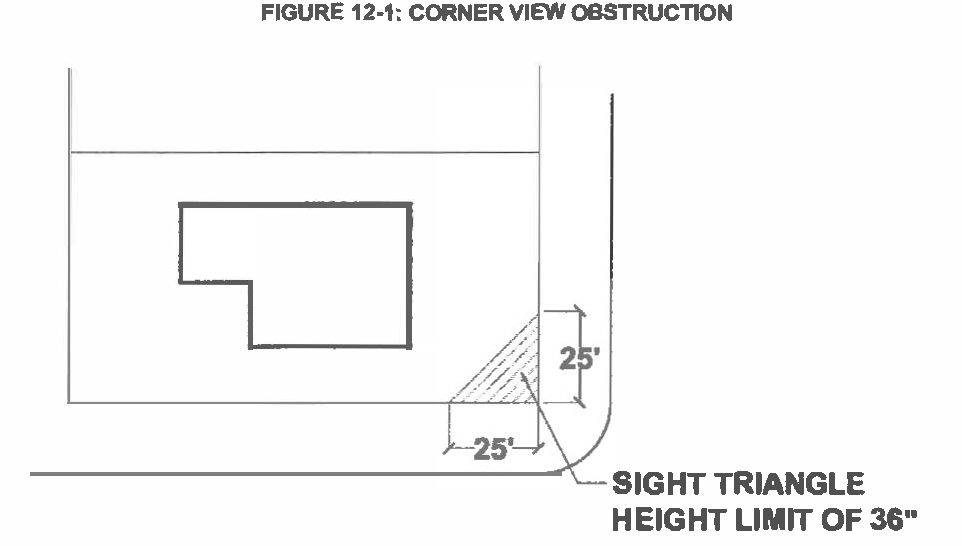
Notwithstanding any provisions relating to building height as provided in this ordinance, the visional clearance area at the intersection of two streets, which shall be defined as a triangular area of a corner lot measured twenty-five (25) feet on the front lot line and twenty-five (25) feet on the corner side lot line, and shall not be obstructed by any sign, wall, fence, hedge, shrub or other object which exceeds thirty-six (36) inches in height. In the event that the grade of a lot is higher than the street grade, the height of the wall, fence, hedge, or shrub shall be reduced so that the visional clearance is not obstructed thirty-six (36) inches over the grade of the street. The vision clearance area is illustrated in Figure 12-1: Corner View Obstruction.
2.
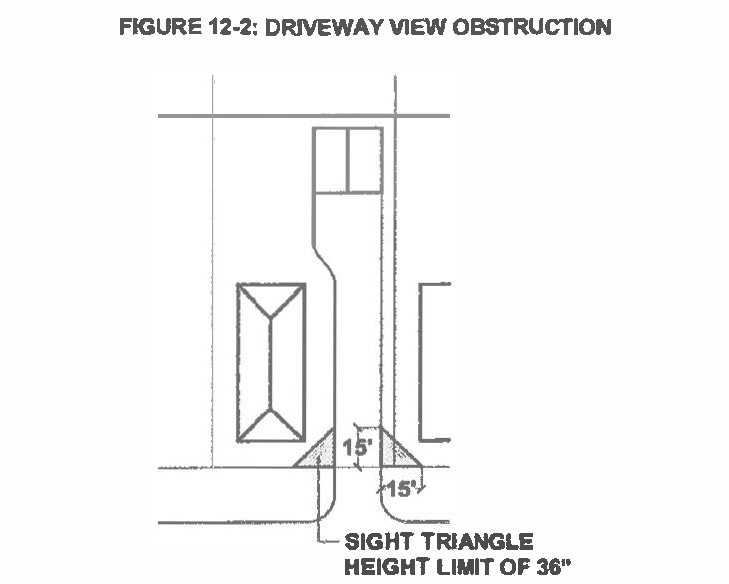
Notwithstanding any provisions relating to building height as provided in this ordinance, the vision clearance area at the intersection of a driveway and a street, which shall be defined as a triangular area measured fifteen (15) feet on the lot line on either side of the driveway, and shall not be obstructed by any sign, wall, fence, hedge, shrub or other object which exceeds thirty-six (36) inches in height. In the event that the grade of a lot is higher than the street grade, the height of the wall, fence, hedge, or shrub shall be reduced so that the visional clearance is not obstructed thirty-six (36) inches over the grade of the street. The vision clearance area is illustrated in Figure 12-2: Driveway View Obstruction.
H.
Obstruction of Watercourse Channels. To prevent encroachment upon, or constriction of, river or creek channels, and thereby avoid obstruction to the natural conveyance of water flow in such rivers, creeks, and other natural watercourses, there shall not be placed, erected, or located within the banks of such watercourses any building or structure, pier or marina, or retaining or revetment wall, except as permitted in Title 15, Chapter 15.64 of the Village of North Aurora Code of Ordinances.
(Ord. No. 14-08-18-01, § 1, 8-18-2014; Ord. No. 12-12-04-02, §§ 5, 6, 12-4-2023)
12.2 - Exterior lighting.
The requirements for exterior lighting are addressed in Chapter 8.32: Outdoor Lighting, of the North Aurora Municipal Code.
(Ord. No. 14-08-18-01, § 1, 8-18-2014)
12.3 - Accessory buildings, structures, and uses.
All accessory buildings, structures, and uses, shall be subject to the requirements of this section and the requirements of Section 12.4 (Permitted Encroachments).
A.
Accessory Buildings (Residential Districts).
1.
No accessory building shall be constructed prior to the start of construction of the principal building to which it is accessory. No accessory building shall be used unless the principal building on the lot is also being occupied for its intended purposes.
2.
Location. No detached accessory buildings shall be located:
a.
In any required front or corner side.
b.
Within five feet of any rear or interior side lot line.
c.
On or within any designated easement.
d.
Within ten (10) feet of the principal building on a lot.
e.
In front of the front line of the principle building that is nearest to the front property line.
3.
Height. Unless otherwise provided for in this ordinance, no detached accessory building or structure shall exceed the peak height of the principle structure (when measured to the highest point on the roof or parapet) or fifteen (15) feet in height, whichever is less. Garage doors shall not exceed eight feet in height.
4.
Area. The combined square footage of all detached accessory buildings shall not exceed ten (10) percent of the zoning lot area or exceed the maximum lot coverage allowed in each zoning district. No one individual detached accessory building shall exceed the total square footage of the footprint of the principal building or structure.
5.
Number. No more than two accessory buildings shall be permitted on a single zoning lot.
6.
All garages must be serviced by a hard surface driveway constructed of concrete, asphalt, or brick pavers.
7.
Secondary dwelling units in accessory buildings shall be prohibited.
8.
A temporary and/or portable structure, such as mobile homes, recreational vehicles, trailers, tents, canopies, etc., shall not be permitted as an accessory building, dwelling unit, parking or storage facilities.
B.
Accessory Buildings (Non-Residential Districts).
1.
No accessory building shall be constructed prior to the start of construction of the principal building to which it is accessory. No accessory building shall be used unless the principal building on the lot is also being occupied for its intended purposes.
2.
Location. No detached accessory buildings shall be located:
a.
In any required front or corner side.
b.
Within ten (10) feet of any rear or interior side lot line.
c.
Within thirty (30) feet of any rear or interior side lot line abutting a residential district.
d.
On or within any designated easement.
e.
Within ten (10) feet of the principal building on a lot.
f.
In front of the front line of the principal building that is nearest to the front property line.
3.
Height. Unless otherwise provided for in this ordinance, no detached accessory building or structure shall exceed the peak height of the principal structure (when measured to the highest point on the roof or parapet) or, if abutting a residential district, twenty (20) feet in height.
4.
Area. The combined square footage of all detached accessory buildings shall be included in the applicable floor area ratio (FAR) requirement and shall not exceed the maximum lot coverage allowed in each zoning district.
5.
All garages must be serviced by a hard surface driveway constructed of concrete, asphalt, or brick pavers.
6.
A temporary and/or portable structure, such as mobile homes, recreational vehicles, trailers, tents, canopies, etc., shall not be permitted as an accessory building, dwelling unit, parking or storage facilities.
7.
Accessory buildings shall be clearly incidental and subordinate to the principal building and not used for human habitation.
8.
In all Business Districts, the exterior elevations of accessory buildings shall be architecturally compatible, and comprised of the same material and color, as the principal structure.
C.
Fences and Walls.
1.
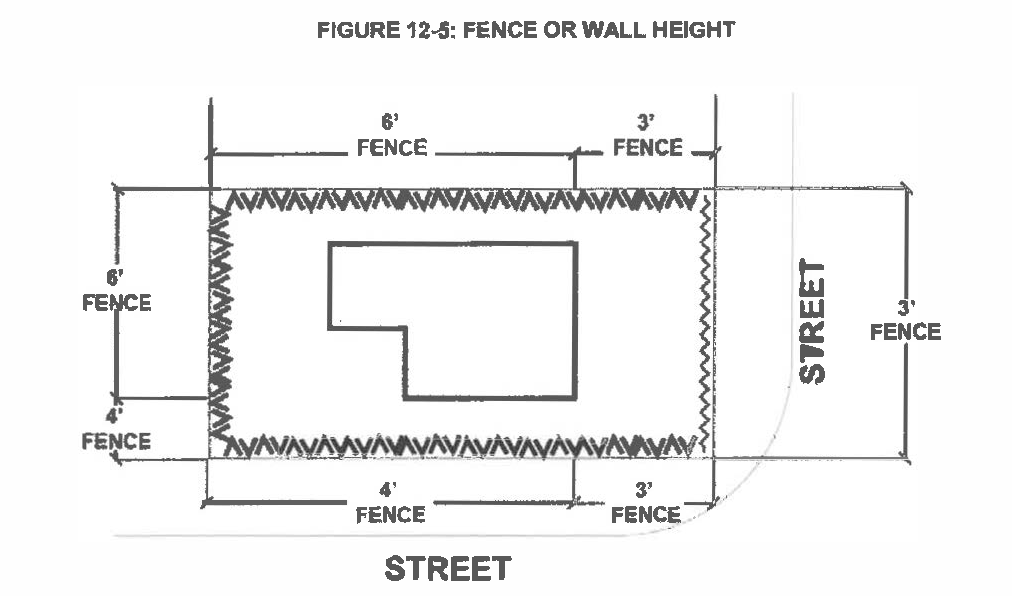
Height. The height of a fence shall be measured from the average grade of the lot to the top of the fence panel. Fences and walls shall be constructed so as not to exceed the following heights displayed in the fence height table.
Fence Height Table
* A three-inch height variation shall be permitted on the top or bottom of the fence to allow for decorative features and/or drainage elements.
2.
Fence Location. Fences should be located on or within the property line.
3.
Construction and Design Requirements.
a.
The finished side of the fence shall face outward or away from the lot on which the fence is erected.
b.
A fence or wall, including all posts, bases, and all other structural parts shall be located completely within the boundaries of the lot on which it is located.
c.
Fences shall not be constructed in a manner that obstructs the vision clearance of corner lots per the requirements of Section 12.1.G.1.
d.
No fence equipped with or having barbed wire, spikes, or any similar device, or any electrically charged fence, sufficient to cause shock shall be erected, placed and maintained in any zoning district, with the exception of agricultural and industrial uses.
e.
As required by state law, all in-ground swimming pools are to be fenced no less than four feet in height. Above ground pools shall be fenced if any portion of the pool is less than four feet above the adjacent grade.
D.
Mechanical Equipment in Business and Industrial Districts.
1.
All ground-based mechanical equipment shall be located in the rear or interior side yard and shall be completely screened from public view. Screening materials may be masonry, wood, landscaped hedges, and shall effectively screen mechanical equipment so no portion is visible from a street or adjoining lot.
2.
In cases where it is impractical to locate mechanical equipment within the rear yard, the community development director may approve an alternative location, which must still be properly screened. Screening materials may be masonry, wood, landscaped hedges, and shall effectively screen mechanical equipment so no portion is visible from a street or adjoining lot.
3.
Any heating, ventilation, or air conditioning equipment located on the roof of any structure in any zoning district shall be screened either by an architectural element of at least six feet from any supporting wall of the building to permit safe access to the roof by the fire department.
E.
Outdoor Storage and Display.
1.
Retail goods establishments are permitted temporary outdoor storage and display areas as an accessory use to the primary use on the same lot or tract of land and in accordance with Section 11.3-C-7 (Temporary Outdoor Sales and Display).
2.
The following uses are permitted to have outdoor storage and display areas in accordance with the provisions of this section, and the screening requirements of Chapter 14: Landscaping and Screening:
a.
Greenhouse/nursery, including the growing of plants in the open.
b.
Retail establishment.
c.
Motor vehicle dealership.
d.
Motor vehicle rental establishment.
e.
Motor vehicle service and repair, major and motor vehicle service and repair, minor in accordance with Section 11.2.D.9 (Motor Vehicle Repair and/or Service).
f.
Additional accessory outdoor storage and display areas may be approved by the community development director.
3.
All manufacturing, assembly, repair or work activity shall take place inside an enclosed building. No work shall take place outdoors.
4.
Outdoor storage or display areas shall not encroach upon any public right-of-ways, setbacks, easement areas, fire lanes, and/or required parking areas.
5.
No materials shall be permitted to remain stored or displayed outdoors for a period of time exceeding thirty (30) days.
6.
The maximum display or storage area shall not exceed ten (10) percent of the total gross floor area of the commercial building or space.
7.
No materials stored or displayed outdoors shall be of a greater height than that of the required screening as provided for in Chapter 15: Landscaping.
8.
Temporary outdoor storage areas and displays shall not alter the required fire separation or required fire rating of the exterior wall as defined in the currently adopted building code.
F.
Satellite Dish Antennas.
General Requirements.
1.
Satellite dish antennas shall be permanently installed on a building, or otherwise permanently mounted.
2.
Subject to operational requirements, the dish color shall be of a neutral color. No additional signs or advertising shall be permitted on satellite dish itself.
3.
Compliance with all federal, state and local regulations shall be required in the construction, installation, and operation of satellite dish antennas.
4.
All exposed surfaces of the antenna shall be kept clean and all supports shall be painted to maintain a well-kept appearance. Antennas no longer in use must be removed.
G.
Small Wind Energy Systems.
1.
Small wind energy systems shall be permitted accessory uses on any roof in any nonresidential zoning district. Small wind energy systems shall not be permitted accessory uses in any residential zoning district, except the E-R Estate Rural Residence District.
2.
Small wind energy systems shall not exceed fifteen (15) feet in height above the elevation of the roof installation point, measured from the point of attachment to the top of the turbine blade at its highest point. Small wind energy systems shall be located no closer than ten (10) feet from an adjacent property line. No more than one small wind energy system shall be allowed per zoning lot.
3.
Small wind energy systems shall have a nonreflective finish and shall be neutral in color. Small wind energy systems shall not be artificially lighted.
4.
A building permit shall be required prior to erecting any small wind energy system. Mounting for such systems shall be in conformance with all electrical codes and building codes to ensure wind and weight loading requirements are met. Plans shall be stamped by a licensed structural engineer, and inspected by a qualified inspector for such installations.
5.
An emergency direct current disconnect switch shall be provided in an accessible location near the electric meter to shut off such system in the event of an emergency.
6.
Small wind energy systems shall not be permitted in any location other than the surface of the roof of the structure, unless otherwise specified in the subject zoning district.
7.
Small wind energy systems shall have a governor installed to regulate and limit the speed of the turbine in high wind events.
8.
Small wind energy systems not in service for a period of one hundred eighty (180) days shall be removed and the property on which it is located restored to its original condition within thirty (30) days.
9.
Small wind energy systems shall be primarily used to generate energy for the property where it is located.
H.
Solar Energy Collection Panels and Solar Water Heating Systems.
1.
Solar panels shall be permitted on any roof in any zoning district as permitted accessory uses. Solar panels shall only be permitted on the roof of a building or structure, unless otherwise specified in the subject zoning district.
2.
Solar panels may be located on any roof plane. Solar panels shall be flush with the roof line when possible, and shall not be elevated more than thirty (30) degrees off the roof pitch where it is attached or no more than five feet, whichever is less. Solar panels shall not extend beyond the roof line.
3.
Solar shingles may be located on any roof provided that they are incorporated into and made to appear as part of the roof, continuous in area without gaps, rectangular in shape and do not cause glare to reflect on to neighboring properties.
4.
All solar panels and the visible structural parts of a solar panel shall be monochromatic. No solar panel shall be artificially lighted.
5.
A building permit shall be required prior to erecting any solar panel. Mounting for such systems shall be in conformance with all electrical codes and building codes to ensure wind and weight loading requirements are met. Plans shall be stamped by a licensed structural engineer and by a qualified inspector for such installation.
6.
Solar collection systems shall maintain operable status and be kept in good aesthetic and structural condition.
(Ord. No. 14-08-18-01, § 1, 8-18-2014; Ord. No. 15-09-21-04, § 2, 9-21-2015; Ord. No. 18-12-17-01, § 2, 12-17-2018; Ord. No. 21-12-20-04, § 2, 12-20-2021)
12.4 - Permitted encroachments.
An encroachment is the extension or placement of any structure or building, or component of such, into a required yard. Permitted encroachments are found in Table 12-1: Permitted Encroachments. No encroachments are allowed in any easements unless specifically permitted by the easement provisions.
(Ord. No. 14-08-18-01, § 1, 8-18-2014)
12.5 - Environmental performance standards.
All uses shall comply with the performance standards established in this section unless any federal, state, county or local law, ordinance or regulation establishes a more restrictive standard, in which case, the more restrictive standard shall apply.
A.
Noise. No activity or use shall be conducted in a manner that generates a level of sound as measured on another property greater than that allowed by federal, state and Chapter 8.20: Noise Control, of the Municipal Code of North Aurora, as amended from time to time. These limits shall not apply to construction noises, noises emanating from safety signals or warning devices, noises not directly under the control of the owner or occupant of the property, and transient noises from moving sources, such as motor vehicles, railroads and aircraft.
B.
Glare and Heat. Any activity or the operation of any use that produces glare or heat shall be conducted so that no glare or heat from the activity or operation shall be detectable at any point off the lot on which the use is located. All exterior lighting should conform to the standards of Chapter 8.32: Outdoor Lighting, of the Municipal Code of North Aurora. In any industrial district, any operation or activity producing glare shall be so conducted that direct and indirect illumination from the source of light shall not cause illumination in excess of one-half of one footcandle when measured at any residence district boundary line. Flickering or intense sources of light shall be controlled or shielded so as not to be noticeable across any lot lines.
C.
Vibration. No earthborn vibration from the operation of any use shall be detectable at any point off the lot on which the use is located.
D.
Dust and Air Pollution. Dust and other types of air pollution, borne by the wind from sources, such as storage areas, yards, roads, conveying equipment and the like, within lot boundaries, shall be kept to a minimum by appropriate landscaping, screening, sheltering, paving, fencing, wetting, collecting, or other acceptable means. This requirement shall not apply when the wind speed is greater than twenty-five (25) miles per hour. Determination of wind speed for the purposes of this rule shall be by a one hour average or hourly recorded value at the nearest official station of the U.S. Weather Bureau or by wind speed instruments operated on the site.
E.
Discharge and Disposal of Radioactive and Hazardous Waste. The discharge of fluid and the disposal of solid radioactive and hazardous waste materials shall comply with applicable federal, state and local laws and regulations governing such materials or waste. No operation that produces radioactive or hazardous waste material shall commence without prior notice to the village. Notice shall be given at least three months before the operation is commenced. Radioactive and hazardous material waste shall be transported, stored, and used in conformance with all applicable federal, state and local laws.
F.
Electromagnetic Interference. Electromagnetic interference from any operation of any use in any district shall not adversely affect the operation of any equipment located off the lot on which such interference originates.
G.
Odors. Any condition or operation which results in the creation of odors of such intensity and character as to be detrimental to the health and welfare of the public, or which interferes unreasonably with the comfort of the public, shall be removed, stopped, or modified so as to remove the odor.
If, in a particular circumstance, a determination of an odor being qualified as a nuisance is inconclusive, the standard shall be that the emission of odors is prohibited when emitted in such quantities that it is detectable at any point along a lot line when diluted in the ratio of one volume of odorous air to two volumes of clean air, as measured with a calibrated field olfactometer.
H.
Toxic Substances. The release of toxic substances shall be safe to the general population and shall not exceed ten (10) percent of the maximum permissible airborne concentration allowed when measured at any point beyond a lot line.
I.
Fire and Explosion Hazards. Materials that present potential fire and explosion hazards shall be transported, stored and used only in conformance with all applicable federal, state and local laws.
(Ord. No. 14-08-18-01, § 1, 8-18-2014)

