
North Aurora City Zoning Code
CHAPTER 16
DEFINITIONS
16.1 - Purpose.
This section of the Ordinance contains definitions for general terms used within the Ordinance.
(Ord. No. 12-08-20-02, § 2, 8-20-2012)
16.2 - Interpretation.
The language set forth in the text of this Ordinance shall be interpreted in accordance with the following rules of construction:
A.
The singular number includes the plural, and the plural the singular.
B.
The present tense includes the past and future tenses, and the future tense includes the present.
C.
The word "shall" is mandatory, the word "may" is permissive, the word "should" is suggestive.
D.
Both of the terms "shall not" and "may not" are prohibiting.
E.
The masculine gender includes the feminine and neuter.
F.
Whenever a defined word or term appears in the text of this Ordinance, its meaning shall be construed as set forth in the definition. Words not defined shall be interpreted in accordance with definitions found in Merriam-Webster's Dictionary.
G.
Minimum Requirements: When a regulation is expressed in terms of a minimum requirement, any fractional result of 0.5 or more must be rounded up to the next consecutive whole number.
H.
Maximum Limits: When a regulation is expressed in terms of maximum limits, any fractional result will be rounded down to the next lower whole number.
I.
All Other Fractions or Decimals: When measurements of a number results in a fractional number, any fractional result of 0.5 or more must be rounded up to the next consecutive whole number. Any fractional result of less than 0.5 may be rounded down to the previous consecutive whole number.
(Ord. No. 12-08-20-02, § 2, 8-20-2012; Ord. No. 12-12-04-02, § 8, 12-4-2023)
16.3 - General terms.
Aboveground Utility Cabinet or Cabinet. An aboveground structure, used by a service entity to provide communication service to the public, which has a volume above ground of greater than twenty-four (24) cubic feet, or linear size greater than four feet in any one dimension.
Abut. To have a common district boundary or zoning lot boundary. The terms "adjacent" and "adjoining" shall have the same meaning as abutting.
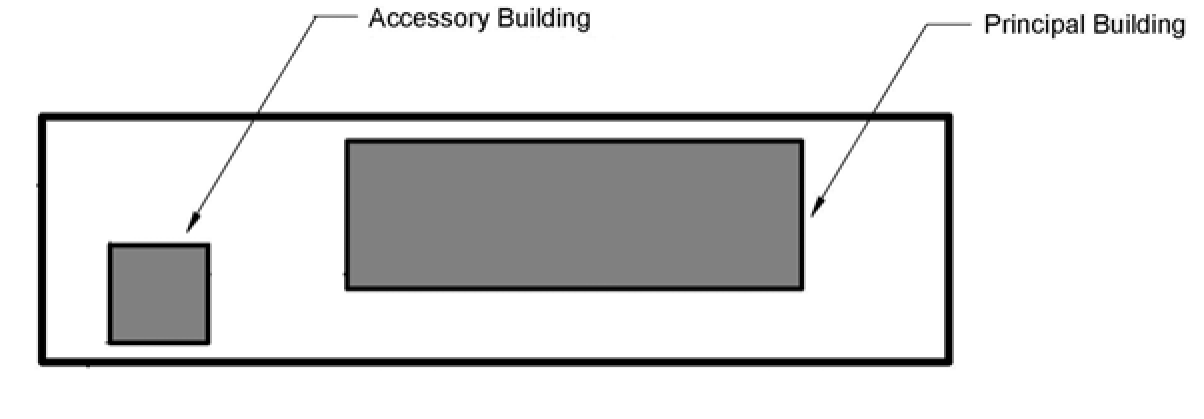
Accessory Building. A building located on the same lot as, and of a nature customarily incidental and subordinate in area, extent or purpose to, the principal building, the use of which is clearly incidental and subordinate to the principal building and not used for human habitation. Accessory Buildings may include (but not limited to) a detached garage, pool house, shed or workshop. (See Figure 16-1: Accessory Building)
FIGURE 16-1: ACCESSORY BUILDING
Accessory Structure. A structure located on the same lot as, and of a nature customarily incidental and subordinate in area, extent or purpose to, the principal building, the use of which is clearly incidental and subordinate to the principal building. Accessory Structures may include (but not limited to) a deck, gazebo, patio pergola, or swimming pool.
Accessory Use. A use that is customarily incidental and subordinate to the principal use of a lot or building and located on the same lot as the principal use or building.
Addition or Enlargement. Any construction that increases the size of a building or structure in terms of site coverage, height, length, width or floor area.
Adult-Oriented Business. "Adult-Oriented Business" shall include the following, as defined by this section and this Ordinance: adult bookstores, adult entertainment cabarets, adult hotel/motel, adult motion picture theaters, adult novelty stores, and other similar uses.
A.
Adult Bookstore. An establishment having at least twenty-five (25) percent of its sales or display area devoted to books, magazines, films for sale or for viewing on premises by use of motion picture devices or by coin-operated means, and periodicals which are distinguished or characterized by their emphasis on matter depicting, describing or relating to "Specified Anatomical Activities" or "Specified Anatomical Areas." This shall include any establishment with a segment or section devoted to the sale or display of such materials, or an establishment that holds itself out to the public as a purveyor of such materials based upon its signage, advertising, displays, actual sales, presence of video preview or coin-operated booths or any other factors showing the establishment's primary purpose is to purvey such material.
B.
Adult Entertainment Cabaret. A public or private establishment which features topless dancers, strippers, go-go dancers, male or female impersonators, lingerie or bathing suit fashion shows, not infrequently features entertainers who display "Specified Anatomical Areas." Included are those uses which feature entertainers who, by reason of their appearance or conduct, perform in a manner which is designed primarily to appeal to the prurient interest of the patron or features entertainers who engage in explicit simulation of "Specified Sexual Activities."
C.
Adult Health Spa/Sauna. A health spa, sauna or massage parlor that provides steam baths, heat bathing, massage, alcohol rub, fomentation, electric or magnetic treatment, or similar treatment or manipulation of the human body, and is distinguished or characterized by an emphasis on "Specified Sexual Activities" or "Specified Anatomical Areas."
D.
Adult Hotel/Motel. A hotel, motel or similar commercial establishment offering public accommodations for any form of consideration that provides patrons with closed-circuit television transmissions, films, motion pictures, video cassettes or video cassette recorders, DVDs or DVD players, slides, or other photographic reproductions for viewing or recording, characterized by an emphasis upon the depiction or description of "Specified Sexual Activities" or "Specified Anatomical Areas" and/or rents, leases or lets any room for less than a six-hour period, or rents, leases or lets any single room more than twice in a twenty-four-hour period.
E.
Adult Motion Picture Theater. A building or area used for presenting materials distinguished or characterized by an emphasis on matter depicting, describing or relating to "Specified Sexual Activities" or "Specified Anatomical Areas."
F.
Adult Novelty Store. An establishment having a substantial or significant portion of its sales or stock in trade consisting of toys, devices, clothing novelties, lotions and other items distinguished or characterized by their emphasis on or use for "Specialized Sexual Activities" or "Specified Anatomical Areas" including adult displays and adult products as defined in Chapter 5.52 of the North Aurora Municipal Code, Adult Products. This includes an establishment that holds itself out to the public as a purveyor of such materials based upon its signage, advertising, displays, actual sales or any other factors showing the establishment's primary purpose is to purvey such material.
G.
Specified Sexual Activities. For the purpose of this Ordinance, "Specified Sexual Activities" means: 1) human genitals in a state of sexual stimulation or arousal; 2) acts of human masturbation, sexual intercourse or sodomy; and 3) fondling or other erotic touching of human genitals, pubic region, buttocks or female breasts.
H.
Specified Anatomical Areas. For the purposes of this Ordinance, "Specified Anatomical Areas" means: 1) less than completely and opaquely covered human genitals, pubic region, buttocks or female breasts below a point immediately above the top of the areola; and 2) human genitals in a discernable turgid state, even if completely and opaquely covered.
Alley. A public or private right-of-way that normally affords a secondary means of access to abutting property. A street shall not be considered an alley.
Alteration. Any change in the size, shape, character, occupancy or use of a building or structure.
Alternative Tower Structure. Manmade trees, clock towers, bell steeples, light poles and similar alternative design mounting structures that camouflage or conceal the presence of antennas and towers.
Animal Hospital. An establishment for the care and treatment of the diseases and injuries of animals and where animals may be boarded during their convalescence. An "Animal Hospital" shall not include "Kennel."
Antenna. Any structure or device used to receive or radiate electromagnetic waves as defined by the FCC or any successor agency.
Antenna Structure. A structure which includes the radiating and/or receive system, its supporting structures, and any appurtenance mounted on them as defined by the FCC.
Arbor. A freestanding structure to support vines or climbing plants; also called a "Trellis."
Architectural Feature. A part, portion or projection that contributes to the aesthetics of a structure, exclusive of signs, that is not necessary for the structural integrity of the building or to make the structure habitable.
Arrays. A group of antennas arranged by a wireless telecommunications service provider and placed on a tower, structure or building at a given height and location to provide desired directional characteristics.
Art Gallery. A commercial establishment engaged in the sale, loan and/or display of paintings, sculpture, video art or other works. "Art Gallery" does not include "Cultural Facility," such as a library, museum or noncommercial gallery that may also display paintings, sculpture, video art or other works.
Assisted Living Facility. A licensed facility that provides daily assistance and long-term residence for disabled or elderly individuals. This includes a combination of housing, supportive services, personalized assistance and health care designed to respond to the individual needs of those who need help with activities of daily living, such as dressing, grooming, bathing, etc. An "Assisted Living Facility" shall not include "Independent Living Facility," or "Community Residence." Any such facility must have a Certificate of Need from the State of Illinois.
Attic. An unfinished space below the roof of a structure.
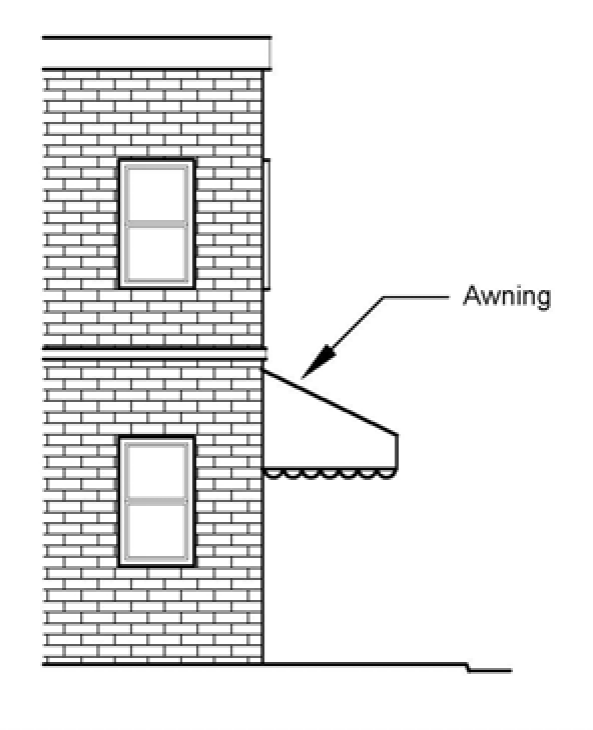
Awning or Canopy. A structure constructed of canvas, canvas-like or other materials that is supported by the exterior wall of a building and constructed on a supporting framework. Such a structure may be either a retractable or fixed structure. (See Figure 16-2: Awning or Canopy)
FIGURE 16-2: AWNING OR CANOPY
Balcony. A platform which projects from the exterior wall of a building above the ground floor, is exposed to the open air, has direct access to the interior of the building, and is not supported by posts or columns extending to the ground.
Bar/Tavern. Any public place that engages in the retail sale of alcoholic liquors for consumption on the premises with or without food and where the sale and consumption of liquor predominates the sale and consumption of food.
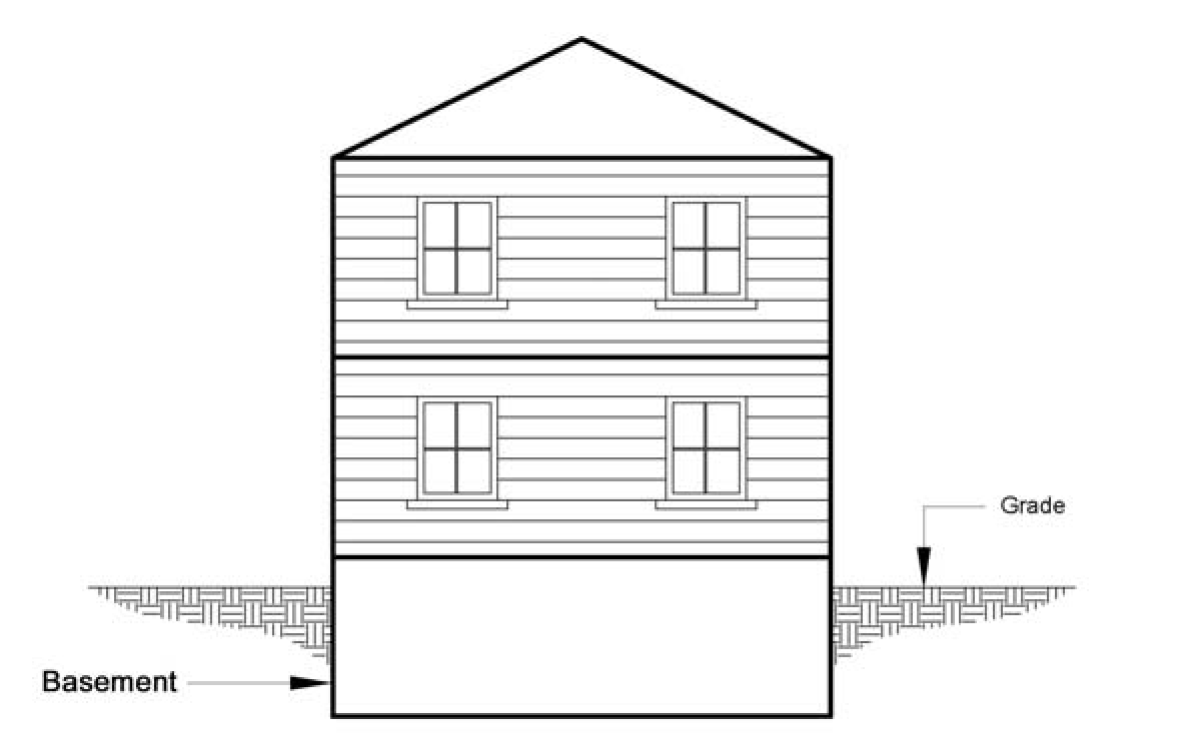
Basement. That portion of a building located partly underground, but having one-half or more of its clear floor-to-ceiling height below the average grade of the adjoining ground, which shall not count as a story. A basement with more than one-half of its clear floor-to-ceiling height above the average grade of the adjoining ground shall count as a story. (See Figure 16-3: Basement)
FIGURE 16-3: BASEMENT
Bay Window. A window which projects outward from the building that does not rest on the building foundation or on the ground.
Bed and Breakfast Guest Home. A residential building containing an aggregate of not more than five lodging rooms offered for rent to transient guests for a continuous period of thirty (30) days or less, and containing the owner's principal residence. Food may be served only to overnight guests, exclusively between the hours of 5:00 a.m. and 10:00 a.m. only if the kitchen facilities adhere to the regulations set forth by the Kane County Health Department.
Berm. An earthen mound designed to provide visual interest on a site, screen undesirable views, reduce noise or fulfill other such purposes.
Block. A tract of land bounded by streets or by a combination of one or more streets and public parks, cemeteries, railroad rights-of-way, bulkhead lines, shorelines of waterways or corporate boundary lines.
Body Piercing. To make a hole in the body or oral cavity in order to insert or allow the insertion of any ring, hoop, stud, or other object for the purpose of ornamentation of the body, but specifically excluding the standard transverse piercing of the ear lobe that is commonly performed in retail establishments in conjunction with the sale of earrings.
Bowling Alley. Indoor recreation facility for the sport of ten-pin or duck-pin bowling.
Buildable Area. The area of a lot remaining after the minimum yard and open space requirements of the Ordinance have been subtracted.
Buildable Lot. A lot on which a building or other structure may be erected in conformity with this Ordinance and other Village regulations.
Building. A structure enclosed on all sides with exterior walls, built, erected and framed by a combination of materials and having a roof to form a shelter of persons, animals or property.
Building, Attached. A building which has at least part of a wall in common with another building, or which is connected to another building by a roof.
Building, Detached. A building surrounded by open space on the same lot as another building. A building connected to another building only by an unenclosed structure, shall be deemed to be a separate detached building.
Building, Principal. A building on a zoning lot in which the principal use is conducted.
Building, Residential. A building which is arranged, designed, used or intended to be used for residential occupancy by one or more families or households. This shall include, but is not limited to, the following types: single-family dwellings, two-family dwellings, townhouse dwellings and multifamily dwellings.
Building, Temporary. Any building not designed to be permanently located, placed or affixed in the place where it is or where it is intended to be placed.
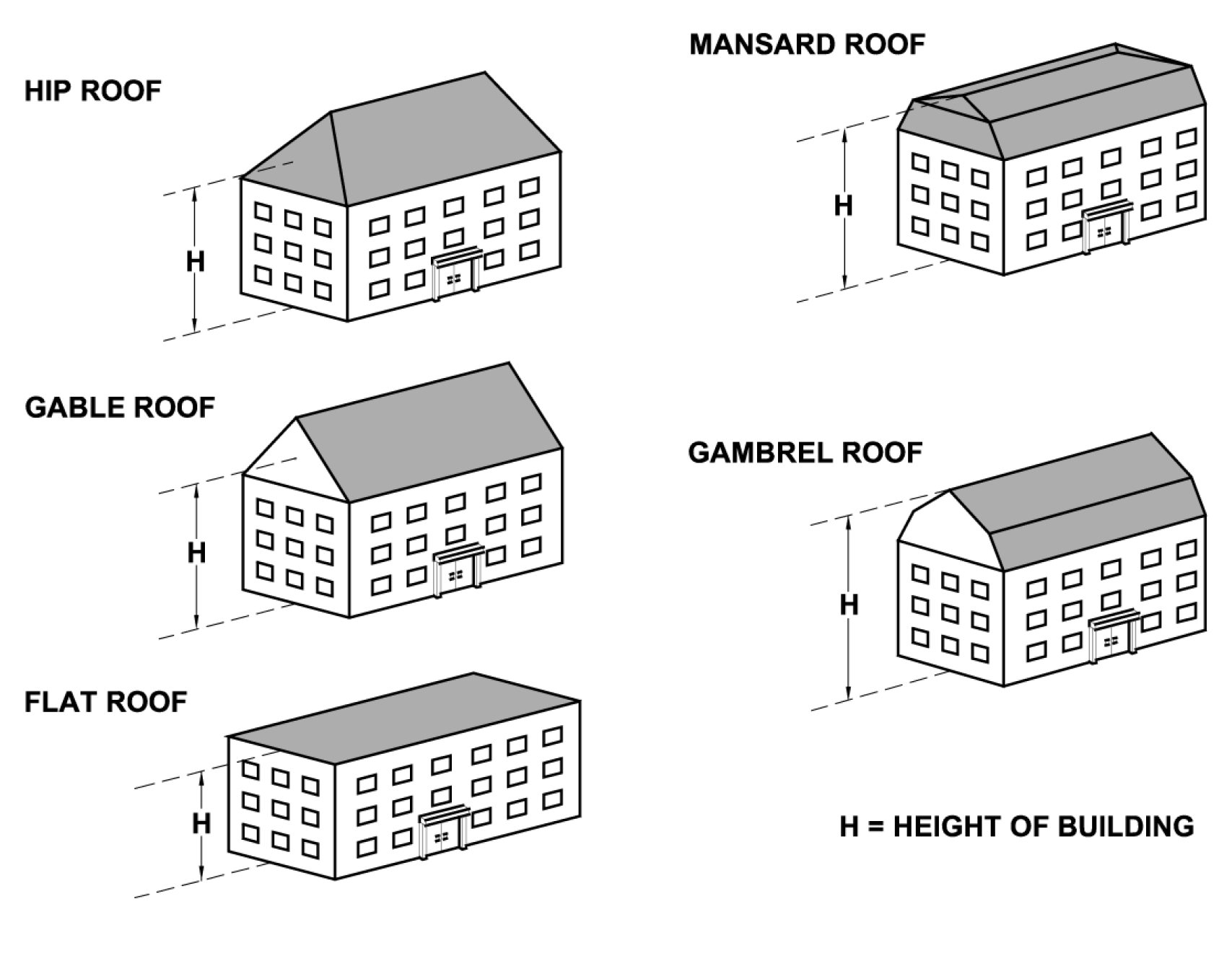
Building Height. The vertical distance measured from grade, as defined by this ordinance, to the highest point of the roof or the highest point of the structure, except for hip and gable roofs, where height will be measured at half the distance between the ridge and the eave. (See Figure 16-4: Building Height)
FIGURE 16-4: BUILDING HEIGHT
Building Line. The inner edge of any required yard or setback, and the corresponding outer edge of the buildable area.
Building Permit. An official document issued by the Village which authorizes the construction, alteration, enlargement, conversion, reconstruction, remodeling, rehabilitation, erection, demolition, moving, or repair of a building or structure.
Bulk. A term encompassing the regulation of the size, height and location of a structure as it relates to its zoning lot and to other structures.
Bus Storage Facility. An establishment used for the storage or layover of passenger buses or motor coaches.
Business. An enterprise that occupies time, attention, labor and materials, or where merchandise is exhibited or sold, or where services are offered.
Cannabis Business Establishment. An adult-use cannabis craft grower, cultivation center, dispensing organization, infuser organization, processing organization or transporting organization.
Cannabis, Craft Grower. A facility operated by an organization or business that is licensed by the Illinois Department of Agriculture to cultivate, dry, cure and package cannabis and perform other necessary activities to make cannabis available for sale at a dispensing organization or use at a processing organization, per the Cannabis Regulation and Tax Act, (P.A. 101-0027), as it may be amended from time-to-time, and regulations promulgated thereunder.
Cannabis, Cultivation Center. A facility operated by an organization or business that is licensed by the Illinois Department of Agriculture to cultivate, process, transport and perform necessary activities to provide cannabis and cannabis-infused products to licensed cannabis business establishments, per the Cannabis Regulation and Tax Act, (P.A. 101-0027), as it may be amended from time-to-time, and regulations promulgated thereunder.
Cannabis, Dispensing Organization. A facility operated by an organization or business that is licensed by the Illinois Department of Financial and Professional Regulation to acquire cannabis from licensed cannabis business establishments for the purpose of selling or dispensing cannabis, cannabis-infused products, cannabis seeds, paraphernalia or related supplies to purchasers or to qualified registered medical cannabis patients and caregivers, per the Cannabis Regulation and Tax Act, (P.A. 101-0027), as it may be amended from time-to-time, and regulations promulgated thereunder.
Cannabis, Infuser Organization or Infuser. A facility operated by an organization or business that is licensed by the Illinois Department of Agriculture to directly incorporate cannabis or cannabis concentrate into a product formulation to produce a cannabis-infused product, per the Cannabis Regulation and Tax Act, (P.A. 101-0027), as it may be amended from time-to-time, and regulations promulgated thereunder.
Cannabis, Processing Organization or Processor. A facility operated by an organization or business that is licensed by the Illinois Department of Agriculture to either extract constituent chemicals or compounds to produce cannabis concentrate or incorporate cannabis or cannabis concentrate into a product formulation to produce a cannabis product, per the Cannabis Regulation and Tax Act, (P.A. 101-0027), as it may be amended from time-to-time, and regulations promulgated thereunder.
Cannabis, Transporting Organization or Transporter. An organization or business that is licensed by the Illinois Department of Agriculture to transport cannabis on behalf of a cannabis business establishment or a community college licensed under the Community College Cannabis Vocational Training Pilot Program, per the Cannabis Regulation and Tax Act, (P.A. 101-0027), as it may be amended from time-to-time, and regulations promulgated thereunder.
Car Wash. A commercial establishment engaged in the washing and cleaning of passenger vehicles, recreational vehicles or other light duty equipment, whether automatic or by hand, within an enclosed, or partially enclosed, building.
Carnival. Any aggregation of four or more attractions whether shows, acts, games of chance or skill, rides or amusement devices.
Cemetery. Land used or dedicated for the burial of the dead, including crematoriums, mausoleums, and necessary sales and maintenance facilities. Mortuaries may be included when operated within the boundary of such cemetery.
Chimney. A vertical shaft of reinforced concrete, masonry, or other material enclosing one or more flues, for the purpose of removing products of combustion from solid, liquid or gaseous fuel.
Christmas Tree Sales Lot. A retail sales operation, generally conducted wholly outdoors, that offers for sale on a temporary, limited basis, Christmas trees and related holiday items such as wreaths and Christmas tree stands.
Cigar/Hookah Lounge. A business or establishment that caters to patrons who smoke cigars or use smoking devices such as hookah pipes, water pipes, or vaping devices on the premises.
Circus. Any display of wild animals, spectacles made up of acts of physical skill and daring, acts with trained wild animals, displays of elaborate and colorful costumes and trappings, and comedy by clowns, sideshows, rides, amusement devices, games of chance or skill, and concession stands.
Club, Lodge or Hall. A membership organization which caters exclusively to members and their guests for social, intellectual, recreational or athletic purposes. A "Club, Lodge or Hall" may, subject to other regulations controlling such uses, maintain dining facilities, possess a liquor license, or engage professional entertainment for the enjoyment of dues-paying members and their guests. "Club, Lodge or Hall" shall not include "Country Club."
Co-location. Placement of wireless telecommunications equipment from more than one service or service provider on a single tower or site.
Commercial Motor Vehicle. For the purposes of Title 17, commercial vehicles shall be any self-propelled or towed vehicle that meets one of the following categories:
A.
Has a gross vehicle weight, a gross vehicle weight rating, a gross combination weight, or a gross combination weight rating of twelve thousand and one (12,001) or more pounds (F Plate or greater).
B.
Is a box truck or cutaway (with any plate) where the passenger compartment is completely separate from the cargo area with seating for the driver and no more than one or two passengers.
C.
Has a gross vehicle weight, a gross vehicle weight rating, a gross combination weight, or a gross combination weight rating of ten thousand and one (10,001) pounds to twelve thousand (12,000) pounds (D Plate) AND any one of the following characteristics: contains a bucket, lift, towing, dump bed, ladder storage or other similar equipment; is taller than ninety inches (90") in height; is designed to carry more than fifteen (15) passengers.
Common Ownership. Ownership by the same person, corporation, firm, entity, partnership, or unincorporated association; or ownership by different corporations, firms, partnerships, entities, or unincorporated associations, in which one or more stockholder, partner, or principal owns an interest in each corporation, firm, partnership, entity, or unincorporated association.
Community Residence. A group residence consisting of a group home or specialized residential care home licensed, certified or accredited by the appropriate state or federal agencies, and serving as a single housekeeping unit for the housing of unrelated persons with functional disabilities who share responsibilities, meals, recreation, social activities and other aspects of residential living. "Community Residence" does not include a residence which services persons as an alternative to incarceration for a criminal offense, or persons whose primary reason for placement is substance or alcohol abuse, nor does it include a nursing or medical facility.
A.
Community Residence, Large: A community residence providing living accommodations for more than eight residents, including live-in staff. Visiting staff who do not reside within the community residence shall not be counted for purposes of establishing the number of residents.
B.
Community Residence, Small: A community residence providing living accommodations for no more than eight residents, including live-in staff. Visiting staff who do not reside within the community residence shall not be counted for purposes of establishing the number of residents.
Compost Pile. An enclosed or partially enclosed collection of decaying plant product for the purpose of producing a stabilized humus-like material that is potentially beneficial to plant growth and usable as a soil conditioner, top soil, growing medium additive or other similar use.
Comprehensive Plan. The Comprehensive Plan of the Village of North Aurora, as adopted and amended by the Village Board.
Conforming Structure. Any structure that complies with all the regulations of this Ordinance for the zoning district in which such structure is located or is designed or intended for a conforming use.
Contractor Office. An establishment used for a contractor's business office and may include the repair, maintenance, or storage of a contractor's vehicles, equipment, or materials. Contractor office may include a contractor storage yard as an accessory use.
Contractor Storage Yard. Land used primarily for the storage of equipment, vehicles, machinery, building materials, paints, pipe, or electrical components used by the owner or occupant of a contractor office in the conduct of any building trade or building craft. Contractor storage yards are accessory to a contractor office.
Contractor Trailer. This use includes security trailers, construction equipment sheds, contractor trailers and similar uses incidental to a construction project and sales of homes within a newly constructed development.
Convenience Store. A small retail establishment with a floor area of five thousand (5,000) square feet or less that sells a limited line of food and beverages, groceries, and household items intended for the convenience of the neighborhood or travelers.
Crematorium. A facility for reducing corpses to ash. Crematoriums do not include incinerating establishments used to dispose of toxic or hazardous, infectious or narcotics materials.
Cultural Facility. A use that is open to the public and provides cultural services and facilities including, but not limited to, museums, cultural centers, historical societies, aquariums and libraries operated by a public, private or nonprofit organization.
Data Center. A building or part of a building containing a large group of networked computer servers typically used by organizations for the remote storage, processing, or distribution of large amounts of data.
Day. When used in this Ordinance, "Day" shall mean one calendar day.
Day Care Center, Adult. A facility, other than within a residential dwelling unit, providing care for elderly and/or functionally impaired adults in a protective setting for less than twenty-four (24) hours per day. "Adult Day Care Center" does not include a program operated by a "Place of Worship," that provides care for elderly and/or functionally impaired adults in a protective setting for less than twenty-four (24) hours per day.
Day Care Center, Child. A facility, other than within a residential dwelling unit, providing care for children in a protective setting for less than twenty-four (24) hours per day. "Child Day Care Center" does not include a program operated by an "Educational Facility" (all types) or "Place of Worship," that provide care for children three years of age or older for less than twenty-four (24) hours per day.
Day Care Home, Adult. A residential dwelling in which a permanent occupant of the dwelling provides care in a protective setting for elderly and/or functionally impaired adults who do not spend the night at the dwelling.
Day Care Home, Child. A residential dwelling in which a permanent occupant of the dwelling provides care in a protective setting for children who do not spend the night.
Deck. A raised platform structure built above grade on supporting posts or columns, which is open to the sky and attached to the principal building. "Deck" shall not include "Balcony."
Density. The number of dwelling units per net acre or applicable portion of an area counted for density limitation purposes as more specifically prescribed for particular zoning districts.
District. A contiguous portion of the Village within which certain uniform regulations and/or requirements, apply under the provisions of this Ordinance.
Dog House. An accessory structure designed for the containment of dogs and other domesticated animals.
Dog Run. An enclosed outdoor area intended for the exercising and/or containment of dogs and other domesticated animals.
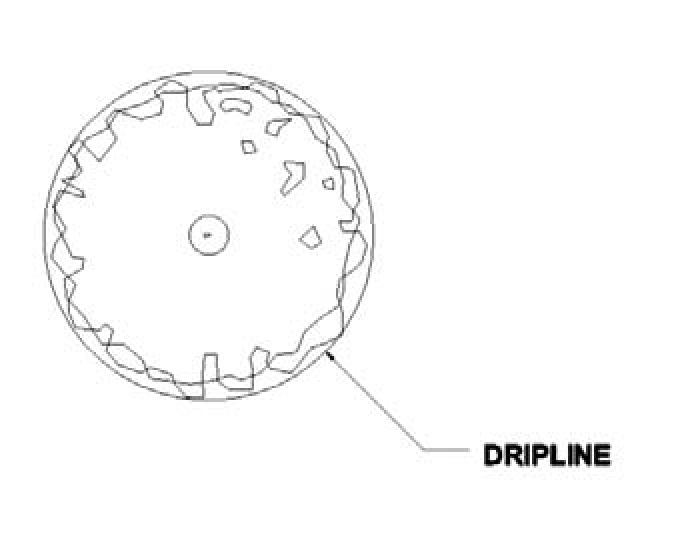
Drip Line. An imaginary line encircling a tree corresponding to the furthest extension of the tree foliage. (See Figure 16-5: Drip Line)
FIGURE 16-5: DRIP LINE
Drive-Through Facility. Premises used to provide or dispense products or services through an attendant, window or automated machine, to persons remaining in motor vehicles in a designated stacking aisle. A "Drive-Through Facility" often exists in combination with other uses.
Driveway. A paved strip of land designed and intended for providing vehicular access between the street and a parking space or garage of private or public property.
Driving Range. An area equipped with distance markers, clubs, balls and tees for practicing the striking of golf balls. Miniature golf courses are considered an "Outdoor Recreation Facility" and not a "Driving Range."
Dry Cleaner, Retail. An establishment which launders or dry cleans articles dropped off on the premises directly by the customer or where articles are dropped off, sorted, and picked up but where laundering or cleaning is done elsewhere.
Dwelling. A building, or portion of a building, designed or used exclusively for residential purposes, including single-family, two-family, townhouse and multifamily dwellings, but not including trailers, "Hotel/Motels," "Bed and Breakfast Guest Homes" or automobiles.
Dwelling, Above the Ground Floor. Dwelling units within multi-story buildings located above nonresidential uses on the ground floor.
Dwelling, Attached. A single structure containing more than one dwelling unit, each of which is designed to be occupied as a separate permanent residence for one household or family, including residential units in condominiums, townhomes, duplexes and similar multifamily buildings. Each dwelling is separated from the other by a wall extending from the ground to the roof or a ceiling and floor extending from exterior wall to exterior wall, except for a common stairwell exterior to both dwelling units.
Dwelling, Duplex. See Dwelling, Two-Family.
Dwelling, Multifamily. A building designed as a single structure containing three or more individual dwelling units where each dwelling unit has an individual entrance to a common hallway or the outdoors. "Dwelling, Multifamily" shall not include "Dwelling, Townhouse."
Dwelling, Single-Family. A building containing one individual dwelling unit, which is located on an individual zoning lot and is not attached to any other dwelling unit.
Dwelling, Townhouse. A building designed as a single structure consisting of no less than three dwelling units, with no other dwelling, or portion of other dwelling, directly above or below, where each unit has a separate entrance and direct ground level access to the outdoors. These units are connected to other dwelling units by a single party wall with no opening.
Dwelling, Two-Family. A building designed as a single structure, containing two attached dwelling units, each of which is designed to be occupied as a separate permanent residence for one household or family. Each dwelling is separated from the other by a wall extending from the ground to the roof extending from exterior wall to exterior wall, except for a common stairwell exterior to both dwelling units. Each dwelling unit shall have an individual entrance.
Dwelling Unit. A dwelling unit consists of a room or group of rooms, which include permanently installed bathroom and kitchen facilities, and are arranged, designed and used as living quarters for one family or household.
Easement. An interest in land that provides for a specified use of that land by a person(s) other than the fee owner.
Eave. The projecting edges of a roof overhanging the wall of a building.
Educational Facility, College/University. A post-secondary institution for higher learning that grants associate or bachelor degrees. The institution may also have research facilities, and/or professional schools that grant master and doctoral degrees. "Educational Facilities, College/University" also includes post-secondary theological schools for training ministers, priests or rabbis. "Educational Facilities, College/University" shall not include "Educational Facilities, Commercial, Vocational, or Trade."
Educational Facility, Commercial, Vocational or Trade. A school established to provide for the teaching of industrial, trade, clerical, managerial or artistic skills. This definition applies to schools that do not offer a complete educational curriculum that grants associate or bachelor degrees. "Educational Facilities, Commercial or Trade School" shall not include "Educational Facilities, College/University."
Educational Facility, Elementary and/or Secondary (Nonresidential). A public, private or parochial school offering instruction at the elementary, junior and/or senior high school levels. "Educational Facilities, Primary/Secondary" also includes secondary theological schools for training ministers, priests or rabbis.
Educational Facility, Elementary and/or Secondary (Residential). A public, private or parochial school offering instruction at the elementary, junior and/or senior high school levels that includes residential boarding facilities for its students.
EME/RF Study. A study of the amount of electromagnetic energy (EME) and radiofrequency (RF) emitted by a wireless telecommunications antenna.
Encroachment. The extension or placement of any structure or component of a structure into a required yard.
Entertainment/Recreation Facility, Indoor. An establishment that provides specialized indoor facilities for spectator or participant uses. Typical uses include, but are not limited to, arcades, arenas, auditoriums, ball courts, billiard halls, bowling alleys, gymnasiums, laser tag, miniature golf courses, pools, skating rinks, theaters, trampoline parks, water slides, and other similar facilities. Incidental sales of food and beverages is permitted.
Entertainment/Recreation Facility, Outdoor. An establishment that provides facilities for spectator or participant uses conducted outdoors in open or only partially enclosed facilities. Typical uses include, but are not limited to, amusement parks, ball fields, fairgrounds, miniature golf courses, music arenas, outdoor stadiums, outdoor theaters, raceways, rodeos, skateboard parks, swimming pools, theme parks, tennis courts, and other similar facilities. Incidental sales of food and beverages is permitted.
Erect. To build, construct, attach, hang, place, suspend or affix.
Exception. Modification to existing zoning and/or subdivision control standards within a zoning district granted as part of the special use or planned unit development application process.
Exterior Kitchenette. A complete cooking facility located outdoors typically involving a sink, stove or similar cooking range appliance and a food preparation counter.
Fall Zone. The area within a prescribed radius around the base of a wireless telecommunications tower. This is the area within which there is a potential hazard from falling debris, such as ice, collapsing material or the collapse of the tower itself.
Family. One or more persons related by blood, marriage, or adoption, who are living together in a single dwelling and maintaining a common household. A "Family" includes any domestic servants and not more than one gratuitous guest residing with such "Family." This definition does not include convents, rectories, sororities, fraternities or similar uses.
Farm Stand. A structure for the seasonal display and sale of agricultural products.
Farmer's Market. The offering for sale of produce or processed, packaged or prepared food, subject to the procedures and regulations set forth in the Village of North Aurora Municipal Code.
Fence. An artificially constructed barrier of wood, masonry, stone, wire, metal or other combination of materials of thirty (30) inches or more in height erected to enclose, screen or separate areas. Artificial barriers of less than thirty (30) inches shall be considered a landscape feature.
Fence, Open. A fence, including any gates, designed and constructed so that the surface area of any segment of such fence contains at least fifty (50) percent open space as compared to solid materials.
Fence, Solid. A fence, including gates, made entirely of opaque material.
Financial Service Establishment. Institution that provides personal, commercial, and retail money holding, investment and lending services, with or without walk-up only automatic teller machines. This classification includes establishments such as banks, savings and loans, mortgage lending offices, credit unions, securities and brokerage offices. A "Financial Institution" shall not include a currency exchange, payday or title loan agency.
Floor Area, Gross. The sum of the gross horizontal area of the plans of the several floors of a building, as measured from the outside face of the walls.
Floor Area Ratio (FAR). The numerical value obtained by dividing the gross floor area of a building or buildings by the lot area on which such building or buildings are located, as measured from the outside face of the walls.
Food or Beverage Production, Processing or Bottling. Any use involving the preparation, production, processing, canning, or bottling of items meant for human consumption.
Footcandle. A unit of illumination equivalent to the light intensity at all points a distance of one foot from the power of one candle.
Frequency. The number of oscillations per second in a sound wave and an index of the pitch of the resulting sound.
Funeral Home. A building used for the preparation of the deceased for burial, display and rituals before burial or cremation. A "Funeral Home" includes chapels located within the building used for the display of the deceased and the conducting of rituals before burial or cremation.
Garage. A building, either attached or detached, used or designed to be used for storage of vehicles, equipment boats and accessory storage related to the use of the principal dwelling.
Gas Station. A business facility which is primarily distinguished by the retail sale of gasoline and related petroleum products necessary for the day-to-day operation of motor vehicles and commonly referred to as a "gas station." Such a facility may, in addition, offer a car wash and/or convenience store.
Gazebo. A freestanding outdoor structure that is open-sided and designed for recreational use and not for habitation.
Glare. Light emitting from a luminaire with an intensity great enough to reduce a viewer's ability to see, or, in extreme cases, causing momentary blindness.
Golf Course. A tract of land laid out with at least nine holes for playing a game of golf and improved with tees, greens, fairways, and hazards. A golf course may include a clubhouse, restrooms and shelters as accessory uses. A "Driving Range" may be included as part of a "Golf Course."
Grade. The average level of the finished surface of the ground adjacent to the exterior walls of the building or structure.
Green Roof. The creation of contained green space on the roof of a structure, where plants are not planted in the ground but applied as another layer of the roofing system.
Guest House. A detached accessory building located on the same zoning lot as the principal building and containing living quarters for temporary guests.
Guest, Permanent. A person who occupies or has the right to occupy a hotel or apartment hotel accommodation as his or her domicile and place of permanent residence.
Health and Athletic Center. An establishment that provides exercise facilities such as running, jogging, aerobics, weight lifting, court sports and swimming, as well as locker rooms, showers, massage rooms, saunas and other related accessory uses.
Hedge. A row of closely planted shrubs, bushes or other kind of plant forming a boundary or fence.
Home Occupation. An occupation carried on in a dwelling unit by the resident, where the use of the dwelling unit for the occupation is secondary to and coextensive with the use of the dwelling unit for residential purposes.
Hospital. An institution providing health services primarily for inpatient, or medical or surgical care for the sick or injured, and including the related facilities located within a "Hospital," such as laboratories, outpatient departments, training facilities and classrooms, central service facilities and staff offices that are integral to the facility.
Hot Tub. An artificial container of water designed with a mechanical air injection system and/or circulating device for recreational use.
Hotel. An establishment providing, for a fee, sleeping accommodations and customary lodging services, including maid service, the furnishing and upkeep of furniture and bed linens, and telephone and desk service. Related ancillary uses may include, but shall not be limited to, conference and meeting rooms, restaurants, bars and recreational facilities.
Household. The person or persons living together in a dwelling unit.
Impervious Surface. The portion of a site occupied by structures, pavement or other surfaces that do not allow for the absorption of water.
Independent Living Facility. A residential complex containing dwellings where the occupancy is limited to persons who are fifty-five (55) years of age or older or, if two persons occupy a unit, at least one shall be fifty-five (55) years or older. Such facilities may include common areas for meals and socializing, offer minimal convenience services, but exclude institutional care such as medical or nursing care. An "Independent Living Facility" shall not include "Assisted Living Facility," "Community Residence" or "Nursing Home."
Indirect Light. Direct light that has been reflected or has scattered off of other surfaces.
Industrial, Heavy. The manufacturing or compounding of raw materials, which may include the storage of large volumes of highly flammable, toxic matter or explosive. This manufacturing may involve outdoor operations as part of their manufacturing process. Typical heavy industrial uses include, but are not limited to: concrete batch plants, concrete, tile, or brick manufacturing, motor vehicle, and tire assembly, chemical processing, metal casting or foundries, gas manufacturing, grain milling or processing, refining, smelting, or alloying, petroleum or petroleum products. Heavy manufacturing processes ordinarily have greater than average impacts on the environment, or that ordinarily have significant impacts on the use and enjoyment of adjacent property in terms of noise, smoke, fumes, odors, glare or health and safety hazards.
Industrial, Light. The manufacturing, sorting, processing, fabrication, assembly, treatment, or packaging of previously prepared materials, finished products or parts, and incidental storage, sales, and distribution of such materials, products, or parts, provided all industrial activities are contained entirely within a building and noise, odor, smoke, heat, glare, and vibration resulting from the industrial activity are confined entirely within the building.
Industrial, Medium. The manufacturing, sorting, processing, fabrication, assembly, treatment, or packaging of products from processed or unprocessed raw materials, and incidental storage, sales, and distribution of such products. Such activities may produce noise, vibrations, illumination, or particulate that is perceptible to adjacent land users but is not offensive or obnoxious.
Industrial Park. A special or exclusive type of planned industrial area designed and equipped to accommodate a community of industries, providing them with all necessary facilities and services. Industrial parks may be promoted or sponsored by private developers, community organizations, or government organizations.
Intensity of Use. Any factor such as square feet of gross floor area, number of dwelling units or number of employees used as a basis for requiring parking or loading facilities.
Junk Yard/Scrap Yard. An establishment used for the storage, disassembly, processing, or salvage of equipment, machinery, motor vehicles, or similar material.
Kennel. An establishment where pet animals owned by another person are temporarily boarded for pay or remuneration of any sort. "Kennel" shall include those facilities where pet animals are boarded for the day. "Kennel" shall not apply to zoos or animal hospitals operated by veterinarians duly licensed under the law where the boarding of animals is accessory to medical treatment.
Laboratory, Commercial. Facilities for research, development, analyzing, and testing of products but not primarily facilities for the manufacture or sale of products, except as incidental to the main purpose of the laboratory. Such facilities may include, but are not limited to, technology-intensive fields such as chemical, biological, pharmaceutical, environmental, electronics, building materials and genetic research.
Land Banking. Designating land on a site to be held and preserved for an identified future purpose, such as additional parking. See "Parking, Land Banked."
Laundromat. A facility where patrons wash and dry clothing or other fabrics in machines operated by the patron.
Laundry Establishment, Commercial. A building, portion of a building, or premises used for cleaning clothing, fabrics, textiles, or articles of any sort in bulk. Such facilities are generally not open to the public and take delivery of items to be cleaned from trucks or vans.
Lighting, Shielded. A fixture that is shielded in such a manner that light rays emitted by the fixture, either directly from the lamp or indirectly from the fixture, are projected below a horizontal plane running through the lowest point on the fixture where light is emitted.
Lighting, Unshielded. A fixture that allows light, either directly from the lamp or indirectly from the fixture or a reflector, to be emitted above the horizontal plane running through the lowest point on the fixture where light is emitted.
Loading Spaces. A location within a loading facility exclusive of driveways, aisles, maneuvering areas, ramps, columns, landscaping areas, office and work areas for the temporary parking of a commercial vehicle while loading or unloading goods or materials.
Lot. A parcel of property that has been identified separately from other parcels of property through the formal subdivision or resubdivision process.
Lot Area. The computed area contained within the boundary lines of a lot.
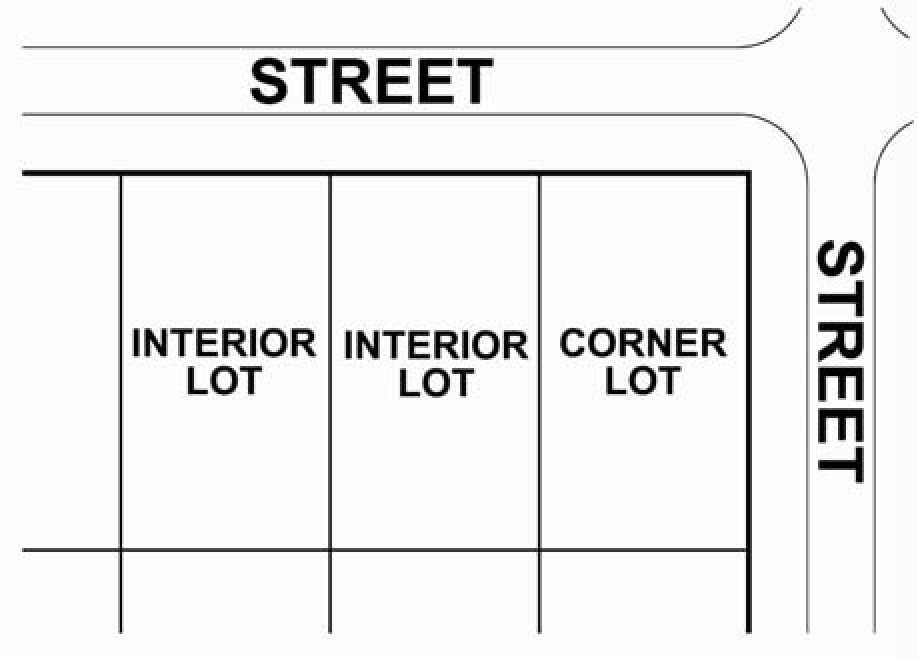
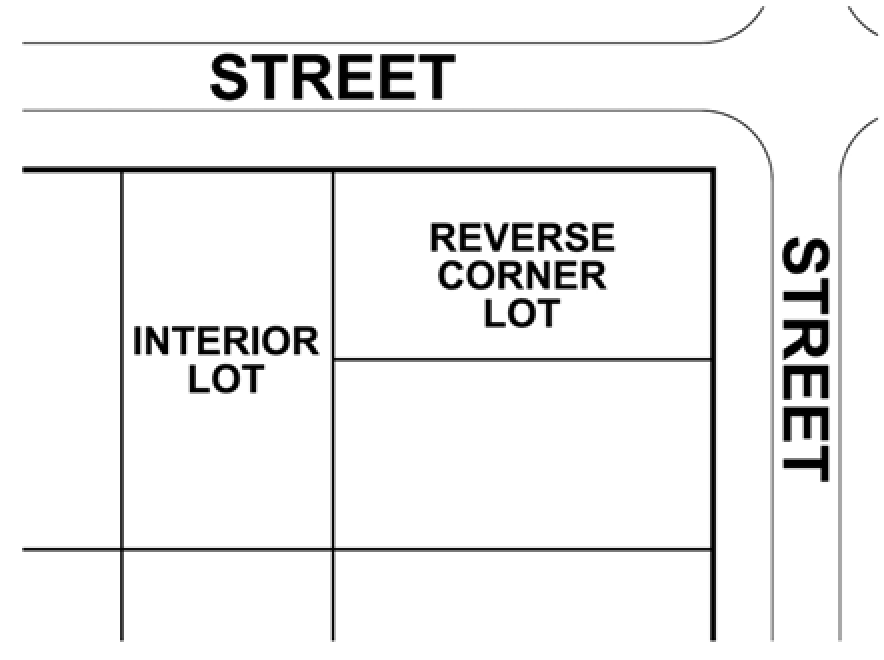
Lot, Corner. A lot situated at the junction of, and abutting on, two or more intersecting streets. (See Figure 16-6: Corner and Interior Lots)
FIGURE 16-6: CORNER AND INTERIOR LOTS
Lot Coverage. The portion of a lot that is occupied by buildings or structures, including accessory buildings, expressed as a percentage of total lot area. Lot coverage shall not include accessory structures.
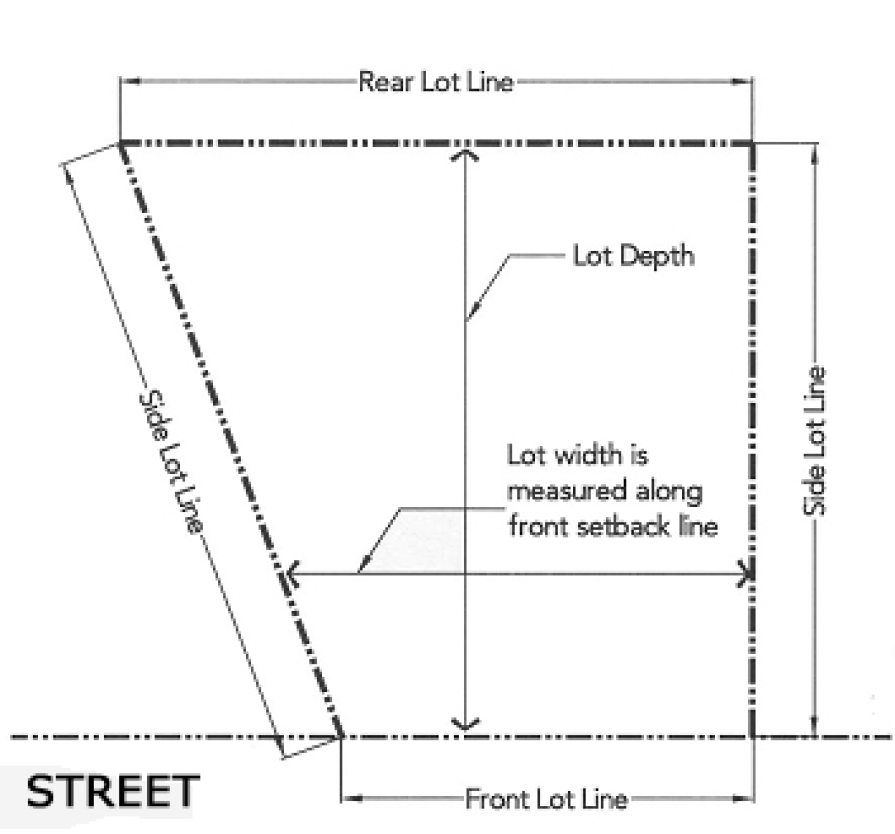
Lot Depth. The distance between the front lot line and the rear lot line of a lot, determined by measuring from the deepest point of the rear lot line to the front lot line. (See Figure 16-8: Lot Width and Lot Depth)
FIGURE 16-8: LOT WIDTH AND LOT DEPTH
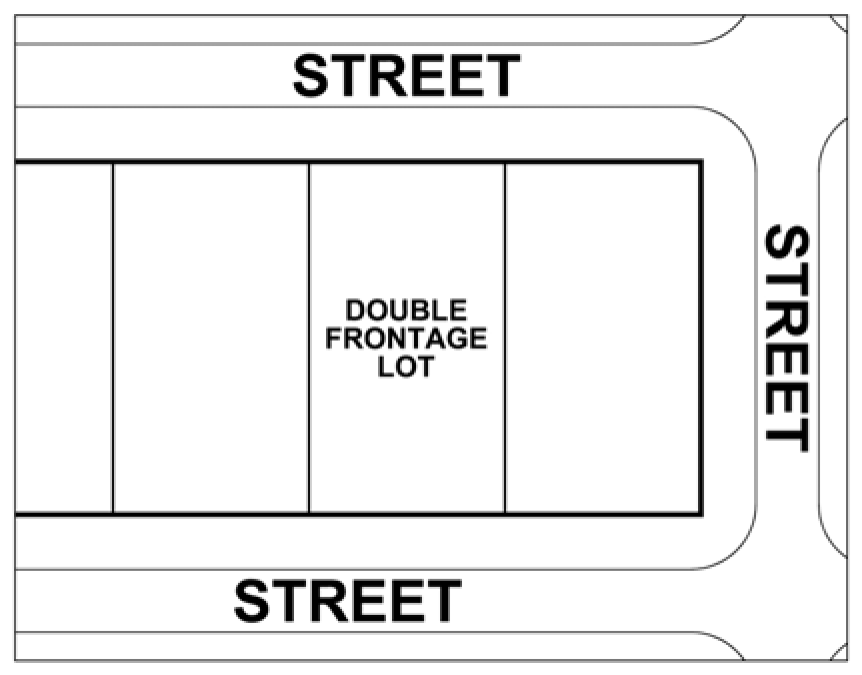
Lot, Double-Frontage. A lot, sometimes referred to as a "through lot," having frontage on two streets at opposite ends of the lot, which is not a "Corner Lot." (See Figure 16-9: Double-Frontage Lot)
FIGURE 16-9: DOUBLE-FRONTAGE LOT
Lot, Interior. A lot other than a corner lot or a double-frontage lot. (See Figure 16-6: Corner and Interior Lots)
Lot Line. A property boundary line of any lot.
Lot Line, Front. The lot line which abuts an existing or dedicated street. For the purposes of this Ordinance, the "Front Lot Line" of a "Corner Lot" or a "Reverse Corner Lot" shall be the shortest street frontage of the lot.
Lot Line, Interior. A lot line which does not abut a street or alley.
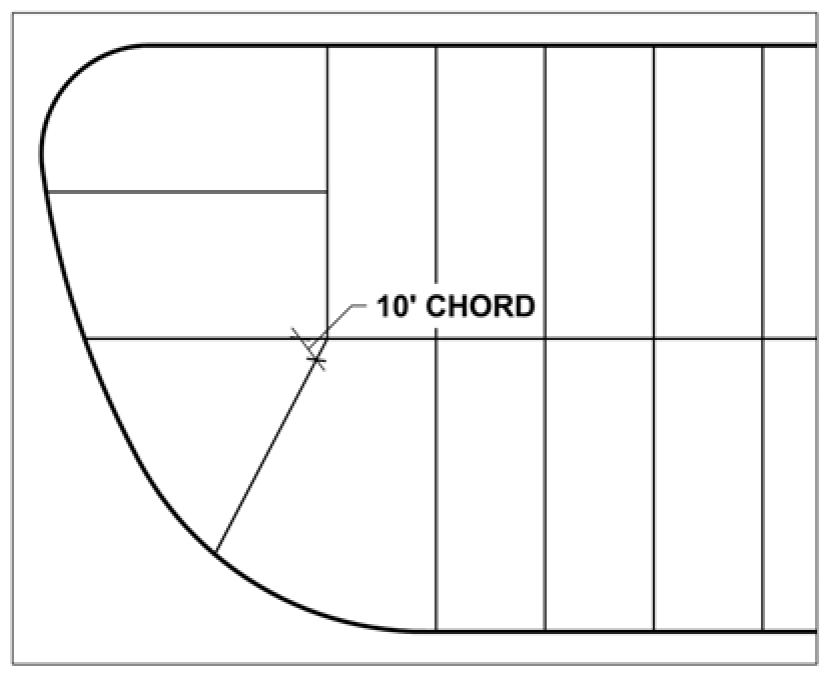
Lot Line, Rear. The boundary of a lot which is most distant from and is, or is approximately, parallel to the front lot line. In the case of an irregular or triangular shaped lot and for purposes of determining the rear yard dimension, the rear lot line shall be deemed to be a line ten (10) feet in length, within the lot, which is parallel to and at a maximum distance from the front lot line. The ten-foot chord for an irregular lot is shown in Figure 16-10: Rear Lot Line Chord for Irregular Lots.
FIGURE 16-10: REAR LOT LINE CHORD FOR IRREGULAR LOTS
Lot Line, Side. Any boundary of a lot that is not a front lot line or a rear lot line.
Lot of Record. A single lot which is part of a subdivision or resubdivision which has been recorded in the Office of the Register of Deeds of Kane County, Illinois.
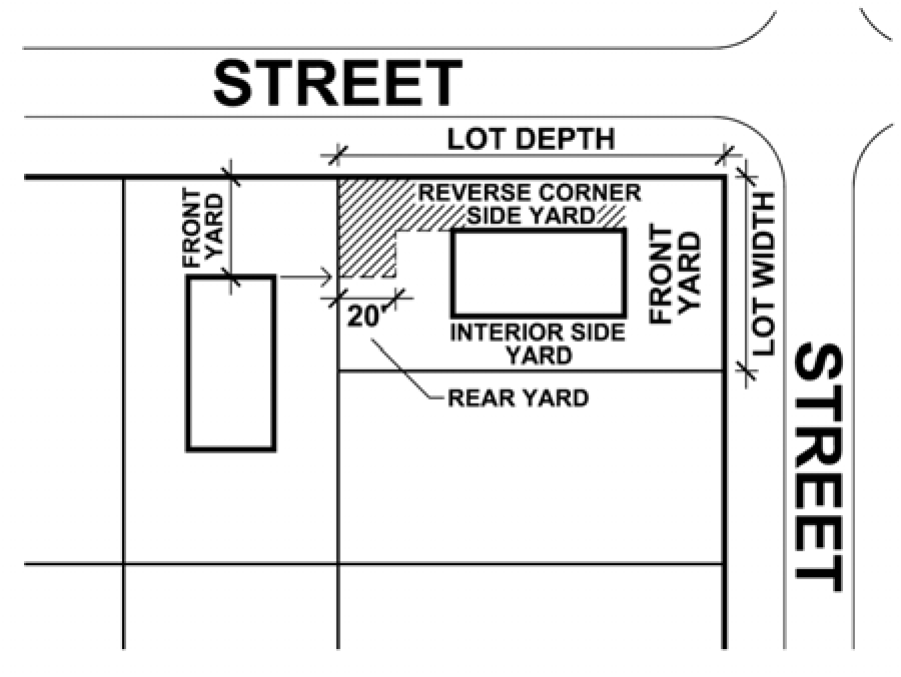
Lot, Reverse Corner. A "Corner Lot" where the side lot line adjoining a street is substantially a continuation of the front lot line of the first lot to its rear. (See Figure 16-11: Reverse Corner Lot)
FIGURE 16-11: REVERSE CORNER LOT
Lot Width. The minimum horizontal distance between the side lot lines of a lot measured at the required front yard setback line. (See Figure 16-8: Lot Width and Lot Depth)
Lot, Zoning. A single tract of land located within a single block which, at the time of filing for a building permit, is designated by its owner or developer as a tract to be used, developed or built upon as a unit, under single ownership or control. A "Zoning Lot" may or may not coincide with a "Lot of Record."
Luminaire. A complete lighting unit extending from a support structure, parallel to the ground, consisting of a light source and all necessary mechanical, electrical and decorative parts. A "Luminaire" does not include a pole or other support.
Marquee. A permanent structure constructed of durable material extending perpendicular from part of the wall of a building but not supported by the ground.
Maximum Permissible Exposure (MPE). A standard devised by the FCC to calculate safe levels of exposure of persons to radiofrequencies, such as those emitted by wireless telecommunications antennas.
Microbrewery/Microdistillery/Microwinery. An establishment where beer, wine, or spirits are manufactured by the holder of a state craft brewery or craft distillery license. As a principal use, the establishment may include a taproom which is open to the public primarily for the sale of beer, wine, and/or spirits manufactured on-site for on-site and/or off-site consumption. As an accessory use, Microbrewery shall be permitted only in conjunction with a Restaurant.
Mixed Use Development. The development of a tract of land or building or structure with two or more different uses in a compact urban form. Uses are limited to residential, office, retail, educational and civic.
Mobile Home. A structure on wheels designed and constructed for dwelling purposes which contains cooking, sanitary and electrical facilities and has a gross area of three hundred (300) square feet or more, and which conforms to ICC code requirements for residential uses.
Motel. An establishment providing, for a fee, sleeping accommodations and customary lodging services, including maid service, the furnishing and upkeep of furniture and bed linens, and telephone and desk service in which the rooms are primarily accessible from an outdoor parking area.
Motor Vehicle. Any self-propelled wheeled vehicle designed primarily for transportation of persons or goods along public streets.
Motor Vehicle Repair, Major. Such use includes everything in Motor Vehicle Repair, Minor and establishments involved in engine or transmission rebuilding or reconditioning, collision service, painting, repair or replacement of major vehicle systems.
Motor Vehicle Repair, Minor. Such use includes the repair and replacement of cooling, electrical, fuel and exhaust systems, brake replacements and adjustments, tire replacement and repairs, wheel servicing, oil changes, battery replacements, repair and replacement of shock absorbers and suspension systems, and repair and installation of radio and entertainment systems.
Motor Vehicle Dealership. Any business establishment that sells or leases new or used motor vehicles. A "Motor Vehicle Dealership" may maintain an inventory of the vehicles for sale or lease either on-site or at a nearby location and may provide on-site facilities for the repair and service of the vehicles sold or leased by the dealership.
Motor Vehicle Rental Establishment. Rental of motor vehicles, trailers and vans, including incidental parking and servicing of rental vehicles.
Nightclub. An establishment serving food and/or liquor and providing music and space for dancing by patrons only. A nightclub shall not include an adult business.
Nonconforming Lot. A lot of record that does not meet the lot area or lot width requirements of this Ordinance for the zoning district in which it is located.
Nonconforming Structure. An existing structure that does not meet the requirements of this Ordinance.
Nonconforming Use. An existing use that does not meet the requirements of this Ordinance.
Nursery School or Preschool. A facility for the education of five or more children of pre-elementary school age.
Obscene. Any material or performance if: 1) the average person, applying contemporary adult community standards, would find that, taken as a whole, it appeals to prurient interest; and 2) the average person, applying contemporary adult community standards, would find that it depicts or describes, in a patently offensive way, ultimate sexual acts or sadomasochistic sexual acts, whether normal or perverted, actual or simulated, masturbation, excretory functions or lewd exhibition of the genitals; and 3) taken as a whole, it lacks serious literary, artistic, political or scientific value.
Occupancy Certificate. A certificate that permits the use and/or occupancy of a structure or portion of a structure after it is constructed, reconstructed, remodeled or moved, indicating that the proposed occupancy or use complies with all the provisions of the Zoning Ordinance.
Octave Band. Dividing the range of sound frequencies into octaves in order to classify sound according to pitch.
Off-Track Betting Establishment. A building in which patrons may wager on horse, harness or greyhound racing that is not located within a race track.
Office Park. A zoning lot that has been planned, developed and operated as an integrated facility for a number of separate office buildings and supporting ancillary uses with special attention to circulation, parking, utility needs, aesthetics and compatibility.
Office, Business and/or Professional. A use that engages in the processing, manipulation or application of business information or professional expertise. Such an office may or may not offer services to the public. A "Professional Office" is not materially involved in fabricating, assembling or warehousing of physical products for the retail or wholesale market, nor is an office engaged in the repair of products or retail services. It is characteristic of a "Professional Office" that goods are not manufactured, assembled or shown or sold on the premises to a customer. Examples include, but are not limited to, professional offices for nonprofit organizations, advertising, accounting, investment services, insurance, contracting, architecture, engineering, legal services, planning and real estate services. "Professional Office" does not include government offices.
Office, Medical and/or Dental. An outpatient facility operated by one or more licensed physicians, dentists, chiropractors or other licensed practitioners of the healing arts. "Medical Office" shall also include alternative medicine clinics, rehabilitation centers, imaging centers, testing centers, as well as medical and dental laboratories incidental to the medical office use.
Open Space (Bulk Regulation). Land within a zoning lot devoted to landscaping, lawns and other similar uses. Open space shall not include structures, driveways, streets, parking lots or spaces, sidewalks, plazas, terraces, patios, swimming pools, decks or other similar impervious or semi-impervious surfaces.
Open Space (Permanent Common). Any land held and developed as permanent open space or any land dedicated to the public as parks, playgrounds, parkway medians, landscaped green space, conservation easement, schools, community centers or other similar areas held in public ownership or covered by an open space easement.
Ordinance. This Zoning Ordinance, as from time to time amended.
Outdoor Dining. A seating area located outdoors of a contiguous restaurant, usually in addition to an indoor seating area.
Outdoor Lighting. The nighttime illumination of an outside area or object by any manmade device located outdoors that produces light by any means.
Outdoor Lighting, Temporary. The specific illumination of an outside area or object by any man-made device located outdoors that produces light by any means for a period of less than seven days, with at least one hundred eighty (180) days passing before being used again.
Outdoor Sales and Display. The outdoor sale and/or display of goods, accessory to the principal use.
Outdoor Storage. The keeping of any goods, material, merchandise or equipment outside of an enclosed building. An item shall be deemed to be in storage if it is being maintained or repaired on the premises. Outdoor storage is an accessory use.
Owner. A titleholder of record, or if title is held in trust, the beneficiary of the trust. A long-term lessee may also be deemed an owner, provided that at time of application, not less than twenty (20) years remain on the lease.
Particulate Matter. Dust, smoke, or any other form of airborne pollution in the form of minute separate particles.
Parapet Wall. That portion of a wall which extends above the roof line.
Parcel. A tract or plot of land of any size that may or may not be subdivided or improved.
Park. A noncommercial, not-for-profit facility designed to serve the recreation needs of the residents of the community. "Parks" include, but are not limited to, ballfields, football fields, soccer fields, basketball courts, playgrounds and park district field houses that may have indoor recreation facilities.
Parking, Land Banked. Land designated on a zoning lot or part of a zoning lot to be held and preserved for an additional parking at a future time.
Parking, Off-Street. The storage space for vehicles that is located on a zoning lot.
Parking, Tandem. A parking space within a group of two or more parking spaces arranged one behind the other.
Parking Lot (Principal Use). A zoning lot that is an open, hard-surfaced area, other than street or public way, available to the public, designed and intended primarily for the storage, for limited periods of time, of operable passenger automobiles and commercial vehicles. Such storage may be for compensation, free or as an accommodation to residents of a multifamily dwelling, or clients and customers of a business.
Parkway. The area between the property line and the curb or, in the absence of a curb, between the property line and the nearest edge of the street paving.
Party Wall. A wall starting from the foundation and extending continuously through all stories to or above the roof, that separates one building from another, but is in joint use by each building.
Patio. An impervious, or semi-impervious, surface at finished grade designed and intended for recreational use by people and not as a parking space.
Pawn Shop. An establishment that lends money on the deposit or pledge of physically delivered personal property, and who may also purchase such property on the condition of selling it back again at a stipulated price. "Pawn Shop" shall include establishments that buy personal property, such as jewelry or artwork made of gold or other valuable metals for refining.
Payday or Title Loan Agency. An establishment providing loans to individuals in exchange for receiving personal checks or titles to the borrowers' motor vehicles as collateral. A "Payday or Title Loan Agency" shall not be considered a "Financial Institution."
Performance Standards (Environmental). A criterion to control noise, odor, smoke, toxic or noxious matter, vibration, fire and explosive hazards, or glare of heat generated by or inherent in use of land or buildings.
Pergola. A freestanding structure usually consisting of parallel colonnades supporting an open roof of girders and cross rafters. A "Pergola" is built as an outdoor structure with lattice or open slat roof for partial shade.
Permitted Use. A use permitted in a zoning district upon satisfaction of the standards and requirements of this Ordinance. A permitted use does not require special administrative review and approval.
Person with a Disability. A person has a "disability" for purposes of the Americans with Disabilities Act (ADA) if she or he: 1) has a physical or mental impairment that substantially limits a major life activity; 2) has a record of such an impairment; or 3) is regarded as having such an impairment. A person must satisfy at least one of these three parts of the definition to be considered an individual with a disability.
Personal Training Establishment. An indoor facility providing instructional athletics including, but not limited to, aerobic exercise, weightlifting activities or martial arts in a class setting or individual training format.
Place of Worship. A building, together with its accessory buildings and uses, where persons regularly assemble for religious purposes and related social events and which building, together with its accessory buildings and uses, is maintained and controlled by a religious body organized to sustain religious ceremonies and purposes.
Planned Unit Development. The subdivision and/or development of a land area as a single unified development, where certain Zoning Ordinance regulations, such as bulk and use standards, may be modified to allow for more flexible planning in conformance with the planned unit development standards and approval processes.
Principal Building. A building in which a primary use of the lot on which it is located is conducted.
Principal Use. The main use of land or buildings as distinguished from an accessory use.
Property Line. The lines forming the boundary of a lot, parcel, or zoning lot.
Public Way. Any sidewalk, street, alley, roadway, highway, or other public thoroughfare within a public right-of-way.
Retail Goods/Services. A commercial establishment that provides physical goods, products, merchandise, or provides a service directly to the consumer for purchase. Retail Goods/Service establishments may include but are not limited to appliances stores sales and service, bicycle stores, clothing stores, dry goods stores, florist, hardware stores, hobby shops, leather goods, locksmiths, music stores, office supply stores, shoe sales or repair, sporting goods stores, toy stores, and other similar uses provided they are not specifically listed as a permitted or special use in any other section.
Recreational Vehicle. A vehicle, or similar means of human transportation, used primarily for recreational purposes, which shall include, but is not limited to, the following:
A.
Boat/Raft. Any unit that is used for water travel.
B.
Camper Trailer. A non-self-propelled motor vehicle designed to be towed and designed to be used as a temporary dwelling for travel or recreational use.
C.
Motor Home. A portable dwelling designed and constructed as an integral part of a self-propelled vehicle.
D.
Pickup Coach. A structure designed primarily to be mounted on a pickup or truck chassis and with sufficient equipment to render it suitable for use as a temporary dwelling for travel, recreational or vacation uses.
E.
Snowmobile. A motorized vehicle used for travel over snow or ice.
F.
Utility Trailers. A vehicle, enclosed or non-enclosed, without its own motive power (excluding semitrailers) that is designed and constructed to transport another vehicle, such as a car, boat, motorcycle, or snowmobile, or to transport equipment and/or tools, such as lawn mowers, etc., and that is eligible to be licensed or registered and insured for highway use.
Real Estate Model Unit. A residential unit temporarily used for display purposes as an example of dwelling units available or to be available for sale or rental in a particular subdivision or other residential development. Model units may also incorporate sales or rental offices for dwellings within the development.
Recycling Center. A facility in which recyclable material is collected, separated, processed, baled, or otherwise prepared prior to shipment to another facility for remanufacture into new materials.
Refuse Dump. Land used for the disposal of waste matter and related material.
Rehabilitation Facility. Structures and land used for the treatment of alcohol, drug abuse, or other addictions, where one or more patients are provided with care, meals and lodging.
Restaurant. A structure in which the principal use is the preparation and sale of food and beverages for consumption on the premises or for carry-out. "Restaurant" shall not include accessory restaurants, snack bars or refreshment stands accessory to other principal uses. A "Restaurant" with live performances (music, theater, etc.) shall be considered live entertainment.
Ringelmann Chart. A chart described by the U.S. Bureau of Mines used to estimate the light-obscuring capacity of smoke and smoke density.
Ringelmann Number. A figure from the Ringelmann Chart that coincides most nearly with the light-obscuring capacity of smoke.
Satellite Dish Antenna. A dish antenna designed for transmitting signals to a receiver or receiving station or for receiving television, radio, data, communication or other signals from other antennas, satellites, or other services.
Self-Service Storage Facility. A facility used only for the storage of personal property or commercial inventory where individual renters control individual storage spaces.
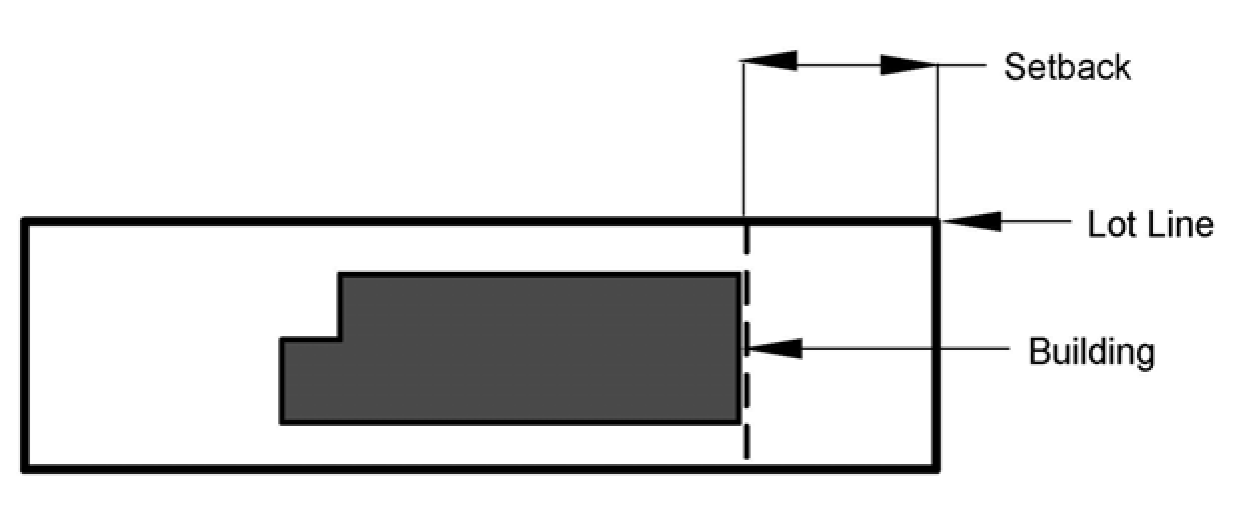
Setback. The minimum distance by which any building or structure must be separated from a property line. (See Figure 16-12: Setback)
FIGURE 16-12: SETBACK
Shade Tree. A deciduous tree planted primarily for its high crown of foliage or overhead canopy. A large shade tree is over forty (40) feet in height. Medium shade trees are between twenty-five (25) and forty (40) feet in height. Small shade trees reach up to twenty-five (25) feet in height.
Shed. A relatively small accessory building often purchased pre-built or as a kit in pre-fabricated sections not designed to be served by heat or plumbing. A "Shed" is typically intended to store lawn, garden or pool care equipment.
Shopping Center. A group of retail and other commercial units that is planned, owned and managed as a single property.
Short Term Rental. A dwelling used as a primary residence that is either wholly or partially rented for a short period of time (less than thirty (30) days at a time) to transients or temporary guests. Short Term Rentals shall not include "Hotels," "Motels," or "Bed and Breakfast Guest Homes."
Sign. A name, identification, description, display, illustration or attention-getting device which is affixed to or painted or represented directly or indirectly upon a building or other outdoor surface or lot, and which directs attention to a person, business, product, service, place, organization, thought, expression or entertainment. "Sign" shall not include the flag of any nation, state or governmental entity. Additional definitions related to "Sign" can be found in Chapter 15.48 of the North Aurora Municipal Code, Signs.
Site Plan Review. The formal review of a site plan to assist in determining the manner in which an applicant intends to make use of property whereby the Plan Commission deliberates each plan and forwards a recommendation to the Village Board for final approval.
Small Wind Energy System. A mechanism or device that converts wind energy into electrical power, including windmills and residential wind turbines, towers and supporting structures and such directly connected facilities as generators, alternators, inverters, batteries and associated control equipment.
Solar Panel. A device that collects and converts sunlight as a source of energy for purposes such as heating or cooling a structure, heating or pumping water, or generating electricity.
Special Use. A use that owing to some special characteristics attendant to its operation or installation is permitted in a zoning district only after review by the Plan Commission, and approval by the Village Board, which may be conditioned. A use is a special use if it is designated as such in this Ordinance.
Stacking Space. A space specifically designated as a waiting area for vehicles patronizing a drive-through facility.
Stoop. An exterior floor typically, but not necessarily, constructed of concrete and/or masonry, with a finished floor elevation higher than the adjacent ground level. A "Stoop" typically has steps leading up to it and is utilized primarily as an access platform to a building.
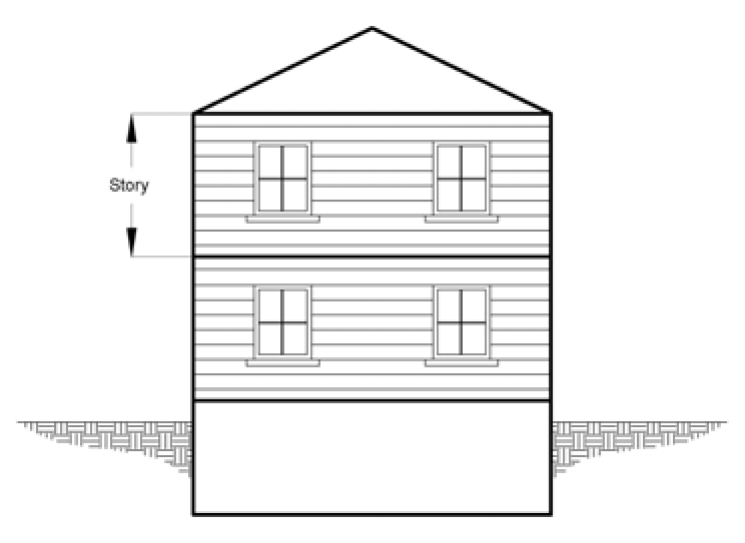
Story. That portion of a building included between the upper surface of any floor and the upper surface of the floor next above it, or if there is no floor above it, then the space between the floor and the ceiling next above it. A basement with less than one-half of its clear floor-to-ceiling height below the average grade of the adjoining ground shall count as a story. The floor of a story may have split levels provided that there is not more than a four-foot difference in elevation between the different levels of the floor. A mezzanine floor shall be counted as a story when it covers over one-third of the area of the floor next below it, or if the vertical distance from the floor next below it to the floor next above it is more than twenty-four (24) feet. (See Figure 16-13: Story)
FIGURE 16-13: STORY
Story, Half. A story located directly under a sloping roof where the area that has a ceiling height of at least seven feet is less than two-thirds of the area of the story below.
Street. A permanent public or private right-of-way or easement which is platted for common use as the primary means of access for motor vehicles to properties adjoining it.
Street, Frontage. All of the property fronting on one side of a street between two intersecting streets, or in the case of a dead-end street, all of the property along the side of the street between an intersecting street and the end of such dead-end street.
Street Level. The story of a building that has its floor at the closest level to the street, with direct pedestrian access to that story from the outside.
Street Line. The street right-of-way line abutting a property line of a lot.
Strip Center Development. A pattern of commercial development comprised of two or more separate businesses, generally one lot in depth with commercial activity arranged in a line, usually along an arterial street.
Structural Alteration. Any change in the exterior supporting members of a structure, such as bearing walls or partitions, columns, beams or girders, or any substantial change in the roof or exterior walls.
Structure. Anything constructed or erected that requires location on the ground or attached to something having location on the ground.
Swimming Pool. A private receptacle for water and/or an artificial pool of water over twenty-four (24) inches in depth designated for recreational or fitness.
Tattoo Parlor. Establishments where services offered are tattooing, body piercing and nonmedical body modification. This definition does not include establishments that offer ear piercing as an accessory use.
Thoroughfare. An arterial or collector street as designated in the Comprehensive Plan.
Temporary Storage Containers. A portable or readily movable and self-contained container or trailer designed or used for the purpose of storage.
Temporary Storage Structure. An accessory structure without foundation or footing designed for the purpose of storage on a nonpermanent basis.
Tent. Any temporary structure or enclosure, the roof of which or one-half or more of the sides are constructed of silk, cotton, canvas, fabric, or similar pliable material.
Three-Component Measuring System. Instrumentation which can measure earth-borne vibrations in three directions, in a horizontal as well as vertical plane.
Tobacco Shop. Retail establishment that sells tobacco related paraphernalia, cigarettes, cigars, or tobacco in any other form, including smokeless tobacco and vaping products.
Trailer. Any non-self-propelled, wheeled vehicle, designed for carrying persons or property when drawn by a motor vehicle.
Transition Yard. Land area with landscape plantings and other components used to visibly separate one use from another, or one zoning district from another, or to shield or block noise, lights, or other nuisances. A designated portion of a transition area in which landscaping, open space or other requirements are imposed for the purpose of minimizing the potential adverse effects of two different zoning uses, classifications, or districts that are contiguous or proximate to each other.
Trellis. A freestanding structure used in the garden to support vines or climbing plants; also called an "Arbor."
Use. The purpose or activity for which land or a structure is designed, arranged or intended, or for which it is occupied or maintained.
Use Not Specifically Identified. A purpose or activity which is not explicitly classified or described by this Ordinance.
Use, Accessory. A use that is customarily incidental and subordinate to the principal building, structure, or use, and located on the same zoning lot.
Use, Principal. The dominant use of land or a structure as distinguished from a "Use, Accessory."
Use, Temporary. Any use designated, operated, built or occupied for short, thirty (30) days or less, and/or intermittent periods of time and may include tents, trailers and other structures on wheels or other supports for business, educational or recreational purposes.
Veterinary Clinic. An organization of one or more veterinarians who have their offices in a common building and who provide in-patient and out-patient care to animals.
Vibration. The periodic displacement of earth as measured by designated frequency-cycles per second.
Village Office or Facility. A building or structure owned, operated and/or occupied by the Village of North Aurora to provide a governmental service to the public. "Village Office or Facility" does not include park district field houses, recreation centers, or school buildings.
Wall. An upright structure of building material, such as masonry or plaster, serving to enclose, divide or protect an area.
Warehousing, Storage, and Distribution Facility. The storage, wholesale and distribution of manufactured products, supplies and equipment including ecommerce fulfillment centers.
Wetlands. Transitional lands between terrestrial and aquatic systems where the water table is usually at or near the surface of the land and is often covered by shallow water. For purposes of this classification wetlands must have one or more of the following three attributes: a) At least periodically, the land supports predominantly hydrophytes; b) The substrate is predominantly undrained hydric soil; c) The substrate is nonsoil and is saturated with water or covered by shallow water at some time during the growing season of each year.
Window Light Well. An enclosure installed below grade that retains the earth around a window that is either entirely or partially below grade and is constructed for the primary purpose of providing light and ventilation to a basement.
Window Well, Escape. An enclosure installed below grade that retains the earth around a window that is either entirely or partially below grade and is constructed for the primary purpose of egress from a below grade space during an emergency.
Wireless Telecommunications Antenna. A specific device, the surface of which is used to transmit and/or receive radio-frequency signals, microwave signals, or other signals transmitted to or from other antennas. "Wireless Telecommunications Antenna" does not include "Satellite Dish Antenna."
Wireless Telecommunications Facility. An unstaffed structure used to house and protect the equipment necessary for processing telecommunications signals, which may include air conditioning equipment and emergency generators.
Wireless Telecommunications Tower. A structure designed and constructed to support one or more "Telecommunications Antennas" and including all appurtenant devices attached to it. A tower can be freestanding (solely self-supported by attachment to the ground) or supported (attached directly to the ground and with guy wires) of either lattice or monopole construction.
Yard. An area on a lot which is unoccupied and unobstructed from its lowest level to the sky, except for obstructions specifically permitted by this Ordinance. A yard extends along a lot line for a depth specified by the zoning district in which such lot is located. (See Figure 16-14: Yards)
Yard, Corner Side. A side yard on a corner lot which abuts a public street. (See Figure 16-14: Yards)
Yard, Front. A yard extending the full width of the lot between side lot lines for the required minimum depth, as specified by the zoning district in which such lot is located, measured perpendicular to the front lot line. (See Figure 16-14: Yards)
Yard, Interior Side. A side yard that does not abut a street right-of-way. (See Figure 16-14: Yards)
FIGURE 16-14: YARDS
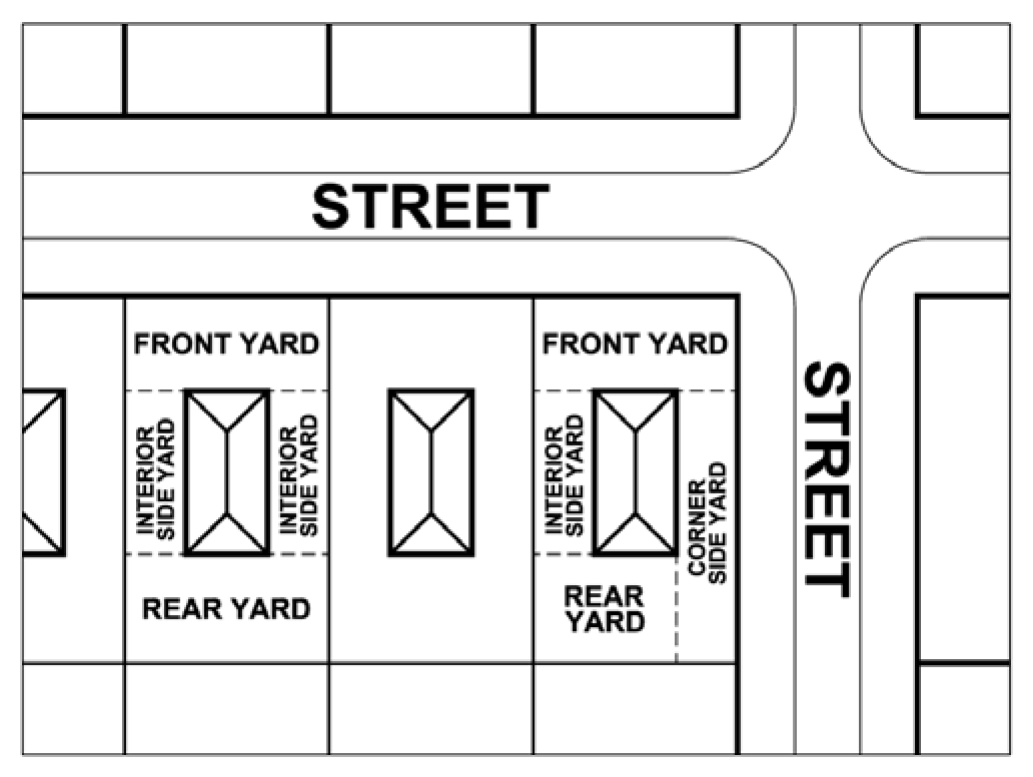
Yard, Rear. A yard extending between the side lot lines for the required minimum depth, as specified by the zoning district in which such lot is located, measured perpendicular to the rear lot line. (See Figure 16-14: Yards) In the case of an irregular or triangular shaped lot, the rear lot line shall be deemed to be a line ten (10) feet in length, within the lot, which is parallel to and at a maximum distance from the front lot line. (See Figure 16-10: Rear Lot Line Chord for Irregular Lots)
Yard, Reverse Corner Side. A side yard of a reverse corner lot which abuts a public street. (See Figure 16-15: Reverse Corner Side Yard)
FIGURE 16-15: REVERSE CORNER SIDE YARD
Yard, Side. A yard extending along a side lot line between the front and rear yard, for the required minimum depth, as specified for the district in which such lot is located, measured perpendicular to the side lot line. (See Figure 16-14: Yards)
Zoning Amendment, Text. A change in the wording, context, or substance of this Zoning Ordinance.
Zoning Amendment, Map. A change in the zone boundaries or area district boundaries upon the Zoning Map.
Zoning Appeal. A request for a review of the Community Development Director's interpretation of any provision of this Ordinance.
Zoning Certificate. A written declaration that verifies that buildings, structures, or uses are consistent with the terms of this Zoning Ordinance for the purpose of carrying out and enforcing its provisions.
Zoning Districts. The districts into which the Village of North Aurora, Illinois, has been divided as set forth on the Official Zoning Map.
Zoning Interpretation. An interpretation of the specific provisions of the zoning code by the Community Development Director or other officer or employee having authority to make or implement zoning interpretations, in light of the general circumstances that the specific provision was intended to address.
Zoning Map. A map entitled the "Official Zoning Map of North Aurora, Illinois," which is incorporated into this Ordinance, as part thereof, for the purpose of designating zoning districts.
Zoning Variance. A decision of the community development director or plan commission that, if approved by the Village Board, permits an applicant to depart from the precise regulations of this ordinance. A variance may be granted only in accordance with the standards of this ordinance.
(Ord. No. 12-08-20-02, § 2, 8-20-2012; Ord. No. 13-07-15-03, § 1, 7-15-2013; Ord. No. 13-10-07-02, § 2, 10-7-2013; Ord. No. 14-04-21-01, § 5, 4-21-2014; Ord. No. 14-08-18-01, § 2, 8-18-2014; Ord. No. 15-04-06-01, § 6, 4-6-2015; Ord. No. 15-09-21-04, § 4, 9-21-2015;Ord. No. 15-12-07-13, § 3, 12-7-2015; Ord. No. 19-10-21-01, § 2, 10-21-2019; Ord. No. 24-02-19-01, § 4, 2-19-2024; Ord. No. 24-10-07-05, § 7(Exh. F), 10-7-2024)

