
North Aurora City Zoning Code
CHAPTER 14
LANDSCAPING AND SCREENING
14.1 - Purpose.
The landscaping and screening requirements established herein are intended to preserve and enhance the appearance, public health, safety, convenience, comfort and general welfare of the Village by fostering aesthetically pleasing development. Proper landscaping contributes to the Village in many ways: enhancing its character and scenic beauty, providing clean air, reducing noise, preventing erosion of topsoil, reducing the rate of stormwater runoff, providing nesting areas for birds and habitat for other wildlife, conserving energy, and providing shade and windbreaks. These regulations are also intended to increase the compatibility of adjacent uses, and minimize the adverse impact of noise, dust, motor vehicle headlight glare or other artificial light intrusions, and other objectionable activities or impacts conducted on, or created by, adjoining or neighboring uses.
(Ord. No. 12-08-20-02, § 2, 8-20-2012)
14.2 - Landscape plan.
A.
Landscape Plan Required. A detailed landscape plan shall be submitted to the Village as part of site plan review and shall be approved prior to the issuance of a building permit. Single-unit and two-unit dwellings are exempt from landscape plan requirements.
B.
Content of Landscape Plan.
1.
The location and dimensions of all existing and proposed structures, property lines, easements, parking lots and drives, roadways and rights-of-way, sidewalks, ground signs, refuse disposal areas, recycling areas, sidewalks, bicycle paths, parking facilities, fences, electrical equipment, recreational facilities, drainage facilities, berms, lighting, paving materials, seed and/or sod, entrance treatments and other freestanding structures, as determined necessary by the Community Development Director.
2.
The location, quantity, size and name, both botanical and common, of all existing plant materials, including trees and other material in the right-of-way, and indicating plant material to be retained and removed.
3.
The location, quantity, size and name, both botanical and common, of all proposed plant material including, but not limited to, shade trees, shrubs, groundcover, annuals/perennials and turf.
4.
The existing and proposed grading of the site indicating contours at two-foot intervals. Proposed berming shall be indicated using one-foot contour intervals.
5.
Elevations of all fences and retaining walls proposed for location on the site.
6.
Elevations, cross sections, and other details as determined necessary by the Community Development Director.
7.
A maintenance plan detailing the method by which the owner of the property, any lessee, property manager, mortgagee in possession, or other person in possession and/or control of property of the premises shall be responsible for the upkeep repair, and replacement of all landscape materials, fences, barriers, and refuse disposal areas.
C.
Minor Changes to Approved Landscape Plans. After a landscape plan is approved, minor changes to the landscape plan, including substitution of species that do not result in a reduction in the net amount of plant material as specified on the approved landscape plan may be approved by the Community Development Director. Reduction in the size or number of plant materials shall not be permitted. Changes to the species of plant materials of an approved landscape plan shall not be permitted, except that similar species, may be substituted if approved by the Village.
(Ord. No. 12-08-20-02, § 2, 8-20-2012)
14.3 - Selection, installation and maintenance of plant materials.
A.
Selection. All planting materials used shall be of good quality and of a species either native to northeastern Illinois or capable of withstanding the climate extremes of northeastern Illinois, as well as the individual site microclimates. Size and density of plant material, both at the time of planting and at maturity, are additional criteria that shall be considered when selecting plant material. Drought and salt tolerant plant material must be used within ten (10) feet of road right-of-ways and off-street parking areas. Any tree selected for a landscape plan must be in accordance with the Section 16.12.190 (Landscaping and Trees) of the Village Subdivision Ordinance unless otherwise approved by the Community Development Director.
B.
Installation. All landscaping materials shall be installed in accordance with the current planting procedures established by the American Nursery and Landscape Association. All plant materials shall be free of disease and shall be installed so that sufficient soil and water are available to sustain healthy growth.
C.
Required Element. Landscape materials depicted on landscape plans approved by the Village shall be considered to be required site plan elements in the same manner as buildings, parking and other improvements. As such, the owner of the property, any lessee, property manager, mortgagee in possession, or other person in possession and/or control of property shall be jointly and severably responsible for the maintenance, repair and replacement of all landscape materials, fences, and barriers over the entire life of the development.
D.
Maintenance. All landscaping materials shall be maintained in good condition, shall present a healthy, neat and orderly appearance, and shall be kept free of refuse and debris. Any dead, unhealthy, or missing plants shall be replaced within six months of notification by the Village. Fences and barriers shall be maintained in good repair. The owner of the property, any lessee, property manager, mortgagee in possession, or other person in possession and/or control of property of the premises shall be responsible for the maintenance, repair, and replacement of all landscape materials, fences, barriers, and refuse disposal areas. Irrigation systems, if provided, shall be maintained in good operating condition to promote the health of the plant material and the conservation of water.
(Ord. No. 12-08-20-02, § 2, 8-20-2012)
14.4 - Design standards.
Landscape plans, as described above, shall be prepared, evaluated, and approved based on the following design criteria.
A.
Scale and Nature of Landscaping Material. The scale and nature of landscaping materials shall be appropriate to the size of the structures.
B.
Selection of Plant Material. Plant material shall be selected for its form, texture, color, pattern of growth and suitability to local conditions.
C.
Shade Trees. All shade trees shall have a minimum trunk size of two and one-half inches in diameter measured at twelve (12) inches above grade.
D.
Evergreen Trees. Evergreen trees shall have a minimum height of six feet at planting and shall be incorporated into the landscape treatment of a site, particularly in those areas where year-round screening and buffering is required.
E.
Ornamental Trees. Single stem ornamental trees shall have a minimum trunk size of two and one-half inches at planting. Multiple stem ornamental trees shall have a minimum height of six feet at planting.
F.
Shrubs. All large deciduous and evergreen shrubs shall have minimum height of three feet at installation, and all small deciduous and evergreen shrubs shall have a minimum height of eighteen (18) inches at installation. Large shrubs shall be considered to be those shrubs that reach five or more feet in height at maturity. Small shrubs shall be considered to be those shrubs that are below five feet in height at maturity.
G.
Softening of Walls and Fences. Plant material shall be placed against long expanses of building walls, fences and other barriers to create a softening effect and to help break up long expanses of blank walls with little architectural detail.
H.
Planting Beds. Planting beds shall be mulched with bark chips, shredded hardwood, feather rocks, or similar materials. Mulch shall not be used as a substitute for plant materials.
I.
Irrigation. Landscape design pursuant to the requirements of this chapter shall recognize the need for irrigation and water conservation in accordance with Chapter 13.28 of the North Aurora Municipal Code. Sprinkler irrigation systems may be required for certain landscaped areas, as determined by a professional landscape architect. The need for sprinkler irrigation systems shall be determined by the type of plant material and whether there is a permanent means available to water plant material. All irrigation systems shall be designed to minimize the use of water.
J.
Energy Conservation. Plant material placement should be designed to reduce the consumption of energy by the development.
1.
Deciduous trees should be placed on the south and west sides of buildings to provide shade from the summer sun.
2.
Evergreens and other plant materials should be concentrated on the north and west sides of buildings to dissipate the effect of winter winds.
K.
Preservation of Existing Trees.
1.
Effort should be made to preserve and protect existing trees with trunk diameters in excess of six inches measured twelve (12) inches above grade. Such trees shall be noted on a landscape plan and the Community Development Director may require changes to the landscape plan if, in his/her opinion, an essentially equivalent scheme employing tree fencing or other such modifications may save existing trees. Trees to be preserved shall be determined by the Community Development Director based upon tree size, tree species, extent of existing tree mass, potential to screen or buffer undesirable views and appearance of existing trees.
2.
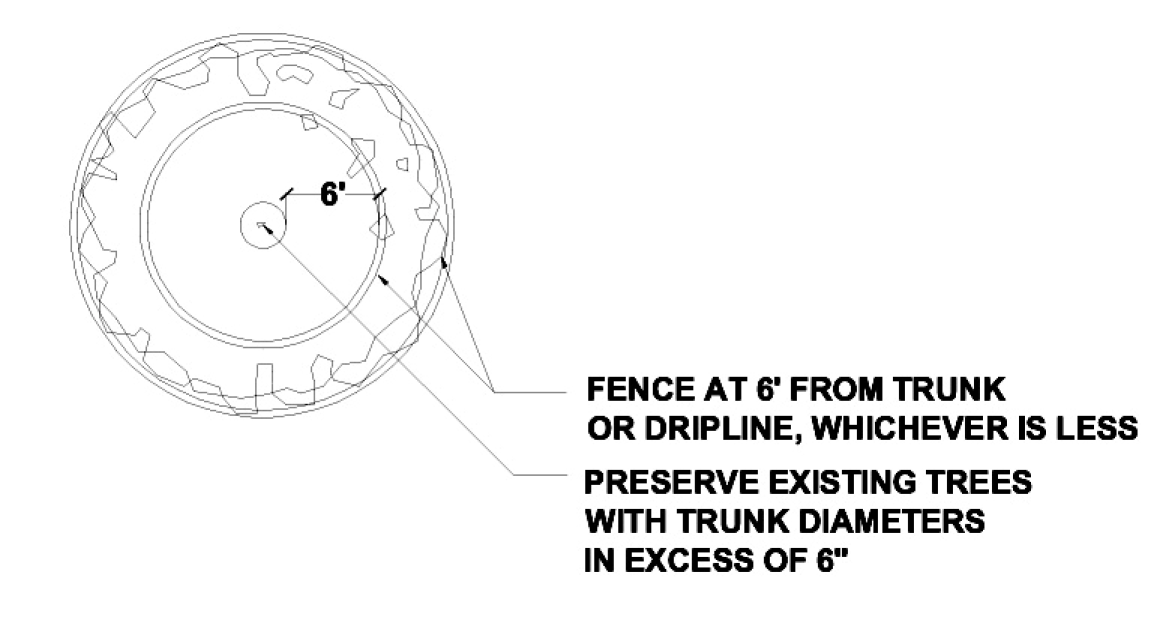
Construction equipment and personnel shall be kept away from such trees and their root systems by the installation and maintenance of fencing at the drip line of trees or a distance of six feet around the trunk, whichever is less. Trees to be saved that are badly damaged or destroyed by construction activities shall be replaced by trees with a minimum diameter of three inches on an inch-for-inch basis upon recommendation of the Community Development Director and approval by the Plan Commission. See Figure 14-1: Tree Fencing.
FIGURE 14-1: TREE FENCING
L.
Berming. Earthen berms and existing topographic features shall be incorporated into the landscape treatment of a site where there is sufficient space and, in particular, when berms and existing topographic features can be combined with plant material to facilitate effective screening.
M.
Vision Triangle. In no district shall any fence, wall, tree, hedge, or shrubbery be erected, constructed, maintained, or grown to height exceeding three feet above the street curb nearest to it, within twenty-five (25) feet of the intersection of any street lines or of street lines projected.
(Ord. No. 12-08-20-02, § 2, 8-20-2012)
14.5 - On-lot landscaping.
A.
Turf Required.
1.
All yards within the Village shall be landscaped primarily with live turf or other plant materials.
2.
All yards shall be prepared with six inches of topsoil on the prepared ground surface and cleared of stumps, badly damaged trees, boulders and other debris.
3.
Yards shall be maintained and repaired as necessary until growth is uniformly well-established.
B.
Required Trees.
1.
Shade trees shall be provided for all multi-unit developments, at a minimum of one tree per five hundred (500) square feet of total lot area minus the area of the building.
2.
Shade trees shall be provided for office and commercial developments at a minimum of one tree per five hundred (500) square feet of total lot area minus the area of the building.
3.
Shade trees shall be provided for manufacturing, warehouse and distribution developments at a minimum of one tree per one thousand (1,000) square feet of total lot area minus the area of the building
(Ord. No. 12-08-20-02, § 2, 8-20-2012)
14.6 - Parkway landscaping.
The following requirements shall apply to parkways (those areas within the public right-of-way located between the curb and the sidewalk). All parkways shall be landscaped in conformance with this Ordinance and other provisions within the Village Code and with the approval of the Community Development Director and Public Works Superintendent. This shall involve improving the ground surface of the parkway with groundcover or turf, and includes parkway trees. In some cases, hard surface treatments may be permitted by the Community Development Director.
A.
Parkway Trees.
1.
Parkway trees shall be planted at the equivalent of one tree at an average interval of every forty (40) linear feet in accordance with Section 16.12.190 of the Municipal Code. All single-family lots that are wider than seventy (70) feet shall be planted with two trees. Where appropriate, parkway trees may be clustered or spaced differently as determined appropriate by the Community Development Director and Public Works Superintendent.
2.
A variety of compatible species should be included in the planting plan for a specific site or development in accordance with Section 16.12.190 of the Municipal Code. The selecting of tree species shall be reviewed and approved by the Community Development Director and Public Works Superintendent with particular regard for site-appropriate species.
3.
Trees shall not be planted within four feet of any sidewalk or other paved area within the parkway. Trees shall not be planted within twenty (20) feet of a proposed or existing street light.
4.
Decorative groupings of trees in commercial or multifamily residential developments may be substituted for interval planting upon review of the Community Development Director and approval of the Plan Commission.
B.
Other Landscape Materials. The remainder of the ground surface area within the parkway shall consist of maintained plantings. Brick pavers, gravel, asphalt, groundcover and shrubs exceeding eighteen (18) inches in height at maturity, and concrete, except in conjunction with driveways and walkways, are only permitted within the parkway with the approval of the Community Development Director and Public Works Superintendent.
(Ord. No. 12-08-20-02, § 2, 8-20-2012)
14.7 - Parking lot landscaping.
A.
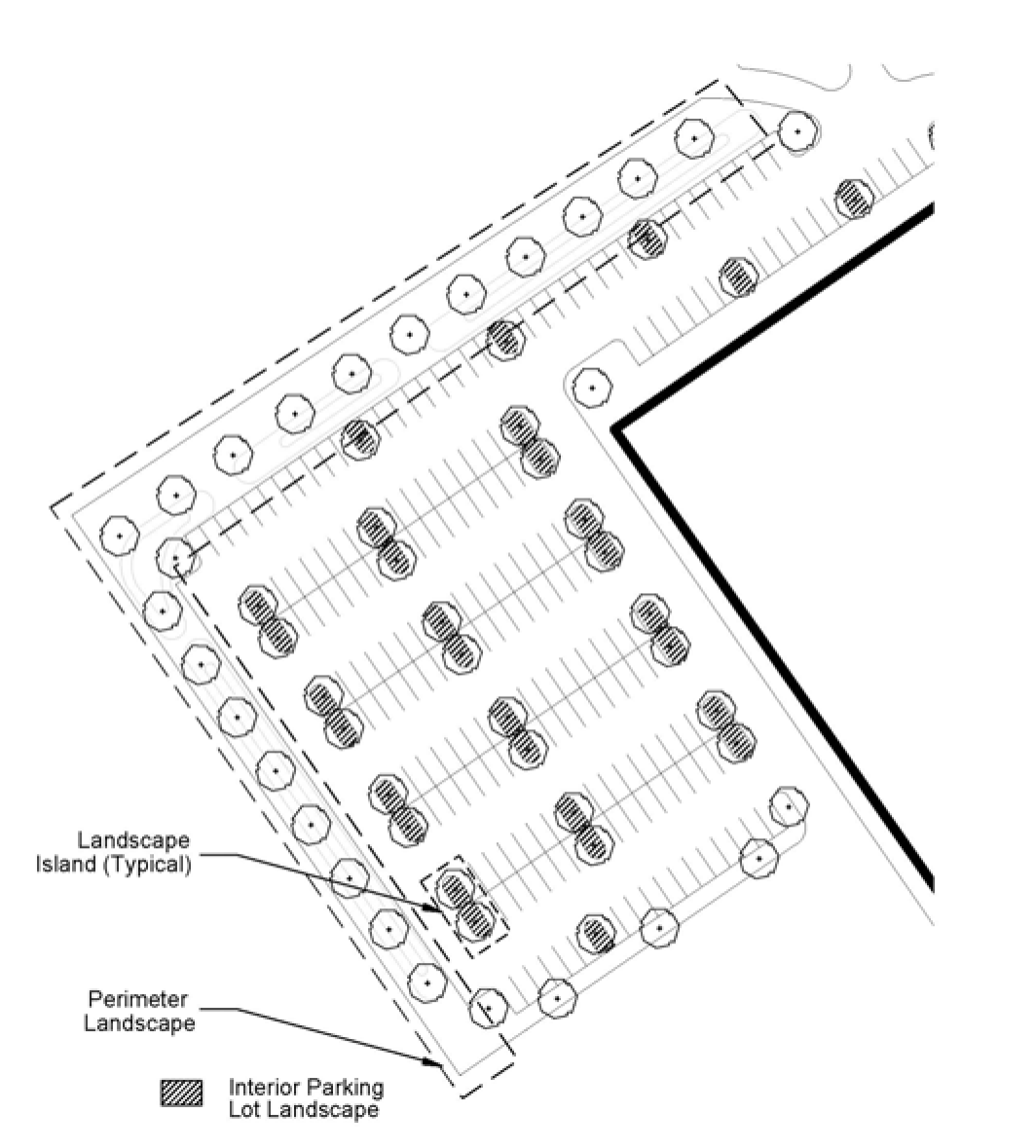
Required Parking Lot Landscaping. All those portions of a parking lot that abut a street shall provide a perimeter landscape yard in accordance with Section 14.8 (Parking Lot Perimeter Landscape Yard). See Figure 14-2: Parking Lot Landscaping.
B.
Parking Lot Landscaping Design Guidelines. For those parking lots of ten (10) or more spaces, the interior parking lot landscaping design guidelines of Section 14.9 (Interior Parking Lot Landscaping Design Guidelines) shall apply. The Community Development Director may require compliance with these design guidelines as part of site plan approval. Nothing in this chapter shall be deemed to prevent the applicant's voluntary installation of additional interior parking lot landscaping, so long as parking space requirements and parking lot design requirements are complied with.
FIGURE 14-2: PARKING LOT LANDSCAPING
C.
Existing Parking Lots. For existing parking lots that currently do not contain the required perimeter parking lot landscaping or if the Community Development Director determines that additional interior landscaping in accordance with Section 14.9 (Interior Parking Lot Landscaping Design Guidelines) is required, such landscaping shall be provided when:
1.
A new principal building or building addition is constructed.
2.
An existing parking lot is expanded by ten (10) or more spaces.
3.
Over twenty (20) percent of the total area of an existing parking lot is reconstructed. However, resealing or re-striping of an existing parking lot, which does not entail paving or resurfacing by replacement of the asphalt or concrete, shall not be subject to this requirement.
4.
When there is an ownership change from a rental apartment building to condominium ownership.
5.
When a special use is sought.
(Ord. No. 12-08-20-02, § 2, 8-20-2012; Ord. No. 13-07-15-03, § 1, 7-15-2013)
14.8 - Parking lot perimeter landscape yard.
A perimeter landscape yard is intended to enhance and screen parking lots from the street, and to provide a uniform scheme of landscaping along the street frontage.
A.
Applicability. Perimeter landscaping is required for all portions of parking lots that abut the street.
1.
Parking Areas Adjacent to Residential Districts. All parking areas containing more than four parking spaces shall be effectively screened on each side adjoining or fronting on any property situated in a residence district by a wall, fence, or densely planted compact hedge not less than five feet in height. All open trailer and truck parking areas shall be effectively screened on each side adjoining or fronting on any property located in or adjacent to a residence district by a wall or fence not to exceed eight feet in height or densely planted compact hedge.
2.
New Parking Areas Adjacent to Nonresidential Districts. One shade tree and five shrubs shall be required per forty (40) feet of perimeter length. Twenty (20) percent of the total length of perimeter plant material shall be evergreen.
B.
Width of Perimeter Landscape Yard. A perimeter landscape yard shall be a minimum of five feet in width and shall require six-inch curbing. This shall exclude any bumper overhang.
C.
Required Landscaping Improvements. The following landscape improvements shall be provided within the perimeter landscape yard.
1.
Amount of Landscaping. A landscape treatment shall run the full length of the perimeter landscape yard.
2.
Trees. One tree shall be planted every forty (40) linear feet of yard length. Trees may be clustered based on specific site requirements, as approved by the Community Development Director.
3.
Shrubs and/or Pedestrian Walls and Berms.
a.
For every three feet of perimeter yard length, one shrub, measuring a minimum of two feet at planting and reaching a minimum of four feet in height at maturity.
b.
The number of shrubs may be reduced or combined with a berm, which is accentuated with landscape plantings and turf, or with a low pedestrian wall, so long as an effective screening is provided to a height of four feet, as approved by the Community Development Director.
c.
Where feasible, plant materials shall be installed between the sidewalk and the pedestrian wall to provide a softening effect on the wall.
4.
Groundcover. Landscaped areas outside of shrub and tree masses shall be planted in turf or other live groundcover.
(Ord. No. 12-08-20-02, § 2, 8-20-2012)
14.9 - Interior parking lot landscaping design guidelines.
The following design guidelines shall be used by the Community Development Director in determining what interior parking lot landscaping shall be required as a condition of site plan approval. Nothing in this chapter shall be deemed to prevent the applicant's voluntary installation of additional interior parking lot landscaping, so long as parking space requirements and parking lot design requirements are complied with.
A.
Location and Amount. One parking lot island should be provided between every ten (10) parking spaces. Rows of parking spaces shall be terminated by a parking lot island.
B.
Size. Where parking lot islands are required, they shall be the same dimension as the parking stall. Double rows of parking shall provide parking lot islands that extend the entire width of the double row. Parking lot islands shall be at least six inches above the surface of the parking lot and protected with concrete curbing, except where an island is designed specifically for the absorption of stormwater.
C.
Type of Landscape Material. Shade trees should be the primary plant materials used in parking lot islands and landscaped areas. Ornamental trees, shrubbery, hedges and other plant materials may be used to supplement the shade tree plantings.
D.
Quantity of Landscape Material. A minimum of one shade tree should be provided for every parking lot island. If the island extends the width of a double row, then two shade trees should be provided. Additional landscaped areas within the parking lot should provide a minimum of one shade tree for every three hundred (300) square feet of landscaped area.
E.
Groundcover. A minimum of seventy-five (75) percent of every parking lot island or landscaped area should be planted with shrubs, turf or other live groundcover.
(Ord. No. 12-08-20-02, § 2, 8-20-2012)
14.10 - Buffer yard guidelines.
A.
This section establishes guidelines for the dimensions and improvement requirements of buffer yards as transitions between uses and/or districts. The following guidelines shall be used by the Community Development Director to determine that buffer yards shall be required as a condition of site plan approval, as well as the design of these yards. Nothing in this chapter shall be deemed to prevent the applicant's voluntary installation of buffer yards to these design specifications.
B.
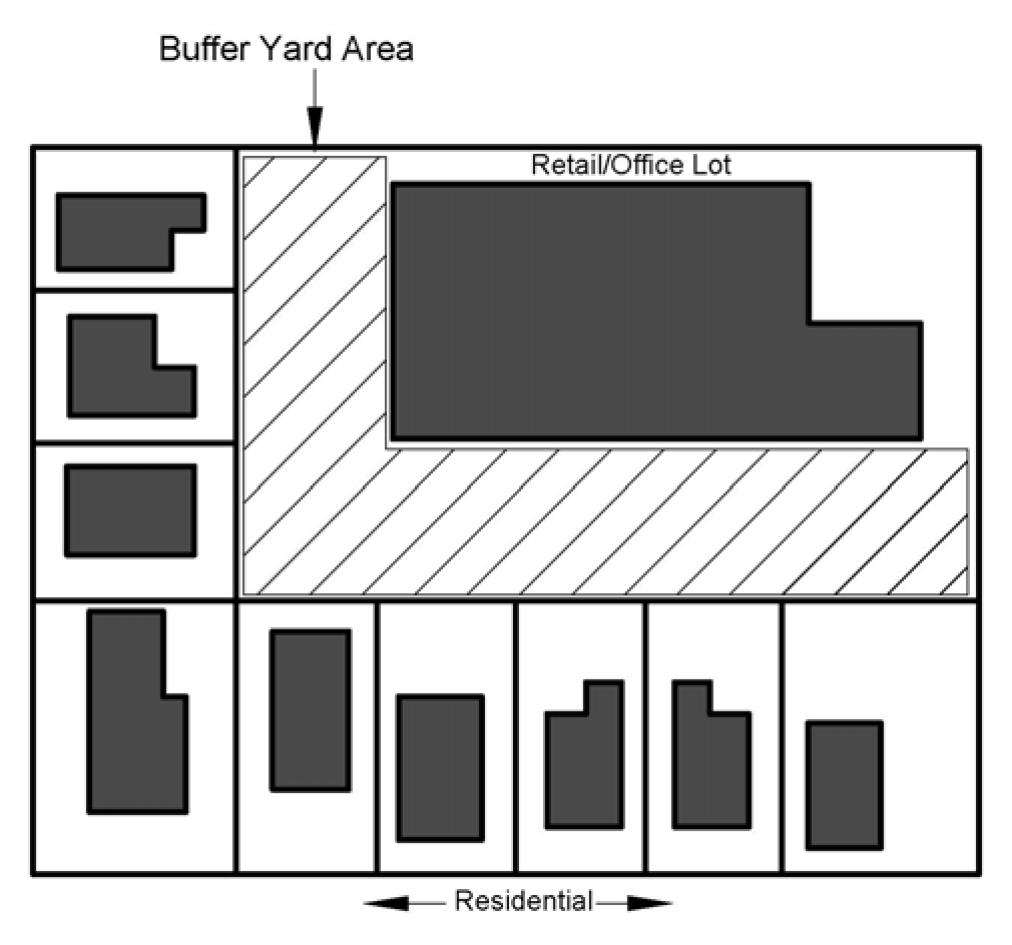
Where buffer yards are required, they shall be provided in interior side yards and rear yards. (See Figure 14-3: Buffer Yard) Buffer yards may be located within required yards, and shall be reserved for the planting of material and installation of screening as required by this section. No parking, driveways, sidewalks, accessory buildings, or other impervious surfaces shall be permitted within the buffer yard area. The Community Development Director shall have the discretion to require additional landscape material than that described in these guidelines, where necessary.
FIGURE 14-3: BUFFER YARD
C.
All plantings in the buffer yard shall be in accordance with the design standards of this Chapter. The minimum size and improvement of buffer yards for various situations shall be as follows:
1.
B-1, B-2 and B-3 Districts, and Nonresidential Uses in Residential Districts. Where a lot in a B-1, B-2 and B-3 District abuts a residential district, or where a nonresidential use is located within any residential district, a buffer yard a minimum of five feet in width, a solid opaque screen fence or wall six feet in height, a berm and/or combination thereof may be required. Within the required landscape buffer, the following improvements shall be provided:
a.
Shade trees planted on an average of one tree for every thirty (30) feet of the yard length.
b.
A solid opaque screen fence or wall six feet in height erected along one hundred (100) percent of the yard length.
c.
Areas not planted with trees shall be maintained as turf or other groundcover. If required by the Village, this buffer shall be supplemented with shrubs.
2.
O-R, O-R-I, I-1, and I-2 Districts Where a lot in an O-R, O-R-I, I-1 and I-2 District directly abuts any residential district, a buffer yard a minimum of ten (10) feet in width shall be required. Within the required buffer yard, the following improvements shall be provided.
a.
A mix of shade trees and evergreen trees planted on an average of one tree for every twenty (20) feet of the yard length.
b.
A solid opaque screen fence or wall six to eight feet in height erected along one hundred (100) percent of the yard length. A berm, planted with the above required plant material may be substituted for the screen fence or wall, where approved by the Community Development Director.
c.
Areas not planted with trees shall be maintained as turf or other groundcover. If required by the Community Development Director, this buffer shall be supplemented with shrubs.
d.
All outdoor storage areas of goods, products, materials, supplies, machinery equipment, or commercial vehicles, shall be enclosed to a height of eight feet above grade and screened to an opacity of not less than seventy-five (75) percent, by means of fencing, berming, landscaping, or a combination thereof.
3.
Landscape Buffers Along Major Arterial and Collector Streets.
a.
For the purpose of improving the safety, appearance and environment of the Village, a fifty-foot landscaped buffer shall be provided and maintained on all properties adjoining the following streets: Airport Road, Deerpath Road, Illinois Route 25, Illinois Route 31, Illinois Route 56, Mooseheart Road, Oak Street, Orchard Road, Randall Road.
b.
Where a greater buffer is required by the zoning district regulations, or for a planned unit development, the greater buffer requirement shall apply. The landscape buffer shall comply with the following:
i.
Except as otherwise provided in this Ordinance, no parking or structures, including all accessory buildings, signs and fences over four feet in height shall be permitted within the landscape buffer area.
ii.
The buffer shall be devoted entirely to landscaped areas except for public sidewalks and necessary paving of driveways to reach the building and parking areas provided such driveways are generally perpendicular to the front lot line.
iii.
The ground cover of the landscaped area shall contain at least seventy-five (75) percent live landscaping of which at least twenty-five (25) percent consists of shrubs, trees, flowering plants, or other plant material over twelve (12) inches in height.
(Ord. No. 12-08-20-02, § 2, 8-20-2012)
14.11 - Screening requirements.
A.
Refuse Disposal Dumpsters. Refuse disposal dumpsters in all zoning districts shall be screened on three sides by a solid wood fence, or masonry screen wall to a height of not less than six feet but no more than eight feet to seventy-five (75) percent opacity. The dumpster enclosure shall be gated on the fourth side, and situated on a concrete apron that extends a minimum of six feet beyond the opening of the enclosure so as to support the weight of the waste disposal vehicle during unloading. Refuse shall not be permitted to accumulate such that it is visible outside or above the height of the enclosure.
B.
Loading Spaces. Loading spaces in all zoning districts shall be located and oriented so as not to be visible from the street and adjacent properties, while still allowing access to the use it is serving. In addition, loading spaces in all zoning districts shall be screened as much as possible, unless such screening is determined unnecessary by the Community Development Director. Such screening shall consist of a solid wood fence, masonry screen wall or slatted chain link fence to a height of not less than six feet or a continuous evergreen or dense deciduous shrub hedge, or a combination.
C.
Outdoor Storage and Outdoor Sales and Display Areas.
1.
Outdoor Storage Areas. All outdoor storage areas shall be screened by a solid wood fence, masonry screen wall or slatted chain link fence at least six feet in height to seventy-five (75) percent opacity. Where feasible, plant materials shall be installed along the fence or wall located along public rights-of-way to provide a softening effect. No materials stored outdoors shall be of a greater height than that of the required fence, wall or hedge.
2.
Outdoor Sales and Display Areas.
a.
When the rear or side yard of an outdoor sales and display area abuts a residential district, or the rear yard is separated from a residential district by an alley, the outdoor sales and display area shall be effectively screened from view by a solid wood fence, masonry screen wall, or dense hedge at least six feet in height to seventy-five (75) percent opacity. Chain-link fencing is prohibited. Materials stored shall not be permitted to be visible outside, or above the height of the enclosure.
b.
All outdoor sales and display areas shall be designed with a landscaped yard along the public right-of-way, excluding alleys, a minimum of five feet in width and planted with shade or evergreen trees at a rate of one tree per twenty-five (25) feet, and supplemented with shrubs and perennials to enhance the view from the public right-of-way. These outdoor sales and display area screening requirements are not intended to prohibit openings reasonably necessary for access drives and walkways.
c.
Motor vehicle dealerships or rental establishments with outdoor sales and display lots shall be designed with a perimeter landscaped yard meeting the landscaping requirements of this section, but such plantings may be clustered. However, the yards of these establishments that abut a street may be planted with small shrubs and/or a low pedestrian wall, rather than shade or evergreen trees, to optimize the view of motor vehicles for sale.
d.
Growing areas for nursery stock for greenhouses/nurseries shall be considered a landscaped yard.
D.
Day Care Centers and Nursery Schools. The outdoor play area of a day care center or nursery school shall be screened from the view of adjacent uses by solid wood fencing to a height of six feet or by landscaping six feet high by three feet deep.
(Ord. No. 12-08-20-02, § 2, 8-20-2012)

